What the Hand Means
Across the iconographic vocabulary of the Western mystery stream the hand is the figure of utterance without speech. It is the part of the body that decides what the body's intention will look like in the world: a fist closes, a palm opens, two fingers rise and two lower, an outstretched left palm receives. Where the face shows what is felt and the foot shows where it goes, the hand shows what is being offered, withheld, blessed, or warded — and almost every culture that has cared about ritual has built a small grammar of hands in answer.
Three streams converge on the hand as Pamela Colman Smith paints it. From Christian liturgy comes the two-and-two benediction of the Hierophant, the Latin and Eastern fingering in which the upper digits name the visible teaching and the lower name the hidden — a single pronouncement with two faces. From the Indian mudrā tradition, far older than the Christian gesture but structurally cousin to it, comes the principle that a hand-position is itself an utterance: abhaya forward for fear-not, varada down for granting, palm-up in the lap for meditation. From the late-antique Mediterranean comes the Hand of Fatima, the Hamsa, the apotropaic palm worn against the evil eye across Jewish, Christian, and Islamic lineages — the hand as a sign that wards as much as it gives. To read the hand in tarot is to admit that the body has been a fluent speaker in every tradition the deck inherits, and the painter has copied a vocabulary, not invented one.
How the Hand Appears in the Deck
The hand appears most strikingly as the four cloud-borne hands of the Aces — Smith's chosen visual rhyme across the suits, where each elemental gift (wand, cup, sword, pentacle) is offered by a single right hand emerging from a cloud. The rhyme is iconographically load-bearing: the hand belongs to no specific person, the cloud obscures the source, and the gift therefore precedes the recipient rather than rewarding her. Will, love, thought, and matter all arrive at one specific hand, but that hand is not the agent of arrival. This is the deck's most consistent statement that elemental beginnings are received before they are owned.
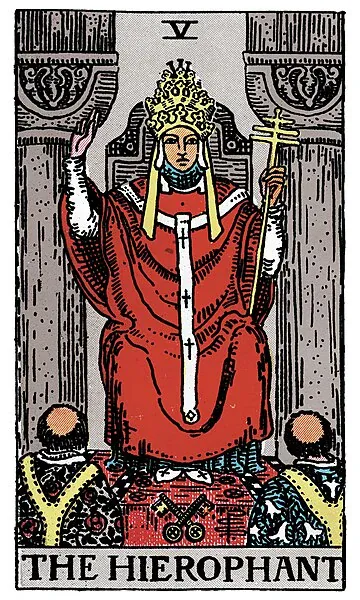
On The Hierophant the hand is in the foreground, raised in the two-and-two benediction — the upper fingers shown, the lower hidden, the doctrine of the seen mediated by the unseen. On the Queen of Swords the right hand grips the upright sword while the left hand opens forward in the gesture of permission: power and manner held in the same posture. On the Nine of Wands the hand grips the ninth stave as a support that has not yet ceased to be ready as a weapon — the wounded keeper has not let go even when leaning. Read across these cards together and the symbol resolves into one statement: in tarot the hand is the part of the figure where the gift becomes a giving, where doctrine becomes a blessing, where power becomes a manner. The cards are full of cups and swords and coins, but it is hands that decide what is being said by holding them.
Cards That Carry the Hand
Five cards in the deck place a defining hand within the painted scene.
Hover a pin to see where the symbol sits on the card.
The Hierophant
On The Hierophant the hand rises in the two-and-two benediction — index and middle straight for the seen, ring and little folded for the hidden — the same teaching shown twice, once openly and once not.
· Read this card →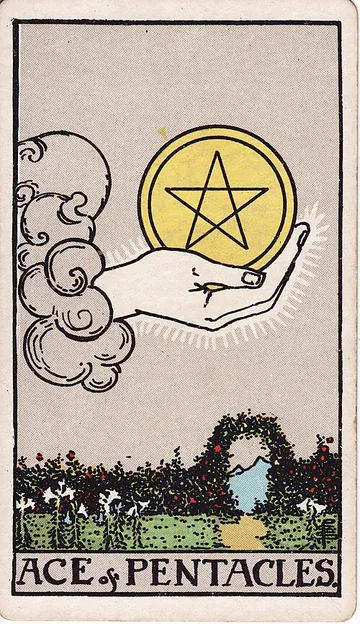
Ace of Pentacles
On the Ace of Pentacles the hand emerges from a cloud and offers a single coin on its palm. The hand belongs to no specific person; the gift therefore precedes the recipient rather than rewarding her.
· Read this card →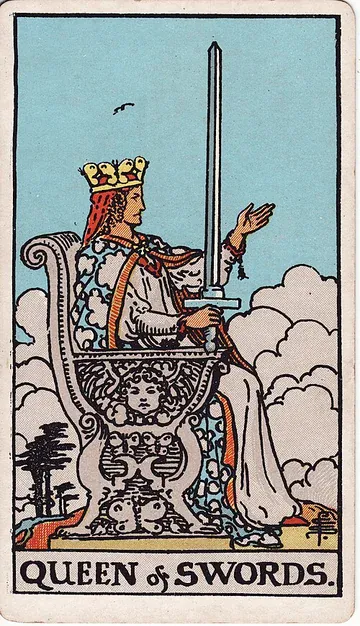
Queen of Swords
On the Queen of Swords the right hand grips the upright sword and the left hand opens forward, palm up — power and permission held in the same posture, the manner of judgement that lets the other speak first.
· Read this card →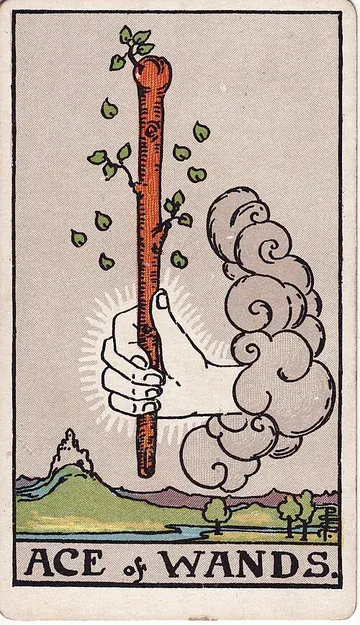
Ace of Wands
On the Ace of Wands the hand grips the freshly leafing staff like one grips a sapling — close to the bark, not the tip. Will arrives at a specific hand, but the hand is not the source of will.
· Read this card →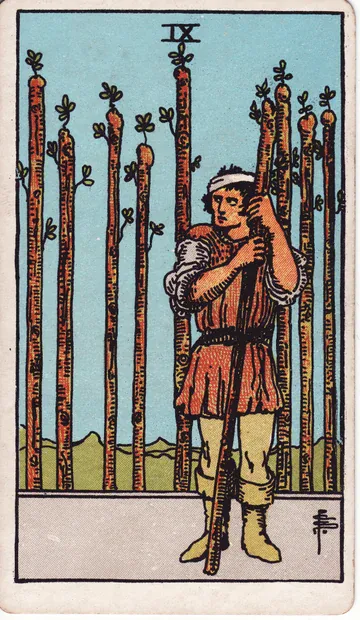
Nine of Wands
On the Nine of Wands the hand grips the ninth stave as a support and not yet a weapon — the wounded keeper leans, but the grip has not relaxed.
· Read this card →Other Symbols Nearby
The Hand belongs to the Posture category — the way figures hold themselves, where their weight rests, what their bodies are saying before their faces are read. It sits next to the eyes that close, the head that bows, the back that turns. Read alongside the broader symbolic atlas of the deck.
More entries in this category are coming soon.
Older Sources
The hand's iconographic depth predates tarot by millennia and is layered from at least three traditions. From the Indian mudrā literature — Buddhist and Hindu, attested in iconographic form by the early centuries CE — comes the principle that a hand-position is itself a doctrinal utterance: abhaya-mudrā for fear-not, varada-mudrā for granting, dhyāna-mudrā for meditation. From Christian liturgical practice, from the late antique East forward, comes the benediction in which the fingers form the abbreviation of Christ (ICXC) and at the same time number the natures and the Trinity — the gesture Pamela Colman Smith painted on the Hierophant. From the late-antique Mediterranean comes the Hand of Fatima, the Hamsa amulet, the open right palm worn against the evil eye across Jewish, Christian, Islamic, and pre-Abrahamic North African material — the hand as a thing that wards as much as it gives.
Smith's most original choice in 1909 was the hand-from-the-cloud of the four Aces. The cloud-borne hand is not a gesture native to the Marseille tarot tradition she was reworking; she chose it, and she chose it four times, so that the four elemental beginnings of the deck would share a single pictorial signature. The Aces are the deck's most quoted images precisely because of that decision — a designer's hand, painted four times into the cards, asking that every elemental gift be read as having arrived from somewhere the receiver cannot quite see.