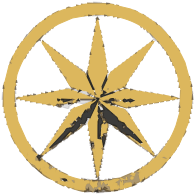
What the Star Means
Within the symbolic vocabulary of the deck, the star is not a luminary but a figure — a geometric body identified by the count of its points. Five rays describe the pentagram, the figure of the human form (head and four limbs) and of the four classical elements gathered under spirit; six rays describe the hexagram, the interlocked upward and downward triangles read by Renaissance Hermetic writers as the meeting of the macrocosm above with the microcosm below. Seven rays mark the septagram of the seven classical planets; eight rays mark the octagram, the figure that closes the round of seven and opens it again — the wheel that has come full and starts another turn.
Across these counts the star carries one steady office: it is the figure of direction. To the ancient navigator the fixed stars were the only reliable landmarks of the open sea — the Egyptians watched for Sirius (Sothis) to rise just before the dawn and so anchored the agricultural year to a single returning point of light; the Magi of Matthew's gospel set out across a desert because a star indicated where to go. Whether five-, six-, seven-, or eight-pointed, the star in the deck is the symbol that says: from here, this way.
How the Star Appears in the Deck
The star enters Pamela Colman Smith's painted deck on three cards, and it does so with a careful arithmetic of points. On XVII The Star — the trump that bears its name — a great eight-pointed golden star hangs at the top center of the sky, surrounded by seven smaller eight-pointed stars in attendance. A.E. Waite's gloss in The Pictorial Key reads the great star as the truth that the soul receives directly; the seven companions are commonly understood by Golden Dawn commentary as the seven classical planets ranked beneath that one source. Read the trump and you are reading a sky that has been deliberately counted.
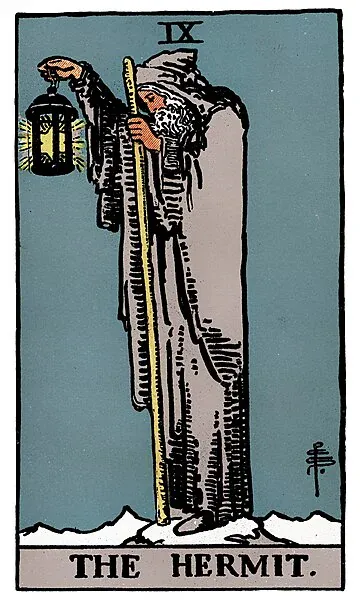
On IX The Hermit, the geometry shifts. Inside the lantern raised against the night, Smith has painted a six-pointed star — Solomon's Seal, two triangles closed upon each other, fire and water made one. What the Hermit carries is therefore not ordinary flame but a joined order, a small portable hexagram of as-above-so-below. The light he uses to find his step is itself a figure of correspondence.
On the Queen of Pentacles (pentacles-13) the star count drops to five: the seated figure holds a pentacle — a five-pointed star inscribed in a disc — in her lap, and looks down at it as a thing already kept rather than reached for. Across the three cards the deck sets out a small geometric ladder: 5 (the body), 6 (the marriage of opposites), 8 (the completed and reopening wheel), each a different way the same heavenly figure orients a different stage of the road.
Cards That Carry the Star
Three cards in the deck place a star within the painted scene — at three different point-counts.
Hover a pin to see where the symbol sits on the card.
The Hermit
On The Hermit the star is a six-pointed Solomon's Seal inside the lantern — not common firelight but two triangles closed upon each other, the small portable hexagram by which the upper order lights the lower step.
· Read this card →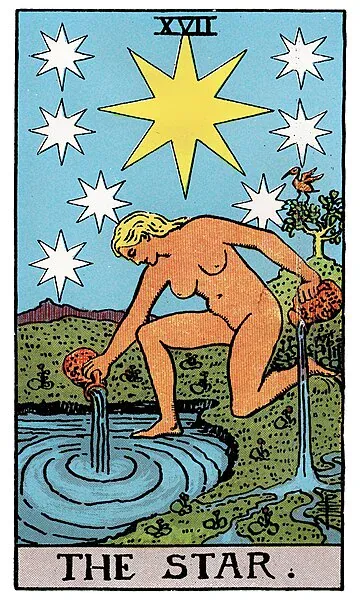
The Star
On The Star the great central figure is eight-pointed — the medieval alchemists' Stella Sapientiae, the first geometry to surface out of chaos. Around it the seven smaller eight-pointed stars rank as the seven classical planets, the whole heaven counted and held still.
· Read this card →The Star
On The Star the great central figure is eight-pointed — the medieval alchemists' Stella Sapientiae, the first geometry to surface out of chaos. Around it the seven smaller eight-pointed stars rank as the seven classical planets, the whole heaven counted and held still.
· Read this card →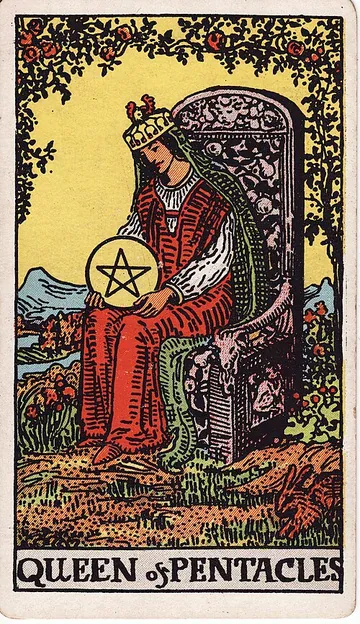
Queen of Pentacles
On the Queen of Pentacles the star is reduced to five points and inscribed within a disc — the pentagram of the elements and of the human form, held in her lap rather than at arm's length: mastery that has settled into keeping.
· Read this card →Other Symbols Nearby
The Star belongs to the Geometry category — figures defined by number of points, of sides, of intersections. The other symbols in this category are listed below; read them alongside the star to see how the deck thinks in counted shapes.
More entries in this category are coming soon.
Older Sources
The painted stars on Smith's three cards inherit a count-by-count tradition far older than the Rider-Waite-Smith deck. The pentagram, the figure of five points, was already a Pythagorean signature in the sixth century BCE — the points of the body, the four elements held under spirit — and was canonized as a magical figure by Eliphas Lévi in the mid-nineteenth century, who paired it with the hexagram (six points) as the two governing figures of the microcosm and the macrocosm respectively. The hexagram's older lineage runs through the Hebrew Magen David and the Renaissance Hermetic image of Solomon's Seal: two triangles, one ascending, one descending, the visible diagram of the maxim "as above, so below." The seven-pointed septagram remained the figure of the seven classical planets — a shape carried into the Golden Dawn's tabular correspondences. The eight-pointed octagram, the figure on the Star trump itself, is the oldest of all in some readings: it appears on Mesopotamian seals as the symbol of Inanna / Ishtar, the morning star, and re-emerges in medieval alchemy as the Stella Sapientiae, the star of wisdom.
The star as a sign of direction has an equally long line. The Egyptians waited for Sirius (the star they called Sothis, "the soul of Isis") to rise just before the sun on the morning that began the inundation of the Nile, and so set the agricultural year to a single returning star. The Magi in Matthew 2:2 set out from the East because, as the gospel records, they had "seen his star" and followed it. The Hermetic dictum picked up by the Renaissance — "that which is above is like that which is below" — kept the heavens as readable, by figure and by count, as a manuscript. When Smith painted three different star counts onto three different cards in 1909, she was not improvising: she was placing each card on a particular rung of an old, deliberate ladder of points.