
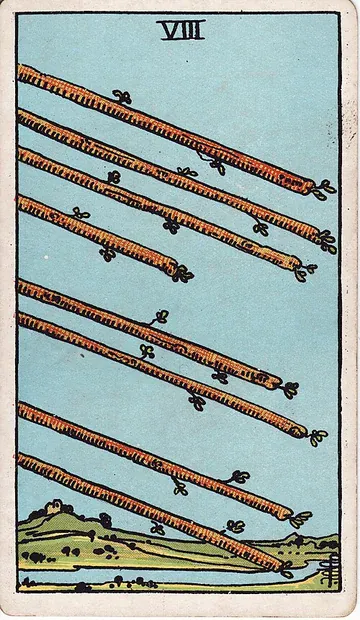
Eight of Wands Reversed · Core Meaning
Something stopped the volley of the Eight of Wands halfway across the sky. The eight staves are still there, still clean, still leafy — but they hang oddly, suspended at strange angles, neither landing nor returning. The trajectory has met an obstruction the throw did not predict. The message dropped into the spam folder. The application went into the wrong inbox. The conversation that should have moved by Tuesday is sitting on Thursday. The card describes the unsettling quality of momentum that was real and is now stuck.
This is the reversed card's central knot: motion has been initiated, but the receiving end is not receiving. Fire under Mercury in Sagittarius wants to fly direct; reverse it, and you get language that misses its target — the perfectly worded text read by the wrong eyes, the carefully chosen subject line that triggered the spam filter, the precise question asked of a person who had no authority to answer. The energy of the throw has not gone bad. The route has gone bad.
There is a second flavor of the Eight of Wands reversed: the volley fired in panic. Not the considered throw, but the eight messages sent in eight minutes after a sudden trigger — five follow-ups to the same person, three over-explanations of the same point, the apology that immediately undoes itself, the impulse-text whose regret arrives before the read receipt does. The reversed card describes the seeker whose pace has tipped from agile into reactive, whose volleys have started colliding with each other in the air.
A third flavor, subtler: the volley that has been postponed past the point of its own meaning. The plan you and a friend made for spring keeps moving — first to summer, then to autumn, then to "let's pick a date soon." The reversed Eight of Wands describes the arrow that is, technically, still in flight, but is taking so long to land that no one quite remembers what it was carrying. The structure is intact; the meaning is leaking out.
The astrological signature reverses too. Mercury in Sagittarius upright is the courier on the arrow — fast, oriented, already directed. Reversed, the messenger is mid-stride and disoriented, the trajectory bent at the wrong angle, the language going faster than the thinking. Sagittarius's wide-aim quality, ungrounded, becomes scatter. Mercury's quickness, ungrounded, becomes garble. The seeker is asked to slow down enough to hear what the obstruction is actually telling them.
Within Hod reversed, the structure of the volley has come apart. Eight things flying in parallel without colliding becomes eight things flying in chaotic crosshatch — clipping each other, redirecting each other, none of them landing where the original throw intended. The card asks for a small, specific repair: not a new throw, not abandonment of the project, but a re-routing. Different channel. Different recipient. Different verb tense.
Read the Eight of Wands reversed the way you would read a sky right after a flock of birds has scattered. The information is still there, but distributed differently than the seeker planned. The work is patience without passivity — to stop forcing the stalled channel and listen for the channel that will actually carry the message.
Eight of Wands Reversed · Love
Nothing is landing between the two of you, and the reversed Eight of Wands is the card of that non-arrival. The text was sent two days ago, and the read receipt has been on for thirty hours. The voice memo was answered with an emoji. The plan to meet has been rescheduled twice and is now floating somewhere in next month. The card is the precise card for the love that has not gone bad but has lost its rhythm — and the loss of rhythm, with this card, is the warning.
For an existing partnership, the reversed Eight of Wands often indicates the season of crossed wires. You are not fighting; you are missing each other. They wanted to talk last Tuesday, but you were absorbed; you wanted to talk Thursday, but they had already gone quiet. The patterns of timing that used to work — the morning text, the evening call, the Saturday breakfast — have drifted out of phase. Both partners are still here, still committed, still in love. Neither is reaching the other. The card asks for an explicit reset of the channel: not new feelings, but a new rhythm. Pick a time. Pick a medium. Show up.
For someone in a new connection, the reversed Eight of Wands is the card of the fast start that has hit its first wall. The first two weeks were every-hour communication; the third week has gone strangely still. They have not blocked you. They have not gone cold. They have simply stopped responding within the same window, and their replies have shortened. Read this carefully: the reversal does not predict the end. It names a slowing whose meaning is not yet clear. Pull back without panic. The card responds to the partner who waits one beat rather than the partner who fires the sixth message into the silence.
For the question of whether someone is in love with you and the card arrives reversed, read it as a yes whose voice has been muted by something specific. They feel something. The feeling is not the issue. The channel between feeling and expression has clogged — possibly through their own conflict, possibly through external pressure, possibly through a misread of an earlier signal of yours that they have not yet found language to ask about. The work is theirs, not yours. The card discourages chasing.
For the question of reconciliation after a break, the reversed Eight of Wands offers a complicated answer. Yes, in the literal sense — the conversation can be reopened, the messages can resume, the warmth can be re-instated. But the reversal suggests the resumed channel will keep stalling at the same point that broke it the first time. Returning to the relationship without changing the route is returning to the place where the volley got stuck. If reconciliation is genuinely the goal, find a different medium for the conversation that broke things — a long letter instead of texts, a single in-person evening instead of a back-and-forth, a counselor instead of late-night phone calls. The card asks for new channels, not new feelings.
For someone in a long-distance relationship, the reversed card is the card of the visit that keeps not happening. The flight that gets canceled. The work commitment that comes up. The family obligation that surfaces. Read the pattern as the field's commentary: the structure of the long-distance setup has begun to refuse to support the next move. The reversal does not declare the relationship doomed; it names the specific problem of channel. Either the channel changes — one of you moves, the visits become more frequent, the timeline becomes concrete — or the relationship slowly thins into a pen-pal correspondence that neither of you ever quite ends.
For the single seeker, the reversed Eight of Wands describes the connections that almost happened. The match that messaged twice and disappeared. The setup that fell through. The promising conversation that did not move past the second date. The card is gentle but clear: the field is producing many half-arrows in your direction, and none of them are completing the trajectory. The work is not to send more arrows from your end. The work is to ask why the channels are jamming. Sometimes the answer is structural — the apps, the venues, the social shape of your weeks. Sometimes the answer is internal — the speed at which you escalate, the pace at which you ask for the next step. Pick one channel and reshape it. The volley returns when the channel clears.
For someone whose partner is reserved by nature and has gone quieter than usual, the reversed Eight of Wands warns against reading the silence as a verdict. Reserved partners under this card are often experiencing their own clog — work pressure, family stress, a private worry they have not yet found the door to share. The card asks the seeker to make the smallest, lowest-pressure invitation: a question that requires only a yes or no, a plan that does not depend on enthusiasm, a touch that does not require reciprocation. Open the door. Do not push them through it.
For a seeker considering whether to send the difficult message — the truth they have been holding, the question they have been afraid to ask, the boundary that needs to be set — the reversed Eight of Wands counsels patience for the right channel, not silence. The message still wants to be sent. The sending wants to be deliberate, in person where possible, with time set aside for the response. Do not send the difficult thing in the middle of a stalled text thread; the channel is too narrow. Find the wider channel.
Eight of Wands Reversed · As Feelings
Real feelings, stuck in transit — that is the reversed Eight of Wands on the question of what someone feels. They are not cold. They are not dishonest. They are caught somewhere between feeling and saying, and the gap between the two is widening rather than narrowing. The card describes the partner whose interior knows but whose voice has not arrived.
This is the card of the partner who is composing the long honest message in their head and has not yet written it down. Or worse, has written it down and not pressed send. They are aware of the silence. They feel the silence as guilt. The guilt becomes its own obstacle to breaking the silence. The reversed card is the precise card for that loop.
If they are reserved by nature, the reversed Eight of Wands warns of the shutdown that looks like calm. They feel something, possibly something significant. The expression of the something has run into their own private fear — of getting it wrong, of being too much, of being too late to say what they should have said three weeks ago. The reversal does not mean they are gone. It means they have run out of language for what is happening inside them, and the running out is the symptom you are reading.
If they are demonstrative, the reversed card warns of escalating noise without escalating substance. They will text you eight times in a morning and then go silent for three days. They will declare big things on a Friday and not call until the following Wednesday. The volume of their volley has not decreased — it has lost its rhythm. The pattern is the warning. Read the rhythm, not just the count.
For a partner you have been with a long time, the reversed Eight of Wands in feelings can mean the steady stream of small contact has thinned, but the underlying feeling has not. They love you, and they have stopped showing it in the daily way they used to. This is sometimes about life — work, kids, parents, illness — eating their attention reserves. Sometimes it is about a private resentment that has not yet become a sentence. The card asks for the direct ask: not "is everything okay" — that question, too vague, the volley jams on it — but a specific question about a specific instance of the silence. "I noticed you didn't text yesterday morning the way you usually do — what was happening?" The card responds to specificity.
For a new connection, the reversed Eight of Wands as feelings often describes ambivalence with a tilt. They like you. They are not sure they want what liking you would mean for the rest of their life. They are pulling toward and pulling away on alternating days. The card is honest about the texture: this is real ambivalence, not strategy. The work, if there is work, is not to convince them. It is to give them enough quiet to resolve their own internal volley before they have to perform any answers to you.
For a flirtation that has been ambiguous for a long time and the reversed card arrives, the warning is particular: the ambiguity is no longer functional. It served its purpose once — protected both of you while you figured each other out — and is now blocking the exchange. Either someone says it, or both of you watch the warmth slowly transmute into a more distant friendliness. The reversed Eight of Wands describes the moment language is being asked for and is not arriving. If you can be the one who says it, say it. If you cannot, accept that the field may close.
For Japanese-style readings about the partner's private feelings — the inside of their head when you are not in the room — the reversed Eight of Wands describes a head full of half-thoughts about you. They are not deciding. They are not concluding. They are circling. The reversal asks the seeker to stop trying to decode the partial signals as if they were complete; the signals are partial because the interior is partial. Wait without ceasing to live your life. The card warms back into upright when the interior resolves and the language arrives — not before.
For someone whose partner sent a sudden burst of attention and then went quiet, the reversed Eight of Wands names the pattern as classic for this orientation. The burst was real. The silence is also real. Both came from the same person, and the seeker is being asked not to interpret one as authentic and the other as withdrawal. They were both authentic. The fluctuation itself is the information: this is a person whose channel between feeling and action is currently unreliable, regardless of what they feel. Calibrate accordingly.
Take the Eight of Wands reversed in feelings as a card of held warmth — warmth that exists, warmth that has not yet found its way through the obstruction. The work is theirs. The card discourages the seeker from picking up the labor of getting their feelings unstuck for them. That is not love; that is project management. Step back. Let the channel clear or not.
Eight of Wands Reversed · Career
Everything at work is technically in motion and nothing is actually moving; the reversed Eight of Wands is that week. The email was sent, but the recipient has been out of office. The deck was delivered, but the decision-maker has not opened it. The contract is in a third party's queue. The launch went out and disappeared into the algorithm. The card is the precise card for the era of administrative friction that keeps real work from completing.
For someone considering whether to stay in a current role, the reversed card warns of the role whose forward motion has stalled. The promotion process has not been canceled, but it has not progressed in two quarters. The promised project has not been killed, but it has been delayed three times. The growth path remains theoretically intact and practically static. The card asks: at what point does the theoretical path become a stalling tactic? Set yourself a deadline. If the move you are waiting for has not happened by the deadline, the answer the company is giving you is no, even if the words say maybe.
For someone considering a new role, the reversed Eight of Wands warns of the offer that is real but slow. The interview process is dragging across weeks. The follow-up emails are kind but indefinite. The start date has been postponed once already. The role itself may be worth waiting for; the company's pace may simply be the company's pace. But the reversal asks: is the slowness a temporary administrative issue, or a window into how this team operates? If the latter, the workplace on offer is one whose volleys all jam. Read the data.
For someone job-searching with no traction, the reversed Eight of Wands describes the precise frustration of the silent inbox after good interviews. You did the work. You sent the materials. The conversations went well. Then nothing. Three weeks of nothing. Five weeks of nothing. The card is honest: the silence is not personal, and it is also not random. The market is jammed at a structural level — too many qualified candidates, too few openings, too many hiring freezes that are not announced as freezes. Do not interpret the silence as your failure. Adjust the channel. Apply to companies you have been considering too small or too unconventional. Reach out warmly to people who can introduce you. The card responds to the seeker who changes the route, not the seeker who keeps refining the same cover letter.
Entrepreneurs and freelancers should read the reversed Eight of Wands as a check-in question about the channels through which work is supposed to find them. Has the funnel quietly broken? Is the mailing list still growing? Are the referrals from previous clients still arriving? The reversal is honest about the boring possibility: a system that worked last year may have stopped working this year, and the silence in the prospect list is the data. Do not attribute the slowness to luck or season. Audit the channel. Often, one specific link in the chain has broken — the SEO post that used to bring in leads is no longer ranking, the platform has changed its algorithm, the previous referrer has moved jobs. Find the specific break. Repair it. Then watch the volley resume.
For a creative practice, the reversed Eight of Wands describes the season after a launch when the response is smaller than expected. The book is out. The piece has been published. The album has been released. The reception is not negative; it is silent. The card warns the seeker against the most common error here: working harder on the same channel. Posting more. Promoting harder. Begging your network. The card describes a launch that has met a saturated channel and asks the seeker to redirect — into a different community, a different format, a different conversation. The work itself is not the problem. The route is the problem.
For someone in a stalled negotiation — salary, contract, partnership, equity — the reversed Eight of Wands is the card of the conversation that has stopped advancing because the parties are talking past each other. The original frame is no longer producing movement. The reversal asks for a structural reset: a new meeting, a new mediator, a written summary that makes both parties' positions explicit. Without the reset, the negotiation will simply end through entropy, with neither party formally walking away.
For a public-facing role — sales, business development, communications, partnerships — the reversed Eight of Wands names the cold prospect list that should not be cold. The five deals that should have closed by now and have not. The two prospects who have stopped replying after warm initial conversations. The card asks for a specific intervention: pick three stalled deals and resurrect each through a different channel than the one that stalled. A phone call instead of email. An in-person coffee instead of a video meeting. A direct ask instead of a soft check-in. The card responds to the channel switch. It does not respond to the same email retemplated and resent.
For the seeker whose mid-flight project has been disrupted by something outside their control — a client emergency, a regulatory change, a key team member leaving — the reversed Eight of Wands offers a small mercy. The disruption is real. The disruption is not your failure. The work that has been thrown off course will, with patience, find a new trajectory; what is required is honesty about the current state, not heroic effort to pretend the original trajectory is still intact. Update the project plan. Adjust the timeline. Communicate the slip. The card respects the professional who admits the slip cleanly more than the professional who hides it past the point of recovery.
For someone who has been firing too many follow-up emails to the same stalled thread, the reversed card has a single specific instruction: stop. The sixth follow-up is not received better than the fifth. The seventh is received worse. The card describes the volley that has lost its grace through repetition, and the only repair is to remove yourself from the channel for two weeks. The silence will either produce a response or confirm what the silence has already been telling you.
Eight of Wands Reversed · Money
Somewhere between an approved payment and a settled balance, the reversed Eight of Wands is holding the money still. The invoice was sent. The payment was approved. The processing time is past its stated maximum. The card is the precise card for the era of transactional friction — wires that take longer than wires should, refunds that disappear into bureaucratic limbo, paychecks that arrive on the wrong day for reasons no one can explain.
For someone managing cash flow on the edge, the reversed Eight of Wands is a card of small frustrations that compound. Not the dramatic financial crisis — that lives in other cards. The slow drain of the late payment that produces the overdraft fee that produces the credit card interest that produces the slow erosion of the buffer. The card asks for tactical attention to the friction points: which payments routinely arrive late, which channels routinely produce delays, which clients have a quiet pattern of slow-paying. Restructure around the data. The reversed card describes a system whose specific gears are sticking; the repair is at the level of the gears, not the system.
For the seeker waiting on a delayed payment, the reversed Eight of Wands counsels active follow-up through a different channel than the one that produced the delay. If the email has been silent, send a polite voicemail. If the voicemail has been silent, ask for a meeting. If the meeting cannot be scheduled, escalate to a different contact at the same company. The card warns against passive waiting — the silence will not break itself — and against angry escalation. The card responds to the channel switch executed with warmth.
For a question about whether a financial gamble will pay off, the reversed Eight of Wands warns against speed. The instinct under this card is to act before the opportunity disappears. The instinct is wrong. The opportunity that disappears in 24 hours is rarely the opportunity that pays off; it is more often the opportunity engineered to feel that way. The card asks for one extra night of consideration. If the deal cannot survive 24 hours of patience, the deal is not the deal you wanted.
For someone in financial recovery from a previous mistake, the reversed Eight of Wands describes the specific irritation of progress that is real but slow. The debt is shrinking. The savings are growing. The pace is half what you hoped for. The card asks for a different relationship to time: not faster work, but more patient compounding. Read your statements quarterly, not weekly. The day-to-day movement under this card is invisible by design; the quarterly view shows the actual trajectory.
For investments, the reversed card warns of the position that has stopped doing what it was supposed to do. The thesis was clear. The numbers haven't moved. The market hasn't moved against you, but it hasn't moved with you either. The reversed Eight of Wands asks: is this thesis still valid, or are you holding by inertia? Set a specific check-in date. If the thesis still holds, hold. If you cannot articulate why the thesis still holds, the position has become wallpaper. Sell the wallpaper.
For a question about a major purchase that has been on the consideration list, the reversed Eight of Wands counsels the patience of one more season. The desire is real. The desire is not yet integrated. Wait until the desire either intensifies into a clear yes or dissolves into a clear no. The reversal warns against the purchase made because you are tired of considering, not because you are ready.
For windfall — a payment, a gift, a refund that arrived faster than expected — the reversed Eight of Wands offers a small specific warning. Money that arrives in the reversed orientation tends to leave the same way: through unconsidered fast spending. Park the windfall for one full week before you decide what to do with it. The card respects the seeker who lets the gift settle before asking it to do work.
A practical move when the reversed card appears in a money question: pick the one stalled financial item that has been gnawing at you and resolve it by changing the channel. The voicemail you have been meaning to leave. The conversation with the accountant you have been postponing. The small claim that needs a different department's attention. The card responds to the channel switch.
Eight of Wands Reversed · Health
Out of phase is the exact phrase for the body in a reversed Eight of Wands — not collapsed, not in crisis, simply running on a clock that no longer matches the day. The sleep is enough hours but unrefreshing. The energy peaks at 11pm and crashes at 3pm. The morning is a fog and the afternoon is a jangle. The card is the precise card for the era when the body is technically functioning and is not actually well.
For someone managing a chronic condition, the reversed Eight of Wands often describes the season when the established management plan has stopped producing the same results. The medication that worked is producing diminishing benefit. The exercise routine is no longer translating into the energy it used to provide. The dietary protocol is feeling less responsive. The card asks for a check-in with the practitioner — not because something is dramatically wrong, but because the protocol that fit last year may not fit this year. Bodies recalibrate. Treatment plans need to recalibrate with them.
For someone in recovery from a recent illness or procedure, the reversed Eight of Wands describes the recovery curve that has flattened. The early gains came fast. The middle stretch is slower. The fatigue hangs longer than expected. The card is gentle but specific: the body's repair systems are working — they are just working at a pace that does not match the seeker's expectations. Accept the slower middle. Do not push. Pushing under this card produces setbacks; patience produces eventual return.
The card's particular health signature in reversed remains the hips and thighs — the long muscles that were meant to carry the body forward. In the reversed orientation, these are the muscles that have started to seize. The hip flexor that has tightened from too much sitting. The IT band that has shortened from too much screen time. The lower-back hinge that has lost its mobility. The card invites a small specific medicine: hip openers in the morning, walks long enough to feel the adductors release, an honest stretch session twice a week. The body asks for the unjamming of its own channels.
For mental health, the reversed Eight of Wands is the card of the loop. The thought that returns at 4am. The worry that shows up at the same point in every shower. The argument with a person who is not in the room and never will be. The card describes the mind whose attention is in motion but circular — running the same trajectory over and over without landing. The medicine is not more thinking. It is structured interruption: a walk that breaks the spiral, a conversation with a real other person that pulls the loop into the world, a journaling session that names the loop and asks it what it actually wants. The card responds to the loop being witnessed; it does not respond to the loop being argued with.
For someone managing anxiety, the reversed Eight of Wands describes the day when the nervous system has tipped from agile into reactive. Small triggers are producing disproportionate responses. The body is firing alarms that the situation does not warrant. The card asks for the long exhale — not the breath exercise practiced for two minutes when convenient, but the breath practiced for ten minutes when the alarm is loudest. Breath is the channel that the reversed card most reliably re-clears.
For someone managing depression, the reversed Eight of Wands describes the morning when the practices that used to lift the fog have stopped lifting it. The walks are happening. The meals are happening. The medication is being taken. And the fog has thickened despite the protocol. The card warns against the conclusion that the seeker is failing the protocol; the more likely truth is that the protocol needs adjustment. Talk to the practitioner. The adjustment is rarely dramatic — a dose change, an added support, a different practice slotted into the morning. The card responds to the small recalibration.
For someone whose sleep has gone strange — falling asleep fine, waking at 3am, unable to return — the reversed Eight of Wands names the specific signature. The mind has been over-fired during the day. The volleys of the day have not landed; they are still circulating in the body when night falls. The medicine is structural: a wind-down that is real, a phone-curfew that is honest, a journaling practice that names what is unfinished and gives it permission to wait until morning.
A phone-curfew is a structural habit and not medical advice. The card describes a felt season — energy out of phase, channels jammed, recovery slowed — and the kind of attention the body asks for in that season: smaller adjustments, longer exhales, the long muscles, the honest exhale into the long night. Keep your practitioners. Take your medicine. The reversal is information, not diagnosis.
Eight of Wands Reversed · Spirituality
A practice can be kept perfectly and still stop reaching the rest of the day; reversed, the Eight of Wands is where that gap sits. The morning meditation is happening. The journal is being kept. The ritual is being observed. And the day still tightens by 11am, the same patterns still produce the same friction, the same conversations still go sideways. The card is the precise card for the practitioner whose discipline is intact and whose integration has stalled.
This is the seeker who has built a careful spiritual architecture and notices, with quiet honesty, that the architecture has become a contained system rather than a permeable one. The breath you are doing on the cushion is not the breath available in traffic. The patience available in the journal is not the patience available with your family. The reversed card asks for a structural look at why the practice has not crossed the threshold — not because the practice is wrong, but because the channels through which practice usually translates into life have grown clogged.
For someone in a long meditation tradition, the reversed Eight of Wands often names the plateau that has begun to feel like a stop. The breakthroughs of the early years have ended. The teachings have lost their freshness. The retreats blur together. The card invites the seeker to consider whether the tradition is still alive in them, or whether they have become a custodian of a museum exhibit. There is no shame in either answer; the card simply asks the seeker to be honest about which one is true.
For seekers exploring belief, the reversed card warns against the spiritual consumerism that pretends to be exploration. Reading three books a month about three different traditions is not exploration. It is information accumulation. The card asks for one tradition picked and stayed with through one full season of difficulty — the season when the practice stops working, the season when the teacher annoys you, the season when the community disappoints. Real exploration of a tradition begins after the honeymoon ends. The reversed Eight of Wands names the seeker who keeps changing teachers before the relationship has been long enough to teach them anything.
For someone whose prayers have not been answered the way they hoped, the reversed Eight of Wands offers a careful reframe. The prayer was not unheard. The answer is in transit and is taking a route the seeker did not anticipate. The card warns against the conclusion that silence is rejection; in spiritual time, silence is usually rerouting. The work is to keep praying without dictating the channel of the response.
For seekers in active devotional work — to a deity, an ancestor line, a tradition's lineage — the reversed Eight of Wands describes the season when the relationship has gone quiet. The signs that used to come daily have thinned. The voice that used to feel close feels distant. The card invites a renegotiation: not louder asking, but a quieter listening. The reversed card describes the moment when the seeker has been doing all the talking and needs to stop.
For someone who has become spiritually overstimulated — workshops, retreats, energy work, modalities, podcasts, books — the reversed card is the precise mirror. The volley of inputs has stopped serving the inner life and started fragmenting it. The card asks for radical subtraction. Pick one practice. Drop the rest for one full month. Notice what surfaces in the silence the subtraction creates. The reversed Eight of Wands warms back into upright when the channel has been narrowed enough to actually carry signal.
A real practice when this card appears, doable in twenty minutes: write down five spiritual messages, books, teachers, or modalities you have absorbed in the past year. Honestly note which of them have actually changed how you live. Most will not have. Pick one of the ones that did and recommit to it for one season. Set the rest aside without judgment. The card responds to the depth of the channel, not the breadth.
Eight of Wands Reversed · Yes or No
Soft no — or a yes whose timing keeps slipping.
Refusal is not what is happening in the air here. It is more often the answer that wants to be yes and cannot find the right channel to arrive — or the answer that arrives so late that the seeker has already given up, and then has to decide whether to receive what comes after the giving-up. The arrows are mid-flight and have been redirected.
For yes-or-no questions about a relationship, a job, a move, a decision: the answer is technically yes, but the yes is not arriving on the timeline you set, and the timeline slip is itself the data. The card asks: what does the slowness mean? Sometimes it means external friction that will eventually clear. Sometimes it means the underlying alignment is not as strong as the surface appearance suggests, and the field is producing the friction as a soft warning. Read carefully.
For questions about whether someone will reply, whether a delayed message will come through, whether the silence will break: yes, eventually, and probably not in the channel you have been waiting on. The reply is coming through a different door — a mutual friend mentioning something, a chance encounter, a different platform. The card invites the seeker to stop staring at the original channel and notice the messages arriving through the side doors.
For questions about whether to act, the reversed Eight of Wands counsels patience. Send the message in 48 hours, not now. Take the call but ask for the meeting after the next one, not immediately. Make the move in three weeks, not three days. The reversal warns specifically against the impulse to chase speed; speed under this orientation produces tangles, not landings.
For questions about whether someone is being honest, whether an offer is genuine, whether a plan will hold, the reversed card warns of pleasant surface obscuring real obstruction. What is being said is not exactly false; it is also not the whole picture. There is information that has not been shared yet, and the conversation will need to happen through a different channel before the full picture surfaces. Ask the second question. Ask the question that the surface answer is implicitly avoiding.
Pressed for a date, the reversed Eight of Wands suggests yes, eventually, with the understanding that "soon" will keep redefining itself. The week becomes the month becomes the quarter. The card discourages attaching urgency to the timing; the volley will land when it lands, and the seeker's pacing of their own life cannot afford to be hostage to the slipping schedule of the answer.
For binary decisions — should I act, should I wait — the reversed card answers wait, but specifically wait while changing one thing. Not passive wait. Active rerouting wait. Pick one channel that has been used to send the same message repeatedly and let it rest for two weeks. Use a different channel in the meantime. The reversed card responds to channel switching; it punishes channel repetition.
For questions about whether a stalled situation will resolve in your favor, the reversed Eight of Wands gives a careful conditional yes — provided the seeker stops trying to force the original channel to work. Resolution is available. Resolution is not available through the door you have been knocking on. Try the back. Try the friend of a friend. Try the small unconventional channel you have been overlooking because it felt below the dignity of the question. The card respects unconventional patience.
If the question was: am I doing the right thing? — the reversed card answers yes, you are, and asks why the right thing keeps producing slow returns. The question is not whether the action is right. The question is whether the route is right. Adjust the route. The action remains.
Eight of Wands Reversed · Advice
Stop pushing on the channel that has jammed. Whatever you have been pressing on — the message thread that has gone quiet, the application portal that has not updated, the person who has not replied — step back from the specific channel and re-enter the situation through a different door. The card warns precisely against the instinct to repeat the same gesture harder when the gesture has stopped producing motion.
If there is one specific instruction the reversed card offers, it is to stop sending follow-ups to the same person about the same thing. The fifth follow-up is not received better than the fourth. The sixth is received worse. The card has remarkable specificity here: cease the chain, leave the channel quiet for a defined window — at least two weeks for slow channels, at least three days for fast ones — and use the window to do something completely unrelated to the stalled question. The silence does work that pressure cannot.
A second instruction: change the channel. Most stalled volleys under this card are not stalled because of the seeker's content. They are stalled because the medium has worn out its usefulness for the message. If the email is not working, schedule a phone call. If the phone call is not working, propose a meeting. If the meeting is not working, write a letter. If the digital connection is not working, propose an in-person visit. The card respects the seeker who is willing to step out of the convenient channel and into the uncomfortable one. The volley moves when the channel widens.
A third instruction: forgive yourself for the misfires. Most messages that go astray under this card are the seeker's best honest attempts to communicate; the misfire was not the seeker's failure. The reversed card describes a season in which the field itself is producing static — too many demands on too few attention spans, too many channels competing for the same hour of the day, too many conversations that needed more time than the conversation budget allowed. The misfires are not personal. The repair is structural. Apologize once for the messages that landed wrong, and then move on; do not turn the apology into the new repeated channel.
A fourth instruction: prepare to receive in a different shape than you expected. The reversed Eight of Wands describes answers that arrive sideways. The job offer that comes through the friend you had not contacted, after weeks of nothing from the company you applied to. The romantic message from someone you had stopped expecting to hear from, weeks after the person you had been pursuing went silent. The card asks the seeker to keep peripheral vision wide. The answer is not arriving on the central trajectory. Watch the edges.
A fifth instruction, gentler than the others: rest the volley. There is a class of stalled situations under this card that are not, in fact, asking for rerouting; they are asking for a full pause. The relationship that needs three weeks of no contact. The negotiation that needs to be set aside until the new quarter. The application that needs to wait until the next cycle. The card respects the seeker who can tell the difference between a situation that wants channel switching and a situation that wants to be set down completely for a season. Both are valid responses to the reversed orientation. The error is acting as if pressure is always the answer.
Practical advice for the day the card appears: pick one stalled message thread, one stalled application, one stalled relationship channel, and consciously remove yourself from it for forty-eight hours. Do not check it. Do not refresh it. Do not compose the next message. Use the forty-eight hours to do something physical — a walk, a meal cooked from scratch, an evening with someone unrelated to the stalled question. The card responds to the deliberate withdrawal. It does not respond to the panicked re-engagement.
A final, quieter instruction: ask whether the original throw was the right throw. The reversed Eight of Wands often describes situations in which the seeker has been fighting for a destination they would no longer choose if asked freshly. The job they applied to a year ago is not the job they want now. The relationship they pursued in the spring is not the relationship they would pursue today. The card invites a re-examination of the trajectory itself. Sometimes the right repair is the redirection of the volley altogether — recall the unsent arrows, pick a different target, throw fresh.
Eight of Wands Reversed · Card Combinations
Eight of Wands Reversed + Eight of Swords
The volley jammed against an internal binding. Where the reversed Eight of Wands describes the channel obstructed, the Eight of Swords describes the seeker who has tied themselves to the chair. Together, the cards name a specific kind of stuckness: the messages would land if the seeker were available to receive them, and the seeker is unavailable through their own self-restriction. The repair is internal — loosen one knot — before any external rerouting will produce results.
Eight of Wands Reversed + Nine of Wands
The exhausted defender meeting a volley that has stopped. The Nine of Wands has been holding the line; the reversed Eight is the news he has been bracing for, finally not arriving. Read the pairing as a reading of waiting fatigue: the seeker has spent so much energy preparing for a delivery that has been delayed that the energy reserves are gone. The instruction is to stop the watch — set the wand down, take the helmet off — and let the answer arrive when it arrives without your continuous monitoring.
Eight of Wands Reversed + The Chariot
Will trying to force a stalled field. The Chariot wants to drive; the reversed Eight describes a field that does not respond to driving. The pairing is a hard one because the Chariot's instinct is exactly wrong for the situation — and the seeker, who often draws the Chariot when committed and competent, is being asked to do the opposite of what they know how to do. Park the chariot. Wait. Drive again next month, when the field has unlocked.
Eight of Wands Reversed + Temperance
Stalled motion meeting the angel of right pace. The reversed Eight is the volley jammed; Temperance is the patience required to let the jam clear. Together, the cards offer the gentlest repair available in this orientation. The instruction is to lower the urgency, water down the heat, accept that the resolution is going to take three pours instead of one. Temperance softens the reversed Eight rather than overriding it. The pairing rewards the seeker who can stop, breathe, and resume at the slower correct pace.
Eight of Wands Reversed + Four of Pentacles
Maximum stillness meeting maximum closed grip. The reversed Eight cannot land what the Four of Pentacles refuses to receive. Together, these cards describe a financial or emotional situation in which abundance is technically arriving and the seeker has already decided they cannot afford to receive it. Open the hand. The instruction is structural: you cannot complain about the volley failing to land while the fist is closed. The pairing is honest about the seeker's role in the obstruction.
Card Combinations
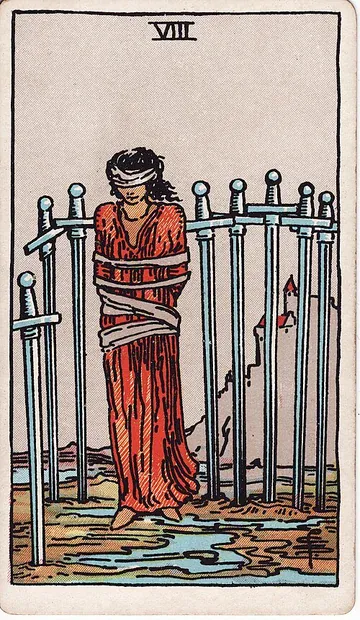
Eight of Swords
Series sibling and tonal contrast — the volley arriving for the bound figure. Eight of Wands is pure outward motion; Eight of Swords is inward containment. Together, the contrast is the reading: news is in flight while the seeker has tied themselves still in the dark. Untie one rope. The arrows are coming either way.

Nine of Wands
Suit successor — the volley arriving exhausted at the wall it was aimed at. The Nine of Wands is the wounded sentry, fence raised, still on his post. Together, these cards describe arrival depleted; the messages land on a body that has stopped having reserves to receive them. Lower the guard before the news arrives, or the news will not be able to be heard.

The Chariot
Major modulator — directed momentum at higher altitude. The Chariot is will; the Eight of Wands is undirected speed. Together, they describe a rare configuration in which strong intention and fast field are aligned in the same direction. Effort and luck multiply rather than add. Stay on the line; do not pull the reins to admire the speed.

Temperance
Major modulator — pacing and integration counterpoint. Where the Eight of Wands wants haste, Temperance asks for proportion. Together, these cards describe a season in which the right action moves fast in some channels and slow in others. The skill is knowing which arrow to loose and which cup to keep pouring. Not everything moves at the same speed.

Four of Pentacles
Extreme tonal contrast — maximum motion meeting maximum closed grip. The Four of Pentacles clutches; the Eight of Wands flies. Together, they describe a hard contradiction: opportunity is incoming and the hand will not open to receive it. Most often financial — the volley wants to land in a fist already closed. Open one finger. The volley cannot land in a closed hand.
Frequently Asked Questions
Which door is the Eight of Wands reversed answer coming through?
Not the one being watched — that is the practical content of the reversal. This is rarely a clean no. It is more often a yes whose timing keeps slipping, or a yes that cannot reach you through the channel you have fixed your attention on. The message went to a spam folder. The decision-maker has been out for two weeks and nobody said so. The reply is waiting on a platform you stopped opening. So treat it as a soft caution rather than a refusal: the answer is probably still in your favor and it is arriving sideways. Check the side doors literally — the other inbox, the mutual friend, the phone call instead of the thread, the person one level down from the one you have been petitioning.
We keep reaching and missing — what is the Eight of Wands reversed describing?
Timing drift, which is a different problem from indifference and responds to different treatment. Reversed, the card describes crossed wires: two people both reaching, neither arriving, messages that land when the other person has already moved on to the next hour of their day. The warmth is intact. The synchronization is not. In an established bond this shows up as a season where every conversation happens slightly out of phase — the apology offered on a night the other one wanted lightness, the invitation extended the week they cannot take it. With a newer spark it is the fast start that hit a wall nobody put there. For a reconciliation the card asks for a change of channel before the conversation resumes: the same medium that broke it will most likely break it again.
Eight of Wands reversed: is the silence mine to break?
Once, and then no. Reversed, the card shows warmth that is real and stuck: they are not cold, not dishonest, just caught in the widening gap between feeling something and saying it. A single clean message from you can sometimes dislodge that — one sentence, no interpretation, no request for a summit. What does not help is the fifth follow-up into the same silence, which turns their paralysis into avoidance and puts you in the position of carrying both sides of a conversation. So send the one thing, in a channel you have not already exhausted, and then stop. The rest of the unsticking belongs to them. Whether they do it is the actual information you are waiting for, and their silence answers the question as clearly as words would.
What advice does the Eight of Wands reversed give?
The reversed Eight of Wands counsels stopping the same gesture and changing the channel. Stop sending the fifth follow-up. Stop refreshing the email. Step away from the stalled thread for forty-eight hours. Switch from email to phone, from text to in-person, from chasing to receiving. The card respects the seeker who can pause the volley and reroute, not the one who keeps firing into the same silence.
How is the Eight of Wands reversed different from upright?
Upright, the Eight of Wands is the volley already loosed — fast, clean, in flight. Reversed, the volley has been halted mid-air; the arrows hang at strange angles, the messages drop into spam folders, the timing slips week by week. The energy of the throw was real, but the channel has obstructed. Same eight staves, same trajectory — the difference is whether the trajectory completes.