
Five of Pentacles · Core Meaning
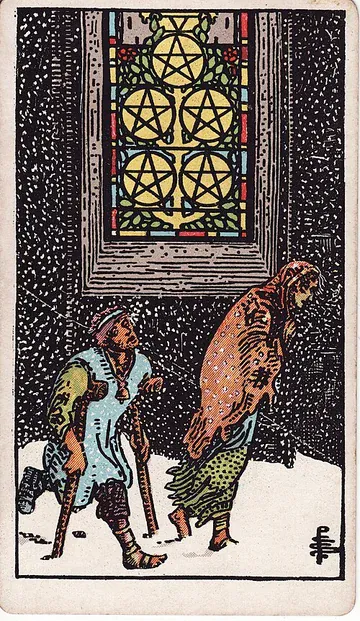
The Five of Pentacles is the deck's card of material winter. Two travelers move through the snow outside a cathedral — one on crutches, one barefoot. Above them, a stained glass window holds five gold pentacles in its pattern, lit warm from within. The light is right there, behind a single pane. The door is also right there, around the corner of the wall. Neither of them looks up. They walk past warmth they have either forgotten how to claim or are too ashamed to ask for.
This is the card's signature tension: scarcity that is real and help that is closer than the sufferer believes. The Rider-Waite-Smith image is doing two contradictory things at once and means them both. The cold is not a metaphor; the bare feet on snow are not symbolic of "missed opportunities" in some abstract sense — they are bodies actually freezing. And the warmth is not a fantasy; the church window actually glows. The card asks you to hold both: the lack is genuine, and the relief is closer than shame currently allows.
The traditional astrological signature reinforces the bone-honesty of the card. Pentacles Five sits in the first decan of Taurus, ruled by Mercury — Mercury in Taurus, 4/21 to 4/30. This is the last week of April, the part of spring that still holds frost in the early morning. Mercury is the planet of language and exchange; Taurus is the body's slowest, most physical sign. Their meeting in this decan is what happens when speech is forced down to the bone of need: the words become plain, direct, embarrassed of nothing. Hardship strips ornament. Pentacles Five is the decan of necessary plainness.
The kabbalistic placement deepens the reading. The card sits on Geburah, the sephirah of severity, in Assiah, the world of action. Geburah's classical meaning is the cut that removes excess and leaves only bone. In the suit of earth — the suit of the body, the wallet, the four walls — Geburah does not appear as a metaphysical pruning. It appears as the eviction notice, the layoff, the foreclosure, the diagnosis, the long winter where the heating bill is half of rent. Geburah in Assiah is severity made literal. The card describes the season after which only what is essential remains — and the soul is asked to find out what is essential.
There is a third image the card holds, the most easily overlooked: the two travelers do not walk apart. They are bound by their shared exposure. The card is sometimes read as isolation, but the picture itself is of companionship inside lack. Whoever you are with in the cold counts more than the warmth you do not currently have. The first instruction of the Five of Pentacles, before any practical move, is to notice the other body next to yours in the snow.
The sensory register the card carries reinforces the diagnosis. The colors are coal-ash and candlelight yellow — the soot of a long-burning stove and the small surviving flame. The scent is wet wool and woodsmoke. The stones are jet and smoky quartz, the metals lead and tin — slow, dense, unglamorous metals. The animals are the crow and the wolf, both creatures who learned to live through winter not by avoiding it but by learning its uses. The Five of Pentacles is not a card of fragility. It is a card of the soul that is already harder than it knew, walking through cold that would have killed a softer creature, and that quiet competence is part of what the card is asking the seeker to honor in themselves.
The number itself belongs to the reading. Five is the numeral of conflict among the pips — the necessary rupture that shakes a settled order — and in the suit of earth that rupture lands on the most settled thing a person owns: the roof, the paycheck, the body's reliable functioning. What the Four of Pentacles had arranged, the Five disturbs. The card's elemental company matters here too. Earth beside water shares the cold, and the two figures in the snow are exactly that — the body and the feeling enduring one weather together. Air sharpens the same cold into wind, which is what makes hardship articulate and cruel: the mind starts explaining to you why you deserve the snow. Fire arriving beside this card either finally warms the room or burns the last blanket, and the spread around it decides which.
Read the Five of Pentacles the way you would read a photograph of someone outside in winter, hand still raised because they almost knocked. The card describes the pause before the knock. The pause is not failure. It is the moment when the long winter becomes either a season or a permanent identity, and the card asks you to choose the season.
Five of Pentacles · Love & Relationships
Two people walking the same cold road are still two people, and that is what the Five of Pentacles upright describes inside a relationship. This is not a card of indifference or of love withheld. It is the card of two people who care, who are bound to one another, and who have temporarily run out of the resources required to carry each other well. The cold is real, and so is the bond. The work the card asks for is to remember which of those two facts is structural and which is seasonal.
For an existing partnership, the Five of Pentacles arrives during a hard stretch — a job loss, a serious illness, a death in the family, a shared financial crisis, or simply the slow compounding of small losses into a year that has emptied both of you. Conversations become utilitarian. Sex thins. The future you used to plan has been quietly shelved. None of this is a failure of love. The card asks both partners to keep walking through the snow together rather than separating to suffer alone. Whoever has slightly more strength on a given week sets the pace.
For a new spark, the Five of Pentacles is harder to read kindly, but it is not a closed door. It can describe a connection that began under conditions of shared scarcity — you met in a moment when both of you were going through something, and the meeting itself was warmth in a cold field. The card warns that connections born of mutual lack sometimes do not survive the return of plenty: when one person warms up first, the bond that was the cold can dissolve. Pay attention to what the relationship is actually built on. If only the cold, the spring will end it. If something else as well, the spring will reveal it.
For a single seeker asking whether love is currently possible, the Five of Pentacles answers honestly: this is not the season of easy meetings. You may be moving through a stretch where your visible bandwidth is small, where you are conserving for survival, where the version of yourself you can offer is the underfed one. The card does not say you are unlovable. It says you are wintering. The work is to refuse the shame of wintering — to remember that the version of you that is currently cold is still the version someone could meet.
For love after a wound, the Five of Pentacles is one of the deck's gentler cards. It says: you are still walking. The wound has not killed you. You are out in weather you did not choose, and you are continuing to put one foot in front of the other. Someone else is, too — somewhere in your future or already in your day. The card does not promise an immediate reunion with warmth. It promises that the wintering itself is a state from which the soul can still be loved.
The card's particular love language is presence inside hardship. The Five of Pentacles loves the way two figures in the snow love — by not drifting apart. By matching pace. By keeping the body of the other in peripheral vision so that no one is left behind. This is unglamorous love. It is also some of the most durable love the deck describes. People who survive a winter together know things about one another that no engagement photograph reveals.
Money disparity inside a couple bends this card in a particular direction. One of you has a cushion and the other does not; one covers the rent while the other pays in currencies that do not show up on a statement. The Five of Pentacles describes the shame that accumulates in the person with less and the careful, apologetic guilt that accumulates in the person with more — and how both of them go quiet about it at roughly the same time. The quiet is the problem, not the disparity. Couples who say the arithmetic out loud, who decide explicitly what is shared and what is a gift and what is a loan, tend to survive the imbalance. Couples who leave it unspoken end up as two people walking the same road at two different temperatures, each pretending not to notice the other's weather.
For the question of whether someone is in love with you and the Five of Pentacles arrives upright, read the card carefully. They may care deeply and be unable to express it through anything resembling effort right now. They may be wintering in their own life — financially, mentally, somatically — in ways that flatten what they can offer. The card asks you not to confuse a frozen period with a lack of feeling. It also asks you to be honest about whether the cold is theirs alone or whether you are being asked to carry warmth they could be sharing if they were willing.
For the question of long-distance, scarcity-strained, or otherwise resource-limited relationships, the Five of Pentacles validates what you are sensing. The structure is hard. The structure is not necessarily wrong. The card asks both partners to stop pretending the strain is invisible — to name what is hard out loud, to stop performing ease neither of you feels. Naming the cold is the first warmth.
Caregiving bends the card a different way again. When a couple's resources are being drained by a third body — a parent with dementia, a child in treatment, a sibling in crisis — the Five of Pentacles is not describing a fault between the two of you. It is describing a winter neither of you caused, which arrived through a door you could not have closed. The strain shows in the smallest places: nobody has cooked in a week, the affection has turned into logistics, both of you are too tired to be kind and too decent to say so out loud. The instruction the card carries here is respite, and respite is a practical arrangement rather than an emotional one. One afternoon a week, somebody else holds the weight. Ask for the afternoon. A relationship in this particular winter needs sleep considerably more than it needs a conversation.
For a relationship considering whether to ask for help — couples therapy, financial counseling, family mediation — the Five of Pentacles answers yes, knock on the window. The shame of having reached this point is not stronger than the relief of admitting it. The card describes a couple who needs help and is too cold to ask. The card's blessing is the one that follows the ask.
Five of Pentacles · As Feelings
Cold, and embarrassed about being cold — that is the Five of Pentacles as an answer to how someone feels about you. They feel something — that is rarely the question — but the something is currently buried under a layer of material or emotional hardship that has narrowed their bandwidth. They are not turning away from you. They are turning away from being seen in the state they are currently in.
For a partner you have been with a long time, the Five of Pentacles in feelings often means they are ashamed of what they have not been able to give. A man who has been out of work for six months may stop initiating intimacy because he feels he has nothing to bring to the table. A woman who is grieving may stop talking about her day because the day has been hard, and she does not want to be the heavy weather in your life. Read the silence as protection — flawed protection, but protection — not as withdrawal of feeling.
For a new connection, the Five of Pentacles in feelings can mean a person who is interested but cautious. They have been through enough recent winter — financial, romantic, professional — that the prospect of a new bond feels like another exposure they cannot afford. They like you. They are also calculating whether they can sustain liking you. This is not a verdict against you. It is a verdict about their current capacity.
If they are reserved by nature, the Five of Pentacles in feelings can read as pulled inward and quietly suffering. The withdrawal is not tactical — it is the same instinct that keeps the two figures walking past the lit window instead of knocking. They are minimizing their footprint because they feel they have nothing to give and do not want to take. The kindest thing you can do is reduce the cost of contact: send a short message, ask a question that takes thirty seconds to answer, signal that proximity does not require performance.
If they are demonstrative, the card describes a person who has temporarily gone quiet, and the silence itself is the most meaningful signal. They are not hiding — they are conserving. The conserving is most often about something other than you. Ask, with care, whether they are okay. Do not demand reassurance about the relationship. The two questions can feel similar from inside the silence. They are not the same question.
For a partner in active hardship — illness, layoff, grief, a family crisis — the Five of Pentacles in feelings means they love you and they are distantly aware that they are not currently able to show it well. They notice. They feel the gap between what they want to give and what they have to give. The reading they themselves are doing of the situation is harsher than the reading you are tempted to do. Be gentler than you think the situation requires. The shame is doing enough work without you adding to it.
Some people inside this card express feeling only as labor. They will not tell you they love you; they will change your tires, fix the tap that has been dripping since March, drive four hours to collect you from an airport at two in the morning. The Five of Pentacles amplifies that habit, because a person who believes they have nothing left to give will give the one thing still in their possession, which is effort. If the person you are asking about has gone verbally quiet and is nevertheless still showing up to do things, read the doing. The card describes a heart that translates itself into tasks. That is not a lesser translation of the sentence. It is the version of it that a cold climate permits.
A family pattern surfaces in this card often enough to name. Someone raised in a household where every gift arrived with an invoice attached — where help was later cited as evidence in an argument — learns early that being cared for is a dangerous position to be in. When the Five of Pentacles describes such a person's feelings, what reads as reluctance toward you is usually reluctance toward the entire category of being held. They flinch at your generosity because generosity, in their history, has always been the first half of something. Do not escalate the generosity in order to prove yourself; escalation confirms their model. Keep the offers small, repeated and unconditional, and let the repetition do the arguing.
There is a small, important caution embedded in this card. The Five of Pentacles in feelings can sometimes describe a person who has begun to romanticize their own suffering — who is using hardship as identity, who finds the cold familiar enough to refuse warmth when it is offered. Watch for the partner who declines help that would actually relieve them. That is not a card about how they feel about you; it is a card about how they have started to feel about themselves. Compassion for that pattern is appropriate. Indefinite participation in it is not.
Read the Five of Pentacles in feelings as warmth held inside a body that is currently too cold to express it. The feeling is real. The expression is not currently arriving. The work, where there is work, is theirs.
Take the Five of Pentacles in feelings as confirmation that you are not imagining the chill. The chill is real. The feeling beneath the chill, in most readings, is also real, and is in your favor. The structure between the two is the work.
Five of Pentacles · Career & Work
The building is warm and you are outside it: at work the Five of Pentacles upright is the card of the institution that stopped holding you. A layoff, a contract not renewed, a department dissolved, a long stretch of underemployment, a freelance client list that has gone dry, a role that has cut your hours until the math no longer works. The loss is real and it is not your fault. The card refuses both the consolation of "everything happens for a reason" and the cruelty of "you should have seen it coming." It says: this is winter, and you are in it.
If you are currently looking for work, the Five of Pentacles describes a search that is harder than you expected, longer than you planned for, and more isolating than you anticipated. The applications go out and the silence comes back. The savings account moves the wrong direction. The body has begun to carry the search the way it carries any other long stress — shallow sleep, tight chest, irritability with people who do not deserve it. The card validates the difficulty. It also says: do not be alone in it. Find one other person who is also outside the institution. A peer who is also between jobs. A former colleague who has been laid off. A friend who has been freelancing through a slow season. Wintering with one other person is structurally different from wintering alone.
For someone considering whether to leave a current role that has become quietly unsustainable, the Five of Pentacles is more nuanced. It can read as the warning that the role itself is the cold — that the underpayment, the lack of recognition, the ambient hostility of the workplace has become the weather you have stopped noticing. In this reading, the card asks whether you have mistaken endurance for fit. If the role has been freezing you for years, the church window may be elsewhere. The card asks you to look up.
For someone considering a new role, the Five of Pentacles upright reads with caution. The role on offer may be one that exploits the desperation of the current moment — a salary calibrated to your fear, a structure designed for someone who cannot say no. Read the offer carefully. Negotiate. The card warns against accepting a frozen-water role because anything looks better than the snow you are standing in. Sometimes a winter is shorter than the cage you would build to escape it.
Entrepreneurs and freelancers should read the Five of Pentacles as the season when the business is not yet covering its costs. The launch did not land the way the spreadsheet promised. The customer who was supposed to stabilize the year has not closed. The runway has shortened from comfortable to alarming. The card does not say abandon the practice. It says ask for help. Talk to peers. Pay for one hour with someone who has been through this. Apply for the grant you assumed you would not get. The card collapses when isolation is broken.
For a creative practice, the Five of Pentacles can describe the season after a project that did not earn out — the book that did not sell, the show that closed early, the album the audience did not find, the work you bled for that did not return enough to justify the bleeding. The card refuses to tell you the work was bad. It says: the season was hard. Practical questions remain. Do you make the next thing on the same scale, smaller, or differently? Who can pay for studio time while you decide? The card asks for honesty about the math, not despair about the work.
For questions about layoff, severance, or restructuring, the Five of Pentacles is unambiguous. Take everything the institution offers. Negotiate above the offered number. Apply for unemployment the day you are eligible. Use the COBRA continuation. Ask the friend with the connection. The card describes a season in which the seeker who refuses help — out of pride, exhaustion, or the belief that asking is shameful — bleeds for longer than necessary. The institution that dropped you owes you the help you are entitled to. Take it.
For students, early-career seekers, and people in training programs, the Five of Pentacles can describe the season when the financial cost of the path has begun to outpace what the path is currently returning. Loans accumulate. Side work to keep the lights on cuts into study time. The original vision of why you began this training has dimmed under the weight of the bills. The card does not say abandon the path. It asks for a frank inventory: what supports are available that you have not used? Tutoring funds, financial aid offices, mentor networks, hardship grants, peer study groups, advisors whose office hours you have been skipping out of embarrassment. The early-career version of this card asks the same knock the rest of the card asks: the offices that exist to help you exist to help you. Use them.
For colleagues asking about a coworker who has gone through hardship, the Five of Pentacles in their card is a request you may not have heard. They are not going to ask. The card invites you to extend the offer first.
Five of Pentacles · Money & Finances
Money in the Five of Pentacles is a number and a date — what sits in the account, and what comes due on Friday. Not the metaphorical "scarcity mindset" some self-help books warn against — the actual condition of not having enough. The bills are real. The math is real. The cold is real. The card refuses to spiritualize hardship into a lesson before the hardship has been acknowledged as hardship.
For someone in active financial difficulty, the Five of Pentacles describes the season honestly. There is rent due that you do not currently have. There is a credit card that has been juggled long enough that the juggling is its own job. There is a car repair that you cannot afford and cannot avoid. There is an emergency that has stopped feeling like an emergency because emergencies are now the baseline. The card validates that this is genuinely hard. It also says: do not spend the energy you do have on pretending it isn't.
The card's central financial instruction is to ask. Apply for the food assistance program you qualify for. Call the utility company about the hardship plan that is not advertised. Negotiate with the medical billing office; they have a discount for self-pay or for income below a threshold, and they will not offer it unless you ask. Tell the friend with money that you cannot make it to the dinner because dinner is not in the budget. The Five of Pentacles softens the moment "I can't afford it" leaves your mouth. The phrase that has felt like failure becomes the phrase that lets the scaffolding form.
For questions about debt, the Five of Pentacles can describe the season inside a long climb. The principal is barely moving. The interest is faster than the payments. The card does not promise immediate relief. It does ask whether you have explored every consolidation, every refinance, every income-driven repayment plan, every bankruptcy consultation, every conversation with a non-profit credit counselor. The shame of looking at the options is currently costing you more than the options themselves would.
For someone considering a financial gamble in the middle of scarcity — a high-risk investment, a side bet, a get-rich-quick course, a cryptocurrency speculation — the Five of Pentacles answers no. The card describes the seeker most likely to be exploited by predatory schemes precisely because the cold has dulled judgment. Whatever you are about to bet, do not bet it. The next move is conservative because conservatism is the thing you can currently afford to lose least.
For a windfall arriving in the middle of scarcity — a tax return, a small inheritance, a gift, a back-pay settlement — the Five of Pentacles upright cautions against the immediate spend. Pay the most punitive debt first. Build the smallest possible buffer. Do one repair you have been deferring that will cost more if it gets worse. The card warns against the relief impulse to celebrate the windfall by spending it on something that pleases for a week and disappears. Cold-body spending evaporates fast.
For long-term financial planning during a hard season, the Five of Pentacles asks for one boring move per month. One conversation with a person who knows more than you. One application. One negotiation. One automated transfer, even if it is for ten dollars. The card responds to small, persistent, attended motion. It does not respond to grand resolutions made on a Sunday and abandoned by Wednesday.
The card's signature financial trap is the predatory loan, the high-interest credit product, and the buy-now-pay-later trap that targets exactly the body the Five of Pentacles describes. The marketing of these products is calibrated to a nervous system in scarcity — the relief of being approved, the immediate access, the postponement of the math. The card warns against signing for any product that has hidden the actual interest rate behind a friendly interface. Read the fine print. Pay the credit card balance in full each month if you are using one at all. Refuse the financing offer the appliance store pushes at checkout. The Five of Pentacles describes a season in which the seeker is most vulnerable to financial predation precisely because the cold has already begun. Protect against the predator before negotiating with the existing debt.
A practical move when the card appears in a money question: write down the actual number you owe, in dollars, on paper. Most seekers in financial scarcity have stopped looking at the actual number. The avoidance has become the most expensive thing in their budget. The Five of Pentacles asks you to look. The look itself is the first warmth.
Five of Pentacles · Health
One traveler is on crutches and one is barefoot in the snow; in health questions the Five of Pentacles reads a body pushed past its margin. The element is earth and the temperament is melancholic — pierced by cold, slow to recover, holding more than it has admitted to itself. The body part the card carries is the ankle and the knee, the joints of injured walking. The traveler on crutches is in the image for a reason.
If you are managing a chronic condition, the Five of Pentacles describes a flare or a season of decline. The pain is louder than usual. The fatigue is heavier. The thing that was being managed is, for the moment, less manageable. The card does not predict permanence. It validates the difficulty and asks for the next level of help — the specialist, the second opinion, the medication adjustment, the physical therapy referral, the home modification you have been postponing because you have not wanted to admit it might be necessary. The card collapses when the body's needs are denied. It softens when the body's needs are met without shame.
If you are in active recovery — from surgery, from injury, from an episode of acute illness — the Five of Pentacles describes the unglamorous middle of the recovery. The triumph of being out of the hospital has worn off. The slow daily work of rehab has become the new texture of life. The card asks for honesty about the labor. Recovery is not a vacation. It is full-time work the body is doing while the mind goes a little stir-crazy. Allow the work. Stop apologizing for the slowness.
For mental health questions, the Five of Pentacles can describe a depressive season, an episode of anxiety that has narrowed daily function, a stretch of grief that has taken up more space than the grieving person had budgeted. The card validates the heaviness. It also names a specific danger pattern: the seeker who has stopped seeking. The therapist appointment canceled and not rescheduled. The medication that ran out and was not refilled. The walk that used to help, abandoned. The card asks: what supports have quietly fallen away in the last month? Restore one. Not all. One.
For somatic symptoms — chronic pain, digestive issues, sleep disruption, the physical signs of long stress — the Five of Pentacles asks whether the body is carrying the weight of something the mind has been refusing to look at. Job stress that has become chest tightness. Relational distress that has become a stomach. Grief that has become a back. The card does not prescribe; it observes. The observation itself often loosens what the mind has been clenching.
For questions about whether to seek medical care for something you have been hoping would resolve on its own, the Five of Pentacles answers go. Make the appointment. The cost of the appointment, in money or in shame or in the discomfort of being seen, is currently smaller than the cost of waiting. The card describes seekers who walk past the church window again and again — the urgent care, the therapist, the GP, the dentist — out of an embarrassment they did not consciously choose. The card asks you to knock.
A note on financial barriers to care, since they are real and the card is honest about them: ask for the cash-pay rate, ask about sliding scale, ask about the community health clinic, ask the hospital about the financial assistance application that exists but is not advertised. None of this is medical advice — keep your practitioners, follow your treatment plans, take your medications. The card simply reminds you that the door is around the corner of the wall, and that the institution that owes you care is more likely to provide it than your shame currently believes.
Five of Pentacles · Spirituality
Exclusion is the spiritual subject of the Five of Pentacles — being outside a warmth that other people are plainly inside. The image is theologically precise: the building of organized warmth is right there, the sacred light is glowing through the stained glass window with its five pentacles literally inlaid in the pattern, and the two travelers walk past it. The card is not a critique of the church or of organized practice. It is a portrait of the soul who has been wounded badly enough — by religion, by community, by their own life — that the buildings designed to hold them no longer feel like they apply.
For seekers who have left a tradition they were raised in, the Five of Pentacles describes the long winter after departure. The familiar warmth has been refused on principle. The new warmth has not yet been built. The seeker is genuinely cold. The card respects the refusal — leaving is sometimes the only honest move — and also names the cost. There is no spiritual practice that does not require some form of community. Solitude, sustained too long, becomes a kind of malnutrition. The card asks whether the refusal of the inherited tradition has become a refusal of any tradition, and whether that second refusal is still serving the soul that made the first one.
For seekers in active practice who have hit a hard season, the Five of Pentacles can describe the dryness — the meditation that has stopped delivering, the prayer that has stopped feeling answered, the ritual that has become rote. This is what most contemplative traditions call the desert. The desert is not failure. It is a documented, named, expected stage of any sustained practice. The card asks for endurance and for company. Find one other practitioner. The desert walked alone is heavier than the desert walked with one other person who knows the terrain.
For seekers exploring belief, the Five of Pentacles is a card of honest agnosticism. It refuses the easy comfort of certainty. It also refuses the easy nihilism of "nothing is real." The card stands in the actual cold and looks at the actual window and asks what the seeker is willing to admit they need. Most seekers, if asked honestly, want some form of meaning, some form of belonging, some form of being held. The card does not name the answer. It refuses to let the seeker pretend the question has not been asked.
The card's spiritually-weighted symbol is the cathedral window itself — the five pentacles glowing in stained glass, the light that is one pane away. In the kabbalistic frame, this is Geburah's strange mercy: the severity that strips away surplus until the soul knows exactly what it needs. The window is the answer to what has been stripped. It is not a coincidence that the answer is on the other side of a wall the seeker is currently outside of. The path of the Pentacles Five is to find the door — not to dissolve the wall, not to teleport into warmth, but to walk around the corner and knock.
A practice for the season this card describes: thirty minutes, alone, with a notebook. Write down what you are currently pretending isn't cold. Not in a self-improvement frame. Just the list. The financial reality. The relational reality. The medical reality. The spiritual reality. The list is the door. Most seekers in this card have stopped writing the list because the list is unbearable. The card asks you to bear it for thirty minutes. The bearing itself begins to shift the cold.
Five of Pentacles · Yes or No
Soft no — but it is a no with a window.
The Five of Pentacles upright is one of the deck's clearer no-cards in yes-or-no readings, but it is rarely a brutal no. It is more often a no with a condition: not as it stands, not without a knock, not without help. The path you are currently walking does not lead to the warm room you are imagining. The warm room is in fact close. Reaching it requires a turn you have not yet made.
For yes-or-no questions about a relationship, a job, a move, a decision: the answer is most often no, the way you are currently approaching this is not landing the result you want. Something about the framing, the timing, or the resources is missing. The card does not say the underlying possibility is closed. It says the current path through it is. Stop, look up, ask the question one layer below the question you are asking. What are you actually trying to receive? Is the door you are knocking on the door it lives behind?
For questions about whether someone will return — a person who has left, a partner who is distant, a friend who has gone silent — the Five of Pentacles answers with caution. The return, if it comes, will come through the same gate the leaving did: the wound that caused the silence has to be named for the silence to break. The card describes two people who could speak and are not. Whoever has slightly more capacity right now goes first. The card does not promise the response. It promises the honesty.
For questions about a financial decision — should I take the loan, the investment, the gamble, the windfall — the Five of Pentacles answers conservatively. No to the speculative. No to the high-risk. The card describes a season in which preservation matters more than expansion. There will be later seasons for the bigger move. Do not bet the small reserve in the cold month.
For questions about whether to ask for help — should I tell my parents, should I call the friend, should I email the mentor, should I make the doctor's appointment — the Five of Pentacles answers yes, knock. This is the one yes the card carries unambiguously. Whatever shame is making you delay the ask is more expensive than the ask itself. The window is closer than your shame currently believes.
For timing questions — will this happen soon — the Five of Pentacles says not in the immediate frame. The current weather is winter, and winters take their season. Asking the card to skip you ahead to spring is asking the wrong question. The right question is what the winter is for, and the card answers: it is for the inventory of what is essential, the clarity that comes after surplus has been stripped, and the discovery of who walks beside you in the cold.
For binary action questions — should I act now, should I wait — the Five of Pentacles says wait, except for the asks. The expansive moves can wait. The conservative ones — the appointment, the application, the hardship request, the negotiation — should be made now. The card responds to honest asks. It does not respond to ambitious leaps in the wrong weather.
If the question was: am I being unreasonable to feel as cold as I feel? The card answers no, you are not. The cold is real. Most of what you have been carrying alone, you were never meant to carry alone. The yes-no question beneath every yes-no question this card touches is whether you are willing to admit the cold and ask. The card answers that one with a quiet, durable yes.
Five of Pentacles · Advice
Ask, before the shame finishes making its case — the Five of Pentacles upright puts its whole weight behind that one move. Whatever you have been carrying alone — financial strain, medical concern, relational difficulty, professional setback, spiritual dryness — the card describes a seeker close enough to help to receive it, and held back primarily by the embarrassment of admitting the need. The card asks you to put the shame down for one specific ask this week. Not all the asks. One.
If there is one concrete instruction the card offers, it is this: this week, knock on one door. Make the call you have been deferring. Send the email you have been drafting in your head. Apply for the assistance program you have decided in advance you do not qualify for (you might). Tell the family member who keeps offering that you would like to take them up on it. Invite the friend over who has been worried about you. The card responds to the specific, named, embodied ask. Vague resolutions to "be more open to help" do nothing. One door, knocked on this week, changes the weather of the card.
A second instruction: find your second traveler. The figures in the card do not walk alone. Whoever else is in your particular winter — a friend going through their own layoff, a sibling managing the same illness in the family, a colleague also navigating the underpaid season, a fellow member of a recovery group, a peer in a creative slump — the card asks you to make contact with them this week. Solidarity inside scarcity does not solve scarcity. It changes its texture. The exposure to cold becomes shared exposure, which the body and the soul process differently than solitary exposure.
A third instruction: refuse the romanticization of suffering. The Five of Pentacles describes a real winter, but the card warns against the seductive pattern of beginning to identify as a person who is cold, who has nothing, who deserves nothing. There is a version of this card's pattern that becomes a personality. Watch the language you use about yourself. If you have started to describe your circumstances as inevitable, deserved, or proof of something deeply wrong with you, those sentences are themselves now the cage. The card asks you to keep the difficulty as situation, not identity.
A fourth instruction: make the boring practical move. Apply for the unemployment benefits. Call the utility company. Schedule the doctor's appointment. Ask the landlord for a payment plan. Negotiate the medical bill. The Five of Pentacles softens the most under unglamorous, specific, persistent practical motion. The grand emotional reckoning can wait. The boring practical move can not.
A fifth instruction, often skipped: walk past the church window with your eyes open this time. Most seekers in this card have learned, often unconsciously, to look at the ground. The eyes have lowered against shame, against weather, against the visible warmth of other people's lives that feels like a rebuke to your own. The card asks you, this week, to look up — to walk through your day with your gaze at face level. Notice the warm windows you have been avoiding. Notice the doors that exist. Notice the people who would meet your eyes if you let them. The looking-up is not a small instruction. It is the precondition for the knock.
Practical advice for the day the card appears: spend ten minutes writing the exact dollar number of what you owe, the exact details of the symptom you have been ignoring, the exact name of the person you have been avoiding, the exact shape of the help you would receive if you allowed yourself to receive it. The card responds to specifics. Most seekers in the Five of Pentacles have allowed the situation to become a fog, and the fog itself is now a major part of the suffering. Cut the fog with one list, written in plain words, in your own handwriting. The list is the door. Knock.
If the week ends and you have still not asked, notice that the not-asking has become its own kind of snow: quieter than the cold, and just as capable of keeping you outside a lit window that was open the whole time.
Five of Pentacles · Card Combinations
The Five of Pentacles rarely arrives alone in a spread. It carries a particular gravity that pulls the cards around it into the question of how this winter will be navigated and what kind of warmth, if any, is moving through the spread to meet it. Read the neighbors as the answer to the card's central question: who and what walks with the seeker through the cold.
Five of Pentacles + Six of Pentacles
The card's most natural pairing — the suit's gold pair. The five is the lack; the six is the help that arrives. When these cards land together, the spread is describing a winter that is about to soften — money that is on the way, an offer of help that is about to be made, a benefactor or a system that is preparing to extend the resource the seeker has been quietly without. The instruction is to receive cleanly. The Six of Pentacles only completes the Five's arc when the Five admits it needed the help in the first place. Pride that refuses the six leaves the figures in the snow.
Five of Pentacles + Five of Swords
The other Five, the card of mutual injury and damaged dignity. Together these two cards describe a winter compounded by a fight neither party walked away from clean — a relationship that broke under financial stress, a family that fractured around an inheritance, a workplace conflict that left both sides poorer in standing and in resource. The combination warns against the seeker who tells themselves they "won" the Five of Swords confrontation and then finds themselves walking into the Five of Pentacles cold. Ask whether the recent fight is the cause of the current scarcity. Reconciliation, where it is possible, may be the only way out of both cards.
Five of Pentacles + The Hierophant
The building the two travelers are walking past, given a face. The Hierophant is the institution — the church, the university, the hospital system, the employer, the family's official doctrine — and next to the Five of Pentacles it poses one precise question: is the institution the warmth you have been denied, or the wall that is doing the denying? Both readings occur, and the surrounding cards decide. Sometimes the pair describes a seeker who genuinely qualifies for help the institution is administering badly, and the work is paperwork, persistence, and one named human being who will take your call — not despair. Sometimes it describes a person kept outside by a body that has quietly decided they do not belong, and the work is to stop knocking on that door and go looking for the one that opens. This combination rarely means abandon all structure. It usually means find the person inside the structure who still answers.
Five of Pentacles + The Tower
The Tower is rupture — the lightning that strikes the false structure and brings it down in a single image. Together these cards describe the season after the rupture, the cold ground after the building has fallen. The job did not just end; the company collapsed. The marriage did not just strain; it ended in a rupture. The financial situation did not just tighten; the underlying assumption (the inheritance, the partner's income, the steady industry) gave way. The Five of Pentacles is what living through the aftermath looks like. The combination is heavy but honest. What survives the Tower is closer to bone, and the Five of Pentacles' Geburah signature is precisely that — the structure stripped to what was actually load-bearing.
Five of Pentacles + The Star
A combination of unusual gentleness given how hard each card can read. The Tower-Five-Star sequence is one of the deck's quietest healings: the rupture, the cold ground, and then the soft return of light. The Star arriving next to the Five of Pentacles describes the season when the worst of the winter passes — not because the seeker found the door, but because the spring began to come anyway. Hope returns to a body that has stopped expecting it. The combination is permission to begin trusting the warmth again, slowly, without pretending the cold did not happen.
Five of Pentacles + Four of Pentacles
A combination of contrast inside the same suit. The Four of Pentacles is the closed fist around what little is held; the Five is the open hand with nothing in it. Together they describe a seeker who has been clenching against scarcity so tightly that the clench has become its own form of scarcity. The combination warns that hoarding, in the season of the Five of Pentacles, accelerates the cold rather than preventing it. The instruction is to release one thing — one small expense, one small grudge, one small piece of held resource — and watch what happens. The card responds to the un-clenching.
Card Combinations
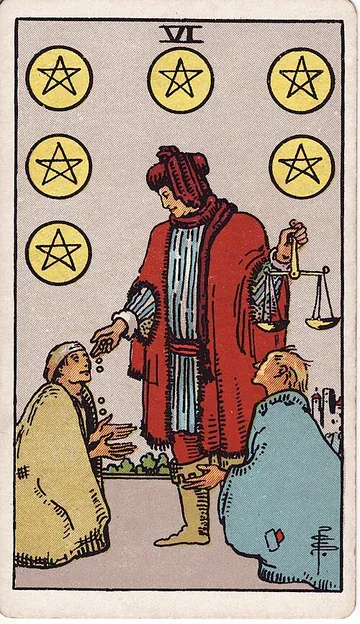
Six of Pentacles
The suit's gold pair. The Five is the lack; the Six is the help that arrives. Together they describe a winter about to soften — money on the way, an offer of help being made, a system preparing to extend the resource the seeker has been quietly without. The Six only completes the Five's arc when the Five admits it needed the help in the first place. Pride that refuses leaves the figures in the snow.
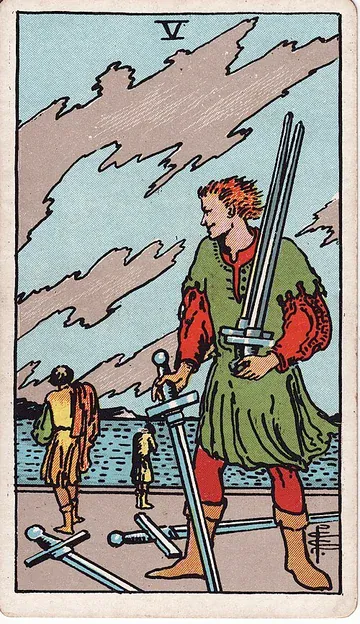
Five of Swords
The other Five — mutual injury, damaged dignity. Together these cards describe a winter compounded by a fight neither party walked away from clean. A relationship that broke under financial stress, a family fractured by inheritance, a workplace conflict that left both sides poorer in standing and resource. Ask whether the recent fight is the cause of the current scarcity. Reconciliation, where possible, may be the only way out of both cards.
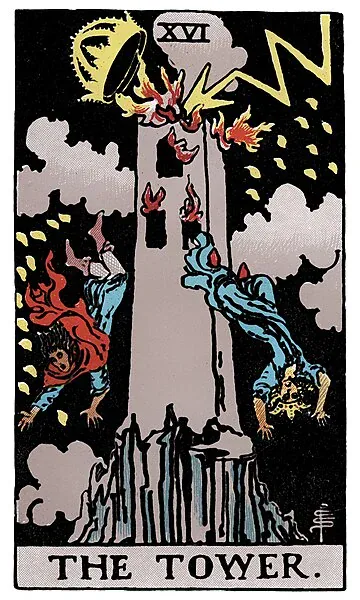
The Tower
The Tower's rupture and the Five of Pentacles' cold ground. The job did not just end; the company collapsed. The marriage did not just strain; it ended in a rupture. The Five describes living through the aftermath. The combination is heavy but honest — what survives the Tower is closer to bone, and the Five's Geburah signature is precisely that, the structure stripped to what was actually load-bearing.
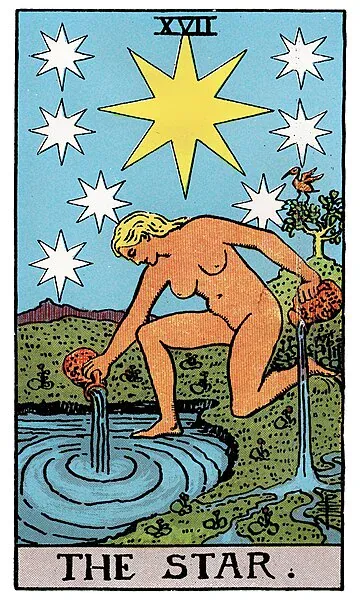
The Star
Tower-Five-Star is one of the deck's quietest healings: rupture, cold ground, and the soft return of light. The Star arriving next to the Five of Pentacles describes the season when the worst of the winter passes — not because the seeker found the door, but because the spring began to come anyway. Hope returns to a body that has stopped expecting it. Permission to begin trusting the warmth again, slowly, without pretending the cold did not happen.
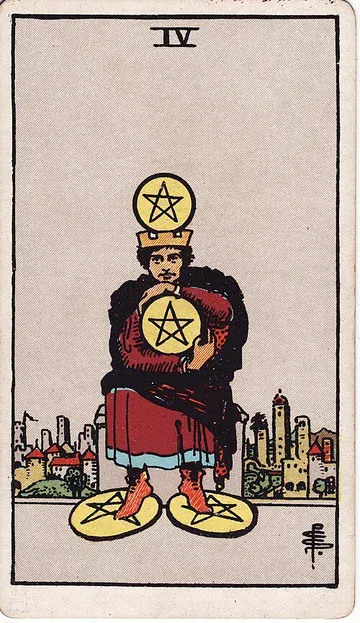
Four of Pentacles
Same suit, opposite gesture. The Four is the closed fist around what little is held; the Five is the open hand with nothing in it. Together they describe a seeker clenching against scarcity so tightly that the clench has become its own form of scarcity. Hoarding, in the season of the Five of Pentacles, accelerates the cold rather than preventing it. Release one thing — one small expense, one small grudge, one small piece of held resource — and watch what happens.
Frequently Asked Questions
What is the winter the Five of Pentacles keeps describing?
The Five of Pentacles is the card of material winter — the season of literal scarcity in money, health, work, or belonging. Two travelers move through snow outside a stained glass window glowing with five gold pentacles. The card validates that the cold is real, names that help is closer than shame currently believes, and asks the seeker to knock on one door this week.
Does the Five of Pentacles mean my partner stopped caring, or that we both ran out of road?
Ran out of road, in nearly every reading: the Five of Pentacles describes a relationship inside winter — care that is real, bandwidth that is temporarily exhausted, two people who must keep walking through the snow without drifting apart. For singles, it describes a wintering season when bandwidth for connection is small. The card asks both partners (or the single seeker) to refuse the shame of the cold and to name what is hard out loud.
Is there any way to read the Five of Pentacles as something other than a no?
Soft no — but a no with a window. The Five of Pentacles is one of the deck's clearer no-cards in yes-or-no readings, but rarely brutal. The current path is not landing the result you want, though the underlying possibility may not be closed. The one yes the card carries clearly is the yes to asking for help. Whatever shame is making you delay the ask is currently more expensive than the ask itself.
What is the advice of the Five of Pentacles?
The advice of the Five of Pentacles is to refuse the shame of asking. Knock on one door this week — make the call, send the email, apply for the assistance program, tell the friend you would like to take them up on the offer they have made three times. The card responds to specific, named, embodied asks. Vague resolutions to be more open to help do nothing.
What does the Five of Pentacles mean for money and finances?
In money readings, the Five of Pentacles describes literal scarcity — bills that are real, math that is real, a season in which preservation matters more than expansion. The card cautions against high-risk financial gambles, asks the seeker to apply for every legitimate hardship program available, and instructs that any windfall in this season be used for the most punitive debt or the smallest possible buffer rather than for relief-impulse spending.
Continue Reading
Five of Pentacles · Card overview · symbols · correspondences →
Return to the full card view — image, symbols, sensory correspondences, and Hermetic axes.
Read the reversed meaning →
Read the same depth on the opposite orientation.
Draw your reading now →
Bring this card to a question — open a quiet ritual.