
Four of Cups · Tarot Card Meaning
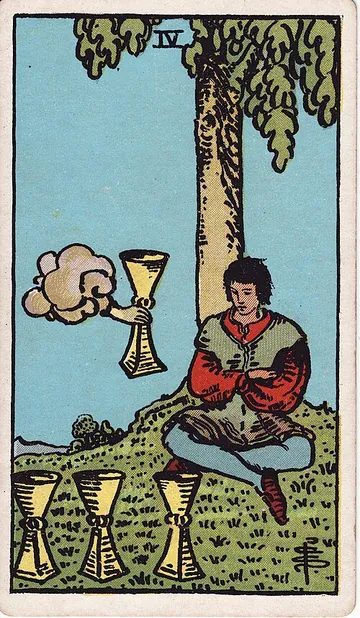
The Four of Cups is the withdrawal card of the deck. A young man sits cross-legged under a tree with his arms folded, three filled cups in a steady line on the grass before him. From the upper left a single hand drifts out of a cloud, holding a fourth cup at the level of his face. He does not look up. His eyes are closed or half-closed; the world has been turned down to the inside of his own head. The image is the moment a known good stops being able to reach you, and the new good arrives in a form you cannot bring yourself to register.
The signature tension of the card is that nothing in the picture is wrong. The three cups on the ground are not empty. The tree is not dying. The hand from the cloud is not threatening. There is no enemy. There is only a slight closing of the body away from what is, and a slight inability to see what could be. The card describes the precise weather of mid-afternoon apathy — the weariness that follows satiety, the dullness that follows arrival, the season when nothing is bad enough to fix and nothing is alive enough to choose.
This is not depression in its clinical sense, though it can be the antechamber of one. It is the lowercase version of stagnation: the gentle, almost reasonable retreat from a life that has begun to feel like furniture. Most adults pass through this card several times across a life. The first cup of the early adulthood, the second cup of the partnership, the third cup of the steady work — the three cups have been earned, and the body that earned them has noticed it does not feel the way the body imagined it would feel once they were on the grass. The Four of Cups is the moment between asking what is wrong and being able to articulate the answer.
The attribution names that stalled water with some precision: the card is the Moon in Cancer's third decan, 7/12-7/21 — feeling at its thickest, water at its closest to its own stagnation. The Moon in its own sign would be the lunar at full saturation, but the third decan is the late watch, when the tide has stopped lifting and the pool has begun to hold. The mood the card describes is the mood of summer afternoons too warm to walk, of bedrooms whose curtains have not been opened in a week, of the kind of grief that has thickened into a silence. Cancer guards. The third decan guards even further. The fourth cup hovers, briefly, over a person who has finished guarding the inside of their own shell.
Kabbalistically, the card sits at Chesed in the suit of Cups — Mercy, the fourth sephirah, the place where flow becomes form, where water learns to take a shape it can rely on. Chesed at its best is the gift of stable feeling: the love that holds, the comfort that does not wear out, the home you can come back to. Chesed when over-relied upon, when allowed to fix without flexibility, becomes the wall around the table. The fourth cup of Chesed has the dignity of the chalice and the shadow of the mason jar. The card asks: are you living inside a vessel that holds you, or inside a vessel that has begun to hold you in?
There is a final figure in the image worth naming: the cloud itself. The cloud is the same vocabulary the suit's Ace uses — there, a hand emerges from a cloud carrying a single overflowing cup, and the suit begins. Here, four cards in, the same hand returns with a fourth offering. The card is therefore a callback to the suit's source, a reminder that the thing offered is the same kind of thing that began everything. The seeker has accumulated three cups along the way. The fourth, returning from the same cloud, asks whether they remember what the first one felt like. Apathy is the symptom; forgetting is the cause.
Read the Four of Cups in any spread the way you would read a photograph of someone who has not realized the room is being entered. The frame is still. The arms are folded. The eyelids have lowered. Above the figure, just out of his peripheral vision, a hand is extending something he might want, if he could see it. The card asks the seeker to notice, with the same care, what is hovering at the edge of their own attention — and whether the cloud has begun to close.
Four of Cups · Love & Relationships
The bond has not broken; it has stopped arriving. Nobody betrayed anyone, nothing was said that cannot be unsaid, and the Four of Cups upright still describes a relationship that functions perfectly and no longer moves you. The early infatuation simply stopped sustaining itself, and nothing has yet replaced it. The body that used to look up at the door when you came home has stopped looking up. The conversation that used to find new corners has begun to circle the same three. The card describes the moment a real love has become, briefly, indistinguishable from a habit.
For an existing partnership of years, the four of cups love reading often arrives in the seventh-year-itch register without the drama the cliche carries. There is no third party. There is no rupture. There is the bedroom that has stopped being an event, the meal that is being eaten without being tasted, the weekend that resembles last weekend so closely the seeker cannot tell which photograph is which. The card is not asking for an exit. It is asking the seeker to notice they have been gone from the relationship for some weeks, and to come back. Often, the partner has been waiting for them to come back without making it a confrontation, because the partner is also tired.
For a new spark in its early stages, the four of cups upright warns of premature jadedness. The other person is still fresh, the messages are still arriving, and yet some part of the seeker has already filed them into the category of disappointment that has not yet happened. This is not the new person's fault. It is the residue of the previous bonds the seeker has not finished metabolizing — the cups of yesterday's relationships still arrayed on the grass, the body folding its arms by reflex against the very offer it asked for. The card asks the seeker to look up at this person who has not yet earned their cynicism.
For a solo seeker asking whether love is possible, the four of cups upright describes the closed-circle problem. The single life has been arranged with such practiced comfort — the apartment exactly as you like it, the routines steady, the rest of the cups well-curated on the grass — that the seeker has stopped scanning the horizon for the cloud. The card is not against the comfort. It notices that the comfort has begun to function as the answer rather than the waiting room. Look up. Someone is extending something. They will not extend forever.
For someone in love after a wound — a divorce, a betrayal, a long grief — the four of cups upright is the card of the stalled recovery. The acute pain has passed. The body is no longer in crisis. The mornings have stabilized. And yet, the heart that used to be willing to risk has folded its arms and decided, quietly, that wanting has been retired from the menu. The card respects the wound. It also names that the protection has begun to outlast its usefulness. The cup from the cloud is asking whether the seeker will let the next love be a different kind of love, or whether they have already decided to refuse it on the basis of what the previous one cost.
For a couple in the long aftermath of a serious conflict — the rupture has been named, the apology has been made, the relationship has technically resumed — the four of cups upright describes the strange flatness of the period that follows. Both people are tired. Both people are relieved the worst has passed. Neither has the energy to actually rejoin the relationship to itself. The card asks for one small re-entering: a question asked, a hand placed, a meal eaten with attention. Reconciliation is not a single act. It is the daily refusal to fold the arms.
For a long-distance or cross-cultural bond, the four of cups upright can describe the fatigue of asymmetric labor. One of you has been carrying the relational logistics — the time-zone math, the call-scheduling, the language adjustments — long enough that the labor itself has begun to subtract from the warmth. The card asks for an honest naming of the imbalance. Not a complaint; an inventory. Often, the partner on the other end has not realized how heavy the carrying has become because the carrying was invisible. Make it visible. The cloud is offering a different distribution.
For the pursuer-distancer pattern in its mid-life form — where the pursuit and the distance have settled into a stable choreography — the four of cups upright is sometimes drawn by the distancer. The seeker has been pulling away for so long that the pulling has become identity. The partner's reach now registers as pressure. The card is gentle but precise: pulling away has become a habit older than the reasons that produced it. There is a hand from the cloud that has been there a while. The card does not require you to take it. It requires you to look up at it once.
For a household where scheduling and child-rearing have replaced the original conversation between the partners — the calendar has eaten the marriage — the four of cups upright is one of the more honest cards a busy couple can draw. It says the structure is intact and the spirit has gone elsewhere. The work is not to add a date night with the same exhausted bodies; the work is to actually arrive at the date night when it is scheduled. Folding the arms is not malicious in this register. It is what the body does when the body has been on duty for too long.
For desire mismatch — the partner who wants more closeness, more sex, more talk, paired with the partner who wants less — the four of cups upright often describes the lower-desire partner's inner weather. They are not refusing. They are not withholding. They have closed slightly, and the closing has stopped being a decision and started being a default. The card invites them to notice the default. It also invites the higher-desire partner to stop reading the closing as rejection. The cloud offers a fourth cup; the seeker has to decide whether to be available to it.
A note on the card's particular love language: the Four of Cups loves through quiet steadiness. It does not love through grand gestures, performative affection, or status-symbol partnership. It loves by being there in the room across the years. This is also why the card's shadow is the love that has become so steady the lover has stopped showing up to it. Steadiness without attention curdles into furniture. The card asks: are you steady, or have you become absent in a steady way?
If you are asking whether someone is in love with you and the four of cups arrives upright, read the answer carefully. They feel something for you, and at the moment of the question, the feeling is not at the front of their attention. They are folded inward — by exhaustion, by old wound, by a season of their own that has nothing to do with you. Nothing has been withdrawn from the feeling itself. They have stopped lifting the eyes that would let the loving be felt by you. The card does not ask you to fix this. It asks you to be specific about what you are seeing: distraction, not absence; closure of attention, not closure of feeling. If you can hold the distinction, the next move becomes clearer than it was before the card landed.
Four of Cups · As Feelings
They feel something, and the something is real. Reading the Four of Cups as a person's feeling is one of the subtlest jobs in the deck, because what is real here is also currently obscured, even from them, by a layer of fatigue or distraction or unfinished feeling about something else. The body language of the card is the body language of someone who has not yet looked up. The eyes have not closed against you; they have closed against the world, and you are inside the world.
For a reserved person, the four of cups as feelings means the feeling has gone underground in the way reserved people's feelings tend to go underground: quietly, without announcement, into a private interior they will not narrate even to themselves until they are ready. They have not stopped caring. They have stopped being able to access the caring at the surface, and you are reading the surface and finding it dim. Read silence here as withdrawal that is older than you, not as withdrawal from you. The cup from the cloud, in their reading, is the version of the relationship in which they would be willing to articulate what they feel. They are not yet willing.
For a demonstrative person, the four of cups as feelings means the public signals have softened. Where they used to post about you, mention you in stories, bring you into rooms, the volume has dropped. This is not a sign that they have changed their mind. It is a sign that they have gone into a season of internal weather, and the relational performance has been temporarily set aside. Demonstrative people tend to assume their internal weather is more visible than it is; the four of cups in their feelings register often describes a partner who thinks you can see the closure and assumes you understand it, while in fact you are watching the surface and concluding the worst.
For a long bond — a partner of many years, a steady friendship — the four of cups as feelings is the card of the love that has settled past its early articulation and entered a phase the lover would not know how to describe if asked. They feel for you what they have always felt for you, and the feeling has gone quiet enough that they have stopped checking on it. This is what long bonds look like from inside on most days. The card warns gently against reading routine quietness as the disappearance of feeling. It also asks the seeker to notice whether they themselves have stopped offering attention to the bond — feelings in long love tend to mirror the attention they receive.
For a new connection, the four of cups as feelings is more cautious. The new person feels something — perhaps a real spark, perhaps a curiosity — and the something has not yet survived the test of their own old patterns. They have a previous relationship still active in their interior, or a long pattern of withdrawing when intimacy approaches, or a season of life in which they have decided not to be available to new things. The card does not say they will refuse you. It says the offer is hovering near them, and they have not yet looked up at it. Whether they look up is not your work.
For someone you have had a recent conflict with, the four of cups as feelings often describes a particular post-conflict weather. The fight is technically over. The apology has been made or not made. The bodies have stopped tensing. And neither party has yet rejoined the warmth that preceded the fight, because the warmth requires more attention than either has at this moment. Both are folded. The card invites whichever of you is reading it to be the first to unfold — not in a way that demands immediate reciprocation, but in a way that makes reciprocation possible.
For distance — the partner traveling, the friend who moved away, the bond stretched across geography — the four of cups as feelings can describe a season in which the absent person has stopped reaching across the gap with the consistency that defined the bond's first months at distance. They have not stopped feeling. They have started losing the energy required to convert the feeling into messages, calls, plans. The work, if you are the one home, is to ask honestly whether you have been doing the same. The card is rarely one-sided. The fold tends to mirror.
For a life-stage difference — partners of meaningfully different ages, or friends in radically different chapters — the four of cups as feelings can describe the quieter person's experience of being unable to fully meet the louder one because they are operating at a different metabolic register of feeling. They love you. They cannot match the rhythm at which you require the love to be performed. The card asks both parties for patience with the asymmetry. It is not a deficit. It is a difference of pace.
For divided warmth — they care about you and also care about someone else, in a way you both know about or both do not know about — the four of cups as feelings warns of the closure that comes when the person has not made peace with their own divided attention. They have folded against the choice rather than made it. Neither cup, in this register, gets the full hand. The card invites you to notice that the apparent dimness in their attention is not specifically about you; it is about an unresolved structure inside them that has begun to ration the warmth it can produce.
A small caution embedded in this beautiful and difficult card. The four of cups as feelings can sometimes be misread as avoidance — the partner who is using fatigue as a cover for genuine retreat. The honest reading distinguishes the two by attention to time. A short season of folded arms is the card's natural weather; most bonds pass through it. A long season — months that turn into seasons, a closure that has stopped describing itself even to itself — is no longer the four of cups. It has become a different card, and the card change asks for a different conversation. The four of cups gives you time to notice without panic. It does not give you forever.
Take the Four of Cups in feelings as confirmation that the warmth has not vanished, only narrowed. Whatever they feel, the feeling is real and it is not currently in motion toward you. The work, if there is work, is yours: to refrain from filling the silence with conclusions, to keep your own cup tended, and to be the kind of presence the cloud is — patient, available, not insisting on being seen.
Four of Cups · Career & Work
Nothing is wrong with the job, and that is precisely the difficulty the Four of Cups upright names: a role outgrown so quietly that nobody registered the outgrowing, least of all the person inside it. The position is fine. The pay is fine. The colleagues are fine. The body shows up, completes the tasks, and goes home. And somewhere over the last quarter, the work stopped being able to reach you. The card describes the precise weather of professional apathy — not failure, not crisis, but a slow narrowing of what the work can offer to a soul that has stopped extending itself toward it.
For someone in a current role asking whether to stay, the four of cups upright is rarely a verdict. It is a diagnostic. The role has begun to function as a comfort rather than a curiosity. Three full cups are already on the grass — the title, the salary, the pension contribution, the insurance, the schedule that lets you keep your evenings. None of these are bad. All of these have stopped lighting any part of you that lights. The card asks whether you have begun to confuse the absence of suffering with the presence of life. Wait one season before deciding. The answer often arrives quietly when the seeker stops asking the question with the urgency that produced the asking.
For someone considering a new role, the four of cups upright warns of the offer that arrives when you have stopped being able to recognize what you would want. Recruiters reach in good seasons; they reach in bad ones too. If the cup from the cloud is a recruiter's call about a position you would have leapt at three years ago and now cannot bring yourself to schedule the screening for, the card is naming the closure in you, not the inadequacy of the offer. Schedule the call anyway. Sometimes hearing the offer described out loud is what unfolds the arms.
For a freelancer, the four of cups upright describes the season after the practice has stabilized — the steady clients, the predictable invoicing, the calendar that no longer feels like a panic — and the energy that built the practice has begun to mistake the stability for the destination. The work has become competent and uncurious. The card warns that competent and uncurious is the slow path to a freelance practice that ends not in failure but in soft erosion, because the new work that would replenish you is being offered and you are not registering the offer. Take one project this quarter that scares you slightly. The cup from the cloud is sometimes shaped like an awkward yes.
For a creative worker — a writer, a designer, a musician, an artisan — the four of cups upright describes the period between projects that has overstayed its visit. The last work landed. The praise was real. The relief was real. And the new work has not arrived because some part of you has stopped reaching for it. The card is not predicting a failure of inspiration; it is naming a refusal to look up at what has been hovering. Often the new work is in the room and the artist has filed it as too small, too obvious, too sideways. The four of cups invites the artist to take the small obvious sideways thing seriously. It is the cup the cloud is currently extending.
For a student or apprentice in the middle of a long program, the four of cups upright can describe the year when the initial excitement has worn off and the final completion is too far away to motivate. The work is being done; the meaning has gone slack. The card asks for one re-grounding in the original wish. What did you want when you began? What part of that wish has the program already partially answered, even though the answering does not yet feel like an answer? Re-articulate the wish out loud to a person who knows you. Sometimes the four of cups returns to upright through a single conversation in which the apathy is named honestly to a witness.
For a manager or leader of a team, the four of cups upright describes the danger of the well-functioning team that has stopped being able to surprise itself. The metrics are met. The retention is good. The complaints are few. And the manager has begun to notice that the meetings have a quality of going through motions, that the new ideas have stopped arriving, that the team's cups are full and arrayed on the grass and no one is asking for a fourth. The card invites a deliberate disturbance: a new project, a new collaborator, a question you have not let the team try to answer yet. The role of the manager, in this season, is to be the cloud — to extend the offer that the team has not yet looked up at.
For a care or teaching worker — therapist, nurse, social worker, teacher, eldercare provider — the four of cups upright is one of the cards that names the early stages of compassion fatigue without using the clinical phrase. The caring is still happening. The hands are still working. The eyes have closed slightly against what the work asks. The card invites the caregiver to take the rest the system will not offer them, to ask for the supervision that has been in the back of their mind for months, to stop pretending they are at full capacity when in fact the cups have been emptying for a season. The cup from the cloud, in care work, is often the colleague offering help and being declined out of misplaced pride. Accept it.
For a question about promotion or recognition — has the work been seen, will the advancement come — the four of cups upright is a soft diagnostic rather than a hard answer. The work has been seen, and the seer has not yet acted, often because the workplace itself has entered a kind of organizational four of cups: the recognition is hovering in someone's inbox, awaiting an unfolding of attention. The card asks the seeker to keep working without letting the deferred recognition become the reason for their own folding. The advancement, when it arrives, will arrive faster if your interior has not closed against the field.
For a layoff, redundancy, or forced transition, the four of cups upright is rarely the card of the layoff itself — the layoff is a more dramatic card — but it is the card of the period that follows. The transition payment has landed. The schedule is empty. The body is supposed to use the time well. And the body has done none of the things on the list, because the list assumed an interiority the seeker does not currently have. The card asks for permission to let the fallow period actually be fallow. The next role does not arrive through aggression. It arrives through the slow re-emergence of curiosity, which the four of cups, in its honest version, is the precise card of.
For a cross-functional team or partnership where the original alignment has thinned — engineering and product, creative and operations, the founders who have stopped finishing each other's sentences — the four of cups upright describes the meeting in which everyone is technically present and no one is reaching across the table. The work continues; the alliance has gone slack. The card asks for a deliberate re-naming of the shared purpose. Not the corporate version of the purpose. The version each person would write down alone in a notebook before the meeting. Compare the notes. The cup from the cloud is the realignment that becomes visible when the private versions are laid next to each other.
A note on stability and ambition: the four of cups in career is not a card of expansion or of collapse. It is a card of the plateau that has begun to feel like a slow descent only because no one is climbing. Plateaus are excellent rests; descents disguised as plateaus are how careers quietly end. The card asks the seeker to tell the difference. Often, the difference is whether the body is still curious about Monday morning. If Monday is being endured, the cup from the cloud is asking you to look up. If Monday is being inhabited even quietly, the plateau is real, and rest is the right work.
Four of Cups · Money & Finances
Enough stopped feeling like enough somewhere along the way, and no figure on any statement marks the day it happened. Money in the Four of Cups upright is sufficiency that has quit registering as sufficiency. The bank balance is fine. The bills are paid. The retirement account is being contributed to. And the relationship to money has gone flat — the spending no longer brings pleasure, the saving no longer brings security, the earning no longer brings pride. The card describes the precise weather of money that has lost its connection to what it was supposed to fund.
For someone in steady employment with adequate income, the four of cups upright often arrives during the season when income has caught up to the lifestyle but the lifestyle has begun to bore the person who built it. The takeout is the same takeout. The vacations have begun to resemble each other. The objects in the room are the objects that were going to make the room feel finally arrived. The card asks the seeker to notice the gap between what the money was supposed to do and what the money is currently doing. Often, what the money is doing is maintaining a furniture that no longer means anything to its owner.
For a question about whether to make a major purchase, the four of cups upright reads as caution. The purchase, made now, will not deliver the felt thing the seeker is hoping it will deliver. The new car will be a car. The new apartment will be an apartment. The closure that the purchase is supposed to provide is a closure the seeker has been trying to buy for some time, and the four of cups names that the closure cannot be bought because it is interior. Wait one season. If the desire is still real after the season, the purchase is a clean purchase. If the desire fades, the purchase was a substitute for an interior unfolding.
For someone managing scarcity — the long season of austerity, the slow climb out of debt, the careful budgeting that has been the daily practice — the four of cups upright describes the moment the scarcity habit outlasts its necessity. The income has stabilized. The emergency fund is real. The danger has technically passed. And the body has not yet noticed it can relax, because the relaxation feels structurally unsafe. The card invites a deliberate small permission: a meal out, a book bought, a small joy purchased not as celebration but as practice. The four of cups in money is sometimes the card of the seeker who has forgotten what money is for, and it asks them to remember.
For investment decisions, speculative moves, or the choice to enter a riskier financial posture, the four of cups upright is a soft pause. The seeker is not in the right interior weather to make a high-stakes financial decision. The apathy that the card names will read terrible decisions as fine and fine decisions as terrible, because the discrimination apparatus has gone slack. Wait. The card is rarely against the move; it is against the timing. Make the move from a curious interior, not from a folded one.
For a windfall — inheritance, bonus, gift, unexpected income — the four of cups upright describes the strange dullness with which a folded seeker receives a windfall. The gift arrives. The seeker thanks the source. The money sits in the account, doing nothing in particular, because the seeker has not yet found the inside of themselves that would know what to do with it. The card warns against the impulsive use of the windfall to fix the apathy. Money does not unfold the arms. Money sits patiently in the account while the arms unfold on their own time. Let the windfall wait alongside the seeker.
For the long-term financial scaffolding — retirement accounts, life insurance, the structural decisions of the next decade — the four of cups upright describes the seeker who has been deferring these conversations because the conversations require an interior they are currently avoiding. The card asks for one small administrative move this season. Not the whole plan; one small move. Schedule the appointment. Open the document. Write down the current numbers. Often the four of cups in money returns to upright through a single concrete act that proves to the body that decisions are still possible.
A practical move when the four of cups upright appears in a money question: track one week of spending without judgment. Not as discipline; as attention. The card responds to attention. Most folded seekers have stopped knowing where the money is going, and the not-knowing is itself a symptom of the closure. Knowing is the first cup the cloud is offering. Take it.
Four of Cups · Health
The body has turned its own volume down, and the Four of Cups upright describes that dimming rather than any single symptom you could point at. The metrics may be normal. The lab work may come back fine. And the body, at the felt level, has gone slightly dim. Sleep is happening but is not refreshing. Food is being eaten but is not nourishing. Energy is sufficient but is not vital. The card describes the precise gap between functional health and felt wellness — the gap most adults learn to tolerate without naming, and that the four of cups names with great honesty.
The card's particular health signature is the digestive center — the stomach and the gut, the body's middle vessel. The card points to stomach and digestion as the four of cups body part: the dullness of being too full. The card describes a body that has been overfed in some register and is now declining further offerings. The overfeeding can be literal — the heavy meals, the sugar, the alcohol, the screen time consumed past satiety — or symbolic — the relationships continued past their nourishment, the work continued past its meaning, the opinions absorbed past the body's capacity to digest them. Either way, the body is asking for less, and the seeker is interpreting the asking as fatigue rather than as instruction.
For someone managing a chronic condition, the four of cups upright describes the season when the management itself has become the condition. The medication is taken. The diet is followed. The appointments are kept. And the practice that began as a way of getting back to life has begun to feel like the whole of life. The card asks the seeker to remember why the management started. The four of cups in chronic care is rarely about adding more; it is about renewing the connection between the daily discipline and the wider life the discipline is meant to serve.
For acute illness or recovery from a surgical or medical event, the four of cups upright describes the slow phase that follows the dramatic phase. The crisis has passed. The body is technically healing. And the seeker has entered the strange flat country of convalescence in which nothing is happening visibly and the body's interior work is invisible to the seeker's impatient mind. The card asks for permission to let the slow phase be slow. Healing has its own clock. The cup from the cloud, in convalescence, is often the small honest pleasure — a window opened, a friend visited, a walk taken without a target — that the body uses to mark its own progress.
For mental health questions, the four of cups upright is one of the most precise cards in the deck. It is the antechamber of depression — not depression itself, but the weather in which depression sometimes arrives. The seeker is not in clinical territory yet; they are in the four of cups, the soft refusal of offerings, the closed eyes that have not yet hardened into despair. The card is generous to the seeker here: it names what is happening without dramatizing it. It also asks for early action. The cup from the cloud, in this register, is the call to the therapist, the conversation with the trusted friend, the walk in the morning light. None of these are dramatic. All of them, taken at the four of cups stage, prevent the deeper card from arriving.
For loneliness as a health concern, the four of cups upright describes a particular kind: the loneliness of the seeker who has people available and has stopped being able to reach toward them. The phone is full of contacts. The friends are willing. And the seeker cannot bring themselves to make the call, because the call requires an unfolding the seeker does not currently have. The card asks for one small reach this week. Not a major reconnection; a text, a brief call, a coffee. The reach itself unfolds the arms. The cloud is the contact list. The cup is the message that gets sent.
For somatic complaints — chronic stomach trouble, low-grade inflammation, the body's quiet ongoing protest — the four of cups upright invites the seeker to read the body as a messenger rather than a malfunction. The stomach in the card's correspondence is the seat of the dullness of being too full. If the body is complaining there, the body is often saying that something in the seeker's life has been overfilled and is now refusing further intake. None of this is medical advice; the seeker should keep their practitioners and take their medicine. But the card adds a question the medicine cannot answer: what has been overfed, and what does the body want less of?
For sleep, the four of cups upright often describes the sleep that is plentiful and unrefreshing. The hours are there. The dreams have gone quiet. The mornings arrive with a sense that the body has been asleep without having actually rested. The card asks for attention to the day rather than the night. Often, the four of cups sleep is an effect of the four of cups life: a body that has been folded for the day cannot fully release at night. The cure is at the previous link in the chain.
A practical move when the four of cups upright appears in a health question: do one thing this week that requires the body to register a new sensation. A cold morning shower. A walk on a path you have not walked. A meal of food you do not usually eat. The body recovers connection through novelty more reliably than through repetition. The cup from the cloud, in health, is often the small new sensation that reminds the body it can still feel something it did not expect.
Four of Cups · Spirituality
A practice can quietly turn into a chair. The Four of Cups upright is the seeker sitting in one — comfort where an opening used to be. The cushion is sat on. The rituals are kept. The retreats are scheduled. And the door the practice was supposed to open has begun to close, slowly, while the practice itself continues unchanged. The card describes the precise weather of spiritual fatigue that has not yet recognized itself as fatigue, because the externals of the path are intact.
For a seeker in active meditation practice, the four of cups upright describes the season when the cushion has begun to function as a refuge from the life rather than a meeting with it. The sittings are restful. The mind is, by ordinary standards, calm. And the seeker has stopped noticing that the calm has become a kind of withdrawal — a permitted absence rather than a deepened presence. The card asks for a deliberate inversion: bring the practice into the world more roughly. Practice while doing the dishes. Practice during a difficult conversation. Practice while feeling the thing you have been using meditation to soften. The cup from the cloud is the practice that includes what the cushion has been letting you skip.
For a devotional practitioner — prayer, ritual, work with a deity or tradition — the four of cups upright describes the period when the relationship with the holy has gone routine. The words are said. The candles are lit. The forms are kept. And the inner conversation that the forms were meant to host has gone silent. The card invites the seeker to risk a fresh prayer, an unrehearsed petition, a moment of honest interior speech that does not match the script. The holy, in this card's reading, is not bored by the routine; the holy is patient. It is the seeker who has gone away. The cup from the cloud is the new word that surfaces when the seeker stops rehearsing.
For someone exploring belief or in a season of religious questioning, the four of cups upright describes the mid-stage fatigue. The first wave of curiosity has passed. The teachings have been read. The practices have been tried. And nothing has yet become a home. The card asks for patience with the in-between. The four of cups in belief is not a sign that the path is wrong. It is a sign that the seeker is in the correct stage of disillusionment that precedes the deeper choice. Stay in the questioning. Keep at least one practice going. The cup from the cloud will arrive in a form the seeker did not predict — often as an encounter rather than a doctrine.
The card's spiritual practice is the practice of looking up. Specifically, once a day, deliberately. Not at a screen. Not at a teacher's video. At the actual sky, or the actual face of a person across from you, or the actual page of a real book held in real hands. The four of cups returns to upright through small acts of unfolding attention. The card teaches that spiritual life is not the addition of new techniques to a closed seeker; it is the removal of the closure that has prevented existing techniques from working.
For a question about path, the four of cups upright says the path is correct and the walking has gone slack. The seeker is not on the wrong road. They have stopped looking around at the road. The card invites a re-noticing rather than a redirection. Where on the path have the eyes gone? What has been right beside the seeker the whole time and stopped registering? The cup from the cloud, in path questions, is rarely a new path. It is the same path, recovered as living.
A small caution: the four of cups in spiritual practice can sometimes describe spiritual bypass — the use of practice to avoid the very feelings the practice was meant to integrate. The seeker has converted contemplative tools into a sophisticated form of folded arms. The card is gentle about this; most contemplatives pass through the bypass at some point. Integration begins with the honest recognition. The cup from the cloud, here, is often the conversation with a trusted friend or director who can see what the seeker has been hiding from themselves with technique. Take the conversation.
The deeper spiritual signature of the card, drawn from its placement at Chesed in the suit of Cups, is the question of whether the seeker can let the held form release into flow when flow is required. Chesed is mercy — the gift of stable feeling, the love that holds. Mercy without flexibility becomes a wall. The four of cups asks: are you holding the practice, or has the practice begun to hold you in? The release of the held form is itself a spiritual act. The cloud's cup is the next form, which arrives only when the previous form is allowed to loosen its grip.
Four of Cups · Yes or No
Soft no — but a yes hides inside, if you look up.
The four of cups yes or no answer is one of the deck's most precise. The card's natural posture is refusal: the arms are folded, the eyes are closed, the offer is being declined without the seeker noticing they are declining it. Read the card, on its surface, as no. The thing you are asking about is being declined by some part of you faster than the rest of you can register, and the decline is currently shaping the outcome.
But the card also holds, inside its own image, the cup from the cloud. The fourth cup is the yes — quiet, hovering, available for a brief window. The seeker who looks up at it converts the soft no into a yes. The seeker who does not look up has the soft no harden into a default. The card therefore answers your yes-or-no question with a contingent answer: no, on current trajectory; yes, if the seeker unfolds.
For yes-or-no questions about a relationship — should I commit, will this last, are we right for each other — the four of cups upright leans toward no in its first reading. The bond has gone flat enough that the question has begun to ask itself with the wrong urgency. Do not commit while folded. Do not break while folded. Wait for the unfolding. If the unfolding produces a renewed yes, the yes will be sturdier than the question that produced it. If the unfolding does not arrive, the no is real and gentle.
For yes-or-no questions about a job, an offer, a project — should I take it, should I say yes, will it work — the card answers no on a flat read and yes if the seeker can locate the curiosity that the offer originally produced. Look at the offer once more, deliberately, with attention. If something stirs even slightly, take it. If nothing stirs after a careful look, the four of cups confirms the no.
For yes-or-no questions about a move, a change, a leap — should I do this, is now the time — the card warns against deciding from inside the apathy. The four of cups is not the card of decisive movement. Defer the decision until the body has come back online. Often the question that felt urgent in the folded state turns out to have a different shape once the arms have unfolded. Wait one season. Re-ask the question. The card responds to re-asking.
For questions about whether someone is being honest — about their feelings, their plans, their availability — the four of cups upright says the honesty is intact but the disclosure has gone quiet. They are not lying. They are not telling. The silence is not deception; it is closure. Read the gap accordingly. Press lightly if pressing is honest, but do not interpret the silence as malice.
For timing questions — will it happen soon — the card answers slowly. The four of cups is not a card of speed. Whatever you are waiting for, the waiting is part of the shape. The cup from the cloud hovers; it does not race toward you. Cultivate the patience the card itself models, minus the folded arms.
For binary decisions about whether to act today — should I send the message, should I say the thing — the four of cups upright says wait one cycle. Sleep on it. Walk first. Often the message that felt urgent is the wrong message, and the message that arrives after the walk is the right one. The card does not refuse action; it refuses action made from inside closure.
Underneath the yes or no, some seekers are asking whether they have earned the fourth cup. The four of cups answers, gently, that the question itself is part of the closure. The fourth cup is offered to the figure regardless of whether he has earned it. Worthiness is not the language of the card. Availability is. Are you available to receive what is being offered? That is the only question the card actually answers.
Four of Cups · Advice
Look up once, on purpose, and let that be the whole assignment the Four of Cups upright is giving. Not to overhaul the life. Not to break the partnership. Not to quit the job. Not to abandon the practice. Once a day, for one moment, lift the eyes from the inside of your own head and notice what has been hovering at the edge of your attention while you have been folded. The cup from the cloud does not stay forever. It does stay long enough for the seeker who looks up to notice it.
If there is one specific instruction the card offers, it is to unfold the arms before anything else. The card names this directly: the body's posture comes first, then the heart follows. Sit down. Notice your hands. If they are crossed, uncross them. If they are clenched, open them. If your shoulders are pulled forward, let them drop. The four of cups is one of the few cards in the deck whose return to upright is genuinely a physical act before it is a psychological one. Move the body, and the interior begins to respond.
A second instruction: revisit the offer you have already declined. Most seekers who draw this card have, in the last weeks or months, said no — explicitly or implicitly — to something the cloud was extending. Find that thing. The recruiter's email left unanswered. The friend's invitation passed over. The book recommended and never opened. The conversation skirted around. Revisit it without committing to acceptance. Just open the document. The four of cups responds to the willingness to look at what was previously closed against. Sometimes that is enough; the door opens further on its own once the seeker has stood at it.
A third instruction: name the apathy out loud to one person. Not as a confession, not as a complaint — as a description. Tell a friend, a partner, a therapist, a colleague: I have been folded for a while, and I am noticing it now. The four of cups thrives on private silence. It begins to thin the moment it is articulated to another person. The witness does not need to fix anything. The witness just needs to receive the description. Apathy held privately becomes the seeker's identity. Apathy held in conversation returns to being a passing weather.
A fourth instruction, smaller than the others: do one new sensory thing this week. A walk on a road you have not walked. A food you have not tried. A sound you have not heard. A texture under the hand. The four of cups is the body that has stopped registering. The cure is not abstract; it is sensory. Give the body a single new input. The interior tends to follow the senses faster than it follows the will.
A fifth instruction, for those drawn to it: practice the discipline of asking yourself, every morning for a week, what hovering offer you might have already dismissed today. Just the question. No requirement to act. The four of cups returns to upright through the cultivation of attention to what has been hovering. Most days, nothing dramatic is hovering. Some days, something quietly important is hovering, and the asking lets it land. The cup from the cloud responds to being noticed.
Practical advice for the day the card appears: open one window. Step outside for ten minutes. Make eye contact with one person you would normally pass without noticing. Send one message to someone you have been meaning to message for over a month. The four of cups, on its day of appearance, asks for one small re-engagement with the world that exists beyond the folded interior. None of these acts will change the seeker's life on their own. All of them, accumulated, are how the cloud's cup is finally accepted.
Four of Cups · Card Combinations
The Four of Cups speaks most clearly when read against another card that locates the apathy in time, in scope, or in tonal register. The five combinations below cover the most common pairings — the suit successor that mourns what the four refused, the suit sibling that converts withdrawal into deliberate departure, the series sibling at four in a different suit, the Major modulator of chosen suspension, and the wish-card whose offer the four is currently declining.
Four of Cups + Five of Cups
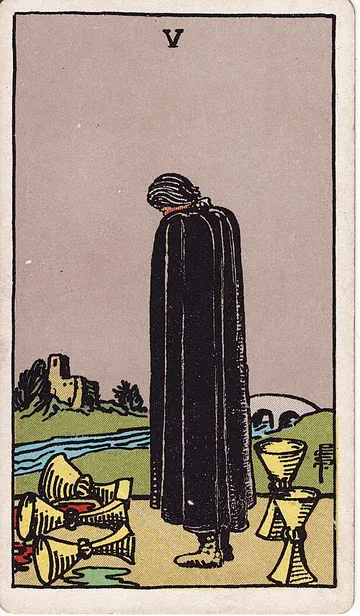
The withdrawal hardens into mourning. Where the four of cups is the soft refusal of the offered cup, the five of cups is the moment the seeker turns toward what was previously unseen and finds it gone. Three cups spilled, two still standing, the figure now grieving the loss he could have avoided by looking up earlier. This combination often arrives when a seeker has spent a long season folded against an offer, and the offer has finally been withdrawn. The pairing is not punitive; it is precise. Mourning the missed cup is part of how the seeker re-learns to look up at the next one.
Four of Cups + Eight of Cups
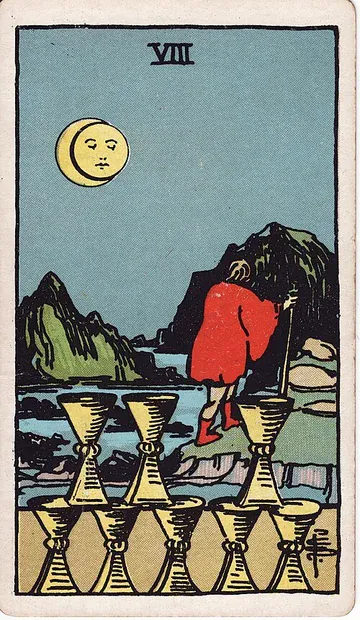
The withdrawal converts into the deliberate leaving. Where the four of cups is the inability to engage with what is, the eight of cups is the conscious choice to walk away from a sufficient life in search of a true one. The pairing is the maturing of the four's apathy into the eight's pilgrimage. Often, the four had to be felt fully before the eight became possible — the seeker had to stop being able to live in the existing arrangement before the leaving could be an honest act rather than a panic. Together, the cards describe a transition that is not failure; it is the ripening of a refusal into a choice.
Four of Cups + Four of Swords
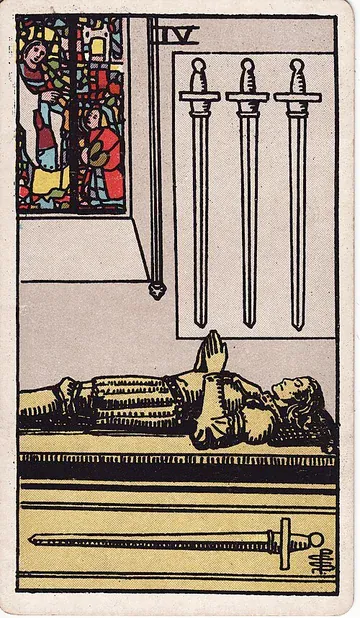
The series sibling — same number, different suit. The four of cups is the unchosen apathy; the four of swords is the chosen rest. Together they ask the seeker to convert the involuntary fold into a deliberate practice of restoration. The four of swords gives the four of cups its dignity: yes, you need to withdraw — but withdraw on purpose, on a schedule, with a return date. Apathy without container is a slow leak. Apathy with container is sabbath. The pairing is the deck teaching the seeker how to rest without losing themselves.
Four of Cups + The Hanged Man
The major modulator and tonal contrast. The four of cups is the unconscious shutdown; The Hanged Man is the chosen suspension. Together they describe the difference between a life lived from a folded posture and a life lived from a deliberate inversion. The Hanged Man chose his rope. The figure under the tree did not choose his fold. The pairing invites the seeker to take the apathy and convert it into a real spiritual suspension — to stop the world deliberately, with a teacher or a tradition or a witness, rather than letting the world stop on its own and calling the result a path.
Four of Cups + Nine of Cups
The wish-card returning to the seeker who has stopped recognizing the wish. The nine of cups is the granted wish, the satisfaction at full saturation, the figure who knows he has received what he asked for. The four of cups is what happens four cups earlier, when the original wish is being offered and the seeker cannot yet let himself want it. Together the cards describe the same suit's beginning and end of an arc — and they ask the seeker, with great gentleness, whether the wish that is hovering today is the same wish that, once accepted, becomes the fullness of the nine. Looking up at the cloud is how the four becomes the nine. Refusing to look up is how the four stays the four for years.
Card Combinations
Five of Cups
The withdrawal hardens into mourning. Three cups spilled, two still standing — the figure who refused to look up at the cloud has now turned around and is grieving the cup he could have taken. The pairing is precise: the four was the soft refusal, the five is the cost of the refusal. The work is to feel the loss without becoming captured by it, and to remember that two cups still stand. Looking up at the next cloud is what converts mourning into motion.
Eight of Cups
Withdrawal converted into deliberate departure. The four of cups is the inability to engage with what is; the eight of cups is the conscious leaving of a sufficient life in pursuit of a true one. The eight is what the four ripens into when the seeker has felt the apathy fully enough to know it is information, not laziness. The combination describes the maturing of refusal into choice — the moment a closed posture becomes an honest pilgrimage.
Four of Swords
Same number, different suit — the involuntary fold paired with the chosen rest. The four of cups is apathy without container; the four of swords is sabbath. Together they ask the seeker to convert the unconscious withdrawal into a deliberate practice of restoration. Withdraw on purpose, on a schedule, with a return date. Apathy with structure becomes restorative. Apathy without structure becomes a slow leak the seeker cannot find.
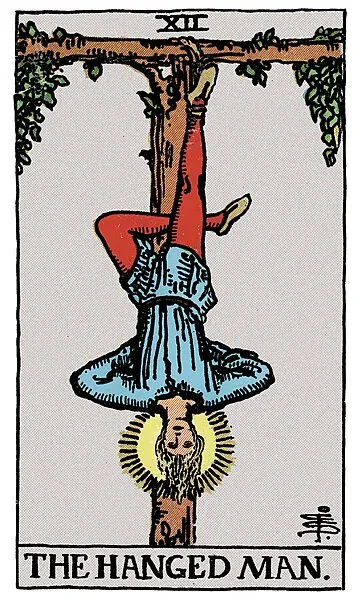
The Hanged Man
Major modulator and tonal contrast. The four of cups is the unconscious shutdown; The Hanged Man is the chosen suspension. The Hanged Man chose his rope; the figure under the tree did not choose his fold. The pairing invites the seeker to convert the apathy into a real spiritual suspension — to stop the world deliberately, with a teacher or tradition or witness, rather than letting the world stop on its own and calling the result a path.
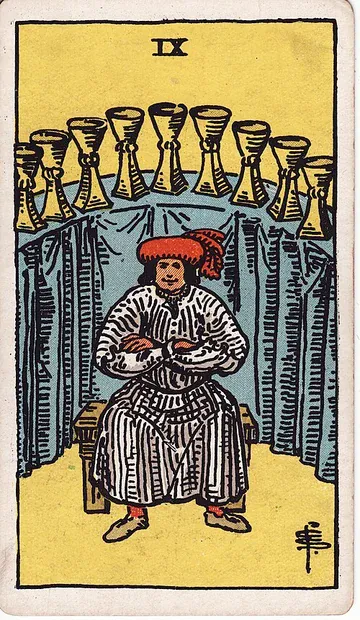
Nine of Cups
The wish-card returning to the seeker who has stopped recognizing the wish. The nine is the granted wish at full saturation; the four is what happens earlier, when the original wish is being offered and the seeker cannot yet let himself want it. The two cards mark the beginning and the end of the same arc. Looking up at the cloud is how the four becomes the nine. Refusing to look up is how the four stays the four for years, while the cloud quietly closes.
Frequently Asked Questions
What does the Four of Cups mean?
The Four of Cups is the withdrawal card. A figure sits under a tree with three full cups before him on the grass and a fourth offered from a cloud he refuses to see. The card describes satiety into apathy — the moment a known good has stopped moving you, and a new offer is hovering only briefly. As the Moon in Cancer's third decan at Chesed, it carries the texture of feeling at its thickest, closest to its own stagnation.
Is the refusal in the Four of Cups a real no, or just a face that has not looked up?
A face that has not looked up — which is why the answer is workable. On its surface, the Four of Cups is a soft no — the card's natural posture is the folded arms and lowered eyes that decline the offered cup before the seeker registers the declining. But the cup from the cloud is the yes hidden inside the image. Read the card as no on current trajectory, yes if the seeker looks up. Defer major decisions until the unfolding arrives; choices made from inside the apathy tend to misjudge what is actually being offered.
Does the Four of Cups mean the relationship is over, or that I have stopped noticing it?
The second, in nearly every spread: this is the bond that has stopped moving you, not the bond that has ended. The relationship is not broken — the partner has not betrayed you — the early infatuation has simply gone slack and nothing has yet replaced it. For long bonds, the card warns against reading routine quietness as the disappearance of feeling. For new sparks, it warns of premature jadedness. For the single seeker, it describes the closed-circle problem: the comfort of solo life so well-curated that the cloud has stopped being scanned for.
If someone feels like the Four of Cups, are their closed eyes about me?
Almost never. The eyes in this card are closed against the whole world, and you happen to be inside the world. The other person feels something for you, and the something is currently obscured — even from them — by fatigue, distraction, or unfinished feeling about something else. They have not stopped caring; they have closed the eyes that would let the caring be felt by you. Read the card as warmth narrowed, not warmth vanished. Opening those eyes is a movement only they can perform.
Is the Four of Cups a depression card?
The Four of Cups is the antechamber of depression rather than depression itself — the soft refusal of offerings, the closed eyes that have not yet hardened into despair. Most adults pass through the card several times across a life without entering clinical territory. But the card is also a precise early warning: if the apathy has lasted months and is no longer responsive to small unfoldings, the four of cups has stopped describing your weather and a different conversation is needed. Reach out to a practitioner before the four becomes a different card.