
King of Cups Tarot Card · Core Meaning
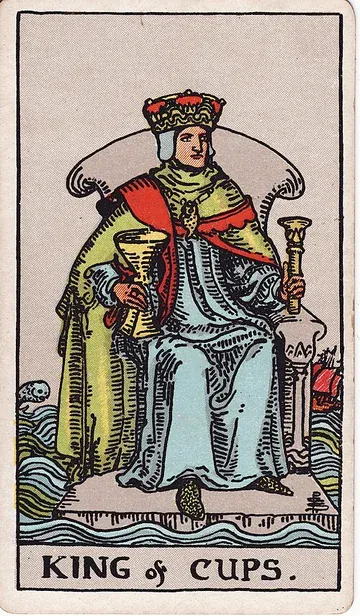
The King of Cups sits on a stone throne that has risen directly out of gray-green water. The waves on either side of him are high and unmistakable — they are not painted as a calm sea — and yet none of them touches the throne, none of them touches the long blue robe, none of them touches the modest gold crown. He holds a chalice in one hand and a scepter in the other and refuses, in the entire image, to set either of them down. Far behind him a ship sails steadily toward somewhere he is not chasing. Closer in, a great fish breaks the surface, leaps once into the open air, and disappears. The king does not look at the fish. He does not look at the ship. His gaze passes through both of them toward something further off the edge of the card.
This is the card's signature tension: feeling held, not suppressed. The cup is full and the scepter is ordered, and the man holding them has decided that neither of those tools is allowed to dominate the other. The waves are the waves of a real life — grief, anger, longing, the news that arrived this morning, the conversation that did not go well last week — and the king has chosen, as a daily practice, to sit at the center of them rather than to climb out and watch from a beach. His steadiness is not avoidance. It is a way of being inside the water without being pulled.
The calendar he is assigned describes the same steadiness: as the King of Cups he carries the Libra third decan (Mars in Libra, ruled traditionally by the late-October temperament) and extends across the first two decans of Scorpio (Mars and Sun in Scorpio) — the calendar window 10/13–11/12. That is a span where late-autumn balance gives way to fixed-water depth: the diplomat at the threshold of the underworld, the one who has seen what is beneath the surface and has chosen, deliberately, to remain at the table. In the Golden Dawn court schema, he is water-of-air — the steady wind that travels along the surface of the sea, giving the water a direction without pretending to still it. He does not ask the ocean to be calm. He gives it a heading.
Notice the palette while you are looking. Nothing in this card is warm. The water is storm-gray going down into deep blue, the robe is the blue of open sea rather than sky, and the crown is small — the one bright object in a picture that has otherwise decided against brightness. The metal that belongs to this card is silver rather than gold: the cooler, more reflective metal, the one that takes the light of something else and hands it back without heat. The air off the card smells of salt-wind and tarred rope, which is a working boat's smell and not a holiday one. And the hour the card keeps is the night watch — the stretch when the passengers are asleep and one person stays awake at the wheel because somebody has to. The whole temperament sits in that detail. The King of Cups is not the celebration. He is the one still awake underneath it.
It helps to hear him against the other three courts of his own suit. The Page of Cups meets feeling as news: a fish appears in his cup and he is astonished by it. The Knight rides feeling as an errand, carrying the cup across country to deliver it to a particular person. The Queen inhabits feeling — she is inside the water with the water, and her gift is that she can be reached there. The King has been all three and now governs. He is the only one of the four with a second object in his other hand, and the scepter is not a weapon: it is the tool for holding a shape steady while feeling moves through it. When this card turns up beside other courts in a spread, that difference is the reading. He is not the one having the feeling. He is the one deciding what the household does about it.
Read the King of Cups as the elder who arrives in your life — sometimes as a literal person, sometimes as a posture you grow into — when the work is no longer to feel things harder but to hold them without dropping the agenda. He is the senior at the meeting who waits until the end before he speaks. He is the partner who hears the difficult thing out before he answers. He is the part of yourself that has stopped needing to win the argument and has started caring whether the relationship survives it. The card describes the shape of mature emotional authority: containment that has stopped being defensive, kindness that has stopped being naive, command that has stopped requiring volume. Whatever the spread asks, the King of Cups answers with the weather of someone who has lived through several seasons and now keeps his counsel because counsel-keeping is itself the gift.
King of Cups · Love & Relationships
Chemistry is not the load-bearing skill in this partnership; the governance of feeling is, and the King of Cups upright is the card of people who have learned the difference. The relationship has weathered a storm or three. The arguments that used to end in slammed doors now end in kettles being put on. Whatever the architecture — long marriage, second-chance pairing, slow rebuilding after a wound — the card describes the season in which both of you have learned that holding the cup and the scepter at the same time is the entire job of love.
For an existing partnership, the King of Cups upright reads as the year you stop being afraid of the difficult conversations. Your partner has become someone who can hear the sentence "I have been quietly unhappy about this since spring" without flinching, without weaponizing it back, without making it a referendum on the entire relationship. They listen until the end. They top up the tea. They ask one question no one has asked yet. The love this card describes is not flashy. It is a love in which the second glass keeps getting poured.
For a new spark, the King of Cups upright often reads as a literal person — the older partner, the senior who has noticed you, the mentor who has begun to feel like more than a mentor. Court cards in tarot often describe the actual human who is standing in your weather, and this one is unusually specific: a man (or a person carrying that energetic register) who is somewhere past the early-fire years, whose attention is steady, whose questions are good. Whether the connection turns into a partnership depends entirely on the second cup: does the older one keep the room safe enough for you to bring your full feeling in? If yes, a real bond is possible. If no — if the steadiness is being used to keep you small — see the reversed reading.
For a single seeker who is asking whether love is possible, the answer this card gives is yes — and the love that is possible is not the dramatic love of one's twenties. It is the love of a partner who is accountable to their own water, who does not flood you with their unprocessed feelings, who can sit at a table with you for an hour and ask about what you actually said rather than what they assumed you said. The card is also a hint about the kind of person you are likely to meet now: someone older in the truest sense — older in patience, older in the willingness to listen, older in the ability to hold feeling without performing it.
For love after a wound, the King of Cups is one of the deck's gentlest companions. He describes the season after the recovery has actually taken — when your nervous system has stopped scanning the horizon for the next betrayal, when you have re-learned the difference between someone being temporarily quiet and someone being secretly furious. The card says the boat is seaworthy again. You can take it back out.
A note on the card's particular love language: the King of Cups loves the way a diplomat loves. He listens completely before he speaks. He notices what you mentioned in passing three weeks ago and brings it up again gently, in private, when the moment is right. He does not announce his feelings the way a Knight of Cups would; he reveals them slowly, in the way he keeps showing up the morning after the hard night. If you have been raised on louder love, this love can read as cool. It is not cool. It is fed. It is steady. It is the love of someone who has decided you are worth the long sentence rather than the loud one.
For the question of whether someone is in love with you and the King of Cups arrives upright, read it as a yes that you might miss if you are listening for fanfare. They have made their feeling for you part of their internal architecture — part of how they organize their week, part of the people they call when something good happens, part of what they think about on the long drives. They will not bring it to you packaged. They will let it accumulate until the structure of their life makes the answer obvious. Look at the structure. The structure tells the truth.
For long-distance or asymmetrical situations, the King of Cups upright reads as the partner who is keeping the long view. They are not reacting to every text turnaround. They are not making the relationship the daily emergency. They are holding their part of the arrangement steadily and waiting for the season when proximity is possible again. Trust the steadiness if you are also being seen — and if you are not being seen, see the reversed section.
For polyamorous, blended, or otherwise non-default relational structures, the King of Cups upright is one of the better cards you can draw. He describes the partner who can hold complexity without resentment, who can be told the difficult thing about another partner without making it about himself, who carries the unusual structure with the same steadiness he carries everything else. Mature relating, in any configuration, is what this card teaches.
For age-gap relationships specifically — the love between people who are at substantially different life stages — the King of Cups upright is one of the deck's most clarifying cards. He describes the older partner whose seniority is a gift to the relationship rather than a power imbalance: their experience is being used to make the partnership safer and more spacious, not to keep the younger partner in a junior position. The card asks the younger partner whether they feel larger in the relationship or smaller. Larger is the upright King. Smaller is a different reading. The age difference is not the question; the way it is being held is.
King of Cups · As Feelings
Deeply, steadily, and with deliberate restraint — the King of Cups gives a feeling that has been governed rather than performed. They do not feel less because they are not announcing it. They feel exactly what you would hope a senior, mature, emotionally literate person would feel — and they are choosing, on purpose, to deliver the feeling in a register you may not initially recognize as feeling.
The body language of the King of Cups in feelings is a person who has gone quiet around the topic of you in particular. Not avoidant quiet. Considered quiet. They have stopped joking about you in the casual way they used to. The mention of you in a group conversation produces a small pause in them before they answer. They are protecting the way they feel from the heat of public commentary — not because the feeling is shameful, but because the feeling matters enough that they would rather it be private until it is ready to be public.
If they are reserved by nature, the King of Cups personality reaches a kind of double-quiet. The reservation is layered. They process at depth, then they govern what is allowed to surface, then they arrange the surfaced piece into a sentence — and only the sentence reaches you. This does not mean you are getting a small piece of what they feel. It means you are getting the considered version. A reserved King of Cups in love writes letters the night before he sends them.
If they are demonstrative, the King of Cups in feelings is unusually beautiful. Their warmth is not effusive — it is consistent. They show up. They notice. They take care of the practical things without being asked. They make you the kind of breakfast that took planning the night before. They are demonstrative in the way a senior captain is demonstrative on his last voyage: he does not say much; he simply gets the ship home, every time, in every weather.
For a partner you have been with a long time, the King of Cups in feelings means they have arrived at peace with you. The years of hoping you would change have ended. The years of secretly being disappointed have passed. They are not settling — they are accepting, which is a different and richer thing. They love who you actually are, including the parts they used to wish were different. This is one of the most generous feeling-states a long bond can reach, and it is what the card is pointing at.
For a new connection, the King of Cups in feelings can mean someone older or more emotionally seasoned than you who is taking the prospect of you seriously. They are not playing games. They are also not rushing. They want to see how you handle the small weather before they invest in the long voyage. The card asks: are you also being a King of Cups about it? Are you also showing your steadiness rather than your charm?
Watch how the feeling behaves in the forty-eight hours after a disagreement — this is where the King of Cups is most legible and most often misread. He goes quiet. Not the sulking quiet of someone assembling a case against you, but the quiet of a person who has decided not to speak until the thing he says will still be true tomorrow. He is composing. Somewhere inside that window he writes the sentence three or four times in his head. Then he comes back, usually on an ordinary errand and usually sideways: he brings the coffee, he asks about something unrelated, and only then does he say the one accurate paragraph he has been carrying. If the silence gets read as withdrawal and the temperature is raised in the meantime, the accurate paragraph never arrives — it gets replaced by damage control. The silence was the composing. Give it the two days.
There is a specific caution embedded in this beautiful card. The King of Cups, in feelings, can confuse self-containment with intimacy. They can feel something deeply and assume — wrongly — that the depth itself is communication. They can love you into invisibility by holding their feeling so tightly that it never reaches your hands. If you sense the depth but never receive the sentence, the card invites a direct ask. He responds well to direct questions asked without heat. He responds badly to interrogation. The difference is your tone.
For someone you have lost contact with — a quiet ex, a fallen-away friend, a senior colleague you no longer see — the King of Cups in feelings says they think of you with steady fondness. Not longing, not regret in the dramatic sense — a settled, ongoing care. They have not made a fuss about you. They have also not forgotten you. If you reach out, the response will be measured and warm. If you do not, the care continues anyway in their interior.
Take the King of Cups in feelings as one of the most reassuring cards you can draw about another person's heart. Whatever they feel, it is governed. Whatever they feel, it is durable. Whatever they feel, it is unlikely to flip into its opposite next week. The work, if there is work, is to learn how to read love delivered in this register.
King of Cups · Career & Work
Some seniors govern by listening, and in a work reading the King of Cups upright is always one of them. The role this card describes — or the role this card asks you to step into — is the one in which composure is the load-bearing skill. Not the brilliant pitch. Not the hot take. The capacity to sit at a heated meeting, let everyone finish, and offer the one sentence that puts the room back on its keel.
For someone asking whether a current role is working, the King of Cups upright answers yes — and adds that the role is teaching you a kind of authority you would not have learned in a noisier seat. Whatever your title, whatever your visibility, the work is shaping you into someone whose presence regulates the room. Colleagues are starting to look at you when the conversation gets tense. Difficult clients are asking specifically for you. The promotion may not have arrived in the formal sense, but the seat has already shifted in the informal one.
For someone considering a new role, the King of Cups upright reads as a positive signal with a grown-up condition. The role will deliver what it promises. The team will be a real team. The pay and the title will hold. The condition is that you be willing to be the steady one — the person who carries the meeting, who absorbs the founder's panic without forwarding it to the team, who can be told a difficult truth without making the messenger pay for it. If that posture excites you, the role is a fit. If it sounds exhausting, sit with the card a while longer; the role is asking for an interior you may not yet have built.
For an entrepreneur or freelancer, the King of Cups upright is the card of the founder who has stopped being a founder in the manic sense and has become an operator in the durable one. The pivots have ended. The narrative has settled. The team is small and competent. You are no longer selling the dream every Monday morning; you are running the actual ship. This is a season many founders never reach. The card celebrates it. It also asks: have you arranged your life so that the operator-version of you is sustainable for ten more years? The Knight builds the company. The King keeps it.
For a creative practice, the King of Cups upright describes the artist who has acquired range. The early work was fueled by intensity. The middle work was fueled by craft. The current work — the work this card sits in — is fueled by judgment. You know what to leave out. You know when the piece is done. You know which feedback to integrate and which to politely set aside. The audience is real and specific, and you have stopped chasing the wider one. This is a deeply mature creative season; honor it by making the work that only this version of you could make.
For job-search, layoff, or transition seasons, the King of Cups upright is the card of the seasoned candidate who interviews well precisely because they have stopped trying. The desperation is gone. The need to impress is gone. What remains is competence and warmth. Hiring managers respond to this. The role you land may not be the obvious next step on the ladder; it may be a sideways move into a seat that uses what you actually carry. Trust the sideways move.
For someone navigating a difficult senior — a manager, a board member, a difficult client — the King of Cups upright reads as the posture that survives. Match their seriousness with seriousness. Do not match their volume. Do not perform anxiety to prove you understand the stakes. Show them, instead, the steadiness of someone who can hold the difficulty without forwarding it. The senior who is testing you is, often, looking for someone who can carry weight. This card describes that someone.
For team-leads and managers, the King of Cups upright is the card that asks whether your direct reports have stopped fearing your reactions. Not whether they fear consequences — fear of poor work, fear of missed commitments, those can stay — but whether they have stopped fearing the moment of telling you the bad news. The King of Cups is the manager whose first response to "I made a mistake" is a steady question, not a face. Build that posture. The work the team can do under it is the work that compounds.
For long, slow projects — the book, the platform, the practice — the King of Cups upright says continue. The work is on a timeline that requires endurance more than spark. You are in the year that does not look like progress to anyone except you. Honor that year. The ship in the distance is moving toward port even when the wind is barely visible.
For someone considering retirement, semi-retirement, or the deliberate winding-down of a career — the senior who has done the long work and is contemplating what comes next — the King of Cups upright is unusually generous. He describes the elder who has earned the right to step back without it being framed as departure. The wisdom that has accumulated is not lost when the title is set aside. It becomes available in a different way: mentorship, board seats, the quiet phone call from a younger colleague, the book that finally gets written. The card honors the transition. It also asks for it to be deliberate rather than defensive.
King of Cups · Money & Finances
Stewardship is the word, and the King of Cups upright practices it the way he holds the cup — level, without gripping. The relationship with money is not flashy and is not anxious. The instinct, every time, is to hold the cup steady — to neither hoard out of fear nor spend out of mood. The card describes the financial life of someone who has been through at least one bad year and has chosen, as a result, to organize their resources around resilience rather than performance.
For a question about a financial gamble or speculative move, the King of Cups upright answers with patience. The card does not say no. It says wait one cycle. Watch the thing you are about to invest in for one more season. The risk is acceptable — but only if you can afford to hold it for the duration without checking the price every morning. If you cannot, the gamble is wrong-sized for your nervous system, regardless of the math.
For someone managing scarcity, the King of Cups upright reads as a return to control. The chaos of the last stretch is ending. The systems you have been quietly building — the spreadsheet you check every Sunday, the conversation with the partner about the joint account, the small monthly transfer that almost did not happen — are starting to compound. The card validates the boring practice. Continue it.
For a major purchase or commitment — house, car, school for a child, business equipment — the King of Cups upright is favorable. The decision has been made with the right amount of feeling and the right amount of order. You know why you want it. You have run the numbers. The purchase will not become an albatross. Sign the paperwork.
For investments, savings, and long-horizon money, the King of Cups upright is the card of the steady allocator. Not the picker of winners — the holder of a sensible, durable portfolio. The card warns gently against being talked into excitement by a louder voice in your circle. You know your risk tolerance. Theirs is not yours.
For windfall, inheritance, or unexpected income, the card asks for a deliberate pause. Do not move the money for thirty days. Let the news settle. Then decide. The King of Cups is allergic to the impulsive decision made in the temporary excitement of new resources. The wealth that lasts is the wealth that was placed by a calm version of yourself.
For debt and recovery, the King of Cups upright is one of the deck's better cards. He confirms the long climb is being executed correctly. The discipline is real. The shame that used to surround the topic has loosened into competence. Continue the schedule. The horizon is closer than it feels on any given Tuesday.
A practical move when this card appears in a money question: open one document that you have been quietly avoiding. The unopened bank statement. The retirement account you have not logged into in eighteen months. The freelance invoice that has been outstanding too long. The card responds to the small, calm act of looking at the actual number — and the number, looked at squarely, is almost always less frightening than the unopened version.
For someone with shared finances — couples, business partners, family arrangements that involve pooled resources — the King of Cups upright reads as the season in which the financial conversation has stopped being a flashpoint and has become a routine. The monthly review happens. The disagreements about priorities are had at the table rather than in the parking lot. The senior partner in the arrangement has stopped using their seniority to override the junior partner's instincts. The card honors this rhythm and asks for it to be maintained even when the temptation arises to skip a quarter.
The card's signature trap with money is the dignified avoidance of the small mention. The King of Cups will speak readily about strategy, philosophy, and long-term planning — and will quietly skip the small fight about who actually paid for dinner last weekend. The unspoken small accumulates faster than the spoken large. The card invites the willingness to bring up the small thing while it is still small. The tea kettle, topped up early, prevents the larger boil.
King of Cups · Health
The waves on either side of the throne are still high, and the throne is still dry; in a health reading the King of Cups upright is a nervous system that has learned to ride rather than be capsized. Sleep has stabilized. Digestion is working. The chronic alarm that sat in the chest for years has loosened. Whatever the specific picture, the card describes a body that has found a sustainable rhythm and is being rewarded for it.
The card's specific somatic territory is the chest — lungs and diaphragm — and the felt sense of breath that can travel all the way down. For someone managing anxiety or panic, the King of Cups upright describes the season in which the breath has come back. The exhale is full. The inhale is not stolen. There is room in the rib cage for an actual feeling to arrive without immediately becoming an emergency.
For someone managing a chronic condition, the King of Cups upright describes a stable plateau that has been earned through discipline. The medication is being taken on schedule. The appointments are being kept. The lifestyle adjustments that felt impossible in year one have become the daily structure of year three. The card honors the boring competence that has produced this stability.
The temperament this card sits inside is phlegmatic with an inner wind — outwardly steady, inwardly observant. For someone whose body tends to hold rather than discharge — water people who store grief in the shoulders, who carry stress in the digestion, who absorb other people's moods — the King of Cups upright is the season in which the holding has become more conscious. You know you are taking on the weather of others. You are learning how to set it down at the end of the day. The practice of putting it down is the medicine.
For acute illness or injury, the card reads as a body that is working with the treatment rather than against it. The inflammation is responding. The bone is knitting. The system is willing. Continue the practical care. Keep the appointments. Take the medicine. The card is the morning the healing begins to be felt.
For mental health questions, the King of Cups upright is the card of the seasoned patient — the person who has done the therapy, kept the medication, built the boundaries, and has now arrived at a relationship with their own interior that is not constantly emergency-oriented. The depression has not disappeared, perhaps, but its hold has changed. The anxiety has not vanished, but its volume is lower. None of this is medical advice — keep the practitioners, take the medicine, do the work — but the card describes the season in which the work has begun to be a practice rather than a crisis.
For someone older — a parent, a grandparent, a senior friend — the King of Cups upright in their health reading describes the ability to age with composure. The body's loosening of strength is being met with grace rather than rage. The conversations about end-of-life care, about wills, about the future — they are being had. This is one of the quietly beautiful health-readings the deck offers for elders.
One reading of this card the image makes unavoidable: the man is holding a cup, and for a great many people the evening cup is the health question nobody wants asked out loud. Upright, the King of Cups describes a relationship with the glass that has become conscious — poured deliberately, or poured less, or set down some years ago and not missed the way it was once missed. The drink, whatever it is, has stopped being the thing that ends the day on your behalf. What the card notices is the difference between a pleasure and a governor. A pleasure can be declined on an ordinary Tuesday without the evening feeling wrong. If declining costs nothing, the card is upright about it. If declining costs something, that is worth saying out loud to somebody qualified to hear it.
A practical attention when this card appears: practice one full breath, slowly, before you respond to the next difficult message. The card lives in the diaphragm. Re-engaging the diaphragm re-engages the card.
King of Cups · Spirituality
There comes a point where seeking turns into keeping, and the King of Cups upright is the elder standing on the far side of it. The early spiritual life was about openings — the first meditation that worked, the first teacher who landed, the first text that rearranged your interior. The middle was about practices. The current season — the one this card sits in — is about stewardship. You are no longer the seeker walking up to the spring. You are the one who keeps the well clean for the next person who arrives.
The card's signature image carries the spiritual weight: a king on a stone throne in the middle of the sea, holding cup and scepter, refusing to set either down. The cup is feeling. The scepter is order. The water is the unconscious — or grace, or the soul, or whatever name your tradition has given the thing that is larger than ego and is constantly underneath the day. The king's posture is the posture this card teaches: do not climb out of the water, do not pretend the water is calm, do not be moved by every wave — sit in the middle of it and continue to hold both tools.
For seekers in active practice, the King of Cups upright describes the maturation of the practice into a quiet daily rhythm. The drama of insight has subsided. The desire to tell anyone about the meditation has ended. The work happens early in the morning, or late at night, or in the same chair on the same day, and you have stopped tracking it because tracking it is no longer the point. The practice is the practice. The fruit shows up in how you handle the difficult email, not in how good the sit was.
For seekers in contemplative or devotional traditions — Christian mystic, Sufi, Buddhist, Kabbalist, ancestor-keeper — the King of Cups upright reads as a stage of the path the tradition would recognize: the elder, the spiritual director, the lay teacher, the one whose role is now to hold space for younger seekers rather than to dramatically progress on their own. If you have been resisting that role, the card invites you to notice that you have already, quietly, become it. People are asking you the questions. You are answering them well. The role is here.
For seekers exploring belief — uncertain, questioning, in transition between cosmologies — the King of Cups upright says hold both cup and scepter. Do not abandon the rigorous mind for the felt experience. Do not abandon the felt experience for the rigorous mind. The card is the integration of the two. The seeker who can sit with mystery and with method at the same time, refusing to drop either, is the seeker the card teaches.
For questions about path, the King of Cups upright says you are aligned with a vocation that may not look like a vocation. The work of being a steady human in a chaotic decade is itself the spiritual work. Continue it. The leaping fish in the image — feeling rising up out of the depths to be acknowledged — is the daily encounter the path consists of. Do not flinch. Do not cradle. Acknowledge: yes, it is there. Then return to the throne.
A practice the card invites, doable in thirty minutes: sit somewhere you can see water — actual water if possible, photograph or video if not. Do nothing for the duration. Let one feeling rise. Let it pass. Notice what is left. The card returns to itself through this practice more reliably than through reading.
King of Cups · Yes or No
Yes — but the considered yes.
The King of Cups upright is one of the deck's more thoughtful affirmatives. It does not offer the clean burst of yes that a Sun or a Three of Cups would offer. It offers the yes of the senior who has weighed the question, looked at the person asking it, and decided that the answer is in your favor. The yes arrives without fanfare. The yes also does not change.
For questions about a relationship — should I trust this person, will the partner come back, is this love real — the King of Cups upright says yes, and adds that the yes is conditional on you receiving the answer the way the answer is being delivered. The card describes a love offered in the register of steadiness, not the register of fireworks. If you are looking for the fireworks version, the yes goes unrecognized. Look at the structure of the relationship rather than its tempo. The structure is the answer.
For questions about a decision — should I take the role, should I move, should I commit — the King of Cups upright says yes, and adds that your hesitation is itself a sign that you are taking the decision seriously enough to make it well. The card respects deliberation. The card does not respect endless second-guessing. Decide within the season. Then carry the decision the way the king carries the cup.
For questions about whether something is honest — is this offer real, is the person being straight with you, will the plan hold — the King of Cups upright says yes. The card has very little tolerance for hidden agendas in its upright form. What you are being shown is what is. The senior at the other side of the table is not playing a long game against you. Trust the seriousness.
For questions about timing — will it happen soon — the King of Cups upright describes a tempo slower than you want and faster than you fear. The card is allergic to urgency in either direction. Whatever the soonness, looking back on this season, the pace tends to read as correct.
For binary questions about whether to act — should I send the message, should I have the conversation, should I make the move — the King of Cups upright answers yes, with the further note that you should send it from your most composed version, not your most wounded one. Wait until the pulse has settled. Then write the sentence. Then send.
For questions about whether someone will keep their word, whether a contract will hold, whether a promise made in private will be honored, the King of Cups upright is one of the most reassuring cards in the deck. He keeps his word. He honors the contract. The card describes the kind of person whose private behavior matches their public statements, and answers in their character.
Should I step in? When the question is about somebody else's difficulty rather than your own, the King of Cups upright gives a qualified yes that most seekers hear as a no. Be available; do not arrive. The card describes the elder who is unmistakably reachable and who does not cross the water uninvited. Make the offer once, concretely, with a door in it — I am around Thursday, the kettle is on — and then hold your position without renewing the offer weekly. If the person comes, you are the throne in the water and you can hold a great deal of what they bring. If they do not come, the offer was still the right move: a standing invitation is a kind of shelter, and unaccepted it still does more than an intervention would have done unasked.
If the question was: am I being too cautious? The card answers: probably not. The caution is part of the wisdom.
King of Cups · Advice
Be the last to speak. In whatever room you walk into this week — the meeting, the family dinner, the difficult conversation with the partner, the negotiation — let everyone else finish their sentences before you offer yours. Not as a tactic. As a discipline. The King of Cups upright is insisting that the seat at the head of the table belongs to the person who has heard the room before they have shaped it.
If there is one specific instruction the card offers, it is to top up the tea. When the conversation begins to heat — when voices rise, when the temperature in the room shifts, when the meeting starts to feel like a fight — do the small mundane act that interrupts the climb. Refill the cup. Stand up briefly. Open a window. The interruption is not avoidance; it is the wind on the surface of the sea, giving the water a different direction. Then ask one question no one has asked yet. The question is your contribution. The question is the scepter.
A second instruction: hold the cup and the scepter at once. Refuse the false choice between feeling and order. The card describes a kind of authority that does not require you to harden in order to function, and a kind of feeling that does not require you to abandon structure in order to be honored. If you have been told you are too sensitive to lead, the card disagrees. If you have been told you are too rigorous to feel, the card disagrees with that too. Be the one who carries both.
A third instruction: do not chase the ship. The King of Cups looks past the leaping fish and the distant ship without rising from the throne. The instruction is steady positioning rather than reactive pursuit. Whatever the news is this week — the friend's promotion, the rival's launch, the opportunity that flashed past — your position is itself a direction. Do not chase. Maintain. The right ships will sail toward where you already are.
A fourth instruction, gentler than the others: let one feeling arrive completely before you respond to it. The card is not asking you to suppress. It is asking you to receive. When the difficult feeling rises — the grief, the anger, the longing — sit with it for the full duration before you turn it into action. The action that is born of the fully-felt feeling is governed. The action that is born of the half-felt one becomes a fight you did not mean to start.
A fifth instruction, for the seeker who has been the steady one for everyone for a long time: receive one piece of care this week without deflecting it. When the friend asks how you are doing, answer honestly. When the partner offers to take the difficult thing off your plate, let them. When someone notices that you look tired, do not say "I am fine." The King of Cups upright has earned the right to be cared for. The throne does not become more durable through being held aloft alone; it becomes more durable through being part of an actual community in which care moves in both directions.
Practical advice for the day the card appears: in one conversation today, be the person who waits. Let the other person finish three sentences in a row before you speak. Notice what they say in the third sentence that they would not have said in the first. That third sentence is what the King of Cups exists to receive.
King of Cups · Card Combinations
The King of Cups in combination is a card that modulates rather than dominates. He is rarely the loudest card in any spread, and that quietness is the point — his presence steadies the cards around him, gives the other suits a center of gravity, and asks the louder cards (Wands, Swords) whether they have considered the long view. The pairings below are the five that most reliably teach something the cards do not say alone.
King of Cups + Queen of Cups
The two regents of the suit at the same table. Water-of-water meets water-of-air. The Queen feels everything the room is feeling and lets the feeling be visible on her face; the King feels everything too but governs which piece is allowed to surface. Together they are a partnership in which one carries the felt life and the other carries the framing — and the rare combination of these two is one of the deepest mature loves the deck can describe. In a question about another person, the pairing often points to a relationship in which both partners are emotionally adult and have stopped performing adolescent versions of love at each other. In a self-reading, the two regents together ask whether you have access to both registers within yourself: the queen who feels, and the king who holds.
King of Cups + King of Swords
A king-meets-king tonal contrast — water at the helm of feeling beside air at the helm of mind. Neither one is wrong; together they are a council. The King of Swords cuts; the King of Cups holds. In a career reading, this pairing often describes the partnership of an analytical leader and an emotionally seasoned one — and the work that comes out of that partnership tends to be unusually durable. In a love or relational reading, the pairing can warn of two people who are each correct in their own register and are talking past each other; the bridge is asking the King of Swords for one more piece of evidence and asking the King of Cups for one more piece of feeling, until the picture each has becomes legible to the other.
King of Cups + Temperance
Temperance is the angel mixing water between two cups; the King of Cups is the human form of that mixing. When these two appear together, the reading is about integration — the mixing of two things that did not previously meet. Two communities. Two parts of the self. Two sides of a difficult negotiation. The combination is one of the deck's most generous in mediation contexts: it confirms that the mediator has both the steadiness (King) and the cosmic timing (Temperance) to make the impossible blend work. In a personal reading, the pairing describes a season of inner alchemy — feeling and structure mixing in a way that produces a third, calmer, more durable self.
King of Cups + Justice
The King of Cups carries the Libra third decan, and Justice carries the Libra archetype directly — so this pairing is a doubling of the same governing principle from two altitudes. The reading becomes about right-sized decision making in a situation that requires emotional intelligence as much as it requires moral clarity. In legal, contractual, or formal-decision contexts, the pairing is favorable: the verdict will be considered, the verdict will be fair, and the person delivering it will have weighed the human cost. In a personal reading, the pairing asks whether you have been Libra-balanced in a recent decision — neither too cold nor too soft — and whether you can carry the verdict with the steadiness the King describes.
King of Cups + Five of Cups
A tonal contrast pair — the steady king meets the spilled cups at the throne's feet. The Five describes a person standing in front of three knocked-over cups, mourning the lost, unable to see the two cups still standing behind them. When the King of Cups arrives in the same spread, he is the older self looking at the younger self in grief — and the offer is composure. Not a denial of the loss. Not a rush to recovery. A steadying presence at the edge of the spilled water, asking the younger one to turn around. The combination is one of the most pastoral the deck offers. In a self-reading, the pairing is about extending to your own mourning self the kindness you would extend to a younger sibling. In a reading about another person, the King of Cups arriving alongside Five of Cups often describes a senior — a therapist, a parent, a mentor — who is patiently waiting for you to finish weeping before offering the hand that will help you stand.
Card Combinations
Queen of Cups
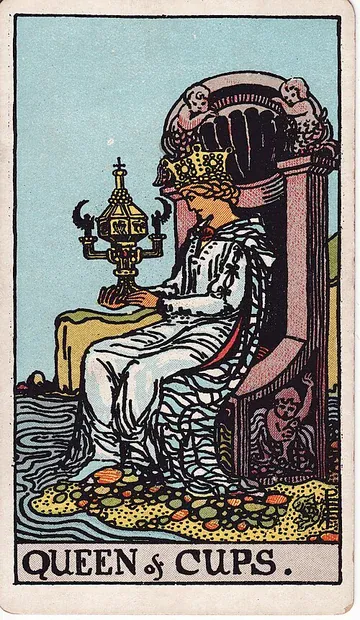
The two regents of the suit at the same table — water-of-water meets water-of-air. The Queen wears the room's feeling on her face; the King governs which piece is allowed to surface. Together they describe one of the deepest mature loves the deck can name, and in a self-reading they ask whether you have access to both registers within yourself: the queen who feels, and the king who holds.
King of Swords
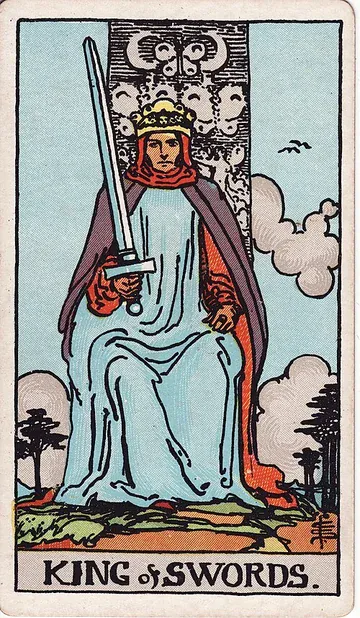
King-meets-king tonal contrast — water at the helm of feeling beside air at the helm of mind. The King of Swords cuts; the King of Cups holds. Together they form a council, and the work that comes out of that council tends to be unusually durable. In a relational reading, the pairing can warn of two correct people talking past each other in different registers — the bridge is one more piece of feeling from the air-king and one more piece of evidence from the water-king.
Temperance
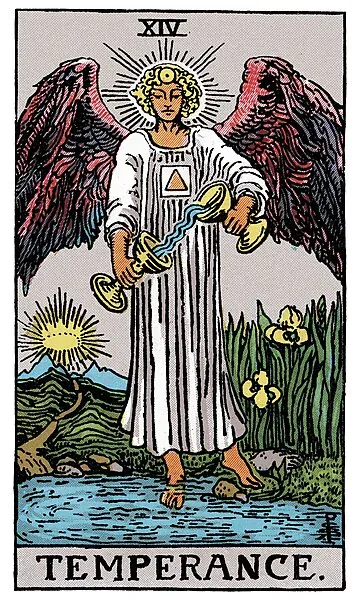
Temperance is the angel mixing water between two cups; the King of Cups is the human form of that mixing. Together they describe integration — two communities, two parts of the self, two sides of a difficult negotiation finally meeting. The pairing is one of the deck's most generous in mediation contexts, confirming that the mediator has both the steadiness and the cosmic timing to make the impossible blend hold.
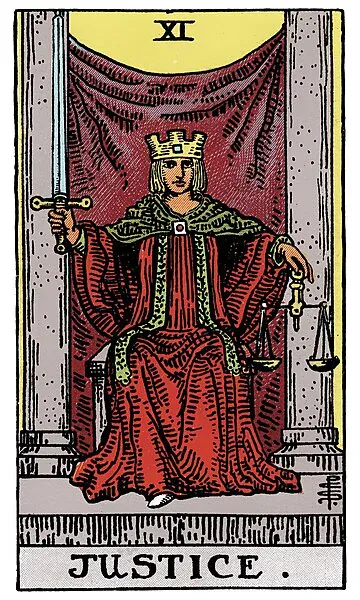
Justice
The Libra third decan of the King of Cups meets the Libra archetype of Justice — the same governing principle from two altitudes. In legal, contractual, or formal-decision contexts, the pairing is favorable: the verdict will be considered, fair, and weighed for human cost. In personal readings, the pairing asks whether you have been Libra-balanced in a recent decision and whether you can carry the verdict with the steadiness the King describes.
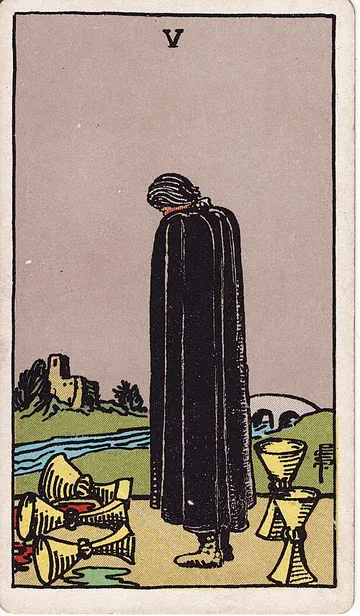
Five of Cups
Tonal contrast — the steady king meets the spilled cups at the throne's feet. The Five describes a figure mourning the lost, unable to see the two cups still standing. When the King arrives in the same spread, he is the older self looking at the younger self in grief — the offer is composure that does not rush the mourning. The combination is one of the most pastoral the deck offers, and in a self-reading it asks you to extend to your own grieving self the kindness you would extend to a younger sibling.
Frequently Asked Questions
What does the King of Cups tarot card mean?
The King of Cups is the card of mature emotional authority — the seasoned diplomat of feeling who sits steady in the middle of stormy water without letting the waves pull him under. He holds both the chalice and the scepter, refusing the false choice between feeling and order. In a reading, he describes a season (or a person) defined by composure that has stopped being defensive, kindness that has stopped being naive, and judgment that no longer requires volume.
What does the King of Cups mean in a love tarot reading?
In love readings, the King of Cups upright signals mature partnership — a love whose central skill is governance of feeling rather than chemistry. For existing partners, it describes the year you stop fearing difficult conversations. For new connections, it often points to a literal older or more emotionally seasoned partner. For singles, it announces that the love now possible is the love of someone accountable to their own water rather than someone who floods you with theirs.
Does the King of Cups feel less because he says so little about it?
No — restraint in this card is a skill, not a temperature. The person feels deeply, steadily, and with deliberate restraint. They have made you part of their internal architecture — part of how they organize their week, part of who they think about on long drives — and they are choosing to deliver the feeling in the considered register rather than the loud one. Look at the structure of how they show up; the structure tells the truth in a register words may not.
Why does a King of Cups yes feel less convincing than a louder card's yes?
Because it arrives without fanfare and expects to be taken at its word anyway. This is a considered yes. Not the bright yes of the Sun, not the celebratory yes of the Three of Cups — the steady yes of a senior who has weighed your question and decided in your favor. The yes arrives without fanfare and does not flip next week. If you were hoping for fireworks, you may miss it; look instead at the structure of what is being offered.
What does the King of Cups represent as a person?
As a person, the King of Cups is the elder of the suit — often a man, or a person carrying senior, mature, water-element energy: the older partner, the seasoned mentor, the therapist, the diplomat, the family patriarch, the senior at work whose presence regulates the room. He listens to the end before he speaks, holds his counsel with intention, and is generally the one called when a difficult conversation needs a steady center.