
King of Wands Tarot Card · Meaning
The king of wands tarot card meaning is, at root, the card of the elder who lights — the one who has watched many fires across many years and now knows which fires are worth the kindling. The king of wands meaning has, by this rank, stopped being about the heat itself and become about where heat is to be placed. He is the last of the four Wands courts, the rank past Page, Knight, and Queen, and what arrives in the King is not more heat but a different relationship to heat. He has stopped running to ignite the first torch. He names where the next torch belongs, and the room walks toward the heading.
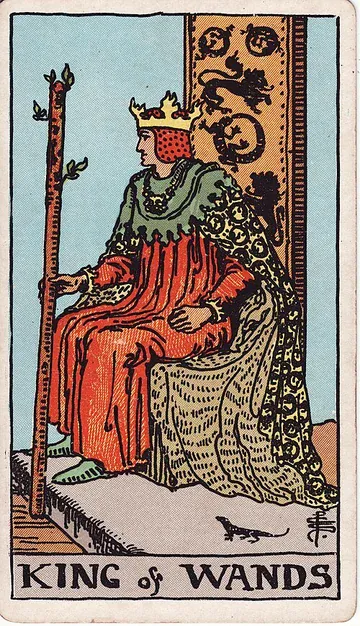
In the Rider-Waite-Smith image, he sits sideways on a stone seat carved with lions and salamanders. His robe is crimson-orange over priest-green; the cloak is stitched with salamanders nose to tail. He grips a still-leafing green staff — a staff of the same lineage as the Page's, the Knight's, and the Queen's, only now in his hand it is putting out new leaves at the top. A crown shaped like flames sits on his head. His gaze, however, is not turned forward toward the distance the crowd watches. It is turned down, to a small black salamander on the ground beside the staff's foot — a creature of the same kin as the embroidery on his cloak, lifting its head to return his look. The picture is not the speech. The picture is what happens before the speech.
The tension of this King lives in the span between the crown and the salamander. The crown is shaped like fire, but the King is not looking at fire. The throne is solid stone, but the staff is still alive. The man who has the most authority in the suit of fire is the man who is most attentive to the smallest spark at his feet. Air-within-fire is the elemental shorthand: outer fire (action, heading, will), inner air (sight, language, the structure that organizes flame). What you meet in the upright King is not the man who burns. It is the man who has learned that fire is governed by where the eye rests, not by how loud the voice is.
The traditional astrological signature reinforces this: the King of Wands holds the cusp from late Cancer into mid-Leo, roughly July 12 through August 11 — the seam where water finally yields to high-summer fire and the year's noon arrives. Cancer's last days carry the tenderness that knows what it is to need a roof; Leo's first days carry the fixed solar warmth that puts a roof over others. The King is the figure who has stood inside both. He has been the one who needed shelter; he is now the one who builds it. That biographical history is why the card is rarely young. Even in a young body, this King has lived long enough to have buried something.
Read the King of Wands as a photograph of someone who has just chosen the next direction in a tangled meeting and has not yet said the sentence. In a moment he will speak — one short sentence, no flourish — and the others in the room will abruptly know where the next step belongs. The card is the second before the sentence. What lives in that pause — the long sight, the priest-green steadiness under the fire-colored robe, the small salamander confirming that the heir is already present — is the whole reading.
King of Wands · Love
Direction rather than heat is what the King of Wands brings to a love reading, and he means direction in the navigational sense. The King describes a relationship organized around a shared horizon. Two people are not arguing about tonight's dinner. They are talking about which city they want to be living in ten years from now, which work they want to be doing then, which kind of life they want to have built by the time the children are grown or the parents are gone. This card is rarely the card of the first kiss. It is the card of the year you start drafting the rest of your life with someone whose name you have stopped having to introduce.
For an existing partnership, the upright King of Wands often arrives in the season when the noise of early conflict has burned down and what is left is the long fire — the steady warmth of a shared direction. The arguments that used to be about household details have become arguments about whether the household itself is pointed at the future you both still want. That is harder, more adult, and usually generative. The King of Wands marriage is not the cozy one. It is the marriage where both of you have decided the relationship is serious enough to have a vision, and you are both willing to do the unglamorous work of negotiating the vision out loud.
For a new spark, the King of Wands describes a partner whose attractiveness is not fundamentally physical — though the physical magnetism is often present. What pulls you in is the way they speak about three years from now. They have a shape for their life. They are not asking you to fit inside it; they are asking you whether yours has a shape too, and whether the two shapes might walk parallel for a stretch. The body recognizes this kind of person before the mind does. You leave the first long conversation feeling, oddly, taller. That feeling is the air-within-fire signature: someone who has lit a small flame in your future without crowding your present.
For a single seeker who is asking whether love is possible, the King of Wands answers yes, and the answer comes with a quiet clause. The person who arrives will not be the partner of your old fantasy. They will be older in some way that matters — not necessarily in years, but in inner weather. They will have a body of work, a body of failure, a body of grief they have already metabolized. You can recognize them by the fact that they speak in short sentences when other people speak in long ones, and by the way they ask one question that reorders your evening. The card asks you to keep your own horizon visible, because this person will be drawn by horizon, not by availability.
For someone in love after a wound — a divorce, a long widowhood, a public-facing rupture — the King of Wands is unusually generous. It says the next attachment will be honest in a way the previous one was not. The years in the dark were not lost. They were the years in which your priest-green under-robe formed beneath the fire-colored outer one. Whoever loves you next is loving someone who has already governed at least one hard fire, and that governance is exactly what makes you legible to them.
For reconciliation after a break, read the King of Wands carefully. It says return is possible, but not as restoration. The relationship you left does not exist. What can exist is a new agreement built between two people who have grown — separately, without curating each other's growth — and who now meet again as different versions. The King is patient with this kind of return because he himself is the elder who knows things take three years to be worth doing. If you are asking whether to call them this week, he is asking whether you have actually become the person who could honor a different kind of bond. If yes, call. If you are calling because you cannot bear the loneliness, set the phone down.
For long-distance and cross-cultural relationships, the King of Wands is among the most encouraging cards in the deck. The card is built for distance, because air-within-fire travels. Two people who can name a shared three-year horizon can hold the bond across continents and time zones. The card asks for one specific practice: monthly, one of you names the heading aloud. Not "I love you" — that is the Knight's job. The King's voice says "the city we are pointed at is still this one. The work we are pointed at is still this one. The shape we are pointed at is still this one." That sentence, said monthly, is what keeps the long fire steady when the body is not in the room.
For a pursuer-distancer dynamic — one of you reaching, the other quietly retreating — the upright King of Wands invites the distancer to step into the King's role for a season. Stop reacting. Sit in the chair. Look not at your partner's anxiety, but at the small salamander at your feet — the small thing actually unfolding between you, the small ember that is yours to keep. Then speak one sentence about what you actually want from the next three years of this. The pursuer's anxiety frequently dissolves when the distancer finally names a heading. Reaching is, in disguise, a request for direction.
For households with practical constraints — a child to raise, an elder to care for, a mortgage that determines the calendar — the King of Wands says the constraints are not enemies of the vision. They are the ground the vision will be built on. The card warns against the fantasy of "if only we had no obligations, we could really live." The King's authority comes from having governed fire inside walls, not from having renounced walls. Build inside what is. The kind of love this card describes is the kind that includes the schedule of the dialysis, the tuition payment, and the elderly cat who needs medicine twice a day, and is not diminished by any of it.
For desire mismatch — one wanting more closeness, more sex, more daily contact than the other — the King of Wands gently reframes the question. The mismatch is rarely about appetite. It is about whether the two of you have a shared three-year picture you can both step toward. When the picture is clear, daily small differences metabolize. When the picture is missing, every small mismatch becomes evidence of a larger absence. Spend an evening drawing the picture. Then return to the question of frequency. It will look different.
If you are asking whether someone is in love with you and the King of Wands arrives upright, read it as a slow, considered yes. They are not making the gesture of a younger card. They are watching what you build, watching how you handle small fires, watching whether your direction stays steady when no one is looking. They will not announce the verdict. They will, one ordinary Tuesday, mention the future in a sentence that includes you without preamble. That sentence is the verdict. Listen for it without flinching.
King of Wands · As Feelings
Neither infatuation nor the soft warmth of the Cups: the King of Wands feels in a third register entirely. It is the steady, watchful regard of a person who has decided you are worth their long sight. They are not, as a Knight is, charging toward you. They are not, as a Queen is, glowing in the room you walk into. They are tracking you across time. They are interested in the direction you are pointed at. They are quietly asking themselves whether your heading and theirs might converge.
If they are reserved by nature, the King of Wands' feelings show up as long, low attentiveness. They will not flood you with messages. They will, however, remember the sentence you said two weeks ago about a difficulty at work, and they will ask, on a quiet evening, how that turned out. Their love language is the long memory. They are paying attention to the parts of you that move slowly — your work, your private project, your relationship with your family of origin, your slow recoveries. Read the silence not as distance but as the space their attentiveness is occupying.
If they are demonstrative, the King of Wands' feelings often come out as introductions. They want you to meet the people who matter in their life — the old friend, the mentor, the sibling. They are positioning you in the architecture of their world. This is not a young gesture. This is a king choosing whom to set a chair beside the throne for. Receive the introductions seriously. The pace can feel slower than the Knight's, and faster, in another way, than the Page's; what looks like an ordinary dinner is in fact a quiet ceremony of inclusion.
For a long bond, the King of Wands in feelings is the card you most want when you have been together a long time. It means the person you have lived beside has not stopped being curious about your direction. They are not bored of you. They are not waiting for the next chapter. They are watching, with the steady regard of someone who has chosen, and they are still choosing, and the choosing has become something quieter than declaration — it has become the daily fact of where they sit at the breakfast table and how they ask you about your day.
For a new connection, the King of Wands as feelings means they think you might be the partner they have been waiting to recognize. They are not certain yet. They are watching you carefully across time. They are watching how you behave when no one is rewarding you for behaving well. They are watching how you treat the people you have nothing to gain from. They are watching what you do with disappointment, what you do with success, what you do with your own ambition when the room is quiet. None of this is judgment. It is the elder's attentiveness. They are deciding whether you are someone whose horizon they want to walk beside.
For distance — a partner across time zones, in a long-distance phase, separated for work or family reasons — the King of Wands' feelings are durable. The body is not in the room and the long sight is doing the work. They are picturing you across the distance with surprising specificity. They are not romanticizing you in absence; they are remembering you in detail. The feelings the card describes survive distance better than almost any other court's, because they were never primarily about proximity. They were always about heading.
For divided warmth — when you sense their attention is also on someone else — the King of Wands offers a precise clarification. The feeling they have for you is genuine, but they have not yet ended the older situation. The King's character is not duplicitous; it is, sometimes, slow to close. They know that ending requires the same long sight as beginning, and they will not foreclose with a gesture that costs the other person their dignity. Read this not as a failure of feeling but as a procedural delay. If the long sight is genuine, the closure will come. If you sense the long sight is not actually directed at you, that is a different reading and a harder one — see the reversed section.
A small caution embedded in the upright King's feelings: this person can read you so accurately that you can mistake the accuracy for control. They are not, in the upright orientation, controlling. They are seeing. The difference matters. If the seeing makes you feel less yourself, it has tipped toward reversed. If the seeing makes you feel more yourself — as if your own direction has come into focus simply by being witnessed — it is the upright reading, and it is one of the deck's quieter forms of love.
Take the King of Wands in feelings as confirmation that the regard is the long kind. Whatever they feel, it is built to last. The work, if there is work, is the structural one — whether the two of you can articulate, out loud, the shape of the future their feelings are quietly already pointing at.
King of Wands · Career & Work
Authority changes hands in this card — from being the sharpest executor in the room to being the clearest about which fires are worth lighting at all. The card describes the transition from doing to deciding, from running to naming, from sprinting toward outcomes to articulating the heading the rest of the team will run along. This is the founder's fire after the founding has stabilized. This is the senior contributor about to become the leader who lets others contribute.
If you are asking whether to stay in your current role, the King of Wands' answer is not "stay" or "leave" — it is a deeper question. He asks whether you are still the right size for the chair you sit in. If your role has grown smaller than your sight, he will not let you stay there long; the staff in his hand is still putting out leaves, and authority that has stopped growing is authority that has stopped being authority. Begin naming, internally, what you actually see now that the role does not let you act on. Bring one of those sightings to your manager this month. If they meet the sighting, the role can grow. If they cannot, the King has already begun to leave in your interior.
For someone considering a new role, the King of Wands upright is one of the more demanding green lights in the deck. He says yes to roles that ask you to lead — not lead by output, but lead by direction. He says wait to roles that look like promotions but are, structurally, executions of someone else's heading. The test is simple: in the new chair, will your job be to name where the next fire is to be lit, or will your job be to carry someone else's torch faster? The first is King work. The second is Knight work. There is no shame in either, but the card is not for the second.
For a freelancer or founder, the King of Wands is among the most encouraging cards the deck offers, with one specific clause. He confirms the practice has matured past the urgent self-employment stage and into the long-vision stage. The work is not a hustle. It is a body of work. The card asks you, this season, to draft the three-year version of the practice. Not the marketing copy. The honest internal map. Where do you want the work to be in three years? Whom do you want to be working with? What kind of edge do you want to be cutting? Write it down. Show it to one trusted person. Then act for ninety days as if the map were already true. The King governs by speaking the future into the present.
For a creative worker — writer, designer, musician, filmmaker, painter — the King of Wands describes the season after a body of work has begun to be recognized and the question has shifted from "can I do this" to "what is this for." The card is the moment you realize the next decade of your practice will be about depth, not novelty. You have proven you can make. The work now is to choose which fires you are willing to keep tending. Most creatives, at this stage, scatter. The King does not scatter. He chooses three. Then he says the names of the three out loud, to one collaborator who will hold them.
For a student or apprentice — anyone in the early stretch of a career — the King of Wands is rare and unusually significant. He arrives when the apprentice has begun, quietly, to see further than the master. This is uncomfortable. It is also one of the most important inflection points a young career has. The King asks you not to leave the apprenticeship reactively, and not to stay obediently. He asks you to articulate what you see that the master does not, in writing, for yourself. Then he asks you to name one piece of your own work that goes in that direction — not as rebellion, but as the first stake of your own ground. The transition from Page to King takes years. It begins on the day the apprentice stops asking permission to see further.
For a manager or leader, the King of Wands is the card of standing in the chair with the fire-shaped crown and not looking at the distance the crowd watches. The temptation in leadership is always to manage what the boardroom is staring at. The King's signature move is the opposite: he looks at the small salamander at his feet — the actual ember that is happening in his own organization, the one nobody else has noticed yet because they are all looking outward. The advice the card offers managers is direct: this week, find the small thing in your team that is just beginning to take shape. Name it out loud to its keeper. Make it visible inside the team. Most leadership impact lives in seeing what is already underway and lighting it forward, not in inventing new initiatives.
For care-work, teaching, healing professions — the work where success is measured in the slow change of another life — the King of Wands has a rare and particular reading. He affirms that the patient work of a teacher, a therapist, a chaplain, a doctor, a coach is precisely his kind of authority. The fire-colored outer robe is the public-facing role. The priest-green under-robe is the work itself. The card asks you to honor the under-robe even when the institution rewards only the outer. Your students will remember you not for your pronouncements but for the salamander you saw in them when they were small.
For a promotion — particularly a leadership promotion — the King of Wands is unusually clear. Take it, with three explicit conditions. First, spend the first ninety days mostly listening, not deciding. Second, refuse to issue any sentence containing "should" until you have understood what the team is already trying to do. Third, name, out loud, within the first six months, the three-year heading you are calling for the team. If you cannot meet these three conditions, the role is not for you yet. The King is not against promotion. He is against the smug, untransformed promotion that becomes the reversed card.
For layoffs, transitions, and forced career changes — the involuntary endings — the King of Wands is unexpectedly steadying. He says the staff in your hand is still leafing. The authority you carry is not a job title. It is a way of seeing. The next chapter will require you to bring the same long sight to a different ground. The card asks you, in the weeks immediately after the ending, not to take the first thing that closes the financial gap. Take a week. Sit in the chair. Look at the small salamander — the small ember that is uniquely yours, the thing you would do if no institution were funding you. Then build around that ember. The next role found this way tends to last longer than the one you lost.
For cross-functional teams, founders' partnerships, and creative collaborations, the King of Wands is the card of clean leadership inside a partnership. He warns against the founder who does not know how to share the throne, and against the partner who quietly hopes the other one will keep deciding everything. He asks for an explicit conversation about who is the King in which domain. Both of you can be Kings in different fires. The conversation is the precondition for the partnership lasting more than three years.
King of Wands · Money & Finances
Finances ordered around a heading are the King of Wands' subject — the long-horizon money mind that has stopped chasing this quarter's number and started building the structure that will support a life thirty years out. The card is not flashy with money. It is strategic. It is the founder who reinvested when others took distributions; the senior professional who chose the smaller salary at the better company; the parent who quietly funded the education account before the holiday.
For someone in financial recovery — paying down debt, climbing out of a hard year — the King of Wands offers a particular kind of steadiness. He says recovery is real, but it will not be felt as a single victorious moment. It will be felt as a long widening. The card asks you, this month, to name the three-year financial heading aloud. Not the goal. The heading — the direction money is pointed at. Ownership? Liquidity? Generosity? Family security? Choose one. Write it where you see it daily. Every spending decision aligns to it for the next ninety days. The King governs through naming, and money cooperates with names.
For the question of a major investment — starting a business, purchasing a property, funding an education — the King of Wands answers a careful yes. The investment is consonant with your long sight, and your long sight is real. He asks you, however, to refuse the impulse-king move: making the largest possible commitment because the vision feels expansive. A King governs through right-sizing. Make the investment at the size your three-year horizon can actually carry, not at the size your current excitement wants. The salamander is small. The wisdom of the card is to honor the small thing that is actually beginning, not the dramatic gesture.
For someone managing a windfall — inheritance, exit, large gift — the King of Wands is one of the deck's most useful cards. He says receive, then wait a season before deciding. The first instinct will be to make a single large gesture — the donation, the move, the vehicle, the renovation. He asks you to delay the gesture by ninety days. During those days, sit with the question of what fire this windfall is being used to light. The right use will reveal itself. The wrong use is whatever your impulse landed on in week one.
For someone weighing whether to stay in a stable, well-paying role or to leave for a more aligned but less lucrative one, the King of Wands is one of the deck's quieter, more demanding cards. He does not romanticize leaving. He asks whether the well-paying role is funding a future you actually want to live in. If the answer is yes, stay. If the answer is no, the long cost of the unaligned salary is greater than the short cost of the transition. The card supports the move with one condition: a three-year financial map drafted before you give notice. Without the map, the move becomes a Knight's move, not a King's.
For the signature money trap of this card — and every card has one — the King of Wands' shadow with money is grandiosity disguised as vision. The temptation to commit at scales beyond what the actual fire requires. Borrowing against the three-year vision in the first quarter. Signing leases your revenue does not yet support. Taking the speaking gig that requires you to look like a King before you have actually become one. The card warns: governance comes from having actually seen, not from performing seeing. Do not finance the performance.
For long-term debt, the King of Wands is uncharacteristically patient. He does not panic about debt. He treats it as a strategic instrument that needs to be aligned with the heading. Mortgage, education debt, business debt — none of these is intrinsically bad in his hand. What is bad is debt without heading. If the debt is buying you ground that the three-year vision sits on, hold it and pay it deliberately. If the debt is buying you a comfort that has nothing to do with the vision, refinance, restructure, or close it. The card supports the boring strategic move that frees the long horizon.
For day-to-day spending, the King of Wands offers a precise reframing. Most people decide spending one transaction at a time. The King decides spending one heading at a time. Once a quarter, name the heading. Then ninety days of small decisions cooperate without daily friction. The card respects the architecture, not the policing.
King of Wands · Health
Breath is where the King of Wands keeps his health. The body part the card governs is the high cavity where breath becomes voice — the lungs that hold the air that becomes the sentence the King will eventually speak. His temperament is choleric with a current of air: fire that has been arranged by sight, heat that has been refined into orientation. He breathes long. He does not pant.
For someone managing a chronic condition, the King of Wands is unusually steadying. He describes the season when the body has settled into a sustainable governance of the condition. The medication is taken on time. The schedule respects the body's rhythms. The relationship with the practitioners has matured into collaboration rather than supplication. The card does not say the condition is gone. It says the condition is no longer running you. Use this season to re-engage with the work that is yours — the project, the practice, the people. Chronic conditions teach kings, and the King of Wands is the temperament that can carry one without being defined by it.
For acute illness or injury, the King of Wands has a counterintuitive reading: do less. The temptation, in acute states, is to manage. The King does not manage acute states. He governs them by entrusting them to the people whose work this is — the surgeon, the physical therapist, the body's own repair. His role is to clear the calendar, to refuse the meeting, to delegate the urgent task to the next-most-competent person, and to give the body the long-breath rest it needs. Choleric temperaments often resist rest. The King's authority is the willingness to rest, because he knows the long sight requires a body that has not been burned through.
For the chest-diaphragm specifically — the breath, the lungs, the high heart — the King of Wands often arrives when the body is asking for more breath. Not exercise. Breath. Five minutes a day, sitting in a chair, breathing into the diaphragm so the lower belly rises and falls before the chest does. Most adults under stress lose this. The King governs through long breath. The practice is simple, doable in any room, and the card responds to it.
For appetite, sleep, and digestion, the King of Wands describes a body that has settled into rhythms that suit it. Not the rhythms of the magazine. Not the rhythms of the productivity podcast. The rhythms of this particular body. The card warns against the smug-king temptation to impose a schedule on the body for performance reasons. Listen to the body's actual hunger. Sleep when sleep arrives, not when the calendar says. The King governs his own kingdom; he does not export the schedule of someone else's.
For stress-related symptoms — tension headaches, back tension, jaw clenching, the tight chest that comes from holding one's breath without realizing — the King of Wands names the cause precisely. You are issuing too many sentences. The voice has been engaged too long. The card asks you, this week, to choose one day of low speech. Not silence as a stunt. Lower volume of decision-making. Fewer pronouncements. More listening. The body unwinds when the King steps off the throne for a day and lets the small salamander govern.
For mental health, the King of Wands is generally reassuring. He describes a mind that has organized itself around a long heading. The depressive sieges are not absent — Kings have weathered them — but they no longer claim the throne. The anxiety has been negotiated with rather than fled from. The card warns against the trap of the smug-king who declares himself well and stops the practices that brought him there. Continue the therapy. Continue the medication. Continue the journal. The King's wellness is built; it is not announced.
For the body as the seat of authority, the King of Wands offers a single instruction: when you feel the urge to issue a hard sentence — at work, at home, to your own self — first take three long breaths into the diaphragm. The pause is the difference between fire that governs and fire that scorches. Many of the King's hardest moments have been sentences he did not say because he breathed first.
(The King's pause before speaking is not medical advice. He reads the temperature of a season; no card reads a body the way a clinician does. This king's counsel does not stand in for yours: the clinicians, the prescribed course, and the daily work all remain. The card simply confirms the kind of attention the body is asking for.)
King of Wands · Spirituality
An elder who has practiced long enough to see across more than one season stands at the center of this card — one and whose role has shifted from being the seeker to being the one who names directions for other seekers. He is not a guru. He is rarely a teacher with a title. He is the person in the community who, when a difficult question arises, says one short sentence that reorders the room. He governs through clarity, not through volume.
For someone in active spiritual practice — meditation, journaling, ritual, devotional work — the King of Wands describes the season when the practice has stopped being a quest and become a discipline. The early ecstasies have given way to steadier weather. The breakthroughs are smaller and more useful. You no longer expect the practice to deliver dramatic returns. You no longer need it to. The card affirms that this is the maturation of the practice, not its diminishment. The fire has stopped flaring; it has become a hearth.
For someone exploring belief, the King of Wands often arrives when one has begun to formulate, in their own words, what they actually take to be true. Not the borrowed phrases of the tradition. Not the curated language of the teacher. The seeker's own articulation. The card respects this articulation. He asks for one short sentence — what do you actually believe, in your own words, about the nature of things? Write it down. Speak it once, to one trusted person. The fire-colored crown is the act of putting one's own framing into the world, and the priest-green underneath is the humility of knowing the framing is provisional.
For seekers in community — sangha, congregation, lineage — the King of Wands describes the role of the elder who lights without dominating. He asks you, if this card is yours, to consider where in your community you are being asked to step into the King's chair. Most spiritual communities suffer not from too many leaders but from too few people willing to take quiet, structural responsibility for the small fires others are tending. Step into one such role this season. Do not perform. Just take the responsibility.
For questions of path, the King of Wands has a precise instruction: you are not lost. You have been mistaking the absence of dramatic signs for the absence of direction. The dramatic signs were a younger person's path. The mature path is built of the long, quiet acts of governance — keeping the practice, showing up to the community, mentoring the one person you have been asked to mentor, refusing the invitation that would scatter you. The King governs by what he refuses as much as by what he embraces.
A practice the card invites: thirty minutes, alone, with one question — what is the heading I want my next three years of practice to be pointed at? Not the technique. The heading. Liberation? Service? Presence? Repair? Lineage? Choose one. Speak it aloud. Then live for ninety days as if it were the chosen heading. The King's spirituality is built through naming.
The card's spiritual caution is gentle but real: the elder who has stopped tending the small salamander at his feet — the small ember that is uniquely his, the practice that is for no one but himself — slowly hardens into the reversed king. Avoid this. Even kings keep a candle they light only for themselves.
King of Wands · Yes or No
Yes — but ask what you actually intend to light.
The king of wands yes or no answer, in the upright orientation, is one of the deck's stronger yes cards, with a specific quality of yes that distinguishes it from the other affirmative cards. It is not the soft yes of Cups Nine, the inevitable yes of the Sun, or the hot yes of the Knight of Wands. It is the considered yes of the elder who has watched enough fires to know which ones are worth the kindling. He says yes to the question — and the saying is itself a small ceremony. By answering, he is committing the heading.
For yes-or-no questions about a relationship, a job, a move, or a major decision: yes. The path is consistent with your long sight. The next three years of your life can hold this choice. The card answers cleanly, but it adds a clause — be precise about what you are saying yes to. Not the surface form of the yes. The fire underneath it. If you are saying yes to a job, what is the actual heading the job is pointing at? If you are saying yes to a relationship, what is the future the relationship is being committed to? The King of Wands' yes is most powerful when it is articulate.
For questions about whether someone is being honest, whether an offer is genuine, whether a plan will hold, the King of Wands gives a strong yes. The person, the offer, the plan — they have integrity in the structural sense. They are pointed where they say they are pointed. The card does not promise that the path will be easy, but it confirms the heading is real.
Asked how soon the heading turns into arrival, the King of Wands answers with a longer arc than many other cards. Yes, within the season; but the card reminds you that the King's seasons are slower and weightier than the Knight's. What the Knight measures in weeks, the King measures in quarters. Three months is a typical King answer. The yes is not delayed; it is accurate. The thing that wants three months is being given three months.
For binary decisions — should I take the offer, send the message, make the move — the King of Wands answers yes with a particular emphasis on first naming the heading. Before you act, write down the three-year version of why you are acting. One short sentence. The King's yeses succeed because they are articulate. The King's yeses fail when they are mute.
For questions of authority — should I step into a leadership role, accept a difficult mantle, take on more responsibility — the King of Wands answers yes, conditionally. The role is for you. But take it only if you are willing to govern the way he governs: with long sight, short sentences, and the willingness to look at the small salamander at your feet rather than the distant audience. If you want the role for the audience, the answer becomes the reversed card.
The single caution embedded in the yes is to remember that the King of Wands' yes is a commitment, not a sampling. He does not say yes lightly. When he says yes, he means he will be at this fire for some time. If you are not ready for the duration the yes implies, the soft answer is to wait until you are.
When the real question is whether the role is deserved. The King of Wands answers yes — and adds that deservingness is rarely the right question. The right question is whether you are willing to be the kind of person the role requires. The yes follows from that willingness, not from a verdict about your worth.
King of Wands · Advice
Step back half a pace, lift your eyes three years out, and name the heading aloud to the people who walk with you — that is the King of Wands' entire counsel. The card is not asking you to do more. It is asking you to do less, with greater clarity. Most situations the King is consulted about do not need more action; they need a clearer name for the action that is already underway.
If there is one specific instruction the card offers, it is to stop running yourself to light the first torch. The temptation, particularly for senior contributors, founders, and parents, is to keep doing the work that earned the chair. The King's authority depends on relinquishing that. Name the next heading. Hand the torch to the person whose job lighting it is. Then sit in the chair and watch them do it. They will do it differently than you would. That difference is part of the point.
A second instruction: when someone comes to you for a decision on a small thing, do not decide it for them. Ask instead: "What shape do you want this to have in the end?" This single sentence, asked consistently for ninety days, changes the texture of an entire team, household, or relationship. The King governs by handing back the question. He does not solve the small thing. He helps the asker articulate the larger heading the small thing belongs to.
A third instruction: this week, name aloud, to one specific person, the large direction you have kept to yourself. The card describes the elder who has been quietly carrying a vision he has not yet given voice to. The vision becomes real on the day it is spoken to a witness. The witness need not agree. They only need to hear it. After the speaking, the architecture of your life rearranges around the named heading without further effort. Speech is fire's first form of governance.
A fourth instruction, gentler than the others: do not under-explain. The King of Wands' shadow is the smug elder who says, "I have made my view clear" when, in fact, he has issued one cryptic sentence and walked away. People around him pretend to understand because they fear his disappointment. Real authority over-explains the heading and under-instructs the execution. Reverse this if you have it backward — most people have it backward.
A fifth instruction: tend the small salamander at your feet. The small ember you have been ignoring because the larger fire is more visible — the personal practice, the friendship that needs a phone call, the small sustained discipline that is uniquely yours. Kings who lose their own ember slowly become the reversed card. Schedule the small thing this week. Honor it like a ceremony.
Practical landing actions, pick one for today: write down, in one sentence, the three-year heading of the project you currently lead. Tell one person. Spend fifteen minutes alone with no input, simply watching what arises. Refuse one urgent task that should be delegated, and delegate it. Take three long diaphragmatic breaths before issuing a difficult sentence. The King of Wands rewards small, deliberate, named acts.
The most important note: the card is not asking you to be impressive. It is asking you to be accurate. Most disasters of leadership in modern life are caused by Kings performing kingship rather than governing from the long sight. Do not perform. See, and name what you see, and then sit in the chair while others move along the heading.
King of Wands · Card Combinations
King of Wands + Queen of Wands
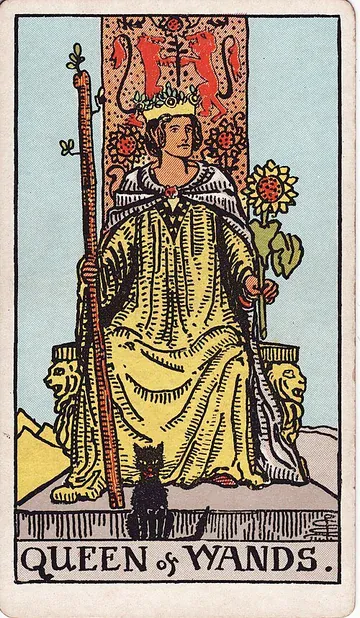
The two regents of the fire suit on the same surface. Where the King governs through long sight and named heading, the Queen governs through luminous presence and the steadying gaze that makes others want to do their best work. Together, this pairing describes the partnership of fire-rulers — two people whose authority is complementary rather than competitive. In love readings, it is the card of the marriage built on shared vision and mutual visibility, the relationship in which neither partner has to dim. In professional readings, it is the founders' partnership where one names the heading and the other holds the room while the team walks toward it. The instruction is to keep both thrones lit. Neither monarch should be carrying the other's load.
King of Wands + Page of Wands
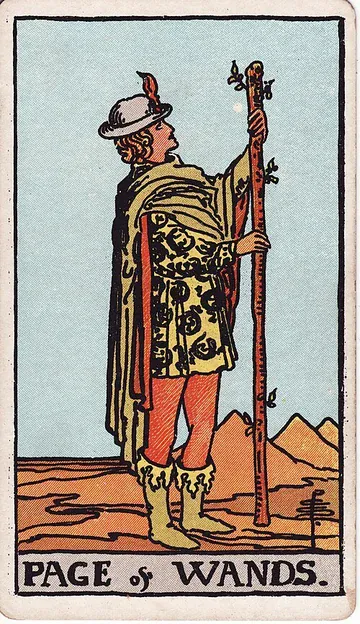
The elder and the spark — the king and the heir. The Page is the small black salamander on the ground in the King's image, made larger and given a name. When this pair appears, the King's job is not to teach the Page how to do what the King does. The Page will not learn that way. The King's job is to protect the Page's particular flame from the crowd, to give the Page a single hard task that the Page is just barely large enough to carry, and to refrain from rescuing the Page when the task is harder than expected. Page work is initiation work. King work is the willingness to let the initiation be real. In family readings, this is the parent and the adolescent child whose direction is becoming visible. In professional readings, it is the senior leader and the high-potential junior whose first major project is beginning.
King of Wands + The Emperor
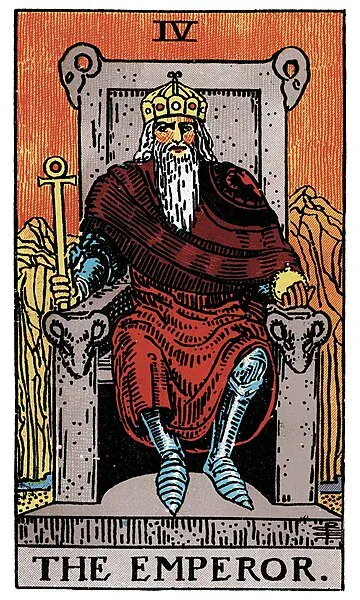
The dual-throne pairing — fire's king beside the Major Arcana's solar regulator. The Emperor governs through structure, law, and stone; the King of Wands governs through long sight, named heading, and the still-leafing staff. Together they describe a moment of mature institutional authority — a leadership in which vision and structure are both present. The risk in the pairing is that the Emperor's regulation overrides the King's living staff. The card asks whoever carries both the throne and the staff to keep the green at the staff's tip alive even inside the stone walls. Authority that has stopped putting out new leaves becomes the Emperor without the King — competent, ordered, and slowly dead. Authority that has kept its leaves becomes the rare thing in modern institutional life: governance that grows.
King of Wands + The Sun
Fire's full noon. The Sun is the Major Arcana's most generous solar card — vision realized in shared light, joy that does not need to hide itself. Beside the King of Wands, the pairing describes the moment a long-tended fire becomes publicly visible and the public visibility does not corrupt the original heading. This is the rare combination: success without smugness, recognition without performance. In career readings, it is the season after a body of work has matured into a kind of light others can warm themselves at. In love readings, it is the year a long relationship's quiet excellence becomes legible to the people around it. The instruction is to receive the light without contracting around it. The King's authority is not threatened by being seen.
King of Wands + King of Cups
The opposed-element kings. Where the King of Wands sees by lighting, the King of Cups sees by holding — the one orients fire by long sight, the other contains water by long patience. When this pairing appears, two complementary forms of governance are being asked to coexist. In partnership readings, it is the relationship between two people whose authorities differ in element but match in stature — the visionary and the holder, the founder and the steward, the speaker and the listener. The risk in the pairing is that each mistakes the other's element for weakness; the strength lies in the recognition that fire alone scorches and water alone drowns. Together, the two kings can govern more than either could alone. The card asks which one is currently trying to do the other's job, and to return that work to its proper element.
Card Combinations
Queen of Wands
Two regents of the fire suit on the same surface — the elder who lights and the queen who steadies the room around the fire. The marriage built on shared vision and mutual visibility, the founders' partnership where one names the heading and the other holds the room while the team walks toward it. Keep both thrones lit. Neither monarch should be carrying the other's load.
Page of Wands
The elder and the spark — the king and the heir made larger and given a name. The Page is the small black salamander on the ground in the King's image. The King's job is not to teach the Page how to do what the King does; it is to protect the Page's flame from the crowd and to refuse to rescue the Page from a hard task that is precisely the right size to grow into.
The Emperor
The dual-throne pairing — fire's king beside the Major's solar regulator. Vision and structure both present. The risk is that the Emperor's regulation overrides the King's still-leafing staff. Keep the green at the staff's tip alive even inside the stone walls. Authority that has stopped putting out new leaves becomes the Emperor without the King — competent, ordered, and slowly dead.
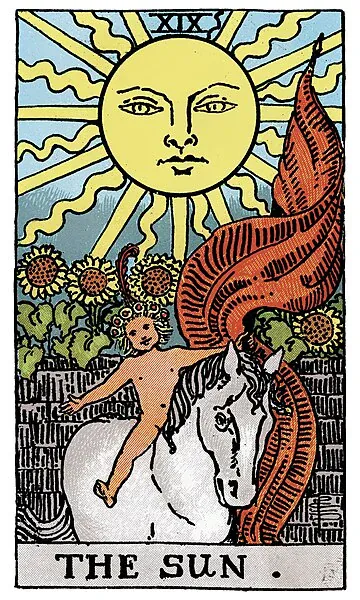
The Sun
Fire's full noon. A long-tended fire becomes publicly visible, and the public visibility does not corrupt the original heading. The rare combination: success without smugness, recognition without performance. Receive the light without contracting around it. The King's authority is not threatened by being seen.
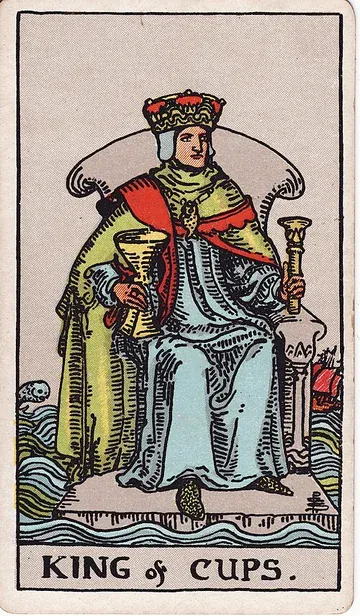
King of Cups
The opposed-element kings — the Wands king sees by lighting, the Cups king sees by holding. The visionary and the steward, the speaker and the listener. The strength lies in the recognition that fire alone scorches and water alone drowns. Together the two kings can govern more than either could alone. Ask which one is currently trying to do the other's job, and return that work to its proper element.
Frequently Asked Questions
What does the King of Wands tarot card meaning describe?
The King of Wands is the elder who lights — the rank past Page, Knight, and Queen in the fire suit, where authority has stopped being heat and become long sight. He governs through naming where the next fire belongs rather than running to ignite it himself. Air-within-fire by elemental signature, holding the cusp of late Cancer into mid-Leo (7/12–8/11), he describes decisive vision, founder's fire, and the kind of leadership in which one short sentence reorganizes a tangled room.
Can I say in one sentence what the King of Wands would be lighting?
If you can, the yes is yours. That test is the card's actual contribution. Upright, the King gives a considered yes — the yes of an elder who has watched enough fires across enough years to know which ones repay the kindling — and the path being asked about is consistent with your own long sight. What he attaches is not a warning but a requirement of articulation. Write the three-year version of why you are doing this, in one sentence, without subordinate clauses. If the sentence comes easily, act this week. If it will not come, the difficulty is not nerves; it is that the heading has not been chosen yet, and this King's yeses succeed precisely to the degree that they have been named out loud before the work begins.
Does the King of Wands care more about direction than about chemistry?
He does, and in this card that is a form of devotion rather than a coldness. The love he describes is steered by a shared horizon: two people who are not arguing about tonight's dinner because they are occupied with which city they want to be living in ten years from now. For an established partnership it is the long fire of a marriage that has matured past surface conflict into agreed direction — less heat on the surface, considerably more structure underneath. For a newer connection, the attractive thing is the way this person speaks about three years out, which is a strange and reliable form of magnetism. For someone single, the next attachment tends to be older in inner weather and drawn to your direction rather than to your availability.
King of Wands: what does it look like when he has decided about me?
It looks like an ordinary sentence about next year with your name inside it and no preamble in front of it. As feelings, this card is the steady watchful regard of someone who has concluded you are worth their long sight — not the charge of a Knight, not the soft warmth of Cups. They have been tracking you across time: how you handle small fires, whether your direction holds when nobody is applauding it, what you do with an inconvenient obligation. That observation period can feel like distance and is not. The decision, when it comes, is almost never announced as a decision. It arrives as a Tuesday remark about a trip in October, a lease, a plan, and it assumes you. That assumption is the verdict.
What is the spiritual meaning of the King of Wands?
The elder who lights — the seeker who has practiced long enough to see across more than one season and whose role has shifted from questing to naming directions for others. He governs through clarity, not volume. The practice the card invites is simple: thirty minutes alone with one question — what is the heading I want my next three years of practice pointed at? Speak it aloud. Then live ninety days as if the heading were chosen. Spirituality matures through articulation.