
Knight of Cups · Core Meaning
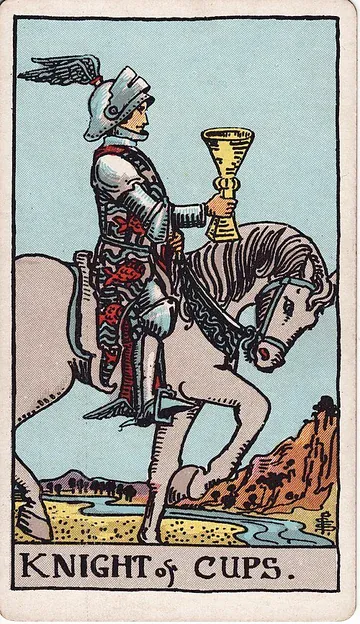
The Knight of Cups is one of the four knights of the tarot — specifically the courier of the Cups suit, the water court of the Major Arcana courts of the Rider-Waite-Smith deck. (If you came here from a search that turned up the 2015 Terrence Malick film of the same name, the card is older and quieter — a piece of Renaissance card-imagery, not a movie about a screenwriter.) He rides a silver-gray horse at a deliberate walking pace across a sloping, arid landscape, and at chest height he holds a golden cup, kept perfectly level so that not a drop spills. His armor is patterned with fish-scales — a defense already shaped like water. His visor is raised. The face it reveals is not a warrior's but an envoy's. Behind him, a thin river threads toward the sea.
This is the card's signature image, and every paragraph below comes back to it. The knight is not charging. He is not fleeing. He is bringing something — a message, a proposal, an invitation, an offer of feeling — and he is walking it forward without sloshing it. The level cup is the whole instruction the card gives in a single object. What you carry must arrive intact. Style alone is not enough; the contents matter; whether you actually ride out matters more than how beautifully you describe the ride.
Half the work of this card is being done by the horse. It is silver-gray, unhurried, and its hooves fall evenly — one, then another — which is the only rhythm in the picture. Nothing else moves. The slope is dry, the grass is thin, the sea is still hours off. A courier who wanted speed would have chosen a different animal and a different road. This one chose the road that lets him keep the cup steady, and the thin river behind him explains why he can afford to: the message was not improvised at the gate. It was drawn up out of a deeper watercourse and has been traveling inside him since before the horse was saddled. When the card turns up in a spread, listen for that evenness. Whatever is arriving has been under way longer than you have known about it.
The card's signature tension is tongue versus legs. The Knight of Cups is the deck's most eloquent courier — he speaks in poems, knows the right phrase, can make a vow sound like the most natural sentence in the world. The question the card asks, in upright, is whether the eloquence is matched by the journey. A real Knight of Cups has put his foot in the stirrup. A performance of one has not. Upright, the card answers: yes, this one rode out. The promise is on its way. The cup will arrive level.
The traditional astrological signature anchors this. In Golden Dawn schema, the Knight of Cups holds the cusp from Aquarius 20° to Pisces 20° — roughly the calendar window of February 9 through March 10. The card reads him as fire-within-water: water on the surface, fire underneath. A spirit burning inside the cup. His slowness is not empty; it is the slowness of something already on fire and refusing to spill. The combined signature is a knight who looks tender and is in fact persistent — a romantic by visible disposition and a fanatic by hidden temperature.
Rank matters here too, and it is the part most readings skip. In the court of Cups the Page receives, the Queen holds, the King governs the whole reservoir — and the Knight is the one who leaves. He is the only member of the four whose defining act happens away from home. That is why this card so rarely describes a settled state and so often describes a passage: the days between deciding and telling, between applying and hearing, between the letter written and the letter handed across. Read him as the middle term of whatever process you are currently inside. The question he makes concrete is never "what do I feel" — that one belongs to the Queen — but "how far am I willing to carry what I already feel, and to whom."
Read the Knight of Cups the way you would read a letter that was hand-delivered rather than emailed. The decision to walk it across town is part of the message. The unbroken seal is part of the message. The level cup is part of the message. Whatever the knight has come to say, he has come the whole way for it. What you do at the door is the rest of the story.
Knight of Cups · Love & Relationships
The warmth the Knight of Cups brings to a love reading travels on horseback at walking pace and arrives holding something. Not the heat of the Knight of Wands, who arrives at a gallop with sparks at the heels of his horse. Not the blunt arrival of the Knight of Pentacles, who comes carrying a contract. The Knight of Cups arrives at a walking pace, with a cup held level, and asks to speak. The relationship he describes is one in which someone has rehearsed, on the road, what they will say at the door — and means it.
For an existing partnership, the Knight of Cups upright is often the season of return-to-eloquence. Whatever drift the relationship had been quietly carrying, one of you is now bringing it back into language. The conversation that has been postponed for six months is suddenly being prepared. The card describes the partner who has been thinking, on long drives or in late showers, about how to say the thing — and is now riding toward the saying. Receive the speech. Do not rush past the formal moment of being told. The level cup deserves the level reception.
For a new spark, the Knight of Cups means the suitor is real. The flirtation has substance behind it. The poems are not borrowed. The texts are not template. He has been thinking about you in the specific texture of you — the laugh, the weather you mentioned, the book you said you would re-read — and is composing himself toward an actual proposal. Not "we should hang out sometime" but a particular invitation with a particular shape. Take the invitation seriously. The card does not predict outcome; it describes the texture of the courtship the suitor is offering. That texture, in the upright card, is sincere.
For a single seeker who is asking whether love is on the road, the Knight of Cups upright reads as yes — but with the specific warning that the courier shows up at walking pace, not at a gallop. The card describes the lover who arrives slowly enough that you have time to notice what he is bringing. If you have been bracing for the dramatic arrival — the lightning-strike romance, the across-the-room recognition — the slow walking-pace arrival might not register at first. The Knight of Cups is the courtship that begins with a long letter, not with a kiss. Watch for the slow one. Watch for the one who keeps showing up with something thoughtful in his hands.
For love after a wound, the Knight of Cups is one of the gentlest cards in the deck. The healing has not yet finished, but a lyrical messenger has arrived at the edge of the field where you have been recovering, and he is willing to wait. He will not rush you. He will not demand you perform readiness you do not have. The card describes the suitor who understands grief — perhaps because he has carried his own — and is offering himself at a pace your nervous system can absorb. Receive him with honesty about the wound. Do not pretend to be further along than you are. The card responds well to truthfulness; it responds badly to performance.
For the long-distance or ambiguous-status seeker — the partner who lives in another city, the one whose situation is complicated, the bond that is real but unresolved — the Knight of Cups upright is good news. He is willing to come the whole way. The distance is not the obstacle the situation has been making it out to be. Ask for the visit. Ask for the actual ride-out. The card supports the request because the request is exactly the request the card is made for.
For the question of whether someone is in love with you and the Knight of Cups upright arrives, read it as yes — and as a yes phrased in particular language. He may not say "I love you" first. What he will do is bring you something. Notice the bringings. The book he found and remembered you would like. The detour on the way home to drop off the soup. The text that arrives the morning after the bad day with the right two sentences. The Knight of Cups loves the way a courier loves: by carrying the cup the whole way and arriving with it level. If you keep waiting for a Knight of Wands declaration, you may miss the offering already in your hands.
For the new connection that you suspect is being romanticized, the upright Knight of Cups offers a rare clean answer: this one is not a fantasy. The fish-scale armor is a real defense; the level cup is real liquid; the river behind him is a real watercourse. The poetry is grounded. The romance has structure. You can lean on what is being offered. This is not always the case in the cups suit — the Seven of Cups is the dream-card of distortion — but the Knight, upright, has crossed the gap between vision and arrival.
If you are the one holding the cup — if the question is whether to say the thing, whether to make the visit, whether to put a feeling into a sentence that cannot be taken back afterward — the Knight of Cups upright answers ride. Say it in your own register and not in a borrowed one. The card has no appetite for polish; the fish-scale armor is patterned, not ornamented. Name the specific thing you want, on a specific date, to a specific person. A vague offering hands the other person the work of guessing, and guessing is precisely what a level cup exists to prevent. Whatever comes back to you at the door, the ride itself changes what you know about your own feeling — most seekers discover the true size of it somewhere on the road, not at the destination.
A note on the Knight of Cups' particular love language: he loves through the gesture that costs him something. The visit. The letter on actual paper. The detour. The promise that comes with the route attached. He is not the lover of grand declarations; he is the lover of small specific arrivals. If you are receiving this card about someone, count the arrivals, not the words. The arrivals are the count.
Knight of Cups · As Feelings
Whatever they are going to say, they have already rehearsed it somewhere on the road. The Knight of Cups upright answers the question of feeling with composure, warmth, and motion already under way. They are not feeling around the edges of feeling — they have arrived at a feeling and are now arranging the language to bring it to you. The level cup, in feelings readings, becomes the interior posture: they are holding what they feel for you carefully enough that none of it spills before they have a chance to give it to you in person.
If they are reserved by nature, the Knight of Cups in feelings does not mean cold. It means deliberate. They are waiting for the right moment, the right phrasing, the right setting — not because they are uncertain, but because they want the cup to arrive level. Read the silence not as absence but as composition. Something is being prepared. The card does not tell you when delivery will happen, only that the courier has set out from his side and is walking.
If they are demonstrative, the Knight of Cups in feelings is a particular flavor of demonstrative — lyrical rather than performative. They will write you a paragraph rather than send you a meme. They will use your full name in the sentence where they say what they want to say. They will plan the visit rather than promise the visit. Read the demonstrations as evidence the cup is being carried, not as evidence the cup has been delivered. The delivery is the arrival; the demonstrations are the road.
For a partner you have been with for a long time, the Knight of Cups in feelings can describe a return-to-romance after a stretch of practical co-existence. They have been thinking about you again. The work has been heavy, the household has been heavy, and somewhere in the middle of all that they have remembered the early language. They are now trying to bring it back. Notice when they speak in a register slightly more formal than usual. That register is the cup being lifted to chest height again.
For a new connection, the Knight of Cups in feelings often means they are trying to make sense of how strongly they feel after such a short time. The pace surprises them. They are reaching for words large enough to hold what is happening — and finding that the words sound like declarations they did not plan to make this early. Read this as authentic, not as overreach. The Knight of Cups personality, when the cup is real, does not feel embarrassed by the size of his own feeling. He simply walks more carefully so the cup does not spill.
For someone who has been hurt before — and is feeling something for you despite themselves — the Knight of Cups in feelings reads as a partner who has decided to ride out anyway. The fish-scale armor is on. The visor is up. The decision has been made: even with old water in the lungs, this one is worth the trip. Be tender with the offering. The decision to ride out, in their case, is more vulnerable than the speech they are preparing.
For a partner you are not yet sure of, the Knight of Cups in feelings asks you to look for arrivals rather than declarations. Are they showing up? Are they bringing things — physical, conversational, emotional — across the gap to you? Are the arrivals at walking pace, slow but unmistakable, or are they sprints followed by long absences? The Knight of Cups is the slow steady arrival. Sprints-and-vanishings are the Knight of Wands. Read the rhythm.
Not every feelings question is about a lover. When the Knight of Cups comes up for a friend who has gone quiet, an estranged sibling, a parent whose affection was never once spoken aloud, the upright card says the fondness is intact and is being carried in the only form that person has ever had for it. Watch what arrives instead of words: the forwarded article, the ride to the airport at five in the morning, the bill quietly covered, the seat saved. Some people have no vocabulary at all for the cup and still walk it the whole distance, every year, without dropping it. The card asks you to count that as speech. It also asks whether you have ever told them plainly that the deliveries were received — most couriers of this kind have no idea their packages arrive.
There is a small caution embedded in the upright card. The Knight of Cups personality, in feelings, can sometimes confuse the journey with the arrival. They can rehearse the speech so many times on the road that they forget they have not yet given it to you. If you sense them composing rather than confessing, gently invite the confession. The card responds well to invitations. It does not respond well to your guessing what is in the cup.
Read the Knight of Cups in feelings as confirmation that the emotional weather on their side is real and is moving toward you at a sustainable pace. Whatever they feel, the feeling is being walked, not panicked. Whatever they intend, they intend to deliver. The work, if there is work, is to be at the door.
Knight of Cups · Career & Work
Some proposals arrive by hand, and the Knight of Cups upright only ever delivers that kind. Not the cold pitch in your inbox. Not the recruiter ping. The thoughtful, tailored, lyrical offer that someone has been composing with you specifically in mind, and is now bringing across the gap to your desk. The card describes the moment the envelope is opened, the moment the offer is laid out at chest height, the moment you realize the person on the other side of the proposal has been paying attention.
If you are asking whether a current role is the right place to keep walking, the Knight of Cups answers with a soft yes — provided the role is one in which your particular care can be put to use. The card does well in roles that require the level cup: client work where each client is treated as an individual, creative work where the craft matters more than the volume, mediation work where the message must arrive intact. It does badly in roles that require sprinting, brutal scaling, or emotional armor that hides the face. If your current role lets you be the envoy with the raised visor, the card supports staying. If it requires you to put the visor down and pretend, the card asks why.
For someone considering a new role, the Knight of Cups upright reads as a positive omen specifically when the offer feels thoughtful — when the recruiter remembered the article you wrote three years ago, when the hiring manager mentioned the specific project of yours that resonated with them, when the offer letter contains language that sounds like it was written about you rather than for the position. That kind of arrival is the card's specialty. Take it seriously. Reply at the same pace it arrived — composed, deliberate, in your own voice. Do not over-sprint the response.
For someone considering whether to send the proposal — whether to write the cold-but-personal email, whether to make the warm introduction request, whether to put your particular work in front of the particular person who might receive it — the Knight of Cups upright is the card of saying yes to the ride-out. The person on the other end will read what you send the way you would read a hand-delivered letter, if your letter is composed at the level the card describes. Take the time to compose it. Send it. The trip is the work.
For freelancers and consultants, the Knight of Cups is one of the most aligned cards in the deck. The work itself is courier work — carrying a careful message from one person who needs something to another who can provide it, and arriving with the cup level. When the card appears in a freelance reading, it confirms the model. The clients you are attracting are the clients who want the kind of attention you give. The slow careful proposal is winning the bid, more often than not, against louder rivals. Trust the pace.
For someone in a creative practice — writer, painter, musician, designer, anyone who makes a body of work and offers it across the gap to readers, viewers, listeners — the Knight of Cups upright is one of the most generous cards the deck holds. The card describes the work that arrives by hand. The album that does not announce itself but is passed person to person. The novel that is recommended in low voices in particular bookshops. The card is the courier of the work itself, walking it from one inner life to another. If you are asking whether your craft is meeting the people it is meant for, the upright card answers yes — at walking pace, person by person, cup unspilled.
For a job-search reading, the Knight of Cups upright suggests the offer that is already in motion is the one to wait for. The faster offers may come first. The card is asking you to keep your decision-making slow enough that the lyrical one — when it arrives — has a chance to be received. A week of patience is often the difference between a transactional acceptance and the role that fits.
For a layoff or transition reading, the Knight of Cups upright can describe the return to work after the gap. Not a triumphant return — a thoughtful one. Someone is preparing the door for you. The next role, when it arrives, will arrive at a pace your nervous system can absorb. The card is the gentle return, not the dramatic comeback.
For an entrepreneur — particularly the founder whose business is built on relationship rather than scale — the Knight of Cups upright confirms the thesis. The customers you serve carefully are bringing other customers carefully. The slow brand is becoming the durable brand. Do not let louder advisors talk you out of the cup-at-chest-height pace. The pace is the product.
For questions about authority and recognition, the Knight of Cups upright is the card of being chosen by name. The promotion that arrives because someone specifically thought of you. The speaking invitation from the conference that does not invite anyone you would expect. The acknowledgment from the elder in the field who has been quietly reading your work. None of this is cosmic destiny — it is the slow accumulation of having ridden out, with the cup level, for years. The card is simply naming the season the accumulation begins to be visible.
Knight of Cups · Money & Finances
Not the windfall, not the gamble: the Knight of Cups upright brings the financial proposal that has had thought put into it before it reached you. The grant application that lands. The investor who asks the right questions. The contract that is paid in full and on time because the person paying it values the relationship as much as the work. The Knight of Cups is not a card of large sums. It is a card of right-sized sums, arriving in the right shape, from the right source.
For a question about whether a financial decision will hold, the Knight of Cups answers with a cautious yes when the decision was made carefully. Did you weigh the offer? Did you ask the second question? Did you give yourself the week to think? If the decision was composed at the pace the knight rides at, the card supports the decision. If the decision was made in a sprint of enthusiasm — the Knight of Wands flavor — the card gently asks you to slow down and re-walk it.
For the seeker who has been managing scarcity, the Knight of Cups upright can describe the small but reliable income source arriving by hand. The patron who keeps commissioning. The repeat client. The agent who actually advocates. The card is rarely the lottery; it is often the stipend. If you have been waiting for one large rescue, the card is suggesting that the sustaining income may instead come as a series of careful arrivals from people who have chosen to support what you are doing. Receive each arrival as the dignified offering it is, not as charity.
For a question about whether to lend, give, or extend money to a friend or relation, the Knight of Cups upright reads as a card of relational priority over transactional clarity. If the relationship matters more than the money, give what you can give without resentment, and frame it as a gift rather than a loan so that no part of the relationship has to track repayment. If the relationship cannot survive the money, the answer is a different one and the Knight of Cups is not the card to ask.
For someone considering a creative or relationship-driven business model — a Patreon, a membership, a subscription practice, anything where the income is a network of small careful arrivals from people who care — the upright card confirms the fit. The model rewards the cup-at-chest-height pace. Do not let comparisons to scale-driven businesses pull you off the road. The road is the model.
For investments and speculative moves, the Knight of Cups upright is mildly cautionary. The card is not built for risk; it is built for delivery. If you are investing in a person, in a relationship, in a careful long-term position, the card supports it. If you are investing in a sudden opportunity that requires a sprint, the card is reminding you it is not your card for that move. Borrow another card's energy if you need to. Or wait until the sprint is no longer the only option on the table.
For windfall — inheritance, gift, unexpected income — the Knight of Cups upright is unusual. The card describes the gift that arrives with a letter attached. Someone is naming what the gift is for. Someone is asking you to use it in a particular way. The instruction is part of the inheritance. Read the letter slowly. The use of the money is half its meaning.
A practical move when the card appears in a money question: write down what you would actually want to be paid for. Not the version that sounds reasonable. The version that includes the care. The Knight of Cups responds to seekers who can articulate the work they are willing to walk the cup across the gap to do. The articulation, more often than not, brings the right offer toward you. The card supports the careful pricing of careful work.
Knight of Cups · Health
The cup is carried level at chest height, and in a health reading the Knight of Cups upright keeps its attention there — the literal organ and the felt center together. The traditional body association is the chest cavity, the heart and lungs, the place where the cup is held level. The card is rarely about acute crisis. It is more often about the steady management of the soft organs, the conditions that respond to consistency, the practices that work because they are walked rather than sprinted.
If you are asking whether a treatment, therapy, or recovery process will hold, the Knight of Cups answers yes — provided the process is one you can keep at walking pace. The card does well with practices that require returning, week after week, to the same gentle work: physical therapy, talk therapy, somatic work, breathwork, the slow rebuilding of strength after illness. It does badly with crash protocols, dramatic cleanses, and any regimen that promises transformation in two weeks. The cup arrives level because it was carried slowly.
For someone managing the heart specifically — cardiovascular concerns, blood pressure, the literal cardiac system — the Knight of Cups upright is a gentle and supportive card. It is asking for the practices the heart actually responds to: regular movement, sleep, the lowering of chronic stress, the company of people who do not require performance. None of this is medical advice; the card is not a cardiologist. But the card's signature is the chest at chest-height, and the seeker holding the chest at chest-height tends to be a seeker whose heart is being attended to.
For the lungs and breath, the Knight of Cups upright supports breath-based practice. Not aggressive breathwork. Slow even breathing — the kind that matches the walking pace of the horse. The lungs respond well to repetition. The card is the lungs' card in the sense that breath is the most reliably level thing the body carries. Watch for shallow breathing as a signal that you have been outpacing your own ride. Slow it. The cup will follow.
For someone managing chronic emotional difficulty — long-term grief, depression, anxiety that has settled into the body — the Knight of Cups upright is one of the more compassionate cards in the deck. It describes the slow envoy of the inner self, walking the felt thing across to the person who can receive it: the therapist, the trusted friend, the journal page, the chosen practice. The card does not promise the resolution of the difficulty. It promises that the carrying of it can be done at a sustainable pace. The cup will not spill if you are willing to walk it.
For the digestive system, the Knight of Cups asks whether you are eating at a pace your body can absorb. The slow meal. The chewed food. The unhurried sit-down. Cups in general carry a digestive note, and the Knight of Cups carries the courier's awareness that what is brought to the table must be received at the table — not on the way to somewhere else. Watch for eating in the car, eating at the desk, eating while scrolling. The card asks for the level meal.
For sleep, the Knight of Cups upright supports the slow descent. The wind-down ritual. The hour before bed in which the screens have been put down and the body has been allowed to remember it is tired. The card describes the kind of sleep that comes when the day has been brought to a close with care. Watch for sprinted nights — the days that end with the body still in motion. The card asks for the dismount before the bed.
For mental health, the Knight of Cups upright is the card of the lyrical season after a hard one. The grief has begun to settle. The depressive water has begun to find its banks again. The thin river behind the knight is the watercourse drained from your harder weeks, now flowing toward the sea. None of this is a diagnosis. The card simply describes the felt season of the body re-finding its level. Keep your practitioners. Take your medicine. The card supports the work; it does not replace it.
For someone managing addiction — to substances, to compulsions, to the comforts that became cages — the Knight of Cups upright is a card of the careful next step rather than the dramatic break. The recovery the card describes is the one that is walked, day by day, at a pace the body can absorb. The card respects the difficulty. It also names the slow steady ride as the form recovery actually takes for most seekers. Trust the pace. The cup will arrive.
Knight of Cups · Spirituality
Devotion in the Knight of Cups upright has legs under it. Not the seated meditator. Not the silent monk. The pilgrim with the offering, walking the offering across the country to lay it at the right altar. The card describes the seeker whose practice is to carry something — a prayer, a question, a piece of inherited wisdom, a vow — and to keep it intact across the journey toward the place it is meant to land.
For seekers in active practice, the Knight of Cups upright reads as the season the practice begins to walk into the rest of life. The meditation is no longer only on the cushion. The journaling is no longer only at the desk. The ritual is no longer only at the altar. What you have been doing in private is starting to leak, in the best sense, into the way you handle conversations, the way you sit at meals, the way you greet strangers. The cup is moving through your day at chest height. This is the integration the practice was always for.
For seekers exploring belief, the Knight of Cups upright describes the lyrical phase of devotion — the falling-in-love phase, the phase where the tradition's poetry suddenly clicks, the phase where you cannot stop talking about the teacher or the text or the practice. Honor the phase without absolutizing it. The card is genuinely tender about this season; it is also aware that the lyrical phase is one phase among many. The horse will keep walking. The landscape will change. The cup, however, is yours to keep level the whole way.
For seekers who have been cycling through traditions — picking up one practice, setting it down, picking up another — the Knight of Cups upright invites a different kind of attention. Not "which is the right one" but "which one am I willing to ride out for." The card describes the pilgrim who has chosen one road, even with eyes open to the existence of others, and is walking it long enough to see what arrives when devotion is sustained. Pick a road. Walk it. The card does not require you to never change roads; it asks you to choose one for now.
For questions about path, the Knight of Cups upright reads as alignment-in-motion. You are not yet at the destination. You are not lost. You are walking, with something specific in your hands, toward a place that is becoming visible. The card respects the in-between-ness. Most spiritual life is the walking, not the arriving.
The card's particular spiritual signature is the raised visor. Most knight-figures keep the visor down; the Knight of Cups, whose work is envoy work rather than combat, keeps the face open. Spiritually, this asks: are you practicing with your visor up? Is the practice making your face more available to other people, or more guarded? The Knight of Cups upright supports the practice that makes the face more readable to those who meet you. Practice that hardens the face is doing different work than the cup-at-chest-height work this card holds.
A concrete practice when the card appears: choose one small lyrical act to carry across the day. A line from a poem you re-read at sunrise. A vow whispered before the first meeting. A piece of bread set aside for the stranger you might pass. Carry it intact. Do not check its progress. At the end of the day, notice whether the carrying of it changed the day. The Knight of Cups responds to this exact form of attention — the small carried thing, the unspilled drop, the day shaped by the carrying.
Knight of Cups · Yes or No
Yes — but a slow yes.
The Knight of Cups upright is one of the deck's clearer yes-cards, with a particular texture: the yes arrives at walking pace, not at a gallop. The thing you are asking about is on its way, the courier has set out, the cup is being carried. The yes is real. It is also not instant.
A relationship, a job, a move, a decision — the courier answers each of them yes, at his own pace. The path you are considering is one the card supports. The person you are asking about is leaning toward you. The opportunity is genuine. There is no hidden trap in the offer. The only specific note is that the answer will arrive in a thoughtful, composed shape rather than in a dramatic one. Do not miss the yes because you were waiting for fireworks.
Asked about a person's honesty, an offer's soundness, a plan's staying power, the upright answer is yes again. The Knight of Cups upright has no shadow in the upright orientation. The visor is raised. The face is the envoy's face, not the fraudster's. The proposal, the message, the offer is what it appears to be.
Asked when the message actually arrives, the Knight of Cups upright suggests yes, within a season. Walking pace. The card does not predict instant resolution and does not predict indefinite delay. The answer arrives at the speed of a careful courier — fast enough to be real, slow enough to be considered. If you have been promised something with a timeline, the Knight of Cups upright tends to support the timeline. If you have been waiting without a timeline, the card suggests asking; the courier responds well to invitations.
For binary decisions — should I act, should I send the message, should I make the move — the Knight of Cups upright says yes, with the particular instruction that the action itself is a small careful ride. Compose what you are going to send. Walk it. Do not sprint it. The cup-at-chest-height pace makes the action land where it is meant to land.
The one caution folded into it is to check how far the yes has actually traveled. The Knight of Cups answers yes the way a courier answers when you ask whether the package will arrive: of course it will arrive; that is what I do. He does not answer with the loudness of a celebration card. He answers with the composed certainty of someone who has already left and is on the road. If you were hoping for a thunderous yes, the soft confirmation might feel anticlimactic. Trust the soft yes. The Knight of Cups' yeses tend to keep their shape better than louder ones.
For the question of whether to wait or to act: the Knight of Cups upright suggests acting, but acting in the form of preparing the door for what is on the way. Do the housekeeping. Clear the calendar. Compose the response in advance. The card asks for the kind of waiting that is itself an action.
If the question was: am I being chosen? The card answers yes, and adds: by someone who has thought about you with care. Receive the choice as the considered offering it is.
Knight of Cups · Advice
Ride out with what you have already promised, and add nothing to the saddlebag on the way. Not to make new promises. Not to compose more elaborate ones. To put your foot in the stirrup for the offering you have already named, and to walk it across the country to the person it was always meant to reach. The Knight of Cups upright is allergic to one thing: vows that never become rides. It is generous with another: small specific arrivals that match the language of the original promise.
If there is one specific instruction the card offers, it is to compose the message you have been drafting in your head and to actually deliver it. The letter you have been writing to the friend you fell out of touch with. The honest sentence you owe the person whose request has been sitting in your inbox. The thank-you that should have been said three months ago and is not yet too late. The Knight of Cups is the courier; the card asks you to be the courier in your own life. Pick one piece of held-back lyrical truth and ride it out this week.
A second instruction: keep the cup level. Whatever you are carrying — to a partner, to a colleague, to a stranger you are about to meet — carry it without sloshing. Do not let your urgency tip the cup. Do not let your fear of being misunderstood add adornment. The level cup is the whole instruction. Plain language carried at chest height tends to arrive better than ornate language carried with a tilted wrist.
A third instruction: raise your visor. The Knight of Cups is the knight whose face is visible. The card describes the encounter in which you let yourself be seen as you actually are — not the polished version, not the performed version, the readable version. This is harder than it sounds. Most adults, by the time they receive this card, have been wearing a low visor for years. The card invites the experiment of putting it up for one specific encounter this week. Notice what becomes possible when your face arrives at the conversation along with your words.
A fourth instruction, gentler than the others: trust the slow pace. The Knight of Cups does not gallop. The card respects every seeker who has been told they should be moving faster, scaling more, sprinting harder. The card's whole pedagogy is that the careful walking pace is the pace at which the cup arrives intact. Do not let louder cards in your life talk you off the walking pace if it is the pace your particular work requires.
Practical advice for the day the card appears: write one letter you have been postponing. Not an email, if you can help it — an actual paragraph, in your actual voice, sent to one specific person. The Knight of Cups is a card of hand-delivered eloquence, and your inbox is too full for the card to do its work there. Lift the message slightly out of the digital flow. Compose it deliberately. Send it once. Do not check whether it was read. The card responds to the act of having ridden out, regardless of what happens at the door.
A second concrete practice: keep one cup level for an hour. Pick a small specific care — a project, a person, a piece of attention — and refuse to spill it for one hour. Do not multitask the care. Do not adorn it. Do not check whether anyone is noticing. The card responds to small private acts of unspilled attention. The seeker who can carry one cup level for an hour can carry larger cups for longer.
Knight of Cups · Card Combinations
The Knight of Cups gathers different meanings depending on what rides beside him on the table. The cup is the constant; the road changes. Below are the pairings the card most often appears in, each one shifting the reading in a specific direction. The full combinations data lives at the bottom of this entry; this section is the prose introduction so you can recognize the pattern when it appears in a spread.
Knight of Cups + Page of Cups
The page is the junior version of the same lineage — the cup-bearer who has not yet grown into the ride-out. When these two appear together, the reading is often about a generational hand-off in feeling: an older sibling preparing a younger one to carry the cup, a mentor showing a student how to compose the message, a parent walking through how to deliver hard tender news. It can also describe the seeker's own inner pair — the part of you that has the message and the part of you still learning how to deliver it. The pairing rewards patience with the page-energy and forward motion with the knight-energy.
Knight of Cups + Knight of Wands
Same rank, opposing element — water courier next to fire courier. This pairing is one of the more diagnostic in the deck for relationship readings: two suitors, two voices in your own head, two competing offers on the table. The Knight of Wands gallops and the Knight of Cups walks; the Wands suitor sets sparks at the door and the Cups suitor leaves a letter. The reading is rarely about which is right and almost always about which is the one for this season of your life. The card combination asks: do you need ignition or delivery right now? Both are real ways of loving someone. They serve different work.
Knight of Cups + The Lovers
The Major modulator that turns the Knight of Cups from a courier into the proposal itself. When the Lovers appears beside the Knight, the message he is carrying is the message of choice — the one specific person, the one specific path, the one specific yes that will reorganize the rest of the field. The lyrical envoy has arrived bearing a real fork in the road. Receive it as the sacred decision it is. Do not rush to the answer; the Lovers respects the considered choice as much as the Knight respects the level cup.
Knight of Cups + The Moon
The Major modulator that asks what the cup actually contains. The Moon is the card of the dream-tide, the unconscious flood, the water that distorts as it flows. Beside the Knight of Cups, the pairing can mean the lyrical message is more dream than substance — the suitor's romance is partly your own projection, the offer's beauty is partly the moonlight rather than the offer itself. It can also mean the opposite: the Knight is carrying a message from the deeper Pisces tide that the rational day-self could not have generated, and the dream is the truth. Read the spread carefully. The Moon does not tell you which it is; it asks you to look at the cup before you accept it.
Knight of Cups + Five of Cups
The tonal contrast — the cup that did spill next to the cup being kept level. When these two appear together, the reading is often about an arriving offering meeting an old grief. A new lyrical suitor is approaching the seeker who has not yet finished mourning the previous one. A new generous offer is meeting the part of you that is still grieving an offer that was withdrawn. The pairing does not ask you to perform readiness you do not have. It asks you to let the arriving Knight see the spilled cup at your feet. The card responds to honesty about old water; it does not respond to pretending the spill never happened.
Knight of Cups + Ace of Pentacles
Water meets earth, and earth is the one adjacency in which this card stops being weather and becomes something you can hold. The Ace is a hand out of a cloud with a coin in it — a container, a first concrete form, an offer with edges. Beside it the lyrical courier finally has somewhere to set the cup down. In a work reading the pairing is the collaboration that acquires a contract, the conversation that acquires a deposit, the loose arrangement that acquires a start date. In a love reading it is the romance that begins booking flights. The pairing is also an instruction to any seeker who has been living on beautiful correspondence: ask for the earth. A date on a calendar. A number. A key. The Knight does not resent being asked to make his cup landable — the whole reason it is carried level is that someone is meant to take it out of his hands.
Card Combinations
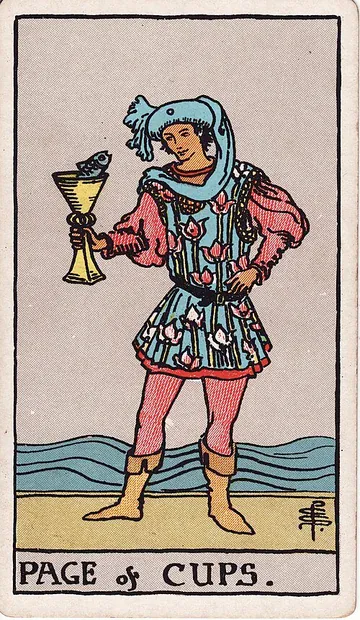
Page of Cups
The junior messenger meets the courier-knight. A generational hand-off in feeling: the page learning from the knight how to compose and deliver a cup, or the seeker's own inner pair — the part with the message and the part learning to walk it. Patience with the page-energy; forward motion with the knight-energy.
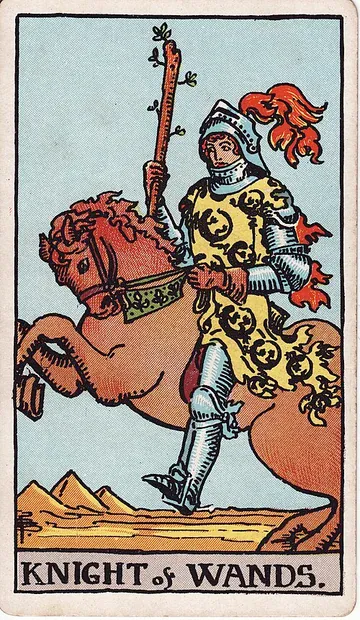
Knight of Wands
Same rank, opposing element. Water courier next to fire courier — two suitors, two voices, two offers on the table. The Wands knight gallops with sparks at the door; the Cups knight walks with a level cup. Rarely about which is right; almost always about which serves this season. Ignition or delivery? Both are real ways of loving someone; they do different work.
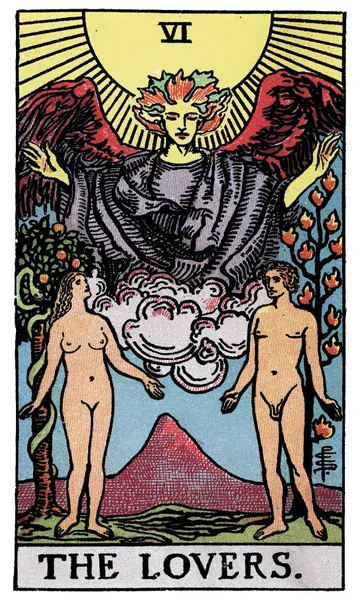
The Lovers
The Lovers turn the Knight of Cups into the proposal itself. The lyrical envoy is now bearing a real fork in the road — the one specific person, the one specific path, the one specific yes that reorganizes the field. Receive it as the considered choice it is. Do not rush; the Lovers respect the slow yes as much as the Knight respects the level cup.
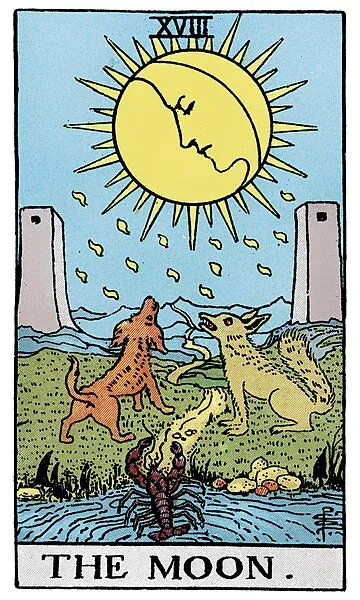
The Moon
The Moon asks what is actually in the cup. The lyrical message may be dream more than substance — the suitor's romance partly your projection, the offer's beauty partly the moonlight. Or the opposite: the Knight is carrying a message from the deeper Pisces tide that the day-self could not have generated. Look at the cup before you accept it.
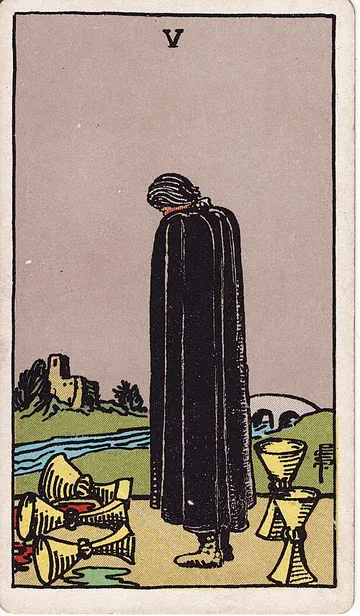
Five of Cups
The cup that did spill meets the cup being kept level. An arriving offering meets an old grief — a new lyrical suitor approaching a seeker still mourning the previous one, a new generous offer meeting the part of you still hurting from one withdrawn. The card does not ask you to perform readiness you do not have; it asks you to let the arriving Knight see the spilled cup at your feet.
Frequently Asked Questions
How long does a Knight of Cups yes take to actually arrive?
As long as a walk takes — this is a slow, composed yes. The thing you are asking about is on its way at walking pace; the courier has already set out with the cup held level. Treat it as a real positive answer, not a maybe, but adjust your expectations: the yes will arrive thoughtfully rather than dramatically. Do not miss the yes because you were waiting for fireworks.
Is the Knight of Cups romance real, or is he in love with the romance?
Upright, the offering is real and the language is only its wrapping. He is the lyrical suitor who has been composing himself toward an actual proposal. The flirtation has substance; the poems are not borrowed; the visit will happen. The card supports new sparks, returning warmth in long partnerships, and recoveries after wounds. His love language is the small specific arrival — the visit, the letter, the detour. Count the arrivals, not the words.
Has the person shown by the Knight of Cups already decided what to say to me?
Largely, yes — the rehearsing is happening on the road. They have arrived at a feeling for you and are composing the language to bring it across. They are not feeling around the edges; they are walking the cup carefully toward you. Read silence as composition rather than absence. Lyrical messages, written paragraphs, planned visits — these are the cup being carried at chest height.
Is the Knight of Cups the Terrence Malick movie?
No — the tarot Knight of Cups is centuries older than the 2015 Terrence Malick film of the same name. The card is one of the four knights of the Major Arcana courts in the Rider-Waite-Smith deck, depicting a knight in fish-scale armor riding a silver-gray horse at walking pace, carrying a golden cup kept perfectly level. The film borrows the name as metaphor; the tarot meaning is unrelated.
What advice does the Knight of Cups give?
The Knight of Cups upright advises you to ride out with what you have already promised. Compose the letter, deliver the truth, raise your visor in the conversation that needs your unguarded face. Keep the cup level — plain language carried at chest height tends to arrive better than ornate language. The card asks for small specific arrivals that match the language of your original promise.
Continue Reading
Knight of Cups · Card overview · symbols · correspondences →
Return to the full card view — image, symbols, sensory correspondences, and Hermetic axes.
Read the reversed meaning →
Read the same depth on the opposite orientation.
Draw your reading now →
Bring this card to a question — open a quiet ritual.