
Nine of Wands · Core Meaning
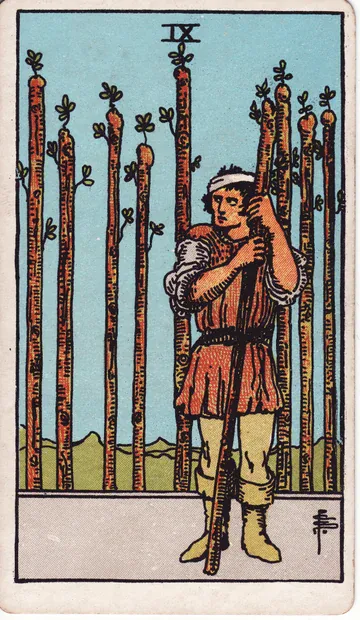
The Nine of Wands meaning, in plain language, is the meaning of the long watch. A man stands at a mountain pass with his head wrapped in white cloth. Behind him, eight wands rise out of the ground in a steady line, planted like a fence. A ninth stave rests in his hand — half walking-stick, half spear, leaned against more than wielded. He has not sat down. He has not run. His eyes pass over the reader and settle on a place behind their shoulder, where the wind has just changed. That is the whole image. That is the whole card. Everything else is footnote.
The signature tension of the Nine of Wands is the tension between vigilance and exhaustion in the same body. He is tired enough that the next blow could fell him, and alert enough that he will see the next blow coming. The card belongs to anyone who has been arguing the same case for nine seasons, parenting a child who keeps changing shape, building a small business through three downturns, recovering from an illness that keeps re-asserting itself, holding a friendship together while the friend keeps almost letting go. It is the last hour of the long shift. The white bandage is not decorative. The eight wands behind are not theory. The wounds are real.
Read the Rider-Waite-Smith image carefully and a more specific instruction emerges. He is not in motion. He is not lying down. He is not surrendering and he is not pursuing — both of those would be different cards. The Five of Wands is the brawl; the Seven of Wands is the contested high ground; the Ten of Wands is the burden carried home. The Nine of Wands is the pause between the eighth round and the ninth, where the body learns whether it can still keep the line. The whole card lives in that pause.
The traditional astrological signature reinforces the texture. Tradition assigns this card to Moon in Sagittarius, second decan — the ten-day arc of December 3 through December 12. Sagittarius is the archer's fire, aspiration aimed at distance, the bow drawn for a target the arms can no longer feel. The Moon in that decan softens the fire downward into instinct, into reflex, into what the body remembers when the mind has gone tired. This is why the sentinel does not fall: his vigilance has stopped being a thought. It has become a posture. He is holding the line in his sleep.
Kabbalistically, the Nine of Wands sits at Yesod in Atziluth — Foundation in the world of pure emanation. Yesod is the lunar vessel that receives the light of will from the higher sephirot and stores it as instinct, as habit, as the unconscious shape of action. In the suit of Wands — the suit of fire and creative will — Yesod is the place where ambition has cooled into routine without losing its shape. The fire has gone underground. It burns more steadily because no one is feeding it spectacle. The card is the ember that survives the windy night.
Read the Nine of Wands the way you would read a photograph of a watchman at the edge of his own resilience. The man in the picture is not a hero. He is not glorious. He is the version of yourself you have not always been kind to: the part that did not give up when giving up would have been easier, the part that kept showing up to a job, a marriage, a healing process, a creative practice, a child's bedside, on the day after the day after the worst day. The card describes that part as alive. The card asks how it is doing. The card asks, most importantly, whether the next thing on the wind is actually a threat — or whether the threat ended weeks ago and only the watching has not stopped.
Nine of Wands · Love & Relationships
The Nine of Wands love reading describes a relationship — or a relationship to the question of relationship — that has been weathered. The bond, if it exists, has come through hard seasons. The seeker, if single, has come through them alone. Either way, the body has learned to brace before it can decide whether the brace is still useful. This is the most common signature of the card in love: the love itself may be steady, but the watching is not.
For an existing partnership, the Nine of Wands often arrives during the year that should have been easier than it is. The fight that nearly ended you ended a season ago. The crisis that defined the relationship for three years has now passed. The structural problem has been named, addressed, and survived. And yet, sitting at the kitchen table at the end of an ordinary Tuesday, you find yourselves still flinching at small noises. The voice goes up half an octave and the shoulders rise. The wrong word at the wrong moment and someone leaves the room. The card is asking both of you to notice: the threat is not in this kitchen anymore. The fence of eight wands is still up because no one took it down. The work of this card, in long love, is the gentle, slow work of dismantling the watch.
For a new spark, the Nine of Wands is a more cautious card than its cousins in the Wands suit. The Two and Three of Wands are the cards of imagined futures; the Knight is the card of arriving with all the noise. The Nine arrives quietly, often with someone who has been hurt by the last person, or by a sequence of last people, and is asking whether you are the next blow. They are not asking unkindly. They are asking carefully. The card asks the seeker to be the kind of partner who can be stood next to without setting off alarms — to move at a pace the bandaged sentinel can read as friendly. Sudden gestures, even loving ones, can register as the next attack. Steady presence is the love language this card recognizes.
For the solo seeker who is asking whether love is possible, the Nine of Wands answers yes — but it adds a precise condition. Love is possible for the person who is willing to set down the ninth stave when love finally arrives. The card is one of the deck's clearest pictures of someone who has built a life around guarding against further wounding, and whose guarding has become the wall around the very door love would walk through. The wounds are real. The protection makes sense. And the protection is also, by now, the thing keeping the next person out. The card asks for a small, deliberate act: identify one defense that no longer has a target. Lower it. Then see who walks toward you in the changed air.
For love after a wound, the Nine of Wands is one of the most honest cards in the deck. It does not pretend the wound has healed. It does not pretend the next love will be unlike the last. What it does is draw the picture of someone who was hit hard, who is still hit, and who has not let the hit be the whole story. The card is the season in which love after a real betrayal becomes possible again — but only because the seeker has stopped trying to pre-empt the betrayal of someone who has not yet done anything wrong. The love after a wound that this card describes is not innocent. It is informed. It chooses to risk anyway, with eyes open, because the alternative — the closed life behind the eight wands — has stopped being livable.
For reconciliation questions, the Nine of Wands gives a complicated answer. The card belongs to people who keep getting up. So if you are asking whether to reconcile after a break, this card validates the impulse: you have not given up; you are willing to take the next round. But the card also asks whether the wound from the original break has been treated, or only bandaged. Reconciling with the same nervous system that broke last time produces the same break, on a slightly later schedule. Take the white cloth off. Look at what is underneath. Decide from the wound, not from the bandage.
For long-distance relationships, the card describes a particular kind of endurance: the love that survives without daily presence because both people have agreed to keep watch over the same line. This is the bond of soldiers, of medical residents working opposite shifts, of partners separated by visa or by the long care of a parent on the other coast. The Nine of Wands honors this. The card warns, only, that the watching can become the relationship if the watching is never set down. Make the trip. Sit in the same room. Let the bandaged sentinel discover that the other person is not actually arriving as an attack.
For pursuer-and-distancer dynamics, the Nine of Wands often describes the distancer's interior — someone who is not fleeing because they don't care, but because every approach reads as an incoming blow. The pursuer in this dynamic, holding the card, gets a clean instruction: slow down. Lower the volume of the asking. The bandaged sentinel cannot answer a frantic knock. They can answer a steady one, eventually, if no one is hammering.
For household and family-constraint cases — the relationship that is being read against an unsupportive in-law, a child from a previous marriage, a chronic illness in the family — the Nine of Wands says the love is real and the structural pressure is also real. Both are true. The card does not pretend the pressure away. It asks the seeker to choose the watch with care. You cannot keep watch over every front. Pick the line that actually needs you. Let the rest pass.
For desire mismatch — one partner wanting more than the other, the long question of whether the difference is workable — the Nine of Wands warns against fighting the same fight a ninth time. If the conversation has been had eight times and has reached the same impasse, the card says: the impasse is the answer. The work now is not another round. The work is to decide whether the love is large enough to hold this particular un-answered question, or whether the un-answered question is becoming the whole house.
For the "are they into me" question, the Nine of Wands upright answers yes — but with the texture of someone who is checking you carefully before opening further. They are not playing games. They are scanning. They have been hurt before. Their feelings are real, and their caution is real, and the two are not in conflict. If you are patient enough to be the kind of approach that can be read as friendly — slow movement, no sudden grand gestures, evidence over performance — the card promises that the bandaged sentinel will set the stave down and let you stand at the gate.
For queer, neurodivergent, or otherwise non-traditional pairings the Nine of Wands often arrives because both partners are arriving with prior wounds — from family, from earlier relationships, from a culture that did not always make space for them. The card validates the bandage. The card does not ask anyone to pretend they were not hurt. What it asks is that two bandaged people learn to keep watch in the same direction, rather than at each other. The fence of eight wands becomes shelter when the line faces outward together.
Nine of Wands · As Feelings
The Nine of Wands as feelings is among the more layered answers in the deck. The card never describes a clean emotion — it describes a person feeling something through layers of prior weather. When the Nine of Wands appears to answer how someone feels about you, the body is the first place to look. Their shoulders, in the imagined picture, are slightly lifted. Their eyes are watchful. Their breath is steady. They are not running. They are not advancing. They are watching you, carefully, with feeling — and the feeling is real, and it is being filtered through the eight wounds behind them.
For a reserved person, the Nine of Wands as feelings means they care more than they have said. The silence is not absence. The silence is the way they protect the feeling from a world that has previously punished them for showing it. Their care is the kind that lives behind a fence: durable, slow, attentive to small shifts in the wind. They notice when you are tired. They notice when you have changed your hair. They notice when your voice goes thin. They do not always say so, because saying so feels like exposing the thing they are trying to keep alive. Read their attention as the love. The bandaged sentinel speaks in glances, not declarations.
For a demonstrative person, the Nine of Wands as feelings is rarer but possible — and it suggests a person whose warm public signals exist alongside a more wary private one. They will tell their friends about you. They will post the photographs. They will text in long affectionate paragraphs. And then, in the room with you, they will go quiet and still, watching. This is not duplicity. This is the body doing the second job. They love you, and they are watching because love itself has previously cost them something. Match the warmth in public; do not press the watching in private. The watching will ease when the body learns it is safe.
For a long bond, the Nine of Wands as feelings often describes settled commitment held by someone who has stopped flinching at the relationship's old triggers. They are not new in their feeling. They have worked something through. The feeling has become structural — the way a mountain is structural, slow to move and steady in weather. The card warns against confusing this stability for indifference. The bandaged sentinel is not bored. They are the version of love that has chosen to keep showing up after eight rounds of testing. That is not less feeling. That is more.
For a new connection, the Nine of Wands as feelings often shows someone who is interested but is also mid-recovery from something else. They are not ready to be all-in. They are not playing games. They are asking themselves, in private, whether they have enough left to give a new person what a new person deserves. The card asks the seeker not to take this as rejection. The watchfulness is information about their last year, not about you. If you can give them the gift of un-pressured time, they will, on their own schedule, let the gate open. If you cannot, the watchfulness reads as cold and you leave — and what gets left is not what you thought you were leaving.
For a post-conflict reading — you have just had a fight, you are checking what the other person feels — the Nine of Wands as feelings is the steadiest card you can draw. They are still angry, and they are not leaving. The argument has wounded them; the relationship has not. They are sitting with the wound, taking stock, and they are still inside the bond. Wait. Do not push. The bandaged sentinel is not someone you can rush back into closeness. Give them an hour, a day, sometimes a week. They will return.
For long-distance feelings, where you are reading whether the other person still cares despite the gap, the Nine of Wands answers yes — the care is intact, and what looks like withdrawal is the body conserving energy for the watch. They cannot be available with the brightness of someone in the same room. They are managing their fire so that it lasts the season. Read the steady, low-burning attention as the love it is.
For divided warmth — the question of whether the other person's affection is split between you and someone else — the Nine of Wands tends to describe a person whose attention is not actually divided so much as guarded. They are not hiding a competitor. They are hiding a wound. The energy that looks like elsewhere is going inward, to the work of healing, not sideways to another person. This is the card to consult when you are tempted to assume infidelity. Often, on this card, the truth is loneliness inside an old wound, not betrayal.
For a person who seems to be avoiding, but might actually be pacing themselves, the Nine of Wands as feelings is one of the deck's clearest disambiguators. Avoidance, on this card, is not a refusal to feel. It is a refusal to feel faster than the body can hold. They will arrive — at their pace, not yours. The seeker's job is to differentiate between disinterest (a different card entirely) and someone who needs the slow approach to feel at all safe. The bandaged sentinel cannot meet a sprinter. They can meet a walker who keeps showing up.
For cultural or life-stage difference — the question is whether their feelings can cross some real gap of context — the Nine of Wands says the feeling itself crosses fine. What does not cross easily is the watching. They have inherited a vigilance from their family, their history, their earlier life. The feeling is for you. The vigilance is older than you. Both can be true. Slow is the answer. The card does not love speed. The card loves the sentry who, after the long night, finally lets one person inside the gate.
Nine of Wands · Career & Work
Work in the Nine of Wands gets measured in stamina rather than in brilliance. The metric is not whether the work has been easy — it has not — but whether the seeker has, against odds, kept the line. The card is the eighth month of the year-long initiative. The fourth quarter of the third year. The morning after the third reorganization. The version of professional life that is not glamorous, not photogenic for a profile, and is, by any honest accounting, the actual texture of how anything substantial gets built.
For a current role that the seeker is asking whether to stay in, the Nine of Wands answers with a careful yes — provided two things are true. First, that the wounds being absorbed are healing wounds, not chronic ones. The bandaged sentinel can take a hit. He cannot take eight new hits a week, every week, for the next year. If the role is producing fresh damage at a pace the body cannot integrate, the card flips toward staying-is-bleeding-out. If the wounds are old, and the role is now stable, the card says hold. You are closer to the dawn than you think.
For a new role decision, the Nine of Wands is rarely the card of the bold leap. It is the card of the considered acceptance. If you are taking a new role and this card appears, the role will require defense as much as initiative. The ask is to hold ground that someone else has previously failed to hold. There will be people who liked the failure of your predecessor and will be quietly working against your success. Read this clearly. Take the role with eyes open. Do not pretend the politics are not there. The card asks you to be the kind of leader whose first ninety days are spent learning the wind, not throwing the first punches. Plant the eight wands carefully. Then watch.
For freelancers, founders, and solo operators, the Nine of Wands often arrives in the middle years — past the launch, before the breakthrough. The exciting story is gone. The terrifying story is gone. What remains is the unglamorous work of doing the same thing, well, on a Tuesday in November, when no one is watching. The card honors this. It says, plainly, that this kind of endurance is what builds the durable practice. Most of the people who started when you started have quit. You have not. The card describes the season that decides whether you are a person who finished, or one of the many who began.
For a creative practice, the Nine of Wands describes the manuscript on the eighth draft, the album on the third arrangement, the painting that has been worked over for months and is now nearly itself. The card is not the burst of inspiration. The card is the discipline that keeps showing up after inspiration has long since stopped. There is a particular danger this card warns against: confusing fatigue with finished. The work is not done because you are tired. The work is done when the work is done. The bandaged sentinel does not abandon his post because the post has gotten boring. He stays because the watch is, in fact, the job.
For students and apprentices in long programs — graduate school, residencies, multi-year credentialing — the Nine of Wands is often a kind reading. The work is hard. You are in the middle. There are people who have it easier and people who have it worse, and neither comparison helps you. The card simply says: keep the line. The eight wands behind you are the eight semesters, the eight rotations, the eight years you have already given. They are not wasted. They are the fence inside which the ninth chapter happens. Walk into the ninth chapter without dropping any of the eight.
For a manager or leader, the Nine of Wands describes the season when leadership becomes about holding the team's nerve, not chasing new ground. The market has shifted. The funding has tightened. The org chart has been redrawn. Your job is not to be brave on a stage; your job is to be present in the meeting where everyone else is afraid. The card warns specifically against performative resilience — the leader who declares that everything is fine while privately running on empty. The bandaged sentinel does not lie about the wounds. He simply does not fall. Tell your team what is true. Tell them you are not falling. Then do not fall.
For a care, teaching, or ritual worker — therapists, nurses, hospice staff, schoolteachers, ministers, ritualists, anyone whose work is the long hold of other people's hard moments — the Nine of Wands is one of the card's most exact pictures. You are in a profession built on absorption. The eight wounds are not metaphor; they are the eight clients, students, patients, congregants whose hard seasons you have carried into your body. The card honors this and warns. The honoring is real: this work is sacred, and almost no one outside the profession understands the cost. The warning is also real: you are not allowed, on the Nine of Wands, to skip the watch over your own body. You are also a person at the gate. Tend yourself with the same attentiveness you tend everyone else.
For a promotion question, the Nine of Wands is rarely the card of the dramatic leap upward. It is the card of the promotion that finally arrives because you have outlasted four candidates who would have technically been brighter, but who left when the going got long. The card validates this. It says quiet competence over a long time tends, eventually, to be the thing that wins the role. Not always. Often. Take the promotion. Honor the long climb. Notice that the people who left did not fail; they simply ran a different race.
For a layoff or transition reading, the Nine of Wands describes the seeker who has been let go and is in the in-between. The body is in shock; the practical questions are loud; the future is unclear. The card says: do not make the next move out of panic. The bandaged sentinel survives because he refuses the unforced error. Stand. Apply for the right roles, not all the roles. Tell the truth in interviews about the wound; do not tell the lie that pretends the wound is not there. The next role will arrive. The card is not lying about that. But it cannot arrive at the speed of fear.
For a cross-functional team or political-difficult workplace, the Nine of Wands warns against the seductive draw of becoming the office's permanent watcher. You can be the person who sees every dynamic clearly and is also the person who never gets any work done, because the watching has eaten the day. Pick your wars. The fence has eight wands. It does not have eighty.
For the leave-or-stay diagnosis — the seeker is honestly unsure whether the role has run its course — the Nine of Wands offers a precise instrument. Ask: in the last thirty days, what have I held that was actually mine to hold, and what have I held only because I have not yet noticed that the war ended? The card is famously the card of the watch that has lost its target. If the watching is now the only thing that gives the role its shape, the role is over. If the watching is still tied to a real, current responsibility, the role is not yet over. The card is asking you to be honest about which it is.
Nine of Wands · Money & Finances
Nothing in the Nine of Wands resembles a windfall. What it shows instead is a surviving balance — the savings that have, against odds, made it through three rough years; the small business that has paid its bills again this month; the recovering financial life that is no longer in crisis but has not yet begun to expand. The card describes a finance that is structurally sound and emotionally still braced.
For the seeker asking whether their financial position is safe, the Nine of Wands says yes, with conditions. The position is safe today because of choices that have already been made — the boring choices, the unsexy ones, the long discipline that almost no one would notice from outside. Continue the discipline. The card does not promise wealth. It promises stability if the watch is kept.
For someone in financial recovery — the long climb out of debt, the slow rebuilding after a job loss, the careful repair after a divorce settlement — the Nine of Wands is among the most validating cards in the deck. You have been hit. The recovery is real. You are not yet at the ten of pentacles' generational ground, and you are not yet at the abundance of the Nine of Cups. You are at the wand-fence, the eight wounds, the ninth stave that is keeping your weight off your tired leg. This is enough for now. The card honors the fact that you are still standing. The card asks you to stop apologizing for the slowness of the climb.
For a financial gamble — a speculative investment, a risky purchase, a big bet — the Nine of Wands counsels against. This is not the card of the bold play. The bandaged sentinel does not have the reserves to take a hit that fails. If you have to ask the card about a gamble, the energy is not yet right for it. Wait. The card you want for the bold play is the Knight of Wands or the Eight of Wands or the Wheel. This card asks you to keep the existing fortifications, not to extend the line.
For a major purchase — a house, a car, a long-anticipated expense — the Nine of Wands does not say no. It asks you to do the deliberate, boring math. Read the actual interest rate. Read the actual maintenance cost. Read the actual five-year picture, not the romanticized one. If the math holds after the watchful read, the purchase is sound. If the math depends on optimism the card warns: the bandaged sentinel does not budget on hope. He budgets on the eight rounds he has already seen.
For debt and repayment, the Nine of Wands supports the consolidation move — the unglamorous, durable move that takes the eight scattered debts and turns them into one walked-down line. Not the dramatic payoff; the steady plan. Set up the automatic payment. Forget about it for a season. Come back and find the line shorter. This is how debt actually leaves a life on this card. The card respects boring.
For windfall — inheritance, gift, settlement, unexpected income — the Nine of Wands warns against the impulse to spend the windfall on relief from the watching. The temptation is to take the gift and use it to feel, finally, like the war is over. The card asks for two seasons of patience. Let the money sit. Decide later. Most windfalls, deployed in the first thirty days, evaporate; the same windfalls, deployed after ninety, change a life. The card supports the ninety-day rule.
For a partner or shared finances question, the Nine of Wands describes the household that is one of the few in its peer group still solvent. You have not had it easier. You have made different choices. The card asks you to honor those choices and to be careful not to let the watching become a private resentment. Money is rarely the source of marital fights; the watching about money often is. Have the conversation about what each person is actually guarding against.
Nine of Wands · Health
A body in the slow tail of recovery — after surgery, after illness, after hard training or a long stretch of stress — is what the Nine of Wands is looking at. The card belongs to the convalescent. The body has not collapsed. The body is also not back to its pre-wound baseline. Both things are true. The work of this card, in health, is the long discipline of the recovery itself.
The card's astrological signature is Moon in Sagittarius, second decan, and the body parts it traditionally touches are the blood and the liver — the systems of circulation and detoxification, the systems that filter and carry. When the Nine of Wands appears in a health reading, those systems often deserve the most attention. Hydration. Sleep. Real food. Less alcohol. Less of the substances that ask the liver to work harder than it should. The card does not give medical advice. It points at where the body's quiet, behind-the-scenes work has been overburdened.
For a chronic condition, the Nine of Wands describes the season when the condition is stable but the management has become exhausting. The medication is being taken. The labs are okay. And the daily attention required to keep the labs okay has begun to wear the seeker down. The card validates the exhaustion and asks for one specific reform: bring help into the watch. The bandaged sentinel cannot keep the line alone forever. A care team, a partner, a friend who knows the protocol, a support group of others with the same condition — the card says, plainly, that the line lasts longer when the watch is shared.
For an acute issue — an injury, an infection, an episode of acute pain — the Nine of Wands describes the body that has begun to heal but is still in the bandage phase. Do not pull the bandage off too soon. Do not return to full activity because you feel forty percent better today and want to feel one hundred percent better tomorrow. The card has seen this story. The body that pushes through the convalescence reinjures within the week. Slow. Slow. The dawn is closer than you think.
For mental health, the Nine of Wands is one of the deck's clearer pictures of the seeker who has done the work of recovery and is now in the long maintenance phase. The acute crisis is past. Therapy is in place. Medication, if it is part of the picture, has stabilized. The seeker is functional. And the seeker is also, by an honest internal account, tired of the daily vigilance against their own old patterns. The card validates the fatigue. It also says, plainly, that the maintenance is the recovery. This is what wellness looks like for someone who has been through what you have been through. Wellness is not the absence of the watch. Wellness is the watch becoming sustainable.
For sleep, the Nine of Wands is a precise diagnostic. The bandaged sentinel does not sleep well because the body has not yet learned that the war is over. Restless sleep, waking at 3 a.m., the dreams that scan for threat — these are the signatures of the unfinished watch. The card asks for a wind-down ritual that is not just a phone-down rule but a full body practice: warm shower, dim light, the same bedtime three nights in a row, a journal page that closes the day's open files. The body needs evidence that the gate is locked. Without the evidence, it stays awake.
For exhaustion that has become structural, the Nine of Wands names the condition: you are running on willpower at the level the body should be running on rest. This is not sustainable, and it is also, on this card, not yet a crisis. The card belongs to the seeker who has time to make a different choice. Cut one commitment. Sleep an extra hour. Drink water before coffee. The card responds to small, real, unglamorous adjustments, not to dramatic resets.
For breathwork, somatic practice, or any discipline that takes the body as its teacher, the Nine of Wands is the card of the practice that has become routine in the steady sense — yoga or qi gong or daily walking that has stopped feeling like a project and started feeling like a baseline. Honor that. The card asks you to keep the practice. It also asks you to notice if the practice has narrowed to defense — if you do yoga only to manage symptoms, if you walk only to keep anxiety down — and to let, occasionally, the practice be for joy as well. The watch wears the body. Joy waters the watch.
Nine of Wands · Spirituality
The Nine of Wands keeps a long watch — the night vigil that does not end at dawn, the practice that keeps faith with itself through dry seasons, the prayer that continues after the answer has stopped feeling close. The card belongs to seekers who have been on the path long enough to know it is not always luminous. The original initiation has receded. The mountaintop experience has become memory. What remains is the daily showing-up, the small ritual at the small altar, the body learning that the practice is not always rewarded with feeling. The card honors this.
The Nine of Wands sits at Yesod in Atziluth — Foundation in the world of pure emanation, the lunar vessel that receives the original light and stores it as instinct. The card's spiritual signature, then, is the moment when the seeker's faith has stopped being a mountain experience and has become a body-level reflex. You no longer choose, in the morning, whether to sit. You sit. You no longer choose whether to walk to the temple or roll out the mat. You walk. The fire of the original calling has not gone out. It has gone underground. The card asks you to trust the underground fire.
For seekers in active practice — meditation, ritual, devotion, journaling — the Nine of Wands describes the season after the breakthroughs have ended and before the next breakthrough begins. The mystics call this the dry season, the dark night, the dim cloud. The card does not promise that the dryness will end soon. It promises that the fence of eight wands — the eight years, eight retreats, eight teachers, eight cycles of practice — is real, and that the line is being held, even when the holding does not feel like much. The card is the patron of the practitioner who keeps faith past the point of feeling.
For seekers in the season after a spiritual wound — a teacher who betrayed trust, a community that turned hostile, a tradition that no longer feels safe — the Nine of Wands is one of the deck's truest mirrors. The bandage on the head is real. The wounds were real. The card does not ask the seeker to pretend otherwise. What it does ask is that the wounding not become the whole spirituality. The fence is for keeping the worst out, not for keeping all spiritual life out. Find the practice you can do in private, with no community, with no teacher, with no name. Sit with that. The Yesod fire wants to keep burning even when the public structures have failed.
For the seeker exploring belief, the Nine of Wands warns gently against spiritual seeking that has become primarily defensive — choosing traditions for what they protect against rather than what they open toward. Yes, you have wounds. Yes, the wounds are real. And the bandaged sentinel does not become whole by adding more wands to the fence. He becomes whole by, eventually, walking back through the gate. Choose practice for what it gives, not only for what it shields.
A practice the Nine of Wands invites — one practice, specific, doable in thirty minutes — is the night-watch sit. Sometime between dusk and midnight, sit in a chair at a window. Do not meditate in the formal sense. Watch the night. Let the eyes adjust to the dim. Let the body register that the gate is closed. Let the breath slow without instruction. Stay until the small alarm in the chest — the alarm that has been running since before you can remember — quiets by itself. Stand up. Sleep. The card responds to this. It is not striving. It is the practice of letting the watch finally rest while the body remembers, at the cellular level, that it is allowed to.
Nine of Wands · Yes or No
Yes — but only if you stop swinging.
The Nine of Wands yes or no answer is one of the deck's most conditional yeses. The card says yes, the line will hold, the project will finish, the relationship will survive, the recovery will land — provided you do not, in your fatigue, throw the punch that ruins it all on the morning of round nine. The yes belongs to the seeker who can stand still. The yes does not belong to the seeker who is so tired that they are looking for any excuse to end the watch.
For yes-or-no questions about a relationship, a job, a move, a long project — the answer is yes, with the caveat that the yes is only available if you keep the line. The Nine of Wands is the card of the closed deal that has not yet closed because the closing has been long. Do not bail in the last week. Do not pick the unforced fight on the last day. Do not, on the morning the email is supposed to arrive, write the email that makes the email impossible to send.
For questions about whether someone is being honest, whether an offer is real, whether a plan will hold, the Nine of Wands says: probably yes, and check the details anyway. The card is naturally suspicious. Its suspicion is not paranoia — it is informed wariness from a seeker who has been deceived before and learned to read fine print. Read the fine print. The yes is real. The fine print is also real. Both go in the same drawer.
Asked how much longer the watch runs, the Nine of Wands suggests the answer is closer than it feels. The watch always feels longer than it is. The dawn is on the other side of the next ridge. The card warns against the seductive belief that nothing is happening because you cannot yet see the result. Things are happening. They are happening underground, in the Yesod layer, in the body's instinctual stratum, where the practice is being assembled into baseline. The arrival is in motion.
For a binary action question — should I act, should I wait — the Nine of Wands almost always answers wait. Not forever. Not as avoidance. As the strategic patience of the seasoned watchman who knows that the first move is usually wrong. Let the wind pass. Notice who actually arrived once the noise dies down. Then move, with full information, in the direction the situation has actually developed — not in the direction of the situation you imagined three weeks ago.
For "will I get past this?" the Nine of Wands answers yes. The card belongs to the seeker who, by character and by training, gets past things. The card is a portrait of someone who is, definitionally, not falling. If the question is whether you make it, this card is a yes. The work is to not undo the yes by setting your own line on fire out of impatience for the dawn.
If the question was: do I have it in me to keep going? The card answers yes, and reminds you that the eight wands behind you are the answer the question needed.
Nine of Wands · Advice
The advice of the Nine of Wands begins with one instruction. Do not strike first. The card belongs to a moment when the seeker is tired enough that the body wants to end the long watch by picking a fight that lets it stop watching. This is the most reliable failure mode of this card: the bandaged sentinel, in the last hour before dawn, swings at a shadow that turned out to be nothing, and the swing is what wakes the actual enemy. Hold. Whatever you are tempted to settle today, settle tomorrow. The card almost never punishes the seeker who waits. It often punishes the one who could not.
A second instruction: differentiate the wind from the enemy. Most of what you are bracing against is not arriving. Sit in a chair. Make a list of the threats you are tracking — the ones that wake you at 3 a.m., the ones that color every meeting, the ones that have you scanning the body language of friends. Mark each one with a pen. Which of these has produced an actual incoming move in the last thirty days? Which is a residue from a war that is over? The card responds beautifully to this list. The fence has room for the live threats. The dead ones can be taken down.
A third instruction: take help. The bandaged sentinel believes, by the hour the card arrives, that he can only do this alone. This belief is part of his wound. The card does not endorse it. Pass the ninth stave, occasionally, to someone else. Let your partner do the laundry without micromanaging. Let your colleague present the slide you would normally present. Let the friend who keeps offering finally help. The card says, plainly, the watch lasts longer when it is shared. Solo watch is how the line eventually breaks.
A fourth instruction: tend the body that is doing the watching. The blood and the liver are this card's body. Drink water before coffee. Sleep an extra hour. Eat a meal you did not eat at the desk. Go for a walk that has no goal. The card's exhaustion is reversible. The reversal is not heroic. It is small, daily, unglamorous, and exactly what you have been telling yourself you do not have time for. You have time. You are spending it on the watch. Spend a little of it on the watcher.
A fifth instruction, gentler than the others: forgive the eight wounds. The bandaged sentinel often, by this point in the long campaign, has begun to resent his own scars. He sees the bandage in the mirror and reads it as failure. The card disagrees. The bandage is the proof that the watch held. The wounds are the proof that the war was real. None of this is your shame. All of it is your endurance. Let the wounds be a line item in the ledger of what you have come through, not a witness to your inadequacy.
A practical move on the day the card appears: lower one defense. Pick one ongoing watch — one relationship you have been guarded in, one family member you have been clipped with, one professional contact you have been wary of, one inner voice you have been silencing — and lower the watch by ten percent. Not by abandoning it. By letting one small thing through. See what happens. The card learns through small experiments. It does not respond to dramatic resolutions. It responds to evidence that the bandage can come off without the wound reopening.
Nine of Wands · Card Combinations
Nine of Wands + Eight of Wands
The volley followed by the watch. The Eight of Wands is the eight arrows in flight — the messages, the announcements, the rapid sequence of moves that left their mark — and the Nine of Wands is the body still standing in the field where they landed. Read together, the combination tells a clean story: the wounds have a source, the source was real, and the source has, for the moment, stopped firing. The work now is not another volley back. The work is to take inventory of what was hit and what survived. The pause is the ground on which the next move is built. Whoever sent the eight is unlikely to send a ninth in the immediate future; whoever holds the ninth stave can use the quiet to plant the line more deliberately than fear allowed last time.
Nine of Wands + Ten of Wands
The burden becomes the new shape. The Nine of Wands warns; the Ten arrives. Together, this combination describes the seeker who survived the long watch and then, in the relief of survival, took on more than the body could hold. The fence of eight wands gets unbundled and carried as a load. The card pair is one of the deck's strongest portraits of high-functioning over-extension — the leader, the parent, the founder, the caregiver, who came through the hard year and immediately accepted the next responsibility. The advice in this pair is to refuse the ten until the nine has been honored. Set the staves down. Rest. Then choose what to carry.
Nine of Wands + The Moon
The Moon brings the shadows the bandaged sentinel has been watching for — and reveals, half the time, that the shadows were projections more than actual approaches. Together, this combination describes the season when paranoia and informed wariness have become hard to tell apart. Do not act on the imagined enemy. Do not, also, ignore the dream that keeps repeating. The Moon insists on the unconscious; the Nine of Wands insists on the body's instinct. Read the convergence as information about what the deeper self is processing, not as a forecast of an external threat.
Nine of Wands + The Star
The counter-image, the one the seeker most needs to draw. The Star is exhaustion bathed and laid down — the figure pouring water by the pool, vulnerable, unguarded, restored. Where the Nine of Wands stays standing because falling is not an option, the Star kneels because the war is over. The pair, drawn together, is one of the deck's clearest invitations to set the watch down. The dawn the bandaged sentinel has been holding for has, in fact, arrived. He has not yet noticed because his body still expects the next blow. The Star says: the next blow is not coming tonight. Set the stave down. Take off the bandage. Let the water find the wound.
Nine of Wands + Nine of Cups
A pairing of two very different kinds of arrival. The Nine of Cups is the wish granted, the table set, the soft yes. The Nine of Wands is the watch held, the line kept, the wary yes. Together, the combination often appears at a moment of strange double-truth: the seeker has gotten what they wanted and is still bracing for the loss of it. The pair is the engagement after the long courtship. The job offer after the long search. The remission after the long illness. The card pair asks the seeker to trust the arrival without lowering the watch all at once. Receive the cups. Set down one wand. Then another. Let the body learn, slowly, that the wish was real.
Card Combinations
Nine of Cups
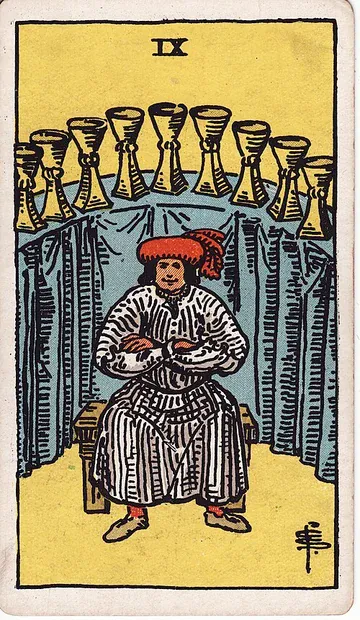
Two ninth-card arrivals at the same table — the wish granted next to the watch held. The wounded sentinel and the satisfied host meet at the moment most seekers do not believe they will: the relationship has come good, the role has landed, the recovery is real, and the body is still bracing. The pair asks for ceremony. Set one wand down. Pick up one cup. Drink. The wish is not claimed by being granted; it is claimed by being received. The watch can finally start to ease.
Ten of Wands
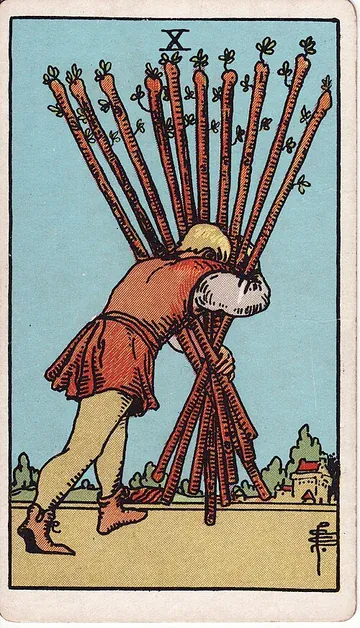
The fence becomes the load. The Nine of Wands' eight planted staves get unbundled and bound to the seeker's back, and the watch becomes a burden carried into a new chapter. Together the pair describes high-functioning over-extension — the survivor who came through the long campaign and immediately accepted the next responsibility. The instruction is to refuse the ten until the nine has been honored. Rest. Then choose the load with intention rather than reflex.
The Moon
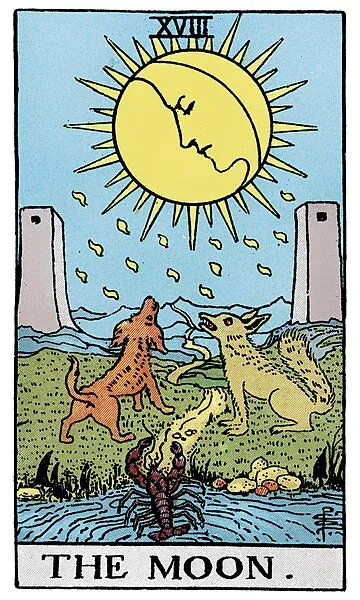
The Moon meeting the bandaged sentinel. Shadows arrive, dreams thicken, the unconscious sends material the watching mind cannot evaluate. Paranoia and informed wariness become hard to distinguish. The pair asks for journaling and patience rather than action. Do not end relationships, quit jobs, or burn bridges from this convergence. Wait for the moon to clear; the body's instinct will speak more cleanly when the dream-tide has receded.

The Star
The Star is the medicine the bandaged sentinel most needs and most resists. Where the Nine of Wands stays standing because falling is not an option, the Star kneels because the war is over. Together the pair tells the seeker that the dawn they have been holding for has, in fact, arrived; the body has not yet noticed because it is still expecting the next blow. Set the stave down. Take off the bandage. Let the water reach the wound. The watch is allowed to end.
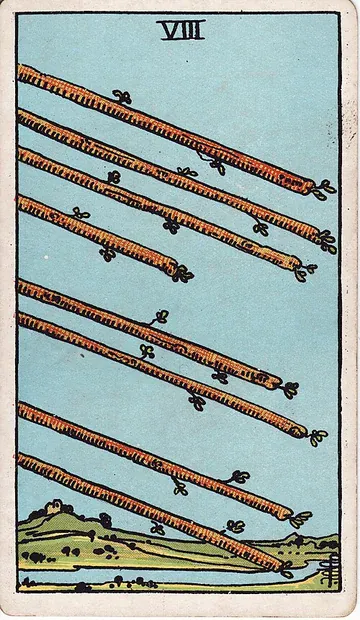
Eight of Wands
The volley and the watch together. Eight arrows in flight, then the body still standing in the field where they landed. The pair tells a clean story: the wounds had a source, the source was real, the source has stopped firing for now. The work is not another volley back. The work is to take inventory of what was hit and what survived, then plant the line more deliberately than fear allowed last time. The pause is the ground on which the next move is built.
Frequently Asked Questions
What does the Nine of Wands tarot card actually mean?
The Nine of Wands tarot card means the long watch — the season after eight rounds when the seeker is tired, scarred, and still standing. The image is a bandaged sentinel with eight wands planted behind him like a fence and a ninth in his hand, gaze past his shoulder. The card honors endurance, warns against the unforced strike in the last hour, and reminds the reader that the line they have been holding is closer to dawn than to defeat.
Does the Nine of Wands' yes depend on me not throwing the unforced punch?
Almost entirely. The card answers yes — the bond holds, the project finishes, the recovery lands — and then attaches one condition, which is about your own hand rather than about circumstances. Round nine is where fatigue starts looking for an exit, and the cheapest exit available to a tired person is a fight. Send the email at midnight. Say the sharp true thing to the colleague. Force the conversation that ends the waiting by ending the relationship. None of those decisions come from the situation; they come from exhaustion wanting the watching to stop. So the practical version of this card's yes is: make no irreversible move before sleeping, and refuse any conflict you did not choose in daylight. Hold that and the underlying yes arrives intact.
Which of my eight defenses is keeping the next love out?
The card asks that question rather than answering it, and it is worth taking literally: eight wands stand planted behind the sentinel like a fence, each one a real thing that once protected something real. In love, the Nine of Wands describes a bond — or a whole relationship to being in one — that has been weathered. The sentinel cares and watches at the same time. For a newer connection it describes someone who needs a steady, low-volume approach rather than grand gestures. For a long partnership it means love that survived real seasons and has reached the stage where the defenses can be set down one at a time. For someone single, the useful work is naming which particular rule — never date anyone in the same field, never be the one who texts first, never introduce anybody before six months — started as protection and has quietly become the wall.
What does the Nine of Wands feel like as someone's feelings?
When the Nine of Wands appears as feelings, the warmth is real and is being filtered through prior wounds. They care, and they are watching — not because they distrust you, but because love has previously cost them something. Read silence as protection rather than absence. Match a steady, low-volume approach. The bandaged sentinel cannot answer a frantic knock; he can answer a patient one, on his own schedule, when his body has learned that you are not an incoming blow.
What is the Nine of Wands warning the seeker about?
The Nine of Wands warns against two failures of the long watch. The first is the unforced strike — picking a fight on the morning of round nine because fatigue wants the watching to be over. The second is the watch that has lost its target: continuing to brace against threats that have not arrived in months because the body has not yet learned the war is finished. Neither failure is shame; both are recoverable. Refuse the cheap punch and lower one defense.