
Page of Cups · Core Meaning
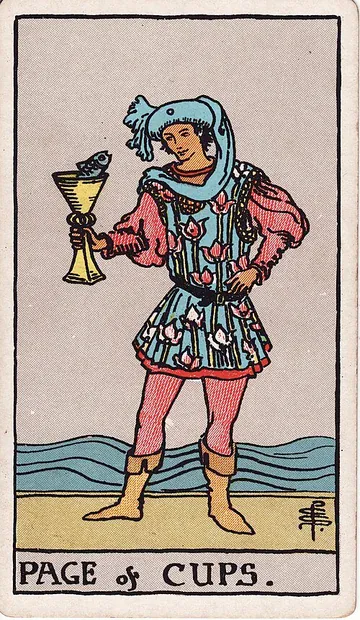
The Page of Cups is the young messenger standing at the edge of water, holding a cup that has begun to speak. In the cup is a fish: absurd, living, impossible to file under ordinary correspondence. The Page does not drop it. He does not pretend he expected it. He bends his attention toward the small creature and lets the moment become strange before he decides what it means.
This is the card's first teaching. Not every true message arrives in a formal envelope. Some messages arrive as a blush, a child's question, a line of melody heard while washing a glass, a dream that refuses to fade, an apology typed and erased three times. The Page of Cups does not ask whether the message is impressive. He asks whether it is alive.
As a court card, the Page is not mastery. He is the beginning of a relationship with the suit. Cups are water: feeling, intimacy, imagination, memory, the soft intelligence that moves before speech. The Page is water learning to take form. The card names him earth-within-water: the first thin silt where feeling becomes something the hand can touch. A poem is not yet a book. A crush is not yet a partnership. A hunch is not yet a plan. But each has crossed from vapor into shape.
The symbols make the card precise. The floral robe says imagination already has a pattern; it is not blank mood but a fabric with color. The calm sea behind him says the message does not require thunder. The soft cap with red cloth says the mind need not harden into a helmet. The fish in the cup says the content matters more than the sender's status. Something small is speaking from below the waterline, and the Page's dignity lies in listening without embarrassment.
Because he is a Page, the card also carries the ethics of apprenticeship. He has not yet learned the courtly performance of feeling. He has not become the Knight who carries emotion outward, the Queen who holds it with depth, or the King who governs it without drowning. He is earlier than all of that. His gift is not command. His gift is reception before pride has organized the face. In a reading, this often points to the moment before you decide whether a feeling is acceptable. The Page asks you to notice the feeling before your social training names it too much, too little, too childish, too inconvenient, or too late.
There is a reason the sea behind him is calm. The Page of Cups is not the storm of crisis that forces confession. He is the small tide that can be missed because nothing dramatic announces it. This is why the card often appears around emails, sketches, dreams, notes, invitations, and first sentences. These are not minor because they are small. They are minor because they are early. Their scale is their protection. A seed does not need a parade; it needs a patch of ground that is not immediately paved over.
The Page is also a test of how you treat the uncredentialed. The message may arrive from a younger person, a less experienced colleague, a quiet friend, a dream, or the part of yourself you usually edit out before speaking. If your first instinct is to ask whether the source has authority, the card redirects you to the content. Is it alive? Does it carry water? Does it ask for a more honest response than the one you prepared?
Upright, the Page of Cups describes the tender first arrival: a message, invitation, apology, creative seed, emotional opening, or intuitive nudge. It is sincere and not yet polished. It may feel young because it is young. That youth is not a flaw. The card asks for patience with beginnings, including the beginnings inside yourself. If you demand adult proof from every new feeling, the fish disappears before it can be named.
The Page's question is simple: can you receive the small thing without humiliating it? Can you give the odd thought a page in the notebook, the new affection a little air, the apology a hearing, the dream a sketch? This card is not naive. It knows that many small things do not become large things. It also knows that every living large thing was once small enough to be laughed at.
Page of Cups · Love & Relationships
In love, the Page of Cups upright is the first soft approach. Not the formal proposal, not the final promise, not the heavy architecture of shared life. It is the message that feels almost too simple: "I thought of you when I saw this." It is the careful compliment, the apology that does not yet know how much it needs to repair, the shy invitation made with more sincerity than style. The card asks that tenderness be read in its own scale.
For a new connection, the Page of Cups often describes the early signal of interest. Someone is curious, moved, and a little unpracticed in showing it. Their affection may come sideways: a song sent without explanation, a small gift, an attentive question, a nervous joke that reveals more than it hides. Read the awkwardness as part of the message. The fish is not a polished jewel in the cup. It is a living thing, blinking at the surface.
For an existing partnership, the Page appears when emotional freshness is trying to return. One partner may offer a small olive branch after a dull season: making tea without being asked, admitting a hurt in a less defended voice, sending a photo from the day because they wanted to share it. This card does not repair a relationship by grandeur. It repairs by reintroducing curiosity. The person across the table is not only the person you have memorized. They are still capable of surprising you.
For couples carrying conflict, the Page of Cups is the first true sentence after too many strategic sentences. It is not the argument itself; it is the moment one person stops managing the argument and says the vulnerable thing underneath. "I missed you." "I felt foolish." "I did not know how to ask." These are small sentences, but the card treats them as emissaries. The advice is to hear them before correcting them.
For a single seeker, the Page of Cups says love may begin through receptivity rather than pursuit. This does not mean waiting passively for someone to arrive. It means becoming available to the small signals you usually dismiss: the conversation that lingers, the friend-of-a-friend whose kindness registers late, the invitation you almost decline because it seems unimportant. The Page does not chase the fish. He notices it has appeared.
For someone healing after disappointment, this card is especially tender. It does not ask the wounded heart to leap. It asks the heart to listen for one small sound from the water. A first crush after grief, a first honest laugh with someone new, a first moment of wanting to dress nicely again: these are Page of Cups moments. They do not erase the wound. They prove the inner sea is not dead.
For long-distance or message-based relationships, the card is literal. The text, note, voice memo, letter, or quiet confession matters. The medium may be slight, but the feeling behind it is not necessarily slight. Still, the Page is young. A message opens the cup; it does not build the whole shore. Let the exchange grow through repetition, consistency, and embodied presence before giving it the weight of a mature bond.
For the question "do they like me," the Page of Cups is usually more useful than a dramatic card because it describes the actual scale of early affection. They may not have a plan. They may not have named the feeling to themselves in adult language. But they lean toward you. Their attention has softened. They are listening for your replies with more care than casual friendship requires. The answer is not "they are ready for everything." The answer is "something in them has lifted its head."
For queer, secret, or socially complicated affection, the card can describe the first safe signal. A person may test the water through humor, art, coded references, shared taste, or a small confession about another part of life. The tenderness may be wrapped in caution because the world has not always been kind to it. The Page asks for sensitivity to context. Some cups are small because the room has made large cups dangerous.
For relationships with a significant age gap, experience gap, or difference in emotional fluency, the Page asks for care around innocence. The less experienced person should not be treated as a toy, muse, student, or emotional pet. The more experienced person should not be made responsible for every uncertainty. The upright Page is sweet because the exchange respects the beginning. It becomes unhealthy when one person uses another person's tenderness to feel powerful.
For questions about reconciliation, the Page of Cups upright favors a gentle beginning, especially if the contact includes humility. It is the apology that does not demand immediate forgiveness. It is the request to talk, not the claim that everything is fixed. If you are the one reaching out, keep the cup small. Say the true thing plainly. Do not decorate vulnerability until it becomes performance.
For marriage, cohabitation, or a bond already carrying practical weight, the Page does not replace the harder cards of commitment. Instead, it restores a missing ingredient. Bills may be paid, calendars shared, children raised, relatives managed, and still the relationship may be starving for one small cup of sweetness. The Page says the love may need less administration and more wonder: a note in the bag, a walk near water, a question asked as if the answer is not already known.
For a relationship beginning after friendship, the Page of Cups is especially accurate. The feeling may arrive almost embarrassingly, as if it has been in the room for years and only now has climbed into the cup. The card asks both people to be gentle with the change in atmosphere. Friendship gives the water a familiar vessel, but romance changes the temperature. Name the shift without forcing it to become a verdict too quickly.
For people who are unsure whether they are ready for love, the Page says readiness may feel like curiosity before it feels like certainty. The heart often returns in the form of a question. Who is this person? Why did that kindness move me? Why did I want to answer? The Page of Cups is not the lifelong vow. It is the first clean water after thirst. Treat it gently, and let time reveal whether the fish belongs in a larger sea.
Page of Cups · As Feelings
As feelings, the Page of Cups is tender, curious, and newly awake. Someone feels touched by you, but the feeling may still be finding its language. It is not yet the settled warmth of the Queen or the declared devotion of the Knight. It is the first lifting of a fish over the rim: a sign that something in the deep has noticed you and wants to be met.
If the person is shy, the Page can show feelings that appear through indirect gestures. They ask careful questions. They remember small details. They send things that seem casual but are selected with attention. They may look away after saying something honest. The feeling is present, but it is wearing a soft cap instead of armor. It does not want to be laughed at.
If the person is expressive, the Page of Cups can be openly sweet. They may flirt through play, art, music, private jokes, or small offerings. The feeling has a youthful quality, even in an older person: a willingness to be charmed. They may seem more imaginative around you, more inclined to tell stories, more willing to risk a little foolishness. The card's affection is not cynical.
If this describes a long-term partner's feelings, the Page suggests renewed tenderness rather than newness in the literal sense. They may be rediscovering the early part of loving you: the part that notices your face at breakfast, the part that wants to send a message from the grocery aisle, the part that feels protective of the bond without needing to control it. The relationship may need more small cups and fewer heavy speeches.
If this describes an ex or someone from the past, the Page often shows a feeling that has softened into an unfinished message. They may want to apologize, check in, or admit that some part of the bond still speaks to them. But the Page is not a guarantee of mature follow-through. The feeling can be sincere and still young. Ask whether the message has enough integrity to become action.
If the question is "are they attracted to me," the card answers with a gentle yes, especially through emotional and imaginative attraction. They are drawn to your softness, your oddness, your way of making the room less defended. This is not only physical heat. It is fascination with your inner weather. The attraction may grow stronger if given a nonjudgmental space.
If the person is already involved elsewhere or emotionally unavailable, the Page can describe feelings they hold in a private cup without knowing where to place them. The tenderness is real, but the structure may be immature. Do not confuse being moved with being ready. The Page's sincerity needs a world it can ethically inhabit.
If the person has been hurt before, the Page of Cups can show feelings approaching with caution. They may test whether kindness is safe. They may offer a small story and watch whether you handle it roughly. They may retreat after vulnerability, not because the feeling vanished, but because exposure startled them. The card asks for patience, while still asking for mutuality. Tenderness can explain a slow pace; it should not erase your need for respect.
If the person is younger in emotional style, even if not younger in years, the Page may show affection mixed with uncertainty about how to behave. They may idealize, blush, over-apologize, or become oddly formal when the feeling matters. Their care may be more imaginative than consistent at first. Look for learning. The Page is allowed to be a beginner; he is not allowed to remain unteachable.
If the bond is creative or artistic, the feelings may be braided with inspiration. They may feel that you open a door in them: music returns, language loosens, color sharpens, the ordinary day becomes more symbolic. This is beautiful, and it needs grounding. Being someone's muse is not the same as being known. Ask whether the feeling sees you, or only the fish you have awakened in their cup.
If there has been a recent misunderstanding, the Page can show feelings of remorse that are still looking for courage. They may be replaying the conversation, noticing where the tone changed, wanting to repair but afraid the repair will sound too small. The card favors the small repair. A sincere "I heard myself later" may matter more than a grand speech that arrives after the tenderness has gone stiff.
If this is a friendship, the Page describes affection that may not be romantic but is still emotionally important. Someone may feel safe with you, creatively opened by you, or moved by your presence in a way they do not want to flatten into a label. Let the bond have its actual shape. Not every fish in the cup is a lover; some are the first sign of a friendship becoming honest.
If the card describes your own feelings, it asks you to stop interrogating every tender impulse as if it were on trial. You may not know yet whether the feeling is love, art, friendship, longing, or a message from an older part of yourself. Let it speak first. Classification can wait. The cup is small enough to hold without making a life around it.
Page of Cups · Career & Work
In career and work, the Page of Cups upright describes the small idea that has begun to behave like a messenger. It is not yet a business plan. It is not yet a polished pitch. It may be a concept scribbled in the margin during a meeting, a design direction that feels oddly alive, a side project that keeps tapping on the glass after you close the laptop. The card says: write it down before the practical mind throws it back.
For someone in a current role, the Page can indicate a new creative opening inside familiar work. A team needs a gentler communicator. A stale process needs someone willing to ask a naive question. A client problem turns out to require imagination more than force. The Page of Cups is useful in rooms where everyone has become too professional to listen. He is not childish; he is unarmored enough to notice what the armored people miss.
For a job search, the card favors sincere outreach, portfolios with heart, and conversations where personality matters. A cover letter that sounds human may serve you better than one polished into vacancy. An informational interview, a short note to someone whose work you admire, or a small sample made with care can open more than a grand campaign. The Page arrives bearing something modest. Later, its modesty is recognized as the answer.
For career change, the Page describes the first emotional consent to a new path. You may not have the credentials yet. You may not know whether the field can hold your whole life. But something in you is listening. Pay attention to what makes you lean forward. Pay attention to what you study after everyone else is asleep. The card does not say to abandon structure; it says the new structure begins as curiosity.
For artists, writers, designers, musicians, and makers, this card is the creative seed at its most vulnerable. Protect the unfinished draft. Do not show it to the person who specializes in killing small things. Do not polish it so early that it loses its living movement. Let the strange image remain strange for a while. The fish in the cup is not a defect in the vessel. It is the reason the vessel matters.
For students or apprentices, the Page is especially strong. It honors the beginner's ear: the willingness to ask one small question first, to practice without needing to appear brilliant, to let the teacher's answer disturb the first draft of your certainty. In a culture that prizes instant authority, the Page protects the dignity of not knowing yet.
For managers and leaders, the card advises listening to the junior voice, the quiet colleague, the person who says, "This may be odd, but..." That sentence may carry the fish. The Page of Cups in a workplace often arrives through the person whose title is too small for the insight they are holding. Make a room where that insight can survive the first ten seconds.
For conflict at work, the Page suggests an emotionally intelligent first repair. A brief apology, a clarifying note, a check-in after a difficult meeting, a question asked without accusation: these may shift more than a formal escalation. The card is not anti-boundary. It simply knows that some professional knots are tied around unspoken feeling.
For work involving clients, patients, students, or readers, the Page of Cups is the card of listening beneath the stated request. The client asks for a logo and is really asking for permission to be seen differently. The student asks a technical question and is really asking whether they belong in the room. The patient describes a symptom and is also describing fear. The Page does not abandon the practical request; he hears the living fish inside it.
For interviews, presentations, and pitches, the Page advises sincerity over over-armoring. Know the material. Prepare the facts. Then let one human sentence remain in the room. Why do you care about this work? What question brought you here? What small observation proves you are actually listening? Polished confidence can be useful, but the Page opens doors through attentive presence.
For people returning to work after burnout, illness, caregiving, grief, or a long pause, the Page of Cups says re-entry may begin delicately. You may not come back as the old professional self all at once. You may need a smaller cup: part-time hours, a trial project, a low-stakes conversation, a mentor who can hear the tremor without making it the whole story. Do not despise gradual return. The sea behind the Page is calm because not every comeback needs a trumpet.
For people whose work depends on taste, empathy, or narrative judgment, the Page is not soft decoration; he is a method. He notices what the audience will feel before the spreadsheet records it. He hears when a sentence has lost its pulse. He knows when a product is technically correct and emotionally dead. This is not an argument against data. It is a reminder that some truths arrive first as discomfort in the hand.
For workplace advice questions, the card often says: ask the naive question. The room may be avoiding it because everyone is invested in sounding competent. "Who is this for?" "What are we afraid to say?" "What would make this kinder without making it weaker?" Such questions can feel too simple for a serious meeting. That is why they work. They return the room to the cup.
For entrepreneurship, the Page of Cups says the first audience may be small but meaningful. A few people respond because the work feels alive. Believe the quality of that response before measuring only the scale. The Page is not the launch metric. He is the first person at the shoreline saying, "There is something in this cup." Build carefully from there.
Page of Cups · Money & Finances
A small message about money arrives, and its smallness is exactly why it gets dismissed. The Page of Cups upright is not the card of mature wealth; it is that message, and it deserves the attention: a modest offer, a gift, a creative commission, a scholarship lead, a side-income idea, a note about pricing your work differently. The amount may be small. The significance may not be.
For someone starting to earn from creative work, the Page marks the first exchange of money for something that once lived only in imagination. A print sells. A client pays for the first session. A friend insists on paying for the work instead of treating it as a favor. The card asks you to receive the money without insulting the seed. Do not say, "It is nothing." It is the first coin placed beside the cup.
For budgeting, the Page encourages a kinder relationship with money. This does not mean vague spending or sentimental accounting. It means listening to the emotional story behind the numbers. Where do you spend to soothe embarrassment? Where do you refuse help because receiving feels childish? Where does a small amount of money, used well, restore dignity? The Page notices the feeling before designing the rule.
For offers, gifts, and financial help, the card says the gesture is likely sincere, though still modest in scale. Accept if the terms are clean. Ask clear questions if the terms are vague. The Page of Cups can be sweet but inexperienced; a kind offer still needs practical edges. Put the agreement in writing without making the cup feel punished.
For financial decisions involving art, study, therapy, healing, or emotional development, the Page often supports a small, deliberate investment. Buy the class if it keeps calling. Pay for the tool that helps the practice begin. Choose the version that is enough, not the version that flatters the fantasy of mastery. The Page does not need the most expensive brush. He needs the brush that gets used.
For family money, the Page can indicate a modest gift, allowance, contribution, or emotional conversation about support. The amount may be less important than the tone. Someone may be trying to say, "I see you," through a practical gesture. Receive with clarity. If a gift carries pressure, name the pressure. If it is clean, do not make embarrassment refuse what kindness has offered.
Freelance and seasonal earners get a particular reading from this card. Income arrives the way the surf arrives on the Page's shore: thin uneven lines, twice in one week and then nothing for a month. The card does not moralize about that rhythm. It asks you to learn it. Which months are full, which are the ebb, what the last three autumns actually looked like in the account rather than in memory. A tide chart is not a cage. It is the difference between a lean month you had already made room for and a lean month that arrives as humiliation, and the second one costs far more than money.
For negotiations, fees, or first contracts, this card asks you to protect the young thing with simple terms. A creative seed does not become more spiritual because the agreement is vague. Write down scope, dates, payment, revisions, and expectations. The Page's tenderness is safest when the shore is visible. Water without banks becomes confusion.
For children, dependents, or anyone learning money through you, the Page of Cups asks for gentleness around financial education. Shame is a poor teacher. A small allowance, a transparent conversation, a savings jar, a first invoice, a first mistake handled without ridicule: these can become lifelong messages. The card remembers the first emotional tone attached to money.
Some of the Page's money moves are indefensible on a spreadsheet and correct anyway. The secondhand book bought because the cover would not let go of your hand. The ferry ticket across the bay on a free morning. One tube of paint in a color you have no plan for yet. The Page arrives carrying a small, apparently useless object, and only later does anyone recognize it as the answer. Keep that line in the budget honestly small and honestly real. A life with no room at all for a useless purchase tends to grow a much more expensive hunger somewhere else, usually in a month when you are tired and the hunger has learned to shop.
For debt or scarcity, the card advises beginning with one humane message: call the office, ask the question, request the plan, tell the truth to someone who can help. Shame thrives in silence. The Page of Cups is a messenger before he is a magician. Send the message. Let the water move.
Page of Cups · Health
For health, the Page of Cups upright points to early signals from the body and the emotional life. It is the small symptom, the recurring dream, the change in breath, the tightness in the chest before a conversation, the sudden appetite for gentler food, the tears that arrive without a clear cause. The card does not diagnose. It asks you to listen while the signal is still small.
The card's body association is the chest, heart, and lungs. Read that symbolically and practically. How are you breathing? What conversations make the chest close? What tenderness has been held so carefully that it has become pressure? The Page of Cups may appear when the body is asking for a softer rhythm before the body has to ask loudly.
For emotional health, this card favors journaling, therapy, honest check-ins, and creative expression that lets feeling become shape. Draw the dream. Write the unsent letter. Sing badly in the car. Tell one safe person the small truth before it grows teeth. The Page is earth-within-water: feeling made touchable. Without form, feeling can flood; with a first form, it can be held.
For recovery, the Page suggests gentle beginnings rather than heroic overhauls. A short walk, a glass of water, the first appointment, the first night of better sleep, the first morning without dread: these matter. Do not humiliate the beginning because it is not yet a transformation. The body often returns by small tides.
The temperament attached to this card is phlegmatic: inward, soft, slow to heat. A body of that make tends to hold rather than discharge. Fluid gathers, mornings are heavy, grief settles under the ribs instead of leaving through the mouth or the legs. Warmth and gentle motion serve such a constitution better than intensity. A walk before the day gets loud, warm food instead of cold, a room that is not damp, sleep begun earlier than the argument in your head would allow. The card is not against exertion, and it does not romanticize fragility. It notices that a soft, water-natured body is usually coaxed rather than conquered.
For relational stress held in the body, the Page of Cups asks what has not been said because it sounded too small. The small thing may be the thing the body keeps repeating. "I need you to answer me." "I felt dismissed." "I am scared." "I do not want to be touched that way tonight." Such sentences can change the breath because they return the message to the world instead of making the ribs carry it alone.
For people who have learned to ignore sensitivity, this card may feel almost irritating. It seems to ask for attention to subtlety when life demands efficiency. But subtlety ignored for long enough often becomes symptom. The Page's medicine is early listening: not panic, not self-diagnosis, not obsession, but the disciplined kindness of noticing what changes in the body when the soul has been addressed honestly.
For creative health, the Page reminds you that expression is not a luxury add-on to survival. A person who never gives feeling a symbolic route may ask the body to hold too much raw water. The drawing, song, page, prayer, or conversation may not solve the condition, but it can change the pressure around it. A cup does not cure the sea. It gives the hand a way to carry some of it.
There is also the question of how you report. Many people arrive at an appointment and shrink the symptom on the way through the door: it is probably nothing, sorry to take up the slot, I only came because someone insisted. The Page keeps the fish above the rim instead — small, strange, said plainly. Write three sentences before you go. What changed. When it started. What makes it worse. A clinician can work with an odd small detail, described exactly. They cannot work with the apology you handed over in its place, and neither can the part of you that has been trying to get your attention.
For stress and burnout, the card asks where sensitivity has been mocked into silence. You may have dismissed your own needs as too delicate, too inconvenient, too emotional. The Page of Cups says sensitivity is data. It is not always final truth, but it is information. Gather it with care, then decide what practical support it requires.
None of this replaces medical care. Keep practitioners, tests, treatment, and evidence in the room. The Page of Cups simply reminds you that many health choices begin before the appointment: in noticing, naming, and sending the message before the message grows cold.
Page of Cups · Spirituality
Spiritually, the Page of Cups is the beginner who has not yet learned to be embarrassed by wonder. He hears a fish speak from a cup and does not immediately turn the event into doctrine. This is a rare gift. Much spiritual life is ruined by the rush to explain. The Page lets the strange thing remain alive.
For active practice, the card suggests listening practices: dreamwork, contemplative journaling, water ritual, prayer without performance, meditation that begins with the body rather than the idea of the body. The message may be small. It may be one sentence. It may be an image that returns for weeks. Treat it as correspondence, not command.
For people returning after religious injury or spiritual disappointment, the Page offers a gentle door. You do not need to adopt a whole system at once. You may begin with one true question. You may begin with the part of you that still finds the dawn tide beautiful. You may begin with a cup of water on the desk and a sentence written honestly beside it.
For ancestral, devotional, or symbolic work, the card asks you to treat small correspondences respectfully without forcing certainty onto them. A name recurring, a scent remembered, a family object found in a drawer, a dream of water: these may be invitations to attend. They are not orders. The Page listens with a notebook, not a crown.
For creative spirituality, the Page of Cups is the sketch before the altar is built. A song may become prayer. A painting may become confession. A bowl of water may become a threshold because you approach it with care. The card does not separate imagination from devotion too quickly. It asks what becomes holy when you give it patient attention.
For questions about signs, the Page offers a disciplined middle path. Do not strip the world of meaning so thoroughly that nothing can speak. Do not turn every coincidence into command. The fish in the cup is neither proof of cosmic favoritism nor an accident to be ignored. It is a small living question. Treat it as a prompt for attention and a request for ethical response.
For ritual, keep the scale intimate. Pour water. Name the feeling. Ask one question. Leave space for an answer that may arrive as memory, image, or quiet refusal. The Page of Cups is not impressed by complexity. He trusts the small vessel used honestly more than the elaborate rite performed to avoid the actual sentence.
The card's spiritual discipline is humility. The beginner's ear is not ignorance; it is trained receptivity. The Page knows that the soul often speaks in scales too small for the dramatic seeker. A feather on the threshold, a child's remark, a line from a book opened by accident: not proof, not prophecy, but material for attention.
The shadow to watch is sentimental inflation. Not every feeling is revelation. Not every dream is instruction. The Page's wisdom lies in listening first and answering second. Let the message become clearer through time, repetition, and ethical action. A true spiritual message makes you more tender and more honest, not more grand.
Page of Cups · Yes or No
Yes, if the question can begin softly.
The Page of Cups upright leans yes for questions about messages, apologies, first contact, creative openings, emotional honesty, and the possibility of tenderness. It is not the massive yes of a completed structure. It is the yes of a door opened a few inches. Something living is present. Something worth hearing has surfaced.
For love questions, the card gives a gentle yes: interest, affection, curiosity, or an apology may be real. But the yes is young. Do not ask the Page to behave like the King. Let consistency, time, and directness show whether the feeling can mature.
For career and creative questions, the answer is yes to beginning, sketching, sending the note, taking the class, or giving the small idea a protected place. It is not yet a yes to betting everything on the first sign. The fish belongs in the cup today; later you can decide whether it belongs in a larger tank.
For money and practical decisions, the Page says yes only when the scale is modest and the terms are clear. Small investment, sincere offer, gentle first step: yes. Large risk based only on mood: wait. The card honors feeling, but it does not ask feeling to do the work of accounting.
For reconciliation questions, the answer is yes to a first respectful contact if humility is present. It is not a yes to skipping the repair. It is not a yes to treating an apology as a magic word. The Page supports the note that says, "I would like to talk if you are open to it," and then accepts the other person's freedom to answer.
For questions about whether to trust intuition, the Page answers yes, but with a cup-sized yes. Write it down. Watch for repetition. Compare it with facts. Ask whether it makes you more honest rather than more dramatic. The Page does not require you to choose between intuition and discernment. He asks the two to sit beside the same water.
For questions that involve another person's consent, the Page's yes never overrides the other person's voice. A tender impulse may be sincere and still need permission. Send the message in a way that leaves room for no. Offer the cup without pushing it into anyone's hands. The Page is gentle because he respects the space around the answer.
If the question is "is this worth exploring," the Page answers more strongly than if the question is "is this complete." Exploration belongs to him. Completion belongs to older cards. Say yes to the conversation, yes to the sketch, yes to the first lesson, yes to noticing the dream. Do not smuggle a demand for certainty into a card whose whole wisdom is the protection of beginnings.
For timing, the card suggests early movement: first message, first draft, first reply, first sign. The answer may appear as contact rather than completion. If the question requires a finished outcome, reframe it. Ask whether the beginning is alive. On that question, the Page answers yes.
If you need a one-sentence verdict, make it this: yes to the first honest cup, no to pretending the first cup is the whole sea. The Page supports beginnings that are named as beginnings. He becomes misleading only when a seeker asks him to certify an ending, a guarantee, or a fully grown bond before time has done its ordinary work.
Page of Cups · Advice
Listen first; answer second. The Page of Cups upright puts those in that order and does not negotiate about it. Do not rush to make the strange thought useful. Do not crush the tenderness with a verdict. Something small has lifted its head over the rim, and your first task is attention.
Send the gentle message. Make the apology plain. Ask the sincere question. Put the first version of the poem, plan, melody, design, or confession somewhere it can breathe. The Page does not advise dramatic exposure. He advises a protected first offering: enough movement that the feeling does not stagnate, enough privacy that the beginning is not trampled.
If another person offers you a Page of Cups gesture, receive it without mockery. Many people test safety through small cups before they risk larger ones. The casual note may be a careful doorway. The awkward compliment may be more honest than a polished declaration. You do not have to accept what is not right for you, but you can respond with dignity.
If you are stuck, return to the body. Breathe. Notice the chest. Walk near water if you can. Write down the dream before checking your phone. Ask what part of you is trying to speak in a voice too young to command the room. The Page often arrives when an inner beginner has been waiting outside the adult schedule with a damp little message in hand.
If shame is present, lower the scale. Shame often grows when the task is too large for the tender part that must perform it. Do not make the first message carry the whole history. Do not make the first draft carry the whole career. Do not make the first prayer carry the whole faith. Give the Page a small errand and let him complete it.
If impatience is present, slow the response. The practical mind may want to know immediately whether this feeling is useful, profitable, mutual, mature, or permanent. The Page's advice is to stop asking harvest questions at seed time. Make one clean place for the beginning. Put it in the calendar, the notebook, the conversation, the studio, the inbox. Then see how it behaves.
If another person's response disappoints you, keep your dignity. The Page of Cups does not guarantee that every small offering is received as you hoped. Sometimes the message teaches by leaving your hands. Sometimes the draft is not ready for that reader. Sometimes the apology is heard and still does not reopen the door. The advice remains the same: offer cleanly, learn cleanly, and do not punish the tender part for being brave enough to speak.
Also protect the conditions around the beginning. Do not ask a new tenderness to survive constant interruption. Do not show an unfinished work to a person who only knows how to rank. Do not bring the first honest sentence into a room where everyone is performing invulnerability. The Page is brave, but he is not indestructible. Choose the first shore well.
When the Page appears as advice for a difficult conversation, begin with the smallest true thing that does not accuse. Accusation may come later if harm must be named, but the first cup is often more effective when it reveals rather than attacks. "I felt far away from you after that conversation" opens more water than a verdict about character.
The practical instruction is modest: give the unfamiliar voice one page, one hour, one honest answer, one small chance. Do not marry it. Do not monetize it immediately. Do not make it prove its entire future. Let it be alive in front of you. Then, with kindness and discernment, decide the next cup.
Page of Cups · Card Combinations
Page of Cups + Ace of Cups
The messenger meets the source. A small emotional signal opens into a wider beginning: first love, first forgiveness, first creative flow after drought. The Ace fills the cup; the Page teaches you to hear what rises inside it. Keep the beginning clean. Do not make it perform maturity before it has roots.
Outside love, this pair often marks the return of feeling to work that had become procedure. A teacher remembers why the subject moved them at nineteen. Someone at a bedside feels something other than protocol. A writer who had been assembling correct sentences hears one arrive whole. The Ace supplies the flood; the Page supplies the manners — bend, listen, write it down before the shift resumes and the water is needed elsewhere.
Page of Cups + Page of Pentacles
The dream finds a notebook, a schedule, a practice, a budget. This pairing is excellent for study, creative apprenticeship, therapy homework, or turning a tender idea into a daily discipline. The Page of Cups brings the fish; the Page of Pentacles asks what it eats, where it lives, and what can be done today.
In love, this pair can show a sweet beginning made safer by consistency: messages answered, plans made, promises kept at human scale. In work, it is the best friend of the beginner who actually practices. The emotional seed is not left floating. It is planted in soil.
Page of Cups + The Moon
The message comes through dreamwater. Intuition, memory, and fear may be braided together, so the work is careful listening rather than instant belief. This combination favors dream journals, art, therapy, and slow interpretation. Do not dismiss the image. Do not obey it blindly. Sit with it until the tide shows what is real.
This combination can also describe projection in its earliest form. You may be seeing a person, project, or path through the water of old longing. That does not make the message worthless. It means the message needs night vision and morning verification. Record both.
Page of Cups + Page of Wands
Tender feeling meets spark. A creative crush, flirtation, playful project, or youthful collaboration may appear. Cups listens; Wands moves. Together they can begin something lively, but the pace needs watching. Let excitement warm the water without boiling it away.
When healthy, this pair is charming: two beginners daring each other into life. When ungrounded, it becomes scattered texts, half-started projects, hot enthusiasm, and quick evaporation. Give the spark one cup to warm, not ten cups to empty.
Page of Cups + Three of Swords
Tenderness stands in front of the card that hurts. This is not a doomed pairing; it usually means a small honest message is being offered into a situation that already contains a wound. An apology arrives after the betrayal is known. A new affection appears while the old grief is still legible in the room. A gentle question is asked of someone who has been living behind three blades and answers everything at an angle.
The instruction here is scale. Do not ask one small cup to heal a pierced heart by itself, and do not withhold it because it cannot. What the Page can honestly offer is contact: not repair of the whole history, not proof that the hurt was worth it, only one living thing lifted over the rim while the older pain is still present and still allowed to be present.
Page of Cups + The Lovers
A small confession stands before a real choice. This pairing often appears when affection asks to become conscious: naming a crush, choosing honesty in a relationship, admitting what the heart has already begun to know. The Lovers adds consequence. The Page says the first sentence still matters.
In creative life, this pairing can also mark the choice to follow the work that genuinely calls rather than the work that only flatters identity. In love, it asks that sweetness become aligned action. A note, glance, or small confession is not trivial when it stands at a crossroads. It may be the cup through which the larger choice first speaks.
If the question involves a relationship that has not yet been named, this combination says the naming matters. The Page cannot keep the feeling forever in charming ambiguity once The Lovers arrives. The small message is still small, but it stands before a gate. Speak gently; choose honestly; let the answer have room to be mutual.
Card Combinations
Ace of Cups
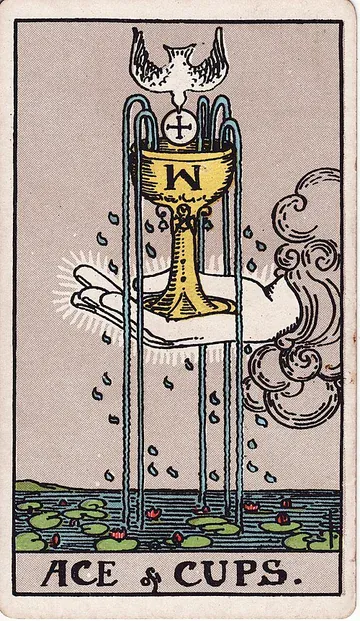
The first messenger meets the overflowing source. Page of Cups plus Ace of Cups marks a tender beginning with real emotional water behind it: first love, first forgiveness, first creative flow, first prayer that feels alive. Keep the opening clean and modest enough to survive.

Page of Pentacles
The feeling learns a practice. Page of Cups plus Page of Pentacles is the student, apprentice, artist, or seeker turning a delicate idea into notes, schedules, budgets, and repetition. The dream is not betrayed by structure; structure gives it a place to keep breathing.

The Moon
A message rises through dreamwater. With The Moon, the Page of Cups becomes intuitive, imaginal, and ambiguous: meaningful images, uncertain motives, old fears speaking in symbolic form. Record the message, but let time and grounded action separate guidance from projection.

Page of Wands
Tenderness meets spark. Page of Cups plus Page of Wands can show flirtation, creative play, youthful collaboration, or the first lively exchange between feeling and desire. The pair is fertile but easily scattered; excitement needs enough stillness to hear what the cup is saying.

The Lovers
The small confession approaches a real choice. Page of Cups plus The Lovers often appears when affection asks to be named, when a shy message carries consequence, or when creative and relational honesty converge. The Page supplies the first sentence; The Lovers asks whether it aligns with the life being chosen.
Frequently Asked Questions
What does the Page of Cups mean?
The Page of Cups means a tender message, creative seed, apology, intuitive nudge, or emotional beginning. Its image is a young figure listening to a fish in a cup: something small and alive has surfaced from below the ordinary mind. The card asks for receptivity, patience with beginnings, and the courage not to mock what is still young.
Is the Page of Cups too young a card to give a real yes?
Young is not the same as unreliable here. Upright, the Page of Cups is a gentle yes, especially for first contact, apologies, creative starts, emotional honesty, and small risks of tenderness. It is not a final-outcome yes. It says the beginning is alive and worth tending. Let time and consistency show whether the young feeling can mature.
Does the Page of Cups mean a message is coming, or that I am the one meant to send it?
Either, and the spread's neighbours usually decide which. In love, the card points to a sincere but young overture: a shy message, a sweet invitation, an apology, or the first return of curiosity after hurt. It favors tenderness over drama. In an established bond, it can show emotional freshness returning through small gestures and honest sentences.
Does a Page of Cups feeling mean they are shy, or that they have not named it yet?
Usually unnamed rather than shy — the fish has surfaced and has not been introduced. As feelings, the Page of Cups is curious, touched, and emotionally open, though not always confident. Someone may feel drawn to you in a tender or imaginative way and show it through small messages, careful questions, gifts, or playful gestures. The feeling is sincere, but it may still need maturity and structure.
Why is there a fish in the Page of Cups?
The fish in the cup is the card's central image: a living message rising from the emotional depths into a form the Page can hold. It suggests intuition, imagination, surprise, and the strange intelligence of feeling. The Page's task is not to explain the fish away, but to listen long enough to understand what has surfaced.