
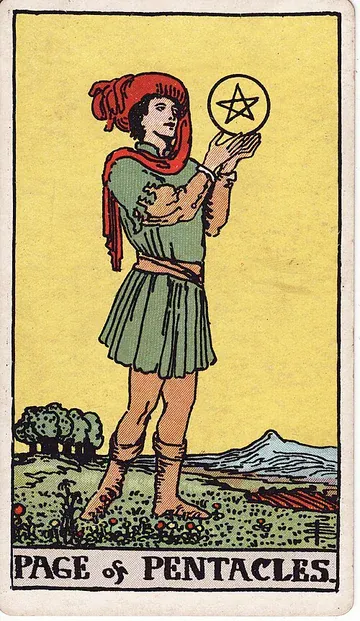
Page of Pentacles · Core Meaning
The Page of Pentacles is the deck's apprentice — earth-of-earth, the densest and quietest stratum of the court. He stands at the edge of a freshly ploughed field, head bent, holding a single golden five-pointed star between two open palms. He is not weighing it for value. He is reading it the way a child reads the first letter that finally makes sense: slowly, with the small surprise of having earned this much.
In the Rider-Waite-Smith image, the figure is young and serious. His coat is heavy. His shoes show fresh earth caked at the rim — proof he is not in a classroom, he is in the field. Behind him the soil is turned but not yet sown; in front of him a row of small flowers and young barley shoots; in the distance a line of blue mountains he cannot yet see himself walking toward. There is no second coin. There is no shop. There is only this one star, this one pause, this one young person learning that the thing he has studied is now real enough to hold.
The card's signature tension is the gap between knowing and using. The Page of Pentacles understands the coin he has been given. He has read about it, asked about it, perhaps written it out by hand. What he has not yet done is spend it. He has not yet exchanged it for bread, given it to the master in payment for a lesson, dropped it into another person's palm in trust. The tension is reverent — he is not hoarding, he is studying — but the next move asks him to let the coin leave his hands. The card holds him in the half-second before that decision.
The traditional astrological signature reinforces this stillness. The Page of Pentacles, as a court card, does not own a single decan but presides over the whole earth-time of the year — the span of Capricorn, Taurus, and Virgo, the three earth signs together. He is the apprentice of every earth season at once: the depth of midwinter Capricorn, the green patient earth of Taurus, the disciplined late-summer harvest of Virgo. Polarity feminine, receptive, holding. Element earth within earth. There is no Sephirah for him — courts walk between the worlds rather than fix to one — and that walking is itself the lesson. He is in transit between knowing and doing, and he is content to remain there an hour longer than most other Pages.
In a reading, the Page of Pentacles often arrives at the beginning of something tangible: a new course, a first job in a real trade, a return to study after years away, a scholarship, a piece of material news that will turn into work if you let it. He is also, frequently, the messenger card — bringing word about money, a contract, an offer, a small windfall that needs honoring. Read him as the morning the package arrives: the body slows down, the hands come up, the eyes focus on what is actually here. Whatever has landed in your life is small, gold, and asks to be looked at carefully before it is moved.
Read the Page of Pentacles the way you would read a photograph of a young person on their first day at work. The expression is concentrated. The body is intact. Whatever happens next is built from this looking.
Page of Pentacles · Love & Relationships
Earnestness is this card's whole romantic register — the Page of Pentacles learns a relationship rather than performing one. The coin in two palms becomes the new feeling, the new partner, the new arrangement; you are looking at it carefully, you have not yet decided exactly how to spend it, and the card promises that this looking is not avoidance. It is the way the earth element loves: slowly, with attention, in small concrete acts.
For an existing partnership, the Page of Pentacles upright marks the season when both people quietly recommit to learning each other. Not the high-stakes drama of a vow renewal — the smaller, denser ritual of paying attention again. One person notices what the other has been reading. Someone signs up for a class together. The bills get sat down with on a Sunday afternoon and a real budget gets drafted. The card describes the love that begins to build a shared craft: a garden, a renovation, a saved-for trip, a small business plan written on the back of an envelope. Earth love expresses itself in projects. The Page is the early stage of a project that will outlast the season.
For a new spark, the Page of Pentacles is one of the most reassuring cards the deck offers. It says the spark is real, it is being held seriously by both people, and the earnestness is not adolescent — it is the right register for what is starting. The other person is studying you, in a quiet way, not to test you but to understand you. They want to know what you actually like, what your work is, what your routines are. There is none of the performative urgency of fire-element courtship. Texts arrive when they are useful. Plans are made and kept. The body is not braced. After a stretch of relationships that ran hot and burnt out, the Page can feel almost too slow — and that slowness is the point. Earth-of-earth does not flame. It accumulates.
For a single seeker who is asking whether love is possible, the Page of Pentacles answers yes, and adds that the love coming is the kind that begins with a small obvious sign — a class, a workplace, a recurring errand, a friend-of-a-friend who has been quietly there for months. Not a stranger across a crowded room. Someone whose name you already partly know. The card asks you to look at the people already standing on the freshly ploughed ground of your life and notice which of them is reading you back. The seat at the table will not arrive in costume. It will walk in wearing earth-stained shoes from work.
For love after a wound, the Page of Pentacles describes the careful re-entry. You are not ready for a tournament; you are ready for a tutorial. Something small, low-pressure, daily. A coffee that becomes weekly. A walking partner. A practice partner. The card protects against premature commitment after grief — it asks you to stay in the apprentice register for a while longer than feels romantic. Earth love after a wound is rebuilt one small honest afternoon at a time. The card supports that pace and warns against trying to skip to the harvest.
For the seeker dating with a long-term frame, the Page of Pentacles is a good omen, with one caution: the apprentice is not yet the householder. This is a card of beginnings, not of established hearths. If you draw the Page early in a relationship, take it as confirmation the relationship is on real ground. If you draw it after years of being together, it is a re-set card — asking whether you have stopped learning each other, and offering you the chance to begin again as students of the bond.
For long-distance or slow-burn situations, the card is patient. It does not demand resolution. It blesses the long arc — the distant blue mountains the Page cannot yet see himself walking toward are the future of the relationship, and the card reminds you that the present coin in the palm is enough for now. Look at what you actually have. Study it. The future of the bond is built from the way you handle the present detail.
For partners considering a major material decision together — moving in, buying property, merging finances, starting a business — the Page of Pentacles upright is a green light qualified by the demand for proper apprenticeship. Do the homework. Read the contract. Talk to the people who have done this before. The card does not bless impulse on these scales; it blesses informed first steps. Walk one rule of the new arrangement all the way through by hand before signing.
A note on the card's particular love language: the Page of Pentacles loves the way a student loves a craft. He pays attention. He shows up early. He brings the right tool. He remembers what was said last lesson. If you are loved by a Page of Pentacles, the gestures are not loud — they are steady, useful, exact. The text asking whether you ate lunch. The errand done without being asked. The small gift that is precisely what you needed and not the showy thing the algorithm would have suggested. Read these correctly. They are not low-investment. They are the highest investment this temperament makes.
If you are asking whether someone is in love with you and the Page of Pentacles arrives upright, read it as a quiet, growing yes. They are not yet sure how to spend the coin — they are still studying it — but the coin is in their palm and they have not put it down. They want to do this well. They want to do this honestly. They are learning you the way you would want to be learned. Give them time, and offer the small concrete reassurances that earth-of-earth knows how to receive: a plan, a calendar entry, a small shared task. The card responds well to structure. It does not respond well to ambiguity dressed up as freedom.
Page of Pentacles · As Feelings
Studious is the word: with the Page of Pentacles, someone is paying close, slightly self-conscious attention to who you actually are. They are not in the high register of a new infatuation; they are not in the cool register of someone playing it safe. They are looking at you the way the figure on the card looks at the coin: as a real thing they did not expect to be holding, and which they want to understand before they do anything definitive.
This is not coldness. The earth element registers warmth as gravity rather than heat. They feel pulled toward you in a way that has begun to organize their week. They have started noticing details — what you take in your coffee, what you said about your sister last month, the kind of weather that makes you tired. None of this is being performed. Most of it is internal. The Page of Pentacles in feelings describes someone whose interior is rearranging quietly to make room for your reality.
If they are reserved, the Page makes the reservation legible. Their quiet around you is not absence. It is the quiet of a student in a library. They are reading the situation. They want to get it right. If you have been worrying that their silence means a fade, the card is gentle correction — silence in this temperament is the sound of attention. They are going to come back with a small, exact thing, not a grand declaration. Read for the small exact thing.
If they are demonstrative, the Page transmutes the demonstration into earnestness. Their public signals are not performance for an audience; they are documentation. Posting a photo of something you were both doing is, for this temperament, closer to a journal entry than to a status update. They are recording their own life in your presence. That is a high form of attention, even if it does not feel as romantic as fireworks.
For a partner you have been with a long time, the Page of Pentacles in feelings can mean a return to studenthood — they have begun, quietly, to relearn you. Maybe you have changed. Maybe they have realized the version of you in their head is several years out of date. Maybe a recent event has made them more curious about your interior than they have been in a long while. Receive this gently. Do not require them to announce it. Let them ask the small new questions and answer them honestly. The card describes the moment a long bond catches itself before it ossifies.
For a new connection, the Page of Pentacles in feelings often means they think you are someone they could build something real with — a thought they are not yet ready to say out loud, because saying it too early would betray its seriousness. They are taking it slowly because they take you seriously. Match the pace. Do not punish them for not declaring earlier than they are ready. The card warns specifically against projecting cold-feet narratives onto an earnest student.
For situations where you are uncertain whether they are interested at all, the Page of Pentacles is a soft yes with a footnote. Yes, they are interested. The footnote is that their interest expresses itself through small useful gestures rather than through romantic theater, and you may be looking for the wrong signals. Watch what they are doing, not what they are saying. The Page of Pentacles in feelings is the partner who fixes your bike chain in silence and considers it a love letter.
For partners whose feelings you are reading after conflict, the Page can describe someone who is privately processing what happened with rigor. They are not stewing. They are not performatively forgiving. They are, in their own way, taking notes — what was said, what was meant, what they want to handle differently. This is the temperament that comes back, days later, with a thought that is more thoughtful than you expected and slightly more honest than you wanted. Honor the slowness. The result is usually worth it.
A small caution embedded in the card: the Page of Pentacles can mistake studying you for actually being with you. He can fall in love with the idea of getting you right and forget that the relationship requires risk, not only diligence. If you sense them perpetually preparing without acting — perpetually looking at the coin without spending it — the card asks you to gently invite the spending. Ask the small concrete question. Set the small concrete date. The Page responds well to invitations. He flounders inside the open question.
Take the Page of Pentacles in feelings as confirmation that the emotional ground beneath the question is being treated with respect. Whatever they feel, it is not cheap, it is not casual, and it is not lazy. The work, if there is work, is to help them understand that earnestness is not the same as readiness — and that the coin in the palm becomes valuable only the moment it is offered.
Page of Pentacles · Career & Work
First morning, clean boots, a field nobody has walked yet — at work the Page of Pentacles is the apprentice card. The freshly ploughed field is in front of you. The single gold coin in your palm is the small concrete thing you are now responsible for: the first paycheck, the first client, the first project, the first year in a real trade. The card describes the moment before the work begins for real, when you are still slow with everything because everything is genuinely new.
If you are asking about a current role, the Page of Pentacles answers that the role is real, the role is generative, and the role asks you to remain in student mode a while longer than ego would prefer. You are still learning the system. You are still memorizing names. You are still translating the manual. None of that is a failure of competence; it is the proper texture of the early stretch. The card warns against premature confidence. The senior version of you is being assembled now, slowly, in the small acts of doing the basics correctly. Trust the basics. Do them again.
For someone considering a new role, the Page of Pentacles upright reads as a yes with a craft caveat. The new role is the right ground for you, but you should choose the role primarily on what is taught there, not what the role pays or what title comes with it. The card asks: who is the master at this place? What craft will I leave knowing how to do? What manual will I have walked through end to end by the time I leave? If those answers are good, take the role. If those answers are vague, the role is a costume rather than an apprenticeship; pass.
For someone returning to school, signing up for a course, accepting a fellowship, or starting a certification, the Page of Pentacles is one of the deck's clearest blessings. He is, at heart, the student card of the suit of the body and the world. The card confirms this is the right time to be learning, this is the right thing to be learning, and the slowness you feel is appropriate. Do not skip steps. Walk one rule all the way through. The time invested now compounds.
For freelancers and entrepreneurs in the first year of a new venture, the Page of Pentacles describes the slow apprenticeship to your own business. You are learning how clients actually behave, how invoicing actually flows, how long a deliverable actually takes when no one is hovering over you. You are turning over the soil of your own field. The card warns specifically against the pressure to look further along than you are. Your work is to make the first thing real, not to look impressive at networking events. Earth-of-earth is built one furrow at a time. The card protects that pace.
For someone in the middle of a career, the Page of Pentacles can arrive as an unexpectedly humbling card — not because you are demoted, but because a new tool, a new domain, a new technology, or a new collaborator has put you back at the beginning of something. The card asks you to receive the apprenticeship rather than fight it. The senior person who can become a student again is the one whose career stays alive across decades. The senior person who refuses calcifies. The Page is reminding you which option is yours.
For job-seekers, the Page of Pentacles is a card of small concrete openings. Not the dramatic offer; the email that schedules a coffee, the contact who knows someone, the small contract that turns into a full contract. The card asks you to take the small concrete thing seriously. Most careers are built off doors that looked too small to be doors. Walk through the small one. The blue mountains in the distance are reached by the foot already on the field.
For creative practitioners, the Page of Pentacles describes a body of work in its earnest beginning. The first portfolio. The first commissioned piece that you are doing for someone who is paying you and trusting you. The card supports the careful student, not the precocious genius. Refuse the temptation to skip the boring part. The boring part is where the craft is built.
For someone considering a layoff, transition, or pivot, the Page of Pentacles is a hopeful card if you are willing to start at the entry of the new field. It is a difficult card if you require the new field to immediately confer the seniority you held in the old one. The card grants tangible new ground; it does not grant the avoidance of the apprenticeship. If you can metabolize being a student again — actual student, not performative-mentor-who-is-also-learning — the new field will reward you. If you cannot, the card warns of a pattern — choosing roles that flatter your past instead of rebuilding your future.
For colleagues and team dynamics, the Page of Pentacles can also describe a junior person on your team who is handling something more carefully and thoughtfully than is being recognized. The card asks you to look down the org chart — at the intern who reads everything before asking, at the new hire who asks the most basic question about the system because they are the only one who actually wants to know. They are doing the work the senior people stopped doing. Learn from them. Promote them. Pay them.
A note on stability and pace: the Page of Pentacles is not a card of rapid promotion or sudden wealth. He is the card of the year you become competent at one specific thing. If your question demanded a Knight of Pentacles (sustained productive work), a Queen of Pentacles (matured stewardship), or a King of Pentacles (mastery and ownership), and you got the Page, the card is asking you to honor the order of the suit. Pages become Knights become Queens and Kings. There is no shortcut. There is only the freshly ploughed field, the coin in the palm, and the long arc that begins the day you start studying it correctly.
Page of Pentacles · Money & Finances
A small, specific sum is what the Page of Pentacles puts in your hands, and it wants handling with attention. Not yet wealth. Not yet abundance. The single gold coin in two palms — the first paycheck, the first dividend, the modest scholarship, the tax refund that arrives on time, the unexpected small windfall. The card describes the relationship between you and a real, present, manageable amount of money. Whether this amount becomes the foundation of something larger depends on how you treat it now.
For a question about a financial bet, investment, or major purchase, the Page of Pentacles answers cautiously. The card is not against the move; the card is against the move made without the homework. Read the prospectus. Talk to two people who have actually done this. Walk the contract through line by line. The figure on the card studies the coin before he spends it; the card asks the seeker to do the same. Most financial regret in a Page of Pentacles reading comes from skipping the studying phase and treating impulse as decision.
For someone managing scarcity, the Page of Pentacles is one of the deck's most encouraging financial cards. It describes the early signal that the long climb is beginning to register. The first month the budget actually balanced. The first paid invoice from your own work. The first month you were able to put something — even a small something — into savings. The card honors the small and warns against discounting it. Earth-of-earth is built one coin at a time. The card protects the practice.
For someone receiving a windfall — inheritance, gift, lottery, settlement — the Page of Pentacles upright says: do not spend it for thirty days. Sit with it. Read about it. Consult with someone who has handled this before. The card describes the careful hand of the inheritor who turns out, fifteen years later, to have built something durable from what could have evaporated. The figure does not refuse the coin. He just refuses to spend it before he understands what spending it means.
For investments, the card supports the boring, well-understood, long-horizon move. Index funds. Retirement accounts. The slow consolidation of debt. The buying-down of small high-interest loans. The Page of Pentacles is a card of incremental compounding, not of speculative wins. If your question was about a high-volatility play, the Page is asking you to choose the boring move — and to recognize that boring is, statistically and emotionally, the higher-return path for someone in the apprentice phase.
For the seeker carrying debt, the Page of Pentacles offers a structural blessing on the debt-payoff plan that is built on study rather than shame. Pull the actual numbers. Sit with them. Build the calendar of payments. Accept that the climb will take the time it will take. The card is patient. It does not require you to be debt-free in a year; it requires you to know exactly what you owe and to begin walking toward zero one furrow at a time.
For someone considering a major purchase — a car, a first home down payment, an expensive course — the Page of Pentacles asks: have you done the math? Have you done the math twice? Have you done the math with the worst-case income scenario folded in? If yes, proceed. If you have only done the optimistic version, wait a season. The card is not against ambition. The card is against ambition that has skipped its homework.
In questions of new income streams, side projects, or first-time freelance work, the Page of Pentacles validates the small first attempt. The fifty-dollar invoice. The hundred-dollar tutoring session. The first product sold for what feels like a laughably modest amount. These are not failures of scale. These are the freshly ploughed field. Do them. Honor them. Send the invoice on time. Pay the small tax on the small income. Each of these acts is the apprentice's coin being handled correctly. The seniors who are now wealthy mostly began here.
A practical move when this card appears in a money question: open the spreadsheet you have been avoiding. Pull every number into one document. Sit with what is actually there. The card responds to honest visibility. The seeker who does not know what they earn, what they spend, and what they owe is the seeker who cannot study the coin in their palm — because they have not yet brought the coin into the light.
Page of Pentacles · Health
The body becomes the subject being studied when the Page of Pentacles lands on a health question. Earth element, polarity feminine, temperament steady and enduring — the card associates with the spleen, stomach, and limbs, the patient work of digestion and the daily work of walking. It is not a card of acute crisis. It is the card of the long quiet relationship between you and the body that carries you, beginning to be repaired through the small honest practices.
If you are asking whether a treatment, regimen, or new health practice will work, the Page of Pentacles answers yes — provided you remain a student long enough for the practice to register. The card warns specifically against the pattern of starting six things at once, abandoning all of them within three weeks, and concluding that nothing works. Earth-of-earth requires repetition. Pick one practice. Walk it for thirty days. Then evaluate.
For someone managing a chronic condition, the Page of Pentacles describes the season of patient relearning. The labs are not dramatic. The body is not in crisis. There is, however, a slow accumulation of detail — what the body responds to, what flares it, what timing of medication actually works, what kind of sleep is restorative versus exhausting. The card honors the careful patient who keeps the small notebook. Do that. Write it down. The pattern emerges from the data, not from intuition.
For someone in recovery — from injury, surgery, illness, addiction — the Page of Pentacles is one of the deck's clearest blessings. It describes the slow rebuild that has begun to take. The body is taking instruction. The system is responding. The work that felt useless six weeks ago is starting to register in small concrete ways: better sleep, slightly more energy in the afternoon, the appetite returning, the gait stabilizing. The card protects the rebuild from the impatience that has historically interrupted it. Stay in the boring middle of the recovery. The boring middle is where the body actually heals.
The card's particular health signature is the stomach and digestion — what is taken in, how it is metabolized, how the limbs are fed. Watch the basics. Are you eating real food at regular hours? Are you walking? Are you sleeping enough that the body has time to repair? The Page of Pentacles does not require an exotic protocol. He requires the boring fundamentals to actually be in place. If they are not, no protocol on earth will compensate.
For someone managing weight, food relationships, appetite, or the body image questions that orbit them, the Page of Pentacles asks for honest curiosity rather than punitive discipline. Track without shame. Notice without judgment. The card wants the apprentice attitude — what is actually happening here, what is the body actually asking for, what time of day does the difficult feeling actually arise — rather than the grading attitude. Earth-of-earth heals slowly through accurate observation. It does not heal through hatred of the body it inhabits.
For mental health, the Page of Pentacles describes the early stretch of therapy or psychiatric care that is beginning to take. The journal is being kept. The session is being attended. The medication, if there is one, is being taken as prescribed. The work is not yet finished — the Page is never the end of an arc — but the work is honestly underway. The card protects the early months of therapy from the impatience that wants results faster than the work allows. Stay. Keep going. The slow accumulation is the medicine.
For someone considering a new health practice — a yoga class, a meditation course, a cooking class to relearn how to feed themselves, a strength training program after years away — the Page of Pentacles is enthusiastic. He is the card of the beginner mat, the first pose held wrong, the small humility of being new at something physical in a body that used to be young. Honor the beginner. Stay through the awkward stretch. The mastery on the other side is real.
A small caution on this card and health: the Page can over-study. He can read everything about the condition, follow every podcast, become an amateur expert on the diagnosis — and quietly avoid making the appointment, taking the medication, or doing the hard practice. If you sense yourself becoming a student of your condition rather than a steward of your body, the card is asking you to spend the coin. Pick up the phone. Make the call. Take the first dose. The book in your hand is not the cure. The cure is on the other side of the door you have been studying instead of opening.
The book in your hand is not the cure, and this card is not medical advice. The Page of Pentacles describes the relationship between attention and the body, not a diagnosis. Keep your practitioners. Take your medicine. The card simply confirms that the slow, honest, student-mode work you are doing is the right shape of work for what your body needs.
Page of Pentacles · Spirituality
A spiritual life starts in the Page of Pentacles the plainest way there is: someone decides to begin, and then begins. Not the peak experience. Not the breakthrough. The first hundred mornings of sitting on the cushion. The first season of journaling at the same time every day. The first stretch of any contemplative discipline where you are still mostly bad at it and still showing up anyway. The figure on the card holds the coin not as an artifact of attainment but as the small, concrete, daily thing he is being trusted with.
The card resists the spiritual marketplace. Earth-of-earth has no patience for the language of high vibes, manifestation, or instant transformation. It honors the slow, patient, almost unglamorous reality that contemplative practices have always required: a place to sit, a time to sit, the willingness to keep returning when the mind has wandered. The Page of Pentacles is the spiritual student who reads the boring book all the way through, who attends the same sangha for three years before claiming any teacher, who keeps the practice in the body before claiming the body has been changed.
For someone in active practice — meditation, prayer, ritual, devotional work, somatic discipline — the Page of Pentacles confirms the practice is taking root. Not in the dramatic ways. In the small ways: an old reactivity that flares less. A patience with the slow person at the checkout that surprises you. A willingness to do the dishes without resentment. Earth-of-earth fruit shows up in the kitchen, the walk to the train, the way you handle the small tedious correspondence. If you have been doubting whether your practice is doing anything, the card answers: it is doing the right thing, in the right order, at the right pace.
For someone exploring belief — converting, returning, leaving, syncretizing — the Page of Pentacles asks the apprentice question: who is the teacher, what is the lineage, what is the practice you would actually do this Wednesday? The card warns against spiritual collection, the impulse to stack traditions like coins in a drawer. Pick one. Walk it. The Page is not against eclecticism in the long run; he is against eclecticism as a substitute for depth in the short run.
The card's spiritual practice — if you draw it asking what to do — is concrete and humble. Keep a small physical notebook. Write three lines a day. Walk somewhere outside, slowly, for at least twenty minutes. Touch something earth-like at least once daily — a stone, a plant, the bark of a tree, the actual soil of a yard or a windowsill pot. These are not symbolic gestures. They are the practices that match the temperament of the card. Earth wants to be touched.
For seekers worried they are doing it wrong, the Page of Pentacles is gentle correction. There is no doing it wrong if you are doing it. The early stretch is supposed to feel awkward. The mind is supposed to wander. The discipline is supposed to feel slightly imposed. The card validates the awkwardness as evidence of honest beginning, not evidence of incompatibility.
A small caution: the Page of Pentacles can become a perfectionist about the practice. He can study every book about meditation rather than meditating. He can perfect the altar rather than sit at it. If you sense yourself becoming an expert on the practice without actually doing the practice, the card is asking you to put the book down. The coin in the palm is meant to be spent. Sit. Pray. Walk. The studying is the foundation; it is not the building.
For questions about spiritual path and direction, the Page of Pentacles points downward — into the body, into the daily, into the unspectacular. The path forward for this temperament is not upward into transcendence. It is downward into incarnation. Do the dishes. Take the walk. Show up to the mat. The blue mountains the figure has not yet seen himself walk toward are the future of the practice. The future is reached through the present detail.
Page of Pentacles · Yes or No
Yes — but slowly, and only if you are willing to remain a student.
The Page of Pentacles upright is one of the deck's cautious yes-cards. He answers in favor of the question, but conditions the answer on patience. The thing you are asking about is real, the ground beneath it is solid, and the path is correct — and it will not unfold at the speed you want. The card asks: can you stay with the project long enough for it to actually work?
For yes-or-no questions about a job, a course, a new relationship, a financial commitment, or a creative project, the Page of Pentacles answers yes when the questioner is willing to be in apprentice mode for the duration. The role is right; expect to remain a junior at it for a while. The course is right; expect to remain an early student for a while. The relationship is right; it will start small and remain small for a while. The card is honest about the pace.
For questions about whether something will work out — a treatment plan, a financial recovery, a slow-burn romance — the Page of Pentacles answers yes, with the footnote that the working out happens by accumulation rather than by event. There is no single moment when the answer arrives. There is a series of small mornings, each of which adds a little to the foundation. If you are looking for a thunderous yes, the Page will disappoint. If you are willing to receive a quiet yes, the Page is one of the most reliable yes-cards the deck offers.
For questions about whether to take a small concrete step — apply for the job, sign up for the class, send the message, make the call — the Page of Pentacles answers yes without much qualification. The small concrete step is exactly his register. He blesses the act of beginning honestly.
For questions about whether to make a large irreversible commitment — marriage, mortgage, business launch — the Page of Pentacles answers wait. Not no. Wait. You are not yet at the stage of the journey where this commitment belongs. Stay in the apprentice phase. The Knight, the Queen, and the King will arrive in their own time, and the commitments that match those stages will be appropriate then. Commitments out of order tend to collapse.
For questions about whether someone is being honest, whether an offer is genuine, whether a plan will hold, the Page of Pentacles answers yes. The card has very little shadow in the upright orientation. What is being shown is what is. If a person is presenting themselves as an earnest student of you, they are an earnest student. The card does not deceive.
For questions about timing, the Page of Pentacles answers slowly. Not far — the matter is in motion, the field has been ploughed — but slowly. Think in seasons, not weeks. The figure on the card does not yet see himself walking toward the distant blue mountains, and yet the walking has already begun. Trust the long arc. Do not require the immediate event.
If the question was: should I begin? The card answers an unequivocal yes. If the question was: should I have arrived already? The card answers with the gentle correction that arriving belongs to a later card. You are at the beginning of something that will become significant. Stay.
Page of Pentacles · Advice
One transaction, not another plan: the Page of Pentacles upright asks you to spend some of the coin you have been studying. Not all of it. Once. The card does not ask you to abandon the studying — earth-of-earth is built on attention — but it warns that attention without action eventually curdles into avoidance. Take the small concrete first step. Use the thing you have been preparing to use. Hand the first imperfect version to the world. The studying continues; it now continues in dialogue with reality rather than in isolation.
If there is one specific instruction the card offers, it is to walk one rule all the way through by hand. Pick the most important thing you have learned in your current discipline — the first lesson of the manual, the foundational technique of the craft, the basic move of the new role — and execute it, fully, today, without shortcuts. Not the impressive thing. The basic thing. The Page of Pentacles is the card of the apprentice who masters the basic move so thoroughly that, three years later, he can do the impressive thing because the basics are entirely automatic. The path to mastery starts with one rule walked correctly, once.
A second instruction: enroll in something. Sign up for the course, the class, the workshop, the certification, the apprenticeship that you have been considering for months. The card supports the honest enrollment. The fee paid. The schedule entered into the calendar. The accountability of being a student in a place where students are taken seriously. The card warns against the autodidact's drift — the YouTube algorithm as substitute for sustained study. The figure on the card is alone in the field, but his teacher exists, and he will return to that teacher with the coin examined and the field still untouched. Find your teacher. Pay them. Show up.
A third instruction: keep a notebook. A real one, on paper, that lives on a desk. The Page of Pentacles is a card of recorded learning. The student who writes down what they are learning learns it twice. Use the notebook for the discipline you are trying to grow into — sketches, vocabulary, tool descriptions, lessons from each session, the questions you want to ask the next time you see the teacher. The notebook is not for posterity; it is for you, six months from now, who will have forgotten what you knew clearly today and will be grateful for the record.
A fourth instruction: treat the small windfall, the small paycheck, the small client, the small opportunity as the real thing. Do not wait for the larger version of any of them to begin behaving with seriousness. Send the careful invoice for the small amount. Write the careful thank-you for the small contract. Show up early to the small meeting. The Page of Pentacles is the apprentice who treats the first job with the rigor he will, eventually, treat the largest job. The pattern is set now.
Practical advice for the day the card appears: do the boring fundamental for one hour. Whatever the boring fundamental is in your current pursuit — scales for a musician, drills for an athlete, vocabulary review for a language student, code commits for a programmer, rough sketches for a visual artist, slow careful reading for a scholar — do that thing, alone, without looking at your phone, for one full hour. The card responds to the boring fundamental. It does not respond to the impressive shortcut.
A fifth instruction, gentler than the others: forgive yourself for being early. The Page of Pentacles is the card of being unimpressive in service of becoming, eventually, deeply competent. You are allowed to be slow at this. You are allowed to be visibly a beginner. You are allowed to ask the basic question. The shame of being a student is what most often poisons the studying — the felt sense that you should already know, that asking betrays you, that the slowness is evidence of inadequacy. The card asks you to release that shame. Earth-of-earth has no quick path. Everyone who became good began here.
Page of Pentacles · Card Combinations
Page of Pentacles + Page of Cups
The two introvert Pages — earth and water, quiet siblings of beginning. The combination describes a relationship, project, or creative practice where careful study (Pentacles) meets receptive feeling (Cups). Often a young romance built on letters and shared notebooks, or a creative practice begun with both technical precision and emotional honesty. The two Pages temper each other: water keeps earth from becoming dry and over-systematized; earth keeps water from drifting into pure feeling without form.
Page of Pentacles + Eight of Pentacles
The same craft, two stages later. The Page is the first morning at the bench; the Eight is the thousandth morning, after the technique has been practiced into the bone. When these arrive together, the card is showing the long arc of an apprenticeship: where you are now (Page) and where the discipline will take you if you stay (Eight). Read this combination as a confirmation that the small slow work is heading somewhere. Do not skip the apprenticeship to be the journeyman before the journeyman is real.
Page of Pentacles + The Hermit
Earth-of-earth meets the lantern of solitary study. The combination describes the seeker who has chosen — or is being asked to choose — a stretch of solitary, disciplined learning. A long course done alone. A craft practiced in private for a season before it is shown. A sabbatical for the sake of becoming competent. The Hermit lights the path; the Page walks it slowly. This pairing is not lonely; it is sacred. The mountains the Page does not yet see are the ones the Hermit has already mapped.
Page of Pentacles + Page of Wands
Two Pages of opposite element — earth and fire — together describe the early phase of a project that needs both careful study and a spark willing to begin before the studying is finished. The combination often shows up at the start of a creative entrepreneurship, a new collaboration, or a relationship where one person is the steady student and the other is the restless beginner. They are not in conflict; they need each other. The Wands Page provides the leap; the Pentacles Page provides the landing. Make sure the two are talking to each other.
Page of Pentacles + Knight of Pentacles
The same suit, the next chapter. The Page studies the coin; the Knight has already begun the slow steady ride across the field. Together, the two cards describe the transition from learning to doing — the morning the apprentice is given the first real route, the first real client, the first season of being the person who shows up. Read this combination as a sign that you are being asked to take the next step. Not the dramatic step. The next step. The Knight's pace is slow but durable, and the Page is being invited into it.
Card Combinations
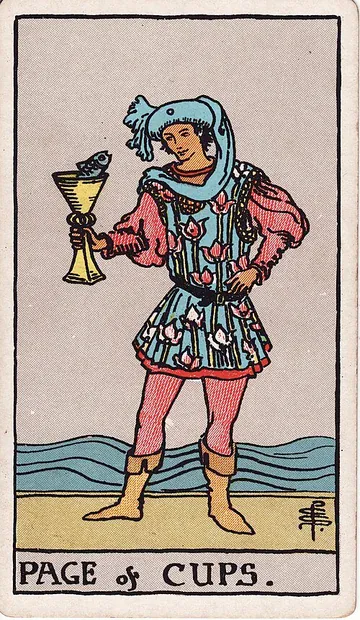
Page of Cups
The two introvert Pages, earth and water — careful study meeting receptive feeling. A young romance built on shared notebooks, or a creative practice begun with both technical precision and emotional honesty. Earth keeps water from drifting; water keeps earth from drying. Read this pairing as the early page of a long, honest book.
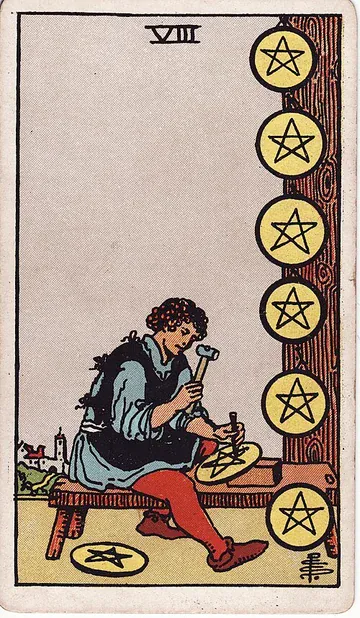
Eight of Pentacles
Same craft, two stages later. The Page is the first morning at the bench; the Eight is the thousandth, after the technique has been practiced into the bone. Together they show the long arc of an apprenticeship — where you are now and where the discipline takes you if you stay. Do not skip the boring middle. The mastery is built there.
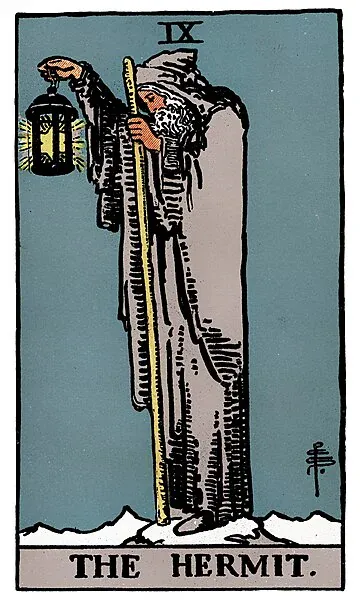
The Hermit
Earth-of-earth meets the lantern of solitary study. A stretch of disciplined, patient learning chosen on purpose — a long course, a private practice, a sabbatical for the sake of becoming competent. The Hermit lights the path; the Page walks it slowly. The mountains the apprentice does not yet see are the ones the elder has already mapped.
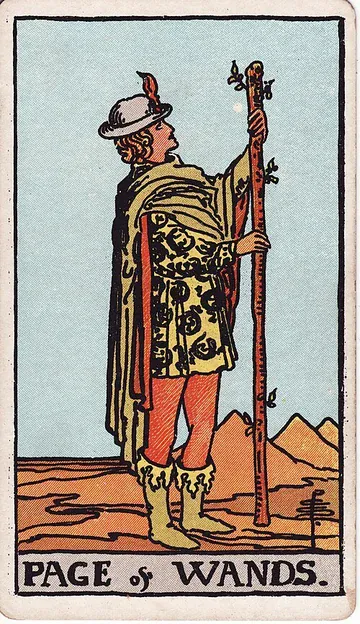
Page of Wands
Two Pages of opposite element — fire and earth — describing the early phase of any project that needs both careful study and a spark willing to begin before the studying is finished. They are not in conflict; they need each other. The Wands Page provides the leap; the Pentacles Page provides the landing. Make sure the two are talking.
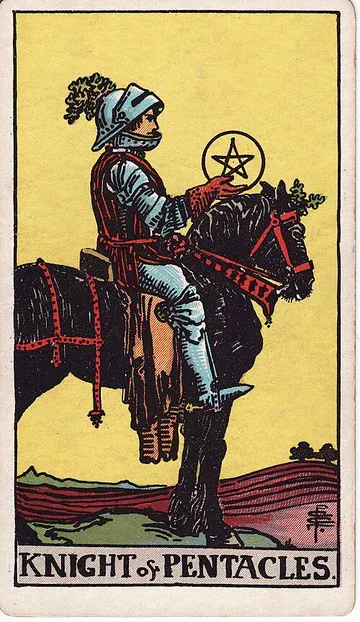
Knight of Pentacles
The same suit, the next chapter. The Page studies the coin; the Knight has already begun the slow steady ride across the field. Together, they mark the transition from learning to doing — the morning the apprentice is given the first real route. The pace is slow but durable; the Page is being invited into it. Step forward.
Frequently Asked Questions
What does the Page of Pentacles mean in a tarot reading?
The Page of Pentacles is the deck's earth-element apprentice — a young figure holding a single gold coin in two palms at the edge of a freshly ploughed field. The card describes the careful beginning of something tangible: a new course, a first job, a small windfall, a piece of material news. It asks you to study what has landed in your hands, then spend it once. The energy is studious, patient, slightly slow, and entirely real.
Does the Page of Pentacles say yes to something I am only just beginning?
Yes — but slowly. The Page of Pentacles answers in favor of the question, with the footnote that the path unfolds at the pace of an apprenticeship rather than at the speed of an event. The job, the relationship, the practice, the financial recovery you are asking about are real and on solid ground; they will require you to remain a student long enough for the foundation to actually take. Treat the soft yes as the most durable kind.
Does the Page of Pentacles mean someone is serious about me, or only curious?
In love, the Page of Pentacles describes earnest, studious affection — a relationship being learned rather than performed. For new connections, the card promises the spark is real and the other person is paying close, careful attention. For existing partnerships, it marks a season of recommitting to small concrete acts: shared projects, real budgets, practical attention. Earth-of-earth love expresses itself in steadiness and useful gestures, not in fireworks.
Why does the Page of Pentacles feel so careful rather than passionate?
When the Page of Pentacles describes how someone feels about you, they are studying you carefully and earnestly. They are not in the high register of infatuation; they are arranging their interior, quietly, to make room for who you actually are. Their warmth registers as gravity rather than heat — small useful gestures, accurate questions, a slow rearrangement of their week. Read silence here as attention, not absence; this temperament is documenting, not withdrawing.
What does the Page of Pentacles mean for career and money?
In career readings, the Page of Pentacles is the card of the apprentice on the first morning — the new role, the new course, the return to study. It asks you to choose roles for what they teach rather than what they pay, and to walk one rule all the way through by hand. In money readings, it describes a small concrete sum — a first paycheck, a modest windfall, the early signal that the long climb is registering. Handle it carefully. Earth-of-earth wealth is built one coin at a time.
Continue Reading
Page of Pentacles · Card overview · symbols · correspondences →
Return to the full card view — image, symbols, sensory correspondences, and Hermetic axes.
Read the reversed meaning →
Read the same depth on the opposite orientation.
Draw your reading now →
Bring this card to a question — open a quiet ritual.