
Page of Wands · Core Meaning
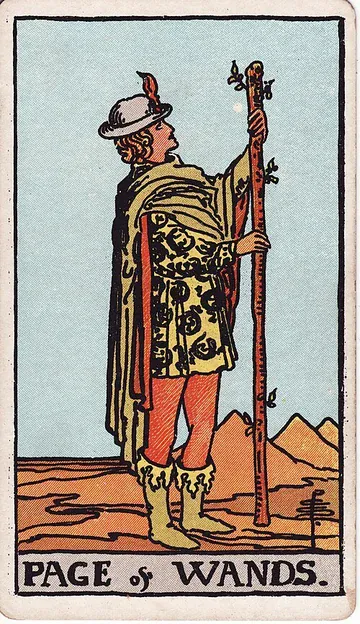
The page of wands tarot card meaning lives in a specific posture: one foot is already forward. He has not asked permission. He is not waiting for the council to convene. The hands grip a tall green staff that is taller than he is, and at the very top — where you would expect a finial or a polished knob — a few small leaves have just opened. The staff is alive. Whatever he is carrying has not finished growing. He is tilting his face up to look at the leaves, not at the pyramids on the horizon, not at the road ahead, not at us. He is interested in the wrong thing first. That is exactly the card.
The figure wears a pale-yellow tunic stitched with tail-biting salamanders, the medieval shorthand for fire-spirits — creatures that are supposed to live inside flame and survive it. The salamanders are sewn into a circle, each biting the next one's tail, like a flame folding back on itself before it has decided which way to leap. A single red feather rises from the cap. Not a helmet plume — a messenger's plume. The cap announces he is on the road, not on a battlefield. The Page of Wands is never a soldier. He is what the soldier was, fifteen years before the war.
The card's signature tension is enthusiasm without architecture. The fire is real. The leaves are real. The eagerness in the body is real, and not performative — this is not a salesman, this is a kid with news. But the news has not yet been tested. The plan has not yet been costed. The friend he is about to tell has not been asked whether they have ten minutes. The Page is the moment before the morning settles into work — the smell of the kitchen still on him, the impulse not yet taxed by anyone else's response.
Read against the Golden Dawn schema, the Page of Wands is the Princess of the Shining Flame, Malkuth in Atziluth — earth-of-fire, the throne of the fiery world. That kabbalistic placement matters: Malkuth is the lowest sephirah, the kingdom, the body, the place where everything finally lands. Atziluth is the highest world, the world of pure emanation. Where these two meet — the most material expression of the most abstract fire — you get this card. A spark that has finally agreed to take a body. Earth, here, does not mean caution; it means embodiment. The flame has come down out of pure idea and is now wearing legs. It can walk. It does not yet know how far.
Take the page of wands tarot signature in any spread as the question: where is the new flame trying to take a body? Not where will it succeed; not how long it will last. The card asks you to honor the moment when an impulse first wants to wear shoes and step out of the door. The Knight of Wands will arrive later with the horse. The King will arrive much later with the campaign. For now, this is the figure who has just heard something and wants to tell one person before breakfast cools.
The card is also, very specifically, the card of the beginner. Not the prodigy — the beginner. The first time you tried the thing. The first language lesson where you said your own name and it sounded foreign. The first email pitch you sent before you knew the word "deck." The Page of Wands does not promise mastery. It promises that the beginner's fire is its own legitimate weather, and worth honoring before the corrections start.
Page of Wands · Love & Relationships
In love readings, the page of wands love signature is endearing bluntness. Someone — possibly you — is approaching the situation with more enthusiasm than polish, and the enthusiasm is the gift. This is not the cool, considered partner. This is the person who shows up early and tells you about the thing they read this morning before you have had your coffee. The eagerness arrives undiluted. They have, in fact, never played it cool in their life. The card asks whether you can let yourself be courted by someone who is bad at hiding that they like you.
For an existing partnership where one partner is carrying the Page's eagerness — they came home with three new ideas this week, they want to redo the kitchen, they have started a podcast — the card describes a season of restlessness inside the bond. The eager partner is not bored of you. They are bored of the part of life that has stopped feeling new, and they are casting around for the next torch. Read this carefully: the energy is not pointed away from the relationship. It is pointed at life in general, and you are still the person they want in the room while they figure out which match to strike. The work, if there is work, is to receive their bringing-of-news without flattening it with an itemized critique. The Page wilts under critique long before they wilt under disagreement. Disagreement is a flame; critique is a wet rag.
For a new spark, the Page of Wands describes the meeting where the other person was clearly more interested than they meant to let on. They forgot to be smooth. They asked the second question too quickly. They mentioned the song they had been listening to on the way over. There was a small quality of "I just thought of something" running through the entire conversation. Read this as a soft, cleaner-than-usual signal: the interest is real, the interest has not been styled, the interest does not yet know what shape to take. Don't ask them on a six-week trip. Ask them on a walk on Saturday.
For a solo seeker who has been burned by fast-fading enthusiasms — the partner who arrived with fireworks and left when the first hard week came — the Page of Wands is a more delicate card to draw. The card itself is honest about its own pattern: it lights things on fire and sometimes the things go out. The seeker who has been hurt by this kind of partner is correct to be wary. But the card is asking, gently: are you still letting yourself notice the spark when it shows up? Or have you trained yourself to look only at the back-end stability of a person, in a way that has begun to filter out everyone with any wildness left? Vigilance is wisdom; reflexive cynicism is a wound speaking. Sit with which one you are practicing.
For someone re-entering the world after a wound, looking for a way to feel curious again, the Page of Wands is a kind card. It does not require you to be ready for a deep partnership. It asks only whether you can let one small flicker of interest — a writer you re-read, a class you sign up for, a stranger whose face you turned to follow on the train — count as a signal that you are still alive to other people. Curiosity is not commitment. Let curiosity move first. The Page of Wands does not need you to know whether this becomes love. The card needs you to keep the door of attention slightly open.
For reconciliation where the returning party brings news — they came back with a story about therapy, a job change, a year abroad, a family illness, something — the Page of Wands describes the texture of that return. They are not coming back the way they left. They are bringing kindling. Read carefully whether the kindling is offered to you, or whether they want a match struck under their own life and you are the nearest source. Both can be loving. They are not the same.
For long-distance and cross-cultural relationships where the messenger role matters, the Page of Wands is the card of the voice memo, the photograph of the strange breakfast, the screenshot from the local newspaper, the ten-minute video tour of the new neighborhood. This is the love language of the page in love: I saw something, and the first thing I did was want to tell you. Don't dismiss it as content. It is the way fire travels at distance — by being narrated, in pieces, in real time, to one specific person.
For pursuer-distancer dynamics where one of you is the eager Page and the other has stabilized into the watcher, the card asks both sides to do something hard. The Page must learn that not every flame must be reported the moment it lights — some flames need a chamber to breathe in before they meet other people's air. The watcher must learn that not every report is a demand for action — sometimes the Page is just letting you know they are alive, the way a child shows you a drawing without asking you to frame it. Both sides over-correct. Both sides can soften.
For desire mismatch, where one partner wants experiments and the other wants steady ground, the Page of Wands describes the partner who is bringing the experiments. The card is on their side, not against you. But the card also reminds them that experiments need a lab — a contained space the experiment doesn't have to leak out of. Negotiate the lab before you negotiate the experiment. Where, in the relationship, is your partner allowed to be a beginner without it threatening the whole architecture? Build that room first.
A final note for the reading where you are the eager one and want to know if your enthusiasm is welcome: the Page of Wands answers that yes, it is, but you must be able to receive a "not right now" without taking it as rejection of the whole self. The page of wands love is most beautiful when the page can let the flame live without burning the listener. Tell one person at a time. Pour your kindling into one fire, not seven.
Page of Wands · As Feelings
Warm, fast and entirely unconsidered is what the Page of Wands reports back about someone's feelings. They feel something for you, and the feeling has not been stress-tested. They have not yet asked themselves whether this is wise, whether this is convenient, whether this fits the rest of their life. They are simply pulled toward you in a way that surprises them, and the surprise is part of the pleasure. Read this as honest, but raw — a real signal sent before the editor has had a chance to soften it.
If they are reserved by nature, the Page of Wands in feelings is striking. The reserved person is not usually carrying this kind of fire. When the card appears for them, it means you have moved them past their own usual register. They may be slightly uncomfortable with how much they are feeling. They may be over-correcting by going quiet, or by suddenly being too direct in a way that feels off-tempo. Don't read the awkwardness as disinterest. The Page in a reserved body looks like a slightly flustered version of the person you knew. They are not playing a game. They have lost their script.
If they are demonstrative by nature, the Page of Wands in feelings can mean they are publicly excited about you in a way they may not yet have privately committed to. They will tell their friends. They will mention you to their mother. They will make a small show of how they met you — the meeting is already a story they are telling. This is real, but read it for what it is: someone who shows enthusiasm before they have decided what to build with it. Enjoy the warmth, and don't take the public fanfare as a substitute for the slower private arrival.
For a long bond where the Page of Wands appears as how the partner currently feels, the card describes a re-spark. They have remembered something about why they liked you. Maybe an old memory surfaced, maybe they saw you do something small that reminded them, maybe the year has just rotated to the season they fell in love. The Page is the feeling of falling in love a second time with the same person. Don't let the moment pass without naming it back to them.
For a new connection, the Page of Wands as feelings means they are still in the part of the chemistry where everything you say is interesting. Your normal sentences are landing as wit. Your average opinions are landing as insight. Read this gently — it is real, and it is also the early phase. The page-of-wands phase of new love does not last forever. It cools into something steadier or burns out. The card does not predict which one. It simply confirms you are currently in the rapt-attention chapter.
A small caution embedded in this beautiful card: the Page of Wands in feelings can be enthusiasm without architecture. They are excited about you without yet having figured out what they want to do about it. They may not call when you expect a call. They may not follow up the way the intensity of the moment seemed to promise. This is not necessarily a lie. The Page often has more flame than calendar. If they go quiet, do not immediately assume the feeling is over. Sometimes the Page just got distracted by the next leaf opening on the next staff.
For someone new who is feeling like the Page of Wands at this very moment about you — and you are wondering whether to take it seriously — take it seriously as a feeling, and lightly as a forecast. Their interest is unfeigned. Their interest is also not yet committed to a shape. Let them show you what shape it wants over the coming weeks. The Page becomes the Knight when the eagerness learns to mount a horse and travel.
For Japanese-style "what is the other person thinking" framing, where the question is the texture of the silent interior — the Page of Wands answers that the interior is light, eager, slightly proud of its own restlessness, and largely composed of you, for the moment. The body is leaning forward. The voice has not been edited. Whatever they say, they probably mean. Whatever they don't say, they have probably not yet thought of.
Page of Wands · Career & Work
Something small has been turning over quietly in your head for a few weeks now — the side concept, the experiment, the proposal you keep meaning to send — and the Page of Wands is the itch to begin it this week. The Page is the figure inside you who already has one foot forward. He is not asking the leadership team. He is asking whether you can stop bracing and let him strike one match. The card does not promise the project will become a career. It promises that the small ignition is your honest next move.
For someone in a current role with a new project itch, the card validates the itch and quietly limits its scope. Yes, light the torch. No, do not announce a new strategic direction. The Page lights one specific thing — one demo, one small redesign, one volunteer project, one writing sample. He does not light the whole department. The card warns against the version of yourself that wants the new thing to be a referendum on the old job. Let the new thing be the new thing. The job can still be the job for a while.
For a new role decision — taking it or waiting — the Page of Wands leans toward taking it, with a precise caveat. The role is exciting because it is genuinely new, and your fire wants newness right now. That instinct is not foolish. But the Page does not see far. He sees the next one hundred yards. Make sure the role is good for the next one hundred yards, and stop pretending you can see whether it is good for ten years. You can't. Nobody can. The Page chooses the one hundred yards he can actually walk and trusts the next page to choose the next stretch.
For freelancers and founders, the Page of Wands describes the season of three pitches you haven't sent and one product you haven't launched. The card is sympathetic to your situation and slightly impatient with you. The Page does not respect the deferred ignition. He respects the actual sending. Pick one — the smallest one, the one that scares you the least — and send it today. The Page understands that nothing is well-formed enough. Nothing in his picture is well-formed either. The leaves at the staff's tip are barely open. He is going anyway.
For a creative practice, the Page of Wands is the card of the rough draft. Of the sketch you would not show your gallery. Of the verse you wrote on the way to work. The Page is not yet a master and is not pretending to be one. The card defends the right of the practice to be in its early form for as long as it needs. Beware the inner critic who looks at the early draft and demands it justify the entire body of work. That is not a useful critic. That is the King of Pentacles strapped to a chair pretending to be your editor. Send him out for tea. Let the Page draw.
For students, apprentices, and trainees, the Page of Wands is one of the kindest cards in the deck. It tells you that the beginner's clumsy enthusiasm is not a flaw to be hidden — it is the very thing that lets you learn fast. The expert in your field was once exactly here, and the experts who stayed kind remember that the Page is sacred. Ask the question that makes you sound like a beginner. The right teacher will treat the question gently. The wrong teacher will make you embarrassed. The Page tells you which one is which.
For a manager being approached by an eager junior, the card is asking you to be the right kind of teacher. The junior is bringing kindling. They are also bringing a slightly chaotic delivery. The instinct to flatten them with seniority is the wrong instinct. The instinct to fully co-sign their unstructured plan is also wrong. Find the one specific small ignition inside their pitch that you can fund or protect for two weeks. Send them off with that. Watch what they bring back. The Page learns by carrying out one task to completion, not by being given the whole department.
For the newly promoted handling sudden fire, the Page of Wands describes the disorientation of the first weeks. You have authority you did not have last month and do not yet know how to wear. Resist the urge to immediately remake everything. The Page in this seat is supposed to listen for two months before he lights anything. The fire will come. The first job is to learn the shape of the room you are now in charge of.
For layoff and transition, the Page of Wands is gentle. The card describes the version of you who has stopped grieving the old role and started, in small private ways, to wonder what is next. You are not yet sure. You are noticing things — a job posting that lit you up for ten seconds, a friend who mentioned a project, an industry you once dismissed that is suddenly interesting. The Page is the figure who lets you take those small ignitions seriously without committing to any of them yet. Follow the smallest interesting thread for a week. See where it goes.
For cross-functional collaborators bringing the eagerness across team lines, the card is the card of the person who shows up at another team's meeting because they had a thought. The card protects this kind of energy. It is also the kind of energy that gets edited out of organizations as they age. Keep it. Encourage it in others. Don't let the corporate antibodies kill the Page inside the company. The Page is who you were on the day you joined. Some part of him should still have a chair.
For the side-project temptation while in a stable job, the Page of Wands says yes, but contained. The lab metaphor again: where, in your week, is your side project allowed to be experimental without leaking into the day job? Build that room. Then play in it. The Page does not have to leave the King's house. The Page just needs a corner where he is allowed to sketch.
For someone returning to industry after a break — parental leave, illness, a sabbatical, a reinvention — the Page of Wands honors the beginner-energy of the return without requiring that you start over. You are not a true beginner. You are a beginner-shaped re-entry, which is its own thing. Lean into the gift the break gave you: you have less ego invested in how things were done before. The card is the card of the second beginner — the one who knows enough to know what they don't know, and enthusiastic enough to ask the question anyway.
A final career caution: the Page of Wands at work can over-pitch. The presentation lands as too much. The follow-up email is too long. The first impression is louder than the room expected. If the card appears around a specific meeting you are about to walk into, the advice is to halve everything. Halve the slide count, halve the email length, halve the number of asks. The Page convinces by being slightly less intense than the receiver expected, not slightly more.
Page of Wands · Money & Finances
In money readings, the Page of Wands describes the small bet, not the portfolio shift. There is a financial spark you are tracking — a side income idea, a small investment, a course you want to take, a piece of equipment that would unlock a new income stream. The card validates the spark and softly limits the size of the bet. The Page is not the King. He does not yet have the resources to absorb a real loss, and he has not yet earned the credibility to make a big move. But he has earned the right to make one small specific move.
For someone considering a small investment in their own work — a course, a tool, a piece of software, a coach — the Page of Wands leans yes. The amount should sting a little but not threaten the rent. The instinct that this could open a new chamber is probably correct. But buy one thing at a time. The Page in a financial reading goes wrong when he buys the whole bundle: the course, the tool, the membership, the conference ticket, all at once, without using any of them yet. Buy one. Use it. Then buy the next.
For someone running a small business or freelance practice, the Page of Wands is the card of the new offering or the experimental price point. Try the new package. Run the small launch. The card does not promise it will be the new flagship; it promises it will teach you something about what your audience actually wants. Treat the launch as data collection, not as a pivot. Most pages of wands launches do not become the main product. They reveal which question to ask next.
A specific Page-of-Wands trap with money: enthusiasm-driven impulse purchases dressed up as investments. The webinar that was on sale. The masterclass from the influencer who lit you up for three days. The starter kit for the hobby you are convinced this time will become your second income. None of these are bad in themselves. The trap is buying the kit, the course, the bundle, before you have actually started the work. Begin the work first, with whatever is on hand. Then, after two weeks of real practice, decide whether the kit is genuinely the bottleneck.
For debt and recovery, the Page of Wands is not the strongest card, but it is not unkind. The Page does not have the patience for a five-year payoff plan. He has the patience for the next one specific move. If the financial situation is heavy, find the smallest move that creates one degree of forward motion this week. One automatic transfer. One conversation with a creditor. One subscription canceled. The Page is not the architect of the recovery; he is the figure who keeps you from freezing. The freezing is the actual enemy. The Page warms.
For windfall — a small unexpected sum, a tax refund, a gift, a one-time bonus — the card asks you to direct one third of it toward the fire. Not all of it; that's the trap. Not none of it; that's the King of Pentacles' joyless caution. One third toward something that genuinely lights you up. The other two thirds toward the boring stable work the Pentacles court is doing in the background. The Page understands that money you never spend on what makes you feel alive becomes money you eventually spend on something worse to compensate. Honor the spark with a portion. Discipline the rest.
For long-horizon financial questions — retirement, big purchases, major lifestyle decisions — the Page of Wands is, frankly, not the right counselor. He does not see far. He is the wrong card for the thirty-year question. Defer to other cards, other counselors, other parts of yourself. The Page has the next one hundred yards. Get the next one hundred yards right. Trust the King to handle the longer view when the time comes.
Page of Wands · Health
In health readings, the Page of Wands carries the fire signature in its earliest expression. The body the card describes is energetic but uneven — bursts of vitality followed by short collapses, appetite that arrives and disappears unpredictably, sleep that is either too easy or too restless. This is not yet illness. This is the body in its young-fire mode, where energy is plentiful but unschooled.
The card's specific body associations from the elemental detail are the crown and forehead — the seat of the first flush of an idea, the place where excitement registers physically before the rest of the body catches up. When the Page of Wands appears in a health reading and you notice headaches, jaw tension, eye strain, or a feeling of running too hot at the temples, the card is naming what is already happening. The fire has gathered at the top of the body. It needs to come down, into the hands, into the feet, into the work — or it stays caught in the head and starts to burn.
For acute issues, the Page of Wands often reads as something hot and brief — a fever that breaks quickly, a flare-up that responds to rest, a small burn or scrape, a stress headache that lifts when the deadline passes. The card is not predicting; it describes the texture of an acute event that arrives quickly, peaks, and passes. Don't ignore it; do remember that the Page's fires are typically short-lived.
For chronic conditions, the Page of Wands is more nuanced. The card warns against the pattern of starting and abandoning health practices in rapid succession — three weeks of running, then a new diet, then a meditation course, then a fast, then nothing for a month. Each ignition is real. None of them is sustained long enough to integrate. The Page in a chronic-health context is asking for one small daily practice you can keep for ninety days. Not the most ambitious one. The one you do not abandon.
For the emotional-to-somatic mapping, the Page of Wands describes excitement that leaks into the body — racing thoughts that show up as a tight chest, eagerness that becomes shallow breathing, restlessness that shows up as foot-tapping and clenched jaw. The body is doing what the mind is doing. The card asks for the practices that re-seat the fire in the lower body: walking, hands in soil, deliberately slow exhalation, weight on the soles of the feet. Earth-of-fire. The Page is supposed to be earthed, even though he is fire. When he is not earthed, the fire goes to the head.
For someone in mental-health territory, the Page of Wands at its best is the return of curiosity after a depressive season. The first time you noticed something interesting in two months. The first idea that made you reach for a notebook. The first small project that did not feel impossible. Honor it. Do not flood it with expectation. The Page does not need you to immediately commit to a new life. The Page needs you to write down the small idea, take a walk, and let tomorrow be a different day.
The Page's caution in mental-health context is hypomanic ignition — the fire that arrives suddenly with grand plans, sleep loss, irritability, and a sense that everything is finally about to make sense. This is not the ordinary Page. This is the Page who has not eaten or slept and is mistaking depletion for clarity. If a fire arrives and you have stopped sleeping, the card is asking you to call your practitioner before you call the friend you most want to tell.
The Page sends you to the practitioner precisely because it has no medical advice of its own. The card describes a felt season of body and mind. Keep your doctors. Keep your medicine. Keep your therapist. The Page is the figure inside you who notices the fire is back. He is not the one who decides what to do about it. That is the council's work, and you should bring the council in.
Page of Wands · Spirituality
A call has been felt and not yet answered, and the Page of Wands stands in that gap. Not the path you have walked for years; the doorway you have just noticed. Some part of you has been quietly hearing something — a tradition you keep finding, a teacher whose name keeps surfacing, a practice you have circled three times this year — and the Page is the figure who has finally turned his face toward it. The leaves at the staff's tip have just opened. You do not know yet what kind of plant this becomes. You know only that it is alive.
The card's kabbalistic seat — Princess of the Shining Flame, Malkuth in Atziluth, earth-of-fire — names the spiritual posture exactly. Malkuth is the kingdom, the body, the place of arrival. Atziluth is the highest world of pure emanation. The Page is what happens when the most rarefied flame agrees to step down into the densest material. He is the spiritual fire that has consented to wear shoes. This is why his eagerness matters: in him, an abstract spark has become available to a specific human in a specific morning, and that is rare enough to honor.
The salamanders sewn around his tunic — tail-biting, circling, never resolving into a fixed pose — are the visible sign of the spiritual posture. The fire-creature folds on itself. The spirit has no settled shape yet. It is already circulating, already alive, already protecting him. But it has not yet decided what it is for. This is honest. Most genuine spiritual beginnings look like this. The seekers who arrive with a fully formed cosmology are usually arriving from someone else's catalog. The seekers who arrive carrying live, undecided fire are the ones the tradition was built for.
For active practitioners, the Page of Wands describes a return of beginner's mind to a long practice. You have meditated for years and yesterday it felt like the first time. You have prayed in a language you barely speak and a single word landed for the first time. You have read the same scripture for a decade and a verse you skipped past now seems aimed at you. This is the Page of the long practitioner — the gift the tradition gives you when you have stopped expecting newness from it. Receive it cleanly. Do not narrate it before you have lived it.
For seekers exploring belief, the Page of Wands defends the right to be a beginner without immediately enrolling. You are allowed to read the book without joining the order. You are allowed to attend the service without converting. You are allowed to learn the chant without taking the lineage. The Page is not a commitment-card. He is a curiosity-card. Move slowly. The Knight of Wands will arrive when, and only when, there is something worth riding toward.
The card invites a specific small practice you can do in thirty minutes today: take one element of a tradition you have been circling — one prayer, one chant, one breath, one verse, one mudra, one small offering — and do it once, with full attention, alone, without telling anyone you did it. Do not film it. Do not journal it immediately. Simply do the thing. The Page learns by trying, not by reading about trying. One sincere attempt, kept private, teaches more than ten well-described approaches.
The card's spiritual caution is the seeker who is in love with the idea of seeking and never lights an actual fire. The Page becomes a tourist when his ignitions are all photographed and never burned. Be wary of the version of yourself that collects practices the way the King of Pentacles' shadow hoards land. Spirituality is not a portfolio. The Page invites you to be small, sincere, and regular — the daily lighting of a small flame, not the curation of every flame you have ever been near.
Page of Wands · Yes or No
Conditional yes — but the yes lives in one specific small move.
Asking the Page of Wands a yes-or-no question is like asking the page of wands yes or no whether you should light the fire — yes, of course, but the yes is for one small specific fire, not for the whole forest. The card does not refuse the question. It refines it.
For yes-or-no questions about whether to take a chance, send the message, ask the question, sign up for the thing, the Page answers yes — provided you are asking about the very next move, not the whole campaign. Send the email today. Make the small bet. Take the introductory class. The card does not promise the introductory class becomes a career. It promises that the introductory class is the right next move, and that the question of "what is this becoming" is a question for next month.
For yes-or-no questions about whether someone is interested, whether an offer is real, whether the early signs are honest, the Page leans yes. The interest is not staged. The offer is not a long con. The early signs mean what they appear to mean. The card has very little hidden agenda. What you see is most of what is there. The Page's caution is not that he is lying — he is, almost never, lying. The caution is that he may not yet know what he wants to do about what he is feeling, and his "yes" may not yet have a Tuesday afternoon attached to it.
For binary decisions where you are asking whether to act now or wait, the Page leans toward acting — but small. Don't make the big move yet. Make the smallest version of the move that still counts as motion. Send the introductory message; do not send the whole pitch. Ask for the first meeting; do not ask for the offer. Buy the first lesson; do not buy the certification track. The Page's yes wants you to walk one hundred yards, see what the road looks like from there, and then ask the question again.
For timing questions — will it happen soon — the Page of Wands suggests sooner than you think, but in a smaller form than you imagined. The big version of the thing is not arriving in two weeks. A small first version of the thing might be arriving by Friday. Honor what arrives. Do not wait for the bigger version to land before you begin.
Where the question is about leaving — the course you stopped attending, the job you have outgrown, the standing Thursday obligation that has become a duty — the Page answers with a question of his own: is the fire out, or was it never properly lit? He has a genuine blindness here. He walks away at the first dull week and calls it discernment. So the yes to leaving is granted only after one honest, undivided week of trying the thing the way a beginner would try it, without the running commentary of boredom. If no leaves open in that week, go, and go cleanly. The Page's exits are allowed to be quiet. His fires are loud; his goodbyes do not have to be.
There is also the reading where the same yes-or-no has been laid out three times tonight, shuffled and re-shuffled, waiting for the card to soften. The Page is the worst figure in the deck to keep interrogating. He is the one who leaves half a cup of tea cooling on the table because he stood up mid-sentence to go and check something. Deliberation is not his instrument. Asked twice, he gives the same answer he gave the first time — go and find out — and asked a third time he simply looks up at the leaves again. If you are still shuffling, the honest reading is that the small move is already known and you are hoping a card will make it on your behalf.
If the question was whether you have permission to be excited about this — yes, you do, and the card is mildly exasperated that you needed permission. The Page reminds you that the world has a lot of cool draftspeople and a shortage of people who will actually strike the match. You are allowed to be the one who strikes the match.
Page of Wands · Advice
Spend the spark today, on one specific thing, before the day has finished assembling its excuse — that is the whole of the Page of Wands' instruction. The card is not patient with the deferred ignition. It does not respect the version of you who keeps planning the launch and never launches. The Page is asking you to take the smallest, most concrete piece of the new thing and act on it before lunch.
If there is one specific instruction the card offers, it is to tell one person. Not the team. Not the audience. Not the family group chat. One person, chosen well, who will receive the news with the right combination of care and honesty. The Page wilts in front of large audiences before the idea has hardened. The Page thrives when one trusted listener says "tell me more." Pick the listener carefully. Then tell them.
A second instruction: line up your enthusiasms in a row and choose only one. The Page reversed shows you what happens when you light all three at once — three windows opened, none closed. The Page upright is asking you to honor the fact that you have multiple flames you want to start and choose, today, which one you light first. The other two are not lost. They are in the drawer. They will be there next month. The Page learns to prioritize by lighting one fire all the way and noticing which other fire he genuinely wants next.
A third instruction: make the demo, not the deck. The Page convinces by showing a live small thing, not by describing a large planned thing. If your idea has a small physical or visible expression — a sketch, a prototype, a handwritten note, a sample, a screenshot, a recording, a draft — make that and bring it. The Page has nothing to hide behind, and that is his strength. He does not have a thirty-page slide deck. He has a staff with leaves on it. Show your leaves.
A fourth instruction, gentler: forgive yourself for being a beginner. Most of the people who never start are protecting themselves from looking like a beginner in front of those who already know. The Page does not have this defense, and that is why the Page is sacred. The first few attempts will be clumsy. They will be good anyway, because they will be real. Do not let the imagined critics in your head edit the first attempt before it leaves the kitchen.
A fifth instruction, practical: eat before you pitch. The Page in a depleted body becomes the Page reversed — over-eager, sharp, badly timed. Sleep, food, water, a walk, a small piece of grounding before the meeting. Earth-of-fire wants its earth honored. The fire is sweetest when the body is fed.
Ask the question you think is too basic to ask, out loud, while the room is still in it. The Page has no reputation to protect yet, and that is the whole of his advantage — the plain question he blurts out at minute forty is usually the one three experienced people in the room were also carrying and had quietly decided to look up later. A beginner's blurt costs eight seconds of awkwardness. The silence you pick instead costs three weeks of working from a diagram you never understood. Raise the hand before the meeting closes, not in the corridor afterwards.
And when the idea takes you mid-conversation, finish the sentence you are in before you go. The Page's signature exit — coat grabbed halfway through someone else's paragraph, a half-drunk tea left cooling on the table — is charming exactly once, and only to people who already love him. Repeated, it tells everyone in the room that their time is the cheaper material. You can keep every degree of the urgency and still land the goodbye: say the last line, name the hour you are back, then move as fast as you like. Nothing in the flame is lost in those four seconds.
Practical advice for the day the card appears: write three sentences about the new thing in your kitchen, in the morning. Do not edit them. Do not optimize them. Send them to one person. Then go on with your day. The card responds to the small specific motion. It does not respond to the deferred grand plan. Move now, in a small way, in a direction you can actually walk. Tomorrow, do it again.
Page of Wands · Card Combinations
The page of wands tarot card combinations are most useful when read as the question: "where in the next stage of the fire is this Page actually heading?" The Page is the youngest figure in his suit; the cards he meets tend to tell him what he is becoming. Below are six load-bearing pairings — read them as the combined image first, the pair-meaning second.
Page of Wands + Ace of Wands
The new spark next to the suit's opening note. Not the same card; the Ace is the pure ignition itself, the gift of fire from the cloud, before any specific person has picked it up. The Page is what happens the morning after the Ace is offered — the figure who has accepted the kindling and is now walking with it. Together, the pair describes a fresh-and-uncomplicated beginning that has both the original flash and the first willing carrier. The work is to keep the carrying simple. Do not let the announcement become more elaborate than the actual thing on offer.
Page of Wands + Knight of Wands
The eager messenger meeting the next stage of his own fire — the figure who has finally got on the horse. Together, the pair describes a momentum that is gathering: the Page has found the energy to go further than one delivery, and the Knight is the version of him who knows how to ride. This combination often appears when a small ignition has become a real campaign in a matter of weeks. The warning is that the Knight is still not the King. Speed is being mistaken for strategy. Honor the acceleration; do not yet treat it as arrival.
Page of Wands + The Fool
Beginner's fire next to its archetypal cousin. The Fool is the seeker about to step off the cliff with the white dog and the bundle. The Page is the courier who has already accepted the assignment and is on the road. Together, the pair describes a season of first steps where the inner Fool and the inner Page agree, for once, that motion is the right answer. Read this combination as a green light for genuine beginnings — but listen carefully for whether you are stepping into the void with provisions (Page) or stepping into the void with only the rose and the dog (Fool). They are not the same risk. Both are honored.
Page of Wands + Page of Cups
Court siblings, opposite elements. The Page of Wands brings news; the Page of Cups brings feelings. Together, they are the friendship between the kid who runs into the room with a project and the kid who runs into the room with a small fish in a cup, asking you to look. Both are sincere. Both are easily wounded. The pair often appears in readings about the start of friendship or romance where neither party is yet defended, and the meeting is sweeter and more fragile than either of them realizes. Treat the pairing tenderly. Adults forget how to do this.
Page of Wands + The Hermit
The loudest young flame set beside the deck's quietest old one. Both figures are holding a light on a staff, and the difference is everything: the Hermit's lamp is glassed in, held low, lit for the six feet of path directly ahead; the Page's staff is open, green, and still putting out leaves he cannot stop looking up at. Together the pair describes a spark that is entirely genuine and a season that is asking you not to narrate it. This is the one pairing that overrules the Page's instinct to tell someone before breakfast. Keep the flame; lose the audience for now. What the Page would have announced by Friday, work on alone for a month, and let the leaves get past their first pair before anybody is invited to look.
Page of Wands + The Sun
The eager messenger crowned by the suit's brightest Major. The Sun is the great solar radiance — child on the white horse, sunflowers, full daylight. The salamanders embroidered on the Page's tunic are themselves small solar creatures; this combination amplifies their visibility. Together, the pair describes a season where the spark you carry is genuinely seen and welcomed. Recognition arrives. The world says yes. The risk is to mistake the welcome for the arrival; the Page is still a Page, and the work of becoming a Knight, then a Queen, then a King is still ahead. Receive the sunlight. Keep walking.
Card Combinations
Ace of Wands
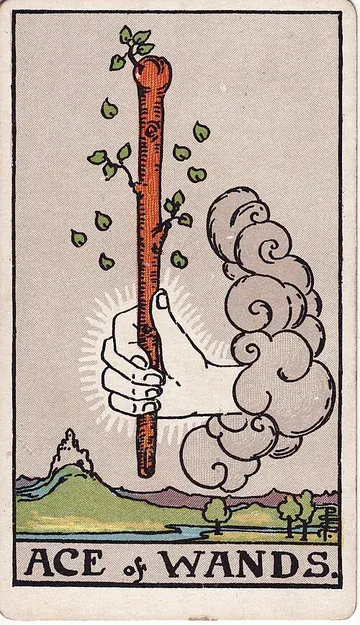
Pure spark meeting its first willing carrier. The Ace is the gift of fire from the cloud; the Page is the figure who has accepted the kindling and is walking with it. Together, an uncomplicated genuine beginning — both the original flash and the first honest courier. Keep the carrying simple. Don't dress the announcement larger than the actual thing on offer.
Knight of Wands
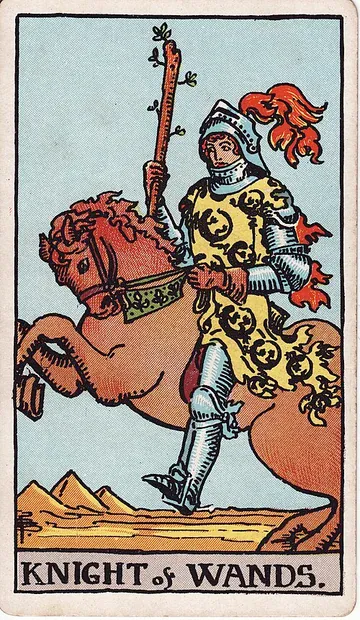
The eager messenger meeting the next stage of his own fire — the figure who has finally got on the horse. Momentum is gathering: the Page found the energy to go further than one delivery, the Knight knows how to ride. A small ignition becoming a campaign in weeks. The warning: speed mistaken for strategy. Honor the acceleration; don't yet treat it as arrival.
The Fool
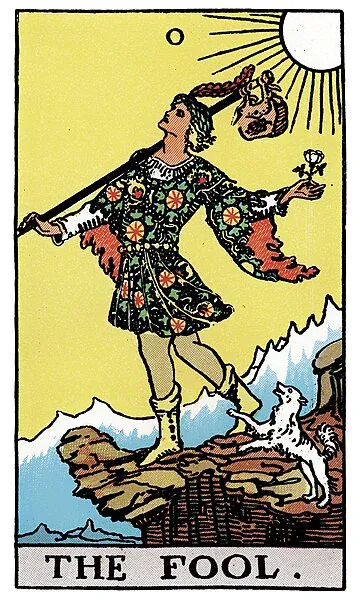
Beginner's fire next to its archetypal cousin. The Fool is the seeker about to step off the cliff with the white dog and the bundle; the Page is the courier already on the road. Together, a season of first steps where inner Fool and inner Page agree, for once, that motion is the right answer. Honored beginnings — but listen for whether you step in with provisions or with only the rose.
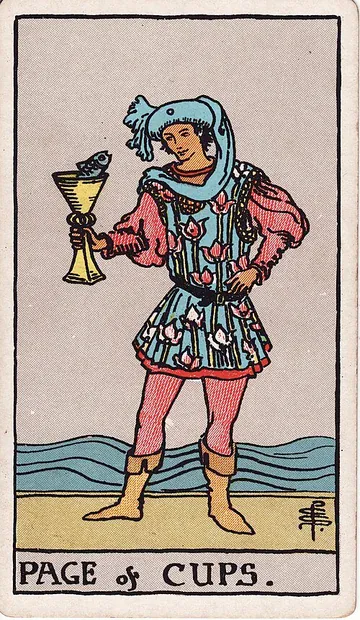
Page of Cups
Court siblings, opposite elements. The Page of Wands brings news; the Page of Cups brings feelings. Together, the friendship between the kid who runs in with a project and the kid who runs in with a small fish in a cup. Both sincere, both easily wounded. Often the start of friendship or romance where neither party is yet defended — sweeter and more fragile than either realizes.
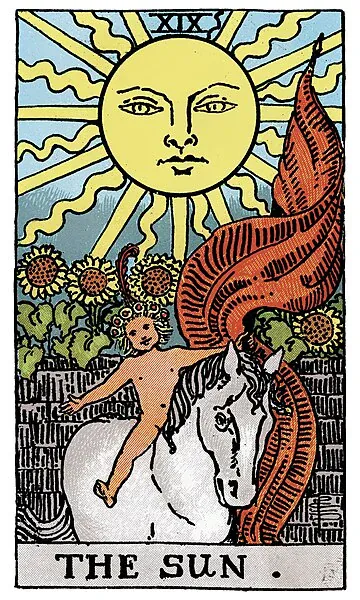
The Sun
The eager messenger crowned by the suit's brightest Major. The salamanders embroidered on the Page's tunic are themselves small solar creatures; this combination amplifies their visibility. A season where the spark you carry is genuinely seen and welcomed. Recognition arrives. The risk is to mistake the welcome for arrival — the Page is still a Page. Receive the sunlight; keep walking.
Frequently Asked Questions
Does the Page of Wands cover the whole plan, or only the first torch?
Only the first torch, and it is worth taking the limit seriously rather than treating it as a technicality. The Page of Wands gives a conditional yes: yes to the next small specific move — the introductory email, the trial lesson, the fifty-pound bet, the first conversation with someone who has done this before — and no opinion at all on the five-year version. That is not evasion. It is the correct scale for a figure who is the youngest in his suit and whose whole competence is ignition. Act now, concretely, in the direction the spark points, and let the results of that one act inform the next question. The campaign-sized questions belong to the Knight, who rides, and the King, who governs.
Is the Page of Wands' bluntness a warning sign or the real thing?
The real thing, most of the time — and it will not look polished while it is happening. The card describes endearing bluntness: someone, possibly you, approaching with honest enthusiasm instead of studied cool, saying the interested thing before working out how it lands. Interest that has not been edited is easy to mistake for immaturity, because editing is what we have been taught to read as seriousness. What the card is actually showing is unguardedness. For a newer connection, expect a slightly unstyled courtship — arriving early, texting twice, telling you about the thing they are excited about before asking how your week went. For an established bond, expect a partner bringing news and wanting you in the room while they work out what to do with it.
Page of Wands: do they know yet what they want to do about this?
No, and expecting them to is the fastest way to misread the card. As feelings, the Page of Wands shows warmth that is fast and entirely unexamined: they have not asked whether this is wise, convenient, or compatible with the rest of their life, because they have not yet gotten as far as asking anything. They are simply pulled toward you and have not hidden it. That makes the signal honest and unusable as a plan. Read it as real interest with no calendar attached. Pressing for definition at this stage usually produces an answer invented on the spot to satisfy the question, which then has to be defended. Let the next two or three weeks supply what the feeling has not yet worked out for itself.
What does the Page of Wands say about a new project?
The Page of Wands validates the new project itch and softly limits its scope. Light one specific torch — one demo, one small launch, one volunteer pitch — not the whole strategic blueprint. The card promises the small ignition is your honest next move. It does not promise the project will become a career; that is a question for later cards.
Why is the Page of Wands called earth of fire?
In the Golden Dawn schema, the Page of Wands is the Princess of the Shining Flame — Malkuth in Atziluth, earth-of-fire. Malkuth is the kingdom, the body, the place of landing. Atziluth is the highest fiery world. Where these meet, you get the most material expression of pure flame: a spark that has finally agreed to wear a body and walk.