
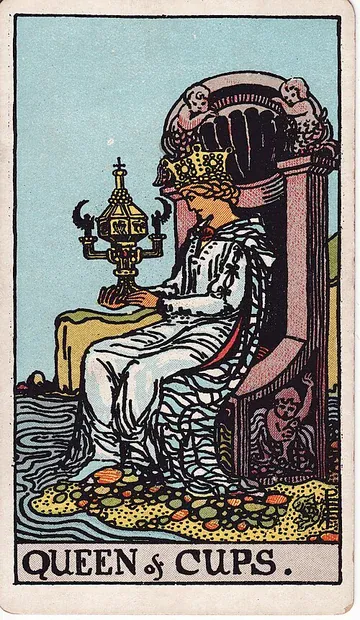
Queen of Cups · Core Meaning
The Queen of Cups, the water-of-water court of the Tarot Minor Arcana, sits on a throne of pale stone at the place where the sea touches the shore. The arms of her throne are worked into small cherubim and fish. In both hands she holds a chalice with a lid — not the usual open cup of the suit, but something closer to a reliquary, a covered vessel whose interior remains her own decision. Her gaze does not meet the viewer's. It rests on the cup, and through the cup on something further inside. The water has come up to her feet. The hem of her robe trails into it. Among the pebbles at the base of the throne, several stones have shaped themselves into small sleeping animals.
The card's signature tension is the question of what to keep covered. A queen of cups does not refuse feeling — she is made of it; her temperament is phlegmatic, the medieval humour for water, the cool inward weather of those who absorb. What she refuses is the obligation to put every feeling on display. The lid is not concealment. The lid is sovereignty. She decides when the cup is opened and to whom. This is what makes the card a portrait of mature emotional depth rather than romantic excess: depth without exhibition, presence without performance.
The traditional astrological signature is the Gemini-Cancer cusp, the eleven of June through the eleven of July, the days when the long northern light is at its longest and the tides at their most legible. As court card her elemental composition is water-of-water — outer water and inner water both, a clear still pool that can hold someone else's whole reflection without itself being mirrored. Her colors are pearl-gray and deep indigo. Her stones are pearl and moonstone. Her animals are dolphin and swan. Her time is dusk at high tide.
Look at the arms of the throne before anything else. On one side a cherub, on the other a fish — the creature of air and the creature of water, cut into the same pale stone, holding up the same elbow. The seat itself is the argument. She is not someone who chose the sea over the land, or feeling over sense; she sits on the line where the two grind against each other and has made that line habitable. No one else in the suit does this. The Page stands at the edge with the water behind him. The Knight rides across the stream. The King's throne floats clear of the shore altogether, a slab on open sea. Only the Queen keeps her feet on stone and her hem in the tide. In a reading about belonging — to a family, a profession, a country, a faith one half-left — this detail is the reading. It describes the person who can live at an edge without needing either side to take them whole.
Then the pebbles. Among the stones banked at the foot of the throne a few have taken the shapes of small animals asleep — something curled, something coiled, something with an ear. These are the stories she has received across years and no longer needs to show anyone: the grief told to her at two in the morning and never repeated, the confession that cost the speaker everything to make. The card's proposal about memory is unusual and worth sitting with. What is genuinely held does not stay liquid and does not stay loud. It settles. It hardens gently. It becomes part of the ground around the seat. Drawn into a position about the past, the Queen of Cups shows a past that has finished moving — nothing suppressed, nothing bleeding. The stones are asleep, not buried.
One more fact of the picture, easy to miss and hard to forget once seen: hers is the only covered cup in the deck. Every other chalice in the suit stands open — spilling, overflowing, raised in toast, tipped out onto sand. The lid appears exactly once, in the hands of the figure most capable of feeling, and that placement is the whole teaching. The capacity to close is given to the one who could hold the most.
When this card lands in any spread, read it as a posture before a prediction. The Queen of Cups is what someone in the situation is being asked to do, or has already begun doing: hold the cup, listen first, refuse to revise the other person's words back into one's own narrative. The reframe for any spread position: this is the seat from which to speak, even when the question is about what to say.
Queen of Cups · Love & Relationships
In love the Queen of Cups describes the partner who can sit in the room with feeling without trying to fix it. She does not narrate the other person's distress back at them. She does not interrupt with consolation that arrives before the sentence is finished. She listens to the end. She lets the silence after the sentence be silent. This is rarer than romance and harder than warmth, and it is what the card means when it appears in a love position.
For an existing long partnership the card speaks of the season when the relationship begins to live by its quieter signals — the cup of tea set down without being asked for, the hand at the small of the back as the other passes through the doorway. The Queen of Cups does not measure love by declaration. She measures by the unvoiced gesture that arrives at the right moment. The reading invites the long couple to name what their unvoiced language has become, and to trust it more than the words about the words.
For a new spark, the card is more cautious than ardent. The Queen of Cups does not rush a new bond into definition. She watches first. She lets the other person describe themselves before she describes herself. She is interested less in the surface charm than in what shape the other holds when no one is watching. If the new attachment can survive being looked at this slowly, it is worth attending to. If it cannot, the slowness has done its work and named the limit.
For the solo seeker, the card is not a verdict on whether love is possible. It is an instruction about what kind of love is being prepared for. The Queen of Cups asks the seeker to become, first, the person they would be glad to sit beside. She is not a card of waiting passively for romance to arrive; she is a card of becoming the seat at the table — the one who can hold another's day without dissolving into it. Love that meets a Queen of Cups will arrive into a room that is already lit.
For love after a wound — divorce, betrayal, slow estrangement — the Queen of Cups is exactly the right card to draw. She is what survives the wound when the wound has been allowed to be a wound. She does not pretend the rupture didn't happen. She does not weaponize the rupture into a story. She holds the residue of what was, and she does not let it become the entire interior. The recovery she describes is not the absence of feeling but the slow return of capacity to feel without flooding.
The Queen of Cups loves in a particular way, and naming it matters: she loves by attending. She is not the partner who plans the dramatic surprise. She is the one who remembers the small thing — the medication time, the recurring date, the specific tea, the name of a friend's parent — and who lets the remembering be the gift. If the seeker is wondering whether the other person loves them, ask whether the other person remembers. The answer in the body of the relationship is more reliable than the answer in the words.
When the question is 'are they in love with me' and the Queen of Cups appears as the other's stance, the truthful answer is that the feeling exists but is held under the lid. The other has not said it because saying it is not yet how they speak. Their love arrives in the offered glass of water, the chair turned slightly toward you in a crowded room, the question they remembered to ask the second time. Read for these signals before reading for declaration.
When the Queen of Cups appears as a person in your life, the variant matters. As a romantic partner she is the one whose presence returns you to yourself rather than rearranging you. As a mother or maternal figure she is the parent who lets you finish the sentence — the one whose silence is not neglect but the giving of room. As a mentor she is the older woman in the studio or the office who offers tea before opinion, who listens until the trouble has finished arriving, and who then says the one specific thing the trouble was waiting to be asked. As a colleague she is the desk you go to when you need to be heard without being managed.
If you are the talker in your relationship — the one who processes out loud, who arrives home with the day already in sentences, who solves the other person's problem while they are still describing it — then the Queen of Cups is not a portrait of your partner. She is an instruction addressed to you. The card asks for one week in which you come home and ask a question before you make a report. It is a small and strangely difficult discipline. Most talkers discover within three days that their partner has been carrying something for a month and had no opening to set it down. The relationship does not need you to become quiet by temperament. It needs the room to have two chairs in it.
A harder branch: the season when one of you is in real trouble — a bereavement, a diagnosis, a job gone, a parent failing — and the question brought to the cards is whether the relationship is still healthy. The Queen of Cups answers by changing the measure. During such a season the bond is not measured by mutuality, symmetry, or how the evenings feel. It is measured by whether the one in trouble is being allowed to be in trouble without also having to manage the other's reaction to it. That is the entire test. A relationship that passes it can run lopsided for a year and be sound. One that fails it can look balanced and be hollow.
There is a version of this question that arrives late at night: should I reach out to someone I stopped speaking to. The Queen of Cups is unusually clear here, and her clarity is about form rather than yes or no. If the message you are drafting explains, defends, relitigates or asks them to understand your side, the card says the message is not ready. If the message is short, makes no claim on their response, and simply puts down in front of them the fact that they were thought of, the card says send it. She pours the warm water and leaves. The offering that requires nothing back is the only kind this card knows how to make.
Queen of Cups · As Feelings
When the Queen of Cups is read as feelings — the question 'what do they feel about me' — the answer comes back as texture rather than verdict. The feeling is real and held. It is not loud, not declarative, not ornate. It moves like water under a thin layer of stillness — present in every surface ripple, but not advertised. The other has been holding what they feel for some time. The lid is on for a reason that is theirs, not yours.
If the person in question is naturally reserved, the silence is not absence. The Queen of Cups describes the way reserved feeling looks from inside the body: the steady noticing of the other's coming and going, the small accommodations made without announcement, the cup of warm water set down without anyone asking. Their silence about their feeling is itself a form of the feeling. A reserved Queen of Cups partner does not stop loving when they stop describing.
If the person is normally demonstrative and the Queen of Cups appears, the reading flips: the demonstrativeness has come down to a quieter register specifically because the feeling has deepened. They have moved from the outward speech of early infatuation into the inward listening of trust. The change in volume is not a change in temperature. It is the temperature settling.
For a long bond, the feeling has stabilized into the thing the relationship is made of. They are not in the room with you the way the Knight of Cups is in the room — galloping in, chalice raised. They are in the room the way the floor is in the room. The feeling has become structural. This is easy to mistake for distance only if the seeker has confused performance with presence.
For a newer connection the Queen of Cups feeling describes someone arriving at a conclusion about you slowly and accurately. They have not announced the conclusion because the conclusion is still composing itself. They are watching how you behave when you are tired. They are watching how you treat the waiter, the difficult relative, the news on the phone. What they will eventually feel is not yet final. What they currently feel is interest, and a willingness to be patient with their own findings.
For a wounded bond — a fight unresolved, a recent betrayal, a season of distance — the Queen of Cups suggests the other person is holding the rupture without weaponizing it. They are still feeling it. They have not closed off. The lid that is on the cup is the lid that lets feeling continue rather than scatter. This is the shape of someone who could be approached again, slowly and at their pace.
A caution specific to this card: the Queen of Cups can stretch her empathy past her own outline, and read someone else's mood as her own internal weather. When the card shows up as feelings and the seeker has been going through a hard season, ask whether the feeling being read is in fact the other's, or whether the seeker has, by long habit, taken in the other's feeling and is now reading it back to themselves.
The most useful question to bring to a Queen of Cups feelings reading is not 'do they love me' but 'what would they need in order to say it'. The answer is almost always: more time, less performance, and a setting in which speaking is not required. Read for the room, not the line.
If the seeker is asking about the feeling of a friend rather than a romantic partner, the Queen of Cups says: this is one of the people who would notice if you stopped showing up. They might not say so. They would notice. If you have been wondering whether to lean further into that friendship, the card answers yes — and answers by inviting the seeker to be the one who first lets the other person finish a sentence over a long, slow afternoon.
When the person asked about belongs to the past — an ex, a friendship that lapsed, someone whose number is still in the phone — the Queen of Cups describes a feeling that has cooled without turning cold. They think of you at particular hours and in particular weather. A song does it. A street does it. What they feel is neither longing nor indifference but something the language of relationships handles badly: continued regard, no longer attached to a plan. The lidded cup is exactly this. The feeling is kept, and keeping it does not commit them to reopening anything. A seeker hoping the card means they are about to make contact is reading past what is actually shown. What is shown is that you were not deleted.
Ask the card about a parent, an aunt, a grandmother, and the register changes again. The Queen of Cups in this position often names the elder whose affection has only ever arrived as practical acts — the food pressed on you at the door, the tire pressure checked without mention, the bill quietly paid. Their generation, their family, their own childhood did not hand them the sentence. The card's instruction to the seeker is to stop waiting for the sentence and to start reading the acts as the language they are. And then, if it can be borne, to say the sentence yourself, once, out loud, and let them not answer it. Being unable to reply is not the same as not having heard.
Queen of Cups · Career & Work
In a working life the Queen of Cups describes the colleague, manager, or self that other people seek out when they need to be heard. People come to her desk to think out loud. They leave clearer, even when she has said little. This is not a soft-skill in the dismissive sense; it is an instrument, and in some rooms the most valuable instrument present.
For the seeker in a current role, the card is a confirmation that this capacity is the real resource of the moment. The temptation to translate this resource into something more conventionally legible — a louder presence in meetings, a more aggressive scope claim — is to be resisted unless the structural situation actually requires it. Listening at the level the Queen of Cups listens is rare enough that misnaming it as a deficiency is one of the most common mistakes ambitious people make about their own work. If colleagues come to you to be heard, you are not behind. You are doing one of the high-skill labors the role contains.
For someone deciding whether to take a new role, the Queen of Cups asks a specific question: in the new room, will you still be allowed to listen first? Some workplaces require constant declarative output and treat reflective pauses as weakness. A Queen of Cups in such a setting will burn out fast or be revised by the room. Other workplaces — therapy adjacencies, design studios, slow-cycle research, certain leadership seats — actively need this card's gift. Take the role if the room can metabolize quiet; refuse it if the room is already too loud for the kind of work you do best.
For a freelancer or independent practitioner, the card is good news with a structural caveat. Clients who find a Queen of Cups practitioner tend to keep her — the work she does makes them feel met. The caveat is pricing and scope: this card's holder routinely undercharges for the listening labor and overdelivers on the held attention. The Queen of Cups must learn to name the listening as the deliverable, not the warm-up.
For the creative — writer, painter, composer, performer — the Queen of Cups is the season of long subterranean work that does not yet show on the outside. She is not the productive Three of Pentacles labor; she is the soaking that comes before. Drafts may be slow. Output may look thin. The work happening is the kind whose value will only be visible later, when something the seeker received quietly during this period emerges in the work as a deeper register. Trust the slowness. Don't trade the depth for visible velocity.
For a layoff or transition, the card is gentler than it first reads. The Queen of Cups does not panic in transition. She holds the loss without dramatizing it. She is the person who can sit with the uncertainty of the next role without scrambling for any role. If a transition is happening, the card recommends a slower job search than usual — fewer applications, more careful conversations. The next right seat will be found by being heard into rather than chased.
For a promotion question the card is more nuanced. A Queen of Cups can lead, but she leads by listening her team into clarity rather than by issuing the loudest plan. If the promotion is to a role that fits this style — head of a design pod, director of a clinical team, editor of a slow-cycle publication — the card is yes. If the promotion is to a role whose primary job is broadcasting, the card is asking whether you actually want to spend a decade in a register that is not yours.
For a returner — someone re-entering work after parenting, illness, caregiving — the Queen of Cups is one of the warmest cards possible. She names exactly the depth the returner has accumulated in the years that read on a résumé as gap. The depth is not a gap. The depth is the asset. The work is to find a room that will hire for the depth and trust the rest to follow.
For someone in a deeply burned-out season at work, the Queen of Cups warns that the card's shadow has begun: the cup has been left open too long, the absorbing has continued past the point where the absorber can hold what is being absorbed. The instruction is not to leave the role yet. The instruction is to put the lid back on the cup for a season — close one channel of intake, refuse one piece of emotional labor, leave the meeting that is not yours to fix — and notice whether the role becomes survivable when the lid is on.
Early in a career the Queen of Cups often arrives for someone who has just been told, in a performance review or by a well-meaning mentor, to speak up more. The card does not contradict the feedback; it reframes what speaking up would consist of. A junior with this card's register does not become visible by contributing more sentences. They become visible by contributing the one sentence that names what the room has been circling for twenty minutes — which is a thing only a listener can do. Track, for a month, the moments when you knew what was actually wrong and said nothing. Say it the next time, once, in eleven words. That is the whole practice, and it is worth more than a louder presence.
Somewhere in most teams there is a person both sides of a conflict talk to, and this card frequently names them. It is a real position and it carries a real hazard: the confidant becomes the place the conflict is stored instead of resolved. The Queen of Cups is willing to hold, but holding a dispute is not the same as metabolizing it for an organization that will not do its own work. If you have become that person, the card's counsel is to keep listening and to stop transmitting — no more carrying softened versions of one party's position to the other. Let them speak to each other. The stone animals at her feet are asleep because they were received, not because they were relayed.
Queen of Cups · Money & Finances
The Queen of Cups is not a money card by primary trade. Pentacles handles abundance directly. The Queen of Cups handles money the way she handles feeling — by holding it under a lid, by not advertising what is in the cup, by deciding privately when and to whom resources open. This is a quietly capable financial posture. It is not poor.
For someone in a solid but unflashy financial moment, the card affirms what is. The Queen of Cups sits well with savings accounts that grow without theater, with the slow paydown of debt, with investments held longer than the news cycle wants. She is the patient money — the money that is not spent to perform.
For a financial decision, the card recommends slowness. A Queen of Cups response to a possible purchase, a possible loan, a possible new investment, is: hold the question for one tide cycle longer than feels necessary. Sleep on it through one more night. Sit with the offer for one more morning. The information that is going to clarify the decision often arrives only after the surface excitement has settled, and the Queen of Cups knows how to wait the surface out.
A particular trap the card warns about is generosity that has not been measured against capacity. The Queen of Cups will give — to a sibling, a friend in trouble, a partner mid-transition — and will not always notice that her own cup is running low. The card invites the seeker to set, before any new request, an internal limit on what is available to lend, give, or float, and to refuse to revise that limit upward in the room when the request is being made. Generosity decided in advance survives. Generosity decided under pressure tends to deplete.
For someone in debt or in financial recovery, the Queen of Cups is gentle and exact. She does not shame the situation. She does not rehearse blame. She names the position without dramatizing it and moves to the next small useful step. Recovery in this card's register is monthly, not heroic. The reading invites a single specific structural step — a consolidation, a budget conversation with a partner, a forty-minute session with the spreadsheet — taken once and then trusted to do its work.
For windfall or new-money questions, the card is cautious in a useful way. A Queen of Cups season is a poor time to make a fast large move with money that has just arrived. The card recommends letting unexpected money sit for a full lunation in a holding account before any allocation. By the end of the cycle the right shape of the allocation tends to be visible without any forcing.
There is a kind of money this card understands better than any other in the deck: money with feeling attached to it. An inheritance. A parent's account after a funeral. The savings of a marriage that has ended. The cheque from selling the house you grew up in. The Queen of Cups counsels that such money not be treated as ordinary money for a while, because it is not being experienced as ordinary money, and decisions made about it while it is still warm tend to be decisions about grief rather than about finance. Keep it separate. Name it, on paper, for what it is — my mother's, the house's, the years'. Let the naming be explicit and slightly ceremonial. Money that has been named can eventually be spent well. Money that has been quietly merged into the current account tends to be spent in a fog and mourned twice.
In a shared household the card describes the partner who keeps the ledger without ever raising it — who knows the balance to the pound, absorbs the anxious months alone, and says at dinner that everything is fine. This is competence and it is also a slow structural risk, because privacy about money inside a partnership eventually becomes opacity, and opacity is where resentment banks up on both sides. The correction the card offers is small: one scheduled hour, monthly, in which the numbers are simply looked at together, with no decision required. Not a crisis meeting. A reading of the tide table. The lid is hers to lift, and this is a room in which lifting it costs nothing and prevents a great deal.
Queen of Cups · Health
The Queen of Cups maps in the body to the chest and the heart. Her temperament is phlegmatic — the cool, moist, inward-running humour of medieval medicine, the body type that absorbs and retains. Her scents are wet stone, sea-salt, and chamomile. Her plants are lotus and sea-holly. Her time is dusk at high tide. Read the card's health register through these registers, not as diagnosis but as the kind of attention the body is asking for.
For an acute issue, the card asks whether the body has been receiving more than it has been releasing. A Queen of Cups in a health spread often points to the chest carrying what should have been spoken — held grief, held tenderness, held responsibility for someone else's mood. The somatic translation of long-held emotional reception is real, and the card invites a small daily practice that lets the chest empty: a five-minute window each morning of slow exhalation, a journaling page that closes at the end without needing to resolve, a long walk where speaking aloud to oneself is permitted.
For a chronic condition the Queen of Cups counsels patience and the absence of dramatic intervention. She is not the card of the radical protocol. She is the card of the small consistent attention — the chamomile tea at the same hour, the sea-salt bath on Sunday, the long sleep when the day allows. Healing in her register is tidal. It happens by repetition rather than by breakthrough.
The card's specific somatic suggestions, drawn from her sensory signature: a saline rinse for the sinuses when the head feels full; a chamomile tisane forty-five minutes before sleep; a walk to a body of water at dusk when the chest feels held. These are not medical instructions. They are ways of letting the body recognize the season the card has named.
For a mental health season the Queen of Cups is exact. She names the difference between feeling deeply and being flooded. Feeling deeply is sovereignty. Being flooded is the lid having been off too long. If the seeker has been crying easily for several weeks, has been unable to distinguish their mood from the mood of the people around them, has been waking at three in the morning unable to put the chest's water back inside its banks, the card's prescription is the lid. Close one channel of emotional input for a week — the news, the friend whose distress is constant, the social feed that runs grief without filter — and notice the body return to its own outline.
For a partner or family member's health, the Queen of Cups invites the seeker to be the seat by the bed without becoming the patient. She is the one who can sit with someone who is unwell without absorbing the illness as her own weather. Showing up while remaining oneself is an art the card teaches.
For pregnancy or post-partum the card is one of the most apt in the deck. Pearl, moonstone, dolphin, swan, the chest and the heart, the dusk-and-tide rhythm — all of it matches the bodily register of those months. The card's gentleness is not sentimental; it is structural. The body in those months really does need the held cup, the chamomile, the slowness. The card affirms that.
Sleep deserves its own paragraph here, because the card's hour is dusk at high tide and the seeker who carries this register often lives on a slightly later clock than the one their life is scheduled around. Their clearest thinking arrives at nine in the evening. Their body begins to soften at eleven. The alarm belongs to somebody else's temperament. The card is not suggesting the schedule be abandoned; it is suggesting the evening hours be protected rather than spent, since those are the hours in which this particular body actually restores. One concrete move: whatever currently happens between nine and ten at night — screens, other people's messages, the day's residue — give thirty minutes of it back to something with water in it. A bath, a long glass, a walk in the wet air. The body knows this hour is its own.
Watch the breath while listening. A phlegmatic, absorbing body has one reliable tell, and it happens in company: the in-breath is taken and held while the other person speaks, as though holding still would help them finish. Hours of this pass without notice, and the chest ends the day tight in a way that has nothing to do with illness and everything to do with posture. The correction takes no time at all. When someone is talking, let the out-breath go, quietly, before they reach the end of the sentence. The listening does not suffer. The chest stops storing the conversation.
Queen of Cups · Spirituality
Spiritually the Queen of Cups is the figure who knows that the deepest contact is not the one that is performed. Her chalice is lidded for a reason: there are layers of inner life that do not survive being narrated to others. They survive being witnessed by the self in silence. The card is a teacher of interior privacy as a sacred resource.
Her animals — the dolphin and the swan — both belong to two elements at once. The dolphin breathes air but lives in water; the swan rests on water but flies. The Queen of Cups is the seat of dual citizenship between the inner and outer, the felt and the said, the kept and the offered. Her stones, pearl and moonstone, both come from water and both hold light without reflecting glare. They are the kind of light that is for sitting near, not staring at.
The practice she invites is small and exact: thirty minutes a week of held silence — no music, no podcast, no inner running monologue prepared in advance. Sit by water if water is available. Sit by a window if it is not. Hold a cup of warm water in both hands and let the cup be the entire content of the time. When the cup cools, the practice is done. The first few weeks of this practice will feel like nothing is happening. The card promises that the nothing is the practice.
The Queen of Cups is also a teacher of intercessory presence — the practice of holding another in silent attention without trying to fix or speak for them. Some traditions call this contemplative companionship. Some call it sit-with. The card recommends extending it as a regular gift to one specific person in the seeker's life: a parent who has gone quiet, a friend in long illness, a child mid-storm. Not advice, not consolation, not a planned conversation. Just the held presence, in the room or by phone, for as long as the cup of warm water in your own hand stays warm.
The shadow of the card's spiritual signature is the temptation to use depth as leverage — to wear silence as a mantle of superiority over louder companions, or to keep the lid of the cup closed in a way that withholds rather than protects. The line between sovereign reserve and weaponized silence is not always thick. The card asks for honest self-questioning about which side of the line one's quiet is currently sitting on.
For someone in a season of doubt or spiritual dryness, the Queen of Cups is unusually kind. She does not require belief. She requires the seat. Sit by the water, hold the cup, and let nothing happen. Whatever returns will return without being performed.
The cup she holds is shaped like a reliquary, and a reliquary is not a container for liquid. It is a container for a remnant of someone who is gone. That detail opens a practice the card offers to anyone carrying a death — recent or twenty years old. Choose one small object that belonged to the person: a key, a thimble, a folded ticket, a pair of reading glasses. Put it somewhere it can be seen daily and not handled. No shrine, no candles, nothing that asks the household to participate. What the Queen of Cups teaches about grief is that it does not need to be expressed in order to be honored; it needs to be housed. The lid goes on. The relic stays inside. And the seeker is permitted to walk past it on an ordinary Tuesday without stopping, which is how the dead are actually carried across a long life.
A discipline worth attempting for a month: keep one true thing unsaid on purpose. Not a secret — a secret is something withheld from someone who has a claim on it. This is something real that you notice about your own inner life and simply decline to narrate to anyone, including to the group chat, including to the page. Most of us discharge our interior the moment it forms, and what discharges cannot deepen. The Queen of Cups is the argument for the opposite experiment. Keep the one thing. Return to it in the thirty minutes of silence each week. By the fourth week it will have changed shape, and the change is the point — that movement is only available to material that was not spent on telling.
Queen of Cups · Yes or No
Yes — but quietly. The Queen of Cups answers in the affirmative, with a strong condition: the yes is the yes of held depth, not the yes of broadcast. If the question is about the rightness of the path, the readiness of the bond, or the trustworthiness of the inner signal, she says yes. If the question is about whether the path will announce itself with fanfare, she says: not in this register.
The yes describes what the affirmative looks like in lived life. It looks like a calm interior the morning after the decision rather than a thrill. It looks like a body that does not flinch when the next small step toward the choice is taken. It looks like the absence of the urge to convince anyone else that this was the right move. The Queen of Cups affirms by stillness, not by celebration.
The condition: the yes only holds if the seeker is willing to keep the cup lidded — to refuse to put the new yes on display, to refuse to seek confirmation from the loudest voices in the social field, to let the choice have its first season in private. A Queen of Cups yes that is broadcast immediately is at risk of being talked out of itself by the room. A Queen of Cups yes that is held is the yes that becomes the new ground.
For a yes-or-no question about a specific person — 'are they the one for me', 'will this friendship deepen', 'is this child going to thrive' — the card answers: the yes you are looking for is already in the body. Sit with the chest's response when you imagine the person, and read what you find. The Queen of Cups trusts somatic affirmation the way some cards trust verbal commitment.
For a yes-or-no question about a path — a job, a move, a creative project — the card's yes is conditional on slowness. Yes if you can begin without announcing. Yes if you can let the first ninety days be private. Yes if the new shape can have its early season under a lid. The card is not anti-celebration; it is anti-premature exposure of a tender thing to a hostile or merely curious room.
The Queen of Cups rarely answers a flat no. When she does, the no looks like a body that closes in the chest at the question — not a flicker of nerves but a sustained constriction. If the seeker has tested the question that way and the chest has closed, trust the closure. The card's no is not loud either. Its no is the absence of the warm water in the hands.
If the question is being asked because the seeker wants permission to move loudly, the card is gently misaligned with that wish. Her yes is real, and it is for the move that can survive being made privately first.
When the question is asked on someone else's behalf — should my sister leave him, should my son take the place at that university, is my friend's new partner good for her — the Queen of Cups withholds the verdict on purpose, and the withholding is itself her answer. She will not read a chest that is not in the room. What she offers instead is exact: your yes is not theirs to receive, and the most useful thing available to you is the question they have not yet been asked. Ask it. Then do not supply the answer. A reading taken for another person is at its best when it hands that person their own next question rather than your conclusion about their life.
And if the question is a should-I-say-something question — the thing noticed about a friend's marriage, the mistake a colleague is walking toward, the truth a family has agreed not to mention — the Queen of Cups answers yes to the caring and not yet to the speech. The condition she sets is arrival: say it only once you can say it in two sentences, with no case attached, and only once you are prepared for it to change nothing. Most of what we urgently need to tell people fails one of those three tests, which is why it usually lands as an argument instead of a gift. Wait until it passes all three. Then say it quietly, once, and hand them the water.
Queen of Cups · Advice
The Queen of Cups offers a handful of concrete instructions, each doable this week.
First, set down the warm water before speaking. When someone arrives at your day with a difficulty — a partner, a colleague, a parent on the phone — do the small physical thing first. Pour the tea. Get the second chair. Open the window. The body's preparation of the room is the card's first move; the conversation is what happens after. Practice this once a day for seven days and notice how often the right thing to say arrives because you set down the cup first.
Second, name one thing this week that you do not take on. Do not announce the refusal as virtue. Do not perform the limit. Simply hold the lid down on one specific channel — a recurring favor that has begun to drain you, an emotional duty in a friendship that has begun to mismatch what the friendship actually returns, a meeting at work whose repair is not yours. The lid is not coldness. The lid is the Queen of Cups' sovereignty. Practice it once on something small and watch the room reorganize.
Third, schedule thirty minutes of deliberate solitude — not productive solitude, not journaling solitude, simply held solitude with a cup of warm water in the hands. Do this once before the week is over. Sit by water if water is near. Sit by a window if it is not. Let nothing happen. The card's central practice is the practice of letting a feeling arrive at its own pace without being asked to declare itself.
Fourth, when the question of the week arrives in conversation, listen until the other has finished arriving. Do not interrupt with the answer that has formed in your head halfway through their sentence. Let the silence after their last word be silent for two breaths longer than feels comfortable. Then speak. The card promises that what you say after those two breaths will be more useful than what you would have said in the original interruption — and that the other person will know they were heard.
Give one person an afternoon with nothing scheduled after it. Not dinner with a reservation, not coffee before a meeting — an unbounded stretch with no closing time announced in advance. The whole difference this card makes is in the last twenty minutes, after the news has been exchanged and the pauses have started to get longer. That is where the real thing usually arrives. It cannot arrive in an hour with a train to catch. Pick the person who has gone quiet lately and offer them the open end of a Saturday.
When a message arrives that stings, write the reply and do not send it until the light has changed. Morning message, evening reply; evening message, morning reply. Keep the draft open and read it once more at the hour when the tide turns. Almost every time, two sentences will come out and one will go in, and the one that goes in will be the sentence that does the work. This is not about being nicer. It is about the difference between an answer written by the sting and an answer written by you.
On Friday, take one minute to notice what you did not repeat. Somebody told you something this week that went no further, and the not-repeating was so quiet that it will otherwise pass unmarked, even by you. Mark it. This is the one labor in your life that leaves no trace and has no witness, and letting it register once a week is how the person doing it stays willing to keep doing it. The stones at the foot of the throne are the shape of exactly this, accumulated over years.
A last instruction in case the week has been hard: when something difficult lands in your day, before reaching for advice or solution, ask the body what it would do with thirty more seconds. Often the body's instruction is not 'fix' but 'sit'. Trust that for the duration of one held breath.
Queen of Cups · Card Combinations
The Queen of Cups does not appear alone in most spreads. The cards she lands beside change her register more than most courts change theirs, because her water-of-water composition will absorb the color of whatever sits next to it. A short field guide to her most legible pairings follows.
With another water card she deepens. Beside the King of Cups she becomes a mirror of mature emotional sovereignty in two registers — her inner attention beside his outward fluency. Beside the Page of Cups she becomes a teacher of how feeling matures from charm into depth. Beside the Two of Cups she affirms that a bond has settled into its real weather; the early intoxication has become the long mutual recognition.
With Pentacles she finds form. Beside the Queen of Pentacles she shows the contrast and complement of feminine sovereignties — the one who tends the body of feeling and the one who tends the body of resources; together they describe a household, an institution, or a friendship that knows how to keep both fires lit. Beside the Ten of Pentacles she names the long-built family in which depth has been allowed to accumulate across generations.
With Wands she is forced into reply. Beside the Knight of Wands or the Three of Wands her water is asked to take a public position; this is not her natural register, and the combination often reads as the moment when held depth is required to declare itself in the world. The card's instruction in such pairings is to declare without performing.
With Swords she is at risk. Beside the Three of Swords her cup begins to fill with someone else's grief; the pairing is the card of empathy that has crossed into self-erasure. Beside the Five of Swords her listening is being taken advantage of by a more strategic player; the combination warns that not everyone who arrives at her cup deserves a full pour.
With Major Arcana she is most clearly herself. Beside the High Priestess she becomes the human face of what the High Priestess holds in symbol — sovereign feminine depth made visible at the seat by the water. Beside the Moon she is the figure who can sit with the dream-tide without drowning; this pairing is the card of someone who has learned to read the night without being unmade by it. Beside the Star she is the figure who has come back from the difficult season with her chalice intact and is, very quietly, beginning to pour again.
With the other queens she is best read as one voice in a council. Beside the Queen of Swords the pairing puts reception and discernment at the same table — the one who takes the whole story in beside the one who can say which part of it is true. Neither queen is complete alone: unaccompanied, the Queen of Cups absorbs what should have been assessed, and the Queen of Swords assesses what she never properly took in. Together they are what a good clinician, a good editor, or a good older friend actually consists of. Beside the Queen of Wands the contrast is warmth in two temperatures — the one who lights a room on entry and the one who is noticed only by whoever needed her. The pairing often surfaces for someone deciding how much of themselves a public role can be asked to carry, and its counsel is that the two can be held in one life so long as the seeker knows which of them is the performance and which is the person.
Among the remaining Major Arcana, three change her most. Beside Temperance the distinction to read is the difference between mixing and merging: the angel pours from vessel to vessel and both vessels remain, which is precisely the discipline the Queen of Cups is either practicing or losing. Beside the Hermit the two silences are not the same silence — his is chosen and lit for the road, hers is inhabited and seated; drawn together, they describe a season of withdrawal that is productive rather than evasive. Beside the Empress the pairing separates two kinds of care that get confused in families: the Empress gives, abundantly and visibly, while the Queen of Cups receives, invisibly and without revision. Where both appear, someone in the picture is being asked which of those two things they have actually been offering, and which one is being asked for.
Card Combinations
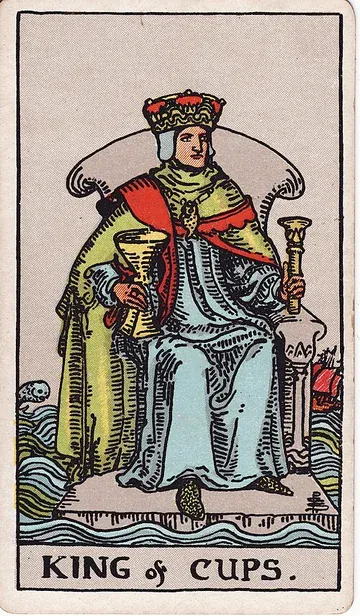
King of Cups
Queen of Cups beside the King of Cups is the full water court in one spread — water-of-water meeting air-of-water, her inner pool beside his outward navigation. The pairing reads as a partnership or inner constellation in which feeling is both held and articulable, where neither party has to do all of one labor; her lidded chalice rests on the shore, and his open cup moves over the water. Together they describe a relationship, a clinical pair, or a single mature self that has finally learned to keep depth and speech in the same room.

Queen of Pentacles
Queen of Cups beside the Queen of Pentacles is the contrast and complement of feminine sovereignties — water beside earth, the held interior beside the tended household. The pairing describes a friendship, a maternal pair, or an institutional partnership in which one queen tends the body of feeling and the other tends the body of resources. Together they keep two fires lit; alone, each can become starved for what the other holds. The combined image is a long table where tea has been poured and the bread is on the board.
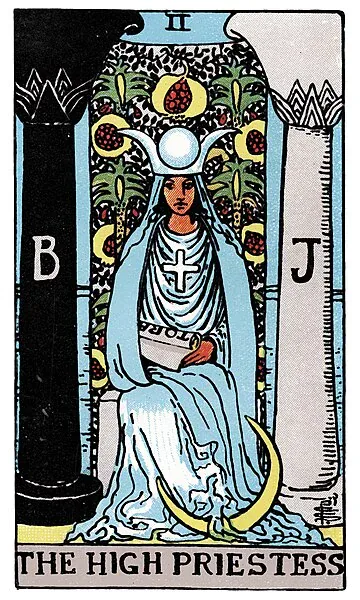
The High Priestess
Queen of Cups beside the High Priestess is sovereign feminine depth in two registers — the symbolic and the lived. The High Priestess is what the Queen of Cups holds in her chalice; the Queen of Cups is the human face of what the High Priestess holds in symbol. Together they describe the rare moment in which a seeker has access to both the inward archetype and a concrete human seat for it — a teacher, a partner, a self — that lets the deep be both kept and met. The image is a veiled doorway opening onto a shore.

The Moon
Queen of Cups beside the Moon is the seat at the dream-tide. Where the Moon alone can drown the seeker in tides without a referent, the Queen of Cups offers the throne from which the tide can be witnessed without being swallowed. The pairing is the card of someone who has learned to sit beside the night without being unmade by it — the dreamworker, the night-shift nurse, the long-illness companion, the seasoned therapist. Together they describe fluid sovereignty: feeling let in without erasing the one who feels.
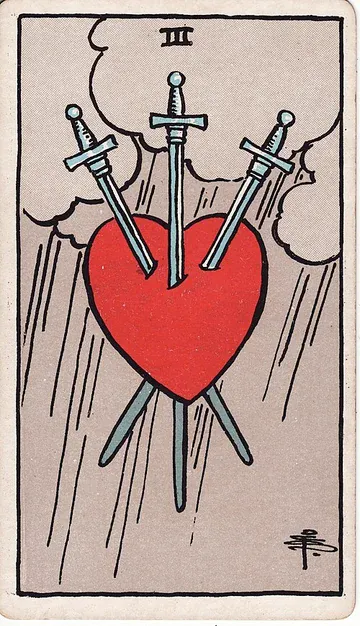
Three of Swords
Queen of Cups beside the Three of Swords is the most precise warning the deck offers about empathy crossing into self-erasure. The held chalice has begun to fill with someone else's grief; the three swords are not in the seeker's chest by birth but by absorption. The pairing names the moment when listening has gone past sovereignty and become identification — when another's wound is being read as one's own weather. The instruction is the lid: close one channel of intake long enough for the seeker's outline to return.
Frequently Asked Questions
What is the Queen of Cups tarot card meaning?
The Queen of Cups is the water-of-water court of the Tarot Minor Arcana. She holds a lidded chalice on a throne where sea meets shore, and her presence is the answer rather than her speech. The card describes mature emotional sovereignty — depth without performance, empathy that revises nothing, the held cup whose opening she decides. As a posture rather than a prediction, she is the seat from which to listen first.
Does the Queen of Cups still say yes if I need to explain the decision to everyone?
Her yes thins the moment it needs an audience. The Queen of Cups is yes — but quietly. Her affirmative is the calm interior the morning after a decision, the body that does not flinch toward the next small step, the absence of the urge to convince others. The condition is privacy: her yes only holds if the seeker is willing to keep the choice lidded for its first season. If the question demands a loud broadcast yes, the card is gently misaligned. If the question asks whether the inner signal can be trusted, she says yes.
Why would someone feel the Queen of Cups strongly and still say nothing?
Because her cup has a lid, and the lid is a choice rather than a symptom. As feelings, the Queen of Cups names a real and held emotion that has not yet been declared. The other person is feeling — steadily, without ornament — and is keeping the lid on the cup for reasons that are theirs. Read for the small remembered gestures (the cup of water set down, the chair turned slightly toward you) before reading for the spoken line. If the bond is long, the feeling has stabilized into what the relationship is made of; if new, the feeling is composing itself.
What does the Queen of Cups mean as a person?
As a person the Queen of Cups is the one whose presence returns you to yourself rather than rearranging you. She can be a romantic partner whose love language is attending; a parent who lets you finish the sentence; a mentor who offers tea before opinion and then says the one specific thing the trouble was waiting for; a colleague whose desk you visit when you need to be heard rather than managed. Her gift is the quality of her listening, not the volume of her speech.
Is being loved by a Queen of Cups the same as being taken care of?
Close, and worth separating: she attends rather than manages. In love the Queen of Cups is the partner who can sit in the room with feeling without rushing to fix it. She loves by attending — by remembering the small specific things and letting the remembering be the gift. For long bonds she affirms the unvoiced language of the relationship; for new sparks she counsels slowness; for solo seekers she invites the seeker to become the seat at the table. For love after a wound she names the slow return of capacity to feel without flooding.