Queen of Wands · Tarot Card Meaning
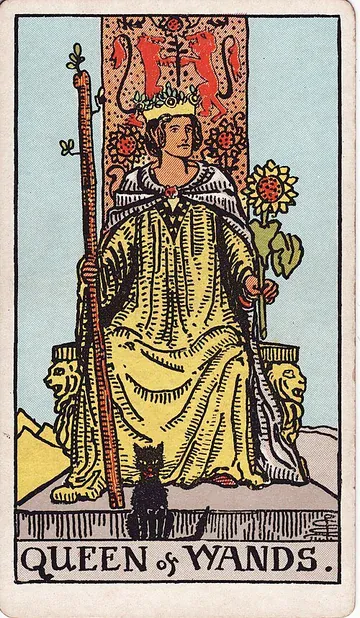
The Queen of Wands sits forward on a stone throne, the high back carved with lion sigils and a row of sunflowers. Her gold-and-crimson robe falls open across her knees like a quiet, standing fire. In her right hand a leafing green staff rests across her lap — the wood is still alive, putting out small leaves at the tip. In her left hand, an open sunflower, palm-sized, the second sun in the picture. A black cat crouches at her feet and looks straight at the viewer, a step ahead of her in noticing you. Her own face is turned half-aside. She knows you are there. She is not deciding what to be from your reaction. The Queen of Wands meaning, in plain language, lives in that posture: present, warm, decided, and not negotiating with the room. Most readers searching the Queen of Wands tarot card meaning are looking for a way to recognize this person — in someone they know, or in themselves — and the recognition is the point.
This is the signature tension of the card — warmth held with edges. The fire of the suit is not, on this card, a charge or a sprint. It has cooled into temperature. The Queen of Wands does not chase. She also does not retreat. She is the host who has lit the fire, set out the chairs, and is waiting to see who walks in. If you walk in friendly, the warmth meets you. If you walk in hostile, you meet the staff before you meet the smile. Both responses come from the same self.
The Queen of Wands is filed as a court card with outer fire and inner water. The outer is the visible heat — the magnetism, the laugh that fills a room, the clean voice that carries. The inner is the water that cooled the fire into shape: feeling, memory, the long internal life that has taught her what she actually wants. The combined quality is water-within-fire — not an extinguishing but a circling back. Fire passed through water's coil gains magnetism, warmth, and a sense of edge. This is the line to remember when you draw the card. She is not the Knight's outward spark. She is the spark that has been through a long inner season and come out with a sense of where its own rim is.
Her dates hold the same water-into-fire seam: the Queen of Wands holds the cusp from late Pisces into early Aries, roughly March 11 to April 10 — the ten days at the end of the dreaming sign and the ten days at the start of the cardinal fire. Pisces is the water she came up through. Aries is the fire she now sits inside. She is the moment when an inner image, long held in the soul's water, finally takes a body and walks. The card's plant is sunflower and cinnamon; its animals are the black cat and the lion; its time is the warm light of three in the afternoon in spring; its body part is heart and upper stomach. Read these as one weather: a bright but late afternoon, in the season when the year decides to commit, with the heart already lit.
Read the Queen of Wands the way you would read a portrait of the friend everyone knows is unbluffable. The half-turned face is not coldness. It is the ease of someone who has stopped arranging her angle for the camera. The sunflower in her hand is not decorative. It tells you her fire blossoms whether or not anyone is watching. The black cat at her feet is the part of her that the world has called inauspicious — the desire too direct, the laugh too loud, the no said too simply — and which she has not asked to leave. The whole portrait is the picture of a person who has learned her own temperature and is no longer adjusting it for the weather of the room.
Queen of Wands · Love & Relationships
The Queen of Wands love reading describes warmth that arrives without performance and leaves without apology. The card belongs to a stage of love where one of the people involved has learned the shape of their own desire well enough to offer it cleanly. The fire has been through the water of their interior, and what is being given is steady. There is no wheedling on this card and no withholding. There is a body in a chair, a sunflower on the table, a clear yes when the yes is yes, and a clear no when the no is no.
For an existing partnership, the Queen of Wands often arrives in the year after the bond's hardest negotiation. The questions about whether the relationship would survive have been answered. Both partners have stopped auditioning. The dynamic the card describes is the one where both people have learned what they actually want from each other and have stopped wishing the other person were a more flattering shape. There is laughter again at the kitchen table. There is desire that is not theatrical. The Queen of Wands at this stage of long love is the picture of a partnership that has stopped being a project and started being a temperature.
For a new spark, the Queen of Wands describes a meeting where one of the people — often the seeker, sometimes the other — is no longer playing the early-stage game. They are not pretending to be cooler than they are. They are not delaying the text to seem composed. They are also not pursuing in the high-Knight register, all flame and motion. They are simply present, warm, and direct. If you have just met someone who answered your message at the speed of someone who actually wanted to and asked the question they were actually curious about, the Queen of Wands is the card of who they are when they are not performing. Match the directness. Do not retreat into theater. The card responds to people who can take a clean, warm offer without flinching.
For the solo seeker who is asking whether love is possible, the Queen of Wands answers with a yes that has a specific texture. Yes — once you have learned to be warm with yourself first. The card is the friend at the table who asks, gently and without pity, what the seeker has been giving themselves of the things they keep waiting to be given by a partner. Touch. Compliments. A meal cooked with attention. A body in a chair that is not negotiating with anyone else's needs. The Queen of Wands does not arrive into a life that is starving its own fire. She arrives into a life that has learned to keep its own fire lit, and is therefore not asking the next person to be the only source of heat.
For love after a wound, the Queen of Wands is one of the deck's most generous cards. She has been through the water. She is the picture of a person who has been hurt and has not turned the hurt into a small cold place at the center of the chest. The wound did not curdle her warmth. It taught her the difference between people who are worth the warmth and people who are not. If the seeker is in this season — past the worst of the heartbreak, beginning to feel the body warm again — the card validates the recovery. It also gently warns: do not save the warmth for the next love. Spend it now. On friends, on a long meal, on the small project that has wanted attention. The fire that is fed wherever it can be fed is the fire the next person will recognize.
For reconciliation questions — should I return to the partner, should I let them come back — the Queen of Wands gives a frank answer. Return only to a person who can meet you at the temperature you are now. The seeker who draws this card has often, in the time apart, become a more decided version of themselves. They know what they want more clearly than they did. They are less willing to accept the kind of vague affection that drained them last time. Reconciling on those new terms is possible and sometimes excellent. Reconciling because both people are lonely and the cold is making them flexible is the way the same break happens twice. The card asks for the new terms.
For long-distance and cross-cultural relationships, the Queen of Wands describes a love that travels well because the warmth is internal. She does not need the daily proximity to remain herself. The card is one of the deck's clearest pictures of a person who can sustain a bond across borders, time zones, and incompatible work schedules — because the fire inside is not waiting for the partner to arrive in order to be lit. If you are reading this card in a long-distance question, the bond is sound. The question is whether the architecture of the relationship — the visits, the calls, the eventual closing of the distance — is being built with the same care the warmth itself has been built with. Internal warmth is not an excuse to skip the practical scaffolding.
For pursuer-and-distancer dynamics, the Queen of Wands almost always represents the partner who is neither pursuing nor distancing. She is sitting in the chair. She has said what she wants. She has stopped translating her preferences for the other person's comfort. If the seeker is in the pursuer role, the card asks them to stop running at the closed door and instead to show up at the same temperature she is — present, warm, not negotiating, not begging. If the seeker is in the distancer role, the card asks them to notice that the partner who is sitting steady on the chair is not actually demanding anything except real meeting. Walk back into the room.
For household constraint cases — relationships read against difficult in-laws, blended-family responsibilities, illness in the family that has been pressing on the bond — the Queen of Wands is a useful arbiter. She does not pretend the constraint is not there. She also does not let the constraint write the temperature of the partnership. The card asks the couple to keep the fire lit in the small private rooms — the bedroom, the dinner table once the children are asleep, the half-hour walk on a Saturday morning — even when the public-facing parts of the household are full of other people's needs. The warmth is the line that does not bend, even when everything else is bending around it.
For desire mismatch — one partner wanting more sex or more closeness than the other, the long-running question of whether the gap is workable — the Queen of Wands offers a clean instruction. Whoever wants more must say what they want, in their own voice, without dressing it up as accusation. Whoever wants less must say so plainly, without dressing it up as exhaustion. The card has no patience for managed conversations about desire. It does have patience for two people who can both speak their actual temperature out loud and decide, from there, whether the relationship can hold the difference. The card does not promise that every mismatch is workable. It promises only that the workable ones become workable through directness.
For the "are they into me" question, the Queen of Wands upright answers yes with very few qualifications. The signal is in their unselfconsciousness around you. They laugh at their own joke before checking your face. They reach for you in public without performance. They tell their friends about you in the same voice they use for everything else, not the lower, careful one. There is no game running here. They are not playing at all. If your gut keeps returning to the question, the card asks you to notice that the gut is the only thing still hesitating. They have already decided.
Queen of Wands · As Feelings
The Queen of Wands as feelings is one of the more generous answers in the deck — and one of the most precise. The card never describes vague affection. It describes feeling that has been thought through, held against the heat of an interior life, and decided on. When the Queen of Wands appears to answer how someone feels about you, the body in the picture is steady, the face is half-turned without coldness, and the warmth is real, undivided, and self-possessed. They feel for you in the way a person feels who has stopped wasting feeling on uncertainty. Whatever they have decided about you, it is felt at room-temperature confidence, not at fevered drama.
For a reserved person, the Queen of Wands as feelings means more than they have said and more than they intend to say first. The reservation is not coldness — it is the half-turned face. They are watching you before they speak, not to evaluate whether you are worthy, but to make sure their words land in a body that can hear them. They are not waiting for you to prove anything. They are waiting to feel the room is right for what they have to give. The warmth is already lit. The voice will arrive when you stop scanning their face for the warmth that is plainly already there. Read their attention as the answer. The card speaks first in the direction of the gaze, not in the words.
For a demonstrative person, the Queen of Wands as feelings is one of the most delicious cards you can draw. They will tell you. They will tell their friends. They will plan. They will make small gestures with no agenda. They feel like themselves around you and they like that feeling. The card warns only against confusing the brightness for shallowness. The Queen of Wands' demonstrative warmth is not a performance. It is the natural state of a person whose interior is warm and who has stopped editing the warmth on the way out. Receive what is being offered. Do not test it.
For a long bond, the Queen of Wands as feelings often describes settled commitment in the form of low, durable heat. The acute hot phase of the relationship has matured into a steady inner climate. They are not new in their feeling. They have lived through several seasons of you. They have stopped hoping for a more flattering shape of you, and that releasing of hope has, paradoxically, made the love larger. They love the actual you. They are not bored. They are at home. The card asks the seeker not to mistake the absence of theater for the absence of fire. The fire is the most reliable kind: the kind that does not need fuel from outside in order to keep burning.
For a new connection, the Queen of Wands as feelings often describes someone who has decided faster than they have admitted. They knew, on the second date, that they wanted you in their life. They are now moving at the pace of disclosure — letting the feeling come through without scaring the situation by saying the whole truth in week two. The card is generous to this kind of slow honesty. It also tells the seeker not to push for more declaration than the season can hold. The feeling is real. The slow naming of it is care, not hesitation.
For a post-conflict reading — you have just had a real fight, and you want to know whether the bond survived — the Queen of Wands as feelings is one of the clearer cards you can draw. The feeling did not go anywhere. The water inside the fire absorbed the conflict; the fire is still steady. They may need a day. They may need a quiet evening. They are not stewing. They are letting the heat re-collect. When they come back, they will come back warm. Do not flood their phone. Let the temperature equalize on its own.
For long-distance feelings, where the seeker is reading whether the partner still cares despite the gap, the Queen of Wands as feelings answers yes — and clarifies the texture. They do not need to text constantly to keep the feeling alive in themselves. The fire is internal. What looks, sometimes, like a quieter day-to-day is actually the steady room-temperature warmth of someone who is not anxious about you. Read the steadiness as the love it is. If you need more frequent contact, ask for it directly; the card responds well to direct asks. It does not respond well to manufactured anxiety designed to extract reassurance.
For divided warmth — the question of whether their attention is split between you and someone else — the Queen of Wands almost always rules out the divided heart. Her temperature is too clearly directed for the attention to be wandering. If you feel her attention has narrowed lately, it is rarely because there is another person; it is more often because she has been working on something internal and has needed to hold the heat closer to her chest for a stretch. Trust her direction. If you have a real reason to ask, ask plainly. She will answer plainly. She does not hedge.
For someone who seems demonstrative in public but quieter in private — the question of whether the public warmth and the private warmth match — the Queen of Wands as feelings is one of the deck's most reassuring cards. The two halves match. She is not performing affection she does not feel. The private quietness is the same person at lower volume. If anything, the private register is the truer one — the laugh that comes after the company has gone, the hand on your back as you fall asleep. Read the private warmth as the unedited version of the public warmth.
For a partner from a different cultural or linguistic background, where the seeker is uncertain whether the warmth crosses the gap, the Queen of Wands as feelings is reassuring. The feeling itself crosses cleanly. Warmth on this card is body-level — the temperature of the chair when she gets up from it, the way her hand finds your shoulder before her words find your sentence — and body-level warmth translates without language. What may need translating is the ritual of how warmth is shown in their tradition. Ask. The asking is the love. They will tell you.
Queen of Wands · Career & Work
A working life run from a clear sense of one's own temperature is what the Queen of Wands describes. She belongs to people who know what they will and will not work on, who can read a room without losing themselves to it, and who can be the warmth of a team without becoming its emotional service department. The Queen of Wands is rarely the workaholic and rarely the avoider. She is the steady hand who shows up, does the work that is hers, and refuses the work that is not.
For a current role, the Queen of Wands answers with a confident yes if the seeker can describe what they want from the role in a single sentence. The card belongs to seekers who know what they are doing it for. If you cannot say what the role is for you — what skill it is feeding, what story it is telling, what season of life it is funding — the card asks you to stop working long enough to figure it out. The Queen of Wands does not value work for its own sake. She values warmth that has somewhere to go. A role without that direction will, over time, stop suiting her, and she will leave it more decisively than she stayed in it.
For a new role decision, the Queen of Wands tends to confirm the offers that meet two tests. First, the role wants the actual person you are, not a version you would have to manage to maintain. Second, the people you would be working with are people whose company you can imagine on a Tuesday afternoon, when the work is dull and the room needs warmth from somewhere. If both tests pass, the card says take the role and bring all of yourself into it. If either fails, the card says decline gracefully and keep looking. The Queen of Wands has no patience for jobs that ask their holder to be smaller than they are.
For freelancers, founders, and solo operators, the Queen of Wands is a beloved card. It describes the practitioner who has learned to charge without apologizing, to say no without elaborate explanations, and to draw clients who can match the temperature of the work being offered. The card is the picture of a small business that has stopped chasing volume and started cultivating fit. If you are a freelancer in a season of overwhelm, the Queen of Wands says: prune the client list. Not the bottom twenty percent — the bottom twenty percent of fit, regardless of revenue. The freed-up warmth is what attracts the next, better tier.
For a creative worker — writer, painter, musician, designer, anyone whose work depends on staying alive to their own taste — the Queen of Wands describes the practitioner who has stopped chasing trends and started making the thing only they can make. The card respects originality that has been earned by years of attention, not the originality that performs distinctness for the algorithm. If you have been wondering whether to follow a hot pattern, the card says no. Make the work that is yours. The audience that finds the work like that — the work made by someone who knows their own temperature — tends to be smaller, more devoted, and more durable than the audience for the trend-chasing work.
For students and apprentices in long programs, the Queen of Wands is more rare and more pointed. The card asks the student to begin to differentiate their voice from their teacher's. Apprenticeship has taught what it can teach. The next phase of growth comes from the student's willingness to disagree, in small ways, with the inherited canon — to say "this is how I would do it instead" and to mean it. The card does not advocate for arrogance. It advocates for the slow, courteous emergence of a real voice. Most students never make this transition. The card belongs to the ones who do.
For a manager or leader, the Queen of Wands describes leadership through warmth and clarity rather than through control. She is the manager whose team would defend her in private. She is the leader who can say a hard sentence without making the room cold. The card warns against two failure modes: leadership that uses charm as a substitute for honesty, and leadership that has become so committed to clarity that the warmth has gone out of it. Both halves are required. The card asks the leader to keep the fire lit for the team while also being the one who tells them, plainly, when something is not working.
For care, teaching, or ritual workers — therapists, teachers, nurses, ministers, ritualists, anyone whose work is the long absorption of other people's hard moments — the Queen of Wands is one of the deck's clearest models of sustainable practice. The card belongs to the practitioner who has learned to give warmth without giving herself away. The black cat at her feet is the boundary the world calls inauspicious — the no said cleanly to the request that would have crossed the line — and which she keeps near her, not as cruelty but as the architecture that lets the rest of her work go on. If you are in the helping professions and you keep noticing yourself running out of warmth, the card asks you to look for the line you are not drawing. There is one. Draw it.
For a promotion question, the Queen of Wands often arrives during the season when the seeker has begun to outgrow the role they are in. The promotion is not so much earned as recognized — the warmth and the judgment have already become visible to the people who decide. The card asks for one specific thing: do not spend the run-up campaigning. Continue the work. Be the warmth in the meetings. The promotion arrives because of who you have been, not because of who you have been trying to seem. If the role does not arrive on its own schedule, the Queen of Wands is also one of the deck's clearer prompts to leave for somewhere that already sees you.
For a layoff or transition reading, the Queen of Wands is gentler than her reputation suggests. She does not deny the difficulty of being let go. She asks the seeker to not let the cold of the transition curdle the warmth of who they are. Take the small actions: file the paperwork, update the public profile, reach out to the three people who actually know your work. Then sit. The next role for the Queen of Wands rarely arrives from frantic searching; it arrives from the steady warmth of the network noticing that she is, briefly, available. Be steady. Be findable. The card almost always delivers a better next chapter than the one that ended.
For cross-functional teamwork or politically difficult workplaces, the Queen of Wands is the figure who can hold her own counsel through several reorganizations without becoming bitter. She is allied with no faction and friendly with all of them. The card warns against the temptation to weaponize that position — to play factions off each other, to trade the warmth for political gain. The warmth is the position. Once the warmth becomes a tool, it has stopped being warmth. Stay clean. The long career on this card is built by being the person whose word is good and whose warmth is not for sale.
Queen of Wands · Money & Finances
In money readings, the Queen of Wands describes a financial life run from a sense of what one is willing to be worth. The card belongs to people who can quote a price without flinching, who can decline a bargain that asks them to be smaller than they are, and who can spend on warmth without confusing it with luxury. The Queen of Wands does not hoard, and she does not splurge to prove she can. She runs the household and the business out of a steady understanding of her own value.
For the seeker asking whether their financial position is sound, the Queen of Wands answers with a careful yes — provided the seeker has stopped underpricing themselves. The card is one of the deck's clearer prompts to raise the rate. Not to gouge. To name a number that matches the actual quality of the work. The card almost always confirms the higher number. The clients who can pay it find their way; the clients who cannot were never going to be the right clients anyway. Most financial trouble on this card is self-inflicted through chronic underearning, not through external scarcity.
For someone in financial recovery — climbing out of debt, rebuilding after a divorce, or recovering from a bad business deal — the Queen of Wands is a generous card. The recovery is real, the climb is real, and the card describes the seeker as someone who has not let the financial wound take their warmth. They are still themselves. They are simply themselves with less margin for now. The card asks them to refuse one specific temptation: the temptation to take a lower-status, lower-paid role out of shame. Take the role that matches the actual person you have become through the recovery, not the role that lets you hide.
For a financial gamble — a speculative investment, a startup bet, a big creative risk — the Queen of Wands is more permissive than the Nine of Wands. The card has appetite. She takes risks, and she takes them well. The condition is that the risk has to be one she actually understands, not one she is taking because someone she admires made it. The card asks for one minute of honest self-examination before the bet is placed: is this my judgment, or am I borrowing someone else's confidence? If it is her judgment, she goes. If it is borrowed, she does not.
For a major purchase, the Queen of Wands often confirms the purchase that adds to warmth and refuses the one that adds to display. The new dining table, where the long meals will happen, is a card-aligned purchase. The luxury car bought to signal status is not. The card is unsentimental about the difference. If the purchase serves the actual life you live — the hosting, the cooking, the work, the body's comfort — the card supports it. If the purchase is buying a more flattering version of yourself, the card asks you to keep the money.
For debt and repayment, the Queen of Wands supports the focused, decisive plan. Not the elaborate spreadsheet that becomes its own avoidance project; the simple plan that picks the highest-interest debt, attacks it with what the budget allows, and continues. The card is impatient with avoidance. She is also impatient with shame. She does not want to hear the long story about how the debt happened. She wants to know what is being done about it now. The card responds beautifully to the seeker who can answer, in one sentence, what they will pay this month.
For windfall — inheritance, gift, settlement, unexpected income — the Queen of Wands has a clear instruction: take a portion and use it to expand the warmth of your actual life, not to perform a more impressive one. Pay off the thing that has been gnawing. Take the trip with the friend who has been quietly there. Buy the tool that lets the work happen at the next level. Save something. Do not, on this card, blow the windfall on the version of yourself you would post about. The card respects the windfall as a gift to the actual person, not the public one.
For a partner or shared finances question, the Queen of Wands describes the household where money conversations are direct, brief, and unpunitive. Both partners can name what they want and what they fear. Neither uses money as the proxy for an unspoken hurt. If the household money is currently the site of the most frequent fight, the card says the fight is not actually about money. Find the warmth that has been withdrawn somewhere else, restore it there, and the money fight will quiet on its own.
Queen of Wands · Health
The body the Queen of Wands describes knows its own weather. The card's traditional body associations are the heart and the upper stomach — the centers of warmth and digestion, of love and fuel. When the Queen of Wands appears in a health reading, those systems often deserve the most attention. Cardiovascular vitality, the rhythm of the chest, the digestion that turns ordinary food into living tissue. The card describes a body that, when well, runs warm and steady, and that, when stressed, telegraphs its trouble through the chest and the gut before any other system.
The card's astrological signature is the cusp from late Pisces into early Aries, March 11 to April 10. The body energy of that span is the body coming out of winter — the metabolism waking up, the appetite returning, the desire to move outdoors after the indoor months. If the seeker is reading the card in early spring, the energy is on their side. The card is friendly to fresh starts in the body: a new exercise routine, a return to a movement practice, a reset of the eating rhythm.
For a chronic condition, the Queen of Wands describes the season when self-management has matured into routine without becoming joyless. The medications are taken, the appointments are kept, the dietary lines are held — and the seeker has, over time, stopped feeling that their condition is the most interesting thing about them. They are well in the way someone with a chronic condition can be well: managed, adapted, and primarily occupied with their actual life rather than with the management. The card honors this. It also asks for one specific kindness: do not skip the small pleasures because the discipline has become the identity. Cinnamon on the oatmeal. The walk in the actual sun, not on the treadmill. The body that has learned discipline can also be permitted joy.
For an acute issue — surgery, injury, infection, an episode of acute pain — the Queen of Wands describes the body that recovers well because it is not fighting itself during the recovery. The seeker on this card tends to follow the protocol without bargaining with it. They do not push through. They do not perform health for visitors. They take the rest. The card supports this. Recovery on the Queen of Wands is rarely dramatic and usually faster than expected, because the body's energy is not being spent on resistance.
For mental health, the Queen of Wands is one of the deck's clearer pictures of the seeker who has done the inner work and is now living from the resulting warmth. The acute crisis is past. The therapy, if it is part of the picture, has matured into a regular practice rather than a crisis intervention. The medication, if it is part of the picture, is right-sized. The card describes mental health as the steady inner climate of a person who has stopped fighting their own temperature. The card warns specifically against backsliding into the old performance of being okay — the smile that masked the difficulty, the busy schedule that hid the avoidance. The Queen of Wands has stopped performing wellness. She is well. There is a difference.
For sleep, the Queen of Wands is generally a kind card. The body that has learned its own warmth tends to also have learned its own rhythm, and the rhythm includes real sleep. If sleep has been disrupted on this card, the card almost always points to one specific thing: an unspoken yes or no in the seeker's daily life that has been left unsaid for too long. The body cannot relax while the unsaid thing is taking up space. Say it. Sleep returns.
For exhaustion that is structural rather than acute, the Queen of Wands offers a precise diagnostic. The seeker who is tired on this card is rarely tired from the work itself. They are tired from the small accommodations — the meeting they did not want to take, the friendship they have outgrown but have not pruned, the family obligation they have kept showing up for past the season when it was honest. Each of these accommodations costs warmth. Add them up over a year and the body has paid for them in fatigue. The card asks for two or three honest cuts. Energy returns within weeks.
For body image and the long question of how a person inhabits their physical form, the Queen of Wands is one of the deck's most generous mirrors. The card belongs to people who have stopped asking the body to be a different body. The body is the body that is. It has its own temperature, its own appetites, its own seasons. The card asks for warmth toward the body as it is, not as the marketing wants it to be. The cinnamon is the spice. The sunflower is the plant. The afternoon light is the time. None of these are thin or young. All of them are alive.
Queen of Wands · Spirituality
Warmth held with sovereignty is the spiritual signature of the Queen of Wands. She is the seeker who has been through a long inner season — the water that the fire of her younger self had to pass through — and has come back with a practice that no longer needs witnesses. The fire of the original calling has not gone out. It has cooled into the temperature she lives at. She does not need to perform her seeking. She does not need to defend her tradition. She sits, warm, in her own seat, and the people who recognize the temperature recognize it.
The Queen of Wands' spiritual signature lives in the cusp from Pisces into Aries — the last days of the dreaming sign, when the inner image is preparing to take a body, into the first days of the cardinal fire, when the body finally walks. The card is the moment when the long internal practice — the meditation, the dreams, the years of journaling, the conversations with teachers and texts — finally becomes a way of being, not a discipline. She is the seeker who has stopped rehearsing the practice and started being the practice.
For seekers in active practice, the Queen of Wands describes the season when the practice no longer needs scaffolding. You have stopped tracking the streak. You have stopped photographing the altar. You have stopped reading the next book before finishing the practice the previous book asked of you. The card belongs to the practitioner who has settled into one or two real things and is letting them go deep. The black cat at her feet is the part of her practice that the spiritual marketplace would call inauspicious — the silence that does not produce content, the long sit that does not deliver insight, the prayer that no one but her hears — and which she keeps near her, knowing that the part of the path the world cannot see is the part that is doing the actual work.
For seekers in the season after a spiritual wound — a teacher who betrayed trust, a tradition that turned cold, a community that stopped feeling like home — the Queen of Wands is one of the deck's most healing cards. Her warmth has been through water. She knows what it is to lose the original mountain and have to find the inner version. The card validates the wound and refuses to let the wound become the whole identity. She continues to practice. She does not advertise the continuing. She has stopped explaining herself to anyone who has not earned the explanation.
For seekers exploring belief, the Queen of Wands warns against spiritual seeking that has become primarily aesthetic — the well-curated altar, the right books on the shelf, the right vocabulary in the conversation. She is not anti-aesthetic. The sunflower in her hand is beautiful. The robe is gold-and-crimson. But the aesthetic is downstream of the practice, not upstream of it. The card asks you to put the well-curated altar to actual use. Sit at it. Do not photograph it.
A practice the Queen of Wands invites — one practice, specific, doable in thirty minutes — is the warm-seat sit. Find a chair in a sunny room in mid-afternoon. Sit upright. Hold one warm object — a candle, a cup of tea, a small stone that has been in the sun. Keep your eyes half-open, half-aside, the way her face is in the picture. Do not perform meditation. Do not aim for insight. Sit, warm, in your own chair, in your own room, until the body remembers that it is allowed to be at its own temperature without adjusting for anyone else's. Stand up. The card responds to this. It is the practice of unbluffable presence — and it is the seedbed from which her clearer yes and clearer no, in every other domain, eventually grow.
Queen of Wands · Yes or No
Yes — boldly so, when the question is whether to step forward in your own warmth.
The Queen of Wands yes or no answer is one of the most direct in the deck. She does not equivocate. She does not say "perhaps" or "depends on context." She is a card with a clear temperature, and her answer comes at her temperature: warm, decided, generous. The card says yes to the seeker who is willing to show up as themselves and bring their whole heat to the question. The yes is not unconditional — it is conditional on the seeker actually arriving — but the condition is one any honest seeker can meet.
For yes-or-no questions about a relationship, the answer is yes. The card belongs to bonds that have temperature. If the bond in question has warmth, the card confirms the warmth. If the question is whether to deepen the bond, the answer is yes, on the condition that you bring your full self, not the manageable version. If the question is whether to leave a bond that has gone cold, the answer is also yes — the card values warmth more than continuity. She does not stay in cold rooms.
For yes-or-no questions about a job, a project, a creative venture, the Queen of Wands answers yes when the work asks for the actual person you are. The card has no patience for jobs that require their holder to be smaller. If the role can hold your warmth, take it. If the role asks you to dim your light to be palatable, the card answers no, no matter how much the role is paying.
For questions about whether someone is being honest, whether an offer is real, whether a plan will hold, the Queen of Wands gives a clear-eyed yes. She is not naive. She has been through the water. Her trust has been tested. When she trusts something now, the trust is informed. The card asks the seeker to read the actual signals — the body language, the unforced gesture, the tone of voice when the speaker is not performing — and to take the answer those signals are giving. They are usually giving an accurate one.
Asked when it arrives, the Queen of Wands suggests the answer is on the way and is moving at the speed your warmth is generating. The card is impatient with passive waiting. She does not believe in the universe's mysterious timeline. She believes that warmth attracts warmth, and that the seeker who is showing up at full temperature draws the response in. If you are waiting for the answer to arrive on its own, the card asks you to look at whether you have been showing up at full warmth or at half. Half-warmth produces half-arrival. Full warmth does not delay.
For binary action questions — should I act, should I wait — the Queen of Wands almost always answers act, with the further note that the action she means is not frenzy. It is the steady, warm move toward what you actually want. Send the message. Make the offer. Decline the meeting. Say the thing. The card respects directness. It does not respect the elaborate strategic delay that pretends to be wisdom while it is actually fear.
For "is this person right for me" the card answers yes if the person can meet you at your temperature. Test the temperature in two specific places: how they handle your no, and how they handle your warmth in public. A person who can absorb both — who does not get small when you say no, and who does not perform discomfort when you are warm in front of others — is a card-aligned partner. The card's yes flows toward those people without hesitation.
If the question was: am I allowed to want this? The Queen of Wands answers yes, and adds, with some patience, that the question itself is the only thing in your way.
Queen of Wands · Advice
The advice of the Queen of Wands begins with one instruction: give your warmth to those you choose to, and keep your "no" for the rest. Neither sentence requires further explanation. The card is the patron of clean offers and clean refusals. It does not ask the seeker to be ungenerous; it asks the seeker to stop spending warmth on rooms that do not return it. The most common failure mode of seekers who draw this card is the slow leak of warmth through a hundred small obligations that no one is even tracking. Plug the leaks. The warmth that returns is more than the warmth that leaves.
A second instruction: refuse one thing this week, in a single sentence, with no apology. The thing you have been too polite to refuse — the small request that made you sigh when you said yes, the standing meeting that has gone past its purpose, the family ritual that everyone has stopped enjoying but no one will end. Refuse it. Do not over-explain. The Queen of Wands does not negotiate her no. "I am not going to be able to do that" is the whole sentence. The card will support you in the small backlash. It is almost always smaller than the dread predicted.
A third instruction: notice who the room rearranges itself around when you arrive. The Queen of Wands' magnetism is real, and seekers who draw the card are usually carrying more of it than they realize. Use it carefully. Use it generously toward the people whose warmth deserves it. Use it sparingly toward the people who have been mistaking your warmth for a free service. Magnetism untracked becomes the thing the wrong people get out of the seeker. Magnetism noticed becomes a tool the seeker chooses how to deploy.
A fourth instruction: tend the body that holds the fire. The card's body is heart and upper stomach. Eat real meals at real tables. Keep the rhythm of warmth in the day — the morning ritual, the afternoon walk, the evening that does not collapse into a screen. The Queen of Wands does not stay warm by accident. She stays warm because she has built the small daily architecture that keeps the temperature on. If you have been letting the architecture slip, restore one piece. The card responds.
A fifth instruction, gentler than the others: keep the black cat near. The part of you the world has called inauspicious — the desire that is too direct, the laugh that is too loud, the no that is too clean, the friendship the family does not approve of — is part of why the fire stays lit. Do not exile it to be more palatable. The Queen of Wands' particular completeness depends on her willingness to keep the disowned part close to her foot. Yours does too.
A practical move on the day the card appears: do one warm thing for someone in your life that is not on the obligation list, and one clear refusal of something that is. The two together — the freely chosen warmth and the freely chosen no — are the daily practice of being who this card describes. Most seekers can do one or the other on any given day. The card asks for both. Both, repeated, become the temperature you live at.
Queen of Wands · Card Combinations
Queen of Wands + Queen of Cups
The fire-mother and the water-mother in the same reading. Both are figures of presence and care, but their care comes through different elements: one through warmth and decided temperature, the other through receptive holding and emotional fluency. Read together, the combination describes a moment when the seeker is being held by both kinds of care at once — usually through two different people, sometimes through two halves of one. The card combination resists the temptation to merge the two figures into a generic "feminine wisdom." Each holds her own seat. The seeker's job is to know which one is being asked for in any given moment: the friend who will sit with the tears, or the friend who will tell you, with warmth, exactly what to do next. The card pair asks you not to mistake one for the other.
Queen of Wands + King of Wands
The fire-mother and the fire-father at the same hearth. The King of Wands brings the long-range vision and the willingness to act on it; the Queen brings the daily warmth that makes the action sustainable. Together, this is one of the deck's clearer pictures of a partnership — romantic, professional, or creative — that is built to last because both people know their own temperature and have learned to let the other person's temperature be different. The combination warns against the failure mode of two fire courts trying to be the same fire. They are not. He is the long throw; she is the holding seat. The pair works when each lets the other be the element they are.
Queen of Wands + The Empress
Two figures of feminine sovereignty and one of the deck's richest combinations. The Empress is the abundant nurturer, the green world made flesh, the body that gives without losing itself. The Queen of Wands is the magnetizer, the warm hostess, the fire that draws what it needs by being itself. Together they describe a season of unselfconscious creative and relational fertility — the seeker is making things, drawing people, growing the life that surrounds her, all at the same time. The combination warns gently against the dispersion that abundance can produce. Choose where the warmth and the nurture will go. Both Queens become more themselves when they are pointed at something specific.
Queen of Wands + Strength
Leo's territory in both cards — the lion that sits on the throne's carving, the sunflower in the hand, mastered fire on both sides. Strength is the figure with her hand on the lion's mouth, neither forcing nor being forced; the Queen of Wands is the figure who has internalized that mastery into a daily temperature. Together, this is the card pair of the seeker who has learned to live with her own appetites — the desire, the anger, the magnetism, the laugh — without either suppressing them or being run by them. The combination is rare and clarifying. It tends to appear in seasons when the seeker has just realized that the inner force she had been afraid of is the same force that runs her warmth. The instruction is simple: stop apologizing for it. Use it.
Queen of Wands + Queen of Swords
Tonal contrast — fire-warmth and air-clarity in the same picture. The Queen of Swords is the seated figure with the lifted blade, the precise mind that cuts through what is sentimental and false; the Queen of Wands is the seated figure with the warm body, the temperature that keeps the room alive. Together they describe a partnership of intelligence and warmth — sometimes inside one person, more often across two — that produces decisions both kind and accurate. The combination warns against the temptation to choose between them. Most seekers, asked which Queen they would rather be, pick the one they are not, and the picking itself is the avoidance. The card pair asks you to keep both: the warmth that makes the room livable, and the clarity that keeps the warmth from being exploited.
Card Combinations
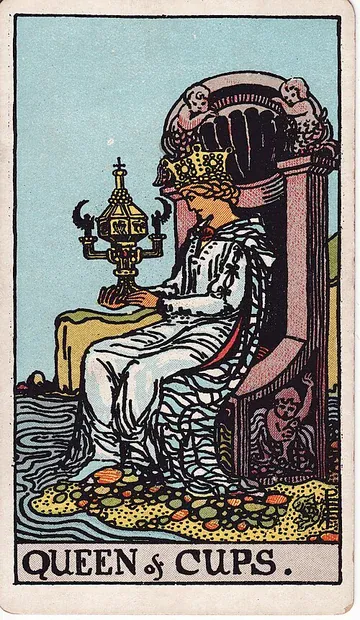
Queen of Cups
The fire-mother and the water-mother in the same reading. Both figures are present, both care, and the care comes through different elements: warmth and decided temperature on one side, receptive holding and emotional fluency on the other. The combination resists the temptation to merge them into a generic feminine wisdom. Each holds her own seat. The seeker's work is to know which kind of care the moment is asking for — the friend who will sit with the tears, or the friend who will tell you, with warmth, exactly what to do next — and not mistake one for the other.
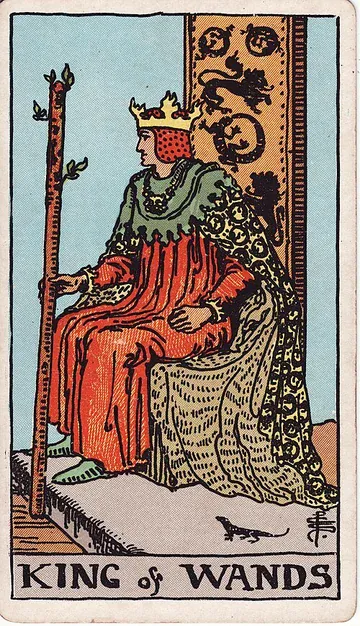
King of Wands
The fire-mother and the fire-father at the same hearth. The King brings the long-range vision and the willingness to act on it; the Queen brings the daily warmth that makes the action sustainable. Together, the pair describes a partnership — romantic, professional, or creative — built to last because both people know their own temperature and let the other's be different. The combination warns against two fire courts trying to be the same fire. He is the long throw; she is the holding seat. The pair works when each lets the other be the element they are.
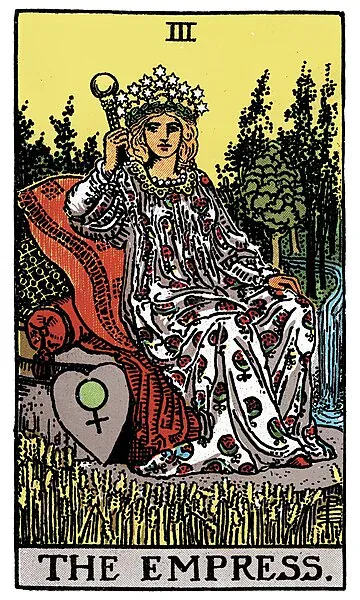
The Empress
Two figures of feminine sovereignty in one frame. The Empress is the abundant nurturer, the green world made flesh; the Queen of Wands is the magnetizer, the warm hostess. Together they describe unselfconscious creative and relational fertility — making things, drawing people, growing the surrounding life all at once. The combination warns gently against the dispersion abundance can produce. Both Queens become more themselves when the warmth is pointed at something specific, not spread thin across every possibility at once.
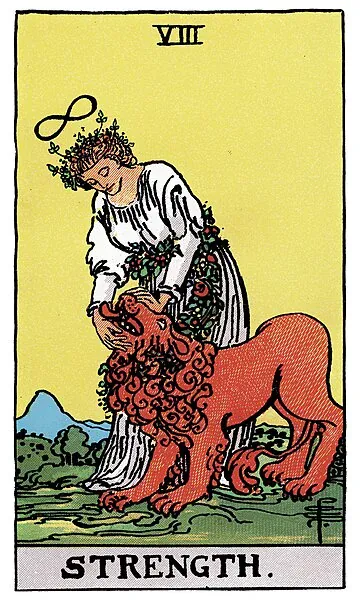
Strength
Leo's territory in both cards — the lion that sits on the throne's carving, the sunflower in her hand, mastered fire on both sides. Strength is the figure with her hand on the lion's mouth, neither forcing nor being forced; the Queen of Wands has internalized that mastery into a daily temperature. Together, the pair describes the seeker who has learned to live with her own appetites — desire, anger, magnetism, laugh — without either suppressing them or being run by them. The instruction is simple: stop apologizing for the inner force. The warmth and the force are the same fire.
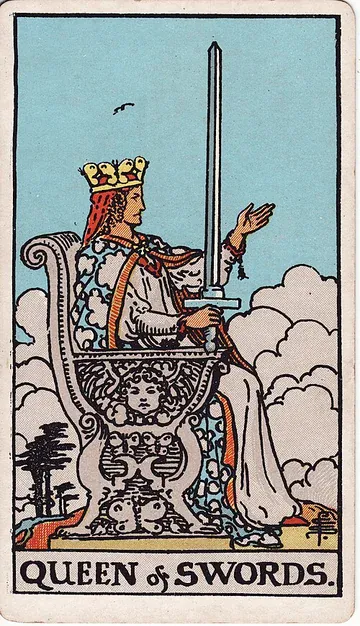
Queen of Swords
Tonal contrast — fire-warmth and air-clarity in the same reading. The Queen of Swords lifts the blade; the Queen of Wands sits steady on the throne. Together they describe a partnership of intelligence and warmth — sometimes inside one person, more often across two — that produces decisions both kind and accurate. The combination warns against choosing between them. Most seekers, asked which Queen they would rather be, pick the one they are not, and the picking is the avoidance. Keep both: the warmth that makes the room livable, and the clarity that keeps the warmth from being exploited.
Frequently Asked Questions
What are the black cat and the sunflower doing on the same throne?
Holding the two halves of one person in the same seat. The sunflower is the visible warmth — turned toward the light, generous, impossible to misread. The black cat at her feet is the part that is not for public consumption: instinct, appetite, the private knowledge of what she wants and what she will not tolerate. Most traditions split these into different figures. This card refuses to, and that refusal is the whole meaning. The Queen of Wands is warmth held with edges — a woman who came through a long inner season and returned with a clear sense of her own temperature. Generous, magnetic, unbluffable. She does not chase and she does not retreat, and she can offer warmth cleanly to the people she chooses and a clean no to everyone else.
Does the Queen of Wands only arrive into a life that is already warm?
That is her one condition, and she is unsentimental about it. The love she describes arrives without performance and leaves without apology, which requires both people to have somewhere to stand that is not the relationship. For an established partnership she is the year after the hardest negotiation, when the auditioning has stopped and affection is being given rather than traded. For a newer connection she is the evening one person quits the early-stage game and simply says what they want. For someone single the card answers yes to whether love is possible — with the caveat that it tends to appear once a life has been made warm enough to invite someone into. She does not arrive into a starving life, not because she is withholding, but because starvation changes what gets accepted.
Why is the Queen's face half-turned if she has already decided?
Because she is watching to see whether the words are landing, not weighing whether to say them. That half-turn is the most misread detail on the card. As feelings, the Queen of Wands is one of the deck's most generous and most precise answers: the other person feels warmly and decidedly, at a steady room temperature rather than in fevered swings, and no part of their attention is being spent on uncertainty about you. What the angle of the face registers is care about reception — whether you are in a state to hear what they intend to offer, whether the moment can carry it. Read the direction of the gaze as the love, since this card always speaks in attention before it speaks in words.
Does the Queen of Wands only say yes at full temperature?
She does, and the condition is worth stating plainly because it is the only one she attaches. Her yes is among the most direct in the deck — no perhaps, no it-depends, no softening for comfort — and it is given to the seeker who shows up at full temperature rather than in the manageable half-version they usually present. To relationships with real warmth in them, to work that wants the actual person rather than a professional costume, to the question of whether to act: yes. To any arrangement that requires you to be smaller, quieter, or less specific than you are: no, delivered in exactly the same unbothered voice. That evenness is the point. She is not rewarding boldness; she is declining to negotiate about size.
What kind of person is the Queen of Wands?
The Queen of Wands is the friend everyone knows is unbluffable — the host who lights the fire and waits to see who walks in. She is a Pisces-into-Aries cusp figure, born between roughly March 11 and April 10, with the dreaming inner life of late winter and the cardinal fire of early spring. She is magnetic without trying, generous without performing, and capable of saying no in a single sentence without apology. Her black cat, sunflower, and lion-throne are all parts of one self: the desire, the warmth, and the sovereignty held in the same seat.
Continue Reading
Queen of Wands · Card overview · symbols · correspondences →
Return to the full card view — image, symbols, sensory correspondences, and Hermetic axes.
Read the reversed meaning →
Read the same depth on the opposite orientation.
Draw your reading now →
Bring this card to a question — open a quiet ritual.