
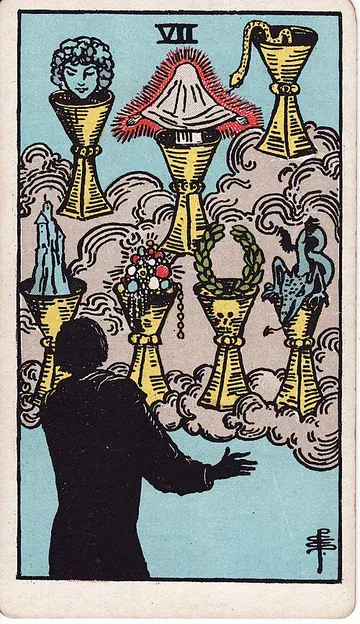
Seven of Cups · Core Meaning
The Seven of Cups meaning starts with a picture: a silhouette stands in the foreground, dark against a gray sky, and seven cups rise softly from a single cloud at eye level. Each cup carries a different lure — a hidden human face, a coiled serpent, a heap of jewels, a draped cloth concealing something, a small castle, a leaping dragon, a wreath of laurels. Each gives off the same seductive glow. The figure is rendered as outline only. Whoever watches the cups is, in this card, a self whose features have not yet been settled.
This is the card's signature tension: arrival of desire without a destination. The cups are full and the cups are everywhere — and none of them has been chosen, and none of them has been refused. The seeker is suspended at the moment before reaching, in the lit pause when every possibility is still possible because none of them has been tested against a real life. The Seven of Cups does not punish wishing. It names the cost of wishing while declining to wake.
Note that all seven cups issue from the same cloud. They share one origin: imagination. The card asks you to notice that the apparent variety in front of you may be a single weather pattern wearing seven costumes. Whatever you call the choices — "I could move there, or there, or there"; "I could love them, or them, or them"; "I could be the one who does this, or this, or this" — the cloud is the same cloud. The work of the card is partly to see the cloud.
Note also the silhouette. The watcher is given no face. Whoever stands before the cups is being shown to themselves as not-yet-formed — a self whose contours will only sharpen once one of the cups has been chosen and tested. The card describes the chicken-and-egg of identity: the seeker cannot know who they are until they choose, and they cannot choose until they know. The way out is to choose anyway, knowing the choice will be partial, knowing the chosen self will be imperfect, knowing the choosing itself is what will produce the face.
The traditional astrological signature confirms the texture: Venus in Scorpio, third decan (11/13–11/22). Venus, the planet of attraction and love-by-image, lands here in deep water — Scorpio's most submerged decan, where feeling does not let go easily. Together, Venus in Scorpio is desire that has been pulled below the surface, that fastens onto a beauty without asking whether the beauty is real. The card is not exactly about lust; it is about the way longing magnifies an object until the object stops being available to ordinary scrutiny. The third decan ruler in Golden Dawn attribution is Venus repeating in Venus's own watery octave — the pull doubled, the bewitchment compounded. The dates 11/13 to 11/22 land in late Scorpio season, when the year itself is about to descend into Sagittarian fire; the card sits at the threshold where water has not yet given way to flame.
Kabbalistically, the Seven of Cups sits at Netzach in Briah — Victory in the World of Creation. Netzach is the sephirah of attraction, the pull that beauty exerts on the soul. In the watery, image-rich world of Briah, Netzach's pull becomes proliferation. The single magnetic image multiplies. Rather than one beloved, seven figures glowing the same way. Rather than one calling, seven possible callings, each attractive enough to keep you from picking. This is Netzach's classic snare: beauty so vivid it paralyzes choice. The corrective sephirah on the Tree of Life is Hod — the place of distinction, of name, of the analytical cut. The Seven of Cups asks for Hod's gift even as it shows Netzach's overflow.
The polarity is feminine — receptive, holding. The card does not act on the cups; it receives them. This is important. The tendency to read the Seven of Cups as a card of indecision punishes the seeker for what is structurally a moment of receptivity. Sometimes the work of the card is not faster choice but more careful holding — keeping the seven cups in awareness long enough to see which one is actually rising from your own depths and which is rising from someone else's projection landing in your cloud.
Read this tarot card the way you would read a photograph of someone the moment before they reach into a buffet. Whatever lives in that pause — appetite, indecision, the secret hope that one cup will be more obviously right than the others, the older hunger underneath the surface choices — is the Seven of Cups meaning for that reading. The picture itself is not a verdict. The picture is a prompt to look at the watcher.
Seven of Cups · Love & Relationships
Seven lit cups, and one silhouette that has not moved a foot in any direction — in love, that is the Seven of Cups upright exactly: many objects, one unsettled question. The seeker is being pulled toward several possibilities at once — several people, or several imagined versions of the same person, or several imagined versions of the kind of love they could become. Real love requires the foreground of one face. The card describes the moment before that foreground exists.
For someone in an existing partnership and drawing the Seven of Cups, the card often surfaces an undercurrent: a fantasy about a different life, a different partner, a different self the relationship has not allowed. This is not necessarily an affair. It is more often a private weather pattern — the colleague who is pleasant in the way a cup is pleasant, the version of you that exists in another city, the parallel relationship you played out only in your head. The card is asking you to name the fantasy honestly, so that what you choose to do with it can be a choice rather than a drift.
For a new spark, the Seven of Cups upright reads as caution about projection. Whoever you have just met may be a real person, and may also be a person you have draped your unmet wishes across. The illuminated face inside the cup is the danger — it is the cup that promises the romance you have never quite had, with the partner you have never quite met. Before you let the new spark become more, watch for the moment they stop being a person and start being a screen.
For a single seeker who is asking whether love is possible, the Seven of Cups answers with a question: which kind of love, exactly. The card is not negative on the possibility of love. It is precise about the cost of wishing for love in seven directions at once. If half your imagination is on a partner who looks like the laurel-cup (status, achievement, the public marriage), and half is on a partner who looks like the castle-cup (security, the home, the lineage), and half is somewhere else — then the actual person who is trying to find you cannot fit the silhouette. Narrow the wish. Pick the cup you would still want at six in the morning.
In the question of love after a wound, the Seven of Cups can describe the long convalescence in which the seeker rebuilds love by trying it on in fantasy first. This is healthy in moderation. It becomes a problem when the rehearsal becomes the relationship. The card asks gently whether the next step is to keep imagining or to let one of the imagined cups become real, even at the risk that the real version will be smaller and stranger than the dreamed one. Real love is always smaller and stranger than the dream. The smallness is the price.
The love language of the seven floating cups is worth naming. The Seven of Cups loves the way a poet loves before a first reading — the love is rich, colored, full of detail, and largely invisible to the beloved. The seeker can hold whole interior romances that the partner never knows about. This is sometimes a gift (the love is real, the imagining feeds the actual relationship) and sometimes a trap (the imagined relationship begins to compete with the actual one). The work is to bring the inner version into the outer life, in small gestures the partner can recognize.
If you are asking whether someone is in love with you and the Seven of Cups arrives upright, read it as suspended. They feel something. They are also fascinated by several other possibilities — possibly about you (multiple versions of who you might be to them) or possibly outside of you (other lives they could imagine instead). The card is not a no. It is a not-yet. Their attention is real but unfocused. Until something pulls one cup forward, the answer cannot land.
For a seeker holding the question of an ex — whether they will return, whether reconciliation is on the table — the Seven of Cups upright suggests the ex is in the same suspension you are. They have several imagined futures on the table, and you are one of them. Do not act on this as a yes. Do not grieve it as a no. Wait until the cloud disperses. Whatever stays after the dispersal is the real signal.
For polyamorous, queer, or non-traditional love structures, the Seven of Cups can be especially honest about the moment of staring at a wide field of possible bonds. The card is not telling you to pick monogamy. It is telling you that some bonds need to be tested against the body, the calendar, the rent payment — moved out of the cloud. Pick one cup, lift it, drink. Then pick another. The cups do not vanish because you committed to one of them; they wait. But staring at all seven, untouched, is its own way of choosing nothing.
For the long-distance seeker — the partner across cities, time zones, the ocean — the Seven of Cups upright is a particular caution. Long-distance love is fertile ground for the cup-with-the-illuminated-face: the partner you mostly imagine, the relationship that exists in messages and calls more than in shared rooms. The card asks whether the love can survive the actual logistics of being in the same place. Not as a verdict — many long-distance loves do — but as a question worth answering before you collapse the geography.
For the seeker who has been hurt and is dating again with caution, the Seven of Cups upright can describe a protective scattering. Holding seven possibilities at once means none of them can hurt you the way the last one did. This is intelligible. It is also a way of staying in the cloud forever. The card asks you to notice when the breadth has stopped being curiosity and started being armor. When you can name the moment, you can decide whether to keep the armor on.
For the seeker who has decided not to date at all and is being asked by the card whether that decision is honest, the Seven of Cups offers a gentle audit. Sometimes "I am not ready" is true. Sometimes "I am not ready" is the seven cups posing as one cup. If your seven imagined partners — the ideal you say you are waiting for — would never actually walk through your door because they do not exist in any version of the actual world, then "not ready" may be a way of staying in the gallery indefinitely. The card does not push you out. It invites the audit.
Seven of Cups · As Feelings
Fascinated, suspended, unresolved — the Seven of Cups reports a feeling that has not finished forming. They feel something about you. They also feel pulled toward several other versions of their life, and at this moment those versions and you exist in the same gallery, glowing at the same brightness. The card is not cold. It is not indifferent. It is a heart in a buffet.
If they are reserved by nature, the Seven of Cups in feelings often means quiet, intense interior fixation. They are thinking about you a great deal. The thinking has not yet hardened into a stance. They are turning you over in their head, comparing the version of you they have met to the version of you they have imagined, asking themselves whether the two versions can be the same person. Read silence here as deliberation, not absence. They are not bored. They are bewitched and unsure.
If they are demonstrative, the Seven of Cups in feelings can mean a partner whose enthusiasm is real but spreads thin. They are excited about you, and they are also excited about three other things this week. The excitement is genuine; the focus is what is missing. Read the warmth as warmth. Read the scattered attention as the actual cost.
For a partner you have been with a long time, the Seven of Cups in feelings can describe a stretch of restlessness — a partner who has begun to fantasize about other lives, not necessarily about other people. They are not falling out of love. They are wondering what other shapes their life could take. This is normal. This is also delicate. The card asks for honest conversation, not surveillance. The fantasy is information about an unmet need; punishing the fantasy buries the need.
For a new connection, the Seven of Cups in feelings can mean a partner who has fallen for an image of you that you may or may not match. Do not over-correct by performing the image. The card warns against the loop where you sense their projection and quietly start meeting it. The partner who falls for the projection will eventually meet the actual you and feel betrayed — even though you simply showed up. Let them meet you early. Let some of the cups dim.
For someone you have just begun talking to, the Seven of Cups in feelings often describes daydreaming. They have constructed an inner life that includes you. They have imagined the first dinner, the first trip, the conversation at month six. None of this is bad. The card simply names that the inner construction is far ahead of the outer relationship. Slow down. Let the outer catch up.
There is a small caution embedded in this card's feelings reading. The Seven of Cups, in love, can produce a partner who is in love with the feeling of being almost-in-love. The pre-relationship pleasure — the texting, the imagining, the wondering — is so rich for them that the actual relationship feels like a downgrade. Watch for the partner who keeps you in suspension because the suspension is what they enjoy. This is the card's signature trap as feelings. The cure is asking, gently and clearly, what they actually want — and letting their inability to answer be the answer.
For a partner who has gone quiet after a stretch of closeness, the Seven of Cups in feelings often describes overload rather than retreat. They have collected too many feelings about you to hold all at once and are sitting with the cups without lifting any. Give time. Do not flood the gallery. They will come back when one of the cups has begun to glow brighter than the others.
For an ex who has reappeared after silence, the Seven of Cups in feelings can mean that you are one of several reopened questions in their life right now. They are revisiting an entire chapter, not just you. Read their reach-out as information about their season rather than as a clean signal about you specifically. If the reach-out persists past the season, it has chosen you. If it fades when their cloud thins, you were one of the cups, not the cup.
For the question of whether someone is keeping their feelings hidden, the Seven of Cups in feelings often answers yes — but the hiding is from themselves first, you second. They have not yet admitted to themselves which cup they are about to lift. Surveillance will not help. The card asks for patience while their own clarification finishes; if you press for an answer before the cloud disperses, the answer that arrives is reflex, not truth.
When the real question underneath is whether you are being compared to someone else, the Seven of Cups answers with unusual precision: probably, and not in the way that torments you. Comparison in this card is rarely a ranked list with names on it. It is closer to a fog of adjacent lives — the person they almost dated in another city, the self they were at twenty-four, a couple they watched across a wedding table and have not stopped picturing. You are being held beside weather, not beside a rival. That is harder on the imagination and far better for the odds. Nothing in that fog has a body. You do.
Seven of Cups · Career & Work
Too many promising directions and not enough committed motion is a particular kind of stuck, and the Seven of Cups upright is its portrait at work. Several possible careers, several possible projects, several possible roles glow at the same brightness. The seeker spends the day rotating through them in their head, never quite landing. The card is not lazy. It is dazzled. The dazzle is what costs.
If you are asking whether a current role will turn out well, the Seven of Cups answers ambiguously. The role is real. The role is also one of several roles you keep imagining yourself doing. Until you decide whether you are committed to this seat or whether you are using this seat as a placeholder for the seven other seats you might prefer, the role cannot deliver. The card asks you to either commit fully (with a date set in advance to reassess) or to stop performing commitment and acknowledge you are scanning. Both moves are honest. The hybrid is the trap.
For someone considering a new role, the Seven of Cups upright is a warning about glamour. Read the offer carefully. The title is bright. The brand is bright. The compensation is bright. Now ask: which of those brightnesses survived once you imagined the actual day-to-day? The card describes offers that look golden in the cloud and prove cloth-draped on arrival. The draped cup is a real cup in the image — it conceals something. Often it conceals the fine print: the unsustainable hours, the manager you did not meet, the politics that surface in week three.
For someone in a job search and considering many leads at once, the Seven of Cups upright is the diagnostic card for paralysis-by-options. You are spending more time choosing than applying. You are chasing the cup that is brightest today and dropping it when a brighter cup appears tomorrow. The card asks for ranking. Force yourself to put the seven applications in order. Apply to the top three this week. The rest go into the cloud, not the trash. They are still possible. They are simply not now.
Entrepreneurs and freelancers should read the Seven of Cups as a warning about the shiny pivot. The business has options. The business cannot run on options. The card describes the founder who has six product directions, six audience segments, six brand names, and zero ship dates. Ship one. Survive the boredom of executing the chosen cup. The unchosen cups will not vanish; they are extensions of the same imagination that produced the first one, and if they are real opportunities, they will still be real in three months.
For a creative practice, the Seven of Cups can describe an extraordinary period of inspiration — and a real risk of producing nothing. Every idea wants to be the next book. Every sketch wants to be a series. Every voice memo wants to be an album. The cloud is generous. The hand is overwhelmed. The card invites the discipline of containers: pick one container (a single project, a single deliverable, a single deadline) and pour the inspiration into it. The other inspirations are not wasted; they become the background fertility. They do not become the work.
For someone considering a layoff, a transition, a sabbatical, the Seven of Cups upright is gentler than it looks at first. The card supports leaving — but warns against leaving toward a fantasy. If you are leaving the current seat for an imagined seat that has not been described in concrete terms, the Seven of Cups warns you may be moving from a real cup to a cloud cup. Do the unromantic work first. Talk to actual people in the imagined field. Read the actual job descriptions. Let the dream lose some of its glow. If after that scrubbing you still want the new seat, take it. The card is for clarification, not paralysis.
For questions about authority, leadership, or being chosen for a role, the Seven of Cups can describe being looked at by many possible mentors, employers, or collaborators — and not yet stepping forward decisively. The opportunity is broad. The hand has not raised. Raise the hand. The card is asking for visibility, not modesty.
For someone in a stable role who is being approached by recruiters and wondering whether to entertain the conversations, the Seven of Cups upright is a check on glamour again. Recruiter pitches are professionally engineered to look like cloud-cups — bright, full of possibility, omitting the pieces you would not like. Take the calls if you want; let them inform you about the market. But do not let three glossy conversations make your current seat feel duller than it is. The current seat is being compared, by definition, to its glossiest competitors. That is unfair to it.
For someone choosing between a salaried role and self-employment, the Seven of Cups can describe the seductive flicker between the two cups: the security cup and the freedom cup. Both are real cups. Neither is purely what it advertises. The salaried cup omits the political tax. The freedom cup omits the loneliness and the irregular income. Sit with both, lift one for a season, and accept that whichever you choose will have a cup-shaped reason to be jealous of the other for a while.
A note on stability. The Seven of Cups is not a card of arrival in career. It is a card of the season before arrival, the season of staring. Most ambitious seekers pass through several Seven-of-Cups stretches in a working life. The work is to recognize the stretch when you are inside it, name it accurately, and not pretend the staring is the same as the doing.
Seven of Cups · Money & Finances
Every option on the table looks good from this distance, which is precisely the difficulty the Seven of Cups upright names about money. The seeker is being shown several financial possibilities at once — several investments, several spending paths, several imagined future selves with different relationships to money — and is moving toward none of them with any conviction. The card is the budget that has been drafted in seven slightly different versions and never adopted.
For a question about whether a financial gamble will pay off, the Seven of Cups upright is a soft warning. The opportunity may be real, and it may also be glamour. The card describes the hot stock tip, the property listing that looks brighter than its disclosures, the side venture that is being pitched on its upside. Before committing money, ask the unromantic questions. What is the hidden cost? What is the cup with the cloth over it concealing? The card is not telling you not to invest. It is telling you to lift the cloth before you reach for the cup.
For the seeker who has been managing scarcity, the Seven of Cups can describe the dangerous moment of being seduced by a magic-bullet solution: the multilevel marketing pitch, the crypto pivot, the get-rich-quick course that promises to dissolve the long structural problem in three weeks. The cards understand the exhaustion that makes the fantasy attractive. The card also warns: the magic cups are usually the ones with the serpent or the dragon in them. The seductive cup that promises an end to scarcity rarely delivers that end. Slow recovery beats fast magic.
For someone with discretionary income trying to decide what to do with it, the Seven of Cups upright is the diagnostic card of the indecisive saver. There are seven possible uses for the money — investing, paying down, saving, traveling, gifting, learning, treating yourself. None of them is wrong. None of them is being executed because all of them are being weighed. Pick a single allocation for this month. The other six remain available next month. Indecision is a choice, and its cost is the loss of the time horizon.
For investments, the Seven of Cups warns against diversification used as avoidance. Real diversification is a thoughtful spread; phantom diversification is "I bought a little of everything because I could not pick." The first multiplies safety; the second multiplies fees. Examine your portfolio. Count the positions you actually understand. Trim the ones that are there because they were once a passing cloud-cup.
For windfall — bonus, gift, unexpected income — the Seven of Cups upright can describe the trap of the windfall: the receiver who immediately splits the money in their head into seven competing claims and then lets the money quietly leak across all seven without ever choosing. Sit with the windfall a week. Let the noise quiet. Then pick one or two destinations.
The card's caution around money is the same as its caution everywhere: do not mistake imagined wealth for actual capacity. The seven cups in the cloud are not yet money. The money is what makes it from the cloud to the table. Until then, every plan that involves the cloud-cup is conditional. Build the rest of your life on the cup you are actually holding.
For couples or co-investors making joint financial decisions, the Seven of Cups upright warns that two clouds are louder than one. Each partner brings their own seven cups; the union of the two clouds produces fourteen cups, all glowing. Decisions made inside that doubled cloud are unstable. The card asks for explicit ranking conversations — write the cups down, lay them on the table, agree on the order. Decisions made from a written page survive the cloud reforming.
Seven of Cups · Health
A body whose signals are scattered, and a mind that keeps collecting explanations rather than committing to one — the Seven of Cups upright describes that pairing rather than either half of it. The metrics are mixed. The symptoms point in several directions. The seeker has read several possible diagnoses online and is now holding them all simultaneously, none of them tested against a clinic visit. The card describes diagnostic limbo.
If you are asking whether a treatment will work, the Seven of Cups answers conditionally. The treatment may work; the treatment also may be one of several treatments you are considering, and the lack of commitment to a single protocol is itself part of the problem. The body responds to consistency. The card asks you to pick one approach and follow it long enough to know whether it works, before swapping to the next bright option.
For someone managing a chronic condition, the Seven of Cups can describe the seductive pull of alternative explanations. The condition has a name. The condition has a known protocol. And yet, somewhere in the seeker, there is a wish that the diagnosis is wrong, or that a different framework would dissolve it, or that the right supplement would replace the medication. The card is gentle about the wish — it is human to want a smaller diagnosis — but firm about the cost. Wishing is not the practice. The practice is the practice.
The card's particular health signature, drawn from its element-detail correspondences, is the eyes — the senses magnified by longing. Watch for visual fatigue: too much screen time spent in fantasy (research, social media, the inner film of who you might become), too little time looking at the actual room you are in. The Seven of Cups also touches the digestive register through its watery suit, and through Venus-in-Scorpio's susceptibility to the seductive substance: alcohol, sweets, recreational comforts that began as pleasures and started promising something they cannot deliver. Honest inventory.
For mental health questions, the Seven of Cups can describe the seeker who is using fantasy as anesthesia. The daydreams have become a place to live, and the actual life has been waiting outside the daydream for a while. This is not the same as schizophrenia or dissociation in any clinical sense — the card does not diagnose. It simply names a pattern: the inner cinema is so vivid that the outer body has been forgotten. The card asks for a reattachment to the body. Walk. Eat slowly. Notice the room.
The card can also describe the indecisive patient — the seeker who is touring practitioners without committing to any of them, looking for the one who will say the magic thing. The cost of this tour is the loss of continuity in care. Every practitioner inherits the case fresh and tries to understand it from the start. The card suggests choosing one practitioner you trust enough and staying with them long enough for them to actually know you. The right healer is not the one who matches the most beautiful cup. The right healer is the one who can hold the unbeautiful parts.
Sleep deserves its own note under this card. The Seven of Cups keeps the hour just before the dream releases you — the four-in-the-morning stretch where the inner film runs brightest and the body is least rested by it. Seekers inside a Seven of Cups season often describe crowded, vivid dreams and a peculiar tiredness that sleep does not touch, because the night has gone to auditioning futures rather than repairing tissue. The ask here is unglamorous: a fixed waking time, a dark room, the phone somewhere other than the bed. The dreams are worth keeping. A notebook holds them better than the body does.
A fixed waking time and a dark room are habits worth trying, not medical advice. Keep your practitioners, take your medicine, do the boring practical things. The card simply names the gap between researching health and practicing it, and asks you to close the gap.
Seven of Cups · Spirituality
A path can multiply into a buffet, and the Seven of Cups upright is the seeker standing at one with an empty plate — every practice sampled, none of them yet inhabited deeply. The altar has crystals from one tradition, mantras from another, a tarot deck from a third, an oracle deck from a fourth, books from a fifth, a meditation app from a sixth. The cups are real. The drinking has not started.
This is not a card about being shallow. It is a card about Netzach in the world of Briah — beauty proliferating in the realm of imagination — and beauty is a real spiritual force. The seeker who is dazzled is not failing. They are at a stage of the path where every door is glowing the same. The work is to notice that glowing-the-same is itself a clue: when seven things look equally bright, the eye is the problem, not the doors.
For seekers in active practice, the Seven of Cups can describe the season of method-shopping. The mindfulness teacher is interesting; the kabbalah lineage is interesting; the contemplative Christian thread is interesting; the Zen sangha is interesting. Each opens a real door. The card asks you to pick one and walk through far enough to meet the back wall — the part of the practice where it stops being beautiful and starts being work. Most practices do not deliver until past the back wall. Hopping between methods means staying on the lit side forever.
For seekers exploring belief, the Seven of Cups warns against the cosmology buffet. It is possible to assemble a worldview out of the most attractive pieces of every tradition you have encountered, without any of them disagreeing with you. This is not faith; it is curation. The card invites you to let one tradition challenge you in a way you do not enjoy — to let one cup contain something that does not flatter you. The growth is on the other side of that discomfort.
The signature symbols carry weight here. The illuminated face inside one of the cups, in the spiritual register, is the projection of the perfect teacher — the person who will know what you cannot find on your own. The serpent and dragon in two of the other cups are the spiritual seductions that bite — charismatic communities that promise transformation and quietly absorb your judgment, intoxicating practices that displace ordinary attentiveness. The single cloud the cups all rise from is the seeker's own longing, undifferentiated, projecting itself onto every door. Knowing the cloud is yours is half the practice.
A practice the card invites, doable in thirty minutes: sit. Pick the practice you have most recently been most curious about — the one that has been calling you most. Set a timer. Do only that practice for the duration. Notice the moment you reach for a different cup. Notice the cup that calls you when you are sitting still. That cup, the one that called you mid-practice, is information. Often it is the one you most need to drink from. Often it is also the one you have been most avoiding.
For questions about path, the Seven of Cups answers that the path is real, and the multiplicity is the test. The seeker who can hold seven open doors and still walk through one is the seeker who matures. The seeker who keeps standing in the foyer is the seeker who decorates the foyer.
Seven of Cups · Yes or No
Soft no — pick one cup first.
The Seven of Cups upright is one of the deck's clearest "not yet" cards in a yes-or-no question. It is rarely a flat no, and almost never a clean yes. The card describes a moment in which the seeker has not yet narrowed the question enough for a binary answer to be meaningful. Until you can name which cup you are asking about, the cards cannot tell you whether to lift it.
For yes-or-no questions about a relationship, a job, a move, a decision: the Seven of Cups answers wait. Not refuse. Wait. The seeker is being shown that several versions of the question exist simultaneously, and the version they have phrased to the deck is not necessarily the version they actually want to know about. Ask the question more precisely. The deck will answer more precisely.
For questions about whether someone is being honest, whether an offer is genuine, whether a plan will hold: the Seven of Cups warns of glamour. What is presented may be partly real and partly draped — the cloth-cup in the image conceals something. The card does not say "they are lying." The card says "the picture is not yet the whole picture." Lift the cloth before deciding. Ask the second question. Read the contract twice.
The card's yes-or-no character is consistent with its astrological signature. Venus in Scorpio's third decan is desire that has been pulled below the surface — a feeling that does not yet know whether it wants to surface. The card asks you to let the feeling clarify before forcing it into yes-or-no shape. Sometimes the most honest answer to a yes-or-no question is "neither — the question has not yet finished forming."
When the question is how long the waiting runs, the Seven of Cups suggests the timing is not the bottleneck. The bottleneck is decision. As soon as one cup is chosen, the question of timing answers itself. Until then, the timeline cannot be read.
For binary questions about whether to act — should I take the offer, should I send the message, should I make the move — the Seven of Cups upright says wait one cycle. Sleep. Walk. Let the dream-self give its information. The morning that follows often carries the answer the day-self could not produce. If after a sleep cycle one cup is brighter than the others, lift it. If all seven are still the same brightness, wait another cycle.
Some seekers are really asking whether they have earned any of the seven cups. The card answers that the question is in the wrong shape. The Seven of Cups does not deal in deserving. It deals in choosing.
One shape of question does tilt this card toward yes. Ask it whether to explore — whether to take the trip, sit the first session, sign up for the class, meet the stranger for coffee — and the Seven of Cups agrees without hesitation. It is the card of the gallery, and a gallery is a good place to spend an afternoon. The refusal arrives only when the question carries a signature inside it: a lease, a resignation, a vow, a wire transfer. Yes to looking; not yet to keeping. Read your own wording for which of the two it actually was. Most seekers find they asked a keeping question in looking language, and that mismatch is why the card came back cloudy.
Seven of Cups · Advice
Wake up inside the picture. The Seven of Cups upright describes the lit pause before reaching, and its primary instruction is to pierce the pause — not by panicking into a choice, but by waking enough to see which cup is real and which cup is mist.
If there is one specific instruction the card offers, it is: name the cups. Take a real piece of paper. Write down the seven things you have been holding open in your head — the seven possible jobs, the seven possible cities, the seven possible versions of who you might become. Write them flat, side by side. The act of writing breaks the spell. The cups in the cloud cannot survive the page; some of them will reveal themselves immediately as not yours, and the brightness will redistribute.
A second instruction: rank them. After you have named the cups, force a ranking. Not "which is best" — that is the wrong question, and it brings the buffet back. Ask instead: "which of these would I still want when I woke up at six in the morning, hungover and unflattered?" That is the cup the card is pointing to. The other cups are decoration. They may be beautiful decoration. They are not the meal.
A third instruction: lift one. Not all seven. Not the top three. One. Carry the cup for a week. See if it spills, see if it nourishes, see if it becomes heavier or lighter as you walk. The Seven of Cups becomes the Eight of Cups — walking away from what does not belong to you — only when you have first lifted enough to know what the cup feels like in the hand. Pure standing is not the path forward. Standing has a shelf life.
A fourth instruction: forgive yourself for staring. Most seekers, drawn into a Seven of Cups season, have been quietly ashamed of their indecision. The shame is not useful. The card describes a real season of the soul, not a moral failing. Wishing is generative. Imagining is generative. The card does not condemn the staring; it asks you to let the staring give way to the next stage at the right time. The right time is when one cup has gotten brighter than the others, even slightly. Trust the slight brightness.
Practical advice for the day this card appears: do not commit to anything new. Do not buy anything that promises transformation. Do not say yes to an opportunity that wants an answer in twenty-four hours. Walk. Eat slowly. Notice the room. Let the cloud disperse. The Seven of Cups responds to slowness; the cloud is partly made of velocity. By tomorrow, several of the cups will have dimmed on their own. The remaining ones can be examined honestly.
A practice for seekers in deep indecision: name the cup that frightens you. Not the brightest one, not the most beautiful — the one that, if you imagined lifting it, would change your life enough that some part of you would have to die. That is often the real cup. The cups that do not frighten you are usually decoy cups; they preserve the present at the cost of the future. The cup that frightens is the cup that has actually been chosen for you by the part of you that is trying to grow.
Say the seven names out loud to one person who will not advise you. Not to collect their opinion — to hear your own voice change. Somewhere in the list the tone speeds up, or drops, or goes carefully flat around one of the cups, and that involuntary shift is the most reliable instrument in the room. Ask the listener a single question afterward: which one did I sound different about? Their answer usually arrives before your reasoning does. The Seven of Cups is a card of private weather, and private weather is exactly why the seven look identical from inside. A witness gives the cloud an outside edge.
Seven of Cups · Card Combinations
The Seven of Cups speaks vividly when paired. Its trick is to inflect the cards around it — to multiply their possibilities, to layer fantasy over their facts, to introduce the question of which version is real. Read the combinations below as combined images, not sequenced meanings.
Seven of Cups + Eight of Cups
The exact moment of choice: standing before the seven, then turning away from six of them. This pairing is one of the deck's clearest "decision is happening" combinations. Whatever has been suspended is now narrowing. The seeker has finally identified the cup that is theirs and has accepted the cost of leaving the others on the cloud. Read this pairing as permission to walk — and as a warning that walking is the only way out of the staring.
Seven of Cups + Nine of Cups
Fantasy meeting fulfillment. The Nine of Cups is the wish granted; the Seven is the wish in proliferating, untested form. Together, they ask whether the wish that just landed is the wish you actually meant — or whether one of the unchosen cups was the deeper one and the granted wish has only quieted the surface hunger. Sit with the Nine before celebrating it. Ask whether one of the un-lifted cups still shines.
Seven of Cups + The Moon
Pure dreamscape. Both cards are about projection, water, the senses bewitched. Together they describe a season in which the seeker can no longer easily distinguish their inner film from the world around them. This is not always negative — it is also the territory of artists, mystics, deep dreamers. But it is delicate. The pairing asks you not to make irreversible decisions inside this weather. The clarity is downstream of the season; let the season pass before signing anything.
Seven of Cups + Seven of Swords
Two sevens in a row, both about mirage. The Seven of Swords is the cunning that takes only what it can carry. Together, the pairing warns of a situation in which the seeker (or someone around them) is choosing a self-flattering version of the truth and walking away with it before anyone can verify. Watch for the partial truth that omits the cloth-cup's contents. Watch, too, for your own tendency to take the easier story.
Seven of Cups + The Devil
Intoxicating bondage. The Seven of Cups offers the seductive image; the Devil shows what happens when the seeker forgets they were free to walk away from it. This pairing describes the addiction that began as an option in the cloud and has become the only cup the seeker can see. Substance, person, self-image — the specific content varies; the structure is the same. The pairing is severe but not without exit. The Devil's chains are loose. The Seven's cups are still cloud. Naming both makes the door visible.
Seven of Cups + Two of Swords
Two ways of not choosing, laid beside each other. The Two of Swords sits blindfolded with her back to the water and two blades held in exact balance; the Seven of Cups stands with its eyes wide open in front of seven lit possibilities. One refuses to look, the other cannot stop looking, and both end the day with nothing decided. When the pair arrives together, the usual diagnosis is alternation — a week of researching every option, then a week of refusing to think about any of it. The pairing asks for a small reversible decision made with the blindfold off. One real cup lifted breaks both spells at once.
Seven of Cups + Ace of Pentacles
A single coin held out of a cloud, facing seven cups held out of another. The Ace is the one offer with weight in it — the concrete job, the deposit, the key, the thing that fits in a pocket. Set beside the Seven, it works as a scale: whatever has been imagined can finally be weighed against something that exists. Most of the seven do not survive that comparison, and the not-surviving is the gift of the pairing rather than its cruelty. Take the Ace seriously even when it is plainer than the brightest cup. A modest real thing outranks a magnificent conditional one, and the Seven of Cups is the card that keeps forgetting it.
Card Combinations
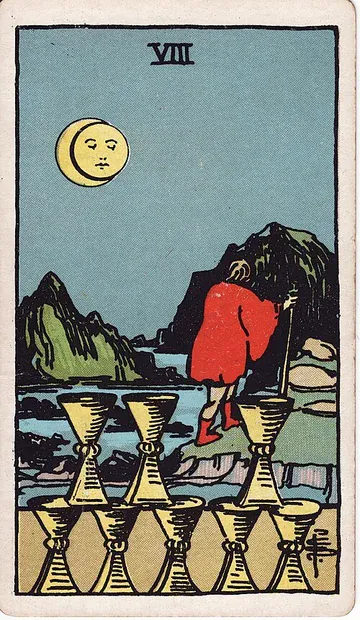
Eight of Cups
The Seven of Cups stares; the Eight of Cups walks away. Together, these adjacent suit cards describe the exact arc from suspension to motion — the seeker stops weighing all seven possibilities and finally turns from six of them. Read this as permission to leave with grief but without backward glance. The cup that survives the leaving is the one that was always yours.
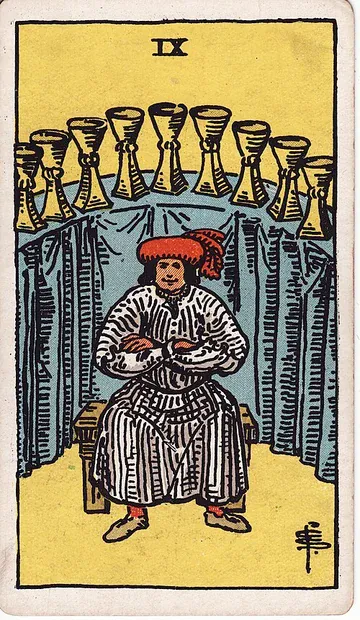
Nine of Cups
Fantasy meeting fulfillment. The Nine of Cups grants the wish; the Seven multiplies wishes in untested form. Together, the pairing asks whether the wish that just landed is the wish you actually meant — or whether one of the unchosen cups was the deeper one. Sit with the granted wish. Ask whether one of the un-lifted cups still shines from the cloud. That older shine is the next teaching.
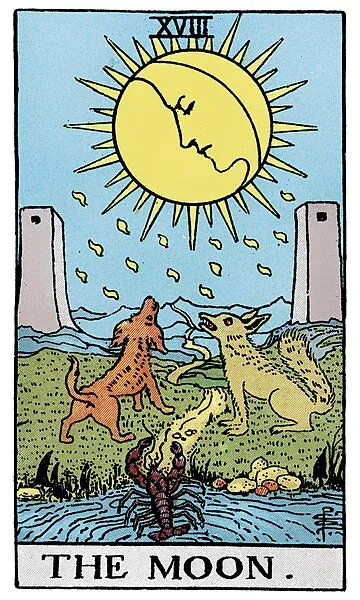
The Moon
Pure dreamscape. Both cards belong to the territory of projection, water, the senses bewitched. Together they describe a season in which the seeker can no longer easily tell their inner film from the world around them. Powerful for artists, mystics, deep dreamers. Delicate for everyone. Make no irreversible decisions inside this weather; let the season pass and the clarity downstream of it.
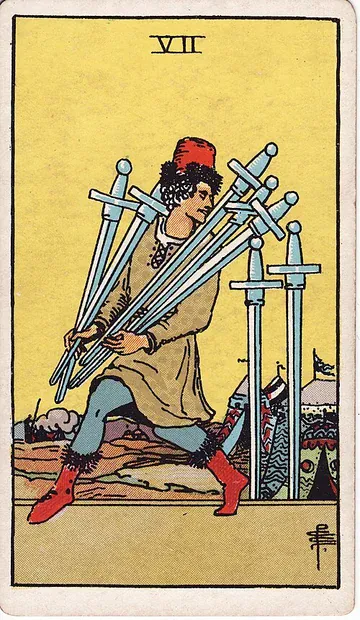
Seven of Swords
Two sevens, both about mirage. The Seven of Swords is the cunning that takes only what it can carry; the Seven of Cups is the seductive image. Together, the pairing warns of a self-flattering version of the truth being walked away with before anyone can verify. Watch for the partial truth that omits the cloth-cup's contents. Watch, too, for your own willingness to take the easier story.

The Devil
Intoxicating bondage. The Seven of Cups offers the seductive image; the Devil shows what happens when the seeker forgets they were free to walk away from it. The pairing describes the addiction that began as one option in the cloud and has become the only cup the seeker can see. Substance, person, self-image — content varies, structure is the same. The Devil's chains are loose. The Seven's cups are still cloud. Naming both makes the door visible.
Frequently Asked Questions
Are all seven cups in the Seven of Cups real options, or is that the trick?
That is exactly the trick — they all rise from one cloud. The card marks the moment of standing before too many beautiful possibilities at once — seven glowing cups rising from a single cloud, none yet lifted, none refused. It describes choosing blind, fantasy, scattered longing, the temptation to mistake the menu for the meal. Read it as a not-yet rather than a no: the work is to narrow the wish before reaching.
Can the Seven of Cups answer anything while I am still holding all the options open?
Not cleanly, no — the card is closer to a soft no than a yes — really, a not-yet. It rarely answers binary questions cleanly because it describes a moment in which the question itself has not been narrowed enough. Pick one cup first, ask again, and the deck will answer more precisely. If you forced an answer today, treat the card as wait.
Does the Seven of Cups mean several people, or several fantasies about one person?
Both readings are live, and the card will not choose between them for you: it is the heart with many objects and one unsettled question. It can indicate fantasy in an existing partnership, projection onto a new spark, or a single seeker pulled toward several imagined futures. The work is to bring one possibility out of the cloud and into the calendar — to test love against an actual life, not just against the dream of one.
What does the Seven of Cups feel like as someone's feelings?
The Seven of Cups as feelings reads as fascinated, suspended, not yet resolved. They feel something real about you and they are also pulled toward several other possible lives at the same brightness. Read it as a heart in a buffet — neither cold nor committed. Real attention, scattered focus. Whether they land on you depends on which cup, in their own private cloud, eventually shines brighter than the others.
What is the spiritual lesson of the Seven of Cups?
The spiritual lesson of the Seven of Cups is that all seven cups rise from the same cloud — the apparent variety in front of you is one weather pattern wearing different costumes. The work is to see the cloud, name your own longing as the source, and then commit to one practice or path long enough to meet its back wall. Beauty proliferating is not the path. Choosing inside beauty is.