
Temperance · Core Meaning
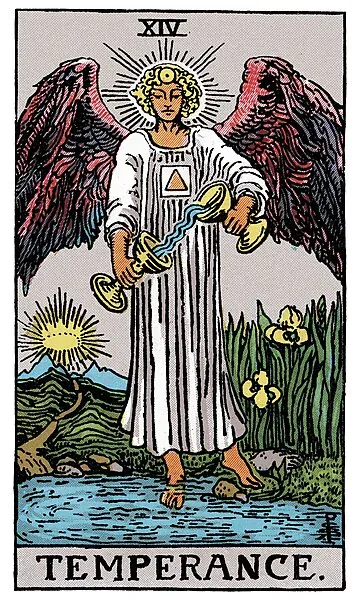
Temperance tarot meaning begins with a strange impossible pour. A red-winged angel stands at the edge of a pool, one foot in water and one foot on land. Two cups tilt between its hands. The clear stream rises in a clean arc, as if gravity has loosened its claim for a moment. Nothing splashes. Nothing strains. The card is not quiet because nothing is happening. It is quiet because the hand holding the transformation is exact.
This is the Temperance tarot card in its purest form: not moderation as smallness, not compromise as the shaving down of every edge, but tempering in the old alchemical sense. Fire and water are both present. Land and pool are both touched. The angel does not stand in the middle as a neutral judge. It stands inside both conditions at once, teaching the body how to be double without tearing.
The square enclosing a triangle on the angel's chest gives the doctrine in miniature. Four holds three. Matter contains spirit. The ordinary world does not need to be escaped for the subtle world to appear; it needs a vessel, a proportion, a temperature. The solar disc on the brow adds the necessary heat. Temperance is often misread as cooling everything down, but the card's own emblem contradicts that. The true fire is present, stored just above the gaze.
Behind the angel, a narrow iris path moves through low hills toward a distant crown. This crown matters. Temperance is not the destination; it is the way the traveler walks after Death has cleared the field. The number 14 follows the thirteenth card's severance. Something has ended. Something has been stripped back to workable material. Now the work is not to resurrect the old form, and not to rush toward the next one. The work is to blend what remains until a living third substance appears.
The traditional correspondences sharpen the image. Temperance belongs to Sagittarius: mutable fire, the arrow in motion, the centaur who joins animal body and human aim. Jupiter gives breadth, trust, and the capacity to make meaning from distance. The Hebrew letter is Samekh, the prop or support, the beam that braces the one who walks on. On the Tree of Life, path 25 runs from Tiphareth to Yesod, from solar beauty toward the lunar foundation where images gather before becoming life.
So the card's balance is not passive. It is athletic and devotional. The angel keeps the pour steady because a larger road depends on it. The water must move. The flame must remain alive. The cup must neither overflow nor run dry.
Read Temperance as the card of skilled mixture: a conversation that needs timing, a project that needs several disciplines, a body that needs rhythm, a relationship that needs difference preserved rather than erased. It says the right answer is not at either pole. It is in the handled stream between them. Temperance reversed, by contrast, shows what happens when the pour becomes avoidance or when every cup is emptied in the name of peace.
For a seeker coming from crisis, Temperance can feel almost too quiet. After the scythe of Death, after the blast of The Tower, after the raw appetite of The Devil, the angel's slow hand may look like insufficient medicine. But the card is precise about the phase of recovery it governs. It is not the scream. It is the day after the scream, and the week after, and the first morning when water tastes like water again. The card asks what can be repeated without violence to the body. It asks which conversation can be held without turning into trial. It asks how the remaining material might become usable rather than merely survivable.
For a seeker who prides themselves on moderation, the card asks a different question: is the fire actually present? Temperance does not praise numbness. The red wings, the solar brow, Sagittarius, Jupiter, and the path from Tiphareth all insist on heat. A life with no appetite, no anger, no risk, no erotic charge, no ambition, no prayer that frightens the mouth a little, is not Temperance. It is an unlit laboratory. The angel tempers because something is hot enough to require skill. If nothing in the spread is hot, look for the hidden avoidance behind the calm.
For a seeker caught between identities, this card is a kind teacher. Immigrant and child of home. Parent and artist. Mystic and bookkeeper. Lover and solitary person. Leader and apprentice. The card says the self does not have to become a single polished coin. It may become an alloy. The alloy is not weaker because it contains more than one metal. It is often stronger, stranger, and more useful. The work is to find the vessel where the parts stop trying to annihilate one another.
Temperance · Love & Relationships
Temperance love is not a fever. It is the long restoration of trust between two different temperatures. The red-winged angel does not pour both cups into a single bland bowl. It keeps them distinct, moving, responsive. In relationships, this card describes a bond that matures through proportion: when to speak, when to wait, when to add warmth, when to add water.
For an existing partnership, Temperance is one of the gentlest signs of repair. The old argument may not be solved by one brilliant confession. The pattern changes through repeated smaller acts: the lowered voice at the threshold of a fight, the pause before a defensive answer, the willingness to return to the same subject without making it a trial. The card favors couples who are learning the craft of pacing. Love becomes less theatrical and more reliable. The angel's one foot in water and one on land becomes the picture of two people who can feel deeply without losing the ground beneath them.
For a relationship marked by difference, Temperance is especially strong. Different cultures, ages, temperaments, work rhythms, spiritual languages, nervous systems: the card does not ask these to disappear. It asks whether the difference can be held in one pair of hands. The square enclosing the triangle is a clue. The material constraints are real. Schedules, children, distance, money, grief, sex, silence, illness, ambition: these are the square. The living spirit of the bond is the triangle. A mature relationship does not deny either shape.
For a new connection, Temperance counsels slow recognition. Attraction may be present, but the card does not move like The Lovers' bright choice or the Knight of Wands' sudden flame. It asks the new spark to prove its rhythm. Can conversation survive a delay? Can interest survive a quiet week? Can desire respect the body and calendar of another person? The upward arc between the cups is beautiful because it is controlled. The connection gains strength when neither person yanks the stream toward themselves.
For a single seeker, Temperance is a card of preparation rather than lack. The empty place is not punishment. It is a vessel being made ready. The card asks what in daily life has become too hot or too diluted for another person to enter cleanly. A schedule packed to the rim, a nervous system trained only for crisis, a heart that treats calm as boredom: these may need tempering before love feels recognizable. This is not a demand for perfection. It is the craft of making a room where another pulse can be heard.
For love after a wound, Temperance is almost literal medicine. It follows Death in the Major Arcana, and so it knows what it means to stand in the cleared place after loss. The card does not say to forget. It shows the slow pour by which grief becomes capacity. The foot in water honors feeling. The foot on land honors daily life. The angel does not choose between them. Healing love under Temperance begins when the old wound no longer dictates the temperature of every room.
If the question is whether someone is in love, Temperance gives a nuanced yes: not the kind that burns down the house, but the kind that learns the house. This person may be measuring the space between you carefully. They may care enough to avoid forcing the pace. Their feeling has a composed surface because it is trying to become sustainable. Watch for consistency rather than spectacle. Temperance affection remembers the appointment, adjusts the recipe, notices when the room has become too bright, and draws the curtain halfway.
The warning is that harmony can be used as a costume. Temperance is not the same as never disagreeing. A relationship that calls every conflict "drama" may be using the language of peace to avoid the heat required for true blending. The angel's fire is still fire. In love, this card asks for a tenderness strong enough to touch the hot place and a discipline kind enough not to scorch it.
For long-distance or cross-cultural love, Temperance is one of the most practical cards in the deck. It does not romanticize difference, but it also does not treat difference as a verdict against the bond. The question becomes operational: how are holidays handled, whose family language enters the room, who travels, who pays, who waits, who translates, who feels at home, who feels temporarily borrowed from their own life? The square enclosing the triangle is useful here. The square is logistics. The triangle is love. If either is ignored, the shape collapses. Temperance love asks for customs, calendars, money, privacy, and body rhythms to be named with the same care as longing.
For a pursuer-distancer pattern, upright Temperance offers a way out. One person may pour fire by asking for clarity, touch, contact, and naming. The other may pour water by asking for space, time, silence, and lower pressure. Each can read the other as the problem. Temperance suggests both are carrying one necessary element badly. The pursuer may need to stop making urgency prove love. The distancer may need to stop making delay prove safety. A real vessel could be an agreed rhythm: when to talk, when not to talk, what kind of reassurance is fair, and what kind becomes a demand for constant pouring.
For relationships under household pressure, this card becomes almost architectural. Children, elder care, health limitations, immigration paperwork, shared debt, religious difference, and family expectation are not unromantic distractions. They are part of the vessel. Temperance does not ask the couple to float above them. It asks the couple to build a life where the sacred heat of the bond does not have to pretend there are no dishes, no rent, no school forms, no medicine, no mother on the phone. Love becomes durable when the angel can stand in the kitchen as well as the chapel.
Temperance · As Feelings
Temperance as feelings describes care that is careful because it matters. The body language is not arms flung open or a door slammed shut. It is the steady hand between two cups. Someone feels the need to keep the stream alive without spilling it. Their feeling may be sincere, but it is also observant, paced, and somewhat self-governed.
If the person is naturally reserved, Temperance can look quieter than the feeling actually is. They may be testing for rhythm: whether messages can breathe, whether silence stays friendly, whether disagreement can happen without injury. The feeling is not cold. It is being tempered. The red-winged angel has fire, but the fire is not thrown across the room. It is held behind the brow, used to keep the mixture alive.
If the person is usually demonstrative, Temperance suggests they are trying to become more measured with you. This may be a sign of respect. Instead of overwhelming the connection with intensity, they are learning what pace the bond can hold. The card often appears when someone knows their own excess and is trying not to repeat it. Their affection becomes practical: checking in, making space, responding with care instead of performance.
For a long bond, Temperance as feelings is the deep affection that has learned its own weather. The person may not be dazzled in the old way, but they are oriented toward you. They know your seasons. They know when to press and when to leave the cup alone. This card can describe a love that has survived enough to stop needing constant proof. Its proof is rhythm.
For a new connection, the card suggests attraction mixed with discernment. They are drawn toward you, but the draw is passing through judgment, history, timing, and a wish not to damage what is still forming. They may be asking themselves whether your lives can actually blend, not merely whether the chemistry is pleasant. This is a serious question, and under Temperance it is a hopeful one.
If you are asking about reconciliation, Temperance as feelings can mean the warmth has not vanished, but it has become cautious. The person may want peace before closeness, repair before return, evidence before surrender. The iris path in the card is narrow; it does not leap from pool to crown. It walks. Feelings under this card often move the same way.
The caution is that Temperance can hide behind maturity. Someone may say they are "taking things slowly" when they are actually avoiding a decision. The difference is motion. In the upright card, the water moves. The cups remain engaged. If their restraint still produces contact, repair, and growing clarity, the feeling is alive. If restraint produces only delay, the card is sliding toward its reversed face.
If distance is part of the story, Temperance as feelings can show someone trying to keep warmth alive without letting absence distort it. They may measure messages carefully because every message carries too much. They may hesitate to promise what the calendar cannot hold. Their feeling is not necessarily weak; it may be trying to become honest about time, travel, money, and the ache of delayed touch. Under this card, affection often appears as practical rhythm: a call kept, a date planned with enough notice, a small ritual repeated across cities.
If cultural or life-stage difference is present, the person's feeling may include a genuine wish to translate. They are not only asking whether they like you. They are asking whether their world can speak to yours without either being made small. A younger person may wonder whether admiration can become equality. An older person may wonder whether steadiness is being mistaken for control. Someone from a different family language may be feeling toward you through layers of custom, duty, politeness, and private desire. Temperance does not flatten these layers. It says feeling becomes trustworthy when translation becomes mutual.
If the connection follows conflict, Temperance feelings are often repair-oriented. The person may be thinking less about the original issue than about the way both of you handled heat. Did either person listen? Did either person punish with silence? Did apology change behavior? Did dignity remain in the room? Their feeling may be warm but watchful, like the angel holding the cup slightly higher until it knows the stream can pass without spilling. This is not suspicion for its own sake. It is care learning whether the vessel is safe.
Temperance · Career & Work
In career and work, Temperance is the card of synthesis. Several materials are on the table: a skill learned elsewhere, a team with incompatible habits, a project that needs both beauty and function, a role that asks for patience after a rupture. The angel's two cups become the work itself. Something useful appears only if the pour is kept steady.
For a current role, Temperance suggests that the job is asking for calibration rather than conquest. The problem may not be solved by harder effort. It may need better sequencing. Meetings need air between them. A colleague needs a different kind of briefing. A project needs one person to slow the fire and another to warm the water. The card favors process redesign, conflict mediation, cross-functional work, editorial judgment, and the quiet skill of making unlike people useful to one another.
For someone deciding whether to accept a role, Temperance asks whether the role blends parts of you that have been kept separate. A job that uses both analysis and care, both design and operations, both teaching and strategy, may be deeply suited to this card. It may not look dramatic from the outside. It may look like a well-built vessel. That is the point. Temperance chooses the position that can hold complexity without turning daily life into combustion.
For students, apprentices, and people still shaping a vocation, Temperance is the card of compound learning. One teacher gives technique, another gives ethics, another gives the difficult lesson of timing. The work is not to pick a single influence too early and imitate it with devotion. The work is to let several streams pass through the same hand until a personal method begins to appear. Sagittarius gives the horizon; Samekh gives the support beam. Both are needed. A path of study under Temperance asks for disciplined breadth: read beyond the syllabus, practice the boring scale, return to the material after the first excitement cools, and notice which knowledge still has heat when fashion leaves the room.
For entrepreneurs and freelancers, Temperance is the craft of sustainable pace. The card warns against building a business that runs only on adrenaline. Sagittarius fire wants distance and aim; Jupiter wants growth; Samekh asks for support. Put a beam under the work. Build the schedule, the review cycle, the bookkeeping habit, the collaboration structure. The angel is not less inspired because its hand is steady. The hand is steady because the inspiration matters.
For creative practice, Temperance is one of the great cards of revision. The first draft is fire. The second cup is water. The work becomes itself through repeated pouring: cut, restore, cool, warm, wait, return. This card understands the artist as alchemist rather than performer. It asks for the studio day when nothing spectacular happens except the sentence becoming true, the color becoming exact, the song finding its middle note.
For managers and people holding authority, Temperance is not merely "good culture." It is the practiced ability to hold competing temperatures without lying about either one. A team may need ambition and humane pace. A direct report may need correction and dignity. A product may need speed and craft. The manager under this card becomes the vessel, which is tiring if the vessel has no support. The card asks leaders to build visible ratios: decision rights, meeting cadence, escalation paths, rest after sprints, and a language for disagreement that does not turn every disagreement into a fire alarm.
For care work, teaching, therapy-adjacent labor, ritual labor, hospitality, and any profession where a human nervous system becomes part of the instrument, Temperance is especially literal. One cup is service. The other is self-containment. The work may be sacred or meaningful, but the body still needs water, time, money, privacy, and a door that closes. The red-winged angel does not pour from its own bloodstream. It pours from vessels. In these fields, the card asks whether the practitioner has vessels outside the act of giving: supervision, peer counsel, sabbath, clean billing, a practice that is not performed for clients or students.
In workplace conflict, Temperance is the mediator who does not flatten the truth. It is not a card of forced consensus. The square and triangle on the chest say that structure and spirit both require representation. Let the facts be facts. Let the human cost be named. Then find the vessel that can hold both. A peace purchased by silencing one side is not Temperance. It is dilution.
If the question concerns promotion or visibility, Temperance answers by pointing to readiness. The distant crown is visible, but the road is still a road. A higher role may require the same skill shown in the image: holding several streams without panic. Prove the rhythm. Become the person whose presence lowers the volatility of a room without lowering its ambition.
For a career transition after burnout, grief, or a major ending, Temperance is the work card that follows the clearing. It does not ask the seeker to find a new identity by Monday morning. It asks for a measured return of appetite. Which tasks still have life in them when panic is removed? Which old skills still pour cleanly into a new container? Which obligations were only survivable because the flame had been turned so low that nothing could be felt? The card's answer is rarely a single leap. It is usually an alloy: old competence, new boundary, different rhythm, clearer support.
For cross-functional teams, Temperance is the card of shared language. Design may speak in feeling and shape. Engineering may speak in constraints. Sales may speak in urgency. Finance may speak in risk. Support may speak in pain gathered from the field. None of these languages is the enemy. The failure comes when one language is allowed to rule all the others, or when the team pretends translation has happened because everyone nodded in a meeting. Temperance asks for acceptance criteria, decision owners, written tradeoffs, and the sentence that names what is being optimized. The third thing appears only when the cups exchange actual substance.
For people in spiritual, therapeutic, educational, or caregiving work, upright Temperance asks for clean channels. The work may involve holding another person's heat without flinching. That does not mean becoming the fireproof object in every room. The angel holds vessels; it is not the vessel. Supervision, referral, office hours, documentation, fees, sabbath, peer consultation, and endings that are not treated as abandonment all belong to this card. Care without structure becomes depletion. Structure without care becomes bureaucracy. Temperance is the hard-won middle where service can remain alive.
For money-career overlap, the card is sober. A beautiful vocation still needs a ledger. A humane workplace still needs compensation. A calling still lives in a rented body. If the work asks for alchemy but pays as if alchemy were a hobby, the vessel cracks. Temperance does not make poverty noble. It asks whether the work can sustain the life that sustains the work. That question may lead to negotiation, a different rate, fewer clients, a better contract, or a refusal to confuse underpayment with devotion.
Temperance · Money & Finances
In money readings, Temperance is the card of proportion. Not scarcity, not indulgence, not the thrill of a single lucky turn. It is the household ledger becoming breathable. It is the investment plan that survives mood. It is a cup poured slowly enough that none of the water is wasted.
For budgeting, Temperance asks for a system that can hold both pleasure and repair. A plan made only of denial becomes brittle. A plan made only of comfort leaks. The card favors allocation: some to debt, some to savings, some to beauty, some to the ordinary costs of being a body in the world. The angel's two cups are not enemies. Present need and future need must be in conversation.
For a large purchase, Temperance counsels waiting long enough to test the temperature. If the desire remains clear after a pause, the purchase may belong in the vessel. If the desire fades the moment it is not fed by urgency, the card has saved you from confusing heat with guidance. This is especially true for purchases meant to calm anxiety. Temperance does not forbid comfort. It asks whether comfort is being asked to do the work of structure.
For investments, the card prefers diversification, time, and disciplined rebalancing. Jupiter gives growth, but Sagittarius belongs to a long arc, not a scratch-ticket impulse. The upward water in the image is miraculous because it obeys a finer law. Financial growth under Temperance works the same way: small repeated moves, held across cycles, can look almost magical from a distance.
For debt or financial recovery, Temperance is encouraging because it understands gradual correction. The balance changes by rhythm. A payment lands. A habit shifts. A conversation about money becomes less ashamed. The card asks for steady return to the plan after interruptions, not purity. The square enclosing the triangle is helpful here: money is material, but the way money moves through a life carries spirit. Shame distorts the pour. Attention steadies it.
The card's financial trap is under-reacting. Because Temperance is calm, it can be mistaken for passivity. If a budget is leaking, name the leak. If a shared account hides resentment, open the ledger. If generosity has become self-erasure, change the ratio. True moderation sometimes requires a decisive adjustment of the cup.
For people whose income arrives irregularly, Temperance is especially useful. Freelancers, seasonal workers, artists, caretakers between contracts, and people rebuilding after a gap often need more than a simple monthly budget. The water comes in unevenly. The vessel has to account for that. This card favors buffers, separate tax money, a baseline living number, and a clear distinction between abundance months and permission-to-spend months. Jupiter may bring expansion, but Samekh asks where the beam is placed before expansion begins.
For family money, Temperance asks who has been silently regulating the room. One person may track every bill while another gets to remain "easygoing." One person may carry ancestral scarcity while another carries ancestral entitlement. One person may use generosity to keep peace; another may use restraint to keep control. The card's medicine is visible proportion. Numbers on the table are not the enemy of intimacy. They are the cup that lets intimacy stop guessing.
For wealth-building, this card prefers patience that is not sleepy. Automatic transfers, regular review, diversified exposure, professional advice when needed, and the refusal to confuse volatility with vitality all fit the image. The upward arc of water looks impossible because the law governing it is subtler than gravity. Money under Temperance can feel the same. Small ordinary decisions, repeated without drama, may eventually create a shape that looks almost miraculous from the outside.
Temperance · Health
For health, Temperance is a card of rhythm, integration, and the body's need for proportion. Its element is fire, but not wildfire: choleric, alchemical fire, the heat that makes transformation possible. Its colors are solar-gold and moon-blue. The image itself is a health teaching: one foot in water, one on land; feeling and routine; rest and motion; heat and cooling.
For an acute concern, the card asks for measured response. Not panic, not neglect. Attend to the symptom, consult the appropriate practitioner, follow the boring instruction, let time do its part. Temperance is not medical advice, and it does not diagnose. It describes the kind of attention the body is requesting: consistent, paced, neither dramatic nor dismissive.
For chronic conditions, Temperance often points to management through small ratios. Sleep, medication, hydration, movement, food, stress, social contact: none may be the entire answer, but the mixture matters. The angel's cups are not labeled cure and failure. They are elements of a living system. The card respects the body as a vessel whose chemistry changes with the day.
Emotionally, Temperance appears when the nervous system is learning to come down from extremes. The body may have become used to crisis heat or numb cold. The card does not shame either adaptation. It asks for titration: a little more feeling here, a little more ground there, a little more warmth in the place that froze, a little more water where anger scorched the tongue. Recovery can be an art of small pours.
The Sagittarian signature brings attention to movement, hips, thighs, gait, and the body's sense of direction, while the card's fire asks that inflammation, overexertion, and depletion be treated with respect. Again, this is symbolic language, not diagnosis. If the body keeps asking for the same correction, Temperance says to stop treating the correction as an interruption and begin treating it as the path.
For mental health, the card favors routines that are humble enough to repeat. A walk before messages. Water before coffee. A meal at a real table. Ten minutes with the journal before the screen begins speaking. Temperance is not glamorous. Neither is the support beam called Samekh. But a beam does not need glamour to hold a roof.
For a body coming out of prolonged stress, Temperance often points to titration. A person may not be able to move from crisis rhythm to peace in one gesture. Peace may even feel threatening at first, because the nervous system has learned to read stillness as the moment before danger. The card suggests small, reliable doses of ordinary life: a predictable meal, a short walk, a room made slightly less bright, one conversation that ends before exhaustion. The body learns proportion through repetition, not through being commanded to relax.
For people who over-manage health, the card offers a subtler warning. A schedule can become another flame. Metrics, supplements, step counts, food rules, sleep scores, and optimization rituals may begin as care and become surveillance. Temperance asks whether the body feels more inhabited or more inspected. The square enclosing the triangle matters: spirit enters matter, but matter must remain alive, not reduced to a spreadsheet. A healthy vessel is one the soul can live in, not merely one the mind can audit.
For people who neglect the body in the name of purpose, Temperance is firm. The distant crown is not reached by abandoning the feet. The road is lined with irises because the path itself is alive. Eat before the meeting if hunger turns every sentence sharp. Sleep before the ritual if devotion has become dizziness. Ask for help before self-reliance becomes a cracked cup. None of this replaces medical care when medical care is needed. It describes the daily attention that lets care take root.
Temperance · Spirituality
Spiritually, Temperance is the path of the alchemist. The seeker does not escape the world; the seeker learns how spirit takes shape inside matter. The triangle inside the square is the whole doctrine. The sacred is not elsewhere. It is in the mixture, the vessel, the timing, the repeated act of pouring without needing applause.
On the Tree of Life, Temperance walks path 25 from Tiphareth to Yesod. Solar beauty descends toward lunar foundation. The bright center of the self must become an image the psyche can live with. This is why the card feels both angelic and practical. It deals with visions, but it asks them to become habits, dreams, prayers, meals, schedules, vows kept after the music has ended.
Samekh, the Hebrew letter of the card, means prop or support. Spiritually, this is humbling. Temperance is not only illumination. It is the support that makes continued walking possible. The most sacred thing in the room may be the structure that lets practice happen: the chair, the cup of water, the same hour every morning, the friend who knows when silence has become avoidance.
A simple Temperance practice: place two cups on a table, one with warm water and one with cool. Pour slowly between them for three minutes without hurrying. Then write one sentence naming what in your life is too hot, and one sentence naming what has gone too cold. Do not solve them in the same sitting. The card's teaching is not instant correction. It is the return of proportion.
The distant crown and iris path remind the seeker that spiritual attainment is not seized by force. The crown appears in the distance because the road itself is part of the consecration. Temperance asks for faith in gradual transformation: not blind faith, but the kind a craftsperson has when returning to the bench.
Another practice belongs to Samekh. Choose one support beam already present but underused: a calendar, a friend, a therapist, a prayer time, a standing walk, a savings transfer, a meal prepared before hunger becomes anger. For seven days, lean on that beam deliberately. Notice whether the beam strengthens because it is used, or whether it reveals the need for a better one. Temperance spirituality is not only the vision of the angel. It is the support that allows the seeker to keep walking after the vision fades.
The card also asks for a reconciliation between high meaning and low maintenance. Many seekers can speak beautifully about purpose while living in rooms that defeat the body. Others can maintain the room while refusing the question of purpose. Temperance brings these into one vessel. Clean the table as if it were an altar; then ask the altar what it serves. Pay the bill as part of the vow; then ask whether the vow still has heat. This is not anti-mystical. It is mysticism with a floor.
When this card appears after a powerful dream, ritual, or synchronicity, its counsel is to distill rather than chase. Write down the image. Then ask what small practice can hold it. A dream of water may become a conversation about grief. A dream of fire may become a boundary. A vision of the crown may become a single hour protected from noise. Temperance does not let meaning remain atmospheric. It gives meaning a cup, a time, a gesture, and a return path into the body.
Temperance · Yes or No
Yes — if the pace is tempered.
Temperance is a yes-card when the question allows patience, cooperation, and adjustment. It is not the yes of immediate conquest. It is the yes of a mixture that can become right if the hand stays steady. The answer favors reconciliation, healing, measured progress, careful blending, and decisions made after the temperature has been checked.
For relationships, the answer is yes when both people can participate in the pour. A bond can repair. A conversation can become safe. A difference can become livable. But the yes asks for a rhythm, not a dramatic proof. If the question demands instant certainty, Temperance answers by slowing the question down.
For work and money, yes means proceed with calibration. Adjust the budget. Take the role if it blends your real skills. Build the project in phases. Bring the mediator into the room. Let the numbers breathe before signing. Temperance rarely says stop. It says do not spill the cup.
For health or emotional recovery, the card's yes is gentle and disciplined. Healing is supported by routine, proportion, and the willingness to keep doing the unglamorous thing. The answer looks like a body returning to rhythm rather than a single dramatic turning point.
If the question is whether to act today, Temperance advises a small action that improves the mixture. Send the clarifying note, not the manifesto. Make the appointment, not the entire life plan. Cook the meal, take the walk, reopen the file for one honest hour. The yes becomes visible in the handled stream between extremes.
For love questions, the yes becomes stronger when both people are participating in the pour. A message answered with care, a difficult topic revisited without punishment, a pace that protects both bodies, an apology followed by changed behavior: these make the card's yes more legible. If only one person is doing all the tempering, the answer weakens. Temperance is mutual exchange, not one person becoming the emotional climate system for two.
For work questions, the answer is yes when the opportunity lets several skills blend without requiring self-erasure. Yes to the role that uses old competence in a new vessel. Yes to the project that needs patience and synthesis. Yes to the negotiation that gives the work a better container. No, or not yet, to the offer that calls chaos flexibility, underpayment devotion, or endless mediation leadership.
For health, money, and recovery questions, the card's yes is often incremental. Yes to the plan that can be repeated. Yes to the budget that allows food, repair, beauty, and future. Yes to the body rhythm that does not depend on shame. The card does not like the grand vow made at midnight. It likes the small ratio that still makes sense after breakfast.
For timing questions, Temperance says the matter is not ripe through pressure but through mixture. The next step may be correct, yet the ingredients may need one more pass between cups. Wait until the conversation can be held without accusation, the budget can be read without panic, the body has slept enough to answer, or the project has been tested by someone outside the first excitement. The yes is real, but it belongs to the prepared vessel.
If the question concerns a choice between two good options, Temperance says yes to the option that can integrate more of the life, not merely excite one part of it. A choice that feeds ambition but destroys the body is not the fuller cup. A choice that preserves comfort but drains meaning is not the fuller cup either. The yes belongs to the arrangement where the most living parts can keep speaking to one another.
Temperance · Advice
Temperance as advice begins with one instruction: keep the pour steady. Do not choose the hottest feeling simply because it is loud. Do not choose numbness because it seems civilized. Place both cups in your hands and admit that both contain something real.
First, slow the exchange. If there is a conversation, give it a vessel: a time, a place, a boundary, a way to pause. Temperance dislikes arguments conducted in doorways, text threads, and exhausted kitchens at midnight. The card asks for conditions that allow truth to arrive without being scorched.
Second, preserve difference. Do not flatten the other person, the project, or the desire into a version that is easier to manage. The angel's art is not erasure. It is relationship. Name what each side contributes. Name what each side endangers. Then look for the third thing that appears only when both are present.
Third, build support. Samekh is the prop, the beam. Make the recurring appointment. Write the budget. Create the shared document. Ask the friend to check in. Put the medicine beside the kettle. Ritual without structure becomes mood. Structure without spirit becomes a cage. Temperance asks for both.
Fourth, add water while the flame is high. Do not wait until everything burns. If desire is rising, give it language. If anger is rising, give it breath and facts. If ambition is rising, give it a calendar. The point is not to extinguish the fire. The point is to keep the fire useful.
For this week, choose one place where life has split into two extremes and make one bridging act. A meal that is both nourishing and pleasurable. A message that is both honest and kind. A work session that is both focused and finite. Temperance changes life through ratios.
If the situation involves another person, make the next adjustment observable. Vague inner decisions are easy to abandon. Say the meeting will end at four. Say the conversation needs ten minutes of quiet before reply. Say the budget will be reviewed on Sunday. Say the repair requires a changed behavior, not only softer language. Temperance likes evidence because evidence gives the stream a channel.
If the situation involves art or vocation, return to revision. Do not ask whether the work is good in the abstract. Ask what temperature it needs next. Does it need fire: a bolder claim, a stronger deadline, a less apologetic form? Does it need water: rest, editing, listening, a slower hand? The angel does not judge the cup for being unfinished. It simply pours again.
If the situation involves recovery, refuse purity. Missing one day does not destroy the vessel. A hard conversation does not mean the relationship has failed. A flare of anger does not erase practice. Temperance is the art of returning to the pour after interruption. That is why it is stronger than perfection: it knows life will move, spill, heat, cool, and ask the hand to learn again.
If the situation involves a choice between two identities, stop asking which self must be exiled. Ask what each self protects. The ambitious self may protect vitality. The quiet self may protect depth. The loyal self may protect history. The restless self may protect future. Temperance advice is to build a week where both can appear in measured form. Give one a morning, one an evening, one a sentence, one boundary. The third thing is discovered through arrangement, not through internal war.
If you cannot find the third thing, reduce the scale. A whole relationship may be too large to temper today, but one conversation can be given a vessel. A whole career may be too large, but one recurring hour can be protected. A whole body history may be too large, but one meal can be made less punishing. Temperance often begins where grandeur ends: with the first ratio small enough to keep.
Temperance · Card Combinations
Temperance + Death
This is the sequence built into the Major Arcana: after the field is cut down, the angel arrives with two cups. Death removes the form that cannot continue. Temperance teaches the remaining elements how to live together. In practical readings, this pairing often describes the sober, sacred work after an ending: grief becoming routine, a household reorganized, identity remixed from what survived.
Temperance + The Devil
The angel and the chain face one another. Temperance asks for proportion; The Devil shows appetite, compulsion, and the places where appetite has become a master. Together they do not shame desire. They ask whether desire has a vessel. This combination can mark recovery work, relationship patterns around dependence, or a creative obsession that needs discipline rather than denial.
Temperance + The Star
Water pours in both cards, but with different music. Temperance pours between cups, intimate and exact. The Star pours into pool and earth, open under the sky. Together they describe healing that moves from private calibration into public hope. The practice that steadies one life begins to bless the landscape around it.
Temperance + The Lovers
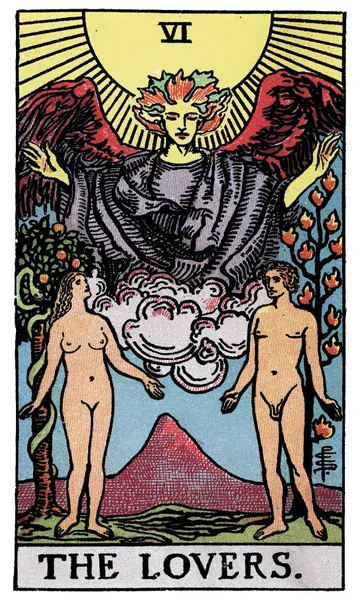
Choice meets proportion. The Lovers brings the bright yes of alignment; Temperance asks whether that yes can be lived in daily rhythm. Together, these cards favor relationships and decisions that preserve difference without breaking union. Attraction is not enough. The cup must be held after the vow.
Temperance + Two of Cups
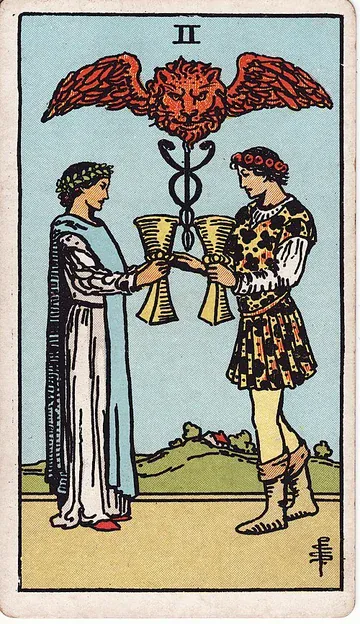
Two cups in human hands echo the angel's vessels. This pairing is tender and concrete: mutual care, repair, apology, the slow craft of meeting another person without spilling oneself. It often describes a bond that can heal because both sides are willing to pour and receive.
Temperance + The Tower
This pairing is the emergency room after the lightning strike. The Tower breaks the false structure; Temperance begins the careful sorting of what can be stabilized. The message is not to make the collapse pretty. It is to stop adding shock to shock. Find water, shelter, facts, sequence. Let the first repair be practical enough for the body to believe.
Temperance + Justice
Here harmony must include accountability. Justice brings the scale, the document, the consequence, the clean sentence. Temperance brings the human timing that allows accountability to become livable rather than merely punitive. Together they ask for repair with terms: what happened, what changes, who carries what, and how the new ratio is measured.
Temperance + The Hermit
The Hermit withdraws with the lamp; Temperance asks what the lamp teaches when the seeker returns. This pair describes solitude used for integration, not disappearance. Step back, listen, distill, then bring one usable truth into the shared room. If solitude never pours back into life, it becomes hoarding. If life never allows solitude, the mixture stays cloudy.
In combination readings, Temperance is often the card that changes the pace of the whole spread. A severe card beside it does not become harmless; it becomes workable. A sweet card beside it does not become vague; it becomes embodied. A fast card beside it is asked to slow enough to last. A slow card beside it is asked to keep moving enough not to stagnate. Look at which card supplies fire, which supplies water, and which one is acting as the vessel. That triad usually gives the practical answer.
Card Combinations

Death
After Death clears the field, Temperance teaches what remains to live together. This pairing is grief becoming rhythm, endings becoming medicine, and raw material slowly blended into a form that can be inhabited.

The Devil
Temperance beside The Devil brings appetite into the vessel. Desire is not denied, but it must be named, measured, and given structure before it becomes a chain.

The Star
The Star opens the sky while Temperance steadies the cup. Together they describe healing that begins in private calibration and becomes hope visible enough to bless the surrounding landscape.
The Lovers
The Lovers provide the bright choice; Temperance asks whether the choice can be lived in daily rhythm. This is attraction given a vessel, a vow taught how to breathe.
Two of Cups
Two of Cups makes Temperance intimate. The angel's alchemy enters a human exchange: apology, repair, mutual listening, and the slow art of pouring without losing oneself.
Frequently Asked Questions
What is Temperance tarot meaning in simple terms?
Temperance means skilled balance: the art of blending opposites without erasing either one. The red-winged angel pours between two cups, one foot in water and one on land. In a reading, it points to patience, healing, proportion, mediation, and the slow formation of a third way.
What does the Temperance tarot card mean in love?
In love, Temperance describes a relationship learning its rhythm. It favors repair, patience, emotional regulation, and differences that can be held rather than flattened. For new connections, it asks for steady pacing. For long bonds, it shows affection becoming trustworthy through repeated, practical acts of care.
What does Temperance as advice ask me to do?
Temperance as advice asks for proportion. Slow the exchange, preserve difference, build support, and add water while the flame is high. Do not confuse peace with avoidance. The card's counsel is active: create the conditions where truth, desire, rest, and responsibility can share one vessel.
Is Temperance a yes or no card?
Temperance is usually a yes, but a yes that requires patience and adjustment. It supports reconciliation, healing, careful collaboration, and phased progress. If the question demands speed, the card slows the pace. Its answer is clearest when the seeker is willing to work with timing rather than force an outcome.
What is the difference between Temperance upright and Temperance reversed?
Upright Temperance shows a living pour: fire and water held in right relation. Temperance reversed shows imbalance, forced calm, excess, or avoidance disguised as peace. Upright, the cups exchange. Reversed, the cups spill, dry out, or are used to postpone the real conversation.