
The Devil · Core Meaning
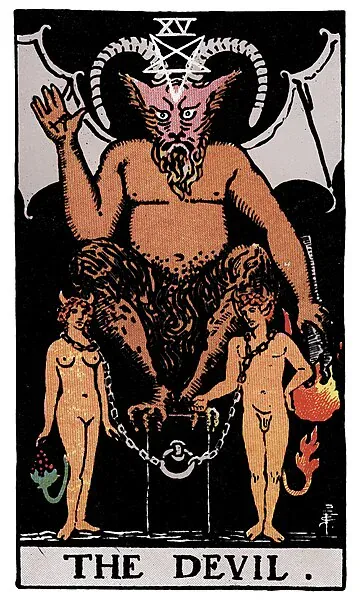
The Devil tarot meaning begins with a scene of terrible stillness. A horned, half-human figure crouches on a black square altar. An inverted pentagram burns above the brow. One hand rises in command; the other lowers a torch toward the earth, flame forced downward as if knowledge has been hired to light the floor of appetite. Before the altar stand the naked pair from The Lovers, changed by the room. Small horns have begun to rise. Tails hang behind them. Iron loops circle their throats. The loops are too wide. The chains are slack.
The Devil tarot card is frightening until the eye notices that slackness. The image is not a locked dungeon. It is a pact that has become habitual, a room one can leave but has stopped imagining leaving. The Devil is The Binder, master of chains, but the card is exact about the chain's engineering. The metal is real. The collar is real. The altar is real. The hand that keeps the pair standing still is partly their own. This is why the card should never be reduced to moral panic. It is not a sermon against desire. It is the portrait of desire unexamined long enough to become management.
Look again at the wings. They are not an angel's feathers and not the bird-wings that hang over the Fool's horizon; they are a bat's, leather stretched across finger-bone, built for flight in a place with no sky. That is the card's precise claim about this kind of captivity. Nothing fell from heaven here. A kingdom was built downward, cave by cave, by someone who kept choosing the dark because the dark was warm and already furnished. The horned head above the pair is a goat's: sure-footed on rock, patient, able to live on almost nothing. Capricorn's animal survives slopes that would turn anyone else back. That same talent for endurance is what lets a person stay years inside an arrangement that is quietly starving them.
The card's number carries the first clue. Fifteen reduces to six, and six belongs to The Lovers. The Lovers ask for chosen union, for the nakedness that can stand in daylight. The Devil is the Lovers' mirror turned over: union recast as chain, choice disguised as compulsion, intimacy rebranded as possession. The same two figures return, but now the room has no windows. What was once mutual recognition has become an economy of hooks. The Devil asks where love, labor, money, pleasure, ambition, or loyalty has become a small black altar on which you keep placing yourself.
Its astrological signature is Capricorn, cardinal earth: material, ambitious, cold enough to count every cost. Capricorn is not evil. Capricorn builds. It climbs. It understands structure, status, contract, endurance, debt, bone, winter, the slow authority of the mountain. Under The Devil, that gift turns too absolute. The ladder becomes the only view. The salary becomes identity. The body is treated as a tool. The desire for mastery becomes the inability to kneel, even to slip a loose chain from the neck. Deep winter, obsidian, oxidized gold, scorched leather: the sensory field is heavy because the card concerns heaviness that has been mistaken for reality itself.
The Hebrew letter is Ayin, the eye. Not the prophetic eye. The material eye, the gaze that sees surfaces, assets, bodies, leverage, proof. On the Tree of Life, the card is path 26, running from Tiphareth to Hod: from the solar heart of beauty and integrated selfhood toward the analytic splendor of language, bargaining, naming, and control. In a balanced form, the path gives clear speech to the heart. In The Devil's room, language becomes contract, explanation, excuse, a clever cage. The mind can justify almost anything if the appetite pays it well.
Older stories keep the same shape. Prometheus is chained to the rock for the gift of fire, and the fire in this card burns downward. Faust signs in a single evening, under a single lamp, for a life that finally feels large enough. Neither figure is a fool; each traded something specific for something specific, and each would sign again in the hour of the signing. That is the card's honesty about pacts. A bad bargain rarely looks bad while it is being made. It looks like the only available way to get warm. And the key to the iron loop, in the oldest reading of this image, is not lost at all. It is under the pillow, in a room where the sleeper long ago stopped reaching for it.
The Devil reversed is already hidden inside the upright card. The lock is usually open. The question is not whether a force exists outside you. The question is what benefit keeps the chain attractive. The card speaks of compulsion, addiction, secrecy, erotic charge, debt, golden handcuffs, toxic attachment, and the pleasure that makes a problem difficult to name. It also speaks of agency. The Devil's most difficult mercy is that the pair are not powerless. A bowed inch would change the whole room. The first act is not heroic escape. The first act is seeing what the eye has learned to ignore.
The Devil · Love & Relationships
The Devil love story is not loveless. That is what makes it dangerous to read too quickly. The heat is real. The grip is real. The longing is real. The card does not say a bond is fake simply because it is difficult, erotic, compulsive, unequal, or hard to leave. It says the bond has begun to ask for payment in a currency the soul cannot keep spending: self-respect, sleep, clarity, freedom, privacy, money, or the quiet right to want something else.
For an existing partnership, The Devil describes the pattern both people know and both people keep feeding. The fight has a choreography. The apology has a choreography. The private bargains are old enough to feel like furniture. One partner withholds and the other performs. One spends and the other rescues. One breaks a promise and the other becomes the court that hears the case forever. The chain is slack, but the ritual is strong. This card asks not who is guilty, but what each person receives from keeping the altar lit.
For a new spark, The Devil often arrives with magnetism that is too immediate to be innocent. The room changes when the person enters. The body recognizes them before the mind has read the contract. This can be erotic, alive, and honest. It can also be the old wound finding a familiar perfume. If the new connection makes you abandon proportion before trust has been earned, the card asks for slowness. Desire is not the enemy. Desire is the torch. Notice whether it illuminates the room or burns downward only to the feet of appetite.
For a solo seeker, The Devil can describe a pattern of attraction rather than a single person. The same face keeps arriving in different clothes. The unavailable one. The brilliant one who borrows stability. The wounded one who turns caretaking into proof of love. The powerful one whose attention feels like promotion. The card is not shaming the pattern. It is showing its architecture. Somewhere, a chain was mistaken for chemistry. The work is to learn the difference in the body, not as an idea.
For love after a wound, The Devil is especially delicate. The person who survived chaos may mistake intensity for safety because quiet love feels suspiciously empty. The body is trained to look for a room with an altar, a door that closes, a promise that costs too much. The card asks for tenderness toward that training. Recovery is not contempt for the old self. Recovery is noticing that the nervous system may call a chain familiar before it calls gentleness real.
For reconciliation, The Devil is a hard mirror. It can show the pull to return because the bond still has charge. The old room knows your name. The messages still light the body. The memory is not cold. But the card asks whether the return renegotiates the pact or simply repeats it. If the same secrecy, debt, jealousy, rescue, or erotic punishment would be rebuilt, the chain is not romance; it is repetition. A genuine return would require new terms spoken in daylight.
For no-contact or long silence, The Devil names the hook that remains when conversation stops. Checking the last-seen status, rereading the old thread, arranging the day around the possibility of a sign: these are not proofs of destiny. They are the body's attempt to keep a chemical bond alive after the relationship has stopped offering a room. The card asks for one clean act of reality. Put the phone down. Put the name back among ordinary names. Let the altar go dark for one evening.
For long-distance, cross-cultural, or life-stage difference, The Devil can point to the place where real obstacles become erotic fuel. The distance intensifies the fantasy. The forbiddenness becomes part of the bond's architecture. Family disapproval, visas, age, status, religion, language, work schedules: any constraint can become an altar if the couple begins loving the obstacle more than the person. The card asks whether the relationship is building a livable bridge or worshiping the impossibility.
For household constraints, shared leases, children, debt, immigration paperwork, or family business, The Devil describes the practical chain. Love may still exist, but departure is expensive. Conversation is shaped by rent, childcare, bank accounts, reputation, or the fear of becoming the villain in the family story. This is not a reason to pretend the chain is imaginary. It is a reason to map it accurately. The card respects material reality. Capricorn counts the cost because the cost matters.
For desire mismatch, The Devil asks the couple to stop lying about appetite. One person wants more sex, more privacy, more money, more intensity, more control, more public proof. The other wants less, or wants differently. When desire is not spoken, it goes underground and becomes leverage. The card does not require matching appetites. It requires truthful ones. A desire seen clearly remains a force. A desire denied becomes a master.
For the pursuer-distancer loop, The Devil shows two people chained to opposite sides of the same altar. The more one reaches, the more the other withdraws; the more one withdraws, the more the other reaches. Both can claim innocence. Both are also feeding the machine. The card asks each person to remove one hand from the chain before asking the other to change. No one gets free by tightening their grip.
Sometimes the chain is a missing word. Two people see each other for months with nothing named, no plan spoken, no place in either public life, and the absence of a label is precisely what keeps the bond charged. Asking for a definition feels like breaking something delicate; not asking keeps one person permanently auditioning. The Devil understands this arrangement well, because ambiguity is a cheap lock — nobody has to admit to holding a key. The useful question is who the vagueness serves. If the answer is the person with more options, the slack in this particular chain is not freedom. It is somebody else's convenience wearing the costume of ease.
If the question is whether someone is in love with you, The Devil says the feeling has force, but force is not the same as care. They may desire you, obsess over you, resent needing you, feel possessive, or feel bound by what has happened between you. That can include love. It can also include hunger wearing love's coat. Read the difference by looking at freedom: does their feeling make room for your full humanity, or does it prefer you as a figure chained near their altar?
The Devil · As Feelings
The Devil as feelings is heat with a hand around it. Someone may feel drawn, consumed, jealous, fascinated, physically stirred, unable to leave the thought alone. The card often describes the feeling that returns at midnight even after the daylight mind has made a sensible decision. It is not gentle. It is not necessarily false. It is a bodily insistence that has not yet become a clean offering.
If the person is reserved by nature, The Devil can make silence louder. They may be managing desire by pretending not to have it. Their restraint is not indifference; it is control. They watch, measure, remember details, and tell themselves that the eye is neutral. Ayin, the eye of matter, is active here. The feeling is being studied because to admit it would change the contract they have made with themselves.
If the person is demonstrative, The Devil can appear as pursuit that feels intoxicating and slightly too complete. They text often. They want proof. They say the charged thing early. They may make the connection feel fated because fated language removes responsibility from appetite. The feeling is real, but the card asks whether the performance gives you room to breathe. A person can want you intensely and still not know how to care for you cleanly.
For a long bond, The Devil as feelings may describe attachment that has fused with identity. They do not simply love you; they do not know who they are without the arrangement around you. This can feel loyal, and part of it is loyal. It can also become coercive in subtle ways: guilt around change, panic around independence, punishment disguised as sadness. The card asks whether the bond can survive each person having a separate shadow.
For a new connection, The Devil often describes fascination before knowledge. They are not yet in love with your whole life. They are captured by a surface, a smell, a voice, a face in a particular light, the way your attention makes them feel powerful or endangered. This is the beginning of a thread, not the whole cloth. Let the feeling gather facts before anyone signs a pact.
After conflict, The Devil can mean resentment and desire braided together. They are angry and still pulled. They may replay the argument because the replay keeps the connection alive. They may want apology, punishment, reunion, and proof all at once. The card asks for clean language. What is the injury? What is the appetite? What is the request? Without naming, the torch burns downward and both people keep stepping on sparks.
In distance or no-contact, The Devil as feelings can show obsession by absence. The person feels the missing as a presence. They may check, compare, imagine, rehearse messages, or keep a private shrine of evidence. This is not automatically a sign of devotion. Sometimes it is the mind's addiction to an unfinished circuit. The card asks for mercy and boundaries in the same breath.
Where jealousy is involved, The Devil names the fear of replacement. Someone may feel that your freedom threatens their existence. They may confuse closeness with access, intimacy with surveillance, reassurance with ownership. Underneath the control is often terror. The terror deserves compassion. The controlling behavior still needs a boundary. The slack chain is the place where compassion and boundary can both be true.
When the feeling is divided, The Devil shows the split between desire and respect. They may want you while knowing the timing is wrong, the structure is unfair, or another commitment stands in the room. The card does not cleanse the desire, and it does not condemn it. It insists on seeing the whole altar: the heat, the cost, the people not in the room who still matter.
There is also a quieter reading, easy to miss because The Devil is such a loud card. The feeling may be neither hunger nor love but sheer habit: a body accustomed to another body, a calendar shaped around a name, an evening with no other architecture available. Habit produces real warmth and almost no movement. If someone seems fond, reliable, present, and strangely unwilling to discuss anything past next weekend, the attachment may have become furniture. Furniture is not nothing. It is simply not a decision, and this card is interested in decisions.
Debt colors feeling too. Someone who was rescued once — money lent, a crisis sat through, a visa, a diagnosis, a season nobody else stayed for — may carry a gratitude that has quietly hardened into obligation. They care for you and they owe you, and the two have fused so completely that neither of you can hear which one is speaking. From outside this looks like devotion. From inside it can feel like a bill that keeps arriving. The clean test is whether they could refuse you something this month without bracing for the ledger.
The most important distinction: The Devil as feelings is not proof that someone is good for you. It is proof that the feeling has gravity. Gravity can help a body stay on earth; it can also keep a body from lifting its head. Read the card by asking what the feeling does after it arrives. Does it invite truth, repair, and mutual freedom? Or does it ask for secrecy, leverage, and the repeated tightening of a chain that was never locked?
The Devil · Career & Work
In career and work, The Devil describes the job, title, salary, institution, client, or ambition that has begun to define the person inside it. The role may be prestigious. It may pay well. It may look enviable from outside. The problem is not success. The problem is the bargain under the success: the private sentence that says, without this, I am nothing; without this, I cannot leave; without this, the life I built collapses.
For a current role, The Devil often means golden handcuffs. The compensation is real. The benefits matter. The mortgage, tuition, visa, insurance, family expectations, or public identity attached to the role are not imaginary. Capricorn earth honors that. But the card asks whether the role has crossed from support into ownership. If every part of the body stiffens before the workday and relaxes only when spending the money earned there, the altar is taking too much.
For a new offer, The Devil asks you to read the contract beneath the contract. The salary may dazzle. The title may soothe an old wound. The office may smell like oxidized gold and expensive leather. But what is being purchased besides your labor? Availability at all hours, silence about ethics, loyalty to a founder's appetite, relocation away from support, a prestige identity that makes future refusal difficult: these are clauses too. Read them before signing.
For freelancers, founders, and independent workers, The Devil can describe the business that started as freedom and became a master. Every client is urgent. Every launch becomes proof of worth. Metrics replace judgment. The person who escaped a boss finds a harsher one in the dashboard. The card asks where autonomy has become self-exploitation with better branding. Raise the rate, refuse the client, close the laptop, or name the appetite honestly.
For a creative worker, The Devil points to the bargain between art and market. There may be genuine talent and genuine demand. There may also be a growing dependence on the kind of work that sells while the stranger, truer work waits in the dark. The card does not romanticize poverty. It asks whether the market has become the only eye allowed to look at the work. Ayin can see sales, comments, and status. It cannot see the soul unless invited.
For a student, apprentice, or person early in a field, The Devil can show the mentor, institution, cohort, or credential path that promises legitimacy at the price of instinct. The chain may be praise. It may be fear of disappointing the person who opened the door. It may be debt. Learn the craft. Respect the structure. Do not hand over the inner eye. The point of apprenticeship is formation, not possession.
For a manager or leader, The Devil warns against becoming The Binder. A leader can chain people through fear, scarcity, charm, promotions, private access, or the suggestion that no one else would value them as much. The card asks the leader to audit power. Are people free to disagree? Free to rest? Free to outgrow the room? If not, the altar has your name on it, even if the organization calls it culture.
For care work, teaching, healing-adjacent professions, and mission-driven labor, The Devil can appear when devotion is being used against the worker. The cause is good, so the hours are endless. The students need you, so boundaries feel cruel. The patients, clients, congregation, or community are real, so exhaustion gets renamed commitment. The card asks for a harder form of ethics: refusing to let a good cause feed on a human body.
For promotion questions, The Devil is not a simple no. It says the promotion has weight. More money, more status, more authority, more visibility. It also says the promotion may lock the current structure around you more tightly. Before accepting, ask what freedom disappears when the title arrives. The question is not whether ambition is dirty. The question is whether the ambition belongs to you or to the altar.
For layoff, exit, or transition, The Devil can describe the terror of losing the chain that has been hurting you. A person can grieve a bad job. A body can miss the schedule that injured it. The card asks for dignity in that contradiction. If the exit is forced, do not mistake fear for proof that the old room was good. If the exit is voluntary, do not demand instant relief from a nervous system trained by captivity.
For cross-functional teams and workplace politics, The Devil points to leverage. Who controls information? Who creates dependency? Who benefits when two teams blame each other instead of naming the structure above them? The card is useful here because it does not sentimentalize. It asks you to see the chain, not just the personalities wearing it. Map incentives. Map access. Map the cost of truth. Then choose your move with clean eyes.
The Devil · Money & Finances
In money and finances, The Devil is the card of the binding contract: debt, lifestyle inflation, status spending, secrecy, a profitable compromise, or a financial dependence that has outlived its original purpose. It is not anti-money. Capricorn knows the dignity of structure, savings, assets, tools, and long work. The problem begins when money stops being a tool and becomes the proof that one exists.
For debt, The Devil asks for numbers without shame. Shame keeps the room dark. Numbers open a window. The balance, the interest rate, the minimum payment, the private borrowing, the family obligation, the subscription, the hidden account: name each link. The card does not respond to vague dread. It responds to inventory. A chain described link by link is already less absolute than a chain felt as weather.
For a major purchase, The Devil asks what the purchase is meant to buy besides the object. A car may buy respect. A home may buy belonging. A garment may buy a body one can tolerate in the mirror. A luxury may buy revenge on an old scarcity. None of these motives are crimes. But if the object is asked to repair a deeper wound, the price tag becomes an altar. Wait long enough to know which desire is speaking.
For investment, speculation, or risk, The Devil warns against the intoxication of leverage. Borrowed money can make a person feel brilliant before it makes them accountable. A winning streak can dress as destiny. The card asks for sober structure: exit terms, maximum loss, written rules, a witness who is not impressed by your appetite. If the plan must remain secret to feel exciting, the chain is already around the throat.
For work that pays well and costs dearly, The Devil is exact. The salary is not imaginary. The rent does not pay itself. Health insurance, family care, immigration needs, school fees, and debt repayment matter. But the card asks whether the money is buying time or consuming it. If the income funds recovery from the job that creates the need for recovery, the system may be eating its own tail.
For family money, shared accounts, inheritance, or dependency, The Devil can describe the golden chain of help that also controls. A parent pays but decides. A partner provides but monitors. A family business supports everyone and owns everyone's weekends. The card does not pretend independence is easy. It asks where gratitude has been converted into obedience. The clean question is: what would need to change for help to remain help?
For materialism, The Devil is less concerned with beautiful things than with possession as creed. The black altar in the card is square, heavy, built from matter at its most unyielding. What stands on it is not a god but the belief that having enough can finally silence need. The trouble is that need, unseen, learns to speak through appetite. The wardrobe fills. The cart fills. The house fills. The inner room remains unfurnished.
For secrecy around money, The Devil asks for a witness before it asks for a miracle. The hidden credit card, the private loan, the cash sent to the ex, the family debt no one mentions, the expensive habit folded into normal spending: these are not only financial facts. They are rooms without windows. Bringing one number into daylight may feel humiliating because the number has been carrying more than arithmetic. It has been carrying identity, fear, and the hope that no one notices.
For ambition, the card distinguishes provision from worship. Wanting stability is sane. Wanting a beautiful house, a margin of safety, a business that works, or enough money to protect the people you love is not a stain on the soul. The Devil appears when the desired structure begins demanding sacrifices no structure should demand: honesty, sleep, tenderness, the ability to leave, the ability to say enough. Money becomes cleaner when enough has a name.
If the card appears during financial recovery, its instruction is practical and unsentimental. Stop hiding. List the chain. Negotiate where possible. Seek qualified help where the structure is larger than one person's discipline. Build a buffer before building an image. Celebrate each link removed, but do not turn austerity into a new altar. Freedom is not purity. Freedom is the ability to choose without the old panic holding the torch.
The Devil · Health
For health, The Devil speaks of the body under a heavy contract. It can describe habits that began as relief and became dependence, stress that settled into the muscles, sleep traded for productivity, appetite used as anesthesia, pleasure turned compulsory, or a shame cycle that makes care harder to receive. This is not a diagnosis. It is a picture of attention: where the body has been asked to keep paying for an arrangement the mind has normalized.
The card's element is earth, and its temperament is melancholic: heavy, adhering, slow to release. Its season is deep winter around the solstice, when the world is cold, dark, and honest about its limits. In the body, this may feel like weight, constriction, dullness, over-control, or a low-grade heaviness that becomes familiar enough to be called personality. The card asks what has adhered. What began as a coping strategy and has now become part of the furniture?
If addiction, compulsive behavior, or dependency is part of the question, The Devil requires a no-shame reading. Shame is another chain. The behavior may be alcohol, drugs, food, shopping, sex, exercise, work, screens, gambling, attention, rage, or control. The card is not interested in humiliating the person inside the pattern. It asks for the first honest description: what does the behavior give, what does it take, when does it ask for more, and who knows?
For acute stress, The Devil can describe a body that is running on contract adrenaline. The deadlines, family demands, arguments, debt calls, secret messages, and late nights have become a system. The body may still be functioning. Function is not freedom. Notice the jaw, the hands, the gut, the places that brace before a notification arrives. Those small signals are the body's slack chains, visible before the whole structure breaks.
For chronic patterns, the card points to repetition rather than crisis. The same flare after the same week. The same crash after the same kind of overwork. The same loneliness answered with the same comfort. The same refusal to ask for support because asking would disturb the identity of being strong. The Devil asks for pattern literacy. Keep notes. Track the room, not only the symptom. The altar has a schedule.
For mental and emotional health, The Devil describes the tyranny of the private loop: obsessive checking, intrusive bargaining, self-punishing routines, secrecy, or the belief that one must earn the right to rest. The card asks for witness. A trusted practitioner, support group, friend, journal, or sober inventory can interrupt the room's closed air. The point is not confession as punishment. The point is light enough to see the lock.
For sensual health, The Devil restores nuance. Pleasure is not the enemy. A body without pleasure becomes another prison. The question is whether pleasure still returns you to yourself or removes you from yourself. Food, sex, touch, luxury, rest, beauty, heat: any of these can be medicine; any can become the master. The card asks for embodied honesty, not purity.
Because the card belongs to deep winter, it also asks about the body's relationship with depletion. Winter is not only cold; it is the season when stored fuel matters. The Devil asks where reserves are being burned in secret: the late work, the hidden worry, the private habit, the relationship that keeps the body on alert. Restore heat deliberately, not through the pattern that steals it.
When to worry: when secrecy deepens, when the habit escalates, when the body signals distress and the mind keeps negotiating, when the people who love you are not allowed to ask simple questions, when stopping for a day feels impossible or terrifying. At that point the card's advice is not heroic isolation. It is support. Professional care, community care, practical accountability, and medical guidance all belong outside the black room. The chain is slack, but sometimes a hand is needed to remember how to bow.
The Devil · Spirituality
Spiritually, The Devil is the card of the false absolute. Something partial has put on a crown: money, sex, pain, doctrine, status, a teacher, a lover, a wound, a method, an identity, a fear. The inverted pentagram does not show matter as evil. It shows the order turned upside down, spirit placed at the lowest point and matter made sovereign. The work is not to hate the world. The work is to restore proportion.
Ayin, the eye, is the spiritual tool here. Not the softened gaze that blesses everything too quickly, but the unflinching eye that looks at the chain before it struggles. Look at the appetite. Look at the bargain. Look at the pleasure. Look at the benefit. Look at the cost. Many seekers want release without seeing what the chain has been doing for them. The Devil refuses that shortcut. Unseen desire becomes master; seen desire becomes force.
On path 26, Tiphareth to Hod, the heart's solar truth moves into the realm of language, naming, and pattern. The spiritual distortion is cleverness used against the soul. Explanations multiply. The seeker can justify the teacher, the affair, the overwork, the debt, the secret, the resentment, the hierarchy, the rule. The Devil asks for one sentence that is simple enough to be dangerous: I am staying because I receive something here. Then ask what that something costs.
After Temperance, the card is especially sharp. Temperance mixes the medicine. The Devil shows the medicine miscompounded into syrup. A practice that once restored balance can become compulsive. Ritual can become performance. Fasting can become punishment. Study can become superiority. Shadow work can become an identity organized around injury. The card asks whether the practice returns you to life or keeps you in the room describing the chain beautifully.
The black altar matters because an altar is not only a place of worship; it is a place where value is organized. Everyone has altars, visible or hidden. The Devil asks which altar receives your best hours, your secret money, your most defended explanations, your body when it is tired, your imagination when it is lonely. If the answer embarrasses you, do not turn the embarrassment into a whip. Let it become information. Spiritual maturity begins where the real altar is finally named.
The downward torch is the second spiritual image. Fire normally rises. Here it is forced toward the floor, lighting the feet of appetite. This is knowledge used to defend bondage: spiritual language used to rationalize a harmful bond, psychological insight used to excuse manipulation, ritual used to avoid apology, intellect used to protect a craving from interruption. The card asks whether your knowledge makes you freer in ordinary rooms. If not, the torch has been turned downward.
The slack chain is the final teaching. The card does not honor fantasies of rescue that erase responsibility. It also does not honor despair that pretends responsibility is impossible. The chain is slack because a part of the soul remains unowned by the room. This is the spiritual fact The Devil hides in plain sight: even captivity contains a point of movement. The movement may be one inch. In this card, one inch is sacred.
A thirty-minute practice: sit with one object of attachment. Put the phone, contract, bottle, receipt, photograph, title, key, or written name on the table. Do not dramatize it. Do not condemn it. Write three columns: what it gives, what it costs, what I fear without it. Then touch your throat with one hand and bow your head one inch. The gesture matters. The chains in the image loosen by humility, not conquest. The practice ends when the object becomes an object again.
The Devil · Yes or No
No — unless the question is whether the attachment is real.
The Devil upright is usually a no for clean action, clean consent, clean timing, or clean freedom. It says the situation has a hook in it. The desire may be strong, the offer may be profitable, the attraction may be undeniable, the role may be prestigious, but the card does not answer from heat alone. It asks what the heat is attached to, who pays for it, and whether the chain is being mistaken for a path.
For relationship yes-or-no questions, read The Devil as no if the question is should I chase, should I break no-contact, should I accept secrecy, should I ignore the red flag, should I prove my love by giving more than I can afford. Read it as yes only when the question is do I feel bound, is this attraction powerful, is there an unresolved pattern here, is the chemistry real. The card confirms the gravity; it does not bless every orbit.
For career questions, The Devil says no to offers that require self-abandonment and yes to the recognition that an existing structure has too much control. Should I take the role because the title flatters the old wound? No. Should I audit the contract, benefits, exit terms, and hidden obligations? Yes. Should I pretend money does not matter? No. The card is practical. It asks for a sober no, not a romantic one.
For money, The Devil says no to the impulse buy, no to secret debt, no to leverage that requires denial, no to the purchase meant to repair a wound. It may say yes to consolidation, negotiation, inventory, or asking for help. The answer depends on whether the action tightens the chain or names it. If the action needs secrecy in order to feel possible, treat the answer as no.
For health and habit questions, The Devil says no to one more round of bargaining with the pattern. It says yes to support, truth, tracking, treatment, accountability, and any modest act that returns choice to the body. The answer is not dramatic. It is a sober hand on the collar, testing whether the metal is locked.
If the question is about another person's behavior, The Devil advises against treating intensity as evidence. Does the person think about me? Maybe. Do they desire me? Often. Are they bound to the pattern? The card can say yes to that. But should their fixation be treated as love, safety, or readiness? Usually no. The yes inside the card belongs to the existence of the hook, not to the wisdom of hanging more life from it.
If the question is about whether to confess, disclose, or bring something into daylight, the answer shifts. The Devil says yes to clean disclosure when secrecy is the chain. Tell the truth in a measured way, to a person who has enough steadiness to receive it, and with attention to safety and consequence. The card says no to confession as drama, punishment, or a way to make someone else carry the heat you do not want to hold.
If the question is whether the situation can be managed without changing, The Devil answers no. Management is often the chain's favorite disguise. A little less secrecy, a slightly better apology, a budget that leaves the core dependence intact, a job boundary that no one honors after two weeks: these may reduce the smoke without changing the fire. The card asks for the term that actually changes the pact.
If the question is The Devil reversed, or whether release is possible, the upright card quietly answers yes beneath the no. That is the paradox of the slack chain. The present action may be unwise. The larger freedom is not fantasy. The no protects the possibility of a better yes later, one spoken outside the black room.
The Devil · Advice
The Devil as advice begins with one sentence: do not fight the chain before you have studied it. Panic tightens the body. Shame darkens the room. Moral performance creates another altar. The first instruction is colder and kinder: look. Look at the pattern by daylight. Look at what it gives you. Look at what it takes. Look at the exact moment when choice narrows.
Write the contract. Not the official one, the hidden one. I receive money and give my evenings. I receive desire and give secrecy. I receive approval and give obedience. I receive intensity and give peace. I receive control and give tenderness. Put the clauses on paper. The Devil loses power when the bargain becomes legible. Hod, the sphere of language and form, can serve the heart when it stops serving the excuse.
Touch the slack part of the chain. Find one place where freedom already exists, however small. A day without checking. A conversation with the person who is not impressed by your performance. A spending freeze for one category. A refusal to answer after a certain hour. A walk without the phone. A truthful sentence in the journal. The card rarely asks for theatrical escape at first. It asks for proof that the lock is not absolute.
Remove secrecy from one link. Tell one trustworthy person the fact you have been arranging the room around. Not the whole saga if that overwhelms the system. One fact. The amount owed. The message sent. The habit returned. The offer made. The boundary broken. Secrecy is The Devil's preferred air. Witness opens a window.
Do not make an enemy of desire. This is crucial. Desire attacked becomes desire in disguise. Desire observed can mature into choice. If the appetite is erotic, speak about it cleanly. If it is financial, count it cleanly. If it is ambition, name the title you want without pretending to be above status. If it is control, admit what uncertainty frightens you. The chain loosens when the desire no longer needs a mask.
Renegotiate one term this week. Ask for a lower payment. Change the schedule. Clarify exclusivity. Refuse the secret. Move the alcohol out of the house. Block the shopping site. Decline the meeting that always becomes unpaid work. Tell the partner the pattern by name. Renegotiation is less glamorous than liberation, but The Devil is an earth card. It respects terms, dates, rooms, locks, keys, and receipts.
Prepare for backlash from the pattern. This does not always mean backlash from another person, though it can. It may mean the body's sudden nostalgia for the old room, the mind's clever argument that the chain was not so bad, the hunger that returns after three clean days, the boss who becomes kind when you set a boundary, the lover who offers intensity exactly when you begin to leave. The card advises you to plan for the old system's intelligence. Chains do not need souls to have momentum.
Keep the image of the bowed inch. The figures in the card do not need to break the altar, defeat the beast, or explain the entire history of bondage before moving. They need to lower the head enough to test the ring. Advice from The Devil is often smaller than pride wants: one call, one written term, one honest number, one night without the ritual, one witness, one refusal. The smallness is not weakness. It is how earth changes.
Finally, separate guilt from responsibility. Guilt says the chain proves you are bad. Responsibility says the chain is here and your hands are on part of it. The first freezes. The second returns agency. The Devil's advice is not to become pure. It is to become honest enough that the old master can no longer speak in your voice.
The Devil · Card Combinations
The Devil changes sharply depending on the neighbor. Beside gentle cards, it reveals where sweetness has become dependency. Beside severe cards, it shows whether the chain is about to break or simply become louder. In combinations, watch the material object in the image: the collar, the altar, the torch, the eye. Then ask what the neighboring card does to that object.
The Devil + The Lovers
This is the mirror pair. The Lovers show nakedness in daylight; The Devil shows nakedness in a room without windows. Together they describe a bond where choice and compulsion are difficult to separate. Attraction is real. Consequence is real. The question is whether the relationship can return to consent, mutuality, and daylight, or whether the pair have begun calling the chain love because love is the word available.
The Devil + Temperance
Temperance tries to mix medicine. The Devil shows medicine sweetened into dependency. Together they can describe recovery work, relapse risk, moderation under pressure, or a relationship where balance has been negotiated so long that no one notices the bargain is unclean. The combination asks for measured repair, not dramatic purity. Pour less. Wait. Dilute the intensity. Let the body relearn proportion.
The Devil + The Tower
The chain meets lightning. This combination often appears when a structure held together by secrecy, debt, appetite, or control can no longer hold its shape. The Tower does not moralize; it exposes. The affair surfaces. The exploitative workplace collapses. The hidden balance becomes visible. The old room cracks open. The pair may not feel ready, but the window arrives by force because no one opened the door.
The Devil + Strength
Here the beast is not killed. It is met. Strength changes The Devil by adding patience, body wisdom, and disciplined tenderness. This pairing is strong for recovery, anger work, sexual honesty, and the slow education of desire. It says the appetite can be trained without being despised. It also warns against using gentleness as another form of control. True strength does not chain the animal; it learns its language.
The Devil + Eight of Swords
Two images of bondage face each other: the Devil's slack chain and the Eight of Swords' blindfolded enclosure. Together they describe a mental contract that keeps a material problem in place. The person may say there is no choice because the mind has narrowed the room. This is not foolishness. It is fear with architecture. The combination asks for one visible fact, one removed blindfold, one tested link.
The Devil + Four of Pentacles
Two images of holding, set side by side. The Four of Pentacles sits with one coin clutched to the chest, one balanced on the crown, one under each foot — a posture that cannot stand up, reach out, or be reached. Beside the black altar, that posture stops being caution and becomes creed. The pairing often concerns money, but rarely only money: it shows a person who has decided that safety is a quantity of held things and who has slowly lost the use of both hands. Read it in a spread as the question of what would have to be set down before anything new could be carried. The chain here is not around the throat. It is in the grip.
In work and money combinations, The Devil often describes the structure beneath the visible card. A bright card may show success while The Devil shows the cost of that success. A difficult card may show collapse while The Devil shows the chain breaking under pressure. Read the pair by asking what becomes harder to deny. The Devil's gift in combinations is diagnostic clarity. It points to the contract, the habit, the appetite, the leverage, the thing everyone knows and no one has named.
The final question in any Devil combination is not which card wins. Cards do not wrestle for dominance in a spread; they alter each other's weather. The neighbor shows the way the chain behaves. The Lovers reveal consent. Temperance reveals proportion. The Tower reveals exposure. Strength reveals the animal. Eight of Swords reveals the thought that keeps the body still. Read the pair as a room with two lamps, not as a verdict with a footnote.
If a spread contains many bright cards around The Devil, do not erase the dark card to preserve comfort. Ask instead what comfort depends on. If a spread contains many difficult cards around The Devil, do not turn the reading into punishment. Ask what mechanism has become visible enough to change. The Devil's combinations are rarely ornamental. They point to the hinge where image becomes action.
Card Combinations
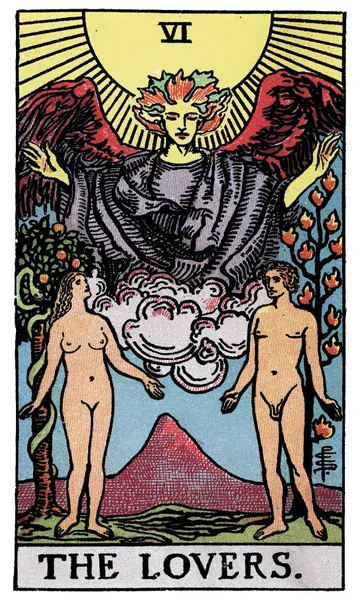
The Lovers
The Lovers beside The Devil turns choice into the central test. Attraction may be real, but the pair must distinguish consent from compulsion, intimacy from possession, and daylight union from a room without windows. The bond matures only where both people can freely choose.
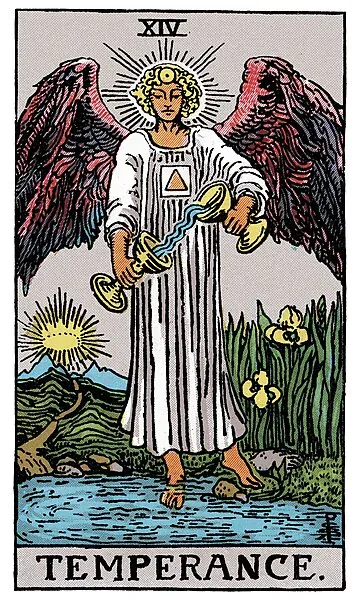
Temperance
Temperance cools The Devil without denying appetite. This combination is recovery by measure: dilution, pacing, witness, honest limits, the medicine restored from syrup into remedy. It favors gradual repair over theatrical purity.
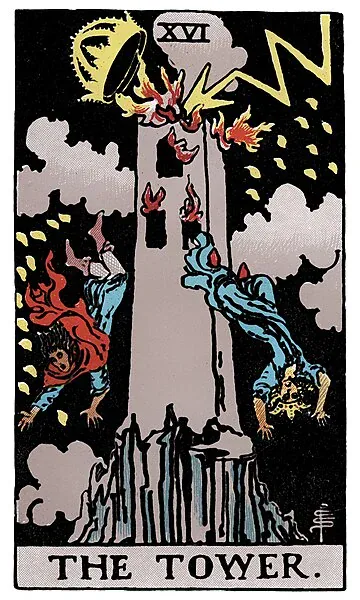
The Tower
The Tower breaks the room The Devil kept closed. Secrets surface, exploitative structures crack, debts or affairs become visible, and the chain loses privacy. The shock is severe, but exposure can become the doorway no one chose to open.
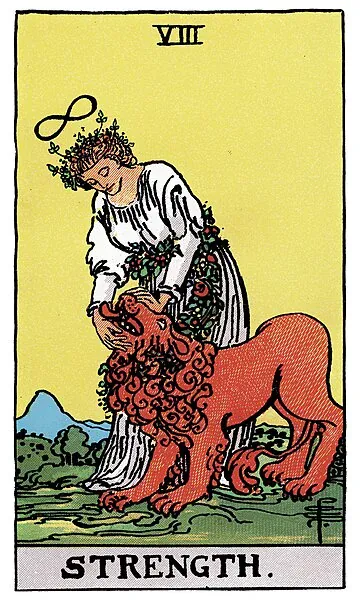
Strength
Strength teaches The Devil's animal without despising it. Desire, anger, hunger, and fear are met through disciplined tenderness rather than punishment. This pairing is potent for recovery, sexual honesty, and learning to hold appetite without becoming its servant.
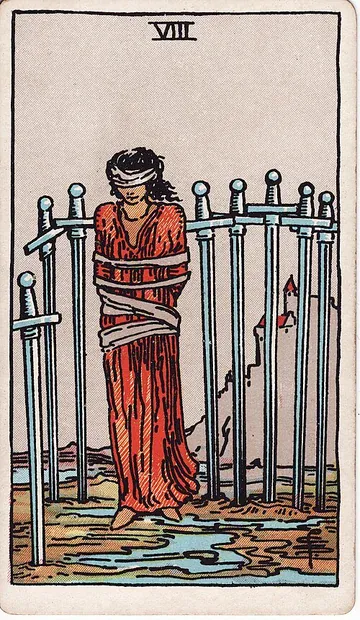
Eight of Swords
Eight of Swords doubles the bondage image in the mind. The material chain and the mental blindfold reinforce each other until one tested fact interrupts the room. This pairing asks for visible evidence, outside witness, and one small movement of agency.
Frequently Asked Questions
What is The Devil tarot meaning?
The Devil tarot meaning centers on attachment that has become a chain: compulsion, secrecy, debt, status, obsession, or desire treated as a master. The crucial image is the slack chain. The card does not erase agency; it asks where the lock may already be open and what benefit keeps the pattern attractive.
What does The Devil tarot card mean in love?
In love, The Devil tarot card describes a bond with heat and cost. The attraction may be real, but the pattern may involve control, secrecy, jealousy, rescue, erotic punishment, or dependence. It asks whether the relationship can return to daylight consent and mutual freedom, or whether the chain has been mistaken for proof of love.
What does The Devil mean as feelings?
As feelings, The Devil points to desire with gravity: obsession, fascination, jealousy, physical hunger, or attachment that is difficult to put down. The feeling can include love, but it is not automatically clean care. Judge it by what it asks for after it arrives: truth and freedom, or secrecy and leverage.
Is The Devil a yes or no card?
The Devil is usually a no for clean action, especially where secrecy, compulsion, debt, or self-abandonment is present. It can be a yes to the question of whether the attachment is real or whether a pattern needs attention. The card confirms gravity; it does not bless every orbit around it.
What is The Devil as advice?
The Devil as advice is to inspect the chain before struggling. Write the hidden contract, remove secrecy from one link, and find the slack place where choice already exists. Do not shame desire; name it. A desire observed can become a force again. A desire hidden becomes the master.