
The Lovers Tarot Card · Core Meaning
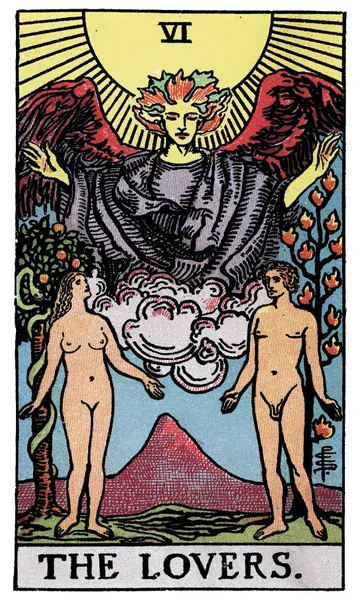
The Lovers tarot card opens onto a garden in early light. Two naked figures stand a small distance apart, the man looking across at the woman, the woman lifting her gaze past him to a winged angel poised between them and the sun. Behind her is the apple tree, its fruit half-hidden in leaves and a serpent coiled along the trunk. Behind him is a tree bearing twelve flames, each flame the size of a small fist, each in its own quiet rhythm. A mountain rises in the middle distance. The whole image is held in a pause — not a kiss, not yet — the pause where a word is still being chosen.
The signature tension is this: the figures are naked, and they are not yet touching. The card is the moment before vow, the moment when looking has become honest enough to require an answer. The bodies have already decided. The mouth has not yet caught up. Under the angel's regard, the lie of half-commitment loses its skin. You either turn toward the other person, or you turn back to the comfortable fog. The Lovers does not show the kiss. It shows the cost of the kiss being weighed.
Read carefully where the eyes go. The man looks at the woman; the woman looks at the angel. This is not coyness. The card is teaching the geometry of real union: that two people cannot recognize each other until each has first recognized something that sees them both. Without the angel, the apple tree and the twelve-flame tree are just decoration, and the figures are just bodies. With the angel, the bodies become a covenant. Lunarcana reads The Lovers tarot card as the diagram of choice that is also a witnessing — a yes spoken in front of something larger than the yes.
The sign written under the card makes the same argument in an older alphabet: The Lovers carries Gemini, ruled by Mercury — the sign of the divided pair, the twins, the messenger who carries words across the seam between two minds. Mercury in Gemini is articulate, quick, unsettlingly accurate. It is the planet of the conversation in which the relationship is named for the first time. The card is mutable air given a body: thought becoming word, word becoming pledge. The Hebrew letter is Zayin, a sword — the blade that separates one thing from another so that knowing becomes possible. To love, in this card's grammar, you must first cut: choose this one, not the other; this life, not the other; this self, not the half-self that hedged.
The kabbalistic placement is Path 17, running from Binah (Understanding) down to Tiphareth (Beauty). Understanding meets the heart by way of the divided pair. The path is named, in older sources, the Disposing Intelligence — the intelligence that arranges and aligns. The Lovers is therefore not romance for romance's sake; it is the soul's machinery for taking what has been understood and bringing it into the body. The wedding of mind and heart, contracted in the body, witnessed by the light. Whatever Eden meant before the bite, this card describes Eden after — the moment two people stand inside their own knowing and decide what to do about each other.
Six is the card's number, and six is two threes joined — the completeness of the pair. Three is a first synthesis, the triangle that closes; six is that closure doubled, each half already whole before it meets the other. This is the arithmetic under the nakedness. Neither figure is missing a piece; neither has come to the garden to be completed. They arrive complete and are still asked to choose, which is what makes the choice a gift rather than a rescue. Note, too, that the robes are simply gone — no fabric between the body and the decision. In older decks the pair stood clothed, a suitor between two women with a cupid aiming from above; the Rider-Waite artists stripped the scene down to Eden and the point of it changed. A choice made in clothing can be a choice made in role. A choice made bare is made by the person as they actually are.
Read the card in any spread the way a painter reads light: the mountain at middle distance is the weight of the choice, the solar disk above the angel is the clarity that makes the choice possible, the apple tree behind her is desire, and the twelve-flame tree behind him is the year that will follow whatever you decide. The Lovers does not predict your love. It describes the shape of the seam at which love becomes real.
The Lovers · Love & Relationships
In love readings, the upright Lovers tarot card means a relationship has arrived at the seam where it must be named or retreated from. The card is generous, but its generosity is conditional: it gives back exactly the depth of the choice you make. There is no version of The Lovers in love that rewards drift. The angel is watching. The bodies have already spoken. What remains is the word.
For an existing partnership, The Lovers describes the stretch of the bond where the easy chemistry has been spent and the more interesting question has surfaced — do we keep choosing each other, knowingly, on purpose, with the eyes open to what it will cost. This is the season of the un-romantic conversation that ends up being the most romantic one you ever have. The agreements you made in the first year were beautiful; the agreements you make now are load-bearing. The card warns gently against assuming the bond will hold itself. The twelve flames behind the man burn one by one through the year. Each flame is a renewal. Each flame is a thing one of you has to pay attention to. Long bonds under this card are the bonds that learn to recommit out loud, in small ways, often.
For a new spark, The Lovers means the attraction is not the surface kind. There is a recognition under it — a sense that the other person is composed of pieces that fit yours strangely, almost too well. Be honest about the strangeness. The card likes new love but does not like it casual. If you treat this person like an interesting weekend, the card collapses into its reversed orientation in a season. If you treat them like a question worth several months of slow looking, the card opens. The early stage of a Lovers connection is unusually serious for its hour: not heavy, not premature, just unwilling to be small.
For a single seeker asking whether love is possible, the card answers yes — and then asks what you have not yet chosen in your own life that is making love invisible. The Lovers is rarely an external problem. The figures in the image are alone in the garden; the angel watches them, not the absent crowd. If you keep waiting for the right person to show up and pull you into a life you have not yet decided to want, the card will keep delivering near-misses. Choose the life first. Choose the city, the work, the way you spend your Sunday mornings. Then the figure who fits walks into the chosen life. Not a moment before.
For love after a wound, The Lovers describes the difficult mercy of being asked to choose again. You have been hurt, and the part of you that was hurt does not want to be available for hurt again. This is reasonable. The card honors it. But the card also points to the angel, the watching light, and asks whether you can let yourself be seen by something larger than the wound. The wound is real. The wound is not the whole of you. Recovery under this card is the slow work of letting the unwounded parts also have a vote. When they get a vote, love becomes possible again — not by forgetting, but by widening.
The Lovers' particular love language is the hand reaching across the small distance. Not the grand gesture. The small, repeated, deliberate one. A morning text that is not a habit but a choice. The dinner cooked when neither of you was tired enough to cook. The hard conversation begun before it had to be begun. The card's love is articulate. It uses words. It says the thing instead of making the other person guess. If your bond has gone wordless, the card asks you to find the words again. Mercury is the patron here. The card answers when language is brought back.
If you are asking whether someone is in love with you and The Lovers arrives upright, read the answer as yes — with the further note that they are in love with you on purpose, not by accident. They have looked at you and chosen. Whatever they have said to you in the last weeks they meant. Whatever they are about to say next, they have been turning over for longer than you realize. The card describes the partner who has already done the private deciding and is preparing the public version. You are not waiting on their feelings. You are waiting on their voice. When the voice arrives, it will be exact.
A small disambiguation specific to this card: The Lovers in love readings can mean either a romantic union or a major relational fork, and the difference matters. If your question contained a choice ("should I stay with this person or that one," "should I move toward this relationship or hold the friendship"), the card is functioning as the choice card, and the action is to choose. If your question contained a longing ("does this person love me," "is this real"), the card is functioning as the union card, and the answer is that the recognition is mutual. Read the question first. The card's voice changes by what you asked.
Someone standing between two people — the old Marseille version of this card, a man flanked by two women with a cupid overhead — reads the upright Lovers with a particular sting. The card does not say which one. It says that the standing-between has become the relationship, and that both of the others are being asked to live inside your hesitation. Sort the two by a question other than which you want more: with whom are you already honest, and for whom do you already edit? The person you edit for is the person you are performing a version of yourself for, and the card's garden has no room for costume. Choose the one you do not edit. Then say the sentence to the other one plainly, soon, before the delay becomes its own unkindness.
The Lovers as Feelings · What They Are Thinking
When The Lovers tarot card appears to describe how someone feels about you, the answer is: chosen. Not in the dramatic, flag-waving way. In the precise way. They have looked at you, recognized something in you that fits the shape of a life they want, and decided. The recognition is not casual. It is also not yet complete — the card is the moment before the vow, not after — but the underlying current is clean: they know what they are doing when they think about you.
If they are reserved by nature, the silence around the feeling is the feeling. The silence is not a bid for the upper hand. They are protecting the seriousness from being trivialized too early. The Lovers in feelings often signals a partner who has been turning the relationship over privately for weeks longer than they have spoken about it. They have run the long version of the question in their head, the one with the families and the years, and the answer has come back yes. They are not yet ready to say it out loud because saying it out loud changes its weight. Read this kind of silence as carefulness, not absence.
If they are demonstrative, The Lovers in feelings signals a partner whose body language has begun to organize around you in public. They angle toward you in groups. They mention you to people who do not yet know you. They invent small reasons to reach across distances. The demonstrative version of this card is the partner who is, with mild alarm, recognizing that you have become the center of where they are pointing. They are excited, slightly embarrassed by how excited they are, and unwilling to pretend otherwise.
For a partner you have been with a long time, The Lovers in feelings is one of the deeper cards in the deck. It means the choosing has not stopped. They are not coasting on the early decision. They are still, after the years, looking at you and deciding to be here. This is rare. Most long bonds slide into autopilot, and the card's reversed orientation describes that slide. The upright card describes the bond that has stayed actively chosen. If your partner is feeling The Lovers about you, the bond is the bond they keep electing.
For a new connection, The Lovers in feelings means they are taking you more seriously, faster, than the calendar of the connection suggests they should. This is not a red flag. It is simply how this card works. Some attractions are slow burns. The Lovers connection tends to move with a quiet swiftness — not love at first sight in the cinematic sense, but recognition at the third or fourth meeting, an interior click that surprises both people. They are feeling the click. They are slightly worried they are imagining it. They are not.
There is also the person who has said nothing at all, whose feelings you are reading only from a change in their behavior — the message that now arrives at the same hour each morning, the seat they take next to yours without seeming to decide it. Under The Lovers, the body has decided before the mouth. Trust the pattern more than the absence of a declaration. The angel in the image is a witness, not a narrator; the pair beneath does not speak, and still everyone looking at the card knows what is happening. What you are watching in this person is the same silent legibility: attention that has organized itself around you and has not yet been given words. The words are the next thing, not the missing thing.
Asked about an ex — do they still feel something — the upright card gives a less comfortable answer than either yes or no. It says they remember the choice, and that the choice is still, on some floor of them, unfinished. The Lovers describes recognition, and recognition does not un-happen; what the card cannot describe is whether the recognition has been re-elected. An ex under this card is the person who, on a quiet evening, still runs the version with you in it. Whether they act on that is a separate matter, and the card is strict about the separation. Read it this way: the feeling persists, the vow was never rewritten, and if they walk back into your life it is because they have finally chosen rather than merely missed.
There is one specific texture worth naming. The Lovers in feelings is the texture of being seen by someone whose seeing is going to require something of you. They are not just enjoying you. They are imagining you across years. This is what the angel above the figures means, transposed into the language of feeling — the watching presence that makes the union real also makes the union accountable. If you sense, when this person looks at you, that the attention has weight, the weight is real. They are looking at you the way the card's image looks at the choice: with the future already in the room.
Read The Lovers in feelings as confirmation that the emotional ground beneath the question is genuine. The other person's interior is not vague about you. They have done the looking. They have done the considering. What remains, on their side, is the conversation that names the feeling — and that conversation, the card suggests, is not far off.
The Lovers · Career & Work
Two offers on the table — or one offer and one staying-put, both with a real future attached to them. The Lovers tarot card describes that fork at the moment it stops being abstract. A choice has arrived in your professional life that is not a choice between good and bad but between two goods — and the card is asking you to make it. The image is unmistakable: two paths, two trees, two figures, and the angel above asking which one you are willing to be witnessed making. There is no version of The Lovers at work that rewards keeping both options open. The hand can hold one thing at a time.
If you are asking whether a current role is the right one, The Lovers answers by reframing the question. The card does not say the role is right or wrong. The card says: have you actually chosen this role, or did you drift into it? The work that is held by a real decision tends to be sustainable across the difficult months. The work that is held by inertia falls apart at the first serious challenge. If you can name, out loud, why you said yes to this work and what you are willing to spend for it, the role is the right one for now. If you cannot, the card is asking you to either re-choose it deliberately or to find the work you would re-choose.
For someone considering a new role, The Lovers is the card of the offer that has surfaced an old question. The new role is appealing partly because the old role has revealed something you can no longer ignore. Take the offer seriously, but take the question more seriously. What is the new role offering that the old one could not, and is the new role the only place that thing exists, or is it just the most visible doorway? The card's caution is against romanticizing the second tree because the first tree has gone slightly bare. The mountain in the middle distance is the actual cost of leaving. Look at it before you walk past it.
Two offers arriving in the same week — the rarer and more disorienting version of the fork — is the situation the card's image was almost drawn for. The apple tree and the tree of twelve flames stand at the same distance; neither is nearer. Do not decide by comparing the offers to each other, which produces a spreadsheet and no sleep. Decide by comparing each offer to the year it implies: the tree behind the man carries twelve flames, one per month, and the honest question is which twelve months you can picture without flinching. The commute, the Tuesday afternoon, the person you report to when something goes wrong. The offer whose ordinary Tuesday you can see clearly is the one the card is pointing at. The one that only looks good as a title is the apple: bright, and then eaten.
For entrepreneurs and freelancers, The Lovers describes the season when the small business is asking to be married. Until now, you could keep it as a side practice, a thing you tended on weekends, a thing you could deny when it got hard. The card means it is asking for the full vow. This is uncomfortable, because vowing to your own work means accepting that the work is going to fail in public if it fails at all. The reward is that the work that has been vowed-to begins to mature with a different velocity. Hesitant work stays at hesitant scale. Chosen work compounds.
For a creative practice, The Lovers tarot card means the body of work has reached the stage where a particular voice is asking to be committed to. You have been able, for years, to write in three styles, to paint across four lineages, to keep your range broad and your choices open. The card asks if you are now willing to narrow. Not forever. For long enough that the chosen voice can mature. The seam between your range and your specificity is the same seam the card is always describing — the seam where two becomes one because you said yes to one of them.
For job search, promotion, or a layoff, The Lovers refuses easy comfort and offers something more useful. The card asks you to stop reading the situation as a verdict on your worth and start reading it as a fork. The job market is not telling you who you are. It is presenting you with a set of forks, and the work is to walk to one of them and put your weight on it. Promotion is a fork. Layoff is a fork. The card's gift, in a difficult professional season, is to insist that agency is still in the picture even when the externals are not cooperating.
A note on partnership at work — co-founders, collaborators, the colleague who has become more than a colleague: The Lovers across a partnership question is one of the most exact cards the deck offers. It says, plainly, that the partnership is real, the partnership has weight, and the partnership requires a vow that has not yet been made. Most working partnerships fail not because the work failed but because nobody ever stood at the seam and said yes. If The Lovers has appeared, the seam has appeared. Stand there. Speak.
The Lovers · Money & Finances
In money readings, The Lovers tarot card is the card of values made financial. Money under this card is rarely the surface question. The surface question is whether to take the offer, make the purchase, accept the windfall, sign the joint account. The deeper question is what you actually value, and whether the money decision in front of you reflects that value or contradicts it. The card is asking you to choose a financial life that is recognizably yours, not the inherited one and not the borrowed one.
For a question about a financial bet, investment, or major purchase, The Lovers answers conditionally. The bet is fine if you can name what you are buying. Are you buying security, prestige, freedom, beauty, the proof that you have arrived, the safety net for someone you love? Each of those is a defensible reason. The card supports any of them. What the card refuses is the purchase made because you could not stand at the fork and choose. Money spent in the absence of choice tends to be money that does not nourish. Money spent in the presence of a real chosen value tends to feel like the right amount even when the number is large.
For someone in financial recovery — climbing out of debt, rebuilding after a loss, repairing a damaged credit history — The Lovers describes the season when the recovery has stabilized enough that you can begin to make affirmative choices again, not just defensive ones. The early stage of recovery is all reaction. The Lovers stage of recovery is when you can ask, again, what you actually want a financial life to do for you, and start moving toward it. Pick the value. Move toward it slowly. The card is patient with slow money built on a real choice.
The signature financial trap of The Lovers is the joint decision made out of fear of the partner's disapproval. This shows up in marriage, in business partnership, in family-of-origin obligations. You agree to the financial arrangement that the other person wants because saying no would require you to do something the card is asking you to do anyway: stand at the fork and speak. The card's mercy here is that it offers a script. The script is honest articulation of value. "I love you, and I am not willing to put my money behind this particular thing." Most relationships survive this sentence. The relationships that do not survive it were not built to survive any honesty, and the card has, painfully, shown you a true thing earlier than you wanted to know it.
For windfall — inheritance, a meaningful bonus, an unexpected gift, a settlement — The Lovers describes the gift that arrives with a question attached. The question is what you are going to choose to do with it. Inherited money carries the values of the people who built it. The Lovers asks if those values are yours, and if they are not, whether you can re-purpose the money toward the values you do hold without dishonoring the source. This is a real moral consideration, not a sentimental one. The card respects the source and asks you to author the next chapter.
For debt, repayment, or the boring structural work of long-term financial design, The Lovers is unexpectedly useful. The card supports the boring move when the boring move is a chosen move. Pay the thing off because you have decided that freedom from the debt is worth more to you than the marginal pleasure the debt was buying. Build the buffer because you have decided that future-you is a person worth investing in. The Lovers makes financial discipline feel less like punishment and more like the architecture of a life that is actually yours.
The Lovers · Health
For health readings, The Lovers tarot card describes the body that has been asked, by some condition or shift, to make a choice about how it will be lived in. The card's element is air, the season is early summer, and the temperament is sanguine — quick, two-sided, lit. The body under The Lovers is rarely catastrophically ill. It is more often at a fork: a habit that has been viable until now is asking to be released, a practice that has been deferred is asking to be begun, a relationship between mind and body that has been one-way is asking to be made mutual.
If you are asking whether a treatment will work, the card answers that the treatment will work to the degree that it is chosen. Reluctantly tolerated treatment fails more often than committed treatment, regardless of the protocol. The card is not asking you to fall in love with the medication or the program; it is asking you to choose to be in active relationship with your own healing rather than passive recipient of someone else's plan. Bring the questions. Bring the hesitations. Make the protocol yours by understanding it. The card supports the body that is awake in its own care.
Two practitioners, two opinions, two protocols — the fork appears in health readings more literally than people expect, and the upright card meets it calmly. It does not adjudicate the medicine; that belongs to the practitioners. It adjudicates the seeker. Which plan are you able to follow on a bad week, when you are tired and the appointment is inconvenient and nobody is watching? That is the plan the body can be married to. The other may be more elegant on paper and fail in the third month, when adherence has to survive without enthusiasm. Ask the practitioner whose plan you can picture yourself living inside to explain it once more, slowly, until you could explain it to someone else. Understanding is the air element's way of consenting. A protocol you can explain is a protocol you have chosen.
For someone managing a chronic condition, The Lovers can describe the difficult honesty that long-term illness eventually requires. There is the life you imagined before the diagnosis, and there is the life you have. The card asks, not cruelly, whether you are still grieving the first one in a way that is preventing you from inhabiting the second. The grief is legitimate. The grief is not a permanent residence. At some point the body asks for a vow to the actual life — and to the body it is being lived in — and the vow is what allows the chronic condition to become livable rather than only endured.
The Lovers' particular health signature is the lungs and the nervous system — Mercury and Gemini both, the breath and the wires. Watch for shallow breath, scattered attention, the sense of being pulled in two directions until the body cannot remember which direction it is supposed to settle into. The card's somatic symptom is duality that has not been resolved into choice. The cure is not relaxation in the abstract. The cure is making one decision the body has been waiting for you to make. The breath restores itself once the choice is made.
For mental health questions, The Lovers is gentler than its astrological signature suggests. The card describes the moment when the work in therapy has surfaced a real question — usually about a relationship, a family of origin, a long-running ambivalence — and the body is asking for the question to come into language. Anxiety under this card is often the body holding two contradictory truths and refusing to choose between them. Depression under this card is sometimes the body's refusal to keep performing the un-chosen life. Both signals are intelligent. Both signals are asking for the conversation.
Reading a symptom as a signal is a frame, not medical advice. Keep your practitioners. Take your medicine. The Lovers tarot card simply offers a frame: the body is not your enemy, even when it is in pain. It is the second figure in the image, naked and honest, asking you to look at it and acknowledge that whatever choice is being deferred elsewhere in your life, it is being held in the body until the rest of you catches up. Look. Speak. The body, like the card, responds to being addressed directly.
The Lovers · Spirituality
Spiritually, The Lovers tarot card describes the soul's first autonomous yes. Until this card, the seeker has been moving through inheritance — the Hierophant's "ought," the family's tradition, the borrowed cosmology, the practice that someone else recommended. The Lovers is the moment the seeker stands inside the inheritance, looks up, and says: I will keep this part because I have chosen it; I will let this part go because it was never mine. The card is the threshold from received religion into authored relationship with whatever you mean by the sacred.
The kabbalistic placement is exact for this. Path 17 runs from Binah, the great Mother of Understanding, down to Tiphareth, the Beauty at the heart of the Tree. The seeker has understood something — abstractly, structurally, in the head — and is now being asked to bring the understanding into the heart, where it becomes felt. The angel above the figures is the light of Tiphareth turned back upward to witness the choice. The two trees behind the figures are the two halves of the inheritance: desire (the apple tree, the serpent, knowledge) and order (the tree of twelve flames, the calendar, the discipline). The work is to take both into the body and walk forward as one.
For seekers in active practice, The Lovers means the practice has reached the stage where it requires consent. Up until now, you have been doing the practice because someone told you it works, because you read it in a book, because the teacher you respect does it. The card invites the recommitment that turns the practice from something you do into something you are. This is uncomfortable, because the recommitment exposes which parts of the practice were yours and which parts you were performing. Performance falls away under The Lovers. The practice that remains, after the falling-away, is the real one.
For seekers exploring belief, the card describes the season of the tradition that fits. You have been sampling — a meditation lineage here, a poetry tradition there, a household ritual borrowed from a friend, a holiday observed because it feels right. The Lovers is gentle but firm: at some point, sampling becomes its own kind of refusal to commit. The card is not asking you to convert. It is asking you to stop pretending that nothing has called you. Something has called you. Acknowledge what. The acknowledgment is a kind of marriage, and like any marriage, it does not foreclose the other paths so much as let the chosen one finally deepen.
For questions of path, The Lovers asks the most useful question in the deck: what are you willing to be witnessed becoming? The angel watches. The angel is not an enforcer; the angel is the structure of accountability that any real spiritual life requires. A seeker without a witness drifts. A seeker with a witness can be wrong, can fail, can recover, because there is something larger than the self to be answerable to. The witness can be God, the unnamed, the lineage, the future child, the dead grandmother, the higher self, the work itself. The card is not particular about the form. The card is particular that the witness exists.
A specific practice for seekers under this card: write down, in plain language, the thing you would be willing to vow if you were brave enough. Not the dramatic vow. The ordinary one. The morning practice. The honest weekly conversation. The small refusal of the comforting lie. Then, with no witness but the page, vow it. Sign it. Date it. The card responds to the act of articulation more than to the dramatic gesture. The angel reads the page.
The Lovers · Yes or No
Conditional yes — yes if you are willing to choose.
The Lovers tarot card is one of the deck's clearest yes-cards, but its yes is hinged. The yes is real. The yes is not unconditional. The card answers yes to questions where the seeker is willing to take responsibility for the answer, and reverts to silence — or to the reversed orientation — when the seeker is hoping the card will choose for them. The Lovers tarot yes or no question always returns the question to the asker. Are you willing to choose. Are you willing to bear the cost. The card answers by asking that.
For yes-or-no questions about a relationship, the answer is yes if the relationship is one you are prepared to actively choose. The card is unusually exact: it does not affirm relationships you are passively in. It affirms the relationship you would re-elect if given the choice fresh today. If you would, the card's yes is full and warm. If you would not, the card is asking you to notice that the bond has become drift, and the yes the card can offer is conditional on you re-entering the relationship deliberately.
For yes-or-no questions about a job, an offer, a move, a decision, the answer is yes if the decision has been made by you and not for you. The card supports chosen action. The card is wary of action that is being performed because the seeker is trying to outrun ambivalence. Read the answer as a green light only if the green light is being entered by your own foot on the pedal. If the foot is somebody else's — a partner's, a parent's, a friend's, an algorithm's — the card's yes converts, almost immediately, to a soft no.
For questions about whether someone is being honest, whether an offer is genuine, whether a plan will hold, The Lovers answers yes when the honesty is mutual. The card is the union card; it requires that honesty live on both sides of the seam. If the other party is being honest with you, and you are being honest with them, the yes is sound. If either party is performing honesty rather than practicing it, the card's yes turns to a longer answer that the seeker has to read carefully. Watch the eyes in the image. Both figures are looking somewhere — the man at the woman, the woman at the angel. Honesty under this card is the willingness to look directly at what is in front of you.
For questions about timing — will it happen soon — The Lovers' yes implies a season, not a week. The card's image is held in early summer, the breath before the long warmth. What is asked about will arrive in a recognizable timeframe, but the timeframe is shaped by the choice you make in the meantime. Postponement of the choice postpones the timing. Cleanly made choice accelerates the timing without forcing it.
For binary decisions — should I act, should I wait — The Lovers reverses the standard reading of waiting. The card distinguishes between strategic waiting (gathering information, letting the situation clarify) and avoidant waiting (using time as a way to defer the choice). Strategic waiting is fine; the card supports it for as long as it serves clarity. Avoidant waiting collapses the card's yes into a no. If your waiting has become its own answer, the card is asking you to notice what the waiting has been protecting you from, and to stand at the seam and speak.
If the question was: should I love this person? The card answers yes — and asks why you needed permission.
The Lovers · As Advice
The advice of The Lovers tarot card is to choose. Not eventually. Now, in the smallest unit of "now" that is honest — this week, this conversation, this paragraph of your life. The card is generous about the size of the choice. The choice does not have to be the dramatic one. It often should not be. Most life-altering choices, under this card, are made in ordinary kitchens, in plain sentences, on weeknights when nobody but the two people involved would have noticed.
Pick the one. The figures in the image are two, the trees are two, the paths are two — and the card insists that the seam can only be crossed by choosing one of the two. Holding both is not freedom. Holding both is the postponement that eventually rots into the reversed card. Whatever your two are right now — two people, two cities, two careers, two versions of yourself — pick. Even the unbeautiful choice, taken cleanly, is more alive than the elegant indecision.
Speak the choice out loud to one other human. The card runs on Mercury and the letter Zayin: the messenger, the blade. Both want articulation. Both want the cut between things to be made by language. A choice held silently is, often, only half a choice. Pick the friend, the partner, the sibling, the therapist, the journal page that will hear you say it, and say it to them. The act of speaking it begins to construct it. Until then it is hypothesis. After then it is the new ground.
Stand under the angel. The card's most distinctive instruction is to make the choice in front of something larger than the choice. This is what people mean when they say they made a decision "for" their values, "for" the work, "for" the lineage, "for" the kind of person they are trying to be. The "for" is the angel. Find yours. It does not have to be religious. It can be a future self, a community, a craft, a child, a teacher, a dead grandmother, a single value you are unwilling to betray. Make the choice in its presence. The choice made under a witness holds.
A fourth instruction, gentler: forgive yourself for the time you spent at the fork. Most people stand at the seam for longer than they wanted to. The card is not punishing the time. It is just saying the time is now full. Receive the lateness. Begin from where you actually are.
Practical advice for the day The Lovers tarot card appears: write the choice down, in a single sentence. Not the consequences of the choice — the choice itself. "I am choosing this person." "I am choosing this work." "I am choosing to leave." Read the sentence back to yourself once, slowly, as if you were reading it about someone else. If the sentence is true, sign it. If the sentence is not yet true, the card has revealed which way you actually want to walk; the work this week is to make the sentence true. The card responds to action that is small, articulate, and named. Vague longing it does not respond to.
The Lovers · Card Combinations
The Lovers does not read alone well. Its meaning sharpens against the cards next to it, because the card is itself about the seam between two things. A second card in the spread becomes either the question being chosen between, the witness above the choice, the cost of the choice, or the inheritance being chosen out of. Read the pairing as a single image rather than two cards talking past each other.
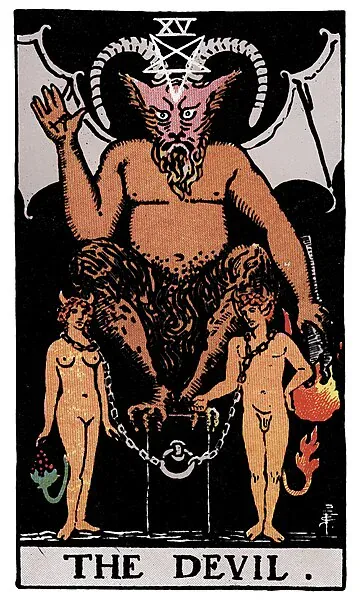
The Lovers + The Devil. The same composition, inverted. In The Lovers, two naked figures stand under a winged angel and the sun. In The Devil, two naked figures stand chained at the foot of a horned figure under a dark torch. The pairing is one of the deck's most precise diagnostics. It asks whether the bond you are reading is union or compulsion — the difference is not always visible from inside it. Real union, under The Lovers, means either party could leave and chooses not to. The chains in The Devil are loose enough to lift over the head; the figures stay because they have stopped imagining themselves outside the bond. When these two cards appear together, the question is whether the relationship is being actively re-chosen or whether the comfort of the known has become its own architecture. The card pairing does not condemn the bond. It asks the bond to look at itself in the angel's light and the dark torch's light at once and decide which it is closer to.
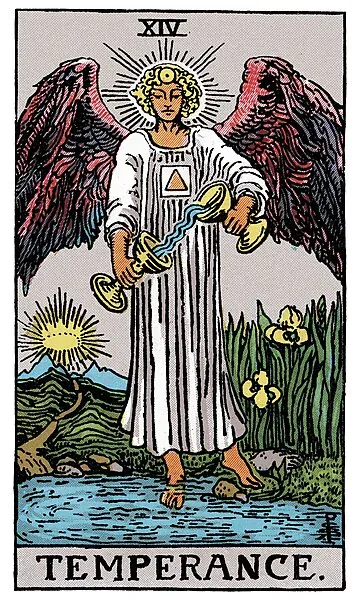
The Lovers + Temperance. The alchemical wedding completed. Where The Lovers is the moment before the vow, Temperance is the integration that follows the vow — the angel by the water with one foot on land and one on river, pouring liquid between two cups so smoothly that no drop is lost. This pairing means the choice has been made and the work of building a unified life from the two has begun. Read it as the season in which the partnership, the new role, the chosen self is being slowly braided into the existing life. The instruction is patience without distraction. Temperance does not work in haste, and the union The Lovers initiated takes longer to settle than the seekers usually expect. The cards together are deeply reassuring: what you chose is being woven, even when the weaving is invisible.
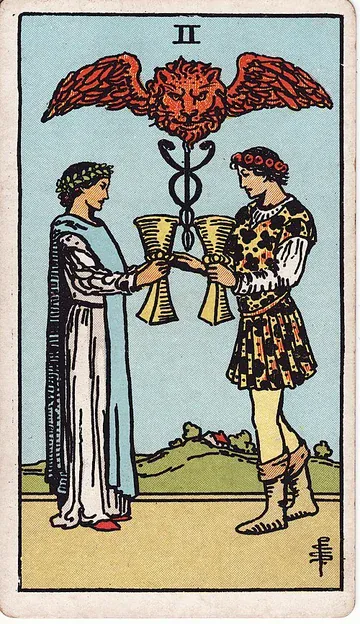
The Lovers + Two of Cups. The Major answer reflected in the small card. The Two of Cups carries Venus in Cancer, the small chalice exchange between two figures, and shares decan and sephiraic resonance with The Lovers' Path 17 (the heart side of Binah's flow into Tiphareth). When these two cards appear together, the relationship being asked about is structurally sound at every level — the cosmic level (The Lovers), the felt level (Two of Cups), and the daily-practice level (the gesture of pouring a cup for the other person). The pairing is one of the deck's clearest signals of mutual real attraction grounded in compatible values. The card does not promise the future; it confirms that the present is a real foundation. The action this combination supports is to stop testing whether the bond is real and to start tending to what the real bond needs.
The Lovers + The Chariot. The choice translated into motion. The Chariot follows The Lovers in the Major sequence: after the vow, the body has to leave Eden and ride. The pairing means the decision you made — or are about to make — is going to require travel, in a literal or figurative sense. A move, a launch, a public announcement, a stretch of life in which the commitment must be driven through resistance not yet met. The Chariot's two sphinxes are the two halves of yourself that must be kept aligned to keep moving. The good news in this pairing is that the choice has unlocked motion; the demand is that the motion be steered consciously, not coasted on. Long Chariot rides under The Lovers' authority are some of the most productive years a life has.
The Lovers + The Hierophant. The predecessor card paired with the choice card. The Hierophant is what you were before — the inherited tradition, the family's expectation, the institutional version of the life you were supposed to live. The Lovers is the moment you stand inside the inheritance and decide which parts to keep. When these two cards appear together, the choice in front of you is not really between two options external to yourself; it is between the inherited script and the authored one. The card pairing is gentle about this — it does not insist you reject the Hierophant. Many seekers, on close looking, find the inherited script holds more of what they want than they realized. But the pair insists the seeker choose, even if the choice is to keep the inheritance, because the unchosen inheritance becomes the reversed card a season later. Choose the script you were given, knowingly. Or choose past it, knowingly. Either is a yes to your own life.
Card Combinations
The Devil
The same composition inverted. Two naked figures under a horned torch instead of the angel and sun. The pair asks whether the bond is union or compulsion — both have closeness, only one has freedom inside it. The chains in The Devil are loose enough to lift. Stand in both lights at once and read which the relationship is closer to.
Temperance
The alchemical wedding completed. The Lovers chooses; Temperance integrates. The angel by the water blends two cups so smoothly nothing spills. The pair describes the season after the vow when the new life is being braided slowly into the old. Patience without distraction. The work is invisible while the weaving happens.
Two of Cups
The Major answer reflected in the small card. Venus's exchange between two figures pours the heart-side of Path 17 into daily form. The pair confirms mutual recognition grounded in compatible values — cosmic, felt, and tended in the gesture of pouring a cup for the other. Stop testing whether the bond is real; begin tending what the real bond needs.
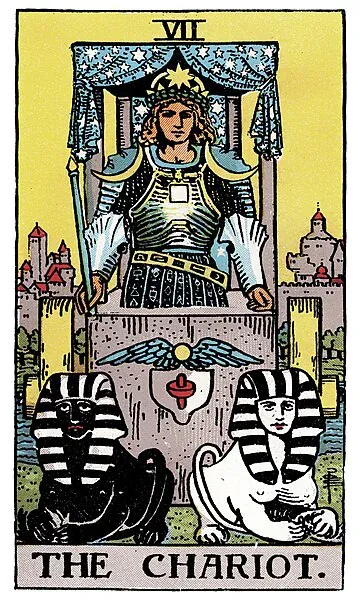
The Chariot
Choice translated into motion. The Chariot follows The Lovers in the Major sequence; after the vow, the body has to leave Eden and ride. The pair means the decision is going to require travel, literal or figurative, with the two sphinxes asking to stay aligned through resistance. The choice has unlocked motion; the demand is conscious steering.
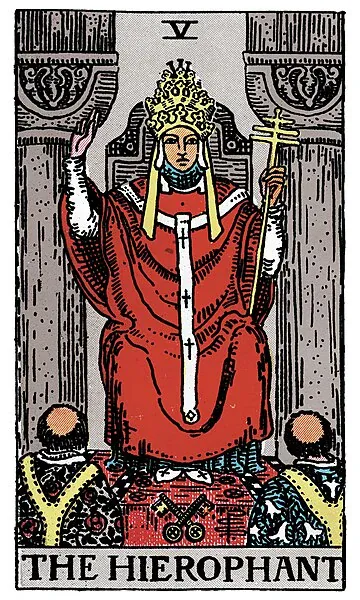
The Hierophant
The inherited script paired with the autonomous yes. The Hierophant hands down the ought; The Lovers stands inside it and decides what to keep. The pair is not a rejection card — many seekers find the inheritance holds more of what they want than they realized. But the inheritance must be chosen, knowingly, or walked past, knowingly. The unchosen script becomes its own quiet trap.
Frequently Asked Questions
Does The Lovers answer a decision, or just hand it back to me?
It answers — but only after you have. Its verdict is a conditional yes: the card affirms what you are willing to actively choose. For relationships, jobs, or decisions that you are prepared to take responsibility for, the answer is full and warm. For situations where you are hoping the card will choose for you, the yes turns soft and conditional. The card's character requires the seeker's foot on the pedal.
Has this relationship reached the point where it must be named?
With The Lovers, recognition has reached the seam of vow. The bond — whether long-term or new — has arrived at the moment where it must be named, recommitted, or honestly re-evaluated. For singles, the card asks what life you have not yet chosen that is making love invisible. For partners, it confirms the love is real and asks for active choosing rather than drift.
What does it mean when The Lovers card represents how someone feels about you?
When The Lovers describes someone's feelings, they have looked at you and chosen — privately, often before they have said so out loud. They are taking you seriously. Reserved partners hold the seriousness in silence; demonstrative ones organize their public life around you. The recognition is mutual and weighted; what remains on their side is the conversation that names it.
Does The Lovers tarot card mean soulmate?
The card describes a recognition deep enough to be called soulmate by readers who use that vocabulary, but Lunarcana frames it more precisely. The Lovers is the architecture of mutually chosen union under witness — not destiny, but agreement. The card's romance is not that the universe has paired you. The romance is that two free people, looking at each other clearly, have decided to walk forward together.
Why is there an angel standing over the two figures?
Because a choice made in full view is a different act from one made privately. The Lovers' spiritual lesson is the soul's first autonomous yes. The Hierophant hands down the inheritance; The Lovers is the moment the seeker chooses, deliberately, what to keep and what to let go. Path 17 from Binah to Tiphareth, ruled by Gemini and the Hebrew letter Zayin, asks the seeker to bring understanding into the heart by way of a real choice — and to make the choice in front of a witness larger than the self.