
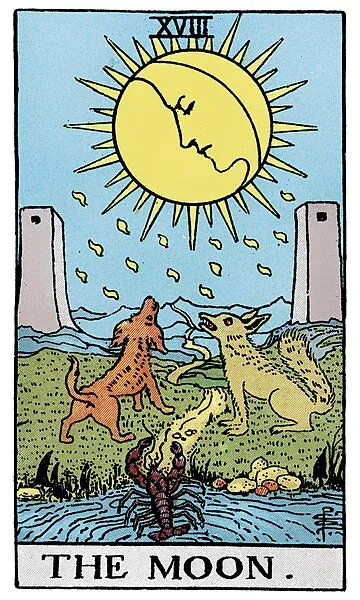
The Moon · Core Meaning
The Moon is the eighteenth card of the Major Arcana, and its tarot meaning is night work. Not nightmare, not crisis — the simple, irreducible fact that some stretches of the soul's road run after dark, and the only honest way through is to walk them. The card's image is unhurried. A path winds out from between two gray towers and reaches toward distant mountains. A wolf and a dog raise their muzzles to the same Moon, one from the wild and one from the hearth. A crayfish climbs from the shallow pool at the road's edge, dripping water onto the stones. Above all of this, the Moon's face hangs half-hidden in cloud, eyes closed, silver and patient.
This is the card's signature tension: the road exists, the destination exists — and the light to verify either belongs to a body that is not the road's own. The Moon shines by reflection. What you see by its light is real and not real at the same time. The trees on the path are the trees on the path, but the figure behind them might be a coat on a chair, or the past, or your own breath made visible. The Moon does not promise to clarify. It promises only to keep going overhead while you keep going underneath.
The attribution arrives doubled here, sign and planet at once: the Moon as a card carries Pisces — mutable water at its most porous — and the Moon itself as planet, the body that has always governed tides, dreams, and the part of the psyche that does not speak in sentences. On the Tree of Life, the card sits on the twenty-ninth path, running from Netzach (victory, the realm of feeling and creative momentum) down to Malkuth (the Kingdom, the embodied world). The Hebrew letter is Qoph, whose literal meaning is the back of the head — the part of yourself you cannot see directly, the place a touch lands when someone walks up behind you. The Moon, in other words, is the path along which feeling becomes flesh through territory the eye cannot quite catch.
Eighteen reduces to nine, and the nine is worth holding. Other nines in the deck arrive at something — a wish granted, a vigil kept through to morning, a harvest counted in the field. The Moon's nine arrives at a face that shines with light it does not own and cannot vouch for: a fullness that has not yet landed. Its season in the old correspondences is late winter, the wet before the thaw, when the ground has softened and the ice has begun to loosen and nothing whatsoever has bloomed. Its direction is west, where things go down. This is a card about the stretch of a cycle that has stopped being one thing and has not yet become the next.
Read the Moon the way you would read the experience of walking home through a long, quiet park at one in the morning. The body knows the route. The mind narrates. Some of what the mind narrates is true and some of it is the residue of a film you saw last Sunday. The card asks you to keep walking, to trust the route under your feet more than the images at the edges, and to write the night's catalogue down the next morning so that the things that survive the daylight can be sorted from the ones that needed only the dark.
Notice where the path starts. Not at a door you have used before, not at a gate in a wall you built: it starts between the two gray towers, and those towers are the last built things on the road. Past them the map stops. Everything else the card shows — the pool, the two howling animals, the long curve toward the mountains — is happening outside the boundary of what has already been named. Readers often take the towers for guardians deciding whether to admit you. They read better as the edge of the known: two markers that tell you the moment you left the vocabulary that used to work, and that are still standing when you come back through them from the other side.
The fifteen yellow yods falling from the Moon's light — sometimes called dewdrops — say one thing more. The night gives. It dampens the road. It feeds the moss. The Moon is not a withholding card. It is a card of borrowed gift: not your own light to give yourself, but a light you can walk by until the Sun rises in the next card of the Major Arcana.
The Moon · Love & Relationships
The Moon in love readings is the card of what happens beneath the surface of a relationship — the layer where projection lives, where fear of the other person rehearses itself in private, where intuition catches at things that have not yet been said. It is rarely the card of a clean answer, and it is also rarely the card of crisis. It is, more often, the card of two people walking the same night road and trying to figure out how much of the figure ahead is the partner and how much is their own coat hung on a branch.
For an existing partnership, the Moon often arrives during a season of inarticulate strain. Nothing has technically gone wrong. There has been no announcement. And yet the conversations are slightly thinner than they were three months ago, and the silences have started to feel like tunnels with something at the far end. Both of you carry things still unspoken. The card does not tell you to drag those things into the light by tomorrow. It tells you that the relationship is in the part of its arc where shadow is doing work, and that the work is honored by patience, not interrogation. Allow the shadows to sleep beside you for now. Notice them. Write them down. Choose one to bring up next month.
For a new spark, the Moon describes the early haze where attraction and projection have not yet separated. You are interested. You are also possibly interested in a story you wrote about the person before you met them. The card's instruction is gentle: keep walking, but do not yet sign the lease. The crayfish climbing out of the water is the part of you that is just beginning to learn the language of the new connection. Give it time to dry. Give it the second and third date before deciding what the first one was. The early Moon is not a warning that the spark is false; it is a reminder that night-light makes everything a little more cinematic than it actually is.
For a single seeker asking whether love is possible, the Moon answers with a question of its own. What part of the desire for love is the desire for love, and what part is the desire to stop being asked the question? The card finds many of its readers in the season of the well-furnished solitude — the apartment that has become beautiful, the routines that have become satisfying, the friends who fill in the chairs. None of this is wrong. The Moon simply notices that some seekers, by this point in the road, have stopped being able to tell whether they are reaching for a partner or reaching for a release from the ambient pressure of being unattached. Sit with the question for a season before acting on it.
For love after a wound, the Moon is a true companion. It does not ask you to be over it. It does not insist on closure. It walks the night road with you and lets the howling of the wolf and the dog name what you cannot yet say. The grief and the recovery are not opposites here; they are two voices in the same throat. If you are dating again after a long break, the card asks you to bring the unhealed parts to the new person honestly, not as a confession but as a kind of weather report. Real intimacy does not require you to have finished mourning. It only requires that you do not pretend you have.
For the long-distance or cross-cultural couple, the Moon is uncomfortably accurate. So much of the relationship lives in interpretation — text tone, time-zone friction, the slow guess at what the other's silence means. The card warns against the spiral where every gap fills with worst-case narration. Set a small, specific question to ask each week. Keep the rest of the projection material in a notebook, not in your messages.
For the seeker in a pursuer-distancer dynamic, the Moon describes the dance with unusual precision. One of you is reading the moon for signs of the other's interest; the other is moving in and out of cloud. Neither of you is acting in bad faith. Both of you are being shaped by an old pattern. The card asks the pursuer to put down the binoculars for a week and the distancer to step into a single, specific moment of presence. The pattern only loosens when both partners do something slightly different than they did last time.
For reconciliation after a break, the Moon is rarely a clean yes or a clean no. It says: the bond you remember is not the bond as it now stands. Reconciliation, if it happens, will require meeting an actual person, not the version you have been polishing in your head for the last several months. If you can do that — meet the actual one — the Moon is willing. If you would rather keep the polished version, the card is asking you to mourn it properly and let it go.
For the question "are they into me," the Moon's upright answer is honest in a way that frustrates yes-or-no readers. They are interested. They are also unclear. There is feeling on their side, and there is also some private tangle they have not yet been able to name to themselves, which means they cannot yet name it to you. Read the Moon as a soft yes with a long fuse. Whether the fuse burns to flame depends on what they do with their own night work — and what you do with yours.
For the household with a desire-mismatch — different sleep rhythms, different libidos, different needs for solitude — the Moon often describes the season when the mismatch has begun to feel personal. It usually is not. It is biology, history, two different night-roads meeting in one bedroom. The card asks for a structural conversation rather than a confessional one. What can the architecture of the week make room for that the architecture of last year did not?
The Moon · As Feelings
When the Moon appears upright to describe how someone feels about you, the answer is layered rather than singular. They feel something. They feel several things, in fact, and not all of them are organized yet. The Moon is not a flat card here, the way the Sun or the Three of Cups would be. It is a card of feelings still moving in tide — drawn toward you, then pulled back by an old gravity, then drawn again. Read this not as instability of affection but as a person whose interior is in a season the Moon describes well: the feelings exist, they are real, they have not yet decided their shape.
If they are reserved by nature, the Moon in feelings is one of the more accurate cards the deck offers. They feel a great deal and they will not yet be able to say so. Their silence is not absence. It is the long lag between feeling and articulation that some people simply have. They are noticing you. They are turning over the question of you in a part of themselves they do not show to anyone. Read the silence as cargo, not as void. If you can give them time without needing reassurance every three days, they will eventually arrive — and the arrival will be more substantial because of the lag.
If they are demonstrative, the Moon in feelings can mean their public signals are running ahead of their private clarity. They want to want you. They like the story of being with you. And in the quieter rooms of themselves, they are still untangling what is genuine attraction from what is the comfort of having found someone who fits the slot. None of this is dishonesty. It is the Moon's particular emotional weather: the feeling is real, the feeling is also partially scenery.
For long bonds, the Moon in feelings often describes a partner whose love for you has gone underground for a stretch. Underground is not the same as gone. They have stopped being able to find the felt sense of it on a daily basis. The card asks you not to read this as withdrawal but as a season — sometimes triggered by their own work pressure, sometimes by an old grief surfacing, sometimes by a quiet identity change they have not yet shared. The feeling will surface again. The Moon is also the card of the dream that returns. What is yours in the long view is yours, even when it is currently in cloud.
For new connections, the Moon in feelings can describe someone who is privately enchanted and publicly cautious. They are talking about you to a small circle. They are not yet ready to be public. They are protecting the early bloom from too much air. Whether the protection serves the bond or strangles it depends on whether they know how to come back out into the daylight in a few weeks. The card asks you to give them the run-up.
A small caution embedded in the Moon's feelings reading: if the texture begins to feel like ghostly intermittency rather than weather, name it. The Moon honors mystery. It does not honor avoidance dressed up as mystery. If the silence has stretched past what feels ecological — if you have been waiting for weeks while constructing elaborate narratives about what they might be doing — the card invites you to break the spell with a single direct question, asked once, not repeatedly.
For the question "do they think about me when I am not around," the Moon answers yes — often more than they let on, often during exactly the kind of late hours the card is keyed to. You appear in their drift. You appear in the half-thoughts that arrive before sleep. Whether they will translate that drift into action is the work the card cannot do for them.
For someone whose feelings about you are tangled with feelings about a previous partner, the Moon is unusually accurate. The earlier relationship has not finished its work in them. You are appearing on a screen that still has someone else's image faintly visible. This is not necessarily a sign of bad faith. It is often a sign that grief and attraction are co-occupying the same interior right now. The card asks you to be patient with the overlap and to refuse to compete with the ghost; competing only deepens the projection. Be the present person you are. The ghost recedes on its own schedule.
For a partner whose feelings are running underneath an unspoken life decision they have not yet shared with you — a job they are weighing, a city they are thinking of leaving, a private vow — the Moon describes the gap between the affection and the disclosure. The feeling toward you is real; the architecture they are protecting is also real, and they have not yet figured out how to bring the two into the same conversation. The card asks for patience with the gap and a single direct question, asked once, when the moment lands.
Read the Moon as feelings, finally, as a card of feeling that respects its own depth. The other person feels you in ways they have not yet brought to language. The patience to let that articulation happen, without leaning on them to perform it before they can, is the gift the card asks of you. The card also reminds you that your own feelings, in this same season, are likely running ahead of language too. Both of you are inside the lunar weather. Neither of you has to be finished with the night work before the relationship can take its next honest step.
The Moon · Career & Work
Low light is not the same as no information, and the Moon in a work reading is the card that knows the difference — it asks for movement through unclear data rather than premature certainty. The role, the project, the colleague's intention, the offer's true shape: something is not yet legible. The card does not tell you the data is missing because something is wrong. It tells you the data is missing because the part of the cycle you are in is the part that does its work in low light.
For someone in a current role and asking whether to stay, the Moon describes the period when the metrics still look fine and the gut has begun to disagree with the metrics. You go in, you do the work, you receive the feedback that says the work is good, and somewhere in the week — Tuesday afternoon, the late commute home — you notice that something in you no longer believes the work matters in the way it once did. The card is not telling you to quit on a Wednesday. It is telling you the felt signal is not noise. Track it for a season. Write down what specifically activates the disquiet. The pattern that emerges from three months of those notes is what the Moon is trying to deliver to you, slowly.
For someone considering a new role, the Moon arrives most often when the offer looks correct on paper and the body has reservations the mouth has not yet articulated. Do not sign while the reservations remain inarticulate. Take a walk. Sleep on it for two nights. Write the night-thoughts down by morning. The card respects the rational analysis. It also insists that the rational analysis is not the only analysis your nervous system is doing.
For freelancers and entrepreneurs, the Moon describes the season where the numbers are okay, the clients are mostly returning, the work is being made, and you nonetheless have lost the felt thread of what you are building toward. This is one of the card's most common career placements. It is not a sign that the business is failing. It is a sign that the founder has been so heads-down in production that they have stopped doing the soft, slow work of strategy — the kind that happens by walking and writing and not on a Notion board. Reserve a half-day. Walk. Write. Let the question be unanswered for an afternoon.
For creative workers, the Moon is unusually generous if you let it be. The card is the card of the half-formed image, the dream you almost remember, the working sentence that is not quite right but is closer than what you had yesterday. Creative practice in a Moon season often feels unproductive precisely because the materials are still in the dark, still becoming themselves. Trust that the dark is doing necessary work. Do not over-light the studio. The fluorescent productivity that tries to scrub the Moon out of the practice usually scrubs the practice itself out with it.
For students or apprentices, the Moon describes the long middle of the learning arc — the part where the introductory enthusiasm has worn off and the mastery is not yet in sight. You are reading the same paragraph for the third time. You are not sure whether you are stupid or whether the paragraph is actually difficult. The card's answer is usually the second. Stay with it. The Moon honors steady, unspectacular practice in a way that few other cards do.
For managers and leaders, the Moon often appears when the team's mood has shifted in a way no one has been willing to name. Someone is unhappy. Someone is considering leaving. The signals are in the late replies, the canceled one-on-ones, the slightly different tone in the comments thread. The card asks you to do the unglamorous work of pulling each person aside and asking gently. Not in a status meeting. In a hallway, on a walk, after the formal moment has passed.
For care work and teaching work, the Moon is one of the truer cards in the deck. The work itself happens largely in territory the spreadsheet cannot see. The student who shifted because of something you said in October, the patient who eventually called for help because of a relationship you built over months, the child whose stability was stitched together by a series of unnoticed evenings. The card honors this. It also warns against the burnout that comes from doing this work without ever letting yourself believe it is real because no one tracks it. Believe yourself. The work is real.
For someone newly promoted, the Moon describes the disorientation that follows the title change. You expected to feel like you had arrived. You feel, instead, like you have been handed a flashlight in a slightly larger room. The card says this is correct. The flashlight is the right tool. Walk the room slowly. Let the sense of the new role build over months, not weeks.
For someone navigating a layoff or transition, the Moon offers a particular kind of solace. The path between the two towers does end. The mountains in the distance are real. What is happening to you now, however, is the part of the journey where you cannot yet see them. The card asks you not to make permanent decisions in this stretch. Apply for the things. Rest when you can. Write the dreams down. The season ends. The Sun is the next card.
For cross-functional teams and collaborators, the Moon describes the slight drift between what each function thinks the project is. Engineering thinks the goal is one thing; product thinks it is another; design thinks it is a third. No one is wrong. Everyone is reading the moon by their own light. Pull the team into a room. Let each person describe what they think the destination looks like. The reconciliation is the work.
The Moon · Money & Finances
Nothing is on fire; the numbers have simply gone soft at the edges. The Moon in money readings is fog rather than crisis — the stretch of the year when the actual shape of your finances slips slightly out of view. You know you are mostly fine. You also have not opened the spreadsheet in five weeks. There is a vague sense that you have been spending more on the small things, but you have not totaled it. The card describes this fog accurately and asks for the simple, almost boring, antidote of attention.
For the seeker asking about a financial gamble, investment, or speculative move, the Moon answers with caution, but not with refusal. The opportunity may be real. It may also be partly your own projection of what the opportunity could be. Run the numbers twice. Run them with someone whose night is brighter than yours on this terrain. Do not commit money on a hunch alone, even though the Moon respects hunches; this is a card whose hunches need verification before they touch capital.
For the seeker managing scarcity, the Moon describes the moment when the structural facts of your situation have started to feel personal. The bills are not your character. The shortfall is not a sign of who you are. The card warns against the night-time spiral that turns a difficult season into a story about your worth. The numbers are numbers. They will respond to attention and time. The story you tell yourself about them is the part the Moon asks you to write down and challenge in daylight.
For the seeker asking whether to make a major purchase — a car, a home, a piece of equipment — the Moon often arrives when the desire for the thing has begun to do a lot of the work that the analysis should do. The car is appealing. The car is also possibly carrying the symbolic weight of "I have made it." Separate the symbolic load from the functional analysis. If the car still wins on the functional analysis alone, buy it. If the car only wins because it makes you feel a certain way about your life, wait a month and see whether the feeling needs a car or whether it needs something else entirely.
For someone working through debt, the Moon describes the long tunnel between deciding to address the debt and feeling like the debt is no longer the dominant fact of your inner life. The tunnel is real. The far end is real. The card asks for the slow, steady, unglamorous work of monthly payments and a quarterly check-in with someone who can see the numbers honestly with you. There is no glamour in this stretch. There does not need to be. The debt resolves the way most night roads resolve: by being walked.
For freelancers managing cashflow volatility, the Moon is frequent company. The income comes in tides. The card asks you to design for the tide rather than against it. Save in the months that are full so the months that are thin do not become emergencies. The Moon reversed will warn about pretending the tide is not there; the upright Moon honors the tide and asks you to plan around it.
For windfall — bonus, inheritance, unexpected check — the Moon upright cautions against deciding what to do with the money in the first week. The week of arrival is not when the wisdom about the money is highest. Park it. Wait a month. Let the symbolic weight settle off the literal money. Then decide.
A practical note: the Moon responds well to the simple ritual of opening the spreadsheet on the same day each month. Not a long session. Twenty minutes. The card's worst financial expressions tend to be the ones that hide. Visibility is the antidote almost every time.
The Moon · Health
In health readings, the Moon points the body's attention to the systems that operate under the skin — the lymphatic, the hormonal, the nervous, the parts of the somatic self that show their work indirectly. The card sits in Pisces and on the path of Qoph, the back of the head; its body associations skew toward fluids, sleep, dreams, the immune system, and the felt sense of mood. The Moon's element is water and its temperament is phlegmatic — slow, deep, sometimes a little stagnant if it does not move. Phlegmatic temperament is old symbolic language and not medical advice. The card describes what kind of attention the body is asking for, not a diagnosis.
For chronic conditions, the Moon often arrives in the season where the condition's flares have begun to correlate with sleep, stress, and weather in ways the linear schedule cannot quite capture. Track the data without obsessing over it. A simple two-line journal for three months — what was the body like today, what was the night before like — usually reveals the pattern that the doctor's office does not have time to find. The card respects rhythm. The condition is more legible to rhythm than to spreadsheet.
For acute symptoms, the Moon is rarely the card of emergency. It is more often the card of the symptom that has been hovering at the edge of attention for two weeks while you decided whether to call. Call. The card's bias is toward the appointment, not toward more weeks of waiting and intuiting. The Moon trusts intuition; it also trusts the clinic.
For someone navigating sleep, the Moon is the card of the deck most directly tied to it. Sleep is its native medium. If the question concerns insomnia, fragmented sleep, vivid dreams that leave you tired, or the feeling that the nights are working against you, the card asks you to take the sleep seriously as a discipline rather than as something that should just happen. Examine the inputs — caffeine timing, screen exposure, the quality of the last hour before bed. The Moon also asks whether something unspoken in your waking life is being worked on by your dreams. Writing dreams down for two weeks often releases the pressure.
For mental health questions, the Moon describes the texture of anxiety with unusual precision: the fear that catastrophizes in low light, the sense that something is wrong without specific evidence, the rumination that loops more loudly the closer it gets to night. The card honors the experience and offers an old, simple intervention. Do not act on night-thoughts. Write them down and read them in the morning. Most of them dissolve. The ones that remain are the ones to take to a therapist or a journal practice.
For somatic and emotional intersections — the migraine that follows the family argument, the gut response to the boss's email, the chest tightness that arrives when you sit down to write — the Moon insists on the link without forcing it into a clean cause-and-effect. The body and the feeling are not separate. The card asks you to honor the body as a partner in the emotional work, not as a problem to be silenced with the next medication adjustment.
For the seeker in recovery — from injury, illness, surgery, or a long acute season — the Moon describes the part of recovery where the visible markers have stabilized and the felt sense of being whole has not yet returned. This is normal. The card asks for patience with the lag. The body has been through more than the chart records. Give it the months it needs to remember itself.
For hormonal cycles, the Moon is unusually intuitive. The card respects the felt knowledge that the body is different in different phases of the month or the year. Plan with the cycle rather than against it where you can. The Moon does not honor the productivity ideology that wants every day to be the same. It honors the truer, older rhythm.
A small structural note: keep your practitioners. Take your medicine. The card's gift is attention, not replacement. The Moon and the clinic are partners.
The Moon · Spirituality
Practice under the Moon is night work: it does not announce itself, does not perform, and offers none of the satisfying mileposts the more public spiritual paths hand out. It works on you in your sleep. It works on you while you are walking. The card sits on the twenty-ninth path of the Tree of Life, running from Netzach down into Malkuth — from the realm of feeling and creative momentum into the embodied world of the Kingdom. This is the path along which something interior crosses the threshold and becomes a fact of your daily life. The crayfish climbing out of the pool at the road's edge is the soul's own slow emergence: the part of you that has been beneath language is moving toward speech, but it will not yet speak.
For seekers in active practice — meditation, ritual, journaling, devotional work — the Moon describes the long stretch where the practice has stopped delivering visible breakthroughs and has begun to do its quieter, deeper labor. This is the part of practice that most seekers leave. They mistake the absence of visible breakthrough for the absence of work. The card insists otherwise. The wolf and the dog howling at the same Moon are the wild and the domesticated parts of the seeker, both finding their voice in the same dark — and the discipline of the Moon practice is to let both voices speak rather than choosing one.
For seekers with a dream practice, the Moon is your card. It honors the dream as data without making the dream into prophecy. Keep a notebook by the bed. Write down whatever is closest to the surface in the first ninety seconds after waking. Do not attempt interpretation in those ninety seconds; just record. Read the entries weekly, not nightly. The patterns that emerge over a season are the work of this card.
For seekers exploring belief, the Moon describes the season when the inherited religious framework no longer fits and the new one has not yet announced itself. The path is between the two gray towers — the towers as the structures of the known — and reaches toward distant mountains that are not yet legible. This stretch is uncomfortable and necessary. The card honors the discomfort and asks the seeker to keep walking. Do not commit prematurely to a new framework just to escape the in-between. The in-between is where most of the actual spiritual work happens.
For shadow work, the Moon is the central card in the Major Arcana. The Hebrew letter Qoph means the back of the head, the part of yourself you cannot see directly. The Moon does not promise to give you that view. It promises only to walk with you while you turn and turn again, catching glimpses, writing what you saw, and learning to recognize the parts of yourself by their shadow on the road. The fifteen yods falling from the Moon's face are the small, individual gifts the night gives to the seeker willing to do this work — droplets of recognition, not the flood of revelation.
A specific practice the Moon invites, doable in thirty minutes: take a walk after dark, without your phone, in a place you know well. Walk slowly. Notice what arrives in the silence. When you return, write three sentences. What did the body feel? What thought repeated? What image, however fragmentary, came back from somewhere you did not expect? Do this once a week for a season. The card responds to it. The Moon's gifts arrive in this kind of time, not in the time of retreat weekends or workshops — though those have their place. The deeper Moon work is in the unscheduled, unsupervised, repeatable practice.
For questions about path, the Moon answers that you are exactly where the path requires you to be. The discomfort of not yet seeing the mountains is not a sign that you took the wrong road. It is a sign that you are on the part of the road the Moon governs. The Sun is the next card. It comes. It does not need to be hurried.
The Moon · Yes or No
Conditional yes — but not yet.
The Moon upright is one of the deck's most honest yes-or-no cards because it refuses to flatten the answer. The thing you are asking about is real. The path toward it exists. The destination is not a phantom. And — the moment you are in is not the moment the question can be cleanly answered, because some of the data is still under cloud. The card's verdict is: yes is possible, but the yes will need a few more weeks of walking before it is legible.
For yes-or-no questions about a relationship, the Moon answers that the bond has weight, that the other person is genuinely engaged, and that the timing of clarity is not in the same week as the question. Wait. Walk. Let the next two weeks reveal what they will. Do not push for an answer the situation cannot yet produce.
For yes-or-no questions about a job, an offer, a move, the Moon's verdict is the same. The opportunity is real. Some part of the offer or the situation is not yet visible. Take the walk. Sleep on it. Do not commit on Tuesday what could be seen clearly by Sunday.
For yes-or-no questions about whether someone is being honest, the Moon is famously a card to read carefully. It does not say they are lying. It says some of what they are telling you is sincere and some of what they are telling you is the version of themselves they wish were true. The card asks you not to confront — confrontation here usually closes the door — but to observe. Watch what they do over the next month, not what they say in the next conversation. The Moon's honesty test is behavioral, not verbal.
For timing — will it happen soon — the Moon answers within a season, but not within a week. The card is keyed to the slower cycles. If your question is about a thing that should resolve in days, the Moon is telling you the resolution will take longer than that, and that the longer timing is not punishment.
For binary action questions — should I act, should I wait — the Moon almost always says wait. Not forever. Long enough for the night to do its work. The card respects action; it just notices that most actions taken in fog are corrected later by actions taken in light. Save yourself the correction.
If the question was: do I trust my instinct on this? The Moon answers yes — your instinct is reading something real. And: do not act on the instinct alone, in the dark, tonight. Write the instinct down. Sleep on it. Read the note in the morning. If the instinct still stands at noon, it is signal. If it does not, it was the part of the night that was not signal, and you saved yourself a regret.
A question worth separating from the rest: when the yes you are waiting for belongs to another person. A reply, a verdict, an invitation, a decision someone else has to reach about you. The Moon is honest about this. The mind you are waiting on is doing its own night work, on its own stretch of road, by light no better than yours. Most such answers arrive; they are rarely being withheld as punishment. What the card asks is that you stop refreshing the inbox as though attention could speed a process happening inside someone else's week. Put the question down for three days. Pick it up on the fourth and notice whether it still carries the same weight.
The Moon · As Advice
The Moon's tarot meaning as advice is to walk the night road without trying to make it day. The desire to bring everything into clarity right now is, almost always, the wrong instinct in this card. The road exists. The mountains exist. The light to verify either belongs to a body that is not under your control. Trust the road. Keep walking. Write down what you see at the edges, but do not stop walking to argue with the figures the moonlight is making.
If there is one specific instruction the card offers, it is the one its image gives directly: do not turn on all the lamps. The seeker who tries to floodlight the night out of every relationship, every project, every uncertainty ends up burning themselves out and dispelling the very work the dark was doing. Use moonlight when moonlight is what you have. Let the dim places stay dim until they reveal themselves on their own schedule.
A second instruction: write the dreams down. This can be literal — a notebook by the bed, the first ninety seconds after waking — or it can be metaphorical, the practice of taking the half-formed images that arrive during the day seriously enough to record them. The Moon's gifts are usually small, image-shaped, and easy to forget. The notebook is the card's friend. Without it, most of what the Moon gives evaporates by lunchtime.
A third instruction: do not decide inside the dream. Some of the most consequential mistakes happen at midnight, when the night has loaned you a kind of false certainty. The text you are about to send. The decision you are about to commit to. The relationship you are about to define. The card asks you to put the device down, walk away from the keyboard, sleep, and read the night's draft in the morning. If the decision still stands at noon, the decision is real. If it does not, the night was rehearsing a script that did not need to be performed.
A fourth instruction, gentler than the others: distinguish intuition from anxiety. They feel similar in low light. The card's traditional pairing with the Nine of Swords is not accidental — anxiety often masquerades as intuition, especially around three in the morning. The simple test: intuition leaves the body slightly clearer; anxiety leaves the body slightly tighter. If the inner voice you are listening to leaves you clearer, follow it. If it leaves you tighter, sit with it. It might still be signal, but the signal will need translation before action.
Practical advice for the day the card appears: take an actual walk after dark, in a place you know, without your phone. Twenty minutes. Notice what arrives. When you return, write three sentences about it. The Moon responds to this practice in a way that few other cards do. It is the cheapest, most reliable form of attention you can give the work the card is asking for.
Pick one person to tell. Not five — the seeker who narrates a foggy season to five friends comes back with five different maps and ends the week further from the road than they started. One person, who knows you well enough to say that doesn't sound like you and be right. Tell them once a fortnight, not once a day. The Moon can be walked alone, but it is walked better with a single witness standing at the edge of the path, whose reading of you stays steady while your own reading of yourself goes in and out of cloud.
Keep track of the hour. Most people have a time of day when certainties arrive, and for most of them it is not an hour when those certainties should be trusted. Eleven at night. The second glass. The twenty minutes after a hard phone call. Write the hour beside the thought when you record it — just the number, no commentary. After a month the pattern reads itself: what showed up at eleven and never again was weather, and what has arrived four separate times at nine in the morning on ordinary days is something you actually think. The card does not ask you to distrust the night. It asks you to date your evidence.
One more, for the decision you are wrestling with right now: ask yourself whether the urgency is the situation's or your own. Most of what feels urgent at night is your own discomfort with not yet knowing. The situation can usually wait until Sunday. Your discomfort cannot — but your discomfort is your work, not the situation's. Sit with the discomfort rather than collapsing it by acting prematurely. The card will reward the patience.
The Moon · Card Combinations
The Moon + The Star
The night road lit by the after-fog of the Tower's break. Where the Moon is the long walk through unverifiable terrain, the Star is the small clean light that makes the walk bearable. Together they describe a season of slow rehabilitation after a difficult period — the seeker has not yet arrived, but the worst of the disorientation has lifted, and the path is now visible enough to walk without despair. The pairing is one of the deck's gentler combinations. Trust both lights. Use the Star's clarity to set direction; use the Moon's patience to walk it.
The Moon + The High Priestess (major-02)
Two lunar archetypes meeting on the same page. The High Priestess is the verifiable inner Moon — the one whose silence is full and whose pillars frame a door. The Moon as eighteenth Major is the silver fog itself, the territory before the door. Together, they describe a season of unusually deep intuitive work, in which the seeker is both the one walking through the night and the one tending the threshold at its end. The combination warns against confusing the two. The Moon's images are not yet the High Priestess's truths; they are the raw material she will, in time, refine.
The Moon + Nine of Swords (swords-09)
The most important diagnostic pairing in the deck. The Nine of Swords is the figure sitting up in bed at three in the morning, surrounded by the swords of imagined catastrophe. When it arrives next to the Moon, the question becomes: which of these images are intuition, and which are anxiety wearing intuition's coat? The combination demands the test. Write the night-thoughts down. Read them at noon. The ones that survive daylight are the Moon's signal. The ones that dissolve were the Nine's rehearsal — and their dissolution is itself a relief.
The Moon + The Sun (major-19)
The next card in the Major Arcana, and the dawn after the long night. When the Moon and the Sun appear together, the seeker is being shown the full arc — what is currently in fog, and what the same situation will look like once the light comes. The pairing is unusually hopeful for the Moon's dignity, and it asks the seeker not to skip the night to get to the day. The Sun's clarity is the reward of the Moon's walk; without the walk, the Sun is only a bright room with nothing learned in it.
The Moon + Eight of Cups (cups-08)
The decan-and-zodiac neighbor, sharing the Pisces / Saturn signature. Where the Eight of Cups is the deliberate departure from a life that was no longer giving water, the Moon is the road that follows the departure. Together, the two cards describe the long stretch between leaving and arriving — the months of walking through unfamiliar terrain after the older life has been put down. The combination honors the courage of the leave-taking and asks the seeker to be patient with the walk that follows. The arrival is real. The walk is also real. Neither can be skipped.
The Moon + Seven of Cups (cups-07)
Seven chalices hanging in cloud, each holding a different life, none of them weighed. Next to the Moon the pairing is almost too accurate: the fog is what lets every option look equally plausible, and the seeker has been standing in it comparing lives instead of testing one. The combination is not a warning against imagination. It is a request for a single experiment. Take the option you could try this week at the smallest possible scale — the one email, the one class, the one conversation — and let the world return one piece of evidence. A single tested chalice dissolves four of the imagined ones with no further effort.
The Moon + The Hermit (major-09)
Two lights on the same night road, and they are not the same kind of light. The Hermit carries a lamp he lit himself, and it shows one step at a time; the Moon shows the whole landscape and vouches for none of it. When the two arrive together, the instruction is to prefer the lamp. Shorten the horizon. Stop trying to make out the mountains and look instead at the next twenty feet of ground, which is the only stretch either light can actually verify. The pairing also describes the seeker who has chosen solitude for a season, and the Moon's presence asks the harder question about it: is the solitude being used for the work, or is it the place where nothing has to be checked against anyone?
Card Combinations
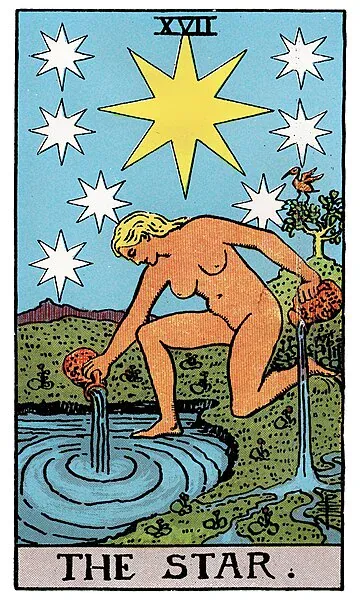
The Star
The night road meeting the Star's small clean light. Together the cards describe slow rehabilitation after a difficult season — the seeker has not yet arrived, but the worst of the disorientation has lifted and the path is now visible enough to walk without despair. Use the Star's clarity to set direction; use the Moon's patience to walk it.
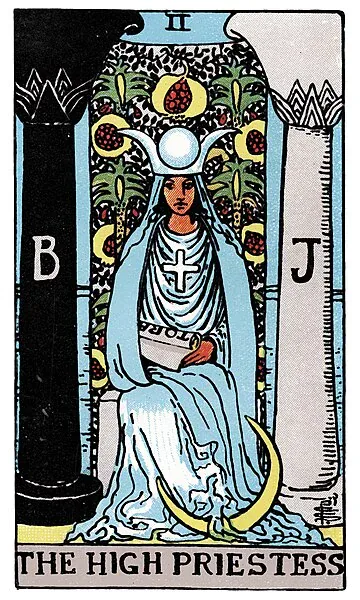
The High Priestess
Two lunar archetypes meeting on the same page. The High Priestess is the verifiable inner Moon, the threshold; the Moon as eighteenth Major is the silver fog itself, the territory before the door. Together they describe a season of unusually deep intuitive work, in which the seeker is both the one walking through the night and the one tending the threshold at its end.
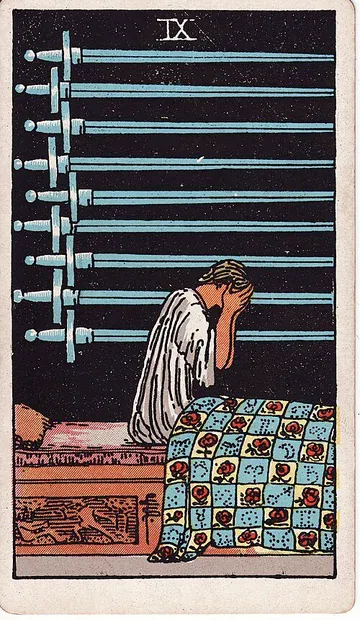
Nine of Swords
The most important diagnostic pairing in the deck. The Nine of Swords is the figure surrounded by the swords of imagined catastrophe at three in the morning; the Moon is the night that gives those images their plausibility. The combination demands the test — write the night-thoughts down, read them at noon, separate the rehearsal from the signal. Most of what you feared was not the thing.
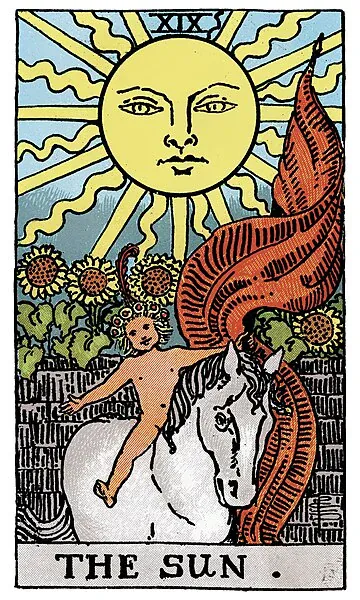
The Sun
The next card in the Major Arcana — the dawn after the long night. When the Moon and the Sun appear together, the seeker is being shown the full arc: what is currently in fog, and what the same situation will look like once the light comes. The pairing is unusually hopeful for the Moon's dignity and asks the seeker not to skip the night to get to the day.
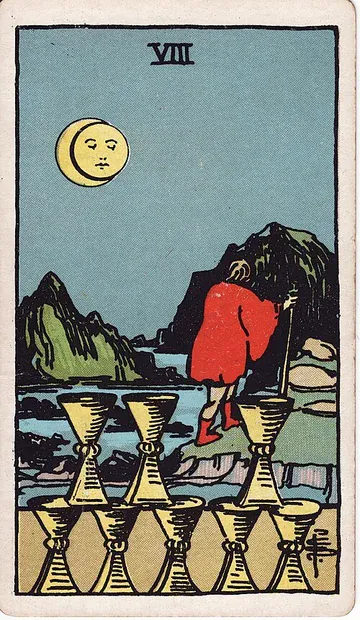
Eight of Cups
The decan-and-zodiac neighbor, sharing the Pisces / Saturn signature. The Eight of Cups is the deliberate departure from a life that was no longer giving water; the Moon is the road that follows the departure. Together they describe the long stretch between leaving and arriving — the months of walking through unfamiliar terrain after the older life has been put down.
Frequently Asked Questions
What does The Moon tarot card mean?
The Moon, the eighteenth Major Arcana card, means night work — the part of the soul's road that runs through unverifiable terrain. The path between two gray towers, the wolf and dog howling at the same Moon, the crayfish climbing from the pool. It is not a card of crisis but of patience: the road is real, the destination is real, and the light to verify either is borrowed. Walk by it.
Does The Moon mean someone is hiding something, or that I cannot see clearly yet?
More often the second. The Moon in love describes the layer of a relationship beneath the surface — the projection, the unspoken, the place where intuition reaches before language does. For partnerships, it is often a season of inarticulate strain that resolves with patience rather than interrogation. For new sparks, it warns against signing the lease while the early haze is still doing its work. The bond is real; the timing of clarity is not yet now.
What does The Moon mean as advice?
The Moon as advice is to walk the night road without trying to make it day. Trust intuition, but do not decide inside the dream. Write what you see at the edges of the path; read it in the morning. Distinguish intuition from anxiety — intuition leaves the body slightly clearer, anxiety slightly tighter. Take an actual walk after dark, without your phone. The card's gifts arrive at that pace, not at the pace of urgency.
Does The Moon mean wait until the fog clears before deciding?
The Moon is a conditional yes, with a delay. The thing you are asking about is real and possible, but the moment of clarity is not yet this week. Walk. Sleep on it. Some of the data is still under cloud. The card honors action and also notices that most actions taken in fog need correcting later. Save yourself the correction. Wait long enough for the night to do its work, then choose.
What is the difference between The Moon and The High Priestess?
Both are lunar archetypes, but their roles differ. The High Priestess is the threshold, the verifiable inner Moon — silent, full, framed by two pillars and a door. The Moon as eighteenth Major is the territory before the door, the silver fog itself. The High Priestess holds what the Moon is still walking through. Together they describe deep intuitive work; alone, the Moon is the journey, and the High Priestess is the keeper at its end.