
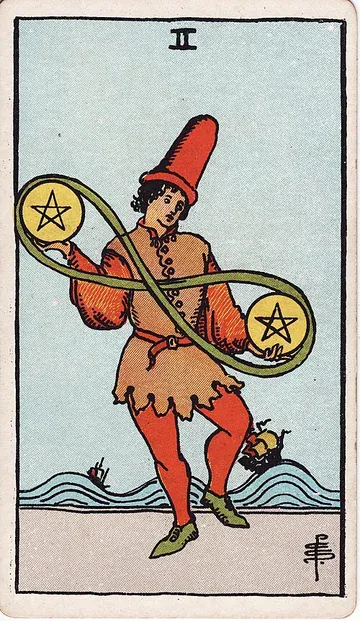
Two of Pentacles Reversed · Core Meaning
Reversed, the Two of Pentacles is still dancing — it has simply gone past the edge of what the dancer can hold. The throwing hand slows by half a beat. One coin hits the sand. Or both are still aloft, but the figure has lost track of which to catch first, and the rhythm — the thing that was holding the whole choreography together — is breaking. The cord that loops between the two pentacles has not snapped, exactly. It has gone slack. The infinity sign is still drawn in the air, but the air has gone out of the drawing.
This is the reversed card's central knot: overextension that has crossed an invisible line. The seeker is doing what they have always been doing — managing the projects, holding the relationships, tracking the finances, attending to the body — and at some point in the recent stretch, the doing stopped working. Not in any single dramatic way. In small ways. The deadline that slipped. The text that went unanswered for three days. The bill that was paid late. The body that hit a wall it has not hit before. The reversed Two of Pentacles is not the card of catastrophic failure; it is the card of competence that has been quietly eroding under load.
There is a second flavor of the reversed card that is less obvious. Not the dropped ball, but the frozen juggle — the seeker who is still technically holding everything, but has lost the rhythm that made the holding sustainable. The figure's body has stopped swaying with the waves. The knees have locked. The cups are aloft because the figure has gone rigid, and the rigidity is now the thing that will end the juggle. The reversed card warns against this kind of brittle competence. Stiffness in motion is the precursor to collapse, even when collapse is still some weeks away.
The astrological signature inverts to match. Jupiter in Capricorn's first decan, upright, is expansive movement held inside disciplined form — growth that respects the vessel. Reversed, the same configuration becomes the expansive impulse over-extended past the vessel's capacity, or the vessel hardened so completely that nothing can move within it. Jupiter wants more; Capricorn wants structure. When the friction between the two becomes excessive, the seeker starts adding cups beyond the count the hands can hold, or the seeker stops adding entirely and the structure becomes the cage. Both readings are the reversed card.
The kabbalistic reading reverses too. Chokmah in Assiah is the first differentiation, force becoming two in the world of action. Reversed, the differentiation has gone wrong: the two have become unhealthily separated, or the two have been forced into a single point that cannot hold them. The seeker is asked to find the right middle — the place where the two can remain distinct without collapsing into one and without flying apart into chaos.
Reversed, the Two of Pentacles asks: what did you take on that you did not have hands for? And: which cup, if you could pick one to set down without anyone seeing, would you choose? And: where, in the rhythm you have been keeping, has the rhythm started to keep you?
Two of Pentacles Reversed · Love
Two people can be decent to each other and still be losing, and the reversed Two of Pentacles is what that looks like from inside the house. A third thing is pulling on your hands — work, family, illness, financial pressure — and the relationship is the cup that has begun to slip. Not because the love has thinned, but because the bandwidth has. The reversed card is precise about the difference. The feelings are intact. The infrastructure of the partnership is straining.
For an existing partnership, the reversed Two of Pentacles often describes the season when both partners have quietly become roommates running parallel logistics. You text about the schedule. You coordinate the kid's pickup. You negotiate the household bills. The texts about how you actually feel have receded. The card is not predicting that the relationship will end. It is describing the precise mechanism by which long partnerships erode: not through betrayal, not through lost love, but through a long stretch of ambient stress that displaces the practices of intimacy. The card asks for a deliberate intervention. Block one evening a week. Talk about something other than logistics. Re-introduce the third loop in the cord, the one that is not about the schedule.
For a new connection, the reversed card warns of asymmetric availability. One of you is reachable, attentive, present in the small slots. The other is not, and the not-being-there is being framed as temporary while quietly becoming permanent. The card asks the seeker to be honest about the pattern. If the other person has been "too busy" for three months and is still saying it is temporary, the temporary state has stabilized into the actual state. The card does not condemn the other person — it simply describes the choreography. Their juggle does not currently include the loop you would need it to include. That may not change.
For someone asking whether love is possible after a break, the reversed Two of Pentacles is often a soft no, or a yes that is more complicated than either party wants. The relationship that broke broke because the rhythm became unsustainable. Returning to the same arrangement that broke under the same pressure that broke it is not reconciliation — it is the same juggle with the same cups. The card asks whether the underlying conditions have actually changed. If one partner has set down one of the demanding cups that was eating their bandwidth, the rhythm can return. If neither has, the return will repeat the breaking. Reconciliation in the reversed Two of Pentacles is conditional on structural change, not on emotional desire.
For a single seeker, the reversed Two of Pentacles describes a life that has become too crowded for love to land. The seeker is busy. The seeker is good at being busy. The busyness has become both a defense and a handicap. The card is not condemning. It is naming. If the seeker draws the reversed Two repeatedly across love readings, the card is asking the same question each time: which of the cups currently aloft are you willing to set down to make a space for someone? Without that, the answer to "is love possible" is technically yes — but no shape of love will actually fit through the door of your week as it currently stands.
For long-distance partnerships under stress, the reversed Two of Pentacles often describes the moment when the structure that was sustaining the long-distance arrangement has slipped. The standing call has been missed twice. The visit calendar has gone unbuilt for the next quarter. The cup has not yet dropped, but the rhythm has gone uneven. The card asks for the honest conversation. Long-distance does not survive on feelings; it survives on choreography. When the choreography slips, both partners need to acknowledge the slip rather than pretending it is fine. Repair, in the reversed card, looks like rebuilding the rhythm rather than declaring renewed love.
For the love language of juggling-attention, the reversed card describes the partner who used to remember everything and has begun to forget. They are not falling out of love. They are falling out of bandwidth. The card asks the asking partner to make a clear choice: extend grace and acknowledge the season is hard, or name that the forgetting has crossed into a level you cannot continue to absorb. Either is legitimate. What is not legitimate is allowing the forgetting to continue without being acknowledged on either side, which slowly poisons the bond from below.
For the question "is this person into me" with the reversed card, read the answer as: yes, in some warmth, but not in any way that is currently moving across the table to you. The feelings are stuck on their side. The card warns against waiting indefinitely for them to figure out how to deliver. Waiting itself is one of the cups in your juggle, and waiting indefinitely is a dropped one, even when the dropping is invisible.
For the overlapping-priority partnership — two ambitious people whose work, family, or callings are each large enough to be a full life on its own — the reversed Two of Pentacles describes the season when the choreography between the two ambitions has broken down. The unspoken agreement that you would each catch what the other dropped has frayed. Now both of you are dropping cups on the same days, and the household is the cup landing hardest. The card does not declare incompatibility; it asks for an explicit re-negotiation. Whose turn is it on which weeks. Which obligations are non-negotiable for one and flexible for the other. The repair lives in the writing-down, not in good faith alone.
For love after a wound, the reversed Two of Pentacles can describe the seeker who has used busyness as the bandage and is now finding that the bandage has begun to obscure the wound rather than allow it to heal. The schedule that filled the months after the loss has filled them so completely that the grief has had nowhere to land. The card asks for a deliberate reduction in the busyness specifically to make room for the feeling that has been postponed. This is not contradiction with the upright reading; this is the moment when the upright reading's careful re-emergence has tipped into avoidance, and the reversed card is naming the tip.
Two of Pentacles Reversed · As Feelings
The warmth is real; the timing is not — and reversed, the Two of Pentacles is nearly always a card about timing when someone asks how another person feels. They feel something. The feeling has not yet found its way out of the part of their life that is currently consuming them. This is the Two of Pentacles reversed as feelings at its most precise: warmth held captive by a logistical reality the other person has not yet figured out how to shift.
If they are reserved by nature, the reversed card can mean the inner monologue about you has begun to thin. They were tracking you carefully a month ago. They are still tracking you, but the tracking has gone shallower as the demands on their attention have widened. The card is not declaring rejection. It is naming a precise drift. If you sense that you used to be more centrally on their mind than you currently are, the sense is correct. The drift is real. The drift may also be reversible, but only through intervention from one of you.
If they are demonstrative, the reversed Two of Pentacles in feelings can describe the partner who is performing care without delivering it. They post the photographs. They send the goodnight texts. They say the right phrases on the phone. The performance is not necessarily false; it is, more often, a placeholder for delivery they cannot currently make. The card asks the seeker to read the gap. The texts come in. The presence does not. The structure of the relationship has tilted into representation rather than encounter. Watch for whether they show up, not whether they say they will.
For a long-term partner, the reversed card in feelings can describe affection that has gone operational and started to thin even at the operational level. They love you. They have stopped, for the moment, doing the small specific things that their love used to be made of. The mornings they used to make coffee for you have become mornings they handle their own. The Sundays they used to protect for the two of you have become Sundays of catch-up work. The card asks for the quiet, non-blaming conversation about what has been displaced. Most reversed Two of Pentacles in long partnerships is recoverable; what kills it is unspoken accumulation.
For a new connection, the reversed Two of Pentacles in feelings can describe ambivalence that the other person has not yet acknowledged to themselves. They are interested. They are also resistant. The interest and the resistance are taking turns, and the rhythm of the taking-turns is what the seeker is feeling as inconsistency. One week they are present. The next week they have receded. The card warns against reading either week as the truth — neither is. The truth is the unresolved oscillation. The card asks the seeker to be patient with the oscillation only as long as it shows signs of resolving. A pattern that does not stabilize within a season is not ambivalence; it is its own answer.
For a partner you are unsure about, the reversed Two of Pentacles in feelings asks the harder question: are you waiting for warmth that has not yet been delivered, or are you waiting for warmth that the other person is structurally unable to deliver in their current life? The card distinguishes between the two. Some reversed Two of Pentacles is a season; some reversed Two of Pentacles is a structural reality. The seeker has to read carefully. If their life has been like this for years, the season is the structure. The card asks for honesty about which one you are inside.
For someone you have only just met, the reversed card in feelings can describe a mismatch between their interest and their availability. They like you. Their life cannot currently absorb you. The card warns against reading their distraction as personal. It is rarely personal; it is bandwidth. The card also warns against waiting indefinitely for the bandwidth to free up. Note the timing. Decide for yourself how long you are willing to wait inside the unresolved availability before letting the cup land.
For a partner during a recent hard stretch — illness, grief, professional crisis — the reversed Two of Pentacles in feelings can describe genuinely preserved love that is, for the moment, traveling on a damaged road. Read tenderness as still real. Adjust expectations. Check in. The card supports the seeker who can extend grace through the season without losing themselves in the extension. The grace has limits; the limits are part of the grace.
A specific caution for the reversed card: when feelings have gone unreliable, the seeker often interprets each pulse of warmth as proof of underlying steadiness. The pulse is real. The pulse is not the same as the steady current. The card asks the seeker to read the average, not the peaks. Some partners run hot in moments and absent in stretches. Some partners run quiet in moments and reliably present across stretches. The reversed Two of Pentacles person is currently running unreliable. Whether to wait for the reliable mode to return is the seeker's choice. The card does not make it for them.
Two of Pentacles Reversed · Career
In career readings, the reversed Two of Pentacles describes the work life that has crossed from full into too full. The deadlines are slipping. The quality is dropping in places no one outside the seeker has yet noticed. The body that used to recover overnight no longer recovers overnight. Something has to give, and the card is asking the seeker to make the giving deliberate rather than waiting for the breaking.
For someone in a current role, the reversed card warns of the slow erosion of competence under cumulative load. The work that used to take an hour is taking ninety minutes. The follow-up that used to be automatic is being missed. The colleagues who used to receive your full attention in meetings are now receiving partial attention while you triage other tabs. The card is not blaming the seeker. It is naming the pattern. The role has expanded past the original shape, and either the shape needs to be renegotiated or the seeker needs to set down some of the unofficial work that has accreted around the official one. Doing nothing means the erosion will continue, and the moment of formal failure will arrive without warning.
For someone considering a new role, the reversed Two of Pentacles asks for hard honesty about what you are currently dropping. The new role is not relief if you carry the same juggle into it. The new desk receives the same overextension you brought from the old one, and the new role reveals the overextension faster than the old role did. The card supports the new role only when paired with a deliberate audit of what comes with you. Cut, before you move. Do not assume the move will do the cutting for you.
For an entrepreneur or freelancer, the reversed card describes the small business that has grown past its original choreography. The number of clients has gone up. The administrative load has grown. The work itself is starting to suffer. The card asks for one of three concrete moves: hire someone, raise prices to take fewer clients, or formally narrow the service offering. None of these are easy; all of them are required eventually. The card warns against the seductive instinct to just work harder. The harder-work strategy works for one season. After that, it begins to cost more than it produces.
For a side-project alongside a day-job, the reversed Two of Pentacles describes the moment when one of the two is bleeding into the other. Either the day-job is leaking into the side-project's evening hours, or the side-project is starting to compromise the day-job's quality. Both directions are unsustainable. The card asks for a frank reassessment of capacity. If the side-project is the dream, what would it take to formalize a transition timeline? If the day-job is the priority, what would it take to put the side-project on official hold? The middle, where neither is winning, is where reversed Two of Pentacles lives, and it is the worst of both worlds.
For a creative practice, the reversed card warns of the artist who has spread their attention across too many smaller projects and is no longer building the body of work that the underlying ambition actually requires. Three half-finished books. Five abandoned recordings. A studio full of paintings nobody outside the studio has ever seen. The card asks for selection. Pick one. Finish it. The choice is not about discarding the other projects forever; it is about restoring the rhythm of completion that the practice has lost.
For a job-search or career transition, the reversed Two of Pentacles describes the search that has become a second full-time job on top of the existing one and is starting to fail in both directions. The applications are being sent, but they are getting less personal because the volume has expanded. The current role is being maintained, but on autopilot, because the search is consuming the active attention. The card asks for limits. Cap the number of applications per week. Cap the number of conversations per week. Protect the energy reserves the actual transition will eventually require. Sprint searches that exhaust the seeker rarely produce the right next chapter.
For a promotion question, the reversed card warns of a promotion that will exacerbate an already-strained juggle. The new title sounds like recognition; the new responsibilities will widen the cups currently aloft rather than reduce them. The card does not say to refuse the promotion. It says to negotiate the structural support that goes with it — the additional headcount, the redistribution of responsibilities, the explicit setting-down of the work that should not follow you into the new role. Without those negotiations in advance, the promotion will accelerate the erosion the reversed card is naming.
For a layoff or forced transition, the reversed Two of Pentacles can describe the in-between season when severance is running thin, the search has not yet produced the next role, and the seeker is starting to take any work to keep the cash flow whole. The card warns against the panic move. The work taken in panic rarely becomes the work that builds the next chapter; it usually becomes a third cup that prevents the search itself from completing. Keep the buffer if you can. Take small bridge work only if it does not consume the search-time. The card supports patience here, not because patience is virtuous, but because the next role lands more cleanly when the search has not been fragmented by stopgaps.
For colleagues and team dynamics, the reversed card can describe a workplace that has become toxic through chronic overload — the team that has been understaffed for two quarters and is now eating itself, the manager who is failing because the role they were given was structurally impossible. The card validates what the seeker is sensing. It also asks the seeker to decide their own position carefully. Sometimes the answer is to advocate for structural change. Sometimes the answer is to leave. Both are responses to the same diagnosis. The card endorses the deliberate response and warns against the resigned drift that absorbs the dysfunction without naming it.
Two of Pentacles Reversed · Money
In money readings, the reversed Two of Pentacles describes a financial wobble that has crossed from manageable to uncomfortable. The cash flow that used to balance is now arriving slightly later than the bills. The buffer that used to carry the wobble has gone thin. The decisions that used to be deliberate are starting to be made under pressure. The card is not predicting financial disaster; it is precisely describing the moment when small slips begin to compound, and asking for the careful intervention that prevents the compounding from becoming the disaster.
For someone tracking a budget, the reversed card warns that the tracking itself may have slipped. The spreadsheet has not been updated in three weeks. The receipts have piled up unentered. The seeker has the vague sense that things are going okay, and the vague sense is operating in the absence of actual data. The card asks for the small unromantic act of catching up. Sit down. Reconcile the past three weeks. Look at the actual numbers. The reversed card almost always becomes more navigable the moment the seeker stops avoiding the ledger.
For a question about whether to make a major purchase, the reversed Two of Pentacles is a soft no, or a delay. The card describes a financial life that is currently absorbing more than it can comfortably sustain. Adding a new commitment now will tip the wobble into actual problem. The card is not forbidding the purchase forever; it is asking for the postponement until the underlying rhythm has been restored. A season of restraint, then re-evaluation. The seeker who acts now without the audit will spend the next year managing the regret.
For someone considering an investment, a gamble, or a speculative move, the reversed card is a clear no. The Two of Pentacles upright was permissive about disciplined risk; the reversed card is not. The card describes a financial position that is already overextended; speculative moves on top of overextension produce the kind of loss that takes multiple years to unwind. The card asks the seeker to first restore the foundation before considering any move that depends on the foundation holding.
For someone managing two income streams under reversed Two of Pentacles, the card warns that one of the streams may be quietly costing more than it brings in. The side hustle that looked profitable last quarter, when properly accounted for the time it consumes, is now operating at a hidden loss. The rental property that produced rental income is now producing net deficit when maintenance costs are honestly tallied. The card asks for the unsentimental review. Sometimes one of the two streams needs to be wound down, not because it has failed dramatically, but because it has stopped earning its place in the juggle.
For someone in financial recovery, the reversed Two of Pentacles describes a setback or a slowing of the climb. The progress that was steady has flattened. The debt that was being paid down has started to grow again, slowly, through one too many small overrun months. The card is not condemning. It is naming. The seeker who recognizes the slowing while it is still small can intervene; the seeker who waits will find the intervention much harder six months from now. Catch it now.
For windfall under the reversed card, the warning is about deployment under pressure. A windfall that arrives during a wobble tends to be eaten immediately by the wobble itself — paying down the credit card balance that has crept up, covering the rent shortfall from last month, plugging the holes the buffer should have plugged. None of this is wrong; some of it is necessary. The card simply warns that windfalls absorbed into ongoing wobble do not become wealth-building events. They become triage. The longer-term work is restoring the underlying rhythm so that the next windfall, if one comes, can be deployed deliberately rather than triaged.
For long-term financial planning, the reversed Two of Pentacles describes the moment when the long-term plan needs to be honestly revised. The retirement number that was reasonable five years ago has become unreasonable given the actual trajectory. The mortgage timeline that assumed steady raises has not absorbed the years of flat income. The card asks for the revision. Not the dramatic gesture, just the quiet update of the assumptions to match the reality. Plans that match reality survive. Plans that do not match reality eventually shatter against it.
A practical move when the reversed card appears in a money question: pick one financial cup currently aloft and set it down on purpose. Cancel one subscription. Pause one obligation. Defer one optional cost for a quarter. The act of deliberately reducing the juggle, even by one element, often restores enough rhythm that the rest becomes manageable again. The card responds to specific, small, completed acts of reduction much more than to large abstract resolutions.
Two of Pentacles Reversed · Health
For health readings, the reversed Two of Pentacles describes a body that has been holding the rhythm under sustained load and has begun to register the cost. The fatigue that used to clear with one good night of sleep is no longer clearing. The pain in the lower back, the wrists, the shoulders — the pivots of the juggle — has become chronic rather than episodic. The mood has thinned. The patience has thinned. The body is sending the kind of signals it sends when the choreography has crossed into the unsustainable, and the card is asking the seeker to listen rather than to keep adapting around the signals.
The card's bodily map is the same as upright — waist and wrists, the pivots of juggling — but reversed, these are the regions where overload makes itself most visible. Tightness at the waist that does not unwind with stretching. Stiffness in the wrists that has gone past the keyboard ache into something the seeker has begun to organize their day around. The card does not diagnose; it points to where attention needs to go.
For someone with a chronic condition, the reversed Two of Pentacles often describes a season when self-management has slipped. What used to have a fixed hour now floats to wherever the day has room, and some days have none. The exercise is happening — sometimes. The discipline that held the condition in stable territory has loosened, and the loosening has felt like a small permission rather than a problem. The card warns that the loosening is now the issue. The condition is starting to drift back toward the territory the seeker had worked hard to leave. The rhythm that was holding it steady is worth restoring. The card does not ask for a heroic restart; it asks for the resumption of the small daily steadinesses.
For an acute issue, the reversed card warns of the illness or injury that the seeker has been working around rather than working through. The cold has been suppressed by over-the-counter medication for ten days while you push through the launch. The injury has been stretched and ignored because the season is too busy for proper rest. The card asks for the acknowledgment that working-around has limits, and the limits have been reached. Take the day off. See the practitioner. The detour is not the catastrophe the seeker is imagining; the continued working-around is.
For someone managing an exercise practice, the reversed Two of Pentacles describes the practice that has either dropped completely under load or has continued at intensity that has crossed into damage. Both are reversed-card errors. The seeker who has stopped exercising entirely because the schedule has gone wild is letting the body deteriorate. The seeker who is still pushing the same intensity into a body that is now under cumulative stress is courting injury. The card asks for moderation in both directions. Some practice, scaled to current capacity, sustained until the season changes.
For sleep, the reversed Two of Pentacles is one of the deck's clearer warnings. Sleep is the cup that the seeker drops first and notices last. The card describes the sleep that has been quietly compromised for weeks — the bedtime that has crept later, the wake-time that has crept earlier, the night that is technically eight hours but has become fragmented in ways the seeker has stopped tracking. The card asks the seeker to treat sleep as the non-negotiable foundation it actually is. Most reversed Two of Pentacles in health readings begins to repair through restored sleep, before any other intervention.
For someone managing food and eating, the reversed card warns of the eating that has gone reactive — meals skipped under pressure and then over-eaten at night, snacks substituted for meals through the busiest weeks, the body fed for fuel rather than for nourishment. The card does not lecture. It asks for the basic practice of eating at regular times even when the schedule resists, and for the simple meal eaten at the table rather than at the desk at least once per day. Small rhythms restore.
For mental health, the reversed Two of Pentacles can describe the season when the practices that hold the seeker together have started to lapse. The therapy appointment that has been rescheduled three times. The journal that has not been opened in a month. The walks that have stopped. The card warns that the lapses are not individually catastrophic but cumulatively serious. Re-engage with one of the practices, deliberately, before the rest of the supports erode. The reversed card responds to the small act of resumption — making the appointment, opening the notebook, taking the walk on Sunday — much more than to grand resolutions about returning to perfect practice. Making the appointment is the small resumption the card supports; the medical advice happens inside it, not here. Keep your practitioners. Take your medicine. The card simply offers the gentle, honest mirror: the rhythm that holds your wellness has slipped, and the slip is asking to be acknowledged before it deepens.
Two of Pentacles Reversed · Spirituality
Spiritually, the reversed Two of Pentacles describes the practice that has been crowded out by the world. Not abandoned — abandonment is dramatic, and the card is rarely dramatic. Crowded. The morning meditation that has not happened in ten weeks because the mornings have all been consumed. The journal that lies on the bedside table unopened. The contemplative reading that gets put back on the shelf each Sunday with the resolve to begin tomorrow. The card describes the seeker whose spiritual life has not been rejected, only displaced — and asks whether the displacement has gone on long enough that it has become its own quiet decision.
The card's kabbalistic placement, Chokmah in Assiah, reverses into the wisdom that has lost its ground in the world of action. The teaching the seeker once carried into the body has stayed in the head, where it is repeated as content rather than enacted as practice. The card asks for re-embodiment. Not more reading. Not more research. Sit. Walk. Light the candle. The reversed card responds to the smallest act of returning to the form, much more than to the most articulate explanation of why the form matters.
For seekers in active practice who find themselves in a slip, the reversed Two of Pentacles names the slip without judgment. Most spiritual lives, across decades, contain seasons of slip. The card asks two questions. First: is this slip a temporary displacement that will repair itself when the external pressure eases, or has the slip become a structural change in the priorities you actually live? Second: if the slip is structural, are you willing to name it as a deliberate choice — to say "I have, for this season, set the practice down" — rather than continuing the pretense that you are still practicing while you are not? Both honesty options are available. The card supports the seeker who chooses one.
For seekers exploring belief, the reversed card warns of the spiritual life that has become collected rather than lived. The bookshelf is full of contemplative classics. The Spotify queue is full of teaching podcasts. The Instagram feed is curated with quotes. None of this has become a practice. The reversed Two of Pentacles is the card of spiritual consumption that has displaced spiritual action. The remedy is not more curation; it is one specific, small, embodied practice repeated daily for a month. Choose one. Begin. Stop reading until you have done it for thirty days.
For ritual work, the reversed card warns of practices that have gone mechanical. The gestures are still being performed, but the attention has left them. The seeker is going through the motions and feeling the diminishing return. The card asks for either a deliberate rest from the practice, so the heart can return to it freshly, or a complete reset of the form — different posture, different sequence, different time of day — to let the attention re-engage. Mechanical practice and no practice are similar in their fruits; both starve the soul of what the practice was meant to feed.
For questions about path, the reversed Two of Pentacles asks whether the path has become something you carry rather than something that carries you. The seeker who has been doing the practice for years has, sometimes, mistaken the maintenance of the practice for the practice itself. The card invites a reset moment. Step back. Notice that the path was never the practice; the practice was the vehicle by which the path made itself available. If the vehicle has stopped serving, change the vehicle. The path is patient.
A small practice for the reversed Two of Pentacles in spiritual readings: at the close of the day, sit for three minutes — not the forty you used to manage, not the ten you cannot find — and breathe. Three minutes. The card responds to the deliberate, ridiculous-seeming smallness of the gesture. Three minutes resumed daily for a week is, in the card's accounting, more spiritual movement than forty minutes promised and not delivered. Begin with the small. Let the small accumulate. The infinity cord between practice and life rebuilds through small, repeated loops.
Two of Pentacles Reversed · Yes or No
Possible, but not at this weight — no, until something is set down first. The Two of Pentacles reversed yes or no is rarely a clean refusal. It is more often a warning that the path being asked about is technically possible but currently structurally unsustainable. The card looks at the cups already aloft in the seeker's life and says: there is not room to add this without dropping something else, and what would have to drop is more important than what is being asked.
For yes-or-no questions about a relationship, a job, a move, or a decision: the answer is no for now, or yes only with a structural change you have not yet made. The card is not predicting failure if you act anyway; it is precisely describing the cost. You can take the new job, but the relationship will be the cup that drops. You can begin the new relationship, but the side-project will be the cup that drops. The reversed card asks the seeker to face the trade explicitly rather than hoping the trade will not be required.
For questions about whether something will work out, the reversed card answers: not in the current structure. The card does not condemn the goal. It says the path being walked toward the goal has gone past sustainable, and the work-out outcome depends on first restoring the underlying rhythm. Step back. Audit. Re-set. Then move.
For questions about whether someone is being honest, whether an offer is genuine, whether a plan will hold: the reversed card warns of pleasant surfaces hiding strained underlying realities. The honesty is partial. The offer is genuine in intention but cannot be delivered at the level promised. The plan looks good on paper and will fail at execution because the people executing it are already overextended. Read the structure carefully. Do not be reassured by sincerity alone — sincere people deliver poorly when they are out of bandwidth.
For timing, the reversed Two of Pentacles often suggests delay rather than refusal. The thing you are asking about may yet happen, but not in the timeline you are hoping for. The current rhythm cannot accommodate it. Wait for the rhythm to change. Sometimes that wait is weeks; sometimes it is a season; sometimes it is longer. The card does not specify the duration. It specifies the condition: the wait ends when the underlying juggle has been honestly reduced.
For binary questions about whether to act now or wait, the reversed card leans toward wait. Not forever. Long enough to set down at least one of the cups that is currently consuming your attention, so the new act has somewhere to land. Acting under reversed Two of Pentacles, without the prior reduction, tends to produce the wrong outcome — not because the act itself was wrong, but because the strained system absorbing it cannot give it what it needs to flourish.
If the question was "should I keep going," the reversed card answers: keep going only if you are willing to set down at least one of the things you are currently holding. Continued juggling at the current level is not sustainable, and the card is not asking you to be less ambitious — it is asking you to be more honest about the choreography.
If the question was "do I have what it takes," the reversed Two of Pentacles answers: yes, and the asking is a sign that the system is overloaded. Capable people who are well-rested do not ask whether they have what it takes; the asking is itself a symptom of the strain the card is describing. The work is not to find more capability; the work is to set down enough so that the capability already present can express itself cleanly.
Two of Pentacles Reversed · Advice
Set one coin down on purpose — that is the whole of the Two of Pentacles reversed as advice. Not as failure, not as defeat, not as the dramatic gesture of giving up. As the deliberate, conscious act of admitting that the juggle has crossed past your range, and that the rhythm cannot return until the load itself reduces. Pick one of the things you are currently holding. Choose the one that is consuming the most attention for the least felt return. Set it down. Tell whoever needs to be told. Resume the rhythm at a count of cups your hands can actually hold. The card warns that the seeker who refuses this choice does not preserve the juggle by refusing; they extend it slightly while guaranteeing the eventual collapse will be involuntary. Voluntary reduction now is the only way to prevent involuntary failure later.
Stop adding cups for ninety days. The reversed Two of Pentacles often appears in the lives of seekers who have a habit of saying yes — to projects, to invitations, to the request that arrived at the worst moment, to the friend who asked for the favor when you were already at capacity. The habit is part of how you got here. The card asks for a temporary moratorium. For ninety days, the answer to "can you take this on" is no, with no apology and no explanation beyond a brief honest statement that you are at capacity. The moratorium does not have to be permanent; ninety days is enough for the existing juggle to either reduce naturally or for you to identify which cups you actually want to be holding.
Audit the calendar. The Two of Pentacles reversed responds with unusual reliability to the practice of looking at the actual calendar — not the imagined one, but the one with the actual hours blocked off — and naming, for each block, what cup it is feeding. Do this for a week. Notice the blocks that are being absorbed by cups you have not consciously chosen. Notice the cups that are getting no blocks at all. The audit, alone, often surfaces the cup that wants to be set down. The seeker rarely needs to be told which one; they need to be made able to see the choreography clearly enough that the answer becomes obvious.
Tell one person the truth. The reversed Two of Pentacles describes a strain that the seeker has often been carrying mostly silently. Some of the strain is structural — too many demands. Some of the strain is the silence around the demands. Telling one trusted person — partner, friend, therapist, mentor — the actual current state of the juggle, in its specific embarrassing detail, often provides a kind of relief that no internal reorganization can produce. The card endorses the small honest disclosure to one person. The disclosure is not the solution; it is the precondition that lets the solution become possible.
Practical advice for the day the card appears: cancel one thing on this week's calendar that is not strictly required. Not the work meeting. Something smaller. The optional dinner. The catch-up call you have been dreading. The errand that can wait one more week. Cancel it on purpose, with full awareness of what you are doing. The reversed card responds to the small completed act of reduction far more than to the large abstract resolve. One cancellation is the proof that you are willing to set down what you are willing to set down. Begin there. The rhythm restores from below, one small honest act at a time.
Two of Pentacles Reversed · Card Combinations
Two of Pentacles Reversed + Two of Cups
The juggle that has begun to thin the partnership beneath it. The two cards together describe a relationship that is, on the surface, still intact — but the dignity that earth and water used to share has gone uneven. One partner is over-absorbed in their juggle; the other is feeling the cup of the partnership move from the center of the table to the edge. The combination asks for restoration of the shared time before the slow drift becomes structural. Set down one of the juggle's cups on purpose. Reclaim the evening that used to be theirs.
Two of Pentacles Reversed + Three of Pentacles
The solo juggle that has refused the offered help. The Three of Pentacles is collaboration — the craftsperson, planner, and patron meeting to share the work — and the reversed Two beside it describes the seeker who has been offered hands and not accepted them. The advice is direct: the colleagues who have offered to help are not threats to your ownership of the work; they are the rhythm-restorers your hands need. Accept one offer. Hand off one cup. The reversed Two repairs through delegation, not through harder solo effort.
Two of Pentacles Reversed + Wheel of Fortune
A turn of fortune arriving while the seeker is mid-wobble. The Wheel introduces external change — opportunity, luck, disruption — and the reversed Two describes a juggle already past capacity. The combination warns that even favorable change, layered onto an overextended life, will not feel favorable. The advice is to deliberately reduce the juggle before responding to whatever the wheel has brought. A good opportunity received in wobble becomes a missed opportunity. Stabilize first, then meet what the wheel turned toward you.
Two of Pentacles Reversed + The Hanged Man
A signal that the juggle has gone past adjustment and into the territory where suspension is the only honest move. The Hanged Man does not ask for a smaller juggle; it asks for the cessation of juggling altogether for a season. Sabbatical. Retreat. Step back fully. The reversed Two beside the Hanged Man rarely repairs through marginal optimization. The combination supports the larger pause — the medical leave, the unpaid month, the deliberate hiatus that lets the underlying choreography re-set rather than reorganizing under the same exhausted assumptions.
Two of Pentacles Reversed + Four of Pentacles
A diagnostic pairing. The reversed Two is the juggle that has slipped; the Four is the temptation to grip what remains so tightly that nothing can move at all. Together, the cards describe a seeker who, finding the rhythm broken, has been retreating into rigid control as a substitute. The Four offers the false comfort of total holding. The combination warns against this trade. Rigid control is not the cure for failed rhythm; it is the next stage of the same problem. The repair is not tighter holding. The repair is letting one of the cups land cleanly and rebuilding the rhythm from the smaller, honest count.
Card Combinations
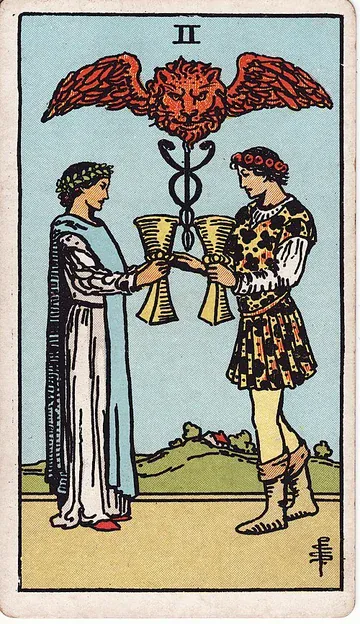
Two of Cups
Two twos in elemental friendship — earth steadied by water, the juggle met by a partnership that holds the second hand. Together, the Two of Pentacles and the Two of Cups describe a long bond that has stopped pretending the work of staying connected is anything other than rhythmic. The dignity between earth and water is the foundation; the choreography is the shared art. The advice is to honor what each suit gives the other. The cup steadies the juggler. The juggler protects the cup.
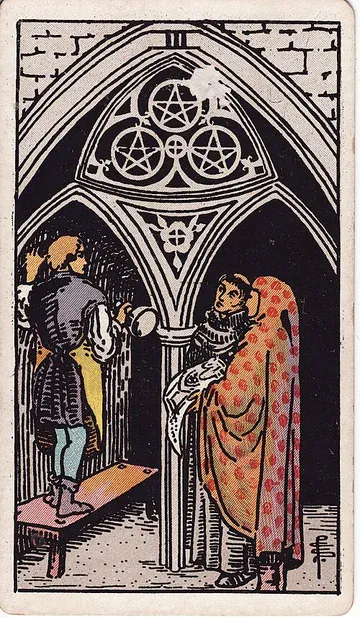
Three of Pentacles
The solo juggle yielding to collaboration. The Two of Pentacles is one figure with two coins; the Three of Pentacles is a craftsperson, planner, and patron meeting in a vaulted room to coordinate a single piece of work. Together, the cards describe a transition the seeker is being invited to make — from carrying everything alone to letting the work become collaborative. The Three reduces the Two's wobble by adding hands. Look for the colleagues, contractors, and team members who can take one of the cups and hold it cleanly while you handle the rest.
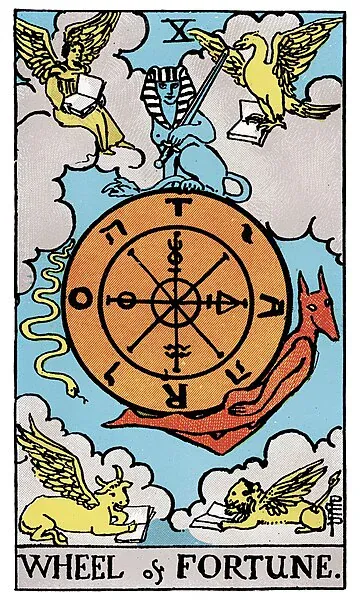
Wheel of Fortune
Daily rhythm meeting cyclic fortune. The Two of Pentacles is the seeker's own choreography; the Wheel of Fortune is the larger turn of luck and timing the choreography happens inside. Together, the cards describe the moment when the small rhythm being kept reveals itself as participation in something much bigger — a season of fortune with its own arc. The advice is to keep the daily juggle steady while the larger wheel turns. The wheel rewards steadiness during its turning more than it rewards dramatic intervention.
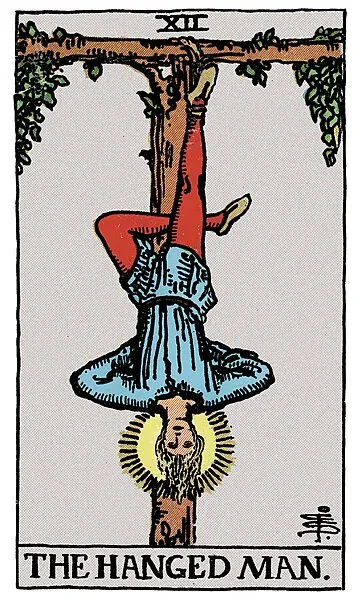
The Hanged Man
Balance in motion meeting suspended balance. The Two of Pentacles holds two cups aloft through constant adjustment; The Hanged Man holds a single posture by surrendering to gravity. Together, the cards describe the seeker who has been juggling for a long stretch and is now being asked to switch into a different mode entirely. Not more juggling, but a deliberate suspension — sabbatical, retreat, hiatus. The Hanged Man invites the seeker to set both pentacles down for a season and meet what is true beneath the rhythm.
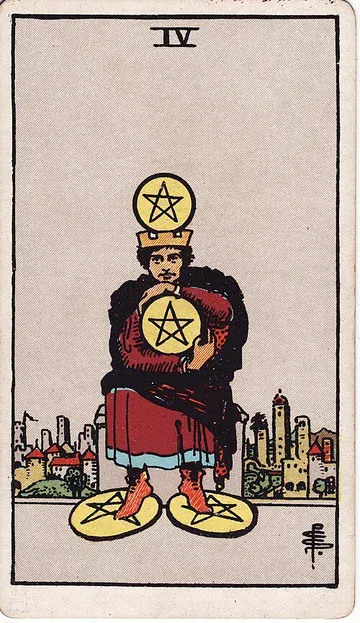
Four of Pentacles
Fluid juggling against fixed clutching — a tonal contrast that sharpens the Two of Pentacles' meaning. The Two keeps both coins moving through soft knees and shifting weight; the Four of Pentacles holds his coins so tightly that nothing can move at all. Together, the cards name the choice the seeker is currently inside: continue the juggle, or harden into the grip. The Four offers the false comfort of total control; the Two offers the truer comfort of honest motion. The advice is to stay with the wobble. Clutching looks like safety from outside; from inside, it is the slow constriction that ends movement entirely.
Frequently Asked Questions
Is the Two of Pentacles reversed telling me to put something down before I answer?
The Two of Pentacles reversed yes or no is closer to no than yes. The card describes a life already overextended; adding the new commitment without first reducing one of the existing cups will tip the whole juggle into wobble. Treat the answer as a soft no for now, or a yes only with a structural change you have not yet made. Set one cup down on purpose, then reconsider.
With the Two of Pentacles reversed, is my partner overloaded or have they stopped trying?
Overload, in nearly every case: reversed, the Two of Pentacles describes a relationship squeezed by demands the partnership did not choose — work, family, illness, financial pressure pulling on hands that were already full. For partnerships, it warns of the slow drift into parallel logistics where intimacy has been displaced by scheduling. For singles, it describes a life too crowded for love to land. For reconciliation questions, it asks whether the underlying rhythm has actually changed.
With the Two of Pentacles reversed, is their silence about me or about their week?
Their week, in most cases: the Two of Pentacles reversed as feelings describes warmth held captive by a logistical reality the other person has not yet worked out how to shift. They feel something. The feeling has not yet found its way out of the part of their life that is currently consuming them. Read silence as bandwidth, but watch the pattern across weeks — a feeling-rhythm that is steadily thinning is its own answer.
How do I know when the Two of Pentacles juggle has crossed into unsustainable?
The warning is that the juggle has crossed from sustainable into unsustainable, and the small slips you have been ignoring are the early signs of an erosion that will compound. The deadline that bled. The text that went unanswered. The bill paid late. The body's new chronic ache. The card warns against the seductive instinct to just work harder. The harder-work strategy works for one season, then it begins to cost more than it produces.
What advice does the Two of Pentacles reversed give?
The Two of Pentacles reversed advice is to set one coin down on purpose. Pick the commitment that consumes the most attention for the least felt return. Set it down deliberately — not as failure, but as the conscious act of admitting that the juggle has crossed past your range. Then audit the calendar, declare a ninety-day moratorium on adding new commitments, and tell one trusted person the actual current state of the load. Voluntary reduction now is the only way to prevent involuntary collapse later.
Continue Reading
Two of Pentacles · Card overview · symbols · correspondences →
Return to the full card view — image, symbols, sensory correspondences, and Hermetic axes.
Read the upright meaning →
Read the same depth on the opposite orientation.
Draw your reading now →
Bring this card to a question — open a quiet ritual.