Wheel of Fortune Tarot · Core Meaning
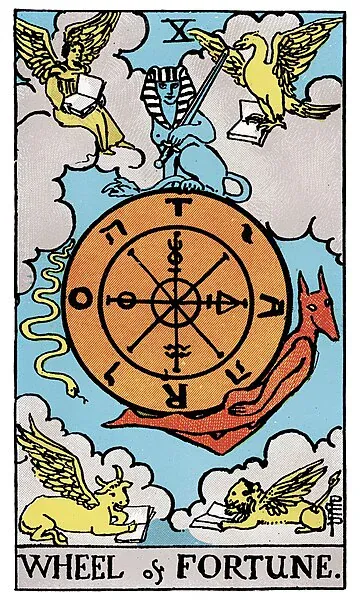
Nothing in this picture has a hand on the rim, and the wheel turns anyway — motion the Wheel of Fortune names but did not start. A great wheel hangs in indigo cloud, its rim cut with the letters R-O-T-A and the four Hebrew letters of the divine Name. A blue sphinx sits at the top, sword across its lap. A serpent slides down the left edge. A jackal-headed figure rises along the right. At the four corners of the sky, four winged creatures — a man, an eagle, a lion, a bull — read from open books. The wheel turns slowly. No hand pushes it. No hand can stop it.
This is the card's central image: the wheel is already moving, and you happen to be standing at an angle where your hand can reach the next notch. Not the whole rim, not the axle, not the previous turn that took someone else up while you were down. Just the one tooth directly in front of you. The sphinx at the top is not steering. It is the still center that does not get flung off when the wheel accelerates. The serpent and the jackal-headed one are not winning or losing — they are taking their turn at descent and ascent, knowing that the wheel will turn again either way.
The card's signature tension is between the wheel and the axle. The wheel is the visible drama: timing, fortune, the unexpected door that opens, the equally unexpected door that closes. The axle is the seat from which the wheel is watched. The Wheel of Fortune is often misread as a card about good or bad luck. It is more precisely about recognizing the wheel one is already inside — the cycle of weather, the season of arrival or descent, the longer rotation of which any single moment is one tooth. The card is named "Fortune," and the English word tempts the predictive reading. Resist. The card does not forecast. It describes a shape.
The traditional astrological signature is Jupiter — the planet of expansion, benevolent fortune, larger-than-asked-for gifts, the door that opens from the outside. Its zodiacal homes here are Sagittarius and Pisces, both mutable, both signs that bend with the wind rather than break against it. Together: bigness that arrives on its own schedule, and a temperament willing to ride it without claiming to have summoned it. On the Tree of Life, the card walks the 21st path, from Chesed (Mercy) to Netzach (Victory) — from the structured generosity of the upper triad down to the lived experience of triumph, the path along which grace becomes movement. The Hebrew letter is Kaph (כ), the open palm — the hand that can both grasp and release, which is exactly the gesture the card asks for.
Ten is the number cut into the card, and ten is a round closed: every count that begins at one arrives here and starts again as one. That is why the card's clock runs on hinge days — solstice, equinox, the four points of the year where the light's arc changes direction without anyone touching it. Its hour is noon, the sun at its height, which is also the first instant of its descent; its season is the autumn equinox, the day the year tips and the tipping is invisible until the week after. None of this is doom. It is arithmetic. A cycle that has reached ten is not ending; it is about to be counted from the beginning, and the seeker who feels the ground shift under a perfectly ordinary Tuesday is usually standing on one of these hinges.
Look once more at the corners. The four winged readers are the four fixed signs — the man of Aquarius, the eagle of Scorpio, the lion of Leo, the bull of Taurus — and they do not rotate. Inside the ring, the card's own signs, Sagittarius and Pisces, are both mutable: they are the turning. The image is therefore a diagram of how to survive motion: fixed points at the edges, mutable motion at the center, and a sphinx who is neither, holding the sword flat instead of raised. Kaph, the letter, is a double letter — one shape carrying two sounds, the hard opening and the soft breath. The palm that closes on the notch and the palm that lets the notch go are the same hand. A seeker who can only do one of the two is not yet reading the card; they are reading half of it.
Read the Wheel of Fortune the way you would read a photograph of someone realizing the season has changed. The leaves are the same color they were yesterday, and yet the air has shifted. The wheel did not announce itself. The seeker simply notices, in a quiet moment, that they are riding a different arc. Whatever happens next is not the card's subject. The card's subject is the seeing — and the small, well-timed gesture that follows from the seeing.
Wheel of Fortune Tarot · Love & Relationships
The turn came before either of you had a word for it, and the upright Wheel of Fortune in love reads the season a relationship has entered rather than the reason it entered. Something underneath the surface has been winding toward this moment for longer than either party realized. The card does not name the turn — it might be deepening, it might be a public threshold, it might be a long-postponed honest conversation, it might be the season after the season of grief. What the card insists on is that the turn is real, and that it began before you noticed.
For an existing partnership, the Wheel of Fortune marks the year the relationship stops behaving like the relationship you have been managing. The patterns that defined the last cycle are unwinding. New patterns are forming under them, not loudly, often without a fight. Couples who draw this card are sometimes startled by how much has changed in the months they were busy with other things. The card asks for a kind of attention — not vigilance, not strategy, just the willingness to look up and see what season the bond is actually in. The mistake here is to keep relating to last year's relationship while this year's is already underway.
For a new spark, the Wheel of Fortune is one of the deck's most pointed cards about timing. The right person can arrive on the wrong day. The wrong person can arrive on a day so right it almost makes them feel right. This card asks the seeker to read the timing as carefully as they read the person. If the chemistry is real and the season aligns — both of you ready, both of you looking up at the same time — the card supports the move. If the chemistry is real and the season is off — one of you mid-recovery, one of you mid-leaving — the card asks you not to mistake the wheel's pull for the person's depth. The wheel will turn again. Not every turn is the one you act on.
For a single seeker asking whether love is possible, the Wheel of Fortune answers with a quiet yes that has a precise shape: love is on its way, and it is coming through a door you did not know was a door. The card is associated with the unexpected encounter, the friend-of-a-friend, the move to a different city, the hobby you took up for yourself that put you in a room you would not otherwise have entered. The instruction is not to grip the search. The instruction is to make sure your life still has unscripted edges — places where the wheel can bring someone in. Over-scheduled lives leave no notches the wheel can reach.
For love after a wound, the Wheel of Fortune describes the slow return of capacity. Not capacity to love, exactly — that was never lost — but capacity to be moved by what arrives. The numbness that protected you through the worst of it is loosening. The card does not promise that the next love will look like the previous one, or that it will arrive on a schedule that makes psychological sense. It simply names that the wheel is turning back into the green half, and that the work now is to keep yourself porous enough to receive what comes through.
The wheel keeps a love language of its own. The Wheel of Fortune loves the way a cycle loves — by returning. Couples under this card learn that connection is not a steady line but a series of returns: each partner moving away into their own season, each return carrying something neither of them could have brought without the time apart. This is not a card of fusion. It is a card of orbit. The bond holds because both people are moving on their own arcs and the arcs intersect, again and again, on the same axle.
If you are asking whether someone is in love with you and the Wheel of Fortune arrives upright, read it as: the feeling is real, and it is currently being shaped by their life's larger weather. Whatever phase they are in — the job that absorbs them, the family situation that takes precedence, the internal reckoning they have not told anyone about — is filtering how the love expresses itself. They are not pretending. They are also not entirely available to themselves yet. The wheel will bring them around. Your work is to stay legible from the axle, not to chase them around the rim.
A lease ends in March. A visa comes up for renewal. One of you is offered work in a city the other has never seen. Couples living across distance draw this card at exactly these moments, and the card is unusually plain with them: the logistics are the wheel, and the wheel has just presented a notch. The decision about who moves, or whether anyone moves, does not get easier with another year of weekend flights — it gets rehearsed. The upright Wheel favors the version of the couple who treats the lease date as the turn it is, sits down with a calendar rather than a hope, and chooses. Choosing to stay apart is also a choice the wheel honors. Letting the lease renew itself by default is not.
An old name lights up the phone. Someone from a previous chapter — the one who left at the wrong time, the one you left — reappears, and the timing is uncanny enough that it feels arranged. The Wheel of Fortune has a specific reading here, and it is not "fate has brought them back." It is: two orbits have intersected a second time, and the question is what each of you has become since the first intersection. If the seasons have genuinely changed for both — the recovery finished, the marriage ended cleanly, the city changed — the second orbit can hold what the first could not. If only one of you has turned, the reunion is a rerun with better lighting. The card asks you to check both odometers before you answer the message.
Some people draw this card on an anniversary, or in the week of a birthday that ends in a zero, sitting inside a relationship that is neither bad nor alive. The Wheel's counsel to them is the counsel of the hinge day: this is the hour to look up, not to decide. A relationship at ten years has completed a round; it is about to be counted from one again, and the person you count it with is either the person beside you or not. The card does not tell you which. It tells you that flatness on a hinge day is information, and that the question "do I want to begin this round again with you" deserves an honest evening rather than another year of not asking it.
Wheel of Fortune as Feelings
Their attention arrives and withdraws on a schedule neither of you agreed to, and the upright Wheel of Fortune reads that as feeling in motion rather than feeling in a category. Not stalled, not solidified, not safely categorized. They are inside a turn they did not entirely consent to, and you are part of the turn. They are noticing things about you they had not noticed before, and they are not sure yet what the noticing means.
If they are reserved by nature, the Wheel of Fortune in feelings means a private re-evaluation. They have been carrying a stable picture of you — friend, colleague, casual presence, old story — and the picture has begun to revise itself without their permission. They have not told anyone. They have barely told themselves. The internal weather is shifting; the words for the new weather have not arrived. Reading silence here as absence is the wrong move. The silence is the wheel turning slowly enough that no one has yet thought to make an announcement.
If they are demonstrative, the card can mean openly mixed feelings — moments of clear warmth followed by moments of withdrawal, both genuine, neither performance. They are responding to a turn inside themselves that you are not the cause of and cannot fix. The temptation when this card lands in feelings is to read the warm moments as the truth and the withdrawn moments as the problem to solve. Don't. Both are the truth. The turn is unfinished.
For a partner you have been with a long time, the Wheel of Fortune in feelings can describe the moment they begin to see you as someone they did not fully know they had married. Not in a sudden way. Slowly. They notice a quality in you they had taken for granted, or a fragility they had not registered, or a strength they realize is the reason the relationship has held. The feelings are deepening through re-perception. This is one of the gentler cards a long bond can draw.
For a new connection, the Wheel of Fortune in feelings means they are conducting a quiet inventory: what role might you play in their life, what would change if you stayed, what would they have to release to make room. They are not yet ready to share the inventory. The card asks the seeker to give them the time the inventory takes — not infinite time, but more than the impatient heart wants to give. Most decisions made about new connections during a Wheel-of-Fortune season are made too early.
A small caution embedded in this card's feelings shape. The Wheel of Fortune can sometimes describe someone whose feelings are not quite about you — they are about the season of their life, and you happen to be present during the season. Watch for whether the warmth, when it arrives, is specific to who you are or generic to what you represent (the right person at the right moment, the safe harbour during a storm, the proof of recovery). The first lasts. The second turns when the wheel turns.
Take the Wheel of Fortune in feelings as confirmation that motion is happening on their side. What you do not know yet is the direction. The card asks for patience that is not passive — patience that stays present, stays curious, stays itself. The wheel will reveal the shape it is making. Not on your timeline. On its own.
An ex who lands here is thinking about you in the past tense and finding the tense inaccurate. Something in their current season — a loss, a move, a relationship that ended for the reasons yours did not — has turned their memory of you over, and the underside looks different from the top. This is not the same as wanting you back. It is closer to re-reading a letter and noticing a sentence they skipped the first time. Whether the re-reading becomes a message depends on their orbit, not on any signal you send. The card advises against sending one to find out.
Between friends, the Wheel in this position describes the slow slide of a category. The picture they hold of you has been "friend" for long enough that the label has stopped being examined, and the label is now being examined. They are startled by it. They are also enjoying the startle more than they are admitting. The reserve you notice is not indifference; it is the awkwardness of someone who has discovered a door in a wall they had walked past for years and is not sure the door is meant for them.
There is also the person whose life is packing itself into boxes — the relocation, the deployment, the graduate program in another time zone — and whose feelings for you are real and dated. They feel what they feel, and they feel it against a calendar. The Wheel of Fortune does not pretend the calendar away. It names the actual situation: warmth that has a ticket booked. What that warmth is worth is a question for the person receiving it, and the card's only insistence is that the ticket be counted as part of the feeling, not as a footnote to it.
One question the card hands back to you: when their season changes and the warmth arrives, do you want to have been the person or the season? Someone in a bright turn can feel fondness for everything inside the turn. Someone who feels fondness for you specifically can name three things about you that have nothing to do with the turn. Listen for the three things. They are the difference between a feeling that orbits and a feeling that passes through.
Wheel of Fortune Tarot · Career & Work
Ten is a round completed, and a working life under the upright Wheel of Fortune is usually one round in — which makes the question timing rather than merit. A door is opening that you did not engineer. A cycle is closing that you did not consciously close. The market shifted, the org chart redrew, the long project that defined your last two years has reached the moment when its end becomes visible. The Wheel of Fortune in career is rarely about effort and almost always about positioning. The work has been done. What changes now is the angle from which it can be seen.
If you are asking whether a current role will turn out well, the Wheel of Fortune answers with a conditional yes. The role itself is not the question — the question is whether you are paying attention to the season the role is in. Roles have lifecycles. Some companies are in their growth wheel and you are riding it up; some are in their consolidation wheel and you are quietly being scraped at the rim. The card asks you to name which wheel you are on. If it is rising, do not wait for the role to certify itself before you act on it. If it is descending, do not pretend the descent is just a bad quarter.
For someone considering a new role, the Wheel of Fortune is one of the deck's clearest "the window is open now" cards. The window will close. Not punitively — windows do — and the next one will be different. If the offer is on the table and the position you stand in lets you reach the next notch, the card supports the move. The hesitation that wants more data, more weeks of conversation, more certainty about the long-term arc is reading the question wrong. The Wheel of Fortune does not give certainty about the long-term arc. It gives clarity about which gesture, this week, is in your range.
Entrepreneurs and freelancers should read the Wheel of Fortune as a confirmation that the macro environment is currently with them. The market wants what they are making. The cultural mood matches their angle. The platforms they depend on are in a phase that rewards, rather than punishes, their kind of work. Use the season. The next season will reward something different, and the work to prepare for the next season begins now — quietly, in the corners of the current success.
For a creative practice, the Wheel of Fortune can describe the moment a body of work becomes legible to its audience. Not because the work changed but because the audience caught up to the work. The card celebrates the late recognition, the article that finds its readers years after publication, the song that becomes someone's anthem long after it was written. The instruction is to receive the recognition without renegotiating yourself to keep it. Whoever just found you is responding to who you already were. Stay there.
For someone in transition — between roles, after a layoff, mid-pivot — the Wheel of Fortune is a friend. The transition is not the failure. The transition is the wheel turning, and the next position is becoming visible from inside the motion. The mistake under this card is to grip the previous role, the previous title, the previous sense of self too tightly. The wheel that took those away is the same wheel that is bringing the next chapter in. The hands that release the old notch are the hands that catch the new one.
A note on visibility and luck. The Wheel of Fortune is not the card of effort, but it is also not the card of magical thinking. Luck under this card is the visibility of pattern: the recognition that what looks like a stroke of fortune is, in fact, the harvest of months of unseen work meeting the moment when the moment was ready. Set your hand on the notch. Do the boring practical thing the moment asks for. The wheel will provide the rest.
A promotion is under discussion — not offered, discussed — and the seeker wants to know whether to push. The upright Wheel says the discussion is the notch, and the push is smaller than it feels. Ask for the timeline in writing. Ask who else needs to agree. Send the summary of what you have actually delivered this year, without adjectives, to the person who decides. That is the whole gesture. The card is not describing a campaign; it is describing the one email that turns a conversation into a decision while the wheel is still at the angle where the decision can be made.
Graduating, or looking for a first serious role, puts a seeker inside a wheel they did not know existed: the hiring calendar. Budgets open in one quarter and close in another; teams staff up in spring and freeze in the weeks before the year-end. The Wheel of Fortune upright tells the new entrant that the calendar is currently open, and that the open calendar rewards volume of honest applications over the perfect application sent late. Apply to the role you are seventy percent qualified for this week. The hundred-percent role, found next quarter, may be found in a frozen quarter.
Sometimes the notch appears because someone above you moved. The manager resigns; the team lead goes on leave; the reorganization leaves a chair empty that nobody has thought to fill. This is the card's most literal career image — a tooth on the wheel exposed by the rotation of another tooth. The seeker who draws the Wheel in this situation is being told that the exposed seat is visible to them for a short window before it becomes visible to everyone. Name the seat. Say, plainly, that you want it. The wheel does not fill empty chairs with people who wait to be asked.
Wheel of Fortune Tarot · Money & Fortune
The money arrives on a date nobody in the room picked: the upright Wheel of Fortune is financial weather turning in your favor through a channel you were not actively working. Not the bonus you negotiated. The bonus that arrived because the company's quarter was strong. Not the client you pitched. The referral that came in because someone you helped two years ago finally had a budget. The card has Jupiter's signature: more than asked for, arriving from outside.
For someone asking whether a financial bet, investment, or larger purchase will pay off, the Wheel of Fortune answers conditionally. The current cycle is favorable, and the asset class, role, or move you are considering is more likely to land well now than it would have six months ago or six months from now. The condition is the same as the condition everywhere on this card: act inside the timing. Half-acting — putting in some money, not all the money, taking the offer but hedging against it — produces half-results. The wheel rewards the gesture committed to the notch.
For the seeker managing scarcity, the Wheel of Fortune is one of the gentler cards. Long climbs out of debt sometimes finish faster than expected when the wheel finally turns — a tax refund larger than projected, a side income that compounds, a forgiveness program that opens, a job change that retires the worst of it in a single quarter. The card cautions against the disbelief that follows long austerity. Receive the relief. Do not spend the next six months waiting for the relief to retract.
The card's signature trap with money is the gambler's reading of fortune. The Wheel of Fortune is not the card of doubling down. The wheel that just brought you up is the same wheel that will bring you down again on its next rotation, and the seeker who mistakes one favorable turn for a permanent change of luck is positioning themselves to give it all back. Take the gain. Bank a portion. Diversify. The card supports the conservative move during the favorable season — not because the season will end punitively, but because the season will end, and the structure built during the bright window is what holds when the window closes.
For windfall — inheritance, settlement, unexpected gift — the Wheel of Fortune is one of the most direct confirmation cards in the deck. The money is yours. The timing is real. There is no hidden cost. The card asks you to receive cleanly and decide deliberately. Windfalls under this card most often disappear in the first ninety days, not because of misuse but because of unconscious spending — the small upgrades that compound into the full amount being gone before any structural use was made of it. Wait a season. Then move.
For long-term financial planning, the Wheel of Fortune is the card of the cycle. Build for the next downturn during the upturn. The current generosity is real, and it will not be permanent. This is not pessimism. It is the card's actual teaching. The wheel turns. Position now, while the wind is at your back, for the season when the wind will not be.
Income that arrives in waves — commission, freelance invoices, the seasonal trade that earns nine months of rent in three — is the Wheel's native financial weather, and the card has a specific instruction for people paid this way. During the wave, pay the axle first: the fixed costs of the next lean stretch, moved into an account you do not look at, before the wave feels like income. The sanguine temperament the card carries wants to spend outward — the celebration dinner, the new equipment, the generous round for everyone — and none of that is wrong in itself. It is wrong in sequence. The upright Wheel is not asking a feast-and-famine earner to stop feasting. It is asking them to feed the famine first, while the feast is on the table.
Two people merging their money draw this card at the moment of the merge, and it reads as encouragement with one condition. The condition is that the merge happens on a hinge you both name — the wedding, the mortgage, the child — and not by drift, one shared account at a time until nobody can say whose caution paid for whose optimism. Merged money under the Wheel needs a written map of what stays separate, because the wheel that is carrying you both up now will turn, and a downturn met with an unmapped shared account turns a financial season into a marital one.
One question worth writing down when this card lands on a money question: what is the number in my finances that does not move when the wheel turns? Rent, the loan payment, the school fees, the insurance — the fixed points at the corners of the image. Everything else is the rim. The seeker who knows their fixed number to the dollar can ride a favorable turn with a light hand and a bad one without panic. The seeker who has never calculated it experiences every turn of the wheel as a surprise, and surprise is the most expensive thing on this card.
Wheel of Fortune Tarot · Health
The body keeps a calendar the diary does not, and the upright Wheel of Fortune finds it coming back to its own rhythm after a stretch of disruption. The system is recalibrating. Whatever pulled you off baseline — illness, stress season, a medication shift, a long stretch of poor sleep — is unwinding, and the body is finding its way back to its center of gravity. The card does not name a specific outcome. It names that the cycle has tipped, and that the work now is to cooperate with the return rather than to force it.
If you are asking whether a treatment or recovery will hold, the Wheel of Fortune answers with a conditional yes. The body is willing. The protocol is correct for this cycle of your life. The condition is consistency through the boring middle of the recovery, the part where the dramatic improvements stop and the slow consolidation begins. Most setbacks under this card happen during the apparently uneventful weeks when seekers stop doing the small daily things because nothing dramatic seems to require them. The wheel turns through the small daily things. Keep doing them.
For someone managing a chronic condition, the Wheel of Fortune can describe a season of unexpected ease. Not cure. Ease. The condition is doing what it does, and the body has found a way to live around it that it did not have last year. Use the ease. Plan the trip. Have the conversation. Catch up on the rest you have been deferring. Chronic conditions teach a different relationship with time, and this card offers a known kind of grace: the body cooperative for a stretch.
The card's particular health signature, read through Jupiter, is the liver, the digestive expansion, the way the body processes abundance. Watch for the trap of receiving good news and immediately over-spending the new energy. The Wheel of Fortune in health invites the seeker to expand into wellness rather than to sprint through it. Eat the meal. Skip the second helping when the second helping is not joy but momentum. Take the walk. Do not turn the walk into a training program before the walk has been the walk.
For mental and emotional health, the Wheel of Fortune is one of the deck's quieter pieces of good news. The depressive season is loosening. The anxiety that gripped the chest is softening. The therapeutic work is meeting you. None of this is sudden. The card does not describe breakthroughs. It describes the slow return of the felt sense that life is happening to you rather than at you. Trust the slow return. Do not test it. Do not measure it weekly to see whether it is real. The wheel does not respond well to constant inspection. It responds well to attention that lets it turn.
A practical reframe when the card appears in a health reading: the body is asking for cooperation, not management. Cooperation looks like sleep, water, food the body recognizes, the medications the practitioner prescribed, the practice the practitioner suggested. Management looks like the spreadsheet, the optimization, the protocol layered on top of the protocol. The Wheel of Fortune in health is consistently kinder to cooperation than to management. None of this is medical advice — keep your practitioners, take your medicine, do the work. The wheel only marks that the turn has begun to run with your effort rather than against it.
The sanguine temperament the card carries — warm, outward, blood-and-air — shows its return in small social facts before it shows in any measurement. You want the window open. You want people at the table. You find yourself walking the long way to the shop because the walk is pleasant rather than because the step count demands it. These are the body's own reports that its cycle has tipped back toward the green half, and they are worth trusting more than the number on the scale or the app. Circulation, appetite, the wish for company: the Wheel upright reads all three as the same weather.
A body on a hinge day is a body mid-recalibration, and the card asks for gentleness with the hinge itself. The weeks around the equinoxes and the year's turning — the lengthening or shortening light, the change of temperature in the bedroom, the shift in what the body wants to eat — are the weeks when sleep goes strange for no reason and the old ache returns for a few days and then leaves. Do not read the hinge as decline. Read it as the wheel notching over. And use the hinge for the one piece of maintenance you have been deferring: the check-up, the dental appointment, the blood work your practitioner mentioned a year ago. The wheel is at the angle where routine care meets an available body. That angle does not stay.
Wheel of Fortune Tarot · Spirituality
Kaph is an open palm, and the 21st path it letters runs from Chesed down to Netzach — which is where the Wheel of Fortune stands a seeker: inside a larger pattern they did not author. The four kerubim at the corners of the sky — man, eagle, lion, bull — read from open books while the wheel turns. They are the witnesses. They are the chart against which the rotation is measured. The seeker's task is not to be the wheel and not to be one of the kerubim but to recognize that both are happening at once: motion at the center, stillness at the edges, both equally real.
For seekers in active practice — meditation, journaling, ritual, devotional work — the Wheel of Fortune means the practice has begun to reveal cycles you had not noticed. The same fear comes back every spring. The same insight resurfaces every autumn. The longer rhythms of your life have started to become visible. This is the gift of practice: not the absence of cycles but the recognition of them. The card asks you to make peace with the recurrence rather than to expect linear progress.
For seekers exploring belief, the Wheel of Fortune carries a particular teaching. The R-O-T-A on the rim is Latin for "wheel"; rearranged it spells TARO and ORAT (he prays). At the center, the four Hebrew letters of the divine Name. What turns is not luck but the rotation of letters — the same set rearranged once is a new fate. The card names that meaning is not given by external events; it is shaped by how the letters of one's life are arranged inside the wheel. The seeker's freedom is not freedom from the wheel. It is freedom to participate in the arrangement.
The card's spiritual caution is the shadow named in the deck schema: treating fortune as merit and misfortune as punishment. When the wheel brings ascent, it is tempting to read it as the universe rewarding good behavior. When it brings descent, the same logic curdles into self-blame. Both are evasions of the wheel itself. The wheel turns because the wheel turns. The spiritual work is to find the still axle inside oneself from which the turning can be witnessed without being personalized.
A real practice the card invites: sit for fifteen minutes with the question "What is the wheel I am currently inside?" Not "what should I do" — that puts you on the rim. The question is more structural. What is the longer cycle of your life this season belongs to? What turn began before you noticed? What turn is closing now? Write the answers down without editing. Read them back the next morning. The card responds to honest inventory, not to dramatic resolution.
For questions about path, the Wheel of Fortune answers that the path is unfolding correctly. Your job is not to redirect it. Your job is to set the open palm — Kaph — on the next thing within reach, and to let the rest of the wheel be the wheel.
Three traditions keep this wheel, and each adds a layer the others lack. The Norns of the north do not turn a wheel; they spin and cut, and their teaching is that the length of a season was measured before you entered it. Fortuna of Rome stands blindfolded beside her wheel, and her lesson is that the turning has no opinion of you — the blindfold is not cruelty but impartiality. The Bodhisattva turns the dharma-wheel by hand, and there the emphasis flips: the wheel is set in motion on purpose, as teaching, and the one who turns it does so for everyone on the rim, not for themselves. Hold all three. Measured, impartial, and turned for others. The seeker inside a cycle can borrow whichever one the week requires.
There is a phrase in Chinese, four characters long, that holds the entire card: blue seas to mulberry fields. Where the ocean was, there are now farms; where the farms are, the sea was once. It does not say the change was good or bad. It says the change was total, and slow, and that anyone standing on the field would not believe the sea. The Wheel of Fortune asks the seeker to be the person who can stand in the mulberry field and remember the water — who knows that the current arrangement of their life is one arrangement of the letters, and that the sea is not gone, only elsewhere on the rim.
Wheel of Fortune Tarot · Yes or No
Conditional yes — if you set your hand on the next notch.
The Wheel of Fortune upright is one of the deck's more delicate yes-cards. It does not give the unqualified yes of the Sun, the soft yes of the Nine of Cups, or the immediate yes of the Three of Wands. It gives a yes that is conditioned on the seeker's willingness to act inside the current window. The wheel is in your favor. The window will not stay open. If you reach, the yes is real. If you wait for certainty, the moment becomes a different moment, and the answer becomes a different answer.
For yes-or-no questions about a relationship, a job, a move, a decision: yes, on the condition that you act on what is already in motion rather than waiting for it to declare itself. The card does not reward the seeker who stands on the rim asking the wheel to slow down. The card rewards the seeker who recognizes the angle they are standing at and uses it.
For questions about whether someone is being honest, whether an offer is genuine, whether a plan will hold: yes, with a small note. The honesty is real as of now. The plan is sound as of now. The wheel is bigger than this single answer, and circumstances may shift. Take the yes. Do not over-build on the assumption that the conditions of this yes will remain unchanged forever.
When the question is how soon the wheel turns, the Wheel of Fortune upright suggests yes, and the soonness is not entirely up to you. It is up to the meeting of your readiness with the cycle's timing. Some weeks. Sometimes faster than expected. The mistake is to push for an earlier timeline than the wheel is offering. The wheel offers what it offers.
For binary questions about whether to act — should I take the offer, should I send the message, should I make the move — the Wheel of Fortune answers yes, with the condition that the action is the gesture that completes the wheel's turn rather than starting a new one. Read the question carefully. If you are asking whether to act on something already in motion, yes. If you are asking whether to start from scratch in a direction the wheel has not been turning toward, the card is silent on that one — the question belongs to a different reading.
The card cautions against over-reading the yes as a guarantee. The Wheel of Fortune is the card of conditions met, not of outcomes secured. Acting inside the favorable window does not exempt you from the work the action requires. The wheel opens the door. You walk through. What happens on the other side is its own reading.
If the question was: am I in the right cycle to do this? The card answers yes — and adds that the cycle will not announce itself a second time, so the question itself is the moment to act on the answer.
A deadline makes the card concrete. Suppose the offer expires Friday, the apartment is taken by whoever signs first, the enrollment window closes at the end of the month. The upright Wheel's yes is at its clearest exactly here, because a deadline is a notch with a date on it. Say yes before the window, not after a weekend of re-asking. And if the deadline is artificial — a pressure tactic rather than a real turn of the wheel — the card still says yes to the underlying thing and no to the pressure: take the offer, and take it on the day you would have chosen anyway. The wheel keeps its own calendar. Salespeople keep theirs.
Wheel of Fortune Tarot · Advice
Sit where the sphinx sits, at the axle, and put a hand on the one notch actually within reach: that is the whole of the Wheel of Fortune's upright advice. Not the whole wheel. Not the perfect notch on the other side. The tooth directly facing you, this week, in the position your life is currently occupying. The card asks for a quality of attention that is precise without being grasping — eyes open to what is moving, hands ready for the small gesture that meets the moving thing.
If there is one specific instruction the card offers, it is to stop trying to control the wheel. The seeker who arrives at this card is often someone who has been gripping. Gripping a relationship, a project, a financial situation, a recovery. The card asks for the gesture of Kaph — the open palm. Hold what is yours to hold. Release what is not. The wheel will take care of the rotation; your work is the angle of approach.
A second instruction: name the cycle. Sit with the question of which longer wheel you are currently inside. The cycle of a relationship's third year. The cycle of mid-career re-evaluation. The cycle of grief-into-rebuild. The cycle of the body recovering after the long illness. Naming the cycle changes the meaning of the small daily events. What looked like an isolated setback becomes a known phase of the cycle. What looked like an unearned gift becomes recognizable as the pattern of the cycle's bright window. Name the wheel you are on. The naming is half the work.
A third instruction: act now, not later. The card's clearest practical teaching is timing. The window the wheel has opened will not stay open indefinitely. The opportunity that is in your range this week may not be in your range next month. The card does not penalize hesitation morally — it simply notes that hesitation produces a different reading. If the gesture is honest and the gesture is now, make it.
A fourth instruction, gentler: do not personalize the wheel. The wheel turns because the wheel turns. Crediting yourself for the bright half and blaming yourself for the dark half are the same evasion. The card asks for a more mature relationship to fortune — one that recognizes both halves as the same wheel and does not require either half to mean something about your worth.
Practical advice for the day the card appears: do one thing that requires you to act on incomplete information. Send the message before you have rehearsed it perfectly. Apply for the role before you have certainty about the outcome. Make the financial move while the conditions are favorable rather than after they have already turned. The Wheel of Fortune responds to people who can act inside motion. It does not respond well to people who require stillness as a precondition for action.
Before you reach, find your corners. The four readers at the edges of the card are the parts of a life that do not rotate — the two friends who are the same in every season, the morning practice you keep whether the news is good or bad, the room in the house where nothing gets decided. Write down your four. If you cannot name four, that is the week's work, before any notch is touched: a seeker with no fixed corners gets flung when the wheel accelerates, and a favorable acceleration flings just as hard as an unfavorable one. The people who ride a good turn well are the people who had somewhere still to stand while it happened.
Receive without bargaining. When the unasked-for thing arrives this week — the refund, the invitation, the yes from the person you assumed was a no — notice the reflex to negotiate with it: to wonder what it will cost, to promise something in return, to decide you have not earned it and quietly make yourself smaller so the ledger balances. Kaph is an open palm, and an open palm does not sign contracts. Say thank you, out loud, to nobody in particular. Then do the next ordinary thing on the list. The wheel is not keeping accounts, and a seeker who keeps them on the wheel's behalf spends the bright half of the turn paying a debt that was never issued.
Wheel of Fortune · Card Combinations
The Wheel of Fortune is one of the deck's most modulating cards. Whatever sits next to it is read against the longer cycle the wheel is naming, and its meaning sharpens or softens accordingly. The card rarely stands alone. It is almost always reframing the card to its left or right by saying: this is one tooth in a longer rotation. The pairings below are the ones most worth holding the card next to.
Wheel of Fortune + The World
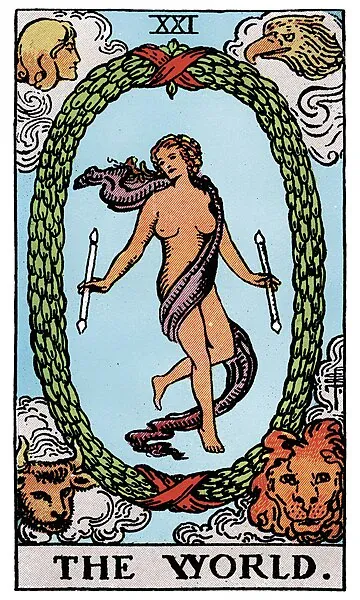
The cycle the wheel set in motion has reached its completion. What began as a turn has become a full revolution. This pairing often arrives at the end of a long arc — the degree finishing, the project shipping, the relationship reaching the public threshold, the recovery becoming the new baseline. The instruction is to honor the completeness without immediately starting the next wheel. The World is rarely drawn; receive it as the harvest of patience.
Wheel of Fortune + Death
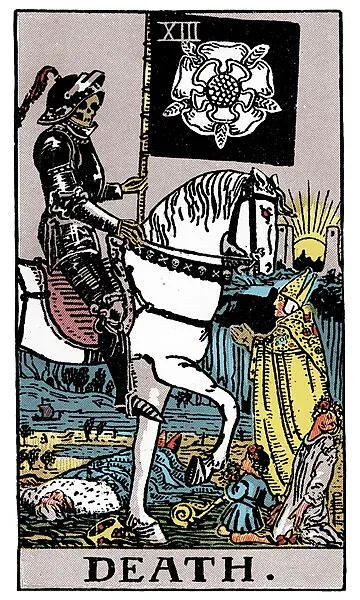
The wheel turn that closes a phase entirely. Where the Wheel alone is rotation, Death adds the irreversibility — this is not a turn that returns. This combination shows up at career endings that reveal themselves to have been longer in the making than the seeker realized, at relationships that stop before either party fully consents, at the seasons of life that become visible as having ended only after the next season has begun. Do not grieve the wheel for turning; grieve what is being released, and let the release be honest.
Wheel of Fortune + Ten of Pentacles
The generational wheel: family, inheritance, the long arc that holds a lineage together. When these cards appear together, the question is not your individual cycle but the wheel your family or community is on. Inheritances landing. Houses passing between generations. The grandparent who finally meets the new grandchild. The instruction is to notice that you are one tooth in a wheel much older than your own life, and to act with the awareness of who comes after you on the rim.
Wheel of Fortune + The Devil
A tonal contrast pairing. Where the Wheel of Fortune is the wheel of fate — large, impersonal, turning regardless of effort — The Devil is the wheel of compulsion, the habit-loop the seeker has built for themselves and re-enters without consciously choosing to. The combination asks you to distinguish the two wheels. Not every cycle you are inside is destiny. Some are habits with the costume of destiny. The card asks for the honest separation.
Wheel of Fortune + Justice
The balance that follows the spin. Where the Wheel turns without moral comment, Justice arrives to weigh the consequences of the turn. This combination shows up when actions taken inside a favorable cycle are about to be evaluated, fairly, against their actual outcomes. The instruction is not to fear the weighing. Justice with the Wheel is rarely punitive — it is precise. The cycle gave you the conditions. What you did inside the conditions is what is now being read. Be honest about what you did.
Card Combinations
The World
The cycle the wheel set in motion has reached its full revolution. Long arcs completing — the degree finishing, the project shipping, the relationship reaching the public threshold. Honor the completeness without immediately starting the next wheel. The World is rarely drawn; receive it as the harvest of patience.
Death
The wheel turn that closes a phase entirely. Where the Wheel alone is rotation, Death adds the irreversibility — this is not a turn that returns. Career endings longer in the making than realized; relationships that stop before either party fully consents. Grieve what is being released, and let the release be honest.
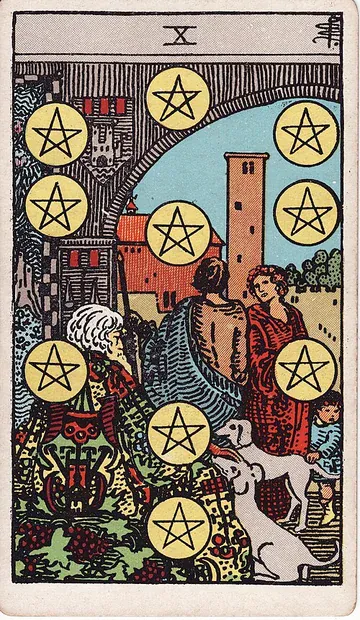
Ten of Pentacles
The generational wheel: family, inheritance, the long arc of a lineage. The question is not your individual cycle but the wheel your family is on. Inheritances landing. Houses passing between generations. Notice that you are one tooth in a wheel much older than your own life, and act with awareness of who comes after you.
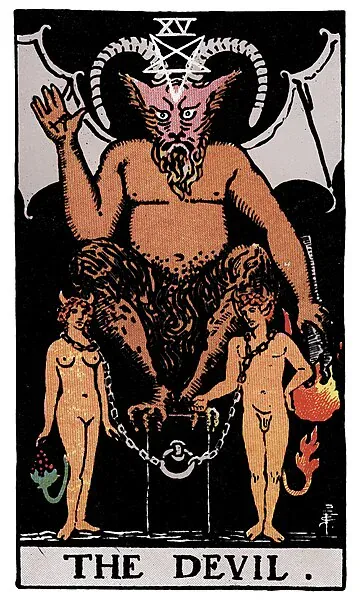
The Devil
Tonal contrast: the wheel of fate vs the wheel of compulsion. Where the Wheel of Fortune is large and impersonal, the Devil is the habit-loop the seeker has built and re-enters without choosing to. The combination asks you to distinguish the two wheels. Not every cycle you are inside is destiny. Some are habits in the costume of destiny.
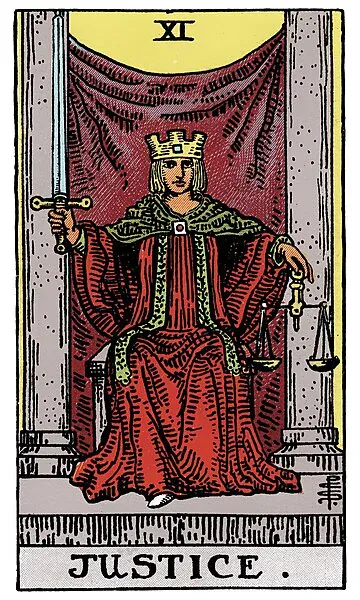
Justice
The balance that follows the spin. Where the Wheel turns without moral comment, Justice arrives to weigh the consequences. Actions taken inside a favorable cycle are about to be evaluated, fairly, against their actual outcomes. Justice with the Wheel is not punitive — it is precise. Be honest about what you did with the conditions you were given.
Frequently Asked Questions
What does the Wheel of Fortune tarot card mean?
The Wheel of Fortune is the card of motion you did not start. It describes a cycle the seeker is already inside — a turn in fortune, timing, or season — and asks for the small, well-timed gesture that meets the wheel where it is currently positioned. It is not a prediction; it is a recognition of the weather one is already inside, with Jupiter's signature of larger-than-asked-for opportunity arriving from outside.
Is the Wheel of Fortune about luck, or about timing?
Timing. Luck is only what timing looks like from outside it, which is why the upright Wheel of Fortune reads as a conditional yes rather than a lucky one: yes, if you move inside the window the current rotation has opened, instead of waiting for that window to hold still. Nothing in the picture is being rewarded or punished — the serpent going down the left edge and the jackal-headed figure rising on the right are at two points of one turn, and they will trade places. So the card is not measuring how deserving the seeker is. It is measuring where in the rotation their hand currently sits, and asking them to use the notch directly in front of them while it is still in reach.
Does the Wheel of Fortune mean a relationship is at the turn of a cycle?
Usually, yes — and the turn began well before either person noticed it. For an established couple, the patterns that organized the last few years are unwinding quietly, often without a fight, and the risk is relating to last year's relationship while this year's is already underway. For a new spark, the Wheel of Fortune makes timing as much of a question as chemistry: the right person can arrive on a day that cannot hold them. For a single seeker, the turn tends to come through a door that was not marked as a door — the friend-of-a-friend, the class taken for its own sake, the move to a different city. What the card asks for in every case is porousness: a life with enough unscheduled edge that the wheel has somewhere to bring someone in.
Does the Wheel of Fortune mean someone's feelings are changing without them deciding to?
That is close to exactly what it describes. The feeling is in motion and the motion is not being steered — their life's larger weather is doing the shaping, and the person is often the last to have words for it. A reserved person is conducting a private re-evaluation they have barely admitted to themselves; a demonstrative one is producing genuinely mixed signals because the mixture is honest. Neither is a verdict about you. The Wheel of Fortune is unusually clear that a feeling caught mid-rotation should not be read as a final position, and that the useful response is presence rather than pursuit: stay legible from the axle, and let the turn finish before asking it to name itself.
Where is the still axle of the Wheel of Fortune, and how do I sit at it?
At the sphinx's seat. The axle is the place inside yourself from which the wheel can be witnessed without being personalized, and sitting there is a practice rather than a mood. Treating fortune as merit and misfortune as punishment are the same evasion. The card asks you to recognize that motion at the center and stillness at the edges are equally real, and to participate in the arrangement of letters — R-O-T-A, TARO, ORAT — that shapes one cycle into the next.
Continue Reading
Wheel of Fortune · Card overview · symbols · correspondences →
Return to the full card view — image, symbols, sensory correspondences, and Hermetic axes.
Read the reversed meaning →
Read the same depth on the opposite orientation.
Draw your reading now →
Bring this card to a question — open a quiet ritual.