
Three sevens · the bones of the journey
Pollack's arrangement: 0 the Fool stands outside the arithmetic — he is both origin and terminus, the unmanifest soul itself. The remaining 21 form three rows of seven. I–VII is the Material / Conscious world, where the traveler learns roles, relationships, and will in the outer sphere. VIII–XIV is the Emotional / Soul turn inward, where he meets his own depths. XV–XXI is the Spiritual / Transcendent reforging, where he passes through shadow and revelation into wholeness.
Each row's last card (Chariot VII, Temperance XIV, World XXI) is that phase's synthesis — gathering the preceding six lessons into one picture. The three rows are not ranks but layers: one traveler, three descents.
Another mainstream reading comes from Sallie Nichols' Jung and Tarot (1980): she reads the Majors as a Jungian archetypal journey — a map tending toward individuation. This page uses Pollack's three sevens, but the two readings don't conflict; they only emphasize different things.
Twenty-two stations
· Phase I · cards I–VII ·
Material / Conscious
The traveler steps out of the house — learning tools, relationships, authority, choice, will. The world of this phase lies outward: he is working out where he is, who he is, and what he can do.
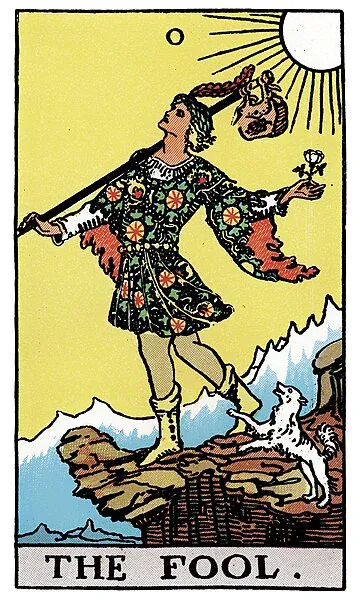
0 · Material / Conscious
The Fool
Before the journey begins, and after it ends. The Fool is the soul not yet named — a white rose in one hand, a light wand over his shoulder, looking outward at the cliff rather than down. He holds no map; he trusts that the next step will grow the road. All that follows owes its weight to the fact that he dared to set out first.
I leap without proof, and the unproven becomes path.Read the full card →
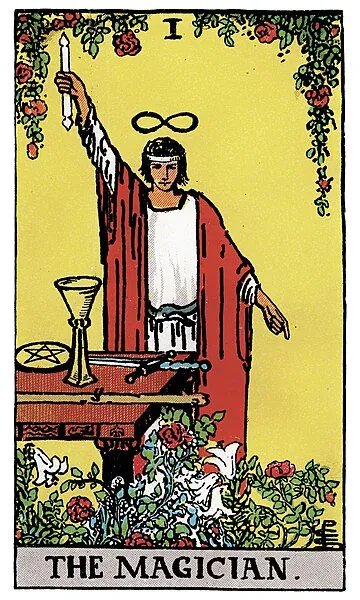
I · Material / Conscious
The Magician
The Fool sees his own hands for the first time. The Magician is the starting note of 'I can do' — one hand up receiving, one hand down delivering. The four-element tools lie ready on the table, but the point is not the tools; it is the conduit running top to bottom. When awareness wakes, manifestation becomes possible instead of merely imagined.
I am the conduit — what above gives, below shows.Read the full card →
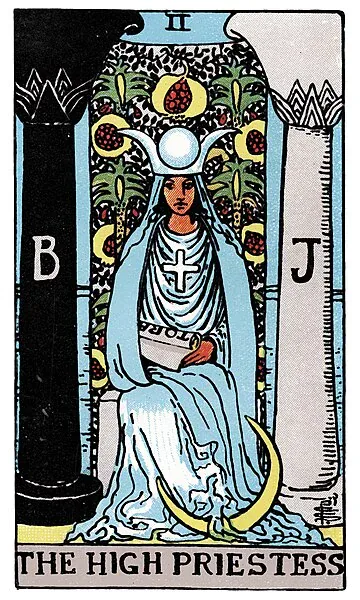
II · Material / Conscious
The High Priestess
After the Magician's outpouring he meets a veil. The High Priestess is the other half of the psyche — she does not perform outward; she listens inward. She keeps the secret and she lets it open, teaching the Fool that not every answer can be spoken — some can only be sat with. Silence here becomes a skill, not an absence.
I keep the veil, and let it part.Read the full card →
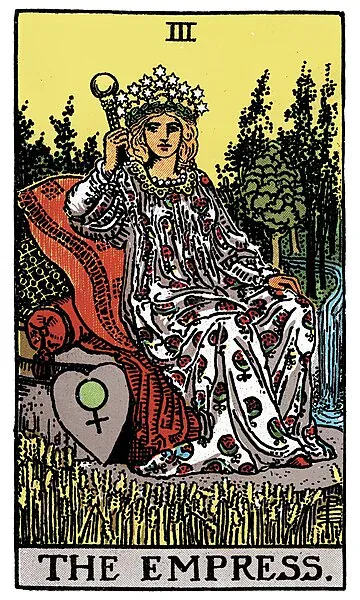
III · Material / Conscious
The Empress
After the poles of knowing come body and earth. The Empress is mother-abundance — wheat, laurel, a warm lap. She teaches the Fool to ripen on nature's cadence, letting the seed stay in the soil rather than yanking it upward. Nourishment precedes achievement; this is his first step from thinking into being.
I let the seed ripen on its own cadence.Read the full card →
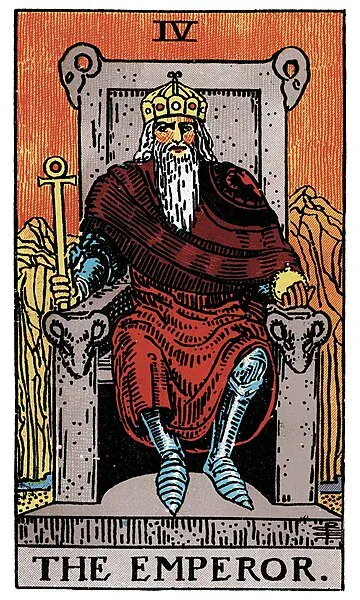
IV · Material / Conscious
The Emperor
After the mother's lap, the father's frame. The Emperor drives four stakes — edges, order, promise, responsibility. His word to the Fool: structure is not a cage; it is the scaffold you grow upward along. Freedom without bones is only drift. Here he learns to hold the weight of authority — his own included — without cruelty.
I drive four stakes; form takes its bones.Read the full card →
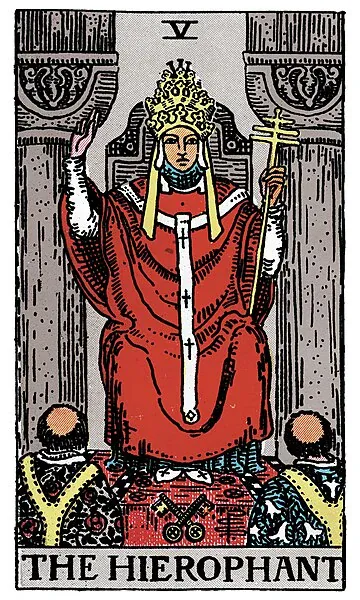
V · Material / Conscious
The Hierophant
Above the personal Emperor stands the inherited fire. The Hierophant passes the old knowing into the next pair of hands — language, rite, consensus. The Fool learns here that he did not invent the world from zero; he stands in a long river. The task is not blind acceptance but discernment: which fires are worth carrying, which he must let go cold.
I pass the old fire into the next pair of hands.Read the full card →
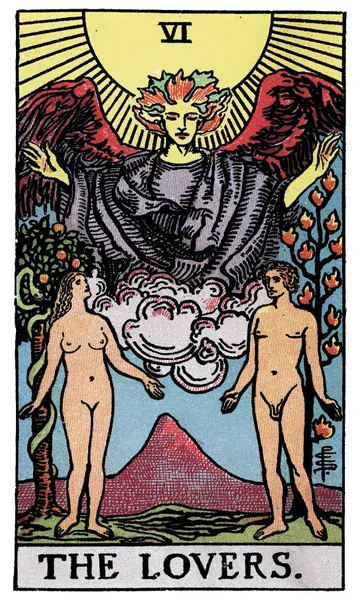
VI · Material / Conscious
The Lovers
After inheritance comes personal choice. The Lovers is larger than romance — it is any 'between two' stance: two paths, two selves, two values. The angel overhead blesses; the hand that chooses remains his own. Here the Fool learns to carry the seam — whichever side he chooses, the other does not vanish.
I choose between two, and bear the seam.Read the full card →
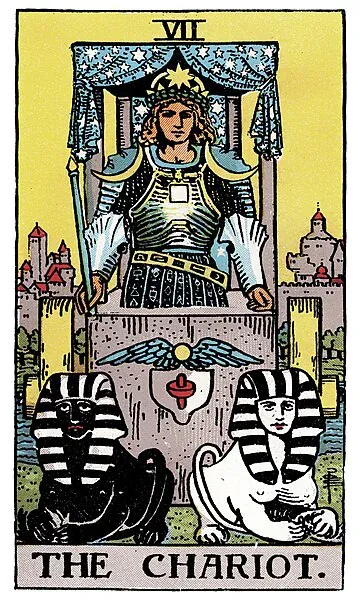
VII · Material / Conscious
The Chariot
The first phase's synthesis. The Chariot gathers the preceding six lessons into one directed sortie — Emperor's frame, Empress's roots, Lovers' decision, Magician's conduit. The two-toned sphinxes pull the car not by reins but by the driver's will. The Fool rides out beyond the familiar gate — Campbell's 'crossing of the first threshold.'
I yoke two waters to my will, and cross the line.Read the full card →
· Phase II · cards VIII–XIV ·
Emotional / Soul
With the outer lessons set, the traveler turns inward. Beast, solitude, fate, balance, surrender, death, reconciliation — no card here is easy; each one asks him to hand over some part of himself.
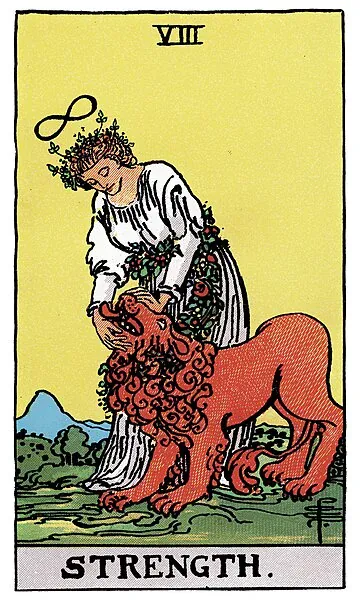
VIII · Emotional / Soul
Strength
After the sortie he meets the beast. Strength is not wrestling; it is closing the lion's jaw with softness — breathing in time with his own instinct rather than suppressing it. The Fool recognizes for the first time that real force lies inside. From here his gaze turns inward — the door to what Jung called the shadow begins to appear.
I close the jaw with softness, breathing with the beast.Read the full card →
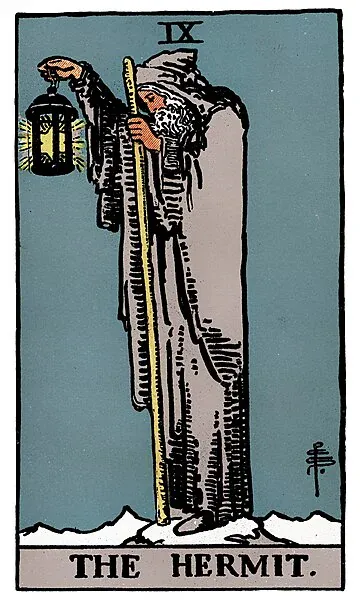
IX · Emotional / Soul
The Hermit
Having sat with the inner beast, he walks into solitude. The Hermit lifts his lamp and leaves the noise of the world below. The lamp lights only one step at a time; he learns not to need the whole path revealed — only to ask, at this moment, one honest question. Loneliness here is not punishment but clarification.
I walk alone, and judge the path by a single step of lamplight.Read the full card →
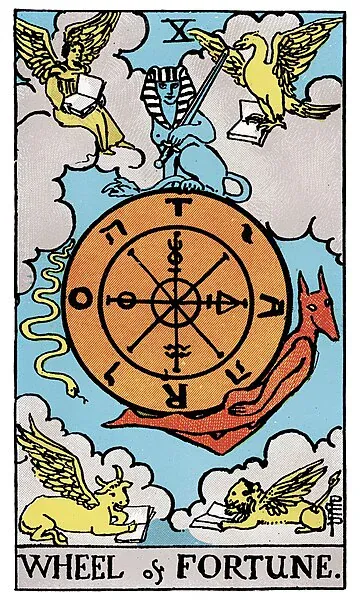
X · Emotional / Soul
Wheel of Fortune
In the hermit's clarity he sees a larger picture: the Wheel turns without consulting him. The Fool learns here to accept the tide — rise has its fall, height its descent. He stops trying to arrest the wheel and learns instead to rest his heart on the still axle at its center.
The wheel turns itself; I sit at the still axle.Read the full card →
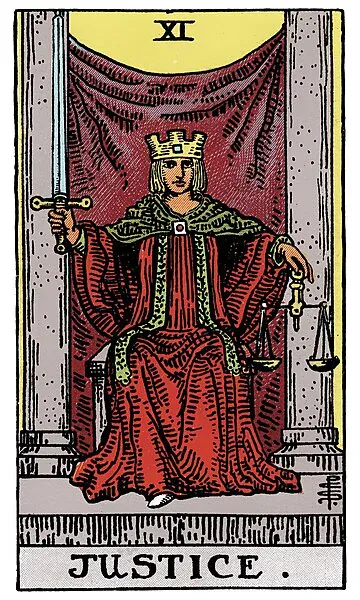
XI · Emotional / Soul
Justice
After accepting the tide he must learn the scale. Justice is not vengeance; it is having heard through, having weighed. No easy answers here — he must face the echoes of his own past actions without self-defense and without getting a free pass. The sword is drawn only after the scales have settled.
My sword is having heard; my scales, having weighed.Read the full card →
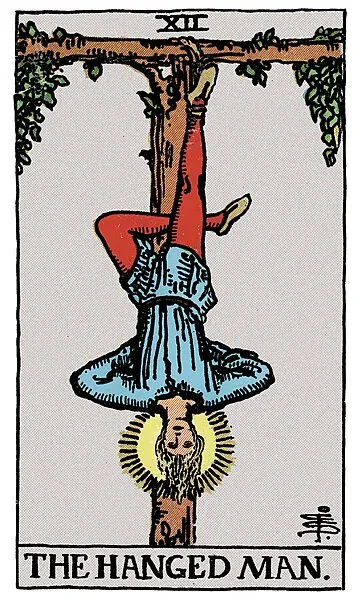
XII · Emotional / Soul
The Hanged Man
After the scale, the hanging. The Hanged Man voluntarily inverts — the familiar way has carried him as far as it can, so he stops and lets the world turn upside-down in his sight. An active stillness. Hanging there, he sees the side of himself he could not see before — and the hanging itself is already arrival; he does not need to rush the landing.
I hang inverted; hanging is already arrival.Read the full card →
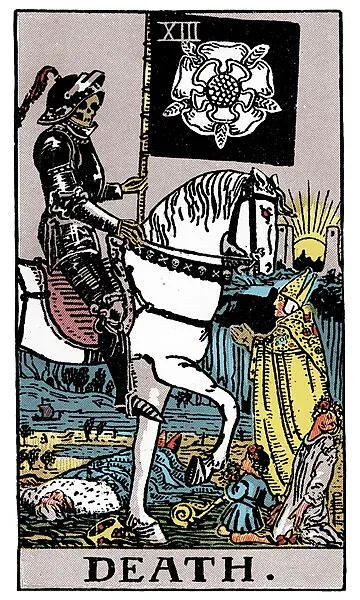
XIII · Emotional / Soul
Death
After hanging, letting go. Death is not annihilation; it is letting what must die pass — an identity, a role, a relationship, an older version of himself. The hardest lesson of the whole arc: unless something is released, the next life cannot arrive. He is not destroying; he is making room.
I let what must die pass; the deeper life comes forward.Read the full card →
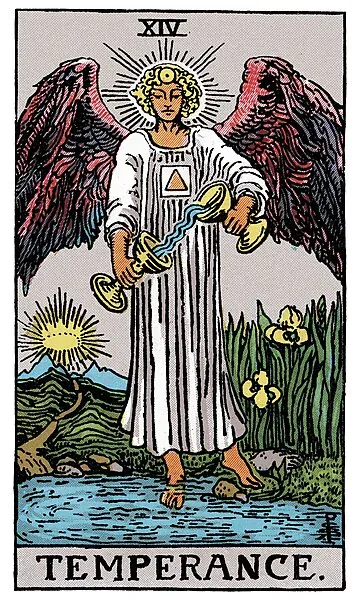
XIV · Emotional / Soul
Temperance
The second phase's synthesis. Temperance's angel pours between two vessels — fire and water, above and below, self and Other — until a third thing forms. Here the Fool finally learns reconciliation. The Emotional / Soul leg closes as a sustainable inner flow — he is now ready to descend one layer deeper.
Between two vessels I pour until a third thing forms.Read the full card →
· Phase III · cards XV–XXI ·
Spiritual / Transcendent
The deepest leg. The traveler meets his shadow (the Devil), watches the false structure fall (the Tower), and is looked upon again by star and moon before stepping bare into the noon sun, answering the horn, and closing this entire circle.
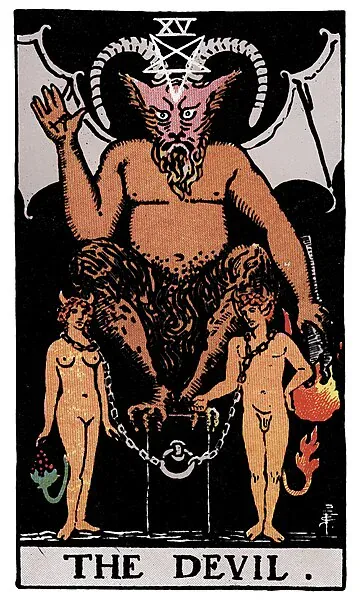
XV · Spiritual / Transcendent
The Devil
After the alloy, he meets the shadow. The Devil is not an outside adversary; he is the part of the Fool he has least wanted to own — fixation, appetite, power-wish, compulsion. The chain is looser than it looks. The task is to inspect it first, then decide whether to struggle. In Jungian terms, this is the pivotal encounter.
I inspect the chain before I struggle.Read the full card →
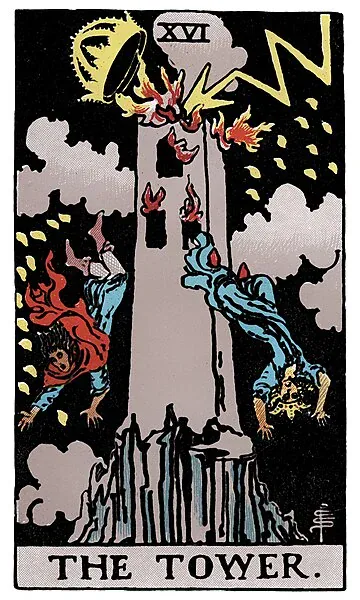
XVI · Spiritual / Transcendent
The Tower
Once he sees the chain clearly, certain invented structures stop holding. Lightning splits the Tower — not punishment but revelation. The Fool wakes mid-fall: what seemed unshakable was painted brick. It hurts, and it is necessary; only with the Tower down can he see the sky it had been blocking.
Lightning splits the false tower; I wake as I fall.Read the full card →
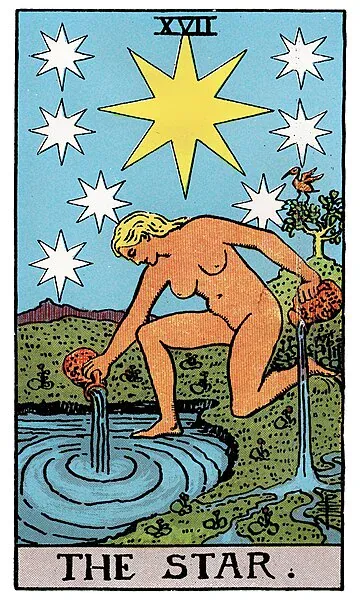
XVII · Spiritual / Transcendent
The Star
After the fall, the Star. Above the rubble, distant stars come on one by one. The Fool kneels to pour what remains of his water and lets starlight read him bare. This is the most fragile moment after revelation, and the most pure — he relearns hope, not the naïve kind, but the kind that walks through collapse.
I pour what remains, and let the distant stars see me bare.Read the full card →
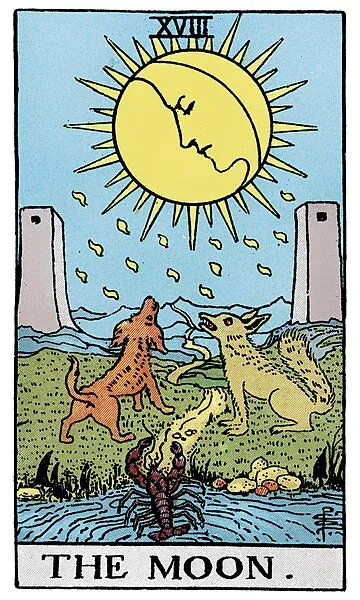
XVIII · Spiritual / Transcendent
The Moon
After the still night of the Star, a damp pass remains. The Moon's light is borrowed — not direct like the sun. Wolf and dog howl between the towers; a road climbs from the water. Here the Fool faces the unconscious itself — dreams, mirage, distortion — neither fleeing nor drowning, meeting the Moon's eye straight on.
I pass between the towers, and meet the Moon's eye unflinching.Read the full card →
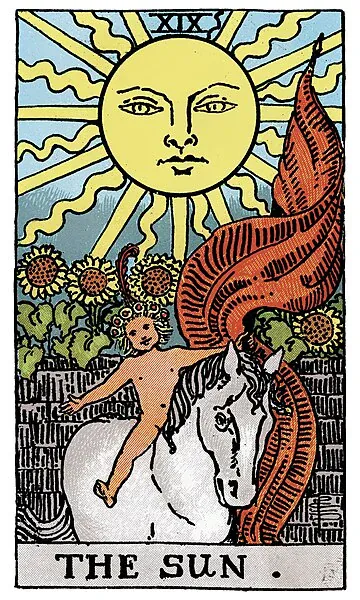
XIX · Spiritual / Transcendent
The Sun
After the Moon's fog, the noon. Beneath the Sun, the Fool rides out past the wall bare — childlike frankness, but no longer the unformed child of the beginning. The protecting wall is no longer needed; he lets the noon read him whole. This is Campbell's Apotheosis — unified, clarified, fully exposed and fully present.
I ride out from the wall bare; let the noon read me whole.Read the full card →
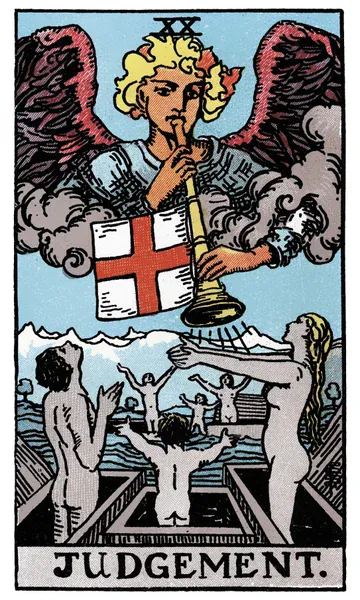
XX · Spiritual / Transcendent
Judgement
After the Sun, the horn. Judgement is not condemnation; it is a waking — past versions of the self rise from the coffin and are reintegrated. The Fool answers the call — not an external summons but an inner self finally loud enough to hear and recognize. He owns every past step, then chooses to continue.
The horn sounds. I rise to meet it.Read the full card →
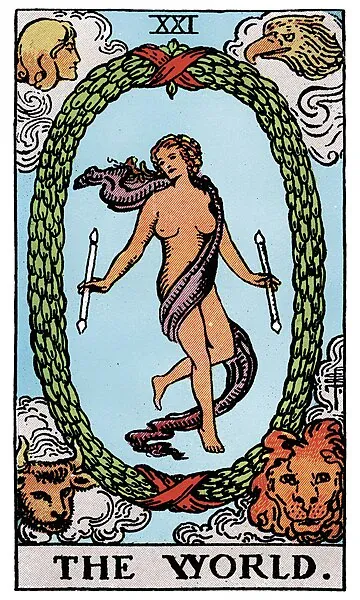
XXI · Spiritual / Transcendent
The World
The journey's synthesis. The World closes the full circle — the four living creatures at the corners, the dancer at the center both inside and outside the ring. The Fool realizes at last: he never left the starting point; he only saw it clearly for the first time. And the moment this circle closes, the next is already opening — which is why he will become the Fool again.
I close this circle and open the next.Read the full card →
Numerological echo · bones and reflection
Numerology reads each number as a stage — 1 beginning, 10 completion. For any Major past 9, sum its digits and you fall back onto the 1–9 skeleton: the Sun (19) → 10 → 1 the Magician; the World (21) → 3 the Empress. Every two-digit Major carries a one-digit echo — the same note played at a lower octave.
Which is to say: the three sevens of the Fool's Journey are not only a narrative grouping — they are also a projection of the numerological skeleton. Learn the 1-through-10 rhythm, and the 11–21 band reads like the same melody folded and transposed.
Deeper: the 1–10 skeletonBack to the Fool · spiral, not line
After the World, the traveler does not stop at the end — he becomes the Fool again. Not a regression into ignorance, but a willingness to trade known for the next unknown. A spiral: the same theme returns, and the height at which he stands is different.
This is why tarot can be drawn again and again without going dry. Every question places him at one station of one revolution — and recognizing where he actually stands, and which of last cycle's lessons is still echoing, matters more than whether a card 'hits.'
This page is only the handbook
This page unfolds the twenty-two Majors as readable notes — so you can hold the three sevens in a single pass. If you'd rather walk the journey frame by frame, more film than text, an immersive mode is waiting next door. That is meditation; this is study. The two are complements; both are worth coming back to.
Enter immersive mode →Further reading
Numerology
The 1–10 skeleton beneath the three sevens.
Reversals
The inward turn of the same card — the shadow face of the journey.
Tarot history
From the 15th century to today — when the journey narrative took shape.
Glossary
Campbell · Jung · Pollack · Nichols · individuation.
Archetypes
The 22 Majors mapped onto Jungian archetypes and cross-cultural mythic echoes.