
Before You Begin
Give the reading fifteen to twenty minutes in which nothing else is asking for you. Close the other browser tabs, turn your phone face down, and take three slow breaths in which the exhale is longer than the inhale. None of this is superstition. It is a way of telling your own mind that the next few minutes are not ordinary scrolling time, and the reading will only be as attentive as you are.
Be clear with yourself about what a reading can and cannot do. Tarot is a tool for reflection and self-understanding. It can help you notice what you are feeling, name a pattern, or see a situation from an angle you had not tried. It cannot tell you a date, read another person's mind, or replace a doctor, a lawyer or a financial adviser. Treat it as a mirror, not a forecast, and it will be far more useful.
- A deck, or a digital draw such as Lunarcana's.
- Fifteen to twenty quiet minutes.
- A notebook or a notes app for the journal entry.
- One question, written down before you shuffle.
Shape the Question
The question is the most important part of the reading, and most first readings go wrong here rather than in the cards. A good tarot question is one the cards can actually help you think about: something about your own situation, your choices and your inner life, asked openly enough to leave room for an answer you had not expected.
Open beats yes-or-no
"Will this work out?" leaves the cards nothing to say except a guess. "What would help this work?" gives every card something to contribute.
Present beats far future
Ask about what is happening and what you can do now. A reading about the present is something you can check against your own experience this week.
Your side of the story
You can explore your own feelings, choices and relationship to another person. You cannot read their private thoughts, so do not build the question around them.
One question at a time
A question with three parts gets a muddled answer. Pick the part that matters most today and save the others for another reading.
Three rewrites
- · Instead of ·
- Will he come back?
- · Try ·
- What do I need to understand about how this relationship ended?
It moves the question from his choices, which you cannot read, to your understanding, which you can work with.
- · Instead of ·
- Will I get the job?
- · Try ·
- What strength am I underusing in this application?
It turns a verdict you would simply wait for into something you can act on before the interview.
- · Instead of ·
- When will I meet someone?
- · Try ·
- What is shaping the way I approach new relationships right now?
Tarot cannot give dates. It can help you look at the patterns you bring to meeting people.
For many more examples, and a tool that rewrites a question as you type, see the art of asking.
Choose a Spread
A spread is a layout: a fixed number of cards, each placed in a position with its own meaning. The position turns a card into an answer to a specific part of your question. The same card means something different in a position called "what helps" than in one called "what is in the way".
For a first reading, fewer cards is better. Three cards are enough to tell a small story with a beginning, a middle and an end, and few enough that you can hold the whole reading in your head. These five spreads cover most first questions, from the simplest to the most detailed:
- One CardCards: 1One card as a focus for the day or for a single theme. The best way to learn the cards one at a time.
- Past · Present · FutureCards: 3The classic first spread: past, present and future, read as one moving story. Use it for almost any open question.
- Situation · Action · OutcomeCards: 3For practical questions: where things stand, what you could do, and where that path tends to lead if nothing else changes.
- Body · Mind · SpiritCards: 3For checking in with yourself rather than a situation: how you are doing physically, mentally and in what gives you meaning.
- Celtic CrossCards: 10The ten-card classic for a deep look at one complex question. Save it until three-card readings feel comfortable.
Whatever you choose, decide before you shuffle and keep to it. Changing the spread after seeing the cards is a way of choosing the answer you wanted.
Shuffle and Draw
Any shuffle works: riffle, overhand, or spreading the cards face down on a table and stirring them. Shuffle while holding your question in mind, and stop when it feels done — many readers notice a small sense of settling. Some cut the deck into three piles and restack it; that is a habit, not a requirement. If a card jumps out while you shuffle, you can set it aside and look at it after the reading as a side note.
Draw the cards one at a time and lay them face down in the order the spread gives, so each card lands in its position before you see it. Then turn them over in the same order. In a digital reading the app does the shuffle and you choose the cards; the order and the positions work exactly the same way.
Decide before you shuffle whether you will read reversed cards — cards that land upside down. For a first reading, it is perfectly fine to turn every card upright and read only the upright meanings.
If you do want to read them, the three lenses for reversed cards are set out in reversed tarot cards.
Read the Positions
Resist the urge to look up every meaning straight away. Reading the picture before the book is what separates a reading from a list of keywords, and it is also how the 78 cards become familiar. Take each card in turn and go through the same four steps.
1 · Describe what you see
Say literally what is in the picture. Who is there, what are they doing, what is the weather, where is the light? "A figure walks toward a cliff edge with a small dog at their heels" is a better start than any keyword.
2 · Notice your first reaction
Does the card feel welcome, uncomfortable, puzzling? Your reaction is information about where you stand on the question. Write it down before it is overwritten by the book.
3 · Put it in its position
Now ask what the picture says about this position of this question. A figure stepping off a cliff, in a position called "present", might be the leap you are already taking.
4 · Then check the meaning
Last, read the card's traditional meaning and compare it with what you noticed. Keep whatever fits and let the rest go — the book is a cross-check, not the verdict.
Combine the Cards
A spread is more than its cards one by one. Once each card has been read in its position, step back and read them together, the way you would read the words of a sentence rather than each word on its own. These cues help a reading come together:
Tell it as a story
Read the cards left to right as one sentence: "This led to this, which opens onto this." If the story will not hold together, ask which card does not fit, and why.
Count the Major Arcana
The 22 Majors stand for larger themes, the 56 Minors for everyday situations. A spread full of Majors points to something significant in your life; a spread of Minors to the texture of daily choices.
Notice the suits
Several cards of one suit colour the whole reading: Wands for energy and drive, Cups for feeling and relationships, Swords for thought and conflict, Pentacles for work, body and money. A missing suit can matter as much as a crowded one.
Look for echoes and contrasts
Repeated numbers, figures facing each other or turning away, the same colour or symbol in two cards — these are links the spread is drawing for you. Two cards that seem to contradict each other often show a tension worth naming.
When you want more structure than this, four complete methods for reading a spread are compared in the reading frameworks.
A Sample Three-Card Reading
· Sample spread · read-only ·
Here is a complete reading, worked through the steps above. It is a fixed example: it uses no credits and nothing is saved.
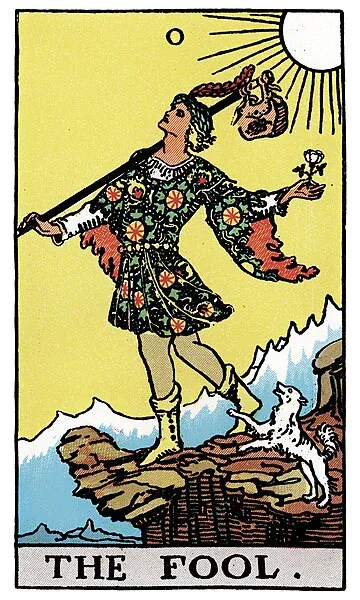
Past
The Fool
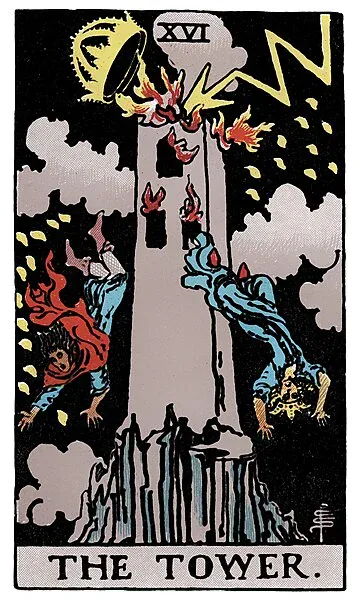
Present
The Tower
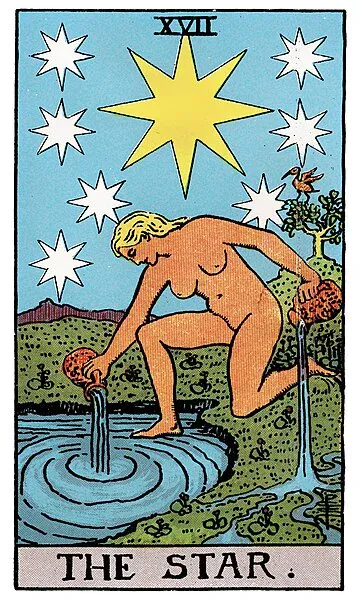
Future
The Star
- · Question ·
- What do I need to see about the change I am going through at work?
Past — The Fool. A young figure steps lightly toward a cliff edge, eyes on the sky, a small dog at their heels. In the past position, this reads as the way the change began: with an open, perhaps naive leap — saying yes before knowing everything it would involve.
Present — The Tower. Lightning strikes a tower; a crown falls, two figures tumble out. My first reaction is discomfort, which is itself useful. In the present position, the Tower describes a structure that is breaking open: plans, assumptions or a role that no longer holds the weight put on it.
Future — The Star. A figure kneels by water under a large star, pouring from two jugs, calm and unguarded. In the future position this is not a promise of how things will turn out, but a picture of where the current points: toward renewal, quiet and a more honest kind of hope once the dust settles.
Putting it together
Read as one sentence: an innocent leap led to a breaking open, which opens onto quiet renewal. Three Majors in a row say this is a significant chapter, not a passing mood. The Fool and the Star are both open-air, unguarded figures, while the Tower is the one enclosed structure — and it is the one that breaks.
The reading does not say whether the change at work is good or bad. It suggests that what is falling now was built on assumptions made at the start, and that something steadier can grow once those are let go. The question it leaves is not whether the Tower falls, but whether you still look up at the Star after it does.
· Journal line ·
“Which assumption from the beginning of this change am I still holding on to?”
Write It Down
A short journal entry is what turns tarot from a one-off curiosity into a practice. It takes two minutes, and it is the only way to see later what a reading meant to you. Cards that seemed opaque at the time often become obvious a week afterwards, and you can only notice that if you wrote down what you thought first.
Keep the entry short enough that you will actually do it. This template is enough:
- Date and question.
- The spread and the cards, in their positions.
- My first reaction to each card, in a few words.
- The reading in one sentence.
- One thing I will notice or try this week.
- A week later: what fits now, and what I missed.
To turn single readings into a steady habit, with daily draws and longer journal practices, see building a tarot practice.
Common Pitfalls
Asking for dates
The cards cannot give a timestamp, and guessing one undermines everything else in the reading. Ask what you can do now instead.
Asking again after an answer you did not like
Reshuffling for the same question just produces noise. Sit with the first reading, write it down, and come back in a few days if you still want to.
Reading someone else's mind
You can only read your own side of a relationship. A question about what another person secretly thinks gives you a projection, not information.
Reading the book before the picture
Looking up every meaning first turns the reading into a list. Describe the picture, notice your reaction, and keep the book for last.
Drawing clarifiers until it says yes
One extra card to clarify a confusing position is fine. Five extra cards is a search for reassurance. Decide your limit before you start.
Ready?
Write down your question and open a real three-card reading.
Keep Reading
How to turn a vague worry into a question the cards can work with.
Three lenses for reading a card that lands upside down.
Positional, narrative, dialogic and intuitive: four ways to read a spread.
Every layout, from one card to the full Celtic Cross.