
I. Why Keyword Reading Falls Short
Tarot's power lives between the cards, not in any single one. An isolated Strength card says courage. But Strength arriving after the Ten of Swords and before the Two of Cups is a very specific courage — hard-won, intimacy-facing, post-collapse. That is a third meaning neither card has alone.
This is why keyword reading stays flat. Keywords are dictionary definitions; spreads are sentences. The word run means nothing in the dictionary that tells you how “run a meeting,” “run late,” and “run out” differ — context is where meaning is made. In a spread, context is built by framework.
II. The Four Frameworks
Each framework is good at something the others are not. Experienced readers switch between them mid-reading — pick one as the spine, and borrow from another when the spine misses something.
Positional
· Positional ·Each card's meaning is shaped by the slot it lands in.
- · Core ·
- Positional reading treats the spread as a pre-gridded board. Every slot carries a fixed meaning — “past / present / future,” “you / them / the bond,” or the ten finely-cut positions of the Celtic Cross. The drawn card inherits the slot's frame. The Hermit in the past position is an introversion already walked; the Hermit in the advice position is a counsel to step back now. Positional reading is structural and quick to learn; its cost is a certain stiffness — the grid can hide the breath between cards.
- · When to use ·
- Best for well-structured questions, beginner practice, and reviewing a long-running situation. When you want to know which stage a thing is at rather than what the thing is saying, reach for positional. Celtic Cross, past-present-future, situation-action-outcome — those spreads were designed for it.
Narrative
· Narrative ·Read the spread as beginning, middle, and end of a small story.
- · Core ·
- Narrative reading treats three to five cards as a miniature story — first card opens, middle turns, last card closes. Card order is not just chronological but dramatic: tension-escalation-resolution, or stability-rupture-new order. The reader's task is to find the verb that stitches the three cards into a sentence. Rachel Pollack's treatment of the Major Arcana in Seventy-Eight Degrees of Wisdom — the Fool's Journey — is narrative reading at its most ambitious: all twenty-two Majors as one person's growth arc. Its strength is that the reader stops listing keywords and begins to actually tell a story; its risk is cliché, flattening every draw into a three-act formula.
- · When to use ·
- Best for life-stage reviews, major turning points, untangling the shape of an ongoing experience. When the question is “what happened over the past six months” or “where is this relationship actually heading” — narrative can thread scattered cards into a line.
Dialogic
· Dialogic ·Let two cards (or two groups) ask each other questions.
- · Core ·
- Dialogic reading treats the spread not as a line or a grid but as an exchange between voices. The most familiar case is a relationship spread — a “you” column and a “they” column — read horizontally, one card asking, the other answering. It can also be the inner dialogue of conscious / unconscious, or expectation / reality read side by side. Dialogic reading converts tarot from monologue to two-person play. It asks the reader to drop the essentialist question (“what does this card mean?”) and ask instead: “what is this card saying to that one?” The upside is depth — relational stuck-points loosen fast. The cost is abstraction; beginners tend to read the exchange as two parallel monologues.
- · When to use ·
- Relationships (partner, parent, collaborator), inner conflict (reason vs. feeling), comparing options (stay vs. leave). Any question where two forces are shaping each other rewards dialogic over positional.
Intuitive
· Intuitive ·Ignore the grid — notice which card catches your eye first.
- · Core ·
- Intuitive reading is the antithesis of the previous three — no preset slots, no fixed order, no imposed structure. Spread the cards flat and ask yourself: which one jumps out first? Which card tightens my chest? Which two are looking at each other? Here the reader's body and unconscious are the real instrument. Mary K. Greer uses this mode extensively in 21 Ways to Read a Tarot Card — draw the feeling, role-play a card, speak to a figure. Its strength is bypassing mental defenses and touching the point where the real blockage lives. Its cost is privacy — intuitive reading is hard to teach and easy to confuse with projection. The practice is not getting it right; it is learning to hear the difference between what the card says and what you wish it said.
- · When to use ·
- Best when stuck, when the mind is spinning, when an experienced reader needs a quick glance, when reading alone in a contemplative mood. If you have already done positional and narrative and still feel “none of that hit the point,” reshuffle the cards and try intuitive.
III. Four Readings, One Hand
The same three cards — Five of Wands, Two of Cups, Ten of Swords — yield four very different readings depending on which framework you pick up. Switch the tabs below and compare.
· Sample hand ·
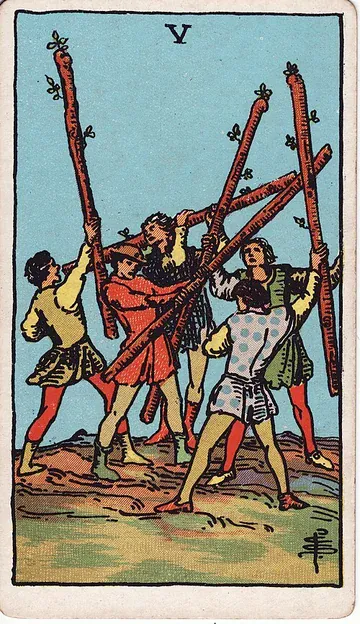
Five of Wands
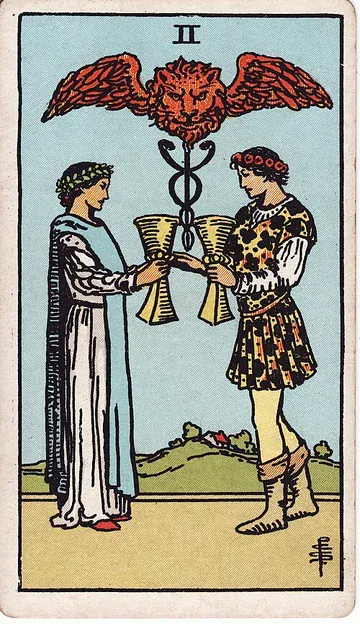
Two of Cups
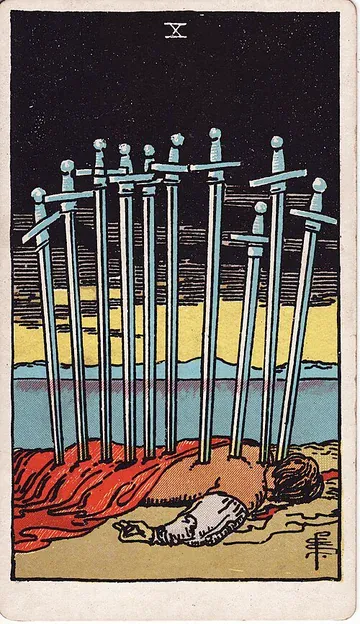
Ten of Swords
· Switch framework ·
· Sample reading · Positional ·
Positional reading as past / present / future: the past is the Five of Wands — you came out of a contest or multi-sided jostle where there were no true enemies, only several people wanting the same thing; the friction was real. The present is the Two of Cups: the noise has dropped, and in front of you stands a possible bond or alliance — two independent wills choosing to reach toward each other. The future, the Ten of Swords, is not ruin but the necessary end this intimacy will demand: some old version of yourself, some outdated story, has to be cleanly terminated. It hurts, but it is a clean cut; what is left afterward is open ground.
IV. Using Them Together
Experienced readers rarely finish a reading inside a single framework. The typical flow: use positional to set the skeleton — which card landed in which slot; use narrative to stitch the three into an arc; use dialogic to press on the tension between two key cards; finally run the spread past your intuition and ask which card is making you the most uncomfortable.
The four frameworks are four mirrors. A single reading rarely needs all four at once — but if you only ever use one, you are guaranteed to miss what the other three would have shown. Which mirror to pick depends on the shape of the question: structural questions want positional; life-shape questions want narrative; relational ones want dialogic; stuck ones want intuitive.
V. Elemental Dignity
The four frameworks above all read relationships between cards — but there is a quieter layer beneath: the elements of the cards themselves are already strengthening or weakening each other. This rule set is called elemental dignity, attributed to MacGregor Mathers of the Hermetic Order of the Golden Dawn at the end of the 19th century.
The mainstream rule is short: Fire and Air (both active) strengthen each other; Water and Earth (both passive) strengthen each other; Fire and Water, and Air and Earth, weaken each other. Fire-Earth and Water-Air count as only mildly friendly, close to neutral. When two adjacent cards are elementally friendly, both meanings amplify; when opposed, both are weakened, sometimes cancelled. Read the element distribution first, the card-specific meaning second — an old Golden Dawn shortcut that still pays.
In Book T, the Golden Dawn's own text, a card is strengthened greatly by its own suit and weakened by the opposite element (Fire–Water, Air–Earth); of the four remaining pairs, three are called friendly (Fire–Air, Air–Water, Fire–Earth) and Water–Earth is not rated. Corax counts all four as friendly. Some modern authors, Mary K. Greer among them, count Fire+Earth and Water+Air as only mildly friendly, close to neutral. Lunarcana's house rule takes that stricter version: same element, Fire–Air and Water–Earth friendly; Fire–Water and Air–Earth opposed; Fire–Earth and Water–Air close to neutral.
VI. Reverse Reading — Energy Flow
Advanced readers add one more layer on top of the four frameworks: the direction of flow between cards. Three cards in a row are not only left-middle-right; they can flow clockwise, stare at each other, or cross. A six-card two-column spread tells one story vertically and another horizontally.
The simplest drill: after drawing three cards, don't speak yet — look at which way the figures on each card are facing. If the first figure's gaze lands on the second, there is a “looking” line through the spread. If the last figure's back is turned to the middle card, the energy is leaving the scene. Positional reading alone will not show this. Direction is a silent grammar.
A note on terminology: positional / narrative / dialogic / intuitive is the four-way split we use at Lunarcana for teaching clarity — not the tarot world's one canonical division. Mary K. Greer catalogues far more than four techniques in 21 Ways to Read a Tarot Card; Rachel Pollack leans narrative in Seventy-Eight Degrees of Wisdom. Read these four names as our working split, not as discipline-wide definitions.
Further reading
The whole reading, from question through interpretation.
Rewriting a vague question into one tarot can actually answer.
Fire, water, air, earth — the substrate of elemental dignity.
Pick a grid that lets the frameworks above land on concrete slots.