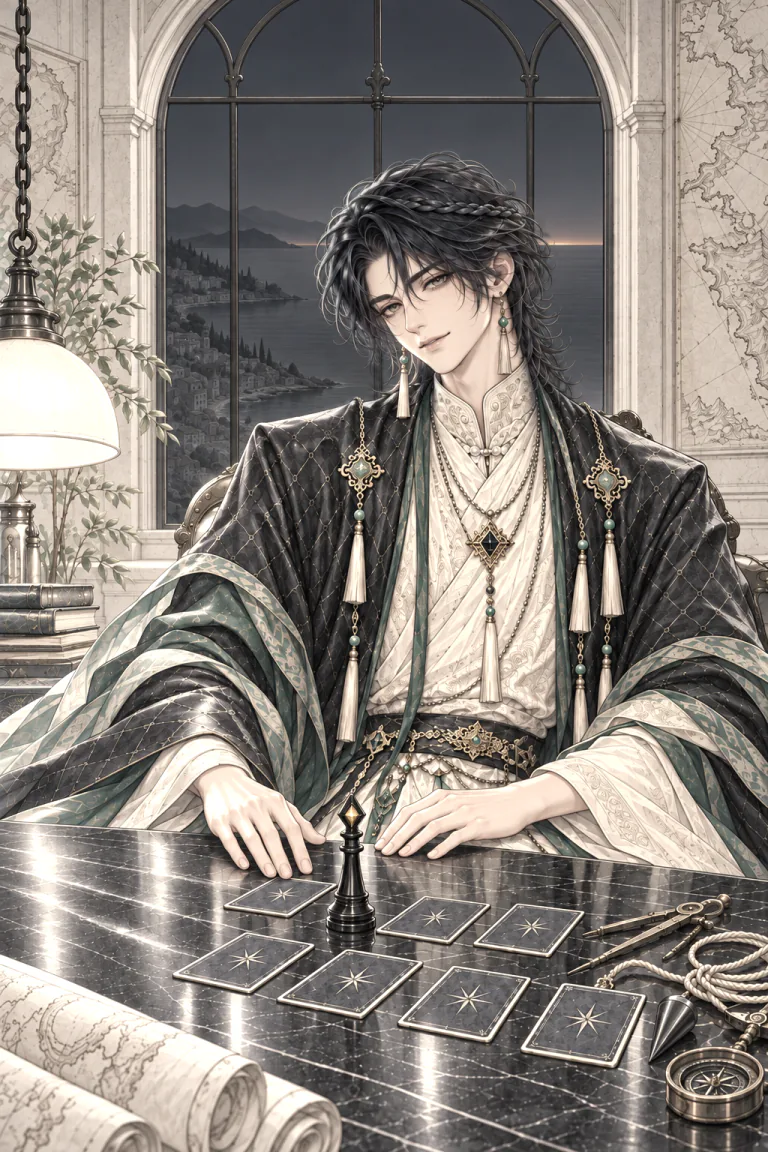
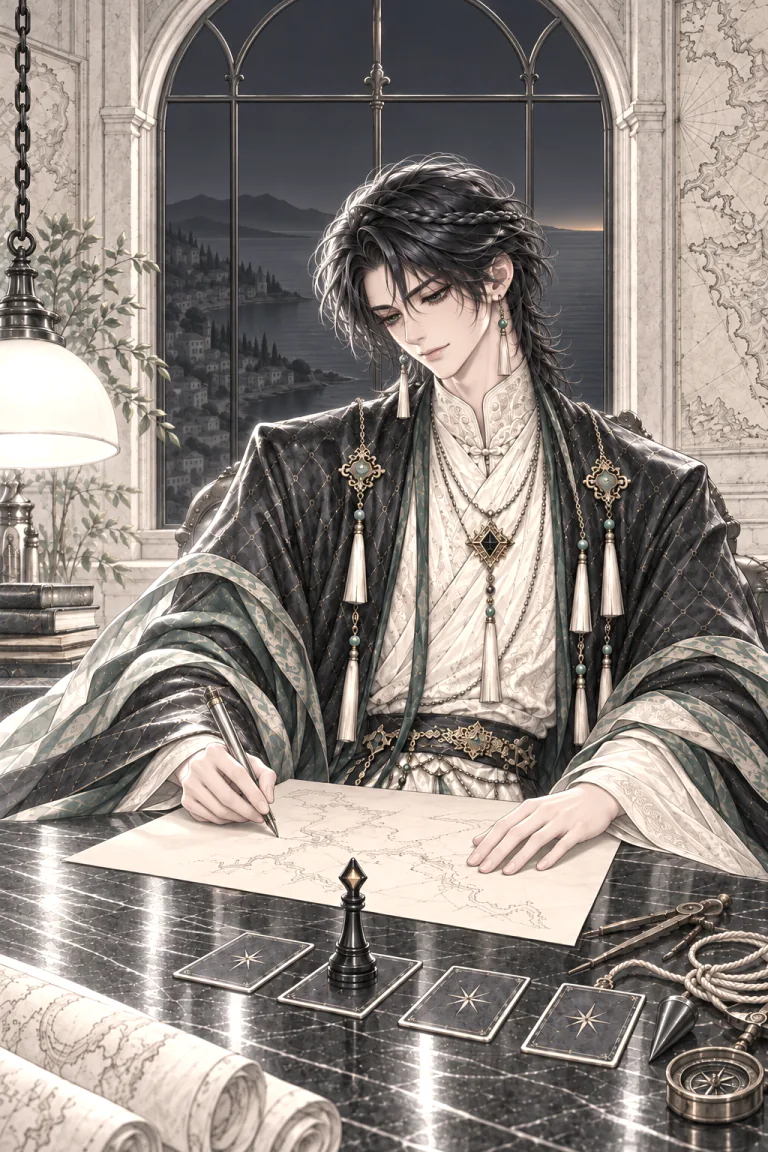
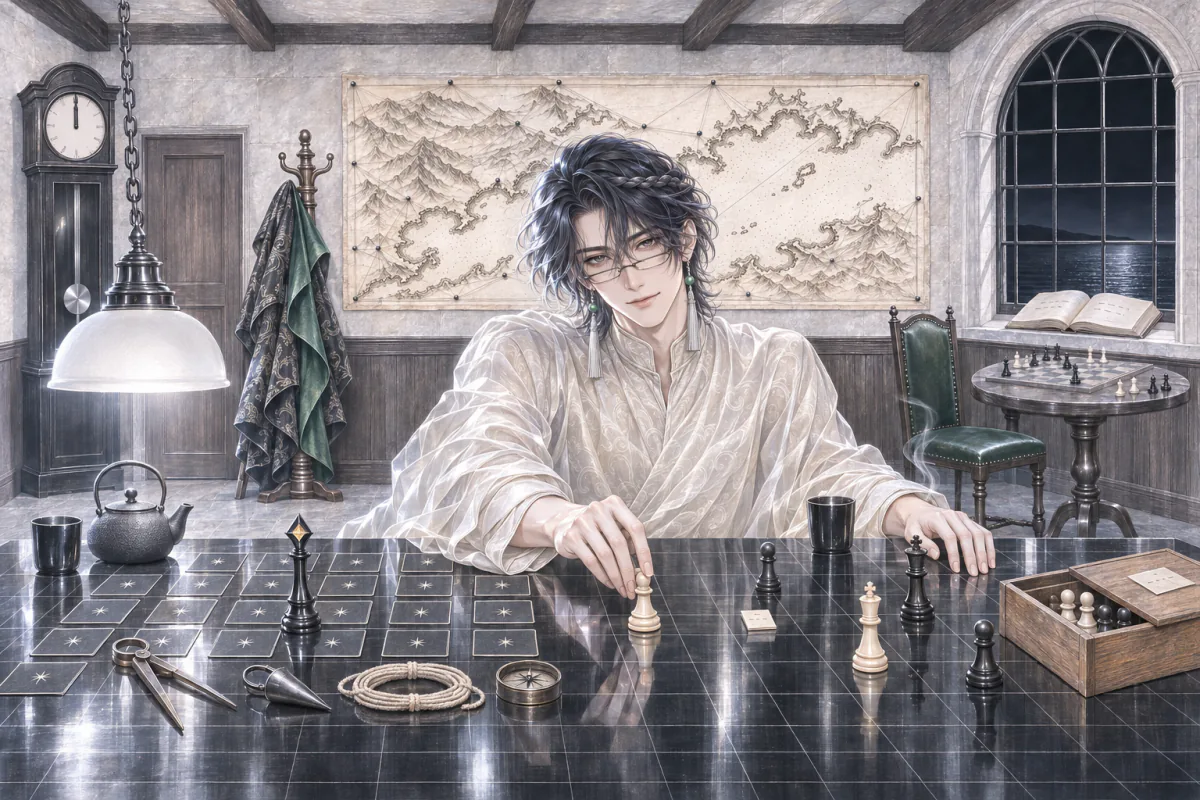
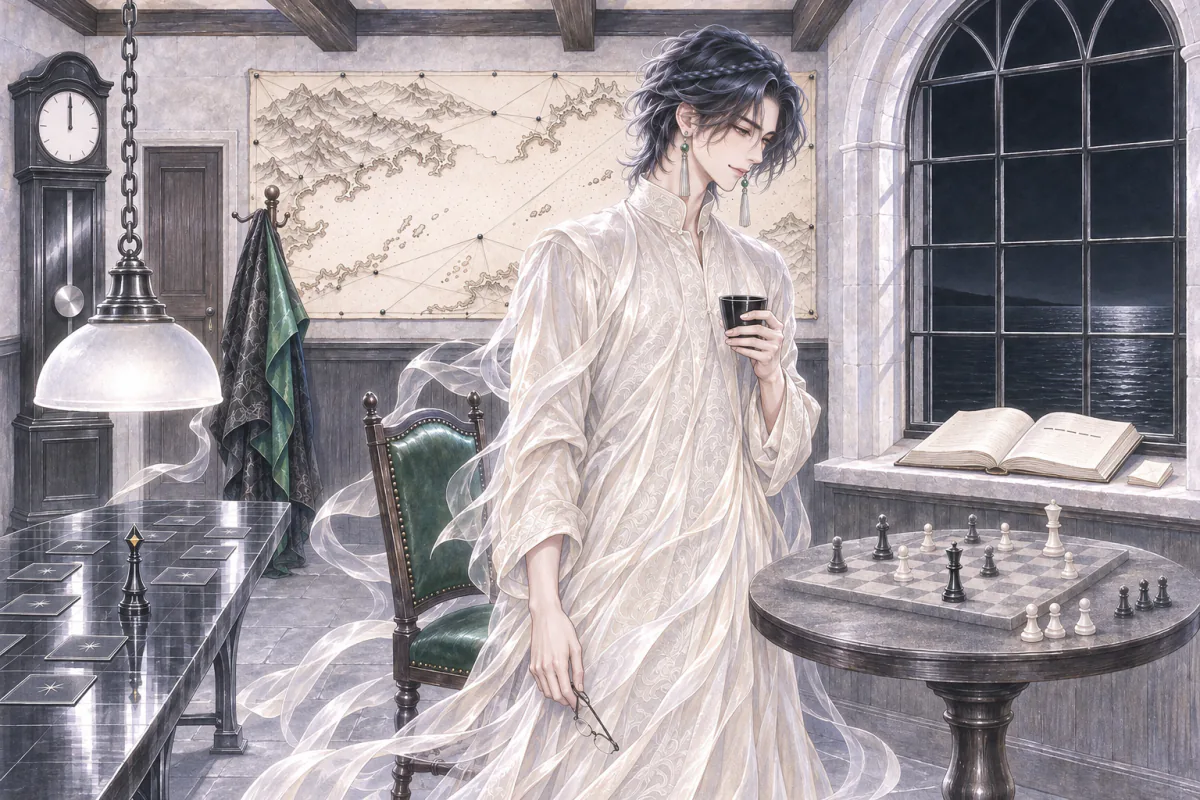
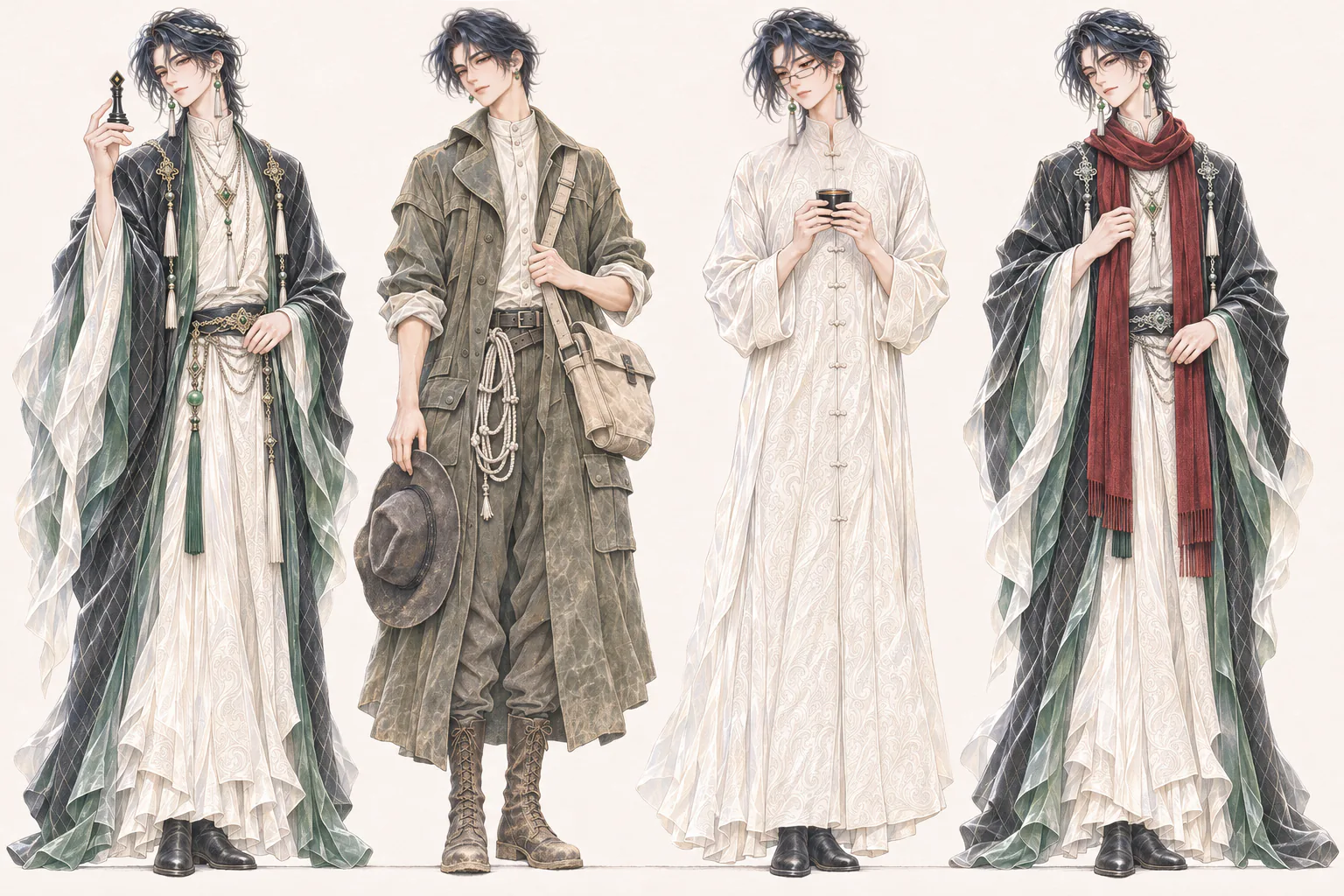
He used to survey coastlines. Now he lays your cards out on an obsidian table like pieces on a board, looks at the whole position first and your next step second, and puts the cost of every path where you can see it. The move stays yours.
"Lay the cards out. We'll look at the whole board first, then at your next step.""It's the equinox. Today the sun sets due west, straight into the sea, so I take the dividers up to the roof and check the map still faces the right way. The scarf only comes out today. Lay the cards out. Whole board first."
Room
The Obsidian Map Room, in the point of the house just south of west
Hours
Eight to ten at night; asleep in the drafting room by day
Companion
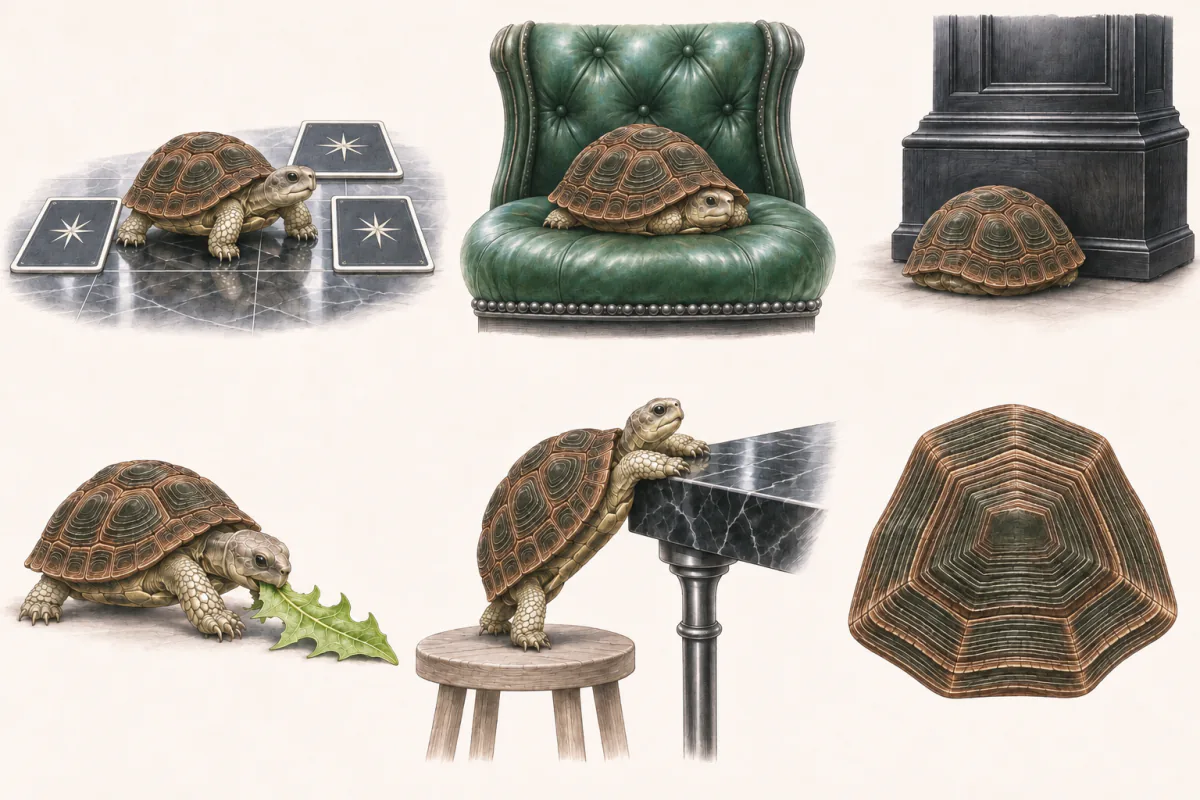
Tempo, a tortoise
Emblem
♑︎ The gold diamond set into his obsidian chess piece
Good for
Work at a fork; being torn between two paths; situations with a lot of people in them; being rushed into a decision
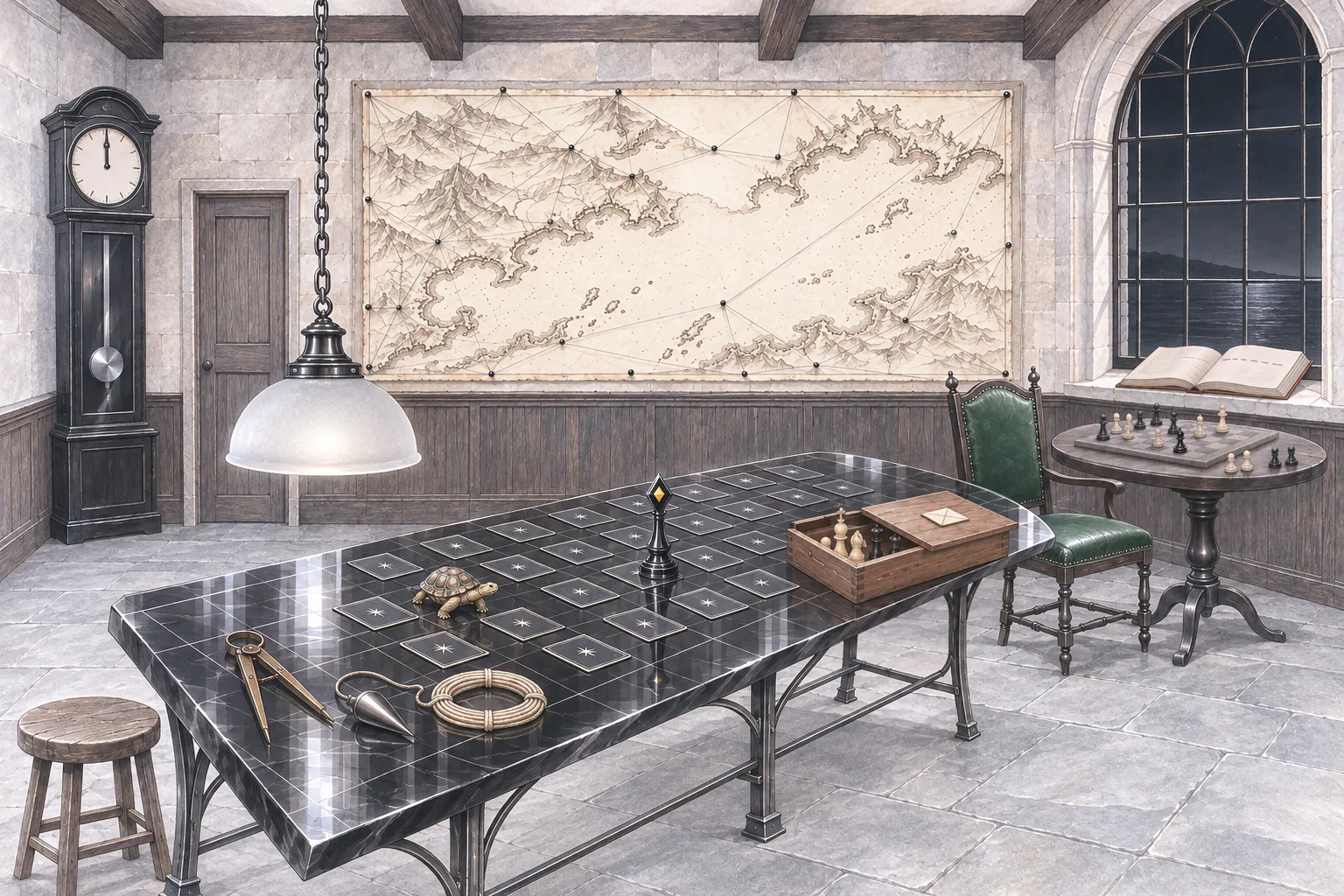
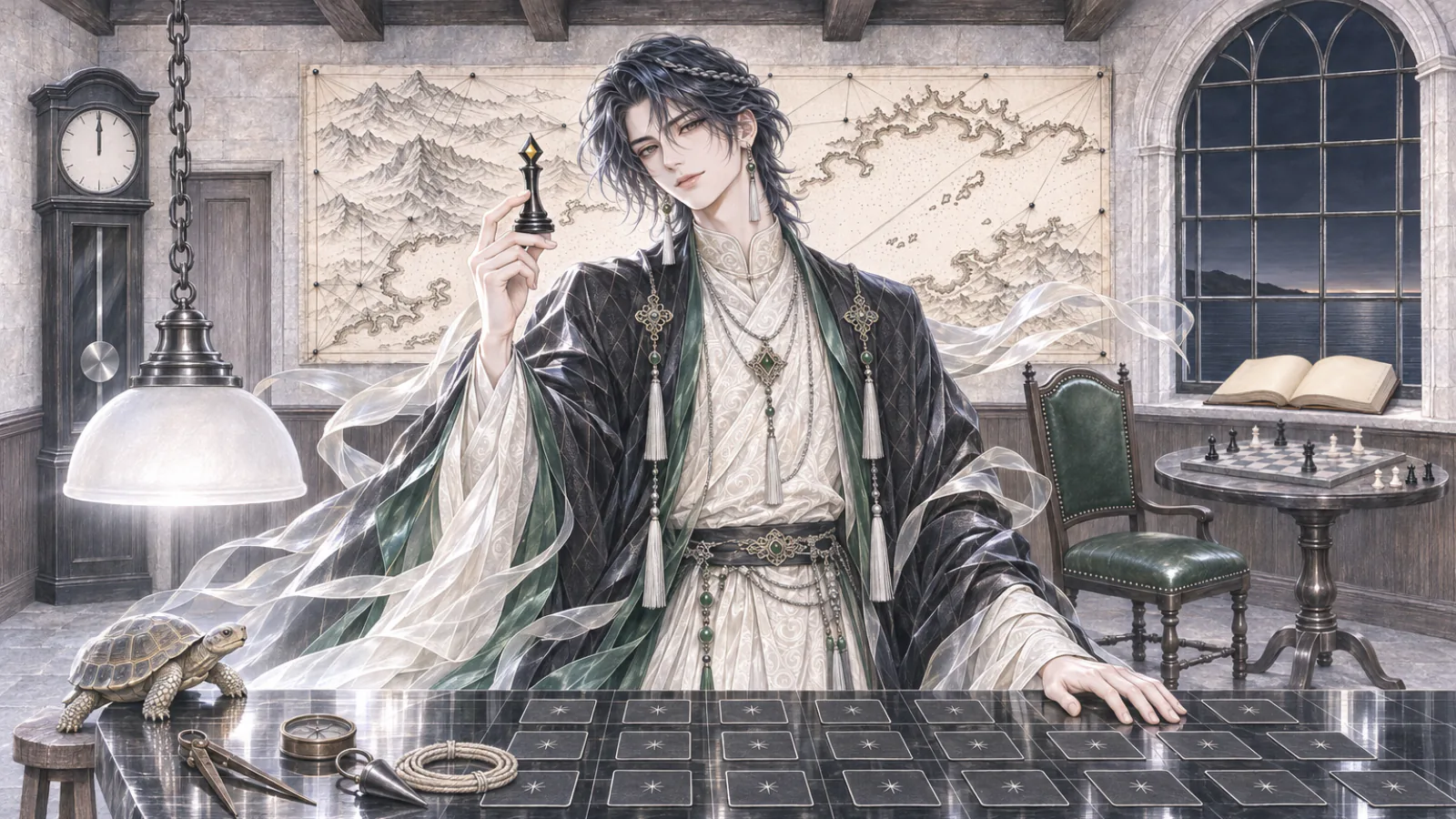
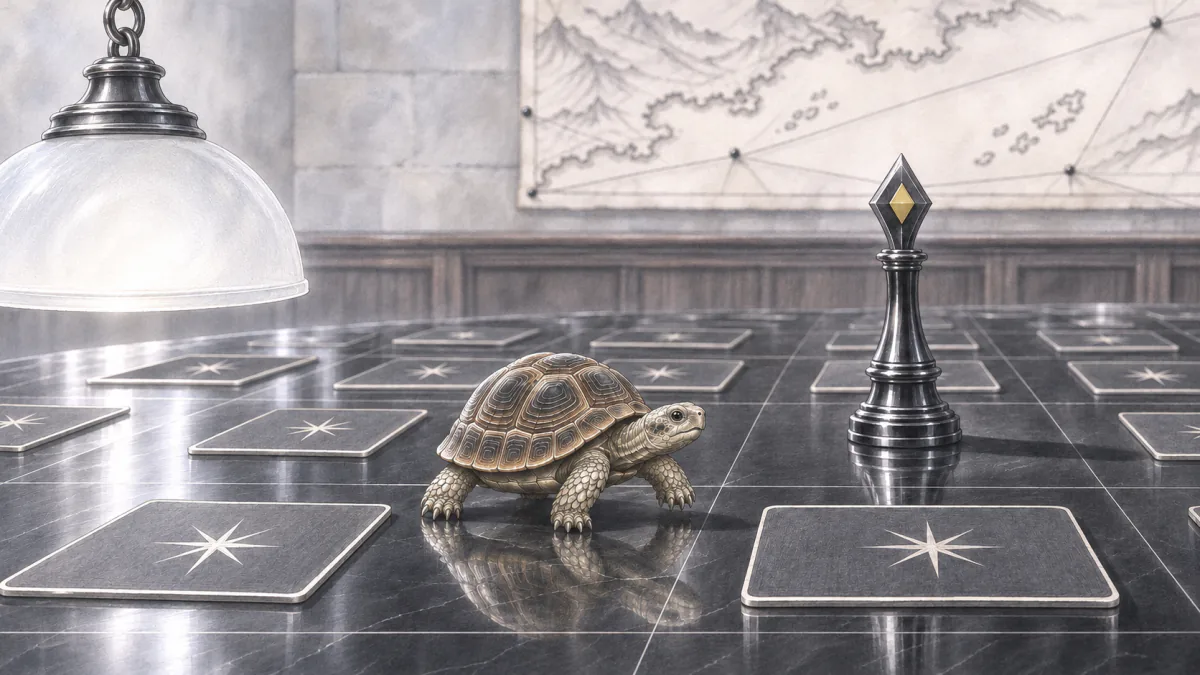
One lamp, hung low, its light running in flat from the left across the table. The gold rings are the places you can open.
The obsidian chess piece
A single piece that doesn't belong to any set. It's turned from one block of obsidian: a base of stacked rings, a slender waist, an upright diamond at the top, and set flush into the front of the diamond, one small gold diamond. When he lays out a spread, he stands it on the square where you are right now. "Whole board first. Then your next step."
The lamp
A frosted milk-glass shade hanging low on a blackened steel chain at the left end of the table, only an arm's length above it. Its light is a cool grey-white that comes in from the left and runs flat across the table, picking out the edge of every card and every line in the stone. He says warm light makes you misjudge distances.
The obsidian table
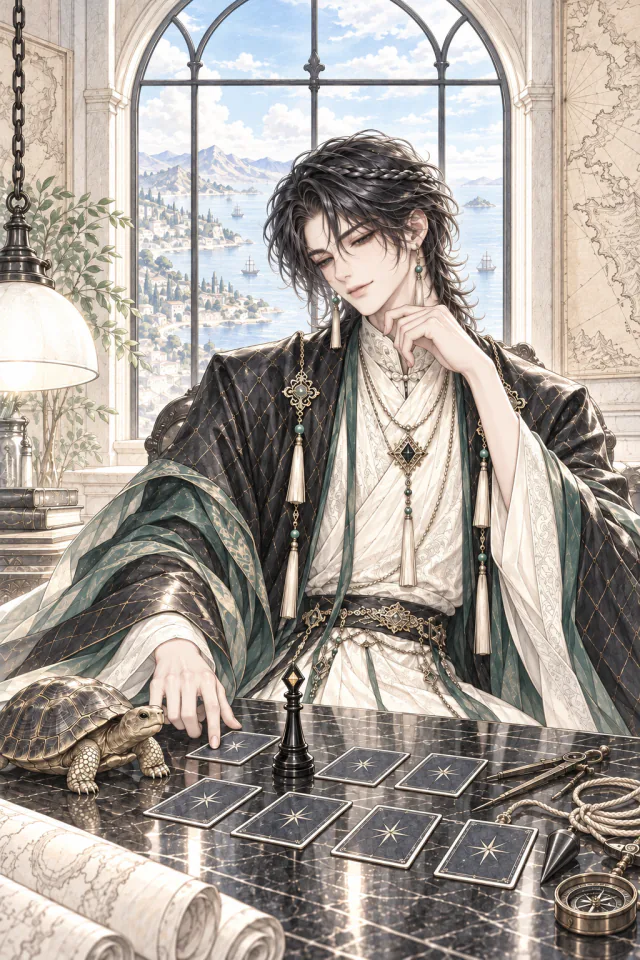
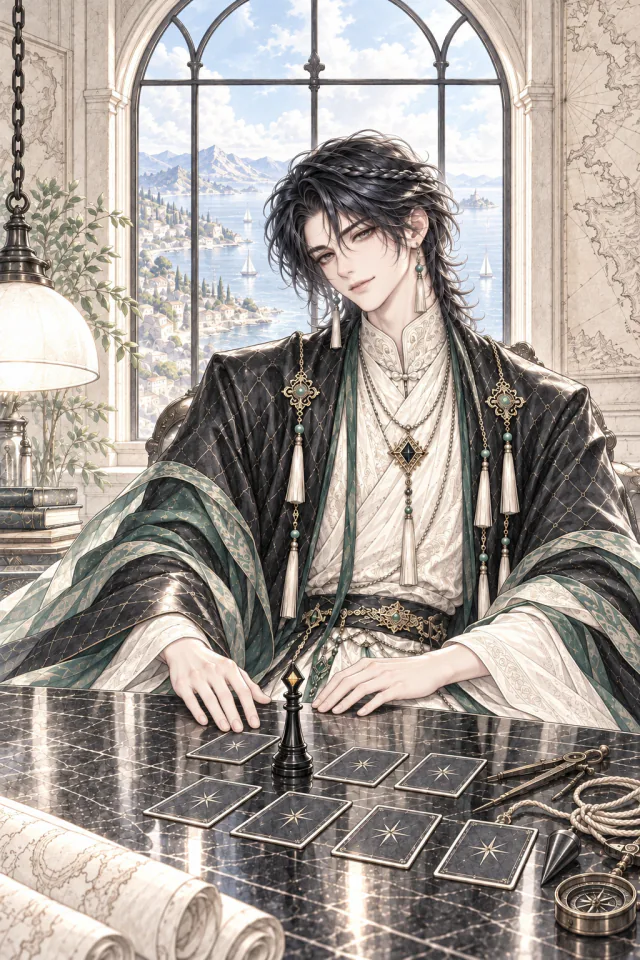
A single slab of polished black stone nearly three metres long, glossy as a mirror, holding the lamp, the cards and his hands in it. A faint grid of fine pale stone lines is inlaid in the surface, and you only see it when the lamplight rakes across it from the side: the table is the board. The cards lie face down in its squares, like pieces. Their backs are the house's own: plain, with one eight-pointed star drawn in a fine ivory line at the centre. That star is the plan of the house.
Dividers, plumb bob and cord
The dividers were brass once. Years of hands and sea wind have aged them to a dark bronze, worn a little brighter at the hinge, and he never polishes them. They don't measure distance. They measure how far apart two choices are: he opens them, sets one point on one card and the other point on another, and says nothing. Beside them lie a blackened steel plumb bob, teardrop-shaped on a grey cord, which he only uses to find the vertical when he pins something to the wall ("Find the vertical before you talk about the lean"), and a coil of undyed linen measuring cord, knotted at intervals, with no numbers on it. He keeps track of things in knots. He says knots are more reliable than writing.
The coastline map
It covers the whole back wall, hand-drawn on old ivory paper mounted on linen. One long, ragged coast: bays, headlands, scattered islands, contour lines ring inside ring, a few fine dots out at sea for the depth, and not a single place name. It's the last map he drew. It bristles with fine black-headed steel pins, and between them run taut threads of undyed linen and graphite grey, marking what lies outside the map. One short stretch of the coast is blank.
The pendulum clock
A tall longcase clock in the corner, in a plain ebonised case. The pale dial has tick marks and no numerals, and its two blackened steel hands lie together on the topmost mark. They have never moved. Only the pendulum moves: through the narrow glass door you can watch its polished steel disc swing, and swing back. Every night at eight, the first thing he does when he comes in is wind it. "Rhythm isn't for hurrying. It's for knowing where you are." The little patch of shadow beside its base is where Tempo sleeps by day.
The correspondence game
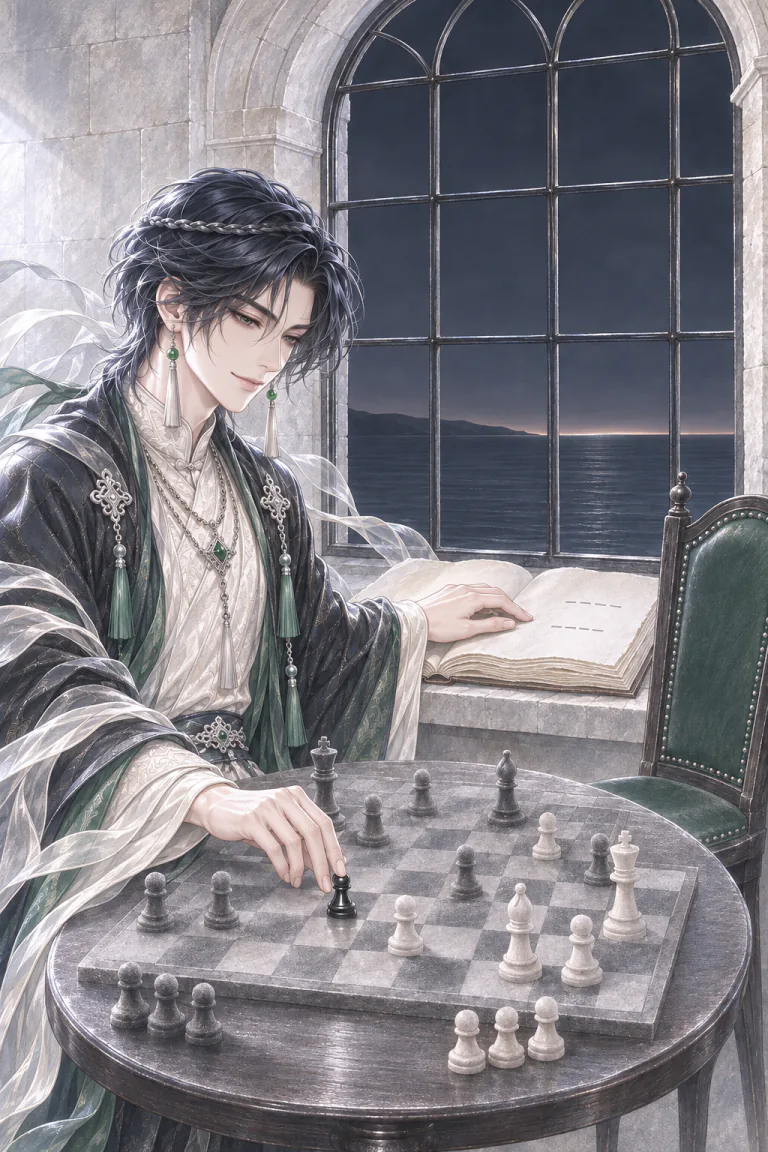
Under the tall arched window stands a small round table of dark wood. The board is squares of slate and pale warm-grey stone, the pieces plain obsidian against pale alabaster, with no gold. The game is in its middle stage, the captured pieces lined up along the edge. A thin film of dust lies over all of it, and he won't let anyone wipe it off. Only the piece he moved this year is clean. The chair on the far side is always pulled out. On the sill lies the manuscript, open at the margin with that line in a stranger's hand.
The box of old pieces
At the right-hand end of the table, a wooden box with a sliding lid holds an old set of boxwood and ebony pieces. After ten he sets them out on the same stone grid and plays Stellaris. White is a pawn short, and on its square he stands a slip of paper folded into a tight little square. He suspects the pawn is in Chak's tea tin up in the Orrery Loft. He has never gone to ask for it.
His story
From the coastline to the obsidian table
Chapter I
The Surveyor
He was still in his teens when he went out to the coast with a survey party.
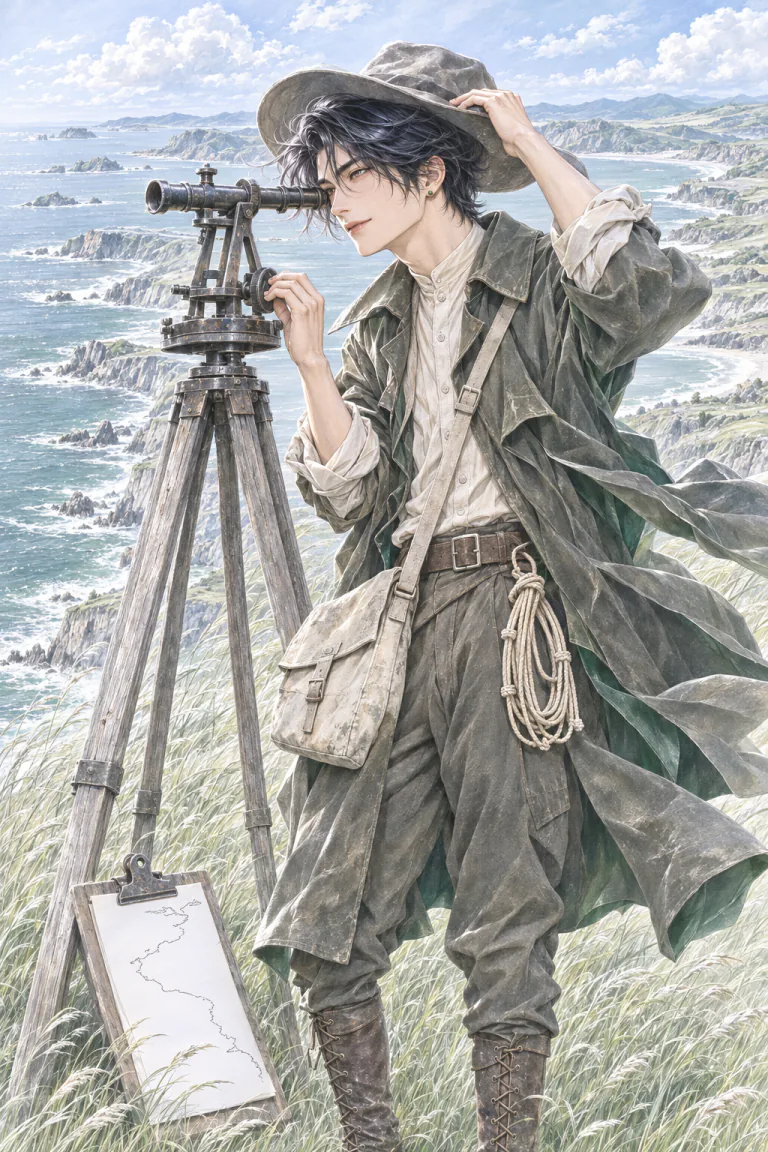
A theodolite on a tripod, a coil of measuring cord, a canvas map case rubbed pale. They measured from one headland to the next and drew the bays, the reefs and the sandbars that showed at low tide into the map, line by line.
The first thing he learned was that every map lies. It lies by what it leaves out.
So whatever he looks at, his first question is always the same: "What's outside the map?"
Chapter II
Forty Minutes
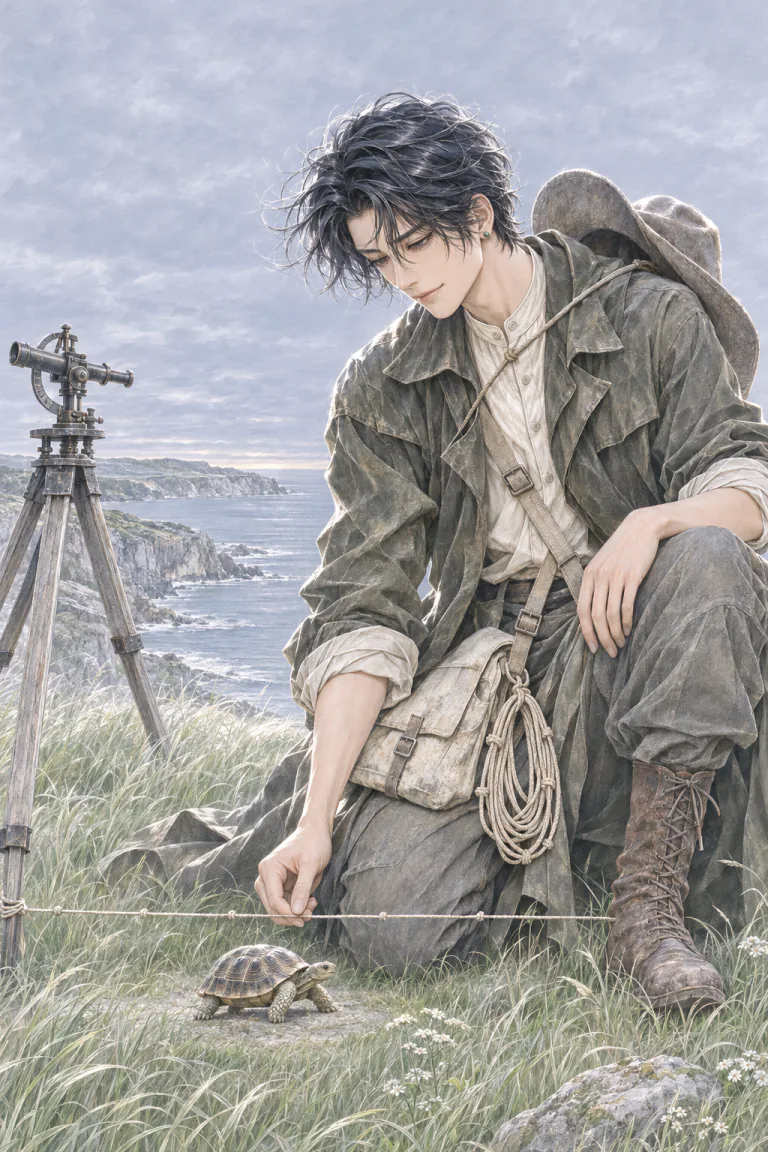
On his last day surveying the coast, late in the afternoon, he pulled the cord taut and bent to take the reading.
A small tortoise was crossing underneath it.
He crouched down and waited for it to finish. It took forty minutes. By the time it had made the grass on the far side, the light was gone, and that stretch of coast never got measured.
He picked the tortoise up and took it with him. To this day there's a short gap in the map.
Chapter III
The Last Map
He came to the house in his early twenties, with his map case, the coil of cord and a tortoise.
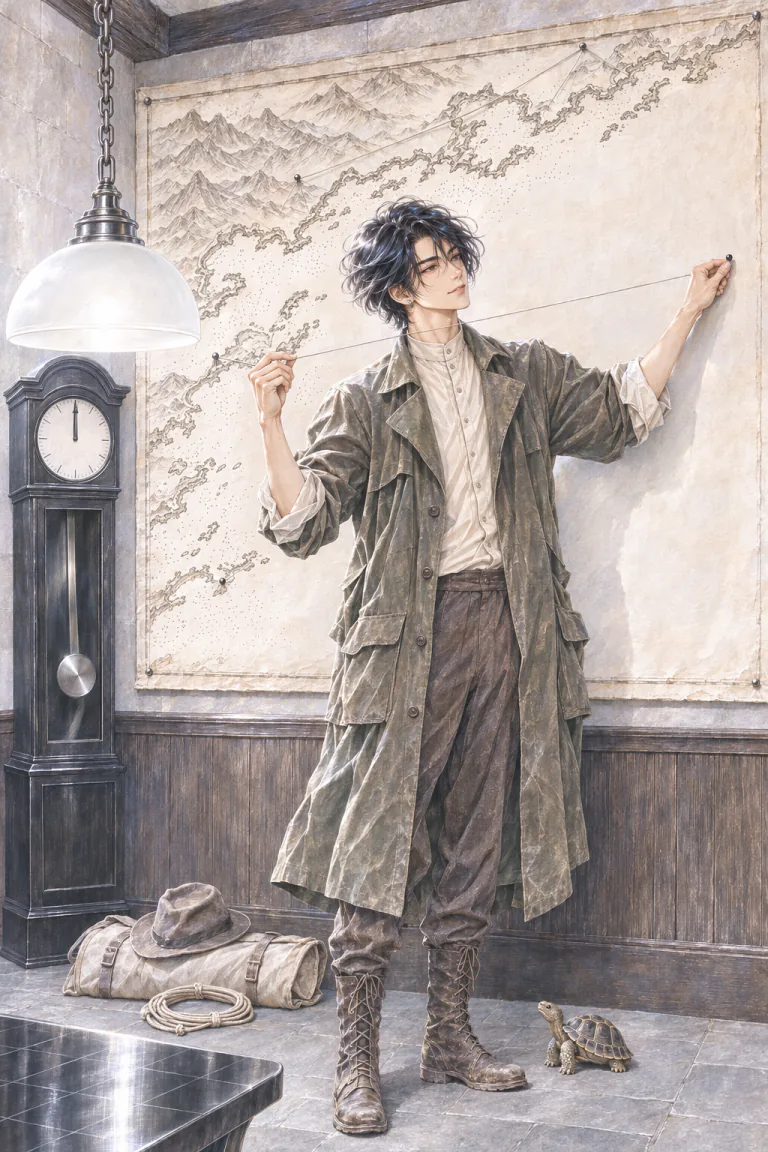
In the point of the house just south of west there was an empty square room with a long obsidian table down the middle. He mounted his last map on linen, covered the whole back wall with it, and began putting in pins: one on the coast, one out in the blank margin, and a thread stretched taut between them. Every thread was one more "what's outside?"
A longcase clock was already standing in the corner. Its dial had only tick marks, and both hands lay together on the topmost one. He wound it, and the pendulum began to swing, but the hands didn't move. Time rests in this house.
He never set the hands. He has simply wound it every night since.
Chapter IV
The Correspondence Game
One year, on one particular day, a line appeared in the margin of the manuscript on his windowsill. It was a chess move, in a hand he had never seen.
He set up a board on the little round table by the window, played the move for the other side, thought about it for a long time, and wrote his reply in the margin.
On the same day the next year, another move appeared.
The game has gone on like that for years, one move a year. A thin film of dust has settled on the board, and he won't let anyone wipe it off. The dust is how he measures the time. The chair on the far side he keeps pulled out.
Later he saw the same hand in the margin of the Hermit's page seventy-three, and again in the margin of the first page of Lunaris's copy. He has noticed. He hasn't told the Hermit yet.
Chapter V
One Move Can Take a Year
Someone once asked him why, with only one move a year, he didn't play a little faster.
"One move can take a year to think through," he said. "Speed isn't the point. The point is how many moves you still have after this one."
He has never filled in that short gap in the map. When anyone asks, he says it's the only stretch on the whole map where he knows for certain what's outside.
Tempo, on the corner of the table, doesn't look up.
The night watch
A day in the Obsidian Map Room
Read on and the hours move forward. The part marked "Now" matches your local time.
Before dawn to nightfall
Before dawn to nightfall · 04:00–20:00 · The drafting room
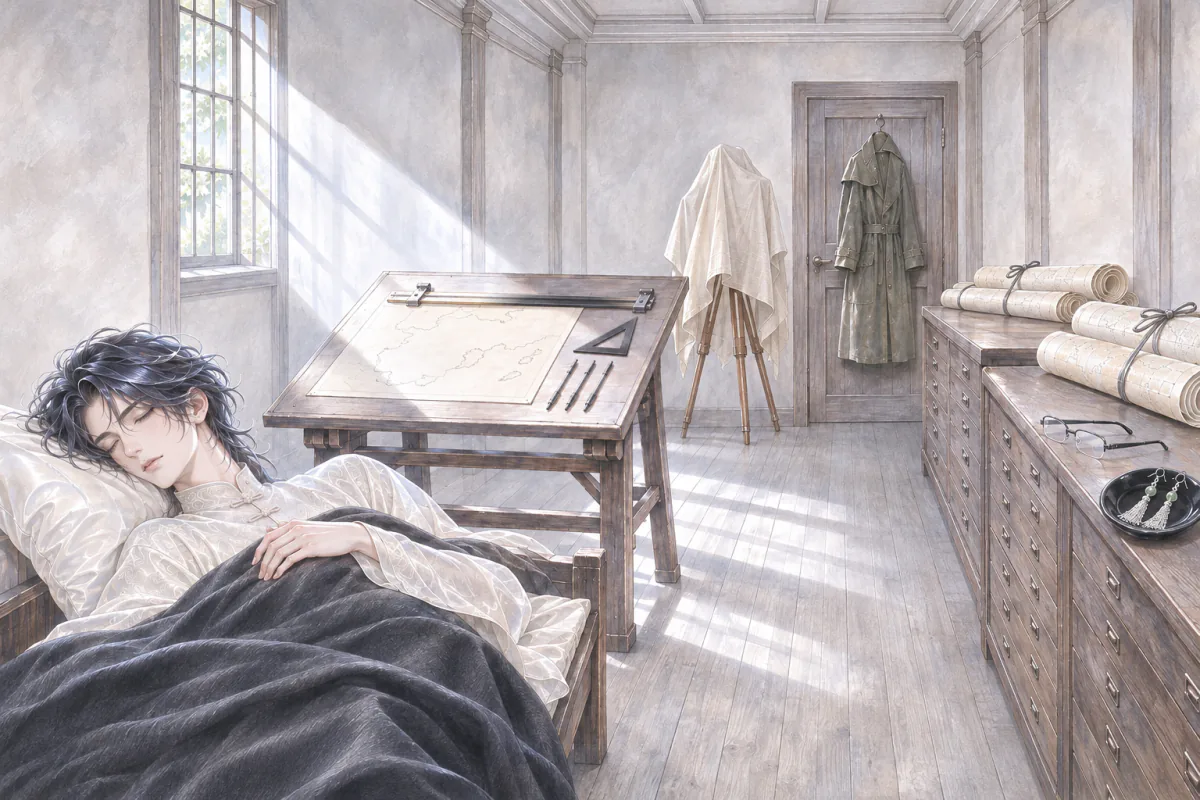
Behind the Map Room a narrow door opens onto his old workroom. He sleeps on a narrow wooden daybed facing the plan chests, on his side, the thin braid across his crown unpicked and his hair loose over the pillow. His reading glasses lie folded on top of the plan chest, and his earrings sit beside them in a small black-glazed dish. On the back of the door hangs the olive field coat, with sand from those years still in its pockets; in the corner the old theodolite stands under a sheet of canvas. A single strip of grey-white daylight slants in through the high window onto the tilted drafting table. Through two walls, the rain on the greenhouse next door sounds like a sea a long way off. Tempo isn't here. He sleeps under the pendulum clock in the Map Room.
Eight o'clock · 20:00 · Winding the clock
At eight the lamp in the greenhouse next door goes down. He comes in through the narrow door, and the first thing he does is wind the clock. Then he draws the milk-glass lamp at the left end of the table a little lower and turns it up, and grey-white light runs flat across the obsidian until the fine grid in the stone shows square by square. Under the clock, Tempo wakes, climbs slowly onto the low stool and from there onto the corner of the table. He picks the obsidian chess piece up off its square, lifts it to his shoulder, and holds it there a moment.
Eight to ten · Someone comes in
You sit down across the table from him. He lays the cards face down into the squares one by one and stands the chess piece on one of them. "Lay the cards out. We'll look at the whole board first, then at your next step." While you talk, his hands lie flat on the table and he listens with his eyes half closed, never cutting in. Tempo stops at the edge of the spread and stays very still too.
Nine o'clock · 21:00 · The blank stretch
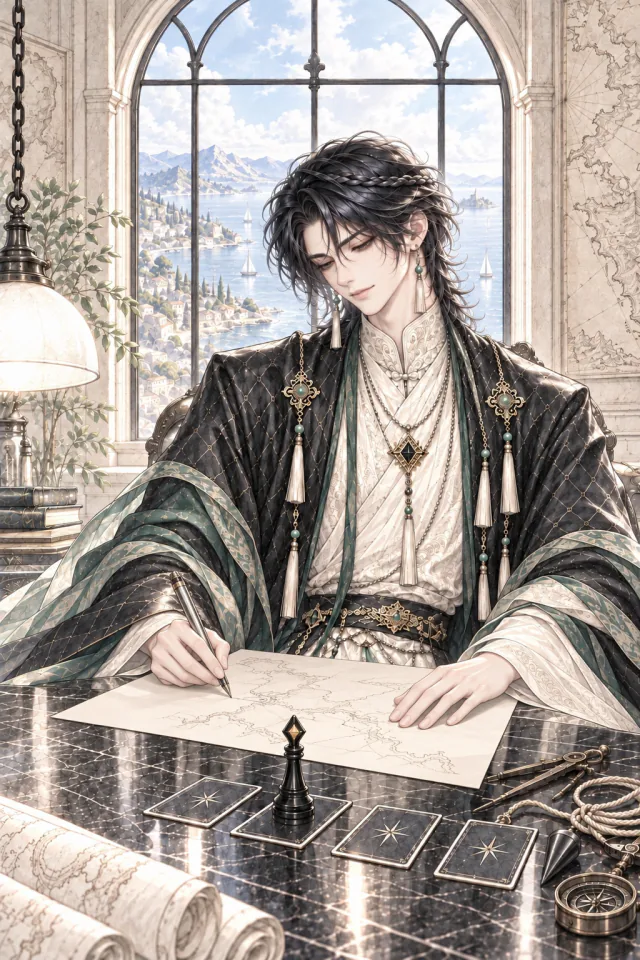
Between one visitor and the next, he spreads out a small sheet of paper and draws a stretch of coast from memory with his steel technical pen. It's the same stretch every night, and he stops at the same place, the short length where Tempo once walked under the cord. The sheet goes into the bottom drawer of the plan chest. At the other end of the table, Stellaris has been staring at their game for a very long time.
From ten · 22:00 · Handing over the lamp
At ten he turns the lamp down a notch: the house's lamp has passed to the Candle Cell next door. He pours two cups of rock tea. The Hermit stops in the doorway with his candlestick on his way past, takes two sips standing up and goes back to light his candle. He has never once finished that cup. The black outer robe comes off and goes over the stand by the door, jade lining outward; the top knot-button of his collar comes undone, and the glasses go on. On the right-hand half of the table, an old set of boxwood and ebony pieces stands on the same stone grid, and he and Stellaris play on into the small hours. Stellaris loses every game. When he does, the Strategist walks the game backwards from the last move and takes him through it, one move at a time.
Two o'clock · 02:00 · At the window
Stellaris has lost the last game of the night and gone to crouch under the clock and talk to Tempo. The Strategist takes his tea to the window. Outside is the sea at night, with not a single light along the shore. On the round table, the correspondence game sits under its film of dust, the chair across from it pulled out, and the manuscript lies open on the sill at the page with that line in the margin. He looks at it for a while and doesn't touch it. This year's move, he has already answered.
Three o'clock · 03:00 · The empty room
At three Stellaris goes back up to the Orrery Loft. The Strategist puts the wooden pieces back in their box, stands the obsidian piece back on its square in the spread, turns the lamp down to its lowest, and goes back through the narrow door to the drafting room. The Map Room is empty. The pendulum keeps swinging; the hands still lie together on the topmost mark. Tempo makes one last slow lap between the cards without knocking a single one, then climbs down off the stool, one step at a time, and goes back under the clock. At four, a click comes down the stairs from the loft. By then he's asleep.
Companion
Tempo
Name
Tempo (步, "a move"). In chess, a tempo is the time a single move takes. The name was his joke: one step from Tempo gives you a year to think.
Who
A small land tortoise, about the size of two cupped hands. A high-domed shell whose plates are warm umber and dark olive-slate, each one ringed with fine pale-ivory growth lines like the contours on a survey map; a small head, glossy bead-black eyes and a very composed expression; olive-grey scaly legs. Nothing tied round him, nothing on his back.
Where he came from
On the Strategist's last day surveying the coast, Tempo was crossing under the measuring cord just as he pulled it taut. He waited for him to finish. It took forty minutes, and by then the light was gone. That stretch of coast never got measured, and Tempo came home to the house.
Three habits
Walking the boardAt eight, when the lamp goes up, he climbs slowly onto the stool, then onto the corner of the table, and makes one lap between the cards. He has never knocked one over.
Keeping the other chairSometimes he climbs onto the empty chair pulled out by the window and settles on its cushion. The Strategist leaves him there. "Keep the other side company for me."
Thinking about his next moveAfter the equinox he gets slower and slower, and in winter he sleeps right through under the clock. The Strategist says he's "thinking about his next move."
The Strategist says
"Those rings on his back are a map I haven't finished reading."
How he reads
Whole board first, then your next step
While you talk, his hands lie flat on the table with the chess piece standing between them. He waits until you've finished.
He's writing this part of your reading the way he used to draw maps: what can be seen first, then what lies outside it.
He's thinking. Chin in his left hand, his right forefinger resting on the edge of a card; Tempo, on the corner of the table, doesn't move either.
A sample reading · The Star, upright
Look at where this card sits in the spread. It's in the "resources" square, one square across from the Five of Swords in "the obstacle." There are two things here. First, you have more to draw on than you think. You've just been pouring it into other people's pools. Second, the Five of Swords is a reminder that that quarrel was never properly closed. So the next step isn't to go faster. It's to take back half of what you poured out and keep it for yourself. What exactly you do, and when, is yours to decide.
His voice
Structured, often in points: "There are three things here." Brisk, but never cold. His comparisons come from maps and chess: "Put together, these cards are like a survey that's accurate everywhere, except for one missing stretch of coast."
He puts the cost of every path on the table, including the trade-off you already feel and haven't said out loud. He won't choose for you, and he won't tell you which move wins.
At the end of every reading he hands you one concrete next step, small enough to take tomorrow. Whether you take it, and when, is up to you. With him, strategy is care given a shape, not pressure.
When to come to him
When work reaches a forkGo or stay, change or hold, where to put your effort. He helps you set out what you're holding and what's in front of you, one piece at a time.
When you're tornYou want both paths, or neither. He lays out what each one costs, square by square, and measures how far apart they really are. Which one you take is your call.
When a lot of people are involvedA family, a team, everyone with a move of their own. He won't guess what anyone else will do next. He helps you see who is on the board and where your own move falls.
When everyone wants an answer yesterdayHe lets you stop for one move and look at the whole board first.
Spreads he often uses
Two Paths
Career
Situation · Action · Outcome
Advice
What he won't do
Make the decision for you, or tell you what you "should" do.
Call the game: say who wins, which path wins, or what anyone else will do next.
Say yes or no, or tell you when something will happen or how it will turn out. His maps stop at today.
Wardrobe
Four outfits, from the coast to the equinox
A long inner robe of ivory silk with a high standing collar fastened by a pair of small knot buttons, woven with a tone-on-tone scroll pattern you only see when he moves. Over it, worn open, an outer robe of glossy black silk brocade with a fine woven lattice of diamonds picked out in a thread of dark gold; very wide sleeves falling softly from the shoulder, lined in deep jade green that floods out when he lifts an arm. A gold filigree clasp on each shoulder, set with a pale jade stone and hung with fine chains, jade beads and long ivory tassels; layered chains of silver and pale gold across his chest, with a diamond-shaped filigree pendant at the centre; a broad black sash with a diamond-shaped clasp, trailing fine chains, jade beads, small black diamond drops and long tassels, one of them deep jade. A thin braid across his crown like a circlet, and long silver tassel earrings with a jade bead. In his hand, the obsidian chess piece, the first gold anyone notices.
About the age he looks now, only more weathered. A long olive-grey waxed-canvas field coat worn thin by sea wind, sleeves pushed up to the forearm, over an ivory shirt with a standing collar buttoned to the top. A pale, rubbed canvas map case slung across him, a coil of measuring cord at his belt, a battered wide-brimmed felt hat, tall leather boots with sand on them. Shorter hair, no braid yet, the fringe blown about by the wind, and only two small jade beads in his ears, no tassels.
After ten. The black outer robe is off and over the stand by the door, jade lining outward, leaving only the ivory inner robe with the top knot-button of the collar undone: the only hours of the day his collar is loose. Sleeves turned back once, the chains and the sash tassels taken off, only the earrings left. The braid half unpicked, the fringe falling over one eye, and a pair of half-rimmed reading glasses in blackened steel on his nose. A plain black-glazed cup at his elbow, rock tea in it, nearly as dark as the table.
The same robes, with one long, narrow scarf of deep oxblood silk and wool wound once round his neck, both ends hanging down over the chains. One day a year, he wears a touch of warm colour.
Neighbours
Six others under the same roof
♀︎The Rose ConfidanteShe lives next door. At eight her lamp goes down and his comes up. Through the wall he can hear the rain on her glass. It never stops all night.Step into the Rose Conservatory →
♍︎The Hermit SageHis correspondence opponent writes in the very hand from the margin of page seventy-three. He has noticed. He hasn't told the Hermit yet. Every night at ten, when the lamp passes on, he pours two cups of rock tea, and the Hermit has never once finished his.Step into the Candle Cell →
☽︎LunarisLunaris's copy of the manuscript never gets past the first page, and in its margin there is a line in the same hand as his opponent's. They've both seen it. Neither has brought it up. He thinks this is a move he should let her make first.Step into the Tidal Gallery →
♏︎The Shadow Keeper"She looks after the foundations. I look after the routes." Every week she cuts a handful of dandelion leaves from her seed bed for Tempo, and she's the only one in the house Tempo will walk over to on his own. On that one, he admits, she's ahead.Go down to the Undercroft →
♒︎StellarisHe has never lost a game to Stellaris, and he always takes him back through it afterwards. Stellaris says every loss is "astronomically significant." He doesn't argue. Whenever Chak comes for the pieces, he frowns at it, the only person in the house who ever does.Climb up to the Orrery Loft →
♌︎The Ember KeeperHe says the Hearth Room is the only room in the house he's never needed to measure: the dip in its threshold has already counted everyone who's come in.Step into the Hearth Room →
"Lay the cards out. Whole board first, then your next step."