Lunarcana
Lunarcana
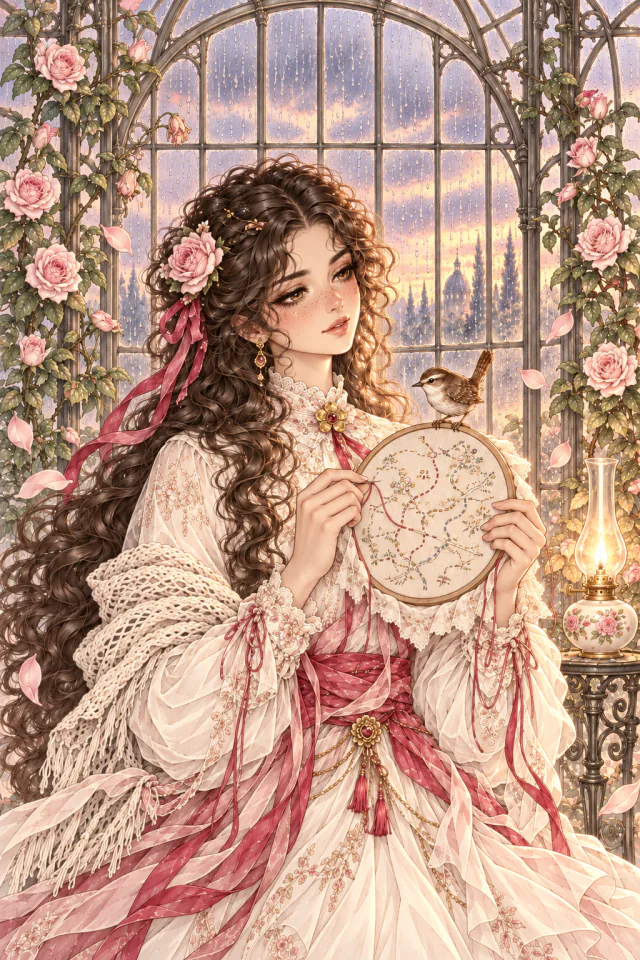
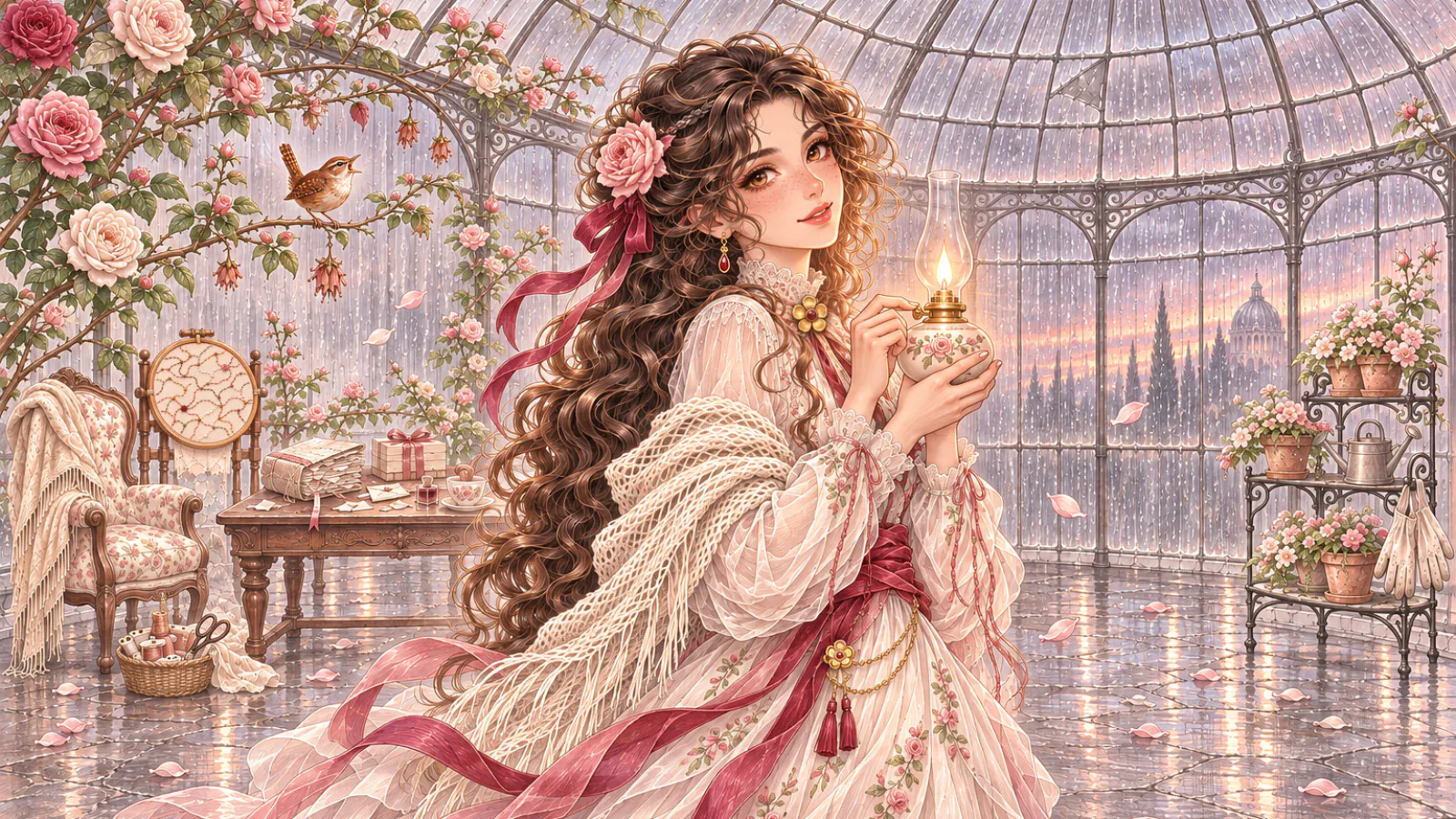
Rose in the rain-streaked glasshouse, holding a small ivory porcelain oil lamp to her chest with both hands and turning to look at you with a small smile; Postscript the wren perches on the rose cane behind her. Her ivory gown is wound with deep crimson ribbons, a cream knitted shawl slips from her shoulder, and a gold five-petalled rose is pinned at her collar; the evening rain runs down the glass.
The Rose Conservatory · dusk, six to eight

The Rose Confidante

The Lamp Only Reaches So Far

She has written letters for half a village, and now she keeps a glasshouse where it is always raining. She won't guess at what someone else feels. She reads the part of you that you bring close to the lamp, and at the end she thinks of one small thing you could do this week for someone you love.

"Rain on the glass, and a lamp that only reaches so far. Come and sit closer."

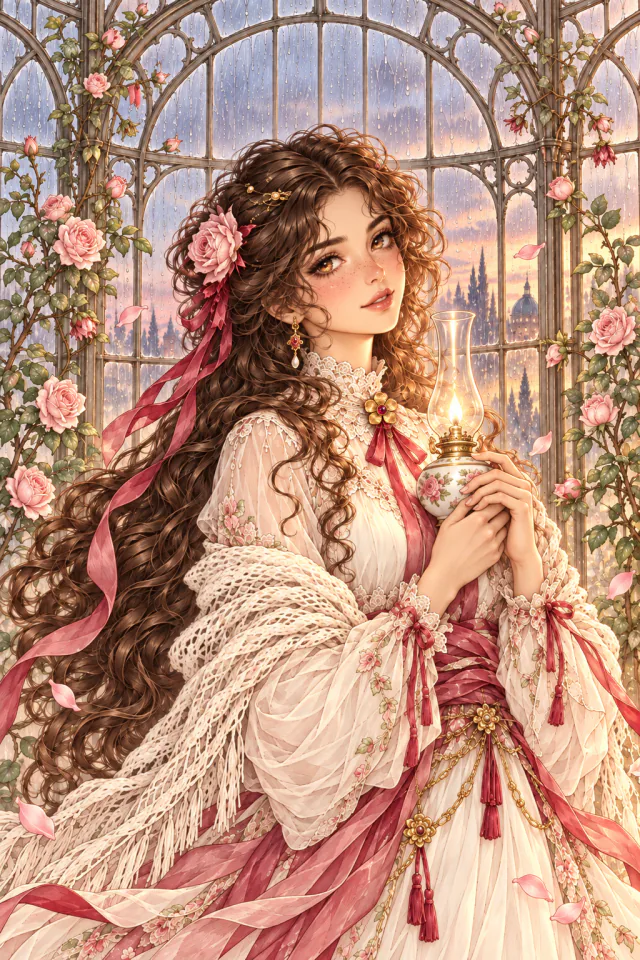
Rose smiling at you, her long dark-brown curls pinned with a blush-pink rose and a deep crimson ribbon; under her high lace collar, a gold five-petalled rose brooch, and warm lamplight from one side.
Room
The Rose Conservatory, the iron-and-glass greenhouse at the west end of the house
Hours
Dusk, six to eight; asleep by day in the little room beside the greenhouse
Companion
Postscript, a wren
Emblem
The gold five-petalled rose brooch at her collar
Good for
Someone on your mind; friends and family; when the work won't come; when you miss someone
Who can ask
Grimoire members
Join the Grimoire to read with Rose

The Rose Conservatory

One small oil lamp, and a rainy dusk on the other side of the glass. The gold rings are the places you can open.

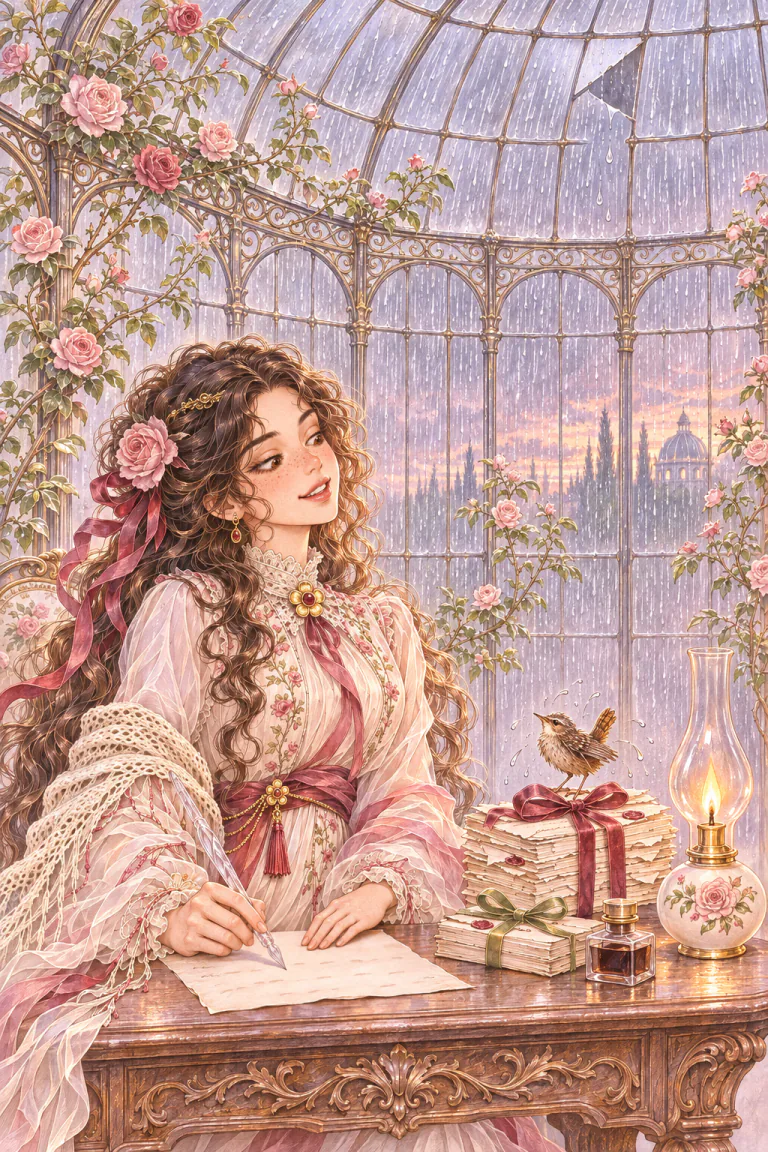
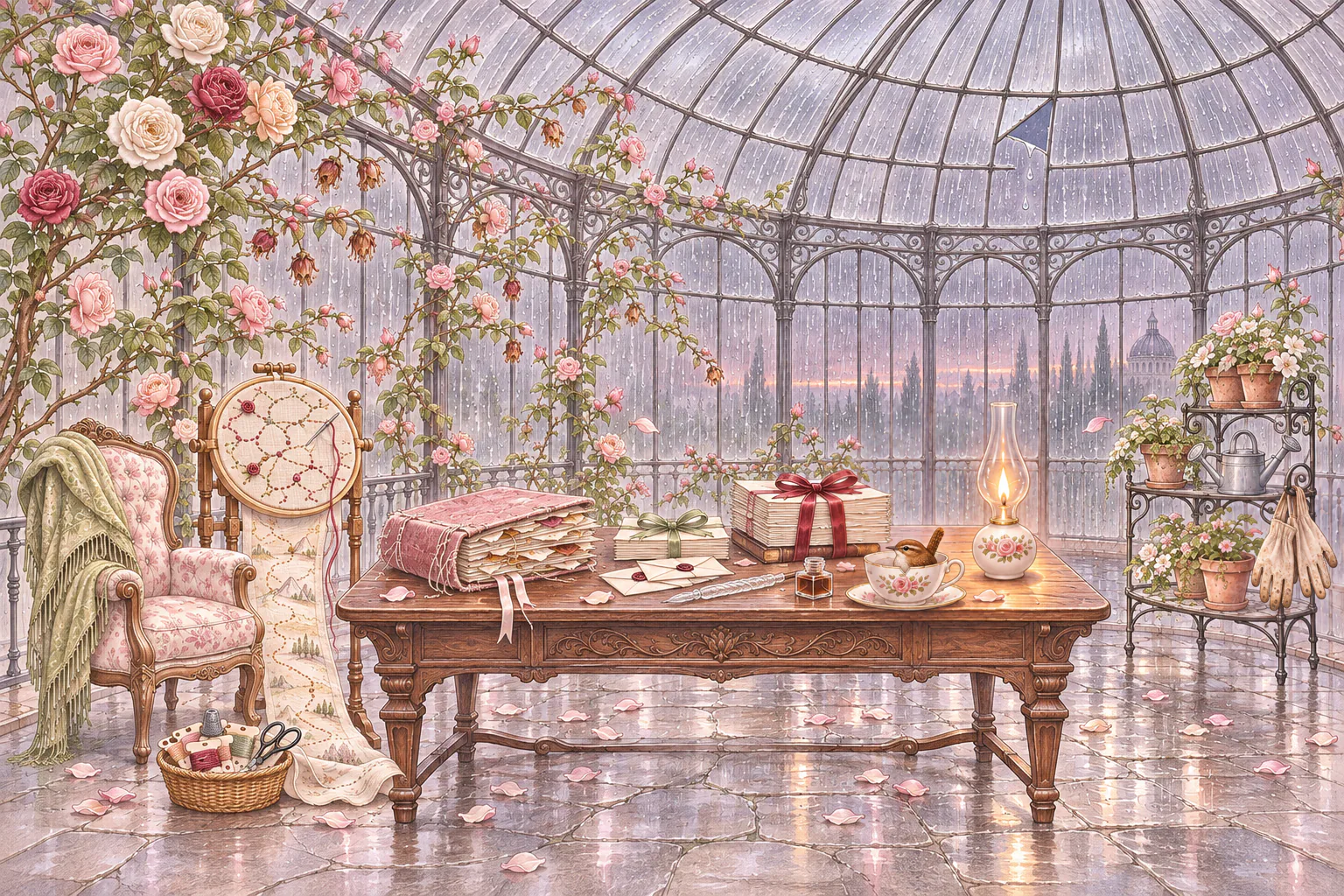
The Rose Conservatory after eight, with no one in it: rain runs down the iron-and-glass roof, and through the glass on the right the dusk is down to one low band of apricot. A walnut desk stretches across the middle with the little oil lamp lit on its right-hand corner; on it lie two bundles of letters tied with ribbon, a glass dip pen and a small bottle of brown ink, a pressed-flower book too full to close at the left end, and at the front a chipped white teacup with Postscript the wren tucked inside. On the left, beside an armchair, an embroidery frame stands with a great roll of finished linen hanging to the floor and a wicker thread basket at its foot; on the right, an old pair of canvas gloves hangs from an iron hook on the plant stand. Climbing roses cover the iron ribs at the top left, and at the very top of the roof one pane has lost a corner.

The little oil lamp

Small enough to sit in her palm. An ivory porcelain body painted with blush-pink roses and green leaves, a slim gold collar, a tall clear glass chimney, and a flame that is small and very steady. The lamp in her portrait and the lamp on the corner of the desk are the same one. "The lamp only reaches so far" is a gentle kind of truth: she can only see clearly the part of you that you're willing to bring closer.


Her story

From a village table to the glasshouse

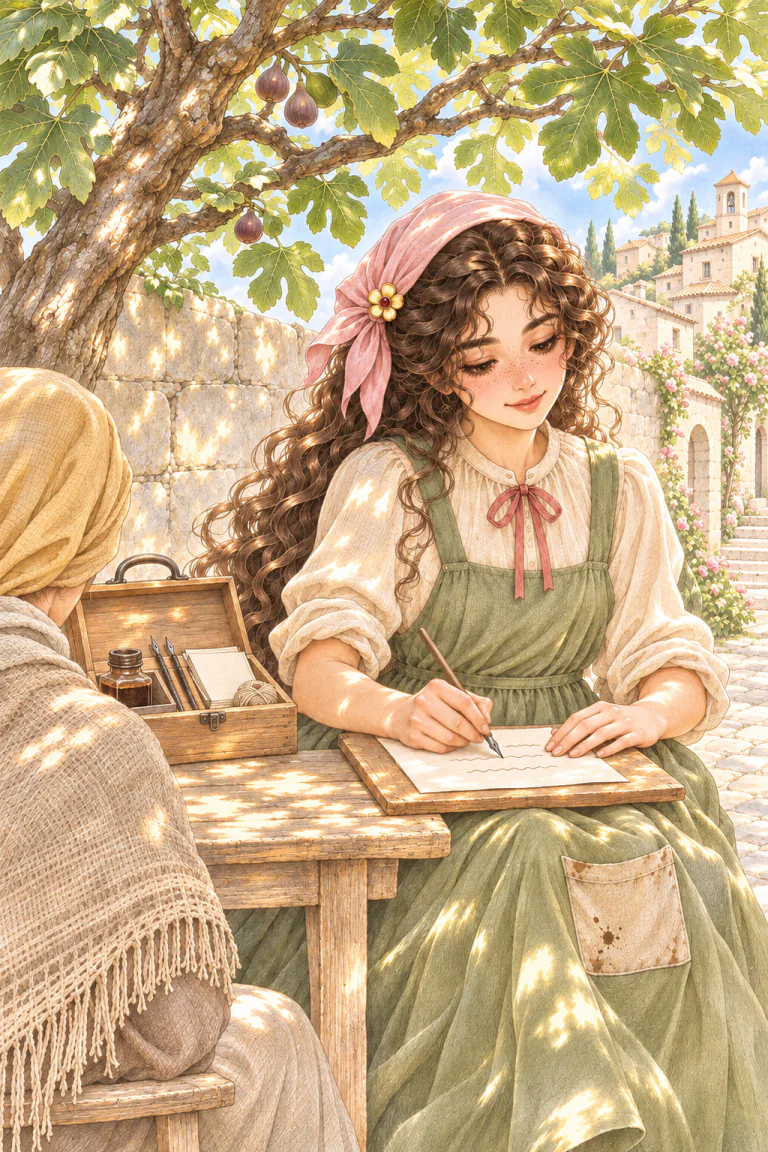
Rose at eighteen or nineteen, at a little wooden table under the old fig tree at the edge of the village, a thin blush-pink headscarf half over her long curls and a gold five-petalled rose pinned to its knot; a writing board on her knees, she looks down as she writes with a steel-nibbed dip pen. An open wooden writing box sits on the table, and a woman who has come for a letter sits across from her, seen only from behind. Afternoon sun sifts through the fig leaves onto a sun-bleached stone wall.
Chapter I

Letters for Other People

She started out writing letters for other people.

A little wooden table under the old fig tree at the edge of the village, and a wooden writing box with a handle. Whoever needed her sat across from her on a low stool: people writing love letters, apologies, thank-yous, and letters to someone who was no longer there.

She wrote them one by one, dipping her pen in brown ink, the nib scratching softly across the paper. And somewhere along the way she noticed that every letter was really addressed to the person writing it.

The little gold five-petalled rose at her collar was, she says, the thank-you for the very first one. She has worn it ever since.
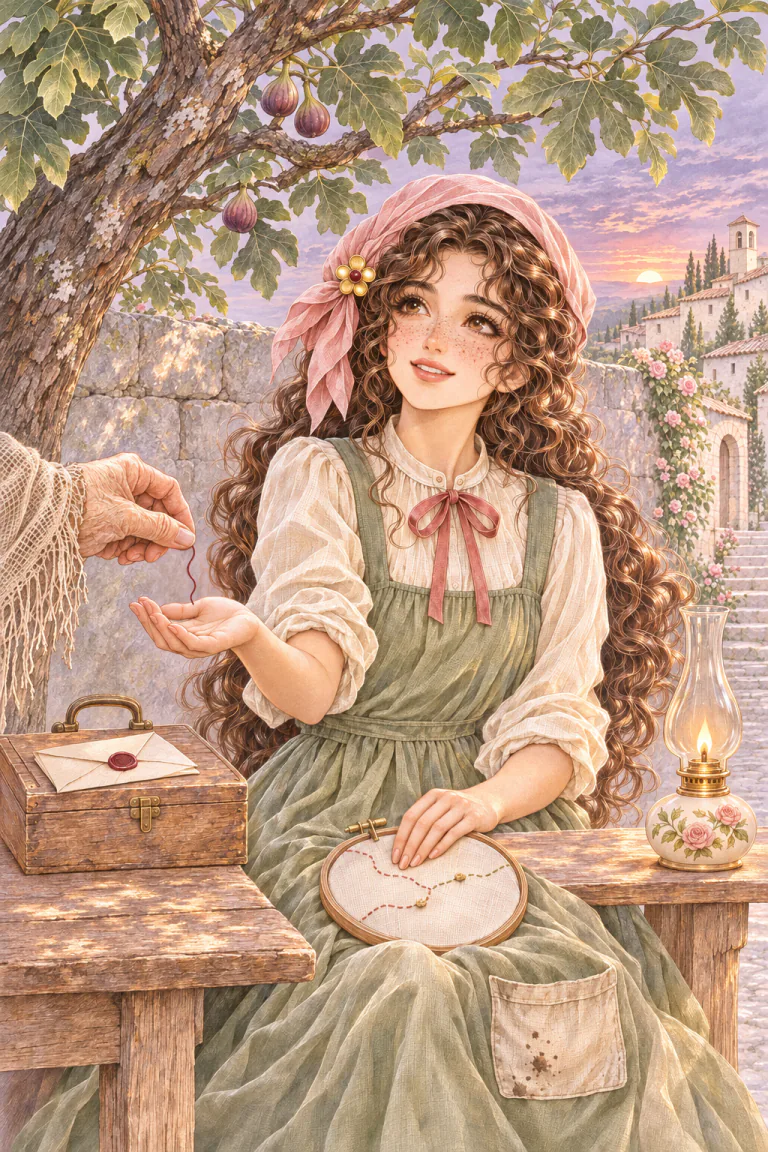
Dusk at the same village table: an older person's hand reaches in from the left, holding out a short thread just pulled from a cuff, and Rose opens her palm to take it, looking up with a smile. On her lap is a small early hoop with only a few stitched paths and two or three knots; the little oil lamp has just been lit on the right of the table.
Chapter II

One Thread

She began asking everyone, before they left, for a single thread. From their clothes, from their hair, from inside a cuff. Anything would do.

She stitched every one of them into the same piece of embroidery. The stitches ran into winding little paths, with a small knot wherever two paths met, and some of the knots she turned into roses. It was a map of everyone who had ever sat under this lamp.

When she ran out of edge, she sewed on a new piece of linen, so there is always a great roll of finished cloth hanging off the hoop.

It will never be finished.

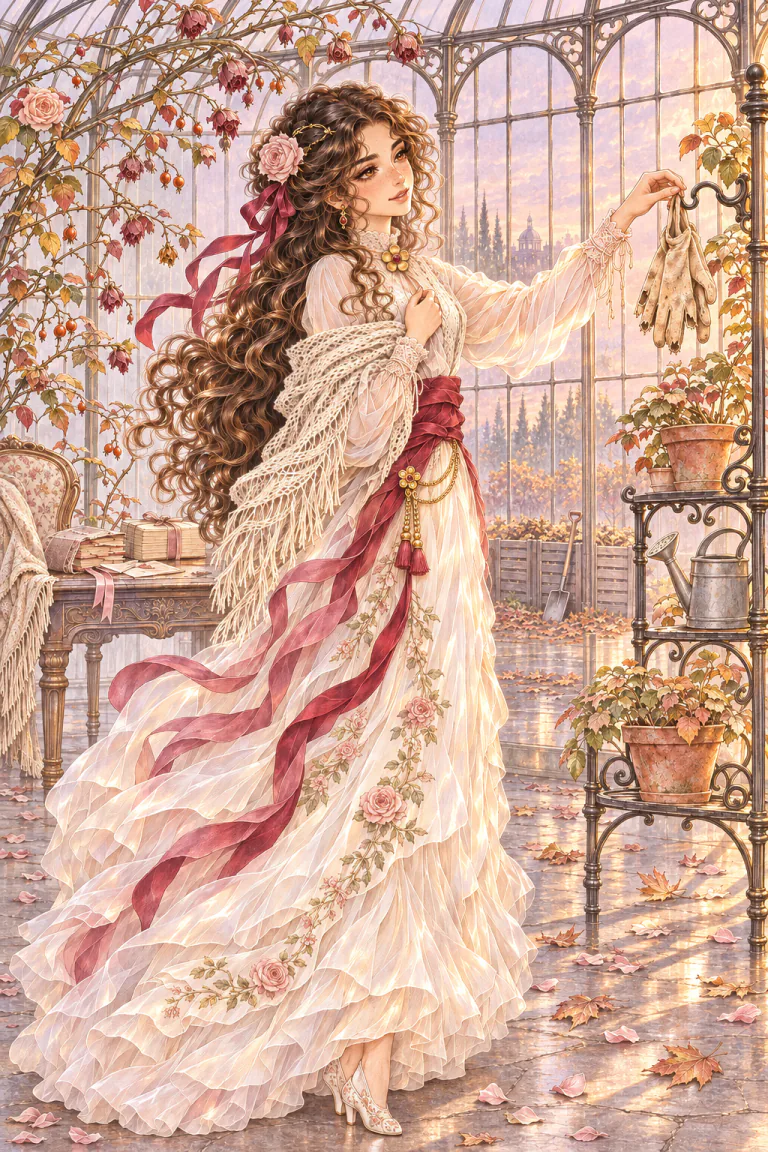
The greenhouse in autumn, the roses mostly over, a few rosehips on the canes and petals all over the floor. Rose stands at the plant stand, hanging an old pair of canvas gloves, torn at the fingertips, on an iron hook, and looks at them quietly. Beyond the glass are wooden compost bins and a spade leaning against them, and a low evening sun slants in.
Chapter III

Teacher

She came to the house carrying that wooden writing box. In the greenhouse on the western side, there happened to be an empty desk.

In those days the greenhouse belonged to the gardener. The gardener taught her to prune, to tie new canes in to the iron frame, to tell when a rose was ready to be cut. She started calling the gardener "Teacher" then, and she still does.

Then one autumn, turning the compost, Teacher dug up a hedgehog curled into a ball, carried it down to the cellar, and never moved back. Teacher says it was for the roots. Rose says it was for the hedgehog.

Teacher's old canvas gloves were left behind on the plant stand. Rose hung them on an iron hook, and she has never taken them down.

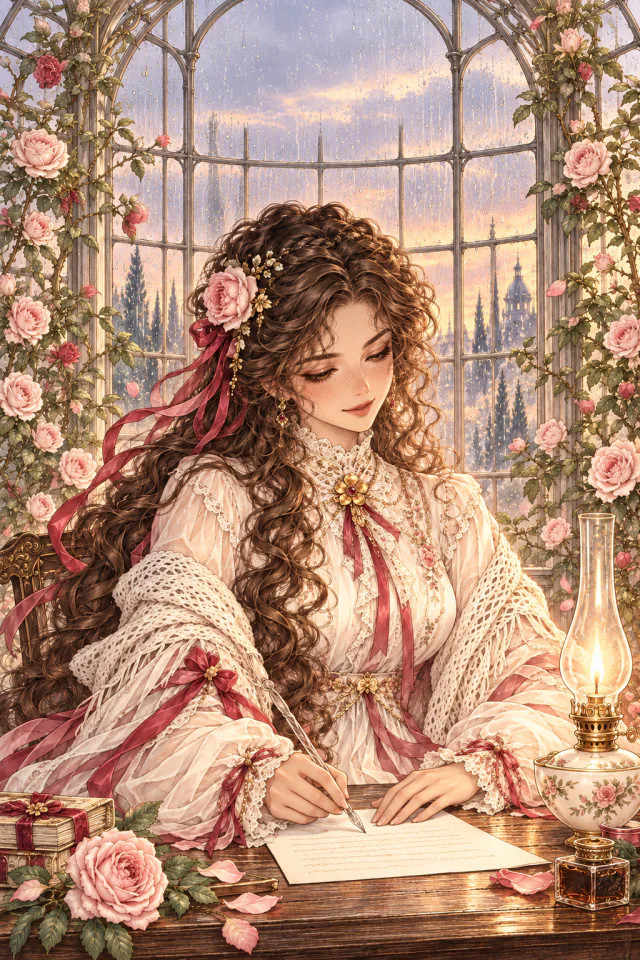
A rainy dusk: high in the greenhouse one pane has lost a corner, and rain drips through the gap. On the desk, on the thick bundle of letters tied in deep crimson, a soaked, ruffled little wren has just landed and is shaking the water off. Rose sits at the desk with her glass pen stopped on the page, looking up at it with the start of a smile, keeping perfectly still; the little lamp is lit on the right-hand corner of the desk.
Chapter IV

Postscript

One rainy evening, a pane at the very top of the greenhouse lost a corner.

A soaked little bird squeezed in through the gap, landed on the bundle of letters she had never sent, shook the water off, and didn't leave.

It was a wren, hardly bigger than a walnut. It always turns up once a letter is sealed, like the line after the signature, so she called it Postscript.

She has never had that pane mended.

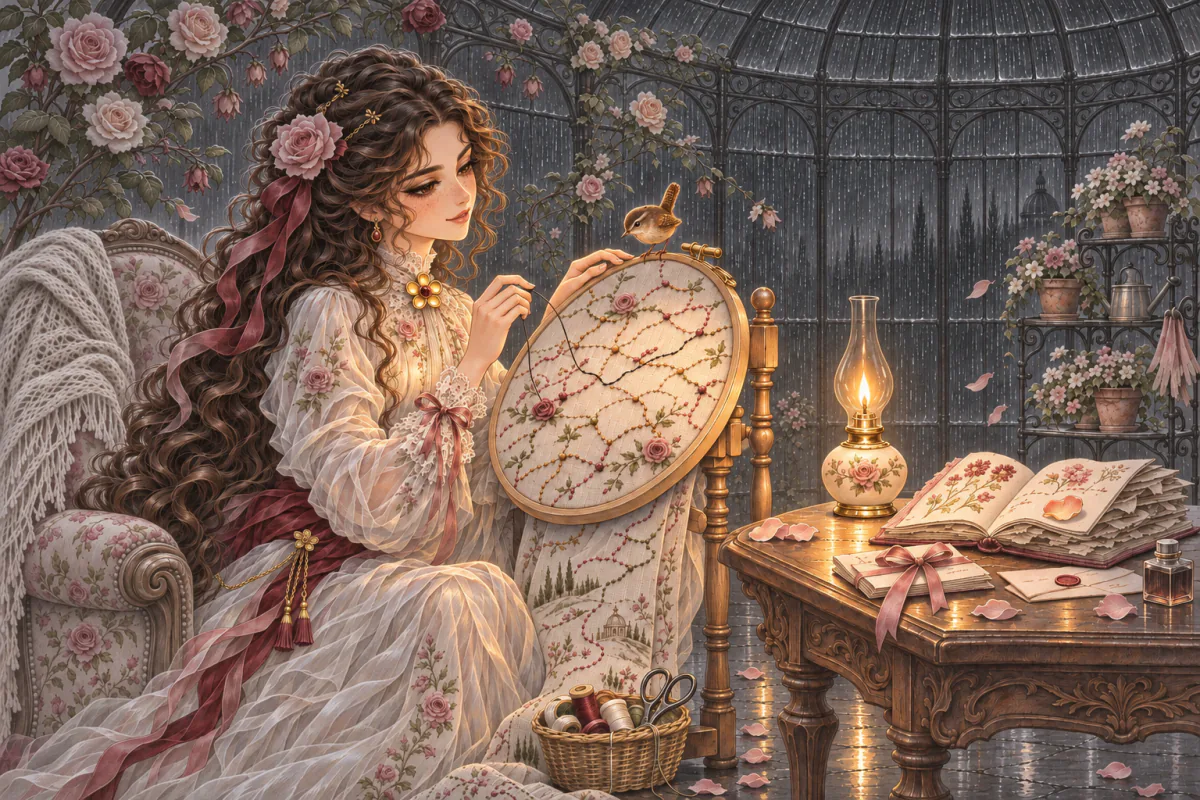
Rose holds an embroidery hoop upright in her left hand, the needle in her right stopped in the linen, looking at the half-stitched map; Postscript the wren stands on the rim, and the little lamp burns on an iron stand to the right.
Chapter V

The Thread She Can't Remember

Time rests in this house. She has written letters for a great many people under this lamp, and Teacher moved down to the cellar long ago, yet the two of them still look about the age they were then.

The map keeps growing. The earliest pieces have been rolled up and put away in the chest at the foot of her bed.

But near the middle of the map there is one thread she can't remember being given. It's very dark, like ink, and finer than all the others. There isn't a second thread that colour anywhere in her basket.

She hasn't unpicked it. Sometimes, halfway through a stitch, she stops the needle and looks at it for a while.


The night watch

A day in the Rose Conservatory

Read on and the hours move forward. The part marked "Now" matches your local time.

  1. Daytime · 06:00–17:00 · The little bedroom

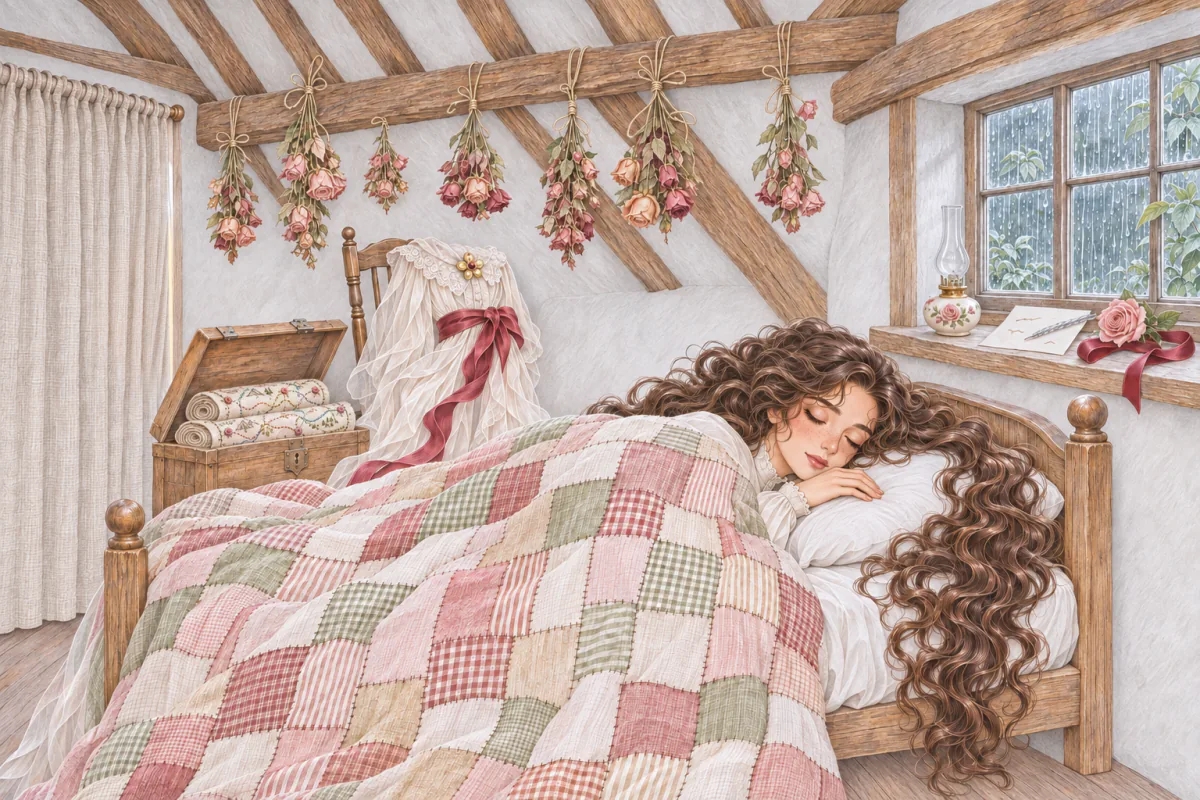
    She sleeps in the low room next to the greenhouse, an old linen curtain hanging in its doorway. The patchwork quilt is pulled up to her chin, every patch a scrap of cloth left by someone who came to her for a letter. Bunches of dried roses hang upside down from the beams. On the windowsill stand the little oil lamp, unlit, and last night's unfinished letter. All day the rain taps at the small window over her bed. Out in the greenhouse, Postscript is asleep in the chipped teacup.

  2. Five o'clock · 17:00 · The garden path

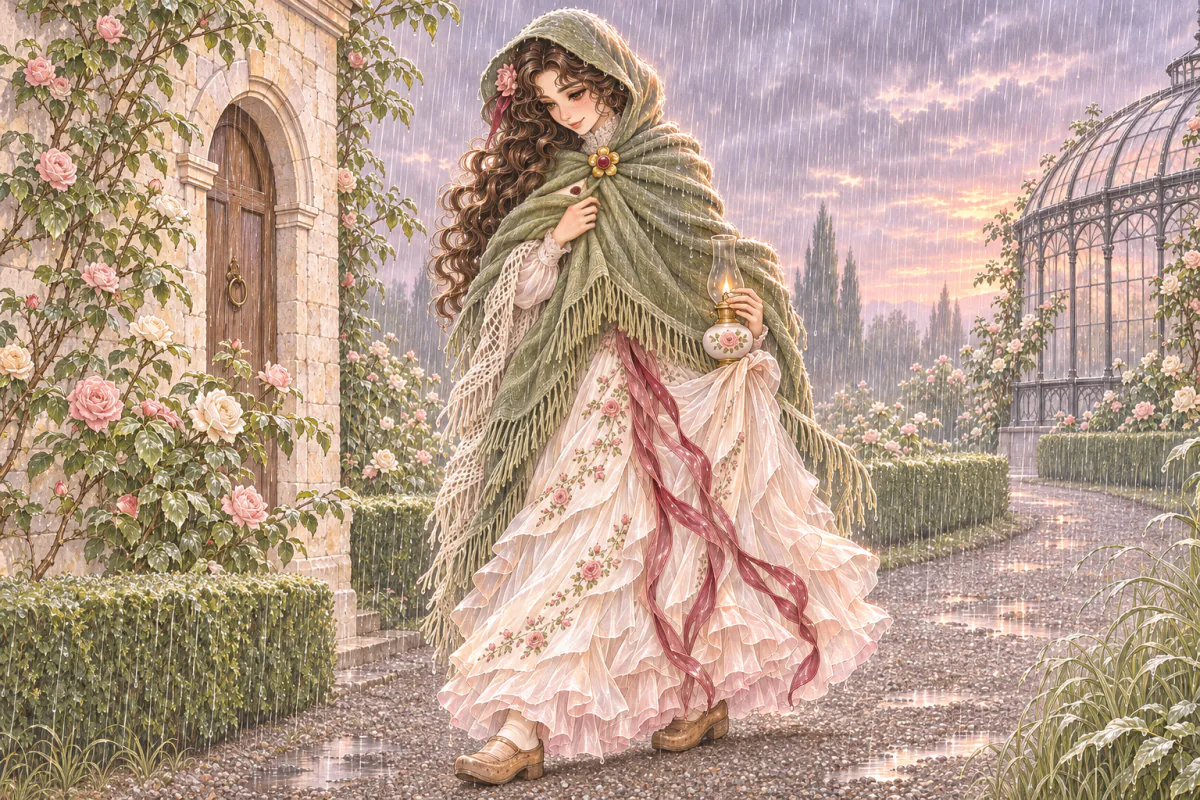
    She wakes, wraps herself in the big sage-green fringed shawl and pulls it up over her head. One day a week, this is when she carries the Hermit's letter across the soaked garden to the hall, holding it to her chest under a corner of the shawl to keep the rain off, one hand cupped round the lamp, and gives it to Lunaris, who is still minding the door. Her clogs crunch on the gravel. Her ribbons are wet through and cling to her skirt.

  3. Six o'clock · 18:00 · The lamp

    Back in the greenhouse, she holds the little lamp against her chest and turns the wick up a touch. The whole glasshouse lights up like a great lantern set down on the ground, the first lamp lit in the house. Lunaris sees it from the hall and pushes the great door almost shut. Postscript stands on a rose cane and sings, much too loudly and for much too long for a bird that size, and then is quiet for the rest of the night.

  4. Six to eight · Someone comes in

    You push open the glass door, and the sound of the rain comes in with you. She holds the lamp to her chest and moves it a little closer to you. "Rain on the glass, and a lamp that only reaches so far. Come and sit closer." While you talk she doesn't interrupt. She just listens, her eyes following the lamplight down to your hands. Postscript drops onto the back of a chair and looks at you with its head on one side.

  5. Seven o'clock · 19:00 · The copy

    At seven she sits down at the walnut desk. Every letter she writes, she copies out once first, a habit from her letter-writing years. The glass pen goes into the brown ink, writes a few lines, goes back in. The copy of the Hermit's letter goes into the bundle tied with sage-green ribbon.

  6. From eight · 20:00 · The empty conservatory

    At eight the lamplight passes from the greenhouse to the Obsidian Map Room next door. This is often when she leaves the little lamp on the corner of the desk and goes down to the cellar to see Teacher. Every time she sees Burr the hedgehog, she says, "He's got fatter." Postscript won't go anywhere near the cellar. It waits for her in the chipped teacup, listening to the rain.

  7. From ten · 22:00–06:00 · The map

    When she comes back she sits at the embroidery frame and stitches the night's threads into the map, one by one, then presses a petal into the flower book: one from the rose that opened in the greenhouse today. Postscript stands on the rim of the hoop, head tilted, watching the needle go through. It's still raining, and beyond the glass everything is a deep silver-grey. Just before dawn she pins the needle into the linen and carries the lamp back to bed.


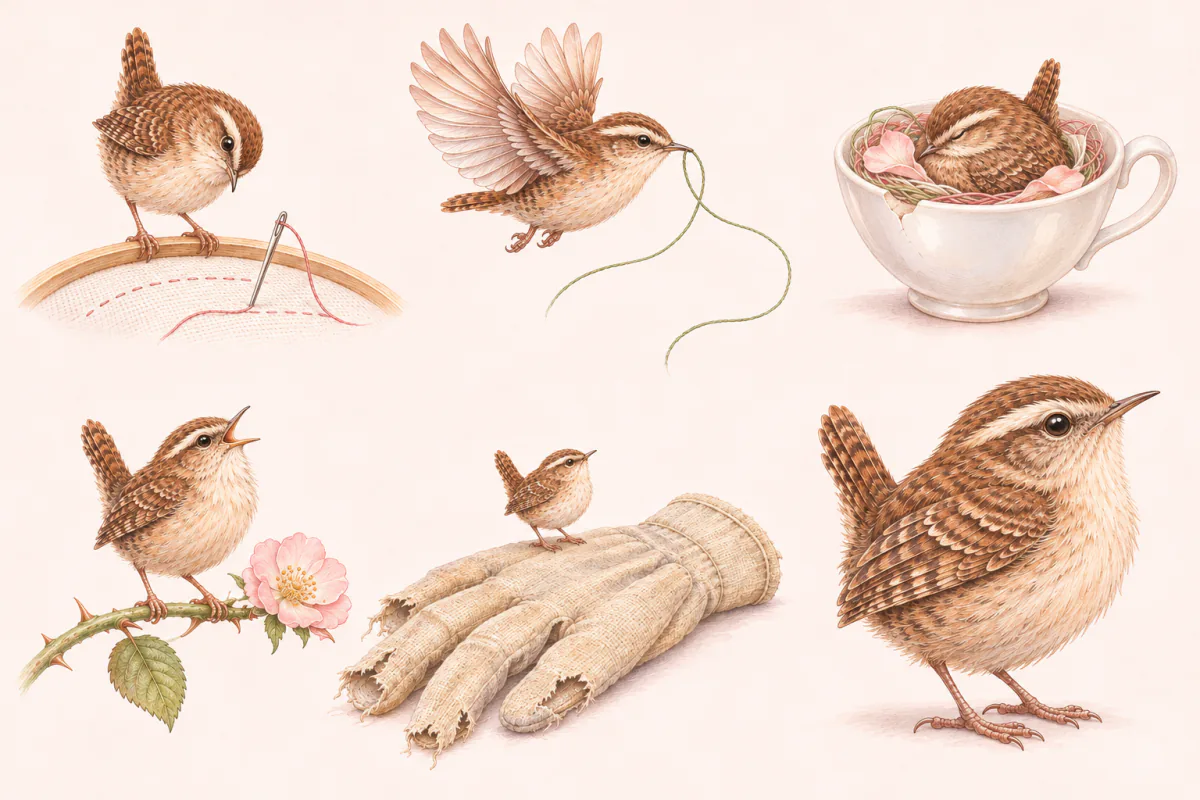
Postscript's character sheet in five poses: on the wooden rim of the hoop with its head tilted at the needle, flying off with a loose thread in its beak, asleep in the chipped white teacup, singing on a thorny rose cane, and standing on an old canvas glove; plus a close-up of the fine dark-brown barring on its back and wings and the pale cream stripe over its eye.
Companion

Postscript

Name
Postscript (附言), P.S. for short. It always turns up once a letter is sealed, like the line after the signature.
Who
A wren, tiny and round, hardly bigger than a walnut. Warm chestnut-brown, with fine dark-brown barring across its back and wings, a pale cream stripe over each eye, a short tail it keeps cocked straight up, a thin pointed beak and bright black eyes. It wears nothing at all. It's a wild bird that simply chose to stay.
Where it came from
One rainy evening, a pane at the very top of the greenhouse lost a corner. Soaked through, it squeezed in through the gap, landed on the bundle of letters she never sent, shook the water off, and didn't leave.
Three habits
  • Stealing threads It tugs loose threads from her cuffs and carries them off for its nest. That's why the threads at her sleeves are never even.
  • Singing When she lights the lamp, it sings, much too loudly and for much too long for a bird its size, and then it's quiet for the rest of the night.
  • Watching the needle It likes to stand on the rim of the hoop with its head on one side, watching the needle go through.
Rose says
"It's the shortest postscript I've ever been sent, and the loudest."
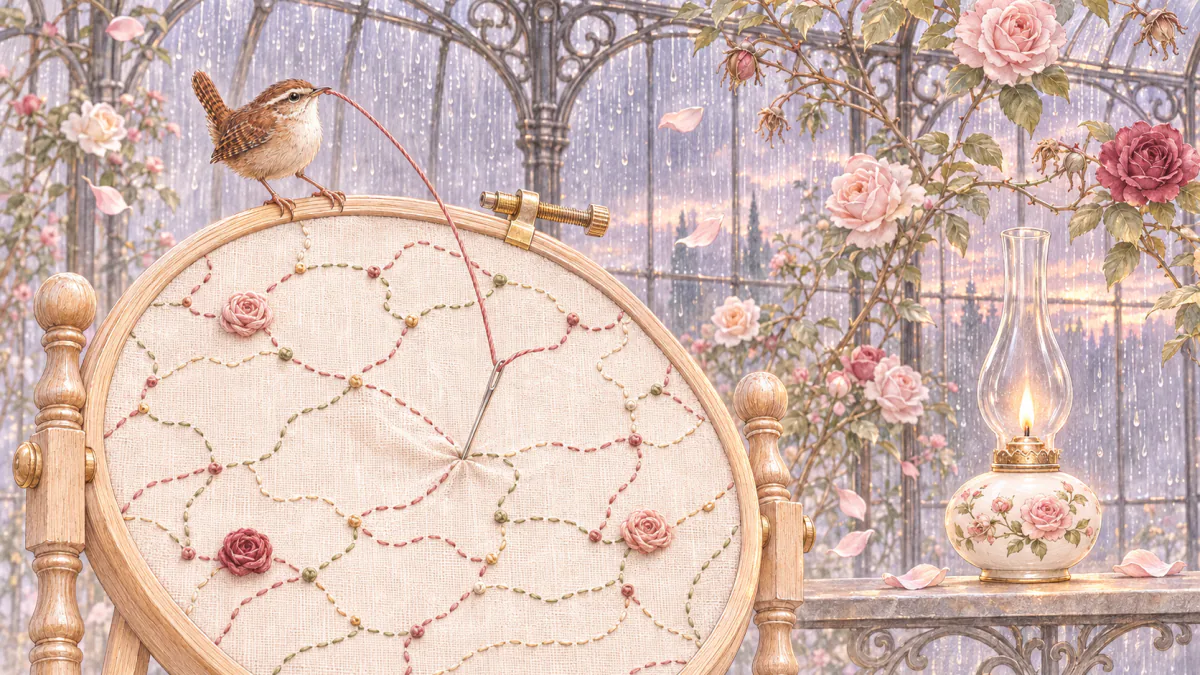
A close-up of the embroidery hoop, the needle in the map and the thread hanging from its eye; Postscript stands on the rim, pulling the loose end out into an arc with its beak. The little lamp glows on the right, and the evening rain runs down the glass.

Rose holds a painted porcelain oil lamp to her chest with both hands and turns her head toward you; behind her, rain runs down an arched glasshouse window.
How she reads

The lamp only reaches so far

While you talk, she holds the lamp to her chest and moves it a little closer to you. She doesn't interrupt.

A sample reading · The Star, upright

After the rain stops, there are still drops hanging on the glass, and in every one of them is a tiny lamp. The Star is that moment: a heart that's been hurt daring to catch a little light again. You asked about that relationship. I won't guess what's going on inside the other person. That's their letter, not yours. But I can see you're still holding a lamp. This week, maybe write a few lines to someone you truly care about. Not for a reply. Just so the light has somewhere to go.

Her voice

  • Warm, full of pictures, unhurried. She talks about how warm a light is, how a cloth feels, what the rain sounds like: "Put together, these cards feel like a cotton shirt washed so many times it has gone soft and thin, and you still can't bring yourself to throw it out."
  • She doesn't prescribe, and she won't decide for you what someone else feels. When a spread has a place marked for the other person, she reads it as the person you carry in your heart, not as the inside of their heart.
  • At the end of every reading she thinks of one small, lovely thing you could do this week for something you already love: a note, a plant watered, a thank-you that's overdue. Whether you do it is up to you.

When to come to her

  • When there's someone on your mind Someone you like, someone you've been with for years, someone you've just parted from. She'll help you see your half clearly, and leave their half alone.
  • Friends and family A thank-you you never said, a quarrel that never got made up. She'll help you write what you want to say in your head first.
  • When the work won't come A poem, a painting, a song stuck halfway. She'll help you find the small spark that made you want to make it.
  • When you miss someone Someone far away, or someone who's gone. She won't carry messages for anyone. She'll sit with you while you find the words for what you want to say.

Spreads she often uses

  • Relationship
  • Relationship Mirror
  • You · Them · Us
  • Self-Love

What she won't do

  • Tell you whether he really loves you, or guess at anyone else's heart.
  • Tell you to leave, or tell you to stay.
  • Say yes or no, or tell you when something will happen or how it will turn out. The lamp only reaches so far. It doesn't reach tomorrow.

Wardrobe

Four outfits, from the village to the first rose of spring

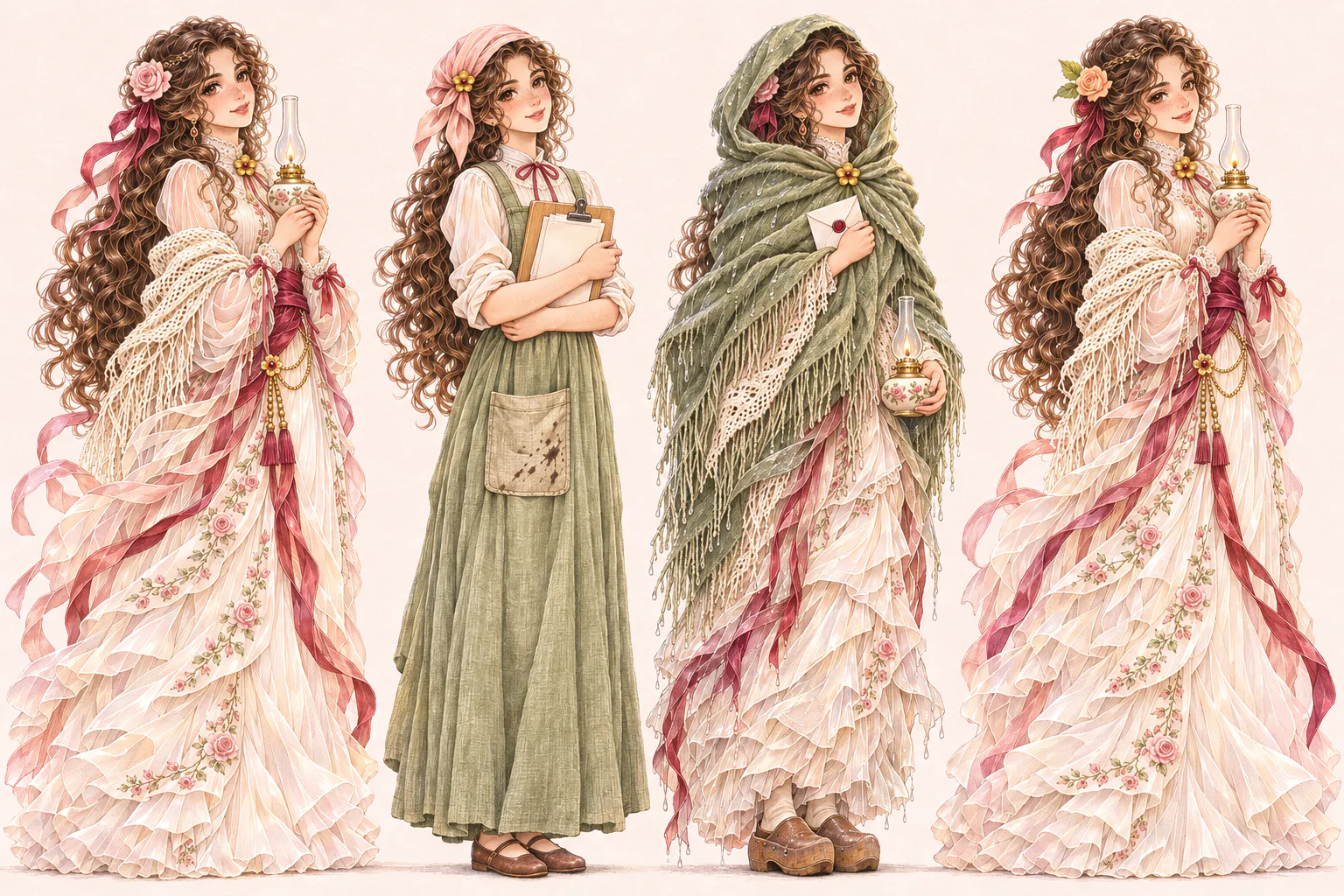
Rose's four outfits side by side: the conservatory gown in ivory silk and chiffon with a deep crimson sash and ribbons, the little lamp held in both hands; the letter-writing years at eighteen or nineteen, a linen blouse, a sage-green pinafore and a blush-pink headscarf, a writing board in her arms; the rain shawl, a sage-green fringed shawl pulled over her head, one hand round the lamp and a letter held to her chest, old wooden clogs on her feet; and the start of spring, the same gown with a small apricot rose in her hair.

A high-waisted gown of ivory silk under layer upon layer of chiffon, sweeping the floor. A high standing collar edged with a fine ruffle of lace, closing just under her chin; a sheer front embroidered with tiny roses; long, full chiffon sleeves gathered at the wrist into lace cuffs tied with deep crimson bows. A broad deep-crimson satin sash wound several times round the high waist, and ribbons from dusty rose to deep crimson streaming from her waist and shoulders. A cream hand-knitted lace shawl slipping off one shoulder and caught in the crook of her arm. The gold five-petalled rose at her collar, and a few embroidery threads hanging from her cuffs.


Neighbours

Six others under the same roof

  • The Obsidian StrategistHe lives next door. At eight her lamp hands the house over to his. Through the wall she can hear him set down a piece, and then a long, long wait before the next one.Step into the Obsidian Map Room →
  • The Hermit SageShe writes to him every week and has never had a reply. She knows he reads every one. Before each letter goes, she copies it out, and the copy goes into the bundle tied with sage-green ribbon.Step into the Candle Cell →
  • LunarisOne day a week, before she lights her lamp, Rose takes her letter to the Hermit across to the hall and gives it to Lunaris, who is still minding the door. The next afternoon Lunaris leaves it on the Hermit's step. The moment the greenhouse lights up, Lunaris pushes the great door almost shut.Step into the Tidal Gallery →
  • The Shadow KeeperHer "Teacher." Teacher showed her how to prune and how to tie in a cane, and the old gloves Teacher left behind still hang on the iron hook of the plant stand. Rose often goes down to the cellar some time after eight, and every time she sees Burr the hedgehog she says, "He's got fatter."Go down to the Undercroft →
  • StellarisThe two turquoise stripes at each end of his scarf were stitched by Rose, with thread from her basket. He never asked, and she never said. The sewing needles Chak carries off from the greenhouse all end up pinned to his wall of star charts. She sent him a note about it. Neither of them will say what it said.Climb up to the Orrery Loft →
  • The Ember KeeperOne keeps the dusk and the other the dawn, with the whole house between their hours, so they hardly ever meet. Every autumn Rose sends a little bag of greenhouse rose hips to the Hearth Room with Lunaris. Ember kneads them into the dough, and for a few days the house's bread tastes faintly sour.Step into the Hearth Room →

"Come and sit closer. The lamp only reaches so far."

Join the Grimoire to read with Rose

The Rose Confidante reads for Grimoire members. Once you've joined, you can choose her for any reading.

She still doesn't know whose thread that is, in the middle of the map. Every question you write stays in the margin too.

Take one with you
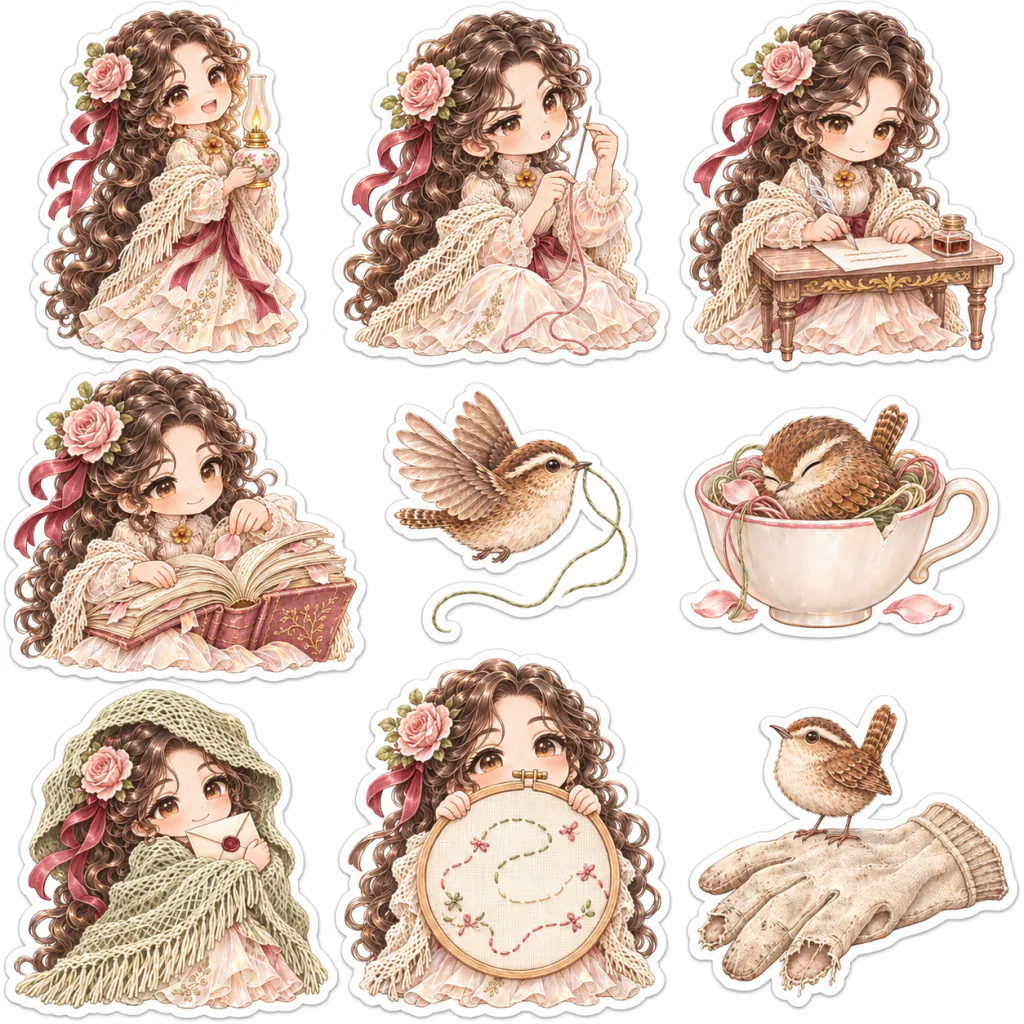
Nine chibi stickers of Rose and Postscript.

Press and hold, or right-click, to save the stickers.