
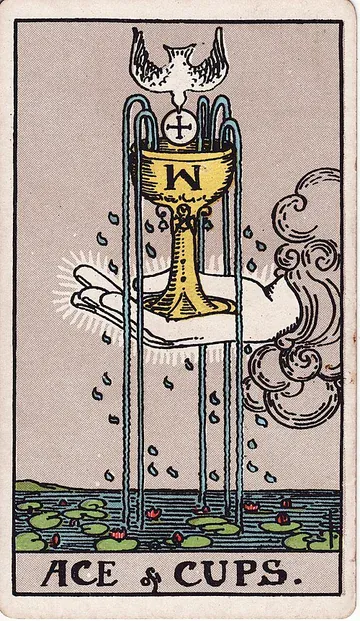
Ace of Cups · Tarot Card Meaning
The Ace of Cups begins before there is a story. A hand comes from cloud and holds a chalice already filled past usefulness. Water falls from its lip in five streams, the senses receiving before the mind has assembled a reason. A white dove descends with a wafer marked by a cross, and below the cup a lotus waits on still water. No figure stands beneath it. No person claims it. The Ace of Cups is the tarot card of feeling before ownership, tenderness before argument, the source of Water before emotion has divided into love, grief, mercy, desire, memory, or song.
The signature tension of the Ace of Cups is that it overflows before anyone has asked it to pour. This is not the managed cup of hospitality, not the exchanged cup of partnership, not the shared table of later cards in the suit. It is the original vessel. Its fullness is not proof of effort. Its fullness is the condition from which effort later becomes possible. The card asks a severe question in a soft image: can the seeker receive what is given without immediately naming it, spending it, doubting it, or turning it into a plan.
As the ace of the suit of Water, this card is the root of Water itself: the first undivided drop before feelings separate into kinds. Its numerology is One, origin, wholeness before division. Its polarity is receptive and holding. Its elemental field is moon-white and sea-blue, West-facing, autumnal, phlegmatic, inward, and soft. In the body it belongs to the chest, the heart, and the lungs: the places where breath, grief, affection, and pressure become one felt weather. Its scent is lotus and jasmine; its stones are moonstone and aquamarine; its metal is silver. These are not decorative details. They tell the reader what register the card speaks in: not heat, not argument, not command, but coolness, shimmer, intake, and tide.
The symbols are exact. The overflowing chalice is a vessel receiving grace, and the overflow is not failure. It is the vessel's purpose. The five streams correspond to the five senses, and the card therefore insists that feeling arrives before thought. The descending dove brings the wafer to the cup's mouth, a sign that something sacred enters quietly, without spectacle. The lotus on still water neither strives nor hurries. It simply receives. The whole image is a grammar of receptivity: hand, cup, water, dove, lotus, pool.
Because the card is so gentle, readers often mistake it for sweetness alone. It is sweeter than many cards, but it is not simple. The Ace of Cups can describe new affection, emotional renewal, spiritual opening, creative first light, reconciliation with the body, and the return of tears after numbness. It can also expose how difficult receiving has become. A person trained to earn every kindness may find this card almost embarrassing. A person who has poured for everyone else may not know what to do when the cup is held toward them.
This page is about the Ace of Cups as a tarot card; the stray live-search phrase "ace of cups columbus" points elsewhere and is not the subject of the reading. The card itself is not a place or brand. It is the image of a vessel so full that the first work is not pursuit but reception.
Most readers arrive with the plainest possible question: what does the Ace of Cups mean? The plainness is useful, because it keeps the question close to the card rather than to fantasy. The answer begins with the image: the offered chalice, the five streams, the dove, the lotus, the pool. Meaning follows the water.
There is also a discipline hidden in the card's softness. Because the scene contains no human figure, the reader cannot outsource the meaning to personality. There is no lover to accuse, no rival to defeat, no authority to obey. There is only the offered cup and the condition of one's own receiving. The card can therefore expose a surprising poverty in people whose lives look emotionally full: many contacts, many tasks, many messages, and very little true intake. The Ace asks whether any of that water reaches the heart and lungs.
In practical readings, this makes the card excellent for beginnings that are still pre-verbal. A person senses affection before romance is declared. An artist senses a work before the draft begins. A grieving person senses the first thaw before hope feels appropriate. A spiritual seeker senses the return of prayer before belief has rebuilt itself. The Ace of Cups dignifies those first movements precisely because they are fragile. It says that the first drop counts.
Read the Ace of Cups in any spread as the arrival of emotional source. Something has begun before it can defend itself. Something tender has reached the lip of the cup. The right question is not yet what it means or where it goes. The first question is whether there is a clean enough vessel to hold it.
Ace of Cups · Love & Relationships
In love, the Ace of Cups is the first water before it has learned the shape of a relationship. It can describe the first tenderness of a new affection, the return of softness inside an old bond, the first real grief after a long emotional winter, or the quiet recognition that the heart is not closed after all. The card does not announce a completed partnership. It shows the cup before the table, the dove before the vow, the feeling before the name.
For an existing partnership, the Ace of Cups describes a renewal that begins small enough to be missed. It may be the morning apology that does not perform itself, the hand on the shoulder in the kitchen, the hour when both people stop defending the old version of the fight. The relationship may not be solved, but a source has reopened under it. The card asks both partners to protect the first stream. Do not demand that a renewed tenderness immediately carry the whole history. Let it be water before it becomes architecture.
For a new spark, the Ace of Cups is the moment before strategy enters. Someone's name on the screen changes the air in the room. The first conversation lingers in the body after the phone is put down. The attraction is not merely visual or social; it is a softening of the chest, a sense that the inner weather has gained a spring. This is not yet proof of compatibility. It is proof that feeling is alive and has found a place to rise.
For a single seeker asking whether love is possible, the Ace of Cups answers from the root, not from the calendar. The question may come after exhaustion, after a season of refusing hope, after the body has become efficient at not wanting. The card shows the cup held out before any person appears. Love is possible because feeling is possible. The work is not to scan every doorway. The work is to notice where the inner water has begun to move again.
For love after a wound, this card is tender and unsentimental. The Ace of Cups does not erase betrayal, grief, divorce, abandonment, or the long ache after attachment fails. It shows the first drop that does not belong to the wound. Sometimes that drop is not romantic. It is friendship, music, sleep, appetite, prayer, a clean room, or the first honest cry in months. Romance may come later. The card is more interested in whether the heart has regained the capacity to receive.
For a relationship in conflict, the Ace of Cups can indicate the one sincere sentence that has not yet been spoken. Not the thesis, not the legal defense, not the catalog of evidence. The sentence may be as plain as "I missed you" or "I was scared" or "I did not know how to stay soft." The dove descends with a wafer, not with a weapon. The card advises against winning the argument at the cost of losing the water.
For reconciliation questions, the Ace of Cups is open, but it is not careless. It can describe genuine tenderness still available between two people, especially when the separation hardened around fear rather than cruelty. Yet the cup is an ace, not a ten. It does not show an established home. It shows the first vessel. A return that honors this card must begin as a new offering, not as a demand that the old relationship resume from its last broken sentence.
For unspoken love, secret affection, or the question of whether someone is drawn to you, the Ace of Cups describes a feeling that has likely begun before it has become action. The person may be moved, softened, curious, emotionally stirred. They may not yet know what to do with the cup. The card's image is important here: the hand offers from a cloud, the dove descends, the water falls, but no human figure steps forward. The feeling exists. The form may still be absent.
For long bonds, marriages, chosen families, and partnerships that have survived many weather systems, the Ace of Cups is the rare blessing of beginning again without pretending to be new. A couple can know every scar and still meet one another at the spring. The card may appear after illness, after caretaking, after the children leave, after a loss changes the household, after the old script no longer fits. It says the bond can receive a fresh stream without denying the river it has already been.
For the person whose love language is giving, the Ace of Cups carries a direct challenge. The card is not only about pouring. It is about being poured into. If you are always the hand with the cup, the image becomes distorted; you become the cloud that never rains on itself. Let another person offer. Let the meal be cooked for you. Let the message arrive without immediately returning two. The Ace of Cups in love asks for the dignity of receiving.
For someone asking about a relationship that has not yet become physical, the Ace of Cups places feeling before touch. Desire may be present, but the card is more concerned with tenderness than heat. It asks whether the body feels safe enough to soften. A first kiss under this card matters less as conquest than as recognition: the cup has been offered, and both people have noticed the same water.
For a relationship strained by distance, travel, illness, work, or family obligations, the Ace of Cups can show that the emotional source is not dead even when the practical stream is interrupted. A message sent with real attention, a voice note heard at night, a remembered detail mailed across miles: these are small vessels. The card does not make distance easy. It says the first water can cross a difficult space if both people protect it from neglect.
For queer love, chosen family, or any bond that had to grow outside inherited permission, the Ace of Cups can feel especially vivid. It shows affection before it has been authorized by the surrounding world. The hand comes from cloud, not from an institution. The tenderness is real before anyone gives it a recognized name. The card asks for a vessel strong enough to honor the water without forcing it into a shape that betrays its source.
At its best, Ace of Cups love is not dramatic. It is clean. It feels like breath returning to the lungs, like a room after rain, like the first lotus opening on still water. It asks less for a promise than for care around the beginning. The first water is easy to spill. Hold the cup level.
Ace of Cups · As Feelings
As feelings, the Ace of Cups describes a person moved before they are organized. The feeling is fresh, receptive, and sometimes startlingly pure. It has not yet become a plan, a confession, a commitment, or even a stable story. It is the chest opening before the voice knows what to say. If the question is "what do they feel," the card answers: something has begun, and it begins in the heart before it reaches the mouth.
For someone naturally reserved, the Ace of Cups can look quieter than expected. They may not flood the room with messages. They may not make a public sign. Their feeling may show as gentleness in small places: a softened tone, a remembered detail, a pause before leaving, a willingness to stay emotionally present for one more sentence. The five streams are senses, not speeches. Watch the body before the declaration.
For someone demonstrative, the Ace of Cups feels like an immediate outpouring. They want to share songs, food, images, prayers, old stories, parts of themselves that usually stay behind the ribs. The danger is not insincerity. The danger is speed. A feeling can be real and still too new to bear the weight placed on it. The card asks for tenderness around scale: let the stream be a stream before calling it a sea.
For a long bond, Ace of Cups feelings are the return of affection where habit had become the only visible structure. Someone looks at a familiar person and feels the original water move again. It may arrive as gratitude, sorrow, apology, desire, or the sudden recognition of how much has been survived together. This is not novelty. It is renewal. The cup is old in the hand and new in its filling.
For a new connection, this card describes the first yes of the emotional body. The person may not know much yet. They may not know whether your lives fit, whether timing cooperates, whether the story has room to grow. But their inner weather changes around you. They feel open, softened, curious, and slightly unguarded. The Ace of Cups is less "they have decided" than "they have been touched."
For someone healing from past pain, the Ace of Cups as feelings can be both beautiful and frightening. They may feel something real and immediately notice the old instinct to seal the vessel. The card does not cancel the wound. It shows water approaching it. Their feeling may move in alternating currents: tenderness, withdrawal, longing, carefulness, a desire to receive and a fear of what receiving costs.
For a friendship, family bond, or non-romantic attachment, Ace of Cups feelings are affection without agenda. The card can describe the person who feels safe with you, moved by you, grateful for your presence, or newly able to let you matter. Not every cup is romantic. Some cups are mercy. Some are kinship. Some are the relief of being understood without performance.
For someone asking whether the other person misses them, the Ace of Cups suggests an emotional memory that remains wet rather than sealed. They may remember the kindness more than the conflict, or the softness beneath the ending more than the facts of the ending. Yet the card is not a guarantee of action. The dove descends; the person in the scene is absent. The feeling may be alive without having found a human gesture.
For hidden or unspoken feelings, the card is particularly clear. Something has not been admitted because it is too young, too sacred, too vulnerable, or too inconvenient to expose. The cup is full, but the hand is clouded. This can be tenderness protected from scrutiny. It can also be a person who feels deeply and lacks the courage or language to pour.
For a person who is already committed elsewhere, emotionally or formally, the Ace of Cups as feelings must be read with sobriety. The feeling may be real, but reality is not permission. The cup does not cancel vows, duties, children, shared homes, or unfinished endings. It simply names the water. The ethical question belongs to the people holding it. A fresh feeling handled without integrity quickly becomes a spill.
For a person in a time of spiritual or creative awakening, the feeling may not even be about romance alone. You may have become associated with their return to softness, art, prayer, or desire for a more honest life. This can feel intimate and can also be confusing. The Ace of Cups sometimes describes projection of renewed aliveness onto the nearest kind face. The feeling is sacred, but the form needs discernment.
For someone who has been emotionally numb, this card can describe the shock of feeling anything at all. They may not know whether they feel love, relief, attraction, grief, gratitude, or simple safety. All these waters may arrive together before separation. The kindest reading is not to force a label. The cup is full of undivided Water. Naming comes later, after the senses have reported what the heart can bear.
The nuance of the Ace of Cups as feelings is that purity is not maturity. A fresh feeling can be sincere, luminous, and still untested. It has not yet moved through conflict, scheduling, difference, grief, boredom, or choice. Receive it as a beginning. Do not force it to impersonate an ending.
Ace of Cups · Career & Work
In career and work, the Ace of Cups is the return of feeling to labor. It rarely describes the most strategic option on paper. It describes the project, role, colleague, practice, or field that lets the inner water move again. After a period of dry competence, the work suddenly has a pulse. A sentence in a meeting is truly heard. A draft opens. A client arrives with the right problem. The cup fills before the career plan knows what to call it.
For a current role, the Ace of Cups suggests that not everything in the job is dead. There may be one living stream inside a structure that otherwise feels ordinary: a team you care about, a problem that still matters, a mentorship exchange, a small creative channel. The card asks for attention to the part that still produces tenderness or sincere interest. If the whole role is exhausting, this stream may show where the next path begins.
For a new role decision, the Ace of Cups favors the option that restores emotional contact with the work. It may not be the loudest title. It may not be the most impressive line on a profile. The body knows something through the chest and lungs: which offer lets breath deepen, which conversation leaves the heart less armored, which room feels possible. The card is not anti-practical. It simply refuses to treat feeling as irrelevant data.
For a job search, the Ace of Cups marks the first real opening after discouragement. This can be the first interview that feels human, the first person who reads the application carefully, the first idea for a portfolio or letter that does not feel borrowed. The card does not promise immediate employment. It marks the return of responsiveness. The search is no longer only a machine; a living exchange has entered it.
For entrepreneurs and freelancers, the Ace of Cups is the origin moment of an offering. A service, product, studio, newsletter, practice, or collaboration begins as something genuinely felt. The card asks for protection around the beginning. Do not overprice the seed with anxiety, overbrand it before it breathes, or crowd it with the whole business plan on day one. Let the chalice receive the first water. Then build the vessel around what actually flows.
For creative practice, this is one of the cleanest cards in the suit. The Ace of Cups is the first image after blankness, the melody that arrives while washing a cup, the character whose voice appears before the plot, the color that makes the canvas possible. It is not discipline yet. It is not editing. It is source. The advice is to catch it without crushing it. Keep a notebook near the bed. Leave the instrument visible. Give the first stream somewhere to go.
For caretaking professions, healing arts, therapy, teaching, hospitality, design, art, spiritual support, or any work that receives human feeling, the Ace of Cups confirms vocation at the level of temperament. The card does not say the workplace is healthy. It says the function of the work touches the right spring. The distinction matters. A person can belong to the work and still need a better institution, better boundaries, better pay, or a less extractive container.
For workplace conflict, the Ace of Cups points to the emotional fact beneath the procedural one. Someone feels unseen. Someone offered care and felt it rejected. Someone needs an apology more than a policy. The card does not dissolve practical accountability, but it asks that the conversation begin where the water is. A clear sentence of care may do more than another defensible memo.
For burnout, the Ace of Cups is not a productivity hack. It asks whether the cup is empty because nothing is being received. The worker may be pouring from duty, competence, guilt, ambition, or fear, while no stream returns to the chest. The remedy begins with receiving: rest that is not earned, art that is not monetized, a meal not eaten at the desk, a colleague's kindness accepted without deflection. Work cannot draw forever from a sealed well.
For leadership, the card describes the leader who creates emotional permission. Not indulgence, not blurred boundaries, not endless availability. Permission. The leader notices where a team has dried out and makes a vessel for the first honest water: a direct check-in, a humane deadline, a room where someone can say the project hurt. The Ace of Cups at work is the opposite of sentimental management. It is clean receptivity made structural.
For people returning to work after illness, caregiving, grief, or a long pause, the Ace of Cups describes re-entry through gentleness rather than conquest. The first good hour matters. The first colleague who sees the whole person matters. The first task that does not feel like punishment matters. A career does not have to roar back to life to be alive. Water often returns as a seep before it becomes a stream.
For students, apprentices, and people at the threshold of a field, the card favors the subject that makes learning feel like receiving rather than proving. The right teacher may matter as much as the right syllabus. The right studio, cohort, lab, or reading room may open the chest before the credential becomes clear. The Ace of Cups asks the learner to notice where awe still happens. Awe is data.
For people whose work depends on emotional intelligence, the card advises clean boundaries around empathy. The gift is real; the risk is real. To feel a client's sorrow, a student's hope, a patient's fear, or an audience's hunger is not the same as becoming responsible for metabolizing all of it alone. A good vessel has edges. The Ace of Cups at work supports feeling that has form.
The career message is therefore precise: choose and tend the work that returns feeling to the system. Water with Earth settles into tangible fruit; the card is friendly to Pentacles because feeling needs form. Water with Fire can boil off; do not let urgency evaporate the tenderness. Water with Air can be stirred into useful waves, but analysis alone cannot drink.
Ace of Cups · Money & Finances
In money and finances, the Ace of Cups is not the card of accumulation for its own sake. It is the card of resources entering the emotional body. Money here matters because it allows care, beauty, rest, offering, and repair. A payment may feel like relief in the lungs. A gift may restore dignity. A purchase may become a vessel for a new life phase. The card asks what money is meant to hold.
For a financial beginning, the Ace of Cups can describe the first deposit, the first paid client, the first gift after a dry season, the first small buffer in an account that has known only pressure. The amount may be modest. The feeling is not. The cup is full because the system has learned that receiving is possible. Honor the beginning by giving it structure. Water is friendly to Earth; let the feeling settle into a plan, a budget, a named account, a tangible fruit.
For a major purchase, the card asks whether the object participates in care. A home, instrument, therapy fund, art material, travel for a reunion, a course that restores the creative spring, a meal that marks reconciliation: these can belong to the Ace of Cups. A purchase made only to simulate feeling does not. The question is not whether the thing is beautiful. The question is whether it receives and gives water back.
For investment or financial risk, the Ace of Cups is gentle but inexperienced. It is an ace, not a seasoned Pentacle. It can support seed money for a heartfelt beginning, especially a creative, therapeutic, devotional, or relational project. It does not support throwing resources at a mood. Wait long enough to know whether the water remains after the first shimmer. Then give the beginning a vessel that can survive weather.
For debt, repayment, or recovery from scarcity, the card describes the emotional side of repair. The numbers matter, but the chest matters too. Scarcity trains the body to refuse receiving even when help arrives. The Ace of Cups asks for a clean acceptance of support: the payment plan, the family loan with clear terms, the scholarship, the fee waiver, the client who pays promptly. Do not romanticize struggle when water is offered.
For generosity, the Ace of Cups is clear. Give from the overflow, not from the wound. If giving leaves resentment in the cup, it was not overflow. If giving becomes a way to secure love, it was not overflow. True Ace of Cups generosity feels like water moving through a vessel that remains connected to source. It may be simple: buying flowers for the table, covering a friend's coffee, funding one hour of someone else's rest.
In family money, the Ace of Cups often appears around gifts meant to heal more than they can actually heal. A parent offers help and hopes the help says "I love you." A child receives money and hears an apology not spoken. A partner pays for a trip instead of naming loneliness. The card does not reject the gift. It asks that the water and the vessel match. If the gift is love, let love be spoken beside it.
For pricing creative or care-based work, the Ace of Cups asks the maker not to confuse devotion with undercharging. A heartfelt offering still needs Earth beneath it. Water friendly to Pentacles means the sacred work can have invoices, deposits, cancellation policies, and fair exchange. The cup remains more available when the hand holding it is not financially shaking.
The money trap in this card is emotional spending disguised as sacred receiving. The moon-white shimmer can make any desire feel meaningful for an hour. Before spending, ask whether the purchase still feels clear after breathing, eating, and sleeping. The Ace of Cups respects beauty. It does not ask beauty to do the work of grief.
Ace of Cups · Health
For health, the Ace of Cups belongs first to the chest: heart, lungs, breath, and the tender pressure behind the sternum where emotion becomes bodily weather. Its temperament is phlegmatic, inward, soft; its colors are moon-white and sea-blue; its season is autumn; its direction is West. The card asks what kind of reception the body needs. It does not diagnose. It attends.
In an acute situation, the Ace of Cups points to hydration, breath, tears, rest, and the body's ability to receive care. It may appear when the simplest forms of support matter more than dramatic intervention: drinking water, taking the medicine already prescribed, accepting soup, sleeping, letting someone drive, letting the lungs slow. The card's wisdom is not complicated. The vessel cannot heal while it is always pouring.
In chronic conditions, the Ace of Cups can describe a softer relationship with management. Not cure. Not denial. A shift in how the body is held. The person stops treating the body as an adversary and begins to hear the first stream of its requests. This may mean returning to appointments, tracking symptoms without contempt, asking for accommodations, or noticing which forms of care make the chest unclench.
For emotional health, this card often marks the return of tears. That return can be holy and inconvenient. Numbness sometimes protects the heart until water is safe enough to move. When the Ace of Cups appears after a long dry season, tears are not a failure of composure. They are the body remembering how to drain and refill. The descending dove does not demand performance. It brings a sign that feeling has found the cup again.
For anxiety, grief, heartbreak, or tender overwhelm, the Ace of Cups asks for containment before interpretation. A blank page, a trusted listener, a quiet room, a warm bath, a hand over the chest, three slow breaths: the vessel first, the explanation later. The five streams are senses, so the body may need sensory grounding before the mind can speak usefully. Name what is seen, touched, tasted, heard, and smelled. Let thought arrive second.
For relational caretakers, helpers, parents, therapists, teachers, artists, and friends who receive much feeling from others, the card can indicate compassion replenished. It can also ask whether enough is being received in return. A heart is not an infinite public fountain. The healthiest Ace of Cups rhythm is tide: in and out, receiving and giving, cup and stream.
For people recovering from emotional shock, the Ace of Cups may show a window when the body can accept care that it previously refused. The nervous system may allow warmth, touch, sleep, nourishment, or conversation in small amounts. Small is not trivial. A single tolerable kindness can be the first sign that the cup is turning upright. Measure progress by receptivity, not by performance.
For questions around intimacy and the body, the card emphasizes consent and softness. The body may need to feel received before it can desire. It may need the pace of water rather than the pace of fire. A person healing from shame, pregnancy, loss, transition, aging, or medical intrusion may find in this card a language of gentler return: breath, boundary, affection, and the right to stop.
For daily maintenance, the card favors rituals that are simple enough to repeat: water on waking, one unclenched breath before answering messages, a few minutes near a window, a scent that tells the body it is safe, a cup of tea held without multitasking. The Ace of Cups does not ask the body to become an improvement project. It asks the body to be received.
Nothing in this section replaces medical care. The Ace of Cups offers symbolic attention, not diagnosis or treatment. Its health message is simpler and more demanding: let the body be a vessel, not only an instrument. Notice where breath catches. Notice what softens it. Begin there, with the first water.
Ace of Cups · Spirituality
Spiritually, the Ace of Cups is grace as a physical event. The dove descends. The wafer touches the chalice. The water falls in five streams. The lotus receives without hurry. The card does not argue for belief. It portrays the moment when meaning enters the body before the mind has certified it. A practice becomes wet again. A prayer finds the chest. A silence stops feeling empty and begins to feel inhabited.
Because this is the root of Water, the card's spiritual path is reception. Not passivity, not collapse, not waiting for rescue. Reception is an art of making a clean vessel. The Grail, the horn of Abundantia, and Guanyin's pure vessel all echo here: the sacred container that receives and gives in the same gesture. To receive spiritually is to let blessing move through without immediately making it property.
For devotional practice, the Ace of Cups may mark the return of tenderness after dryness. The altar may have felt decorative. The journal may have felt dutiful. The meditation may have felt like sitting in a closed room. Then one morning a single line opens the chest. The card asks not for a larger performance but for fidelity to the small opening. The first water is easy to frighten with grand plans.
For seekers without formal religion, the card can still describe a sacred moment. The first rain before dawn. A lotus scent in a garden. A song that makes grief breathable. The sudden kindness of a stranger. The feeling is not proof that a doctrine is correct. It is proof that the world has touched the inner vessel. The Ace of Cups honors that touch without demanding a label.
A practice for this card can fit inside thirty minutes. Fill a simple cup with water. Sit with it near a window or in a quiet room. Name, aloud or on paper, five things the senses received today before the mind judged them. Drink slowly. Then write one sentence beginning with "I am willing to receive..." and keep the sentence concrete. Not everything. Not a destiny. One form of water: help, sleep, apology, affection, patience, breath.
The card also asks the seeker to distinguish receptivity from spiritual appetite. Not every moving sensation is a mandate. Not every tear is instruction. Not every dream needs to become doctrine. The Ace of Cups is holy because it is first water, and first water is easily polluted by the ego's wish to make meaning too quickly. Let the image stay simple for a while: cup, dove, lotus, pool.
When the card appears during a season of devotion, its question is almost embarrassingly plain: what can be received without being earned first. The answer may reveal more about spiritual life than a library of theories. Grace often fails not because it is absent, but because the hand refuses the cup.
The spiritual caution is subtle. The Ace of Cups can seduce the seeker into loving the opening more than the life it asks for. A beautiful feeling is not the same as integration. Grace that never becomes kindness, repair, art, patience, or honesty remains suspended above the water. The dove descends so the sacred can enter the cup. Let it enter conduct too.
Ace of Cups · Yes or No
Yes — if the question can be answered by a clean opening of the heart.
The Ace of Cups is a gentle yes-card. It says yes to new affection, yes to emotional renewal, yes to sincere apology, yes to creative beginning, yes to receiving care, yes to the first honest feeling after numbness. Its yes is not loud. It does not arrive as conquest or guarantee. It arrives as water at the lip of a cup: enough to begin, enough to trust the feeling as real, not enough to skip the work of holding it well.
For love questions, the answer is usually yes at the level of feeling. There is tenderness. There is emotional possibility. There is a source beginning to open. If the question is whether a relationship is already stable, already committed, already structured, the card is more modest. It says the water is real; it does not say the house has been built around it.
For career or creative questions, the Ace of Cups says yes when the choice restores aliveness. Send the first draft. Take the meeting that softens the chest. Begin the project that keeps returning in the quiet hour before dawn. The answer favors beginnings that have emotional truth rather than purely strategic polish. It does not remove the need for Earth: budgets, schedules, contracts, containers.
For reconciliation, apology, or contact after silence, the answer is a careful yes when the offering is clean. The card favors the message that pours without demanding immediate repayment. It favors "I am sorry" over "now tell me I am forgiven." It favors the open hand over the hook. If the motive is to receive, repair, or acknowledge feeling, yes. If the motive is to extract assurance, wait.
For money, health, or practical risk, the answer is conditional. The Ace of Cups supports the option that nourishes, heals, receives, or begins. It does not support decisions made from emotional flooding. If the body feels like a cup overflowing because the feeling is sacred, proceed gently. If the body feels flooded because anxiety has taken the cup, pause and create containment first.
For questions about another person's feelings, the yes is emotional rather than contractual. Yes, there is a stirring. Yes, the chest has opened. Yes, the water is present. But the Ace does not answer whether the person has the maturity, availability, or courage to build the next vessel. That distinction protects the reader from turning a real feeling into an imagined promise.
For questions about whether to speak, the card says yes when the speech is an offering and no when the speech is a demand disguised as vulnerability. A clean Ace of Cups sentence can be brief: "I care," "I am sorry," "I feel something here." The sentence should pour, not hook. If the desired answer is required for emotional survival, build more containment first.
For timing, the Ace of Cups points to the first phase, not the harvest. The beginning may be near or already present, but the final form remains unwritten. The right response is not to ask the ace to behave like a ten. Let yes mean beginning. Let beginning be enough for the first step.
Ace of Cups · Advice
No one stands beneath the chalice in this card, and that empty place is where the Ace of Cups puts its whole instruction: the water is already falling, and someone has to be willing to stand under it before asking what it is for. Receiving comes before explaining. Let the kindness land. Let the apology land. Let the attraction, grief, inspiration, or relief land. The mind may want to name the source, judge the motive, calculate the implication, or decide the next five moves. The card asks for one clean interval in which the cup is simply held. Not everything needs to become a plan before it becomes real.
Make a vessel. This is the most practical instruction the card offers. If a feeling has appeared, give it a place that is not another person under pressure to contain it for you. A journal page, a voice note, a walk by water, a therapist's room, a kitchen table, a prayer, a song, a blank document. Water without a vessel becomes flooding. Water in a vessel becomes nourishment.
Protect the beginning from performance. Do not announce every new tenderness to the entire room. Do not overexplain the first creative impulse. Do not demand that a new bond define itself before it has learned its own breathing. The dove descends quietly. The lotus opens without public proof. Some beginnings need privacy until their roots touch the mud.
Accept care in one concrete form this week. Let someone cook, drive, listen, pay, hold, edit, witness, or simply sit beside you. If no one has offered, ask clearly for one form of help that can actually be given. The Ace of Cups becomes distorted in people who can only pour. Receiving is a practice, and it may feel less graceful than giving at first.
Speak one unsentimental truth of the heart. Not a speech. Not a flood. One clean sentence. "I care." "That hurt." "I missed this." "I am tired." "I want to begin." The card values purity of water over volume. A single honest sentence can open more than a dramatic confession built to control the listener's response.
Clean one physical vessel. Wash an actual cup, bowl, jar, or glass. Let the action be literal. The card's symbolism becomes more useful when the body participates. As the vessel is cleaned, name what has been clouding reception: suspicion, hurry, shame, exhaustion, pride, old grief, the habit of being useful before being honest. Then use the vessel for water, tea, flowers, or nothing at all. Emptiness can be readiness.
Choose one boundary that protects tenderness. This may be turning off the phone during a first conversation, refusing to discuss a new relationship with cynical friends, keeping a creative draft private, or telling a loved one that a vulnerable topic needs a slower room. The Ace of Cups is soft, but softness without boundary becomes spillage. A cup is a boundary shaped for receiving.
Let joy be modest at first. The Ace of Cups does not require a public transformation, a dramatic announcement, or a life rearranged by morning. It often asks for the smaller courage of admitting that something feels good, that a kindness mattered, that a sentence opened the chest. Keep the response proportionate to the beginning. A cup can be honored without turning it into an ocean.
Finally, distinguish tenderness from urgency. The Ace of Cups is immediate but not frantic. If the feeling demands action now, possession now, proof now, the cup may be filling with anxiety rather than grace. Slow the breath. Touch the chest. Return to the water. The right beginning can survive a night of sleep.
Ace of Cups · Card Combinations
Ace of Cups + The High Priestess
The cup is full, and the temple is silent. Together, these cards describe feeling that has not yet become speech because it belongs first to inner knowing. This combination often asks for privacy, dream attention, and a refusal to rush disclosure. The High Priestess places a veil around the Ace's water, not to hide it forever, but to keep it from being handled before it has revealed its own depth.
Ace of Cups + The Star
The overflowing chalice meets the night sky's long restoration. This pairing is emotional renewal after depletion: the first water that feels clean, the first hope that does not insult the wound. The Star widens the Ace's tenderness into a field of healing. It is not sentimental. It is the image of a person kneeling by water after the worst has passed, learning again that the future can be quiet and still worth tending.
Ace of Cups + Two of Cups
The source becomes exchange. One cup held by cloud becomes two cups held by human hands. This is the combination of first feeling becoming mutual recognition: apology received and returned, attraction answered, friendship named, a bond beginning to take shape. The Ace supplies the water; the Two supplies the mirror. The instruction is to let the offering become relational without forcing it to become permanent too quickly.
Ace of Cups + Three of Cups
The private spring enters a circle. With Three of Cups, the Ace's tenderness becomes celebration, friendship, community, chosen family, or creative kinship. A feeling too large to hold alone finds witnesses. This pairing is especially strong for announcements, reunions, collaborative art, and the relief of not carrying joy privately. The caution is to share the water without diluting the original tenderness that made it sacred.
Ace of Cups + Three of Swords
The open cup meets the pierced heart. This is one of the most honest combinations in the deck: grief and tenderness occupying the same room. The Ace does not erase the Three of Swords. It places water beneath it. Tears, apology, mercy, and the first sincere movement after heartbreak all belong here. The pairing can indicate healing beginning at the exact place that still hurts, not around it.
Across all these pairings, the Ace of Cups keeps asking the same question in different rooms: where does the first water go. The High Priestess protects it, The Star restores it, Two of Cups exchanges it, Three of Cups shares it, and Three of Swords mourns through it. The card beside the Ace tells the reader what kind of vessel the beginning needs.
If the surrounding spread is mostly Wands, the Ace of Cups may need protection from haste; fire can animate water, but it can also boil it off. If the spread is mostly Pentacles, the water has a chance to become habit, home, or tangible care. If Swords dominate, the reader may need to stop explaining the cup long enough to drink. If other Cups gather around it, the question becomes depth rather than permission: not whether feeling exists, but which form of feeling is asking to be honored first.
In every case, keep the Ace small enough to stay true. The surrounding card may be enormous, painful, glamorous, or severe, but the Ace remains a first vessel. Do not let the larger card bully the first water out of its delicacy.
Card Combinations

The High Priestess
The cup held beneath the veil. Ace of Cups with The High Priestess describes feeling that belongs first to inner knowing: dreams, silence, intuition, and tenderness not ready for public handling. Let the water reveal its depth before speech claims it.

The Star
The first cup beneath the healing stars. Ace of Cups with The Star is emotional renewal after depletion, a clean stream returning without insulting the wound. Hope here is quiet, restorative, and bodily, like water touched after fever.

Two of Cups
The source becomes exchange. Ace of Cups with Two of Cups shows first feeling meeting mutual recognition: apology answered, attraction returned, tenderness given a human mirror. Do not rush permanence; let the offering become relational first.

Three of Cups
The private spring enters the circle. Ace of Cups with Three of Cups turns new tenderness into friendship, celebration, chosen family, or collaborative art. Joy asks for witnesses, but the original water still needs careful handling.
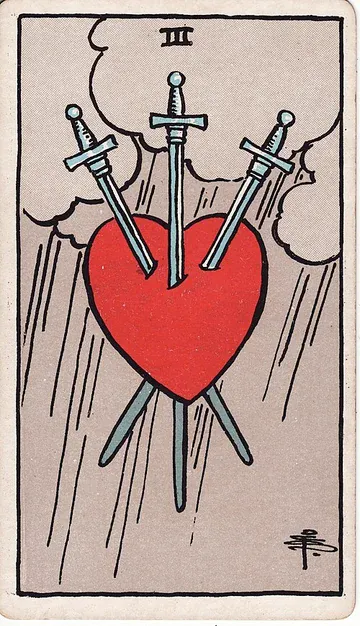
Three of Swords
The open chalice beneath the pierced heart. Ace of Cups with Three of Swords places mercy, tears, and first repair directly under heartbreak. The wound is not erased; it is finally given water and a vessel for grief.
Frequently Asked Questions
What is the Ace of Cups tarot card meaning?
The Ace of Cups means emotional source: new feeling, tenderness, grace, creative opening, and the capacity to receive. Its overflowing chalice, five streams, dove, and lotus show feeling arriving before thought. Upright, it is less a completed story than a beginning that asks for a clean vessel.
Does the Ace of Cups promise a relationship, or only the feeling that starts one?
Only the feeling — an ace is a source, never a finished structure. In love, the Ace of Cups describes new affection or renewed tenderness. It can mark the first softening after conflict, the first real spark with someone new, or the return of emotional openness after a dry season. It does not guarantee structure; it says the water is real.
If the Ace of Cups is how someone feels, why does it never say what they intend to do about it?
Because the chalice pours before anyone has decided where the water should go. As feelings, the Ace of Cups is fresh, sincere, and not yet fully organized. Someone may feel moved, softened, emotionally open, or newly touched by your presence. The feeling exists before it has become a plan. Watch tenderness, tone, and receptivity more than declarations.
Is the Ace of Cups a yes you can act on, or only a yes to the feeling?
It is a yes to the water before it is a yes to the vessel. The Ace of Cups upright is usually yes, especially for questions about love, apology, healing, creativity, or emotional openness. Its yes means a beginning is real. It does not replace the practical work of building structure around that beginning, so receive the answer gently and proceed with care.
What is the advice of the Ace of Cups?
Receive before explaining. Make a vessel for the feeling: a conversation, journal, ritual, rest, or creative form. Let tenderness stay tender instead of forcing it into proof. The Ace of Cups advises clean receptivity, honest speech, and care around beginnings that are still wet.