
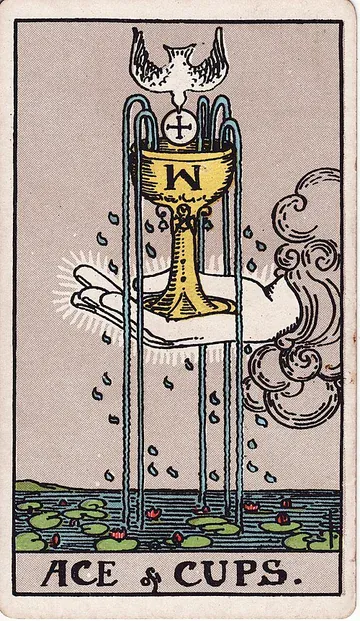
Ace of Cups Reversed · Meaning
The Ace of Cups reversed is the same chalice, but the relationship to water has changed. The cup may be tipped, sealed, overfilled, or held by a trembling hand. The five streams do not fall cleanly into the pool. The dove's descent is delayed. The lotus on still water waits without receiving. Reversed, the card describes feeling that exists but cannot move well: blocked emotion, withheld tenderness, numbness after overwhelm, a source that has not disappeared but has lost its channel.
This card is often misunderstood as absence of feeling. More often, it is feeling without a vessel. A person may care deeply and be unable to say the first true sentence. A body may be full of grief and unable to cry. A creative life may ache with images and still produce nothing. A relationship may contain affection that has been dammed by pride, exhaustion, fear, or the old training that says receiving is dangerous. The cup is not empty in every version of this card. Sometimes it is so full that nothing can be poured without spilling.
The root of Water reversed shows what happens when origin becomes obstruction. Upright, One is wholeness before division. Reversed, One can become isolation: a sealed cup, a heart asked to hold everything alone, a beginning that never receives enough care to become form. The elemental field remains moon-white and sea-blue, West-facing, autumnal, inward, and soft, but the softness may feel heavy. The chest, heart, and lungs become important symbolic terrain. The breath catches. The sternum tightens. Tears sit behind the eyes without falling.
The image's symbols invert without becoming a different card. The overflowing chalice becomes a vessel that cannot accept more, or a vessel pouring from emptiness. The five streams, senses before thought, become sensory confusion or emotional shutdown. The dove with the marked wafer becomes the sign of the sacred that cannot yet be trusted. The lotus on still water becomes a receiver whose surface has gone too still, not peaceful but suspended.
Reversed, the Ace of Cups can point to emotional fatigue, blocked affection, self-protection, disappointment in love, creative dryness, spiritual numbness, or the habit of pouring care toward others while refusing care inward. Its common phrase, "pouring from an empty cup," belongs here only when read precisely. The problem is not simply that the cup has no water. The problem is that the system of receiving and giving has broken rhythm.
The reversed Ace of Cups gathers a whole cluster of questions — what it means, what it says about love, what someone is feeling, whether the answer is yes or no — and every one of them circles the same thing: is the water gone, or is the cup unable to hold it? The reversed card asks for that distinction before any answer is trusted.
The reversal can also appear when the reader has confused numbness with peace. Still water in the upright card is receptive; still water in the reversed card may be frozen, abandoned, or over-controlled. The difference is felt in the body. Peace has breath in it. Numbness has a lid. Peace can receive a dove. Numbness watches the dove circle and does not trust the descent.
This is why the reversed Ace can feel more serious than its gentle imagery suggests. A blocked beginning can alter the whole story that follows. If the first cup cannot receive, the Two cannot exchange, the Three cannot celebrate, the Ten cannot bless the household. The work is early, small, and therefore powerful. Repair at the source changes the river downstream.
The card is also merciful because it works at the scale of the first cup. It does not ask the reader to solve every relationship, every grief, every creative drought, or every spiritual disappointment at once. It asks for the earliest place where water stopped. That place may be embarrassingly simple: the apology avoided, the nap refused, the glass left empty, the poem abandoned after one cruel comment, the help declined because needing help felt too exposed. Reversal makes the source visible by showing where the flow does not pass.
There is a social dimension as well. Many people learn to keep the Ace reversed because their environments reward dryness. Families may mock need. Workplaces may praise emotional self-erasure. Friend groups may treat sincerity as excess. In such places the cup does not turn over because the person lacks feeling; it turns over because feeling has never been safe in the room. The card asks not only "why are you closed" but "where did openness become costly."
The card's medicine is not to force feeling. Forced water floods. The first task is containment. A page. A room. A trustworthy witness. A boundary. A glass of actual water. A hand on the chest. One conversation that does not demand final resolution. The reversed Ace asks for the channel to be repaired before the river is judged.
Ace of Cups Reversed · Love & Relationships
In love, the Ace of Cups reversed describes tenderness that cannot yet pour cleanly. There may be affection, longing, grief, or desire, but the cup is tipped away from the person who needs to receive it. The relationship may feel emotionally present in flashes and absent in structure. One day the water rises; the next day the vessel closes. The card asks where love has become blocked, rushed, withheld, overgiven, or too frightened to be received.
For an existing partnership, the reversed Ace often appears when affection is still alive but the channel has clogged. The couple may be functional. Meals happen, schedules run, messages get answered. Yet the simple gestures have thinned: warmth in the voice, pleasure in touch, curiosity about the inner life of the other person. The card does not say the bond is loveless. It says the source needs clearing before resentment becomes the main language.
For a new connection, the card can describe a beginning that struggles to stay open. The spark may be real, but one or both people are armored. Someone responds warmly and then disappears. Someone wants closeness and then becomes awkward when closeness arrives. The Ace reversed is the emotional start-stop: not necessarily manipulation, not necessarily indifference, but a nervous system unsure how to receive what it asked for.
For a single seeker, the reversed Ace of Cups can show a heart protected so efficiently that even welcome things cannot enter. This protection may be intelligent. It may have been earned by real pain. The card does not shame the closed cup. It simply notices the cost. If every possible affection is screened for danger before it is allowed to breathe, the first water has no place to gather.
For love after heartbreak, this card can mark the season when the body is tired of being told to open. The wound may not be dramatic anymore, but the cup remains turned slightly away. Tears may be exhausted. Hope may feel intrusive. The card's advice is not to force romance. It is to restore the capacity to receive any clean tenderness: friendship, rest, beauty, apology, music, touch with consent, silence that does not punish.
For conflict or apology, the Ace of Cups reversed points to the unsaid sentence that has curdled. Someone may want to apologize but fears the vulnerability of beginning. Someone may want to forgive but cannot yet trust the cup. The reversal asks for smaller speech. Not "let us fix everything tonight," but "this hurt me," "I still care," "I need time," "I can hear one thing." A blocked cup opens through precise, limited truth.
For reconciliation, the reversed Ace is cautious. It can show feeling that remains but has nowhere healthy to go. The emotional memory may be wet; the structure may still be broken. Returning only because the heart aches risks pouring new water into an old crack. The better question is whether a new vessel exists: changed behavior, clearer boundaries, slower pace, mutual accountability, room for the wound to be named without being used as a weapon.
For unrequited love, the card can describe the pain of pouring toward a closed vessel. One person may be emotionally full; the other may be absent, unavailable, or unable to receive. The reversed Ace asks the giver to stop mistaking intensity for exchange. Water offered where there is no cup becomes a puddle at the feet. Tenderness deserves a vessel.
For someone who overgives in relationships, this card is direct. The cup has been lifted for everyone else while the hand trembles. Care has become proof of worth. Listening has become a way to avoid being seen. Romance becomes another place to perform abundance while privately running dry. The reversed Ace asks for a radical act of love: let the cup be filled before it is offered.
For someone who undergives, the same card names the sealed chalice. Feeling is kept safe by being kept private. The person may believe that withholding prevents harm, but withholding also prevents repair, delight, and trust. The first offering can be small. A sentence. A gesture. A message without a hidden test. The point is not emotional spectacle. The point is flow.
For long-distance love, the reversed Ace can describe a bond where the idea of tenderness remains but the daily vessels have failed. Messages become logistical. Calls become delayed until both people are too tired to feel. The water is not necessarily gone; it may have no regular channel. The repair is concrete: a standing time, a less performative check-in, one shared ritual that does not depend on crisis to prove the bond exists.
For relationships shaped by family pressure, secrecy, immigration, illness, finances, or social constraint, the card may show tenderness made complicated by outside containers. The cup may be full in private and nearly invisible in public. The reversal asks whether the hiddenness protects the water or slowly poisons it. Some bonds need privacy to survive their beginning. Some need courage and form before privacy becomes erasure.
For intimacy and sexuality, the reversed Ace asks for gentleness around the body's refusal or flooding. Desire may be blocked by grief, stress, medication, shame, dysphoria, trauma, fatigue, or simple lack of emotional safety. The card does not make the body wrong. It asks the lovers to stop treating the body as an argument. Make the vessel safe before asking the water to rise.
For established love under stress, the card can be hopeful if both people respect its scale. It is not the Ten of Cups reversed; it is not the collapse of the whole house. It is the first cup turned wrong. A first cup can be righted. But it cannot be righted by pretending it is upright. Name the blockage. Protect the first stream back.
The most damaging response to this card in love is theatrical repair. Grand promises, dramatic messages, sudden declarations, and sweeping intimacy can all overwhelm the very cup that needs steadying. Reversed Ace of Cups love improves through repeatable tenderness: the same kind tone three mornings in a row, the boundary honored without sulking, the small apology delivered before the injury hardens, the invitation that does not punish a slow answer. Water trusts rhythm.
Ace of Cups Reversed · As Feelings
As feelings, the Ace of Cups reversed is rarely simple indifference. It is feeling blocked at the lip of the vessel. Someone may be moved and unable to show it, interested and afraid to receive, tender and emotionally tired, or so flooded by private material that the feeling cannot travel toward you cleanly. The card is the chest full of water and the mouth saying very little.
For a reserved person, this card can mean that silence is not empty, but it is not yet offering either. They may feel stirred by you and immediately retreat into analysis, duty, humor, or distance. The feeling touches the cup, then the cup tips away. Read this as a limitation in their capacity to hold vulnerability, not as a request for you to pry the cup open.
For a demonstrative person, the reversed Ace can show emotional overflow without grounded care. They may say intense things, send long messages, speak of healing or destiny, and still fail to provide the calm vessel that real intimacy needs. The water is everywhere, but the cup is not steady. Their feelings may be sincere in the moment and unreliable in form.
For a long bond, Ace of Cups reversed feelings often describe affection buried under fatigue. The person may love you and be too tired to feel their own love clearly. Care has become logistics. Concern has become criticism. Touch has become another task. The card asks for replenishment before interpretation. Do not decide the whole bond from a drained week.
For a new connection, the card can describe attraction complicated by emotional unavailability. Someone enjoys your presence, feels softened by you, even imagines what closeness might be, but the inner vessel is crowded with old grief, current stress, another attachment, or fear of being changed. The feeling is a seed in wet soil with a stone above it.
For someone healing from a past wound, the reversed Ace as feelings shows tenderness meeting scar tissue. They may feel safe with you and resent that safety because it wakes what was not safe before. They may want to receive affection and distrust their own wanting. The feeling can move in pulses: approach, retreat, approach, shame. The card asks for patience without self-abandonment.
For hidden feelings, this is one of the classic signatures of the unsent message. The person may draft and delete, imagine and withdraw, soften in private and appear neutral in public. The reversal does not guarantee confession. It describes obstruction. The hand may hold the cup, but the cloud around it has thickened.
For an ex or estranged person, Ace of Cups reversed feelings can mean the emotional residue is present but difficult. They may remember tenderness and also remember why the cup tipped. They may feel regret, affection, sorrow, or a wish for cleansing, yet lack the structure to make contact responsibly. The card distinguishes between feeling something and being ready to offer something.
For friendship or family, the reversed Ace can show care trapped behind pride, awkwardness, shame, or generational training. Some people love by doing and cannot say they are sorry. Some people worry and translate worry into control. Some people want closeness but know only criticism as a language of concern. The card asks the reader to notice the water without excusing the cracked vessel.
For someone who seems hot and cold, the reversed Ace gives a useful distinction. Hot and cold can be strategy, but it can also be the unstable rhythm of an unsteady cup. The person feels, panics, withdraws, misses the feeling, returns, then panics again. Compassion may understand the pattern. Boundaries decide how much of it can be allowed near your own nervous system.
For someone who says they do not know what they feel, the card can be literal. Their inner water may not yet have separated into categories. Attraction, comfort, fear, admiration, dependence, guilt, grief, and desire may be sitting in one undivided pool. Pressing for a verdict can make the cup tip further. Time may clarify, but time without honesty only preserves the fog.
For someone who appears indifferent after a breakup, the reversed Ace warns against taking the surface as the whole truth. Some people grieve by sealing the cup. They become efficient, polite, even cheerful. The water is hidden because exposure would undo the structure that lets them function. This does not guarantee return. It simply means absence of visible feeling is not always absence of feeling.
The hard truth of Ace of Cups reversed as feelings is that blocked tenderness can still hurt. It is possible for someone to care and still be unavailable. It is possible for feeling to be real and insufficient. The card's counsel is to honor what exists without building a life around what cannot yet flow.
Ace of Cups Reversed · Career & Work
In career, the Ace of Cups reversed describes work where the emotional source has been blocked, drained, or mistrusted. The job may continue. The calendar may be full. The inbox may prove that things are moving. Yet the inner cup is dry, tipped, or sealed. The person works from competence rather than contact. The day gets done, but the chest does not come with it.
For a current role, the card often appears when a once-meaningful job has become a place of emotional drought. The work may still matter in theory, but the worker no longer receives water from it. This may be burnout, grief, boredom, institutional disappointment, or the slow damage of being asked to care inside a system that does not care back. The reversal asks for an honest inventory: what still nourishes, what only extracts.
For a new role decision, the reversed Ace warns against choosing only because the current cup is empty. A new offer may look like water simply because the old room is dry. Read carefully. Does the new role contain genuine emotional or creative source, or only escape? The card does not forbid leaving. It asks that leaving be guided by living water, not only by thirst.
For a job search, this card can mark discouragement. The seeker may have sent too many applications into silence, repeated a story so often it has lost its pulse, or begun to feel like a document rather than a person. The remedy is not false optimism. It is rehumanization. One conversation with a real person, one letter written in a living voice, one portfolio piece that still carries feeling can reopen the channel.
For entrepreneurs and freelancers, Ace of Cups reversed can show an offering built from genuine feeling that has become overexposed. The client work keeps taking the sacred spring and turning it into deliverables. The brand has begun to ask for the most intimate water on a schedule. The card asks for boundaries around source. Not every insight belongs in the newsletter. Not every tenderness is inventory.
For creative work, this is the dry well, the blocked draft, the studio avoided because its silence has become accusatory. The card is not a verdict on talent. It is usually a problem of vessel. The project may need a smaller form, a private phase, a collaborator, a walk, a season of input, or permission to make something bad enough that water starts moving again. Source returns through contact, not self-disgust.
For caretaking professions, the reversed Ace is the warning of compassion fatigue. Teachers, therapists, nurses, healers, artists, service workers, and managers can all reach the place where they continue to pour because the role requires it while nothing pours back. The card asks for structural replenishment, not another scented candle on top of depletion. Caseload, hours, supervision, pay, boundaries, and rest are vessels too.
For workplace relationships, the reversed Ace can indicate a missed apology, an emotionally unsafe team, or a culture where sincerity is punished by mockery or extraction. People keep their cups sealed because the room has taught them to. A leader drawing this card should ask where the team stopped telling the truth. An employee drawing it should ask whether openness is actually possible in the current container.
For promotion, recognition, or visible success, the reversed Ace can describe the strange emptiness after being chosen. The title arrives, but the work no longer feels alive. The praise comes, but the body feels untouched. The card asks whether the wish was for recognition or for meaningful contact with the work. These are different cups.
For study, training, or a career pivot, the card advises repairing the relationship to learning. Curiosity may be blocked by fear of waste, age, money, or looking foolish. The Ace reversed says the first stream may be small: one class, one page, one conversation, one exercise done privately. The source does not return by shaming itself into a river.
For managers and founders, the reversed Ace can describe a culture that asks for passion after it has destroyed the conditions for passion. Posters about mission do not refill a drained cup. Neither do retreats, slogans, or public praise when the daily vessel remains cracked. The card asks leaders to examine workload, emotional safety, compensation, and the real cost of constant responsiveness. Care must become structural or it becomes another extraction.
For people changing fields, the card may indicate grief for the old identity. Even when leaving is right, the previous work may have held a version of the self that needs mourning. Without that mourning, the new beginning can feel strangely dry. The Ace reversed asks for a goodbye ritual: clean the desk, archive the files, thank the skills, name what the old work gave and what it took.
For people whose creative or vocational source has been mocked, dismissed, or commercialized too early, the reversal can show a protective closure. The work stopped flowing because exposure felt unsafe. Return may need privacy before audience, play before product, and one trusted witness before the market. The first water should not be sent back to the place that contaminated it.
For people in high-status work, the reversed Ace can hide beneath success. The role may be admired precisely because it requires emotional self-erasure. The public sees competence, elegance, stamina. The private body feels a sealed cup. This card asks whether achievement has become a socially rewarded way to avoid receiving. A career that cannot allow tenderness eventually begins to mistake dryness for rigor.
In practical terms, the career advice is to stop pouring from an empty cup and stop calling emptiness professionalism. Water with Earth helps: make the invisible drain visible through schedule, budget, scope, and rest. Water opposed by Fire warns against urgency that boils off tenderness. Water with Air can help name the pattern, but only if analysis returns you to the body rather than keeping you above it.
Ace of Cups Reversed · Money & Finances
A tipped cup still pours. It simply pours where nobody is standing to drink, and that is the shape the Ace of Cups reversed gives to a bank balance: resources moving, and no one fed by the movement. Spending may be used to create a feeling that does not last. Giving may be used to earn closeness. Refusing help may be used to protect pride. Receiving may feel suspicious even when it is clean. The financial issue is not only arithmetic. It is the condition of the cup.
For emotional spending, the reversed Ace is exact. The purchase is not really the object; it is the hope of being soothed, chosen, renewed, or made beautiful by the object. Sometimes the purchase is harmless and even kind. Sometimes it becomes a private ritual of pouring water into a cracked vessel. The card asks for a pause before payment: what feeling is being sought, and is this the cleanest vessel for it?
For overgiving, the card describes generosity that has stopped being free. Paying for everyone, rescuing a partner, absorbing family costs, undercharging clients, lending without terms, donating from guilt: all can belong here when giving empties the cup and secretly asks to be loved in return. The remedy is not coldness. It is honest containment. Give from overflow. Put terms around the rest.
For receiving help, the reversed Ace often marks resistance. A grant, refund, gift, support payment, scholarship, family contribution, or friend's generosity may be available, but the body refuses it. Pride calls itself independence. Fear calls itself discernment. The card asks whether refusal is wisdom or old training. A clean gift can be received cleanly when the terms are clear.
For debt or scarcity recovery, this card points to the emotional residue of having gone without. Even when money begins to stabilize, the chest may stay braced. The person may hoard, splurge, refuse pleasure, or panic at ordinary expenses. The reversed Ace says the financial vessel needs emotional repair too. A budget that ignores grief often fails because the grief finds another door.
For investments, business spending, or financial risks, the reversed Ace advises delay until the feeling clarifies. Do not invest because desperation wants a miracle. Do not fund a project because the idea briefly made the heart flood. Do not buy belonging. Give the desire a night, a spreadsheet, and a conversation with someone who does not profit from your yes.
For work that is underpaid because it is heartfelt, the reversed Ace asks for a serious correction. Care is not made purer by being financially unsafe. Art is not made more sacred by unpaid invoices. Healing work is not more compassionate when the practitioner cannot afford rest. The cup turns over when devotion is used to justify depletion. Fair exchange is part of the vessel.
For inheritances, gifts, or family support, the card can show money carrying old water. The gift may arrive with grief, guilt, obligation, apology, control, or unfinished history attached. Receiving may be correct, but the emotional terms need clarity. A clean agreement can keep the water from becoming brackish. Name what is gift, what is loan, what is expectation, what is love.
For shared finances in relationships, the card asks where money has become a substitute for tenderness. One person pays instead of apologizing. Another withholds money instead of naming fear. A couple avoids the budget because the budget reveals the emotional imbalance. The first repair is often not a number. It is a sentence about what money has been carrying in silence.
The reversed Ace also warns against using scarcity as an identity after the facts have begun to change. Some people remain emotionally poor around money long after resources improve, because receiving still feels unsafe. This does not mean spending carelessly. It means allowing enough pleasure, softness, and support into the budget that money can become a vessel for life rather than only a wall against disaster.
Ace of Cups Reversed · Health
For health, the Ace of Cups reversed asks attention to the chest, heart, lungs, breath, tears, and the emotional weather that gathers in the body when feeling has nowhere to go. It does not diagnose illness. It describes a symbolic pattern: the vessel is tipped or sealed, and the body may be carrying water that has not been allowed to move.
In an acute health question, the card often points to depletion before drama. The body may need hydration, rest, quiet, and the acceptance of practical care. The person may be trying to continue pouring while the cup is empty. This is the sick day not taken, the breath ignored, the cry swallowed, the meal skipped because everyone else's needs came first. The card asks for immediate containment.
For chronic conditions, the reversed Ace can describe emotional fatigue around ongoing care. The appointments, tracking, routines, restrictions, and explanations may have worn down tenderness toward the body. The person may be doing the regimen while resenting the vessel. The card asks for one act of care that is not punitive: a softer reminder, a better pillow, a kind note in the medication box, a practitioner who listens.
For anxiety, the image is often the full cup that cannot pour. Sensation gathers in the chest, breath shortens, the mind tries to solve what the body has not released. The five streams are blocked at the senses. Grounding through the senses can help symbolically: cool water on hands, naming objects in the room, smelling jasmine or another steady scent, touching the sternum, lengthening the exhale. These are not replacements for care; they are ways of giving water a channel.
For grief, the reversed Ace may mark delayed tears. The person knows the loss, speaks of the loss, functions around the loss, and still cannot cry. Or the tears come everywhere, without container, flooding the day. Both belong to the same card. The issue is flow and vessel. A ritual, appointment, grave visit, letter, or timed solitude can make a container where grief is neither denied nor allowed to drown everything.
For caregivers, helpers, parents, partners, and people in emotional labor, this card is the body saying it cannot keep receiving and pouring without replenishment. Compassion fatigue can feel like numbness, irritability, shallow breath, or a strange absence where tenderness used to be. The reversed Ace asks for real support, reduced load where possible, and the humility to be cared for.
For recovery from overwork, the card is especially pointed. Rest may initially feel wrong because the body has learned motion as proof of safety. The cup is put down and anxiety rises. This does not mean rest is failing. It may mean the system is finally quiet enough to reveal how empty it has been. Replenishment can feel uncomfortable before it feels nourishing.
For people who struggle to receive touch, food, praise, or help, the reversed Ace places attention on consent and pacing. The body may reject good things because good things once arrived mixed with demand. A smaller vessel may be needed: a shorter hug, a simpler meal, a compliment allowed without response, help accepted for one task only. Receiving can be titrated.
For respiratory symbolism, the card asks where breath has become shallow around feeling. A person may speak calmly while breathing only at the top of the chest. They may hold the ribs still to avoid crying. They may sigh without noticing. Breath practices can be useful when kept gentle and medically appropriate. The aim is not mastery of the body. It is permission for the cup to move.
Because the card is tied to heart and lungs, any alarming physical symptom belongs with a qualified clinician rather than symbolic interpretation. The narrative here is not medical advice. It is an invitation to notice how emotional blockage, exhaustion, and lack of receptivity may be shaping the body's daily weather. The first health practice is to steady the cup and let one honest stream move.
Ace of Cups Reversed · Spirituality
Spiritually, the Ace of Cups reversed describes dryness at the source. Prayer feels like speaking into cloth. Meditation feels like sitting beside an empty bowl. Ritual objects look beautiful and do not touch the chest. The seeker may wonder whether the water has gone away. The card suggests a different reading: the water may be present, but the vessel cannot receive in its current state.
This reversal often appears after spiritual disappointment. A practice failed to protect the seeker from loss. A teacher became human in a painful way. A community mishandled trust. A hoped-for sign did not arrive. The cup turns over not because the sacred is absent, but because receptivity has become dangerous. The first spiritual task is not devotion. It is honesty about the injury to trust.
For active practitioners, the card can show overpouring. The person offers, serves, prays, reads, guides, facilitates, listens, and continues long after the inner spring is dry. Spiritual work becomes another form of extraction. The reversed Ace asks the practitioner to stop confusing availability with holiness. A vessel that never receives becomes brittle, no matter how gracious it appears.
For seekers without a formal path, the reversal may feel like numbness toward beauty. The first rain does not move the heart. Music does not open the room. The old symbols feel remote. This may be a season of grief, fatigue, depression, or ordinary overexposure. The card's advice is small: return to one sense. Touch water. Smell lotus, jasmine, tea, soap, rain, anything clean. Let the sacred approach through the body before belief is asked to speak.
The mythic echoes of this card become important in reversal. The Grail is not a trophy. Abundantia's horn is not a demand for endless plenty. Guanyin's vessel is not an obligation to pour mercy past the point of self-erasure. Reversed, these images ask whether the sacred vessel has been used as an excuse to ignore the vessel's limits.
The reversed Ace also challenges spiritual bypassing around emotion. A seeker may call themselves peaceful when they are dissociated, forgiving when they are afraid of anger, surrendered when they have stopped asking for anything. The card brings the question back to the cup: can the vessel hold ordinary human water, not only approved spiritual feelings. Anger, grief, need, and disappointment may be the streams that return sincerity.
For those who serve others spiritually, the reversal asks for a private life that can receive. The guide who never becomes guided, the listener who never speaks, the healer who never admits injury, the ritualist who never rests: all eventually meet the tipped cup. Devotion needs a Sabbath, a friend, a supervisor, a body, a meal, and a place where no one is being helped for an hour.
A thirty-minute practice for the reversed card: pour water into a cup, then pour half of it into a bowl. Sit with both. Name what has been given away too quickly and what has been refused too quickly. Drink from the cup. Leave the bowl for a plant, sink, or threshold. The point is not drama. It is restoring rhythm: receive, hold, pour, stop.
If the practice brings nothing, that too is information. Dryness honestly met is already different from dryness performed around. The reversed Ace often begins its repair through faithful, ordinary attendance to what does not move yet. Sit beside the empty-feeling cup without decorating it. The dove does not need applause to descend.
Ace of Cups Reversed · Yes or No
Not yet — the feeling needs a vessel first.
The Ace of Cups reversed is not a harsh no. It is a no to rushing, a no to emotional flooding, a no to pouring from an empty cup, a no to asking a blocked channel to carry a river. For yes-or-no questions, the answer is usually "not yet" unless the question is about pausing, resting, receiving help, or naming the blockage. Those receive a quiet yes.
For love questions, the reversed Ace says the feeling may exist, but it is not flowing cleanly enough to build on without care. If the question is whether someone feels something, the answer may be yes in a blocked form. If the question is whether to force confession, chase reassurance, or treat tenderness as commitment, the answer is no. The cup is not steady.
For reconciliation, the card advises waiting until a real vessel exists. An apology, boundary, changed behavior, and enough time for the nervous system to stop bracing are all part of the vessel. Wanting the water back is not the same as having a cup that can hold it. The answer is not yet if the old crack remains unnamed.
For career and creative decisions, the reversed Ace says no to launching from depletion. It says yes to rest, draft work, private repair, and smaller containers. If the question is "should I quit everything today because I feel dry," pause. If the question is "should I make space to recover source," yes. The card is precise about scale.
For money or health questions, the reversed Ace warns against decisions made from emotional lack. Do not spend to feel held. Do not refuse help to feel strong. Do not ignore the body's request for care because the calendar is full. The better answer is the one that restores flow without pretending the cup is already full.
For questions about another person's feelings, the reversed yes-or-no answer is nuanced: yes may exist in the heart, but no may exist in behavior. If the practical question is "can I rely on this feeling," the answer is not yet. If the practical question is "is there any feeling here," the answer may be yes, but blocked feeling should not be treated as available love.
For questions about sending a message, the card asks what the message is meant to do. A message that names one clean feeling and releases control may be appropriate. A message designed to force the other person to become the vessel for all withheld water is not. The difference can be felt in the body: the first brings sadness and steadiness; the second brings urgency and contraction.
For questions about whether to forgive, the reversed Ace distinguishes forgiveness from immediate reopening. The heart may begin to soften before trust has enough structure. It is possible to let one stream of mercy move while the door remains partly closed. The card says no to performative forgiveness and yes to honest emotional thaw.
For questions about self-love, the answer is yes to returning inward and no to turning self-care into another performance. The cup needs privacy, water, rest, and truthful language more than a new identity.
For timing, the card indicates delay for emotional or energetic repair. The beginning may still be possible. In many readings it is close, but blocked. The useful action is not to push harder. It is to turn the cup upright, clear the lip, and let one stream prove that movement has returned.
Ace of Cups Reversed · Advice
Set the chalice down on something flat. Nothing in the Ace of Cups reversed can be measured, repaired, or even seen clearly while the vessel is still being carried at an angle, which is why the first move is to stop pouring. Stop explaining, rescuing, performing warmth, chasing the person who cannot receive, refreshing the inbox, forcing the poem, or calling depletion devotion. Put the cup down. Look at it. Ask whether it is empty, cracked, too full, or simply turned away from the source.
Create containment before expression. If a feeling has become too large, do not send it immediately to the most charged person in the story. Put it somewhere that can hold it without consequence: paper, voice memo, therapy, prayer, a walk, a bowl of water beside the bed. The point is not secrecy. The point is preventing overflow from becoming damage.
Accept one form of care that does not require you to be impressive. Let the friend bring food. Let the colleague cover one task. Let the practitioner help. Let the page receive the ugly sentence. The reversed Ace often appears for people who have made self-sufficiency into a shrine. The card asks for a humbler altar: a cup that can be filled.
Say the small truth before the large confession. "I am hurt." "I am tired." "I miss softness." "I do not know how to receive this." "I need slower." These sentences are not dramatic, and that is why they can work. The blocked cup opens through manageable honesty. Flooding the room with the entire reservoir may only frighten the first stream back.
Repair the rhythm of giving and receiving. If you have been overgiving, choose one place to reduce the pour. If you have been withholding, choose one place to offer cleanly. If you have been numb, choose one sensory act that lets the body register water again: a shower taken slowly, tea held in both hands, rain listened to without multitasking, a lotus or jasmine scent on the wrist.
Choose one person or place that has earned access to the first stream. Not everyone deserves the cup. The reversed Ace is not advising indiscriminate openness. It is advising a repair of flow with discernment. A trustworthy listener, a skilled practitioner, a quiet chapel, a private document, a body of water, a studio with a locked door: these can be vessels before the charged relationship becomes one.
Reduce one leak. Leaks are not only dramatic betrayals. They are the endless scroll that thins feeling, the habit of answering every message immediately, the joke that dodges every tender sentence, the extra obligation accepted while resentment rises. Choose one leak and close it for a week. Notice whether the cup begins to fill.
Ask what the blockage protects. A reversed cup is often guarding something tender: dignity, sleep, grief, a private creative source, a memory that still feels raw, a body that has been handled without enough care. Protection is not the enemy. Old protection becomes a problem only when it keeps guarding a door that now needs to open. Thank the guard, then negotiate a smaller post.
If a relationship is involved, make the first request behavioral rather than total. Ask for a slower conversation, a specific apology, a weekly check-in, a pause before leaving the room, a boundary around late-night arguments. Do not ask the other person to become emotionally fluent by force of one crisis. The reversed Ace heals through vessels that can actually be used.
Do not punish yourself for blockage. A sealed cup usually learned sealing somewhere. Respect the intelligence that helped you survive, then ask whether it still needs to govern every opening. The reversed Ace returns upright through patience, vessel-making, and the first honest drop. Begin there.
One final instruction: do not confuse privacy with avoidance. Privacy protects the first stream from rough handling. Avoidance prevents the stream from ever meeting air. The difference is visible in the body. Privacy feels quiet and chosen. Avoidance feels tight, repetitive, and vaguely ashamed. Choose privacy when the cup is young. Challenge avoidance when the cup has become a locked room.
Ace of Cups Reversed · Card Combinations
Ace of Cups Reversed + The High Priestess
The blocked cup meets the silent temple. This combination can show feeling hidden so deeply that even the person carrying it does not have full access. Dreams, intuition, and bodily signals may speak before conversation can. The counsel is privacy with honesty, not secrecy as control. Sit near the veil. Do not tear it down.
Ace of Cups Reversed + The Star
The dry cup under the healing sky. The Star does not shame the Ace for being empty; it creates a larger field where water can return. This pairing often appears after emotional fatigue, heartbreak, illness, or creative depletion. Hope is present, but it is medicinal rather than dramatic. Small replenishments count. Clean water, clean sleep, clean company.
Ace of Cups Reversed + Two of Cups
The source is blocked at the threshold of exchange. Two people may care and still fail to meet because one cup cannot pour or receive. The combination asks for mutuality to be rebuilt through small offerings, clear boundaries, and speech that does not demand instant merger. If only one person is carrying both cups, the relationship cannot become the Two.
Ace of Cups Reversed + Three of Cups
The private cup is empty inside a social circle. This can describe loneliness in company, celebration that feels performative, or a friend group that receives the cheerful version while the real feeling stays sealed. The remedy is one honest witness rather than louder festivity. Let one trusted person see the tipped cup before asking the whole circle to understand it.
Ace of Cups Reversed + Three of Swords
The blocked cup meets active heartbreak. Tears may be delayed, apologies may be stuck, or grief may flood at inconvenient times because no vessel was made when the wound first opened. This pairing asks for tender containment around pain: a letter, a session, a ritual of release, a conversation with boundaries. The heart is pierced; the water still needs somewhere to go.
In reversed combinations, the Ace asks where flow stopped before the second card intensified the story. The High Priestess may hide the water, The Star may restore it slowly, Two of Cups may reveal unequal capacity, Three of Cups may show loneliness inside community, and Three of Swords may show grief waiting for a vessel. The answer is rarely force. The answer is the right container, at the right scale, for the first return of water.
Elemental dignity sharpens the reading. Pentacles beside the reversed Ace often help because Earth can make the repair tangible: a schedule, budget, meal, boundary, appointment, or room. Wands can be difficult if urgency demands instant catharsis, though clean fire can warm the frozen cup. Swords can name the blockage, but too many Swords may turn feeling into a case study. Other Cups deepen the emotional truth and may also increase flooding. The reader should ask which element is helping the water move and which one is interrupting it.
The reversal does not make these combinations hopeless. It makes them earlier. The story has not yet reached the celebratory circle or the healed horizon. It is still at the lip of the cup, where one blocked stream can change the whole landscape. That is demanding, but it is also intimate work. The first honest drop is enough to begin the repair.
If a spread contains both upright and reversed water cards around this Ace, read the pattern as uneven flow rather than contradiction. Some rooms of the life may receive well; others remain sealed. The combination section exists for that kind of nuance: not a verdict, but a map of where the water can travel and where it stops.
Card Combinations

The High Priestess
The cup held beneath the veil. Ace of Cups with The High Priestess describes feeling that belongs first to inner knowing: dreams, silence, intuition, and tenderness not ready for public handling. Let the water reveal its depth before speech claims it.

The Star
The first cup beneath the healing stars. Ace of Cups with The Star is emotional renewal after depletion, a clean stream returning without insulting the wound. Hope here is quiet, restorative, and bodily, like water touched after fever.

Two of Cups
The source becomes exchange. Ace of Cups with Two of Cups shows first feeling meeting mutual recognition: apology answered, attraction returned, tenderness given a human mirror. Do not rush permanence; let the offering become relational first.

Three of Cups
The private spring enters the circle. Ace of Cups with Three of Cups turns new tenderness into friendship, celebration, chosen family, or collaborative art. Joy asks for witnesses, but the original water still needs careful handling.
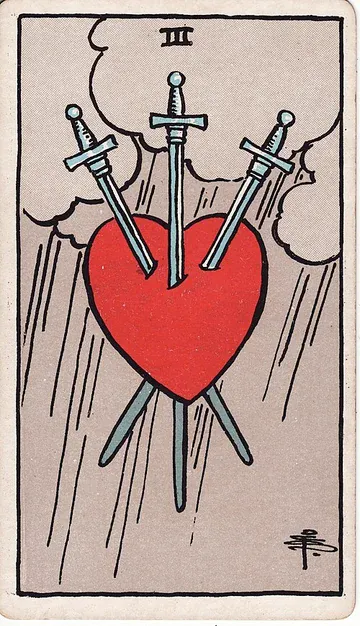
Three of Swords
The open chalice beneath the pierced heart. Ace of Cups with Three of Swords places mercy, tears, and first repair directly under heartbreak. The wound is not erased; it is finally given water and a vessel for grief.
Frequently Asked Questions
When the Ace of Cups comes reversed, is the cup empty or simply sealed?
Far more often sealed than empty — which is why the reversal is workable. The Ace of Cups reversed means blocked emotion, withheld tenderness, numbness, creative dryness, or a cup that cannot receive. The feeling may still exist, but the channel is obstructed. Its medicine is containment: one honest vessel, one clean sentence, one way for water to move safely.
Is the Ace of Cups reversed yes or no?
The Ace of Cups reversed is usually not yet. It says the feeling, plan, apology, or beginning needs a steadier vessel before action. It can be yes for rest, receiving help, naming the blockage, or creating emotional containment. It is no to rushing from depletion.
Does the Ace of Cups reversed mean the tenderness is gone, or that it has nowhere to land?
Almost always the second. In love, the Ace of Cups reversed describes affection that cannot pour cleanly: emotional unavailability, blocked apology, overgiving, undergiving, or tenderness frightened by old pain. It does not always mean lack of love. It means the cup needs repair before the water can be trusted.
Can someone feel a great deal for you and still arrive as the Ace of Cups reversed?
Yes, and that is the most common version of it. As feelings, the reversed Ace of Cups can show warmth held back, attraction complicated by fear, grief, fatigue, or the inability to receive closeness. Someone may care and still be unavailable. Honor the feeling without building your life around water that cannot yet flow.
What is the advice of the Ace of Cups reversed?
Stop pouring from an empty cup. Make containment before expression: write, rest, ask for help, name one small truth, and repair the rhythm of giving and receiving. The reversed Ace of Cups does not ask for dramatic release. It asks for the first safe stream.