
Ace of Wands Tarot Card · Core Meaning
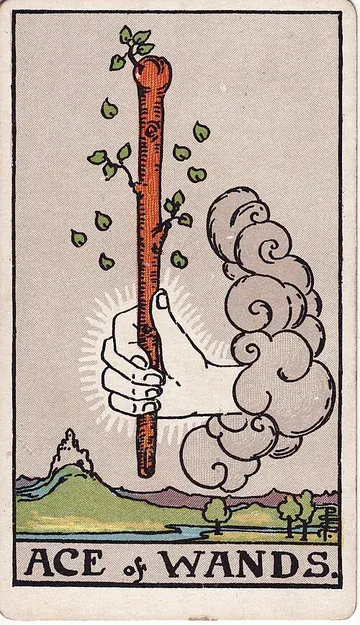
The Ace of Wands is the seed of fire — the moment before will has a name. In the Rider-Waite-Smith image, a hand emerges from a low cloud and grips a freshly cut wand that is somehow already alive: green leaves, shaped like the Hebrew letter yod, fall away from it like soft rain. Beneath the cloud, a fertile plain opens; a river bends through it; far across, on a distant mountain, a small castle waits. Nothing in the picture is arriving in a hurry. The hand is not yet pointing toward anything. The wand has not been wielded. And yet, fire has already entered the world.
Everything difficult about this ace is held in the hand that has not yet pointed. Ignition has happened, but direction has not. The yod-leaves are not flame — they are the seed of flame, the first letter of the divine name spilling out as foliage, telling the reader that whatever this is, it is rooted in something older than the gesture itself. Read the card as the photograph of a beginning that is so early it can still be aborted, so early it can still grow toward almost anything, so early that the figure holding it has not yet had to commit.
The traditional Hermetic Qabalah signature places this card at Kether in Atziluth — the topmost sephirah in the topmost world, the crown of the world of emanation. That is the highest possible address for the suit of fire. The Ace of Wands is the root of fire: not a particular flame, but the fact that fire is possible at all. Crowley calls it "the first manifestation, the radix of fire." It is fire-of-fire, the elemental seed before any elemental shape.
Numerologically, the card is One. One is origin: the first landing of will upon the world, the original division between nothing and something, the singular pulse that all the later twos and threes and fours are commentary on. The Ace of Wands is what the suit of fire keeps trying to remember as it descends through the Two's planning, the Three's expansion, the Four's celebration — the unbidden first impulse that started the whole sequence. By the time you reach the Ten, you are dragging ten staves up a hill; the Ace is the moment before any of them existed, when only the urge existed.
The mythic echoes are Promethean. The Ace of Wands is the torch that Prometheus stole from the gods and put into the hand of a mortal — fire has always been given, not invented. It is also the burning bush that does not consume itself: a flame that speaks before it destroys, a light that is information before it is heat. The hand from the cloud is the divine hand; the wand is the medium; the human, in the picture, has not yet appeared. The card is the gift before the receiver has reached for it.
Read the Ace of Wands the way you would read the silence before a kettle whistles. There is nothing visible to act on — and yet something is already happening. Whatever comes next is on its way. The reading does not ask what the seeker will do. The reading asks what the seeker will recognize: there is a fire here that wants something, and the recognizing is itself the first response. The figure of the wand has sprouted; the question is whether the seeker will pick it up before the leaves stop falling.
Ace of Wands Tarot · Love & Relationships
In love readings, the Ace of Wands is the spark — the first tremor of attraction before the body has decided what to do with it. It is the moment your eyes catch on someone in a room and your stomach makes a small unannounced movement. It is the message in the drafts folder that you have read four times. It is the door that you didn't know was a door until someone mentioned the room behind it. The card carries no architecture yet. It is the heat before any decision.
For the seeker who is single and asking whether love is possible, the Ace of Wands is one of the deck's brightest answers. Yes — and the yes is going to arrive in a way you cannot fully plan for. Not the dating-app match you have been calibrating for three months. Something more abrupt: a stranger at a counter, a re-introduction at a friend's gathering, an old name that has resurfaced for reasons no one can explain. The card describes the kind of love that begins as a flicker rather than a strategy. The work, if there is work, is to keep your hand soft enough to receive a wand you did not request.
For an existing partnership in a long quiet stretch, the Ace of Wands is the new flicker inside an old room. Something has begun to want again. It may be a sexual reawakening after a year of polite cohabitation; it may be a project the two of you decide to start together that gives the bond a new center; it may be the realization, on an unimportant Tuesday, that you still want to know what the person across the table is thinking. The card does not say the relationship is new. The card says a new fire has entered the relationship. Treat it gently. Old marriages have been saved by less.
For the seeker in the early stage of a new connection, the card is the first message. The first glance. The cup of coffee that was supposed to be a quick thing and lasted three hours. The card describes the spark someone is afraid to act on — the message half-typed, the question half-asked, the gesture interrupted by the decision to be cool. The Ace of Wands warns gently against that interruption. The fire is real. The cooling is performed. Send the message you would send if there were no audience. Whatever rises in the body when you imagine sending it is the wand sprouting. That is the data.
For the seeker after a wound — after the divorce, after the long grief, after the relationship that taught you what you cannot tolerate — the Ace of Wands is the first interest you have felt in a long time. It does not come with a promise. It does not come with a face yet, sometimes. It comes as a small noticing: you laughed at a stranger's joke. You re-watched a film for the love story. Your body has decided it is alive again before your mind has caught up. The card describes the very first movement of the long return.
For the question "is this person interested in me", the Ace of Wands answers as raw impulse rather than as decided pursuit. Yes, they are interested — but the interest has not yet figured out what to do with itself. They have had the thought. They have not yet written the message. They have noticed your name. They have not yet asked the mutual friend about you. Read it as a flicker: real, present, not yet committed. If you wait for the wand to be carried across the room and offered, you may be waiting for a courage they don't yet have. The card sometimes asks the seeker to be the one who picks up the wand and walks first.
A specific note for the long-distance or cross-cultural first move. The Ace of Wands does not respect the obstacles you have constructed about logistics. It says: write to them. The visa, the timezone, the language, the city you are not yet sure if you can move to — these are problems for the Two of Wands, the planning that comes after. The Ace is asking only whether you are willing to acknowledge that the spark exists. The map can wait.
A small but important disambiguation. The Ace of Wands looks similar, in love readings, to the Ace of Cups, but they are answering different questions. The Ace of Cups is the spring of feeling — the first softness, the first vulnerability, the chest opening. The Ace of Wands is the spark of desire — the first impulse, the body waking, the fire wanting. Both can be the start of love, but they are different starts. The Cups start has tears in it. The Wands start has a kind of bright restless laughter. Read the card for what the picture actually shows: a hand, a wand, leaves falling — not a chalice running over.
A caution gentle but real. The Ace of Wands sometimes shows up not as the start of a relationship but as the spark you cannot tell from anxiety. The body is hot, the breath is short, the mind is racing — is that desire, or is that fear of being alone? Is that this person, or is that the city you just moved to and have not yet made friends in? The card is not asking you to interrogate the spark out of existence. The card is asking you to keep the hand from the cloud open long enough to feel where the heat actually points. Sparks that point at a person continue to point at that person when the room is quiet. Sparks that point at your own loneliness move whenever the room moves.
For the seeker holding a gesture they have not yet acted on — the unsent text, the held compliment, the question they have rehearsed for two weeks — the Ace of Wands is a soft permission. The wand has sprouted. It is in the hand. The leaves are falling. The reading does not predict the response; the reading describes the moment before the gesture, when the gesture is still possible. Make it possible by making it. The card's love language is the small bold movement, sent before it has been talked out of.
Ace of Wands Tarot · As Feelings
Ask what someone feels, draw the Ace of Wands, and the answer arrives as heat rather than as a sentence — a pulse has started in them, and the pulse has not yet found language. They feel something — and the something is hot, sudden, and surprising to them. They have not had time to build a story about it yet. They are unsure whether to name it. They may even be unsure whether it is about you specifically or about the season of their life that you happen to be standing inside. What the card describes most precisely is unprocessed warmth. Read it as the reddening of skin, not as the writing of a poem.
If they are by nature reserved — the type who weighs words, who waits, who watches before moving — the Ace of Wands in feelings means an impulse has cracked through their normal reserve. They are surprised by it. They are not necessarily comfortable with it. They have not decided yet whether to act, and their not-acting is not refusal but bewilderment. Read silence here as someone trying to understand a fire they have not had recently. They are not cold; they are checking whether the warmth is real before they let it move them.
If they are demonstrative by nature — the kind of person who narrates their feelings in real time, who messages quickly, who is comfortable being explicit — the Ace of Wands in feelings means the demonstrative impulse has just been triggered. They are about to act. They may have already drafted the message. The hand from the cloud is, in their case, already extending toward you. The card is describing the moment between thought and gesture, and in their case that gap is short. Expect motion soon.
For someone whose interest in you has just begun — a colleague, an acquaintance, someone you have crossed paths with two or three times — the Ace of Wands says they have caught a flicker. You have started to occupy a small bright square of their attention that wasn't there a week ago. They are not in love. They have not even decided whether they want to know you. They have only registered that something inside them turned its head. That is the entire reading. The rest is what they choose to do with the turning.
For a long bond rekindling — an ex you have not spoken to in a year, an old friend with whom the contact had thinned, a former lover who has resurfaced — the Ace of Wands in feelings means the embers were not as cold as you both pretended. Something has flickered back. They have thought of you in a way they had stopped thinking of you. The card does not promise reunion. It describes the fact that the fire is not, in their interior, finished. What is done with that fire is its own subsequent question.
For a reserved person finally noticing you — the colleague who has been polite for two years, the friend's friend who has been at the edges of every gathering, the slow-warming person you had given up on — the Ace of Wands says the slow warming has reached the threshold. The first impulse has finally lit. They are not yet ready to talk about it, and they may pretend nothing has happened, but the wand has sprouted. Pay attention to small new gestures. They will not announce themselves; they will leak.
For a partner you have been with a long time, the Ace of Wands in feelings means they have just had a fresh thought about you. Not a re-confirmation of the long, settled affection — a new small flame. They have just noticed something they had stopped noticing. The way you laugh at a particular joke. The shape of your concentration when you read. The fact that you are aging in a way they find interesting rather than alarming. The card describes the mid-life rediscovery: the partner whose attention has just refocused.
For someone who feels a pulse but has not yet moved, the Ace of Wands warns gently against expecting the wand to walk to you on its own. The card is the seed of action, not the action itself. They feel; they have not yet decided. If you wait for full resolution before responding, you may be waiting through their entire window of nerve. The card sometimes tells the seeker that the first move belongs to the seeker — not because the other person is uninterested, but because the other person is at the moment the wand sprouts, and that is a fragile moment to ask someone to be brave inside.
A small uncertainty about the impulse itself. The Ace of Wands in feelings sometimes describes someone who is not yet sure whether what they feel is about you specifically or about the new energy they are generating in their own life. They have started a project, started exercising, started reading a different kind of book — and they have noticed a person while inside that fresh fire. Sometimes the person they notice is the right person and the fresh fire is the medium that let them see clearly. Sometimes the person is incidental and the fresh fire is the entire thing. The card cannot tell you which, and it is fair to say neither can they yet. The work is to let the wand develop enough that it can answer that question on its own.
Take the Ace of Wands in feelings as confirmation that the heat is real. Whatever else is uncertain, this is not a lukewarm reading. They feel something, and the something has weight. The work is to honor that the something is still very early — earlier than language, earlier than story, earlier than commitment — and to meet it at the temperature it is at, not the temperature you wish it were.
Ace of Wands Tarot · Career & Work
Work begins twice: once when the idea lands, and once when somebody finally does something about it. The Ace of Wands is the first of those two — the idea that arrives already itching to be tried. Not the polished proposal. Not the deck you would show a stakeholder. The first tremor: the half-sentence in the margin of a notebook, the sketch on the back of a receipt, the phrase you said to a friend at dinner that you are still thinking about three days later. The card describes the moment the wand sprouts in the hand, before the work of carrying it has begun.
For the seeker with the first idea, sketch, or draft, the Ace of Wands is the most uncomplicated yes the suit of fire offers. Yes — pursue it. Yes — the impulse is sound. Yes — even the version that feels embarrassingly raw is worth committing to a document somewhere. The card cautions against the common mistake of waiting for the idea to mature in the head before letting it touch paper. Ideas mature in the hand, not in the head. Sketch the bad version today. The river beneath the cloud is patient; the leaves stop falling whether or not you reach for the wand.
For the freelancer with a new lead, the Ace of Wands describes the inquiry that has just landed — and the small private thrill it produced before you talked yourself into being measured about it. The thrill was the data. The card says: respond from the thrill, not from the measured calculation. The lead is real. It is going to need shape, of course; that is the Two of Wands. But you are still at the Ace, and the Ace is the moment before the conversation has been over-strategized. Send the warm reply. Ask the curious question. Let the fact that you are interested be visible.
For the creative worker mid-blank-page — the writer staring at a cursor, the painter standing at a primed canvas, the composer with a quiet morning and no first phrase — the Ace of Wands describes the moment just before the first mark. The wand is in the hand. It has sprouted. The leaves are falling. What has not happened is the gesture toward the canvas. The card invites a small, deliberately imperfect first move: the bad sentence, the wrong color, the ugly chord. The Ace responds to motion, not to thought. Whatever you make in the next thirty minutes is the response the card is asking for.
For the founder with a sudden conviction — the morning where you woke up and realized what the company actually wants to be, the meeting where the right framing finally surfaced, the long walk where the strategy crystallized — the Ace of Wands confirms the conviction is real. It is not a manic episode. It is not a reaction to last quarter's frustration. It is the seed of will that has just landed. The card warns against two opposite errors: announcing it to the entire team before it has had a private week to stabilize, or smothering it under your own caution because the conviction feels too sudden to trust. Hold it privately for a week. Then start moving.
For the role change waiting on a signal — the seeker who has been quietly considering a transition, the manager who has been wondering whether to apply for the next level, the practitioner who has been considering switching disciplines — the Ace of Wands is the signal. Not the external one (the recruiter has not yet called; the offer letter is not in the inbox). The internal one. The body has just done a small unmistakable thing: a tiny lift when the new direction is mentioned, a tiny dullness when the old direction is mentioned. That asymmetry is the wand. The card says: trust the asymmetry. Begin the visible steps that follow internal conviction.
For the student with a research question, the Ace of Wands describes the moment the thesis question has finally appeared — vague enough to be real, specific enough to be workable. Most research questions are over-formulated when they are fake and under-formulated when they are alive. The Ace says the question you are circling is alive. Begin to write toward it before you can prove it deserves to exist; the proving comes from the writing.
For the manager hearing the first version of a team plan, the Ace of Wands warns against editing the plan to death in the first conversation. The plan in front of you is the wand sprouting. Editing it now is asking the leaves to stop falling on a schedule. Let the proposal stay rough for one more cycle. The Two of Wands' map will follow. The Ace is the willingness to begin without a complete map.
For the seeker after a layoff or in a forced pivot, the Ace of Wands is one of the kinder cards to draw. It says the next thing is on its way and is going to feel surprisingly yours. The forced exit from the old role is uncomfortable, and the discomfort is real. But the new spark is also real. Watch for the small unbidden enthusiasms in the next two weeks — the project a friend mentions that you find yourself thinking about, the article that holds your attention for forty minutes, the skill you keep returning to in your own time. The Ace is pointing to the embryo of the next chapter. Note what you actually feel pulled toward. That is the data.
For a side-project first move, the card is unambiguous: yes. Spend the weekend on it. Buy the domain. Send the first message. The fact that it is small does not mean it is unimportant. The wand has sprouted because the impulse is small enough to be true. Big strategic decisions are rarely Aces; they are usually committees. Aces are the private fires that nobody asked you to start, and they often turn out to be the work that, in five years, is the work you are most known for.
For the vocation calling that has just landed — the seeker who has just realized what the actual life-work is, sometimes after a decade of suspecting — the Ace of Wands is solemn. The card is not asking the seeker to immediately overturn their existing life. The card is asking the seeker to acknowledge inwardly that the calling has arrived, and to begin the slow practice of arranging the outer life around the inner fact. Tell one person you trust. Begin one small daily practice that points at the calling. Do not yet quit anything. The Ace is the first tremor; the architecture of the life it requires will follow over years.
The Ace of Wands in career reads less as a prediction and more as a permission. The fire is real. The hand is open. The wand has sprouted. The gesture you are about to make is sound, even if you cannot yet defend it on a slide. Make it.
Ace of Wands Tarot · Money & Finances
In money readings, the Ace of Wands describes the seed of a new income stream, a new financial idea, or a sudden bold financial impulse — not the wealth itself, but the spark that may, with steady work, become wealth. The card is fire, and fire in money is energy: the energy to ask for the raise, the energy to launch the side practice, the energy to send the invoice you have been avoiding. The card is rarely about the literal arrival of money. It is about the arrival of the will that, downstream, makes money possible.
For someone considering a new venture, a side hustle, or a creative product — the e-book, the course, the small consulting practice, the Etsy shop — the Ace of Wands is permission to begin. Begin small. Begin imperfect. The card asks the seeker to set up the first version this week: the landing page, the first invoice, the first listing. The income that will eventually flow does not begin until the wand is held. The wand is held by doing the small concrete first thing.
For the question of asking for a raise or renegotiating a rate, the Ace of Wands says the impulse is sound. The number you have been quietly thinking about is the right number. The reluctance to ask is performed reluctance, not real wisdom. The card's caveat: the Ace is the fire, not the strategy. Have the fire when you walk in. Bring the Two of Wands' planning to the conversation. But do not let the planning talk you out of the fire — many seekers ask for less than they want because they prepared the case so thoroughly that they convinced themselves of the smaller number on the way.
For investment or speculative questions, the Ace of Wands is mixed. It does not warn against, but it does not confirm. The card describes the new conviction about a possible investment — the tip that has just surfaced, the asset class that has just caught your attention, the position you are tempted to enter. The card says: the conviction is real, but it is at the seed stage. Do not yet bet the size you are tempted to bet. Take a first small position. Learn the asset by being inside it. The Ace is the first move, not the final allocation.
For a windfall question — bonus, freelance check, unexpected payment — the Ace of Wands can describe the arrival, but it is more often about what to do with the arrival. The card asks the seeker to direct the windfall toward the new fire rather than toward the existing comforts. The bonus is the fuel. The fire is the work you have been quietly meaning to start. Do not absorb the windfall into the everyday. Use it to seed the thing that does not yet exist.
For someone managing scarcity — the seeker counting carefully, the freelancer between projects, the student whose budget is tight — the Ace of Wands is a gentle and specific card. It describes the surge of will that often precedes a financial turn. Not the money yet. The willingness to pursue the money. The card asks: what is one move you could make this week that you have been deferring out of shame, fatigue, or the belief that small moves do not matter? Make it. The Ace says small moves are precisely what matter; small moves are how the river beneath the cloud begins to run.
For debt or recovery questions, the Ace of Wands is encouragement to begin the plan rather than perfect the plan. Make the call to the creditor. Open the spreadsheet. Set up the first automatic transfer to the savings account. The card is unromantic about money — it is fire, and fire is hot enough to burn through avoidance. The hand from the cloud is also the hand that picks up the phone.
A specific caution. The Ace of Wands' shadow in money is the sprouted staff hurried into wielding — the sudden enthusiasm that becomes a financially expensive impulse. The course you sign up for at 2 a.m. and never finish. The equipment you buy for the project that has not yet had a single hour of practice. The domain registered in a flush of Friday evening conviction. The Ace's fire is real, but the Ace warns against confusing buying with beginning. The wand is in the hand for free. Reach for it before you reach for the credit card.
The Ace of Wands' relationship to money is best summarized as: money follows fire that has been carried steadily for a year. The card is not promising the money. The card is promising the fire. Whether the fire is carried steadily for a year is the seeker's part of the contract. The river is patient. The castle, on the distant mountain, is not going anywhere. Walk.
Ace of Wands Tarot · Health
For health readings, the Ace of Wands speaks from its elemental signature: the root of fire, choleric temperament, the body's hot, outward, projective register. Traditionally the Ace of Wands governs the liver and the blood — the organ of cleansing and the medium of heat. The card describes the body's first surge: either the first surge before sickness names itself, or the first surge of returning vitality after recovery. Read which it is from the body's wider context, not from the card alone.
For someone returning from a long stretch of illness, fatigue, or low-energy season, the Ace of Wands is unambiguously a good sign. The energy is coming back. The appetite — for food, for movement, for company, for projects — is beginning to restore. The card describes the first morning where the body wakes and wants something. Not yet wants a great deal. But wants. After a season where the body wanted nothing, this is significant. Honor it by responding to it gently. Eat the meal that suddenly appeals. Take the walk that the body asks for. Do not yet sprint.
For someone in good baseline health, the Ace of Wands describes a fresh wave of vital energy — the kind of week where you wake before the alarm, where the workout feels different, where you finish the day and still have appetite. The card warns gently against burning the new fire too quickly. New fire is not durable. New fire is the seed of fire. Banking it for the work that matters serves the seeker better than spending it on indistinct restlessness.
For someone with a new symptom that has just appeared — a heat in the body, an inflammation, a flushed face, an unexplained pulse, a sudden surge of irritability — the Ace of Wands warns that the body's choleric register is up. The liver and the blood are the traditional seats of this. Choleric register, liver and blood are old symbolic language, not medical advice. The card is not a diagnosis. The card is a direction of attention: where in the body, right now, is heat collecting? Whatever the doctor recommends, the card asks for the seeker's own attention to be turned there. Many fevers and inflammations resolve faster when the body is given heat-honoring care: hydration, rest, less stimulation, no further pushing.
For someone with chronic conditions in the digestive or hepatic system — sluggish liver, irritable bowel, autoimmune flare cycles — the Ace of Wands often describes a flare or a wave. The cycle has just started; it will move. The card asks for active care during the wave: the diet that helps, the rest that helps, the practitioners who help. Calling a wave a wave is not medical advice. The card simply notices the wave is here.
For mental health questions, the Ace of Wands is layered. For someone emerging from depression, the card is the first morning the depression begins to lift — the first walk where the world is interesting again, the first time something makes you laugh instead of dully smile. Honor the smallness of the lift. Do not perform recovery prematurely. For someone with anxiety, the Ace can describe the spike: the body's heat register is up, and it is being mistaken for danger. The work, here, is to let the fire be heat without turning it into alarm. Cold water on the wrists. A walk. Eight long exhales. The card responds to being given a channel, not to being suppressed.
For ADHD-flavored or impulse-driven systems, the Ace of Wands describes the surge — the new project that has captured the entire attention, the sudden ability to work for six hours without a break. The card warns against using the surge to start three more things. Channel the surge into one. Bank the rest. The shadow of the Ace is the seeker who lights the wand and then immediately uses it to set fire to too many corners.
For exercise and movement, the Ace of Wands invites the new practice. Today is the day to begin. Not the perfect schedule, not the curated equipment, not the well-researched plan — the first walk, the first set, the first stretch. The body responds to the gesture, not the architecture. The hand picks up the wand; the wand explains itself.
For sleep and rhythm, the Ace of Wands can describe a season where the body is unusually alert — falling asleep later, waking earlier, restless in the middle of the night. This is fire, and fire is hot, and hot bodies don't lie down easily. Read it as a passing surge if other parts of the body are well; read it as a signal to add cooling rituals (less screen time, evening bathing, a cooler room) if it persists.
A specific signature for the Ace of Wands in health: the body asking for outdoor air, sunlight, and movement. Choleric, southern, summer, the noon hour. When the card appears in a health reading, the simplest practice is to add ten minutes of unmediated daylight to the day. Not a screen. Not a podcast. Light on skin, air in lungs. The card responds.
Ten minutes of daylight is a suggestion about rhythm, not medical advice. Keep your practitioners. Take your medicine. The card describes a felt season — the first surge of fire — and asks for attention. The attention is its own kind of medicine.
Ace of Wands Tarot · Spirituality
Spiritually, the Ace of Wands sits at Kether in Atziluth — the highest sephirah in the highest world, the crown in the world of emanation. That is the deepest possible address for a fire card. It is the seed of will at the topmost altitude: not a particular intention, not a particular practice, not even a particular spiritual conviction, but the fact that there is will at all. The card describes the moment before any spiritual life has been organized — the unbidden pulse that, downstream, becomes the practice, the path, the discipline, the lineage. The hand has come from the cloud. The wand has sprouted. The yod-leaves are falling. Something inside the seeker has just woken up that wants something it cannot yet name.
For the seeker beginning a spiritual practice — the first sit, the first journal, the first ritual, the first time you stood in a tradition's space and felt the body decide it wanted to come back — the Ace of Wands is the most direct confirmation the deck offers. The impulse is sound. The fire is real. The fact that you cannot yet articulate why you are drawn is itself the most important data; will at this altitude does not yet have language. The work is to honor the pull by going to the place again. The path that becomes a path is a path you walked twice.
For seekers in active practice who have hit a season of dryness — the meditation that has become rote, the journal that has become diary, the ritual that has become routine — the Ace of Wands describes the new fire arriving inside the existing form. Not a new tradition. Not a different teacher. A fresh impulse inside the practice you already keep. The Promethean image is exact here: fire is given, never invented. The seeker did not generate the fire by trying harder. The fire arrived because the seeker kept the form open long enough for fire to land in it. Receive the new heat without forcing it to mean anything yet. Let the practice carry it for a season.
For seekers in transition between traditions, the Ace of Wands is gentle and clear. The new pull is real. You are not unfaithful for feeling it. The new tradition is not a betrayal of the old one — the wand is sprouting in your hand, and your only job is to let it sprout. The traditions are not in competition for fire; fire is one. The form that hosts the fire next is a question the fire itself will answer if the seeker keeps the hand open.
For seekers in atheist or post-religious frameworks, the Ace of Wands is not a demand to believe in anything. The card simply describes the fact that something has woken inside you that wants. The wanting is older than belief; the wanting is the data point. The card asks the seeker to take the wanting seriously without immediately needing to assign it cosmology. The yod-leaves do not require the seeker to recognize them as yod. They are still falling.
For the question of vocation, calling, or "what is the work my life is for" — the Ace of Wands is the first answer the deck gives. The first answer is rarely the full answer; the first answer is rarely articulable. The first answer is the direction the body leans when no one is watching. Notice, this week, what you do when the obligations clear for an hour. What you reach for is the yod-leaf. Whatever you reach for repeatedly across months is the path the wand is pointing toward.
A practical practice anchored to fire — the discipline the card asks for, doable in 30 minutes:
Light a single candle. Sit with it. Do not journal, do not pray, do not chant, do not perform anything. Simply watch the flame. When the mind moves to other things, return to the flame. Twenty minutes. At the end, blow out the candle and write one sentence — only one — about what woke up inside you while watching it. Do this nightly for a week. The Ace of Wands is fire's root, and the practice that responds to it is the practice that returns the seeker to literal flame, briefly, deliberately, without ornament. The candle teaches what no other teacher can: that fire is older than the seeker's capacity to articulate fire, and that sitting with that older thing is a form of prayer that does not require any belief beyond willingness to be still in front of light.
For the question "am I on the right path", the Ace of Wands is one of the kinder cards. It does not say the path is right; it says fire has just lit on it. Whether you stay on it is the seeker's part. The card simply confirms that whatever has woken in you is real, and that paying attention to it is not foolish, and that the small, faithful, daily acts of honoring it — the candle, the journal, the early morning, the walk that becomes meditation — are the work the card is asking for.
The Ace of Wands' spiritual register is Promethean rather than monastic. The card does not ask the seeker to renounce. It asks the seeker to receive the gift of fire that has been handed across the cloud, and to be brave enough to hold it without letting the leaves stop falling.
Ace of Wands Tarot · Yes or No
Yes — but it is the yes of a beginning.
The Ace of Wands upright is one of the deck's most full-throated yes-cards. As the seed of fire, it confirms that whatever you are asking about has the spark. The energy is there. The impulse is sound. The first conditions for the thing to live have arrived. Whether it lives all the way through to the distant castle on the mountain depends on what the seeker does after the spark — but the spark itself is unambiguous.
For yes-or-no questions about a new direction, a new project, a new connection, a new practice: yes. The card is full-bodied here. The fire has lit. Begin.
For yes-or-no questions about whether to act now on something you have been deliberating: yes. The card is not the card of waiting. The Ace says the wand has sprouted and is in the hand; deliberation past this point is mostly fear of moving. Move.
For questions about whether someone is interested, whether a connection has potential, whether a feeling is mutual: yes. The interest is real. The potential is real. The mutuality may not yet be visible from the other side, but the spark is genuine on at least one side, and that is enough to move toward the conversation.
For questions about whether to begin, whether to start, whether to take the first step — the card is essentially designed for these. The Ace is the first step. The yes is the answer that lives in the picture itself.
The conditioning embedded in the yes is this: the Ace of Wands is the first card of the suit, and it does not promise the second through tenth. The fire is real; the carrying is the seeker's. The card says yes to the beginning. It does not, by itself, promise completion. The Two of Wands is the planning. The Three of Wands is the patience. The Four of Wands is the early celebration. The Ten of Wands is the burden of carrying ten staves up a hill. All of those are downstream questions, with their own answers. The Ace answers only one question: can I begin? And that answer is yes.
For binary questions about whether to take an action that requires courage — sending the message, asking for the meeting, signing the lease, saying the difficult sentence — the Ace of Wands says yes, and adds that the courage is itself the response. The wand is in the hand. The leaves are falling. The gesture is what completes the picture. Not gesturing is not safety; not gesturing is letting the leaves stop falling without ever knowing what would have grown.
For questions about timing — should I act now, or wait? — the Ace of Wands says now. The card is not the card of strategic patience. The card describes the moment when fire is hot. Hot fire is the moment to forge. Cold fire requires more wood, more time, more conditions. The seeker is being shown that the fire is currently hot. Move.
For questions about whether something is meant to last, whether something is the right long-term shape, whether something is the final thing — the Ace of Wands does not answer those questions directly. The card is too early to know. What the card answers is whether the beginning is real. The beginning is real. The longness, the rightness, the finalness — those are revealed by the carrying.
If the question was: do I deserve to begin this? The card answers yes, and asks why the question of deserving was where you stopped. The wand has sprouted in your hand. Sprouted wands do not require permission.
Ace of Wands Tarot · Advice
Light it while it is still warm. That is the entire instruction of the Ace of Wands, easy to say and considerably harder to obey. Whatever has woken in you — the idea, the impulse, the sudden conviction, the fresh interest, the unsent message, the project sketch in the margin of your notebook — give it a small concrete first move this week. Not the perfect move. Not the considered move. The first move. The card is named the Ace because it is one; one is the singular pulse before plurality, the original gesture before the second-guessing arrives. Honor the singular pulse.
If there is one specific instruction the card offers, it is to make a small physical artifact of the impulse before the impulse cools. Sketch the diagram. Write the first paragraph. Buy the cheap version of the equipment. Send the message. Make the call. Reserve the room. The Ace of Wands does not respect ideas that live exclusively in the head; the Ace lives in the hand. Until something tangible has happened, the wand has not been picked up. Pick it up.
A second instruction, equally important: do not start more than one. The shadow of the Ace is the sprouted staff hurried into wielding — the seeker who has been newly lit and immediately spends the fire on three impulses, four impulses, nine impulses, until the fire is so distributed that none of the impulses gets enough heat to live. Choose one. Begin one. Bank the rest of the fire for that one. The other ideas will not vanish if they are not pursued today; the ideas that matter return repeatedly. The ones that do not return were not fire — they were sparks of restlessness wearing fire's clothes. Trust the test of return.
A third instruction: do not yet build the architecture. The Ace is not the Two. The Two of Wands' planning, the Three of Wands' patience, the Four's early celebration — those are real and necessary, and they are not the work of this card. The Ace's work is the willingness to begin without a complete map. If you find yourself building a spreadsheet, designing a schedule, writing a project plan, you are likely avoiding the first move by performing the second move. Make the first move. The architecture will arrive on its own once there is something to architect around.
A fourth instruction: send the message. There is almost always a specific message — to a specific person, about a specific thing — that the Ace of Wands is asking the seeker to send. Reread your last week and locate it. The card responds well to specific small bold gestures sent into the world before they have been talked out of. The message is the wand. Send it.
A fifth instruction, gentler: forgive the imperfect first version. The first sentence you write will be the wrong sentence. The first sketch will be off. The first conversation will be clumsy. The Ace of Wands is the beginning, and beginnings are clumsy by structure, not by failure. The seeker who waits for elegant beginnings waits forever. The seeker who begins clumsily is, within a season, doing the work the elegant seeker is still planning.
Practical advice for the day the card appears: do one thing in the next two hours that you have been deferring for two weeks. Not the most important deferred thing. The smallest deferred thing. The card responds to kept impulses. Every small kept impulse strengthens the seeker's relationship with the larger impulses. Every broken impulse — every promise to oneself unkept — teaches the seeker, slowly, that the fire is not to be trusted. Keep one impulse this afternoon. The fire learns to land more readily next time.
A final instruction, for the seeker carrying a vocation that has not yet found its shape: tell one person you trust. The Ace of Wands often reveals itself first in private. Speaking it aloud to one trusted witness is the first externalization, and externalization is what allows the impulse to begin to take shape outside the seeker's head. Not a full announcement. One person. One sentence: I think I want to start doing X. The witness is the air the wand needs.
The Ace of Wands is the card of the small bold beginning. The advice is to make the small bold beginning. There is nothing larger to advise.
Ace of Wands Tarot · Card Combinations
The Ace of Wands is rarely the entire reading on its own — it is fire-of-fire, the seed before any shape, and what shape it takes is told by the cards that arrive with it. The five combinations below are load-bearing. A reader holding the Ace of Wands next to one of these five learns something that neither card carries alone.
Ace of Wands + Two of Wands
The seed becoming the plan. Where the Ace is the sprouted wand in the hand, the Two is the figure on the parapet, holding a globe, looking at the territory and beginning to map it. Together, the cards describe the full first arc of any fire endeavor: the impulse arrived, and the seeker has begun to ask where the impulse is pointing. This combination shows up when an idea has just landed and the seeker is ready to take it seriously. The instruction is to honor both moves at once: the bold first sketch (Ace) and the willingness to think about scale (Two). Neither without the other. The Ace alone is enthusiasm without architecture. The Two alone is planning without spark. Together, they are the genuine beginning of a project that has a chance.
Ace of Wands + Ace of Cups
The primal contrast. Two springs, each in a different element. The Ace of Cups is the spring of feeling — the chalice running over, the heart's first softness, the vulnerability that has just opened. The Ace of Wands is the spring of will — the hand that grips the sprouted wand, the heat that has just lit. Together they describe a seeker who is being met by both their fire and their water at once: a moment in life where the inner emotional world and the outer impulse to act are aligned. This is rare and significant. The card asks the seeker to recognize that what they feel and what they want to do are pointing the same direction. Most of the time, in most lives, those two springs are out of alignment. When the deck shows them aligned, the work is to act from that alignment — knowing it is brief.
Ace of Wands + The Magician
Trained will channeling raw spark. The Magician is the figure with one hand pointing at the sky and one at the earth, the four suits laid before him on the table, the lemniscate over his head. He is the trained channel — the seeker who has the discipline to take fire from the heavens and bring it into specific shape on earth. The Ace of Wands is the fire he is channeling. Together, the cards describe the seeker whose latent practice is finally meeting a real seed of will. The impulse is real, and the seeker has the trained capacity to do something with it. This combination is one of the deck's most affirming for any creative or magical or vocational work. The instruction: stop hesitating about whether you are "ready". You are the Magician. The Ace just arrived in your hand. Begin.
Ace of Wands + The Fool
The unbidden beginning. The Fool is the figure at the cliff edge, white rose in hand, dog at heel, sun at the back, about to step. The Ace of Wands is the wand that has just sprouted in his other hand — the impulse arriving precisely as the Fool prepares to step into the unknown. Together, they describe the seeker on the verge of a beginning so fresh that no one, not even the seeker, can reasonably defend it from a strategic standpoint. The combination warns against not taking the step on the grounds that it cannot be defended. The Fool's step is unprovable; the Ace's fire is unarguable. The two together insist that the seeker move into the unknown carrying the spark and trusting that the dog at the heel will keep the path. This is the deck saying: the timing is now, even if you cannot explain why to anyone else.
Ace of Wands + Eight of Wands
The seed and the swift movement. The Eight of Wands is eight staves flying through clear air, urgent, fast, all pointing the same direction. The Ace is the first wand, the seed; the Eight is the moment when the seed has become trajectory. Together, the cards describe the rare period when a beginning becomes immediately propulsive — the project that, once started, takes off; the conversation that, once opened, doesn't slow; the relationship that, once acknowledged, accelerates. The combination is encouraging: the seeker is being shown that this fire is going to move once lit. The caution is gentle: speed is not the same as direction. The Ace pointed somewhere. Honor where it pointed even as the Eight begins to fly. Otherwise the speed becomes its own direction, and direction-by-momentum is rarely the direction the seed actually wanted.
Card Combinations
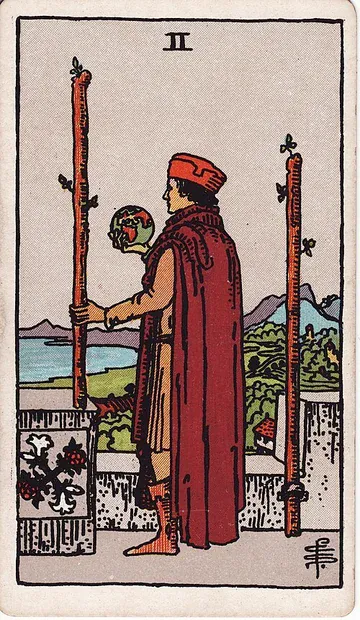
Two of Wands
The seed becoming the plan. The Ace's sprouted wand passes into the hand of the figure on the parapet who holds the globe and reads the territory. Together: the impulse arrived and the seeker is ready to ask where it is pointing. Honor both moves at once — bold first sketch and willingness to think about scale. Neither is sufficient on its own.
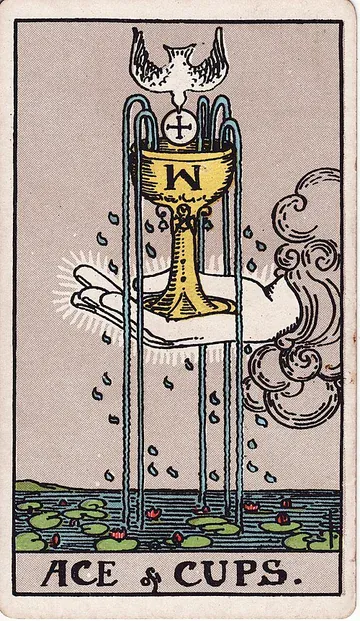
Ace of Cups
The primal contrast — two springs, each in a different element. The Ace of Cups is the spring of feeling (chalice running over, heart's first softness); the Ace of Wands is the spring of will (the heat that has just lit). Together, the inner emotional world and the outer impulse to act are aligned. Rare and significant. Act from the alignment — knowing it is brief.
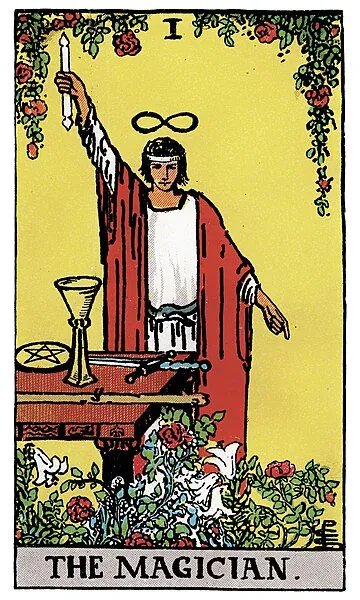
The Magician
Trained will channeling raw spark. The Magician is the disciplined channel — one hand at the sky, one at the earth, the four suits laid before him. The Ace of Wands is the fire he is channeling. Together: the latent practice has finally met a real seed of will. Stop hesitating about whether you are ready. You are the Magician. The Ace just arrived in your hand. Begin.
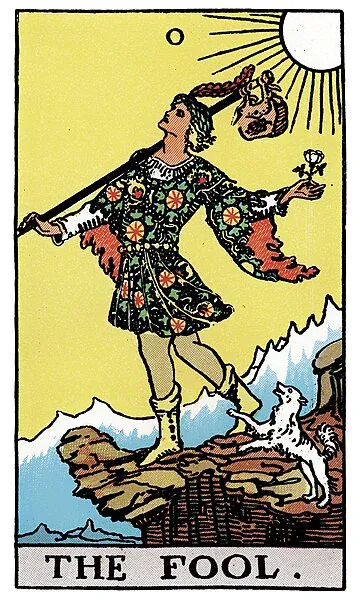
The Fool
The unbidden beginning. The Fool steps from the cliff edge with white rose and dog at heel; the Ace is the wand that has just sprouted in his other hand as he steps. Together: the seeker is on the verge of a beginning so fresh it cannot yet be defended strategically. The Fool's step is unprovable; the Ace's fire is unarguable. Move into the unknown carrying the spark.
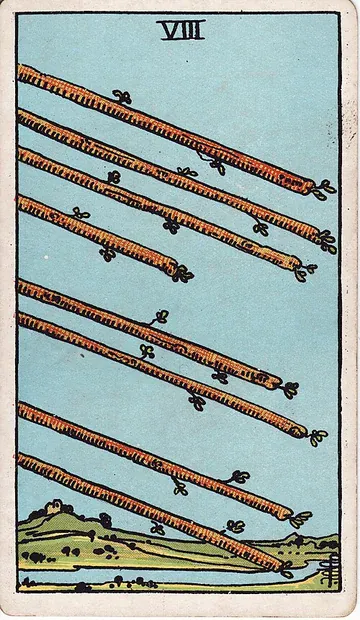
Eight of Wands
The seed and the swift movement. The Ace is the first wand; the Eight is the moment when the seed has become trajectory — eight staves flying through clear air, urgent, all pointing the same direction. Together: a beginning that becomes immediately propulsive. The fire is going to move once lit. The caution is gentle: speed is not direction. Honor where the Ace pointed even as the Eight begins to fly.
Frequently Asked Questions
What does the Ace of Wands tarot card mean?
The Ace of Wands is the seed of fire — the first tremor of will before the impulse has named itself. A hand from a cloud holds a sprouting wand; yod-shaped leaves fall like rain; a distant castle waits on a far mountain. The card describes a fresh spark — a new idea, a new desire, a new direction — that has just landed in the seeker's life. Read it as permission to begin without a complete map.
Can I act on the Ace of Wands when I still have no plan?
Yes — and the missing plan is less of an obstacle than it looks. The Ace of Wands is the seed of fire, not the map: the hand from the cloud holds a wand that is not yet pointing anywhere, and the card answers only the question of whether to begin. To that it gives a full-throated yes — to beginnings, new directions, fresh sparks, acts of small bold courage. What it does not do is promise completion. The carrying of the wand through the Two, Three, and Four of the suit is the seeker's part, and that is where planning belongs. Make one gesture small enough to fit inside this week and let the route assemble behind it.
What does the Ace of Wands mean in a love reading?
In love readings, the Ace of Wands is the spark — the first message, the first glance, the first impulse that has not yet decided whether to act. For singles, it describes love arriving in a more abrupt way than dating-app strategy would predict. For long bonds, it describes a fresh flicker inside an old room. For the question of whether someone is interested, it answers yes — but the interest is at the seed stage, not the committed-pursuit stage.
Why does the Ace of Wands read as heat rather than as affection?
Because the card is the seed of fire and nothing past it. When the Ace of Wands describes how someone feels about you, the answer is unprocessed warmth — a hot, sudden pulse that surprises them as much as it would surprise you. They feel something. They have not yet built a story about it, and affection is a story: it has a shape, a history, a set of promises. This has none of that yet. Reserved people register the pulse as a crack running through their usual reserve; demonstrative people are about to act on it before naming it. Read it as the reddening of skin rather than the writing of a poem — the fire is real, the resolution is not here.
What's the spiritual meaning of the Ace of Wands?
Spiritually, the Ace of Wands sits at Kether in Atziluth — the crown of the world of emanation, the highest possible address for fire. It is the seed of will at the topmost altitude, the unbidden pulse that, downstream, becomes practice and path. The card describes the moment something inside the seeker wakes up that wants something it cannot yet name. The Promethean echo is exact: fire is given, never invented. Receive it.