
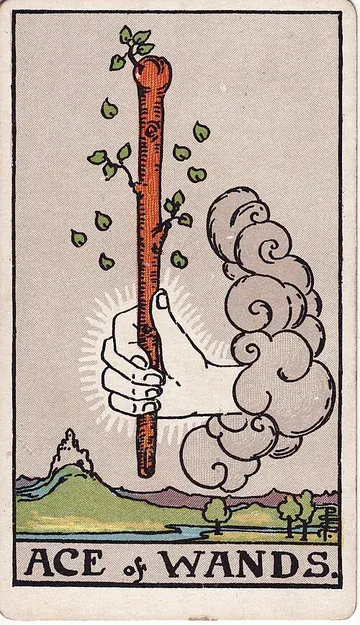
Ace of Wands Reversed · Core Meaning
Turn the Ace of Wands over and the yod-leaves fall the wrong way — upward, back toward the cloud, away from the ground they were meant to seed. The hand still extends from the cloud. The wand is still in the hand. But something has gone wrong with the fire: either the wand has been forced to be wielded before it was ready, or the wand has been kept so carefully to the chest that the leaves have stopped falling, the air has gone out of it, and the small green growth that wanted to live in the new wood has begun to wither.
This is the reversed card's central knot: ignition without arrival. Either the impulse arrived too early — before the conditions could hold it — and was hurried into action it could not sustain, or the impulse arrived and was not honored, was not given the small concrete first gesture that lets the wand stay alive in the hand. The reversed card is not punishing the seeker for failure. It is reflecting back what is: the fire is real, but the fire is not currently moving. Something is in the way.
There are three flavors of the reversed card, and the seeker should read for which flavor is present. The first is the false start: the project, the message, the relationship, the pivot that was begun in an authentic surge of fire but was begun too soon, before the surrounding architecture could support it. Nothing is wrong with the fire. The structure was not yet there to hold it. The second is the forced heat: the seeker who has been pretending to feel a fire they do not feel, performing enthusiasm for a project, a relationship, a vocation that is not actually their fire. The wand sprouts because the seeker willed it to sprout, not because the cloud sent it. Such wands wither quickly. The third is the suffocated spark: the impulse that did arrive but was kept so privately, treated so cautiously, postponed for so long that the leaves stopped falling. The fire is still in the hand; the air has gone out of it.
The astrological signature reverses too. Where upright the Ace of Wands sits at Kether in Atziluth — the seed of fire at the topmost altitude — reversed it describes that seed misaligned: fire that has not yet found its world, fire that wants to descend into action but has either been pushed down too quickly or held back too long. Either way, the descent has been disturbed. The work is to restore the natural rhythm of fire: a real heat, not a forced one; a real first gesture, not a postponed one.
Reversed, the Ace of Wands asks: what are you starting in order to avoid finishing something else? And: what fire have you been pretending to feel? And: where has the wand been suffocating in your hand because you were too careful with it?
Ace of Wands Reversed · Love & Relationships
Four drafts of the same message, none of them sent — the reversed Ace of Wands tells that kind of love story: the attraction that rises and stalls, the relationship that begins and stalls, the desire the seeker cannot tell apart from anxiety. The fire was real. The carrying went wrong. None of this is the seeker's failure of worth; some sparks are simply early, some are forced, and some are real but kept so carefully that they smother themselves before they have had air.
For the seeker single and asking whether love is on its way, the reversed Ace of Wands describes a delay rather than a refusal. The spark is on its way; the conditions are not yet in place for it to arrive in a way that lasts. The card asks the seeker to spend this season tending the conditions: the friendships, the rhythms, the work that fills the rest of the life, the small daily practices that make a person available to a real connection. Sparks land more cleanly on a life that has been kept warm. The reversed card warns against grasping; the grasping is what dries the wood.
For the existing partnership, the reversed Ace of Wands describes a fire that has been forced or postponed. Either the seeker has been performing enthusiasm for the relationship that the body does not actually feel — saying the warm sentences, posting the warm photos, going through the warm motions — and a quiet honesty is now overdue. Or the seeker has felt a real new flicker and has not honored it: the gesture that would refresh the bond has been postponed for so many small reasonable reasons that the gesture itself has cooled. The card asks for one of two truths to be told: the truth of the absent fire, or the truth of the present fire that needs air.
For the new spark, the reversed Ace of Wands is the message half-typed and never sent. The first move that was almost made and then talked out of. The dinner you canceled because you were tired and then realized, weeks later, was the moment you would have had if you had gone. The card is not yet final. The cloud is still there. The wand is still in the hand. The reading describes the interruption of the gesture, and most interrupted gestures can be resumed if the seeker chooses to resume them. Send the message you almost sent. The fire is asking only to be permitted to move.
For the spark you cannot tell from anxiety — the card's particular signature in difficult times — the reversed Ace of Wands describes the body's heat misread as desire when it is actually fear. The chest is hot, the breath is short, the mind is racing about a person, and the seeker has labeled all of this attraction. Sometimes it is. Sometimes it is the fact that you have not slept, you have not eaten properly, you have just moved cities, you have just left a long relationship, and your body's surge is the body's surge, not a love story. The card asks the seeker to wait two weeks. Sparks that point at a person continue to point at that person when the room is quiet. Sparks that point at the seeker's own loneliness move when the room moves.
For the relationship that has just ended, the reversed Ace of Wands describes the seeker who is already trying to start something new before the old fire has been fully extinguished. The rebound. The next-flame. The new connection picked up in the airport on the way home from the breakup. The card is not punitive — many seekers pass through a rebound, and rebounds occasionally become real. But the card warns that the new fire will be hard to read while the old fire is still hot. Wait a season. The genuine new spark, when it arrives, will be unmistakable because the old has cooled enough to make the new visible.
For the post-wound first interest — the seeker who has been alone after a major loss and has just felt a flicker for the first time — the reversed Ace of Wands describes a gentler hesitation. The flicker is real; the seeker is not yet sure whether they trust their own body's flicker. The work is to honor the flicker without immediately mortgaging the rest of the life to it. A single coffee, not a marriage proposal. The reversed card asks for small, slow re-engagement. The fire will tell you, in a month, whether it was the new beginning or the body's first practice run.
For someone whose interest has just begun in you and is now reversed in the reading — the suggestion is that they had a flicker, then talked themselves out of it. They felt something, then decided it was inconvenient, then decided it was inappropriate, then decided it was unwise, and the cumulative weight of those decisions has put the fire down. The card does not say the fire is gone. The card says the fire has been postponed. Whether they pick it up again is a question of their courage, not the seeker's.
For long-distance, cross-cultural, or logistically complex first moves, the reversed Ace of Wands warns that the seeker has been letting the logistics extinguish the spark. The visa, the timezone, the language, the city — these have been the reasons not to send the message. The card says: send the message. The logistics are problems for the Two of Wands; the Ace is asking only whether you are willing to acknowledge that the spark exists. The suffocated spark is not killed by the visa. It is killed by the seeker pretending the visa is a reason not to acknowledge the spark.
A specific note for reconciliation questions. The reversed Ace of Wands offers a partial yes, not a clean one. There is fire still in the bond — but the fire that ended the relationship has not yet been fully understood, and returning prematurely will reproduce the original ending. The card asks the seeker to wait for a new fire, not the old one warmed over. New fire, after a real ending, has a different quality. It does not feel like a return. It feels like an arrival.
Ace of Wands Reversed · As Feelings
Upright, the Ace of Wands is heat that travels; reversed, it is heat that stays exactly where it started. The warmth is real and it is going nowhere at the moment. They felt something. The feeling is still there. Something has happened between the feeling and the gesture: a hesitation, a fear, a forced second-guessing, a real reason or a reason that has been treated as real, and the result is that the wand they were going to extend has not been extended.
This is the card of the partner who almost messaged and didn't. The crush who almost asked you to coffee and chose to wait. The colleague who has been about to mention something for three months. The friend who keeps thinking of you and keeps not reaching out. The feelings are not pretended. The feelings are postponed.
For someone who feels a pulse but has not moved, the reversed card is precisely diagnostic. They feel. They have not acted. The non-action is not coldness; the non-action is one of three things: they are afraid the feeling won't be returned, they are afraid the feeling will be returned and complicate their life, or they have been practicing the inhibition of feelings for so long that the feeling cannot get through to gesture without help. The card asks the seeker to consider whether the seeker is willing to be the one who gestures first. Sometimes the reversed card asks for that. Sometimes the reversed card simply describes the situation, and the seeker chooses to wait.
For someone whose interest just started but immediately stalled, the reversed Ace of Wands describes the flash of attraction that they then talked themselves out of within a day. They had the thought. They followed it with three counter-thoughts. By the end of the week the thought was filed under "not now". The card does not say the thought is gone. The card says it has been deprioritized. Whether they retrieve it is a function of what happens next, often outside the seeker's control.
For a long bond that should be rekindling but the spark is reversed — the card describes the partner who is privately ready to let the relationship be alive again but is performing the routine of polite distance. They are waiting for the seeker to break the routine. Or, equally, the seeker is waiting for them to break the routine. The card warns that both people waiting produces no fire. One of you has to acknowledge the suffocated spark by gesturing into it. The reversed card is asking for that gesture from whichever of you reads it first.
For a reserved person finally noticing you but reversed — the slow warming has begun, has reached the threshold, and has crossed back over the threshold. They had the impulse. They retreated. Reserved people, when frightened by their own fire, often retreat further than they were before they felt it. Read silence here as protection of self, not absence of feeling. The work, if there is work, is to make the environment around them so non-threatening that their next attempt can land. Or to accept that they may not have another attempt and to redirect your fire elsewhere.
For a demonstrative person mid-impulse but reversed, the card describes the awkward moment between the demonstrative person's normal speed and the present moment. They are usually fast. This time they are not. Either they are nervous about you specifically — the card sometimes describes the partner who is more in love than they normally allow themselves to be — or something else in their life is drawing on the fire that would normally come to you. Wait a week. Demonstrative people resume their nature once the obstacle clears.
For post-distance reignition, the reversed Ace of Wands describes the partner who has been thinking of you across the distance and has not yet messaged. The fire is real. The crossing of the silence has not happened. The reading does not predict whether they will message; the reading describes the present truth that the silence is not coldness. Whether to message first is the seeker's call.
For divided warmth — the partner who feels something for you and feels something equally for someone else, or for an old life, or for a stalled question they have not resolved — the reversed Ace of Wands describes the fire that is not yet undivided. The fire toward you is real. The fire is not exclusively toward you. The card does not predict the resolution; the card describes the present division. Many seekers, presented with this card, project clean resolution onto it. The card does not promise that. The card describes a fire that is, currently, in three places at once.
For someone who wants to act but has not found the wording, the reversed Ace of Wands is gentle. They are stuck on the how, not the whether. They have decided they want to reach. They have not yet decided what to say. The card asks the seeker to be patient with that gap. Sometimes the gap closes when the seeker creates an opening — a casual question, a low-stakes invitation, a moment that does not require the other person to compose perfect language to accept.
For uncertainty about the impulse itself — the partner who feels something but is genuinely unsure whether what they feel is about you, about the season of their life, about a need they have not yet named — the reversed Ace of Wands warns that pursuing them now will likely yield an answer they cannot fully give. They do not know what they feel. Asking them to commit to what they feel only forces them to perform an answer. The work is to give them the time, and to let the time clarify what is fire and what is the body's general weather. If, after a season, the fire is still there and is still pointing at you, the card has resolved itself toward upright. If not, the card has resolved itself, more honestly than premature pursuit would have, toward absence.
Ace of Wands Reversed · Career & Work
What becomes of a good idea that nobody built a structure for? At work, the reversed Ace of Wands is that question standing in the room — the impulse that did not survive the architecture. The new project that was launched too soon, before the team or the funding or the personal capacity could carry it. The pivot that was made in haste and is now being quietly regretted. The freelance pitch that was begun in genuine fire and was then talked into something safe, until the safe version was unrecognizable from the original spark. The card is not declaring failure. The card is naming the gap between the spark and the structure, and asking the seeker to attend to it.
For the seeker with the first idea that has already gone dim, the reversed Ace of Wands warns that the idea is being smothered. Either by the seeker's own caution — too many drafts, too many preparations, too many waits for the perfect first move — or by external feedback received too early in the impulse's life. The card asks the seeker to make a single small concrete move within forty-eight hours that re-introduces air to the wand. Send the email. Make the rough version. Show one trusted person. Air, not architecture.
For the freelancer whose new lead is reversed, the reversed Ace of Wands describes the inquiry that arrived warm and went cold during the seeker's drafted response. Either the response was over-written, or the response was delayed past the lead's attention span, or the response was hedged so thoroughly that the warmth that prompted the inquiry was no longer being met by warmth in the reply. The card asks the seeker to write a shorter, warmer reply than they think appropriate. Many leads die in over-considered first emails.
For the creative worker mid-blank-page, the reversed Ace of Wands describes the creative block in its specific Ace shape: not the block of someone with nothing to say, but the block of someone who has had the impulse and immediately rejected it as not good enough to begin with. The yod-leaves were falling and the seeker waved them away. The reversed card asks for a season of the deliberately bad first version. Write the embarrassing draft. Paint the wrong color. The block is the standard, not the absence. Lower the standard for forty-five minutes a day, for two weeks, and the fire will begin to move again.
For the founder with a sudden conviction that has now soured, the reversed Ace of Wands distinguishes between two cases. First case: the conviction was real, and the souring is the friction of moving the conviction into the world. The reversed card here says: stay with it; the friction is not the verdict. Second case: the conviction was forced — the seeker willed themselves into a conviction because the previous conviction had stalled and the team needed something to rally around. This is a hard truth to read. The reversed card asks for the seeker's honesty about which case is present. Forced fire never produces real heat for long. If the conviction was forced, the kinder move is to let it cool and to wait for a real one rather than to force three more iterations on a fire that did not actually arrive.
For the role change waiting on a signal that has not come, the reversed Ace of Wands describes the seeker who has been reading external silence as internal absence of fire. The recruiter has not called; the offer letter is not in the inbox; therefore the seeker has concluded that the impulse to change was misguided. The card warns against this reasoning. The Ace is internal, not external. The fire to change roles is not validated by external timing; it is validated by the body's small unmistakable lift when the new direction is mentioned. Continue the visible steps. The signal is the seeker's own felt signal, not the world's response time.
For the student with a research question that has gone dim, the reversed Ace of Wands describes the question that has been over-formulated. The original question was alive; the second draft was respectable; the third draft was a sentence the seeker could defend in a committee; and by the fifth draft the question was indistinguishable from any other question in the field. Return to the first draft. The vague version. The version that could not yet be defended. The fire was in that version.
For the manager whose team plan has come back reversed, the reversed Ace of Wands warns of the plan that has been edited until it is no longer the plan. The bold first version contained the spark; the consensus version contains compromise. Sometimes consensus is necessary. Sometimes consensus is a form of suffocating the spark to make everyone comfortable. The card asks the seeker which is which.
For the layoff or forced pivot in its reversed form, the reversed Ace of Wands describes the seeker who has been forcing themselves to feel new fire too quickly. The market says you must pivot; the financial pressure says begin something new; the inner spark has not yet arrived. The card asks for the courage to wait two more weeks. Not forever. Just long enough for a real spark rather than a performed one. Forced pivots produce side projects that fade by month three.
For the side-project first move that has not been made, the reversed Ace of Wands is gentle and direct. The reason it has not been made is not capability or time. It is fear that the small first version will be embarrassing. The card says: yes, the small first version will be embarrassing. The small first version is supposed to be embarrassing. That is how Aces work. Begin it anyway. The embarrassment of the first version is the price of admission to the work the project will eventually become.
For the vocation calling that has been reversed — the seeker who feels they were called to a particular work and has not begun it — the reversed Ace of Wands describes a long-suffocated impulse. Often years long. Sometimes decades long. The card is not punitive about this; many people receive vocations they do not act on, for reasons that were genuinely reasonable at the time. But the card is clear: the impulse is still in the hand. It has not died. The leaves have stopped falling, but the wood is still living. Begin one small daily practice this week that points at the calling. Tell one trusted person. The vocation does not require a complete reorganization of the seeker's life to be honored. It requires a daily ten-minute acknowledgment.
Ace of Wands Reversed · Money & Finances
A bright hour, a bold decision, then months of quiet: the reversed Ace of Wands is the financial impulse that misfired — the move made too soon, the move postponed past its moment, or the enthusiasm-driven spending that never came back as return. The card does not predict catastrophe. The card describes the gap between the spark of financial fire and the structure that would have let the fire produce sustainable warmth.
For the seeker whose new venture or side project has begun and stalled, the reversed Ace of Wands names the stall. Possibly the venture was begun before the foundational work was in place — the customer research, the small audience, the clear offer. Possibly the venture was begun in real fire but the seeker has spent the fire on cosmetics rather than substance: the logo, the website, the brand colors, before the first paying customer. The card asks the seeker to redirect the next ten hours of effort to one concrete act that produces money — a sale, a session, an inquiry — rather than another round of preparation.
For the question of asking for a raise or renegotiating a rate that has been postponed, the reversed Ace of Wands describes the suffocated impulse to ask. The seeker has known for months that the number is wrong. The seeker has not yet asked. Each week of not asking compounds the problem: the longer the wrong number persists, the harder it becomes to claim the right one. The card says: ask this week. The fire has been waiting. The waiting is not strategic; the waiting is fear of the conversation. Have the conversation.
For investment or speculative questions in their reversed form, the reversed Ace of Wands is more cautious than the upright. The card warns of the impulse-driven trade — the position taken in a flush of conviction that was not actually researched, the asset class entered because a friend mentioned it at dinner, the bold sizing that the seeker would not have chosen if they had slept on it. The card asks for a smaller first position, or no position. The impulse may be real, but the impulse at the reversed Ace stage has not yet earned the size the seeker is tempted to give it.
For the windfall question reversed, the reversed Ace of Wands describes the windfall that arrived but is being spent on the wrong fire. Either the seeker is using the bonus to fund a project they have been talking about for years and have not yet started — and the project is not actually their fire, it is performed fire — or the seeker is absorbing the windfall into the everyday in a way that diffuses it. The card asks: of the things in your life that the windfall could fund, which one would you regret not funding in five years? Direct it there. The card warns against the diffusion of unexpected money into ordinary expenses; the diffusion is the most common way windfalls disappear.
For someone managing scarcity with the reversed card, the Ace's specific gentleness applies. The card does not mock the seeker for not having more. The card describes the impulse that has been suffocated by scarcity: the small move toward income that the seeker has not made because the move felt embarrassing or insufficient. The card says small moves are not insufficient. The first paid client at a low rate is more important than the eventual high rate that exists only in the seeker's planning documents. Take the small concrete move, the one that produces actual money this week. The reversed card unblocks when the seeker stops waiting for the perfect move.
For debt or recovery questions reversed, the reversed Ace of Wands describes the seeker who has been postponing the call. The call to the creditor. The setup of the budget. The honest look at the spreadsheet. Each postponement worsens the situation by a small amount and worsens the seeker's confidence by a larger amount. The card asks for the call this week. Not a perfect plan. A call. The fire to address the debt is real; what has not yet happened is the small concrete first action that lets the fire begin to move.
A specific shadow of the reversed Ace of Wands in money is the enthusiasm-driven spend. The course bought at 2 a.m. The equipment ordered in a flush of conviction for a project that has not yet had a single hour of practice. The domain registered in a Friday-evening surge. The card warns the seeker against confusing buying with beginning. The wand is in the hand for free. The first hour of practice costs nothing. The credit card is not a substitute for the gesture.
The reversed Ace of Wands' relationship with money is best summarized this way: the fire is real, but the fire has been either misdirected or postponed. The work is to redirect or to begin, depending on which case is present. The river beneath the cloud is still running. The castle on the distant mountain is still there. What has stopped is the seeker's small concrete first move. Make it.
Ace of Wands Reversed · Health
The body runs its fire the way a stove does, and the reversed Ace of Wands is the stove with a bad damper — roaring far past anything the room needs, or banked so low that the signals which should rouse it no longer do. The card speaks from the same elemental signature as upright (fire, choleric, the liver and the blood, southern direction, summer season), but the reading is of disordered fire: heat that has lost its rhythm, surge that has lost its ground, vitality that has been forced or smothered.
For the burnout case — the seeker who has been running on fire for too many months without rest, whose energy has tipped from generative to corrosive — the reversed Ace of Wands describes the body's growing complaint. The hands shake slightly. The sleep is shallow. The temper is short. Small frustrations produce disproportionate heat. The card warns that fire without rest cools into something less vital than rest would have provided, and asks for the deliberate banking of fire: a week of less. Less stimulation, less screen, less caffeine, less self-driving. Not forever. The card is not asking for permanent diminishment; it is asking for a recovery period the seeker has been postponing.
For the slow-decline case — the seeker whose energy has been trending downward for months without an acute event, who is "fine" but is not, who has not slept properly in weeks but has not noticed — the reversed Ace of Wands describes the suffocated spark. The body is not raising the alarm because the seeker has been suppressing alarms for so long that the body has stopped sending them. The card asks for a deliberate practice of attention: a daily check-in with what the body actually feels, not what the schedule says it should feel. A request for re-noticing is not medical advice. The card simply asks for re-noticing.
For the sudden symptom in its reversed form — the new heat that appeared and then disappeared, the inflammation that flared and faded without explanation, the unexplained pulse — the reversed Ace of Wands warns against dismissing the symptom because it has stopped. The symptom appearing and disappearing is information; the body is telegraphing something. The card asks the seeker to write down the symptom and the surrounding context, even if it has already cleared. Patterns reveal themselves over weeks. The card is asking for the seeker's record-keeping, so that when the practitioner is consulted later, the data is there.
For chronic conditions in the digestive or hepatic system, the reversed Ace of Wands describes a wave that has been mishandled. Either the wave was forced through with stimulants and willpower (more coffee, more push, more pretending), or the wave was given so much rest that the body has lost some of its rhythm. The card asks for the middle path: the gentle continuation of motion (walking, light stretching, moderate hydration) without forcing the system. The middle path between rest and motion is described here, never prescribed, and it is not medical advice. Keep your practitioners.
For mental health questions in their reversed form, the Ace of Wands offers a layered reading. For the seeker whose anxiety has spiked, the reversed card warns that the body's heat register is being misread as danger. The chest is hot, the breath is short, and the mind is producing catastrophic stories to explain the heat. The work is not to suppress the heat but to give it a non-catastrophic channel: cold water on the wrists, movement, eight long exhales, a phone call to a person who is not currently in the catastrophic story. For the seeker emerging from depression but in a fragile early phase, the reversed card warns against the false dawn — the day when the energy returns suddenly and the seeker tries to do everything they have been postponing. False dawns are common in early recovery. The card asks for slow re-engagement, one element at a time.
For ADHD-flavored or impulse-driven systems with the card reversed, the specific shadow is the seeker who has used the surge of fire for novelty rather than for the work that needed it. Three new projects started; none completed. Five new books begun; none finished. The card asks for one concrete completion this week — even a tiny one. Completion teaches the system how to stay with fire rather than how to keep generating new fire to replace the fire that just dispersed.
For exercise and movement reversed, the Ace of Wands describes the practice that has stalled. Either the practice was begun with too much intensity and the body is now resisting return, or the practice was begun and the seeker has been finding small reasons to skip. The card asks for the small bold first move: ten minutes today, in the next hour. Not the planned full session. Ten minutes. The card responds to motion, not to schedule.
For sleep and rhythm reversed, the Ace of Wands describes a body whose night-fire has not been allowed to bank. The seeker is staying up late looking at screens, or working late, or stimulating themselves into evening tasks the body cannot release. The card asks for a fire-cooling evening ritual: a real dimming of light, a deliberate ending of input, a window of unmediated quiet before sleep. An evening of dimmed light is a ritual, not medical advice. The card simply names the rhythm.
A specific signature for the reversed Ace of Wands in health: the body is asking for air and the ending of forced motion. Whatever is currently being forced, ease it. Whatever has been smothered, let it have light. Walk outside without your phone. Sit in the sun for ten minutes. Drink a full glass of water before reaching for caffeine. The card responds to these. The reversed Ace returns to upright through the deliberate restoration of natural fire-rhythms — not through more effort, not through less effort, but through honest tending of the body's actual signals.
Restoring a natural fire-rhythm is the card's image and carries no medical advice. Keep your practitioners. Take your medicine. The card describes a felt season — the spark out of balance — and asks for attention.
Ace of Wands Reversed · Spirituality
Kether in Atziluth is the highest address fire has, and the reversed Ace of Wands describes a seed of will disturbed somewhere on the way down from it. Upright, the card is the unbidden pulse arriving cleanly into the seeker's life; reversed, the pulse has been disrupted — either pushed into form too early, or held back so long it has begun to dim, or imitated by the seeker's own willing rather than received from the cloud.
For the seeker beginning a spiritual practice that has stalled, the reversed Ace of Wands describes the early-practice difficulty: the first month was bright, the second month was dutiful, the third month is mostly skipped. The card warns that the bright first month was real but was not yet the practice. The practice begins precisely at the point where it stops being interesting. Continue. The wand has not died; the seeker has stopped reaching for it daily because the daily reaching has become unromantic. The work is to reach unromantically. The reversed card returns to upright through the small daily honoring of the impulse that began the practice, even when the body does not feel like it.
For seekers in active practice who have hit a plateau that has now soured, the reversed Ace of Wands describes the temptation to abandon the form for a more exciting form. New tradition, new teacher, new framework. The card warns that the new excitement is often the seeker's restlessness, not a genuine call. Stay. The dryness is information; the dryness is asking the seeker to deepen rather than to switch. The Ace's spiritual reversal is rarely solved by a different practice. It is solved by a more honest engagement with the one already chosen.
For seekers in transition who are in fact being called to a new tradition, the reversed Ace of Wands describes the resistance. The new pull is real; the seeker has not yet given it room. Loyalty to the old form, fear of the disapproval of old teachers, the sense that switching is somehow unfaithful — these are real and human. The card does not ask the seeker to perform the transition with bravado. The card asks for honesty about what is currently calling, and small permission to follow the call without immediately mortgaging the old form. Both can be tended for a season. Fire knows where it is going.
For seekers in spiritual crisis — the dark night, the loss of faith, the practice that has stopped making any sense — the reversed Ace of Wands is more solemn. The card describes the wand that, in this season, has stopped sprouting. The seeker has been waiting for the next pulse and the pulse has not arrived. This is not failure. Crisis is a chapter, not a verdict. The card asks for the practice of not abandoning the post. Continue the small daily form even while the meaning has gone out of it. Light the candle even when the candle does not seem to mean anything. The pulse returns, and when it returns it returns to a seeker who has kept the post.
For the question "what is the work my life is for" with the reversed card, the Ace warns that the seeker has been trying to force the answer. The body has been pushed to declare a vocation it has not actually felt. The card asks for the courage to admit not knowing yet, and to keep the small daily practices that allow real knowing to surface. Fire does not respond to interrogation. Fire responds to faithful waiting and small honest noticing. What you reach for repeatedly when no one is watching is the data point; what you say in interviews about your purpose is often the performance.
For seekers in atheist or post-religious frameworks with the reversed card, the warning is gentle: do not let the absence of a cosmology be the reason to ignore the wanting. The wanting is older than belief. The reversed Ace of Wands describes the seeker who has dismissed the wanting because they have no framework that can hold it. The card asks the seeker to take the wanting seriously even without framework. Frameworks are downstream of attention. Attention to the wanting is the practice; the framework, if it arrives, arrives later.
A practical practice for the reversed card, anchored to fire, doable in 30 minutes:
Light a candle in a room you have been avoiding. Sit with it for fifteen minutes without performance. At the end, write a single sentence about what is suffocated in your spiritual life right now. Not what you want to be true. What is. Do this nightly for three nights. The reversed Ace of Wands returns to upright through honesty about the suffocation. The fire cannot move until the seeker admits where the air has been taken out of the wand. Naming the suffocation is the first restoration of air.
For the question "am I on the right path" with the reversed card, the Ace is gentle and clear. The path is not wrong. The seeker has either rushed onto the path before being ready, or has been on the path so long that the path has become routine in the dull sense, not the steady one. The card does not ask the seeker to leave. The card asks for the resumption of small daily honoring of why the path was chosen. The reversed Ace returns to upright through the recovery of original fire — not the manufacturing of new fire, not the finding of a different path, but the remembering of why the present path was chosen and the renewed willingness to walk it.
The Ace of Wands' reversed register is not failure. It is the description of fire temporarily out of rhythm. The work is to restore rhythm. The cloud is still there. The hand is still there. The wand is still in the hand. The leaves are waiting to fall again, as soon as the seeker remembers how to receive the gift without forcing it and without smothering it.
Ace of Wands Reversed · Yes or No
Not yet — or yes, but not in the form you currently picture.
A slammed door is the wrong picture for this reversal. It is more often the answer of postponement: the spark exists, but the conditions for the spark to land are not yet here. Or it is the answer of misdirection: the seeker is asking about the wrong thing — the literal version of a deeper question — and the literal version cannot be answered cleanly because the deeper version has not yet been articulated.
For yes-or-no questions about whether to begin a particular new direction, the reversed Ace of Wands answers with caution. Not refusal. Caution. The fire that would carry the beginning has not yet arrived in full strength, or has arrived and has been forced too quickly into shape. Wait two weeks. Test whether the impulse is still alive after the rest of life resumes its ordinary rhythm. Sparks that survive ordinary life are real sparks. Sparks that exist only inside the heightened week of consideration are usually the body's restlessness wearing fire's clothes.
For yes-or-no questions about whether someone is interested or whether a connection has potential, the reversed card answers that the interest exists but is not currently moving. They feel something. The feeling has not yet found gesture. Whether the feeling becomes gesture is a question of their courage, not of the seeker's worth. The card does not predict resolution; the card describes the present interruption.
For questions about timing — should I act now? — the reversed Ace of Wands says wait. Not forever. Not because the impulse is wrong. Because acting on a not-yet-fully-arrived impulse produces a kind of forced first move that often has to be redone. Better the second move than the half-formed first.
For questions about whether something is meant to last, the reversed Ace cannot answer. The card is too early. The card describes the spark; the lasting is told by the carrying, and the carrying has not yet begun. Ask again in a season.
For binary questions about whether to take a courageous action — sending the message, asking for the meeting, applying for the role, signing the lease — the reversed Ace of Wands says: examine whether the courage is real or performed. Sometimes the seeker is asking the deck for permission to do the thing they already know they should not do, and the reversed Ace is the deck declining to give the permission. Sometimes the seeker has been waiting for permission to do the thing that is actually right, and the reversed Ace is asking for one more day of honest sitting with the question. The seeker knows which case applies. The card asks for honesty rather than assurance.
For questions about whether something will happen — will the offer come, will the call arrive, will the message return — the reversed Ace warns that fixating on external arrival rarely accelerates it. The fire has been put on the seeker's side. Whatever the seeker does today is the part the seeker controls. The arrival of an external response is not within the card's scope.
For the question "should I keep waiting", the reversed Ace of Wands distinguishes between two cases. If the waiting is active — the seeker is doing the small daily work that points at the desired outcome — the answer is yes, keep waiting, the fire is moving even if the result has not yet arrived. If the waiting is passive — the seeker is holding still and hoping — the answer is no; the reversed Ace is asking for movement, not for further stillness. The card responds to motion. Reversed-Ace stillness is a kind of suffocation.
If the question was: do I deserve to begin this? The reversed card answers yes — and notices that the question is itself the suffocation. The wand has sprouted in your hand. Sprouted wands do not require permission. The reversed card returns to upright the moment the seeker stops asking whether they are allowed and begins the small first move that does not require permission to make.
Ace of Wands Reversed · Advice
The advice of the reversed Ace of Wands is the inverse of the upright's: instead of "light it while it is still warm," the reversed says restore the conditions for fire to land cleanly. Some impulses have been forced; some have been suffocated; some are unfinished from a previous season and are still waiting in the seeker's hand. The work is to attend to which case is present and to do the small concrete thing that fire requires next.
If there is one specific instruction the reversed card offers, it is to close one open loop before beginning anything new. The seeker who is reading this card has, somewhere in their life, an unfinished thing that is drawing on their fire. A conversation not had. A project not completed. A message not sent. A boundary not stated. A decision not made. The fire that should be available for the new beginning is currently being held by the unfinished thing. Close one of them. Not all of them — the seeker who tries to close everything before beginning will never begin. One of them. The most important one, or the easiest one, depending on what the seeker can actually do this week. The fire returns once the loop closes.
A second instruction: do not begin a fourth thing this week. The reversed Ace's specific shadow is the seeker who responds to spark-disruption by generating more sparks: three new projects, four new ideas, five new conversations, in the hope that one of them will catch. None of them catch, because all of them are competing for the same finite fire. The card asks for the painful discipline of not starting more. If the previous fire has gone out, sit with that for a season before lighting another. The body of work that emerges from this discipline is more honest than the body of work that emerges from constant restart.
A third instruction: name the suffocated spark out loud. There is, somewhere in the seeker's life, an impulse they have been holding privately — a vocation, a relationship, a project, a confession, a desire — that has been suffocating in the hand because it has never been spoken to a witness. Speak it. To one person. The reversed Ace returns to upright through the externalization of impulses that have been held too long internally. Not a public announcement. One trusted witness. One sentence. The witness is the air the wand needs.
A fourth instruction: let the false fire die honestly. There is, also somewhere in the seeker's life, a fire the seeker has been performing — for a relationship, for a project, for a vocational identity — that the seeker does not actually feel. The reversed Ace asks for the honesty of letting that one die. Not by drama. Not by destructive announcement. By the small daily refusal to keep performing. False fires that are not refilled by performance go out on their own within weeks. What is left, when the false fire is gone, is the truer fire that has been waiting beneath it. That is the fire to follow.
A fifth instruction, gentler than the others: be patient with the next impulse. After a season of reversed-Ace difficulty — false starts, suffocated sparks, forced fire that did not catch — the seeker is often suspicious of the next impulse when it arrives. The seeker tests it harshly, doubts it preemptively, demands it prove itself before being honored. The card warns against this. New impulses, after a hard season, arrive at the same fragile temperature as any other Ace. They cannot prove themselves to the seeker's wounded skepticism. They can only be received gently. Receive the next one gently. Whether it survives depends on the seeker's gentleness, not on the seeker's testing.
A sixth instruction, specific to the reversed card: do not seek a new teacher, a new framework, a new program, a new tradition this week. The reversed Ace's specific shadow includes the seeker who responds to internal stall by externalizing the search. New books. New courses. New theories. The card asks the seeker to remain with the existing form long enough to see what the form is actually asking of the seeker. The new framework is rarely the answer. The honest engagement with the present framework, after the romance has ended, is the answer.
Practical advice for the day the reversed card appears: do nothing new in the next four hours. Instead, finish one thing you have left half-done. The bowl of dishes. The unanswered email older than three days. The book on the bedside table you have not finished. The phone call to the friend you owe a reply to. The reversed Ace responds to the small completed gesture more reliably than to the large new beginning. Completed gestures restore the seeker's relationship with their own fire. After the completed gesture, the next real beginning becomes possible.
A final note for the seeker carrying a long-suffocated vocation: the reversed Ace is not the verdict that the vocation has died. The reversed Ace is the description of the present suffocation. Vocations can survive decades of suffocation; many do. The work is to begin the small daily honoring this week — not to make up for the lost years, not to dramatically reorient the life, but to begin the ten-minute daily practice that points at the calling. The reversed Ace returns to upright not through grand gestures but through the small kept impulse, repeated until the wand begins to sprout again. The fire was given to you. It was not yours to refuse. Receive it now, even late, even imperfectly. The cloud is patient.
Ace of Wands Reversed · Card Combinations
The reversed Ace of Wands rarely appears alone. The companion cards are the ones that disclose which flavor of the reversal is present — the false start, the forced heat, or the suffocated spark — and what the seeker is being asked to do about it. The five combinations below are the most load-bearing pairings; reading the reversed Ace next to one of them gives a far clearer picture than reading either card alone.
Reversed Ace of Wands + Two of Wands
The seed disturbed and the planning paralyzed. The Two of Wands is the figure on the parapet with the globe in hand, looking at the territory and trying to map it. When the Ace is reversed beside it, the planning has begun without a real spark — the seeker is making maps for a journey they have not yet wanted to take. The combination warns against the over-planned launch that has lost contact with the fire that should be driving it. The instruction: stop drafting. Return to the impulse. If the impulse is not there, do not force the map.
Reversed Ace of Wands + Ace of Cups
Feeling without will, or will without feeling, depending on which is reversed. With the Cups upright and Wands reversed, the seeker is experiencing real emotional opening but no impulse to act on it — the heart has softened, the body has not yet picked up the wand. The combination describes the kind of love or vulnerability that needs the seeker's small first gesture to become real. With both reversed, the springs of both feeling and will are temporarily blocked; the work is to wait for the rhythm to return rather than to force either side. Do not perform feeling. Do not perform fire. Let the body be honest about what is and is not currently moving.
Reversed Ace of Wands + The Magician
The trained channel without fresh fire. The Magician is the seeker with the practice, the discipline, the four suits laid before him on the table — but the Ace, reversed beside him, says the fuel has not yet arrived. This combination often appears for skilled practitioners between projects: the seeker has all the technique, all the readiness, and is waiting for something to channel. The card warns against the Magician's temptation to manufacture a project to perform skill on. Stay with the present quiet. The fresh fire arrives when the practice is held without forcing it.
Reversed Ace of Wands + The Fool
The unbidden beginning that has been refused, or the leap that has been made too early. With the Fool upright and Ace reversed, the seeker is at the cliff edge but the wand has stopped sprouting — the impulse to step has gone out before the step. The combination warns against making the leap without the spark; the leap without spark is not faith, it is anxiety wearing faith's clothes. With the Fool reversed too, the picture is clearer: the seeker has been afraid of beginnings in general, and the work is to start with smaller cliffs. The Ace will return when the seeker has remembered that beginnings are survivable.
Reversed Ace of Wands + Eight of Wands
False acceleration. The Eight of Wands is eight staves flying through clear air, urgent, fast — but with the Ace reversed at its root, the speed has no real seed. The combination describes the project, the relationship, the move that has begun to gather momentum without the spark that would justify it. Other people are excited. Things are moving. The seeker, alone in the room at night, knows the fire is not actually theirs. The combination asks the seeker to slow the acceleration before the speed becomes the only direction available. Better the difficult pause than the year of carrying a project the body never wanted.
Card Combinations
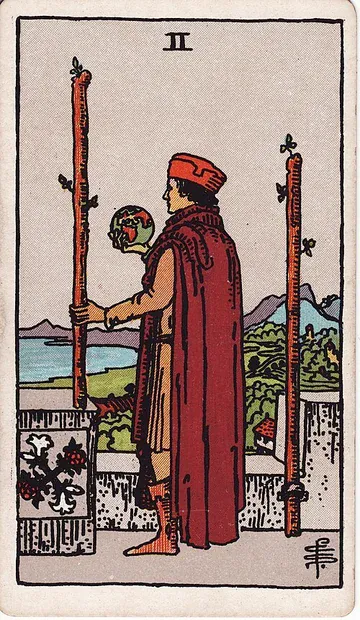
Two of Wands
The seed becoming the plan. The Ace's sprouted wand passes into the hand of the figure on the parapet who holds the globe and reads the territory. Together: the impulse arrived and the seeker is ready to ask where it is pointing. Honor both moves at once — bold first sketch and willingness to think about scale. Neither is sufficient on its own.
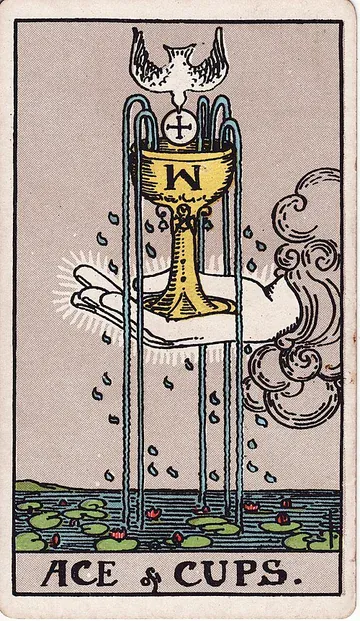
Ace of Cups
The primal contrast — two springs, each in a different element. The Ace of Cups is the spring of feeling (chalice running over, heart's first softness); the Ace of Wands is the spring of will (the heat that has just lit). Together, the inner emotional world and the outer impulse to act are aligned. Rare and significant. Act from the alignment — knowing it is brief.
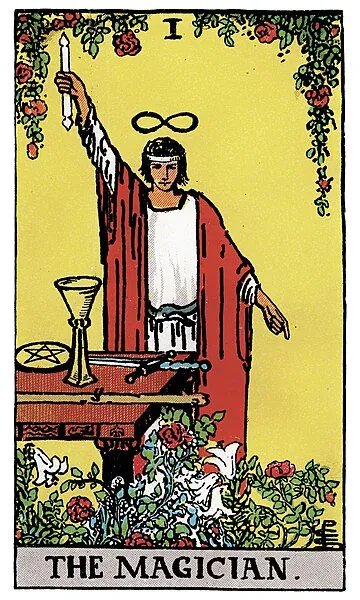
The Magician
Trained will channeling raw spark. The Magician is the disciplined channel — one hand at the sky, one at the earth, the four suits laid before him. The Ace of Wands is the fire he is channeling. Together: the latent practice has finally met a real seed of will. Stop hesitating about whether you are ready. You are the Magician. The Ace just arrived in your hand. Begin.
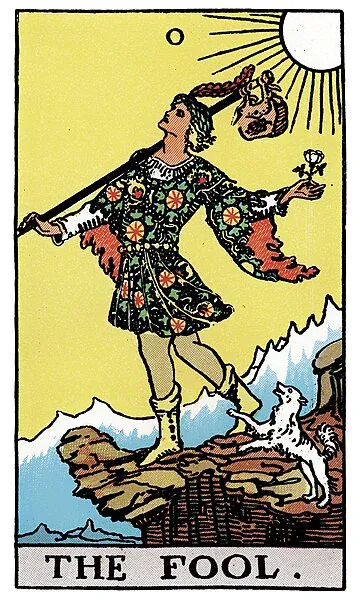
The Fool
The unbidden beginning. The Fool steps from the cliff edge with white rose and dog at heel; the Ace is the wand that has just sprouted in his other hand as he steps. Together: the seeker is on the verge of a beginning so fresh it cannot yet be defended strategically. The Fool's step is unprovable; the Ace's fire is unarguable. Move into the unknown carrying the spark.
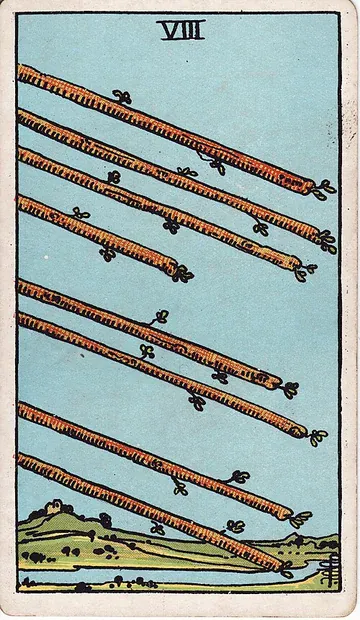
Eight of Wands
The seed and the swift movement. The Ace is the first wand; the Eight is the moment when the seed has become trajectory — eight staves flying through clear air, urgent, all pointing the same direction. Together: a beginning that becomes immediately propulsive. The fire is going to move once lit. The caution is gentle: speed is not direction. Honor where the Ace pointed even as the Eight begins to fly.
Frequently Asked Questions
Is the Ace of Wands reversed a false start or a smothered one?
Both live inside the card, and telling them apart is most of the work it asks for. The reversed Ace of Wands describes the spark that did not catch: forced into form before conditions could hold it, held so close to the chest that the leaves stopped falling, or postponed until the heat went out of it. A false start feels like regret with a date attached — you can name the hour you moved too early. A smothered one feels like a low-grade absence: an impulse you can still describe accurately and no longer feel. The fire was real in both cases; it was the carrying that went wrong. Name which one is present, then make a single concrete gesture to restore the rhythm.
Should I relight the idea the reversed Ace of Wands describes, or let it go?
Test it rather than decide it. The reversed Ace of Wands is rarely a clean no — more often a not-yet, or a yes arriving in a different form than the one being pictured, since the fire exists even when the conditions for it to land do not. Give the impulse two weeks of ordinary life and feed it no fresh drama in the meantime. A spark still there on a dull Tuesday is real and worth relighting, with one small move rather than a grand relaunch. A spark that only lives inside heightened consideration — the late nights, the long walks, the story told about it — is restlessness wearing fire's clothes, and letting it go costs nothing that matters.
How do I tell an Ace of Wands reversed spark from plain fear of being alone?
By watching where the heat points once the room goes quiet. Reversed in love readings, the Ace of Wands describes the spark that stalled — the message drafted four times and never sent, the relationship that began and stopped, the desire that cannot be separated from anxiety. A spark that is about a person keeps pointing at that person on an ordinary evening with nothing to prove. A spark that is about your own loneliness moves whenever the circumstances move: the new city, the empty weekend, the friend who just announced an engagement. For singles the card suggests the conditions are not yet in place, so tend the rest of the life first. For partnerships it names forced enthusiasm, or a gesture kept unsaid past its moment. For reconciliation it offers a partial yes only once a genuinely new fire has arrived — not the old one warmed over.
Ace of Wands reversed: are they holding back, or was there never a spark?
There was a spark. The reversed Ace of Wands does not describe absence — it describes warmth that is not currently moving. They felt something; the feeling never became gesture, and something got in between: a hesitation, an old fear, a reason that may be real or may only have been treated as real. This is the person who almost messaged and didn't, the colleague who has been about to say something for three weeks. Reserved people retreat when their own fire frightens them; demonstrative people are unusually slow this time, which is itself the tell. The feelings are postponed, not missing. Whether the warmth ever becomes a gesture is a question of their courage — and sometimes the card asks the seeker to be the one who moves first.
What is the advice of the Ace of Wands reversed?
Close one open loop before beginning anything new. The unfinished thing somewhere in your life is currently holding the fire that should be available for the new spark. Name a suffocated impulse out loud to one trusted witness — externalization is the air the wand needs. Let any false fire you have been performing die honestly. Do not start a fourth thing this week. The reversed Ace returns to upright through small kept gestures, not grand new beginnings.