
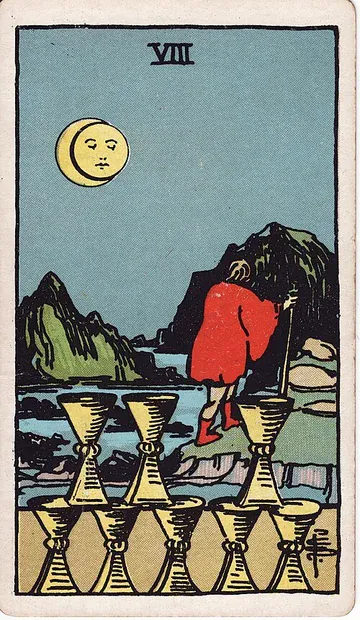
Eight of Cups · Core Meaning
The Eight of Cups tarot card meaning, in any deck, is the meaning of the quiet departure — the moment a person sets a finished thing down and walks away from it without drama, without farewell, without insulting the thing by pretending it failed. Eight cups stand stacked in two rows beneath an eclipsed moon. The place for a ninth is empty — visibly, deliberately empty. A cloaked figure leans on a staff and walks for the mountains beyond the still water. He does not turn back. He does not wave. The card is not a flight. It is a turning.
The empty place where a ninth cup should stand is where the whole tension of this card lives. Nothing in the picture has gone wrong. The cups are not cracked. The water is not stormed. There is no ash, no blood, no violence in the frame. The figure leaves a place that, by the logic of the eyes, is fine — and the leaving is the whole event. The Eight of Cups belongs to the part of life that the language of crisis cannot reach: the resignation written from a job that was never unkind, the relationship ended on a Tuesday for no reason anyone outside the bond would understand, the practice abandoned because the practice had become a costume.
The astrological signature reinforces this. The Eight of Cups is Saturn in Pisces, first decan. Saturn is gravity, structure, the patient teacher who refuses to lie about what time it is. Pisces is water at its most porous, the soul-element that dissolves edges. Together, Saturn in Pisces is the weight that finally reaches a feeling — the moment a long emotion grows out to the edge of the vessel that was holding it and admits the vessel cannot stretch further. The dream meets gravity. The feeling has come of age. There is no rage in the leaving, because the leaving was decided by the long arithmetic of attention, not by a single insult.
Kabbalistically, the card sits at Hod in Briah — Splendour in the World of Creation. Hod is the structure that makes form discernible: the ordering, the naming, the count. The figure does not dump the cups on the ground. He stacks them. He lines them up. He honors the form of what is being left. This is what makes the Eight of Cups so unlike a tantrum or a panic — the leaving is itself a piece of work, completed before it is renounced. The staff is the admission that the road will be long; the eclipse is the admission that he sees and does not yet see what he is going toward.
Eight, in the numerology of the suit, is the number at which feeling is asked to submit to the scrutiny of form. Seven was the vision with too many cups in the cloud; Eight is the audit. The figure has counted. That is what the two tidy rows are — not decoration, an inventory. And the inventory is what makes the departure trustworthy: he is not leaving on a mood, he is leaving on a number he has checked twice. Water at Eight is the quickest of the elements to declare itself full, and this is the card where the water is finally asked to prove the claim. Held beside a Pentacle, the Eight's leaving reads practical and slow; beside a Wand it scorches on the way out; beside a Sword it arrives first as a sentence — the farewell written in the head long before the feet agree. The suit changes the weather of the departure. The departure itself is not in question.
The empty ninth place at the top of the stack is the spine of the whole card. He is not leaving because eight cups are not enough. He is leaving because eight is not nine, and the ninth is not here, and to pretend otherwise would be to make this place into a home it was never meant to be. Read the Eight of Cups, in any spread, as the description of a person willing to leave a sufficient thing to look for a true one.
Read the eclipse, finally, as the card's secret instruction about epistemology. The figure does not wait for the moon to clear before he begins. He walks in partial light. The Eight of Cups is one of the deck's clearest counter-arguments to the idea that you must know everything before you may move. The honest seeker walks toward the mountains in the eclipse-light because the eclipse is the light he has been given, and standing at the table waiting for full clarity would only stack a ninth and a tenth and an eleventh cup of postponement. Begin with what you see.
Eight of Cups · Love & Relationships
Nothing is outwardly wrong, and on the inside it is already finished; in love the Eight of Cups upright is that precise discrepancy and very little else. The fights are not loud. The trust is not broken. The Sunday morning still happens. And, somewhere behind the figure's back, a small private voice has begun to count what is no longer here. The Eight of Cups in love is not the card of cruelty. It is the card of the slow recognition.
For an existing partnership, the upright Eight of Cups can mean one of two things. Most often it is the seeker's own quiet readiness to leave — the long walk has begun in the imagination weeks before it begins in the calendar. The body has already turned. The mouth has not yet found the words. The card asks the seeker to honor the readiness rather than rationalize it away with the catalogue of reasons to stay. There is no scoreboard the card respects more than the scoreboard the body keeps.
Sometimes, instead, the Eight of Cups appears for the partner. The seeker wakes one morning and senses the second figure in the kitchen has put on a cloak. The partner has not yet announced anything. The partner is not yet sure of anything. But the partner is, internally, already on the path between the table and the mountain. The card invites the seeker to stop performing reassurance and ask the real question. Often the answer is not what the seeker fears; sometimes it is. Either way the answer is more habitable than the not-asking.
For a new spark, the Eight of Cups upright is unusual and worth pausing on. It can mean the new person carries a half-finished elsewhere — an ex they have not yet fully left, a city they have not yet decided about, a chapter of their own life they have not yet stacked. They are walking toward you and walking away from something simultaneously. There is nothing dishonest in this. It is simply the geometry of the season. Read the relationship's pace from the staff, not from the eclipse: how steady is their walk?
For a single seeker who is asking whether love is possible from this season of life, the Eight of Cups upright says: yes, but the next love is on the other side of a leaving you have not yet completed. The empty ninth place is not your inadequacy — it is your honesty. Until you put down what is finished, the next love cannot find a clean space to enter. This is one of the few cards where the recommended action is subtraction rather than addition.
For love after a wound, the Eight of Cups is generous. It describes the season after grief in which the soul finally stops hauling the wreckage. There is no cruelty in this. The grief was real. It was simply complete. The card describes the morning the survivor packs the box of the old love away — not into the bin, into the cupboard — and goes out walking. The walk is the recovery. Nothing else needs to be performed.
The walker has a love language, and it is an unusual one. The Eight of Cups loves by being honest about endings. It is a card that cannot stay where staying has become a small lie. Partners who are read for and receive the upright Eight of Cups around their own behavior are not coward partners; they are partners whose integrity will not let them counterfeit a feeling. This can be hard for the receiving end of the leaving. It is not a wound. It is a courtesy expressed strangely.
If you are asking the Eight of Cups whether someone is in love with you, the answer is the most precise of the cups suit: they care, and they are leaving. They are leaving without anger. They are leaving for reasons that have very little to do with you. The card is not telling you to chase. The card is telling you to bless the leaving and turn your own staff toward what is next. The chair the Eight of Cups leaves empty is a seat for honesty, not for replacement.
For seekers reading the Eight of Cups about a long-distance bond, a bond stretched across time zones or across years — the card often confirms what both parties have begun to suspect. The architecture has worn out the affection. The keeping-in-touch has begun to feel like keeping-up. The card supports the truthful conversation. The conversation may not end the bond; it will reset its terms.
For seekers reading the Eight of Cups around a partner who is commitment-phobic — the partner who has been unable to define the relationship after months or years — the upright Eight names the architecture of the avoidance. They are not refusing you. They are walking, in their interior, toward a future they cannot yet picture, and the staying with you would require a stillness their soul has not yet earned. This is not a verdict on whether the bond is salvageable. It is a description of the season they are in. Honor your own response to that season; some seekers can wait it out, and some cannot, and both are honest. The card does not name which you should be.
For seekers asking about a complicated triangle — an affair, a transitional partner, a relationship overlapping with the close of a previous one — the Eight of Cups upright is one of the more honest cards in the deck. It does not moralise. It names that someone in the picture is mid-walk, and the triangle's geometry is the geometry of an incomplete leaving. The card will not advise you who is right. It will tell you that the triangle is unsustainable as it stands and one of the legs of it is in motion whether the visible decisions have been made yet or not.
Eight of Cups · As Feelings
Tender, and turning. The Eight of Cups gives you someone whose feeling for you is real and who is also, at this moment, walking. The walk is not against you. The walk is toward something they have to find. The cups they leave behind are stacked, not thrown — they are honoring what was here, even as they go.
If they are reserved, the Eight of Cups in feelings reads as quiet resignation. They have decided. They have not told you yet. They are walking on the inside while the body still sits at the table. Read silence here as the staff's first quiet thud on the path, not as an absence of feeling. They feel a great deal. The feeling has simply tipped past the threshold where staying made sense.
If they are demonstrative, the Eight of Cups in feelings can mean a tearful goodbye that is nonetheless a goodbye. They will tell you they love you while they leave. They will mean both halves of the sentence. The card is rarely cruel; it is just unwilling to pretend. Demonstrative people in this card often perform the leaving as a final act of honesty — they would rather hurt you with the truth than soothe you with a lie that wears thin in six months.
For a partner you have been with a long time, the Eight of Cups in feelings is the most delicate reading the suit offers. It often does not mean they are leaving the relationship. It can mean they are leaving a version of the relationship — the version where they were silent about something, the version where they were holding a resentment, the version where they pretended a mismatch did not matter. The leaving is internal. They are putting down a costume, not leaving the room. Read the surrounding cards: if Six of Swords or Two of Wands sits nearby, the leaving is geographical; if Four of Cups or Hanged Man is near, the leaving is psychological.
For a new connection, the Eight of Cups in feelings can mean they like you genuinely and are not in a season where their life has room. They are in transit. They are between chapters. Their interior is too unsettled for a new bond to land on stable ground. None of this is a verdict on you. Sometimes the kindest reading the card offers is: yes, they feel real warmth, and the warmth cannot become weather here.
For someone you barely know — an early date, a first conversation, a brief meeting — the Eight of Cups in feelings can describe a private restlessness they have brought into the encounter. They are not fully present. They are scanning the horizon over your shoulder. This is information, not insult. You are seeing them on a particular day of their walk.
An ex who has gone quiet is one of the most common questions put to this card, and the Eight of Cups gives an unusually specific answer: the silence is not a strategy. They are not waiting for you to break first. They are walking, and the walking uses everything they have. People in this card do not have a spare hand for the phone. What they feel, when they think of you, is a warmth with a fence around it — real, and deliberately not visited. The fence is not contempt. It is how someone who cannot yet trust their own resolve protects the resolve. Read a returned message that is polite and short as exactly what it is: a person being careful with a door. Whether the door opens later is not a question this card answers. What it answers is the one you asked — they feel something, and the feeling is not what is moving them.
Friendship readings pull this card more often than people expect. A friendship of fifteen years, no argument, no betrayal — and the Eight of Cups turns up for what they feel. The reading is almost tender: they love you, and they have stopped reaching, because the reaching has begun to cost more than it returns. Friendships end of logistics far more often than of injury. Someone moved. Someone had children. Someone's week stopped having the shape that made the calls possible. What the card describes is a person standing at the stack of everything the friendship was, understanding it as finished rather than spoiled. You may well be able to call that back. The card does not forbid it. It only asks you to notice that the effort would have to come from somewhere other than obligation, because obligation is the exact material the cups are already full of.
There is a small, important caution embedded in this card's feelings reading. The Eight of Cups can describe someone who confuses leaving with depth. They believe they are sensitive because they keep walking. They believe they are honest because they keep packing. Watch for the partner who treats every relationship as a station on a longer pilgrimage — the cups stack and stack and stack, and they never stay long enough to drink. If your partner returns the Eight of Cups in feelings repeatedly across many readings, the card is not telling you about the relationship; it is telling you about their pattern.
For the partner's interior — the card as feelings — read the Eight of Cups as a heart that has decided and is walking quietly. The decision is not a rejection. The decision is fidelity to a private signal. Whether the staff turns back to the table is not yours to control. What you can control is whether you spend the season chasing them or whether you, too, take an honest look at what has gone shallow in your own water.
Take the Eight of Cups in feelings as a request for honesty rather than a request for reassurance. Ask them the real question. Tell them what you have noticed. The card responds well to clarity. It does not respond well to clinging.
Eight of Cups · Career & Work
The company was left in your head some months ago and only the body is still commuting. That is the Eight of Cups upright at work: the role outgrown, the chapter finished without ceremony, the resignation that exists everywhere except on paper. The work is not bad. The colleagues are not the enemy. The pay clears. And the seeker, sitting in the chair, has begun to feel the chair as a costume. The Eight of Cups is the card of the resignation letter saved as a draft and never yet sent.
For someone in a current role asking whether to stay, the Eight of Cups upright is one of the deck's clearer answers: the water here has gone shallow. This does not mean the role is unworthy. It means the role's capacity to teach you, stretch you, or feed you has been substantially used. You have stacked the cups. The stack is neat. The next stack will be built somewhere else, and your soul has begun the walk toward that elsewhere. Honor the readiness rather than argue it down.
For someone considering a new role — interviewing, weighing an offer, deciding between paths — the Eight of Cups upright is favorable for the leaving but quiet about the arrival. The card supports the departure from the current chair. It does not yet name the new chair. Be careful: this card is the friend who tells you to leave, not the friend who tells you where to go. Use other cards in the spread for the destination question. Use this one for permission to begin the walk.
For entrepreneurs and freelancers, the upright Eight of Cups often appears around the discontinuation of a service line, a product, an offering. You built it. It worked. The audience came. And it has stopped being the work you want to do. The card supports the sunset. Not every successful thing is meant to be permanent. The most respected practitioners in any field are the ones who can put down a profitable thing because it has stopped being alive in them.
For someone who has been laid off, restructured, made redundant — the Eight of Cups upright reframes the leaving. The corporate paperwork makes the leaving look like an event done to you. The card's eclipse-light suggests something quieter underneath: at some level, you had already left. The body had begun the walk. The official severance was the bureaucracy catching up to the soul's earlier decision. This reframe matters because it shifts the post-layoff season from grief at having been pushed to relief at finally being free.
For a creative practice, the Eight of Cups can describe the season in which the body of work that defined your last decade is finished and the next body of work has not yet appeared. There is no shame in this gap. The card asks you to honor the empty studio, the closed manuscript, the unwritten next album, by walking — literally walking, ideally — until the next assignment finds you. The mountains in the card are not symbolic. Get up. Go outside.
For someone considering a major career pivot — a different industry, a return to school, a move from the corporate world to the artisan world or the reverse — the Eight of Cups upright is one of the most supportive cards you can draw. The card is on your side. It does not promise the new path will be easy. It only confirms that the old path is no longer load-bearing for the person you have become.
For questions about a difficult colleague, a toxic manager, a workplace dynamic that has worn at you — the Eight of Cups upright says do not stay to win the argument. Some games are not worth the season required to win them. The card respects the labor you have already done. It also recognizes that some structures cannot be changed from inside, and the only honest response is to leave and rebuild your gifts somewhere they can land.
For someone considering a sabbatical — a paid leave, an unpaid year, a deliberate gap between roles — the Eight of Cups upright is one of the most supportive cards available. The card respects the deliberate emptiness. It honors the choice not to immediately fill the next slot with the next obligation. The walk between chapters is part of the work of any meaningful career, and the Eight of Cups is the card that gives explicit permission for the unscheduled stretch. Take the sabbatical. The shape of what comes next will become visible from inside the walk, not from inside the planning.
A note on stability: the Eight of Cups is not a card of expansion or visibility. It is a card of subtraction. For ambitious seekers, it can read as disappointing — the card is not naming the next promotion. But the card is more honest than promotion-naming cards. Promotions inside a depleted system do not refill the soul. The Eight of Cups asks the deeper question: not how do I climb here, but is here still worth climbing?
Eight of Cups · Money & Finances
Some financial chapters end with a bang; most simply stop returning anything, and the Eight of Cups upright is the second kind. The investment that has done what it was going to do. The side income that has run its course. The expense category that has stopped corresponding to the life you want to live. The card does not predict windfall and does not predict ruin. It describes the moment a number on a spreadsheet stops carrying meaning.
For the seeker who has been working a particular financial strategy — a savings rate, a debt-payoff plan, a side hustle — the Eight of Cups upright can mean the strategy has reached the end of its useful life. The plan is not failing. The plan has done its job. Continuing the plan past its sell-by date will not unlock more value; it will only consume time that should be redirected. The card supports the rewriting of the household financial plan. Stack the old budget neatly. Walk to the next one.
For a question about whether to leave a well-paying job for less money but more meaning, the Eight of Cups upright is a permission card. It does not minimise the financial cost of the choice. It does, however, confirm that the financial calculation is not the deepest layer of the decision. Some seekers carry the Eight of Cups for years, weighing the same trade — the card asks them to make the actual leaving rather than continuing the deliberation that has, by now, become its own form of stuckness.
For investments, gambles, or speculative moves, the Eight of Cups upright counsels exit. The position has done what it was going to do. The instinct to wait for one more cycle of growth, one more catalyst, one more confirmation — is the instinct of someone who has not yet fully accepted that this trade is finished. Take the gain. Take the loss. Stack the cups. Walk.
For debt and the slow climb out of it, the Eight of Cups upright can describe the moment a particular debt becomes paid and a particular psychic weight lifts. The card invites you to honor the moment rather than immediately rolling the freed cash into the next obligation. Take a breath. Let the soul register that this stack is closed. Then begin the next stack on cleaner ground.
Money lent inside a bond that is ending is its own quiet category, and the Eight of Cups is unusually clear about it. The loan to the sibling. The deposit fronted for a partner. The few thousand advanced to a friend for a business that never opened. The card's counsel is not to write the person off; it is to write the number off — to stop letting an unrepaid amount be the last piece of rope keeping you tied to a chapter you have otherwise left. The money is rarely the real reason their name is still in your accounts. Work out what the figure actually is, ask yourself whether you would lend it again to the person you knew, and then either request it once, plainly, or close the line in your own books and walk. Both of those are honest. Carrying the number in silence for years is the one option this card will not support.
For a windfall — inheritance, gift, settlement — the Eight of Cups is unusual but worth noting. It can mean the windfall arrives because something has ended. The money is real. The grief or the closure attached to it is also real. Receive both. Spend the money carefully — windfalls received in the eclipse-light of an Eight of Cups season are particularly vulnerable to being lost in the fog of the transition. Park it. Wait a season. Decide once you have walked far enough from the source to see the money clearly.
For a major purchase being weighed — house, car, large appliance, expensive tool — the Eight of Cups upright asks whether the purchase belongs to the life you are leaving or the life you are walking toward. This is a load-bearing question. Many seekers, in transitional seasons, buy objects that anchor them to the chapter they are trying to exit. Do not furnish a life you are about to leave.
For the seeker who has been quietly bleeding money on subscriptions, services, or routines that no longer please — the Eight of Cups is one of the deck's clearer mirrors. The cups have stacked. Some of them are being filled with money you do not enjoy spending. Audit them. Cancel three. The card responds to the small, deliberate acts of subtraction more than to dramatic financial gestures.
Eight of Cups · Health
Something in the body has already started walking away from a habit, a substance, a pattern that has worn out its welcome, and the Eight of Cups upright is that departure at the level of flesh. The body knows before the mind does. The cup that used to taste of celebration has begun to taste of routine. The drink that used to relax now adds weight to the morning. The card describes the threshold between tolerating something and being asked, by the body itself, to set it down.
The element here is water; the temperament, the phlegmatic — cold-headed journeying. The body part is the top of the foot, the foot that walks at night. Read these as the card's physiological signature: the body's slower systems, the lymph and the deep emotional currents, are asking for movement. Long walks help this card. Sitting with the symptom helps this card less than walking with it.
For someone managing a chronic condition, the Eight of Cups upright can describe the moment to leave a treatment, a practitioner, a regimen that has served and has now stopped serving. This is delicate. Do not drop a medication on the basis of a tarot card. The card is not your physician. The card is, however, often correct that some part of the care you have been receiving has gone shallow — the practitioner who used to listen now repeats themselves, the protocol that used to work now produces side effects that outweigh the benefit. Take the card as a prompt to have the honest conversation with your medical team, not as an instruction to walk out of the clinic.
There is a body in these readings that rarely gets asked about: the body of the person doing the caring. A parent in decline, a partner in treatment, a child whose needs have reorganized the household — and the seeker, who has not been ill a day, arrives at the Eight of Cups with a body that has quietly stopped recovering overnight. The card's season is late winter, which is the exact weather of long caregiving: light returning by a minute a day to someone who has stopped noticing light. What the card asks for here is not the abandonment of the care. It is the leaving of one room inside it — a night shift handed over for a week, a meal delivered instead of cooked, an hour on a Sunday that belongs to nobody. Respite is not desertion. The stack in the picture includes the cups you have been holding up for somebody else.
For someone trying to leave a comfort behavior — alcohol, late-night scrolling, recreational substances, eating that has stopped being nourishment — the Eight of Cups upright is a deeply supportive card. The card does not shame the comfort. The cups were beautiful when they were full. The card simply names that the cups are now performative. The leaving is honored when it is undertaken without drama, without the public confession, without the dramatic ceremony. Quiet departure works for this card. Loud renunciation often does not.
For mental health questions, the Eight of Cups upright often describes the season after an emotional pattern has run its course. The depressive chapter has begun to lift on its own internal calendar. The anxiety has begun to feel less like a presence and more like an old room you no longer live in. The card supports the gentle work of moving the furniture out of that room — the therapist appointments, the journal entries, the small daily rebuildings that follow the season of darkness. None of this is medical advice; the card is describing a felt season, not a diagnosis. Keep your practitioners. Take your medicine.
For sleep, the Eight of Cups upright can describe the body asking to leave the screen, the late-night ritual, the bedside scroll. The eclipse light in the card is the light of a phone in a dark room. The remedy is not punitive; it is simple. Walk the cups out of the bedroom. Stack them in another room. Let the sleep return.
For digestion and appetite, the card describes the body asking to leave foods that no longer belong to the person you are becoming. This is not a diet card. It is a card of relationships with food — what you reach for when you are bored, what you cook when you are tired, what you eat as a small punishment. The Eight of Cups asks: which of these foods is a cup you are still drinking from out of habit, not out of pleasure?
Eight of Cups · Spirituality
A teacher's voice can stop reaching you without either of you having done anything wrong. The Eight of Cups upright holds that situation exactly: the practice outgrown, the tradition that did its work and has nothing further to give. This is one of the most painful cards in the spiritual range, because the practice that is being outgrown is rarely a bad practice — it is the practice that saved you a decade ago, the teacher who set you on the path, the framework that gave you language for your own interior. The card does not ask you to denounce any of this. It asks you to walk past it.
Hod in Briah is the structural placement: form in the World of Creation. The figure walks because the form he was inhabiting has finished forming him. He has learned what this temple had to teach. The next form is on the other side of the mountain, and it will not be obvious from this side what it looks like. The eclipse light is appropriate: he sees enough to walk, not enough to know.
For someone in active practice — meditation, journaling, ritual, devotional work — the Eight of Cups can describe the plateau that is no longer a plateau but a stop. The breakthroughs have ended. Whatever the temple had to say, it has finished saying. The morning sit has become a chore. The card invites a leaving. Not a renunciation — a leaving. Find a new teacher, a new tradition, a new question. The practice that brought you here will not take you further; the cups it offered are stacked. Honor them. Walk.
For someone exploring belief, the Eight of Cups upright can mean the long, quiet leaving of an inherited cosmology. The religion of childhood, the spirituality of the twenties, the pop-mystical framework adopted in a hard season — any of these can be the cups being left. There is no obligation to make a public statement. The card is not the militant atheist's card and not the deconverted believer's card. It is simply the card of the soul moving on without burning anything down behind it.
For seekers who have been part of a community — a sangha, a coven, a congregation, a practice circle — the Eight of Cups upright can be the card of leaving the community. Often this is the hardest leaving, because the community has been the container that made the practice possible. The card asks: are you staying because the practice is still alive in you, or because the people are? Both are valid reasons. Only one is fidelity to the path.
For questions about path, the Eight of Cups asks whether you have mistaken arrival for permanence. The path you found at twenty-five was the right path then. The fact that it was right then does not obligate you to it now. The deepest spiritual fidelity is sometimes to the moving, not to the form that was moving you.
A small practice when the Eight of Cups appears in spirituality readings: walk for an hour, alone, at night, without your phone. Notice what your interior says when there is no community echoing it back. The card responds to the actual walk more than it responds to any other gesture.
For seekers wrestling with the question of whether the leaving is itself a spiritual bypass — am I leaving because the practice is finished or because the practice has begun to ask me for something I do not want to give — the Eight of Cups is honest. The card cannot tell you which it is. The card can tell you that the question itself is the right question. Sit with it for a season. The truer answer reveals itself in the body, in the small daily moments, in whether the practice still produces a quiet light when you meet it without anyone watching. If yes, stay. If the quiet light has gone out, walk.
Eight of Cups · Yes or No
Soft yes — but only outward.
The Eight of Cups yes or no answer is one of the most honest in the deck. It is yes, in the sense that the path opens for the leaving you are weighing. It is also a yes that points away from the table the question was asked at. This is not a celebratory yes. It is the yes of permission to depart.
For yes-or-no questions about whether to leave a relationship, leave a job, leave a city, leave a chapter — the Eight of Cups upright says yes. The path is real. The leaving is supported. The cost is real, too, and the card does not pretend otherwise; the staff is in the figure's hand because the road is long. But the answer is yes. Begin the walk.
For yes-or-no questions about whether something will continue, hold, last — the answer is no. Whatever you are asking about has done its work in your life. It will not be the central thing in the next chapter. Read this with grace; many things finish without failing. The Eight of Cups confirms the natural ending of a chapter that has been complete for some time.
For yes-or-no questions about whether someone is being honest with you — the Eight of Cups upright says yes, and adds that they are honest in a way that may include leaving. They are not lying. They are also not lying to themselves. The honesty may take a form you were not expecting.
For yes-or-no questions about timing — will it happen soon — the Eight of Cups upright says: the leaving has already begun internally, even if the external action takes weeks or months to manifest. The clock you are watching is not the only clock. The internal walk is the leading indicator.
For binary decisions — should I act, should I wait — the card answers act, with the caveat that the action is the leaving, not the staying. The Eight of Cups does not reward continued deliberation. It is one of the cards in the deck that most clearly says: you have known for a while; the knowing is sufficient; begin.
If the question was: will I regret leaving? The Eight of Cups answers no. There may be grief; there will not be regret. The grief is the price of the honesty. The regret would have been the price of staying.
Some seekers arrive at this card holding the opposite question — not should I go, but will they come back? The Eight of Cups answers no, and specifically: not to this table. The card is not ruling the person out. It is ruling out the return to the arrangement as it stood. Someone who has walked under this eclipse has spent months converting a feeling into a decision, and the conversion does not run backwards on request. If there is ever anything again, it arrives as a different thing, in a different season, between two people who have both changed in the interval. Plan the year on the no. Treat anything else as weather you did not arrange.
If the question was: am I a coward for wanting to leave? The card answers no, with some force. The figure in the card is not a coward. The cowardice would be in the staying, in the silent year added to a chapter already finished. To leave a sufficient thing in search of a true one is the opposite of cowardice. It is the small, slow work of fidelity to yourself.
If the question was: will what I am leaving be okay without me? The card answers yes. The eight cups remain. The structure you built was real. It will hold its shape after you have walked. The fear that the thing will collapse without you is rarely accurate; people, jobs, communities, relationships are sturdier than the leaving-self imagines. Your absence will be felt and absorbed. Your continued unwilling presence would, over time, be more damaging than the clean leaving the card supports.
Eight of Cups · Advice
Leave, and do not explain it first — the Eight of Cups upright asks for departure without preamble. Whatever you have begun to suspect must be set down — the role, the bond, the project, the comfort, the room — set it down without the long preface. Without the elaborate rationale that you have been rehearsing in the shower. Without the case file you have been building against the thing you want to leave. The card asks for a clean turning, not a courtroom.
If there is one specific instruction the card offers, it is to stack the cups before you go. Whatever you are leaving, leave it in good order. Finish the project before you resign. Pay the bills before you move. Have the honest conversation before you go silent. The Eight of Cups loses its dignity when the leaving is sloppy. The card respects departure; it does not respect abandonment. Stack neatly. Then walk.
A second instruction: name the thing you are walking toward, even if the name is provisional. The mountains in the card are not labeled, but the figure is walking in their direction, not in a random arc. You do not need to know the destination in detail. You do need to know the bearing. Write a single sentence about what you are walking toward. The sentence will be wrong in particulars and right in direction. That is enough.
A third instruction: do not turn around. The card is one of the cards in the deck that most clearly counsels against the back-glance. Once the leaving has begun, the rear-view is a trap. Looking back at the eight cups will make them seem fuller than they were. The figure does not turn back, not because he is heartless, but because he knows the eclipse light is generous to what is left behind, and he will not let himself be fooled by the optical kindness of the rearview.
A fourth instruction: walk at night. Make the actual walk. The card responds to physical walking the way other cards respond to journaling or sitting. Take an hour, after dinner, alone, ideally in a place where the streets are quiet enough that you can hear your own breath. The body knows the answer before the mind does, and the body speaks most clearly when it is moving.
A fifth instruction, gentler than the others: you are allowed to grieve the cups. Leaving without explaining does not mean leaving without sadness. The eight cups were not nothing. They held the years they held. You are not required to perform an indifference you do not feel. The card asks for clean leaving, not for false coolness.
Give the walk a date. The figure in the picture is not standing in a doorway weighing the mountains; he is on the road, and the road began on a particular evening. Pick the evening. Write it somewhere only you look — the back page of a notebook, an untitled note on a phone. Tell nobody. A date does two things at once: it ends the deliberation, which has been quietly eating the season, and it gives the practical work a spine — the handover to write, the lease to check, the conversation that has to come first. If the date arrives and you have not moved, you have learned something exact about where the resistance actually lives, which is more than another month of weighing would have taught you. Move the date once, honestly, if the ground genuinely requires it. Do not move it four times.
Practical advice for the day the card appears: write down one thing in your life that is a cup you have stopped drinking from. Set a small ceremony around its leaving — a meal, a walk, a journal entry. Then begin the actual practical leaving, without telling anyone. The card responds to the quiet walk more than to the announcement. Announce nothing this week. Walk.
A sixth instruction, for the seekers who keep this card by their bedside through a long deliberation: distinguish between the leaving and the running. Both involve walking out of a room. They are not the same. The Eight of Cups upright walk has a staff; the runner has no staff. The Eight of Cups walk has stacked the cups; the runner has overturned the table. The leaving is for the seeker who can articulate, in three sentences, what the chapter held and is now finished. The running is for the seeker who simply cannot bear another minute. If you cannot articulate the three sentences, you are not yet ready for the upright leaving. Sit at the table for one more season, take notes, and the leaving will arrive in its own honest time.
Eight of Cups · Card Combinations
Eight of Cups + The Hermit
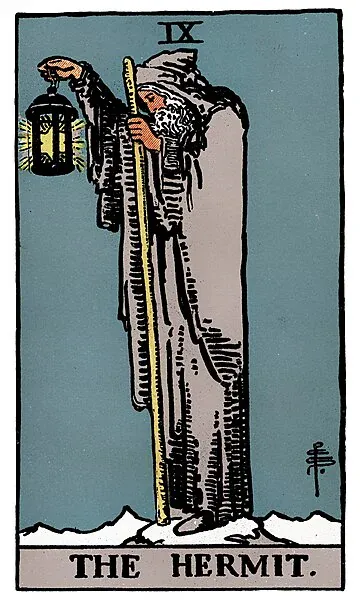
The walk begun in the Eight is the same walk continued in the Hermit. The cloaked figure of the Eight, after months of walking, becomes the hooded figure of the Hermit on the mountain — alone, lantern raised, having arrived not at a destination but at a station of his own interior. Drawn together, these two cards confirm that the leaving you have been weighing is part of a longer pilgrimage, not a one-time event. The instruction is to allow the season of solitude to follow the leaving without rushing to refill the cups.
Eight of Cups + Nine of Cups
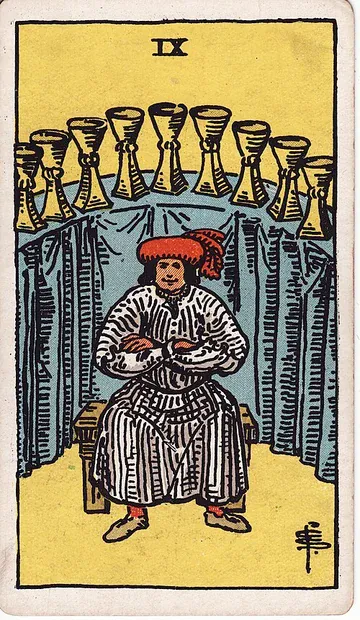
The cup you walked away from and the cup you eventually find. The Eight is the leaving; the Nine is what waits past the leaving — the wish answered, the table set, the body settled. Together, these two cards describe the full arc of the cups suit's late chapters: the willingness to leave a sufficient thing makes possible the discovery of the true thing. The instruction is to keep walking without imagining you can shortcut to the Nine.
Eight of Cups + Ten of Cups
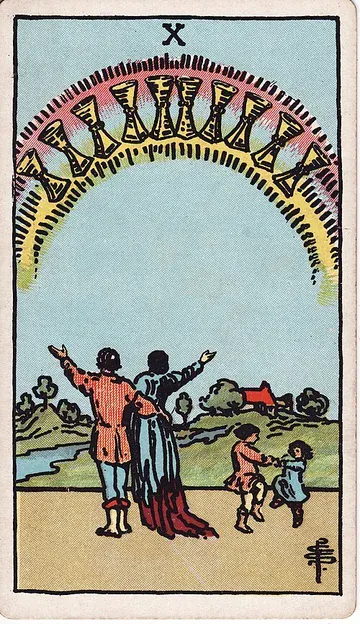
A complex pairing. The Ten is the home you are leaving — and the home is, by the Ten's own image, complete. Drawn together, these cards describe the painful clarity that even a finished, joyful structure can be a structure you have outgrown. The leaving is not a verdict on the home. It is fidelity to a deeper signal you cannot explain to the people in the picture. The card asks for grace toward those who will not understand.
Eight of Cups + Six of Swords
The actual passage. The Eight is the decision to leave; the Six of Swords is the boat that ferries you across the deeper water to the next shore. Drawn together, these cards confirm that the leaving has crossed from the imagination into the logistics — the move is being booked, the resignation is being filed, the bag is being packed. The instruction is to receive the help that is being offered for the crossing. You do not have to row alone.
Eight of Cups + Five of Cups
Suit kin and contrast. The Five is grief at what stays spilled — the weeping figure who cannot yet turn from the lost cups. The Eight is the decision to walk past what is finished. Drawn together, these cards mark the long passage from the Five's weeping to the Eight's walking. If the Five appears closer in the spread to the present, the grief is still active and the leaving is not yet possible; if the Eight appears closer, the soul has finished mourning and is ready to move. The instruction is to be honest about which season you are actually in.
Card Combinations
The Hermit
The Eight's cloaked figure walking under the eclipse becomes, given enough months, the Hermit on the mountain — alone, lantern raised, having walked far enough to see the next teaching. Drawn together, these cards confirm the leaving you have been weighing is part of a longer pilgrimage, not a one-time event. Allow the season of solitude to follow the departure without rushing to refill the cups.
Nine of Cups
The cup you walked away from and the cup you eventually find. The Eight is the leaving; the Nine is what waits past the leaving — the wish answered, the body settled. Together, these cards describe the full arc of the cups suit's late chapters: the willingness to leave a sufficient thing makes the discovery of the true one possible. Keep walking without imagining you can shortcut to the Nine.
Ten of Cups
The Ten is the home you are leaving, and the home is, by the Ten's own image, complete. Drawn with the Eight, the pairing names the painful clarity that even a finished, joyful structure can be a structure you have outgrown. The leaving is not a verdict on the home; it is fidelity to a deeper signal you cannot fully explain to the people in the picture. Bring grace toward those who will not understand.
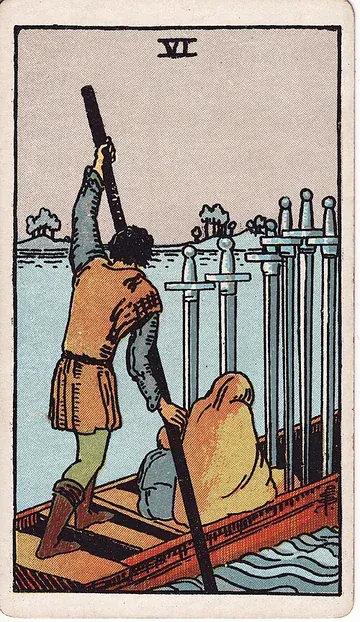
Six of Swords
The Eight is the decision to leave; the Six of Swords is the boat that ferries you across the deeper water to the next shore. Together, these cards confirm the leaving has crossed from the imagination into the logistics — the move is being booked, the resignation filed, the bag packed. Receive the help being offered for the crossing. You do not have to row alone.
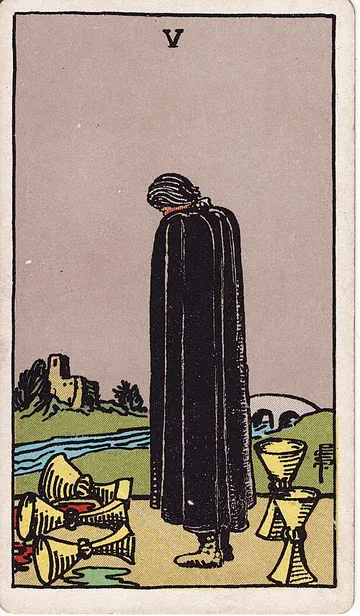
Five of Cups
Suit kin and contrast. The Five is grief at what stays spilled; the Eight is the decision to walk past what is finished. Drawn together, these cards mark the long passage from weeping to walking. If the Five is closer to the present, the grief is still active and the leaving is not yet possible; if the Eight is closer, the soul has finished mourning and is ready to move. Be honest about which season you are actually in.
Frequently Asked Questions
What is the meaning of the Eight of Cups?
The Eight of Cups meaning is the meaning of quiet, deliberate departure. A cloaked figure stacks eight cups beneath an eclipsed moon, leaves the ninth place visibly empty, and walks toward distant mountains without turning back. The card describes the choice to leave a sufficient thing in search of a deeper one — not flight, not failure, but a turning. Honor what is being set down by leaving it in good order.
Does the Eight of Cups say yes to leaving even when nothing has gone wrong?
Especially then — that is the card's whole peculiarity. Its answer is a soft yes — but a yes that points away from where the question was asked. It supports the leaving, the resignation, the move, the honest conversation. It does not support continuing what is finished. Read it as permission to begin the walk you have already begun internally, with the understanding that the road will be long.
If they feel like the Eight of Cups, are they walking away from me or toward something?
Toward something, in nearly every spread. The other person feels something tender for you and is also turning. The walk is rarely against you — it is toward something they have to find. They are honoring what was here even as they go. Read silence as the staff's first quiet thud on the path, not as absence; their heart has decided faster than their voice can speak.
Can the Eight of Cups appear when a relationship is genuinely good and I still want out?
That is its most common address. The card describes a relationship with nothing outwardly wrong with it that is already over on the inside. The fights are not loud; the trust is not broken; and someone is quietly counting what is no longer here. The card asks the seeker to honor the readiness rather than rationalize it away — and, for singles, to subtract a finished bond before expecting a new one to land.
Why does the figure walk away under an eclipsed moon?
The eclipsed moon is the spine of the Eight of Cups image — the moon revealed and hidden at once, the exact shape of a mind that knows and does not yet know. The figure walks because Saturn in Pisces' first decan asks the dream to meet gravity: the feeling has grown to the edge of its vessel and admits this place can no longer hold it. The eclipse-light is generous enough to walk by, not bright enough to flatter what is being left.