
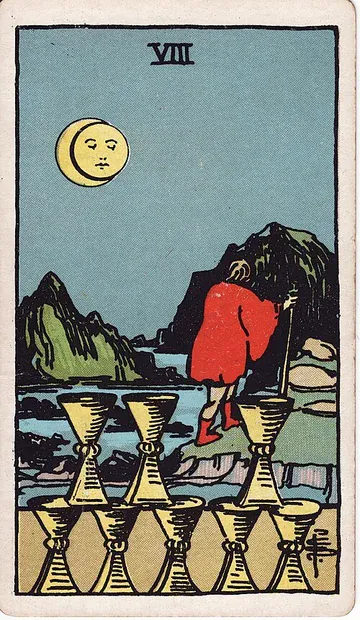
Eight of Cups Reversed · Core Meaning
Nothing in the picture has changed except that the figure is still in it. Same eight cups, stacked under the same eclipsed moon; same empty ninth place; and in the Eight of Cups reversed, the walk that should have started has not started. The staff leans against the wall in the corner of the room. The cloak hangs unworn on its hook. The figure sits at the table pretending the cups still hold what they once held — and the body, in the long internal arithmetic, knows.
This is the reversed card's central knot. The decision has been made internally. The action has not followed. The seeker has known for some time that this chapter is finished and has invented a series of plausible reasons to remain in it. The reasons are not lies, exactly. They are the rationalisations the mind manufactures when it cannot bear the cost of the leaving the body has already chosen. The reversed Eight of Cups is the card of the unsent resignation, the unspoken goodbye, the appointment unkept.
There is a second flavour of the reversed card: the leaving begun and abandoned. The figure walked for a stretch, lost his nerve in the eclipse-light, and returned. He is now back at the table, back among the cups, performing for himself the conviction that the water was deeper than he remembered. The card warns against the panicked return — the chase back to a relationship after the door has begun to close, the return to a job after handing in the resignation, the resumption of a comfort that was set down for good reasons and is now being picked up out of the loneliness of the path.
The astrological signature reverses too. Saturn in Pisces upright is the dream meeting gravity — the feeling honestly outgrowing its container. Reversed, it becomes the gravity refused — the dream insisting it can stay airborne past the point of its own structure. Pisces ungrounded dissolves; Saturn refused stiffens. Together, the reversed signature describes the seeker who insists on the form long after the form has stopped breathing, or the seeker who flees the form before it has finished teaching what it had to teach.
Hod in Briah, reversed, becomes structure that has hardened into mere form — the splendour of a temple still standing whose god has long since left. The cups are still stacked. The stacking has become the practice. The reason the stacking existed has been forgotten.
Read the surrounding suits, too, because the reversed Eight takes its texture from them. Among Pentacles the postponement is material — the lease, the pension, the number that makes the leaving expensive, and the seeker who has turned a spreadsheet into a moral argument. Among Wands it is heat with nowhere to go: the departure announced loudly and repeatedly and never made, a scorch mark left on a room nobody has actually walked out of. Among Swords it is the case file — the leaving argued so thoroughly in the head that the argument becomes a substitute for the act. And among its own suit, Cups, the reversed Eight is water that has stopped moving rather than water that has gone shallow: still, warm, familiar, quietly going bad. Late winter that will not consent to become a spring.
Reversed, the Eight of Cups asks: which leaving have you been postponing? And: which leaving did you abort and now have to either complete or honestly cancel? And: have you mistaken the difficulty of departure for evidence that you should not depart?
There is a third reading the reversed card sometimes carries — closer in spirit to a recovery. The figure who walked away in the upright card has, after a long stretch on the path, returned. He has not returned to crawl back into the chapter he left; he has returned to settle the unfinished business he walked out on too quickly. The cups he never washed. The conversation he never had. The colleague he never thanked. The friendship he ghosted in the heat of the leaving. This reading is rare and worth holding carefully — the reversed card here is not regression but completion. Look at the surrounding cards: if the reversed Eight sits next to Judgement or the Star, the return is for finishing, not for re-entering. If it sits next to the Devil or Five of Cups, the return is the wrong return, and the warning of the more common reversed reading applies.
Eight of Cups Reversed · Love & Relationships
Two shapes of one refusal: the bond that cannot yet be left, and the bond that was left and crawled back to. The Eight of Cups reversed holds both without ranking them. The water has gone shallow. The seeker has drunk it down to the silt. And, somehow, the seeker is still at the table, polishing the cups.
For an existing partnership, the reversed Eight of Cups can mean the comfortable refusal to acknowledge what both partners already privately know. The relationship has run its course; the architecture has worn out the affection; and one or both partners is in a sustained performance of the relationship's continuity. The performances are not malicious. They are protective — of the children, of the house, of the friend group, of the version of self that requires the relationship's presence to be coherent. The card does not demand a leaving. It demands an honesty about what is being kept alive and at what cost.
For someone who already left and is now considering returning — the question of reconciliation — the reversed Eight of Cups offers a soft no, or rather a no to returning to the same shape. The bond as it was is not waiting for you to come back. What you are remembering when you remember the bond is, often, the version of yourself you were inside it. That self is not retrievable. If there is a path back to the partner, it is a path to a substantially different relationship on substantially different terms. The reversed card does not promise that path. It does promise that the panicked return to the shape you knew will not refill the cups.
For someone whose partner has begun to walk — the upright Eight in their cards — and the seeker is reading the reversed card around their own response, the warning is direct. The chase will not work. The chase will not even be heard. Their leaving was a long internal walk before it became a visible movement, and the chase asks them to undo months of interior decision in a week of external pressure. They cannot. Asking them to is not love. Honor the leaving.
For a new connection that has cooled and the seeker is wondering whether to keep texting, keep showing up, keep proposing dates — the reversed card says: the spark has done what it was going to do. The cups it briefly filled are stacking themselves. Stop refilling them with messages. The honest move is to step back and let the silence speak; if there is anything alive on the other end, the silence will draw it out. If there is not, the silence has saved you a season.
For someone in love with an ex they cannot release — the reversed Eight of Cups is one of the deck's clearer mirrors. The figure has not turned around in the upright; the reversed figure has turned around and gone back to where the cups used to be. The cups are still there. They are also still stacked. They are not refilling because you returned. The card asks for the harder turning — not back to the ex, but forward into the unknown without the consolation of the familiar pain.
For a single seeker who has been quietly mourning a relationship that ended years ago — the reversed Eight of Cups can mean the grief has hardened into identity. You have become the person who lost that love. The lost love has become a small temple in your interior life. The reversed card invites the gentle dismantling of the temple — not denial of the love, just the honest acknowledgement that it has finished and is now occupying space in you that the next love would need.
For a partnership where the seeker is the one staying in a known mismatch — the partner is not unkind, is not unfaithful, is not unwilling, is simply not the right fit, and both know it — the reversed Eight of Cups names the cowardice and softens it. Most seekers stay in known mismatches not from lack of insight but from terror of the season after the leaving. The card asks: which is heavier, the season after the leaving, or the next decade in the mismatch?
Some bonds end four times a year and never end. If you are the one who has announced the leaving and then unannounced it — the bag packed on a Thursday, the key returned and collected, the message sent at two in the morning and softened at nine — the reversed Eight of Cups is describing you with more sympathy than you are currently extending yourself. The repetition is not manipulation. It is what happens when a true signal meets a nervous system that cannot yet carry the cost of obeying it. But the announcements do a damage the silence would not. Each one asks your partner to grieve you and then hands them back a person who has not actually gone. The card's request here is narrow and hard: stop announcing. Either decide, or go quiet and prepare. The dignity of this card was always in the walking, never in the declaring.
Then there is the leaving that is not psychologically blocked at all. The seeker knows. The partner, on some level, knows. What stands in the way is a lease with eight months left on it, a visa attached to a marriage, a mortgage in two names, a parent in the spare room who needs both of them. The reversed Eight of Cups gets read as cowardice by default, and in this configuration that reading is simply wrong. Entanglement is not denial. What the card demands here is only that the two be told apart, because a seeker who confuses them spends those eight months in self-contempt instead of in preparation. Name the actual date the obstacle expires. Work backwards from it. A leaving with a calendar behind it is already in motion, even while the two of you are still passing the salt.
For long-distance bonds that have stopped breathing, where the keeping-in-touch has become the relationship's whole substance — the reversed card supports the honest naming. The bond may not need to end; it may need to be redefined. Some friendships make this transition; some romances do not. The reversed card asks for the conversation rather than the slow fade.
Eight of Cups Reversed · As Feelings
When the Eight of Cups appears reversed as feelings, the answer is: ambivalent, and stuck. The other person feels something for you that is real, and they have not yet found the courage either to commit to the bond or to leave it. They are at the table. They have begun the walk in their imagination several times and turned back at the door. The cup in front of them is half-empty and they are still drinking from it, slowly, because they cannot yet decide whether to pour it out or refill it.
If they are reserved, the reversed Eight of Cups in feelings can mean stalled honesty. They have been meaning to tell you something — sometimes that they want more of you, sometimes that they want less, sometimes that they have realized something about themselves they need you to know. The telling has been postponed. The postponement is not strategic; it is paralysed. The card asks you to read the postponement as information without taking it personally; their interior is occupied with a leaving they have not been brave enough to make.
If they are demonstrative, the reversed Eight of Cups in feelings can mean performative continuity. They tell you they are happy. They post the photographs. They show up for the events. And privately, in the interior, they are at the table with the eight stacked cups, wondering. The disconnect between the public expression and the private reality is not malice — it is fear. They are afraid of what would happen if they let the public expression match the private question.
For a partner you have been with a long time, the reversed Eight of Cups in feelings can describe the comfortable refusal to look at what you have both quietly known for a while. They love you. They are also no longer entirely present. The presence comes and goes, and during the goings, they are walking in their imagination toward something neither of you names. The card asks for the conversation rather than the further evasion. The conversation may be hard. The evasion is harder over time, even if it is softer in any given moment.
For a new connection, the reversed Eight of Cups in feelings can mean someone who is technically available but emotionally still in transit from a previous chapter. They have not yet finished walking out of the last bond. They have arrived in your life with the staff still in their hand, the cloak still half on. They like you. They are also not yet free. The card is not telling you to wait for them indefinitely. It is telling you to read the season they are actually in, not the season you wish they were in.
For someone you have just met, the reversed Eight of Cups in feelings can describe the encounter that has the surface of intensity and is, on the inside, a placeholder. They are using you to delay an honesty they owe themselves about their own life. None of this is your responsibility. The card is naming the texture of their interior so that you do not mistake the placeholder for the partnership.
Turn the question around for a moment, because plenty of seekers bring this card about someone they were the one to leave. Read for their feelings, the reversed Eight of Cups describes a person still arguing with a version of you that no longer exists. The conversation goes on in their head with better lines than they had at the time. They have not put the cups down because the ending was made without their consent and there was nothing left for them to do with their hands. What they feel is not simple longing — it is unfinished business wearing longing's coat. This matters practically: a warm message from you lands inside that argument rather than outside it, and restarts it. If you have something to say, say the whole of it once. Partial contact keeps the stack standing.
There is a particular caution in the reversed Eight of Cups for feelings: watch for the partner who has been performing the leaving as a tactic. Some people have learned that the threat of departure produces caretaking from their partner. The reversed card can describe the partner who walks out, comes back, walks out, comes back — using the choreography of leaving as a way to extract attention. This is not what the upright Eight of Cups describes. The upright leaving is honest and quiet; the reversed performance of leaving is loud and theatrical and exhausting. If you recognize this pattern, the card is not naming their love for you. It is naming a wound in them that you cannot heal by remaining in the choreography.
For the partner's interior — the card as feelings — read the reversed Eight of Cups as a heart that has begun several walks and returned from each, and is now genuinely uncertain whether the next walk will be completed or not. The work is theirs. You can support honesty. You cannot make the decision they have been refusing.
Take the reversed Eight of Cups in feelings as a request for honesty in both directions. Ask them. Tell them what you have noticed. The card responds well to clarity from both sides. It does not respond well to the continued mutual performance of a chapter both parties have suspected is finished.
Eight of Cups Reversed · Career & Work
A year ago there was a door; the door is still there and so are you. Reversed at work, the Eight of Cups is that role — or its twin, the role left in a panic and now being circled, with the question of crawling back kept quietly open. Both are forms of the same problem: the relationship between the seeker and the work has lost its honesty.
For someone in a current role, the reversed card warns against the well-furnished cage. The role is comfortable. The colleagues are pleasant. The compensation is fine. And the soul is, week by week, slightly dimmer. The card describes the trap of the resignation that has been written and not sent — the resignation in the drafts folder for fourteen months, opened occasionally, closed without action. The trap is not the role. The trap is the suspended decision. Suspended decisions are heavier over time than either choice would have been.
For someone considering whether to return to a role they recently left — a former employer, a former industry, a former line of work — the reversed Eight of Cups counsels suspicion of the impulse. Often, the return impulse is not about the role; it is about the difficulty of the season after the leaving. The new path is harder than imagined. The cups in the old place look fuller from this distance. The card asks: are you returning because the work was right, or because the path forward is uncomfortable? The latter is not a sufficient reason. The path forward is supposed to be uncomfortable. That is what the staff in the upright card was for.
For entrepreneurs and freelancers, the reversed Eight of Cups can describe the business line that should be sunset and is being kept on life support. The original audience is gone. The original passion has thinned. The revenue justifies maintaining the offering and the soul does not. The card asks for the courageous discontinuation. Some practitioners find this almost impossibly hard, because the revenue feels like proof that the work is still alive. Revenue is proof that someone is paying. It is not proof that the work is alive in you.
For someone laid off and considering a fast return to similar work — the reversed Eight of Cups can describe the panicked re-up. The bills are real. The fear is real. And the fast return often re-creates the exact pattern that led to the leaving. The card invites a slightly longer pause than feels comfortable. Stack the cups before you grab the next set. Often a season of contract work, freelance work, lower-stakes work, gives the soul time to register what it actually wants in the next chapter.
For a creative practice that has stalled, the reversed Eight of Cups describes the writer who has been pretending to write for two years, the painter whose easel is dusty, the musician whose instrument has begun to go out of tune from disuse. The pretending is exhausting. Either resume the practice honestly, with all the discomfort that resuming requires, or honestly retire it and free the energy for what wants to come next. The pretending is the worst of the three options.
A degree half-finished is one of the sharpest versions of this card. Three years into the doctorate, eighteen months into the qualification, the second year of the apprenticeship — and the subject has stopped speaking. The reversed Eight of Cups is honest enough to admit that the sunk cost is real here: a finished credential is worth something an abandoned one is not, and anyone who tells you otherwise is selling a story. What the card refuses is the unexamined default. Most seekers in this position have never separated the two questions — whether they want the work this qualifies them for, and whether they can stand the remaining distance. If the answer to the first is no, the remaining distance is the wrong thing to be measuring. Ask someone who does the job daily what their Tuesday looks like. An hour of that conversation is worth six months of the staying-or-going loop.
For someone considering a major career pivot and feeling stuck in the deliberation, the reversed card names the deliberation as the actual problem. You have been weighing the move for long enough. The weighing has become its own form of the cup you cannot put down. Decide. The decision is more important than which decision. Either commit to the current path with full presence or commit to the leaving with full presence. The middle space is the trap.
For someone working under a difficult manager or in a toxic workplace and continuing to wait it out — the reversed Eight of Cups warns of the cost of the wait. Each month in a depleting environment is a real cost paid in nervous-system reserves the next chapter is going to need. The card is not promising that the leaving will be easy. It is naming that the staying is also not easy and is, on the long arithmetic, more expensive.
The seat this card is hardest in is the one where the leaving is not yours to make for yourself. A manager keeping a person in a role they have outgrown because the conversation would be painful. A founder maintaining a team around a product the market finished with a year ago. A department head renewing a contract nobody in the room believes in. The reversed Eight of Cups names the kindness that has curdled: what looks like loyalty is a postponement, and the person being protected is usually the one paying for it in the currency of their own years. They can feel the water is shallow. They are waiting for someone with authority to say so. Say it plainly, say it early, and have a real alternative in your hand when you do. A leaving arranged in daylight costs everyone less than one that arrives as a surprise in the quarter when the numbers force it.
For questions about whether to take a counter-offer after handing in a resignation — the reversed Eight of Cups counsels suspicion of the counter. The counter is rarely about you; it is usually about the cost to the company of replacing you. The conditions that led to your resignation will, in most cases, return within six months of the counter being accepted. The card respects the original walk. It asks you to honor it.
Eight of Cups Reversed · Money & Finances
An unclosed financial chapter charges rent every month it stays open, and the Eight of Cups reversed is the card of the ones nobody has closed — the subscription you forgot to cancel, the investment position you should have exited, the recurring expense that no longer corresponds to your life and continues to deduct anyway. The card does not predict catastrophe. It describes the slow bleed of postponed decisions.
For the seeker who has been carrying a financial obligation past its useful life — a club membership unused, a service subscription unread, a storage unit holding objects from a life left behind — the reversed Eight of Cups names the bleeding. None of these obligations is dramatic. Together, over a year, they often add up to a real number. The card asks for the audit. Not as discipline. As honesty.
For someone in financial recovery, the reversed Eight of Cups can warn against the panicked return to the old spending pattern after a period of restraint. The constraint loosened, the soul felt the relief, and now the credit card is emerging from the drawer with a confidence the financial reality does not justify. The card asks: are you spending because you have recovered, or because the leaving of the old pattern was harder than the leaving of the new restraint?
For investments and speculative positions held past their thesis — the reversed Eight of Cups counsels honest exit. You held the position because of a particular reading of the market. The reading has changed. The position has not. Most investors lose more money to refusing to admit the thesis has expired than to any other single mistake. Stack the cups. Walk.
For a major purchase delayed indefinitely — the house, the move, the renovation, the equipment for the practice — the reversed Eight of Cups can describe the deliberation that has become its own form of stuckness. You have been weighing the purchase for so long that the weighing is now the experience, not the purchase. The card asks for the decision. Either buy or close the question. Both are habitable. The continued weighing is not.
For windfall — inheritance received, settlement landed, gift arrived — and the reversed card appears: the windfall is at risk of being absorbed by the bleeding the postponed decisions have created. Money that should have been redirected to the next chapter is, instead, being slowly consumed by the maintenance of the previous chapter. The card asks for a hard look at the household financial structure before the windfall meets it. Without the look, the windfall will be invisible within eighteen months.
For the seeker who has been bleeding money on the comfort behaviors of the previous self — the takeout that became routine, the small luxuries that became baseline, the streaming services that proliferated — the reversed Eight of Cups is the deck's mirror. The cups have stacked, and many of them are full of money you do not enjoy spending. The reversed card responds well to the small, deliberate cancellations. Cancel five subscriptions this week. Notice what does not break.
For debt that has lingered past the point where it should have been paid down, the reversed Eight of Cups can describe the avoidance pattern. The debt is small enough not to be a crisis and large enough to be a quiet weight. The card asks: have you been keeping the debt in your peripheral vision because addressing it would require an uncomfortable look at the spending pattern that created it? Often yes. Often the spending pattern is the deeper question. The debt is the cup. The pattern is the table the cup sits on.
For someone with a parked savings goal — the down payment fund that has stagnated, the emergency fund that never quite got built, the retirement contribution that was supposed to begin two years ago — the reversed Eight of Cups names the postponement. The goal has not failed. The goal has simply been deferred so consistently that the deferral has become the relationship. The card invites the smallest possible re-engagement: not the ambitious plan, just the re-opening of the account, the first contribution this month, the conversation with the financial advisor that has been queued for half a year.
Eight of Cups Reversed · Health
The request has been made several times now, politely, and nothing has been set down. Reversed, the Eight of Cups is the body asking for a habit to be put away and the person hearing it clearly without acting. The body's signals have moved from a whisper to a regular tap on the shoulder. The signals are not yet a shout. The window in which the listening would prevent the shout is, however, narrowing.
For someone managing a chronic condition, the reversed Eight of Cups can describe the slow drift away from the practices that were holding the condition stable. The medication is taken inconsistently. The exercise has tapered. The dietary discipline has loosened. The drift has been comfortable; the drift is not yet a crisis. The card asks for the re-engagement before the crisis arrives. Re-engagement is much easier than crisis-management.
For someone trying to leave a comfort behavior — alcohol, late-night scrolling, recreational substances, food relationships that are not nourishing — the reversed Eight of Cups names the half-leaving. You have left the behavior several times. You have returned several times. Each return is not a moral failing; it is information. The pattern of returning is the actual subject the card is asking you to look at. What is the season you cannot bear that produces the return? Until that question is answered, the leavings will continue to be temporary.
For someone whose body has begun to register the cumulative cost of an unaddressed pattern — sleep that no longer refreshes, energy that does not return, mornings that take longer to assemble — the reversed Eight of Cups asks for the honest medical conversation. Not as a panic. As a recognition that the body is communicating something the mind has been postponing the listening to. None of this is medical advice; the card is describing the felt season of postponed honesty, not a diagnosis. Make the appointment.
For mental health, the reversed Eight of Cups can describe the season of pretending to be okay because actually-okay would require a leaving the seeker is not yet ready to make. The therapy that should have been started a year ago is still scheduled for next month. The medication conversation that should have happened has been postponed. The conversation with the partner about the depression that is leaching into the relationship has been deferred. The card respects the difficulty of the leaving. It also names that the postponement is now part of the symptom.
For sleep, the reversed Eight of Cups names the late-night ritual that has become anti-rest. The seeker knows the screen is the problem. The seeker stays anyway. The card asks for the small first leaving — not the perfect new sleep hygiene, just one cup set down. Phone out of the bedroom for a week. Notice what changes.
For digestion and appetite, the reversed Eight of Cups can describe the body's quiet refusal of the foods you have been eating out of comfort or habit. The bloating, the heaviness, the post-meal fog — these are the body's letter, written every day. The seeker has been receiving the letter and not opening it. The card invites the opening.
For exercise, the reversed Eight of Cups can describe the long postponement of the practice you know would help. You have read about it. You have bought the equipment. You have planned the schedule. The actual move has been postponed indefinitely. The card asks for one walk this week. Not a regimen. A walk. The reversed card returns to upright through the smallest, honest beginning.
For seekers carrying a body that has been quietly compensating for a stress they have not named — chronic neck tension that maps to a job, gut symptoms that flare around a particular relationship, headaches that follow specific calls — the reversed Eight of Cups names the somatic letter the body has been writing. The body is not exaggerating. The body is reporting. Read the report. Often the most direct intervention for a stubborn somatic pattern is not another supplement; it is the leaving the symptom has been lobbying for. The body's symptoms tend to soften within weeks of the actual leaving the body has been requesting.
Eight of Cups Reversed · Spirituality
Knowing a practice has gone hollow and performing it anyway is its own kind of devotion, and the Eight of Cups reversed is where that devotion gets named. The morning sit has become a ritual without contents. The teacher's lectures are being attended out of obligation. The community's gatherings are being shown up to with a smile that does not match the interior. The cups are still being stacked. The water is no longer being drunk.
This is one of the more painful reversed readings in the spiritual range, because the seeker often cannot quite name what is wrong. The practice was real. The community was real. The transformation was real. And, somewhere over the last year or two, the relationship between the seeker and the form has cooled. The cooling has not been honored. The pretence has continued. The card asks for the honest naming.
For someone in active practice, the reversed Eight of Cups can describe the practice that has become a costume — the meditation cushion that is sat on for the photograph rather than the breath, the journal that is filled with the same kinds of insights that have stopped translating into life, the ritual that is performed for the comfort of the form rather than for any actual encounter. The card does not demand abandonment of the practice. It asks for honest examination of which parts of the practice are still alive and which parts are decoration.
For someone exploring belief, the reversed Eight of Cups can warn of the spiritual seeker who collects without committing. They read every tradition. They attend every retreat. They speak fluently about every framework. They never sit with any one thing long enough to be changed by it. The card describes the inversion of the upright leaving — the upright figure leaves a sufficient thing in search of a true one; the reversed figure leaves every thing before any thing has the chance to be sufficient or true. The instruction is to choose one and stay long enough to be transformed.
For seekers in a community — a sangha, a coven, a congregation — the reversed card can describe the long postponement of the leaving that is overdue. The community has changed. The teacher has fallen short. The practice has shifted in directions the seeker does not align with. And the seeker stays out of fear of the loneliness on the other side of the leaving. The card respects the loneliness. It also asks whether the cost of staying has begun to outweigh the cost of going.
For seekers who left a tradition and are now circling back to it — the reversed Eight of Cups asks for honesty about the return. Are you returning because the tradition is alive in you again, or because the path you walked into after leaving turned out to be lonelier than imagined? The latter is a real and common reason. It is not a reason to return. The loneliness is part of the path. Returning to the old form to escape the loneliness will produce a worse version of what you left.
For questions about path, the reversed Eight of Cups asks whether you have mistaken the difficulty of the new path for evidence that the old path was right. Difficulty is not always a signal to turn back. Sometimes the difficulty is the path. The card invites discrimination — not all discomfort is wrong-direction discomfort. Some discomfort is just the cost of growth that is actually happening.
A small practice when the reversed Eight of Cups appears: write down one element of your current spiritual life that you suspect has gone hollow, and one element that is still alive. Set the hollow one down for a week. Spend that week doing more of the alive one. Notice what shifts. The reversed card returns to upright through the small, honest experiments — not through any large public renunciation.
Eight of Cups Reversed · Yes or No
Soft no on returning — and a quiet yes only to the harder honesty.
The Eight of Cups reversed yes or no answer is one of the most precise in the deck. It is no to going back, no to staying out of fear, no to refilling the cups you have already drained. It is also yes to a more difficult thing: the honest naming of where you actually are, the acknowledgement of the leaving you have been postponing, the willingness to begin the walk you have been refusing.
For yes-or-no questions about whether to return — to a relationship, a job, a city, a community — the answer is no. The thing you remember when you remember the previous chapter is rarely the thing the chapter actually was. Returning chases a version of the past that did not survive your own growing. The card is not punishing you for the impulse to return; it is naming that the return will not deliver what the impulse promises.
For yes-or-no questions about whether to stay — in a relationship, a job, a city, a pattern that has been worn — the reversed card answers no, but with a softer voice than the upright. The leaving may not need to be immediate. The honesty about the staying does need to be immediate. Stop telling yourself the water here is still deep. The first move is not the leaving; it is the truth-telling.
For yes-or-no questions about whether something will hold, last, recover — the reversed Eight of Cups says no, in the form it currently has. It may continue, transformed; it will not continue as it was. The continuity you are hoping for has already ended. The new form is what is being asked of you.
For yes-or-no questions about whether someone else is being honest with you — the reversed card says they are not yet being honest, including with themselves. Their answer is not malicious. Their answer is paralysed. Treat their stated position as provisional and watch what they do, not what they say.
For yes-or-no questions about timing — will it happen soon — the reversed card answers no, not soon, because the leaving that needs to happen first has not happened. The clock is not on the question you are asking; the clock is on a leaving you have been postponing. Begin the leaving. The timing question will resolve once the postponement does.
For binary decisions — should I act, should I wait — the reversed card answers act, but the action is on the postponed honesty, not on the surface choice. Whatever surface decision is being weighed, the deeper decision is which honest naming you have been refusing. Make that one. The surface decision will follow naturally once the deeper one is made.
If the question was: should I crawl back? The reversed card answers no, with a gentle but unmistakable firmness. Whatever the relationship, the role, or the path was, it has finished. The crawling-back will not refill the cups, and it will cost you another season of clarity you cannot easily afford to lose.
A different binary arrives with this card often enough to name: should I say out loud that I have been thinking of leaving? The reversed Eight answers yes — but say it first to one person who has nothing at stake in your answer. A friend outside the situation, a therapist, a page. The whole pathology of this reversal is that the thought has never been allowed to exist outside your own skull, where it grows in the dark and doubles its weight every few months. Spoken once to someone neutral, it shrinks to its actual size, which is almost always smaller and more workable than the shape it had at four in the morning. Then, and only then, is the conversation with the person themselves worth having.
If the question was: am I being weak for not yet leaving? The card answers no. You are not being weak. You are being human in the face of a hard departure. The card respects how hard the leaving is. It also asks you to begin, this week, the small first move toward it — not the dramatic announcement, just the quiet preparation.
Eight of Cups Reversed · Advice
The hunt for one more reason to stay another day is itself the answer the Eight of Cups reversed is giving. If you are spending serious mental energy on the case for staying — in the role, in the bond, in the comfort, in the pattern — the case is being made for the consumption of someone who has already decided. You are persuading yourself out of a decision your interior has already made. Stop persuading. Honor the decision.
If there is one specific reversed advice instruction the card offers, it is to open the unsent letter. The resignation in the drafts folder. The text message ending the bond. The journal entry naming the practice that has gone hollow. The card does not ask you to send any of it. It asks you to read it. Three minutes with the unsent letter is more honest than three hours rehearsing the case for staying. The body knows what it wrote. Let the body see what it wrote.
A second instruction: name the cost of the postponement. Each month of unmade decision has a price. The price is paid in attention, in joy, in vitality, in time that cannot be retrieved. The card does not demand the leaving today. It demands you stop pretending the postponement is free. Look directly at what the staying is costing this season. The cost is the data; whatever you decide afterward is the decision.
A third instruction: notice what you did not chase. When the upright Eight of Cups season passed for you and you did not walk — what did you not chase? What walk did you not begin? What permission did you not give yourself? Often the postponed walk is something specific — a city, a course of study, a relationship that wanted to begin. The reversed card asks what is currently sitting in the empty ninth place that you have not yet acknowledged.
A fourth instruction: forgive the half-walks. Most seekers, when first encountering this reversed card, have several half-walks behind them. The half-walks are not failures. They were dress rehearsals. They taught you what the leaving feels like in the body. The next walk will be steadier because of them. The card asks for grace toward the previous attempts, not for shame.
A fifth instruction, gentlest of the set: the leaving does not have to be perfect. It does not have to be clean. It does not have to be coherent to anyone but you. The reversed card sometimes paralyses seekers who are waiting to have a fully-articulated rationale before beginning. The fully-articulated rationale does not arrive. What arrives instead is a quiet, persistent interior signal. Trust the signal more than the rationale. The rationale is for the explaining-after; the signal is for the deciding-now.
Practical advice for the day the reversed Eight of Cups appears: identify one cup you have been refusing to set down. Set it down for one week. Not forever — for a week. Notice how the body responds. The reversed card returns to upright through small, honest experiments, not through dramatic renunciations. The seeker who can put a cup down for a week without ceremony is the seeker who can, when the time comes, walk without ceremony too.
A sixth instruction, for the seeker who keeps drawing this reversed card across many readings: the pattern is not the card's fault. The reversed Eight of Cups appearing repeatedly is the deck's most patient teacher. It is asking, again and again, for the same one act — not a renunciation, not a dramatic change, just a single honest acknowledgement. The deck stops sending the reversed Eight when the acknowledgement is made. Not when the leaving is completed; when the acknowledgement is made. The work that follows is yours to pace. The acknowledgement is the price of admission.
Eight of Cups Reversed · Card Combinations
Eight of Cups Reversed + The Hermit Reversed
The walk refused twice over. The leaving has been postponed in the cups, and the solitude that should have followed has also been refused. The seeker is staying both at the table and in the noise — neither leaving the depleted bond nor sitting alone with what the leaving would teach. This combination is one of the deck's clearer paralysis pairings. The instruction is to choose at least one of the two leavings; doing both at once is hard, but doing neither is the trap that produces the second wasted year.
Eight of Cups Reversed + Five of Cups
Grief frozen and the leaving refused. The Five is the figure mourning the spilled cups; the reversed Eight is the figure who has not turned. Together, these cards describe the long season of unprocessed loss that has hardened into a refusal of the next chapter. The instruction is the gentle, non-rushed work of grief — not as a project, but as a permitted season — so that the leaving the upright Eight asks for can finally be made.
Eight of Cups Reversed + Six of Swords
A leaving begun and a return mid-passage. The Six of Swords is the boat halfway across the deeper water; the reversed Eight is the figure asking to be turned back. Together, these cards describe the panicked second-guessing that grips many seekers in the middle of the actual move. The instruction is to keep the boat moving. The other side of the water is not visible from the middle. That does not mean it is not there.
Eight of Cups Reversed + Ten of Cups
The home performed and the leaving refused. The Ten is the family on the porch; the reversed Eight is the seeker who knows, privately, that the porch has begun to feel like a costume. This combination is one of the more painful readings the deck offers, because everything looks well from the outside and the interior knows otherwise. The instruction is the honest conversation, first with yourself, then with the people on the porch. The Ten can survive the conversation; it cannot survive the prolonged silent leaving.
Eight of Cups Reversed + Nine of Cups Reversed
The wish refused and the leaving refused — both in the same hand. The seeker has neither received what they asked for nor walked toward what they actually wanted. The cups are full of the wrong things, and the figure is still seated. This is the deck's most precise paralysis combination. The instruction is to begin with the smaller of the two refusals — usually the leaving — because the wish-refusal often resolves itself once the seeker has begun to walk.
Card Combinations
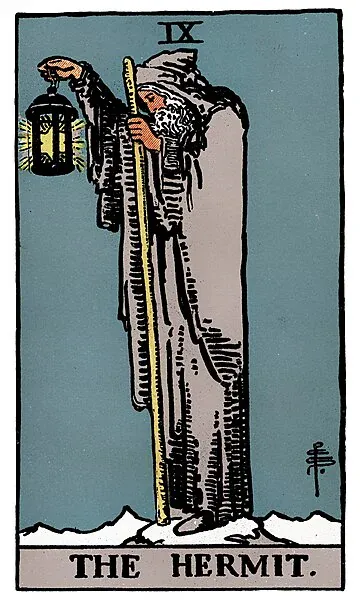
The Hermit
The Eight's cloaked figure walking under the eclipse becomes, given enough months, the Hermit on the mountain — alone, lantern raised, having walked far enough to see the next teaching. Drawn together, these cards confirm the leaving you have been weighing is part of a longer pilgrimage, not a one-time event. Allow the season of solitude to follow the departure without rushing to refill the cups.
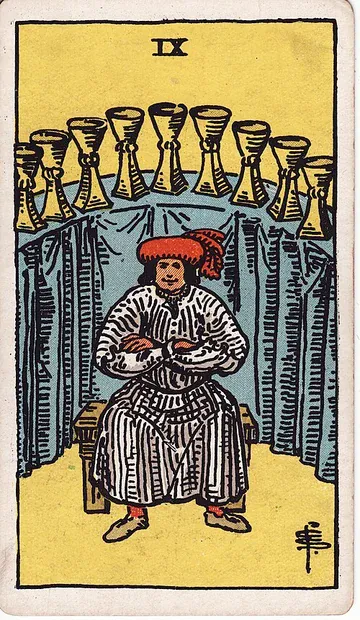
Nine of Cups
The cup you walked away from and the cup you eventually find. The Eight is the leaving; the Nine is what waits past the leaving — the wish answered, the body settled. Together, these cards describe the full arc of the cups suit's late chapters: the willingness to leave a sufficient thing makes the discovery of the true one possible. Keep walking without imagining you can shortcut to the Nine.
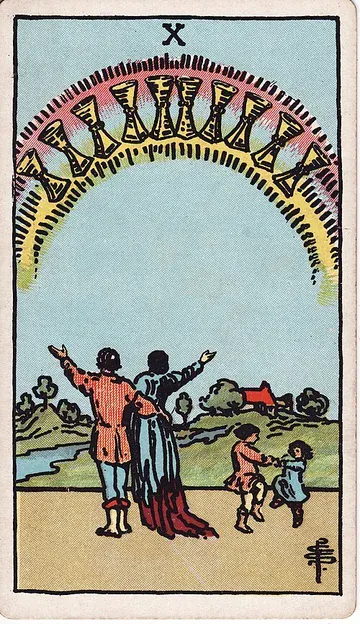
Ten of Cups
The Ten is the home you are leaving, and the home is, by the Ten's own image, complete. Drawn with the Eight, the pairing names the painful clarity that even a finished, joyful structure can be a structure you have outgrown. The leaving is not a verdict on the home; it is fidelity to a deeper signal you cannot fully explain to the people in the picture. Bring grace toward those who will not understand.
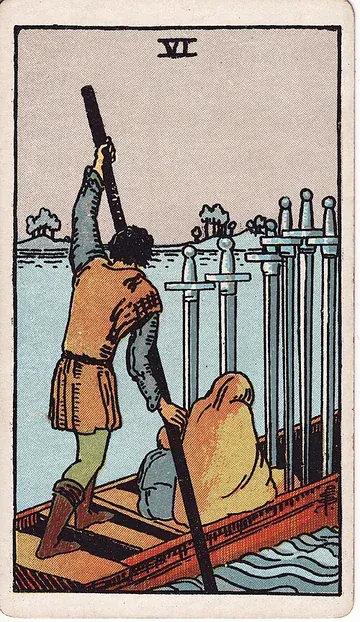
Six of Swords
The Eight is the decision to leave; the Six of Swords is the boat that ferries you across the deeper water to the next shore. Together, these cards confirm the leaving has crossed from the imagination into the logistics — the move is being booked, the resignation filed, the bag packed. Receive the help being offered for the crossing. You do not have to row alone.
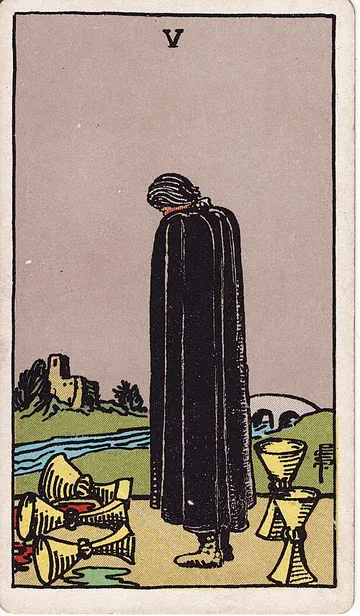
Five of Cups
Suit kin and contrast. The Five is grief at what stays spilled; the Eight is the decision to walk past what is finished. Drawn together, these cards mark the long passage from weeping to walking. If the Five is closer to the present, the grief is still active and the leaving is not yet possible; if the Eight is closer, the soul has finished mourning and is ready to move. Be honest about which season you are actually in.
Frequently Asked Questions
Is going back allowed under the Eight of Cups reversed, or is that the thing it refuses?
That is the thing it refuses. The answer is no on returning, no on staying out of fear, no on refilling cups you have already drained. It is also a quiet yes to the harder honesty: the postponed leaving, the truth-telling, the acknowledgement of where you actually are. Read it as a card that refuses both the chase back and the comfortable continuation, and points toward the one move you have been avoiding.
How long can the Eight of Cups reversed postpone a departure that has already been decided?
Indefinitely, which is the cost the card is pointing at. This is the leaving postponed — the resignation in the drafts folder, the unsent goodbye, the practice gone hollow that is still being performed. Or: the leaving begun and abandoned, the panicked return to a chapter that was finished. Either way, the card describes the gap between what the soul has decided and what the calendar has yet recorded.
Is staying under the Eight of Cups reversed a choice, or the absence of one?
Usually the absence of one, dressed as patience. The card describes the bond the seeker cannot yet leave or the bond they tried to leave and crawled back to. For partnerships, it warns of the comfortable performance of continuity past the point of honest connection. For reconciliation, it offers a soft no — the version of the relationship being remembered did not survive your own growing.
Is the person shown by the Eight of Cups reversed staying for me or staying out of fear?
The card declines to flatter either of you about that. The other person feels something real for you and is also paralysed — at the table, half-decided, performing continuity over a private question they have not yet had the courage to name. Read silence as stalled honesty rather than absence. Their work is theirs; you can support clarity, but you cannot make the decision they have been refusing.
What is the reversed Eight of Cups advice?
The reversed Eight of Cups advice is to stop hunting for reasons to stay one more day — the hunt itself is the answer. Open the unsent letter. Name what the postponement is costing this season. Set down one cup for a week as an experiment, not a vow. The reversed card returns to upright through small, honest experiments and the courage to feel the discomfort that follows, not through any dramatic public renunciation. Begin with the smallest move you can sustain.