
Eight of Pentacles · Core Meaning
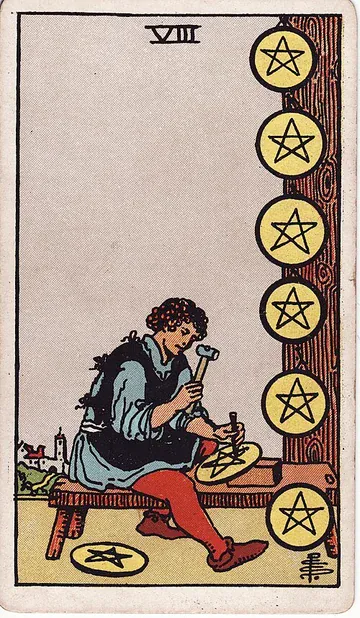
The Eight of Pentacles meaning begins with a posture, not a slogan. A craftsman sits on a wooden bench beside a hut outside the town wall. He has chisel and hammer in hand. Behind him, six finished pentacles hang on a wooden post; the seventh is on the bench under his hands; the eighth lies at his foot, untouched. His coat is plain, his back slightly bent, his eyes only on the metal. The town is a thin road's bend away, but he does not look up. The hammering continues.
This is the card of absorbed practice. Not inspiration — inspiration is a Wands word, the lightning that strikes once. The Eight of Pentacles is what happens after the lightning has gone home and the work is still unfinished on the table. It is the card of the one-hundredth repetition, the year you stopped expecting praise, the morning you noticed your hands had learned something your mind never explicitly taught them. The signature tension lives in the gap between the post and the foot: between what is already finished and what has not yet begun. The bench, in the middle, is where the seeker actually lives.
Read against the deck's other earth cards, the Eight of Pentacles is the apprenticeship card — distinct from the Three of Pentacles' collaborative cathedral and the Nine of Pentacles' walled garden. The Three is craft in a guild; the Eight is craft alone. The Nine is the harvest after; the Eight is the long arc that produces the harvest. Of the three, this card is the least photogenic. It is the one that asks the most. It is also, quietly, the one that produces the others.
The decan behind it is as unglamorous as the labor it describes: the card carries the Sun in Virgo, first decan — bright light turned on the detail. Not the Sun of Leo, which performs; not the Sun of Aries, which begins; the Sun in Virgo, which clarifies. The decan's gift is the discipline of seeing precisely what is in front of you, of landing each strike where it should fall, of preferring accuracy to flourish. In the Tree of Life, the Eight of Pentacles sits in Hod within the world of Assiah — Splendor expressed in form, the gathering of inspiration into a structure that can be taught and passed on. The card is not the lightning. It is the schematic that makes lightning reproducible.
Read the card the way you would read a workshop in late afternoon. The light is slanting through the open door. The hammer is still ringing. The maker has not turned his head in an hour. Whatever else the seeker brings to the spread, this image is the answer beneath the answer: what is the discipline you are being asked to inhabit? what would your life look like if you stayed at the bench? The Eight of Pentacles tarot card meaning is, finally, a single instruction in present tense: keep working.
There is one more layer worth naming in the core image. The road behind the workshop curves toward the town, and a traveler is half-visible at its bend — leaving, or arriving, or simply passing through. The craftsman does not look up. This is not coldness. This is the specific concentration of someone who knows that the bench will not produce anything if every distant figure is granted attention. The card is teaching a hard, rare discipline: the willingness to be unavailable to the rest of the world for the duration of the work session. Most modern seekers struggle with this more than with any other element of the card. Notifications, social pulls, the constant low hum of comparison — all of it conspires to keep the seeker's eyes on the road rather than on the bench. The card asks for a practice of bench-time that is genuinely protected. Not a vague intention. An actual, defended block of hours.
Eight is the number of structure — form that stands because it has been repeated, not because it was inspired. Set the card between its neighbors in the suit and the argument sharpens. The Seven of Pentacles is the grower leaning on a staff, watching the vine, waiting to see what the season decides. The Eight does not wait, and the season is not consulted. Whatever the weather has planned for the harvest, the hammer falls again this morning, and the strike is the one variable the craftsman actually holds. That is the card's whole position: when the outcome is out of reach, take the input and refine it. It is also why the Eight of Pentacles arrives so often for seekers in a season when nothing external can be moved — the hiring freeze, the long illness in the family, the paperwork that will not clear. The bench is what remains available when the town's business is not.
Eight of Pentacles · Love & Relationships
In Eight of Pentacles love readings, the card is a quiet, working card. It does not promise the dramatic spark of the Lovers; it does not deliver the fed contentment of Cups Nine. What it offers is the relationship as practice — the slow, deliberate accumulation of small attentions that, repeated long enough, become a shared life. The pentacles on the post are not gestures; they are evenings. They are the cup of water poured before being asked. They are the lamp left on for the late return. They are the same small kindness, done a hundred times, until kindness has stopped being a decision.
For an existing partnership, the Eight of Pentacles describes the season of unglamorous work. Whatever romantic momentum brought you together has long since handed over to the daily mechanics of staying. The card affirms those mechanics. The dishes, the calendar, the way you ask after each other at the end of the day — these are the actual material of the bond, and the card honors them. There is no reward beyond the work itself. The reward is that the work has continued.
For a new spark, the Eight of Pentacles is a strange but generous card. It says: this person is willing to learn you. They are not looking for the magnificent already-formed soulmate of magazine columns. They are willing to sit at the bench of the relationship and hammer alongside you. The first weeks may not feel cinematic. They may feel like quiet attentiveness, like someone showing up consistently in small ways. Trust the small consistency. The card warns against confusing apprentice love with shallow love — they look similar from outside, and they are not the same thing.
For the single seeker asking whether love is possible, the Eight of Pentacles answers with a question of its own: are you willing to apprentice in the craft of being with another person? The card describes the seeker who needs to put down the search for the perfect partner and pick up the practice of being a partner. Not by lowering standards — by realizing that a relationship is a skill that two people develop in real time, not a discovery they make in advance. The right person finds the bench more easily when the bench is already set.
For someone considering a long courtship — the relationship that has progressed slowly, that has not yet produced fireworks, that the seeker is privately wondering about — the Eight of Pentacles affirms the slow build. The slowness is not a sign of absent feeling. It is the actual material of the kind of bond this card recognizes. Look at what has accumulated. Six finished pieces on the post are not nothing. They are the evidence of the relationship you have already been making.
For love after a wound, the Eight of Pentacles is one of the deck's gentler healers. It says: the work of recovery is the work of small repeated attention to your own life. Trust returns through repetition, not through grand reassurance. A new partner who is willing to be present in small consistent ways, day after day, is the partner who will outlast the fear. The card describes the second love, the chosen love, the love that does not need to convince you all at once because it is willing to convince you in increments.
For long-distance partners, those navigating logistical separation, the Eight of Pentacles affirms the daily practice of bridging distance. The morning text. The shared playlist. The schedule kept. These are not poor substitutes for presence — they are the form presence takes when bodies cannot meet. Honor the form. Tend it with the same attention the craftsman gives the metal.
For couples in the early apprentice phase of cohabitation or marriage, the card recognizes the unglamorous work of building a household together. The negotiation about the dishwasher. The compromise on the coffee maker. The evening conversations about money. None of it is romantic; all of it is the actual marriage. The card affirms the long arc.
For the seeker asking is this person serious about me?, the Eight of Pentacles upright answers yes — and adds that the seriousness will not announce itself dramatically. They are practicing. They are showing up. They are doing the small unflashy things that, in aggregate, are how a life is built. Watch the post behind their back. Count the finished pieces. The card is not romantic; the card is reliable.
The Eight of Pentacles love language is the language of the maintained thing. The dinner cooked when you are tired. The form filled out without complaint. The text answered within the hour. If you are with someone whose love language is this card, you may need to learn to read affection as effort rather than as performance. They are not telling you they love you. They are showing you, by hammering the same kindness one more time.
Eight of Pentacles · As Feelings
The Eight of Pentacles as feelings is one of the harder cards to read because the feelings it describes do not announce themselves. The person under this card does not write you a poem. They do not call you on impulse late at night. They do not make grand declarations. What they do is practice you — slowly, deliberately, in repeated small acts of attention that, over time, accumulate into the unmistakable shape of love.
When the card arrives to describe how someone feels about you, the answer is: focused, deliberate, and quietly invested. They are working on the relationship in the way the craftsman works on the pentacle — not by stepping back to admire, but by leaning in close and refining one detail at a time. Their feelings have weight, but the weight is being expressed as effort rather than as exclamation.
If they are reserved by nature, the Eight of Pentacles in feelings means that what looks like silence is actually concentration. They are not quiet because they have nothing to say. They are quiet because they are still working out how to say it, and the working-out matters to them. The mistake is to read their reserve as distance. It is closer to study. They are learning you the way a craftsman learns metal — by handling it long enough that the responses become intuitive.
If they are demonstrative, the Eight of Pentacles can describe the partner who shows feeling through small consistent maintenance rather than through verbal effusion. They make sure the car is fueled. They remember which medication you take in the morning. They notice when you have skipped breakfast and quietly make sure something is on the counter when you come downstairs. None of these are romantic gestures by the standards of films. All of them are how this card loves.
For a partner you have been with a long time, the Eight of Pentacles in feelings can mean settled, working love — not the early fire, but the steady tending. The fire is no longer the question. The question is whether the tending has continued. The card says it has. They are still working on the relationship. They have not stopped.
For a new connection, the Eight of Pentacles in feelings often describes someone who is more invested than they are letting on. They are taking the early phase seriously. They are paying attention to detail. They are not playing it cool — they are simply temperamentally inclined to express feeling through observed care rather than performed affection. Watch what they do, not what they say. The card lives in the doing.
There is a small but important caution embedded in this card. The Eight of Pentacles personality, in feelings, can sometimes confuse the work with the feeling. They can become so absorbed in doing the relationship that they forget to articulate the emotion that the doing is meant to express. They can mistake apprenticeship for adequacy. If you find yourself sensing their effort but starving for their voice, the card responds well to a direct, quiet ask. Not a demand. An invitation: tell me what you are feeling, even imprecisely; I want to hear it in your own words.
For seekers worried that the other person is losing interest, the Eight of Pentacles arriving as their feelings is a soft reassurance. They are not losing interest. They are absorbed in the work — possibly the work of the relationship, possibly the work of their own life around the relationship — and the absorption can feel from your side like distance. It is not. Check the post. Are the small attentions still landing? If yes, the bond is working as designed.
For seekers asking whether the other person is thinking about them, the Eight of Pentacles answers yes, in a particular way. They are not thinking about you in the romantic-fantasy register. They are thinking about you in the practical register: what does this person need, what can I do, what would help. The thoughts are functional. The functioning is the love.
For a partner who has gone temporarily quiet — not absent, just not actively communicating — the card suggests they are deep in their own bench. Their absorption is not about you. They are working on something that requires attention, and the attention has cost them their usual reaching out. Give them the workshop. Their return, when it comes, will be steady.
Eight of Pentacles · Career & Work
Apprenticeship is the Eight of Pentacles' working subject, and apprenticeship is a middle rather than an arrival. The card describes the seeker who is in the middle of becoming good at something. Not someone who has already mastered the craft — that is the Nine of Pentacles' walled-garden patience. Not someone in collaborative public mastery — that is the Three of Pentacles' cathedral. The Eight is the long, often unwitnessed middle: the years when the work is teaching you, and you are slowly catching up.
For someone in a current role, the Eight of Pentacles affirms the value of staying. The role may not be glamorous. The role may not produce visible wins on a regular cadence. The role is producing skill. The role is teaching you, repetition by repetition, what your hands are actually capable of. The card asks you to count the finished pieces on the post — not the job title, not the raise, not the praise — the actual capabilities you have accumulated. Most seekers are surprised by the count.
For someone considering a new role, the Eight of Pentacles is more nuanced. The card is not against the move. The card is against the move motivated by impatience with the apprenticeship. If you are leaving because the new role offers a real new craft to learn, the card supports it. If you are leaving because you are bored with the unglamorous middle — the card warns. The next role will have its own unglamorous middle. The relationship to the middle is the actual question, not the choice between roles.
For someone considering whether to take a particular offer, the Eight of Pentacles asks: does the new role offer apprenticeship, or does it offer the appearance of mastery? The roles that promise to skip the long middle are the roles that produce the hollow successes the reversed card warns about. The roles that offer a new bench, new tools, new metals to work — those are the moves the card supports.
For entrepreneurs and freelancers, the Eight of Pentacles is one of the most important cards in the deck. The independent maker has no manager to insist on the discipline of repetition; they must manufacture the discipline themselves. The card affirms the practice of the independent craft: the daily writing, the daily painting, the daily code, the daily client work. There is no shortcut. The pentacles accumulate one strike at a time. The seeker who can stay at their own bench, without external supervision, becomes the seeker who builds something durable.
For a creative practice, the Eight of Pentacles is the card of the long body of work. Not the masterpiece. The body. The hundred drawings before the drawing that gets noticed. The decade of poems before the book. The card says: the noticed work is the surface visible above the much larger submerged practice. Stay submerged. The visible peak takes care of itself once the submerged mass exists.
For someone in a job-search or transition, the Eight of Pentacles can describe the season of skill-building between roles. The unemployment, the gap year, the side project — when the card arrives in this season, it is reframing the gap as practice rather than as absence. Use the gap to build. The next role will arrive on the back of what you became while you waited.
For someone facing a layoff or restructuring, the Eight of Pentacles offers the steadiest counsel in the deck: the work that you do now, when the external structure has fallen away, is the work that defines what comes next. Do not perform productivity. Do not flail. Sit at the bench. Refine one craft. The card describes seekers who emerged from forced transitions with deeper expertise than they had going in — and the depth was not luck. It was the choice to apprentice the gap rather than panic through it.
For someone considering further education or formal training, the card is unambiguously supportive. The structured apprenticeship — the program, the certification, the mentorship — is the literal manifestation of this card's teaching. Enroll. Show up. Do the unglamorous middle. The structure is doing for you what the bench is doing for the craftsman in the image.
For seekers worried about being passed over for promotion, the Eight of Pentacles offers a quieter reassurance. The work you have been doing has been observed. It may not be acknowledged in real time; the recognition cycle in most institutions lags the actual work by months or years. The card says: continue. The promotion that comes from accumulated visible competence is more durable than the promotion from political maneuvering. Build the visible competence. The institution catches up eventually.
For someone in middle career, mid-thirties to mid-forties, the Eight of Pentacles can describe a particular plateau — the season when the early career momentum has stabilized and the question of whether to deepen or to broaden has become real. The card votes for depth. The seeker who masters one craft fully, through this card's apprentice years, has more options later than the seeker who stays slightly above competent in many.
Eight of Pentacles · Money & Finances
Every coin in the Eight of Pentacles has a timesheet behind it. Not the windfall of the Wheel, not the inheritance of Pentacles Ten — the wage. The hour traded for skill. The income that grows because the skill grows. The card describes a financial life in which money is the visible accounting of capability that has been built over time.
For the seeker asking whether their income will rise, the Eight of Pentacles answers conditionally. The rise is available — through the craft, through the apprentice years, through the discipline of getting steadily better at what you are paid for. The rise is not available through speculation, through the lottery, through the magical thinking that occasionally tempts seekers in this card's season. The card is patient with money the way it is patient with metal. Strike, refine, strike again.
For someone considering a financial gamble — investment, speculation, large purchase — the Eight of Pentacles warns gently. This is not the card of bold financial moves. This is the card of the slow, boring, durable financial life. The boring moves the card supports: increase the savings rate by one percent. Refinance the loan when rates drop. Pay the higher tax bill rather than the questionable shelter. Open the retirement account you have been meaning to open. None of these are exciting. All of them are the actual mechanism by which financial security accumulates.
For someone in financial recovery — debt, post-bankruptcy, climbing out of a long shortfall — the Eight of Pentacles is one of the most encouraging cards. The way out is the way of the bench: small, repeated, disciplined moves. Each pay period, a little to the principal. Each month, the same boring practice. The card says the climb is real and the climb is working. Most seekers exit financial holes through this card, not through dramatic interventions.
For the seeker building toward a specific financial goal — a down payment, a sabbatical fund, a child's education — the Eight of Pentacles affirms the saving practice. Open the dedicated account. Automate the transfer. Do not look at the balance for the first six months. The accumulation is the point, and the accumulation is invisible until enough strikes have landed.
The card's signature trap with money is the false economy of overwork. Because the Eight of Pentacles is the card of disciplined repetition, it can become the card of the seeker who has confused repetition with worth. Earning more by working more, indefinitely, hits a ceiling — both physical and existential. The card supports the apprentice years, not the lifetime of unpaid overtime. There is a bench, and there is also the door of the workshop. The door opens periodically. The seeker walks through it. The bench will still be there when the seeker returns.
For someone considering whether to invest in their own skill — paying for training, certifications, equipment, a coach, a course — the card answers yes. This is the financial move the card most consistently supports. The skill purchased is the metal purchased. Worked over time, it becomes visible income.
For questions about debt, the Eight of Pentacles supports the disciplined paydown plan. Avalanche, snowball, debt consolidation, refinancing — the specific mechanism matters less than the consistency of the practice. The card respects the seeker who has set up the system and is letting the system work.
For freelance and self-employed seekers, the card warns of the unsteady cash flow that comes with the unsteady habit. The discipline of invoicing on time, of saving for the tax bill, of separating business and personal accounts — these are the unglamorous moves that produce the financial peace that the freelance life can otherwise lack. Set up the system. Run the system. The card honors the system.
Then there is the request that arrives dressed as an opportunity: would you do this one for exposure, for the portfolio, for the relationship, for next time. The Eight of Pentacles has an unusual clarity here, because it knows precisely what an hour at the bench costs. Early in an apprenticeship, unpaid work can be real tuition — the access is the payment, and the card counts that honestly. Once the post behind you holds six finished pieces, the same arrangement has stopped being tuition and become a transfer of accumulated skill onto someone else's ledger. The test the card offers is unsentimental: name what the hour would be worth to a client who pays, then ask whether what is being offered instead is worth more than that number to you. Sometimes it genuinely is. More often it has simply never been priced, and the never-pricing is the leak.
Eight of Pentacles · Health
Repetition shapes a body, and the Eight of Pentacles is honest that it shapes it in both directions. Built into the card's image are three places where long hours of bench work leave their trace: the hands, the eyes, the upper back. The seeker who hammers the metal for years develops particular calluses, particular squint lines, particular shoulder tightness. The card asks: what is your craft writing on your body?
If you are asking whether a discipline is producing health, the Eight of Pentacles answers yes — provided the discipline is a discipline of practice, not of punishment. The body responds to repeated, moderate, attentive movement. It does not respond to extreme effort followed by long absences. The card describes the seeker who walks every morning for forty minutes, who lifts twice a week, who eats what they have always eaten, who sleeps roughly the same hours. The pattern, sustained, builds the body.
For the seeker managing a chronic condition, the Eight of Pentacles is one of the kindest cards. It honors the quiet daily discipline of medication taken on schedule, blood sugar checked at intervals, physical therapy exercises done before they feel necessary. The chronic condition is not a single-strike problem. It is metal that gets worked every day. The card says: keep working it. The discipline is the medicine.
For acute issues — injury, infection, surgery — the card describes the rehabilitation phase rather than the crisis itself. The crisis is for other cards. The Eight of Pentacles is the post-crisis bench: the physical therapy, the cautious return to mobility, the patient rebuilding of capacity. The seeker who tries to skip this phase typically reinjures. The seeker who apprentices to the rehabilitation emerges, often, stronger than before the injury.
The card's particular health signature is the body part marked by long sedentary attention — the hand, the eye, the upper back. For seekers whose work is screen-based, the Eight of Pentacles can describe the slow accumulation of strain in the very places the craftsman's body shows it. The fix is not heroic. It is the small repeated practice: the wrist stretch, the look-away rule, the upper back roll between meetings. The card does not respond to the once-a-month massage. It responds to the daily five minutes.
For mental health, the Eight of Pentacles is the card of the practice that holds. Therapy that has been kept up, journaling that has not been abandoned, the daily walk, the daily reflection, the daily small attention to the interior life. The card warns against treating mental health as a problem to solve and recommends treating it as a craft to practice. The skills are repeatable: noticing the thought, naming the feeling, breathing through the activation, returning to the bench. None of this is medical advice — the card describes a relationship with the body and mind, not a diagnosis. Keep your practitioners. Take your medicine. The card simply confirms that the boring practices are doing the work the dramatic interventions cannot.
For someone considering a body-based discipline — yoga, weightlifting, swimming, running — the card supports the choice and adds a single condition: choose what you can do for years, not what you can do for a season. The discipline that wins under this card is the discipline that becomes invisible — folded into the day, no longer requiring willpower, simply how you move now. That kind of discipline takes apprentice years to develop. Be patient.
For sleep, the Eight of Pentacles recommends the same disciplined attention. Not perfect sleep — practiced sleep. The bedroom kept as the bench is kept: protected, free of distraction, with a consistent rhythm. The card respects the seeker who goes to bed at roughly the same hour, who keeps the screen out of the room, who allows the body the same forty minutes of wind-down each night. None of this is dramatic. Compounded over a year, it transforms the seeker's daytime capacity more than any single intervention.
Eight of Pentacles · Spirituality
Belief follows the hands in the Eight of Pentacles, not the other way round. The seeker under this card does not arrive at the spiritual life through revelation. They arrive through repetition. The morning meditation, sat through whether the seeker felt like sitting or not. The journal kept on the days when nothing seems worth recording. The weekly attendance at the practice — the sangha, the church, the chevra, the group of one's own — that becomes, over time, the actual frame of the inner life.
The card's spiritual signature is Hod, the sephirah of Splendor and form. Hod is where the formless inspiration is gathered into a structure that can be taught and passed on. This is the work of the spiritual tradesperson — the person who takes the lightning and turns it into a schematic, the person who can show the next apprentice how to find the same source they found. The Eight of Pentacles does not glamorize the lightning. It glamorizes the schematic. The schematic is what survives.
For seekers in active practice, the Eight of Pentacles affirms the discipline. Whatever practice you have been doing — sitting, breathing, chanting, walking, fasting from a habit — the card says: continue. The practice is working in ways the practice will not announce. The transformation under this card is rarely visible to the practitioner. It is visible to the people around the practitioner. They notice you have changed before you notice. Trust the report from outside.
For seekers exploring belief, the Eight of Pentacles redirects the question from what do I believe? to what do I do? Belief, under this card, is downstream of practice. The seeker who has practiced sitting for an hour every morning for three years has, at the end, a relationship to silence that no amount of reading produced. The seeker who has practiced compassion in small daily encounters has, at the end, a working sense of what compassion actually is. The card recommends practice over conviction.
The card's spiritual caution is the substitution of effort for surrender. The Eight of Pentacles is so disciplined that it can mistake the discipline for the destination. The seeker becomes proud of the practice. The practice becomes a kind of merit-counting. The cups become decorative; the bench becomes a stage. The card warns: keep the bench private. Keep the work unwitnessed. The most reliable spiritual work happens in the rooms where no one is watching.
For questions about path, the Eight of Pentacles answers that the path is the bench. There is no other path. The seeker who is waiting for the dramatic call, the visionary instruction, the perfect teacher — that seeker is avoiding the actual work, which is sitting down today and doing the small repeated thing the practice asks of them. The card has no patience for spiritual procrastination disguised as discernment. Pick a practice. Do it for ninety days. Then evaluate. Most evaluation done before the ninety days is the seeker's resistance, not their wisdom.
A specific practice the Eight of Pentacles invites, if the seeker needs one and has not yet chosen: the forty-minute bench. Sit at one task, undistracted, for forty minutes, every day, for a season. The task can be writing. It can be sewing. It can be sitting with the breath. It can be walking the same path. What matters is not the choice but the consistency. The card responds to consistency the way metal responds to the hammer — by taking on a shape it would not have taken otherwise.
A note on community in the spiritual life of this card: the apprentice may sit alone, but the apprenticeship is rarely walked alone. The card supports the small steady community — the sangha that meets weekly, the writing group that reads each other's work, the prayer circle that has been gathering for a decade. The community is not the destination either. The community is the witness that keeps the practice honest when private motivation falters. Find one. Show up consistently. Do not perform the practice; share it.
Eight of Pentacles · Yes or No
Yes — but a working yes.
The Eight of Pentacles yes or no answer is one of the deck's most conditional. The answer arrives in the form of a contract: yes, if you are willing to do the work. Yes, if you are willing to apprentice. Yes, if you are willing to stay at the bench long past the point where the work has stopped feeling new. The card does not deliver the unconditional yes-or-no of the wish-card. It delivers the yes that has to be earned in repetition.
For yes-or-no questions about a craft, a course of study, a long-term project, a career investment: yes. The path you are considering is real, and the path is teaching, and the path will produce what you came for if you walk it long enough. The card affirms apprenticeship in any of its forms.
For yes-or-no questions about a relationship — should I commit, should I stay, should I work on this — the Eight of Pentacles answers yes, with the same condition. Yes, if you are willing to do the unglamorous middle. Yes, if you are willing to be the partner who hammers the small kindness one more time. The card does not promise that the relationship will be effortless. It promises that the effort, sustained, builds something durable.
For yes-or-no questions about a job offer or career move, the card answers yes if the new role offers genuine apprenticeship — a new craft, a real teacher, a bench you have not yet sat at. The card answers no, gently, if the move is motivated by impatience with the current bench. The current bench is teaching you. Leaving prematurely costs you the lesson.
For binary decisions about whether to act — should I send the message, should I take the leap, should I sign the contract — the Eight of Pentacles answers: act if the action is part of an ongoing practice; wait if the action is a one-shot attempt to skip the practice. The card's answers are about sequence rather than about timing. The right action at the right point in a sustained practice produces results. The same action, taken impulsively, often does not.
Asked how many hours of practice are left before it lands, the Eight of Pentacles answers honestly: no, not soon, but yes, eventually, if you stay at the work. The card does not move quickly. The card moves consistently. Most things that come under this card come on a six-to-eighteen-month horizon, not a six-to-eighteen-day one. The seeker who can extend their patience past the point where most seekers quit is the seeker the card rewards.
The lived-life shape of the Eight of Pentacles yes is this: a year from now, looking back, the seeker recognizes the yes was being delivered all along, in increments. There is no thunderclap moment. There is only the slow accumulation, and then one morning the seeker realizes they have arrived somewhere they could not have reached any other way.
If the question was: am I capable of this? The card answers yes — and asks why you needed to ask. Capability is what gets built at the bench. The asking, for most seekers, is the avoidance of the bench. Sit down. The yes is in the sitting.
For seekers who have asked the question many times and received different answers from different cards, the Eight of Pentacles offers a quieter clarification: the conditional yes of this card is the deepest yes most working lives ever receive. Few significant outcomes arrive as unconditional gifts. Most arrive as the long working through. If the seeker is hoping for a thunderclap yes, the card asks them to make peace with the slower form. The slower form is the form most lives are built from.
Eight of Pentacles · Advice
Stay at the bench; the Eight of Pentacles has no other opening move. Whatever the seeker has been working on — the relationship, the craft, the career, the recovery, the practice — the card asks for one more repetition. Not a better repetition. Not a more inspired one. The next one. The card has no patience for the seeker who quits ten percent before the work would have produced its return.
If there is one specific instruction the card offers, it is to count the finished pieces on the post. Most seekers under the Eight of Pentacles are quietly underestimating what they have already built. They are looking at the unfinished piece on the bench and the untouched piece at their foot, and they have stopped counting the row of completed pieces hanging behind their back. The card asks: list, honestly, what you have already accomplished in this domain. The list is usually longer than the seeker expects. The list is the antidote to the discouragement that ends practices prematurely.
A second instruction: refine the smallest unit. Pick one detail of the practice — one sentence of the writing, one bar of the music, one element of the conversation, one specific exercise of the workout — and refine it for a session. Not the whole. The smallest unit. The card teaches that mastery emerges from the willingness to spend disproportionate time on tiny details that no one but the practitioner will notice. Most others will not notice. The practitioner does. And the difference between work that has been refined at this level and work that has not is the difference the card is built around.
A third instruction: protect the bench. The Eight of Pentacles describes a workshop outside the town wall — physically separated from the social life of the town, intentionally. The card asks: do you have a place, time, or condition under which you do the work, that is protected from interruption? If yes, defend it ferociously. If no, build it. The protected bench is the structural condition for the practice the card is asking you to inhabit. Without it, the practice slowly leaks into other people's priorities and disappears.
A fourth instruction: do not seek immediate feedback. The seeker under this card who reaches for external validation after every strike is the seeker whose practice never deepens. The work needs the privacy of the workshop to mature. Show the work to a trusted handful when there is enough work to show. Until then, work in the quiet. The card does not respond to performance. It responds to absorption.
A fifth instruction, gentler than the others: take the day off when the body asks. The Eight of Pentacles is the card of disciplined practice, but discipline that ignores the body's signals turns into the reversed card. The seeker who works through the migraine, through the fever, through the deep fatigue, is not being more disciplined. They are being less attentive. Real apprenticeship includes apprenticeship to the rhythms of one's own capacity. Rest. Return to the bench tomorrow. The work will still be there.
Teach one thing you have learned to one person this week. Hod is the sephirah of form — the gathering of inspiration into a structure that can be handed on — and the fastest way to find out whether a skill has actually settled into your hands is to try describing it to someone who does not have it yet. The gaps surface immediately. The parts you assumed you understood turn out to be habit rather than knowledge. This is not only generosity; it is diagnostic. Write the short explanation. Show the newer colleague the shortcut that took you three years to find. Answer the question in the forum you have been reading silently since the beginning.
Decide when the session ends before it begins. The craftsman works by daylight, and daylight does not negotiate — when the slant leaves the window, the hammer stops. Most seekers who draw this card have lost that edge: the work bleeds into the evening, then into the weekend, then into the part of the mind that was meant to be resting, and the accuracy of the strike drops with every hour past the boundary. Set the end. Put it on the calendar as firmly as the start. A session with a known end is worked differently from one with no end — harder, more attentively, with less drifting — and the difference is visible in the piece.
Practical advice for the day the card appears: sit with one task for forty minutes, without checking the phone, without context-switching, without seeking approval. Just the task. Notice what changes when you stop performing the work and start doing it. The card responds to this kind of attention immediately. One forty-minute bench session, done well, produces more than a week of distracted effort.
Eight of Pentacles · Card Combinations
What the Eight of Pentacles does to the card beside it is slow that card down and ask what it is for. It is a tempo card before it is anything else. Put it next to something fast and the pairing becomes a question about sequence; put it next to something finished and the pairing becomes a question about what produced the finish. The pairings below are the ones that most change a reading — the guild, the garden, the teacher, the closed circle, the arrows, the cloud of options. In each, the bench stays constant and the neighboring card supplies the dimension the bench cannot supply on its own: company, harvest, lineage, completion, release.
Eight of Pentacles + Three of Pentacles
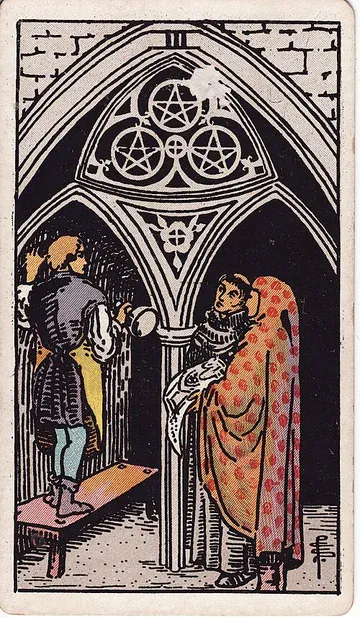
The solo bench meets the collaborative cathedral. When these two cards arrive together, the apprentice has been invited into the guild. The work that was private has become a contribution to a larger structure. This combination shows up in spreads about a job that deepens into mentorship, about a creative practice that finds its first real audience, about the moment a freelancer stops being alone with the craft and joins a working community of peers. The instruction is to bring the bench into the room without abandoning the bench. The depth that you developed alone is what you have to offer the collective.
Eight of Pentacles + Nine of Pentacles
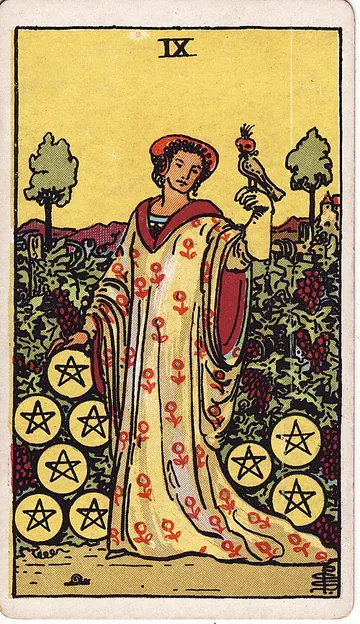
The apprentice arc completing into the harvest. When the Eight and the Nine arrive together, the long discipline has produced the walled garden. The work that was unwitnessed has yielded — independence, financial peace, mastery enjoyed in solitude. This is the combination of the freelancer who has finally built the practice that pays, the creator whose body of work supports the next decade, the seeker whose patient saving has produced the buffer that buys real choice. Receive the harvest. Do not close the workshop. The bench is what produced the garden, and the bench is what continues to feed it.
Eight of Pentacles + The Hierophant
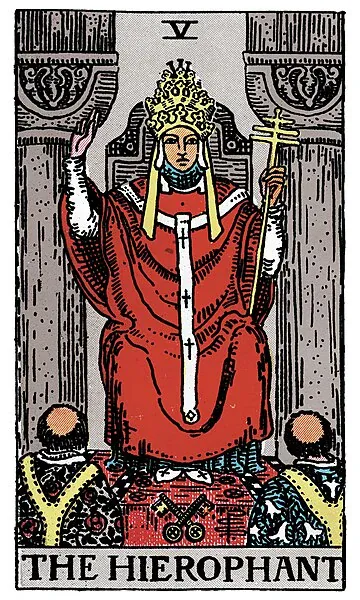
The apprentice meeting the master. The Hierophant is sanctified tradition, the lineage, the teacher who carries something the books do not. When the Hierophant arrives next to the Eight of Pentacles, the seeker is being asked to find a teacher — not an internet teacher, not a content teacher, an actual human being who has practiced longer than you have and can show you the part of the craft that does not transmit through writing. The combination supports formal apprenticeship: the program, the fellowship, the long study under one mentor. The lineage is the difference between a seeker who reinvents the wheel privately and a seeker who inherits two thousand years of accumulated practice.
Eight of Pentacles + The World
The long apprenticeship completing into mastery. The World is integration, completion, the closed circle that has finally come around. When it arrives next to the Eight of Pentacles, the body of work has matured into something whole. The practice has become the practitioner. The seeker is no longer apprenticing; they have, quietly, become the thing they were apprenticing toward. This combination is rare and powerful — most seekers do not stay at the bench long enough to draw it. When you do, the card asks for a graceful pause. Acknowledge the completion. Then, eventually, find the next bench. The World is not the end of practice; it is the beginning of the next, deeper apprenticeship.
Eight of Pentacles + Eight of Wands
The slow bench beside the swift arrows. This is one of the deck's stranger pairings — two cards of the same number, with opposite tempos. The Eight of Pentacles is the year of slow repetition; the Eight of Wands is the week of rapid forward motion. When they appear together, the seeker is being asked to alternate registers. There is a time to sit at the bench, and there is a time to release what has been built into the world. The mistake is to confuse them. The seeker who launches before the practice is mature has nothing to launch; the seeker who never launches has nothing to show for the practice. The combination teaches the rhythm: long bench, then arrows, then long bench again.
Eight of Pentacles + Seven of Cups
The bench beside the cloud of cups. The Seven of Cups is the spread of glittering options — seven possible lives, each plausible, none of them handled. Set against a craftsman who has picked up one piece of metal and is working it, the contrast is almost unkind and entirely useful. This pairing turns up for the seeker with eleven open tabs of courses they might take, six half-started projects, three cities they might move to, and nothing at all hanging on the post behind them. The instruction is not to identify the best option; the card knows there is rarely a best. The instruction is to take any one of them seriously enough to work it for a season. Cups evaporate when looked at directly. Metal does not.
Card Combinations
Three of Pentacles
The solo bench meets the collaborative cathedral. Apprenticeship invited into the guild — work that was private becoming a contribution to a larger structure. The depth developed alone is what the seeker has to offer the collective. Bring the bench into the room without abandoning the bench.
Nine of Pentacles
The apprentice arc completing into the harvest. The long discipline has produced the walled garden — financial peace, mastery enjoyed in solitude, the body of work that supports the next decade. Receive the harvest. Do not close the workshop. The bench is what produced the garden, and the bench is what continues to feed it.
The Hierophant
The apprentice meeting the master. The Hierophant offers the lineage — not internet teaching but a human being who has practiced longer than you have and can show you what the books cannot transmit. The combination supports formal apprenticeship: program, fellowship, long study under one mentor. Inheriting two thousand years of accumulated practice rather than reinventing the wheel privately.
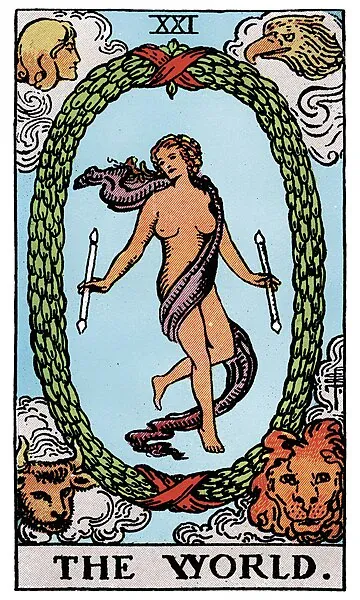
The World
The long apprenticeship completing into mastery. The body of work has matured into something whole; the practitioner has, quietly, become the thing they were apprenticing toward. A rare and powerful pairing — most seekers do not stay at the bench long enough to draw it. Acknowledge the completion, then find the next bench. The World is the beginning of the next, deeper apprenticeship.
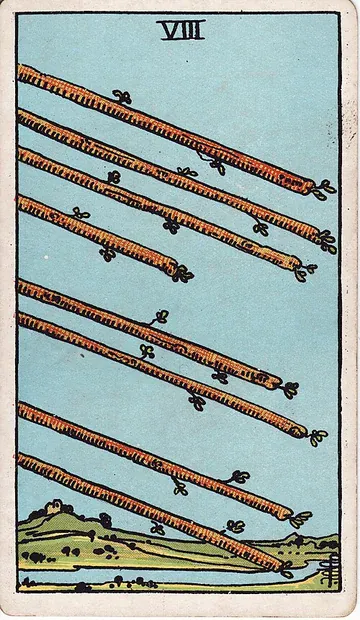
Eight of Wands
The slow bench beside the swift arrows. Same number, opposite tempo. There is a time to sit at the bench, and a time to release what has been built into the world. The mistake is to confuse them. The seeker who launches before the practice is mature has nothing to launch; the seeker who never launches has nothing to show. The combination teaches the rhythm.
Frequently Asked Questions
What is the Eight of Pentacles meaning in tarot?
The Eight of Pentacles meaning centers on apprenticeship, disciplined repetition, and absorbed practice. The card depicts a craftsman hammering pentacles one at a time at a workbench — six finished pieces hung on the post behind him, the current piece on the bench, the next at his foot. It describes a season of skill-building where the work itself is the teacher, and progress accumulates through patient repetition rather than dramatic breakthroughs.
Does the Eight of Pentacles say yes if I am willing to put in the hours?
The Eight of Pentacles is a conditional yes — yes, if you are willing to do the work. The card affirms paths, projects, and relationships that involve genuine apprenticeship and disciplined repetition. It does not deliver fast, dramatic outcomes; it delivers durable ones. For binary questions, treat it as a working yes that asks you to count the pieces you have already finished and to keep showing up at the bench.
Does the Eight of Pentacles mean a relationship is work rather than chemistry?
In Eight of Pentacles love readings, the card describes the relationship as practice — the slow, deliberate accumulation of small attentions that, repeated, become a shared life. It honors the unglamorous middle: the dishes, the texts, the daily check-ins. For partnerships, it confirms the maintenance is the bond. For new sparks, it suggests someone willing to learn you. For singles, it asks whether you are willing to apprentice in the craft of being with another person.
If they never say it, how does the Eight of Pentacles show what someone feels?
When the Eight of Pentacles appears as someone's feelings, they are focused, deliberate, and quietly invested. They express affection through small consistent maintenance — remembering details, showing up reliably, doing rather than declaring. Read silence as concentration, not absence. They are not playing it cool; they are temperamentally inclined to express feeling through observed care. Watch what they do, not what they say. The feelings are real and the feelings are working.
Does the Eight of Pentacles mean belief follows practice rather than the other way round?
The spiritual lesson of the Eight of Pentacles is practice as path. Belief follows repetition; the seeker who sits at the bench every morning develops a relationship to the practice that no reading or revelation can replicate. The card sits in Hod within Assiah — Splendor expressed in form, the gathering of inspiration into a teachable structure. Pick a practice. Do it for ninety days. The card responds to consistency the way metal responds to the hammer.
Continue Reading
Eight of Pentacles · Card overview · symbols · correspondences →
Return to the full card view — image, symbols, sensory correspondences, and Hermetic axes.
Read the reversed meaning →
Read the same depth on the opposite orientation.
Draw your reading now →
Bring this card to a question — open a quiet ritual.