
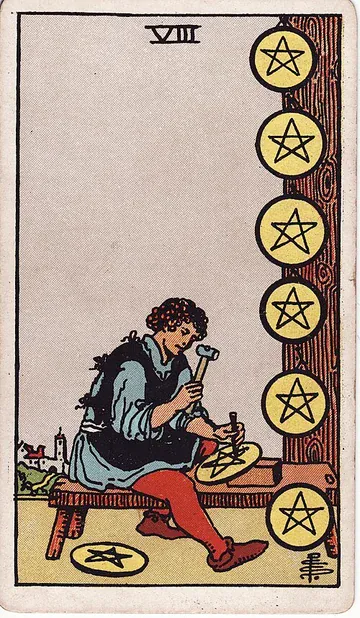
Eight of Pentacles Reversed · Core Meaning
The Eight of Pentacles reversed meaning describes the craft that has become a hiding place. The same craftsman is at the same bench, hammer still ringing, eyes still down — but the room around him has changed. The post behind his back is empty, or it is overcrowded with pieces that look identical. The current piece on the bench has been refined past the point of usefulness; the same detail has been worked, then worked again, then re-worked, and the whole has slipped quietly out of shape. The eighth piece at his foot has not moved in months. The town beyond the road is no longer a place he visits; it is a place he has stopped imagining.
This is the reversed card's central knot: motion without progress. The card describes the seeker who is still working but has forgotten what the work is for. There are two recognizable shapes of the reversed card, and they often overlap.
The first shape is busywork as avoidance. The seeker fills the day with tasks that look like the practice and produce no actual output. Email triage instead of writing. Meetings about the project instead of doing the project. Research instead of drafting. The texture of the day is industrious; the result is hollow. The card warns that the seeker has become attached to the appearance of effort, and the attachment is now interfering with the effort itself.
The second shape is perfectionism as concealment. The seeker is producing real work, but they cannot release it. The piece is never quite finished. There is always one more pass to make. The not-good-enough is, on closer examination, the seeker's strategy for avoiding the moment of exposure that comes when a piece leaves the workshop. The reversed card names this with precision: the craft becomes a fortress against being seen.
The Eight of Pentacles reversed astrological signature inverts the gift of Sun in Virgo's first decan. Upright, the decan's discipline lands each strike where it should fall. Reversed, the discipline becomes obsessive narrowing — the seeker polishes one corner of the work to a high gloss while the rest of the structure has begun to drift. The clarity that was a gift becomes a tunnel. The seeker has lost the wider field.
In the Tree of Life, the reversed card sits uneasily in Hod-Assiah. Hod, properly oriented, gives form to inspiration; reversed, it can become formalism without source. The seeker has the structure but has lost the lightning that the structure was meant to carry. The schematic exists; the thing it was schematic for has been forgotten.
The suit's own weather says the same thing from another side. Earth sits well beside water: a cup in the spread keeps the recipient in view, and the maker remembers who the object is actually for. Earth beside air is where this card goes wrong — the swords-mind falls in love with method, with the system, with the correct way of doing the thing, and the object itself quietly leaves the room. Reversed, the Eight of Pentacles is nearly always earth under too much air. The seeker can describe their process in fine detail. They have a framework for choosing the framework. Ask what the thing in their hands is supposed to do for the person who receives it, and there is a pause. The melancholic temperament that gives this card its patience turns, in that weather, into rumination — thinking about the work wearing the clothes of the work.
Reversed, the Eight of Pentacles asks: what is the thing in your hand still the thing it set out to be? Have you forgotten whom the work is for? Are you hiding in the practice rather than performing it?
There is a third, quieter shape of the reversed card worth naming: the apprenticeship continued past its useful life. The seeker has been at the bench for years; the bench was the right bench at the time; and now, somewhere in the middle of the seventh year, the bench has stopped teaching and the seeker has not noticed. They are still working. They are still producing. They are no longer growing. The card respects the years they spent and asks the question their loyalty has been preventing them from asking: is this still the right bench for me, or have I outgrown it without permitting myself to know?
Eight of Pentacles Reversed · Love & Relationships
In Eight of Pentacles reversed love readings, the card describes the relationship that has become routine in the dull sense. The structure is intact. The daily mechanics are functioning. The right things are being said and done. And yet, sitting at the table together, both partners can feel that the small attentions have stopped being attentions and started being habits performed without the original feeling that made them attentions in the first place.
For an existing partnership, the reversed card most often indicates the polished surface that has lost its interior. The rituals continue — the morning coffee, the evening check-in, the weekend errands done together — and somewhere along the way, the practice stopped being about the other person and started being about the practice. The motions are correct. The motivation has dimmed. The card warns that this is the season the relationship is most vulnerable to the partner who shows up with attention rather than ritual. Not because the new attention is more valuable. Because the old attention has stopped being attention.
For someone in a new connection, the reversed Eight of Pentacles can describe the partner who is going through the motions of dating without yet being present in the connection. They are doing the right things — showing up, texting, remembering details — and yet, in the room together, you can feel the absence of the actual them. They are completing the apprenticeship of dating, not learning you. The card asks for honest evaluation: is this person practicing the relationship, or are they practicing the appearance of one?
When the question is love and the Eight of Pentacles lands reversed, read what is still being maintained and what has quietly stopped being noticed. They are doing the work. The work is not the same as the love. They may be perfecting the role of partner without yet deciding whether they want to be a partner. They may be invested in being seen as a good partner without yet being invested in you. None of this is necessarily malice. Most of it is the seeker's avoidance of the more vulnerable question, which is whether they are willing to be loved imperfectly and to love imperfectly in return.
For the question of reconciliation after a break, the reversed Eight of Pentacles offers a difficult but honest counsel. The relationship that ended did so partly because the practice had become hollow. Returning to it without changing the underlying practice — the way you spoke to each other, the way attention was given and received, the small kindnesses that had stopped being kind — would simply rebuild the hollow shape. The card asks whether you are willing to change the practice itself, not merely to resume it. If yes, return is possible. If no, return is the same exit again.
For the single seeker, the reversed card warns of the apprenticeship of singleness that has hardened into refusal. The seeker has become so good at being alone — so well-furnished, so independent, so practiced at meeting their own needs — that the bench of solo life has become a fortress against the disruption a partner would represent. The apprentice's bench does not judge the craft you have made of your own company. There is real pride in the practice of independence. The card simply notes that the practice is no longer protecting; it is now isolating. The work is to release one cup of the solo discipline. Cook one meal that requires more than one person to eat. Plan one trip that requires another voice in the planning. Make space.
For couples in long marriage, the reversed Eight of Pentacles can describe the tenth or twentieth or thirtieth year of polished competence — the marriage that runs without effort because both partners have memorized their parts. The danger is not crisis; the danger is the slow leaching of presence from the well-oiled machine. The card recommends a deliberate disturbance: a new shared practice, a new shared question, a new shared bench. Not a marriage retreat. A genuine new project. The marriage that recovers from this card recovers through doing something new together.
For someone considering whether to leave a long relationship, the reversed Eight of Pentacles is one of the deck's more cautious advisors. It asks: have you tried changing the practice before considering ending the relationship? The reversed card is often drawn by seekers who are about to walk away from a relationship that has become routine, and the card's question is whether they have actually tried disrupting the routine. If yes, then the leave is honest. If no, the card asks for one season of attempted disruption before the decision.
For a partner you sense is going through the motions, the reversed Eight of Pentacles invites a direct, gentle conversation — not a confrontation, not an ultimatum. Name what you are sensing: that the relationship has stopped being attended to and started being maintained. Ask if they feel it too. The card responds well to the conversation that is willing to disturb the comfortable routine. It does not respond at all to silence around the disturbance.
For long-distance partners, the reversed card warns of the technology stack replacing the relationship. The shared streaming subscription, the synced calendars, the apps for couples — the infrastructure can become the connection rather than the support for it. The card asks for one phone call this week without an agenda. Not a check-in. A real conversation. Most reversed Eight of Pentacles long-distance relationships recover through this single move.
Eight of Pentacles Reversed · As Feelings
The Eight of Pentacles reversed as feelings describes the warmth that has become routine. The other person feels something for you — but the feeling has stopped being attended to. They have stopped studying you. They have stopped refining their understanding. They are running the relationship on a model of who you used to be, and the model has not been updated.
This is the card of the partner who loves the version of you they met three years ago and has not noticed the version of you that is in the room now. They are not lying when they say they care. They simply care about a slightly fictional version, and the fictional version is comfortable to care about because it does not require continuing investigation. The reversed card asks for re-noticing, on both sides. They need to look at you again. You may need to invite them to look.
If they are reserved by nature, the reversed Eight of Pentacles in feelings can mean withdrawn absorption. They are not silent because they are concentrating; they are silent because they are no longer fully here. Their attention has migrated elsewhere — to a project, to a private worry, to a parallel relationship of their own making. The work, which used to be them studying you, has become them studying something else entirely. Read the silence honestly. It is not the same silence as the upright card.
If they are demonstrative, the reversed card warns of performative care. They will text on time. They will say the right phrases. They will remember the anniversaries. And the texture of the affection, when you hold it in your hand, is slightly thinner than it used to be. They are completing the obligations of partnership without inhabiting them. The card is not condemning them. The card is offering precise diagnosis. The cure is not more performance. The cure is presence.
For a partner you have been with a long time, the reversed Eight of Pentacles in feelings often describes settled affection that has stopped being curious. They love you. They have stopped asking who you are becoming. The card describes the marriage where neither partner asks the other what they are reading right now, what is bothering them this season, what they are quietly hoping for. The feelings persist; the attention has lapsed. Re-noticing is the work. New questions. Real ones.
For a new connection, the reversed Eight of Pentacles in feelings can describe someone who is courting the idea of you rather than the actual you. They are going through the motions of pursuit. They are saying the things suitors say. And in the room with you, they are slightly absent — pleased to be there, not yet fully there. The card asks for patience and honesty. They may arrive into actual presence over time. They may not. Watch the trajectory over weeks, not single dates.
For the seeker worried that the other person is losing interest, the reversed Eight of Pentacles arriving as their feelings is a soft confirmation of the worry. They have stopped renewing their investment. They have not yet decided to leave. The relationship is in the in-between state where one partner has stopped attending and the other has not yet named the absence. Name it. Gently. The card responds to the conversation that disturbs the polite silence.
For seekers asking whether the other person is thinking about them, the reversed card answers: less than they used to. The thinking has migrated. They may be thinking about their own life, their own worries, their own next chapter. Their interior has narrowed to a more familiar set of preoccupations. You are not, currently, one of the active preoccupations. This does not mean you are unloved. It means you are not currently being attended to.
There is a version of this that has nothing to do with boredom. Sometimes the other person went to routine because a long season asked them to — a parent who got sick, a year at work that took everything, a depression they have not named to themselves. Their affection became maintenance because maintenance was the only register they had capacity for. The reversed card does not distinguish that from indifference on its own; the seeker has to. The question worth holding is whether the narrowing began when their life got heavy or when your particular presence stopped interesting them. The first has a way back, and it costs mainly patience. The second costs a conversation neither person wants to open.
And one branch this card insists on, uncomfortable as it is to sit inside: sometimes the seeker asking about the other person's feelings is the one who has gone to routine. The card lands in the position marked their feelings and reads, examined closely, like a description of the asker. If you have been running the relationship on a model of who they were when you met, if you could not say what is bothering them this month, if your affection has become a set of reliable behaviors performed toward a person you have stopped studying — the Eight of Pentacles reversed is describing your bench, not theirs.
The Eight of Pentacles reversed as feelings has one specific caution worth naming: the partner who is so absorbed in their own work, their own apprenticeship, their own private bench, that they have stopped emerging from it to meet you. This is sometimes a temporary phase — a deadline, a project, a difficult season — and sometimes a permanent reorientation. Distinguish carefully. The temporary absorption returns. The permanent reorientation does not.
Eight of Pentacles Reversed · Career & Work
Work continues under the reversed Eight of Pentacles; only its purpose has gone missing. The seeker is still at the bench. The hammer is still ringing. And the work, examined closely, is no longer producing what the practice was meant to produce. Either the seeker is in busywork that pretends to be progress, or the seeker is in perfectionism that prevents progress from being shipped.
For someone in a current role, the reversed card asks the hard question: are you still learning here, or are you performing learning? The roles that have stopped teaching but still pay are some of the most insidious traps in a working life. The skills you developed in year one have been ossified. The skills you should have developed in year five have not arrived. The institution likes you. The institution is not investing in you. The card asks for honest assessment: when did you last actually learn something at work? If the answer is two years ago, the bench has become a chair, and the chair is gradually holding you in place.
For someone considering a new role, the reversed Eight of Pentacles offers a different warning. The new role you are considering may also be the wrong bench — not because the role itself is bad, but because you are choosing it for the wrong reason. If the move is motivated by a flight from boredom rather than a draw toward genuine new craft, the reversed card warns: the next role will produce the same boredom in eighteen months, because the issue is your relationship to apprenticeship, not your specific role. Address the relationship before changing the role.
For entrepreneurs and freelancers, the reversed card is particularly precise. The independent maker has no manager to detect the pivot from craft to busywork. The reversed Eight of Pentacles often arrives in the second or third year of the business, when the original drive has been replaced by the maintenance of the operation. The seeker is now spending most of their time on tasks that are not the craft — invoicing, marketing, operations, social media, customer service — and the craft itself has become a smaller and smaller share of the actual hours. The card asks: how many hours this week were spent on the work itself, as opposed to the structure around the work? The answer is often shocking. The cure is structural redesign, not more discipline.
For a creative practice, the reversed Eight of Pentacles can describe the perfectionism that prevents the work from being released. The novel that has been edited for seven years. The album that is almost ready to mix. The painting series that needs one more piece before the show. In each case, the work has long since reached the level where releasing it would teach the seeker more than continuing to refine it would. The card asks: what would it cost to ship this? The honest answer is usually about the seeker's fear of being seen rather than about the actual quality of the work.
For someone facing a layoff or restructuring, the reversed card offers an honest mirror. The skills you built at the previous role were specific to that role. The new market may not value them. The card warns against the assumption that the apprenticeship transfers cleanly. Some of it will. Some of it will not. The seeker who is willing to apprentice again — to start over at a new bench rather than insisting their previous bench should have been honored — is the seeker who recovers fastest.
For middle-career seekers, the reversed Eight of Pentacles can describe the plateau that has hardened into stagnation. The early career produced visible growth. The middle career has produced visible stability. The card asks: when did the visible growth last happen? If the answer is more than three years ago, the seeker has been at a polished plateau, and the polished plateau is, in this card's vocabulary, the perfectionism shape — the seeker has refined their existing role without yet reaching for the next one.
For seekers considering further education or a credential, the reversed card asks careful questions. Is the program a genuine new apprenticeship, or is it a credential to add to the existing identity? The genuine apprenticeship is supported by the card. The credential as ornament is the reversed shape — work that looks like progress without actually changing what the seeker is capable of.
For someone whose work has been quietly underperforming and they are not sure why, the reversed Eight of Pentacles often diagnoses a particular trap: refining the corner of the work that they enjoy refining, while the parts of the work that they avoid have begun to drift. The salesperson who avoids cold calls but perfects their CRM. The writer who avoids submission but refines drafts. The consultant who avoids billing but perfects the deck. The card asks: what part of the work have you been avoiding? Address that.
A particular version of the reversed card shows up for the newly promoted. The seeker was good at the craft — that is why they were moved — and the new job is not the craft. It is scheduling, hiring, unblocking, holding a standard while other people's hands do the making. So they keep slipping back to the old bench: rewriting the junior's work at midnight, redoing the document before the meeting, taking the difficult account back rather than teaching anyone to hold it. It has the texture of excellence and the function of avoidance, and the team learns quickly that whatever they make will be remade. The card asks the newly promoted seeker to grieve the old bench honestly, out loud, to someone — and then to accept that the new craft is the building of other craftsmen. Hod gives form so that form can be handed on. Handing it on is now the work.
Eight of Pentacles Reversed · Money & Finances
Input and return have come apart, which is the reversed Eight of Pentacles' financial signature. The hours are being put in. The work is being done. And the financial outcome, measured honestly, is not corresponding to the input. Either the seeker is overworking for an underpaying situation, or the seeker is overspending on tools and infrastructure that were supposed to enable the work but have started to consume it.
For someone working hard and not getting ahead financially, the reversed card asks: where is the money actually going? The seeker who works sixty hours and saves nothing is not failing at discipline. They are succeeding at a system that is not designed to compensate them. The card recommends honest accounting before another month of effort. Sometimes the answer is to negotiate the rate. Sometimes the answer is to leave. Sometimes the answer is to fix a fundamental imbalance in lifestyle that the income cannot support.
For freelancers and self-employed seekers, the reversed Eight of Pentacles often diagnoses the trap of the cheap rate. The seeker has set their pricing based on insecurity rather than on the value of the work. They are working at apprentice rates after years of practice. They are subsidizing clients who could afford to pay more. The card asks for a hard look at pricing. Most freelancers under this card are charging at least thirty percent below what their work merits, and the thirty percent gap is where their financial peace has gone.
For someone investing in tools, software, equipment, or infrastructure for their craft, the reversed card warns of escalating overhead. The new computer was useful. The new microphone was useful. The new app, the new course, the new certification — at some point, the spending on the practice exceeded what the practice can return. The card recommends a moratorium. Use what you have for ninety days. Resist the new tool. The reversed card often arrives when the seeker has confused the purchase of the practice with the practice itself.
For someone in financial recovery, the reversed Eight of Pentacles can describe the difficult phase where the disciplined paydown plan has stopped feeling like progress. The numbers are moving in the right direction; the felt experience is exhaustion. The card warns that the seeker can abandon the plan in this phase out of impatience, at exactly the wrong moment. Continue. The card respects the unglamorous middle of the recovery. Most plans abandoned in this phase produce relapse into the original financial trouble.
For questions about whether to make a major purchase, the reversed card answers cautiously. The purchase you are considering may be a substitution for the work itself. The new course will not write the book; the new equipment will not produce the work; the new home office will not generate the income. The card asks: what would you do today if you could not buy anything? Most seekers know. The buying has become the avoidance.
For investments and speculative moves, the reversed Eight of Pentacles is conservative. The card prefers the slow durable accumulation to the fast risky bet. If you are tempted toward speculation under this card, the temptation is usually a symptom — boredom with the slow practice, frustration with the slow return — rather than a real opportunity. Wait. The temptation passes. The discipline stays.
For windfall — bonus, inheritance, unexpected gift — the reversed Eight of Pentacles warns of the equipment trap. The seeker receives money and immediately upgrades the tools, the workspace, the gear, the infrastructure. The upgrade does not produce more output. The output stays the same; the overhead has gone up. The card recommends a deliberate pause: receive the windfall, do nothing for ninety days, then make the spending decisions slowly. Most windfalls evaporate not through dramatic spending but through small upgrade decisions made in the first month.
For someone whose income has plateaued despite years of effort, the reversed card recommends one of two structural moves: either change the price (raise rates, switch employers, negotiate) or change the practice (build a second income stream, develop a productized version of the service, find leverage). Continued effort at the current price and structure produces continued plateau. The card respects the effort. The card also names that effort alone is not the whole equation.
Eight of Pentacles Reversed · Health
The bench collects its toll in the reversed Eight of Pentacles — from the hands, the eyes, the upper back. The discipline that built the body in apprentice years has continued past the point where the body could absorb it. The hands ache. The eyes strain. The upper back has become permanently rounded. The seeker has confused continuing the practice with respecting the practice, and the body is paying the difference.
For someone whose work involves repetitive physical effort — manual labor, athletic training, screen-based attention — the reversed card warns of the chronic injury that has been quietly accumulating. The wrist that hurts in the morning. The shoulder that no longer moves the way it used to. The hip that catches on a particular angle. The card asks: when did you last see a practitioner? When did you last actually rest? Most seekers under this card have been ignoring early signals for a long time, and the signals do not get quieter; they get louder until they are unignorable. Address them before they become unignorable.
For someone managing a chronic condition, the reversed card can describe the discipline that has lost its discernment. The seeker is taking the medication, but they are also white-knuckling through symptoms that warrant rest. They are doing the physical therapy, but they are also pushing past the protocol. The card asks for re-engagement with the body's actual signals, not the protocol's idealized version of them. Some days, rest is the discipline. The reversed card respects that.
For acute issues — injury, infection, surgery — the reversed card warns against returning to practice too soon. The body is not metal; the body does not respond to the same hammer used on metal. The seeker who returns to the gym, to the run, to the screen, before the body has actually healed, often reinjures and extends the recovery by months. The card respects patience here. The bench will be there when you can return to it.
For mental health, the reversed Eight of Pentacles often describes the practice that has become a source of additional stress. The journaling that has become an obligation. The meditation that has become a chore. The therapy session attended without engagement. The card asks: is the practice still serving the practitioner, or has the practitioner become servant to the practice? The cure is not necessarily abandoning the practice. The cure is renegotiating the relationship — fewer sessions, different format, real rest, honest conversation with the practitioner about what is and is not working.
For someone in burnout, the reversed Eight of Pentacles is one of the more diagnostic cards. The seeker has been at the bench for too long without lifting their eyes. The work is no longer producing satisfaction. The body is no longer producing energy. The mind is no longer producing the focus that the work requires. The card recommends a real pause — not a vacation that turns into more work, but a season of fallow. The fallow is part of the practice, not its absence. Most seekers under this card resist the fallow until it is forced on them. The earlier you take it, the shorter it needs to be.
For someone managing addictive or compulsive behaviors that grew from disciplined practices — over-exercise, restrictive eating, work compulsion — the reversed card names the territory honestly. The discipline that began as care has tipped into harm. The card recommends professional support and a willingness to release the discipline that has become disordered. The card can say the discipline has tipped; only a clinician can give medical advice about where it has tipped to. The card describes a felt season; the practitioners are the ones who help you navigate it. Keep your practitioners. Take their counsel.
For seekers whose self-care has become another performance, the reversed Eight of Pentacles invites a quiet question: who is the self-care for? If the answer is the audience that watches the seeker's wellness routine, the practice has become reversed. The cure is private practice. Things you do for yourself that no one ever sees. The card most reliably returns to upright through unwitnessed care.
Eight of Pentacles Reversed · Spirituality
Reversed, the Eight of Pentacles finds a discipline built so well that it now keeps out the thing it was built to reach. The seeker has built a beautiful structure — the daily sit, the weekly group, the monthly retreat, the annual pilgrimage. And inside the structure, the original encounter has gone quiet. The form remains. The lightning that used to strike the form has not visited in some time.
This is the spiritual seeker who has memorized the technique and forgotten the question. The discipline of the practice has replaced the relationship with what the practice was meant to open. The reversed card is gentle about this; most serious practitioners pass through this season at least once. The work is not to feel ashamed but to notice the substitution and respond to it.
For someone in active practice, the reversed card asks: when did you last surprise yourself in the practice? When did the sit produce something you did not expect? When did the journal write something the seeker did not know they were going to write? If the practice has become predictable in this way for a long stretch, the reversed card recommends disturbance. New teacher. New form. New question. The old practice will return, deepened, after the disturbance.
For someone exploring belief, the reversed Eight of Pentacles warns against the collection of frameworks. The seeker who has read every tradition, attended every kind of service, taken every course on contemplation, is sometimes the seeker who is most carefully avoiding the actual encounter the traditions are pointing toward. The card recommends choosing one tradition and going deep for a year, rather than another year of comparative breadth. Most seekers under this card have been broad too long.
The card's spiritual caution is the cultivation of merit. The Eight of Pentacles, upright, respects discipline. Reversed, the discipline can become a way of accumulating spiritual credit — the seeker who is proud of their meditation hours, the seeker who can describe their practice with technical precision, the seeker whose interior life has become a project to manage rather than a relationship to inhabit. The card warns that merit-counting is the inversion of practice. Real practice is unmonitored. Real practice does not keep score.
For questions about path, the reversed Eight of Pentacles asks whether the seeker has confused the practice with the destination. The practice was always a vehicle. If the practice has become the destination — if the practitioner is now invested in remaining a practitioner, in identifying as one, in defending the practice from criticism — the vehicle has become a place to live. The card recommends a willingness to release the practice if the practice has stopped delivering. Most practices, examined honestly, are due for a renegotiation every five to seven years. The seeker who refuses the renegotiation is the seeker the reversed card describes.
A small practice when this card appears: skip a session of your discipline, deliberately. Not because you cannot do it. Because you are choosing not to. Notice what arises in the absence. The reversed card most reliably returns to upright when the practitioner discovers that the practice was a tool, not a self — and that the self continues to exist when the tool is set down.
For seekers whose spiritual life has become a content-consumption habit — books, talks, podcasts, retreats — without actual change in their lived life, the reversed card is direct. Stop consuming. Practice. The library, the streaming service, the conference circuit, are not the path. They are the simulation of the path. The path is the actual sit, the actual silence, the actual encounter with the world. Return to it.
Eight of Pentacles Reversed · Yes or No
Technically yes — and the wrong bench to give a year to.
The Eight of Pentacles reversed yes or no answer is rarely a clean refusal. It is more often the answer that keeps you working on something that has stopped repaying the work. The card describes the path that technically continues, that you can keep walking, that will not actively reject you — and that, six months from now, will not have produced what the work was meant to produce.
For yes-or-no questions about a current job, project, or commitment, the reversed card answers: technically yes, you can continue, but the continuation is not the same as the right answer. The path is not closing. The path is also not delivering. The card asks for honest examination: are you continuing because the work is still teaching, or because leaving feels like admitting the previous time was wasted?
For yes-or-no questions about a relationship, the reversed card warns of the comfortable yes. Yes, you can keep this relationship. Yes, both of you may continue. And six months on, the same question waits underneath, with the same hollow. The reversed card is not necessarily an instruction to leave. It is an instruction to disturb. If the relationship can survive disturbance, the relationship is real. If the relationship can only survive routine, the routine has become a substitute for the relationship.
For binary decisions about whether to act, the reversed Eight of Pentacles asks whether the action would be a continuation of avoidance or a genuine new strike. Sending the same message you have sent before, hoping for a different response, is the reversed card's shape. Doing the same work one more time, hoping the work will start producing differently, is the reversed card's shape. The card asks for either a different action or a deliberate pause — not for more of the same.
For questions about a perfectionism-related decision — should I release the work, should I show the piece, should I publish — the reversed card answers yes, with unusual force. Yes, ship it. The work has been ready for some time. The continued refinement is no longer producing improvement; it is producing avoidance. The exposure that releasing the work will produce is not catastrophic. It is the missing element of the practice. Ship it.
For questions about a busywork-related decision — should I keep doing this task, should I keep working on this project, should I keep optimizing this system — the reversed card answers no. The task is not delivering. Stop. Direct the energy to what actually moves the work forward.
On how soon the bench work pays, the reversed card answers: not soon, and possibly not at all on the current trajectory. The seeker can keep waiting at the bench for a delivery that the bench is not built to produce. The card recommends honest reassessment: what is actually achievable from this position, and what would require a position change?
For binary decisions about whether to leave — a job, a relationship, a city, a practice — the reversed card is more decisive than the upright. The reversed card more often supports leaving than the upright does. Not because leaving is easy, but because the alternative — continuing to apprentice at a bench that has stopped teaching — is the slower form of the same loss. Leave with care. Leave with respect for what the bench taught you. Then build the next bench.
If the question was: should I keep trying? The reversed card answers: stop trying. Start evaluating. The trying has become its own substitute for the result. Look honestly at what the trying has produced. Decide based on the evidence, not on the loyalty.
Eight of Pentacles Reversed · Advice
Lift your eyes off the bench — the Eight of Pentacles reversed asks that before it asks anything else. Whatever the seeker has been working on, the card asks them to step back from the bench and look at what has accumulated and what has drifted. The seeker who is too close to the work has lost the wider field. The advice is not to stop the work. The advice is to verify, briefly, that the work is still the work it was meant to be.
If there is one specific instruction the reversed card offers, it is to ship the next thing in its current state. Not perfect. Not finished. Good enough to leave the workshop. The reversed card describes the seeker who has confused continued refinement with continued progress, and the antidote is the act of release. The piece you have been polishing for the last three months — send it out today. Not after one more pass. Today.
A second instruction: audit your hours. Not to count them moralistically, but to see what they have actually been spent on. The seeker under this card is often surprised — sometimes shocked — to discover that the hours they thought were going to the work were going to busywork around the work. The audit is not punishment. The audit is the lifting of the eyes. Once the seeker can see where the time is going, the redirect is straightforward.
A third instruction: name what you are avoiding. The reversed card almost always indicates a specific avoidance — a part of the work, a conversation, a decision, a confrontation — that the seeker has been working around for some time. The work-around has become elaborate. The work-around may even be impressive. And the avoided thing has become more, not less, costly to address. Name it. To yourself, if not yet to anyone else. The reversed card responds to the naming.
A fourth instruction: reduce the perimeter of the practice. Most reversed Eight of Pentacles seekers are doing too much. Too many tools. Too many platforms. Too many side projects. Too many concurrent commitments. The card recommends compression. Pick the one or two practices that are actually delivering and let the rest fall away for a season. The seeker is rarely punished for the things they let go. The seeker is consistently punished for the things they tried to keep going past their useful life.
A fifth instruction, gentler than the others: forgive yourself for the perfectionism. Most serious practitioners have a phase under this card. The phase is not a moral failing. It is a developmental moment in the apprenticeship — the moment when the seeker has gotten good enough to see the gap between their current work and the work they could imagine, and the gap has produced paralysis. The card invites the seeker to ship anyway, and to trust that the next piece will close some of the gap that this piece could not close. The seeker who refuses to ship until they can fully close the gap never ships.
A sixth instruction: consult someone outside the workshop. The reversed Eight of Pentacles describes a seeker who has been working alone with their own judgment for too long. Other people — trusted ones, in the same craft or in adjacent ones — can see what the seeker has stopped being able to see. Send the work to one trusted reader. Ask for the honest reaction. Not the encouragement. The reaction. The card responds to external mirrors when the internal mirror has fogged over.
For someone whose work has become hollow but who is afraid to disturb the hollow because the hollow at least pays the bills: the reversed card respects the fear. The card does not recommend recklessness. The card recommends one small disturbance per week, sustained over a season. A new question asked of the work. A new tool tried. A new conversation started. Disturbance does not require crisis. Disturbance can be quiet, sustained, and, over time, transformative.
Practical advice for the day the card appears: ship one thing today, in its current state, and notice what happens. Not the most important thing. Something small that you have been holding longer than you should have. The note to send. The piece to publish. The application to file. Send it. Then notice the relief that arrives — and notice how the relief was not available while the holding continued.
Eight of Pentacles Reversed · Card Combinations
The reversed Eight of Pentacles rarely changes what the card beside it means. It changes what the seeker is doing with it. Next to almost anything, the reversed Eight supplies the same figure — a pair of hands that will not open — and the neighboring card names what is being withheld from: the workshop of peers, the harvest, the teacher, the ending, the launch window. Read the pairings below as variations on one grip, each one showing a different thing on the other side of the closed hand.
Eight of Pentacles Reversed + Three of Pentacles
The hidden craft refusing the collaboration. When the reversed Eight meets the Three, the seeker has work that could be deepened by inclusion in a community of practitioners and is keeping the work private out of perfectionism or fear. The card pair recommends: accept the invitation, join the workshop, show the unfinished pieces. The community will not judge what the seeker has been judging in solitude. Most reversed Eight seekers under-estimate what other practitioners will see in their work; the under-estimation is itself part of the reversed shape.
Eight of Pentacles Reversed + Nine of Pentacles
The apprenticeship that has stopped teaching, beside the harvest that has not yet arrived. When this pairing appears, the seeker is at risk of mistaking the absence of the harvest for evidence that the apprenticeship has been wasted. The card pair counsels honest assessment: either the practice needs to be changed (because it is no longer producing), or the practice needs to be continued (because the harvest is closer than the seeker can see), and the seeker is conflating the two. Outside counsel — a teacher, a peer, a mentor — is necessary to disambiguate.
Eight of Pentacles Reversed + The Hierophant
The apprentice refusing the master. When the Hierophant arrives next to the reversed Eight, the seeker has been offered guidance and has declined it — preferring the privacy of their own bench to the discomfort of being taught. The card pair recommends accepting the lineage. The work that the seeker is doing alone has been done before, by people who can shorten the seeker's path significantly. The pride of solo apprenticeship can become the trap of solo apprenticeship. Find the teacher. Submit, briefly, to the lineage. Resume the bench afterward, deepened.
Eight of Pentacles Reversed + The World
The completion that is being refused. The World wants to land. The reversed Eight is preventing it from landing by insisting the work is not yet ready. This is the artist who will not exhibit, the writer who will not publish, the practitioner who will not graduate, the apprentice who will not leave the apprenticeship. The card pair is precise: the work is ready. The reluctance is the seeker's, not the work's. Permit the completion. The next chapter requires the closure of this one.
Eight of Pentacles Reversed + Eight of Wands
The slow bench refusing the swift arrows. When these two cards appear together, the seeker has work that is ready to launch and is refusing to launch — and the world is offering the launch window precisely now. Eight of Wands is the moment of release; the reversed Eight of Pentacles is the seeker's hand still gripped on the piece. The card pair offers a single instruction: let go. The arrows will travel further than the seeker can imagine, and the seeker cannot accompany them. The work has its own life. Permit it.
Eight of Pentacles Reversed + Four of Pentacles
Two kinds of holding on, reinforcing each other. The Four of Pentacles is the seated figure clutching one coin to the chest, another balanced on the crown, one under each foot — everything kept, nothing circulating. Beside the reversed Eight, the grip stops being about money and becomes about work: the files never shared, the method never written down, the draft never shown, the skill hoarded because being the only person who can do the thing feels like safety. From outside it looks like diligence. From inside it is the fear of being replaceable. The pair asks for one deliberate act of circulation this month — teach the process to a colleague, hand a real piece of the work to someone else, write down the method and give it away. Nothing released here reduces what the seeker has. A craft is not a coin; it is the one thing that grows in the giving.
Card Combinations
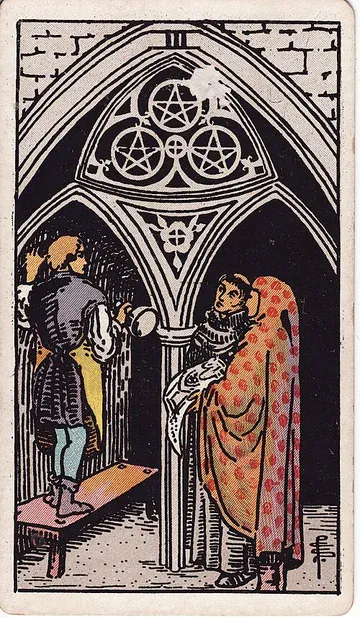
Three of Pentacles
The solo bench meets the collaborative cathedral. Apprenticeship invited into the guild — work that was private becoming a contribution to a larger structure. The depth developed alone is what the seeker has to offer the collective. Bring the bench into the room without abandoning the bench.

Nine of Pentacles
The apprentice arc completing into the harvest. The long discipline has produced the walled garden — financial peace, mastery enjoyed in solitude, the body of work that supports the next decade. Receive the harvest. Do not close the workshop. The bench is what produced the garden, and the bench is what continues to feed it.

The Hierophant
The apprentice meeting the master. The Hierophant offers the lineage — not internet teaching but a human being who has practiced longer than you have and can show you what the books cannot transmit. The combination supports formal apprenticeship: program, fellowship, long study under one mentor. Inheriting two thousand years of accumulated practice rather than reinventing the wheel privately.

The World
The long apprenticeship completing into mastery. The body of work has matured into something whole; the practitioner has, quietly, become the thing they were apprenticing toward. A rare and powerful pairing — most seekers do not stay at the bench long enough to draw it. Acknowledge the completion, then find the next bench. The World is the beginning of the next, deeper apprenticeship.
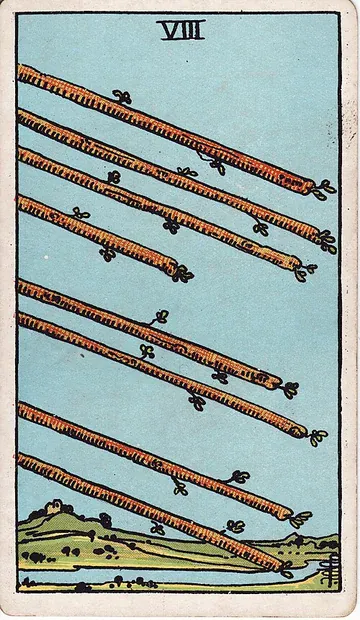
Eight of Wands
The slow bench beside the swift arrows. Same number, opposite tempo. There is a time to sit at the bench, and a time to release what has been built into the world. The mistake is to confuse them. The seeker who launches before the practice is mature has nothing to launch; the seeker who never launches has nothing to show. The combination teaches the rhythm.
Frequently Asked Questions
Is the Eight of Pentacles reversed telling me to leave the bench?
The Eight of Pentacles reversed is rarely a clean no — it is more often a soft caution against continuing on the current trajectory. Treat it as: technically yes, you can continue, but the continuation is not the same as the right answer. The card asks for honest reassessment. Sometimes the answer is to ship what you have been holding; sometimes the answer is to leave the bench that has stopped teaching.
Does the Eight of Pentacles reversed mean the relationship has gone onto autopilot?
Reversed in love readings, the Eight of Pentacles describes routine that has lost its presence — the small attentions still happening but no longer being attended to. For partnerships, it warns of polished surface without interior. For new connections, it can describe someone going through the motions of dating without yet being present. For singles, it suggests independence that has hardened into refusal. The work is to disturb the routine deliberately and see what is still alive underneath.
With the Eight of Pentacles reversed, do they love me or the version of me they learned years ago?
When the Eight of Pentacles reversed appears as feelings, the warmth is real but routine has replaced attention. They love the version of you they met, and they have not noticed the version in the room now. They are running the relationship on an outdated model. Read it as care without curiosity. The feelings have not died; the noticing has lapsed. Re-noticing — on both sides — is the work.
What are the two traps hidden inside the Eight of Pentacles reversed?
Two related traps. First, busywork as avoidance: filling the day with tasks that look like the practice and produce no actual output. Second, perfectionism as concealment: refining work past the point where refinement helps, to avoid the moment of release. Both are the craft becoming a hiding place. The card asks the seeker to lift their eyes from the bench, audit their hours, and ship the next thing in its current state.
How do I get off the bench the Eight of Pentacles reversed has me stuck at?
Lift your eyes. Ship one thing today in its current state, even if it is not perfect. Audit what your hours have actually been spent on. Name what you have been avoiding. Reduce the perimeter of the practice — fewer tools, fewer platforms, fewer concurrent commitments. Consult someone outside the workshop. The reversed card responds to disturbance, exposure, and external mirrors. Most reversed Eight of Pentacles seekers recover through the act of release rather than through more discipline.
Continue Reading
Eight of Pentacles · Card overview · symbols · correspondences →
Return to the full card view — image, symbols, sensory correspondences, and Hermetic axes.
Read the upright meaning →
Read the same depth on the opposite orientation.
Draw your reading now →
Bring this card to a question — open a quiet ritual.