
Eight of Swords · Core Meaning
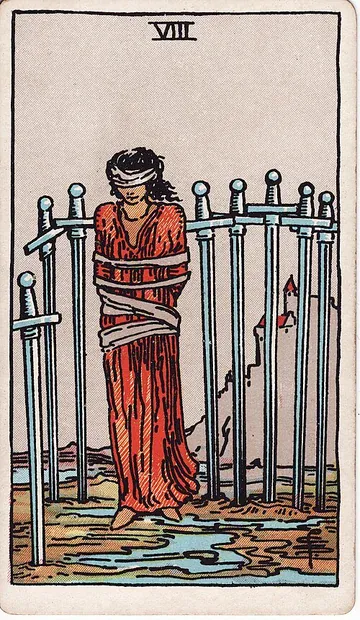
A cage with no lock is still, for a while, a cage. A woman stands alone in marshland, loosely wound in white cloth, her eyes covered by another strip. Eight long swords are planted in the mud around her. Most readings describe a closed ring, but a careful look at the Rider-Waite-Smith image shows the formation is not closed at all — there are gaps before her and gaps behind her. The cloth around her body is not knotted. No guard stands beside her. The castle on the far hill is the only other figure in the scene, and it is silent.
What imprisons her is the blindfold and the feet that have not stepped. That is the card's signature tension: a cage made of attention, held in place by the eyes that refuse to look. The Eight of Swords is the moment a person locates the prison inside their own simulation of the prison. The mind has rehearsed every exit as a disaster. The body, taking the rehearsal as fact, has stopped moving. The cold water rises an inch above her feet, a quiet reminder that stillness, too, costs something.
The traditional astrological signature reinforces this reading. The card belongs to Jupiter in the first decan of Gemini — May 21 through May 31 — and the placement is precisely the wrong one. Jupiter wants expansion; Gemini doubles the mind into branching pathways; the first decan of Gemini sets the doubling at its sharpest pitch. Expansion meeting the twin-minded faculty produces a thinking that branches enough to exhaust every failure scenario, leaving no strength for the first step. The decan is not unlucky. It is overactive. The intellect is doing too much work and the body is doing none.
In the Tree of Life, the card sits at Hod in Yetzirah — the sphere of logic and structure on the formative plane. Hod is where rules refine themselves until they become beautiful. The shadow side of Hod is when the rules become so refined that they begin to treat themselves as dwelling. The seeker has built a structure for thinking about the problem. The structure has become the problem. The Eight of Swords describes the precise moment a careful mind realizes the carefulness has become the cage.
Read this card the way you would read a photograph of someone the morning they woke up and did not get out of bed. The reasons they gave themselves for staying still were good ones. They were also the bars. The picture itself is neutral — the figure is standing, the swords are around her, the castle watches from the hill. The tension is whether the figure recognizes that she is the one who has tightened the cloth, lowered the blindfold, and counted only the obstacles instead of the openings.
Eight of Swords · Love & Relationships
The relationship has become a story you keep telling yourself instead of one you keep living. The bond is not actually closed. The cloth that seems to bind you to a stuck shape is not knotted. What is paralyzing you is the inner script — the long inventory of reasons it cannot work, will not change, must not be touched — and the blindfold you lower over your own eyes each time the actual door comes into view.
For an existing partnership in a difficult season, the Eight of Swords arrives as a specific kind of warning. The marriage has not become unbearable from the outside; the in-laws are not the saboteurs; the calendar is not the enemy. What has happened is that you have rehearsed the difficult conversation so many times in your head that the rehearsal has become the conversation. The actual partner is sitting two rooms away while you have, in your interior, already broken up with them, made up with them, broken up again, and decided it is too late. None of that has happened in the air between you. Lift the blindfold. Use words. The cloth is not knotted.
For a new spark that feels stuck, the card describes the simulation that runs ahead of the connection. Before the second date, you have already imagined the third date, the moving in, the eventual fight, the way it would end. The simulation is so vivid that it has begun to function as evidence. The Eight of Swords asks whether you are dating the person or dating your model of the person. The model is faster, cleaner, less terrifying. The model is also entirely manufactured. Meet the actual person. Let them surprise you.
For a single seeker asking whether love is possible, the upright card answers that love is structurally possible and currently being refused at the level of self-talk. The eight swords are not the absence of suitors. They are the eight reasons you have memorized for why you, in particular, cannot be loved. The cloth is the story about your past that you are reciting at someone before they have asked. The blindfold is the way you stop looking at any actual face that turns toward you. The card does not say no to love. It names the precise mechanism by which you are saying no on love's behalf.
For love after a wound, the Eight of Swords describes the period between the worst of the grief and the willingness to begin again. You are no longer in acute pain. You are also not yet free. The wound has become a scaffolding — a set of rules about who you let near, what you let happen, what you preemptively forbid. The scaffolding was protective in the months when you needed it. It has now become the cage. The card asks whether the rules still serve you or whether they have become the only thing you know how to hold.
For someone in a long-term partnership where the question is whether to leave, the Eight of Swords is one of the most specific cards in the deck. It says: the gate behind you is open. The gate in front of you is open. The eight reasons you have given yourself for staying are all real, and they are all standing to your sides — not in your path. The decision the card asks for is not the dramatic one. It is the quiet one. Take the blindfold off. Look at the actual options. You do not have to leave today; you have to see clearly today. The choice can ripen on its own, but only after the blindfold is lifted.
For someone who keeps choosing partners who reproduce the same wound, the upright card is the moment of pattern recognition. The cage is not a person. The cage is the simulation you carry into each room, the script that converts every new face into the old face, the eight swords you plant in the mud around yourself before any new partner arrives. The work of the Eight of Swords here is not to find a different partner. It is to notice the simulation runs faster than reality and to begin slowing it down.
If you are asking whether someone is in love with you, and the Eight of Swords arrives upright, the answer the card gives is uncomfortable: their feeling is not the obstacle. Their hesitation is not the obstacle. The obstacle is your refusal to look at the actual signal they are giving. They have, in concrete moments, said or done something that resembles affection, and you have rehearsed it into ambiguity. Stop rehearsing. Read the next thing they do without filtering it through the eight swords of your fear.
For a question about communication inside a relationship that has gone quiet, the Eight of Swords describes the silence as elective rather than imposed. Both of you have something to say. Neither of you has said it. The room is not actually forbidden. The conversation is not actually impossible. The silence has just acquired enough weight that breaking it now feels like an act of violence. It is not. It is an act of relief. Speak first. The cloth, again, is not knotted.
A note on the card's particular love language, in upright form: the Eight of Swords does not love the way a host loves, or the way a hunter loves, or the way a child loves. It loves the way someone loves who has decided in advance that loving will not work. The lover under this card builds the case against the love before the love begins. They cite evidence. They produce arguments. They are, internally, a careful jurist. The work is not to silence the jurist. The work is to notice that the jurist has already filed a verdict on a trial that has not yet happened, and to ask whether the actual lover wants to take the stand.
Eight of Swords · As Feelings
When the Eight of Swords appears upright to describe how someone feels about you, the answer is: they feel cornered by their own thinking. The feeling for you is real. It has been real for a while. What is keeping the feeling from moving toward you is not its absence — it is the cage they have built around it from the inside. They have eight reasons not to act on what they feel, and the eight reasons are standing in the mud around them, and the cloth they tell themselves is binding their hands is not actually knotted.
If they are reserved by nature, the Eight of Swords in feelings describes private intensity hidden behind a mask of practical objections. They have rehearsed the conversation in which they tell you what they feel, and they have rehearsed the eight ways it would go wrong, and the rehearsal has saturated the actual room where the conversation could happen. They are not cold. They are paralyzed by a model of their own embarrassment. Read silence here as fear, not absence.
If they are demonstrative by nature, the Eight of Swords in feelings can mean a more specific paralysis: the discomfort of being seen feeling. They are used to broadcasting feelings they have already metabolized. This particular feeling — about you — is not yet metabolized. They cannot yet perform it without exposing how much it matters. So they say nothing about the thing that matters most and continue to be loud about the things that do not. The card asks you to read the gap between their public ease and their private quiet. The quiet is where you are.
For a partner you have been with a long time, the Eight of Swords in feelings is the card of someone who feels stuck in their own role inside the relationship. They love you. They also feel they have stopped knowing how to surprise you, how to be new for you, how to become anything other than the version of themselves you already know. They have built a cage out of the relationship's stable shape and forgotten that the stable shape was originally a freedom. The feeling is not "I want to leave." The feeling is "I do not know how to stay differently." This is recoverable. Ask them what they have stopped letting themselves want.
For a new connection, the Eight of Swords in feelings describes the person who has decided you are too much before knowing you are enough. They have run the simulation. They have counted the obstacles. They have imagined what it would cost to want you, and the cost — to their schedule, their self-image, their next chapter — has felt prohibitive. None of that calculation has anything to do with you. It is all happening on their side of the blindfold. If you want to see what they actually feel, they have to take the blindfold off, and you cannot do that for them.
For someone who has been ambivalent for a long time, the upright card names the ambivalence as self-imposed. Their wavering is not waiting for new information about you. They have all the information. They are wavering because the wavering is the cage, and the cage has become familiar. Some part of them has come to identify with the not-deciding. To decide for you would also be to decide who they are, and that is the bigger threshold. The card describes them precisely. Whether they are willing to step over the threshold is the open question.
A small caution embedded in this reading: the Eight of Swords in feelings is sometimes the card of the person who feels something for you and treats their own feeling as a problem to be solved through more thinking. They are running models. They are weighing. They are, in their own minds, being responsible. From your side of the blindfold, the responsibility looks indistinguishable from coldness. It is not the same. But the practical effect on you is the same — you do not get the warmth of the feeling because the feeling has been encased in the simulation. Be patient with the encasement; do not mistake it for proof of indifference. Also do not wait inside the simulation forever. They have a step to take. If they do not take it, that is information.
If you have been asking what the silence means — the unread message, the unanswered call, the unreturned look — the upright Eight of Swords answers: the silence is not strategy. The silence is not punishment. The silence is the sound of someone standing inside an unclosed cage, counting the swords. They will either step out of the cage or they will not. Your part of the work is to keep your own door open without setting up camp in front of theirs.
Take the Eight of Swords in feelings, finally, as a precise description of texture rather than a verdict. The texture is: warmth held inside, paralysis on the surface, simulation running constantly underneath, real feeling beneath the simulation. The verdict — whether the feeling becomes an offering — depends on whether they realize the cloth is not knotted.
Eight of Swords · Career & Work
The project is not actually blocked, whatever the calendar has been told. The work is not stalled because the market refuses it, the boss forbids it, the budget cannot fund it, or the calendar will not allow it. The work is stalled because you keep running the model of how it could fail before you have made it real enough to fail. The card describes the moment the simulation has overtaken the doing. The risk lives in the mind, not on the table.
For someone in a current role asking whether to stay, the Eight of Swords describes the trap of the well-furnished cage. The role pays. The colleagues are tolerable. The work is not unpleasant. And for months — sometimes years — you have been telling yourself a story about why you cannot leave. The story has eight points. The story is fluent. The story has become the role. What the card asks is whether the story is true. Most of the points, examined, turn out to be assumptions about other people's reactions, about your future capacity to find work, about whether the next chapter can hold weight. Not one of the eight swords is pointing at the door. What the card points at is this: you have been negotiating with assumptions instead of facts.
For someone considering a new role, the Eight of Swords upright is one of the most common cards in the deck for the seeker who has been on the cusp of a change for too long. The offer has been made or could be made. The conversation could be initiated. The application could be sent. None of those moves are blocked. What is blocked is your willingness to commit to the discomfort of being a beginner again. The card warns of the simulation that pre-experiences every awkwardness of the first month so vividly that you decide, in advance, that the first month is unlivable. Lift the blindfold. The first month is uncomfortable but not unlivable. The simulation has been telling you otherwise for eight reasons.
For an entrepreneur or freelancer, the upright Eight of Swords describes the founder paralyzed by their own forecasting. The pitch is half-built. The product is half-finished. The website is half-launched. There is always one more case to handle, one more failure mode to think through, one more risk to model. Underneath the careful preparation is the simulation that says: if I launch and fail, I will have used up my permission to try. So you do not launch. You prepare. The card is precise here: preparation is not the same as work, and at some point the preparation becomes the work, and the actual work is being avoided. Ship something imperfect this week.
For a creative practice, the Eight of Swords describes the writer who cannot start the second book because the first book's reception has been re-litigated in the head a thousand times. The painter who cannot paint because every blank surface is now pre-criticized. The musician who cannot record because the inner critic has annotated every measure before it has been played. The card is the cage of the artist who has begun to identify with the artistic identity more than with the practice. The cure is small. Make a bad thing on purpose. Make it ugly. Make it for one person. The cage opens through movement, not through more thinking about the cage.
For someone in a job search after a layoff, the Eight of Swords names a particular kind of paralysis. The applications you are not sending have not been refused. The networking conversations you are not initiating have not declined. The card describes the seeker who has begun to confuse fear of rejection with rejection itself. The eight swords around you are imagined NOs from people who have not yet been asked. Send three messages this week. The model in your head is not data.
For someone considering a promotion or asking for a raise, the upright card describes the conversation you have not had. The conversation is not forbidden. Your manager has not refused it; you have not yet asked. The card describes the simulation in which you have already lost the conversation, the reaction has already been bad, the outcome has already been humiliating. None of that is real. You are inside the cage of the conversation that has not happened. Have it. The actual outcome is almost always less catastrophic than the rehearsal.
For someone considering a change of field, the Eight of Swords upright describes the long road the simulation has constructed and then refused to walk. To change fields, you would have to be a beginner. To be a beginner, you would have to be visible. To be visible, you would have to risk being judged. To risk being judged, you would have to stop pretending you already know what you are doing. The card asks whether the simulated humiliation is worse than the actual stagnation. It is not. But it has felt larger because you have lived inside the simulation longer than you have lived in any actual humiliating room.
A specific note for managers and leaders: the Eight of Swords upright sometimes describes the leader who has stopped delegating because they have rehearsed every way a delegated task could go wrong. The team has begun to notice. The bottleneck is at your desk. The card asks: what would it cost to let one person fail at one thing this week, knowing the failure is recoverable? Less than the slow erosion of the team's autonomy.
For someone preparing for a job interview or a major presentation, the upright Eight of Swords describes the rehearsal that has become the obstacle. You have prepared. You have over-prepared. You have rehearsed the questions and the answers, the body language and the silences, the recovery from the worst possible question. The preparation has now begun to function as anxiety storage rather than as readiness. The card asks for one act of release the night before. Stop preparing. Walk somewhere. Sleep. The version of you that walks into the room rested and slightly under-rehearsed will perform better than the version that arrives saturated with simulation.
Eight of Swords · Money & Finances
A financial paralysis built almost entirely from the inside is what this card names. The cards are not catastrophic. The numbers are usually workable. What is paralyzing you is the calendar of small refusals: the bill you have not opened, the statement you have not reconciled, the spreadsheet you have not updated, the conversation with the accountant you have not scheduled. Each refusal builds a sword in the mud. After eight of them, you cannot move because you cannot even see what you would move toward.
For someone in financial difficulty, the upright Eight of Swords names a precise pattern: the avoidance that compounds. Debt does not become unmanageable in a single month. It becomes unmanageable through the slow accumulation of unopened envelopes, unreturned calls, unanswered emails. Each individual avoidance is small. The aggregate cage is enormous. The card asks for one act of looking. Open one envelope today. Read one statement. Make one phone call. The cage does not open all at once; it opens one sword at a time, removed not by force but by attention.
For someone making a financial decision — whether to take the job, accept the offer, sign the lease, buy the house — the upright card describes the simulation that has run every number into despair. You have modeled the worst case. You have modeled the worse-than-worst case. You have modeled the case in which the rate goes up and you lose the job and the market collapses and the children get sick. None of those models are happening. Some of them might. Most of them will not. The card asks you to make the decision against the median outcome, not the catastrophic one. Catastrophic models, run repeatedly, become more vivid than reality, but they remain models.
For someone managing a long-term financial recovery — out of debt, into savings, toward a goal — the Eight of Swords describes the moment the discipline has begun to function as a cage. The careful budget has become a structure that prevents enjoyment. The frugality has begun to feel like a personality. The card warns that the eight swords of austerity, once they have served their purpose, can begin to imprison the person they protected. Spend a small amount on something joyful this month. The discipline will survive a meal out. What will not survive is the slow conversion of money management into self-denial as identity.
For investments, gambles, and speculative bets, the upright card warns against decisions made from inside the simulation. The model in your head about the market is not the market. The model in your head about the asset is not the asset. The card does not forbid the move; it asks you to test the model against one piece of actual information from outside your head before acting. Talk to one person who has nothing to gain from the trade. Read one article that contradicts your thesis. Then decide.
For windfall or unexpected income, the Eight of Swords describes a quieter trap. The money has arrived. You cannot decide what to do with it. Each option produces a counter-argument. The savings account is too cautious; the investment is too risky; the gift to family is too sentimental; the spending on yourself is too indulgent. The eight reasons not to deploy the windfall are louder than the windfall itself. The card asks for one decision, made within a week, that puts at least a portion of the money to a specific purpose. Not the perfect purpose. A specific one.
For someone considering a financial conversation with a partner, family member, or business associate, the upright Eight of Swords describes the conversation you have rehearsed and avoided in equal measure. The other party has not refused the conversation. You have rehearsed their refusal so vividly that the rehearsal has begun to substitute for the real thing. Schedule it. Send the email. The cage opens through one act of speaking, not through one more round of preparation.
A practical move when this card appears in a money reading: do not try to fix the whole financial picture in a day. Pick one small, specific, completable financial task — open one envelope, send one email, make one call — and complete it. The card responds to the smallest movement of attention. Eight envelopes opened in eight days will do more than one perfect plan you spend a month constructing and never execute.
Eight of Swords · Health
The body is ready to recover, and the mind has intercepted it on the way. The card belongs to Air, to the throat and the lungs, to the nervous system. Its territory is the place where thinking translates into bodily symptom — the racing heart, the chest tightness, the breath that cannot find its full depth, the sleep that thins to nothing in the small hours of the morning. The body is not refusing health. The mind, running its simulation, is refusing to let the body land.
If you are asking whether a treatment will work, the upright card answers that the treatment is structurally fine — the medication, the therapy, the protocol — and the obstacle is the simulation that runs alongside it. The work is not to find a better treatment. The work is to stop pre-experiencing every possible failure of the current treatment. Each rehearsed failure activates the nervous system, which undermines the treatment, which produces small evidence of failure, which feeds the simulation. The cycle is closable. It closes through one specific act: doing the boring practical thing on time, while letting the model in your head run without believing it.
For someone managing anxiety as a primary condition, the Eight of Swords is one of the deck's most direct mirrors. The anxious mind has built a cage of imagined catastrophes. The body, taking the cage as fact, holds itself in alarm. The card does not pretend the anxiety is unreal. It names the architecture: the eight swords are the eight scenarios, the cloth is the somatic tightness, the blindfold is the inability to see the actual present. The standard practical advice — slow breathing, somatic grounding, naming five things in the room — works precisely because it lifts the blindfold for thirty seconds at a time. Naming five things in the room is widely taught practice, not medical advice. Keep your practitioners. The card simply points to the mechanism.
For someone managing depression, the upright Eight of Swords describes the days when the body is ready to move and the mind has already decided the moving is pointless. The eight swords are the eight reasons to stay in bed. Each is real. None of them are decisive. The card asks for the smallest movement — sitting up, walking to the window, putting on shoes — without requiring the mind to first agree that the movement is worth it. The mind will catch up later. The body moves first.
For chronic conditions, the Eight of Swords can describe the season when self-management has become a cage. The protocol is correct; the discipline is intact; the metrics are stable; and the person inside the protocol has stopped feeling like a person. The cage is the relationship with the condition that has overtaken the relationship with the rest of life. The card asks for one act of disobedience — a small one — that reminds you that the protocol exists to support you, not the other way around.
For sleep specifically, the Eight of Swords names a particular shape: the body wants sleep; the mind refuses to release; the simulations run all night. This is the card of the three-in-the-morning replay of the day's small failures, of conversations you cannot stop reconstructing, of decisions you cannot stop relitigating. The simulations are not productive. They feel productive because they feel like control. They are control's parody. The body needs the mind to stop. Practical move: write the simulation down on paper. Once it is on paper, the mind can release it for the night. The cage opens slightly. The sleep returns slightly. Writing the simulation down is a small experiment rather than medical advice.
For somatic symptoms — chest tightness, throat constriction, shallow breath, the feeling of a hand around the windpipe — the Eight of Swords names what the symptoms are pointing to. The body is reflecting the structure of the cage. The throat closes because the words are not being said. The chest tightens because the action is not being taken. The breath shortens because the body is being held in vigilance for a danger that is not present. The somatic work is not to fight the symptoms. It is to identify what unspoken word, untaken action, unbroken silence, the body is enacting. Keep your practitioners; honor your medications; the card points to the pattern.
For mental health more broadly, the upright Eight of Swords describes the moment a person realizes the simulation has begun to run their life. This is, paradoxically, the beginning of recovery. The cage is most powerful when it is invisible. The card describes the moment the cage becomes visible. From there, the work is movement, not more thinking. Walk somewhere. Talk to someone. Eat something simple. The card responds to action small enough that the simulation does not have time to model it.
Eight of Swords · Spirituality
Some seekers think their way out of practice, and this card is their portrait. The intellect has been trained, the cosmologies have been studied, the books have been read. The structure of the seeker's spiritual understanding is admirable. And inside the structure, the actual practice has thinned. The reading has replaced the sitting. The map has replaced the territory. The eight swords are the eight clever objections to whatever discipline has been suggested. The cloth is the elaborate intellectual frame the seeker has built to justify why this teaching, today, is not quite right.
The card sits at Hod in Yetzirah — the sphere of logic and structure on the formative plane. Hod is one of the great gifts of the Tree of Life when it is in motion. It is what allows ritual to have form, what allows philosophy to clarify experience, what allows the mind to organize what the heart has felt. The shadow of Hod is when the structure refines itself past the point of usefulness — when the rules become so beautiful that they begin to function as substitutes for the experience the rules were originally meant to support. The Eight of Swords is the precise card for that shadow.
For seekers in active practice — meditation, journaling, ritual, devotional work — the upright card asks a specific question: are you practicing, or are you reading about practicing? Are you sitting, or are you researching schools of sitting? The seeker under this card often has more knowledge than skill. The knowledge is not the problem. The substitution is. Spend twenty minutes today doing the simplest version of the practice you have been over-elaborating. The cage opens through return to the simple form.
For seekers exploring belief, the Eight of Swords names the cage of comparison. You have read enough to see that every tradition has its problems. You have studied enough to anticipate every devotional commitment's failure mode. You have, in your interior, pre-rejected every spiritual home before unpacking in any of them. The card does not ask you to become naïve. It asks you to notice that the discernment has begun to function as refusal. The intellect, weaponized against your own longing, becomes the eight swords.
For someone whose spiritual life has gone quiet, the upright card describes the moment of recognizing the silence is not absence but armor. The practice did not stop because the practice failed. It stopped because the practice began to ask for changes you were not yet willing to make. The simulation has produced eight reasons why the changes are unwise, untimely, unnecessary. The card does not insist the changes are correct. It insists that the simulation is not data.
For questions about path, the Eight of Swords offers a small practice rather than a large doctrine: write down, on paper, the eight reasons you give yourself for not pursuing the practice you have been circling. Read them slowly. Then ask, of each one, whether it would survive ten minutes of someone else listening to it sympathetically. Most of the reasons will not survive. The simulation requires darkness to live. Light, however gentle, dissolves it.
A practical thirty-minute practice the card invites: sit somewhere you can see the sky. Do not bring a book. Do not bring a phone. Notice when your mind tries to construct a reason this practice is poorly designed, the timing is wrong, the location is suboptimal. Notice the simulation. Do not argue with it. Stay seated for thirty minutes. The card opens, when it opens, through staying.
Eight of Swords · Yes or No
Conditional no — until you remove the blindfold.
The Eight of Swords upright is one of the deck's clearer no-cards, and its no is precise rather than absolute. The card does not say the path is closed. It says the path is open and you are not seeing it. The yes-or-no answer it returns is no, and the no points specifically at the simulation that has been running between you and the decision. Lift the blindfold and the answer can change. As long as the blindfold stays down, the answer stays no.
For yes-or-no questions about a relationship, a job, a move, a decision, the upright card asks first: what is the question really? The Eight of Swords is the card whose answer is most distorted by the framing of the question. Rephrase. The thing you are actually asking is rarely the thing you have asked. Once the real question is on the table, the card's answer is more useful — and more often, the answer becomes a yes the moment the question is honest.
For questions about whether someone is being honest, whether an offer is genuine, whether a plan will hold, the upright card cautions that the obstacle to clarity is in your perception, not in the situation. You are not seeing what is being shown to you because the simulation in your head is louder than the room. The actual person, the actual offer, the actual plan, may be exactly as represented. The work is to test by looking, not by modeling. Go look. The card refuses to give you a clean yes or no until you have.
Asked when the binding loosens, the Eight of Swords answers that timing is not the obstacle. The obstacle is the standing still, and the standing still is yours to release. As long as you remain in the cage, nothing will happen on the timeline you are imagining. The moment you step out, time begins again. The cage suspends timing as much as it suspends action.
For binary questions about whether to act — should I take the offer, should I send the message, should I make the move — the upright card answers no, with a footnote: not because the action is wrong, but because the action initiated from inside the cage will carry the cage with it. Take the action after the blindfold is off. The same action, taken from outside the simulation, has a different shape and a different result. The card asks for one minute of clear seeing before you move. After that minute, most decisions become obvious.
For questions about whether you are welcome, whether you belong, whether you are allowed, the upright Eight of Swords answers that the gate has not been closed against you. You have closed it on yourself. The card describes the seeker who has prepared the rejection in advance and will not put themselves in a position to receive an answer. Ask. The actual answer is almost always not the one you have been rehearsing.
For questions about whether to stay or leave a stuck situation, the card answers carefully: do not decide today. Decide once you have lifted the blindfold. The decision made with the blindfold on, in either direction, will reproduce the cage. The decision made after seeing, in either direction, has a chance of breaking it.
If the question was: am I trapped? The card answers no, you are not trapped. The arrangement around you is open on at least two sides, and the binding around your hands is not knotted. If the question was: does it feel like I am trapped? The card answers yes. Both of those answers are true at once. That is the card's central teaching.
Eight of Swords · Advice
Stop running the simulation and take one step. Not a perfect step. A step. The cage you are inside is built from rehearsal, and rehearsal is broken not by better rehearsal but by movement. Lift the blindfold. Look at the actual room. Take one real step in any direction. If you do not fall on the first, take another. The card does not promise the path is clear. It promises that the path becomes visible only to feet that are willing to walk.
If there is one specific instruction the card offers, it is to set a deadline on the simulation. Pick a decision you have been turning over for too long. Give yourself a date — this Friday, the end of the month, two weeks from today. When the date arrives, act on the best version of the answer you have, even if the version is incomplete. The Eight of Swords describes the seeker who has confused thoroughness with virtue. Thoroughness without a deadline is not virtue. It is hiding. Set the deadline. Honor it.
A second instruction: speak the thing aloud to one person who can help you decide. Not the person who will agree with you. The person who can think clearly about your situation without a stake in the outcome. The Eight of Swords describes the cage of the interior monologue that has been running unchecked. Saying the simulation aloud, in the presence of a witness, is the simplest known intervention. Many of the eight swords disappear in the act of speaking them. Most of them have only existed because they have not yet been seen.
A third instruction: do something on a day-to-day timescale that is small enough that the simulation does not have time to model it. The cage thrives on big questions. It withers on small actions. Send one email. Open one envelope. Take one walk. Call one friend. Make one meal. The card responds to action faster than it responds to insight, and small actions accumulate into a structural change that no single insight produces.
A fourth instruction, gentler than the others: forgive yourself for the cage. Most thoughtful people pass through this card. The very faculty that makes you good at your work — the careful modeling, the rigorous anticipation, the precise mapping of consequences — is the faculty that, turned inward, builds the cage. The cage is a sign of an over-trained virtue, not a sign of weakness. The work is not to dismantle the virtue. It is to put it back in service of action rather than in service of substitution.
A fifth instruction, specific to the card: write down the eight swords. On paper, list the eight reasons you have given yourself for staying still. Read them slowly. Most of them, on paper, are obviously assumptions about other people's reactions, about your future capacity, about catastrophic outcomes that have not happened. A few of them are real. The few that are real become specific obstacles you can address one at a time. The many that are simulated dissolve in daylight. The card responds to the simple act of writing the simulation down.
Practical advice for the day the card appears: do one thing today that you have been putting off because of imagined difficulty. The thing should be small enough that you can complete it before the day ends. The completion is the medicine. The proof that one small thing can be done — that you can move through one of the swords without being cut — is the data that begins to dismantle the cage. The mind cannot argue with completed actions as effectively as it can argue with intentions. Complete one small thing. Then complete another tomorrow.
Eight of Swords · Card Combinations
The Eight of Swords most often appears in spreads alongside other cards that either deepen its cage or offer the door out. The combined images below show how the card's cage tightens or loosens depending on its companion. The five paired cards below — The Devil, the Nine of Swords, the Two of Swords, the Eight of Pentacles, and The Star — are not the only meaningful pairings, but they are the load-bearing ones for understanding what the Eight of Swords is doing in any reading where it appears.
Eight of Swords + The Devil
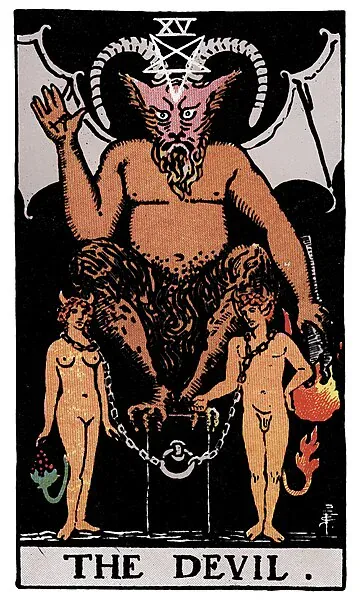
The Devil's chains are the structural mirror of the Eight of Swords' cloth. Both bindings are voluntary — the figures could remove them if they realized they were unlocked. When the Eight of Swords meets The Devil in a spread, the cage of the mind has been reinforced by a habit, a substance, a relationship dynamic, or a self-image that the seeker has identified with too closely. The combination warns that the simulation has hardened into addiction shape, where the suffering itself has become the familiar room. The medicine is to notice the contract is voluntary and that the lock is, again, on the inside.
Eight of Swords + Nine of Swords
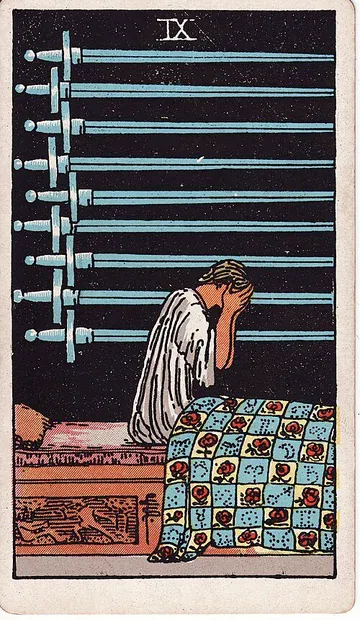
The same suit, escalating. The Eight is the cage; the Nine is the nightmare the cage produces in the small hours of the morning. When these two arrive together, the seeker is in the worst of the inner-cage cycle: the simulation has not only paralyzed daytime action, it has begun colonizing the night. The combination asks for a specific intervention — the simulation must be written down, externalized, given to someone else's listening, before sleep can return. The two cards together are a description of the most acute form of the pattern, but they are also one of the deck's clearest invitations to seek a real witness — a friend, a therapist, a teacher — outside the closed circle of the head.
Eight of Swords + Two of Swords
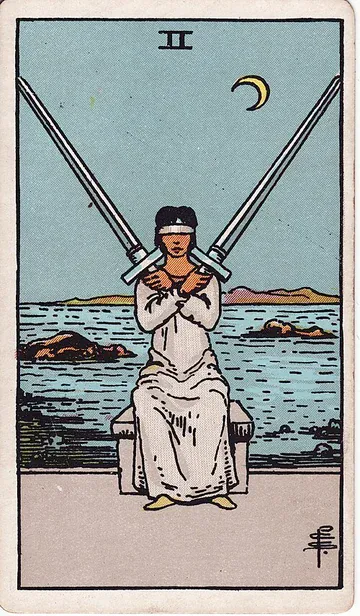
A visual rhyme. Both cards show a blindfolded figure paralyzed by self-imposed not-seeing. The Two of Swords is the earlier moment — the decision held in suspension, two crossed swords pressed against the chest, the clean refusal of either side. The Eight is the later moment — the same pattern grown into eight swords planted around the body, the cloth wrapped, the feet in cold water. When these cards arrive together, the seeker has been in the not-seeing position for longer than the situation requires. The combination asks: at what point does discernment become avoidance? At the eighth sword, usually. The Two warns of the choice; the Eight names the consequence of refusing the choice for too long.
Eight of Swords + Eight of Pentacles
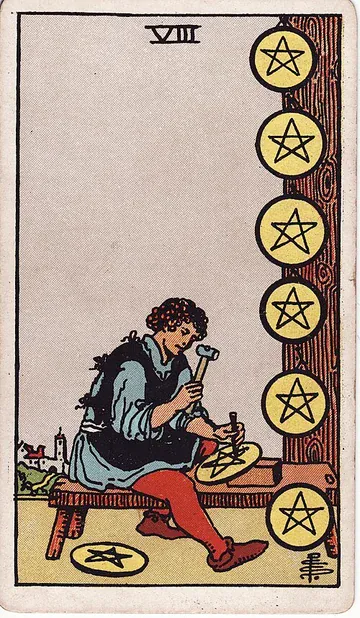
A series sibling, contrasting suit, identical number. Both cards are the number eight — the structure that has refined itself beyond what the situation requires. The Pentacles version is body-discipline: the apprentice at the bench, hammering the same shape, perfecting the craft. The Swords version is mind-discipline gone in. When these two arrive together, the combination is one of the deck's most precise prescriptions: do less mental work; do more bodily work. The Eight of Pentacles is the antidote. The hands moving, the same task repeated, the breath finding its rhythm in the labor — these are what break the Eight of Swords' cage. The simulation cannot survive sustained physical action. The body, doing the work, is the medicine for the mind that has been running the cage.
Eight of Swords + The Star
The most graceful of the antidote pairings. The Star is the figure at the pool, naked, without blindfold, two pitchers pouring water — one to the earth, one to the spring. Where the Eight of Swords stands clothed, blindfolded, paralyzed in cold water, The Star stands undressed, eyes uncovered, knee in the water and at ease. The two cards are nearly mirror images. When they arrive together, the spread is showing the cage and the door simultaneously. The Star says: the blindfold can come off. The water can be lived in, not feared. The pouring is done with both hands. The combination is the deck's quietest reassurance that the cage of the Eight of Swords is exactly the cage that the open-eyed work of The Star dissolves.
Card Combinations
The Devil
The Devil's chains are the structural mirror of the Eight of Swords' cloth — both bindings are voluntary, both unlocked from the inside. Together they describe the cage of the mind reinforced by a habit, a substance, or a self-image the seeker has identified with too closely. The simulation has hardened into addiction shape. The medicine is to notice that the contract is voluntary and the lock is interior.
Nine of Swords
The same suit, the cage escalating into the nightmare hours. The Eight is the daytime paralysis; the Nine is what the simulation produces when the lights go out. Together they describe the seeker for whom the inner cage has colonized both day and night. The combination is the deck's most direct invitation to seek a real witness — therapist, support group, sustained external listening — outside the closed circle of the head.
Two of Swords
A visual rhyme. The Two of Swords is the earlier moment, the decision held in suspension; the Eight is the later moment, the same pattern grown into eight planted swords and a wrapped cloth. Together they show how discernment, held too long, becomes avoidance. The Two warns of the pause; the Eight names the consequence of refusing the choice.
Eight of Pentacles
Series sibling, contrasting suit, identical number — and the deck's most precise prescription against the Eight of Swords' cage. The Pentacles version is body-discipline at the bench, hands working, craft built one stroke at a time. The combination says directly: do less mental work; do more bodily work. Sustained physical action dissolves the simulation more effectively than any further thinking can.

The Star
The most graceful antidote. Where the Eight of Swords stands clothed, blindfolded, paralyzed in cold water, The Star stands undressed, eyes uncovered, knee in the water at ease. The two are nearly mirror images. Together they show the cage and the door simultaneously. The blindfold can come off. The water can be lived in. The pouring is done with both hands.
Frequently Asked Questions
Why are the eight swords planted unevenly instead of in a closed ring?
Because the formation is open on two sides, and that gap is the card's entire argument. This is the card of the self-imposed cage. It depicts a woman bound loosely by cloth, blindfolded, surrounded by eight swords planted unevenly in the mud — a formation that, on close inspection, is open on two sides. The card describes paralysis maintained from inside: the mind has rehearsed the obstacles so thoroughly that the body has stopped moving. The cure is one real step, not a better thought.
If the swords leave gaps on both sides, why does the Eight of Swords still read as no?
Because the gaps are not what is being looked at. The card reads as a conditional no — and the no points at the seeker, not at the situation. The path is structurally open; the obstacle is the simulation that the seeker keeps running between themselves and the decision. Lift the blindfold and the answer can change. Until then, the card stays a no, and its no is a precise diagnostic rather than a verdict on the world outside.
What is the difference between a bond that is stuck and one I have decided is stuck?
The knot, or its absence. In love, the Eight of Swords describes the relationship that has become a story you keep telling yourself rather than one you keep living. The cloth is not knotted; the bond is not actually closed. The card warns of the inner script that has saturated the actual room — the rehearsed conversations, the pre-experienced disappointments, the eight reasons memorized for why love cannot work here. The medicine is to use words and meet the actual person.
How does the Eight of Swords appear as advice?
As advice, the Eight of Swords says: stop running the simulation and take one real step. Set a deadline on the decision; speak the thing aloud to one person who can hear it; do one small action today that is too quick for the simulation to model in advance. The card responds to movement, not to better thinking. The cage opens one sword at a time, removed by attention and by feet that are willing to walk.
Can a mind be too well trained for its own practice?
That is this card's spiritual diagnosis. The Eight of Swords belongs to Hod — the sphere of logic — refining itself past the point of usefulness. The lesson is that the structure of thought, when it becomes too elegant, begins to function as a substitute for the experience the structure was meant to support. The cure is return to the simple form of the practice. Sit, walk, breathe, do the boring discipline that the over-trained mind keeps trying to elaborate around.
Continue Reading
Eight of Swords · Card overview · symbols · correspondences →
Return to the full card view — image, symbols, sensory correspondences, and Hermetic axes.
Read the reversed meaning →
Read the same depth on the opposite orientation.
Draw your reading now →
Bring this card to a question — open a quiet ritual.