
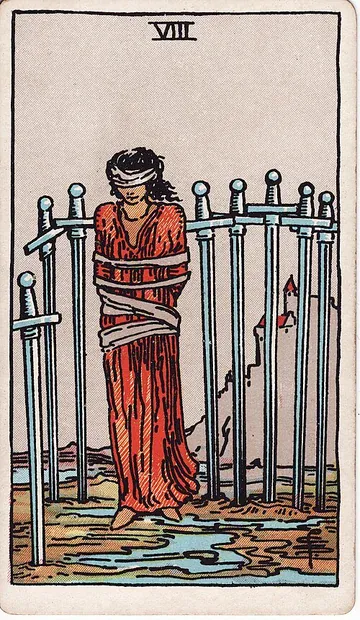
Eight of Swords Reversed · Core Meaning
A cage kept long enough stops being a cage and becomes an address. Where the upright card describes the moment of being temporarily paralyzed by simulation — a cage one might still recognize and step out of — the reversed card describes the slow conversion of the cage into identity. The cloth has been wound around the body for so long that it has become clothing. The blindfold has been worn so consistently that the eyes have begun to forget what unmediated light feels like. The eight swords have moved from being external obstacles into being internal furniture. The seeker is no longer trapped by the cage. The seeker has begun to identify as a caged person.
This is the reversed card's central knot: paralysis that has become character. The figure is no longer struggling with the cloth; she has stopped noticing she is wound. She is no longer looking for the gap in the formation; she has stopped believing the gap exists. She is no longer running simulations of escape; the simulations have run her so long that they have become her interior weather. The card is not punishing the seeker. It is reflecting back a structural reality: the cage that began as a thought has solidified into a way of being, and the way of being now requires the cage to feel like itself.
There is a second flavor of the reversed card. Sometimes it indicates the precise opposite — the seeker who suddenly recognizes the cage as a cage and lurches out of it without preparation, in a single dramatic gesture. The cloth is yanked off; the blindfold is thrown across the marsh; the body kicks at the swords. This is also the reversed card. The dramatic exit is not always the integration; sometimes it is the simulation reversed — instead of imagining every exit as catastrophe, the seeker imagines a single exit as salvation, and tries to perform that exit. The card warns that liberation by spectacle is rarely durable. The cage that opens through one dramatic act tends to reform around a slightly different shape within months.
The decan holding the eight swords turns as they do. Jupiter in Gemini upright is overactive intellect — the twin-minded faculty branching into every possible failure. Reversed, Jupiter in Gemini becomes scattered intellect — the branching now serves no organizing purpose. The seeker has more thoughts than ever and fewer of them are tracked. Decisions are made impulsively to escape the simulation, then re-relitigated, then made impulsively again. The card describes the mental life that has stopped functioning as thinking and become noise.
In the Tree of Life, Hod reversed describes Hod's structure consumed by its own elaboration. The rules are not just refined past usefulness; they have become a closed system that feeds itself. The seeker can recite the structure of the cage with great fluency. The fluency itself has become the cage. Every conversation about the problem becomes another iteration of the model. Every attempt to escape the model produces a new layer of the model. The reversed card is the seeker who has learned to speak knowledgeably about their own paralysis without ever stepping toward action.
Reversed, the Eight of Swords asks: what would you be if you were not the person who is afraid of this? What would you do if the simulation were not running? Who, beneath the long story you have been telling about your own constraints, is actually here?
Eight of Swords Reversed · Love & Relationships
Here the inner cage has widened into the texture of the relationship itself. The simulation has not just paralyzed individual conversations or specific decisions; it has begun to constitute the way you relate to the partner. You no longer have a relationship and a script about the relationship running in parallel. The script has become the relationship. The two of you are conducting two parallel relationships simultaneously, and almost none of either is occurring in the room you share.
For an existing partnership in deep distress, the reversed Eight of Swords is one of the deck's more uncomfortable mirrors. The relationship is not unlivable; many things in it are still functioning. What has happened is that both partners — sometimes only one, more often both — have spent so much time inside the simulation of the relationship that the actual relationship has thinned. The arguments are recursive: each one is the same argument relitigated through slightly different surface material. The peace, when it comes, is the peace of mutual exhaustion rather than mutual resolution. The card asks for an intervention from outside: a counselor, a friend whose only job is to listen, a structured conversation framed by someone who is not inside the simulation. The cage will not open through one more well-rehearsed conversation between the two of you alone.
For someone in a new connection, the reversed card warns of the partner who has rehearsed the relationship into a story before you have had a chance to meet them. They are dating their script of you, not you. They have decided what role you are playing in the script, and they will resist all data that contradicts the role. This is uncomfortable to identify, because the script can be flattering — sometimes you are the rescuer, sometimes the muse, sometimes the long-awaited answer. None of those are you. The card asks you to notice when the partner stops asking what you actually want and begins assigning what you must want, given who they have decided you are.
For a single seeker, the reversed Eight of Swords describes the dating pattern that has hardened into worldview. You no longer believe love is structurally available. The eight reasons against your own loveability have been carried for so long that they no longer register as reasons; they are simply the air you breathe. The card is not telling you the reasons are correct. It is naming the way they have stopped being claims and become atmosphere. The work is not to argue against the atmosphere. It is to step into one social situation each week that the atmosphere predicts will be useless, and let the situation produce its own data. The data, repeated, slowly begins to disturb the atmosphere.
For love after a long wound, the reversed card describes the protective scaffolding that has become a personality. Years ago, the rules about who you let near you were medicine. Now they are clothing. You have begun to introduce yourself, in early conversations, with a list of disclosures designed to filter out anyone who would not respect the rules. The list has become so long that it now filters out everyone. The card asks you to retire one rule per season — not all of them, just one — and see whether you can survive the absence. Most often, you can. The rule was preserving an injury that has long since healed.
For someone whose simulation includes the pattern of choosing partners who reproduce the same wound, the reversed card describes the trap as fully entrenched. The pattern is no longer something you do. The pattern has become how you recognize attraction. You feel pulled toward the people who can complete the inner script. The work is to begin distrusting the pull as data. The pull is the simulation calling its actors to the stage. Real intimacy will sometimes feel undramatic — almost quiet, almost boring, certainly less electric than the pattern partners. Choose the quiet one.
For the question of reconciliation after a break, the reversed Eight of Swords is one of the deck's harder cards. It says: returning to the relationship would rebuild the cage. You have not yet finished noticing that the cage was the cage. To return now would be to seal the simulation around both of you again. The card does not absolutely forbid the return; it warns that the return, made now, will reproduce what broke. Wait. Or, if you cannot wait, return only after one of you has done the structural work of recognizing the simulation that occupied the relationship. Without that work, the return is not reunion. It is reentry.
Asked whether someone loves you, this inverted card wants you to read the story they are telling themselves. They feel something — the warmth is real, the consideration is real, the small kindnesses are real. And the script they are running about you has become long enough, dense enough, well-rehearsed enough, that it now interferes with the warmth ever crossing the table. They are, in their interior, telling themselves a story about you that may not match who you are. They have not yet noticed that the story is interfering with the actual encounter. Until they notice, the warmth will stay inside. None of this is malice. It is also not yet love that has arrived. The card asks you to read precisely: warmth without offering, story without listening.
For someone considering whether to stay in a long-term relationship that has gone quietly numb, the reversed card describes the moment of recognizing that staying is also a choice. The narrative that says "I have no choice, I am stuck, the situation has decided for me" — that narrative is the cage. The reversed card insists, gently and firmly, that you do have a choice. To leave is a choice. To stay differently is also a choice. To stay the same is, also, a choice. What is no longer available is the comfort of pretending the choice has been made for you by circumstance. Pick one of the three. The card responds to chosen movement, even when the chosen movement is to stay. It will not respond to drift presented as inevitability.
A note on the card's love language, reversed: the Eight of Swords reversed loves the way someone loves who has stopped believing love is possible and continues to love anyway, often without naming it as love. They have built a long and elegant case against the reality of the feeling they are having. They will not admit to it. They will, however, show up, week after week, in small concrete ways. Read the showing up. Do not insist on the naming. Sometimes the naming arrives later. Sometimes it arrives never. The pattern of action is the actual relationship.
Eight of Swords Reversed · As Feelings
When the Eight of Swords reversed appears to describe how someone feels about you, the answer is layered. The feeling exists, and underneath the feeling is a long-running internal script about what the feeling means, and underneath the script is a deeper paralysis that the script has been protecting. The reversed card describes feelings that have been fenced in for so long that the fence has become the feelings — at least to the person feeling them.
If they are reserved by nature, the Eight of Swords reversed in feelings describes private intensity that has hardened into private silence. They have rehearsed the conversation in which they tell you what they feel so many times that the rehearsal now substitutes for the conversation completely. They believe, on some level, that the rehearsal has been delivered. They are surprised, when pressed, that you did not receive it. From your side, of course, nothing has been said. The card describes a specific kind of failure of imagination on their part — the failure to recognize that interior speech does not transmit. Loosening that particular knot is a job for the person wearing the blindfold.
If they are demonstrative by nature, the reversed Eight of Swords in feelings warns of a more uncomfortable pattern: performed feeling that has begun to substitute for actual feeling. They will tell you, often, what they feel about you. They will produce the right phrases. They will repeat them. And underneath the words, the card asks whether the words are tracking a real interior weather or whether the performance has begun to constitute the entire interior. This is hard to read at distance. The signal is whether the demonstrative phrases produce action that aligns with them. If the words are loud and the actions are absent, the reversed card is naming the gap.
For a partner you have been with a long time, the reversed Eight of Swords in feelings describes settled affection that has stopped being curious. They love you, in the sense that they would not leave; they love you, in the sense that they would defend you to a third party; they love you, in the sense that they cannot imagine the household without you. What they have stopped doing is asking who you are now. The simulation of you that they carry — the script of the partner from year three, year five, year eight — has become the basis of all their interactions with you. They are responding to the script, not the person. The card asks for re-introduction. Not a dramatic gesture. A small one — a question they have not asked you in a year, a curiosity they have not extended, a willingness to be surprised by your answer.
For a new connection, the reversed Eight of Swords in feelings describes the partner who has fallen for the version of you they constructed before meeting you. The first three conversations were enough to suggest a script. From there, the script has been running. They are not feeling the warmth toward you so much as they are feeling the warmth toward the role you are playing in their narrative. This is dangerous to misread. The early period can feel intoxicating because the script has decided you are the answer, and the script is broadcasting that decision with great conviction. Test by introducing data that contradicts the script. If the contradiction is welcomed and the warmth survives the contradiction, the warmth is real. If the contradiction is resisted and the warmth conditional on you continuing to play the role, the warmth is for the role.
For someone whose ambivalence has lasted longer than the relationship's circumstances seem to warrant, the reversed card describes the ambivalence as identity. They are not weighing two options. They are inhabiting the position of the weigher. Some part of them has decided that to be undecided is who they are. To resolve the ambivalence — in either direction — would also be to give up the position of being the one who is weighing. The card describes them with discomfort, but with precision. Whether they will ever resolve is a real open question, and you cannot resolve it for them.
A small caution embedded in this reading: the Eight of Swords reversed in feelings is sometimes the card of the person who does not feel anything at all, beneath all the rehearsed responses and the elaborate script. The simulation has become so total that there is no longer any actual interior weather underneath. This is rarer than the more common pattern — feelings hidden behind simulation — but it does occur. The signal is the persistent flatness of every actual encounter. They produce the right surface behaviors. The behaviors do not have heat. None of them do. The card warns that, sometimes, all that is there is the script.
For someone who has been waiting for a partner to be ready, the reversed card answers: their not-readiness has stabilized. It is no longer a temporary condition. It has become how they are. You can wait — many people do — and you should know that you are waiting on a structural state, not a passing season. The card does not blur this. It is not predicting that they will never change. It is naming that they have been not-changing for long enough that the not-changing is its own gravity.
Take the Eight of Swords reversed in feelings, finally, as a description of texture rather than a verdict: warmth real, hidden inside a script, the script run for so long that it has begun to constitute the relationship more than the warmth has. The verdict — whether the feeling becomes an offering — depends on whether they ever notice the script is running and choose, against the long habit, to step out of it.
Eight of Swords Reversed · Career & Work
At some point the inner cage became the structure of the working life itself. The job is not actively bad. The career is not visibly stalled. From the outside, the position looks acceptable. From the inside, the seeker has built so elaborate a model of what they are not allowed to do, what they cannot risk, what they would not survive trying, that the model has become the entire decision space. They no longer have a career; they have a long story about why their career must remain exactly the shape it is.
For someone in a current role, the reversed card describes the slow conversion of the role into a fortress. Year by year, you have negotiated more accommodations with the discomfort of the role. The negotiations have been clever. Each one made the day-to-day more livable. Cumulatively, they have built a structure in which the role can never be left, because too many of your other choices have been organized around its constraints. The mortgage was sized to the salary. The schedule was built around the meetings. The friend group was filtered through the workplace. The reversed card asks whether the accommodations have served you or whether they have built a cage with bars made of your own past compromises. The cage is real, and you built it, and you can also dismantle it — slowly, without drama, one accommodation at a time.
For someone considering a new role, the reversed Eight of Swords describes the seeker who has been on the cusp of change for so long that the cusp has become the location. You have been thinking about leaving for years. The thinking has produced no movement. The thinking has, in fact, become the substitute for leaving — every year you have not left, you have at least thought rigorously about leaving, and the rigor of the thinking has produced a private satisfaction that resembles preparation but is not. The card warns that the cusp position is itself the trap. You are not preparing to leave. You are professionalizing the not-leaving. Send one application. Have one conversation. The cage opens through one act, not through one more year of model.
For an entrepreneur or freelancer, the reversed card describes the founder who has built a beautiful business plan for a business they have never started. The plan has become the company. The market research has become the product. The pitch deck has become the launch. The activities of preparation have absorbed the energy that would have gone into operation. The card is uncomfortable here because the preparation has been substantial, the work has been real, and none of it has produced a customer. Ship something this month. Anything. The smallest, ugliest, most embarrassing version of the offering. The cage opens only through reality. Models, no matter how elegant, do not break it.
For a creative practice, the reversed Eight of Swords describes the writer who has spent years calling themselves a writer-who-cannot-write, the painter who has spent years explaining the perfectionism that prevents the painting, the musician who has spent years describing their relationship with their abandoned practice. The identity of the blocked artist has begun to substitute for the practice of the unblocked artist. The card is gentle about this; many people pass through this stage. It is also direct: the identity of the blocked artist, maintained for long enough, simply becomes the identity of someone who is not making art. The block is not the obstacle. The block is now the thing being protected. Make something bad on purpose this week. Do not show anyone. The cage opens only through the disobedience of the unblocked moment.
For someone in a long career with no immediate decision pending, the reversed card describes the slow drift of competence into stagnation. You are still good at what you do. You are no longer growing in it. The growth stopped quietly, three or five years ago, and the stop has been disguised as mastery. The card warns that mastery and stagnation can produce identical surface readings. The difference is whether you are still surprised by the work. If you cannot remember the last time you were surprised, the cage has thickened around you. Take a small risk inside the work — a different method, a different audience, a different scope — and see whether the surprise returns. If it does, you were stagnating. If it does not, you have grown into the place where the work has stopped feeding you, and a larger movement is required.
For someone considering a layoff or contemplating retirement, the reversed Eight of Swords names a particular trap: the identity of the working person being so total that life outside it appears blank. You have built so much of who you are out of the role that the prospect of stepping outside the role feels like stepping outside identity. The card warns that the cage of the role is real, and the void on the other side of the role is also real, and the work is to begin building one piece of identity outside the role before the role ends. A practice, a friendship, a discipline, a quiet project — something that will continue to exist when the work badge is returned. Begin it now. The cage of the role opens slowly when the alternative selves have been quietly nourished.
For someone whose work has been politically blocked — by a manager who will not promote you, by a colleague who undermines you, by an institution that has decided your role's ceiling — the reversed card asks a careful question. Some of the blocking is real. Some of the blocking, the card suggests, has been amplified in your simulation past its actual size. Distinguish. The political reality is one set of swords. The simulation about the political reality is another set of swords. The first is partly addressable through specific external moves. The second is yours alone to lift. Both are real. They require different work. Conflating them is the cage.
A specific note for managers, leaders, and senior figures: the reversed Eight of Swords sometimes describes the leader who has built so elaborate a model of how the team must not change, how the strategy must not pivot, how the structure must not reform, that the model has become the strategy. The team can sense it. The team begins to leave or to stop trying. The card asks the leader to identify one belief about the organization's constraints that has not been tested in three years. Test it. Often the constraint is no longer real and has been preserved by inertia.
For someone returning to work after a long absence — parental leave, illness, sabbatical, recovery from burnout — the reversed Eight of Swords describes the trap of pre-experienced re-entry. You have rehearsed every awkward conversation, every gap-in-resume question, every moment of feeling out of step. The rehearsal has been so thorough that the actual return now feels impossible to face. The card asks for a smaller first step than you have been planning: one coffee with one former colleague, one half-day of contract work, one conversation that does not have to lead to a full return. The cage of pre-experienced re-entry opens through one undramatic act of contact, repeated until the simulation has less material to feed on.
Eight of Swords Reversed · Money & Finances
Financial paralysis here has hardened into a way of living. The avoidance is no longer episodic. The unopened envelope has been joined by all its siblings; the spreadsheet has not been updated for a year; the conversation with the accountant has been postponed so many times that the postponement is now the relationship. The card describes the seeker who has converted financial unconsciousness into a stable, persistent state.
For someone in financial difficulty, the reversed card describes the deep spiral. The debt has not become unmanageable in a single month. It has become unmanageable over the slow accumulation of unnoticed accumulations. The interest has compounded. The fees have layered. The missed payments have triggered structural costs. From inside the cage, this all feels like one big problem — too big to face, too painful to look at, too humiliating to share. The card is not telling you the problem is small. It is telling you that the cage of unconsciousness is making the problem grow faster than your situation can absorb. Reach out to a non-profit credit counselor, a financial planner, a structured debt program — someone outside the cage. The first call breaks the most important sword.
For someone making a financial decision the reversed card has been hovering over for a long time, the card describes the decision that has been deferred so long that the deferral has become the decision. The lease has rolled over. The investment has continued earning suboptimal returns. The retirement plan has not been adjusted. By choosing not to choose, you have been choosing — for years — and the cumulative choice is now larger than any single decision would have been. The card asks for one specific move within thirty days. Not the perfect move. A specific one. The cage of indecision opens only through chosen action.
For someone managing a long-term financial system, the reversed Eight of Swords describes the budget that has become punitive. The discipline began as freedom. It has hardened into a small, anxious accounting that monitors every cup of coffee and every weekend dinner. You are not actually short on money. You are inside a model that treats every dollar as endangered. The cage is not the budget; the cage is the simulation that the budget protects against, and the simulation is no longer reflecting your actual financial reality. Loosen one rule. Spend forty dollars on something joyful and unaccounted-for this week. The discipline will survive the small rebellion. What will not survive is the slow conversion of all financial life into vigilance.
For someone whose financial life has been organized around avoiding shame, the reversed card is one of the most direct mirrors in the deck. The shame is older than the money. The money has been pressed into service as a way to avoid feeling the shame. Each unopened envelope, each unanswered email, each not-checked balance, is a small ritual of not-feeling. The reversed card does not insist you feel the shame on a fixed schedule. It does insist that the avoidance has become the cage, and that the cage requires more energy to maintain than the actual shame would. One small act of looking, this week, costs less than the chronic anxiety of not looking.
For investments and speculative bets, the reversed card warns that the simulation has now begun to operate against your own interest. You have rehearsed every loss so vividly that you cannot enter any position; or, alternately, you have rehearsed every gain so vividly that you cannot recognize when a position is actually wrong. Both versions are the cage. The work is the same: test the model against one piece of actual information from outside the head before any trade. Read one analysis that contradicts your thesis. Talk to one person whose interest is not aligned with your trade. Then decide.
For windfall, inheritance, or unexpected income, the reversed Eight of Swords describes the gift that has been deferred into invisibility. The money came months or years ago. It is sitting in a low-interest account because no decision about it has been made. Each option produced a counter-argument, and the counter-arguments have been winning by attrition. The card asks for one decision within two weeks. Move at least a portion of the windfall into a specific purpose — a fund, an investment, a gift, a project. Not the perfect purpose. A specific one. The cage opens through one chosen movement, and from there the next becomes possible.
For someone whose financial life is shared with a partner and the conversation about money has stopped happening, the reversed card describes the silence as structural. Both of you have rehearsed the conversation; neither has initiated it. The result is not neutral. The not-talking has shaped your spending, your saving, your future planning, in ways that have begun to diverge. Schedule the conversation. Have it with a third party present if necessary — a financial planner, a counselor. The cage opens through one act of speaking, and the cage of shared financial silence is one of the heavier ones to break alone.
A practical move when this card appears in a money question: take one financial action that takes less than ten minutes, and complete it today. Open one envelope. Reply to one email. Check one balance. Close one unused subscription. The cage was built one avoidance at a time, and it opens one act of attention at a time. The smallest acts are the most important, because the simulation cannot grow around what has already been done.
Eight of Swords Reversed · Health
The body has lived inside the mind's cage long enough to start organizing itself around it. The chronic tension has become the baseline. The shallow breath has become the breath. The disturbed sleep has become how this person sleeps. The somatic symptoms that began as signals have become structural — the tight throat, the held shoulders, the chest that does not fully open, the gut that does not fully digest. The card describes the body adapted to the cage rather than fighting it.
For someone managing chronic anxiety, the reversed Eight of Swords names a precise pattern: the anxiety has become identity. You no longer experience yourself as someone who has anxiety; you experience yourself as an anxious person. The distinction matters. The first frame allows for the possibility that the anxiety is something you carry. The second frame absorbs the anxiety into who you are, which makes the anxiety harder to address — because addressing it would feel like losing yourself. The card asks you to begin disentangling. The anxiety is real, persistent, and treatable; it is not the same as you. None of this is medical advice; keep your practitioners. The card simply names the architecture.
For someone managing depression that has lasted years rather than months, the reversed card describes the depressive identity. The version of yourself you know best is the one that cannot get out of bed, cannot answer the email, cannot finish the project, cannot go to the social event. To recover would require acquaintance with a different version of yourself — a version you may not remember or may never have met. The cage is the depressive identity. The recovery is not about feeling better in the abstract; it is about beginning to inhabit a different self. This is hard. The card respects how hard it is. Therapy, medication, structured practice — keep all of them. The card simply describes the deeper terrain.
For chronic conditions of any kind, the reversed Eight of Swords can describe the condition that has absorbed the entire identity. You are no longer a person who lives with the condition; you are a person who is the condition. The illness has become the lens through which all other experience is filtered. This is sometimes necessary, especially in acute periods. When it persists past the period of acute necessity, it becomes a cage. The card asks for one practice that exists outside the condition's domain — one friendship, one creative pursuit, one form of pleasure — that you cultivate in the part of yourself that is not patient. Begin small. The cage opens slowly when the non-patient self is given regular nutrition.
For sleep specifically, the reversed Eight of Swords describes the sleep architecture that has reorganized around the simulation. You no longer have insomnia. You have a sleep pattern that is structured by the three-in-the-morning replay, the unsleeping middle hours, the exhausted dawn. The pattern has become how you sleep. The standard advice — sleep hygiene, schedule, screen reduction — is correct and insufficient. The card suggests the simulation itself must be addressed, and the simulation is addressed not through better thinking but through structured external witness: a therapist, a support group, a writing practice that makes the simulation visible to you outside your head. Pointing toward a therapist or a support group is not the same as giving medical advice. Keep your practitioners.
For someone whose body has begun producing somatic symptoms that doctors cannot find a clean cause for, the reversed Eight of Swords describes a precise pattern. The body is reflecting the structure of the cage. The unexplained tightness, the wandering pain, the digestive dysfunction, the chronic low-grade fatigue — the card suggests these are sometimes the body's translation of unspoken material. The throat closes because the words are not being said. The chest tightens because the action is not being taken. The breath shortens because the body is being held in vigilance for a danger that is not present. This is not all somatic illness. Some illness has biomedical causes; honor those, treat them. The card simply names one pattern that is common and undertreated.
For someone whose health practice — the gym, the diet, the meditation, the sleep regimen — has become a cage of optimization, the reversed card warns. You have been disciplined for so long that the discipline has begun to function as an anxiety container rather than a path to vitality. The metrics have become the practice. The practice has stopped serving the body. The card asks for one disobedience this week. Skip the workout intentionally. Eat something pleasurable that is not optimized. Sleep in. The body responds, sometimes with surprising relief, when the cage of optimization is briefly suspended.
For mental health more broadly, the reversed Eight of Swords describes the moment a person realizes they have been living inside the cage for years and have begun to identify with it. This realization is, paradoxically, the beginning of recovery. The cage is most powerful when it is invisible and most addressable when it is named. The card describes the moment of naming. From there, the work is one piece at a time: a practice, a relationship, a structured intervention, a deliberate act of disobedience against the long-running model. The cage opens slowly. It opens.
Eight of Swords Reversed · Spirituality
The relationship with the block has grown more elaborate than any practice it replaced, until the block is the spiritual life. The discomfort with practice has been described, examined, written about, discussed in spiritual direction. The discomfort is now the central topic. The actual practice has thinned to almost nothing while the conversation about why the practice is difficult has become voluminous. The reversed card names this with care: the seeker who is professionally not practicing.
The card sits at Hod in Yetzirah, reversed. Hod's gift, when in motion, is the form that allows experience to clarify. Hod's reversed shadow is the form that has elaborated itself into a closed system — a structure of thought about practice that no longer permits the practice. The seeker can recite the obstacles to practice with great fluency. The fluency is the cage. Each new teaching, each new tradition, each new method that is offered is greeted with a thoughtful objection — well-formed, intellectually serious, and invariably ending with a deferral. The objections are not wrong. They have, however, stopped serving the question they were meant to address.
For seekers who have been on the spiritual path for many years, the reversed Eight of Swords describes a particular trap: the long-time practitioner who has accumulated enough vocabulary, enough theory, enough sophistication, to articulate why every available next step is inadequate. The seeker has read the books, sat with the teachers, traveled to the retreats. Somewhere along the way, the structure of the seeking has become the seeking. The actual experience that originally moved them is increasingly difficult to remember. The card asks for return to the simple form. Not a new tradition. The form that worked before the elaboration began. Sit in silence for thirty minutes. Walk somewhere old. Read a single page from the book that first moved you. The cage opens only through return.
For seekers exploring belief, the reversed card warns of the comparative posture that has become identity. You can articulate the strengths and weaknesses of a dozen traditions. You have not committed to any of them. The articulation has become its own commitment — to a kind of uncommitted spiritual cosmopolitanism. The card is not insisting on conversion. It is naming that the position of the comparer, maintained for long enough, becomes its own kind of dwelling, and the dwelling does not feed the part of you that originally began comparing. Choose one practice and live inside it for a season. Not forever. A season. The cage opens through commitment, even temporary commitment.
For someone whose spiritual life has gone quiet and stayed quiet, the reversed Eight of Swords describes the seeker who has not just paused practice but has begun building an intellectual case for why the pause was correct. The pause has become a position. The position has been defended in interior conversation, then occasionally aloud, then systematically. The original heat of the practice has receded so far that the seeker can now speak of it as if it had been a phase. The card asks whether the phase actually ended or whether the cage of distance has just thickened. Test by attempting one practice this week without giving yourself permission to opt out. Observe whether something stirs. Often, beneath the long story of disinterest, the heat is still there.
For questions about path, the reversed Eight of Swords offers a small practice that has been useful for many seekers in this position: write down, in plain language, the eight reasons you have given yourself for not pursuing the practice you have been circling for years. Read them aloud to one person who knows you and respects your seriousness. The act of speaking the reasons aloud, in the presence of a witness, often dissolves several of them. The remaining reasons become specific obstacles you can address one at a time. The cage that survives the test of being witnessed is small enough to step out of.
A practical thirty-minute practice the reversed card invites: sit somewhere you can see the sky without screens or books. Notice when the simulation begins constructing reasons this practice is poorly designed, the time is wrong, the location is suboptimal, the discipline is misguided. Do not argue with the simulation. Do not try to silence it. Stay seated for thirty minutes. The simulation will run. The mind will branch. Beneath the branching, sometimes — not always, not predictably — something will open. The cage of the over-articulated spiritual life opens through the simple, stubborn act of staying.
Eight of Swords Reversed · Yes or No
Soft no, deepening — unless one act of disobedience is taken.
The Eight of Swords reversed is rarely a clean no, and it is never an easy yes. It is more often a no that has stabilized into a structural condition, a paralysis that has solidified into the seeker's identity. The card answers no, and the no points specifically at the long-running model that has now begun to function as personality. The answer can change, but only through deliberate movement against the model — the single act of disobedience that proves to the simulation that it has been describing fiction.
For yes-or-no questions about a relationship, a job, a move, a decision, the reversed card offers a more uncomfortable version of the upright reading. The path is open. You have stopped seeing it not because you have not tried hard enough, but because the not-seeing has become how you orient yourself. The simulation is no longer something you run; it has become the lens through which you perceive. The card answers no, and the no will continue to be no until the lens itself is, briefly, set down. Setting it down is harder than it was when the card was upright, because the lens has now grown into the eye.
For questions about whether someone is being honest, whether an offer is genuine, whether a plan will hold, the reversed card warns of two compounding distortions: the situation may be exactly as represented, and your perception may be unable to receive that as represented because the simulation has become your perception. The answer the card offers is no — not because the situation is bad, but because you currently cannot read it accurately. Restore the accuracy of perception first. Once that is restored, ask the question again. The answer will likely change.
On the matter of when, the reversed Eight of Swords answers that timing is the wrong question. The question presumes the seeker is waiting for the world to act. The card describes a seeker who has stopped acting and has converted the not-acting into the answer to all questions about timing. Nothing will arrive on the timeline you are imagining, because the timeline is being constructed inside the cage. Step out of the cage. From outside, time begins again. From inside, time stays paused indefinitely.
For binary questions about whether to act — should I take the offer, should I send the message, should I make the move — the reversed card answers no, with a heavier footnote than the upright version. The action itself is not wrong. The action initiated from inside the deepened cage will reproduce the cage. The card asks for one specific small disobedience first — an act that breaks the simulation slightly without being the big action — before the big action is taken. The big action, taken from inside the simulation, fails. The small action, taken first, changes the simulation enough that the big action becomes possible.
For questions about whether you are welcome, whether you belong, whether you are allowed, the reversed Eight of Swords answers that the closure you are perceiving is largely your own. The world has not closed against you nearly as completely as the simulation insists. The card is direct here: the rejection you are anticipating has not been delivered; you have been preempting it for so long that the preemption has produced a felt experience of rejection. Test by asking. The actual answer is almost always less rejecting than the rehearsal.
For questions about whether to leave a stuck situation, the reversed card answers carefully: do not decide today, in either direction. Decide once one act of disobedience has been completed. The choice made from inside the deepened cage will reproduce the cage no matter which direction it points. The choice made after one small disobedience has begun to disturb the simulation has a chance of moving you somewhere actually different.
If the question was: am I trapped? The reversed card answers no, the gate is still open, and yes, the trap has begun to move into your nervous system. Both are true. The work of reversal is to act in the direction of the first truth even while the second truth feels more real.
Eight of Swords Reversed · Advice
Commit one act of disobedience against your own long-running model. Not a dramatic gesture. Not a cinematic exit. One specific, concrete, completable act that contradicts the simulation you have been operating inside. The cage of the reversed card is no longer addressed by lifting the blindfold once and stepping forward; the blindfold has begun to fuse with the eyes. The work is more patient. One small act of seeing differently. Then another. Then another.
If there is one specific instruction the reversed card offers, it is to externalize the simulation. Inside your head, the model is invisible; it is simply how things are. On paper, in conversation with a witness, in the presence of a therapist or a friend or a teacher, the model becomes visible. Visible models lose their grip slowly. The reversed Eight of Swords advises that the work of escape from the deepened cage cannot be done alone in the head. It must be done with at least one external witness. The witness is not there to fix you. The witness is there to be the surface on which the simulation can be written and read.
A second instruction: pick one belief you have held for a long time about your own constraints, and test it. Not all of them. One. The belief that you cannot be loved by a particular kind of person. The belief that you cannot do a particular kind of work. The belief that you cannot survive a particular kind of conversation. The belief has been stating itself in your interior, unchallenged, for years. The reversed card advises one structured experiment that puts the belief in contact with reality. Reality almost always contradicts the belief in some particular. The contradiction, accumulated across several beliefs, begins to disturb the cage.
A third instruction: act before the simulation has time to model the action. The cage of the reversed card thrives on rehearsal. The medicine is action that is too small for the simulation to model in advance. Send the message before you have rehearsed it. Open the envelope before you have prepared yourself. Make the call before you have written the script. The simulation has been training itself on your patterns. The disobedience is to break the pattern in a small way, often, without warning. The cage thins through small unrehearsed actions. It does not thin through one prepared big action.
A fourth instruction, gentler than the others: forgive yourself for the depth of the cage. The cage of the reversed card is not built in a day. It is built through years of small accommodations, all of which had reasons, most of which were forgivable, none of which individually constituted a cage. The cage is the cumulative effect. You did not fail. You participated, slowly, in the construction of a structure that has now begun to constrain you. The structure is dismantle-able, slowly, through the same scale of small action that built it. Nothing dramatic is required. Only consistency.
A fifth instruction, specific to the reversed card: choose one practice that exists outside the cage's vocabulary. The cage has its own language — the things you talk about, the topics you obsess over, the stories you tell about yourself. The reversed card advises that you take up one practice, even briefly, that does not fit the language. A new physical activity. A new social setting. A new creative pursuit. The practice will feel awkward for the first weeks. The awkwardness is the cage being asked to release one of its claims on you. Stay with the awkwardness. The release happens slowly.
A sixth instruction, for seekers in deep difficulty: get professional help. The reversed Eight of Swords sometimes describes a depth of paralysis that is past the threshold where self-help is sufficient. Therapy, structured medical treatment, intensive group work, residential programs — the card does not insist on any one of these, but it does insist that the cage of the deepened reversed card is sometimes simply too dense for the seeker to address from inside. Ask for help. The asking is itself the first disobedience.
Practical advice for the day the reversed card appears: complete one small act today that the simulation has been telling you is impossible. Not a big act. Not a heroic act. The smallest possible version of the impossible thing. Open the document you have been avoiding for two months, and read one line. Send one text. Eat in one restaurant where you do not know the menu. Take one walk on a route you have not walked. The reversed cage opens through small acts that contradict the simulation, accumulated over weeks. There is no shortcut. There is also no acceleration that the cage can match if you remain consistent. Begin today.
Eight of Swords Reversed · Card Combinations
The Eight of Swords reversed in combination with other cards typically describes the deepening or the dissolution of the inner cage. In some pairings, the reversed card meets a structural mirror — a card that confirms the cage has hardened — and the spread becomes a precise diagnostic. In others, the reversed card meets an antidote — a card that names the door — and the spread becomes a prescription. The five paired cards below — The Devil, the Nine of Swords, the Two of Swords, the Eight of Pentacles, and The Star — function differently in the reversed reading than in the upright one, because the cage they meet is denser.
Eight of Swords reversed + The Devil
The most uncomfortable of the deepening pairings. The Devil's voluntary chains, paired with a cage that has hardened into identity, describes the seeker who has begun to draw meaning from the bondage itself. The suffering has become familiar enough that releasing it would feel like losing a self. The combination warns of addiction patterns that have absorbed identity, of relationships whose pain has become the relationship's only reality, of self-stories that have hardened into clothing that cannot be removed without exposure. The medicine is hard: external intervention, sustained witness, structural support. The cage of this pairing rarely opens through individual will. It opens through community, often through programs, sometimes through professional help, almost always through the deliberate construction of a different daily life.
Eight of Swords reversed + Nine of Swords
The same suit, the worst of the spiral. The reversed Eight pairs with the Nine to describe the seeker for whom the inner cage has not just colonized the day; it has consumed the night. The simulations run in the small hours and produce, by morning, a person who is exhausted before the day begins. The combination is a description of acute psychological distress that has stabilized into chronic suffering. The card pair asks, gently and firmly, for help from outside the head. A therapist. A trained witness. A support group. A medical practitioner. The reversed Eight plus the Nine together describe a state that very rarely opens through self-help alone. The combination is the deck's most direct invitation to seek a real witness.
Eight of Swords reversed + Two of Swords
The visual rhyme has darkened. The Two's clean refusal of either side, paired with the reversed Eight's hardened cage, describes the seeker who has been holding the not-decided position for so long that the position has become character. The combination warns that the wisdom of the Two — the moment of pause — has been overstayed. The pause has become permanent residence. The card pair asks for a decision, in any direction, taken without complete information, accepted as the best version available, treated as the beginning of movement rather than the end of waiting. The cage opens through chosen incompletion, not through a more perfect waiting.
Eight of Swords reversed + Eight of Pentacles
The series sibling, in the reversed reading, becomes one of the deck's most precise medicines. The reversed Eight of Swords describes the mind-cage that has hardened into identity. The Eight of Pentacles describes the apprentice at the bench, the body engaged in patient repetitive work, the mastery built one stroke at a time. The combination prescribes physical practice as the dissolution of mental cage. Begin a craft. Take up running. Learn to cook. Begin a garden. The card pair is direct: the deepened reversed Eight of Swords does not open through more thinking, more therapy alone, or more self-understanding. It opens, in part, through the body engaged in real work over real time. The hands moving, the shape forming, the body building competence that the mind cannot pre-experience — these dissolve the simulation more effectively than any intellectual intervention can.
Eight of Swords reversed + The Star
The most graceful of the antidote pairings, slightly altered by the reversal. The Star, paired with a deepened cage, becomes a quiet description of the door that exists despite the cage's density. The figure at the pool, undressed and unblindfolded, pouring water with both hands, is what the seeker can become when the cage is finally addressed. The reversal of the Eight of Swords does not make The Star unreachable; it makes the path to The Star longer. The card pair is the deck's gentlest reassurance that even the cage that has hardened into identity is, ultimately, dissolvable. The Star is patient. The water continues to pour. The cage opens, when it opens, into the simple posture of being unclothed and unguarded at the pool.
Card Combinations
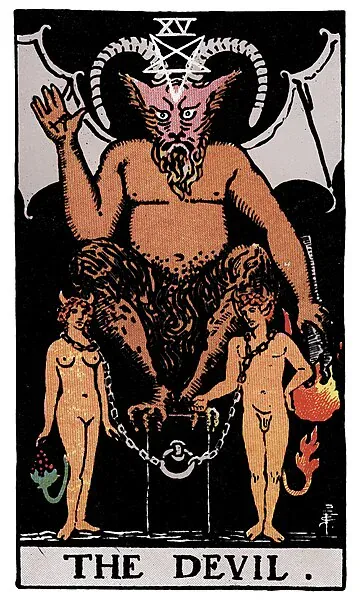
The Devil
The Devil's chains are the structural mirror of the Eight of Swords' cloth — both bindings are voluntary, both unlocked from the inside. Together they describe the cage of the mind reinforced by a habit, a substance, or a self-image the seeker has identified with too closely. The simulation has hardened into addiction shape. The medicine is to notice that the contract is voluntary and the lock is interior.
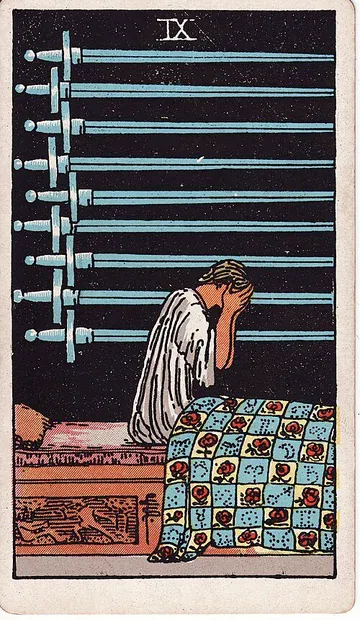
Nine of Swords
The same suit, the cage escalating into the nightmare hours. The Eight is the daytime paralysis; the Nine is what the simulation produces when the lights go out. Together they describe the seeker for whom the inner cage has colonized both day and night. The combination is the deck's most direct invitation to seek a real witness — therapist, support group, sustained external listening — outside the closed circle of the head.
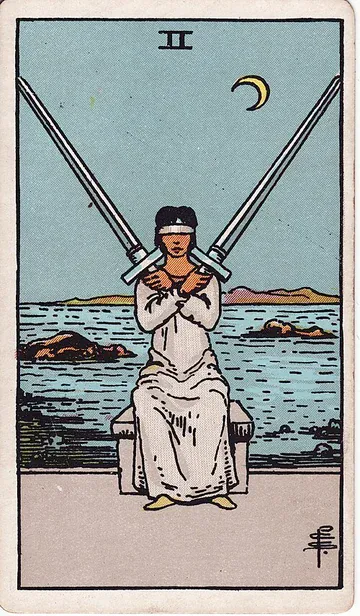
Two of Swords
A visual rhyme. The Two of Swords is the earlier moment, the decision held in suspension; the Eight is the later moment, the same pattern grown into eight planted swords and a wrapped cloth. Together they show how discernment, held too long, becomes avoidance. The Two warns of the pause; the Eight names the consequence of refusing the choice.
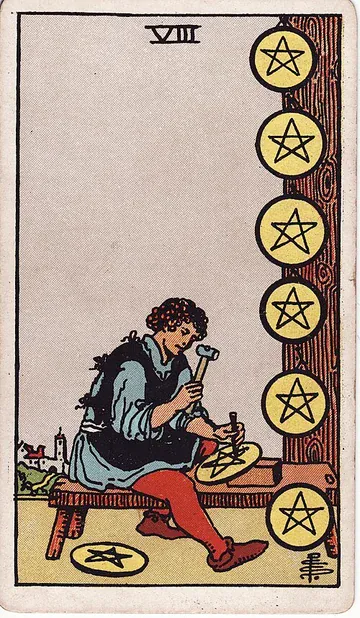
Eight of Pentacles
Series sibling, contrasting suit, identical number — and the deck's most precise prescription against the Eight of Swords' cage. The Pentacles version is body-discipline at the bench, hands working, craft built one stroke at a time. The combination says directly: do less mental work; do more bodily work. Sustained physical action dissolves the simulation more effectively than any further thinking can.

The Star
The most graceful antidote. Where the Eight of Swords stands clothed, blindfolded, paralyzed in cold water, The Star stands undressed, eyes uncovered, knee in the water at ease. The two are nearly mirror images. Together they show the cage and the door simultaneously. The blindfold can come off. The water can be lived in. The pouring is done with both hands.
Frequently Asked Questions
Has the no in the reversed Eight of Swords hardened into a permanent one?
It has hardened, though permanence is not what the card claims. Reversed, it reads as a soft no that has stabilized into a structural condition. The path is technically open; the simulation that prevents you from seeing it has now hardened into the way you perceive. Until one act of disobedience disturbs the simulation, the answer stays no. The card is honest: this is a no rooted in the seeker's own long-running model, and the model can be addressed, slowly, through external witness and small contradicting actions.
When does a blindfold stop being worn and start being the way someone sees?
At the conversion this card marks. Reversed, the Eight of Swords describes the cage that has become the home. The cloth is no longer a temporary binding; it has become clothing. The blindfold has fused with the eyes. The eight swords are no longer external obstacles; they have become internal furniture. The card warns that the inner paralysis has solidified into identity. The medicine is patient — externalize the simulation, test one belief, act before the model can rehearse the action, and accept that this depth of cage often requires real outside help.
What happens when two people run parallel scripts instead of one relationship?
The shared room thins out. In love, the reversed Eight of Swords describes the bond that has become a script run in parallel with the actual partner. Both people may be conducting a simulated relationship that has thinned the actual room. For singles, it warns of the dating pattern hardened into worldview, the eight reasons against your own loveability carried as atmosphere rather than claims. For reconciliation questions, it offers a soft no — returning now would seal the simulation around both of you again.
Can warmth be genuine and still never reach the person it is meant for?
Under this card that is the usual arrangement: the warmth is real and has been encased in a long-running script. They feel something for you, and the script about what the feeling means has now substituted for the feeling reaching you. Read it as warmth without offering, story without listening. The work, if there is work, is theirs — you cannot lift their blindfold for them, and waiting for them to lift it can take longer than the situation warrants.
What counts as disobedience against my own model?
Any act the model did not predict. Commit one of them against your own long-running story. Externalize the simulation by writing it down or speaking it to a witness. Test one belief that has been stated in your interior, unchallenged, for years. Act before the simulation has time to model the action. Accept that this depth of cage often requires professional help. The cage opens slowly through small unrehearsed acts, accumulated with consistency rather than drama.
Continue Reading
Eight of Swords · Card overview · symbols · correspondences →
Return to the full card view — image, symbols, sensory correspondences, and Hermetic axes.
Read the upright meaning →
Read the same depth on the opposite orientation.
Draw your reading now →
Bring this card to a question — open a quiet ritual.