
Five of Cups · Core Meaning
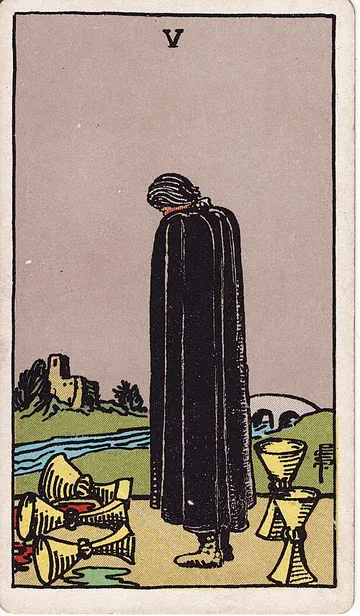
The Five of Cups meaning, in the most honest line, is the first true hour of mourning. The card shows a black-cloaked figure on a gray riverbank with his head bowed. Three cups lie spilled at his feet, their contents already soaking into the earth. He is looking down. He is so completely inside the looking-down that he has not noticed the two cups still standing behind him, untouched. Across the river is his castle. A bridge connects the two banks. The sky is not dark — only dimmed, the kind of gray that follows rain.
This is the card's signature image, and almost every reading of the Five of Cups returns to it. The spilled three are what was lost — the relationship that didn't become, the project that collapsed, the body that didn't hold, the version of the year that was supposed to happen. The standing two are what remains, real and reachable, but currently invisible because grief has narrowed the field of vision down to a circle the size of the wound. The bridge is the way home. The castle is the life he still belongs to. None of it has been taken away. He simply cannot, in this moment, look up.
The Five of Cups tarot card meaning lives inside that not-yet-looking-up. It is not a card about whether the loss will be repaired; the spilled cups stay spilled. It is a card about the hour after. The hour when the only honest thing to do is to grieve, and the second honest thing — the one that comes later, sometimes much later — is to turn around. The card describes both halves of that motion. The bowed head, and the slow turn. Lunarcana reads it as a description of weather, not a prediction: this is what the inside of grief looks like when it is being lived properly, before it has been packaged into a story.
The traditional astrological signature is Mars in Scorpio, first decan — the sharpest cut inside the heart, the moment stability is torn open and what stays is separated from what goes. Mars is the planet of cutting; Scorpio is the water that knows what death is; the first decan is the rawest opening. There is nothing soft about this transit. It produces clean wounds. The kabbalistic placement is Geburah, the sephirah of severity, in the world of Briah — creation. Geburah is the force that purifies by removing. In the suit of Cups — the suit of feeling — severity arrives as a loss that cannot be undone, only metabolized. The card holds Mars's edge inside Cups's container, and the container does not break. It only stains.
Everything in the picture is dated to one specific half-hour: the greyest stretch after rain, when the light has gone flat and the ground is still soft enough to drink. That softness matters. The wine is not pooled on stone where it could be scooped back; it has gone into the earth, the way an unrecoverable thing goes. The old correspondences run in the same key — willow and wormwood, damp soil and myrrh, iron and lead, a crow somewhere out of frame. None of them are ominous on their own. They are the vocabulary of a wake: the bitter herb, the heavy metal, the smell of wet ground being opened. And then the cloak, which is the one item in the scene nobody handed him. The loss arrived from outside; the black garment he put on himself. It shelters him and it cuts him off in the same gesture, and it comes off the way it went on — by his own hand, at an hour he chooses.
Number Five in tarot is the number of conflict, of the instant a stable structure is torn open. In Wands it is competitive struggle; in Swords, defeat; in Pentacles, exclusion from warmth. In Cups, the conflict is interior — the war between what was and what is, fought silently inside the chest. Read the Five of Cups in any spread as the card asking the seeker to finish a grief properly before they ask anything else of themselves. Not to bypass it. Not to monetize it. To stand on the riverbank, in the cloak, and let the spilled cups be spilled. The two behind will still be standing when the head lifts.
Five of Cups · Love & Relationships
In love readings, the Five of Cups is one of the harder cards the deck offers — and one of the more honest. It describes a relationship-shaped grief: a love that has been lost, or that was never quite what you hoped, or that has become a slow accumulation of small disappointments that you are only now letting yourself name. The cloak in the image is the mourning garment the seeker put on for this specific person, this specific almost. The cups at his feet are what he had pictured. The two behind him are the love that is still possible, including, sometimes, with the same person.
For an existing partnership, the Five of Cups upright often arrives in the season after a betrayal that has been named but not yet metabolized. Not necessarily an affair — sometimes a smaller, quieter betrayal: the moment a partner did not show up the way you needed, the years in which something was understood differently by each of you, the fight that revealed what one of you actually thought. The card is not predicting the end. It is describing the chest that is still sore. The work of the card is to grieve the version of the partnership you thought you had, so that the version you actually have can be loved properly. Until that grief is finished, the present partner is being asked to compete with a ghost.
For a new spark that has not yet stabilized, the Five of Cups upright is a warning that you are bringing an older grief into the doorway. The person across from you may be entirely real, entirely worth knowing — and you are scanning them for the shape of a wound you have not yet finished mourning. The card is not telling you to stop. It is telling you that the early conversations need to include the cloak you are wearing. Either acknowledge it, or take it off. Showing up to a new love in mourning clothes you refuse to name is the small unkindness that makes new loves end before they begin.
For a single seeker who has been alone for a long stretch, the Five of Cups can describe a grief over the love that was supposed to have arrived by now. Not the absence of any specific person, but the absence of the life you thought you would be inside by this age. The card honors that grief. It is real. It is not self-pity. The work, when the grief has been allowed, is to notice that the two cups behind you — the friendships that have held, the family that has stayed, the body that still wakes up — are not consolation prizes. They are the standing cups. They count.
For love after a wound — the breakup, the death of a partner, the divorce that finished six months ago and still aches at odd hours — the Five of Cups is the canonical card. It is the card of permission to mourn. Some readers experience this as relief: the deck finally naming what they had been minimizing. The card asks for a real grief, not a performed one. Cry the actual tears. Tell the actual person who can hold the telling. Do not bypass into a new relationship in the third month. The cloak comes off when it comes off; trying to take it off early only stitches it on.
For someone in a long-distance or limbo arrangement that has begun to ache, the Five of Cups upright describes the slow accumulation of small absences becoming a real grief in its own right. The missed birthdays. The phone calls that do not replace presence. The version of the relationship that the distance prevents. The card asks you to stop minimizing this grief because the relationship is still technically intact. Distance grief is grief. Name it for what it is. The standing two cups, here, may be the friendships and the local life that have been sacrificed to keep the long-distance reaching alive — the question is whether the spilled and the standing have been honestly accounted for.
For the question of reconciliation — should I go back, will they come back, was the breakup the right call — the Five of Cups upright leans toward no. Not a hard no. A no that sounds like: the relationship in the form you had it is one of the spilled cups. If something returns, it will not be the same shape. Decide whether the new shape is what you actually want, or whether you are reaching for the spilled three because they are the only cups in your line of vision. The two behind are the question.
For the specific situation where someone is asking whether a person they are still half in love with feels the same, the Five of Cups upright is a soft, painful confirmation that the other person is also grieving — but possibly grieving the loss of an older version of themselves rather than the loss of you. Read carefully. Mutual sadness is not always mutual love. Sometimes both people are at the riverbank, looking at different cups.
A note on the card's particular love language: the Five of Cups loves elegiacally. It feels deepest when it is feeling what was lost. This can be beautiful — there are loves that are honored most cleanly in their ending — and it can be a trap, a way of keeping the lost beloved alive in the chest by refusing the standing cups. Watch for the partner who only seems to love you fully when you are about to leave. Watch for the part of yourself that only feels alive inside heartbreak. Both are Five of Cups patterns. Both can be loosened. Neither needs to be shamed.
If you are asking whether the person you are asking about loves you, and the Five of Cups arrives upright, read it this way: they have feelings that include grief. Sometimes the grief is for you, sometimes for someone before you, sometimes for the version of love they had hoped to feel. Whatever the answer is, do not force them off the riverbank. Stand at a respectful distance. Wait for the head to lift on its own. If it lifts and they walk toward you, the love is real. If they refuse to turn, the love was never going to arrive in this season — and the cleanest thing you can do is begin walking toward your own bridge.
Five of Cups · As Feelings
Sad. Not angry with you, not indifferent to you, not taken up with someone new — sad, which is the plainest thing the Five of Cups ever says about a person. They are inside a grief that is shaping the way they look at you. Whether the grief is about you, or about something else they have not finished metabolizing, is the question the card asks the seeker to sit with.
The most common form, when the Five of Cups arrives in a feelings reading, is that the person is mourning a version of the relationship that did not arrive. They imagined something with you that did not become. They are not pretending the disappointment doesn't exist. They are wearing the cloak in front of you, and they have not yet decided whether to take it off or to keep it on through the next season. Their warmth is real. Their grief is also real. Both are present in the same room.
If they are reserved by nature, the Five of Cups in feelings can mean a quiet, internalized sadness that they are not telling you about. They are protecting you from the weight of it, or protecting themselves from saying it out loud and making it more real. Read silence here as mourning, not as withdrawal. It is the same shape from the outside; it is a different shape from the inside. Do not fill the silence with reassurance. Let them have the riverbank.
If they are demonstrative, the Five of Cups in feelings can mean visible disappointment — the long sigh, the sentence that trails off, the eyes that fill at unexpected moments. They are giving you the cloak to look at because they want you to know it exists. This is information, not theater. They are asking whether the relationship can hold the grief. The honest answer is sometimes yes, sometimes no, and the card's wisdom is to take the question seriously rather than soothing it.
For a partner you have been with a long time, the Five of Cups in feelings can describe a slow accumulation of small unmet needs that have finally become legible to them. They are not building toward an exit. They are mourning the way they have been holding the relationship without naming what was missing. The card asks you to ask. Not interrogate — ask, gently, with room for an answer that takes time. The two cups behind are the love you still have. They are not yet useless.
For a new connection, the Five of Cups in feelings is harder to read. It can mean they are still in love with someone before you, or still grieving a self they had to give up to be open to you. The card cautions against taking the grief personally. It is not aimed at you. It is also not optional weather you can decide to ignore. Either the grief is something they can carry across the bridge while still building a real connection with you, or it is something that requires its own season before they can be available. Notice which.
A small caution embedded in the card: the Five of Cups personality, in love, can confuse the grief with the love itself. They can attach so completely to the spilled cups that the standing two — including, often, you — become slightly invisible. If you sense them looking past you toward something they have lost, the card is naming it. It does not mean their feeling is fake. It means their attention is not yet free.
For Five of Cups feelings in a long-distance or limbo situation — where you are waiting for a decision they keep deferring — the card describes the partner who is genuinely sad about the situation and unable to act inside the sadness. They cannot quite leave. They cannot quite arrive. The grief has paralyzed them. Lunarcana would never tell you to stay or to go; the card simply says that staying without naming the paralysis only deepens it. The conversation that will move the situation is the one neither of you wants to have.
For an ex with whom there is unresolved history — the person you ran into recently, the one whose name appeared in a friend's update, the message that arrived after years of silence — the Five of Cups in feelings describes someone who is still grieving the version of the relationship that did not get to finish properly. They have feelings that are real and complicated. They are not asking you to come back. They are also not entirely indifferent. Read carefully whether what they feel is alive in the present or whether it is the rehearsal of a memory they cannot let rest. The two readings ask very different responses from you.
Take the Five of Cups in feelings as confirmation that emotion is present, that the connection is real, and that grief is the dominant note. The work is not to fix the grief. The work is to be careful with what gets built on top of it. Foundations made of un-mourned loss are not foundations.
Five of Cups · Career & Work
In career readings, the Five of Cups upright is the card of a professional disappointment that has not yet been processed. The promotion you did not get. The funding round that fell through. The project you put a year into that quietly ended without the praise you imagined. The job you loved that ended in a layoff. The card is the chest sitting back from the desk in the half-hour after the email arrived, before the body has decided what to do next.
If you are asking whether to stay in a current role that no longer feels right, the Five of Cups upright suggests that you are still grieving the role you thought you would be in by now. The actual job — the colleagues who are decent, the work that pays the rent, the small things that have been quietly working — is one of the standing cups behind you. The job you wanted is one of the spilled three. The card is not telling you to settle. It is telling you not to make the decision while you are still in the cloak. Mourn the wished-for role. Then decide.
For someone considering whether to leave a role after a specific bad event — the conflict with the manager, the project that imploded, the moment of public failure — the Five of Cups upright counsels patience. The grief is sharpest right now. The decisions made inside this hour will be shaped by the spilled cups, not by the actual landscape. Wait one full season — three months — before the structural decision. If the grief is still acute then, you know it. If it has eased, the standing two come into clearer view. Either answer is valid; only the decision made inside the cloak is questionable.
For someone considering a new role, the Five of Cups upright warns of two related traps. The first is the rebound role — taking the offer because the current situation hurts, without noticing whether the new place is actually a good fit. The second is the role chosen to prove something to the people who hurt you in the last one. Both are decisions made by the cloak. Neither tends to land well. The card is not anti-change. It is asking you to make sure the change is being driven by the standing two cups (where you actually want to go) rather than by the spilled three (what you are running from).
Entrepreneurs and freelancers should read the Five of Cups as a signal that the practice has experienced a real loss — a launch that did not land, a client that left, a season of revenue that did not appear — and that the loss has not been fully named. Founders especially carry these losses silently because the role demands optimism. The card is permission to grieve the version of the company you thought you would have by now. Not in front of the team. In private, with the rituals and the witnesses you trust. The grief, finished, makes the next decisions cleaner. Unfinished, it leaks into every meeting.
For a creative practice, the Five of Cups can describe the season after a project's reception fell short of what you imagined. The book that did not find its readers. The show that closed early. The album that arrived to silence. The card honors that grief. The work was real. The hope was real. The disappointment is real. None of this means the work was wrong, or that you should stop. It means there is a mourning to do for the imagined version of the reception, and the next work cannot begin honestly until that mourning has happened. The standing two cups, here, are the work itself — the practice of making, which has not been taken from you. Even the failed project taught you something. Take the lesson across the bridge.
For someone in active job search, the Five of Cups upright can describe the rejection that has hit harder than expected. The dream company that said no. The interview process that ran for months and ended in silence. The card asks for the small ritual of mourning that one specific possibility — write the letter you do not send, name what you wanted from that specific role, and then close the file. The next role is one of the cups behind you. It is not yet visible. It will become visible when the gaze unlocks.
For questions about a layoff or a forced career change, the Five of Cups upright is one of the kindest cards in a hard moment. It validates the loss. It refuses to bypass the grief into "everything happens for a reason" platitudes. The thing that ended did not end because you were unworthy of it. The thing that ended ended because the structure that held it ended. Mourn it. The bridge is already built. The work is to walk, eventually, in your own time.
For team-level grief — the colleague who left, the company that downsized, the founder who stepped down, the mentor who died — the Five of Cups upright describes the season when an organization is mourning together and pretending not to. Meetings feel hollow. Decisions are postponed. Energy is low in ways no one wants to name. The card asks the seeker who can act as a small steward of the collective grief — naming it briefly in the standup, leaving room for the slowness, refusing to bypass the loss into productivity theater. This is small leadership work, often unrewarded, and it matters more than it is credited for.
For someone approaching retirement, or recently retired, or facing forced retirement before they were ready, the Five of Cups upright is the card that names the grief most working culture refuses to name. The professional identity that was built over decades does not simply convert into "more time for hobbies." Something is being mourned: the daily structure, the colleagues, the meaningful work, the version of yourself who was useful in a specific way. The card asks you to take this grief as seriously as any other major loss. The standing two cups, here, are the next chapter — which is real but is not yet visible while the cloak is on. Give it time to appear.
A note on stability: the Five of Cups is not a card of professional disaster. The castle is still there. The bridge is still standing. The two cups behind are full. What has been lost is real and what remains is also real. Career readings around this card do best when both halves of that sentence are honored. The reading that only sees the loss is a reading that has joined the figure on the riverbank without telling him about the bridge.
Five of Cups · Money & Finances
A loss to the bank balance is one thing; a loss to the future you had already half-lived in is another, and the Five of Cups upright is almost always the second kind. The investment that did not pay off. The business that closed. The client whose departure left a hole in the year. The check that didn't clear. The card describes not the loss itself, which has already happened, but the chest in the days after, sitting at the kitchen table, looking at the spreadsheet that no longer adds up the way it was supposed to.
For a question about whether a financial gamble paid off or will pay off, the Five of Cups upright tends toward no. Not a catastrophic no. A quieter no — the kind that does not bankrupt you but does cost you the version of the year in which the gamble was supposed to land. The card asks you to take the loss honestly. Do not double down to recover what you put in. Doubling down here is the spilled-cups gaze refusing to turn. Walk away with what is left.
For the seeker who has been managing scarcity, the Five of Cups can describe a setback that has wiped out the small margin you had built. A medical bill. A car repair. The unexpected expense that landed in the worst week. The card honors how exhausting that pattern is. It also notices that the two cups behind you — the people who would help if you asked, the support systems you have not yet used, the slow rebuilds that are still possible — are real. Not consolation. Resources. Ask for help if asking for help is something you have been avoiding. The cloak makes asking feel like failure. It is not failure. It is how the bridge gets crossed.
For someone in financial recovery from a larger event — a bankruptcy, a divorce settlement, a business that closed — the Five of Cups upright describes the long middle season. The acute crisis is past. The new normal is still gray. The card asks for honesty about what you have actually lost (so you can finish mourning it) and honesty about what remains (so you can begin to use it). The trap, here, is the seeker who keeps the spreadsheet open all day, looking at the deficit, instead of beginning to do the small things that rebuild slowly. Both grieving and rebuilding are needed. The card is asking which one has gone missing.
For a question about whether to make a major purchase — a house, a car, a piece of equipment — the Five of Cups upright counsels delay. Not refusal. Delay. The decision being made right now is being made by the part of you that is grieving something else. The purchase will not fix that grief; sometimes it will deepen it, by adding a financial weight on top of an emotional one. Wait until the gaze has lifted. Then revisit. If the purchase is still right, it will still be right then. If it was a substitute, that shows.
For windfalls — inheritance, settlement, gift — the Five of Cups can describe money that arrives entangled with grief. The inheritance from the parent who died. The settlement from the accident. The gift from the relationship that ended. Receive it carefully. Take a long time to decide what to do with it. Do not let the grief make the decisions; do not let the money make the grief invisible. Both are real. Both deserve their own attention.
A practical move when the Five of Cups appears in a money question: write the actual numbers down. Not in a financial app — on paper, with a pen. The card responds to slowness and to honest seeing. The cloak makes the numbers feel worse than they are; the page, looked at directly, often shows that the standing two cups (the savings still there, the income still arriving, the resources still available) carry more weight than the spilled three. This is not magical thinking. It is the simple discipline of looking at what is, rather than at what was supposed to be.
Five of Cups · Health
Grief goes into the chest and stays there until something lets it out; the Five of Cups upright reads the body through that single fact. The card's elemental signature is Water at its coldest and deepest, the phlegmatic temperament: the system that runs slow and cold when sorrow is unspoken. The body part the card touches is the chest, the seat of grief, and the tear ducts. The Five of Cups describes the kind of physical signal that reveals an emotional load the seeker has been carrying without quite naming it.
If you are asking about a physical symptom and the Five of Cups arrives, look for the connection to a recent loss. Not always a death — losses come in many shapes: the end of a relationship, the departure of a child to college, the move from a home you loved, the betrayal that broke a friendship. The body is not separate from the heart. Grief that has not been allowed to move tends to settle. Most often in the chest, sometimes in the throat (the unsaid sentence), sometimes in the gut (the held inability to digest what happened). Where grief settles in a body is a description, not medical advice. A symptom is a symptom and deserves an actual practitioner. The card simply notes that the grief is part of the picture and may be part of what is asking to be tended.
For someone managing a chronic condition, the Five of Cups upright can describe the grief over the body that does not work the way it once did, or the way other bodies appear to work. The card honors that grief. There is no spiritual bypass that makes chronic illness lighter than it is. The work is to allow the mourning of the body you were promised — the standing-up, the running, the sleeping through the night, the eating without consequence — without letting that mourning become the entire identity. The two cups behind are what your body can still do. Some days they are very small cups. They still count.
For mental health, the Five of Cups upright is one of the deck's clearest cards for depression — particularly the depressive episode that follows a loss and refuses to move on schedule. The card validates the slowness. Grief is not on the calendar your culture has built for you. Some losses take three months to feel. Some take three years. Some take a lifetime, in soft waves rather than acute crises. The card asks for the basic care: enough sleep, food at regular intervals, sunlight when the season permits, the friend who can be told, the practitioner you have been postponing seeing. None of this is meant to fix the grief. It is meant to keep the body cooperative while the grief does its work.
For someone managing alcohol, food, or other comfort behaviors that have crept upward in a season of loss, the Five of Cups upright is a gentle mirror. The substance is not the problem; the grief that the substance is being used to muffle is the problem. Take the grief seriously. The substance will not relieve it; it will only delay the metabolism. The card asks for the harder, slower work of letting the loss be felt directly, supported by people and practices that can hold it.
For someone in recovery from a specific medical event — surgery, treatment, a hospitalization — the Five of Cups upright can describe the grief over the body's vulnerability that the event revealed. The mortality that is now in the room. The illusion of invincibility that has cracked. This grief is not weakness. It is the soul re-orienting itself to a more honest sense of what a body is. Honor it. Talk about it with the person who can listen without trying to cheer you up. The standing two cups, here, are the body that is still here, still recovering, still worth caring for.
A small practice for when this card appears in a health reading: place a hand on the chest, where the cloak in the image gathers, and breathe slowly for two minutes. Not as a fix. As an acknowledgment. The card responds to the small physical gesture of being-with rather than solving. Most of what the Five of Cups asks for is being-with, repeated daily, until the head lifts on its own.
Five of Cups · Spirituality
Mourning, in the Five of Cups upright, is work with its own hours. Not as a stage to be moved through quickly, not as a problem to be solved by belief, but as a real spiritual labor that has its own integrity and its own rewards. The traditions that take grief seriously — the Jewish shiva, the Mexican Día de los Muertos, the Buddhist forty-nine-day intermediate state — all understand what this card understands: the soul does work in mourning that it cannot do at any other time. Bypassing that work is not advancement. It is theft, mostly from the self.
The card's kabbalistic placement is Geburah — severity, the cutting force that purifies by removing — in the world of Briah, creation. Geburah is the disciplinarian among the sephiroth. It does not enjoy taking things away. It simply knows that some losses are necessary, that some structures have to be cut for the next form to arrive. In Cups, this severity arrives as grief, and grief, properly held, is a kind of devotion. To grieve fully is to honor that the lost thing mattered. The seeker who refuses to grieve is also refusing to acknowledge that the thing was real.
For seekers in active practice — meditation, journaling, ritual, devotional work — the Five of Cups upright describes a season when the practice cannot lift the sadness, and is not supposed to. The meditation will not fix the grief. The journal will not finish the mourning in three pages. The ritual will not bring back what was lost. What practice can do, in this season, is hold the seeker steady inside the grief, so that the grief does its work without destroying the seeker. The instruction is to keep showing up to the practice without expecting it to perform. The cloak is welcome at the cushion.
For seekers exploring belief, the Five of Cups can describe the moment when an old framework breaks. The God you were raised with no longer answers. The certainty you built in your twenties no longer holds. The teacher you trusted has been revealed as flawed. The card honors that grief — religious grief is grief — and asks for honesty about what has actually been lost (the framework, not the underlying need it served) and what remains (the longing for meaning, which is itself sacred). The two cups behind, here, are the perennial questions that survive every collapsed answer.
The card's spiritual caution is the one Geburah always brings: do not let the grief become the new identity. The seeker who has lost something real and important may be tempted to organize the rest of life around that loss — to become the person whose biography is the wound. This is the shadow side of the Five of Cups. The cloak that began as honest mourning becomes a costume worn long after the grief has finished its work. The integration is to remove the cloak, eventually, even though removing it feels like a betrayal of the lost thing. It is not. The lost thing is not asking to be carried this way. The carrying was always the seeker's choice.
A specific practice when this card appears: a thirty-minute ritual of naming. Sit in a quiet room with a single candle. Speak aloud, to the empty room, exactly what was lost — the relationship, the person, the project, the version of yourself, the future that did not arrive. Be specific. Name the small things, not just the headline. Then sit in silence for ten minutes. Then blow out the candle and stand up. Do this once a week for as long as the grief asks for it. The card responds to slow, repeated honesty. The bridge to the castle is built one named loss at a time.
Five of Cups · Yes or No
Soft no — but not a closing of the door.
For five of cups yes or no questions, the answer is no, with caveats that matter. The card is steeped in loss, and the immediate emotional weather around the question is grief or disappointment. Whatever you are asking about — will the relationship survive, will the offer come through, will the plan hold — the most likely near answer is no, this particular shape will not arrive the way you imagined.
But the Five of Cups is not the catastrophic no of the Three of Swords or the Tower. It is the no that has the bridge in the picture. The no that says: the spilled cups are spilled, and the standing two are still real, and the castle is still your castle. The thing you are asking about may not become; the larger life it lived inside has not ended.
For yes-or-no questions about a relationship, a job, a move, a decision: lean toward no for the version of the question you asked. The relationship will not return in the form you remember. The role will not be the role you imagined. The decision will not produce the relief you were hoping for. The card is being honest, not punitive.
For questions about whether someone is being honest, whether an offer is genuine, whether a plan will hold: the Five of Cups warns of disappointed expectations. The other party may not be lying, but what they are offering is not what you thought you were being offered. Read carefully. Ask the second question. Look at what is, not at what was promised in the first conversation.
Asked when the mourning lifts, the Five of Cups upright suggests no, not soon, and the asking-when may itself be the cloak. The card is asking you to release the timeline. The thing that arrives next will arrive when the gaze has shifted, not when the calendar has turned. You cannot accelerate the turn.
For binary decisions — should I act, should I wait — the card answers wait. Specifically: wait until the grief has finished its first acute phase. The action made inside the cloak will be the wrong action. The same action made after the head has lifted may be the right one. A week, a month, a season — give the grief the time it needs. The card is not anti-action. It is anti-action-as-anesthesia.
Asked a second time and a third, the question changes character. Many readers meet the Five of Cups when they have already pulled on this exact matter and disliked the answer — the reshuffle, the different deck, the second opinion from a different reader by midnight. The card is unusually pointed about that habit: re-asking is the fixed gaze wearing another costume. The hand that keeps cutting the deck belongs to the same body that will not turn its head. If this question has been asked more than twice, the useful version of it is no longer whether the answer is yes. It is what would have to be felt if the answer stayed no. That one is answerable, it belongs to you rather than to the cards, and it is the only form of the question this card is prepared to be generous with.
If the question was: am I being foolish to still hope for this? The card answers softly that the hoping is not foolish, but it is misdirected. The thing you are hoping for is one of the spilled cups. The hope itself, redirected, is what will eventually let you turn around.
Five of Cups · Advice
Grieve properly, and on a timeline nobody else gets to set. The Five of Cups upright is not asking you to be okay, not asking you to find the lesson, not asking you to bypass the loss into gratitude. It is asking you to stand on the riverbank, in the cloak, and let the spilled cups be spilled. Mourning is the work. The work cannot be skipped.
If there is one specific instruction the card offers, it is this: name the loss out loud, to a witness who can hold it. The grief that is held silently inside the chest tends to harden. The grief that is named to another person — a friend, a therapist, a journal that will be read by your future self, a candle and an empty room — begins to move. The card responds to articulation. The cloak loosens around the named thing. The unnamed loss is the one that calcifies.
A second instruction: do not make any structural decisions while you are inside the acute grief. Do not quit the job, end the friendship, sell the house, send the email, post the public statement. The decisions made by the cloak are decisions inherited later by a bewildered owner of someone else's regret. Wait one full season. If the decision is still right after a season, it will still be there to make. If it was a flinch, not having made it is the relief.
A third instruction: notice the standing two. Not as a way to bypass the grief — as a way to keep yourself oriented while the grief does its work. The friends who have stayed. The body that still wakes up. The work that still works. The small daily pleasures that have not been taken away. This is not gratitude as a discipline; it is honesty. The two cups behind are not consolation prizes. They are the other half of the truth. Both halves need to be visible.
A fourth instruction, gentler than the others: look at the bridge. Not yet to cross it — only to know it is there. Most of the suffering of the Five of Cups comes from the secret belief that the river cannot be crossed, that the castle is unreachable, that the cloak is now permanent. This is the lie the grief tells in its loudest hour. The bridge is in the picture for a reason. It was already built. It will still be built when you turn around.
Put the dates in the calendar yourself. Grief keeps a calendar whether or not you agree to it — the anniversary of the diagnosis, the day the lease ended, the birthday that now belongs to no one, the week last year when everything was still fine. Ambushed by one of those dates, a person loses a fortnight and spends it wondering why nothing gets done. Written down in advance, the same date becomes something to plan around: the afternoon taken off, the long walk, the one friend warned that this is the hard week. The figure returns to the same riverbank on the same day for a few years running; that is ordinary, and it is survivable when the return is chosen rather than sprung. Open the calendar this week, find the next of those dates, and put a note beside it saying how you intend to spend it.
Practical advice for the day the card appears: do not solve. Do not strategize. Do not optimize. Sit with one cup of tea, slowly. Write one sentence about what you have lost, on paper, by hand. Walk for twenty minutes outside, even if the weather is gray. Call one person — not to be cheered up, only to be heard. Sleep early. The card responds to the small, quiet attention that grief actually needs, and never to the manic attempt to fix the grief by overworking around it.
Five of Cups · Card Combinations
What sits beside the Five of Cups changes the temperature of the grief more than it changes its content. The loss stays a loss; the neighbors decide what is done with it. A Wands card on either side tends to burn the mourning off before it has finished — quick, and the ash returns later in the year. A Pentacles card lets it settle and crust over into scar, which is stable and slightly numb. A Swords card turns it into a sentence that can finally be said out loud, which is the kindest of the three even when the sentence is brutal. Read the pairings below in that light: each is a different answer to the question of what this particular grief is being asked to become.
Five of Cups + Death
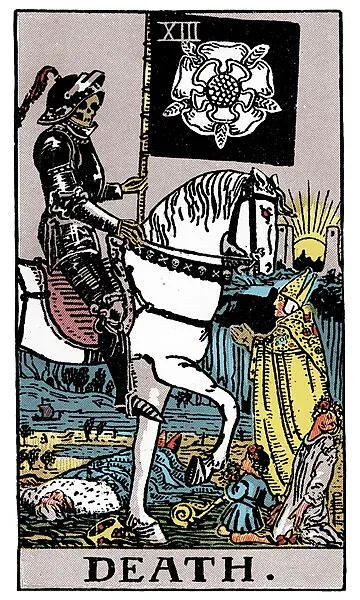
The grief card next to the great transformation card. Both share the Scorpio rulership; both are about endings that the seeker did not choose. Together they are the karmic ending — the loss that is also a structural shift, the death that clears space for a self that could not have lived alongside what is dying. The pairing is hard but clean. Mourn the spilled cups. Allow the larger ending its dignity. The two cups behind, here, are the parts of you that are about to be born into the cleared space. Do not rush them. Do not deny the death.
Five of Cups + Six of Cups
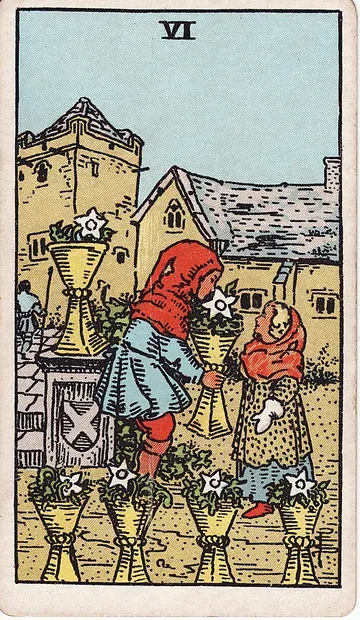
The card of grief next to the card of return — the room the cloaked figure walks into when he finally turns. Six of Cups is the children in the garden, the sweetness from before, the reconnection with what mattered to you when you were younger and more honest. Together, the pairing describes the way grief, properly metabolized, opens the door to recovered innocence. Not the false innocence of bypass; the earned innocence of someone who has lost things and chosen to remain tender. This is one of the most healing pairings in the deck for grief work.
Five of Cups + Four of Cups
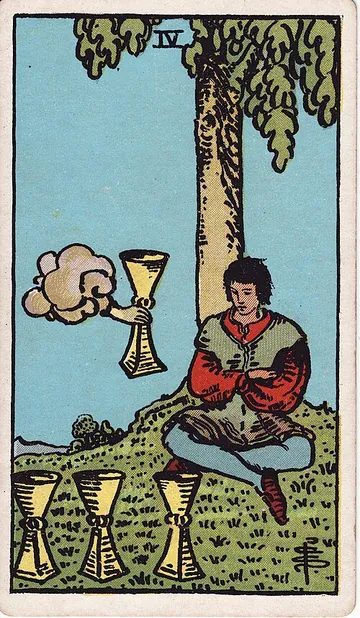
Two consecutive Cups, both inward-facing, both about the gaze that refuses to lift. Four of Cups is the apathy and refusal that often preceded what spilled — the offered cup that was not taken, the conversation that was not had, the small noticing that was not done. Together, the pairing asks the seeker to look at the role that pre-grief disengagement played in what is now being mourned. Not as blame. As information for the next season.
Five of Cups + Three of Cups
Three cups raised beside three cups on the ground. The Three of Cups is the toast — arms linked, vessels lifted to the same height, a harvest shared out loud; the Five is the same count of vessels lying empty in the mud. Set together, the pairing almost always points at the friends: the ones who would come if they were told, and who have not been told. Mourning in the Five is private by design — the cloak is a room with a single chair in it. The Three does not arrive asking the griever to cheer up. It asks whether anybody has been let in. In practice this combination often marks the week the seeker finally says the thing aloud at a kitchen table instead of carrying it alone, and discovers that the telling cost less than the silence had been costing.
Five of Cups + The Star
The grief card next to the canonical card of healing-after-grief. The Star is the figure pouring water from two pitchers under an open sky, the water restored and moving, the night calm. Together with the Five of Cups, this pairing describes the full arc — the spilled cups eventually becoming the poured ones, the cloak eventually exchanged for the openness of the Star figure's bare skin under the stars. The pairing is one of the deck's most reassuring promises about the long shape of mourning. It does not skip the grief. It places it in the larger weather of return.
Five of Cups + Five of Pentacles
Two Fives, both pictures of a downcast figure missing the visible help nearby. Five of Pentacles shows two figures in the snow walking past a lit church window; Five of Cups shows the cloaked figure missing the standing cups behind him and the bridge across the river. Together, the pairing names a pattern: the seeker has begun to organize life around what is missing rather than what is present. Often this pairing arrives in seasons of compounded loss — emotional and material — and asks the same question of both: turn around. The help is not abstract. It is in the picture. Look up.
Card Combinations
Death
The grief card meets the great transformation card; both share Scorpio's rulership. Together they describe the karmic ending — the loss that is also a structural shift, the death of one form clearing space for a self that could not have lived alongside what is dying. Mourn the spilled cups. Allow the larger ending its dignity.
Six of Cups
The grief card next to the room the cloaked figure walks into when he turns. Six of Cups is the recovered sweetness, the children in the garden, the simple connection from before the wound. Together the pairing describes grief properly metabolized opening the door to earned innocence — the tenderness chosen by someone who has lost things and refused to harden.
Four of Cups
Two consecutive Cups, both inward-facing, both about the gaze that refuses to lift. Four of Cups is the apathy that often preceded what spilled — the offered cup not taken, the conversation not had. Together the pairing asks the seeker to look at the role pre-grief disengagement played in what is now being mourned, not as blame but as information for the next season.

The Star
The grief card next to the canonical card of healing-after-grief. The Star is the figure pouring water from two pitchers under an open sky — water restored, night calm. Together the pairing describes the full arc, the spilled cups eventually becoming the poured ones, the cloak eventually exchanged for the bare-skinned openness under the stars. The pairing places mourning inside the larger weather of return.
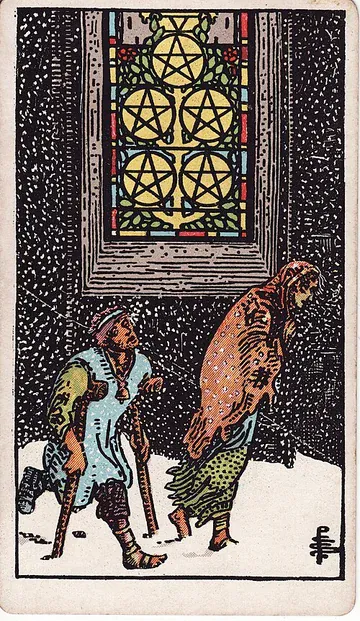
Five of Pentacles
Two Fives, both pictures of a downcast figure missing the visible help nearby. Five of Pentacles shows two figures in the snow walking past a lit church window; Five of Cups shows the cloaked figure missing the standing cups behind him and the bridge across the river. Together the pairing names a pattern: the seeker has begun to organize life around what is missing rather than what is present. Turn around. The help is not abstract.
Frequently Asked Questions
Why does the figure in the Five of Cups never turn around to see the two standing cups?
Because grief has no peripheral vision, and the card refuses to pretend otherwise. The Five of Cups means grief — the first honest hour of mourning a real loss. The card shows a black-cloaked figure on a gray riverbank looking down at three spilled cups; behind him, two cups still stand, unseen. The card describes the inside of grief: a loss is real, but it is not the whole. The bridge across the river to the castle is already built, waiting for the moment the gaze can lift.
Is the Five of Cups a no, or a no to the shape I was picturing?
The second, almost always. The answer is a soft no — the version of the thing you are asking about is unlikely to arrive in the shape you imagined. But the no is not catastrophic. The bridge in the image means the larger life is still intact. Wait until the acute grief has eased before treating the no as final; sometimes the no is only the no for this particular form, with another form still possible.
Am I grieving the person in the Five of Cups, or the version of us I had imagined?
The card is built for that exact distinction. It describes a relationship-shaped grief — a love that ended, a love that did not become what you hoped, or a current relationship in which a real disappointment is being mourned. The card asks for honest grieving before any structural decision. For reconciliation questions it leans toward no in the original form; for new sparks it warns about bringing un-mourned grief into the doorway of someone new.
If they feel like the Five of Cups, is the sadness about me or about something older?
The card deliberately leaves that unsettled. It describes someone who is sad — about you, about themselves, or about a version of the connection that did not arrive. Their warmth is real and their grief is real, both present in the same room. Do not rush them off the riverbank, and do not interpret silence as withdrawal; for this person, silence is often mourning. The work, if there is work to do, is to let the head lift on its own.
Is the Five of Cups a bad omen?
The Five of Cups is a hard card but not a bad omen. It names a real loss honestly rather than pretending it is not happening, which is more useful than a falsely cheerful card would be. The image itself contains the recovery: the two standing cups behind the figure, the bridge across the river, the castle still on the far bank. Nothing has been taken away that cannot eventually be walked back to. The card asks for grief now and for the turn, later, on its own timeline.