
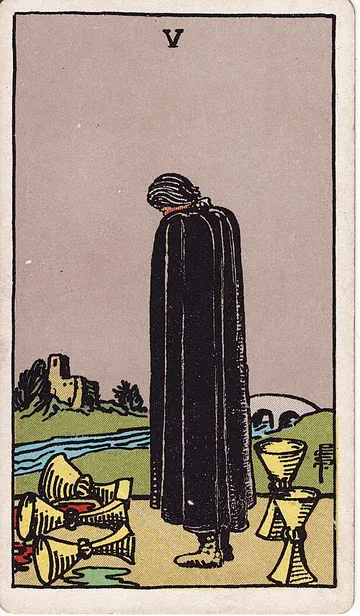
Five of Cups Reversed · Meaning
In the Five of Cups reversed the turn is the whole event — no repair, no restoration, nothing poured back into anything, only a neck moving a few degrees. The figure who has been bowed over the spilled three lifts his head, slowly, and notices what was always behind him: the two cups still standing, the bridge already built, the castle on the far bank. The cloak is still on. The grief is not gone. But the gaze has unlocked, and the unlocking is the entire meaning of the reversed card. What had been narrowed to the size of the wound is widening again to include the rest of what is real.
This is not the same card as the upright with the despair removed. The Five of Cups reversed carries the grief inside the recovery. It is the seeker who is still sad and has chosen, in some small daily way, to begin walking. The cloak comes off in stages. The first stage is simply turning the head. The second stage is recognizing the standing two. The third stage is the first step toward the bridge. The reversed card can describe any one of those stages; in a single reading it usually points to the one that is currently being asked of the seeker.
There is a second flavor of the reversed card, less common but worth naming: the figure who refuses to turn. Not because he cannot, but because the cloak has become too comfortable. The reversed card sometimes describes the seeker who has organized identity around the loss — "I am the one who lost" — and is using the grief as a wall against any future that might require putting it down. This is the shadow form. The card is not punishing it. It is naming it gently and asking the seeker to notice the substitution.
The astrological signature in reverse keeps Mars in Scorpio's intensity but redirects it. Where upright Mars is the cut that produces the wound, reversed Mars is the will that begins the rebuild. Scorpio's water remains deep and still knows what death is, but the water now moves again — toward shore, toward the bridge, toward the next thing. Geburah, the sephirah of severity, becomes the disciplined acknowledgment that the cutting was real and the structure that emerges from the cut deserves to be inhabited.
For a deeper read, watch which of the three meanings is most active in the reading: the first turn (the gaze unlocking, often early in recovery), the slow walk home (mid-recovery, where the bridge is being crossed but the cloak is still on), or the refused turn (the shadow, where the figure has chosen to stay on the riverbank as a way of life). All three are the reversed Five of Cups. All three deserve different responses from the seeker.
In number theory, the reversed Five carries the relief that follows torn-open stability — the moment Six of Cups becomes legible as the next room rather than as an unreachable nostalgia. The conflict at the heart of the Fives has begun to resolve, not by erasing what happened but by allowing the seeker to walk forward into Six's recovered sweetness. The cloak in the reversed image is the proof that the grief was honored. The walk is the proof that it was not the only thing.
For a reading where the reversed card sits as the present-position card, treat it as a description of the current weather: you are in active recovery. For a reading where it sits in the future-position, read it as an invitation rather than a guarantee — the recovery is available if the work is continued. For a reading where it sits in the past-position, the reversed Five often describes a previous chapter you have already crossed, the foundation on which the current life is built. Honor that foundation. The seeker who has done this work before knows what it cost.
Five of Cups Reversed · Love
Heartbreak stops being the first thought of the morning at some point, and the Five of Cups reversed marks that point rather than the end of it. The acute pain has loosened. The cloak is still on, but the head has lifted enough to see that the world is still here. For someone who has been inside grief over a relationship — its ending, its disappointment, its slow erosion — the reversed card is the day the body remembers it is still capable of laughing at something small.
For an existing partnership that survived a hard season, the Five of Cups reversed describes the slow re-arrival into the relationship after a real wound has been processed. Not "back to normal" — the wound is still there — but the day-to-day texture of the partnership is beginning to be inhabited again. Touch returns. Conversation returns. The thousand small acts that make a partnership real are starting to feel possible. The card honors that re-arrival without pretending the wound was not real.
For a new connection that began while you were still grieving an older love, the Five of Cups reversed can describe the moment you realized you were actually here with this new person, not still half-living in the old story. The cloak loosens. The new person becomes legible as themselves rather than as a comparison or a substitute. This is one of the gentler arrivals the card describes, and it usually requires you to have done some honest mourning of the older love first. Without that work, the reversed card sometimes hesitates — the gaze tries to unlock and snaps back to the spilled cups.
For a single seeker who has been alone through a long grieving season, the Five of Cups reversed describes the return of openness. Not necessarily the appearance of a new person — the readiness to see one if they appear. The card is the season in which you stop scanning every face for the lost beloved. The bridge becomes legible. The standing two cups — friendships, family, work that matters, the body that wakes up — begin to feel like enough on their own, which paradoxically is the condition under which a new love can arrive without being asked to fill an absence.
For love after a wound — breakup, death, divorce — the Five of Cups reversed is the canonical recovery card. Not the end of grief; grief over a real loss often runs for years in waves. But the return of capacity. The first night you sleep without crying. The first dinner you eat with appetite. The first moment a friend's joke actually lands. None of this means you are over it. It means you are building the muscle of carrying it across the bridge without needing the bridge to wait until the cloak is off.
For the question of reconciliation — should we get back together, are they coming back — the Five of Cups reversed is more nuanced than the upright. The upright leaned toward no for the original shape; the reversed can mean a yes for a new shape. If both people have done real grief work — separately, without forcing the other to perform recovery — the reunion that emerges can be different from what was. Not the same relationship resumed. A new one, built by people who have changed. The five of cups holds this question without scolding it — grief has already done enough scolding. Sometimes the reunion is real. Sometimes the reaching for it is the cloak that refused to come off. Distinguish honestly. A reunion walked toward in a new body and a reunion reached for from inside the old cloak look identical from the outside and end differently.
For someone asking whether a person they loved who hurt them is capable of love now, the Five of Cups reversed can describe a person who has done their own grief work and emerged different. Watch for the evidence. Words alone are insufficient; the reversed card asks for visible re-arrival in the world (responsibilities held, apologies that change behavior, the actual walking across the bridge rather than the description of intending to). If the evidence is there, the card supports cautious return. If the evidence is only words, the card warns: words spoken from inside the cloak are part of the cloak.
A note on the reversed card's shadow in love: the seeker who has built an identity around having been wronged. The endless rehearsal of the betrayal as the central story. The friendships that are sustained by the retelling rather than by the present. The card names this gently. The grief was real, and naming it was right; somewhere in the journey, naming it became performing it. The integration is to retire the story. Not to deny what happened — to let it become one chapter in a longer book rather than the table of contents.
For Five of Cups reversed in long-distance or limbo questions, the card describes the moment when the situation begins to clarify. Either the partner who had been paralyzed by grief begins to act — a clear conversation, a real decision, a movement either toward you or honestly away — or you yourself begin to walk toward your bridge regardless of their movement. Both are movements only the reversed card is able to make. The shared element is action that the upright card could not yet make.
For someone considering whether to date again after a long widowhood or a long single season that began with grief, the reversed Five of Cups gives a soft green light. The capacity to receive a new person has begun to return. The dating itself does not need to be heroic — the first coffee, the first awkward dinner, the first message exchange that feels neither catastrophic nor obligatory. The card asks you to enter the dating field as the person you are now, with the cloak still on if it is still on, rather than as a curated pre-grief version of yourself. Anyone worth meeting will meet the actual person. The cloak is not the disqualification you fear.
Five of Cups Reversed · As Feelings
When the Five of Cups appears reversed in a feelings reading, the person is on the other side of a grief — not finished, but turned. They have begun to look up. The sadness is still in the chest, but it is not the whole content of their attention anymore. Some of the warmth they have for you has become reachable to them again. The cloak is still on, but the arms are no longer crossed.
This is the card of the partner who has been processing something heavy and is now able to be in the room with you in a way they could not be while they were inside the acute grief. They are not pretending the grief did not happen; they are not pretending you replaced what was lost. They are finding a way to hold both the loss and the present connection at once. This is one of the more mature readings the card offers in feelings.
If they are reserved by nature, the Five of Cups reversed in feelings can mean a quiet re-emergence — they are showing up more, reaching out more, being slightly more visible than they were a month ago. The signals are small. Read them carefully. The reversed card often describes the partner who is recovering enough to begin trying again, not enough to make grand declarations. Trust the small signals. Grand declarations from the cloak are often the cloak performing.
If they are demonstrative, the Five of Cups reversed can describe someone who has begun to talk about the grief openly, with you, as part of letting you in. They are no longer protecting you from the weight; they are inviting you to share it, which is a sign of trust. Receive carefully. Listen without rushing to fix. The card is asking you to be a witness, not a solver.
For a partner you have been with a long time, the Five of Cups reversed in feelings can describe the season after a difficult chapter when the partnership is being re-inhabited. The arguments have stopped. The reaching has resumed. The small daily kindnesses are showing up again. None of it is dramatic. The card is the slow re-warming after a freeze, and the slowness is the integrity of it.
For a new connection, the Five of Cups reversed in feelings can mean someone who is bringing real depth to the early stage because they have lived through a real loss before. They know what they want now. They know what they are not willing to repeat. They are not trying to make you the solution; they are trying to share the present with you, knowing it might not be permanent and choosing to show up anyway. This is the card of the wiser lover — the one who has buried someone, lost a marriage, survived a breakdown, and arrived at the door of new connection without illusions and without fear.
A small caution embedded in the reversed card's feelings reading: the person who is performing recovery they have not actually done. They will say all the right things about having processed the grief. The actions will not match. Watch for the gap between the language of recovery and the lived evidence of it. Real recovery shows up in patience, in steadiness, in the way they handle small disappointments. Performed recovery shows up in the rhetoric and disappears under pressure.
For someone you have been estranged from — a friend, a family member, an ex with whom there is real history — the Five of Cups reversed in feelings can describe their interior softening toward you, before any explicit reconciliation has happened. They have done some of their own grief work over what was lost between you. They are no longer fully closed. The door has not opened, but the bolt has loosened. The card asks the seeker to be patient with the slowness; this kind of return often takes years, and the early signs are very small.
For someone who has been in active therapy or a parallel practice of self-examination, the Five of Cups reversed in feelings often describes a partner who has done their work and arrives in the room with you as a more available person. The grief that was muddying the connection has been brought to a place where it is held more cleanly. They can be present with you now in a way they could not before. The card honors the discipline this required of them. It is real change, not performance, and it deserves to be received with the same seriousness it took to make.
For Five of Cups reversed in feelings around a person you are uncertain about, the card describes warmth that is becoming reachable. They are not yet entirely available, but the door has opened. The work, if there is work, is theirs — to keep walking out of the cloak. You can witness it. You cannot do it for them. The card asks for patience. The bridge is being crossed. It takes the time it takes.
Five of Cups Reversed · Career & Work
Somewhere in here the story of the year stops opening with what went wrong. The Five of Cups reversed marks that shift at work — a professional disappointment whose recovery has genuinely begun, where the layoff that hurt no longer dominates the days. The failed project has been put down. The role that ended has begun to look less like an identity loss and more like one chapter. The card is the morning the cloak comes off enough for the next role to become visible.
For someone considering whether to stay in a current role, the Five of Cups reversed can describe the season in which staying becomes a real choice rather than a default. The grief over the role you wanted has lifted enough that you can see the actual role you have, with clear eyes. Sometimes this leads to leaving. Sometimes it leads to a renewed commitment to staying. Both are valid. The card is asking you to make the decision from the side of the river where the gaze has unlocked, not from inside the cloak.
For someone considering a new role, the Five of Cups reversed is more supportive than the upright. The grief has done its work. The decision is no longer a flinch from the last hurt; it is a choice based on what you actually want now. Take the offer that fits the person you are after the grief, not the person you were before it. They are not the same person. The reversed card knows this and respects it.
For entrepreneurs and freelancers, the Five of Cups reversed describes the post-mortem season after a hard chapter — the launch that did not land, the client who left, the season of revenue that did not appear. The grief has eased enough for the actual lessons to become legible. Not "everything happens for a reason" lessons; specific, useful lessons about what to do differently. The card asks for the honest debrief. Write down what you would do differently. Then close the file and begin the next thing. The bridge has been built; standing on it is not the same as crossing it.
For a creative practice, the Five of Cups reversed describes the return to the work after a project's reception fell short. The book that did not find readers. The show that closed early. The card is the morning you sit back down at the desk, knowing the previous failure, and begin the next thing anyway. The cloak is still on. The work happens inside the cloak. This is one of the most important kinds of artistic perseverance, and the card honors it. Not bravado, not bypass — the simple choice to keep making.
For someone in active job search after a long run of rejections, the Five of Cups reversed describes the shift in the search itself. The applications stop being acts of desperation and become acts of curiosity. The interviews stop being auditions for vindication and become real conversations about fit. The rejections stop wounding the same way. None of this means the next role is guaranteed. It means the search is being conducted by the version of you who has done the grief work, and that version makes better decisions.
For questions about a layoff or forced career change that has now had some time to settle, the Five of Cups reversed describes the slow rebuild. The new identity. The new network. The new work that does not look like the old work and may, on some honest days, be better. The card honors the time this has taken. It also asks for credit — the rebuild has actually happened, even though it does not feel as dramatic as the original loss did. Notice the standing two cups: the skills that survived, the contacts who stayed, the new ones who appeared, the version of yourself who now exists because of the loss.
For questions about authority and recognition at work, the reversed Five of Cups can describe the colleague who has done their own grief work and is more available now than they were. They are not punishing you for things that happened in the previous chapter. They are showing up to the present meeting as someone who has changed. Receive carefully. People do change. The card respects that.
For team-level recovery — the company that has come through a difficult chapter, the department that has rebuilt after a loss, the founder who has returned from a hard pivot — the Five of Cups reversed describes the careful re-formation of collective trust. Not the all-hands speech that papers over what happened; the slow, real work of meetings that name the difficulty without dwelling, decisions that demonstrate the lessons have been learned, small kindnesses that rebuild the texture. The card honors this kind of leadership. It is unglamorous. It is what makes organizations actually survive.
For someone whose career grief is still close to the surface but the gaze is beginning to lift, the reversed card offers a single instruction: take one small action that the upright card could not take. Send the message to the contact you have been postponing. Apply for the role that feels slightly out of reach. Tell one person what you actually want next. The reversed card responds to small actions taken from inside the cloak, before the cloak is fully off. The bridge is built one step at a time.
Five of Cups Reversed · Money
The hole in the year has stopped widening, and that is the first true thing the Five of Cups reversed has to say about money. The income has stabilized at a new level — possibly lower than before, but stable enough to plan around. The savings have started to accumulate again, slowly. The card is the first month the spreadsheet is no longer a daily source of anxiety.
For someone in financial recovery from a larger event — bankruptcy, divorce, business closure, prolonged unemployment — the reversed Five of Cups describes the long middle that has begun to bend toward stability. The acute crisis is years past. The new baseline has been adjusted for. The card honors the work it took to get here. Most of that work was invisible: the small daily disciplines, the renegotiated expectations, the slow rebuilding of credit and confidence and capacity. The two cups behind, here, are the resources that survived and have begun to grow again.
For a question about a financial decision that the upright card would have asked you to delay, the reversed Five of Cups can release the delay. The grief that would have made the decision wrong has been processed. The choice can now be made from a clearer place. The card is not a green light to act impulsively; it is a green light to act deliberately, after the cloak has loosened.
For windfalls received during or after grief — inheritance, settlement, gift — the Five of Cups reversed describes the slow, careful integration of the money into the larger life. The first impulse to spend it dramatically has passed. The actual question of what to do with it can now be asked. Take the time. Talk to the financial advisor. Decide deliberately. The card respects money that has come from grief and asks for the same care in spending it.
For someone managing scarcity who has had a recent small win — a raise, a contract, a debt repaid — the reversed card describes the moment of allowing the win to be real. The cloak around money sometimes prevents the seeker from feeling the relief that has actually arrived. Notice the new normal. Allow the body to relax slightly. The card asks for honest acknowledgment of what has improved, not as bypass of remaining hardship but as accurate seeing.
For investments, gambles, or speculative moves, the reversed Five of Cups counsels measured re-entry. If you stopped investing during the grief season, the card may be giving permission to begin again, slowly, with discipline. If you doubled down inside the grief and lost more, the card asks for the honest accounting and the slow rebuilding of the position from a steadier place.
For someone considering whether to make a major purchase that the upright card had told them to delay, the reversed Five of Cups can release the brake. The grief that would have made the purchase a substitute for unmet emotional need has been processed. The decision can now be made on its actual merits — the house is the right house, or it is not; the car is the right car, or it is not. The card asks for one final honest moment with the question: am I buying this from the recovered self, or am I buying it as the last gesture of the old grief? If the answer is the recovered self, proceed.
A practical move when the reversed card appears in a money question: schedule one financial check-in per month — a quiet hour with the accounts, the spreadsheet, and a cup of tea. Not as a daily anxiety practice; as a steady monthly discipline. The card responds to the slow, regular attention that money actually needs once the acute grief season has passed. The bridge across the river is built by routine, not by one heroic crossing. Notice the small accumulations: the saving that is happening again, the bills that are being paid on time, the quiet competence that has returned without fanfare. These are the standing two cups of financial recovery, and they deserve to be named.
Five of Cups Reversed · Health
The chest loosens by a centimetre, and the body makes that announcement before the mind agrees with it. Reversed, the Five of Cups describes exactly this return to oneself after a season of grief-held tension. The sleep deepens slightly. The appetite returns, irregularly at first, then more steadily. The card is not the sudden disappearance of symptoms; it is the slow re-occupation of the body by the person who lives in it.
If you are asking about a physical symptom and the Five of Cups reversed appears, look for the connection between the symptom's improvement and the resolution of an emotional load. Often the improvement maps to a specific shift — a difficult conversation that finally happened, a decision that was finally made, a piece of grief that was finally allowed. None of this is medical advice; symptoms still deserve practitioners. The card simply notes that the body and the heart are not separate, and that the body's recovery often follows the heart's by a few weeks.
For someone managing a chronic condition, the Five of Cups reversed can describe a season of stable adjustment to the new baseline. The grief over the body that does not work the way it once did has loosened enough that you are no longer fighting the body daily. You have made some peace with the actual capacity. You have built routines that work for the body you have. The card honors that adjustment without pretending the chronic condition has disappeared. The standing two cups are the things your body can still do, now lit by the gaze that has lifted.
For mental health, the Five of Cups reversed is one of the deck's clearer recovery cards. The depressive episode has begun to lift. Not lifted — beginning to lift. The first morning the room looks slightly less gray. The first day the appointments get kept. The first week the friend's text gets answered. The card asks for continued care — the medication, the therapy, the practices — without expecting the recovery to be complete or linear. Most depressive recoveries are slow and uneven. The card validates that and asks for patience.
For someone managing alcohol, food, or other comfort behaviors that escalated during the grief season, the Five of Cups reversed describes the beginning of return to a healthier relationship with the substance or behavior. Not abstinence necessarily; for some, that. For others, a return to moderation that the acute grief had made impossible. The card respects the difficulty of the work. It also asks for honesty about whether the return is real or whether the cloak is still on and the substance has just shifted forms.
For someone in recovery from a specific medical event, the Five of Cups reversed describes the integration phase. The body is healing. The fear has loosened. The mortality remains in the room as a quieter presence rather than a constant pressure. The card asks for the small practices that maintain the body through this phase — gentle exercise, regular sleep, food that nourishes, the relationships that sustain. None of this is glamorous. All of it is the actual work of staying alive after a body has been seriously challenged.
A small practice when the reversed card appears in a health reading: take a slow walk, outside, for thirty minutes, in whatever weather is available. Not a workout. A walk. Notice the body in motion. Notice the breath. Notice the surroundings. The card responds to the simple physical fact of moving the body across ground. The bridge across the river is, in health terms, the daily practice of inhabiting the body that has survived.
For a body that has been managing grief for a very long time and is only now beginning to release some of the held tension, the reversed Five of Cups asks for slowness in the release itself. The body that has clenched for years does not unclench in a weekend. Bodywork — massage, gentle stretching, a slow swim, an acupuncture series — can help, undertaken without the expectation of dramatic catharsis. The card respects the slow biology of grief leaving tissue. Trust the unspectacular timeline. The standing two cups in health terms are sleep, breath, and the steady return of small pleasures. They are not glamorous. They are how recovery is actually built.
Five of Cups Reversed · Spirituality
Integrated is the exact word, and the Five of Cups reversed will not accept a softer one. Not transcended, not bypassed, not converted into a feel-good lesson — integrated. The seeker has done the mourning, has allowed the loss to be real, and has begun to walk forward carrying both the loss and the larger life at once. The cloak is still on. The bridge is being crossed. This is one of the deeper kinds of spiritual maturity, and the card honors it.
For seekers in active practice, the Five of Cups reversed describes the season when practice begins to bear fruit again after a fallow grief period. The meditation that felt empty for months is starting to land. The journal entries are getting longer. The ritual has begun to feel inhabited again. The card validates the slowness of the return and asks the seeker not to demand more of the practice than the practice is currently offering. Recovery from spiritual aridity is itself a slow practice.
For seekers exploring belief, the Five of Cups reversed can describe the moment when a new framework begins to form — not as replacement for the old one, but as the slow accretion of what has actually been learned through the loss. The new framework is humbler. It does not promise to prevent grief. It offers, instead, a way to be with grief that does not require the seeker to lie. The card respects this kind of belief: the kind that has been tested and survived.
For someone whose spiritual life was shaped by a specific tradition that has been complicated by loss — the religion that did not help, the practice that fell silent, the teacher who did not show up — the Five of Cups reversed describes the slow re-evaluation. Some elements of the tradition return, in new form. Some elements are released. The seeker is making personal sense of what was inherited, which is its own kind of spiritual work, and the card honors it.
The card's spiritual caution at this stage is the inverse of the upright's caution: do not, in the rush to be okay, abandon the cloak before its work is done. There is a kind of spiritual bypass that mistakes the recovery card for permission to perform wellness. The reversed Five of Cups is not asking you to be done with grief. It is asking you to keep walking with it. The bridge is being crossed slowly, with the cloak on, and the slowness is the integrity.
For seekers in service work — caregiving, teaching, ministry, therapy, any role that requires holding space for other people's grief — the Five of Cups reversed describes the season when your own integrated mourning becomes a quiet competence in the work itself. You can be with another person's loss without flinching, because you have been with your own. This is one of the most valuable things grief offers, and the card honors it without sentimentalizing it. The seeker who has crossed this bridge becomes one of the people who can wait at it for others.
A specific practice when this card appears: a small ritual of acknowledgment for what the grief has taught. Sit quietly. Name three specific things — small or large — that you now know that you did not know before the loss. Write them down. They might be hard truths. They might be unexpected gentleness. They might be useful skills. They are the standing two cups, named honestly. The card responds to this kind of accounting because it is honest about both halves: the loss was real, and the life that has emerged from carrying it is also real.
Five of Cups Reversed · Yes or No
Conditional yes — earned by mourning.
The Five of Cups reversed in yes-or-no questions tilts toward yes, but with the caveat that the yes has become possible because of the grief work that has already happened. The cloak is still on; the gaze has unlocked. Whatever you are asking about — will the recovery hold, will the new connection become real, will the rebuild succeed — the answer is yes if you continue the work the upright card was asking for, and uncertain if you try to skip it.
For yes-or-no questions about a relationship, a job, a move, a decision: yes, with the conditional. The reconciliation can become real if both people have done their own grief work. The new role can fit if you are taking it from the recovered self rather than the wounded one. The move can be the right move if it is being made from clarity rather than from flinch.
For questions about whether someone is being honest, whether an offer is genuine, whether a plan will hold: the reversed card is more trusting than the upright. The honest signals have started to appear. Read them carefully. Trust evidence over rhetoric.
On the question of when the recovery starts to show, the Five of Cups reversed suggests yes, in the near season but not instantly. The pace is the pace of recovery, which is slow but steady. Expect movement within months, not days. Trust the slowness.
For binary decisions — should I act, should I wait — the reversed card answers act, deliberately. Not the impulsive action of the cloak; the considered action of the recovered self. Take the next small step. Then the next. The bridge is crossed one step at a time.
For questions about a person — will they come back, will they show up differently this time, will the connection deepen — the reversed Five of Cups offers a yes that depends on their own grief work. If they have done the slow, real mourning of what was lost between you, the return is possible and may be deeper than what came before. If they have only performed recovery, the reversed-card yes shrinks to a maybe and then to no. Watch the evidence over the words.
For questions asked while the grief is still acutely fresh — the loss only days or weeks old, the spilled three still wet on the riverbank — the reversed card's yes deserves an extra layer of caution. A yes too early in the mourning is often a recovery-bypass: the seeker reaching for the standing two cups before the spilled three have been allowed their full salt. The reversed Five does not punish that reach, but it does notice it. If the question is whether to make a major commitment — a move-in, a marriage, a job switch, a public announcement — within the first season of a real loss, the reversed card prefers to soften its yes into a not-yet. The bridge is being crossed; the castle has not yet been re-entered. Wait until the cloak has loosened on its own before signing things. The yes will still be a yes in three months, and it will be a more honest one.
A useful contrast for any yes-or-no question that lands on this card: the reversed Five of Cups and the upright Three of Cups are both Cups cards that lean yes, but they are very different verdicts. The Three of Cups says yes because the celebration is already underway — three friends, raised cups, harvest abundance, no grief on the table. The reversed Five says yes because the grief has been sat with long enough to permit forward motion. Same suit, opposite weather. If you draw the reversed Five and feel the urge to read it as a Three of Cups yes, slow down. The yes here is the slow walk across a gray bridge in a black cloak, not the dance under the autumn sky.
If the question was: will I be okay? The reversed card answers yes, slowly, with the cloak still on, walking. The okay-ness is not the absence of grief. It is the capacity to carry the grief while the rest of life resumes. That capacity has already begun. Trust it.
Five of Cups Reversed · Advice
Waiting for grief to be finished before a life resumes is how a year disappears. The Five of Cups reversed asks instead for walking — the sadness still in the chest, the walking happening anyway. The card is asking for the slow daily resumption of capacity. Not the heroic recovery; the steady, quiet one.
If there is one specific instruction the reversed card offers, it is to take one small action that the cloak had been preventing. Send the message you have been postponing. Make the appointment you have been avoiding. Reach out to the friend you let drift. Apply for the role you assumed you were unworthy of. The action does not have to be large. The reversed card responds to small, real movement — the first step across the bridge, taken with the cloak still on. The cloak does not need to come off first. Walking is the way the cloak loosens.
A second instruction: notice and honor the standing two cups. Name them out loud. The friend who stayed. The body that wakes up. The work that still works. The pleasure that has not been taken away. This is not gratitude as performance; it is the simple discipline of accurate seeing. Without it, the recovery does not have foundation. With it, the recovery has somewhere to live.
A third instruction: be careful with the story you tell about the loss. The upright card asks you to name the loss honestly; the reversed card asks you to begin retiring the story from its central place in your identity. The loss happened. It mattered. It does not have to be the headline of every introduction you make to a new person. Let it become one chapter in a longer book. The cloak comes off in stages, and one of the stages is letting the story rest.
A fourth instruction, gentler than the others: forgive yourself for how long the recovery has taken. There is no calendar for grief. Some losses take a season. Some take a decade. Some take a lifetime, in soft waves rather than acute crises. The reversed card respects whatever timeline the grief actually needs and asks you to do the same. The seeker who shames their own recovery for being slow only adds a layer of grief on top of the original one.
A fifth instruction, often the most overlooked: re-enter the body deliberately. Mars in Scorpio sits in the chest like a small, clenched fist; the cloak the figure wears is, in part, a held breath that has gone on for months. The reversed card asks for tangible re-entry through the most ordinary doors. Eat a meal slowly enough to taste it. Unclench the chest on a long exhale, and notice the place between the shoulder blades where the cloak has been bunching. Allow yourself the full hours of sleep the grief has been refusing you out of vigilance. Walk the actual bridge — pavement, dirt, a corridor of your own apartment — and feel the weight shift from one foot to the other. The reversed card does not respond to insight alone; it responds to a body that has begun to move again. The standing two cups, in body terms, are breath, food, sleep, and unclenched musculature. Take them.
A sixth instruction, the one most seekers postpone the longest: begin to receive the people who have been waiting on the far bank. The cloaked figure was not alone in the grief — somewhere across the river, friends, family, partners, and chosen kin watched the bowed head and tried, in their imperfect ways, to reach across. Some of their attempts landed badly. Some did not land at all because the cloak made landing impossible. Now, with the gaze unlocking, the reversed card asks the seeker to make small, deliberate motions toward the people who tried. Reply to the message that has been sitting unanswered for weeks. Accept the dinner invitation. Let the friend who said the wrong thing once say the right thing now. Receiving help is its own discipline, and the reversed Five is the card of practicing it badly at first and then better. The bridge has two ends; cross to the side where the people are.
Practical advice for the day the card appears: do one small thing today that you have been waiting for the cloak to come off before doing. Cook the meal. Make the call. Take the walk. Buy the small thing you have been denying yourself because the grief made it feel inappropriate. The card responds to active re-entry into ordinary pleasure. The bridge across the river is built, in advice terms, of small daily acts of being-alive done while still being sad. Both are true. Both are allowed. The card is the permission to live both at once.
Five of Cups Reversed · Card Combinations
The reversed Five of Cups behaves a particular way alongside its companions, and reading it well in combination means tracking three small motions: the cloak loosening at the shoulders, the bridge widening underfoot, and the gaze unlocking from the spilled three. Whatever sits next to the card is being read through that triple thaw. A neighboring card that intensifies any of those motions — a Cups court that names the friend across the bank, a Star or Sun that lights the far castle, a Pentacle that hands the seeker a tangible small task — accelerates the recovery the reversed card has already begun. A neighboring card that re-tightens the cloak — Devil chains, Tower shock, a poorly-aspected Moon — does not undo the turn, but it does ask the seeker to keep walking through additional weather. Read the pairings below as portraits of the bridge under different skies, not as separate stories. The cloaked figure is the same figure in each.
Five of Cups Reversed + Death
The grief recovered next to the great transformation. Where the upright pairing was the karmic ending, the reversed pairing is the karmic re-emergence — the self that has died being slowly replaced by the self that lives on the other side. Both cards share Scorpio's depth. Together they describe the long completion of an ending: the part where the new form becomes inhabited rather than merely arrived at. Trust the slowness. Both cards know what they are doing.
Five of Cups Reversed + Six of Cups
The turn next to the return. This is the card pairing of recovered innocence — the seeker who has grieved a real loss and emerged with the capacity for sweetness intact. Six of Cups offers the children in the garden, the simple connections, the old kindness made new. Together with the reversed Five, the pairing describes the season when the heart, having been broken, has chosen tenderness over guarding. One of the most healing pairings the deck offers.
Five of Cups Reversed + Four of Cups
Two consecutive Cups, both about the gaze, but here both have begun to lift. Where Four of Cups was the apathy that preceded the loss and Five was the loss itself, the reversed forms together describe the seeker emerging from a long inward season into renewed engagement. The cup the hand from the cloud has been holding out — see Four of Cups — is now visible, and the seeker has begun to consider taking it. Slow re-arrival into life.
Five of Cups Reversed + The Star
The recovery card next to the canonical card of restoration. The Star pours water from two pitchers under an open sky; the reversed Five is the cloaked figure who has finally turned to face the river. Together they describe the long, beautiful arc of healing — the cloak eventually exchanged for the openness of the Star, the river restored, the night quieted into something almost holy. This is one of the most luminous pairings in the deck for grief work that has done its full work.
Five of Cups Reversed + Five of Pentacles
Two Fives, both about downcast figures missing visible help, but here both reversed. Five of Pentacles reversed is the figures finally entering the lit church window; reversed Five of Cups is the figure finally turning to see the standing two. Together, the pairing describes the simultaneous recovery from emotional and material poverty — the decision to stop organizing life around what is missing and to begin actually receiving the help that has been there all along. A pairing that asks for a real, simultaneous turning toward both kinds of nourishment.
Card Combinations

Death
The grief card meets the great transformation card; both share Scorpio's rulership. Together they describe the karmic ending — the loss that is also a structural shift, the death of one form clearing space for a self that could not have lived alongside what is dying. Mourn the spilled cups. Allow the larger ending its dignity.
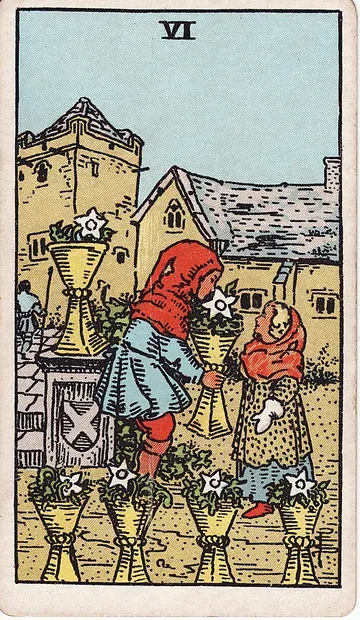
Six of Cups
The grief card next to the room the cloaked figure walks into when he turns. Six of Cups is the recovered sweetness, the children in the garden, the simple connection from before the wound. Together the pairing describes grief properly metabolized opening the door to earned innocence — the tenderness chosen by someone who has lost things and refused to harden.
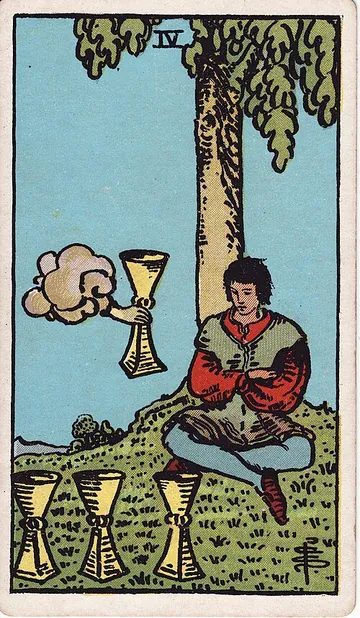
Four of Cups
Two consecutive Cups, both inward-facing, both about the gaze that refuses to lift. Four of Cups is the apathy that often preceded what spilled — the offered cup not taken, the conversation not had. Together the pairing asks the seeker to look at the role pre-grief disengagement played in what is now being mourned, not as blame but as information for the next season.

The Star
The grief card next to the canonical card of healing-after-grief. The Star is the figure pouring water from two pitchers under an open sky — water restored, night calm. Together the pairing describes the full arc, the spilled cups eventually becoming the poured ones, the cloak eventually exchanged for the bare-skinned openness under the stars. The pairing places mourning inside the larger weather of return.
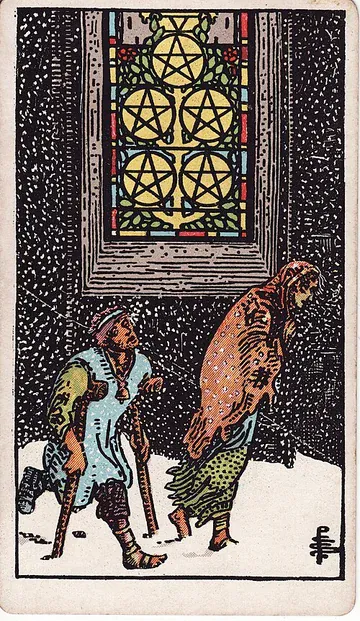
Five of Pentacles
Two Fives, both pictures of a downcast figure missing the visible help nearby. Five of Pentacles shows two figures in the snow walking past a lit church window; Five of Cups shows the cloaked figure missing the standing cups behind him and the bridge across the river. Together the pairing names a pattern: the seeker has begun to organize life around what is missing rather than what is present. Turn around. The help is not abstract.
Frequently Asked Questions
What has actually changed in the Five of Cups reversed if the spilled cups are still spilled?
The direction of the gaze, and nothing else — which turns out to be enough. The reversal is the turn — the figure who has been bowed over the spilled three lifts his head and notices the two cups still standing behind him. The grief is not gone; the gaze has unlocked. The card describes recovery from a real loss that has actually begun to happen: the cloak still on, the bridge being crossed, the castle becoming visible again on the far bank.
Is the yes in the Five of Cups reversed something I have to have mourned my way into?
Yes, and the card is unembarrassed about saying so. The answer leans yes — but it is a conditional yes, earned by mourning. The recovery has happened enough for the next thing to be possible. Read it as: yes, if you continue the grief work the upright card asked for, and uncertain if you try to skip it. The yes is the slow walk across the bridge, not the leap.
Does the Five of Cups reversed mean I am over it, or only facing the right way?
Facing the right way, which is the honest version of the same news. It describes heartbreak recovery that has actually begun. The acute pain has loosened. For existing partnerships, it is the slow re-inhabiting after a real wound. For new connections, it is the cloak loosening enough to see the new person as themselves. For reconciliation questions, it can mean a yes for a new shape of the relationship if both people have done real grief work — though it warns about reaching for the spilled cups out of habit.
Has the person shown by the Five of Cups reversed stopped grieving, or stopped being only that?
Stopped being only that. The card describes someone on the other side of a grief — not finished, but turned. The sadness is still in the chest; the warmth they have for you has become reachable to them again. They have begun to look up. Read it as the partner who has been processing something heavy and is now able to be in the room with you in a way they could not be while inside the acute grief.
What is the advice of the Five of Cups reversed?
The five of cups reversed advice is to keep walking with the sadness still in the chest, taking small actions the cloak had been preventing. Do not wait for the grief to be finished before resuming your life. Send the message. Make the appointment. Notice the standing two cups. Begin retiring the loss from its central place in your identity — let it become one chapter in a longer book rather than the table of contents.