
Five of Swords · Core Meaning
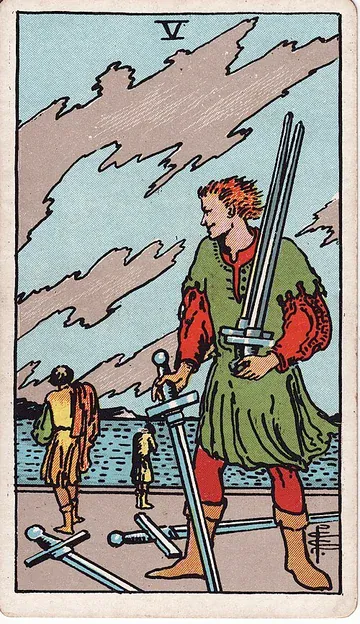
A quarrel can be won so completely that the room empties. In the Rider-Waite-Smith image, a figure stands in the foreground holding three long swords gathered against his chest, the corner of his mouth lifted into something that is not quite a smile. His gaze trails two figures walking away in the middle distance, empty-handed, shoulders fallen. Two more swords lie slantwise in the earth — abandoned, not even worth retrieving. The sky has been cut into jagged gray clouds, as if the air itself is still vibrating from the argument that just ended. The wind, where the victor stands, is loud. No one else is near.
This is the Five of Swords' signature tension: the technical victory and the emotional residue, held in the same frame. Something has been won. The proposal carried. The accusation landed. The last word was yours. And in the act of winning, the very thing that made winning worthwhile has quietly walked off the field. The card does not say you were wrong. It says the cost has not finished settling, and the cost is not in the column you were watching.
The traditional astrological signature gives the texture its specific edge. Venus in Aquarius's first decan — Venus, the planet of tenderness and connection, housed in detached, conceptual air. The sephirah is Geburah, severity, the cutting force; the world is Yetzirah, formation, where mental forms take shape. Translation: the Five of Swords is what care looks like when it has been routed through ideology. The wish to be in right relation with someone has come out of the mouth as the wish to be more correct than them. The gentleness was real. The vehicle for the gentleness was an argument. Geburah cuts away excess to reveal the form — but if you point its blade at closeness, it cuts that too, and you are left with the form of being right and the form of being alone in the same gesture.
Read against the suit's arc, the Five of Swords sits at the moment of first rupture. The Two paused between options; the Three named the wound; the Four lay down to rest in the wound's quiet aftermath. The Five rises from the rest, picks up the swords, and uses them. Not to defend — to win. The Six follows, the boat across gray water, leaving the field behind. The Five is the field itself: the seven o'clock hour after the meeting, the kitchen after the fight, the email thread after the reply-all that ended the discussion and ended several other things alongside it.
Read the Five of Swords the way you would read a photograph taken at the wrong moment in a celebration — the half-second after the toast, when most people are smiling but one face has already begun the calculation of what the toast costs. Whatever lives in that calculation — vindication, satisfaction, the first hairline of doubt, the half-thought of who is no longer in the photograph — is the meaning of the card for that reading. The card itself is precise. It asks the seeker to look at the price tag they have not yet read.
Five of Swords · Love & Relationships
Score-keeping is the illness this card names in a partnership, and it is rarely good news: one or both of you have begun to tally, and the tally has become more important than the bond being tallied. The conversations have started to feel like games — small ones, tactical ones, ones nobody named but both of you are playing. There is a winner of the day's exchange. There is a loser of the day's exchange. And there is, increasingly, no third thing — no shared work, no shared weather, no plain affection that exists outside the running tally.
For an existing partnership, the Five of Swords often arrives during the season of the small petty fights. Not the big rupture — that comes elsewhere. The small ones. The one about the dishes. The one about who said what at the dinner with the friends. The one about whose family is harder to deal with at the holiday. None of them seem worth the temperature they generate, and yet the temperature is generated, again and again, because the fights are not actually about the dishes. They are about a quieter unmet thing that neither of you has yet named, and the dishes are the proxy through which the unmet thing keeps trying to surface. The card asks for the older question to be put on the table.
For a new spark, the Five of Swords is one of the deck's clearer cautions. Watch the disagreements at the early stage. Watch how this person fights — not whether they fight, but how. Are they trying to find the truth with you, or are they trying to win the truth from you? The Five of Swords personality, in early courtship, is sometimes thrilling — the verbal sparring feels alive, intelligent, more interesting than the soft mutual approval of the easier dates. But the thrill is the warning. If every conversation has a victor, the loser's seat eventually becomes yours, even when you are technically the winner.
For a single seeker who is asking whether love is possible, the card answers gently and pointedly: not until the urge to be right has loosened. The Five of Swords describes the seeker who has built such a sharp internal court — for ex-partners, for past disappointments, for the version of themselves who tolerated less than they deserved — that no real living person can walk into the courtroom without the gavel starting up. The work, before love, is to put down the verdict. Not to forgive everyone. To stop holding the trial.
For love after a wound, the Five of Swords describes the season when the wound is healing, but the strategy that grew up around the wound is still in operation. You learned to argue. You learned to defend yourself early. You learned to find the flaw in their position before they could find the flaw in yours. The wound is closing. The strategy is now the obstacle. Notice it kindly. Practice not deploying it on someone who has not yet earned it.
For someone wondering whether to reconcile after a break, the Five of Swords upright is a soft no. Returning to this person, on these terms, would mean returning to the same scoreboard. If the underlying dynamic has not been examined, the next round will look identical to the last round, with slightly different ammunition. The card asks: what new agreement could you both make about how to disagree? If neither of you can name one, the answer is staying away.
For the question of "is this person in love with me" — and the Five of Swords arrives — read it as: they are in something with you, but the something is not love yet. They are in competition. They are in fascination. They are in the buzz of pushing back against you. These are not nothing, but they are not the same as care. Care can feel boring next to friction. Choose boring.
A note on the card's particular love language: the Five of Swords loves by argument. It thinks the way to know someone is to test their positions. This is not entirely wrong — relationships do need honest disagreement — but the card describes the version that has lost the warmth around the disagreement. Real meals are not eaten in this love; thinkpieces are eaten. Real beds are slept in, but the night before the sleep was a debate.
A second note on power. The Five of Swords often shows up around relationships where one partner has more verbal power, more education, more practiced rhetoric, more confidence in their own arguments. The card warns the more powerful partner that winning is too easy and is hollowing the bond. The card warns the less powerful partner that being out-argued is not the same as being wrong, and choosing not to argue is a real choice — not a defeat. Either way, the antidote to the Five of Swords in love is to stop using the better weapon.
For a couple negotiating the end of something — a separation, a lease, the custody of a dog — the card is exact about where the lasting damage happens. The terms are not what either person remembers afterward. The tone of the week in which the terms were agreed is what they remember, and it decides whether the two of you can stand in the same kitchen in five years without bracing. Win the clause if you must. Do not win the week.
Five of Swords · As Feelings
Vindicated, frustrated, superior, cornered, quietly unhappy with themselves — the feeling this card reports is a blend, and an uncomfortable one, which is why it so rarely reads cleanly. The specific blend depends on which side of the recent argument they imagine themselves to be on. But the underlying texture is consistent: they are in a posture, not an opening. The body language the card describes is the figure with arms full of swords, looking at someone walking away. They are watching you with a feeling they have not fully decided to feel.
If they are reserved by nature, the Five of Swords in feelings often means they are privately convinced they were right, are not going to say so out loud, and are letting the silence do the arguing for them. Read the silence carefully. It is not absence. It is a position. They are waiting for you to come back across the field and concede something — sometimes a specific thing, sometimes just generic acknowledgement that they were wronged. They will hold the position longer than is healthy for either of you.
If they are demonstrative, the Five of Swords in feelings is the partner who has been telling the story of the disagreement to other people, in their version, with their framing. The friends know. The family knows. The coworker who has nothing to do with it knows. They are not gossiping for fun — they are recruiting witnesses, building the case, fortifying their version against any future reconsideration. This is uncomfortable to read but real.
For a partner you have been with a long time, the Five of Swords in feelings can describe the season of accumulated small grievances. They love you, probably; they also have a list. The list has been kept silently. Each item on the list seemed too small to bring up at the time, and now the list is long, and the list has a weight, and the weight is making them slightly cooler in the room with you than they used to be. The card asks for the list to be acknowledged before it becomes a verdict.
For a new connection, the Five of Swords in feelings can mean they are competitive about you — interested but in a way that has not yet learned how to be soft about its interest. They are gauging you, comparing you, deciding whether you measure up to what they thought they wanted. This is not love. This may become love if the gauging stops. It will not become love while the gauging continues.
For "how does this person see you" — the Five of Swords answers that they see you as someone they have already had a complicated interaction with, and they are not yet sure whether the complications are worth it. They see your strengths clearly; they also see the corner of your behavior they did not like, and they are weighting that corner heavily right now. Time will sometimes soften this. Argument, currently, will not.
For the question "does he/she/they miss me" after distance — the Five of Swords answers ambiguously. They miss the version of you that was easier to be around. They do not miss the version that fought with them, even if they were the one who started the fight. They are sitting in a kitchen somewhere, half-wishing the doorbell would ring, half-rehearsing what they would say if it did. This is not "they want you back." This is not "they don't." It is "they are still in the field with the swords."
For a person you barely know who has just landed strangely in your life — and the card arrives in the feelings slot — read it as: they are sizing you up. Whatever first impression you made hit them sideways. They are not going to say so. They are going to be slightly more cutting than the situation warrants for a while, until they decide how to file you. Be patient. Don't escalate. Often the Five of Swords first impression resolves into something warmer once the person has decided you are not a threat.
A quiet caution: the Five of Swords in feelings sometimes describes a person who simply cannot be vulnerable with you yet. The aggression is not love-as-aggression in the romantic film sense. It is fear dressed in defense. They were hurt earlier, before you, and they have not yet figured out how to disarm in a new room. Read the feeling as a temperature, not a verdict. The temperature can change.
Five of Swords · Career & Work
The meeting you won is the one this card would rather you had lost. The proposal carried. The pitch landed. The reorg reflected your view, not theirs. And as you walked back to your desk, you noticed the corridor was quieter than usual. The colleagues who used to swing by your office to debrief did not swing by. The Slack channel where the back-and-forth happens has fewer messages in it than yesterday. Nothing has been said. Something has shifted.
For someone asking whether a current role is sustainable, the Five of Swords answers that the role is technically working but the relationships around the role are eroding. The work is getting done. The deliverables are landing. The metrics are intact. And quietly, the people you depend on to do that work are starting to route around you. They have learned not to disagree with you in meetings because disagreeing with you is unpleasant. This is the thing the card most wants you to notice — the absence of disagreement in your meetings is not consensus. It is withdrawal.
For someone considering a new role, the Five of Swords upright reads as a warning to interview the team's relational health, not just the comp and the title. Ask the recruiter about the leader's last hire. Ask why the previous person in this seat left. If you are lateral-moving, ask the hiring manager what disagreements look like inside the team. The Five of Swords describes the workplace where disagreements have been suppressed by organizational politeness, and where the suppression has begun to corrode trust. Walking into that environment with your existing communication style may not be wise.
For a manager or team lead, the Five of Swords is one of the clearer mirrors the deck offers. It asks: have you been winning your one-on-ones? If your reports come out of conversations with you having done the thing you wanted them to do, but slightly more guarded each time, you are losing the longer game. The card distinguishes between authority — which is fine, sometimes necessary — and dominance, which corrodes. Authority leaves the report feeling clearer. Dominance leaves them feeling smaller. Notice which one is happening.
For an entrepreneur or freelancer dealing with a client conflict, the Five of Swords describes the contract dispute, the scope creep argument, the late-payment chase that has gone hostile. You are probably right about the dispute on the merits. The card asks whether being right is going to keep this client. Sometimes the honest answer is no — and the card gives you permission to lose the client to keep your peace. Sometimes the answer is that the relationship is salvageable but only if you pull back from the maximalist position. The card cautions against the satisfaction of the cutting email.
For a creative practice in conflict — the agent dispute, the publisher pushback, the collaborator falling out — the Five of Swords describes the difficult season where your aesthetic position is correct and the people around you are not equipped to receive it. Be careful here. The card has two readings in this scenario. One reading: you are right, and the cost of being right is real, and the work will be better if you hold your line and the work will exist after the relationships have been sorted. Another reading: you are using the rightness of your aesthetic to avoid the harder conversation about the relationships. Discern between them. The Five of Swords is generous with the first; it is severe with the second.
For someone considering whether to leave a job over a conflict, the Five of Swords does not, by itself, say go or stay. It says: do not leave from a position of having just won. Wins look like clarity. They are often the worst decision-making moments. Wait a month. If the urge to leave is still there after the vindication has cooled, leave. If the urge has softened into ambivalence, stay and rebuild.
For someone who has just been let go after a conflict, the Five of Swords can describe the ending where you were technically in the right and were nonetheless removed. This is a hard card to receive. The corporate world's relationship to truth is not always proportional to truth's volume. The card asks you to grieve the unfairness without becoming the person whose entire next job is shaped by the unfairness of the last. Carry the lesson. Leave the lawyering at the door of the next interview.
For someone asking about workplace politics — the alliances, the rivalries, the sub-rosa power plays — the Five of Swords describes the environment where these have become the work. There is real work happening underneath, but the political layer has become thicker than the work layer. The card invites a reset of attention. What was the work, originally? Can you spend more of your week doing it and less of your week navigating? If yes, do that. If no, the role itself is structurally compromised, and no amount of better politicking will fix it.
A note on layoffs and reorganizations: when the Five of Swords appears in this context, it often describes the political residue of the reorg — the people who survived it feeling slightly guilty, the people who were cut feeling slightly betrayed, the meetings everyone is now in that did not used to exist. The card asks for restraint. The next year is about rebuilding trust, not asserting position.
Five of Swords · Money & Finances
Being technically correct has a price, and this card itemizes it. The dispute over the bill is real; the bill itself is small; the energy you are spending on the dispute is large. The roommate who owes you for the utilities is genuinely in the wrong; the friendship is on the line over a sum that, in three years, no one remembers. The court case is winnable; the legal fees and the months of your life will not be returned to you when you win.
For someone in a financial dispute — with a landlord, with a former employer over unpaid wages, with a contractor whose work was poor — the Five of Swords asks for a careful weighing. It does not say roll over. It says read the price tag of pursuing the dispute. Sometimes the dispute is worth pursuing because the principle has structural consequences (you set a precedent, you protect future tenants, you prevent the contractor from doing it to others). Sometimes the dispute is worth pursuing because the sum is large enough to materially matter. And sometimes neither of these is true and you are pursuing it because you are angry. The card asks you to be honest about which you are doing.
For shared finances — couples, business partners, family money — the Five of Swords warns that an argument is converting into a structural rift. The fight is technically about the budget. The fight is actually about whose sense of the future the household runs on. Whoever wins the budget fight is winning more than a number; they are winning the house's direction. The card cautions both parties: if you are the one winning, notice the shape of what you are winning. If you are the one losing, notice that capitulating today builds resentment that will surface in some other room six months from now.
For a person managing debt during a period of conflict — collections calls, family loans gone bad, child support disputes — the Five of Swords describes the trap of escalation. The collector is following a script; you can match aggression with aggression and get nowhere, or you can step out of the script into a slow, factual conversation that more often produces a workable outcome. The card supports the slower move. Your dignity is not preserved by winning the phone call; it is preserved by handling the underlying obligation with adult patience.
For a question about a financial gamble — investment, bet, speculative move — the Five of Swords arrives with a particular warning: do not invest from a place of needing to prove someone wrong. The doubter who said you would not amount to anything is not in the room with this trade. They will not be there if it goes well, and they will not be there if it goes badly. Make the bet for the thesis or do not make it. Bets made for vindication tend to be sized wrong.
For someone considering a lawsuit, the Five of Swords is conservative. It suggests mediation before litigation, settlement before judgment, the structured negotiation before the courthouse steps. It does not say no to the legal process. It says: by the time you are at the courthouse with the Five of Swords as the operating card, you have probably stopped weighing what victory will actually cost in time, attention, sleep, and relationships. Re-weigh.
For windfalls during conflict — the inheritance that came through during the family rift, the bonus that arrived in the middle of the office argument — the Five of Swords cautions against deploying the new resource as a weapon. Do not buy the better lawyer the day you get the bonus. Do not visibly upgrade your life in front of the family member who feels cheated. The card warns of the smug-victor energy that money disputes amplify. Receive the windfall. Wait a season. Decide later, from a calmer seat, what to do with it.
For a budget review or a financial plateau — when the card arrives in a routine money reading without active conflict — the Five of Swords often points to the small expenditures you have been quietly competitive about. The dinners out where you pick up the bill more than you should because you cannot bear letting the other person treat you. The subscriptions you are keeping for status reasons. The tipping pattern that is more about being seen as generous than about the meal. None of these are emergencies. The card simply notices them.
Five of Swords · Health
Chronic argument wears a body down along predictable lines. The element is air, the temperament sanguine — quick and keen — and the body parts are the throat, the lungs, and the nervous system. The card describes a physical signature: the throat that gets sore from too much talking and not enough listening; the breathing that has become shallow because you have been holding it through difficult conversations; the nervous system that is mildly elevated for so long that mild has become baseline.
If you are asking whether a stress-related condition will improve, the Five of Swords answers that it will improve only when the source of the stress is acknowledged and adjusted. The card is not punitive. It simply says that the symptoms — tension headaches, jaw clenching, gastric issues, insomnia rooted in mental overrehearsal — are produced by a way of relating to the world that has become combative. The body is not stupid. It is cooperating with the strategy you have asked it to run, and the strategy is sharpened nervous-system arousal, and the body is exhausted.
For someone managing chronic conditions — autoimmune, cardiovascular, anxiety disorders — the Five of Swords often describes a flare that follows a season of interpersonal conflict. The flare is real. The conflict was real. The connection between them is real. None of this means the condition is your fault. It means the body is registering what the mind has been carrying and is asking for a reduction in the carrying. Reduce one fight this week. Notice if anything settles.
For sleep questions, the Five of Swords frequently describes the insomnia of post-argument rehearsal. You replay the meeting at three in the morning. You construct better versions of what you should have said. You imagine the next round. The mind is convinced it is solving something; the body is being depleted. The honest practice is not to fight the rehearsal but to interrupt it — sit up, light a candle, write the rehearsal down by hand, and put it away. Sleep often returns when the loop has been externalized.
For breath work and lung-related questions, the card has a specific reading. Air-suit five frequently surfaces when the breath has become the shallow chest breath of vigilance. Diaphragmatic breathing — slow belly breaths, longer exhale than inhale — is one of the simplest and most effective practices when this card appears. Not as a spiritual technique. As a nervous system intervention. Five minutes a day, twice a day, lying flat, makes a measurable difference within a fortnight.
For mental health questions, the Five of Swords can describe the season when anxiety has converted into hostility — when the underlying fear is showing up as snapping at people, defensiveness, the urge to win small arguments with the bus driver. This is not character; it is fight-or-flight rerouting through verbal channels. Therapy, if you have access, is helpful here. If not, naming the pattern to one trusted person and asking them to flag it gently when they see it is a humble, practical move. The card responds to honest reflection.
For someone managing addiction or compulsive behavior — drinking that has become more pointed, screen use that has sharpened into doom-scrolling, food relationships that have become punitive — the Five of Swords often shows up alongside an underlying interpersonal conflict. The compulsive behavior is doing a job: numbing, distracting, or providing the dopamine that the depleting fight is consuming. Address the conflict and the compulsive behavior often loosens its grip. Address the compulsive behavior without addressing the conflict and the relapse rate is high.
For acute health concerns — infections, injuries, surgical recovery — the Five of Swords does not predict outcomes. It reminds the recovering body that this is a season for laying down arms, not picking them up. Cancel the meeting you would normally insist on attending. Tell the person you have been arguing with that the argument is paused until you are well. Recovery accelerates in the absence of the chronic combative posture.
Pausing an argument while you mend is a social suggestion, not medical advice. Keep your practitioners. Take your medicine. The card simply offers the honest mirror: the body is asking for a softer way of being in conversation with the world.
Five of Swords · Spirituality
Being right and being whole are not the same condition, and this card lives in the gap between them. The seeker has become very good at the critique — of religion, of teachers, of fellow practitioners, of their own former beliefs — and the critique has become the practice. They are sharper than they were. They are also lonelier than they were. The cups behind them, in this case, are not cups; they are blades, and the blades have started to be the only company.
For seekers who have moved through a deconstruction — leaving a faith, leaving a teacher, leaving a community — the Five of Swords describes the late phase of the deconstruction, when the wisdom of leaving has hardened into the personality of having left. You are no longer the person who got out; you are the person who tells the story of having gotten out, repeatedly, with sharper details each time. The wisdom was real. The hardening is not necessary. The card asks: who would you be without the story of the leaving?
For someone in active spiritual practice that has become argumentative — the meditation that is mostly about being more advanced than the people around you, the journaling that catalogues other people's failings, the rituals that prove your alignment to an unseen scoreboard — the Five of Swords offers a clear mirror. The practice has converted into status. The teacher knows it. The teacher is waiting for you to notice. The card describes the moment just before the noticing.
The Aquarius / Venus signature is particularly important here. Aquarius's first decan is the precinct of the brilliant outsider — the one who sees the whole social game from above and cannot stop pointing out its flaws. Venus, housed there, intends love. She becomes the love that comes out as critique because critique is the only language she has been given. The spiritual work the card asks for is to find a different vehicle for the care. Not to abandon the intelligence. To put it down for an hour and let warmth move without an argument.
For seekers exploring belief, the Five of Swords cautions against the tradition that you have chosen primarily because it lets you feel superior to the tradition you grew up in. This is a common and very human pattern. The new tradition may be richer, deeper, more aligned. The card does not deny that. It only asks: are you here because of the truth on offer, or because of the contrast with where you came from? If the latter is the dominant motive, this tradition gets left the same way you left the last, when its imperfections become visible.
For someone asking about path, the Five of Swords describes the season when the ego has gotten very involved in the path. There is nothing to do about this except notice it. The card invites a small humility: read a tradition you find slightly embarrassing. Spend an afternoon with it. Let yourself be moved by something the sharp version of you would dismiss. The reversed card emerges from this kind of softening.
A small practice when this card appears in spirituality: silence. Not the silence of meditation as performance. The silence of not making your point in a conversation today, even when the point is correct. One day. See what is left when the point is not made. The card responds reliably to this practice — what comes back, often, is the warmth that the argumentative posture had been substituting for.
The deeper invitation, for the seeker who is ready, is to ask what you wanted before you wanted to be right. There is almost always an older wish underneath. Belonging. Being seen. Being trusted. The Five of Swords describes the seeker who built an identity around being correct because being correct felt safer than being any of those other, more vulnerable things. The path forward is not to abandon the rigour. It is to admit the older wish.
Five of Swords · Yes or No
Soft no — but it depends on what you call winning.
The Five of Swords upright is one of the deck's complicated yes-no cards. If you ask it whether you can technically win the thing you are pursuing — yes, often. If you ask it whether the thing you are pursuing is worth the cost it will charge in the winning — usually no. The card distinguishes between the literal question and the actual one underneath, and it answers the literal question with one answer and the underlying question with the opposite.
For yes-or-no questions about whether to pursue an argument, file a complaint, send the cutting email, or escalate a conflict: technically yes, you can win. Probably no, you should not. The win itself will not be enjoyable. The win itself will not change the underlying dynamic. The win itself will move you into the seat the figure on the card is sitting in — three swords clutched, two companions departing, and a wind that has nobody else in it. If that seat is what you want, take the action. If you are imagining a different seat, do not.
For yes-or-no questions about a relationship — should I stay, should I leave — the Five of Swords answers with a soft no on the underlying question and a question of its own. The relationship in its current shape is not the right answer. But are you leaving because you have outgrown it, or because you want to win the leaving? These are different motivations and they produce different next chapters. Wait long enough to know which one is operating.
For yes-or-no questions about a job offer that arrived during a conflict — the recruiter who reached out the week the office fight got bad — the card cautions: probably not yet. The new job is not the answer to the old fight. Resolve the old fight first, even if the resolution is a clean exit, and then evaluate the new job on its own terms. Otherwise the old dispute arrives at the new desk with you, and the new desk will become the new dispute.
For yes-or-no questions about whether someone is honest, whether an offer is real, whether a plan will hold: the Five of Swords reads as a partial yes with concealed conditions. There is something true in what is being presented to you. There is also something not being said. Read the contracts. Ask the second question. If the person on the other side of the table flinches when asked the second question, you have your answer.
Asked how soon, the Five of Swords answers that whatever you are waiting for will happen, but it will arrive shaped by recent conflict. If you are waiting for an offer, the offer comes with strings tied to the recent argument. If you are waiting for a verdict, the verdict reflects the temperature of the proceedings. The card does not extend timelines; it warns about texture.
For binary action questions — should I act now, should I wait — the Five of Swords answers wait. Not forever. Long enough for the heat of the recent thing to come down to room temperature. The decisions you make at peak heat from this card are the ones that read badly three weeks later. The decisions you make a fortnight after the peak are the ones that age well.
If the question was: do I deserve to be heard? The card answers yes — and asks why you are choosing to be heard by force rather than by clarity. The same content delivered without the cutting edge usually lands better. The card reframes the yes-no into a how question: not whether to speak, but how to speak so that being heard is actually possible.
A final note: the Five of Swords sometimes answers a clean yes when the thing being asked is whether to disengage from a fight. Should I stop arguing with this person? Yes. Should I let this go? Yes. Should I walk away from the meeting where the only outcome is winning a point that will cost me the room? Yes. The card is generous toward the seeker who is asking permission to put down a sword.
Five of Swords · Advice
Before you raise the third sword, ask whether the person you would be winning against is still on your side tomorrow. If the answer is yes, you do not need to win. If the answer is no, you have already lost. Either way, the third sword does not solve anything. Put it down.
If there is one specific instruction the card offers, it is to identify the one argument you are currently in that nobody outside the argument cares about. We all have one. The argument with the family member that has gone on for three months. The argument with the colleague that nobody else has noticed. The argument with the customer service representative who is following a script. Pick the one. Concede it today. Not because you are wrong on the merits — you may be entirely right on the merits — but because the cost of continuing exceeds the value of the merit. The card warms reliably to this kind of strategic concession.
A second instruction: notice your audience. The Five of Swords often describes the seeker who has been performing rightness for an imagined witness — a parent who was harsh, an ex who was dismissive, a teacher who underestimated them. The witness is not in the room. The witness has not been in the room for years. The argument you are winning is being conducted for someone who is not present, and the people who are present are paying the cost of an argument they did not start. Locate the imagined witness. Take them out of the chair. Notice who is actually in the chair, and adjust the conversation accordingly.
A third instruction: today, lose one winnable argument on purpose. Pick a small one. The dinner choice. The route home. The meaning of a phrase used at work. Choose to be wrong, on purpose, even though you are right. Watch your nervous system. Notice the discomfort. Notice the recovery. The Five of Swords is, in part, an addiction to the dopamine of being right. The way out of an addiction is to practice not feeding it, in small dosages, in safe situations, until the demand decreases.
A fourth instruction, harder than the others: apologize for one thing where you were not actually wrong. The card knows this is counterintuitive. It also knows that the seeker stuck in Five of Swords territory has sometimes been correct on facts and damaging in delivery, and the apology is for the delivery, not the position. The other person will not always receive it well. That is fine. The apology is your practice, not theirs.
Practical advice for the day the card appears: write down, by hand, the names of the three people whose presence in your life makes you better. Just the names. Look at the list. Ask whether your behavior this week has earned their continued presence. If yes, continue. If no, send one of them a message — not about the conflict, just a real message about something you appreciate in them. Reattach to the company you have been straining.
A fifth instruction, for the seeker who has just won something that left them empty: do nothing for forty-eight hours. Do not announce the win. Do not consolidate the win. Do not push for the next thing. Sit with the emptiness. Often the emptiness has information. It is telling you what you actually wanted, which was not what you just won. Listen before you act on the listening.
A note on retraction. Sometimes the most powerful advice the Five of Swords offers is to retract — pull back the email, withdraw the complaint, undo the public statement, replace the cutting word with the more measured one. Retraction is harder than victory. It is also more useful. The card supports it.
A final, gentler instruction: notice when you are not being argued with anymore. The first sign that the Five of Swords is winning the long game in your life is when the people around you have stopped pushing back. They are not agreeing with you. They have given up on disagreeing with you, which is different. Being not-disagreed-with feels like dominance and is actually loneliness. If you have been winning everything for a while, ask one trusted person what they have been not telling you.
Five of Swords · Card Combinations
The Five of Swords reads differently in company than it does alone. Held next to a sibling, a successor, or a Major arcana, the won-quarrel of the air-suit Five takes on specific weather — sometimes amplifying, sometimes softening, sometimes transmuting into a different question altogether. Five named pairings carry the load of how this card most commonly arrives in real readings.
Five of Swords + Five of Wands
Both fives, both quarrels, but very different rooms. Where the Five of Wands is the open jostling of the practice yard — five people swinging staves, no clear winner, kinetic chaos — the Five of Swords is the post-jostle: the one who walked away with the reputation while the others went home tired. The combination describes a conflict that has graduated from honest exchange into reputation management. Someone has left the practice yard with a story about having beaten the others. The card pair asks: was the original disagreement worth the story it has produced?
Five of Swords + Six of Swords
The suit's natural progression — the won battlefield, then the boat across gray water away from it. Together these cards read as a transition that is already underway. Whatever was won has begun to feel hollow enough that the leaving is starting. The Six of Swords does not promise that the leaving will be triumphant; it is a quiet boat, and the water is gray. But it is movement, and it is movement away from the field. The combination invites the seeker to begin the leaving they have been postponing — to step into the boat without first winning the next round on shore.
Five of Swords + Five of Cups
Both fives, both Geburah severities, but in different waters. The Five of Cups is the spilled chalices and the figure who cannot yet see the two upright vessels behind him. The Five of Swords is the gathered swords and the figures walking away. Together they describe a season of compounded loss — the mourning of the Five of Cups laid over the won-but-empty victory of the Five of Swords. This is not catastrophe. It is the difficult period when severity is doing a thorough job. The combination asks for both honesty about what has been lost and refusal of the additional loss the cutting posture would create. Mourn cleanly. Do not weaponize the mourning.
Five of Swords + Death
Major modulator. Death rarely shows up to soften a card; here, paradoxically, it does. The combination describes the moment when the won quarrel must be allowed to actually end — properly buried, not merely stored. Death asks the Five of Swords to give up its fortress of accumulated swords and let the configuration of the conflict transform into something else. This is one of the more powerful invitations in this card pair: the transformation that becomes available when the seeker stops defending the territory of having been wronged. Difficult, but generous.
Five of Swords + Two of Cups
The deck's clearest tonal contrast. The Two of Cups is the offered chalice — two figures facing each other, ready to drink to the new bond. The Five of Swords is the unilateral victor with the swords clutched against him, unwilling to let go even of the weapons that no longer threaten anyone. When these cards appear together, the question is whether the seeker can put down the swords long enough to receive the chalice. Sometimes the cards arrive together because the chalice is being offered now, in the middle of a conflict, and the conflict-trained reflex is to refuse it. The card pair asks for the harder gesture: take the cup. End the duel-stance. Build the new bond.
Card Combinations
Five of Wands
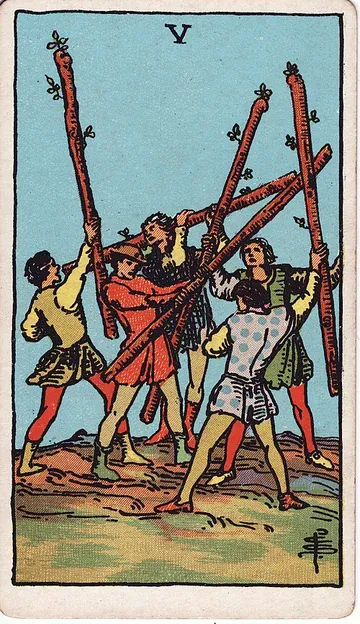
Both fives, both quarrels, but very different rooms. Where the Five of Wands is the open jostling of the practice yard — five staves swinging, no clear winner, kinetic chaos — the Five of Swords is the post-jostle: the one who walked away with the reputation while the others went home tired. The pair describes a conflict that has graduated from honest exchange into reputation management, and asks whether the original disagreement was worth the story it has produced.
Six of Swords
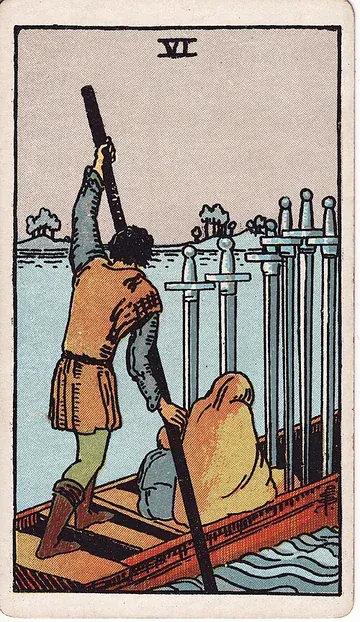
The suit's natural progression — the won battlefield, then the boat across gray water away from it. Together these cards read as a transition that is already underway. Whatever was won has begun to feel hollow enough that the leaving is starting. The Six does not promise that the leaving will be triumphant; it is a quiet boat, and the water is gray. But it is movement, and it is movement away from the field. The pair invites the seeker to step into the boat without first winning the next round on shore.
Five of Cups
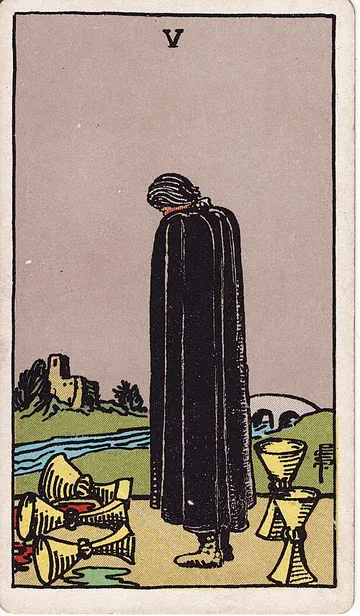
Both fives, both Geburah severities, but in different waters. The Five of Cups is the spilled chalices and the figure who cannot yet see the two upright vessels behind him. The Five of Swords is the gathered swords and the figures walking away. Together they describe a season of compounded loss — the mourning of the Cups laid over the won-but-empty victory of the Swords. The pair asks for honesty about what has been lost and refusal of the additional loss the cutting posture would create. Mourn cleanly. Do not weaponize the mourning.
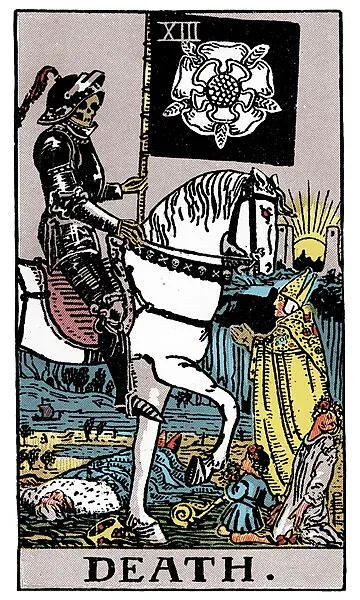
Death
Death rarely shows up to soften a card; here, paradoxically, it does. The combination describes the moment when the won quarrel must be allowed to actually end — properly buried, not merely stored. Death asks the Five of Swords to give up its fortress of accumulated swords and let the configuration of the conflict transform into something else. One of the more powerful invitations in this card pair: the transformation that becomes available when the seeker stops defending the territory of having been wronged. Difficult, but generous.
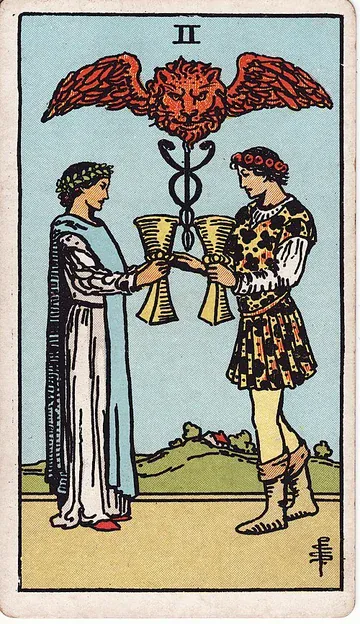
Two of Cups
The deck's clearest tonal contrast. The Two of Cups is the offered chalice — two figures facing each other, ready to drink to the new bond. The Five of Swords is the unilateral victor with the swords clutched against him, unwilling to let go even of weapons that no longer threaten anyone. When these cards appear together, the question is whether the seeker can put down the swords long enough to receive the chalice. The conflict-trained reflex is to refuse the cup. The pair asks for the harder gesture: take it. End the duel-stance. Build the new bond.
Frequently Asked Questions
Why is the victor in the Five of Swords smiling at an emptying field?
Because the win and the emptiness arrived in the same minute. The Five of Swords is the card of the won quarrel that clears the room. The image shows a victor holding three swords as two figures walk away, leaving two more swords abandoned in the dirt. Read it as a hollow victory — the technical win that has cost the relationship, the trust, or the warmth that made winning worth doing in the first place. The card asks the seeker to read the price tag they have not yet looked at.
Can I win the argument the Five of Swords is describing?
Very possibly, and that is exactly the trap it is pointing at. The card is a soft no — but it depends on what you call winning. If you ask whether you can win the thing you are pursuing, the card often answers yes. If you ask whether winning will be worth what it costs, the card answers no. Treat it as a structured caution: the literal question gets a literal answer, the underlying question gets the opposite, and the card asks you to be honest about which one you are really asking.
How do I tell an honest argument from score-keeping in a relationship?
By what happens once the point has been made. In love, the Five of Swords describes the bond where keeping score has become more important than the bond being scored. Watch for the small petty fights about dishes and tone that are proxies for an older unmet question. For new connections, watch how this person fights — not whether they fight, but whether they are trying to find the truth with you or win the truth from you. The card cautions against the love language of being right.
Is the person in a Five of Swords feelings reading angry at me, or at themselves?
Both, in a proportion they have not yet worked out. The answer is a complicated blend of vindicated, frustrated, superior, and quietly unhappy with themselves. They are in a posture, not an opening — the body language of the figure with arms full of swords watching you walk away. Read the silence as a position rather than absence; they are waiting for an acknowledgement they will not ask for directly. The temperature can change, but only when the swords are put down.
What does a sharpened critique cost a spiritual life?
Company, mostly. The lesson of the Five of Swords is that being right is not the same as being whole. The card describes the seeker whose intelligence has sharpened into critique and whose critique has become the practice — the deconstructed believer, the meditation that has converted into status, the sharp tongue that hides an older wish for belonging. The work is to find a vehicle for care that does not require an opponent. Lay down one sword today. See what arrives in the empty hand.
Continue Reading
Five of Swords · Card overview · symbols · correspondences →
Return to the full card view — image, symbols, sensory correspondences, and Hermetic axes.
Read the reversed meaning →
Read the same depth on the opposite orientation.
Draw your reading now →
Bring this card to a question — open a quiet ritual.