
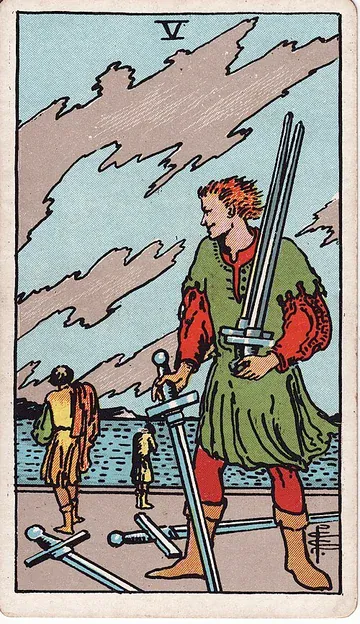
Five of Swords Reversed · Core Meaning
The blades are coming down — sometimes finally, sometimes too late, sometimes only halfway. The figure who was clutching three blades against his chest in the upright image is, in the reversed orientation, in the act of putting them down. The two who were walking away may turn back. The two swords abandoned in the dirt may finally be picked up and returned to wherever swords belong when no one is fighting. The jagged gray clouds are still in the sky, but the wind has dropped.
This is the reversed card's central knot, and it has two faces. One face is reconciliation — the genuine willingness to lay down arms, to apologize for the delivery if not the content, to choose the relationship over the rightness. The other face is rumination — the seeker who is technically not fighting anymore but is replaying the won argument months later, refusing to let it file itself into the past, mentally retrying it on every walk and at every red light. Both readings are available. The context of the surrounding cards and the question asked usually determine which is operating.
In the first reading, the reversed card is one of the deck's quieter graces. The figure has noticed what holding the three swords has cost him. He has watched the two figures continue to walk away long enough to know that being right did not bring them back. He has chosen, finally, the harder thing — to apologize, to retract, to send the second email, to admit the delivery was wrong even when the position was correct. This is genuinely difficult. The reversed Five of Swords, in this reading, is the card of the adult choice: a willingness to be smaller in this one specific way for the sake of being whole in the larger way.
In the second reading, the reversed card warns the seeker who is still in the field, alone, holding the swords from a fight that ended in October, replaying it in March. The technical conflict is over. The internal conflict has not closed. The card describes the unhealthy persistence of a grievance — the rumination that has become the seeker's company, the way the won argument is being carried like a pet, fed daily, kept alive because letting it die would mean facing the silence. The reversed card, in this reading, is asking the seeker to release the dead argument back to the ground.
The astrological signature reverses with the same nuance. Venus in Aquarius first decan upright was care routed through ideology — care that came out as critique. Reversed, the signature softens or hardens depending on which face is operating. In the reconciliation reading, the air finally lets the Venus through; warmth begins to reach the people the critique had been pushing away. In the rumination reading, the Venus stays trapped in the air, and the seeker continues to think their way around an emotional knot that thinking will not undo.
Look again at the two swords still stuck slantwise in the earth — the ones nobody bothered to reclaim. Reversed, they become the card's most practical question. Some part of the quarrel was never worth carrying in the first place: the point about who said what in the group chat, the correction about the date of an event, the piece of evidence assembled at two in the morning. Those are the blades in the dirt. The seeker who is genuinely disarming leaves them there and lets the rust have them. The seeker who is ruminating goes back across the field at night, collects them, cleans them, and files them for a conversation that may never come. Which of the two is happening is usually visible in one small detail — whether the old argument still has to be explained to people who were not there.
Geburah stands behind this card in either orientation — severity, the cutting force that trims away excess so a form can appear — and the suit houses that severity in Yetzirah, the world of formation, where things are built out of thought rather than matter. Reversed, the blade is no less sharp. What changes is what it is aimed at. Turned outward, it produced the field the image shows. Turned inward with any skill at all, it does the work it was always for: cutting the excess out of your own account of what happened until only the part that is true is left standing. That version is shorter than the one you have been telling. It also costs you the flattering sentence, the one where your restraint was remarkable and theirs was not. Paying that small price deliberately is the whole discipline of the reversed Five of Swords.
Read the reversed card the way you would read someone setting down a heavy object — not lightly, not quickly, but at last. The question the card asks is whether the setting-down is real, or whether the object has merely been moved from one shoulder to the other. The answer requires honest reflection, not optimism.
Five of Swords Reversed · Love & Relationships
Two faces, and a love reading splits cleanly between them. Read the surrounding cards. Read the seeker's tone. Read the question. The two readings produce very different advice.
For an existing partnership, the reversed card most often describes the willingness to make the truce real. The fight that has been running underground for months gets named at the breakfast table. One of you says, kindly, that you are tired of the dynamic and would like to try something else. The other one — and this is the part the upright card could not produce — agrees. The truce is not the end of disagreement; it is the end of disagreement-as-warfare. From this orientation, the relationship can be re-threaded. Not all the way back to where it was before the fight started, but to a new place that contains both the lessons of the fight and the willingness to stop fighting.
For a relationship that has been broken off and the seeker is asking about reconciliation — the deck's most sensitive love question for this card — the reversed Five of Swords reads more favourably than the upright version, but with a precise condition. Reconciliation is possible if both parties are putting down the same swords. If one of you has lowered your arms and the other is still clutching, the reversed card describes the asymmetric truce, which is unstable, and which usually breaks back into the original conflict within a season. The honest read: if you can each name what you are putting down — not what you wish the other would put down, but what you yourself are setting aside — the bond can repair. If neither of you can name your own concession, the reconciliation is performative and will not hold.
For a new spark that has had its first sharp disagreement, the reversed card describes the recovery — the conversation a few days later where one of you brings it up and the other one is grateful you did. This is not melodrama; this is the early architecture of a real bond. Many promising relationships end at the first sharp disagreement because neither party knows how to retract. When the reversed Five of Swords appears at this stage, it usually means at least one of you knows how, and the other is willing to learn. Continue.
For a single seeker who has been doing the inner work after a difficult ending, the reversed card describes the thawing — the slow recognition that the ex was not a villain, the wound was not entirely the other person's fault, the story you have been telling has had a single-protagonist shape and you are starting to be able to imagine the other character as a real person with their own difficulty. This is healing. The card supports the work. Do not skip it. The next love comes through this softening, not around it.
For love after a wound, the reversed card describes the disarmament — the quiet, ongoing practice of not deploying the strategy you developed in the previous wound on the new person. They are not the previous person. They will sometimes do something that pings the old wound, and the old strategy rises in you. Notice it. Do not deploy it. Say what is actually happening, kindly. The card warms reliably to this practice.
For someone in a relationship where the partner has been the persistent winner of arguments, the reversed card describes the season when the dynamic finally gets named. You are not the lesser intelligence. You are the one who has not been deploying intelligence as a weapon. The conversation in which you say this is not easy, but the reversed card supports the saying. The relationship that survives the conversation is more solid than the one that preceded it. The relationship that does not survive the conversation was already structurally compromised; the conversation just made the structure visible.
For the rumination reading in love — the seeker who has won an argument with a partner months ago and is still replaying it — the reversed card asks for an end. Hand the swords from that day back to the ground. Stop reading the partner's old messages. Stop building the case in your head. The argument is over. Whatever it was about either resolved (in which case the rumination is harming an alive relationship) or did not (in which case the rumination is preventing a clean leaving). Either way, the rumination itself is now the problem.
For a single seeker who is beginning to date again after a pattern of high-conflict relationships, the reversed Five of Swords supports the new pattern: choosing the person who does not produce the old high-frequency arguments. This may feel boring. The card warns specifically against confusing the absence of conflict with the absence of chemistry. They are not the same. The new chemistry, in this orientation, is the chemistry of being able to relax with someone. Trust it.
The apology arrives and the seeker has no idea what to do with it. This is the other seat at the table, and the reversed Five of Swords lands in it as often as in the first. Someone who spent a season being right has written to say that they were not. Accepting instantly can be its own evasion — the relief of ending the discomfort before the conversation that would make the repair real. Refusing on principle keeps the blades in your own arms, which is precisely the posture the upright image describes, only now with better paperwork. The workable middle is narrow and unglamorous: receive the apology, say plainly that you are glad it came, and name one thing you would want to see hold over the coming months. Not a test. A description. What happens afterwards is information, and information is the thing this card is genuinely good at producing.
For someone considering whether to forgive — not reconcile, just internally forgive — the reversed card supports the forgiving. Not because the other person earned it. Because the holding of the grievance is now consuming more of your life than the original injury did. Forgiving here is a practice for your own architecture, not a verdict about theirs.
Five of Swords Reversed · As Feelings
Warmth is finding its way back, and the blades come down as it travels. The hostility that the upright version described has begun to thaw. They are no longer in the posture of the victor with arms full of blades. They are not yet across the field with you. They are somewhere in between, and they are moving, and the direction of the movement matters more than the current distance.
If they are reserved, the reversed Five of Swords in feelings often means they have been quietly rethinking the recent disagreement and have arrived, internally, at a softer position. They have not said so. They will not necessarily say so. But the next time you see them, the temperature in the room will be different. They have stopped building the case against you. They are starting to remember why they liked you in the first place.
If they are demonstrative, the reversed card describes the friend or partner who has begun to walk back the version of the story they were telling other people. They are correcting the framing, gently, in conversations you are not present for. They are no longer using you as the antagonist of their week. The recruitment of witnesses has stopped.
For a partner you have been with a long time, the reversed Five of Swords in feelings describes a real shift — the long list of small grievances has been reviewed and most of it has been let go. They have decided, quietly, that the relationship is worth more than the ledger. The ledger is not entirely closed; some items remain. But the running balance has been forgiven, and their presence carries it.
For a new connection, the reversed card means they are open again after the early sharp disagreement. They were uncertain. They have decided to keep being curious about you. The disagreement helped them, in fact — it told them something about how you handle difficulty. They liked what they saw. Continue without performing.
For "how someone sees you" as a person — and the card arrives reversed — read it as: they see you as someone who can be in conflict with them and not become the enemy. This is rarer than it sounds. The reversed Five of Swords in this slot often surfaces around a person who has had several relationships in their past where conflict meant rupture. Your willingness to disagree without escalating has registered for them, even if neither of you has named it. Their respect for you is growing.
For "are they done with me" after a dispute — the reversed card answers softly: not done. Cooling, but in a way that may resolve into something better than where you started. The cooling is not the end. It is the necessary distance for them to come to their own honest position about you, without having to perform agreement to keep the peace. Give them the distance. Do not pursue them across it.
For a person you barely know who has been strange in their first impression — and the reversed card arrives now — read it as: their early hostility was about something else, not about you, and they have begun to see this. The defensive crouch they were in when you first met has loosened. The next interaction will be warmer. Don't punish them for the early one.
For the rumination reading — when the reversed card arrives in the feelings slot for someone who is no longer in your life and the question is whether they still think about you — the answer is sometimes yes, in the quiet replaying way. They are not building a future with you. They are sometimes editing the past in their head, the way you might be editing it in yours. This is a kind of haunting, more than a feeling. The card invites the seeker to release the ex from the role of a person whose interior state still matters operationally. Whatever they feel, you are no longer in a position to act on it.
Three days ago they sent the message, and it has not been answered. What the reversed Five of Swords describes inside that gap is not indifference on their side but a specific kind of exposure. Having lowered the swords first, they are standing in the open with nothing in their arms, watching the field for any movement at all. The longer the silence runs, the more available the old posture becomes — they start assembling the reasons the apology was unnecessary, and one or two of those reasons are genuinely good. None of this obliges the seeker to answer before they are ready; an answer given to relieve someone else's exposure is not an answer. It does mean the temperature the card is describing has a shelf life, and the card is candid about that rather than romantic.
For a former colleague or estranged family member where the question is reconciliation: the reversed card reads warmly. Their position has softened. Yours, perhaps, has softened too. The first move from either side will likely be received well. The card invites the seeker to make the first move when it is safe to do so — a brief message, an unexpected kindness, an acknowledgment of an anniversary. Nothing maximalist. Just a small re-extending of hand.
Five of Swords Reversed · Career & Reconciliation
After the office conflict comes the season of repair — voluntary, mandatory, or still under negotiation. The cutting email has been retracted. The mediator has been called in. The reorg has been adjusted to give the displaced colleague a softer landing. The mood in the corridor is, finally, lifting.
For someone who recently won a workplace conflict and felt the cost the upright card described, the reversed orientation is the act of repair. You go to the colleague's desk. You apologize for the delivery, even if not the position. You offer to lunch. You name what you wish you had handled differently. This is hard. The card supports it. The repair will not always be received the way you hope; some colleagues will still keep their distance. But the repair changes the seeker, even when it does not fully restore the relationship, and the seeker is the person who has to keep working in this office.
For someone considering withdrawing a complaint, retracting a public statement, or pulling back from an escalating conflict, the reversed Five of Swords supports the withdrawal. The card is one of the rare ones that explicitly favors retraction over persistence. This is not a weakness reading. It is a strategic reading. The retraction restores degrees of freedom; the persistence collapses them. The career that has more degrees of freedom available to it is the career that compounds well over years.
For a manager or team lead who has been winning their one-on-ones and has noticed the corridor getting quieter, the reversed card describes the season of asking different questions. Ask each report what they have stopped telling you. Ask without defensiveness. Receive what they say without correcting them. The first cycle of these conversations will be uncomfortable. The second cycle will be different — they will start telling you things again, and by then the trust that makes the team into an organism capable of its best work.
For someone in mediation — formal HR mediation, informal third-party-friend mediation, couples therapy applied to a business partnership — the reversed card supports the process. Show up. Speak honestly. Do not rehearse the case. Mediation works when both parties stop performing for the mediator and start having the conversation they could not have alone. The reversed Five of Swords describes the moment when this becomes possible.
For an entrepreneur or freelancer in client conflict, the reversed card describes the willingness to lose a degree of revenue to preserve a degree of relationship. Sometimes the contract dispute is resolved by accepting less than you were owed because the cost of pursuit exceeds the missing amount. Sometimes the client is invited back into a healthier scope agreement. The card supports the move that prioritizes long-term reputation over short-term victory.
For a creative practice in conflict, the reversed card describes the negotiation — between you and the agent, between you and the publisher, between you and the collaborator. Find the shape of the agreement that lets the work survive without either of you having to pretend the conflict didn't happen. The reversed card is generous toward this kind of negotiated peace.
For someone considering whether to leave a job, the reversed card answers more nuanced than the upright. It asks: have you tried the one conversation you have been avoiding? Sometimes the conflict that is making you want to leave is one direct, honest conversation away from being substantially better. Not always. But often enough that the card insists on the conversation before the resignation. If the conversation goes badly, leave. If the conversation goes well, you have saved yourself a transition.
For someone who has been let go after a workplace conflict, the reversed card describes the season of integration — not pretending the firing was fair, but not letting the unfairness define the next chapter. You write the lessons down. You name what you would do differently and what you would do the same. You release the unfairness, slowly, into the past, where it belongs. The next interview is not a retrial of the last one. The reversed card supports this composure.
For workplace politics, the reversed orientation describes the season when the tension is starting to release. People are returning to the work. The faction that had been gathering is dispersing. The meetings are shorter. The reversed card describes a real cooling. Trust it. Do not, in the relief, restart the conflict by gloating about who was right. The cooling is the gift; the gift is fragile.
For a layoff or reorganization aftermath, the reversed card describes the rebuilding of trust — the months of consistent fairness that re-knit a team after the disruption. The card encourages patience. Trust is regained through ordinary actions, repeatedly, over time. There is no shortcut, but the reversed Five of Swords confirms the slow path is working.
Five of Swords Reversed · Money & Finances
Financial repair after a season of dispute is what this inverted card tracks. The argument with the family member over the inheritance has settled — not perfectly, but with a structure both of you can live with. The contractor has been paid the negotiated middle figure. The roommate has cleared the back utilities. The relationship-end of the financial dispute is reattaching, slowly.
For someone who has been pursuing a financial dispute and is starting to wonder whether to settle, the reversed Five of Swords supports the settlement. The full sum is not coming. The partial sum, accepted now with grace, is more than the full sum pursued for another year. The card makes the math explicit: time, attention, and sleep are also currencies, and the dispute has been depleting them. Take the deal that is on the table. Close the chapter.
For shared finances after an argument — the household budget that became a battlefield, the joint account that became a proxy for unspoken resentments — the reversed card describes the reconvening. Sit down at the kitchen table with the spreadsheet. Listen to the quieter partner first. Do not lead with your numbers. The reversed card supports the kind of meeting where neither of you tries to win the budget; both of you try to make a budget that reflects the household you are actually building, not the household one of you wishes you were building.
For someone managing debt during conflict, the reversed orientation describes the call you have been postponing. The collector is more reasonable than you have been letting yourself believe. The hardship plan is real. The negotiation is possible. The card supports picking up the phone and starting the slow, factual conversation that the upright card described you avoiding through escalation.
For investments and bets, the reversed card warns against the consolidation impulse — doubling down to prove the previous bet was right. The reversed orientation here is not victory but humility. If the previous bet was a mistake, take the loss cleanly. Do not try to win it back through a larger version of the same bet. The card distinguishes between adding to a winning thesis (sometimes wise) and revenge-trading against a loss (almost never wise). Tell the truth about which you are doing.
For someone considering a settlement instead of a lawsuit, the reversed card supports the settlement nearly always. Litigation has its place. By the time you are choosing between settlement and litigation, the case has already become the dominant feature of your year. Settlement returns the year to you. The card supports the return.
For windfalls during a conflict, the reversed Five of Swords supports the careful, generous deployment. The bonus arrived during the family rift; instead of weaponizing it, redirect a portion of it to the family member who has been struggling and has not asked. The card distinguishes this from buying off the conflict — which it discourages — and from the genuine extension of a hand, which it supports. Which of the two you are doing is legible in the motive. Examine the motive before deploying the gift.
For a budget review without active conflict, the reversed card describes the slow correction of the small competitive expenditures the upright card flagged. The dinners where you used to fight to pick up the bill are now genuinely shared. The subscriptions kept for status have been canceled, one by one, without ceremony. The tipping pattern has settled into something honest. None of this is dramatic. The reversed card describes the cumulative health of small honest choices made over a season.
For long-term financial planning during a relationship repair, the reversed card supports the joint horizon — the decision to plan five years out together rather than continue the year-by-year accounting that conflict had imposed. The reversed card is generous with this kind of recommitment.
For someone considering forgiving a debt — a friend who has owed you for years, a family member's loan that will not come back — the reversed card supports the forgiving when the debt is doing more damage to the relationship than the money itself is worth. Not in every case. The card asks you to weigh honestly. When the math points toward release, release.
Five of Swords Reversed · Health
The body is coming down off a long combat alert. The chronic vigilance has begun to release. The jaw is not clenched at the same baseline. The shoulders are returning to their natural altitude. The sleep is starting to come back. The card describes the recovery from the depleted nervous system the upright orientation diagnosed.
For someone managing stress-related conditions, the reversed card describes the season after the conflict resolves — not magically, but through the actual lowering of the day-to-day adversarial temperature. The migraines space out. The gastric issues settle. The skin clears. None of this is reward; it is the body responding to a different operating environment. Honor it by not reintroducing the old adversarial temperature out of habit.
For someone managing chronic conditions — autoimmune, cardiovascular, anxiety — the reversed card describes a flare quieting after a season of repair. The body has been registering the repair the way it registered the conflict, in real time, in concrete physiology. The card encourages continued attention to the relational sources of stress as part of the broader treatment plan. Therapy and pharmacology and supplementation are all real and useful; relational repair is also a meaningful axis.
For sleep questions, the reversed card describes the slow return of unbroken sleep. The 3 a.m. wake-up loop is loosening. The pre-sleep rumination is quieter. The card supports the practices that maintain this — phones away an hour before sleep, the candle, the journal that absorbs the day's residue before the head touches the pillow. Continue them even after the sleep returns; they are part of why it returned.
For breath work and lung-related questions, the reversed card supports the deepening practice. The diaphragmatic breathing the upright card prescribed has begun to be the body's default rather than an emergency intervention. The breath is longer. The exhale is slower. The chest is softer. The card encourages the seeker to make this kind of breathing a daily ten-minute commitment for the rest of the year — not because anything is wrong, but because the architecture is being installed.
For mental health, the reversed card describes the de-escalation of converted anxiety. The snapping has reduced. The defensiveness has loosened. The fight-or-flight rerouting through verbal channels has begun to find healthier vehicles — exercise, conversation with a real friend, the hour with the therapist. The card supports the maintenance work. None of this is finished. All of it is meaningfully better.
For addiction or compulsive behavior, the reversed card supports the period of reduced relapse risk that follows the resolution of the underlying conflict. The drinking has come down because the fight that was being numbed has been addressed. The screen use has come down because the dopamine hole the conflict was creating is no longer being created. The card encourages the seeker to treat the recovery as continuous rather than complete — to maintain the supports that have produced the improvement, even as the urgency drops.
For acute health concerns and surgical recovery, the reversed card describes a body whose ambient stress baseline has dropped enough to allow real healing. Surgical wounds close better. Inflammation comes down faster. The recovery curve is steeper. The card encourages the seeker to protect this baseline through the recovery period — to refuse the conflicts that would normally have been entered into, to preserve the calm the body is using to repair.
For someone in physical therapy or rehabilitation, the reversed card supports the slow, daily, unflashy work of repetition. The body responds to consistency, not intensity. The card describes the seeker who has stopped fighting their own pace and is letting the rehabilitation happen at the speed it is going to happen. This is harder than it sounds. The card supports it.
Letting rehabilitation take its own speed is a disposition, not medical advice. Keep your practitioners. Take your medicine. The card describes the felt season of relief that follows the lowering of arms — and it asks the seeker to continue lowering arms, day by day, for the body's sake as much as for the relationship's.
Five of Swords Reversed · Spirituality
Putting down the critique is the harder half of a sharpened mind's education. The deconstruction is complete. The wisdom has been extracted. The lessons have been catalogued. And — this is the harder thing — the personality of the deconstructed has begun to soften back into a person who can be moved by something without immediately analyzing why they are being moved.
For seekers who have left a tradition and have been carrying the leaving as identity, the reversed card describes the season when the leaving stops being the lead. You can hear someone speak about their own faith without immediately constructing the counter-argument. You can read a passage from the tradition you left without the old armour rising. The leaving has integrated. You are no longer the person who got out; you are simply yourself, and your relationship to the old tradition is one fact among many about your life rather than the central fact.
For someone whose practice had become argumentative, the reversed card describes the practice returning to its honest center. The meditation is no longer about being more advanced than the people in the room. The journaling is no longer cataloguing other people's failings. The rituals are no longer performances of alignment. The reversed card describes the seeker who has remembered why they were drawn to the practice in the first place, before the ego found it.
The Aquarius / Venus signature softens in this orientation. Venus, finally, gets to come out of the conceptual air and reach the people she was always trying to reach. The brilliant outsider who could not stop pointing out the social game's flaws begins to participate in the game without disdain. Not naively — the perception is still sharp. But the perception is no longer a wall. It is just a kind of seeing. The seeker remains intelligent and is, at last, also warm.
For seekers exploring belief, the reversed card supports the choice of a tradition for its truths rather than for its contrasts with where you came from. You are no longer choosing the new tradition because it makes you feel superior to the old one; you are choosing it because something in it is actually nourishing. The card supports the deepening into what nourishes.
For someone asking about path, the reversed card describes the season when the ego loosens its grip on the path. There is less performance of seeking. There is more actual seeking. The card encourages the seeker to spend an afternoon, this week, with a tradition or text they would normally find slightly embarrassing — and to let themselves be moved by it without the critic immediately running interference.
The practice the upright card prescribed — the day of silence, the day of not making your point — becomes, in the reversed orientation, a sustained practice. The seeker has discovered that the warmth that returns when the point is not made is the warmth they were always looking for behind the point. They begin to need the point less. The argumentative posture quiets. The intelligence does not diminish; only the deployment of intelligence as a weapon does.
For the seeker who has identified the older wish underneath the wish to be right — the wish to belong, to be seen, to be trusted — the reversed card supports the return to that wish. You stop arguing for the imagined witness in the empty chair. You sit with the actual people in the actual chairs. You allow yourself to want the simple, vulnerable thing that the cleverness was substituting for. This is the deeper integration. The card supports it.
A small spiritual practice when the reversed card appears: gratitude. Not the performative gratitude of the morning journal trend. The specific, named gratitude — to one person, by message or in person, for a specific thing. Not generic. Specific. Done once a week without ceremony. The card responds reliably to this practice. The accumulated swords get returned to wherever swords belong when the wars end, and what is left in the seeker's hands is a kind of warmth that has finally found a vehicle that is not an argument.
Five of Swords Reversed · Yes or No
Conditional yes — to peace, to repair, to disarmament. Soft no to continuing the fight.
The Five of Swords reversed answers most yes-no questions in favor of the de-escalating move. The card distinguishes itself from the upright orientation by asking different questions of the seeker. Where upright asked "should I win this?" and answered with caution, reversed asks "should I stop trying to win this?" and answers, mostly, yes.
For yes-or-no questions about whether to apologize, retract, withdraw a complaint, or accept a settlement: yes. The reversed card supports the de-escalating move with consistent generosity. Not because you were necessarily wrong. Because the cost of continuing the conflict has exceeded the cost of letting it end, and the reversed card sees this clearly.
For yes-or-no questions about reconciliation — with a partner, a friend, a family member, an estranged colleague — the reversed card answers softly yes, with the precise condition discussed in the love section: both parties must be putting down the same swords. If only one party is disarming, the reconciliation is asymmetric and unstable. If both are, the reversed card supports the rebuilding.
For yes-or-no questions about whether to forgive, internally, an old wound — even when the other person has not earned the forgiveness — the reversed card answers yes. The forgiving here is for your architecture, not theirs. The reversed card recognizes that the holding of the grievance is now consuming more life than the original injury did, and it supports the release.
For questions about a job offer that arrived during a conflict, the reversed card answers more favourably than the upright. If the conflict has resolved or is in active resolution, the new offer can be evaluated on its own terms. If the conflict is still hot, the upright caution still applies — wait for the resolution before evaluating.
For questions about whether someone is being honest, whether an offer is real, whether a plan will hold, the reversed card reads as a more straightforward yes than the upright. The reversed orientation has less of the upright's concealed-conditions warning. What is being presented is more reliable. The other party has lowered their own arms. Trust is being offered. Receive it carefully but without paranoia.
For timing — will the resolution happen soon? — the reversed card answers yes, often within weeks rather than months. The reversed Five of Swords describes the season of repair, and the season of repair tends to compress once it begins. Things move faster than they did in the upright phase. The seeker should be prepared to act when the opening arrives.
For binary action questions — should I make the first move, should I send the message, should I show up to the family event despite the unresolved tension — the reversed card answers, usually, yes. The first move is generative. The first move costs less than continued estrangement. The card supports the move from a place of strength rather than from a place of needing the other person's reciprocation.
For the rumination reading — should I let go of the won argument that I am still replaying — the reversed card answers, urgently, yes. The replay is consuming the present. The argument is over. Hand the swords from that day back to the ground. Today.
For the question "am I being too soft" when the reversed card appears in the position of advice — the answer is no, you are being adult. There is a cultural confusion between being right and being whole, and the reversed card sides clearly with whole. Continue.
The only no the reversed card consistently answers is to questions about whether to keep fighting. Should I send another cutting email? No. Should I escalate the dispute? No. Should I rebuild the case I had been building? No. The reversed card supports the laying down of arms with consistent firmness. Whatever the original quarrel was about, the time for fighting it has passed, and the reversed card insists, gently, that this passage is honourable rather than defeat.
Five of Swords Reversed · Advice
If you are still replaying that scene today — the conversation, the meeting, the email thread — hand the swords from that day back to the ground. The replay has become the practice. The practice is not serving you. End the replay deliberately. Write down, by hand, what happened, what you wish you had done differently, what you have actually learned, and then close the notebook. The closing is the work.
If there is one specific instruction the reversed card offers, it is to send the message you have been almost-sending. The retraction. The apology. The follow-up after the cutting email. The "I have been thinking about what you said and you may have had a point." The exact wording matters less than the sending. Most reconciliations are not initiated because both parties are waiting for the other to move first. The reversed card supports the seeker who moves first. The first move is not weakness; it is the decision to value the relationship over the local victory.
A second instruction: apologize for the delivery, even if you do not apologize for the position. This distinction is important. You may have been right about the substance. The way you communicated the substance may have been damaging. The reversed card supports the seeker who can name this clearly: "I still think the answer to the question is X. I am sorry about how I communicated it. I am sorry about the words I chose, the tone, the public-ness, the timing. The substance, I would say again. The delivery, I would do differently." Most people receive this kind of apology well. The seekers who have been waiting for it have been waiting for the delivery acknowledgment, not the substantive concession.
A third instruction: speak the truce first. The reversed card has a specific phrase it often endorses — first speak the truce, before the other person does. There is a quiet kind of leadership in being the first to lay down arms. It does not lose you the position; it changes what the position can become. Many relationships, professional and personal, transform when one person finally says "I am tired of fighting this. Can we try something else?" The reversed card supports the seeker who is willing to be that person.
A fourth instruction: forgive yourself for having been the one who escalated. The Five of Swords reversed often arrives for seekers who are now uncomfortable with the version of themselves who handled the upright card poorly. The discomfort is information; it is also not useful as a sustained mode. Acknowledge what you did. Make the repair where repair is possible. Then release the self-recrimination. The repair is more useful than the punishment.
A fifth instruction, harder than the others: tell one person what you have been not telling them. The reversed card describes the seeker who has been in a long, quiet conflict that nobody has named. The naming is the work. Choose the right person — the one with whom the un-naming has been the costliest. Sit down. Speak honestly. Allow them to respond honestly. The conversation does not always go where you hope. The conversation always changes the architecture.
Practical advice for the day the card appears: do one specific de-escalating action. Withdraw the email. Cancel the meeting where the only outcome would be winning a point. Reschedule the difficult call to a time when you are calmer. Send the brief friendly message to the person you have been frosty with. None of these is dramatic. All of them are concrete. The reversed card responds to the doing rather than the intending.
A note on retraction: the reversed card distinguishes between retraction-from-strength and retraction-from-fear. Retraction-from-strength is the seeker who has reconsidered the position, found a more accurate version, and is updating their stance because accuracy matters. Retraction-from-fear is the seeker who is buckling because the conflict became uncomfortable. The reversed card supports the first and is concerned about the second. If you are retracting, examine which is operating. The first is healthy. The second is something to notice and not act on until the fear has settled.
A final, gentlest instruction: notice when the truce is real. The first sign that the reversed Five of Swords is doing its work is the texture of the room around you changing. People speaking up in your meetings again. The partner who had gone quiet starting to share their day in detail again. The friend who had pulled back saying yes to the dinner invitation. None of this is reward; it is the architecture rebuilding itself once the cutting force has been laid down. Receive it without commentary. The reversed card does not want a victory lap. It wants the simple continuation of the rebuilt warmth.
Five of Swords Reversed · Card Combinations
The Five of Swords reversed reads differently in combination than the upright orientation. The upright pairings tend to amplify or transmute the won-quarrel; the reversed pairings tend to confirm the direction of repair, name the stage of the repair, or warn when the repair is being performed without being real. The named pairings below carry the load of how the reversed card most commonly arrives in real readings.
Five of Swords Reversed + Five of Wands
When both fives arrive together with the swords reversed, the combination describes the chaotic practice yard finally settling. The five staves are being put down. The kinetic argument that produced no clear winner is being acknowledged as a kind of friendship rather than a competition. The combination supports the seeker who is willing to step out of the long-running rivalry — at work, in a friend group, in a family of strong personalities — and let the relationships exist without the constant low-grade jostling.
Five of Swords Reversed + Six of Swords
The suit's natural progression in repair mode. The won battlefield has been left behind, and the boat across the gray water is now genuinely moving. The combination describes the seeker who has finally accepted that the fight is over and is willing to let the leaving be ordinary rather than triumphant. The Six of Swords does not promise drama in the next chapter; it promises movement, and the reversed Five confirms that the movement is real rather than rehearsed. Take the boat. Do not insist on a final speech from the receding shore.
Five of Swords Reversed + Five of Cups
Both fives, both Geburah severities, both reversed-flavoured energy when the swords are reversed. The Five of Cups upright sees the spilled chalices and not yet the upright ones; the Five of Cups in this combination is being asked to turn around. The Five of Swords reversed has already begun the turn — the arms are lowering, the grievance is releasing — and the pairing supports a deeper kind of mourning that is no longer weaponized. The seeker can be sad about what was lost without being angry about it. This is the difficult adult skill the combination teaches.
Five of Swords Reversed + Death
Major modulator. Death, in this pairing, is the friend rather than the threat. The combination describes the moment when the quarrel is allowed to truly die — not be stored in memory, not be archived for future use, but actually buried. Death asks the reversed Five of Swords to make the repair structural rather than provisional. The conversation that ended the fight cannot be revisited every six months as a maintenance ritual; it has to be allowed to actually end. The combination supports the seeker who is ready for the final laying-to-rest of an old conflict.
Five of Swords Reversed + Four of Swords
Same suit, one station earlier, and the pairing reads as the body's share of the truce. The Four of Swords is the effigy laid out on its tomb with three blades on the wall above it and one beneath — rest that has been ordered rather than chosen. Set beside the reversed Five, it says the argument is not the only thing being asked to stand down. The throat that has been holding a position for months, the quick shallow breathing of a sanguine temperament kept on permanent alert, the sleep that has been thin since the week of the fight: all of it is inside the disarmament. The combination asks for something without any dignity in it at all — one genuinely empty evening in the coming week, phone face down, no post-mortem of the conflict permitted, not even a good one. The repair holds better when the nervous system has been let in on it.
Five of Swords Reversed + Two of Cups
The deck's clearest tonal contrast resolved in favor of the chalice. The Two of Cups is the offered cup, the new bond, the willingness to face each other as equals. The reversed Five of Swords is the seeker who has finally put down the swords long enough to receive the cup. When these cards appear together, the question of whether the seeker can transition from duel-stance into bond-stance is being answered, in real time, in the affirmative. Take the cup. End the duel. Build the new bond. The reversed card's most generous combination is this one — the active completion of the journey from one half of the deck's emotional vocabulary to the other.
Card Combinations
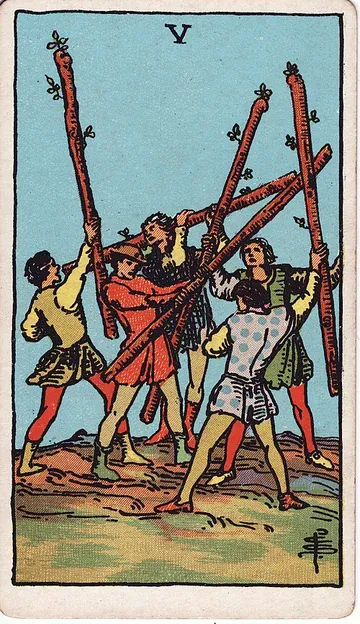
Five of Wands
Both fives, both quarrels, but very different rooms. Where the Five of Wands is the open jostling of the practice yard — five staves swinging, no clear winner, kinetic chaos — the Five of Swords is the post-jostle: the one who walked away with the reputation while the others went home tired. The pair describes a conflict that has graduated from honest exchange into reputation management, and asks whether the original disagreement was worth the story it has produced.
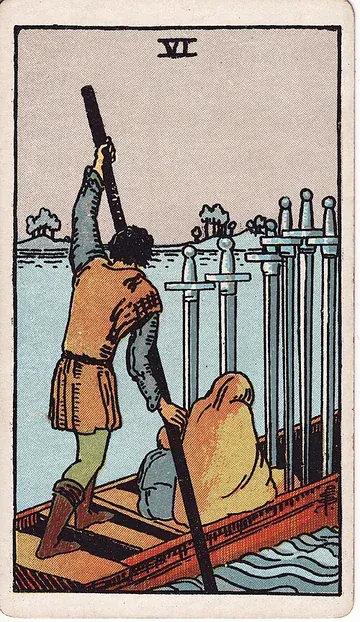
Six of Swords
The suit's natural progression — the won battlefield, then the boat across gray water away from it. Together these cards read as a transition that is already underway. Whatever was won has begun to feel hollow enough that the leaving is starting. The Six does not promise that the leaving will be triumphant; it is a quiet boat, and the water is gray. But it is movement, and it is movement away from the field. The pair invites the seeker to step into the boat without first winning the next round on shore.
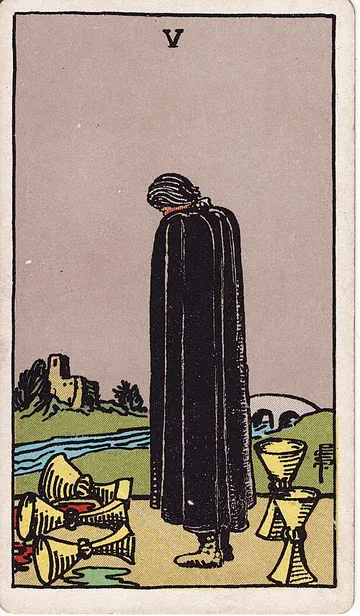
Five of Cups
Both fives, both Geburah severities, but in different waters. The Five of Cups is the spilled chalices and the figure who cannot yet see the two upright vessels behind him. The Five of Swords is the gathered swords and the figures walking away. Together they describe a season of compounded loss — the mourning of the Cups laid over the won-but-empty victory of the Swords. The pair asks for honesty about what has been lost and refusal of the additional loss the cutting posture would create. Mourn cleanly. Do not weaponize the mourning.
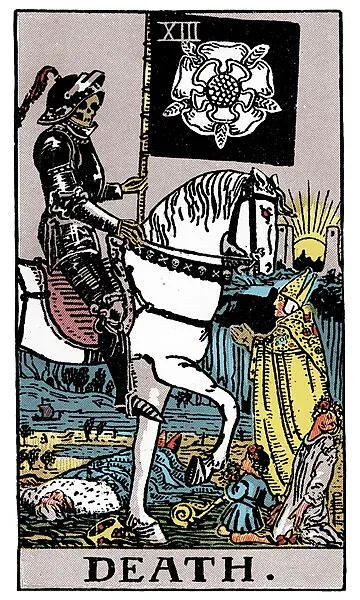
Death
Death rarely shows up to soften a card; here, paradoxically, it does. The combination describes the moment when the won quarrel must be allowed to actually end — properly buried, not merely stored. Death asks the Five of Swords to give up its fortress of accumulated swords and let the configuration of the conflict transform into something else. One of the more powerful invitations in this card pair: the transformation that becomes available when the seeker stops defending the territory of having been wronged. Difficult, but generous.
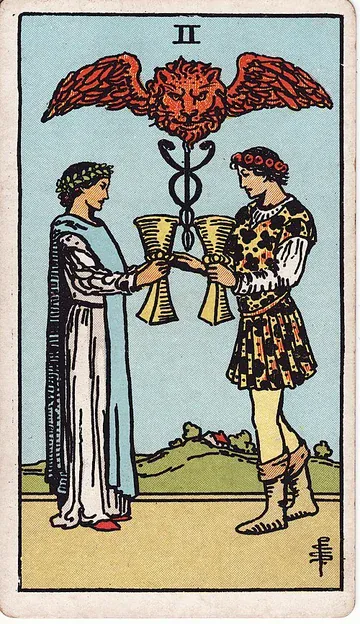
Two of Cups
The deck's clearest tonal contrast. The Two of Cups is the offered chalice — two figures facing each other, ready to drink to the new bond. The Five of Swords is the unilateral victor with the swords clutched against him, unwilling to let go even of weapons that no longer threaten anyone. When these cards appear together, the question is whether the seeker can put down the swords long enough to receive the chalice. The conflict-trained reflex is to refuse the cup. The pair asks for the harder gesture: take it. End the duel-stance. Build the new bond.
Frequently Asked Questions
Does the reversed Five of Swords support being the one who apologizes first?
It does, and it does so consistently. Reversed, the card is a conditional yes — to peace, to repair, to disarmament. It answers yes to questions about reconciling, apologizing, withdrawing a complaint, or letting an old grievance go. It answers a soft no to questions about continuing the fight or escalating the dispute. The reversed card consistently supports the de-escalating move, treating retraction as strength rather than defeat.
How do I tell real reconciliation from replaying an argument I already won?
The card carries both faces and asks the seeker to name which one is theirs. Reversed, it describes the swords being lowered — sometimes finally, sometimes too late, sometimes only halfway. The card has two faces: genuine reconciliation, in which the seeker chooses the relationship over the rightness, or rumination, in which the seeker is still replaying a won argument months later. Surrounding cards usually clarify which face is operating, and the work of the reading is to name it honestly.
Does a truce hold if only one person puts the swords down?
Rarely, and the card is unusually frank about it. Reversed in love, the Five of Swords often describes the truce becoming real. The fight that ran underground for months is finally named at the breakfast table, the apology is offered, the post-rupture conversation is had a few days later rather than never. For reconciliation questions, the card supports the rebuilding when both parties are putting down the same swords; an asymmetric truce, where only one is disarming, tends to break back into the original conflict.
Does the reversed Five of Swords mean they have softened without saying so?
That is its most common reading. The warmth is making its way back, slowly, with the swords being lowered as the feeling moves. They have been quietly rethinking the recent disagreement and have arrived at a softer position. They have not necessarily said so, and may not say so directly, but the temperature in the next encounter will be different. The reversed card describes the thawing.
Who should move first when both sides are waiting for an apology?
You, according to this card. Send the message you have been almost-sending — the apology, the retraction, the follow-up after the cutting email, the 'I have been thinking about what you said.' Apologize for the delivery, even if not the position. Speak the truce first. Most reconciliations stall because both parties are waiting for the other to move; the reversed card supports the seeker who moves first. The first move is leadership, not weakness.