
Five of Wands · Core Meaning
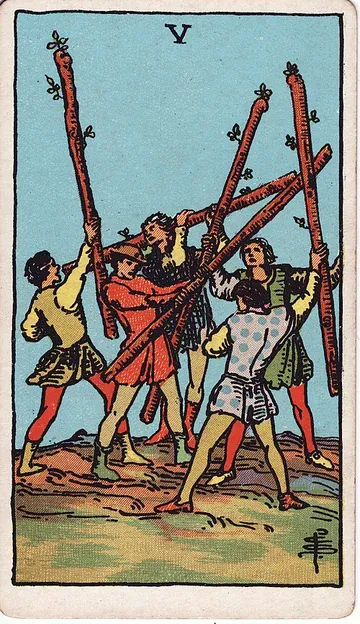
Five young figures stand on bare earth and raise their staves. The staves are crossed but not aligned — each lifted at its own angle, each insisting on its own axis. The clothes are mismatched: one in green, one in red, one in striped yellow, one in ochre, one bare-armed in undyed wool. The ground beneath them is unbroken — no tilled rows, no boundary stones, no flag claiming this corner over that one. It is just past noon, the hour when shadows are short enough to be honest. The breathing is audible. The wood knocks against wood. No one bleeds.
This is the Five of Wands, and its signature tension is the difference between contest and injury. The picture is a quarrel, but it is the kind of quarrel a body can survive. The staves are raised — not abandoned, not hidden — but no one has put down the staff and picked up a knife. The fact that the bodies remain unwounded is not luck. It is the boundary the card holds: this is sparring, not warfare. The first rupture in an established order has surfaced openly, and the openness is what keeps the rupture from becoming a wound. Lunarcana reads the card as a portrait of the moment friction has been allowed to declare itself in the daylight, before it goes underground.
The traditional astrological signature reinforces this exact discipline. The Five of Wands is the first decan of Leo, ruled by Saturn, the late-July to early-August window from July 22 to August 1. Leo is fire that wants to be seen — the urge to display, to perform, to claim the room. Saturn is the planet of structure, rule, and consequence. Saturn in Leo's first decan is the lion in a harness: the showing-off impulse bound by a discipline that says only on the training ground, only with these rules, only in the time the rules allow. The flame must find a permitted shape. It is not asked to go cold; it is asked to stay inside the rope.
Kabbalistically, the card sits at Geburah in the suit of fire — the fifth sephirah, severity, the sphere of Mars's pruning force. Geburah is where the over-grown branch is cut so the tree may stand. The number five is the first rupture in an established order, the elbow of disturbance that breaks the four's tidy room and asks whether the room was tidy because it was alive or because no one had pushed against it. The Five of Wands is not the rupture that destroys; it is the rupture that tests. After the four (Chesed, the porch raised for celebration), the five interrupts: who is allowed under this porch? whose vision of the household will hold? The card stands at the moment those questions are still being asked with raised voices, and the voices are still raised in the open.
Read the card the way you would read a photograph of a training ground at the noon hour. There is heat in it, real heat, and the heat is not pretending to be something else. But there is also a referee, even when the referee is invisible — there is the agreement that this contest stays a contest. Whatever lives in that pause — the impatience to win, the relief at being permitted to disagree, the small satisfaction of finding out you were not the only one with strong feelings, the wariness of which sparring partner will be honest — is the meaning of the card for that reading. The picture itself is neither friendly nor hostile. Which of the five staves is in your own hands decides how the scrimmage reads.
Five of Wands · Love & Relationships
Two people arguing where each can hear the other are further along than two people being careful, and the Five of Wands is the card of that argument. This is not a card of breakage. It is a card of the conversation that is finally happening — the one that had been swallowed for months, the one that the body had been carrying as low-grade resentment until the body refused to carry it any longer. The staves have been raised. Whatever was unspoken has begun to be spoken. The work the card now describes is the discipline of letting the contest stay a contest.
For an existing partnership, the Five of Wands often describes the season in which the same fight keeps surfacing because it has not yet been fought all the way through. The argument about the in-laws. The argument about the mess. The argument about whose career bends to whose. Each round ends not with resolution but with one person walking away exhausted and the other person filing the disagreement into a private ledger. The card insists that the only way out of this loop is through it — but on the training ground, with rules. Set a real time. Sit at a real table. Both staves raised, both bodies unwounded. The Five of Wands does not promise that the fight is brief. It promises that the fight, conducted openly, is survivable.
For a new spark surrounded by competition, the Five of Wands describes the early stage in which the person you are interested in has not made you the only candidate. There are other people circling — perhaps because they are conventionally desirable, perhaps because they are kind to anyone who shows up, perhaps because they have not yet learned to choose. The card is honest about the dynamic. It does not flatter you with the fantasy that you are already singular in their eyes. What it offers instead is a specific instruction: do not pretend the other contenders are not there, and do not become a contender yourself by sharpening yourself against them. Stand in your own shape. The card describes the suitor who wins this Five of Wands not by knocking the others down but by being unmistakably themselves while the others are busy posturing.
For a solo seeker tired of the dating arena, the Five of Wands names the exhaustion accurately. The card knows what it is to keep showing up to the training ground and never leave with a partner. It does not pretend you have not been doing the work. What it asks is a small, honest question: have you been sparring or have you been brawling? Sparring leaves you tired but intact. Brawling leaves you cynical, suspicious, and ready to read every new candidate as a threat. If the dating arena has begun to feel like a fight rather than a meeting, the card is asking you to step off the ground for a season. Not to give up — to remember the difference between practice and combat. The arena will be there when you return, and the return is with cleaner edges.
For a post-wound seeker facing a real disagreement again, the Five of Wands is gentler than it first looks. After a long mourning, after the divorce, after the relationship that ended in a way that taught the body to flinch — disagreement itself can feel like the beginning of injury. The card insists otherwise. The disagreement that arrives in this new bond is not the old disagreement returning. It is the proof that the new bond is real enough to push against. The staves are raised because there is something here worth defending. The bodies are unwounded because the people defending are not the same people who once wounded you. Notice the difference. Stay on the ground. The card supports the conflict that means the relationship is alive.
For reconciliation questions — for a couple who broke and are weighing whether to come back — the Five of Wands names a precise condition. Returning is possible only if the old fight is reopened openly. The reconciliation that tries to skip past the rupture by pretending the rupture did not happen rebuilds the same broken room. The reconciliation that works begins with both people on the training ground saying out loud what was never said the first time. The staves go up. The contest is conducted with witnesses, real time, and no walking away mid-round. If both people are willing to do that, the card is hopeful. If either person wants the comfort without the contest, the card is quietly negative — the rupture will return.
For a long-distance or cross-cultural couple, the Five of Wands often describes the moment when conflict styles diverge. One partner argues with raised voice and quick recovery; the other argues with silence and a three-day cooldown. One partner takes the disagreement to friends; the other holds it inside until it becomes a wall. The card does not declare one style correct. It asks both partners to recognize that their default sparring shape is not universal, and to negotiate a shared training ground neither one quite owns. This is more work than ordinary conflict resolution. It is also the work the card honors. Cross-cultural unions either learn this or fracture along the seam where the conflict styles refuse to meet.
For a pursuer-distancer pattern that has both stopped fighting wrong and started fighting wrong, the Five of Wands is precise. The pursuer has been raising the staff and being met with silence; the distancer has been refusing to raise theirs and calling it peace. Neither is sparring. The pursuer is brawling alone. The distancer is hiding the staff. The card asks each to do the harder thing: the pursuer to lower the volume to a stave-knock rather than a swing, the distancer to actually pick up the staff and meet the contest in real time. Two raised staves are not war. One raised stave and one absence is a brawl in slow motion.
For a household where chores, parenting decisions, or schedules clash, the Five of Wands describes friction that has become the texture of daily life. Whose night to cook. Whose turn to handle the kid's tantrum. Whose calendar bends for the family event. The card warns that these conflicts metastasize when they are conducted as accumulating grievances rather than discrete contests. Each disagreement deserves its own training-ground hour. Each disagreement deserves a real ending, even if the ending is uneasy. The household that learns to say we disagreed about this on Tuesday and here is what we landed on is the household that the card supports. The household that lets every Tuesday's disagreement seep into Wednesday's argument about something else is the household drifting toward the reversed card.
For desire mismatches surfacing in pointed remarks — different libidos, different ideas about exclusivity, different timelines for moving in — the Five of Wands says the surfacing is the gift. The pointed remark is the staff being raised. The card asks you not to flinch from it. Hear the remark for what it is: an opening contest, not an attack. Reply with your own raised staff in the open, not with a swallowed flinch and a private ledger. The conflict held in daylight tends to clarify the desire. The conflict swallowed becomes the wound the reversed card describes.
If you are asking whether someone is in love with you while several others are also circling them, the Five of Wands upright reads as a candid yes-with-conditions. They are interested. They are also in a season where the interest has not yet narrowed. They are paying genuine attention to you and also paying attention to others, and they have not yet chosen — perhaps because they are still gathering information, perhaps because they enjoy the attention itself, perhaps because they are not the kind of person who can choose under pressure. The card asks you to remain honestly visible without becoming a competitor. The contender who treats the others as enemies tends to lose. The one who keeps standing in their own shape, raised but unwounded, tends to be the one the chooser eventually walks toward.
Five of Wands · As Feelings
Engaged but unsettled is the honest summary of what the Five of Wands says about someone's feelings. They are not indifferent. They are not at peace. They are paying you a particular kind of attention — the kind that argues, that pushes back, that tests. Their feelings have edges. The edges are not yet weapons, and they are not yet sheathed. The card describes the body language of someone who has decided you matter enough to disagree with.
If they are reserved competitor by nature — quiet, jaw-set, guarded — the Five of Wands in feelings can mean a silent spar. They are running a private contest with you in their head. They are weighing what you said against what they think. They are noticing whether you flinch when challenged. The reserve is not coolness; it is concentration. They are taking you seriously enough to push against. Read silence here as weight, not absence. They will not raise the staff out loud yet — but they have lifted it inside.
If they are demonstrative competitor — quick to argue, quick to laugh, quick to circle back — the Five of Wands in feelings means a loud spar. They will tease you. They will challenge a thing you said three days ago. They will point out the small inconsistency in your story. None of this is hostility. It is how this kind of person flirts and tests in the same gesture. The card asks you to recognize the signal and to spar back lightly rather than to retreat. The silent retreat tends to read as you forfeiting; the matched volley tends to read as you joining the game.
For a long bond turned testy, the Five of Wands in feelings describes a partner whose fondness has become friction-heavy. They love you and they are tired of one of the patterns. They have not stopped feeling — they have started arguing within the feeling. This is not the death of the bond. It is the season the bond requires the discipline of fair contest. They will spar with you about the thing they used to swallow. Take the spar as the proof that the bond is still alive. The bond they had given up on would not bother to argue.
For a new connection sizing you up, the Five of Wands in feelings means the person is genuinely interested and is conducting due diligence by friction. They want to see how you handle disagreement. They want to know if you fold under pushback or hold your ground without becoming hostile. They are choosing whether to commit by way of contest. This is uncomfortable to read but accurate to how some people fall in love. The card asks you to be neither defensive nor aggressive — just present and matched. The connection that survives this stage tends to be the one where neither party flattens the other in order to be agreed with.
For a post-conflict cooling, where you and they have just had a real argument and are now in the silent aftermath, the Five of Wands in feelings means the heat has not yet fully released and they are still working through the round. They are not punishing you. They are processing. They will return when the processing is done — possibly with one more raised staff, possibly with a hand offered. The card asks you not to interpret the cooling as withdrawal. It is the post-spar breath, not the end of the bond.
For the conflict aftermath where pride is the wall, the Five of Wands in feelings is one of the deck's clearest mirrors. They feel toward you the way someone feels who lost a round they cared about losing fairly. They are not angry; they are private. The pride is not arrogance — it is the small armor a person wears while their dignity reseats itself. They want to come back. They are also unwilling to come back in a way that would feel like surrender. The card asks for a small face-saving gesture from your side. Not an apology if there is nothing to apologize for. A meal. A walk. A neutral question that is not the question of the fight. The card responds to ceremonial offerings.
For divided warmth — where their attention has been split among multiple people, you among them — the Five of Wands in feelings does not pretend you have their full focus. They have several relationships running at heat. Yours is one of them. The card asks you to read this honestly: their feelings for you are real and also not exclusive. The work, if you want exclusivity, is to ask for it openly. The card supports the open ask. It does not support the strategy of trying to crowd out the other contenders by being more present, more available, more accommodating. That strategy reads as forfeit, not victory.
For public-private divergence — warm with you in private, sharp with you in public — the Five of Wands in feelings names the texture exactly. In private their staff is lowered. In public, in front of others, they raise it again, sometimes against you. This is the partner working out something about their own identity using the friction of the relationship as the rough surface. It is not directed at you. It is, however, costing you. The card asks you to call this difference out gently — not as accusation, as observation. Often the public sharpness softens once it has been named.
For someone trying to provoke a reaction — pulling small fights, sending messages calibrated to sting just slightly, not quite hostile but not quite neutral — the Five of Wands in feelings reveals the strategy. They feel something they do not yet know how to say directly, and they are using friction to make the conversation start. The card asks you not to take the bait but to read the underneath. The provocation is a clumsy raised staff. They want the contest in order to find out what they actually feel. Meet them at the table — not at the level of the provocation, but at the level of the underneath.
For someone withholding warmth in order to win the round, the Five of Wands in feelings is not flattering but is honest. They are using silence as the staff. They have decided that the way to keep the upper hand is to be the one who does not reach first. This is sparring that has begun to slip toward something colder. The card asks you to name the dynamic if you can do so without escalating: not you are punishing me, but I notice we have stopped reaching toward each other and it has gotten quiet between us. Sometimes naming it brings the staff back down. Sometimes naming it shows you that the bond has tipped into the reversed card already.
Take the Five of Wands in feelings as confirmation that something is alive between you, and that the something has not yet settled. The contest is the proof of presence. The discipline the card asks for is staying in the open with it — not retreating into private resentment, not escalating into damage. Lift your staff. Hold the boundary that keeps the body unwounded. Let the contest run its honest course. Whatever they feel, they are feeling it about you specifically, and they are feeling it strongly enough to push against you. That is real material. The card asks what you build with it.
Five of Wands · Career & Work
The Five of Wands does its working life in the open: the project everyone wants on their record, the role with three internal candidates, the cross-functional meeting where every department speaks a slightly different language and every department thinks its language is the right one. The card describes the friction that comes from multiple people in the same room genuinely wanting the same outcome and disagreeing about the route. It is not an enemy card. It is a contest card. The work, the card insists, is to keep the contest in the open and let it sharpen the eventual decision rather than corrode it.
For someone in a current role with peer competition, the Five of Wands names the dynamic without judgment. You are not imagining the rivalry. The other strong performer on your team is also looking at the next promotion slot. The colleague who used to be your friendly counterpart has become slightly cooler since the new project assignments came out. The card asks you to neither pretend the competition is not there nor let the competition turn you into someone you do not respect. Do the work openly. Let your output be visible. Do not undercut. Do not scheme. The Five of Wands rewards the competitor who stays on the training ground and punishes the one who tries to win in the dark.
For a new role you are competing for — a job interview, a promotion shortlist, an internal transfer with multiple candidates — the Five of Wands upright describes the late stage of the contest. You are in the room. So are others. Their qualifications are not negligible. The card warns specifically against two reflexes: the impostor reflex that tries to disqualify yourself before the panel does, and the hostile reflex that tries to disparage the other candidates. Neither wins this card. What wins is being clearly, specifically, articulately yourself in the contest. State your version aloud. Do not let someone else summarize you. The decision-makers tend to remember the candidate who stood in their own shape rather than the one who tried to compare favorably to others.
For a freelancer competing against other bidders — agency RFPs, design pitches, consulting proposals — the Five of Wands describes the marketplace as it actually is. You are not the only person who can do the work. Several others are also pitching. The card asks for a particular discipline: do not race to the bottom on price, do not pad the deck with features no one asked for, do not try to outshout the other proposals. Win on fit. The client who chooses you on fit becomes the client you can sustainably serve. The client you wrestle away from a competitor by underselling becomes the client whose work you resent six months in.
For a creative worker dealing with an editor, collaborator, or director pulling the work in a different direction, the Five of Wands describes the productive friction at the heart of every collaborative practice. The editor wants tighter; you want longer. The director wants louder; you want quieter. The collaborator wants more saturation; you want more breath. None of this is malice. All of it is the contest that makes the work real. The card asks for sparring rather than sulking. State your reasons. Hear theirs. Test the disagreement against the actual work. The piece that survives this contest is usually a piece neither of you would have made alone — and that is the point.
For a student or apprentice in a cohort with peer competition, the Five of Wands honors the experience without flattering it. The classroom or studio is its own training ground. The other students are not abstractions. Some of them will be better than you at certain things. Some of them will get the prize you wanted. The card warns against the corrosive habit of secretly tracking who is ahead. Train against the work, not against the cohort. The students who emerge from these years intact tend to be the ones who learned to use the cohort as sparring partners — the ones who treated peer skill as fuel rather than threat.
For a manager refereeing factions on a team, the Five of Wands is the card you draw when the disagreement is louder than the work. Two strong subordinates who disagree about direction. Two departments inside your purview who pull in opposite directions. The temptation is to suppress the conflict for the sake of harmony. The card insists the suppression is the wrong move. Bring the contest into the open. Let both sides articulate their position, on the record, in front of each other. Mediate the round, do not erase it. The team that suppresses contest builds a quieter office and a worse product. The team that learns to spar in the open builds a noisier office and a sharper output.
For a care worker dealing with team friction — nurses with a difficult charge nurse, teachers in a department that argues over pedagogy, therapists in a group practice with clashing approaches — the Five of Wands names the cost of unspoken disagreement. The friction is taking energy that could go to clients. The card asks for the explicit conversation: where do we actually disagree, what do we agree on, what is the working compromise? Care work is one of the contexts where the contest most needs to be conducted in the open, because the alternative — accumulating private resentment — leaks into the care itself. The Five of Wands defends the staff meeting that argues honestly over the staff meeting that nods politely.
For someone on a promotion shortlist where multiple finalists are visible to each other, the Five of Wands describes the specific tension of being publicly considered alongside peers. The card asks for ordinary professionalism with one addition: continue to do the work as if the contest were not happening. The candidates who become campaigners — who lobby, who hint, who maneuver — almost always become less attractive to the panel during the campaign. The candidate who keeps doing the actual job at full quality during the contest becomes the candidate whose name is not arguable.
For someone facing a layoff with seat-shuffling — where the team is being reduced and roles are being merged and several people are competing for fewer positions — the Five of Wands does not pretend the contest is fair. Layoffs almost always mix performance signals with political signals and budget signals in ways that no individual employee can fully read. The card asks for a specific kind of dignity: you cannot control the outcome, but you can control how you stand on the ground. Do not slander colleagues. Do not panic-pivot. Do good work. Document it. Speak clearly to the people deciding. If you are kept, the keeping is on terms you can live with. If you are released, the release is with your name intact and the next contest already preparing.
For a cross-functional team where each function speaks a different language — engineering vs design vs product vs sales — the Five of Wands describes the daily Babel of modern work. Each function genuinely believes the others are obstructing the right answer. The card asks not for forced consensus but for the explicit translation work: the meeting where each function articulates its constraints aloud, the document where the different languages are written down side by side, the willingness to say we disagree, here is the disagreement, here is how we will decide. Cross-functional friction is the cost of having more than one kind of thinking in the room. The Five of Wands defends paying that cost openly rather than pretending to consensus and then sabotaging the decision afterwards.
Five of Wands · Money & Finances
Money arrives here as a contested resource, and the Five of Wands names each of its arenas — the negotiation, the bidding war, the inheritance with multiple heirs, the joint account where two people genuinely disagree about the right next move. The card does not predict scarcity. It describes the texture of money decisions made in rooms where more than one person has a legitimate claim. The work the card asks for is the discipline of making the disagreement explicit rather than letting it run as private resentment.
For someone in a salary negotiation, the Five of Wands describes the moment you and the employer disagree about what the role is worth. The card asks for an actual contest. State your number out loud. Hear theirs. Do not flinch from the gap. The negotiation that lands fairly is almost always the negotiation in which both sides articulated what they actually wanted; the negotiation that ends in lingering resentment is almost always the one in which one side swallowed the difference. Raise the staff. Do not raise it as a threat — raise it as an honest claim about value. The employer worth working for hears that and respects it.
For a freelancer or consultant pricing a contested project, the Five of Wands warns against racing to the bottom against other bidders. The contest is real. Several proposals are on the desk. Your number is one of them. The card insists that the right move is not to undercut your own value. Price what the work is worth to you to do well. If you lose the contract on price, you lose a contract you could not sustainably have served anyway. The Five of Wands rewards the bidder who held the line at a defensible number more than the bidder who got the contract by going low and then resented it for six months.
For shared finances with a partner — joint accounts, shared mortgage, household budget — the Five of Wands often describes the season the disagreement has finally surfaced. One of you wants to save more aggressively; the other wants to spend on quality of life now. One of you wants the bigger house; the other wants the smaller one and the freedom. The card asks for the explicit financial conversation many couples avoid for years. Sit at the table. Both staves up. Neither person allowed to walk away mid-round. The financial bond that survives this conversation is far more solid than the bond that has been quietly metabolizing the disagreement.
For inheritance with multiple heirs, the Five of Wands names the family dynamic without flinching. Whatever the deceased intended, the surviving family members now have to negotiate. The card warns against the strategy of being the heir who claims to want nothing and then resents the outcome. State your interests aloud. Hear theirs. Use a mediator if the disagreement has temperature. The Five of Wands is not against grief — it is against grief weaponized as silent leverage. The fair inheritance contest, openly conducted, leaves the family bond intact. The unfair one, conducted in side-conversations, fractures the family for a generation.
For a major purchase or financial bet, the Five of Wands warns against deciding under the pressure of someone else's contest. If you are buying a house against three other bidders, the card asks: are you buying because this is the right house, or because the bidding has activated a competitive instinct that has nothing to do with your actual life? The same question applies to investments in a hot market, to startup equity offers being matched by other companies, to luxury purchases made because a peer just made one. The card respects the contest itself. It does not respect being dragged into a contest you would not have entered if the rivals had not been there.
For debt or recovery questions, the Five of Wands describes the moment when financial discipline has begun to require disagreement with your own habits. The credit card has been a silent ally for too long. The takeout budget has been creeping. The subscription stack has gone unaudited. The card asks you to raise the staff against your own pattern — explicitly, in the open, with a real number on a real spreadsheet. The contest with your old habits is uncomfortable. It is also the contest that ends the slow drain.
A practical move when the card appears in a money reading: write down the three most contested financial decisions in your life right now, name the other party (a partner, an employer, a family member, your own past habits), and identify whether the contest has been conducted openly or has gone underground. The card responds to surfacing. Money disagreements that get spoken usually resolve. Money disagreements that get swallowed compound.
Five of Wands · Health
Contested signals have a body-texture of their own, and the Five of Wands reads it precisely: nothing collapsed, nothing in crisis, everything at low simmer — heart rate slightly elevated, sleep slightly broken, digestion slightly off, the upper spine tighter than it should be. The card associates with heart and upper spine specifically: the chest carrying more than it has acknowledged, the shoulders rising toward the ears, the neck holding the unspoken argument. The body has begun to display the friction the mind has been refusing to name.
For someone managing acute stress, the Five of Wands names the somatic toll of unresolved conflict. The body knows what the calendar refuses to know — that the meeting last Tuesday is still being rehearsed at 3 a.m., that the unanswered text from the family member is sitting in the chest, that the disagreement at home is being carried into the workday. The card asks for the explicit release. Whatever the conflict is, give it an actual hour: a real conversation, a real journaling session, a real walk in which the argument is allowed to run its course aloud. The body recovers when the contest is conducted; it does not recover when the contest is suppressed.
For chronic conditions involving inflammation, the Five of Wands describes the season when self-management has begun to require active negotiation with the condition rather than passive endurance. The autoimmune flare that has become a monthly event. The migraine pattern that is now predictable. The back pain that started situational and has become structural. The card insists that the body is not the enemy — but the body is asking for an actual conversation, conducted in the open with practitioners. Schedule the appointment. Say the symptoms aloud, in detail, without minimizing. The contest with the chronic condition is not a contest you win by ignoring the staff being raised.
For someone working through trauma or post-traumatic patterns, the Five of Wands describes the activation that comes when the body remembers something the mind has been working hard to put away. A trigger landed. The fight-or-flight has surged. The week has been harder than expected because something old has been touched. The card asks you to recognize the activation as information, not as failure. The body is sparring with the past. The work, with a practitioner, is to keep the contest survivable — to let the staves rise without letting the body bleed. None of this is medical advice; the Five of Wands is descriptive, not prescriptive. Stay in care. Let the support hold the boundary.
For mental health questions, the Five of Wands often describes the season after a depressive trough has begun to lift and the energy is back enough to argue with itself. The depression knew nothing but flat. The recovery has begun to introduce conflict back into the life — disagreements that had been impossible to feel are now suddenly available. This is uncomfortable and is, paradoxically, a sign of recovery. The card asks for patience with the noise. The flat was not health. The argumentative middle stage is closer to health than the silence was. Work with a therapist on conducting these new disagreements without overwhelming the rebuilding system.
For someone dealing with a contested medical situation — a diagnosis being debated by multiple practitioners, a treatment plan that two specialists disagree about, a symptom set that no one has yet named — the Five of Wands describes the medical maze without flattering it. You are not imagining the disagreement among your providers. The card asks you to advocate openly: get the second opinion, hold the practitioners to specific answers, write down the contradictions and present them. The body benefits from the contest being conducted in your presence rather than over your head.
For body practices — exercise, somatic work, martial arts, yoga — the Five of Wands is one of the cards that supports honest training. The work is hard. The work is supposed to be hard. The mild ache, the breath at the edge of capacity, the discomfort of a stretch held to the actual edge — these are the staves being raised against your current limit. The card distinguishes them from the wrong kind of pain (sharp, structural, the body's flare against actual injury). Sparring with the body's edge is the practice. Brawling with the body's edge — pushing past the warning signal because the ego refuses to lose the round — is the move the card warns against. Train. Do not punish. The body that is sparred with regularly grows stronger. The body that is brawled with collapses.
Five of Wands · Spirituality
Friction is not a failure of the path here; the Five of Wands reads it as the productive kind — the friction between a teaching and your life, between two traditions you respect, between the practice you have been doing and the practice you sense is now being asked of you. The card does not flatten this friction into a problem. It reads the friction as the condition under which a real spiritual life sharpens itself.
The card sits at Geburah in Atziluth — severity in the world of pure emanation. This is the sphere where will-force learns its first cuts. Geburah is not punitive; it is the pruning hand that lets the live branch live by removing the dead one. In Atziluth, the world of fire and flame, this pruning is conducted at the level of intention itself. What are you actually committed to? Where has your practice begun to drift from what you said it stood for? The Five of Wands names the small daily contest the honest practitioner conducts: between the version of the path you signed up for and the version your habits have quietly negotiated.
For seekers in active practice — meditation, journaling, ritual, devotional work — the Five of Wands often arrives in the season when the practice has begun to push back. The sit that used to be peaceful has become a wrestling match with the same restless thought. The journal that used to flow has begun to circle the same unanswered question. The ritual that used to settle the body has begun to surface unease. The card insists this is progress. The practice is doing what the practice does: bringing into the open the material that had been swallowed. Stay on the cushion. Stay on the page. The contest is the work.
For seekers exploring multiple traditions — moving between Christianity and Buddhism, between earth-based ritual and contemplative prayer, between depth psychology and devotional practice — the Five of Wands names the friction of carrying more than one map. Each tradition has its own answer. The answers do not always reconcile. The card asks you not to force false harmony. Let the disagreement be real. The path that survives the friction of multiple traditions is usually a path that has been pruned by that friction into something neither tradition would have produced alone — and that is not betrayal of the traditions; it is the honest fruit of carrying them seriously.
For seekers in community — sangha, congregation, lineage, magical group — the Five of Wands describes the inevitable internal conflict every spiritual community generates. Different members have different ideas about purity, about correctness, about who gets to lead, about what the tradition actually teaches. The card insists this is not failure. Spiritual communities are not exempt from the law of fives. The work is to conduct the community's contests openly, with structure, rather than letting them go underground into faction. The community that learns to disagree visibly tends to last; the community that suppresses disagreement tends to schism.
The card's spiritual question is precise: where, in your practice, have you been holding back the staff? Where have you been agreeing with a teaching you do not actually agree with, because the teacher is loved and the disagreement felt impolite? Where have you been performing a practice that no longer fits, because admitting it no longer fits would require finding a new one? The Five of Wands honors the seeker willing to raise the staff against their own complacency. The harness is not removed. The lion does not become a tiger. But the lion no longer pretends the harness is comfortable when it has begun to chafe.
A practice for the day this card appears: choose one teaching you have absorbed without fully testing, and spend thirty minutes writing a real argument against it. Not a dismissal — a careful contest. State the teaching as charitably as you can. Then state, in your own words, where it does not fit your lived experience, where it contradicts another teaching you also respect, where it asks more of you than you have been willing to give. End by noting which side of the contest you actually want to live on. The teaching that survives this exercise becomes more yours; the teaching that does not survive it was probably not teaching you anything new anyway.
Five of Wands · Yes or No
Conditional yes — the contest is permitted, but the contest is the work.
The Five of Wands upright is not a clean yes and not a no. It is the answer that says: the path you are asking about is open, and the path will require you to disagree with someone in the open and stay on the ground while you do. If you are willing to spar, the answer is yes. If you are looking for a frictionless yes, the card is gentler than no but firmer than the comfort you wanted.
For yes-or-no questions about a relationship, a job, a move, a creative project: yes, this is available to you. The opposition you have been sensing is real, and the opposition is not the deal-breaker you feared. The card asks you to name the opposition aloud — to yourself, to the other parties, to the people whose support matters — rather than treat the opposition as a private obstacle. The path forward is on the training ground, not around it.
For questions about whether someone supports your direction — a partner, a parent, a boss, a collaborator — the Five of Wands suggests the support is mixed and is being spoken honestly only in fragments. The full conversation has not yet been had. The card answers yes to the underlying question (the path is workable) and adds that the workability requires you to invite the disagreement into the room. The unspoken half of the support will keep undermining you until it gets spoken.
For questions about timing — should it happen now? — the Five of Wands answers yes if you are prepared to conduct the disagreements now, and no if you are hoping to delay them until the path is clearer. The path becomes clearer only by walking it through the contest. Waiting for consensus before you act produces neither consensus nor action. The card supports moving while the disagreement is still hot, with the discipline that keeps the disagreement honest.
For binary questions about whether to act — should I send the message, should I make the call, should I take the position — the Five of Wands answers act, and adds that the action will be met by pushback. The pushback is not the universe telling you to stop. It is the texture of every action that matters. Send the message. Expect a reply that is not pure agreement. Reply to the reply with your own raised staff. The conversation is the path.
For questions about whether someone is being honest, whether an offer is genuine, whether a plan will hold, the card is precise: the offer is genuine and is also incomplete. There are terms still being negotiated, perhaps unconsciously, by the other party. The card warns against signing as if the negotiation were over. Read the contract. Ask the second question. Raise the missing terms.
For competitive contexts — interviews, auditions, applications, pitches — the Five of Wands answers yes you are a real contender, with the caveat that you are not the only one. The candidates against you are not weak. The card asks you to compete cleanly and specifically, on your own merits, without trying to outshout or undercut. The yes the card offers is conditional on you remaining recognizable through the contest.
If the question was: am I right to feel that I have been carrying a disagreement that needs to surface? The card answers yes — and asks why you have been waiting.
Five of Wands · Advice
Raise the staff where people can see it. The Five of Wands gives that instruction plainly, and all of its difficulty is in the last four words. Whatever conflict you have been carrying privately — with a partner, a colleague, a parent, a habit, a teaching, your own past self — the card asks you to bring it onto the training ground in daylight. Do not pretend the rivals are not there. Do not weaponize the disagreement into something it is not. State the contest as it actually is and let it run with rules.
If there is one specific instruction the card offers, it is to set a real time and a real boundary for the disagreement. Open contests stay survivable when they have edges. Pick the hour. Pick the room. Pick the agreement that nobody walks out mid-round. Pick the smaller agreement that no one is allowed to call the other person a name. The Five of Wands rewards the contest that has structure. It punishes the brawl that has none. The reversed card lives where structure has gone missing.
A second instruction: state your version aloud. The card's situational cue is exactly this — in today's meeting, in today's conversation, in today's confrontation, do not let someone else summarize you. Speak your own sentence. Even if the room is loud. Even if three other voices are louder. The voice that goes unspoken in a Five of Wands moment becomes the resentment that haunts you for the next month. The voice that is spoken, even imperfectly, settles. People can disagree with what you actually said. They cannot disagree with what they had to guess.
A third instruction: hold the boundary that keeps the bodies unwounded. The image of the card is precise — staves raised, no blood. The contest stays a contest only if both parties refuse to cross into the kind of move that injures rather than tests. No name-calling. No threats. No use of the other person's deepest vulnerability as ammunition. No private intelligence weaponized for the public round. The rules are not optional. They are the difference between sparring and brawling, between Five of Wands and the reversed Five.
A fourth instruction: do not fight what is not yours to fight. The Five of Wands also marks the fight you have been picking up on someone else's behalf, the contest you have entered because a friend or a family member asked you to, the rivalry inherited from a parent or a workplace culture. Some of these fights are honestly yours. Some are not. The card asks for the audit: whose contest is this, whose staff am I raising, whose victory am I trying to win? If the answer is not mine, lay the staff down. The training ground is not infinite. Save your energy for the contests that are honestly yours to conduct.
A fifth instruction: after the contest, return to position. The card's integration cue speaks directly to this — set an hour for the quarrel, and after, return to the work. The Five of Wands becomes the reversed card when the contest leaks beyond its hour and seeps into every adjacent moment. Disagreement contained is disagreement that sharpens. Disagreement that becomes the texture of every interaction is disagreement that corrodes. End the round. Walk off the ground. The next round, if it is needed, will be its own round.
Practical advice for the day the card appears: identify the one disagreement you have been postponing. Write down the actual sentence you have been refusing to say. Decide who needs to hear it. Decide when. The card responds to the moment the unspoken sentence becomes a calendar event rather than a private weather. Schedule the contest. Keep the rules. Stand under noon's short shadow with your staff lifted but unwounded. Then, when the round is finished, lower it cleanly and walk back to your other work. The Five of Wands rewards the practitioner who has learned this rhythm.
Five of Wands · Card Combinations
The Five of Wands gathers meaning when read against neighbors who clarify what kind of contest is happening on the bare earth. Some combinations point to the round's resolution; others mark the round's shape; others reveal what the contest has actually been about. Read the combined image rather than two separate verdicts — the second card is the lens that focuses the first.
Five of Wands + Six of Wands
The contest resolves into the victory parade. Same characters, after the dust settles. Where the Five was unaligned staves on bare earth, the Six is the rider returned through the gathered crowd, laurel raised. The combination describes the moment the open contest was finally adjudicated: the promotion shortlist closed, the project funded, the negotiation signed. The card pair warns against two reflexes — bitterness if you were not the rider, complacency if you were. The Six's victory is provisional, and the Five will return next quarter with new contestants. Honor the round. Honor the result. Do not mistake the parade for the end of contests.
Five of Wands + Seven of Wands
From open contest to defending the held position alone. Where the Five was five staves on shared ground, the Seven is one figure on the rise with the others below, staves still pushing up. The combination describes the seeker who has held a position long enough that the contest is no longer about whose ground this is — it is about whether the holder can keep holding. This pair often appears for the long-tenured manager, the public figure who has made a stance, the practitioner who has staked out a methodology. The card pair asks for stamina, the willingness to keep articulating the position rather than assuming the position defends itself, and the discernment to know which incoming staves are honest tests and which are bad-faith pushes.
Five of Wands + Four of Wands
The threshold-rest before flames take each other's measure. Where the Four was the porch raised in celebration, the Five is the contest that arrives once the celebrants are inside the gate and discover they disagree about what the household is for. The combination is read in either direction. Drawn as past-present, it tells the story of the easy beginning that has now reached its first real argument; drawn as present-future, it predicts that the current contest can lead toward a renewed Four if the contest is conducted on the training ground rather than at the dinner table. The card pair honors the truth that no household stays in the Four forever. The Five is the price of the Four being real.
Five of Wands + Strength (VIII)
The Leo modulator: Saturn-in-Leo decan finds its archetype here. Where the Five was the lion harnessed by Saturn's discipline, Strength is the woman closing the lion's jaws with her own quiet hands. The combination reframes the contest: the work is not to crush the opposing fire, and not to extinguish your own. It is to hold both with the patience that keeps them survivable. This pair appears for the seeker who has been winning rounds by force and is being asked to start winning rounds by composure. The fire stays. The way the fire is held changes. The card pair is one of the deepest readings the Five of Wands can receive.
Five of Wands + Five of Cups
Series sibling, tonal contrast — the five-rupture that grieves vs the one that sparks. Where the Five of Wands is staves raised on bare earth, the Five of Cups is the figure cloaked in mourning beside three spilled cups, two intact behind. The combination forces a precise question: is the disagreement in front of you alive, or has it already become loss? The Five of Wands argues. The Five of Cups grieves what cannot be argued back into being. The card pair often appears when a contest is being conducted with someone whose part of the bond has already moved into mourning — the partner still arguing while the other has begun to leave. The instruction is to read which five you are actually inside, and which five the other person is inside. They are not always the same. Treat them differently.
Card Combinations
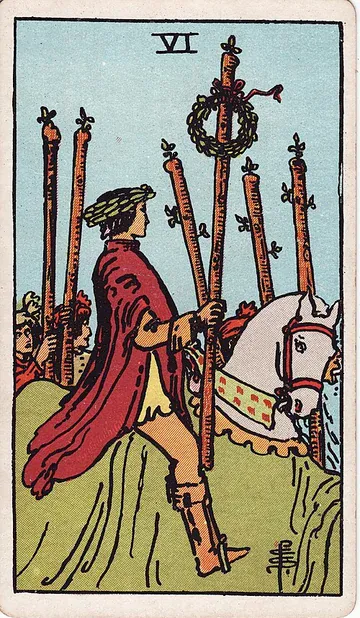
Six of Wands
Successor — the contest resolves into the victory parade, same characters after the dust settles. Where the Five was unaligned staves on bare earth, the Six is the rider returned through gathered crowd, laurel raised. Honor the round, honor the result, but do not mistake the parade for the end of contests; the Five returns next quarter with new contestants.
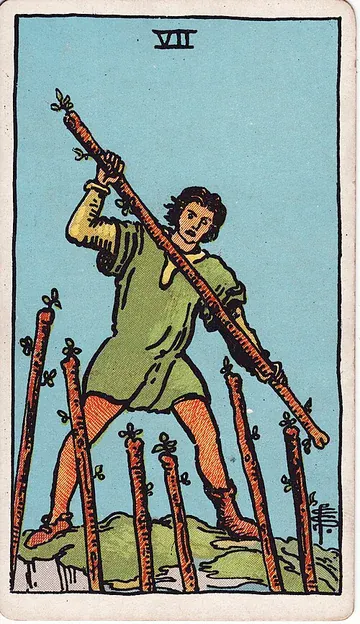
Seven of Wands
Related — from open contest to defending the held position alone. The Seven is one figure on the rise with the others below, staves still pushing up. The pair describes the seeker who has held a position long enough that the contest is no longer about whose ground this is, but about whether the holder can keep holding. Distinguish honest tests from bad-faith pushes; keep articulating the position rather than assuming it defends itself.
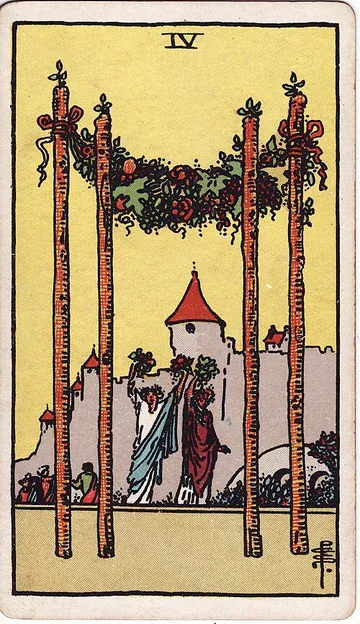
Four of Wands
Predecessor — the threshold-rest before flames take each other's measure. The Four was the porch raised in celebration; the Five is the contest that arrives once the celebrants are inside the gate and discover they disagree about what the household is for. Read in either direction: the easy beginning that has reached its first real argument, or the current contest that can lead toward a renewed Four if conducted on the training ground rather than at the dinner table.
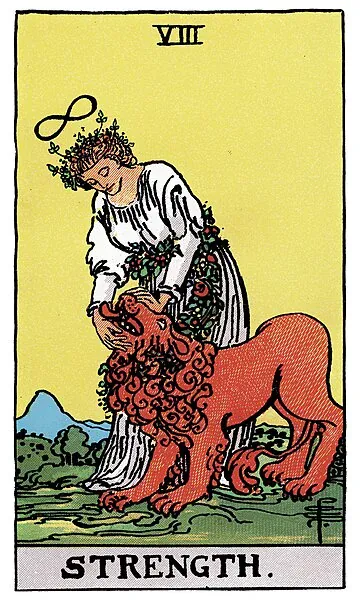
Strength
Leo modulator — Saturn-in-Leo decan finds its archetype here. Where the Five was the lion harnessed by Saturn's discipline, Strength is the woman closing the lion's jaws with her own quiet hands. The combination reframes the contest: the work is not to crush the opposing fire and not to extinguish your own; it is to hold both with the patience that keeps them survivable. Win rounds by composure now, not by force.
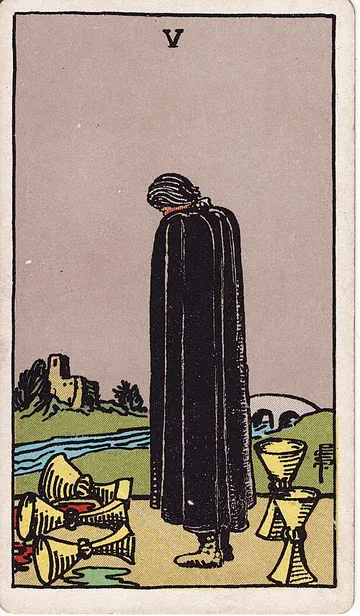
Five of Cups
Series sibling, tonal contrast — the five-rupture that grieves vs the one that sparks. Where the Five of Wands argues, the Five of Cups mourns what cannot be argued back into being. The pair forces a precise question: is the disagreement in front of you alive, or has it already become loss? Often appears when one partner is still raising the staff while the other has begun to leave; read which five each person is inside, and treat them differently.
Frequently Asked Questions
Why do the staves in the Five of Wands never actually connect?
Because nobody in the picture is trying to land a blow. Five figures raise five staves at five different angles on bare earth, and not one of them is aimed at a body: the wood crosses, the wood misses, and everyone walks off the ground at the end of it. That is the whole argument of the card. It describes open contest — competition, sparring, creative friction, the meeting where several people genuinely want the same outcome and disagree hard about the route to it. The mismatched clothing matters too: green, red, striped yellow, ochre, undyed wool. These are not two armies. They are five separate people who have not agreed to a common uniform, which is why the noise is loud and the damage is nil.
Does the Five of Wands mean I have to fight for this?
It means you have to contend for it, which is a smaller and more manageable thing. The path being asked about is open — the card does not block it — and the toll on the way through is that somebody is going to disagree with you out loud and you are going to have to stay on the ground and answer. Not win. Answer. If you are willing to spar, the answer is a clear yes. If what you were hoping for was frictionless agreement, the card is firmer than the comfort you came for and says so early, which is a kindness. Raise the staff. State your version in your own words. Keep the rules you would want the others to keep, especially in the hour when keeping them costs you something.
Is the same argument coming back a bad sign in a Five of Wands relationship?
Not in itself. A recurring fight usually means the fight has never actually been finished — it gets interrupted, defused, or swallowed at minute nine every time, and an unfinished argument returns the way an unfinished sentence does. The Five of Wands is the card of that argument finally being conducted in daylight instead of rehearsed in private. It is not a breakage card. It reads the disagreement as the conversation two people have been circling for months, and it holds two conditions: spar at the table, and do not brawl. The same image covers other contested love shapes — a new spark with other contenders around it, a reconciliation that requires reopening the old rupture by name rather than starting fresh and hoping. Swallowing is the only move the card treats as a loss.
What does the Five of Wands mean for career?
For career, the Five of Wands is the card of open competition — the project with multiple internal candidates, the cross-functional meeting where every department speaks a different language, the bidding contest, the promotion shortlist. The card asks for clean contest: state your version aloud, do not undercut peers, do not lobby in the dark. The competitor who stays on the training ground while others scheme tends to be the one who emerges with both the role and their reputation intact.
What is the difference between the Five of Wands upright and reversed?
Upright, the Five of Wands is the contest conducted in the open — staves raised on bare earth, unwounded bodies, just past noon. Reversed, the contest has gone underground. Surface calm, hidden tally; closed-door politics replacing open argument; resentment fermenting in silence. Upright is sparring, with rules. Reversed is the room where everyone has stopped raising the staff and started keeping a private ledger instead.