
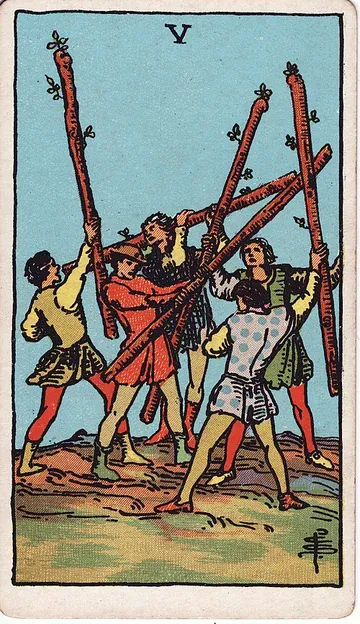
Five of Wands Reversed · Core Meaning
Reversed, the Five of Wands takes the fight indoors. The staves are no longer raised on the training ground at noon. They have been put away — not because the disagreement resolved, but because both sides have decided it is safer to fight in private than in daylight. The mismatched garments now mean factions rather than plurality. The bare earth has been quietly subdivided into private territories. The unwounded bodies hold their wounds elsewhere — in the ledger that nobody talks about, in the silent grudge that never gets a referee.
This is the reversed card's central knot: heat without form. The energy of the Five of Wands has not gone away. The conflict is still present. What has disappeared is the structure that made the conflict survivable. There is no agreed-upon hour, no agreed-upon room, no agreed-upon rule that nobody walks out mid-round. The disagreement has begun to leak: into the texture of every interaction, into the unspoken accounting at every meal, into the silence that lasts a beat too long when a particular topic comes up. The reversed card describes the room in which everyone has stopped raising the staff and started keeping a private ledger instead.
There is a second flavor of the reversed card: the contest that has tipped into brawl. Where the upright card held the boundary that kept the bodies unwounded, the reversed card has crossed it. The disagreement that started as honest sparring has acquired weapons it should not have — names called, vulnerabilities exploited, private information weaponized for public effect. The training ground has become the alley behind it. This is rarer than the underground version but more acute when it appears. The card warns of the cost: contests that become brawls are rarely forgiven, even when the relationship is patched.
The astrological signature reverses too. Saturn in Leo's first decan upright was the lion in the harness — the urge to display bound by rule, the flame finding a permitted shape. Reversed, the harness has either snapped (the brawl) or strangled (the underground). In the snap, the lion's display has become destructive. In the strangle, the lion has stopped displaying altogether and is now pacing inside the harness, growing meaner with each pass. Both are out of true. Both ask for the discipline of the upright card to be restored: the structure that lets the heat exist without consuming the room.
Reversed, the Five of Wands asks: where has the contest gone underground? Where is the swallowed fight that the body is paying for? Whose ledger have you been keeping in private, and what is the cost of never bringing it to the table?
Five of Wands Reversed · Love
A quiet house is not the same thing as a peaceful one, and the reversed Five of Wands knows the difference exactly. The fights ended — not because they were resolved, but because both partners decided it was easier to stop having them. On the surface, peace; underneath, accumulating weight. The card warns that this kind of quiet is not the quiet of agreement. It is the quiet of two people maintaining a shared performance while privately keeping score.
For an existing partnership, the reversed Five often describes the season in which the same fights have been swallowed long enough to harden into walls. One partner stopped bringing up the in-laws because the last three rounds went badly. The other partner stopped bringing up the financial mismatch for the same reason. Both partners now carry their unspoken disagreements as private grievance. The relationship looks calm to outsiders. Inside, both partners are keeping a ledger neither will read aloud. The card asks for the courage of the upright card: bring the ledger to the table. The contest avoided is becoming the contest that ends the bond.
For a new connection where conflict has been suppressed early, the reversed Five warns that the early avoidance is establishing the pattern. You have already, in the first three months, learned not to bring up the topic that caused the awkward dinner. They have already learned not to push back on the joke that landed wrong. Both of you are calling this getting along. The card sees it differently. Real getting along is built on conducted disagreements, not avoided ones. If the bond is going to last, one of you has to break the avoidance habit early — gently, but actually.
For the question of whether someone is in love with you and the card arrives reversed, the answer is complicated. They feel something real, but the something has gone private. The warmth that the upright card would have raised openly is now being carried in their interior, not offered. They may be afraid of the contest that would follow if they declared the feeling. They may be in a posture of wait-and-see that has lasted longer than wait-and-see should. The card asks for an honest read: warmth that does not move toward you for too long becomes equivalent to warmth that has moved elsewhere.
For reconciliation questions — for a couple who broke and are weighing whether to come back — the reversed Five offers a soft no or a guarded only if. Returning is possible only if the underground fight is brought back to the surface. The reconciliation that tries to start where the relationship ended, without first reopening the rupture that ended it, almost always rebuilds the same broken structure. The card insists: if you cannot have the conversation about why you broke, then the return is a temporary truce, not a renewal. The temporary truce will fail again on the same fault line.
For long-distance or cross-cultural couples, the reversed Five describes the conflicts that have gone underground because the distance made them easy to defer. The disagreement about whose country to settle in. The disagreement about how to handle each other's families. The disagreement about whose holidays count as the family holidays. Distance has been a useful shield against having to negotiate these. The card warns that the shield is wearing thin. The contests deferred for two years are about to surface all at once when the distance closes. Better to begin them now, in pieces, than to face them in a mass when the move happens.
For a pursuer-distancer pattern that has stabilized into permanent quiet, the reversed Five names the cost. The pursuer has stopped pursuing — not because the desire has ended, but because the pursuit kept getting met with retreat. The distancer has stopped retreating — not because the fear has ended, but because there is nothing to retreat from anymore. Both have entered a low-grade equilibrium that looks peaceful and is actually a slow drain. The card asks the harder version of the upright instruction: someone has to break the equilibrium first. Whoever breaks it accepts the discomfort of doing so without a guarantee. That is the cost of moving the bond off the reversed card.
For a household where chores, parenting decisions, or schedules have ossified into resentment, the reversed Five is precise. The disagreement that should be a fair contest has become a series of small punishments: the dish left in the sink as a message, the bedtime ignored as protest, the weekend plan made unilaterally because the joint conversation never happens cleanly. None of this is malicious. All of it is the underground version of a fight neither partner is willing to have openly. The card asks for the explicit re-opening of the topic — not in the moment of the small punishment, but in a separate, dedicated hour.
For a partner whose warmth has gone visibly cool, the reversed Five sometimes describes the contest you are already losing without knowing it. They have begun a quiet negotiation with themselves about whether to leave. They have not told you. The card warns against the response of pretending you do not sense the cooling. Name it. Ask the direct question. The reversed card resolves only when the underground process becomes a surface conversation. You may not like the surface conversation. It is, however, something you can finally act on.
For the seeker dating multiple people in parallel, where decisions are accumulating and being avoided, the reversed Five describes the cost of indefinite non-choice. None of the candidates is being given the full contest of your attention. None of them is being told they are not chosen, either. The card warns that this stage, conducted too long, corrodes everyone involved. The seeker becomes someone who accumulates options rather than chooses; the candidates become people who suspect they are being held in reserve. The card asks for an actual round: state where you are with each person, even if the answer is I don't know yet. Stating it openly is what keeps the field a field rather than a slow injury.
Five of Wands Reversed · As Feelings
Reversed, the friction stays inside them. They have feelings with edges on them and no intention of handing those over. The contest the upright card would have conducted in the open is being conducted privately, in their interior, often without your awareness. The warmth has not gone — it has gone underground. So has the disagreement. Both are alive. Neither is on the table.
If they are reserved by nature, the reversed Five in feelings can mean a silent jaw — the partner who has set their face against a topic and is no longer willing to engage with it. They are not cold to you in general; they are cold to the specific area of disagreement, and they are gating the rest of the relationship through that coldness. The card asks for an honest read: when did the gate close, and what is on the other side? Often the silent jaw is protecting a feeling the person is not willing to name even to themselves yet.
If they are demonstrative by nature, the reversed Five in feelings means loud spar that has flipped into pointed silences. The person who used to argue openly with you has stopped — not because the argument ended, but because they have decided arguing is not getting them what they want. They are trying a colder strategy now. This is uncomfortable to recognize. It is also accurate: some demonstrative people, when they tip into the reversed Five, become harder to read than their reserved counterparts because the contrast with their normal warmth makes the silence feel arctic.
For a long bond turned testy and then quiet, the reversed Five in feelings describes the partner who has stopped fighting and is now carrying every old fight as private inventory. Each unresolved round from the past three years is filed. The fondness is real and is being run through a filter of accumulated unspoken grievance. The partner is not punishing you actively; they are simply no longer reaching with the full warmth they once did, and they could give you a list of reasons if asked. The card asks you to ask. Not as confrontation — as invitation. Often the list, named aloud, becomes shorter than it had felt.
For a new connection sizing you up and finding you wanting in some specific way, the reversed Five in feelings means they have drawn a private conclusion they have not yet shared. They have decided something — that you are not quite their type after all, that the timing is wrong, that they cannot offer what you are clearly looking for — and rather than say it, they are conducting a slow withdrawal. The card warns against the response of trying harder. The reversed card does not respond to effort; it responds to honest naming. Ask. Hear the answer. If the answer ends the connection, the connection had ended already.
For a post-conflict cooling that has lasted longer than a cooling should, the reversed Five in feelings describes pride that has hardened into a wall. They are not still angry. They are protecting their dignity by not being the one who reaches first. The card asks for a small offering from your side that costs them nothing to receive — a neutral question, a shared task, a meal made without asking. The reversed Five in feelings often softens when the other person is given a way to come back without having to acknowledge they were ever away.
For the conflict aftermath where pride has turned into the silent grudge, the reversed Five in feelings names the dynamic precisely. The grudge is an honest grudge — they were hurt, and the hurt has not been addressed. The grudge is also no longer about the original incident; it has become an identity move, a way of being-with-you that is now familiar. The card asks both parties to find the small ritual that lets the grudge be set down without anyone losing face. Sometimes this is a third-party conversation. Sometimes it is a long walk where the topic finally surfaces in a tone that is not the tone of the original fight. The reversed Five resolves only with active dismantling.
For divided warmth where the warmth toward you has been hoarded behind a closed door, the reversed Five in feelings means they are choosing other claimants over you in the small moments — and not telling you. The friend's invitation accepted instead of yours. The colleague's call returned faster than yours. None of this is necessarily decisive. The card warns that it is information. The way someone allocates their non-emergency attention reveals where the warmth is actually moving. Read the allocations honestly.
For public-private divergence where they are warm with you in private and cold to you in public, the reversed Five in feelings names the contest happening inside them. They are negotiating with their own social context about whether they can claim you publicly. The negotiation has not yet resolved. The cold public face is the cost you are paying for their private indecision. The card asks for the direct conversation: ask whether they are ready to have you as part of their public life. The answer is information. The non-answer is also information.
For someone trying to provoke a reaction with smaller, sharper signals, the reversed Five in feelings means the provocation has tipped into bait. They are no longer trying to start a contest with you. They are trying to bait you into starting one so they can then act injured. This is not flattering to recognize. It is also a real pattern. The card asks you not to bite. Refuse the small fight that is being staged. State the bigger thing if it is worth stating; otherwise let the bait sit untouched. Bait that goes uneaten loses its function.
For someone withholding to win the round permanently, the reversed Five in feelings is the coldest reading the card offers. They have decided that whoever reaches first loses, and they have committed to never reaching. This is a posture, not a feeling. The feeling underneath is often confusion or hurt or fear. The card asks for the gentlest possible naming: I notice we have stopped reaching toward each other and I don't want this to be how we are. If the naming meets nothing in return, the bond has tipped past where the reversed Five can be reversed. Read the silence as the answer. Begin grieving cleanly.
Five of Wands Reversed · Career
Nobody argues in the meeting any more; the arguing has moved into the messages being sent during it, and that is the reversed Five of Wands at work. The team meetings are quiet. The project plans look aligned. The actual work is being undermined by parallel conversations that never happen in front of all parties. The card warns that this is the most expensive form of disagreement — far more expensive than the open contest the upright card describes — because the cost is paid in trust and in the slow erosion of working relationships.
For someone in a current role with peer competition that has gone underground, the reversed Five names the texture exactly. The colleague you used to spar with openly has stopped sparring openly and started managing perceptions of you to upper management. The peer who used to challenge your ideas in meetings now accepts them in meetings and dismantles them in 1:1s with the boss. None of this is hypothetical. It is the move the reversed Five describes. The card asks for the upright response: bring the contest back into the open. Not by accusation — by transparent communication. Schedule the joint meeting. State the disagreement aloud while everyone affected is in the room.
For a new role you are competing for through a process that has clearly become political, the reversed Five describes the candidate who keeps being told they are the front-runner and yet keeps not being chosen. The decision is being made in rooms you do not have access to. The card asks for clear-eyed realism. Some contests are conducted on the visible training ground; others are decided in the back office. The reversed card warns against pretending the back office does not exist. Find your sponsor. Make sure the people who will speak for you in the closed rooms are speaking specifically and accurately, not vaguely. The contest has moved. Move with it.
For a freelancer whose contract negotiations have been quietly dragged out without resolution, the reversed Five describes the client who is using time as leverage. They are not refusing your terms. They are also not accepting them. They are making you wait until the cost of waiting is higher than the cost of conceding. The card asks for the open contest the upright card prescribed: state a deadline, state the terms beyond which you cannot continue, and stand by them. The negotiation that drags reversed often resolves within a week of someone naming a real boundary.
For a creative worker dealing with a collaborator who has been undermining the work in private, the reversed Five describes the collaborator who agrees to your direction in the studio and then mentions to others that they have reservations. This is more common than open creative disagreement and far more corrosive. The card asks for direct conversation, even at the cost of awkwardness: name what you have heard, ask what their actual position is, request that any disagreements be raised with you first rather than to others. The collaboration either repairs through the conversation or ends through the conversation. Both outcomes are better than its current shape.
For a student or apprentice whose cohort competition has tipped into freezing-out, the reversed Five describes the cohort that has subtly excluded you — the study group that stopped including you, the practical session you were not invited to, the conversation that stops when you walk in. Some of this is paranoia in a high-stress training environment. Some of it is real. The card asks for the precise response: do not retaliate, do not panic, find the one person in the cohort with whom you can speak honestly, and through them re-establish basic communication with the rest. The reversed card resolves through patient re-entry, not through dramatic confrontation.
For a manager whose team has stopped fighting openly and started keeping private grievance lists, the reversed Five is a leadership signal. The team's quiet is not health. The next exit, the next missed deadline, the next subtle sabotage is being cultivated in the silence. The card asks the manager to break the silence first, by example. Hold a real meeting where disagreement is invited. Show that you can hear pushback without retaliating. The team that has tipped into reversed Five does not move back to upright on its own; it requires leadership to demonstrate that the open contest is safe again.
For a care worker dealing with team friction that has gone underground, the reversed Five describes the staff meeting that nods politely while the parking-lot conversations get sharper each week. The patient or client suffers in the gap. The card asks for the explicit team retreat or facilitated session — outside resources if internal ones are exhausted. Care work cannot sustain underground friction for long; the work itself begins to fail.
For someone on a promotion shortlist where the visible process has become a fig leaf for a decision already made privately, the reversed Five names the dynamic without flinching. The decision was made in a room you were not in, and the formal process is theater. The card asks for honest assessment: is this an organization where you can do your real work, or is this an organization where the visible contests are not the real contests? Some workplaces operate this way as a feature, not a bug. The card respects your knowing the difference, and your choosing accordingly.
For someone navigating a layoff with seat-shuffling that has been conducted in secret, the reversed Five describes the cost of opacity. Information is being withheld. Decisions are being framed as inevitable when they were chosen. The card asks for the calm response: do not panic, do not slander, document what is documentable, ask the questions you can ask, accept that some answers will not come. The reversed card in a layoff context is not about winning the contest — it is about preserving your dignity and your reputation through a contest you cannot fully see.
For a cross-functional team where the friction between functions has been managed by avoidance — meetings canceled, decisions deferred, problems passed around — the reversed Five names the cost. The product or service is suffering. The team members are exhausted by the unresolved tension. The card asks for the structured re-opening: a facilitated session, an explicit decision-making framework, a willingness to surface the disagreements that have been swallowed. Cross-functional avoidance does not stabilize. It compounds. The reversed card asks to bring the friction back to the visible training ground before it eats the work itself.
Five of Wands Reversed · Money
A money disagreement that stops being discussed does not stop; it starts being acted out, and the reversed Five of Wands is where that turn happens. The unspoken disagreement about spending has become a pattern of small purchases neither partner mentions. The unresolved question of whose career bends to whose has become a year-long quiet imbalance. The negotiation that should have surfaced has gone underground and is being conducted in cash flow rather than in conversation.
For shared finances in a partnership, the reversed Five often describes the season after the financial conversation should have happened but did not. One partner is now spending in ways the other resents but has not named. The other partner is saving in ways that feel punitive but have not been called out. The bank statements have become a coded language that both partners read fluently and neither speaks aloud. The card asks for the explicit conversation the upright card prescribes — and warns that delaying it further raises the cost. Money disagreements that go underground tend to surface eventually as relationship-ending fights, not as financial-planning fights.
For a salary negotiation that has stalled, the reversed Five describes the conversation that should have been a clean contest and has instead become an indefinite holding pattern. The employer is not saying no. The employer is also not saying yes. The card asks for the direct ask: a specific date by which a decision is needed, with the consequences of missing the date stated honestly. Negotiations that go reversed almost always resolve when one side names a real deadline.
For a freelancer whose client has been quietly disputing the invoice rather than openly contesting the work, the reversed Five describes the client who is paying late, raising small issues out of order, asking for revisions that should have been part of the original scope. Each move is small enough to feel petty to call out. Together they constitute an underground contest about whether the contract should have been priced differently. The card asks for the explicit conversation: name the pattern, restate the contract terms, propose a path to close. Some clients will resolve cleanly; others will reveal that the relationship is not worth continuing.
For inheritance with multiple heirs where the disagreements have gone underground, the reversed Five describes the family in which everyone has agreed to the legal distribution and nobody is happy with it. The unspoken accounting is enormous. Old grievances are being redistributed under the cover of estate logistics. The card warns that the family bond does not survive this configuration unless someone is willing to surface the actual disagreement. A family meeting with a mediator is often the move. The reversed card resolves only when the contest comes back into a structured space.
For a major purchase being deferred indefinitely because the partners cannot agree, the reversed Five describes the slow corrosion of the indefinite defer. The car that needs replacing. The renovation that has been almost ready to start for two years. The vacation that keeps getting pushed. The card asks for the structured contest the upright card honored: a real conversation, a real deadline, a real decision even if the decision is to wait. Indefinite defer is a decision in disguise, and it is usually the worst-quality decision available.
For debt or recovery questions, the reversed Five describes the seeker who has been quietly disagreeing with their own financial plan without revising it openly. The budget is technically still in place; the actual spending has departed from it; the gap is being managed through small mental edits no one would call lies. The card asks for the visible audit. Look at the actual numbers. Acknowledge the divergence. Either revise the plan to match the spending, or revise the spending to match the plan. The underground negotiation with yourself ends only when the negotiation comes onto the page.
For investment decisions in volatile markets where the seeker has been overriding their own stated strategy in the moment, the reversed Five describes the contest between the planning self and the reactive self. The planning self said hold; the reactive self has been buying and selling on impulse. The card asks for a structural fix: automation that removes some decisions from the moment, accountability with a planner or trusted other, written rules with consequences. The reversed Five in finance almost always resolves through structure, not willpower.
A practical move when the card appears in money: write down the three financial decisions you have been silently making rather than discussing — with a partner, with a co-founder, with yourself. Schedule the actual conversations. The card responds to the moment underground accounting becomes visible accounting. It does not respond to private resolve.
Five of Wands Reversed · Health
Swallowed conflict gets paid for somewhere, and in the reversed Five of Wands the body is holding the invoice. The heart-and-upper-spine signature of the upright card has become more pronounced — chronic neck and shoulder tension, jaw set even at rest, the tightness in the chest that does not have a cardiac cause but has a precise emotional one. The conflicts the mind has refused to name are being filed by the body as somatic events. The card warns that the pattern is sustainable only for a while.
For someone managing chronic stress that has crossed into somatic illness, the reversed Five describes the season the body's complaints have stopped being warning signals and have become diagnoses. The headaches that have become migraines. The tension that has become chronic pain. The digestion that has become a labeled condition. None of this is the body betraying the seeker. It is the body translating long-running underground conflict into a language the seeker is now forced to attend to. The card insists on attention. Practitioner visits. Honest disclosure of what is happening in the life as well as in the body. The body's contest is the one that cannot be deferred any longer.
For someone with autoimmune patterns or inflammatory conditions, the reversed Five often describes the flare that arrives during the periods of suppressed conflict. The body's immune system has been recruited into a contest the conscious self refused to enter. This is not metaphor — research on stress and immune function backs the pattern. The card asks for both medical care and the slower work of bringing the underground conflict back to the surface, in some safe space. None of this is a substitute for treatment; it is an addition to it.
For trauma activation that has tipped into chronic overactivation, the reversed Five describes the seeker whose body has been on alert for too long. The fight-or-flight system, recruited initially for an actual contest, has been stuck in standby for months or years. The reversed card honors the struggle and asks for two things: trauma-informed clinical support, and a careful audit of the ongoing contests in the seeker's daily life that may be feeding the system. Sometimes the chronic activation is being maintained by a present-day situation the seeker has been treating as background.
For mental health questions, the reversed Five describes the seeker who has been managing depressive or anxious symptoms by suppressing the conflicts that produced them. The disagreement with the family member that has been ongoing for two years. The work situation that has been wrong for a year. The relationship that has needed an honest conversation for six months. The card warns that the symptoms tend not to resolve until the underground conflicts are surfaced. Therapy. Clinical support. The slow work of bringing the deferred contests back into the daylight. None of this is medical advice; the card describes a pattern, and the practitioner is the one to guide the navigation.
For someone in addiction recovery, the reversed Five often appears at the stage where the substance has been removed and the underlying contests are now arriving without their old anesthetic. The disagreements with the family. The grievances at work. The unresolved grief. All of these were being managed by the substance. Without it, they are arriving raw. The card honors the difficulty and asks for community: meetings, sponsor, therapist, anyone who can help conduct the contests in the open while the body learns the new metabolism. The reversed Five in recovery is not a setback — it is the work itself.
For someone managing a contested medical situation where multiple practitioners have been disagreeing privately about the diagnosis or treatment, the reversed Five names the cost to the patient. The practitioners are not aligning. The patient is caught in the middle. The card asks for the patient-led move: a case conference, a primary practitioner who explicitly takes ownership of coordinating the others, written plans rather than verbal hand-offs. The body's contest cannot be conducted across an unresolved professional contest. Force the alignment to happen in a structured space.
For body practices that have tipped into underground conflict with the body, the reversed Five describes the practitioner who has been training through warning signals. The runner with the knee pain who is almost done with this training cycle. The yoga practitioner ignoring the shoulder. The lifter pushing past the form-breakdown signal. The card asks for the explicit contest with the ego: do you want this round, or do you want the next ten years of practice? The reversed card warns that suppressing the body's signal is the move that ends practices. Listen now. Modify now. The longer arc is the one to defend.
Five of Wands Reversed · Spirituality
A quarrel with your own path does not end when it stops being spoken; reversed, the Five of Wands is where it went quiet and stayed there. The doubts have not been examined. The dissatisfactions have not been named. The teaching that has stopped fitting has not been laid down. The seeker is performing the practice and increasingly resenting it, and the resentment is being filed somewhere the practice does not look at.
The card sits at Geburah reversed in Atziluth — pruning that has either become punitive or has stopped happening altogether. In the punitive version, the seeker is cutting away parts of themselves the path did not actually require them to cut, in the name of discipline. In the absent version, no pruning is happening at all, and the path is becoming overgrown with branches the seeker no longer believes in but has not removed. Both are out of true. Both ask for the upright card's discipline restored.
For seekers in active practice whose practice has tipped into rote performance, the reversed Five describes the cushion that has become a chore, the journal that has become a duty, the ritual that has become a checked box. None of this means the practice is wrong. It means the contest the practice was generating with the seeker's actual life has gone underground. The friction the upright card honored has been replaced by a polished surface and a quiet drift. The card asks the seeker to bring the contest back: what actually needs pruning here? what part of this practice is no longer alive for me, and what part is the part I am avoiding by going through the motions?
For seekers in spiritual community where disagreements with the community have been swallowed for the sake of belonging, the reversed Five describes the cost. The practitioner has been agreeing to teachings they do not actually agree with, performing forms of devotion that do not fit, suppressing questions that would feel like betrayal to ask. The card insists that this kind of belonging is not real belonging — it is performance of belonging at the cost of the self that was supposed to be doing the practicing. Surface the questions. Risk the discomfort. Communities that cannot sustain honest questioning are not communities the seeker can grow inside.
For seekers across multiple traditions whose disagreements between traditions have been managed by avoidance, the reversed Five describes the practitioner who has built a private hybrid by quietly omitting the parts of each tradition that conflict. This is not always wrong. It becomes wrong when the omissions are unexamined — when the seeker has stopped knowing what they actually believe because the synthesis happened in the dark. The card asks for the explicit reckoning: what does each tradition actually say where they disagree, and which side do you live on, and why?
For spiritual bypassing — using spiritual concepts to avoid actual conflict in the daily life — the reversed Five is the precise card. The practitioner who responds to a real grievance with I'm not going to lower my vibration. The seeker who reframes a legitimate complaint into a lesson about themselves so they do not have to address the other person. The card warns that bypassing is the most expensive form of underground conflict because it weaponizes the practice itself. The practice should sharpen the seeker's capacity for honest contest, not insulate them from it.
The reversed card's spiritual question is: where, in your practice, has the contest stopped being honest? Where have you been performing alignment with a teaching you no longer fully agree with? Where have you been using the practice as a shield against feedback you cannot afford to ignore? The card honors the seeker who can ask these questions without panic. Most adult practitioners reach this point eventually. The integration is not in avoiding the question; it is in being able to sit with the question while continuing to practice, until the practice has been re-grounded in honest contest with the actual life.
A practice when this card appears: pick one teaching or practice you have absorbed without fully testing, and write a sustained, careful argument against it. Read it aloud. Notice what relaxes when you let yourself name the disagreement. The reversed Five resolves when the underground argument with the path becomes an open argument that the path itself is strong enough to receive.
Five of Wands Reversed · Yes or No
Soft no — heat without form, decision deferred.
The reversed Five of Wands is rarely a clean yes. It is more often the answer that says: the contest needed to make this decision has been suppressed, and decisions made in suppression do not hold. The path you are asking about cannot be cleanly yes-or-no'd until the underground disagreement is brought back to the surface. The card warns against forcing a verdict before the contest has been honestly conducted.
For yes-or-no questions about a relationship, a job, a move, a decision: the answer the reversed card offers is not yet, and not under these conditions. The conditions need to change. The conversation that has been deferred needs to happen first. The card is not against the path — it is against arriving at the path through avoidance. Act on the path only after the contest has been allowed onto the visible training ground.
For questions about whether someone supports your direction, the reversed Five answers that the support is mixed and is being run through silence rather than spoken. They have not said no. They have also not said yes. The card insists you cannot move forward on what someone has not said. Ask the direct question. Listen to what is and is not in the reply. A non-answer is information, and the information is closer to no than to yes.
For questions about timing — should it happen now? — the reversed Five answers wait, and adds that the wait must be productive rather than passive. Use the time to surface the underground contest. Have the conversation the card has been pointing to. After the conversation, the question of timing usually answers itself.
For binary questions about whether to act — should I send the message, should I quit, should I propose — the reversed Five answers act only after the unspoken thing has been said. The action taken without the prior conversation tends to be received as a unilateral move, even when it was meant as a clean choice. The card asks for sequence: surface, then act.
For questions about whether someone is being honest, the reversed Five gives a precise read. They are not actively lying. They are also withholding parts of the truth they consider too inconvenient to surface. The card warns against accepting partial honesty as full honesty when stakes are high. Ask the second question. Ask the third. Note what they do not answer, not just what they do.
For competitive contexts — interviews, auditions, applications — the reversed Five warns that the contest has already been decided in private, and the visible process is partly theater. This is not a verdict against you; it is a comment on the institution. Continue with full presence, but adjust expectations. If you are not selected, the cause is not your performance in the visible contest. Note this for next time and pick contests where the visible contest is more closely the actual one.
If the question was: should I keep swallowing this disagreement to keep the peace? The reversed card answers no — and asks how much longer you want to pay the cost.
Five of Wands Reversed · Advice
Say the thing you swallowed, out loud, to the person you swallowed it in front of. Whatever conflict you have been carrying privately — with a partner, a colleague, a family member, your own body, your own practice, your own past self — the card asks for the explicit re-opening. Not as escalation. As restoration of the structure that lets the conflict be conducted survivably. The reversed card returns to upright when the contest comes back into the visible training ground.
If there is one specific instruction the reversed card offers, it is to name the unsaid sentence. Pick the disagreement that has been longest unspoken. Write down the actual sentence you have been refusing to say. Read it aloud, alone, until it stops feeling like a betrayal to think it. Then decide the right room and the right hour to say it to the person it concerns. The reversed card resolves through the precise act of moving the underground accounting onto the table.
A second instruction: do not reopen the fight in the moment of the small punishment. The dish in the sink, the late text, the snide remark in the meeting — these are not the right moment to surface the underlying contest. The right moment is a separate, dedicated time when neither party is already in a defensive posture. The reversed Five teaches that timing of the contest is half the contest. Wrong timing makes even the right argument fail.
A third instruction: structure the conversation that has been impossible. If the topic has resisted being raised informally for months, it needs structure — a third party present, a written agenda, an explicit time-box, a rule against walking out. None of this is for tidiness; it is what makes survival possible for a contest that has accumulated weight. The reversed card responds to scaffolding the way the upright card responds to honest spar.
A fourth instruction: do not interpret the other party's reluctance as malice. The contest has gone underground for both of you, almost always. They are not the enemy refusing to come to the field. They are also exhausted by carrying the unspoken thing. The card asks you to make the re-opening generous — to offer a way back into the contest that does not require the other party to admit they were wrong to leave it. Most reversed-Five reconciliations succeed because someone made the return easy, not because someone forced it.
A fifth instruction: forgive yourself for letting it go underground. The reversed card is not a failure of character. Most adults swallow conflicts because the conflicts felt unsurvivable at the time. The card asks for the gentlest version of the audit: which contests did you avoid, and what would you do differently now? The audit is not for self-punishment. It is so the next contest does not have to be avoided in the same way.
Practical advice for the day the card appears: identify the one disagreement that has been underground longest, and decide whether you want to surface it. If yes, schedule the conversation within the next two weeks — not today, not without preparation, but soon enough that the calendar acts as commitment. If no, decide consciously to release the contest rather than continue to carry it underground. Ongoing underground carrying is the worst of all options. Either surface or release. Both end the reversed Five's drain on you. Indefinite carrying does not.
Five of Wands Reversed · Card Combinations
The Five of Wands reversed gathers different meanings depending on the company it keeps. When read with cards that share its quality of suppression, the underground texture intensifies; when read with cards of restoration, the path back toward the upright contest opens. Read the combined image rather than two separate verdicts.
Five of Wands Reversed + Six of Wands
A premature parade. The contest was never properly conducted, and the victory celebration is happening anyway. This pair often appears for the team that has declared a project done while important disagreements remain unresolved, the relationship that is announcing engagement while the foundational fights are still swallowed, the workplace honoring an outcome that was never legitimate. The card pair warns that the parade will eventually have to be re-staged once the underground contest forces itself into view.
Five of Wands Reversed + Seven of Wands
The defender alone on the rise has stopped getting honest tests. Where the Seven of Wands upright is the held position being legitimately challenged from below, this combination describes the holder whose challengers have given up the visible contest and gone underground. The position looks defended; the threats are now sub-rosa. The card pair asks for restoration of the open contest — better to invite legitimate criticism than to govern through silence below.
Five of Wands Reversed + Four of Wands
Forced ceremony. The threshold celebration is being held while the underlying disagreements have not been resolved. The wedding planned around grievances neither family has surfaced. The promotion announcement made while the team's resentment goes unspoken. The card pair warns that ceremonies built on swallowed conflict become hollow within months. Either surface the contest before the ceremony or postpone the ceremony until the contest has been honestly conducted.
Five of Wands Reversed + Strength (VIII)
The lion in the strangling harness. Where the upright Five paired with Strength was discipline restoring composure to the contest, the reversed Five paired with Strength is discipline used to suppress rather than to compose. The seeker is using their capacity for restraint to keep an honest contest from happening. The card pair asks for the careful reframe: Strength was never about silencing the lion. It was about staying with the lion while the lion learned its own measure. Suppression is not Strength; it is Strength's shadow form.
Five of Wands Reversed + Five of Cups
Both fives have gone underground. The disagreement that should have been argued has been swallowed; the grief that should have been mourned has also been swallowed. The seeker is carrying both weights without naming either. This pair is one of the deck's clearest signals that something needs to be said aloud, even imperfectly, before the body and the bond can begin to recover. The card pair asks for the smallest first surface: a single sentence to a single trusted person about what is actually happening. The underground unloads through naming, even partial naming. The pair resolves only when at least one of the buried contests has been allowed back onto the table.
Card Combinations
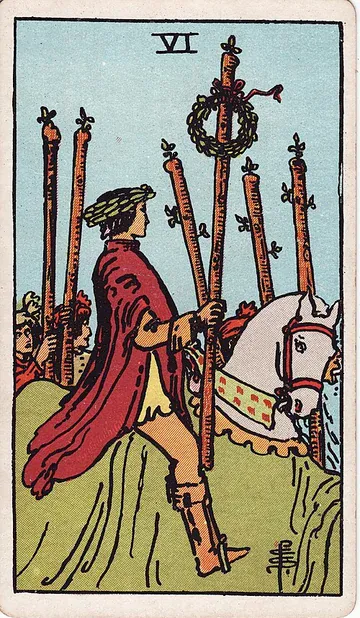
Six of Wands
Successor — the contest resolves into the victory parade, same characters after the dust settles. Where the Five was unaligned staves on bare earth, the Six is the rider returned through gathered crowd, laurel raised. Honor the round, honor the result, but do not mistake the parade for the end of contests; the Five returns next quarter with new contestants.
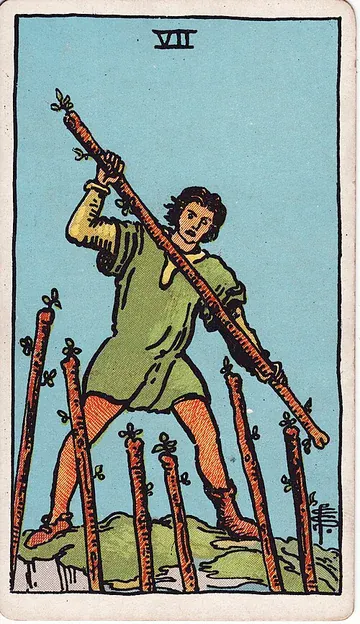
Seven of Wands
Related — from open contest to defending the held position alone. The Seven is one figure on the rise with the others below, staves still pushing up. The pair describes the seeker who has held a position long enough that the contest is no longer about whose ground this is, but about whether the holder can keep holding. Distinguish honest tests from bad-faith pushes; keep articulating the position rather than assuming it defends itself.
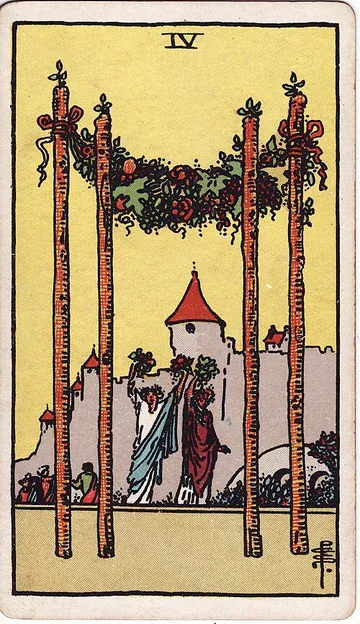
Four of Wands
Predecessor — the threshold-rest before flames take each other's measure. The Four was the porch raised in celebration; the Five is the contest that arrives once the celebrants are inside the gate and discover they disagree about what the household is for. Read in either direction: the easy beginning that has reached its first real argument, or the current contest that can lead toward a renewed Four if conducted on the training ground rather than at the dinner table.
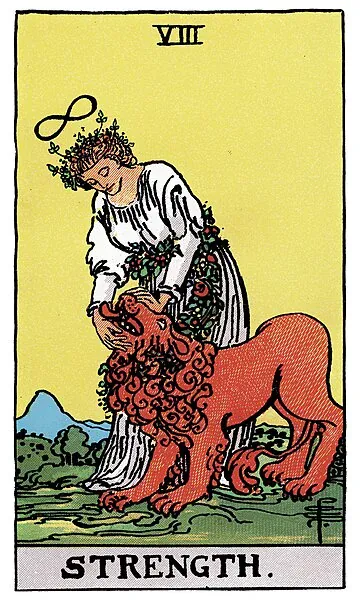
Strength
Leo modulator — Saturn-in-Leo decan finds its archetype here. Where the Five was the lion harnessed by Saturn's discipline, Strength is the woman closing the lion's jaws with her own quiet hands. The combination reframes the contest: the work is not to crush the opposing fire and not to extinguish your own; it is to hold both with the patience that keeps them survivable. Win rounds by composure now, not by force.
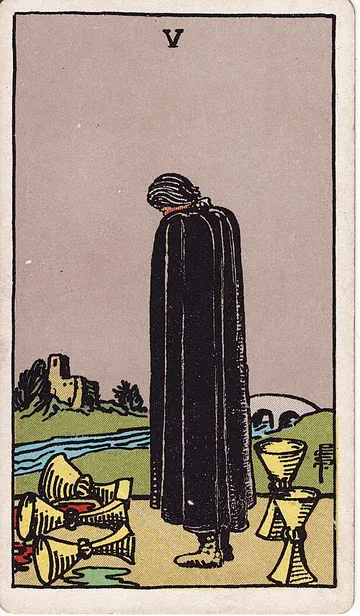
Five of Cups
Series sibling, tonal contrast — the five-rupture that grieves vs the one that sparks. Where the Five of Wands argues, the Five of Cups mourns what cannot be argued back into being. The pair forces a precise question: is the disagreement in front of you alive, or has it already become loss? Often appears when one partner is still raising the staff while the other has begun to leave; read which five each person is inside, and treat them differently.
Frequently Asked Questions
Can a decision even hold while the Five of Wands is reversed?
Rarely, and that is the card's whole answer. Heat without form, decision deferred: the contest that this choice needed in order to be made properly has been suppressed, and something agreed to under suppression tends to come undone later, usually at a worse moment and with interest. Someone in the room did not say their objection. Someone consented in order to end the conversation. A decision built on that has a hollow under it. So the reversed Five of Wands declines to answer the question as asked and sends you back a step: surface the underground disagreement, let it be argued where everyone can hear it, then put the same question again. Until then what the card offers is not yet, and not under these conditions.
We stopped fighting — why does the Five of Wands reversed treat that as a warning?
Because of how the fighting stopped. Reversed, the card describes disagreement that went underground rather than disagreement that resolved: the fights ended because both people decided it was easier not to have them, and easier is not the same as settled. What follows is a particular kind of quiet — grievances filed privately instead of aired, a mental ledger that neither party admits to keeping, courtesy where there used to be heat. From outside it photographs as peace. From inside it feels like two people maintaining a shared performance and waiting to see who breaks it. If the quiet in your house arrived after a real repair, this card is not describing you. If it arrived after a shrug, the work is to put one swallowed sentence back on the table, with structure and without ambush.
What does the Five of Wands reversed mean in tarot generally?
The reversed Five of Wands describes the contest that has gone underground. Open argument has curdled into closed-door politics; raised staves have been hidden; bare earth has been quietly subdivided into private territory. The card is the precise portrait of suppressed disagreement — the team that nods politely while the parking-lot conversations sharpen, the partnership that stopped fighting because both parties decided it was easier to keep score in silence.
Five of Wands reversed: are they angry with me, or protecting their pride?
Usually the second, doing an excellent impression of the first. Reversed, the card describes withheld friction: real feeling with edges on it, kept out of your hands. The contest the upright card would have conducted openly is running inside them instead — pride that hardened into a wall on an evening you may not even remember, a post-argument cooling that outlasted the argument by weeks, warmth deliberately held in reserve so that offering it cannot be used against them. Anger burns and ends. Protected pride keeps a ledger. The tell is whether the coldness is aimed or general: aimed cold is grievance, general cold is self-defense. In both cases the card asks for one direct question, asked without an audience, and for an honest hearing of whatever comes back.
What is the Five of Wands reversed advice?
The advice is to bring the swallowed fight back to the table — but with structure, not escalation. Pick the disagreement longest unspoken. Write the actual sentence you have been refusing to say. Schedule a real conversation, not a moment-of-friction blow-up. Make returning easy for the other party rather than requiring them to admit they were wrong to leave. The reversed card resolves through the precise act of moving underground accounting back into visible accounting.