
Four of Pentacles · Core Meaning
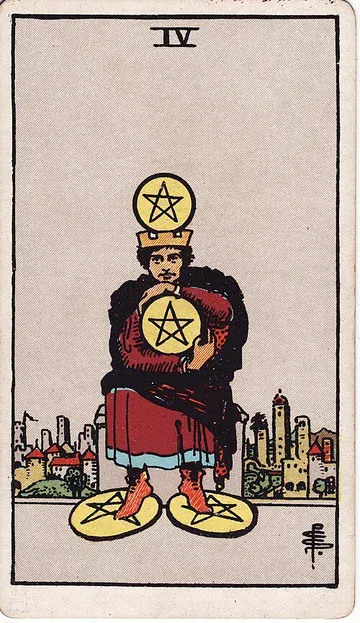
Nothing in the Four of Pentacles is moving, and that is the whole point of it. A crowned figure sits on a square stone seat, alone. One pentacle balances on the crown. One is clasped hard against the chest. Two more are pinned beneath the boots. Behind him, a walled gray city — gates shut, no smoke from the chimneys, no traffic on the road in. This is the moment of consolidation. The thing that was scattered has been gathered. The work now is to keep it from leaving again.
Look at the posture. The spine is straight as a wall. The arms cross the chest in a private architecture. The face does not move. Nothing in the picture is suffering, but nothing is at ease either. The Four of Pentacles is what stability looks like before it has learned to relax. The body is locked in the shape that produced the stability, and the body has not yet remembered how to release.
This is the card's signature tension: the boundary that protects and the boundary that imprisons are drawn with the same line. Drawn well, the wall keeps the wind out and lets the seeker rest. Drawn one inch too tight, the wall keeps the seeker out of his own life. The Four of Pentacles never tells you, in advance, which version you are inside. It only shows you the figure on the seat, and asks you to notice whether you can still feel your shoulders.
The traditional astrological signature is Sun in Capricorn, third decan — the dateRange 1/10 to 1/19. The Sun, lord of vitality and visible identity, has been conscripted by the law of Capricorn. The light no longer blazes; it sits down with weight. Authority has stopped performing and started ruling. In the Tree of Life, the card belongs to Chesed in Assiah — Mercy, but Mercy at its most material. This is the first willing settlement of force into form: the first time the gift has agreed to take a shape that can be held by hands and counted.
Pentacles are earth, and earth at its fourth station is structure. Three of Pentacles built the apprenticeship; Four of Pentacles holds the wages. The walled city in the background is what the wages have built. The closed gates are what the wages cost. The chimneys without smoke are the small daily generosities that have been suspended in the name of consolidation: no fire because no guests, no guests because no fire, the loop quietly intact.
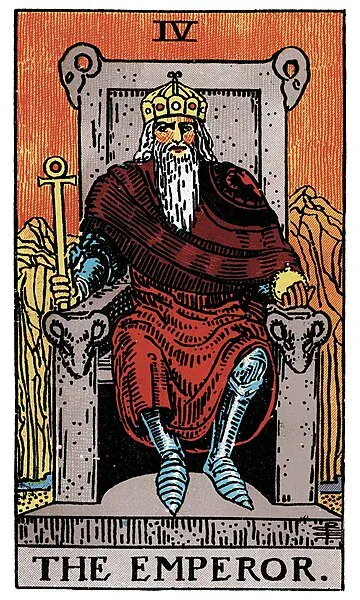
Look at the rigid spine. The card almost rhymes with The Emperor — the same upright back, the same throne, the same fixed gaze — but where the Emperor is the law of the kingdom seated, the Four of Pentacles is the merchant who has bought the seat and is now sitting in it for the first time, still unsure whether he is allowed to lean back. The pride is real. The pride has not yet softened. The figure does not yet trust that the seat will hold him without the muscular effort of sitting at attention.
Read the Four of Pentacles the way you would read a man who has just signed the lease on his first home and is sitting in the empty living room with the keys in his lap, unable to fall asleep because every small sound now belongs to him. That is the card. Pride and vigilance arrive as the same posture. The work the seeker brings is the question of which of the two will learn to let go first.
Four of Pentacles · Love & Relationships
The love in the Four of Pentacles has already been decided; the card's attention goes entirely to what happens after the deciding. The dating phase ended. The choice was made. The shared address, the shared bank account, the shared circle of friends — the bond has crossed the threshold from possibility into structure. The walled gray city in the background, gates shut, is exactly that structure. Whatever the relationship is, it now has walls. The card asks who built them and whether both of you can still come and go.
For an existing partnership in its long, settled phase, the Four of Pentacles is one of the deck's most quietly reassuring cards. Bills are paid together. Holidays are planned together. The family knows about you. The arguments have routines, and the routines have endings. There is a felt safety here that the earlier cups and wands could not yet promise. The card describes the season after the wedding photographs are framed — the ordinary years, the locked door at night, the second key on the hook.
For a new spark, the Four of Pentacles upright is unusual. New love is rarely this still. When the card does arrive in a new connection, it usually means the other person is moving more slowly than you are. They like you, probably more than they have said. They are also someone for whom letting a person inside the walls is a deliberate act, not a reflex. Read the slowness as care, not refusal. They are deciding whether to give you the second key. They will not be rushed.
For a long-term partner you suspect of withdrawing, the Four of Pentacles asks an exact question: have they pulled back from you, or have they simply settled into the shape the relationship took? Settled is not withdrawn. Some love loses its loud signals when it stops being uncertain. The morning routine becomes the love letter. The way they refill your cup without asking becomes the kiss. Look at the structure, not the volume. If the structure is intact, the love is intact, even if the words have grown few.
For a single seeker asking whether love is possible, the Four of Pentacles upright is a slightly difficult yes. The card describes a season in which you are well-defended — your finances are in order, your apartment is the right temperature, your routines are exactly tuned to your own pleasure. You have built a small walled city. Love is not impossible from inside this city. Love is, however, going to require you to leave a gate unlocked and to mean it. The card asks whether you have spent so long perfecting the solo life that you have forgotten how to share a door.
For love after a wound, the Four of Pentacles upright often arrives in the season of careful re-entry. The grief did its work. You are no longer raw. You have rebuilt a life you can stand inside. The wall around the heart is conscious now, and the conscious wall is not the same as the panicked wall. The card supports the wall — for now. It also notes that the long-term work is to learn which stones to remove when the right person knocks. Not all of them. Just enough.
For the question of cohabitation, marriage, or formal commitment, the Four of Pentacles is one of the more straightforward upright signals. The card is the card of the lease, the contract, the ring, the joint deed. If a partnership has been heading toward formalization, the card confirms the formalization is structurally sound. The legal architecture being considered will hold what is poured into it.
For the specific question "is this person in love with me" and the card arrives upright, read it as a careful, deliberate yes. They are not effusive. They will not write you the lyric you might be wanting. But they have re-arranged the structure of their life around your presence. They have given you the second key. They have introduced you in the room where the introductions actually count. Their love has the quality of property: not in the possessive sense, but in the legal sense — they have decided you are part of what they hold.
For seekers in unconventional structures — open relationships, long-distance bonds, queer chosen-family configurations — the Four of Pentacles upright can read as the agreement that holds the unconventional shape together. Not the rules being rigid, but the agreements being honored. The walled city does not specify what happens inside the walls. It only confirms that you and your people have agreed where the walls are.
For relationships with significant material entanglement — joint mortgages, shared businesses, co-parenting — the Four of Pentacles speaks to the integrity of the financial spine of the bond. Money matters in love. The card refuses to be embarrassed about this. It asks whether the structures you have built together are clear, fair, and known to both of you. Where the structures are clear, the love rests inside them. Where the structures are murky, the card asks you to draw them in writing before the murkiness becomes resentment.
Four of Pentacles · As Feelings
When the Four of Pentacles appears upright to describe how someone feels about you, the answer is: settled, careful, and quietly possessive in the protective sense rather than the controlling one. They feel that you matter to them in a way that has begun to organize their week. They are not effusive about it. They may not even have said it cleanly. But the feeling has crystallized — it is no longer in motion, and they are no longer trying to talk themselves out of it.
For someone reserved by nature, the Four of Pentacles in feelings is one of the most undersold cards in the deck. The reserved person, when stirred, does not become more talkative. They become more methodical. They begin to remember the exact way you take your coffee. They notice when your shoes need replacing. They quietly add you to the contingency plans they make when they think no one is watching. The card describes a love that operates as infrastructure. Read silence here as construction, not as absence.
For the demonstrative type, the Four of Pentacles can mean their public signals have stabilized into ownership-language. They speak of you in the plural. They make plans on your behalf. They introduce you with a small possessive flourish. None of this is performance — it is the same pride the figure on the card carries about the coins he has gathered. You have been added to the small, carefully-kept inventory of things they consider theirs.
For a long bond, the Four of Pentacles in feelings means the love has stabilized into a structural certainty. They are not asking, anymore, whether to stay. They have stopped re-litigating the choice. The internal work of loving you is finished and the external work has become routine. This sounds undramatic, and it is. It is also one of the warmer ways an adult can feel about another adult: I have decided. I am here. I do not need to keep deciding.
For a new connection, the Four of Pentacles in feelings is more careful. They are deciding what to do with the warmth. They like you — more than is comfortable, possibly. The like has begun to feel like the kind of feeling that will require them to rearrange furniture inside the life they had built before you. They are not yet sure whether to rearrange. The hesitation is not about you. The hesitation is about what saying yes to you costs the architecture they built when they were alone.
For someone you have hurt and are wondering whether they still feel anything for you, the Four of Pentacles upright can describe the heart that has gone to ground without going away. They have not stopped caring. They have built a wall around the caring so it cannot be hurt again. The wall does not mean the feeling has vanished. It means the feeling has been put under guard. Whether they can let the wall come down is a separate question — the card answers only the first one. The feeling is intact.
For a partner you suspect of being closed off, the card distinguishes between two flavors of closure. The first is a wall built to protect a love still in progress: temporary, conscious, often loosened when trust is offered. The second is a wall built to keep the relationship from costing more than has already been paid: chronic, defensive, hardened. The Four of Pentacles upright tends to describe the first. The reversed version describes the second. If you are reading this section because the upright drew, take the result as good news with a clear instruction: walls of the first kind respond to gentleness and steadiness. Do not try to climb them. Stand near the gate and wait.
For someone you have known a very long time without ever knowing what they actually felt — the friend who might be more, the colleague whose attention has lingered for years — the Four of Pentacles in feelings can describe a love that has been quietly held in inventory the whole time. They have known. They have not said. They have decided that the version of the relationship they currently have is too valuable to risk by speaking. Read this carefully. The card does not tell you whether to speak first. It only confirms that the feeling exists and has existed for a while.
A small caution embedded in the upright Four of Pentacles in feelings: the same protective instinct that makes this person hold you carefully can, under stress, become the instinct to hold you too tightly. Watch for the moment the protection turns into supervision. The good version of this card's love language is the second key on the hook. The strained version is asking where you have been. The card responds well to clean honesty about your own movements. It responds badly to interrogation, in either direction.
Four of Pentacles · Career & Work
A seat, a crown, and a shut gate: at work the Four of Pentacles upright is the card of the position already won. Not the climb, not the new role — the season after the climb, when the title has been earned and the work now is to defend the territory. Renew the contract. Lock down the access. Do not bleed resources. The card describes the season for driving the stakes deeper into ground you have already won, not for breaking new ground.
If you are asking whether to stay in a current role, the Four of Pentacles upright answers with a deliberate yes. The role is providing what it was designed to provide — the salary, the security, the predictable rhythm, the title that opens the next door when you are ready to walk through it. The card asks you not to confuse the steadiness with stagnation. Stability is not stasis. It is the season in which you can finally rest enough to think clearly about what comes next.
For someone considering a new role, the Four of Pentacles upright is a cautious card. The current ground is good. The new ground is unknown. The card does not forbid the move, but it does warn that you should not move out of restlessness. If the new offer is an upgrade in structure — more security, clearer authority, better terms — the card supports it. If the new offer is more excitement at the cost of stability, the card asks whether you understand what you are trading away. Pentacles are slow. They do not respect impulse.
For freelancers, consultants, and the self-employed, the Four of Pentacles upright describes the season of consolidation: the rate that has finally been raised, the contract template that has finally been written, the boundaries that have finally been enforced. Stop discounting your work. Stop saying yes to the project that pays in exposure. The card supports the boring infrastructure — the LLC, the proper invoicing, the retirement account, the emergency fund. None of this is glamorous. All of it is the second pentacle clasped to the chest, the one that will let you keep working ten years from now.
For someone in a new role still inside the probationary year, the Four of Pentacles upright is a quiet instruction to settle in. Do not bring the energy from the previous role. Learn the terrain. Watch how power moves in this room. Build the relationships that will defend you when the first storm comes. The card describes the wisdom of the figure on the seat: he was not always seated. He learned the value of the seat by losing the previous one.
For creative practitioners, the Four of Pentacles is more complex. Earth + holding can read as discipline, the daily practice that lets the work compound. It can also read as the creative body that has begun to repeat itself. Ask honestly: are you defending a body of work that is still alive, or guarding a brand that has stopped surprising you? If the former, the card is supportive. If the latter, the card is the warning that comes before the reversed version arrives.
For someone facing a layoff, restructuring, or organizational instability, the Four of Pentacles upright reads as the card of preparation. Tighten the budget. Rebuild the resume. Quietly call the contacts who would hire you. Do not announce the preparation. The card respects the seated figure who looks calm because his hands are full of what he has gathered. Be that figure. The storm may not arrive. If it does, the figure with hands full of what he has gathered is the one whose footing holds — be that figure.
For job-search readings, the Four of Pentacles upright is unusual. It tends to mean that the right job is the one that resembles, in its structure, what you are protecting now — not the one that promises a complete reinvention. Read the listings carefully. The role that gives you a stable salary, clear scope, and authority you can hold is the one the card endorses. The role that offers stock options and a chaotic founder is the one the card does not.
For promotions, raises, and recognition, the Four of Pentacles upright can describe the season just before a quiet upgrade. Not the dramatic promotion announced at the all-hands. The senior who comes by your desk, asks if you have a minute, and tells you the title is changing on the next paperwork cycle. The card prefers this kind of recognition — earned, structural, formalized in writing. Take it. Sign the new contract. Keep the old one in a folder for reference.
For someone whose work has begun to feel like a cage even though every external metric is good, the Four of Pentacles upright is asking whether the cage was self-built. Often, when this card appears in this context, the answer is yes. You traded for the security you have. The security is real. The trade is also real. The card does not tell you to leave. It tells you to acknowledge the trade — and to decide, with clear eyes, whether the next trade is worth making.
Four of Pentacles · Money & Finances
Money is the one subject on which the Four of Pentacles refuses metaphor. The image is a man holding a coin. The card is about holding coins. Whatever the question, the answer is going to sit close to the literal image: save, consolidate, defend the position you have built, do not bleed resources you cannot easily replace.
For the seeker who has been climbing out of debt, the Four of Pentacles upright describes the season after the last payment. The credit card is paid off. The student loan finally closed. The number that used to keep you awake is gone. The card is the seated figure on the morning after the closing payment, sitting at the kitchen table with the printout of the zero balance, not yet sure how to feel. Take the win. Build the cushion. Do not race to the next purchase.
For the seeker building wealth from a stable income, the Four of Pentacles upright is the card of the boring move that compounds. Open the retirement account. Increase the contribution percentage. Build the six-month emergency fund. Buy the index fund that is appropriate to your time horizon. The card does not respect speculation. It respects structure. Twenty years of unsexy contributions outperform almost any clever bet.
The card's signature trap with money is over-tightening. The same instinct that gathers can, taken too far, refuse to let anything circulate. The seeker hoards the money so well that the money stops doing the work money is supposed to do — paying for repairs, paying for help, paying for the meal with the friend who has been struggling. The card upright is on the right side of the line, but it sits very close to the line. Watch the impulse to skip the small spend that would have made your week better. The small spend is not the thing that ruins you.
For a question about a major purchase — a home, a car, a piece of equipment, a long-anticipated piece of beauty — the Four of Pentacles upright is supportive when the purchase is structural and cautious when the purchase is impulse. The mortgage on the home you can comfortably afford: yes. The car payment that will eat one quarter of your monthly take-home: no. The card asks you to imagine yourself a year after the purchase, looking at the bill, and to know in advance that the figure in the picture would still feel calm.
For investments and speculative bets, the Four of Pentacles upright is a quiet warning against gambling in the name of building. The card does not forbid risk. It asks that the risk be sized to what you can afford to lose without altering the structure of your life. The figure with two coins under his boots and one against his chest is not the figure who bets the chest coin on a long-shot. He is the figure who keeps the chest coin and lets a small allocation go to ground he believes in.
For debt that is still in active repayment, the Four of Pentacles upright endorses the disciplined payoff plan. Do not consolidate just to make the monthly look smaller. Do not refinance into a longer term. The card supports the version of you that pays the boring extra principal each month and watches the balance shrink. It is not glamorous. It is the quiet pride of the seated figure.
For windfall — bonus, inheritance, unexpected income — the Four of Pentacles upright is one of the better cards to draw. The card supports treating the windfall as building material rather than spending money. Pay down the principal. Top up the emergency fund. Allocate a small, deliberate portion to genuine pleasure — one good meal, one trip you have been deferring, one gift to a person who supported you in the hard season. The rest goes to ground. The card distinguishes pleasure from compensation. Compensation is the first warning sign of the reversed version arriving.
For business owners, the Four of Pentacles upright is the card of the cash reserve. The runway. The dull, unphotographable buffer that lets you survive the slow quarter without firing anyone. The figure on the card is the founder who has stopped chasing growth at all costs and has started asking whether the company can survive eighteen months without a single new client. Build for that survival. Then, from inside the survival, decide what to grow.
For taxes, contracts, legal financial structure — the Four of Pentacles upright is the card of the boring meeting with the accountant. Have it. Read the document. Sign the right boxes. The card respects the work nobody wants to do because the work nobody wants to do is the work that prevents the disaster nobody plans for.
Four of Pentacles · Health
In health readings, the Four of Pentacles upright describes the body that has stabilized into a careful posture — and, sometimes, the posture that has stabilized into a body. The card's elemental signature is earth. Its temperament is melancholic — guarded, still, prone to holding rather than releasing. Its body parts, in the traditional reading, are the shoulders and the sternum: the tightened breastplate, the locked yoke at the top of the spine.
If you are asking whether a current treatment is working, the Four of Pentacles upright answers yes — within the boundaries of what the treatment was designed to do. The structure is holding. The condition is stable. The medication is doing its job. This is not the card of dramatic recovery; it is the card of the slow plateau where the body, given a routine it can trust, has stopped sliding. Keep the routine. Do the boring practical things. Show up to the appointment. The card supports continuity.
For chronic conditions, the Four of Pentacles upright can describe the season of well-managed maintenance. The condition has not gone away. The structure that holds it in check has become familiar. The seeker has learned the hours of the day when the body is most reliable, and has built a life inside those hours. The card respects this kind of negotiation with the body. It also asks whether the structure has begun to take more from the rest of life than the condition itself requires.
The card's most common somatic signal is in the upper body. Shoulders that have become a permanent shrug. The jaw that does not unclench until the third drink at the end of the week. The sternum that aches after a long day at the desk for no reason any imaging can find. This is the body that has been told, for too long, to hold. The card asks where the holding is happening and whether it can be released for an hour at a time. Not as a discipline. As a small experiment.
For acute issues — a flu, an injury, an infection — the Four of Pentacles upright is less directly relevant. When it does appear in an acute reading, it usually means the body is responding well to rest and structural care. Sleep. Hydrate. Stay home. Do not push through. The card respects the body that knows when to draw in.
For mental health questions, the Four of Pentacles upright can describe the season after a stretch of acute distress, when the inner architecture has been rebuilt and the seeker is now learning to live inside the new shape. Therapy is regular. Medication, if it is part of the picture, has been titrated to the right dose. The crisis-management strategies have become daily habits. The card supports this season. It also notes, gently, that the same defenses that ended the crisis are not the same defenses that will let the next phase of life unfold. There is a longer conversation here, and the card is the early signal that the conversation will need to be had.
For questions about diet, weight, and the relationship with food, the Four of Pentacles upright can describe the seeker who has built a careful, sustainable relationship with eating. The portion sizes are right. The grocery list has been honest with itself. The body is being fed enough. Do not over-tighten. The card slides toward its reversed shadow when the discipline becomes a small private cult of restriction.
For somatic practices — yoga, body work, somatic therapy, movement of any kind — the Four of Pentacles upright recommends the slow, structural disciplines over the cathartic ones. Strength work. Long walks. The kind of practice that builds, rather than the kind that purges. Earth at this station prefers compounding to release. The release will come later, when the structure can hold it.
A note on the tightened breastplate: if the upper-body pattern is recognizable when you read this section, the card is not asking you to fix it tonight. It is asking you to notice it tonight. The noticing is the first move. The releasing comes from inside the noticing, slowly, the way a wall built one stone at a time can be unbuilt one stone at a time.
Noticing tonight's held tension is not medical advice. A card that describes a holding pattern is describing a mood, not the state of a body. Keep your practitioners. Take your medicine. The card simply confirms that the body, in this season, is asking for the kind of attention that arrives as steady ritual rather than as urgent intervention.
Four of Pentacles · Spirituality
The spiritual question the Four of Pentacles carries is whether a form that once held you has begun holding you in place. It belongs to Chesed in Assiah — Mercy at its most material, the first willing settlement of the divine downpour into form that hands can touch. The card describes the moment the seeker stops asking for more revelation and begins building a daily practice that can house the revelation already received.
The pentacle on the crown is the card's spiritual signature. The seeker has come to identify with what he has gathered. His worth, in his own eyes, has begun to take the shape of the things he holds. This is the spiritual question the card asks: is what you hold the form of your offering, or has it slowly become the substance of your identity? The crown is heavy. The figure has not noticed yet.
For seekers in active practice — meditation, journaling, ritual, devotional work — the Four of Pentacles upright describes the season of consolidation. The new teacher has been chosen. The daily sit has settled into the same hour. The book on the bedside table has been the same book for three months. The card supports this. Most spiritual progress happens not in the breakthrough but in the year after the breakthrough, when the seeker quietly builds the structure that can hold what was given. The card is that structure.
The walled gray city is the spiritual community the seeker has chosen — or, sometimes, the spiritual community the seeker has refused to choose. Either reading is possible. The card does not insist. It asks the seeker to look at the walls and ask: did I build these to keep something sacred safe, or did I build these to keep myself from having to leave the seat?
For seekers exploring belief, the Four of Pentacles upright describes the season when the eclectic shopping has ended and the seeker begins to commit to a particular path. The book is read. The rituals are practiced. The lineage is acknowledged. There is a particular dignity in this commitment. The card honors it. It also notes that commitment is not the same as fundamentalism, and asks the seeker to keep the gates of the city open enough that other forms of beauty can still come and go.
The two coins pinned beneath the boots are the practices the seeker has weighted with attention — the disciplines that ground the rest of the structure. Identify these in your own life. They are likely the most ordinary parts of the practice: the morning silence, the weekly walk, the candle lit on the kitchen table at sunset. These are not the dramatic mystical experiences. They are the things that keep the dramatic mystical experiences from running away with you.
A real practice the card invites — doable in thirty minutes today: sit in a chair with your spine straight, your feet flat on the floor, and your hands open on your thighs. Not closed. Not folded. Open. Set a timer for ten minutes. Notice everything you would normally close, hold, grip, defend. Do not change anything. Just notice. When the timer ends, write three sentences about what you noticed. Then close the notebook and go do whatever was next on your day.
The Sun in Capricorn third decan, the card's astrological anchor, is the saint who has agreed to administer the temple. The mystic who has accepted the responsibilities of the abbot. The visionary who has put on the bookkeeper's apron. There is no shame in this descent of light into structure. The shame, if any, is in believing the apron is the whole of the calling. The card asks the seeker to keep, somewhere in the daily round, a small unaccountable hour — the meditation that produces no log, the prayer that asks for nothing, the silence that is not a practice in the strategic sense. That hour is what keeps the consolidation from forgetting what it was consolidated to serve.
The card responds to this kind of small, structural noticing more than to grand spiritual gestures. The walled city does not need to be torn down. It needs one window opened, today, for half an hour, on purpose.
Four of Pentacles · Yes or No
Soft yes — but only for the holding move.
The Four of Pentacles upright is one of the deck's most situation-dependent yes-cards. As the card of consolidation, defense, and held ground, it answers yes to every question that asks "should I protect what I have?" and no to almost every question that asks "should I expand, risk, or move?"
For yes-or-no questions about staying — staying in the job, staying in the home, staying in the relationship, staying in the city — the answer is yes. The structure is sound. The choice has been the right one. There is no hidden reason to leave. The card supports continuity.
For yes-or-no questions about leaving — quitting the job for a more uncertain one, breaking a stable relationship to chase a more exciting one, selling the home to chase the dream — the answer is no, or not yet. The card asks whether the leaving is restless or considered. If restless, the card refuses. If considered, the card asks for one more season of preparation before the move.
For questions about saving, paying off, building reserves, signing the boring contract that protects the asset — yes. Unambiguously yes.
For questions about spending, gambling, investing speculatively, betting on a long-shot — no. The card does not approve of risk that puts the held ground in jeopardy.
For questions about whether someone is reliable, whether an offer will be honored, whether a promise will be kept, the Four of Pentacles upright is a clean yes. The card respects structure. People and offers under this card honor their commitments. What is on paper will happen.
For questions about timing — will it happen soon — the Four of Pentacles upright suggests slowness. Not "no" but "later than you want." The card moves at the speed of earth. Earth does not respond to urgency. It responds to the same gesture repeated, week after week, until the gesture has become the ground.
For binary decisions about whether to act now, the card answers wait. Not forever. Long enough for the impulse to clarify into a considered position. A week. A season. Enough time for the body to know whether the move is coming from the chest coin or from the boredom of the seated figure.
The conditioning embedded in the soft yes is this: the Four of Pentacles upright is the right card if your question is about defending what is good and already yours. It is the wrong card if your question is about whether you have grown into a shape larger than what is currently being held. The card cannot, by its nature, give permission to break out. It can only confirm that what you are protecting is worth the protection. The breaking-out belongs to other cards. The Four of Pentacles is the seal on the held ground.
For questions about commitment — should I sign, should I marry, should I move in, should I co-sign the loan, should I take the lease — the Four of Pentacles upright answers yes when the commitment matches a structure you have actually built rather than one you are hoping the commitment will create. The card honors signed paper. It does not, however, sign blank paper on the seeker's behalf. Read the document. Ask the second question. Then sign with a steady hand.
For questions about whether to extend trust — a loan to a friend, an introduction to a colleague, a recommendation to a stranger — the card asks you to extend in the size you can afford to lose without altering your own structure. Within that size, yes. Past that size, no. The card respects the act of giving. It refuses giving that requires the giver to dismantle their own walls in the giving.
If the question was: am I doing the right thing by being careful? The card answers yes — and asks you to notice whether the careful version of you is still capable of being moved.
Four of Pentacles · Advice
Name the thing you are guarding — that is where the Four of Pentacles upright starts. Not the abstract concept of stability — the specific thing. The job, the house, the relationship, the savings account, the reputation, the body of work, the dignity beneath the work. The card asks you to name it cleanly. Then it asks whether the wall you are building is exactly the right size for that thing, or whether the wall has begun to enclose other parts of your life that did not need enclosing.
If there is one specific instruction the card offers, it is to drive the stakes deeper into the ground you have already won. This is not the season for new ground. This is the season for the boring infrastructure that lets the old ground keep producing. Renew the contract. Update the will. Refile the taxes. Sign the lease for one more year. Have the medical check-up you have been deferring. The work that is doable today is the work the card respects.
A second instruction: open one door, today, on purpose. The walled city in the picture is shut. The card never tells you to tear the walls down. It tells you to open one gate, deliberately, and to leave it open for an hour. Invite one person over for the dinner you would have eaten alone. Say yes to the small social request you were about to decline. Send the message you have been drafting for a week. The figure on the seat does not need to leave the seat. He needs to remember that other people exist on the other side of the wall.
A third instruction: relax one finger. The hand clasping the chest-coin has become reflexive. The grip has stopped being a decision. Pick one place in your life where you have been gripping out of habit rather than necessity, and loosen it by one finger. Not all of it. One finger. Notice what does not collapse when the grip relaxes. Most of what you are holding does not require the full force of the holding.
A fourth instruction, gentler than the others: take the body's signal seriously. The shoulders are the card's signature. If your shoulders have been at your ears for the last month, the card is asking whether the cost of the holding has begun to outpace the value of what is being held. Not always. Sometimes the holding is necessary and the shoulders are the price. The card is not anti-discipline. It is anti-self-deception. Know honestly what the discipline is costing.
A fifth instruction, for seekers in long-term partnership: ask your partner what part of the shared life feels protected and what part feels enclosed. The two are different. Listen for the difference. The reply often names a thing the seeker has been calling care that the partner has been quietly experiencing as constraint. The card respects the conversation that produces the small, exact correction. It refuses the conversation in which both parties confirm everything is fine and then return to the same room.
Practical advice for the day the card appears: balance one account that has gone unbalanced. Cancel one subscription you have been paying for and not using. Move one item out of the house — to a friend, to a charity, to the trash. Sit, for ten minutes, with your hands open on your thighs. Eat a real meal slowly. Make one phone call to someone you have been meaning to thank.
The card responds to small, structural acts of attention. It does not respond to dramatic resolution. The figure is not asked to leap from his seat. He is asked to notice that the seat is not fused to the city wall, and that he has, all along, been free to stand.
Four of Pentacles · Card Combinations
The Four of Pentacles is a card of held ground, so its strongest combinations are with cards that either reinforce the holding (and ask whether the reinforcement is wise) or contrast with it (and ask whether the holding has begun to refuse the offer being made). Read the pairings below as conversations between postures rather than as added meanings. The figure on the seat does not change when the second card lands; the figure on the seat is asked a different question.
Four of Pentacles + The Emperor
The card of held ground reinforced by the card of established authority. Both figures sit on stone seats. Both have been trusted with a structure that was built before they arrived. When these two land together, the reading is about the seat of authority you have inherited or earned, and the responsibility that comes with sitting in it. The combination is one of the deck's most legitimate signals of structural power — the merchant has become the magistrate; the saver has become the steward. It is also a warning against authority that has stopped listening. Sit straight. Make the laws fair. Open the gate when it should be opened.
Four of Pentacles + The Devil
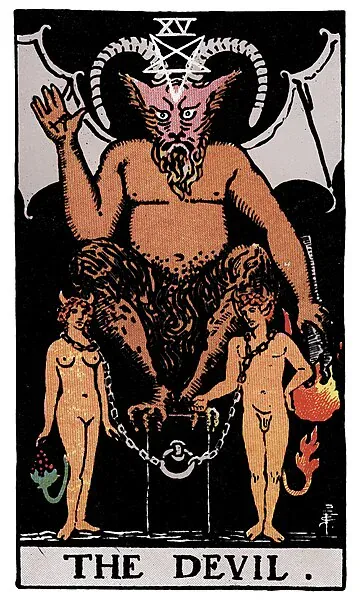
The card of careful holding meeting the card of conscious chaining. This is the precise combination for the moment a healthy boundary has slid into compulsive grip. The thing you held to keep yourself safe has become the thing you cannot put down. Money, status, a relationship, a substance, a worldview — the combination does not specify the object. It specifies the pattern. The figure on the seat has stopped noticing that the chain runs from his own wrist. The reading asks for the small, honest acknowledgement that begins the slow walk out.
Four of Pentacles + Five of Pentacles
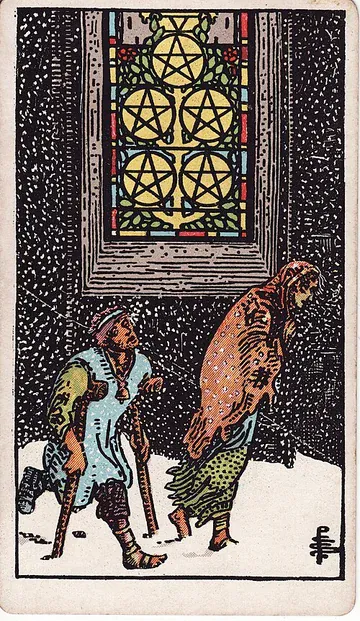
A direct conversation between consolidation and the scarcity that consolidation was built to prevent. When these arrive together, the card pair tells the story of a seeker holding tight today because the cold of the lit window and the snow outside the cathedral is not abstract — it is remembered. The hoarding is not greed. The hoarding is grief in the shape of strategy. The reading asks whether the strategy is still required, or whether the season the strategy was built for has passed and the gripping has continued out of muscle memory.
Four of Pentacles + Four of Cups
Two siblings of the number four. Both stations of stalled inwardness; opposite stances toward what the world is offering. Cups Four turns its face away from the cup the hand is extending. Pentacles Four clenches around the coin already in hand. Together, the pair describes the seeker who has both refused the new offer and refused to release the old position. The reading is asking, gently, whether the no has begun to outnumber the yes in the seeker's life. The walled city is well-defended. It is also empty.
Four of Pentacles + Ten of Pentacles
The question and its answer, separated by the work of letting the structure breathe. Pentacles Four is the held coin and the closed gate. Pentacles Ten is the family courtyard, the elder under the arch, the dogs at his feet, the wealth that has begun to circulate through generations. The combination shows what consolidation can grow into when the seeker learns to release the chest-coin into the family table. Same suit, deepened. The reading asks whether the inheritance you are building is meant to outlast you — and if so, whether you have begun to teach it to leave your hands. The card pair is one of the more hopeful in the deck; it names the path forward without hurrying the seeker along it.
Card Combinations
The Emperor
Both figures sit on stone seats; both have been trusted with structures built before they arrived. The Emperor reinforces the Four of Pentacles' signature of legitimate authority and earned position — the seat of power held with discipline. Together, the pair describes the seeker who has consolidated genuine territory and is now responsible for governing it well. Sit straight; make the laws fair; open the gate when it should be opened. The card pair warns equally against authority that has stopped listening.
The Devil
The card of careful holding meeting the card of conscious chaining. This is the precise pairing for the moment a healthy boundary has slid into compulsive grip. The thing held to keep the seeker safe has become the thing the seeker cannot put down. Money, status, relationship, substance, worldview — the combination does not specify the object. It specifies the pattern. The figure on the seat has stopped noticing that the chain runs from his own wrist.
Five of Pentacles
Suit successor, opposite weather. Pentacles Four built the wall against the cold; Pentacles Five is the cold the wall was built against. Together they tell the long story of hoarding-fear and the scarcity it was meant to prevent — sometimes accurately, sometimes by producing the very condition. The reading asks whether today's wall is still defending against a real winter, or against a winter the seeker survived years ago and has not yet trusted is over.
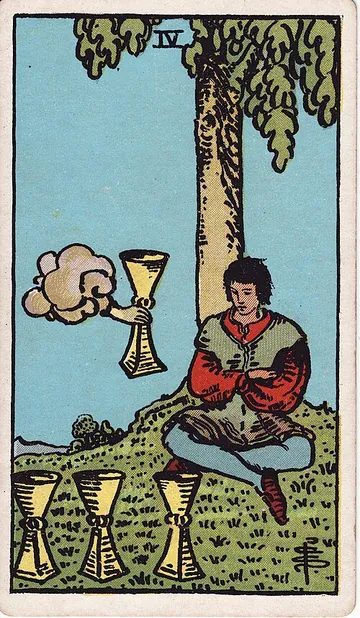
Four of Cups
Sibling fours, opposite stances. Cups Four turns the face away from the cup the hand is extending; Pentacles Four clenches around the coin already in hand. Together, the pair describes the seeker who has refused both the new offer and the release of the old position. The walled city is well-defended and quietly empty. The reading asks, with care, whether the no has begun to outnumber the yes in the seeker's life.
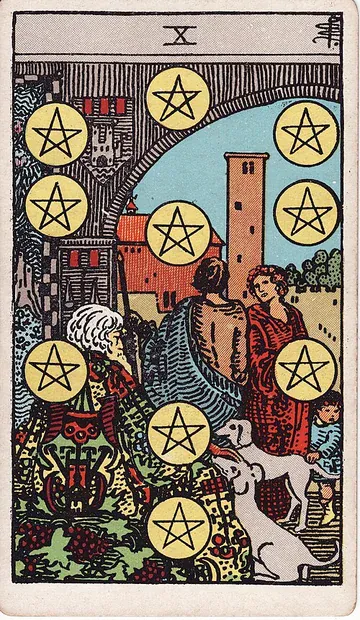
Ten of Pentacles
The endpoint contrast. Pentacles Four is the held coin and the closed gate; Pentacles Ten is the family courtyard, the elder under the arch, the dogs at his feet, wealth circulating across generations. The pair shows what consolidation can grow into when the seeker learns to release the chest-coin into the family table. Same suit, deepened. The reading asks whether what is being built is meant to outlast the builder — and if so, whether it has begun to be taught to leave the builder's hands.
Frequently Asked Questions
What is the meaning of the Four of Pentacles?
The Four of Pentacles upright is the card of consolidation, boundary, and held ground. A crowned figure sits on a stone seat — pentacle on the crown, one coin clasped to the chest, two pinned beneath the boots, walled gray city behind. The card describes the season after the climb, when the work shifts from acquiring to defending. Sun in Capricorn third decan; Chesed in Assiah; structure made willing.
Does the Four of Pentacles say yes to expanding, or only to holding what I already have?
Soft yes — but only for the holding move. The Four of Pentacles upright says yes to staying, saving, defending, signing the boring contract that protects the asset. It says no to expanding, gambling, leaving stable ground for uncertain ground. Read the question carefully. The card answers yes to protecting what is yours and no to almost everything that asks you to risk it.
What does the Four of Pentacles tarot card mean in love?
In love, the Four of Pentacles upright is the card of the consolidated bond — cohabitation, marriage, joint accounts, shared address. The relationship has crossed from possibility into structure. For singles, it can describe the carefully-defended solo life that has not yet remembered how to share a door. For long bonds, it confirms the love has stabilized; the morning routine is the love letter. For new sparks, it means the other person is moving more slowly than you are, on purpose.
Is the possessiveness in the Four of Pentacles a sign of care or of control?
Care, while the card is upright: the Four of Pentacles describes a feeling that is settled, careful, and protectively possessive in the structural rather than the controlling sense. They have decided you matter to them. The decision has begun to organize their week. They are not effusive. They are methodical: they remember how you take your coffee; they have added you to the contingency plans they make when they think no one is watching. Read silence here as construction, not absence.
What does the Four of Pentacles say about money?
Save, consolidate, defend the held ground. The card supports the boring move that compounds — the emergency fund, the retirement contribution, the disciplined payoff. It refuses speculation that puts the structure at risk. The trap with money is over-tightening: the same instinct that gathers can refuse to let anything circulate. Watch the impulse to skip the small spend that would have made your week better; that small spend is rarely the thing that ruins you.
Continue Reading
Four of Pentacles · Card overview · symbols · correspondences →
Return to the full card view — image, symbols, sensory correspondences, and Hermetic axes.
Read the reversed meaning →
Read the same depth on the opposite orientation.
Draw your reading now →
Bring this card to a question — open a quiet ritual.