
Four of Pentacles Reversed · Core Meaning
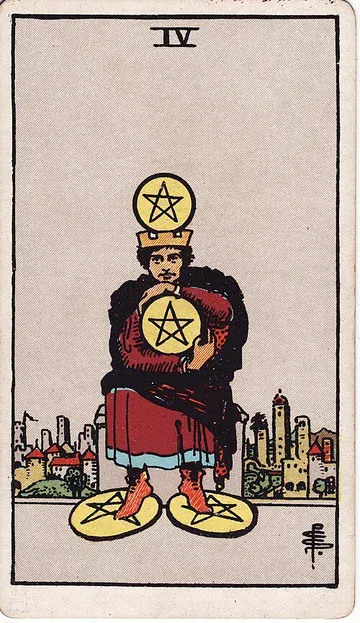
Turn the Four of Pentacles over and the coins begin to move — not because the figure released them, but because a grip that tight eventually fails. Look at the figure inverted: the coin against the chest is now being crushed rather than held; the boots no longer pin the two coins beneath them — those coins have rolled out from under the soles; the pentacle on the crown is sliding off the head. The walled gray city behind is either closing in on its sole inhabitant or, in a second reading, beginning to crumble at the gates. The same image, turned over, names two opposite collapses.
The first collapse is the more common one: hoarding, clenching, scarcity-fear hardened into a permanent stance. The seeker has held so long and so tightly that the holding has become reflexive. The hand cannot open. The chest cannot expand. The original reason for the wall has been forgotten, but the wall has not. What was a strategy has become a cage. The seeker is no longer protecting the coin from the world; the coin is now what is preventing the seeker from being in the world.
The second collapse is rarer and gentler: the wall has come down without consent. The structure that protected the seeker has dissolved before the seeker was ready. Boundaries that were necessary have been negotiated away in the name of openness, generosity, or fear of seeming small. The reversed card here describes the figure standing exposed in the field where the city used to be, surprised by how much wind there is when there are no walls.
The card does not specify which version is in your reading. The clue is the body. If the shoulders are still at the ears and the breath has not reached the belly in months, the reversed card is the first version. If the seeker feels somehow leaky, like nothing they put down stays where they put it, the reversed card is the second. Both versions ask the same root question: what is the right size of wall for this season of your life?
The astrological signature reverses too. Sun in Capricorn upright is light conscripted by law — majesty agreeing to sit down. Reversed, the conscription has stopped serving the light. The Sun, locked into Capricorn's third decan with no release, becomes the king who has forgotten that authority is meant to nourish the kingdom rather than fortify the throne. Chesed in Assiah, reversed, is mercy that has hardened into property. The willing settlement has stopped being willing. It is now compulsion.
In the Tree of Life, Chesed in Assiah reversed describes the divine Mercy that has stopped flowing into form and started ossifying inside it. The settlement that was supposed to be a willing pause has become a refusal of the next descent. The seeker has decided, in some quiet stratum, that this much grace is enough; nothing further is expected; nothing further will be received. The reversed card does not condemn this decision. It does, however, name it. The next phase of the seeker's life — the move from Chesed toward Geburah, from steady mercy toward the precise rigor that follows it — cannot begin while the seeker is still treating arrival as terminus.
Read the Four of Pentacles reversed the way you would read a man who has been gripping the same heavy bag for three hours, long past the train station where he was supposed to set it down. He is still walking. The arm has gone numb. He has begun to think the bag is part of him. The card asks: what is in the bag, and when did you last open it?
Four of Pentacles Reversed · Love & Relationships
Ask the Four of Pentacles reversed about a relationship and it points at the boundary rather than at the feeling. The protective instinct that once kept the bond safe has slowly started to keep the bond from breathing. One partner has decided that holding the relationship still is the same as keeping it alive. The other partner has begun to suspect that the stillness is suffocation.
For an existing partnership, the reversed card most often describes the slow accumulation of small refusals. The refusal to talk about the difficult thing. The refusal to spend money the way the other person would have spent it. The refusal to soften the routine that gives one of you comfort but costs the other their flexibility. None of these refusals, alone, is fatal. The accumulation is. The reversed card warns of the relationship that is being conserved rather than tended — preserved like a fragile object in a cabinet rather than lived in like a home.
For someone in a controlling or possessive partnership, the reversed Four of Pentacles is one of the deck's clearer signals. The protection has crossed into ownership. The "we" has begun to mean "what I have decided about us." Money is monitored. Movements are tracked. The introduction in the room where it counts has not happened, perhaps because the other person prefers you in private where you cannot complicate the architecture they have built. This is not love. It is property management dressed in love's vocabulary. The card asks for honesty about what is actually happening.
For a new spark, the Four of Pentacles reversed warns of the partner who is too quickly trying to define the boundaries of a thing that has not yet had time to grow into its own shape. The exclusivity conversation in week two. The introduction to the family in month one. The financial entanglement before the relationship has earned the entanglement. None of these are themselves wrong; the card warns when the speed of the structure-building is faster than the actual development of trust. Walls built on sand fail in the first storm.
For someone in a long bond that has gone cold, the reversed card describes the season when the comfortable distance has become an actual distance. Both of you are still in the house. Neither of you is in the relationship. The structure remains; the inhabitation has ended. The card does not necessarily counsel separation. It counsels honesty. Either the inhabitation is restored or the structure becomes a known formality both of you accept. The reversed Four refuses to let you keep telling yourself the relationship is intact when only the wall is.
For the question of reconciliation after a break, the reversed Four of Pentacles offers a careful, qualified answer. Returning is possible — but only if the wall that broke the bond the first time has been examined and changed. Going back to the same architecture produces the same collapse. The card asks what new agreement, what new opening, what genuine release of the previous grip you would each be willing to make. If neither of you can name the change, the reconciliation will rebuild the structure that already failed.
For the single seeker, the reversed Four of Pentacles can describe the seeker whose solo life has hardened into a refusal of any partner. Not the conscious, dignified celibacy of a chosen path — that belongs to other cards. The closed-gate version: the catalogue of reasons no candidate qualifies, the standards that have crept upward year by year until no real human could meet them, the pleasure of being alone that has begun to require defending against any possibility of company. The card asks: what would you have to risk to let one specific person actually arrive? The answer is usually the wall. The wall has become the most expensive thing in the seeker's life.
For love after a wound, the reversed Four of Pentacles is one of the cards to read most carefully. After the wound, walls are necessary. The card respects this. What it warns about is the wall that has stayed up past the season it was needed for, until the wall is the seeker's main relationship — more reliable than any person, more present than any partner. The protection that began as healing has, slowly, begun to function as a substitute for the love it was protecting against. The work, when ready, is to take down one stone, then another, on the seeker's own schedule.
For "is this person in love with me" answered by the reversed Four of Pentacles, read it precisely. They feel something. The feeling has been put under guard. The guard has begun to function as a refusal to let the feeling become an offering. They may even, themselves, no longer be sure whether what they feel is love or the careful protection of a memory of love. The card does not resolve this for them, and it cannot resolve it for you. What it confirms is that the warmth exists and that the warmth is not, currently, moving.
For partnerships involving significant financial entanglement that has gone wrong, the reversed Four of Pentacles is direct. The money has begun to take the shape the relationship used to take. Joint accounts are monitored as proxies for trust. Disputes about expenses are disputes about who counts more. Untangle this. Either rebuild the financial architecture as a clean shared agreement or separate it. The card does not allow the murk to continue. The murk is the wall in disguise.
Four of Pentacles Reversed · As Feelings
They feel it and they are guarding it, and reversed, the Four of Pentacles says the guarding has outlived whatever it was guarding against. They feel something. They are also, often, refusing to let what they feel cost them anything. The protection has become more important to them than the connection.
For someone reserved by nature, the reversed card describes the partner whose silence is no longer the slow construction of a careful love — it has crossed into withholding. They have decided not to risk. The decision is not malicious. It is, often, deeply wounded. They have been hurt before, by you or by an earlier life, and the hurt has been organized into a strategy of careful retention. They will not give what they cannot guarantee they can have back. Read silence here as defense, not as construction.
For the demonstrative type, the reversed Four of Pentacles can warn of performative possessiveness. They speak of you in the plural, but the plural is for the audience rather than for you. They post the photograph. They make the public claim. In the room, alone with you, the depth does not match the public statement. They are using the relationship as architecture for their own image — the figure who has consolidated, the figure who is no longer alone — and you are part of the structure rather than the partner who lives inside it with them.
For a long bond, the reversed card in feelings can describe settled possessiveness without active care. They love you in the sense that they have decided you are theirs. They have stopped, however, doing the small daily work of meeting you fresh. The morning question is no longer asked. The check-in conversation has not happened in months. The love, if you ask them, is intact. The attending has lapsed. The card asks for re-attending — not the dramatic gesture, the daily one.
For a new connection, the reversed Four of Pentacles can describe someone who feels enough about you to want to lock the relationship's shape down faster than the relationship can earn it. They are projecting a future onto a present that has not had time to test itself. The intensity is flattering. The intensity is also, often, a wall. They want certainty more than they want you, and they are casting you into the role of the certainty. Take the slowness back. Let the relationship grow at its own pace.
For someone you have hurt and are wondering whether they still feel anything for you, the reversed Four of Pentacles describes the heart that has gone behind a wall and is privately refusing to be moved. They may still love you. They have decided that loving you, given what happened, costs more than they have. The wall here is not punishment. It is self-preservation. Whether the wall comes down depends on choices they will make on their own timeline. The card cannot promise that it will. It only confirms that the wall is real and that knocking is not, today, the right move.
For a partner you suspect has been cheating, monitoring, or otherwise breaching the structure of the bond, the reversed Four of Pentacles is the card of compromised architecture. The protection that the relationship was supposed to provide has been quietly violated. The card does not specify the form of the violation. It does specify that the violation has happened and that the seeker is correct to be sensing it. Trust the body's warning. Investigate carefully and with structure rather than impulsively.
For the seeker who is reading because the other person seems suddenly cold, the reversed Four of Pentacles often describes the season when the partner has begun to consolidate inward without explaining the consolidation. They are protecting something. They may not yet be able to tell you what they are protecting. Give them a small, defined window for the conversation — not an interrogation, not an ultimatum, an invitation. If the wall does not loosen with invitation, the wall is structural and the conversation will need a third party (counselor, therapist, mediator) to be possible.
The most honest reading of the Four of Pentacles reversed in feelings is this: the love is not the issue. The grip on the love is the issue. They have begun to mistake the holding for the loving, and the holding has begun to crush what it was meant to hold. Whether they can release into actual loving depends on a self-examination only they can do. Your work is not to do it for them.
Four of Pentacles Reversed · Career & Work
At work, the reversed Four of Pentacles finds a crown that has become the only thing still being defended. The role is no longer growing the seeker. The seeker is no longer growing the role. Both have begun to defend the existing arrangement as if defense were the same as health, and the defense has slowly become the work itself. The reversed card describes the seat that has fused to the wall behind it.
For someone considering whether to stay in a current role, the reversed Four of Pentacles asks a sharper question than its upright counterpart. The role is paying. The role is stable. The role is also, increasingly, the reason you are not building the version of your career that the next decade requires. The card warns against the rationalization that says "the security is too valuable to leave." Sometimes that sentence is true. Often, when this card appears reversed, the sentence is the wall the seeker has built around the part of themselves that wants to move.
For someone considering a new role, the reversed card can read in two directions. If the new role represents an expansion the seeker has been quietly preparing for and the current role is the reversed Four — then take the role. If the new role is itself a closed system, a slightly larger walled city with a slightly more comfortable seat, the card warns of trading one fortification for another and calling the trade growth.
For freelancers, consultants, and the self-employed, the reversed Four of Pentacles describes the season when the rate has stayed too low for too long, the boundaries have slipped, the difficult clients have been accepted out of fear of the empty calendar. Or its opposite: the rate has been pushed so high and the standards so tight that the practice has stopped finding clients altogether. Either reading is the same root pattern — the relationship between what you protect and what you offer has become unbalanced. Re-tune the architecture. Both directions of the card respond to the same intervention: clarity about what the practice is actually for.
For someone in a new role still inside the probationary year, the reversed Four can warn of the seeker who is gripping the role too tightly, too soon. The willingness to please that gets you through the first three months can, taken too far, become the position from which you cannot ever speak honestly. Loosen the grip in week ten. Disagree with one decision. Push back on one assumption. The card respects the seat that has been earned by competence, not by self-erasure.
For creative practitioners, the reversed Four of Pentacles is one of the more common cards to land in a midcareer reading. The body of work has consolidated. The brand has begun to dictate what the work can become. The seeker repeats themselves not because the repetition is artistically necessary but because the repetition is what the audience expects. The card warns of the practice that has become its own prison. The release is rarely dramatic. It is usually one quiet decision to make a piece of work that does not belong in the existing portfolio.
For someone facing a layoff, restructuring, or organizational instability, the reversed Four of Pentacles is the card of the seeker who has been holding the position so tightly that they have stopped noticing the position has been quietly disassembled around them. Look up. Look at the room. The signals have been there. The card asks for the honest assessment that should have happened three months ago. Better late than not at all. Begin the search now. Build the contingencies now. The grip on the chest-coin will not save the position; only the new ground that begins to be cultivated will.
For job-search readings, the reversed Four of Pentacles often means the seeker is searching from a defended posture rather than from genuine availability. The applications are filed. The networking calls are taken. The intent, however, is to remain inside the existing security and let the new role come to you. Roles do not come to seekers in this posture. The card asks for genuine availability — the willingness to be in motion rather than in defense.
For promotions, raises, and recognition, the reversed Four of Pentacles can describe the seeker whose contribution has not been recognized because the seeker has been quietly hoarding the contribution. The work has not been visible. The credit has been retained inside the seeker's own ledger. Open the ledger. Let the contribution be seen, named, attributed. The card responds to clean visibility, not to the careful protection of unrecognized work.
For someone whose work has begun to feel like a cage even though every external metric is good, the reversed Four of Pentacles confirms what the seeker already suspects. The cage is real. The cage has begun to cost more than the metrics provide. The card does not, by itself, command the leap. It does, however, refuse to let the seeker pretend the cage is the only possible shape of a working life.
Four of Pentacles Reversed · Money & Finances
Two opposite financial pictures live inside the reversed Four of Pentacles, and the rest of the spread has to tell you which one is yours. The first and more common is hoarding — the gripping that has crossed past prudence into pathology. The second is the opposite collapse — the structure that has come undone, the savings that have leaked away, the discipline that has stopped functioning. Both are the same card turned over.
For the seeker whose pattern is hoarding, the reversed card is the small, honest mirror. The savings account is robust. The retirement is on track. The emergency fund covers a year. And the seeker has not bought a new pair of shoes in eight months despite the old ones falling apart. The seeker has not gone to dinner with the friend who keeps inviting them. The seeker has begun to feel a small, private satisfaction from declining to spend. The card warns: the satisfaction has become the practice. The money was supposed to serve a life. The life is being shrunk to serve the money.
For the seeker whose pattern is the opposite collapse, the reversed card is the equally honest mirror. The structure has loosened. The budget has stopped being followed. Subscriptions have piled. Small impulse spending has become the default response to any moderately stressful day. The savings have been dipped into for non-emergencies. The card does not lecture. It asks for the structural intervention that the seeker has been delaying — re-engage the budget, name the spending, restore the boundary that was working.
For a question about a major purchase, the reversed Four of Pentacles asks an unusually direct question: are you buying this to enjoy it, or to compensate yourself for the season you have spent gripping? Compensatory purchases rarely satisfy. They produce the brief relief of having spent and the longer regret of not having received what the spending was a substitute for. The card asks for the honest pause. What is the unmet need? Buy that, if it can be bought; or, more often, address it without buying.
For investments, gambles, and speculative moves, the reversed card has two warnings. To the hoarder: do not begin investing purely as a way to grow the hoard further. The compounding fantasy can become the new wall. To the over-spender: do not solve a discipline problem by chasing a high-return bet that promises to undo the damage. The card refuses both rescues. Both are forms of the same refusal to address the underlying pattern.
For debt that is in active repayment, the reversed Four of Pentacles describes the seeker who has either stopped paying and is in denial, or who is paying so aggressively that the payment has become a kind of self-punishment. Both extremes are the same card. The repayment plan should be sized to the life it serves, not the other way around. Re-tune. The card supports steady, sustainable payment. It refuses both default and self-flagellation.
For windfall — bonus, inheritance, unexpected income — the reversed card warns of the windfall absorbed into the wall. The hoarder will swell the hoard. The over-spender will evaporate the gift. Neither response uses the gift well. The card asks for one deliberate decision before the money is moved. What does this gift make possible that was not possible before? Allocate to that. Do not allocate by reflex.
For business owners, the reversed Four of Pentacles can describe the founder whose conservative cash management has begun to function as a refusal to invest in the business. The runway is long. The business is also no longer growing. The same fear that built the runway is now preventing the next hire, the next product, the next move. The card asks for one calculated investment of the runway in the future of the company. The runway is not the destination.
For taxes, contracts, and structural financial work, the reversed Four can describe the seeker who has been avoiding the meeting with the accountant because some part of them suspects the meeting will require change. The change is what the card supports. The avoidance is what it warns against. Have the meeting. Sign the boring document. Restore the structure that has been quietly slipping.
A practical move when the reversed card appears in a money question: open the spreadsheet you have been avoiding. Look at the numbers honestly for thirty minutes. Make one decision based on what you see. The card does not require dramatic restructuring. It requires the honest look that has not been happening.
Four of Pentacles Reversed · Health
In health readings, the Four of Pentacles reversed describes the body that has been holding too long. The shoulders have not come down from the ears in months. The jaw clenches at night. The sternum aches with a tightness that no imaging can explain. The breath does not reach the belly. The body has been told, for too long, to defend, and the defense has begun to function as the baseline state. What used to be a posture is now the body's only known shape.
For someone managing chronic stress, the reversed Four of Pentacles is one of the deck's clearer signals. The vigilance has stopped being situational. The sympathetic nervous system has been on for so long that the parasympathetic has lost its road back. The seeker has begun to call this "just the way I am." The card disagrees. This is not the way you are. This is the way you have been holding. The card asks for the slow, structural intervention — not the dramatic decompression weekend, the small daily practices that teach the body it is allowed, again, to let the breath drop.
The card's signature somatic site remains the upper body — shoulders and sternum, the tightened breastplate. If the upper-body pattern has been chronic, the reversed card is the moment to take it seriously. Bodywork. Massage. Yin yoga. A standing-desk reset. A daily walk where the arms are deliberately allowed to swing. The intervention is not glamorous. It is structural. The card respects structural interventions and dismisses miracle solutions.
For chronic conditions, the reversed Four of Pentacles describes the season when the discipline that held the condition stable has hardened into a small private cult. Every meal is calculated. Every symptom is logged. Every interaction with the body is mediated by the management of the condition. The body has lost its life inside the management of its condition. The card warns: management is not the same as living. Either the management is loosened to the level that lets the body re-enter the rest of the world, or the condition is managing the seeker rather than the other way around.
For someone whose pattern is the opposite — the seeker who has been disciplined, then loosened, then collapsed into unmanaged living — the reversed card is the equally honest mirror. The medication has been skipped. The exercise has stopped. The therapy is on indefinite pause. The seeker has been calling this "letting go" or "trusting the body." The card calls it the wall coming down before the seeker was ready. Re-engage the structure. Not perfectly. Functionally.
For acute issues — the flu that turned into something longer, the injury that has not resolved, the procedure that did not deliver what was promised — the reversed Four of Pentacles can describe the situation in which the seeker has been holding the body to a recovery timeline the body itself never agreed to. Loosen the timeline. The body is not on a schedule. Push only as fast as the body can actually move.
For mental health questions, the reversed Four of Pentacles can describe the season when the protective strategies that ended the original crisis have begun to function as the new prison. The seeker no longer has panic attacks because the seeker no longer leaves the house. The seeker no longer feels overwhelmed by relationships because the seeker no longer has any. The protection worked. The protection is now the problem. The card asks for the careful re-introduction of small risks — the kind that the original therapy was meant to prepare the seeker to take.
For questions about food, weight, and the relationship with eating, the reversed card warns of the small private cult of restriction or its mirror, the small private cult of consumption. Both are the same card. Both are the seeker treating food as an arena for the management of internal anxiety rather than as nourishment. The card asks for the return of the meal as a meal — eaten with another person if possible, eaten slowly if alone, eaten without the calorie count or the moral grading.
For somatic and movement practices, the reversed Four of Pentacles often signals the practitioner who has been doing the discipline so rigidly that the discipline has stopped serving the body. The yoga has become a checklist. The strength training has become an obligation. The walks have become measured to the minute. Reintroduce play. Move without measuring. Let the body lead for one session a week.
A note on the tightened breastplate: if the upper-body pattern is recognizable when you read this section, the reversed card is asking you to begin, today, the slow work of unwinding the holding. Not all at once. One stone at a time. The wall in the body was not built in a day. It will not come down in a day. It will, however, come down. The card supports the patience that lets it come down without forcing.
Taking a wall down one stone at a time is an image of patience, not medical advice. The card describes a felt season. Keep your practitioners. Take your medicine. The card simply offers the small honest mirror: the body, in this season, is asking you to notice that the holding has begun to cost more than it is providing, and to begin, gently, the work of letting it loosen.
Four of Pentacles Reversed · Spirituality
A practice can become property, and that is what the Four of Pentacles reversed watches for in a spiritual life. The discipline that opened the door has become the door's lock. The lineage that gave the seeker freedom has been wielded as the credential that proves the seeker's superiority over those still searching. The walled gray city, in spiritual terms, has become a fortress of identity rather than a sanctuary of practice.
This is the spiritual seeker who can quote the teachers, name the lineages, recite the disciplines — and has not, in months, sat in the actual silence the teachings were pointing toward. The aesthetics of seeking have replaced the seeking. There is no condemnation in the reversal, only a hand asking the fist to open. Most serious practitioners pass through this season at some point. The work is not to feel ashamed but to recognize the substitution and to begin, again, the actual practice.
For seekers in active practice, the reversed Four of Pentacles describes the discipline that has stopped being alive. The morning sit happens. The journal is kept. The ritual is performed. And nothing inside any of these is moving anymore. The structure remains; the inhabitation has ended. The card does not counsel abandoning the structure. It counsels reintroducing the breath into it — a different posture, a different teacher's commentary, a question asked of the practice rather than asked from inside it.
The pentacle on the crown, reversed, is the spiritual identity that has begun to crush its bearer. The seeker is no longer practicing; the seeker is being a practitioner. The persona of the spiritual person has hardened around the actual person, and the actual person has begun to suffocate inside it. The card asks for the honest dismantling of the persona, not necessarily the practice. Practice without persona is restorative. Persona without practice is the reversed card itself.
For seekers exploring belief, the reversed card warns of spiritual fundamentalism — the position that, having found the path, knows the path is the only path and need not consider any other shape of light. The wall has stopped being porous. New beauty cannot enter. The card honors commitment and refuses fundamentalism. There is a difference. Commitment is the willingness to practice within a tradition while remaining curious about other forms. Fundamentalism is the substitution of certainty for practice.
The walled gray city in the reversed reading is the spiritual community that has begun to exist primarily to defend itself from outsiders rather than to nourish its members. If the community you belong to has begun to talk more about who is not allowed in than about the deepening of practice for those already inside, the reversed card is asking you to look honestly at the community's health. Sometimes the wall is necessary. Often, when the reversed card appears, the wall has begun to function as the community's actual purpose.
For questions about path, the reversed Four of Pentacles asks whether the seeker has confused the consolidation of a particular practice with the completion of the spiritual work. Consolidation is one season. The work continues. There will be another phase that asks the seeker to leave the comfortable plateau and walk into the next unknown. The reversed card warns the seeker who has set up camp at the plateau and renamed it the destination.
A real practice the card invites — doable in thirty minutes today: name one piece of your spiritual identity that has stopped being alive. The robe. The mala. The teacher's photograph. The label you give yourself when introducing yourself to a stranger who asks. Set it aside for one week. Not as renunciation. As an experiment. Notice what is still present in your practice when the identity has been removed. That presence is the actual practice. Everything else is decoration.
The card responds to this kind of small, honest stripping more than to dramatic spiritual breakthroughs. The wall does not need to come down all at once. One stone, today, on purpose, is enough.
Four of Pentacles Reversed · Yes or No
Conditional no — and a hard yes for releasing.
The Four of Pentacles reversed is rarely a clean yes-or-no. It is more often the answer that asks the seeker to identify which question they are actually asking. To questions about whether to grip more tightly, defend more aggressively, hold more firmly: the answer is no. To questions about whether to release, open one gate, take down one stone: the answer is yes.
For yes-or-no questions about staying in the role, the relationship, the home, the city — when the seeker is asking from inside a sense of suffocation rather than security — the reversed card answers no. The structure that once protected has begun to confine. The seeker's instinct that something needs to change is correct. The change need not be dramatic. The smallest honest movement is enough.
For yes-or-no questions about leaving — quitting, breaking up, moving, beginning the new chapter — the reversed card distinguishes between considered leaving and reactive leaving. Considered leaving, after the structural work has been done, the conversation has been had, the alternatives have been examined: yes. Reactive leaving, made from inside the panic of the wall closing in: wait one week. Then re-ask.
For questions about saving, paying off, building reserves, the reversed card asks whether the saving has begun to function as avoidance. If yes, the answer to "should I save more" is no — the answer is "spend on the life you have been postponing." If no, and the saving is genuinely structural, the answer remains yes. The card refuses to answer in the abstract.
For questions about spending, gambling, investing speculatively, the reversed card answers no. The seeker is most likely trying to escape the grip rather than to genuinely build. Escape spending compounds the original trap. Address the trap directly.
For questions about whether someone is reliable, whether an offer will be honored, the reversed Four of Pentacles is the card of compromised structure. The integrity of what was promised has been quietly undermined. Not by the person necessarily — sometimes by the circumstances around the person, sometimes by their own internal collapse. Verify in writing. Confirm in detail. Do not assume the structure will hold.
For questions about timing — will it happen soon — the reversed Four of Pentacles suggests the seeker has been waiting for an external event to release them when the release was always available internally. The grip is the seeker's. The release is the seeker's. Timing is not the operative variable. Decision is.
For binary decisions about whether to act, the reversed card splits the question. If the action is a release — opening the gate, having the conversation, signing the divorce papers, ending the partnership — the answer is yes, on the seeker's own clear timeline. If the action is a further consolidation, a tightening, a defensive move, the answer is no.
For "is this person in love with me" answered by the reversed Four of Pentacles, the answer is qualified. They feel something. They are also actively withholding the something. Whether the withholding ends is a decision they will make on their own timing. The card cannot promise the wall will come down for you specifically. It only confirms that the wall is currently up.
The conditioning embedded in the answer is that the reversed Four of Pentacles asks the seeker to address the grip before addressing the question. Many of the questions the seeker is asking will resolve themselves once the grip loosens. Some will not. The card cannot tell the seeker which is which until the loosening has begun.
If the question was: am I doing the right thing by being so careful? The reversed card answers no — and asks what the careful version of you has been protecting that has not yet been examined.
Four of Pentacles Reversed · Advice
Go through the grip one item at a time — the Four of Pentacles reversed asks for an audit, not an exorcism. Not to release everything — that swings to the other extreme of the same card. To examine, honestly and one item at a time, what you have been holding and whether each item still requires the holding it is receiving. The card respects discernment. It refuses both the indiscriminate grip and the indiscriminate release.
If there is one specific instruction the reversed card offers, it is to give away one thing, today, that you could have kept. A suggestion to a colleague who would benefit from your hard-won insight. Money to a cause or a person who needs it more than your savings account does. An hour of your time to someone who has been quietly asking. The act of giving something you could have retained begins to teach the hand how to open. The grip cannot be argued out of. It can be slowly retrained by the muscle memory of release.
A second instruction: examine your "security" for the parts that have become "stasis." The job that has stopped growing you. The relationship that has stopped surprising either of you. The home that has begun to feel like a museum of your past. The friendship that has become a mutual obligation. Pick one. Disturb it. Not destructively. Carefully. Notice what shifts when the comfortable groove is interrupted. The card responds to honest disturbance more than to comfortable continuation.
A third instruction: open one window in your wall, for one hour, today. The walled city in the picture is shut. The reversed card asks for a deliberate, time-limited opening. Have the conversation you have been avoiding. Send the message you have been drafting. Say yes to the social request you were about to refuse. Make the phone call to the family member you have been managing through silence. The opening does not need to be permanent. It needs to be real.
A fourth instruction: name what you are protecting. Out loud, if you can. Write it down, if speaking is too exposed. The exact thing. Not "my security" — the security of what, against what, why? Specificity dissolves the wall faster than any other intervention. Most walls are built to defend things that, once named, the seeker realizes do not need this much defense. The naming is the first move. The releasing follows.
A fifth instruction, gentler than the others: forgive yourself for the grip. Most adults pass through some version of this card. The grip is not a character flaw; it is a strategy that worked for a season and has continued operating past the season's end. The reversed Four of Pentacles becomes integration when the seeker stops shaming the grip and begins, instead, the slow conversation about what would let it loosen.
For the seeker whose pattern is the opposite — boundaries dropped, structure dissolved, the wall down before the seeker was ready — the advice inverts. Rebuild one boundary, deliberately, today. The financial limit you had stopped enforcing. The conversation topic you had stopped declining to discuss. The hour of solitude you had stopped protecting. Pick one. Restore it. The card respects structure. It refuses both the over-built wall and the dissolved one.
Practical advice for the day the card appears: make one phone call you have been avoiding. Cancel one subscription you have been quietly resenting. Have one honest conversation about money — with a partner, with an accountant, with yourself. Stand up from the chair you have been sitting in for too long and walk for fifteen minutes. Notice the shoulders. Let them drop, on the third block, on purpose.
The reversed card responds to small, honest acts of dis-encrustation. It does not respond to grand renunciation. The figure on the seat is not asked to throw the coins away. He is asked to set one down on the table next to him, look at it from a foot of distance, and notice that he is still alive when his hand is empty.
Four of Pentacles Reversed · Card Combinations
When the Four of Pentacles arrives reversed, its combinations almost always sharpen the diagnosis already implicit in the card. The grip is not the only signal in the spread; the cards that land beside it tell the seeker which version of the grip is operating, and what specifically has been held past usefulness. Read the pairings below as small exact mirrors. They are diagnostic before they are corrective.
Four of Pentacles Reversed + The Emperor
Authority that has hardened into rigidity. The card of the held seat reversed beside the card of the established throne describes the leader, parent, partner, or institution whose structure has begun to function as suppression rather than support. The same posture that once protected has become the posture that prevents anyone from moving. The reading asks whether the authority has stopped serving the kingdom and started serving its own continuity. The release here is rarely dramatic. It is the small admission that the rules were made for the kingdom, not the other way around.
Four of Pentacles Reversed + The Devil
The chain made visible. When these two land together reversed, the reading is direct. The grip has crossed from defense into compulsion. The thing being held — money, status, a relationship, a substance, a self-image — has begun to hold the seeker. The reading is not punitive. It names what the seeker has often half-known for a long time: that the careful management has tipped into the closed loop, and that the loop will not open without conscious decision. One stone at a time.
Four of Pentacles Reversed + Five of Pentacles
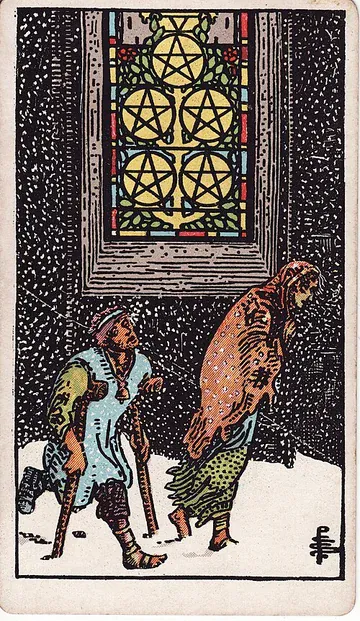
The hoarding that produced the very scarcity it was built to prevent. Pentacles Four reversed beside the lit cathedral window of Pentacles Five describes the seeker who has held so tightly to a private fortune that the relationships, the warmth, the actual community have evaporated. The seeker is now alone in the snow outside the cathedral, holding the coin that was supposed to keep this from happening. The reading asks for the small return — the meal shared, the help requested, the wall opened to one specific person who is willing to enter.
Four of Pentacles Reversed + Four of Cups
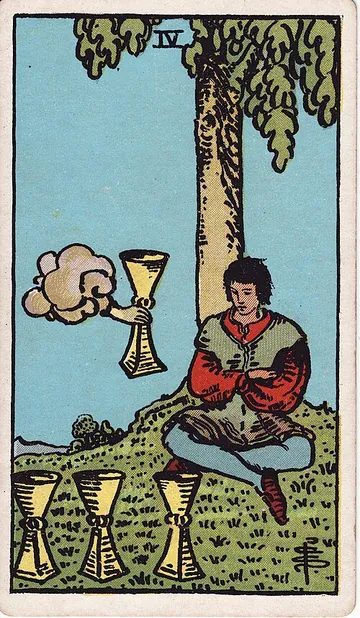
Two siblings of the four, both reversed in stance — opposite refusals on the same axis. Cups Four turns the face away from the offered cup; Pentacles Four reversed grips the coin past usefulness. Together, the pair describes the seeker who has refused both the new offer and the release of the old position, and is now stalled in a doubled stillness. The reading is the gentle confrontation: which of the two refusals are you ready to soften first? Either move begins to dissolve the other.
Four of Pentacles Reversed + Ten of Pentacles
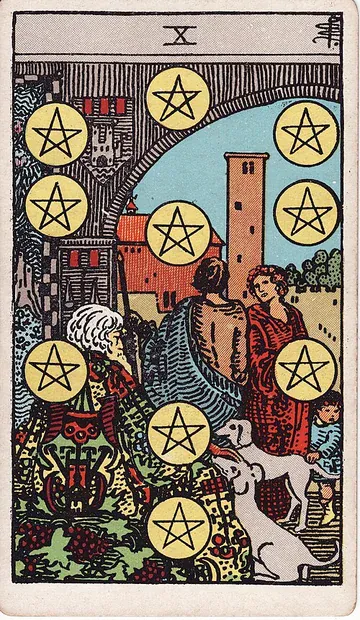
The inheritance that did not move. The reversed grip of Pentacles Four beside the family courtyard of Pentacles Ten describes the structure that should have circulated but did not. The wealth, the wisdom, the position, the property has been kept inside the seeker rather than passed forward. The dogs at the elder's feet are absent in this combination because the elder, in this version, never let the family in. The reading is gentle and direct: what have you been holding that was meant to be received by someone else? Begin the transfer. The release is the inheritance.
Card Combinations

The Emperor
Both figures sit on stone seats; both have been trusted with structures built before they arrived. The Emperor reinforces the Four of Pentacles' signature of legitimate authority and earned position — the seat of power held with discipline. Together, the pair describes the seeker who has consolidated genuine territory and is now responsible for governing it well. Sit straight; make the laws fair; open the gate when it should be opened. The card pair warns equally against authority that has stopped listening.

The Devil
The card of careful holding meeting the card of conscious chaining. This is the precise pairing for the moment a healthy boundary has slid into compulsive grip. The thing held to keep the seeker safe has become the thing the seeker cannot put down. Money, status, relationship, substance, worldview — the combination does not specify the object. It specifies the pattern. The figure on the seat has stopped noticing that the chain runs from his own wrist.
Five of Pentacles
Suit successor, opposite weather. Pentacles Four built the wall against the cold; Pentacles Five is the cold the wall was built against. Together they tell the long story of hoarding-fear and the scarcity it was meant to prevent — sometimes accurately, sometimes by producing the very condition. The reading asks whether today's wall is still defending against a real winter, or against a winter the seeker survived years ago and has not yet trusted is over.
Four of Cups
Sibling fours, opposite stances. Cups Four turns the face away from the cup the hand is extending; Pentacles Four clenches around the coin already in hand. Together, the pair describes the seeker who has refused both the new offer and the release of the old position. The walled city is well-defended and quietly empty. The reading asks, with care, whether the no has begun to outnumber the yes in the seeker's life.
Ten of Pentacles
The endpoint contrast. Pentacles Four is the held coin and the closed gate; Pentacles Ten is the family courtyard, the elder under the arch, the dogs at his feet, wealth circulating across generations. The pair shows what consolidation can grow into when the seeker learns to release the chest-coin into the family table. Same suit, deepened. The reading asks whether what is being built is meant to outlast the builder — and if so, whether it has begun to be taught to leave the builder's hands.
Frequently Asked Questions
With the Four of Pentacles reversed, is the answer no to holding and yes to opening one gate?
Conditional no — and a hard yes for releasing. The reversed Four of Pentacles answers no to questions about gripping more tightly, defending more aggressively, holding more firmly. It answers yes to questions about opening one gate, taking down one stone, releasing what is no longer being held but only clenched. Identify which question you are actually asking before reading the answer.
Is the Four of Pentacles reversed about my partner's possessiveness, or about the wall between us?
Reversed in love, the Four of Pentacles describes the relationship in which the boundary has begun to function as a wall against the partner rather than as architecture that holds you both. Possessiveness without active care; settled distance mistaken for safety. For new connections, it warns of partners trying to lock the relationship's shape down before trust has earned the locking. For reconciliation questions: returning is possible only if the wall that broke the bond the first time is examined and changed.
If they feel something, why does the Four of Pentacles reversed say they are withholding it?
When the reversed Four of Pentacles describes how someone feels about you, the warmth is real but has been put behind a wall the other person no longer remembers how to open. They feel something. They are also actively withholding the something. The protection has become more important to them than the connection. Read it as warmth under guard — real, but currently refusing to move. Whether the wall comes down is a decision they will make on their own timeline.
What is the meaning of the Four of Pentacles reversed?
The Four of Pentacles reversed is the card of the grip that has hardened past usefulness. Hoarding, clenching, scarcity-fear made permanent — or, in a second reading, the opposite collapse, the wall that has come down before the seeker was ready. Both are the same card turned over. The question is which version is in your reading: if the shoulders have not come down in months, the grip version; if everything you put down keeps moving, the dissolved-wall version.
What does the Four of Pentacles reversed want me to let go of first?
Give away one thing, today, that you could have kept — a suggestion, money, an hour. Examine your security for the parts that have hardened into stasis. Open one window in the wall for an hour, on purpose. Name what you are protecting, specifically. Forgive yourself for the grip; most adults pass through this card. The reversed Four responds to small, honest acts of dis-encrustation, not to grand renunciation.
Continue Reading
Four of Pentacles · Card overview · symbols · correspondences →
Return to the full card view — image, symbols, sensory correspondences, and Hermetic axes.
Read the upright meaning →
Read the same depth on the opposite orientation.
Draw your reading now →
Bring this card to a question — open a quiet ritual.