

Judgement Reversed · Core Meaning
Some calls are not refused so much as unheard on purpose, and Judgement reversed is the card that names that particular deafness. The horn is still leaning down out of the cloud; the brass is still bright; the white banner with the red cross is still flying — but the figures in the coffins have not stood. They have heard the sound and have decided, more or less consciously, that they did not hear it. The lids have stayed half-shut. The arms have stayed by the sides. The gray sea has held them in place because they have asked it to.
This is the card's central reversed knot: the refusal to recognize what you have already recognized. The reversal does not abolish the horn; it only abolishes the standing. The verdict has been arrived at, somewhere in you, but you are pretending the arriving has not happened. You are filing the call as noise. You are continuing to live as though the named thing had not been named, because answering the call would require you to leave the version of your life that the unnamed thing made possible.
There is a second flavour of the reversed card, equally common: the verdict has been outsourced. Rather than refuse the call, the seeker has handed the calling over to someone else's mouth. A parent. A boss. A partner. A therapist whose authority you depend on. A culture or a tradition whose voice you have substituted for your own. Pluto, reversed, becomes the planet of decisions delayed because the seeker is waiting for an external judge to confirm what they already know. The horn does not work this way. The horn calls you specifically, by your name, in your own voice. Borrowed verdicts do not cross Path 31; they only echo around Hod.
A third flavour, harder to see: the call has been received as a sentence against the self. The seeker has heard the horn and read it as condemnation rather than recognition. They have folded into self-blame, into a long internal trial in which they are forever the defendant. The fire of Shin (the discerning fire of the mother letter) becomes, in this register, the fire that burns the seeker rather than the fire that distinguishes the seeker's true name from their false ones. This is one of the more painful versions of the reversed card, because it looks like reckoning while in fact preventing it. Real reckoning sets the seeker free. Self-condemnation keeps the seeker available for further self-condemnation.
The astrological signature reverses too. Pluto upright is the slow, irreversible move; Pluto reversed is the slow, irreversible avoidance. The seeker stays in the same shape for so long that the staying acquires its own gravitational pull. The longer the call goes unanswered, the harder answering it later becomes — not because the call has weakened, but because the architecture of refusal has thickened around it. The brass horn is still leaning down. The figures are still in the coffins. The gray sea has begun to feel like home.
Read reversed Judgement as the card of the deferred reckoning. The sentence has formed. The hand has not yet written it. The mouth has not yet said it. The body has not yet stood. The card is asking, with patience that is also Plutonic — that is to say, slow, sober, and not negotiable forever — what would have to happen for you to admit what you already know.
Judgement Reversed · Love & Relationships
Neither person in this couple is reaching for the brass horn, and under Judgement reversed the unspoken has begun to outweigh everything that does get said. The honest sentence is in the room. Both of you can feel where it is. Neither of you is going first. The gray sea between you has thickened into a kind of glassware that you both move around carefully, agreeing not to bump it. The longer this goes on, the harder the saying becomes, and the larger the unsaid thing grows in the space it has been given to grow.
For an existing partnership, reversed Judgement most often indicates the relationship that is technically intact and quietly hollowing. The structure is in place; the routines hold; the social form looks fine. But underneath, something has not been said for a long time. Resentment that should have been named six months ago has gone subterranean. Disappointment that could have been a conversation has become a posture. Both partners are now investing more energy in not naming the named thing than they would have to invest in actually naming it. The card asks one of you to break the spell. It does not particularly care which.
For someone in a new connection, reversed Judgement can describe a relationship in which one or both of you are refusing to recognize what is happening. The connection is real; you can feel the call. But naming it would mean changing your life, and changing your life is more disturbance than the comfort of the unsaid currently allows. So you keep the connection in a holding pattern. You see them when convenient. You let things simmer at low temperature. The card warns that low-temperature holding patterns of this kind eventually cool into nothing. Heat the conversation, or accept that it will fade.
For a single seeker, reversed Judgement can mean the refusal to recognize what kind of love you actually want. You have been asking the deck for a partner without answering, honestly, what shape that partner would have to take. Your search is dishonest in a quiet way. You have been performing openness while privately requiring a very specific candidate, or performing standards while privately ready to accept much less. The card asks you to write down, on paper, what you actually want. Not what is impressive to want. What you want.
For love after a wound, reversed Judgement describes the seeker who has decided, on the wound's behalf, that the chapter of love is closed. The decision is doing protective work; it should not be hurried out of. But the card notices that the decision was made by the wound and not by the whole self, and the whole self has not been consulted in some time. There is more of you than the wounded part. The horn is asking that part to be allowed to weigh in. Not now, perhaps. But not never.
For reconciliation — should I take them back, should I return — reversed Judgement reads as a call that is being avoided in either direction. Either you are refusing the reconciliation conversation because admitting you want it is humiliating, or you are refusing the goodbye conversation because admitting it is over is too final. The card does not tell you which to choose. The card tells you that the refusal is the problem. Have the conversation. Whatever it produces will be more honest than the limbo.
For long-distance and cross-cultural relationships, reversed Judgement describes the silence that has settled into the architecture. The calls have thinned. The visits have been deferred. The future tense, when used, is vague. Both of you know that a real conversation about whether and how this relationship goes forward is required, and both of you have been finding tasteful reasons to not have it. The gray sea is the literal distance and the figurative distance at once. Pick up the phone. Have the awkward, exact conversation. The relationship that survives it will be a real relationship; the one that does not could not survive a real one anyway.
For pursuer-distancer dynamics, reversed Judgement is the card of the dance in its terminal phase. The pursuer has stopped pursuing because the pursuit has become humiliating. The distancer has stopped distancing because the distance has become silent. The two of you are now in a kind of static avoidance, where neither of you is doing the old role and neither of you is doing anything new either. The card asks for an honest read of the dynamic, named out loud. Whoever can name it first does both of you the favor. The naming is the only intervention that works.
For desire mismatch, reversed Judgement describes the partnership in which both partners have privately decided not to address the mismatch and are now living in the slow erosion of intimacy that comes from the unaddressed. Sexlessness, when it is genuinely chosen by both, can be peaceful. Sexlessness when it is the residue of an avoided conversation is corrosive. The card distinguishes between them. If you are the one who is more dissatisfied, you are also the one who has to begin the conversation. The other partner is unlikely to begin it on your behalf.
For divided households — partners who have been functionally separated under the same roof, or who have been splitting their lives in informal ways — reversed Judgement is the card of the unspoken arrangement. You have a marriage on paper and something else in practice. The arrangement has costs you have not yet looked at. The card asks for an honest accounting. Not necessarily for the dissolution; sometimes the accounting clarifies that the arrangement is, in fact, livable. But the accounting has to happen. The unaccounted version is the one that breaks.
For the contact-from-the-past — an ex resurfacing, an old name returning — reversed Judgement reads with caution. The contact is a call. The call is asking for a reckoning, not a reunion. If you respond to the contact as if it were a reunion offer, it gets misheard. They have come back because something between you was unfinished, and the finishing may not be the resumption of the relationship. It may be a long, hard conversation that finally allows both of you to lay the relationship down. Read the call accurately. Do not project onto it the romance of return.
A note on the card's particular love shadow: under reversed Judgement, the lover can confuse intensity for honesty. They can say cruel things in the name of "saying the truth," they can dramatise a reckoning that is in fact a tantrum, they can perform breakthrough rather than have one. The card warns specifically against this register. Real reckoning is quiet. The horn in the image makes no visible sound. If your "honesty" requires volume, theater, or audience, it is probably not honesty yet.
If you are asking whether someone is in love with you and the reversed Judgement arrives, read it as a feeling that has not yet crossed into language. They feel something. They have not allowed themselves to name it, perhaps because the naming would obligate them to act, and they are not yet ready to act. This is not the same as not feeling. But it is also not the same as feeling something they are willing to share. Do not push them to declare. They will declare or they will not. What you can do is be honest about your own position, which removes the ambiguity from your side at least.
Judgement Reversed · As Feelings
When Judgement appears reversed to describe how someone feels about you, the feeling is real but has been refused entry into language. They have arrived at a verdict, somewhere inside themselves, but they are not yet willing to issue it. The brass horn has leaned down in their chest and they have, more or less consciously, covered their ears. The feeling is not weak. The acknowledgement of it is.
This is one of the more frustrating feelings-readings to receive, because the surface signal is mixed. They are warm, sometimes — and then suddenly remote. They lean in, and then withdraw. They make plans, and then cancel them. The pattern is not an indication that they do not feel. The pattern is the texture of someone refusing to let what they feel become what they say. The card asks you to read the underlying signal rather than the volatile surface.
If they are reserved by nature, reversed Judgement in feelings means their interior verdict is being held inside a kind of internal injunction not to say it. Sometimes the injunction is old — a rule about emotional disclosure they learned in childhood. Sometimes it is fresh — they have decided, given the situation, that naming the feeling would cost too much. Either way, the holding is a choice. They are not unable to speak. They are choosing not to.
If they are demonstrative by nature, reversed Judgement in feelings is a more complicated figure: the expressive person whose interior voice has gone quiet on this specific subject. They will be lively about everything except you. The conspicuous absence of their usual style around the question of you is the signal. Listen for it. They are protecting something — usually themselves — by keeping you out of the register where they let things land.
For a long bond, reversed Judgement in feelings can describe the partner who has settled into the relationship in such a way that the act of seeing you accurately has been replaced by the habit of you. They feel the relationship; they have stopped feeling you. The figure they are facing is not exactly the person you have become; it is the person you were when they last looked. The reversal here is the un-noticing. The card asks for the noticing to be reactivated, by you naming yourself in front of them in fresh terms. Tell them what you are working on. Tell them what is hard. Force the looking.
For a new connection, reversed Judgement can mean they are reviewing you, but the review is being avoided rather than completed. They like you enough to be unsure what to do, and unsure-what-to-do has, for them, become a stable resting state. They will hold the not-deciding for as long as you let them. The card asks whether you are willing to let them. There is no obligation to push them; there is also no obligation to wait indefinitely.
For reconciliation feelings, reversed Judgement is one of the deck's clearer warnings. The other person feels something, possibly a great deal, but the feeling has not done the work of becoming an offer. They miss you, and the missing has not produced any move. They regret what happened, and the regret has not produced an apology. They are imagining, sometimes vividly, what your life looks like, and the imagining has not produced a phone call. The card asks you to take the absence of move as the signal it is. Feelings without action are private; you do not have to organize your life around someone's private feelings.
For conflict aftermath, reversed Judgement in feelings can describe the person who has not yet integrated what happened. They are still in defensive mode, or in punishing mode, or in dissociation. The card warns against trying to hurry their integration. Push them and the integration will be performed rather than real, and a performed integration produces the same conflict again three months later. Step back. Let their process happen at its own pace. If it never happens, that is information.
For divided warmth — when the feelings appear to come and go in waves you cannot read — reversed Judgement says the wave is generated internally by their refusal of the named thing rather than by anything you are doing. You are not creating the wave. They are. This is liberating in one sense and hard in another: liberating because you can stop trying to manage their oscillation, hard because the oscillation is unlikely to stabilise without their willingness to look at what they are doing.
For "they are reviewing me but the review is going badly" — which is the worst-case version of this reading, the reading the seeker fears — reversed Judgement is more often a description of the review being stalled than of the verdict being negative. The review has hit a part of themselves they do not want to look at, and they have stopped the review there rather than continue. The stall is about them, not about you. Their interior court has not yet figured out how to render judgment on a part of itself. This may resolve, or it may not. It is, in either case, theirs to do.
For "are they reviewing me at all" — when the seeker fears the other person has simply forgotten, has moved on, has not been thinking about them — reversed Judgement says that the absence of contact is not the absence of thought. They are thinking about you. They have not chosen to act on the thinking. Whether the thinking will produce action is unknowable from where you sit. What is knowable is that you are not being forgotten; you are being avoided, which is a different thing, with different prognoses.
Judgement Reversed · Career & Work
In career readings, reversed Judgement describes the work whose verdict you already know and are continuing to refuse. You know whether the role is right. You know whether the project should be killed. You know whether the manager is wasting your time. You know whether your contribution has been seen accurately or has been quietly reassigned. Your knowledge is not the issue; your willingness to act on it is. The brass horn has leaned down in your career and you are filing the sound under "I'll think about it next quarter."
For a current role, reversed Judgement most often signals the comfortable misfit. The role pays. The colleagues are tolerable. The work itself has stopped engaging you in any deep sense, but the discomfort is so low-grade you have not noticed it as discomfort. You experience it as fatigue, or as restlessness on Sunday evenings, or as the strange flatness of accomplishments that should feel larger than they do. The card asks you to take that flatness seriously. It is the horn calling, muffled. The role is not where you should be next year, and you have known this for some time.
For someone considering a new role, reversed Judgement asks: are you avoiding the question of whether the new role is actually what you want, by busying yourself with the question of whether you can get it? Many career searches under this card are sophisticated avoidance — turning a vocation question into a logistics question because the logistics question feels solvable and the vocation question feels endless. The card is not against the move. The card is against the move you are making to skip past the harder question.
For someone considering leaving — quitting, sabbatical, sabbatical that becomes a quit — reversed Judgement reads as a leaving you have been performing in your head for some time without actually performing. You have rehearsed the resignation conversation a hundred times. You have written the email three different ways. You have not sent it. The card asks: what would have to be true for you to send it? Not what would have to be true in some perfect, rearranged universe. What would have to be true in this one. Is that thing achievable? If yes, achieve it and send. If no, the leaving is a fantasy and the fantasy is doing real damage to your present.
For freelancers and entrepreneurs, reversed Judgement describes the business you have been running while quietly knowing it is not the business you should be running. The clients are paying. The order book is fine. The deeper work — the project that would actually be your project — has been deferred for the third year in a row. The card asks for the honest accounting of what doing the deferred work would actually require, and whether the deferral has become a permanent feature rather than a stage.
For creative workers, reversed Judgement describes the work that has been waiting too long for its public moment because the maker has not been willing to make the case for it. The book is finished and unsubmitted. The album is mixed and unreleased. The exhibition is curated and not yet pitched. The verdict you fear is the one you would receive if you actually sent the work out, and so you have arranged your career to make sure you never receive it. The card sees the avoidance and is gentle about it. It is also clear: at some point, the work has to leave the room. The unreceived verdict you carry is heavier than any actual verdict would be.
For students and apprentices, reversed Judgement can describe the misnamed apprenticeship — the program, the master teacher, the institution you joined under one description that has become a different thing in practice. The fit has been wrong for some time. Your continued presence is now propped up by the sunk cost of the years already invested. The card asks you to look honestly at whether the rest of the program will produce what you came for, or whether it is more of the same compromise extended into your future. The horn is calling you to a different teacher, perhaps. Or to no teacher and a real practice. Either is honourable. The current arrangement is not.
For managers and leaders, reversed Judgement describes the leader who knows what is happening on their team and has chosen not to name it. The underperformer they have been carrying. The team-member whose work is being silently reassigned. The dysfunction in the meetings that everyone leaves talking about and no one addresses. The leader's authority is in part the willingness to say the named thing in a room where saying it is unpopular. The card asks the leader to step into that authority. Avoidance at the top is more corrosive than avoidance anywhere else.
For care and teaching work, reversed Judgement describes the long carer whose own needs have been so deferred that they are no longer audible, even to themselves. You have been holding so much for others that the quiet, internal voice that names what you yourself need has been overruled for years. The card asks for that voice to be allowed back into the room. Take a day off you have been postponing. Have the conversation about the wage that is too low. Refuse the meeting that is not actually your job. The horn is calling you, not the people in your care.
For promotion, reversed Judgement reads with caution. The promotion may be on offer; you may even take it. But the underlying question — whether the promotion is into a life shape you actually want — is being avoided. Many promotions, accepted reflexively, are how people end up doing work for fifteen years that they did not consciously choose. The card does not say no to the promotion. It says: choose the promotion, do not just receive it.
For layoff and being eased out, reversed Judgement is the card of the redundancy that should have been seen coming. The signs were there. The reorganisation was telegraphed. The boss's coolness toward your work was visible. You did not look at the signs because looking at them would have required action. Now the action is being taken on your behalf by the company, and the company's choice is necessarily worse for you than any choice you would have made on your own time. The lesson, going forward, is to look at the signs. The card is severe with this lesson but not vindictive. It just asks for the looking.
For cross-functional teams and collaborators, reversed Judgement describes the silent miscredit. Someone is taking, or being given, credit for work that is not theirs, and you have not raised the question. The card asks you to raise it. Not aggressively. Accurately. Note who did what, in writing, in a forum that creates a record. The card is the friend of the precise, the unfriend of the silent grievance.
For public-facing recognition, reversed Judgement warns of the recognition you fear because you suspect it will be inflated. The work has gotten a small wave of attention, and you are already preparing for the wave to break and reveal you as a fraud. The card asks: did you do the work? If yes, the recognition is approximately fair. The wave will recede regardless. The work remains. You are not a fraud; you are a person briefly paid attention to. Receive what is fair and let the rest go.
For vocation and calling at the deepest level, reversed Judgement is the card of the call you have heard and not answered. There is something you have been called to do for some years now. You can name it, if pressed. You have not done it because doing it would mean reorganising your life. The card does not require the reorganisation today. The card asks you to admit, on paper, that the call has come. Once admitted, the call begins to organize your life from inside, more slowly than it would if you took action, but more reliably than if you continue pretending you have not heard.
Judgement Reversed · Money & Finances
In money readings, reversed Judgement describes the finances whose actual shape you have been declining to look at. The bank balance is not opened. The credit card statement is glanced at and closed. The retirement account was set up six years ago and you do not know the current value. You have been managing money by mood — you have a feeling you are roughly fine, and the feeling is doing the work that an actual look would do. The card asks for the actual look.
For someone carrying debt, reversed Judgement is the card of the debt that has been left unaccounted for so long that you have begun to confuse it with weather. It is just there, like rain. The card insists that debt is not weather. It has a number, a rate, a term. The horn here is the moment you write the numbers down on a piece of paper, in actual digits, and let the digits be the real shape of what you owe. The relief, when this is done, is enormous. The pain of the unfaced version has been doing more damage than any plan, however severe, would do.
For someone whose spending has crept upward, reversed Judgement describes the slow accumulation of small commitments — subscriptions, automatic payments, the casually signed contracts — that have begun to consume the margin. You do not know what you are paying for. The card asks for one honest hour with the recurring charges. Cancel three. The card does not require that you become austere; it requires that you become aware.
For investments, reversed Judgement warns specifically against the investment you cannot articulate. If you cannot, in three sober sentences, say why this is a sound investment, the money is going to a story rather than to an underlying. Do not make the move. Wait until you can say the sentences, or until your inability to say them clarifies that this was not your move to make.
For windfall, reversed Judgement is one of the deck's clearer warnings. The money has come in and it is headed for the wrong thing. Not catastrophically — you are unlikely to gamble it away — but quietly, on a thousand small pleasures and reactive purchases that, six months from now, are hard to account for. The card asks you to wait three months before any large move with windfall money, and to write down, before any spending, what the money is for. Not what feels nice to spend it on. What it is for.
For someone in financial recovery, reversed Judgement describes the dangerous moment when the constraint loosens. You have been disciplined for some time; now there is room; the discipline has begun to slip. The card recognizes that you have earned the looser register, and warns that you have not yet earned permanently looser habits. Stay with the practices that built the recovery for at least one more cycle longer than feels necessary. The body of habit is what carries you across the next downturn, and the next downturn is closer than you think.
For long-term financial structures, reversed Judgement describes the retirement plan that was set up once and has not been touched. The structure is fine. The defaults are not optimal. You should be saving more than you are. You should look at the asset allocation. You should know what fees you are paying. The card respects that this is boring work; it asks for the work anyway. One quiet afternoon. Open the statements. Read them. Make the small adjustments. The card responds with steady favor to small, attended financial moves; it withdraws favor from large, unattended ones.
For the question of generosity, reversed Judgement asks whether the giving has become performance rather than offering. Are you giving to be the kind of person who gives? Are you giving on cue, when others are watching, because the giving stabilises a self-image you need? Real generosity is private and exact. Performed generosity is public and inflated. The card respects the small, true gift more than any photographed cheque. It also respects the honest no when generosity is not affordable.
A practical move when this card appears: open the spreadsheet you have been avoiding. Not to fix it. Just to look. The card returns the strongest readings to those who do this exact small thing on the day it arrives. Looking is most of the work. The fixing follows looking by its own gravity.
Judgement Reversed · Health
For health readings, reversed Judgement is the card of the symptom that has been there for a long time and has not been investigated. The fatigue you have been calling normal. The pain you have been working around. The change in sleep, in digestion, in mood, in libido, in skin. You have a private story about each of these — usually a story that rules out the need for action — and the story has been holding for longer than any single symptom should have been held by a story alone. The horn is calling you to the appointment you have been postponing.
The reversed card warns specifically against the strategy of waiting for the symptom to declare itself definitively. Symptoms do not always declare; sometimes they remain ambiguous until they are no longer ambiguous, at which point the runway for action has shortened considerably. The fire of Shin upright is the fire that discerns; reversed, it is the fire that has been kept low so as not to illuminate what it would illuminate. Turn it back up. Get the test. Make the appointment. Hear what you hear and take the next step from there.
For acute conditions, reversed Judgement describes the response that has been less robust than the situation warranted. You took the pain seriously enough to mention it, and not seriously enough to follow up. You took the medication for two of the prescribed seven days. You attended the first appointment and missed the second. The card asks for the full course of action, completed, even when the immediate crisis has passed. Healing does not respect the seeker's preference for partial measures.
For chronic conditions, reversed Judgement is the card of the regimen that has slipped. Courses are begun and set down near the middle, and the middle is being counted as finished. The exercise that was working has stopped. The diet that helped has eroded. The follow-ups have been pushed out by three months at a time. The card warns that chronic conditions reward consistency and punish drift. The drift is now the problem. Re-engage. The condition has not changed; your relationship to it has.
For mental health, reversed Judgement describes the seeker who has decided, prematurely, that they are fine. The therapy has been paused. The medication is being skipped. The journal is closed. The walks have stopped. You can perform wellness convincingly enough that the people around you have stopped checking. The card asks the harder question: are you actually well, or have you become skilled at not being asked? The horn here is the willingness to be honest with the one practitioner who has the standing to call you on it, including yourself, in a private hour.
For sleep, reversed Judgement describes the long-running sleep problem that has been treated as a personality trait. "I'm a bad sleeper." "I just don't need much sleep." "I've been like this for years." The card asks whether the sleep problem has, in fact, been investigated. Some sleep problems have causes that respond to specific interventions. Some are signals of other conditions. The unresearched version is doing more damage than the research would do.
For appetite and weight, reversed Judgement describes the eating that has slipped into autopilot. You are not eating because you are hungry. You are eating because it is the time. Or you are eating because you are tired. Or you are not eating because you are stressed and you have stopped noticing the not-eating. The card asks for the honest noticing, with neither guilt nor performance. What is actually happening with your eating? Notice for one week. Most of the work is in the noticing.
For substance use, reversed Judgement is one of the deck's clearer mirrors when something has slipped from comfort into compromise. The drinking that started as celebration has become a routine. The recreational use that started as occasional has become weekly. The screen use that started as relaxation has become the only mode of relaxation you have. The card does not condemn. The card asks for the inventory: how much, how often, for what. The answers will tell you what to do without the card needing to instruct you.
For posture and chronic pain, reversed Judgement is the card of the body whose vertical the seeker has compromised in service of accommodation. You have been bent toward someone else's needs for so long that the spine has acquired the curve of the bending. The card asks for the slow, deliberate work of standing upright again, in both the physical and the metaphorical sense. It will take longer than you want. It is also the only direction that does not lead to further deformation.
For immune function and the body's discrimination of self from non-self, reversed Judgement can describe the long-running, chronic, low-grade inflammation that you have not connected to the rest of your life. The body is mounting a defense against something. Sometimes that something is dietary; sometimes it is environmental; sometimes it is psycho-social, the slow inflammation of being asked to live in an environment that has not been honest with itself. The card does not diagnose. It asks the question.
Naming an environment as part of the picture is not medical advice. Keep your practitioners. Take your medicine. The card describes the kind of attention healing requires, in the register of the avoided and the deferred. The first small honest move — the one phone call, the one appointment, the one conversation with the practitioner you trust — is most of the journey.
Judgement Reversed · Spirituality
Spiritually, reversed Judgement is the card of the call refused, the call outsourced, or the call mistaken for condemnation. On the Tree of Life, Path 31 from Hod (the named, the spoken) to Malkuth (the body, the lived) has stalled. The naming has happened, somewhere in the seeker, but the descent into the lived body has not. The intellectual recognition exists; the embodied response does not. The gray sea of the card is the long stretch between knowing and doing.
For seekers in active practice, reversed Judgement describes the practice that has become technically correct and inwardly inert. You sit. You pray. You journal. The forms are kept. The interior contact has thinned. You are aware of this, and you are also aware that admitting it would require either deepening the practice or naming why you are continuing to perform a practice that has stopped working. The card asks for the admission. Either renew the practice with full attention, or set it down honestly. The performed-practice middle is the worst position spiritually; it claims the credit of the disciplined while costing the effort of the disciplined and producing none of the fruits.
For seekers exploring belief, reversed Judgement warns against the spiritual consumerism that collects teachings without integrating any. You read the books. You attend the retreats. You assemble a vocabulary. The vocabulary has not yet crossed Path 31; it has not descended into how you actually live. The teachings have remained Hod-bound, beautiful talk above the sea, never landing in Malkuth. The card asks you to choose one teaching — one — and live it for a season. Not study it. Live it. The descent that follows is the spiritual move that the collecting was substituting for.
For seekers carrying spiritual wounds, reversed Judgement describes the wound that has hardened into the seeker's spiritual identity. You have built a self around the harm done to you by the bad teacher, the betraying community, the tradition that promised what it did not deliver. The harm was real; the building-around-it has become its own structure now. The card asks whether the structure is still serving you or has become a way of staying frozen. Healing does not require that you forgive the harm-doer. It requires that you let the harm stop defining the center of your spiritual life.
For seekers carrying unanswered calls — vocations they have heard and refused — reversed Judgement is the card of the longest deferral. There is something you have been called to do that you have not done. You know what it is. You can name it, if pressed, in a sentence. The card does not require that you do the called thing today. The card asks you to admit, in writing, in an actual sentence on actual paper, that the call has come. The admitting changes the center of gravity in ways that take months to surface. The unadmitted version sits like a stone in the chest.
For seekers who have been outsourcing their spiritual judgment, reversed Judgement is the card of the borrowed authority. You have been deferring to a teacher, a tradition, a partner, a parent, a culture, on questions that are properly yours to answer. The borrowed authority has produced a kind of spiritual quietism — you do not have to decide, because the authority has decided for you. The card asks whether the borrowed verdicts you are living by are ones you actually agree with, or ones you have accepted because disagreeing would cost too much. The horn is calling you, by your own name, in your own voice.
For the seeker in self-condemnation, reversed Judgement is gentle. You have been hearing the call as a sentence against you. The horn, in your reading, is the voice of the prosecutor, not the angel. This is exhausting and it is also wrong. The horn does not condemn; the horn names. The work is to retrain your ear. Practice hearing yourself in the second person, by name, with the warmth of someone who is glad you are still here. If you cannot do this for yourself yet, find a friend or practitioner who can do it for you, and borrow their voice until your own returns.
A small practice when this card appears: write, by hand, the sentence "What I have been pretending not to know about my life is …" — not the way upright Judgement would have you write it, with the expectation of an honest answer landing in your hand. Write it instead with the expectation that it cannot be completed. Sit with the inability for ten minutes. The inability itself is the spiritual material. What is being protected by your refusal to complete the sentence? The answer to that question is the deeper teaching the reversed card carries.
Judgement Reversed · Yes or No
Conditional yes — but not yet, and not on these terms.
Reversed Judgement is rarely a clean no. It is more often a yes that is stalled inside the seeker's own refusal to act on what they know. The answer to the underlying question is often clear; the seeker is just unwilling to receive it as clear. The card describes a verdict whose pronouncement has been delayed, not a verdict that says no.
For yes-or-no questions about a relationship, a job, a move, a decision: the card asks whether you are seeking a yes-or-no answer because you do not already know, or because you do already know and want a deck to confirm what you do not want to admit you know. Most reversed Judgement readings, examined honestly, fall into the second category. You know. You are stalling. The card is asking you to stop stalling.
For questions about whether someone is being honest, whether an offer is genuine, whether a plan will hold, the card warns of the answer you have already half-formed and have not let yourself complete. The signs are there. You have read them. You are looking for the deck to override what your own reading already showed you. The card declines to override. Trust your earlier reading.
For questions about timing — will it happen soon — reversed Judgement says the timing is being delayed by a refusal somewhere in the situation, often in you, sometimes in another party. The thing is not failing to arrive because the universe is withholding. It is failing to arrive because someone, possibly you, is failing to make the move that would let it arrive. Identify the held move. Make it.
For binary decisions — should I act, should I wait — the reversed card answers act, with an unusual qualification: act on the smaller move first. Not the dramatic action. The smallest honest action that gets you out of stalled limbo. The card respects small moves with great consistency. The smallest honest move tends to unstick the larger ones by its own gravity.
If worthiness is the question being held on to here. The reversed card answers: you are using the question of deservingness as a way to avoid the question of doing. Stop asking. Begin.
Judgement Reversed · Advice
The advice of reversed Judgement is to stop refusing what you have already heard. The named thing is in your interior. You know what it is. The work is not to discover it — there is nothing to discover; you discovered it some time ago — but to admit it, on paper or aloud, in a register that begins the descent into the lived body. The card responds to small acts of admission. The card declines to respond to further analysis.
If there is one specific instruction the reversed card offers, it is to write the sentence you have not been writing. The exact one. The one whose words you have rehearsed and have not committed to actual ink. Take a piece of paper. Write it. The act is small. The effects are not. The horn descends into Malkuth through the precise act of putting the sentence into the body of the world, even briefly, even just on a sheet you then fold and put away. The unfolded version has been pretending it does not exist; the folded version cannot pretend.
A second instruction: stop asking external authorities to give you a verdict you have already given yourself. The therapist will not give it to you. The friend will not. The deck will not. The horoscope will not. The verdict is yours. They can witness it; they cannot pronounce it on your behalf. If you have been shopping the question, retire the shopping. Sit with the question alone for a quiet hour. The verdict, when it lands, will land in your own voice.
A third instruction, harder: forgive yourself for the deferral. Most seekers, looking honestly at the reversed Judgement reading they have drawn, will see a pattern of avoidance that they have been engaged in for a long time. The temptation is to read the reversed card as a fresh round of self-condemnation — a new verdict against the seeker, this time for not having made the verdict sooner. Do not take this turn. The horn does not condemn. The horn names. Name the deferral, and lay the deferral down. The next move begins from a clean spot, not from a heap of shame.
A fourth instruction: be specific about what answering the call would actually require. The reversed card thrives on vagueness. "I should be doing something different" is not a usable sentence; it is a fog that protects the seeker from action. "I should be writing the book I have been describing to friends for four years" is a usable sentence. Specificity is the friend. Spend the next week writing one specific version of the called thing, and the week after that, one specific first move toward it. The fog dissipates by being walked through.
A fifth instruction, gentler: recognize the call as a call, not as a sentence. Many seekers under reversed Judgement have heard the horn and have cringed, because cringing is the body's response to perceived attack. The horn is not attack. The horn is invitation. The arms of the figures in the upright card come up because the call is a relief, not a wound. If your body is bracing when the call arrives, take time to retrain the response. Sit with the call gently. Treat it as a friend who has been trying to reach you, not as a judge who has been assembling evidence against you.
Practical advice for the day the card appears: choose one small honest action and do it. Send the email. Make the appointment. Have the brief, exact conversation. The action does not have to be the full answer to the call. It only has to be the first piece. The card's gravity, once you have made one move, begins to do the rest of the work without further heroics on your part.
Judgement Reversed · Card Combinations
Reversed Judgement reads differently next to different neighbors. Beside endings, it sharpens into deferral. Beside light, it reads as the call refused. Beside transformation, it warns of the metamorphosis being held back. The combinations below are the load-bearing pairings — the ones whose shapes change the meaning of the cards on either side. Read each as a single combined image, not as two cards added.
Reversed Judgement + Death
The dissolution is well underway, and the naming of what is rising from it is being refused. Death has done its work; you can feel the old shape gone. The new shape is calling, and you are pretending to still be the old shape rather than admit the new one. This combination shows up at the end of long therapeutic cycles when the seeker has refused to claim the integration the work has produced. Stop pretending to still be the person Death dissolved. Receive the new name.
Reversed Judgement + The Sun
The seeing has happened, and the called response is being held. You have been seen accurately, in your full daylight; that part has landed. The naming that should have followed has been refused, perhaps because being named would commit you to acting in line with the name. This combination warns specifically against the comfort of being seen without being addressed. Let the seeing become a sentence you can answer.
Reversed Judgement + The World
The completion is technically here and is being denied. The phase is over; the integration is available; you are continuing to act as though there were more chapter to do. This combination often shows up at the end of long projects, relationships, or seasons of work that the seeker has refused to formally close. Closing is the gift the World offers. Refusing the closing leaves you stranded between phases.
Reversed Judgement + The Hanged Man
The patience has hardened into avoidance. The Hanged Man taught you to wait; you learned the lesson well, perhaps too well. What was once a fruitful suspension has become a permanent posture. This combination warns against the spiritual virtue of waiting being weaponised against the call when it finally comes. Suspension is a stage, not a destination. Hear the horn. Stand.
Reversed Judgement + The Fool
The cycle has come full circle without the seeker recognising the circling. The Fool set out unnamed; the call is now arriving to give the journey its name; the seeker is responding by setting out again on a new Fool's journey rather than receiving the name the previous one had earned. This combination warns of perpetual beginnerhood — the seeker who keeps starting over to avoid the moment of being named. At some point, the unnamed beginnings have to allow themselves to be named. Let this one be named before you start the next.
Card Combinations

Death
The old self has dissolved; the new self is being named. Death does the breaking; Judgement does the calling. Together they describe the deep arc of identity transition — the long winter of letting the old shape go, then the spring morning of waking under a new name. Do not try to keep the dissolved self present in the called one.

The Sun
To be seen, then be named. The Sun's gift is unconditional visibility; Judgement is the call that arrives after the seeing. Together they are one of the deck's most generous combinations — first the warmth that lets you stand in your skin, then the verdict that says, this is who you are. Wedding flag, ordination, public commitment.

The World
The naming followed by integration. Judgement is the threshold; the World is the room you walk into after. Together they describe the completion of a whole arc — call answered, name received, life lived in the new shape. End of a decade-long project, closure of a long chapter, completion of a body of work. This phase has been integrated.
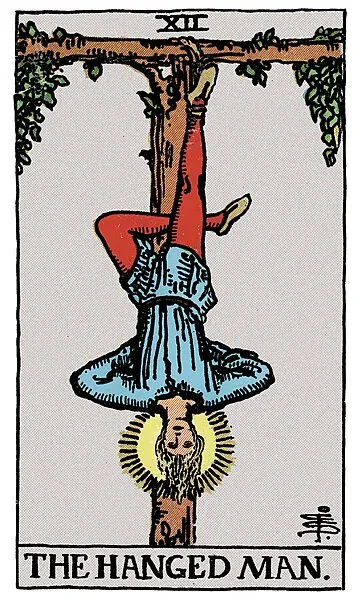
The Hanged Man
The surrender that precedes the horn. The Hanged Man teaches the deliberate suspension of trying; Judgement is the call that arrives after the patience has done its work. The seeker had to stop pushing for the right name to come. Stay hung longer than you thought you needed to. The naming arrives — but only to those who have actually stopped striving.

The Fool
The bookend pairing — unnamed beginning and named ending. The Fool steps off the cliff with no name yet, only the bag and the dog and the rose. Judgement is the verdict at the end of the arc, the moment the journey acquires its name in retrospect. End of an apprenticeship, gap year, journey of self-discovery — the walker laughs and accepts the name, because of course this was always who they were going to be.
Frequently Asked Questions
What does the reversed Judgement card mean?
Reversed Judgement is the card of the call that has come and is not being answered. The horn is still leaning down out of the cloud; the verdict has formed inside you; you have, more or less consciously, decided to file the call as noise. The card is rarely a fresh judgment against you. It is a description of a deferral you have been running, often for some time. The work is to admit, in writing or aloud, the named thing you have been pretending not to know.
Why is neither of us saying the honest sentence under Judgement reversed?
Because deferral stays cheap right up until it is not. In love, reversed Judgement describes the relationship in which the unspoken has begun to weigh more than the spoken and neither person is reaching for the brass horn. For partnerships, it warns of the slow hollowing that comes from avoided conversations. For new connections, it can mean a low-temperature holding pattern that needs heat or honest closure. For singles, it asks what kind of love you have been pretending you do not actually want.
Is Judgement reversed a yes or no?
Reversed Judgement is rarely a clean no — it is more often a yes that is being stalled by a refusal somewhere in the situation, frequently in the seeker. The underlying answer to the question is often clear; the unwillingness to act on it is the real reading. The card responds best to seekers willing to act on the smallest honest move available, rather than waiting for the larger decision to feel comfortable.
What is reversed Judgement saying as advice?
The advice of reversed Judgement is to stop refusing what you have already heard. Write the sentence you have not been writing. Make the smallest honest move, not the dramatic one. Stop shopping the question to external authorities; the verdict is yours. And forgive the deferral, rather than adding fresh shame to the existing avoidance — the horn names, it does not condemn.
Do they have a verdict about me they are refusing to issue?
When reversed Judgement appears as feelings, the other person feels something real but has refused entry to the feeling into language. They have arrived at a verdict and are not yet willing to issue it. The signal you receive will be mixed: warm and then remote, lean and then withdraw. Do not read the volatility as ambivalence. Read it as the texture of someone refusing to let what they feel become what they say.