
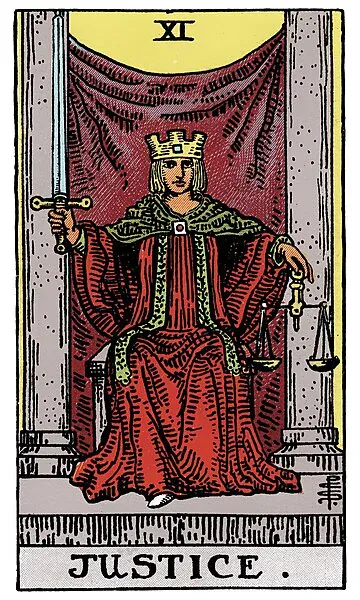
Justice · Core Meaning
The Justice tarot card shows a figure in a scarlet robe seated between two gray stone pillars, a purple veil hung behind. The right hand holds a double-edged sword upright, blade leaning to no side. The left hand carries a balanced scale, level as still water. A small crown rests on her head, the buckle on her breast a perfect square; one white slipper barely shows beneath the robe. She is not statuary. She has feet. She has been listening for a long time, and now she is ready to set the hand down.
The signature tension of the Justice tarot card meaning is the moment between hearing and ruling. Many of the deck's cards live before that moment — the Two of Swords with its blindfold, the Hanged Man suspended over an unresolved question. Justice is the card after listening has ended. The sword is not raised in anger; it is upright because the matter has already been parted into two, and each side has admitted its own shape. The scale is not paused mid-weighing; it is level because the weighing is finished. What looks like stillness is the stillness of completed labor.
This card is sometimes received with a flinch — readers expect Justice to bring the unfavorable verdict they have been bracing against. That flinch is itself diagnostic. Justice does not punish; Justice restores the actual weight. If you have been quietly carrying more than your share, the scale levels and you set down what was never yours. If you have been quietly carrying less, the scale levels and the missing portion finds its way back to your pan. The verdict may not be tender, but it stands. After Justice, the matter cannot be re-litigated by mood.
The astrological signature sits under this posture the way the two pillars sit under the seat. Justice is the card of Libra — cardinal air, ruled by Venus. Cardinal because it initiates: the season turns at the autumn equinox, when day and night balance and the year tips toward winter. Air because the work happens in the medium of speech and reasoning, not heat or earth. Venus because the underlying impulse is harmony, not severity — the goal is the relation that holds, not the punishment that satisfies. Justice is Venus working through structure. The hand that weighs has felt its own emotion and refused to add it to either pan.
In the Tree of Life, Justice walks the twenty-second path, from Geburah (severity) down to Tiphareth (the heart). The Hebrew letter is Lamed — the ox-goad, a simple letter whose root means to teach, to guide. This is the deeper character of the card. Justice is not the executioner. Justice is the teacher who guides force back into right relation with the heart. The verdict is pedagogical before it is punitive: it is the moment the lesson becomes a fact.
Two smaller details deserve a close look before the card is read in a spread. The number is eleven — one set against one — and it reduces to two, the number of the High Priestess who sits between her own pair of pillars a few cards earlier. The High Priestess keeps the veil closed; Justice has drawn it partly aside and taken the seat in front of it. The purple cloth behind her is not decoration. It marks off a larger measure against which this one case is also being weighed: the verdict she is about to give has to hold not only between the two people at the table but against something that outlasts both of them. That is why she can afford to be unhurried. Rose, cedar and myrrh are the card's scents by the old correspondences — Venus's flower, the wood of the bench, the resin of what must be kept unaltered — and its hour is just past noon, the shadow at its shortest, the light falling straight down on both pans so that neither can hide in the other's shade. Whatever you bring to this card, expect it to be lit from directly overhead.
Read Justice in any spread as the moment a long-suspended matter becomes formal. The wheel has stopped on a notch. The account is opened. Whatever the seeker has been deferring — the conversation, the decision, the boundary, the apology — now has the weight of a real entry. The card does not say what the verdict will be. It says the books are open, and the verdict is the verdict the actual weights produce.
Justice · Love & Relationships
In love readings, the Justice tarot card upright is the moment a relationship reaches an account. Not a fight — a reckoning. The unspoken inequities, the small repeated harms, the agreements that were entered in good faith and have quietly drifted out of fairness — these surface, become legible, and ask to be addressed. Justice is the card of the relationship that has stopped pretending. It is also, often, the card of the relationship that survives the honest conversation it has been avoiding for a year.
For an existing partnership, Justice arrives when the architecture of the bond has begun to ask for revision. One partner has been carrying more emotional weight, or more financial weight, or more invisible household weight, and the imbalance has become structural. The card invites the conversation that names the actual ledger — not as accusation, but as accounting. Both pans, weighed honestly. The white slipper beneath her robe is the reminder: she walks. She is not above the table. The verdict does not exempt the person who calls for it.
For a new spark, Justice is unusually serious. It is not the rosy card of new affection; it is the card of the first real test. Maybe the question of exclusivity comes earlier than expected. Maybe a value disagreement surfaces while the relationship is still soft. Justice asks the new connection to grow up faster than it would prefer to. This is not unromantic. It is the card of the partner who would rather know now than discover later. If both can sit between the gray pillars and let the scale level, what comes after is built on real ground.
For the single seeker asking whether love is on the way, Justice answers with a firm, slightly cool yes — but a yes conditioned on internal accounting. The card asks what unfinished verdict the seeker is still carrying from the last relationship. The grievance not yet released. The story of the ex that has not been honestly told. The amount of self-blame or self-exoneration that has crept past actual weight. Justice will not deliver new love into a life still presided over by an old, unfinished court. Settle the books. Then the door opens.
For love after a wound, the Justice tarot card is a card of integration. The grief has done its work. The understanding has matured. What once felt like betrayal can now be weighed accurately — sometimes lighter than it felt, sometimes heavier, but never with the distortion of fresh injury. Justice is the season when you can finally tell the story of what happened without the voice tightening. It is also the season you become legible to a new partner, because the old story no longer takes up the whole room.
There is also the reader standing in front of a document — the lease with two names on it, the joint account, the engagement, the mortgage application, the prenuptial agreement nobody wanted to be the one to mention. Justice is at home here in a way few cards are. It does not read the paperwork as a loss of romance. It reads it as the moment two people say out loud what each is bringing and what each is owed, and let the numbers be seen. If one of you is reluctant to put the terms in writing, the card asks why, and it asks gently: reluctance to be weighed is usually a fear that the weight is not enough, or a hope that it is more than it is. Either fear is better met now, at the kitchen table, than in an office years later. The couple that can sign the square-cornered document without resentment has already passed the test the document exists for.
A different reader keeps the ledger too well. They are the one in the couple who always notices who cooked, who paid, who called whose mother, whose turn it was; the one who raises fairness at dinner and is met with the tired sigh of a partner who feels permanently under audit. Justice upright is a warning to this reader as much as an ally. The figure holds the scale in one hand and the sword in the other, and the sword's edge is turned toward no one. A ledger that only ever produces charges against the other person is not a level scale; it is a prosecution. Ask, before the next tally, whether the goal is a fair relationship or a won argument. The card supports the first without reservation and has nothing to give the second.
Then the question asked in the dark: whether to leave. Justice meets it with the most gravity of any question in this section, and refuses to answer from the wrong pan. It does not weigh how tired you are this week, or how good last weekend was. It weighs the whole record — what has been asked for and answered, what has been asked for and refused, what changed after being named and what has been named three times without moving. Set those on the pans and read the level. If the record shows a partner who hears and adjusts, the card is on the side of staying and doing the slower work. If the record shows a partner who agrees and does not change, the card does not tell you to go. It tells you the scale has already spoken, and that you have been adding your hope to the lighter side to keep it from tipping.
A note on Justice's particular love language: the card loves through structure. The Justice partner remembers what was promised. They keep the agreement made in May into November. They do not weaponize affection as a reward and they do not weaponize withdrawal as a punishment. The love it describes feels safe in a way that surprises people who have only known love as weather. The catch is that this love can be slow to soften. It will not skip the conversation about money before the wedding. It will not pretend forgiveness it does not yet feel. The reward, if you can wait for the slow setting of the hand, is a love that does not require periodic re-litigation.
If you are asking whether someone is in love with you and Justice arrives upright, read it as a yes that does not yet know how to be loud. They have weighed you, and the weight is favorable. They are taking the measure seriously precisely because they intend to keep what they decide. Their silence is not coolness; it is the reserve of someone who refuses to make promises they cannot fulfill. When they speak, they will mean it. That is the love language of the scale.
Justice · As Feelings
When the Justice tarot card appears to describe how someone feels about you, the answer is: deliberate, considered, and quietly serious. Not the warmth of infatuation. Not the ease of long comfort. Something more like the inward stillness of a person weighing something carefully because they intend to act on the result. They are taking you seriously. That is not a smaller feeling than passion. In some ways it is a larger one.
If they are reserved by nature, the Justice signature in feelings reads as restrained respect. They will not rush. They will not perform. They are watching you not for flaws but for consistency — whether the person they meet on a Tuesday is the same person they meet on a Friday, whether your stated values match your actual behavior over a season. This watching is not suspicion. It is the way Justice loves: through verifying, slowly, before binding itself.
If they are demonstrative, the card reframes their warmth as principled. They are warm because they have decided you are worth being warm to, and they will be warm consistently rather than dramatically. They are unlikely to flood you with affection one week and disappear the next. The volume of their feeling may not impress. The reliability of it will outlast every flashier signal you have received from anyone else.
For long bonds, Justice in feelings often describes the partner who has, after a difficult season, finished a private accounting and arrived at the verdict to stay. The pillars are gray, the scale is level, the sword is upright. Whatever doubts they were turning over are no longer operative. They are not staying out of inertia. They are staying because, weighed honestly, you are the choice. This is one of the most underrated good signs in the deck — undramatic, unflattering to neither of you, and deeply solid.
For new connections, Justice in feelings can mean they are quietly determining whether you are someone they can build with. The frame is structural, not romantic. They are asking: would this person be honest in a hard week? Would they pay their share? Would they tell me the thing I do not want to hear? If you are reading the Justice tarot card meaning here as cool, you are reading the surface. The depth is that they are taking you seriously enough to ask whether you would survive the first hard year.
Asked about an ex, Justice as feelings describes an account that has been closed rather than a wound that is open. They have weighed what happened, assigned the portions, and filed it. There may be respect in the file; there is rarely fire. This is worth knowing before a reconciliation message is sent, because a closed case is reopened only by new evidence, not by the same argument made more warmly. If you have something genuinely new to bring — a changed circumstance, an owned share of the ending that you never owned at the time — the card allows the door a crack. Without it, what the card shows is the level scale and someone at peace with the reading.
When the person in question is someone who owes you an apology, the card says something quietly reassuring: they know. The scarlet figure sits inside them too. Whatever they show you in public, privately the matter has been weighed and their own pan has come up short, and the silence you are reading as indifference is more often the paralysis of someone who has reached the verdict and not yet found the courage to pronounce it. This does not oblige you to wait. It only tells you that the account is not being ignored on their side — it is being carried.
Between friends, or between two people who work side by side, the same signature reads as earned trust. They would give you the honest reference. They would tell you the presentation went badly, and tell you why, and stay to help. Warmth in this key is expressed as accuracy — the friend who does not flatter is the friend the card describes — and if you have been waiting for a more effusive sign, you are waiting for a different card. The square buckle at the breast fastens the wearer first: whatever they hold you to, they hold themselves to as well.
There is one small caution embedded in the card. The Justice signature, when in love, can confuse fairness with absence of generosity. They can become so committed to keeping the scale level that they refuse to give more than they receive — and love, sometimes, requires the disproportionate gesture, the pan deliberately weighed down on one side without bookkeeping. If you sense them weighing every offering, gently invite the gift that does not need to be repaid. The card responds well to invitation. It does not respond well to ledger anxiety on both sides.
Take Justice in feelings as confirmation that the emotional ground beneath the question is sound. Whatever they feel, it is considered. Whatever they feel, they intend to honor. The work, if there is work, is the small, slow softening that turns fairness into tenderness without losing the scale.
Justice · Career & Work
A decision has been sitting on the desk long enough to gather dust, and the Justice tarot card upright is the hour it comes due. The deferral has run out. The promotion case must be made or set aside. The conflict with the colleague must be named or accepted as the new permanent weather. The contract must be signed or refused. Justice is the moment the procrastinated matter stops being abstract and becomes a record. The card does not promise the outcome you would prefer. It promises the outcome that the actual weights produce.
If you are asking whether to stay in a current role, Justice answers by asking you to weigh the role honestly. Not the role as you describe it to friends. Not the role as the offer letter described it three years ago. The role as it actually exists, week by week, in the actual texture of your days. Compensation, growth, dignity, the quality of attention your colleagues give your work — set each on the pan. Then weigh against what staying costs you in the parts of your life the role does not see. The card will not give you the verdict; it will give you the level scale and ask you to read it without flinching.
For someone considering a new role, the Justice tarot card upright reads as a signal to read the contract carefully. Not pessimistically — carefully. Justice loves real agreements. It does not love verbal promises that will be hard to enforce. Whatever excitement you feel about the role, separate it for one afternoon and read the offer as if you were advising a friend. Salary, title, scope, the actual reporting line, the equity vesting schedule, the non-compete. The card supports the move when the document, weighed honestly, holds the weight of the verbal promises that brought you to it.
For workplace conflict — the colleague who has been undermining you, the manager whose feedback has drifted from coaching to criticism, the report whose performance has slipped — Justice is the card of the formal conversation. Not the email vented in a moment of anger. The conversation that happens after you have written down the specific instances, weighed your own contribution to the dynamic honestly, and arrived prepared to listen as well as state. The card warns equally against avoidance and against premature ruling. The white slipper is on the ground. You are also a participant. The verdict is fair only when it weighs you too.
Entrepreneurs and freelancers should read Justice as the card of the boring contract that protects the relationship. The friend who became a client without paperwork. The collaborator who started informal and never quite formalized. The hire who joined on a handshake. Justice is the moment to write it down. Not because trust has failed. Precisely because trust is real, and real trust deserves the scaffolding that lets it survive a hard quarter. The card is allergic to the romantic claim that paperwork ruins the spirit. The opposite is true: paperwork is the spirit's architecture.
For a creative practice, Justice can describe the season after a long body of work, when the seeker must honestly assess what landed and what did not. Not by audience metrics alone — the card is more nuanced than that — but by the seeker's own honest reading of which pieces did the work the practice was for, and which pieces did the work of the seeker's vanity. Set them on the scale. Keep what served. Release what did not. The next chapter of the practice rests on the verdict.
Then there is the reader holding a severance agreement. Justice reads the document with them and reads it slowly. The non-disparagement clause, the release of claims, the deadline that seems designed to prevent a lawyer from being consulted, the number that is either what the policy states or something lower offered in the hope that shock keeps you from checking. Weigh it against what is actually owed — accrued leave, the notice period in your contract, the terms your last colleague received. The card does not say fight; it says know. An ending that has been fairly accounted is easier to walk out of than one signed in a fog, and the white slipper under the robe is the reminder that leaving on your own feet is also a verdict.
After a run of rejections, the temptation is to rule in one of two directions: the market is broken, or I am. Justice permits neither ruling until the evidence is laid out. Which stage did each application die at — the screen, the first call, the final round? The pattern is the verdict, and it is nearly always narrower and more fixable than the story told at two in the morning. Cardinal air treats a job search as a case to be prepared, not a fate to be endured: revise the one paragraph that keeps failing to land, ask the recruiter who liked you what tipped it, and let the next round be weighed on corrected material.
A note on authority: Justice is one of the cards of legitimate power. If you are in a seat of authority — manager, lead, founder, parent — the card reminds you that the seat is not yours by personal merit alone; it is yours because two gray pillars support you, and the verdicts you issue must be defensible from both sides. The square stone in the crown is the signal: the law is older than your preference. Use the seat. But never confuse it with your private will.
Justice · Money & Finances
In money readings, the Justice tarot card upright is the card of honest accounting. The numbers come into focus. The vague sense that things are roughly fine becomes the specific knowledge of what is actually owed, owned, and earned. Sometimes this is uncomfortable. Sometimes it is enormously relieving. Either way, after Justice, the financial picture cannot be re-fogged by mood.
For the seeker who has been avoiding the spreadsheet — not catastrophically, just the soft adult avoidance most people practice — Justice is the gentle insistence that the avoidance is now itself the problem. Open the accounts. Look at the actual recurring charges. Read the credit card statement line by line. The scale is not there to convict you; it is restoring your relationship with the truth, which has been quietly drifting. The relief that follows usually surprises people. The fear was the avoidance, not the numbers.
For a question about a financial decision — a major purchase, a refinance, an investment, a business expense — Justice asks for the clean comparison. Run the actual math. Compare against the actual alternatives. Resist the seductive logic of "I deserve this" or "the universe will provide" or any framing that bypasses the scale. The card supports the move that holds up to honest weighing. It does not support the move that needs a flattering story to feel okay.
For debts, the Justice tarot card meaning is unambiguous: the books open. Whatever you owe — money to a lender, money to a friend, the late tax filing, the child support arrears, the bill that has become collections — Justice is the card of the call you have been postponing. Make the call. Negotiate the plan. Pay the smaller agreed amount on schedule. The card responds to engagement, not to the perfect resolution. Most financial wreckage gets bigger in silence and smaller in conversation.
For someone owed money, Justice supports collection. The friend who borrowed and never repaid. The client whose invoice is ninety days past due. The shared expense that was supposed to be split and somehow has not been. The card supports the awkward, specific, dated request. Not as accusation. As accounting. People who refuse to pay what they owe do so partly because the silence of those they owe it to has made the debt feel optional. Justice removes the silence.
Couples who bring the card to a money question are usually asking, underneath, how the household should be split. Equal halves or proportional shares; the joint account or three accounts; whose salary counts as the family's and whose is treated as extra. Justice has an opinion, and it is not the arithmetic answer. The level scale means each partner's contribution is counted at its real weight — including the contribution that never appears on a bank statement, the childcare and the caring for parents and the hours of coordinating that make the higher salary possible in the first place. A split that looks even on the app and feels wrong at the kitchen table has left something off the pan. Put it on. Then decide.
For investments, gambles, and speculative moves, the card is cautious. It is not the wish-card; it does not hand you the windfall. It hands you the realistic assessment of probability and the realistic share of risk you can carry without harm. If the proposed bet would devastate you in the lose case, the scale rules against the bet regardless of the win case's appeal. The card respects calculated risk. It is allergic to the kind of risk that depends on hoping the bad outcome will not arrive.
A note on inheritance and legal-financial matters: Justice is the literal card of court, contract, mediation, and legal settlement. If a financial reading is set against a lawsuit, divorce settlement, estate dispute, or contractual disagreement, Justice supports the formal process. The lawyer is not the enemy of the relationship; the lawyer is the structural protection that allows whatever comes after the matter to be lived freely. Pay the legal fee. Sign the document. Let the verdict become a record so that life after the verdict is not perpetually re-arguing the case.
Justice · Health
For health readings, the Justice tarot card upright is the card of the honest check-in. The body has been quietly carrying an imbalance. Maybe the work hours have crept past sustainable. Maybe the alcohol has crept past the level that lets you wake clear. Maybe the sedentary stretch has lasted a season longer than it should have. Justice is the card that asks you to weigh the actual ledger of how you have been treating the body — without harshness, without flattery — and let the scale level.
The card's elemental signature is air, its zodiac is Libra, and its temperament is sanguine: upright and clear. The associated body region is traditionally the kidneys, the lower back, the lumbar region — the places in the body that hold the work of literal balance. When Justice arrives in a health reading, attention to these areas is invited. Not as diagnosis (the card is not a doctor) but as orientation. Where in your body is the asymmetry showing up? The shoulder you favor. The leg you stand on more. The breath you hold on the inhale or release too early on the exhale. The body's small structural inequalities become legible.
The season of the card — the days around the autumn equinox, when light and dark are briefly the same length — gives the body its own instruction. Sleep and waking are the two pans most people keep tilted for years, and the tilt shows up first in exactly the sanguine faculties the card governs: quick clear thinking, an even mood, the ability to hear the other side without irritation. Ask the plain equinox question. Are the hours of rest and the hours of demand in anything like proportion? Air is the element of the breath, and the breath is where the day's imbalance can be read fastest — shallow and high in the chest when the ledger of the day is unpaid, low and slow when it is settled. Five even breaths at the desk is a small act of the scale coming level.
For someone managing a chronic condition, Justice is the card of the realistic plan. Not the perfect plan. Not the aspirational plan you almost followed for two weeks last March. The plan you can actually keep. The card invites the recalibration that lets the condition be managed by the life you actually have, not the life you keep promising the condition — the one that always lives in some future tense. Halve the goal and double the consistency. The scale rewards the kept agreement.
For mental health questions, the Justice tarot card asks for the honest assessment that has been deferred. The mood that has been "fine" for months may not actually have been fine. The therapist who has stopped helping deserves a clear conversation rather than a slow drift. The medication that needs adjusting has been overdue for adjustment. The card supports the appointment, the second opinion, the increase or decrease in dose negotiated with a real practitioner. Sanguine clarity is not cheerfulness; it is the clear-eyed willingness to see what is and act on it.
For acute matters — pain that has lingered past its usual window, a symptom you have been hoping would resolve on its own, a test result whose follow-up appointment you have been postponing — Justice is the card of making the call today. Not as catastrophe. As accounting. The body is asking for attention, and the verdict it will receive is the verdict of an actual examination, not the verdict of your fear. Most of the time the verdict will be smaller than the fear. Some of the time the verdict will be early enough for treatment to be effective. The fear of the verdict is rarely a friend.
A note on the temperance of Justice: it is not a punishing card in health. The scale is not designed to find you guilty of being human. It is designed to restore the actual weights so that whatever you do next is built on the real ground. Eat the dinner. Take the rest day. Skip the workout you do not have energy for. Do the appointment you have been avoiding. The card responds to honest engagement, not to dramatic self-correction. The scale is not a clinician — the prescriptions, the follow-ups and the second opinions stay with the people trained to weigh them. The card simply offers a clear mirror: the body has weight, and the weight is asking to be acknowledged.
Justice · Spirituality
Spiritually, the Justice tarot card upright is the card of right relation. Not punishment, not karma in the punitive sense, but the simple structural fact that actions land in the world they were sent into, and the world replies according to the actual weight of what was sent. The Hebrew letter Lamed, the ox-goad, is the teacher's instrument — what corrects the path is not punishment but pedagogy. Justice teaches by restoring the actual weights, and the seeker, weighed honestly, learns what they are made of.
The path of Justice on the Tree of Life runs from Geburah (severity, the disciplined fire) down to Tiphareth (the heart, the harmonized center). This is the spiritual signature: severity descending into the heart. The card's work is to take the necessary discipline of conscience and let it land in the seat of love, not in the seat of pride. The verdict is meant to clarify the heart, not to elevate the ego of the one who issues it. When Justice is done well, the seeker does not feel righteous. They feel cleaner.
For seekers in active practice — meditation, prayer, journaling, devotional work — the Justice tarot card meaning often arrives as the season of accountability. The practice that has been performed for the comfort of practicing is now asked to be practiced for what it is for. Are you actually showing up? Are you actually telling the truth in your journal, or have you been writing the version your future self will want to find? Are you actually open in prayer, or have you been negotiating? The card does not chastise. It simply removes the camouflage. The practice continues, more honestly.
For seekers exploring belief, Justice is the card of testing the doctrine against the actual life. Many spiritual frameworks promise things they cannot deliver, or deliver in a form different from the one promised. The card is not anti-faith — Lamed is the teacher — but it is anti-self-deception. The teaching that claims to make you happy must be tested against your actual happiness over a season. The teacher who claims authority must be tested against the actual fruits of those who follow them. The path that is right will hold up. The path that is not right will reveal itself when honestly weighed.
A small spiritual practice the card invites: at the close of the day, before sleep, run a brief and honest inventory. Not in shame. In accounting. Where today did you act in alignment with what you believe? Where did you drift? What was carried that did not belong to you? What did you set down that did belong to you? Five minutes. No flagellation, no flattery. Just the level scale, and the next day built on the actual weight of yesterday rather than the imagined weight. This practice — Stoic, Ignatian, quietly available across traditions — is the one Justice trusts.
For questions about path, Justice answers that the path is what your actions, weighed honestly, have actually been making. Not what you intended to make. Not what you have been telling yourself you are making. The actual path. If the actual path is not the one you wanted, the card invites the recalibration that begins with the truth. The white slipper is on the ground. You walk. The walking is the path.
Justice · Yes or No
Yes — but only when the books are open.
The Justice tarot card upright is a yes that arrives with conditions. Not the soft, easy yes of the wish-card. Not the bright leap of the Sun. The Justice yes-or-no answer is the considered yes — the yes that holds up under examination, the yes that is a yes because the actual weights, set on the actual pans, have produced it. Whatever you are asking about, the card says: yes, if the matter has been honestly accounted for. Yes, if the relevant weights have been acknowledged and not hidden under the table.
For yes-or-no questions about a relationship, Justice answers yes to the relationship that is willing to have the honest conversation. It answers a softer no to the relationship whose continued existence depends on a topic neither party will name. The card does not split couples. It splits couples from the silences that were splitting them anyway.
For yes-or-no questions about a job, an offer, a contract, Justice answers yes to the version of the deal that holds up on paper. It answers caution to the deal that asks you to trust the verbal version against a written version that says something different. Read the document. The yes is in the document or the yes is not real.
For yes-or-no questions about a legal or financial matter — a lawsuit, a settlement, a tax matter, a contractual dispute — Justice is one of the more literal cards in the deck. It answers in favor of the party whose case holds the weight. If you have been honest in your dealings, the card supports your position. If you have been less than honest, the card does not protect you. This is uncomfortable to read in a yes-or-no slot but it is the truth of the card.
For binary questions about whether to act now or wait, the Justice tarot card upright tilts toward act — provided the action you are about to take is the action you would defend if it were reviewed in front of a fair witness. The card is allergic to action that depends on no one finding out. It supports the action that is willing to be seen.
Asked when the verdict comes, Justice answers: in proportion to the work that has been done. The verdict arrives on the schedule of the listening. Once both sides have been heard, the verdict is a matter of days, not seasons. If the verdict still feels far away, more listening is required, on one side or the other or both.
Some questions put the verdict in another person's hand — will they choose me, will the panel select me, will the judge rule for us. Here the card answers that the outcome follows the record, and that your part of the record is closed as of now. What you have put on the pan is what is weighed; charm, urgency and hoping harder after the fact add nothing. Prepare the case fully, then stop pressing. The answer is yes in proportion to the work already done and not at all in proportion to the anxiety spent waiting. And to the question underneath many questions — should I tell them the truth — Justice gives its plainest yes in the deck. The sword parts the obscure into two so each side can see its own shape; a truth withheld is a weight kept under the table, and no verdict issued over it stands.
If the question was: am I right? The Justice tarot card answers more carefully than you might want. It says: weighed honestly, and only weighed honestly, you may be. The card refuses to bless the rightness that has not been tested. It blesses the rightness that has survived an honest examination.
Justice · Advice
The advice of the Justice tarot card upright is to open the books. Whatever has been suspended in your life — the conversation deferred, the decision postponed, the conflict avoided, the agreement that has drifted from its original terms — the card asks you to bring it into the light of an actual ledger. Not in confrontation. In accounting. The pans are equipped. The scale exists. Use them.
If there is one specific instruction the card offers, it is to listen until the listening is finished. The Justice figure has heard the whole case before her hand sets down. Most disputes — personal, professional, internal — are ruled on prematurely, while one side is still mid-sentence and the other side is already drafting the verdict. The card invites the seeker to wait through the discomfort of incomplete hearing. Let the other person finish. Let your own counter-argument finish forming and then refuse to deliver it until you have repeated their position back in your own voice and they have agreed it is theirs. Only then does the hand have the right to the pan.
A second instruction: weigh your own contribution honestly. The seat of Justice is between two gray pillars; the white slipper is on the ground. The judge is also a participant. In any matter you bring to the scale, the first pan to be loaded is your own. What did you do, what did you fail to do, what part of the situation is yours to own? The card does not love the seeker who arrives at the scale as accuser only. It loves the seeker who arrives ready to weigh themselves first.
A third instruction: lift the hand that has been pressing the pan. There is almost always a hand on one side. Affection, history, fear of loss, fear of being seen as wrong, the comfort of the existing imbalance — something has been adding weight that does not belong on the scale. The card asks you to identify it specifically and remove it. Not all at once. Just for the duration of this one weighing. The verdict that emerges from a level scale is the verdict you can live with afterward.
A fourth instruction, gentler than the others: write the verdict down. Not as legal document — as journal entry. Once the matter has been weighed, articulate the conclusion in actual sentences, in your own voice, in a place you can return to. The act of writing is the seal. Verdicts that stay in the head get re-litigated by the next emotion. Verdicts that get written outlast the emotion that comes for them.
Carry one witness with you. Choose, in your mind, a person who holds no bias toward you either way — not the friend who takes your side, not the critic who never does — and before each sentence in the conversation ask whether you could say it in front of them without adjusting a word. The witness does not speak. Their presence removes the small exaggerations that a scale set for two people alone tends to accumulate.
Keep the sword upright. Its work in the card is to part the matter into two so each side can admit its shape, not to strike. In practice this means naming what happened without adjectives, separating the thing done from the story of why it was done, and refusing the satisfying sentence that would wound rather than clarify. A verdict delivered with the sword lowered toward the other person is retribution wearing a robe, and retribution is precisely what the card is not.
Practical advice for the day Justice appears: have the honest conversation that is actually due today. Not the one that is too dramatic to have. The mid-sized one. The recalibration of the chore split. The clarification with the colleague about the project's scope. The text to the friend about the comment that landed wrong last week. The card responds to the conversation that is actually possible. Most of what gets called "needing time" is the avoidance of the conversation that would resolve it in twenty minutes. Set the scale. Lift the hand. Speak.
Justice · Card Combinations
Justice + The Emperor
Two cards of structure, but at different scales. The Emperor is the architecture of the state, of the institution, of the laid-down rule that endures. Justice is the personal accounting that happens inside that architecture. When they appear together, the matter is both private and structural. The verdict you are weighing has implications beyond your own ledger — a contract that interacts with employment law, a family settlement that touches inheritance, a workplace conflict that runs into HR policy. The combination supports formal channels. Do not try to solve it with a personal handshake when the matter has institutional shape. Use the institution; let it do its slower, less personal work.
Justice + Strength
The verdict tempered by inner restraint. Strength is the card of the woman who closes the lion's jaw with a hand that does not strike from rage. When Strength sits beside Justice, the verdict that is about to be delivered has been filtered through patience first. The hand will not set down from anger. The card combination is the antidote to the sword raised in defensive heat. It says: rule, but rule from a center that is not afraid. The justice that emerges from strength does not need to be loud — it does not need the verdict to feel like punishment to feel like resolution.
Justice + Death
The verdict that authorizes a real ending. Death is the card of what comes after the matter is finished — the actual transition, the structural end, the leaving of the form that no longer holds. Justice with Death is the formal close of a chapter. The divorce papers signed. The resignation accepted. The estate finalized. The relationship ended cleanly enough that both parties can build different lives. This combination is sober but not punitive. It says: the verdict has been issued, and the verdict authorizes the ending you have been needing. Now the actual ending happens, and life after the ending begins.
Justice + Judgement
A resonant pairing of two reckoning cards at different altitudes. Justice is the mortal accounting — what is owed, by whom, to whom, in this particular matter. Judgement is the cosmic reckoning — the call of the soul, the rising into the next stage, the great realignment of the whole life. When they appear together, the personal verdict you are weighing is also a soul-level passage. The matter is not just a contract or a conversation; it is the threshold beyond which the seeker becomes someone different. Take the verdict seriously. The next chapter is not the same as the one you have been living.
Justice + Two of Swords
The blindfolded weighing-stage that precedes the verdict. The Two of Swords is Libra-coded too — both cards live in the work of weighing — but where Justice has finished listening, the Two of Swords is still listening with the blindfold on. Together they describe the full arc: the suspension, the listening through the silence, the eventual setting down of the hand. If you are drawing both, the work is to recognize which stage you are actually in. If the Two of Swords is dominant, more listening is still required. If Justice is dominant, the verdict is due. The sequence cannot be skipped, but it also cannot be lived in forever.
Justice + The Empress
Venus twice — once as the garden, once as the scale. The Empress is abundance without a ledger, the harvest that does not count itself; Justice is the same planet keeping accounts. Together the pair describes generosity that has been made durable: the relationship in which giving is real and also fair, the family business where the goodwill is written into the succession plan, the creative collaboration where the credit is shared in writing before the work succeeds. Read it as a good sign for anything that needs both warmth and terms. The one warning is against letting the Empress's largeness excuse skipping the Justice conversation — the harvest divided fairly is the harvest that comes again.
Justice + Seven of Swords
The verdict and the thing carried off in the night. The Seven is the figure tiptoeing from the camp with five blades, glancing back; Justice is the seat that figure is eventually walking toward. In a reading this pairing surfaces the matter that was taken quietly — the credit claimed, the money shifted, the confidence broken, the truth omitted — and says it is now on the scale. If the hand that took is your own, the card offers the chance to bring the swords back before they are found. If it belongs to someone else, the pairing is reassurance that the quiet removal is no longer quiet. Either way the disclosure that costs the least is the one made before the weighing begins.
Card Combinations
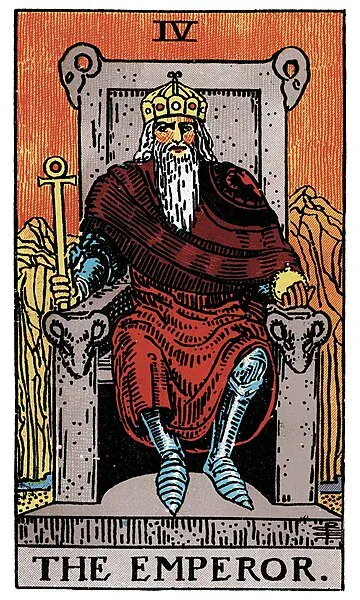
The Emperor
Structural authority meeting personal accounting. The Emperor builds the architecture; Justice rules within it. When they appear together, the matter is both private and institutional — a contract that interacts with employment law, a settlement that touches inheritance, a workplace conflict that runs into HR policy. Use the formal channels; let the institution do its slower, less personal work. Do not try a handshake where the matter has institutional shape.
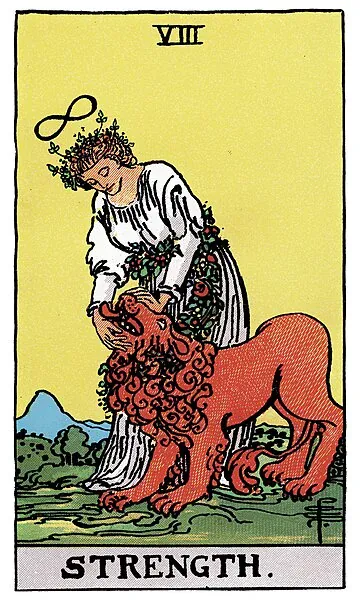
Strength
Inner restraint modulating the outer verdict — the hand that does not strike from rage. Strength is the woman who closes the lion's jaw without violence; Justice is the figure who sets the hand down only after listening has finished. Together they describe the verdict filtered through patience first. The judgment that emerges from inner steadiness does not need to be loud, and does not need the verdict to feel like punishment to feel like resolution.
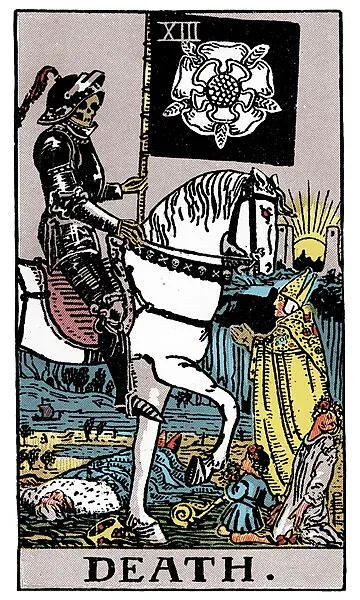
Death
The verdict authorizes the actual ending. Justice issues the ruling; Death performs the close. The divorce papers signed. The resignation accepted. The estate finalized. The relationship ended cleanly enough that both parties can build different lives. This combination is sober but not punitive — the verdict has been issued, and the verdict allows the ending the seeker has been needing. Now the actual ending happens, and life after the ending begins.
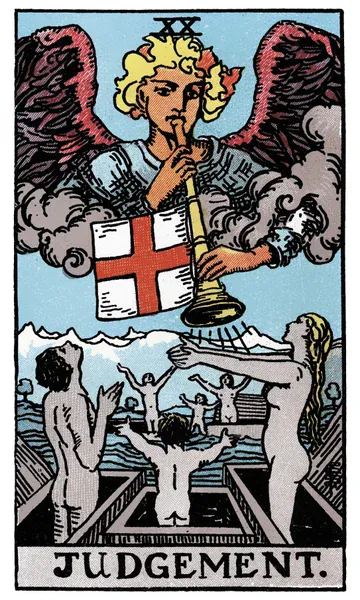
Judgement
Mortal accounting beside cosmic reckoning. Justice is the personal verdict — what is owed, by whom, to whom, in this matter. Judgement is the soul-level call, the rising into the next stage, the great realignment of the whole life. Together they describe the verdict you are weighing as also a threshold the seeker is crossing. Take the verdict seriously. The next chapter is not the same as the one you have been living.
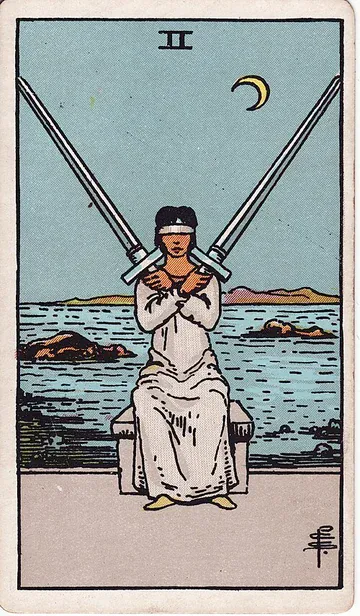
Two of Swords
The blindfolded weighing-stage that precedes the verdict — both cards Libra-coded. The Two of Swords is the listening through silence, the stay in suspension; Justice is the moment the hand sets down. Together they describe the full arc of weighing. If the Two of Swords is dominant, more listening is required. If Justice is dominant, the verdict is due. The sequence cannot be skipped, but it also cannot be lived in forever.
Frequently Asked Questions
Is the Justice tarot card a yes or no?
The Justice tarot card upright is a conditional yes — yes when the matter has been honestly accounted for, with caution when relevant weights have been hidden. It supports decisions, relationships, and contracts that hold up under fair examination, and refuses to bless those that depend on something staying unsaid. Treat it as the considered yes of a fair witness, not the easy yes of the wish-card.
Does Justice mean a relationship is coming to a reckoning?
In love readings, the Justice tarot card describes a relationship reaching an honest reckoning. Unspoken inequities surface and ask to be addressed; agreements that have drifted out of fairness invite revision. For new sparks it accelerates the first real test; for long bonds it supports the conversation that has been deferred. Justice loves through structure — the kept agreement, the named boundary, the verifiable consistency.
What does the Justice tarot card mean as someone's feelings?
When the Justice tarot card appears as feelings, the person is taking you seriously in a deliberate, considered way. They are watching for consistency rather than performing affection. Their reserve is not coolness; it is the reserve of someone who refuses to make promises they will not keep. This is one of the deck's quietly favorable signs for feelings — undramatic, principled, and durable.
What is the spiritual lesson of the Justice tarot card?
The spiritual lesson of Justice is right relation — actions land in the world according to the weight they actually carry, and the soul matures by learning to weigh honestly. The Hebrew letter Lamed is the ox-goad, the teacher's instrument; the path runs from Geburah down to Tiphareth, severity descending into the heart. The work is to let conscience clarify love, not to elevate the ego of the one who judges.
Is Justice a karma card?
Justice is sometimes read as the karma card of the deck, but in a structural rather than punitive sense. It does not describe cosmic punishment; it describes the simple fact that what you put into the world is, eventually, weighed at its actual weight. The card invites honest accounting now so the verdict you live inside is the one you can stand behind, rather than one issued in absentia.