
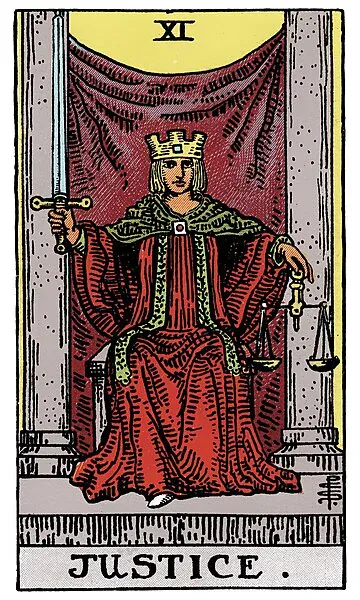
Justice Reversed · Core Meaning
The Justice tarot card reversed is the card of the verdict issued from a tilted scale. The figure in the scarlet robe is still there, still seated between the two gray pillars, the purple veil still hung behind. But the sword leans. The scale is uneven. The white slipper has retreated under the robe; the figure is no longer admitting that she walks. Something has been added to one of the pans that does not belong there — affection, history, fear, alignment, the desire for a particular outcome — and the verdict that emerges, however formally pronounced, will not survive honest review.
This is the reversed card's central knot: judgment without honesty. The justice tarot reversed meaning is not the absence of judgment — judgments continue to be issued, perhaps more loudly than before. The reversal is in the integrity of the weighing. The scale appears level only because the hand on the pan has become invisible, even to the one whose hand it is. The seeker rules on the case while still pressing one side down, and calls the result fair.
There is a second flavor of the reversed card: the refusal to weigh at all. Not biased verdict, but suspended verdict — the matter that has been on the scale for so long that its presence has become the new normal. The conversation never had. The conflict never named. The agreement never updated to reflect what the relationship has actually become. The Two of Swords stretched into a season. Justice reversed in this mode is the card of the moral statute of limitations — the seeker hopes that if the matter is left unweighed long enough, it will resolve itself by erosion. It rarely does. What erodes is trust.
The astrological signature reverses in character without changing planet. Libra upright is harmony actively maintained, Venus working through structure. Libra reversed is harmony performed — the surface of relation kept smooth at the cost of the underlying truth. The cardinal energy that should initiate becomes the energy that defers. The air, which should clarify through speech, becomes the air of the conversation no one is having. Venus, ungrounded, drifts toward people-pleasing and conflict avoidance dressed as kindness.
In the Tree of Life, the path from Geburah to Tiphareth runs from severity into the heart. Reversed, the path is interrupted — severity gets stuck, never reaches the heart, and curdles into self-righteousness; or severity is bypassed entirely, and the heart pretends sufficiency it has not earned. Either way, Lamed the ox-goad becomes the goad pointed at the wrong subject. Either the seeker beats themselves with a verdict the situation does not actually warrant, or beats someone else with a verdict the seeker themselves has not survived examining.
The number tells the same story from the other side. Eleven is one set against one, and reversed the two ones stop facing each other: one becomes the judge and the other the accused, and the card that reduces to two — the High Priestess's number, her pillars, her veil — loses its second chair. The purple cloth behind the figure is the detail worth returning to. Upright it marks a larger measure the verdict must also satisfy; reversed, the seeker has stepped in front of it and is measuring only against themselves. What is fair becomes what feels fair to me, tonight. Ma'at weighed the heart against a feather; the reversed card weighs the heart against the heart's own preference and reports a match. And the hour has moved. The light no longer comes straight down but from one side, and every object on the table throws a long shadow across the other pan.
Reversed, Justice asks: where is your hand? What is the weight you have not acknowledged adding? Whose case have you ruled on without finishing the listening? And — gentler — what verdict have you been issuing against yourself, on evidence that would not hold up if a fair witness reviewed it?
Justice Reversed · Love & Relationships
In love readings, the Justice tarot card reversed describes the relationship whose ledger has been quietly drifting out of fairness, and the partner who has become attached to the drift. The pretense that everything is fine has hardened. The conversation that would re-level the scale has been postponed so many times that postponing has itself become the dynamic. The card is not the card of the broken relationship; it is the card of the relationship that is breaking through being maintained dishonestly, and that has not yet noticed the difference.
For an existing partnership, the justice tarot reversed love reading often surfaces the silent imbalance that both partners know about and neither has named. One does more of the invisible work — the household, the emotional translation, the family logistics — and the other has tacitly accepted the asymmetry. Or one earns disproportionately and uses the earning as unspoken leverage in decisions where it should not weigh. Or one has been forgiven repeatedly for a pattern that has not actually changed, and the forgiveness is starting to feel like a separate form of erosion. The reversed card asks the conversation that the partnership has been protecting itself from.
For a new spark, the reversed Justice card warns of the early warning signs being hand-waved away. The values disagreement that surfaced on the third date has been quietly filed under "we will work it out." The friend whose feedback set off a small alarm has been ignored. The text exchange that did not land right has been re-read in the most generous possible interpretation. The card is not anti-attraction; it is anti-camouflage. The information arriving early in a connection deserves to be weighed early. Discounting it now sets a precedent that will be more expensive to revisit later.
For the single seeker asking whether love is on the way, the justice tarot reversed love answer is gentler than it looks. The card does not say no. It says: the door opens after one specific verdict you have been postponing. Maybe it is the verdict on the previous relationship you have not yet fully accounted for — the part of the ending that was your responsibility, the part you have been narrating in a flattering way for two years. Maybe it is the verdict on a pattern you have been repeating across partners, the small distortion you keep introducing in week three of every connection. The reversed card invites the honest interior court that no new relationship can convene for you.
For love after a wound, the reversed card describes the wound that has not yet been fairly weighed. The story has been told many times, but always from the angle that protects the seeker. The other person was wholly the villain or wholly the saint. The seeker was wholly the victim or wholly the failure. Reality, in most relational endings, is more mixed. The reversed Justice card is not asking you to forgive prematurely. It is asking you to allow a more honest account of what happened, even if the more honest account is harder. The relief on the other side of the harder telling is real, and most people who do this work report that it took less time than they feared.
For the question of reconciliation after a break, justice tarot reversed offers a careful answer. Reconciliation is possible — but only on the basis of a real accounting of what broke the bond the first time, and a real change in the conditions that produced the break. Returning to the same dynamic on the strength of "we miss each other" is the dynamic that will, predictably, break again. The card supports the reconciliation that arrives after both partners have done private work and can bring different shapes back to the table. It does not support the reconciliation that depends on pretending the prior verdict did not happen.
Then there is the couple that has been using love itself as the reason to skip the books. Every grievance goes into one pocket — it does not matter, we love each other, I am not going to be petty — and the pocket holds for years, and then a small thing tears the seam and every old weight falls out at once, onto the floor, in front of everyone. The person on the receiving end of the outburst cannot understand why a forgotten dinner has produced a verdict on the whole marriage. Justice reversed is the card of the pocket the week before the seam gives. If you recognize the pocket, empty it on purpose, one item at a time, while the items are still small enough to be discussed.
A reader in the middle of separating meets the card in its most literal form: the mediation that is not fair, the friends who have been assigned to sides, the version of the ending each of you is telling the children. The reversed scale here is tilted by exhaustion more often than by malice — whoever can bear the process longer gets the better terms, and that is not the same as the right terms. Do not sign in order to make it stop. The card supports getting a fair outside eye — a mediator neither of you chose, a lawyer who has not already been told the story — and it supports it precisely for the person who says they cannot afford one more conversation.
A note on the kind of love the reversed Justice card warns about: the love that becomes a closed jurisdiction. Two people who have built a private legal system in which only their version of events counts, and any outside witness — friend, family, therapist — is dismissed as biased or hostile. It is a harder sentence to read than to write, and it belongs in the record. The closed jurisdiction is the seedbed of long-term relational harm. The card invites the seeker to let one trusted, fair outside voice into the courtroom. Not to outsource the verdict. Just to keep the scale honest.
Justice Reversed · As Feelings
When the Justice tarot card appears reversed to describe how someone feels about you, the feelings are real but the accounting is not. They are weighing you, but the scale is not level. They are issuing verdicts about you — to themselves, sometimes to others — but the evidence has been selectively gathered. This is the card of the partner who has decided who you are based on a few scenes they have replayed many times, while the larger record sits unread.
If they are reserved, the reversed Justice card in feelings can mean private resentment. They have been keeping a quiet ledger of small grievances and have not raised them with you, because raising them would risk the surface of the relationship. The grievances accumulate. The scale tilts. Your access to repairing the dynamic is blocked because you have not been told the dynamic exists. From your side, the connection feels unaccountably cooler than it should. From their side, the connection feels permanently disappointed in a way they have not articulated to themselves.
If they are demonstrative, the reversed card can describe performed fairness — the public posture of "I am being so reasonable about this" that masks a private bias that has already issued its verdict. They will tell mutual friends they are being open-minded. They will use the language of fairness while operating from a place that is not fair. Watch for the partner whose language is unusually formal in moments of conflict — "I just want what is best for both of us" — while their actions consistently favor what is best for them.
For long bonds, justice tarot reversed in feelings can describe the partner who has stopped recalibrating their picture of you. They formed a verdict five years ago — about who you are, what you are capable of, what you can be trusted with — and they have not updated the verdict despite five years of new evidence. You have grown. The verdict has not. The reversed card asks for the conversation that opens the case for review. Sometimes the partner can do this. Sometimes the verdict has hardened into the structure of the relationship in a way that no single conversation will move.
For new connections, the reversed card warns of the early premature judgment. They have decided you are something — promising, intimidating, exactly their type, exactly the wrong type — based on extremely incomplete information. The decision is not malicious; it is just unweighed. Until they meet you more fully, their behavior will be calibrated to a version of you that is largely projection. The work, on your side, is patience without distortion: do not perform the projected version to keep the connection warm. Show up as the actual person. The reversed card releases its grip when reality intrudes consistently enough.
For the question of whether someone is in love with you and the Justice card arrives reversed, read it carefully. They feel something — perhaps strongly. But the feeling has not yet survived honest examination. They may love a story about you more than they love the actual you. They may be using the relationship to balance a deficit in a different part of their life — loneliness, recent loss, professional disappointment — and your role in their feelings has more to do with the deficit than with you specifically. None of this means the connection is impossible. It means the connection requires the next stage to involve more honest weighing on their side, which only they can do.
Asked about an ex, the reversed card describes the case that has been kept open long past its hearing. They are still re-reading the messages, still assembling evidence, still — months on — rehearsing the closing argument to a mutual friend. What they feel toward you is not nothing; it is unfinished prosecution, and a prosecution has warmth of a kind, but not the kind that comes back. Reconciliation with a person in this state is a hearing, not a reunion. Unless you wish to stand trial, the wiser reading is to let their court run out of witnesses.
When the person in question has hurt you, the reversed Justice signature is the flinch away from their own pan. They have decided, privately, that the harm was smaller than you make it or that you provoked it; the story has been told to themselves enough times that it has hardened. Their feelings toward you may be fond, even sorry — and still incapable of the one sentence that would matter, because that sentence would require them to lift the hand. Do not confuse their warmth with accountability. The apology that has not been offered is the accurate reading; the warmth is the veil hung in front of it.
Between friends or colleagues, the reversed signature is the private tally that never gets aired. The friend who has decided you are the one who never reciprocates, on the strength of two canceled dinners and none of the dozen kept ones. The colleague who has filed you as difficult because of a single meeting and reads every later email through that file. The feeling is real and the evidence is thin, and the only remedy the card offers is the boring one: a direct question, asked without heat, that gives them the chance to say what the tally contains before it hardens into the way they treat you.
A small caution embedded in the reversed reading: do not try to win the verdict by performing harder. The reversed Justice card cannot be repaired by your effort alone — the scale is on their side of the relationship. Your work is to remain weight-bearing without distortion. Their work is to lift the hand they have not yet acknowledged is on the pan. If they will not, the verdict you most need to accept is the verdict their unwillingness has already issued.
Justice Reversed · Career & Work
The procedures exist; they are simply not where the decisions get made. That gap is the Justice tarot card reversed at work — a rubric on the table and a verdict that came from somewhere else. The performance review uses the right rubric, but the verdicts were determined two months ago. The promotion process is documented, but the slate of candidates was decided over coffee. The hiring panel scores by competency, but the hire was already chosen before the interviews. The reversed card is the card of the form that masks an outcome which the form did not produce.
For someone in a current role, the reversed Justice card warns of the slowly tilting conditions. The workload has crept upward without a corresponding adjustment in compensation or recognition. The scope of responsibility has expanded, but the title has not. The team's emotional labor has been quietly absorbed by you specifically, and no one is naming it. The card invites the formal conversation. Document the actual scope. Make the case in writing. Bring the matter to your manager with specifics, not impressions. The card is not promising a win in the conversation. It is promising that the conversation, on the record, will produce a verdict you can build on — including, if the verdict is unfavorable, the verdict that this is no longer a place to stay.
For someone considering a new role, the justice tarot reversed in career reads as a warning to interrogate the offer carefully. The role description is doing some work. The compensation looks reasonable until you weigh the equity vesting schedule, the on-call expectations, the actual reporting structure as opposed to the org chart's reporting structure. The card asks for the second conversation with the future manager — not the polished pitch conversation, but the practical one. Ask about a recent failure on the team. Ask how disagreements get resolved. Ask why the previous person in the role left. The answers are the actual offer.
For workplace conflict, the reversed Justice card is one of the deck's clearer mirrors. The conflict has not been honestly described — by you, by them, or by the institutional process meant to handle it. The HR conversation has been proceduralized into something that sounds neutral but functionally protects the company more than either party. The mediation has been weighted by which side has access to legal counsel and which side does not. The card warns against trusting the formal process to produce the just outcome. It can be a tool, but it must be used by you, not used on you. Get your own counsel. Document specifically. Do not assume the procedure is on your side because it is the procedure.
Entrepreneurs and freelancers should read justice tarot reversed in career as the card of the unfair contract about to be signed under the pressure of needing the work. The terms are not great. The payment schedule is bad. The intellectual property clause is overreaching. And the seeker is rationalizing acceptance because the project is exciting or the client is prestigious or rent is due. The card invites the renegotiation that is harder to start than to finish. Most clients will accept a counter-offer. The freelancers who refuse to send the counter-offer because it feels uncomfortable end up funding the client's good quarter with their own bad one.
For a creative practice, the reversed card can describe the season after a public failure that has not been honestly weighed. The reception was mixed, and the seeker has filed it as either total triumph (and is brittle when challenged) or total failure (and has stopped working). The actual record is more nuanced and more useful. What landed? What did not? Why? The reversed card is allergic to both grandiose and self-flagellating retellings of the same body of work. It rewards the close, fair reading.
Handed a severance or a settlement offer, the reader with this card is holding a document written to be signed quickly. The reversed card names what the document counts on: shock, shame, the wish to be out of the building. The number is lower than the policy states. The release of claims is broader than the situation. The deadline is short. Do not weigh it alone, and do not weigh it that afternoon. The seeker who takes the paper to one outside eye before signing is nearly always offered more; the seeker who signs in order to make the feeling stop has ruled on their own case from the accused's chair.
A separate reader sits on the other side of the desk and has been the one saying procedure, custom, this is how we have always done it. The reversed card is not accusing them of malice. It is pointing out that those three phrases are how an uneven matter gets carried past the moment when it could still be corrected cheaply, and that the scale speaks at the next audit whether or not anyone chose to speak first. If you are the one who has been invoking precedent to cover something you know is uneven — the pay band that does not match the scope, the process skipped for one candidate and enforced for another — the cheaper reckoning is the one you initiate.
For someone in a position of authority, the reversed Justice card is one of the most important checks the deck offers. It asks: when you have ruled on someone — a report, a colleague, a vendor — was the ruling fair? Did you finish hearing? Did you weigh your own contribution? Did you account for the pressure you bring just by being the one who decides? The reversed card is the card of the manager who has been issuing verdicts informally and is about to face the formal review of those verdicts in some way they did not foresee. The work is to re-open the cases now, while it is still your court.
Justice Reversed · Money & Finances
In money readings, the Justice tarot card reversed describes the finances that look fine on the surface and are quietly out of true beneath. The accounts balance. The bills are paid. The obvious metrics are okay. And yet, when the books are honestly opened, the picture is not what it has been advertising itself as. There is more debt than the story has been admitting. There is less actual savings than the mental running tally suggests. There is an obligation that has been off-ledger long enough to feel optional, and the seeker is one bad month away from discovering it is not.
For the seeker who has been avoiding the spreadsheet, the reversed card warns that the avoidance has compounded. What was once a simple unpleasant Saturday afternoon has become a project that the seeker now genuinely does not want to face. The card is gentle but firm: the reckoning gets bigger in silence. The actual numbers, however unflattering, are smaller than the imagined numbers. Open the accounts. The relief is on the other side of the opening, not on the other side of the next round of avoidance.
For a question about a specific financial decision, the reversed Justice card invites caution. The math you have been running is missing a variable. The deal you are about to sign has a clause that the verbal explanation glossed over. The investment you are about to make is being justified by a story that, if you wrote it down honestly, you would not endorse. Slow down. Read the document. Run the math on the lose case, not just the win case. The card is not against the move. It is against the move made without honest accounting.
For debts — yours or owed to you — the reversed card warns of the festering ledger. The friend who borrowed and never paid back, and whom you have not asked. The credit card that has rolled forward at interest for so long that you have stopped opening the statements. The shared expense that should have been split and never was. Justice reversed is the card of the postponed conversation that is now actively shaping the relationship by its absence. Make the call. Send the message. The conversation is awkward; the postponement is corrosive.
For investments and gambles, justice tarot reversed in money can describe the moment of doubling down on a losing position out of pride. The trade has not worked, but exiting would mean acknowledging the loss, so the seeker holds — and adds. The card asks whether the holding is calculated or whether it is a refusal to weigh the actual evidence. There is an honest version of holding through volatility. There is a dishonest version that involves not looking at the chart. The reversed card invites the look.
For inheritance, settlement, divorce-financial, and legal-financial matters, the reversed card warns of the soft form of inequity that gets dressed in the language of harmony. "We agreed informally and we do not need to write it down." "I am being generous so we do not have to involve lawyers." "The family will sort it out fairly." The card is allergic to this register. The informal agreement disadvantages whoever is more willing to be uncomfortable, and the seeker who reaches for "we do not need to make this formal" is often the one who should most want it formal. The card supports the legal protection that allows life after the matter to be lived freely.
A practical move when justice tarot reversed appears in a money question: write down every recurring charge currently active on your accounts. Not as judgment. As inventory. Most adults have three to five subscriptions or auto-charges that are no longer serving them, simply because canceling requires fifteen minutes of attention. The reversed card returns to upright through small acts of accounting that have been disproportionately deferred. The relief, again, is real.
Justice Reversed · Health
For health readings, the Justice tarot card reversed describes the body whose ledger has been politely out of true for a long time. The lab numbers are within range, technically. The sleep is sufficient, technically. The symptoms have been there long enough that they have stopped registering as symptoms; they have become the new baseline. The reversed card is the card of the chronic small imbalance that the seeker has stopped weighing, and the slowly compounding cost of that suspension.
The card asks for the honest inventory that has been deferred. How many drinks, actually, in a typical week. How many hours of sleep, accurately reported, not optimistically rounded. How long since the last dental appointment, the eye exam, the routine check, the conversation with the therapist about the medication that is overdue for review. Justice reversed in health is not catastrophic. It is the card of the soft drift that becomes structural if not actively redrawn.
For someone managing a chronic condition, the reversed card describes the season of slipping self-management dressed in the language of self-compassion. The exercise that used to happen has stopped. The monitoring that used to happen has lapsed. The small disciplines that held the condition stable have softened, and the seeker is narrating the softening as well-deserved rest. The card distinguishes between actual rest, which the body welcomes, and chronic neglect, which the body absorbs as wear. Re-engage with the protocol. Not punishingly. Specifically.
For mental health, justice tarot reversed often describes the gap between performing wellness and being well. The seeker has learned the language of therapy well enough to use it as cover. They report being "regulated" while being chronically dysregulated. They describe boundaries they are not actually maintaining. They identify patterns in their relationships that they have not, in fact, addressed. The card is gentle but precise. The vocabulary of healing is not healing. The work is the work, and the work has been quiet for a while.
For acute matters, the reversed card warns against the postponement that has become its own problem. The pain that has lingered. The lump that was supposed to be checked last spring. The cardiac symptom that has been re-narrated as anxiety, possibly correctly, possibly not. The card invites the appointment. Not in panic — in accounting. The body deserves the verdict that an actual examination produces, not the verdict the seeker's fear has been issuing in the absence of one.
For habits that have crept past the line, the reversed Justice card reads cleanly. Alcohol that has moved from social to daily. Cannabis that has moved from occasional to wake-up-with. Screen time that has stopped being a leisure choice and become the substrate of the day. Food relationships that have drifted into a place the seeker would not describe out loud. The card is not punitive. It is honest. The reversed verdict the body has been issuing is that the imbalance is no longer optional to address. The card asks for the honest weighing that has been postponed and the small, sustainable adjustment that follows from it.
A note on the temperance of the reversed card: it is not asking for total transformation. The reversed Justice card is restored to upright through one specific honest accounting and one specific corresponding adjustment, not through a wholesale reformation of the seeker's life. Pick the one most overdue weighing. Do that one. The rest follows. The scale is not a clinician; the prescriptions and the follow-up appointments stay with the people trained to read them. The card simply names the gap between performed health and actual health, and asks the seeker to close it deliberately.
Justice Reversed · Spirituality
Spiritually, the Justice tarot card reversed is the card of the spiritual practice that has been issuing flattering verdicts to its practitioner. The seeker has been on the path long enough to have a vocabulary, has read enough teachings to have a framework, has done enough work to recognize themselves as someone doing the work. And somewhere in there, the work has tilted. The practice has begun to confirm rather than to challenge. The teachings the seeker selects are the ones that flatter the seeker's existing self-image. The practitioners the seeker dismisses are the ones who would refuse to flatter.
This is uncomfortable to read because it lands on most of us at some point. The reversed card is not punishing. It is naming the seedbed of spiritual stagnation. The path becomes a costume. The journal becomes a place to rehearse the version of ourselves we want our future selves to find. The meditation becomes the comfort of having meditated. The reversed Justice card invites the honest interior court that the practice has been protecting itself from.
For seekers in active practice, the reversed card asks one specific question: where has your practice been kind to a part of you that needed challenge instead? The journaling that has not actually addressed the recurring conflict because addressing it would require you to admit something you do not want to admit. The meditation that has not actually examined the relationship pattern because the silence has been used to soothe rather than to see. The teaching you have rejected as not for you because it would have required a verdict you did not want to issue. Pick the one piece. Sit with it honestly for one session. The reversed card returns to upright through specificity, not through a grand reorganization.
For seekers exploring belief, the reversed card warns against the doctrine that has been adopted without honest weighing. The framework that resolves all the seeker's discomfort suspiciously quickly is not necessarily a better framework — it may simply be a more flattering one. Test the doctrine against the actual life. Not against the moments when the doctrine confirms what the seeker hoped. Against the hard moments, when the doctrine asks the seeker to do something the seeker would prefer not to do. The teaching that holds up there is worth keeping. The teaching that does not is worth releasing.
For seekers who have begun to drift toward spiritual bypass — using the language of acceptance to avoid grief, the language of release to avoid accountability, the language of higher self to avoid present-self obligation — the justice tarot reversed is unusually direct. The path is not the bypass. The path runs through the accounting the seeker has been bypassing. Lamed the ox-goad does not exempt the seeker. The teacher's instrument is precisely the one that returns the seeker to the listening they have been avoiding.
A small spiritual practice the reversed card invites: at the close of the day, in addition to gratitude, a brief honest examination of where the day's behavior diverged from the values the practice claims. Not in shame. In accounting. Five minutes. No flagellation. The verdict, written down, is the seal. This is the practice the upright Justice card supports as well, and the reversed card insists upon. The seeker who can sit with the daily honest reckoning without flinching is the seeker whose practice is real. The seeker who cannot is the seeker whose practice has tilted toward the costume.
For questions about path, the reversed Justice card asks whether the path you have been narrating is the path you have actually been walking. Not aspirationally. Actually. The white slipper is on the ground. You walk. The walking is the path. Where the walking and the narration diverge, the truth is in the walking, and the work is to bring the narration into honest alignment with what the feet have actually been doing.
Justice Reversed · Yes or No
Soft no — the scale is not yet level.
The justice tarot reversed yes or no answer is the no that is not punitive. It is the no that says: the matter cannot be ruled on yet because the weights have not been honestly placed. The verdict you would receive from the current setup of the scale would be a verdict you could not stand behind. The card refuses to bless an outcome that depends on something staying unsaid. Set the scale fairly first. The yes is on the other side of the level pan, or it is no.
For yes-or-no questions about a relationship, the reversed card answers no to the version of the relationship you are asking about — but does not necessarily answer no to a future version of the relationship. The question presumes a setup that the reversed card does not endorse. Will this work as it currently is? No. Could it work after the conversation that has been postponed? Possibly — but that is a different question, asked of a different setup.
For yes-or-no questions about a job, an offer, a contract, justice tarot reversed answers caution. The deal as currently structured does not weigh fairly. The compensation does not match the scope. The clause hidden in section twelve does not match the verbal pitch. The card is not telling you to walk away. It is telling you that signing without renegotiation produces a verdict the seeker spends the next eighteen months wishing they had refused. Counter-offer. Ask for the change. The yes lives there.
For yes-or-no questions about a legal or financial matter — a settlement, a tax matter, a lawsuit — the justice tarot reversed yes or no reading warns of an outcome shaped by something other than the merits. The case may be technically winnable and the seeker may still lose because of representation, timing, the specific judge, or a procedural matter the seeker has underestimated. The card is not pessimistic; it is realistic. The verdict is not necessarily fair. Plan accordingly.
For binary questions about whether to act now or wait, the reversed card tilts toward wait. Not indefinitely. Long enough for the matter that has been distorting the scale to be addressed. A week. A month. The duration of one specific conversation. The card is not blessing perpetual delay — perpetual delay is the reversed card's other failure mode. It is blessing the deliberate pause that lets the next move come from a level scale.
Asked how soon the matter settles, the reversed card answers: not on the schedule you have been assuming. The matter will resolve when the actual obstacle resolves, and the actual obstacle is not the one the seeker has been treating as the bottleneck. Find the real obstacle. Address that. Then timing becomes a question of weeks rather than the indefinite stretch the matter has been occupying.
If the question was: have I been wronged? The reversed card answers more carefully than the seeker may want. It says: possibly — and possibly less than the version you have been telling yourself. The reversed Justice card refuses to bless the verdict that has been issued from one chair only. It invites the seeker to listen to the part of the case they have not yet heard, including the part of the case where their own action is on the pan. The verdict that survives this is the verdict worth holding.
Justice Reversed · Advice
The advice of the Justice tarot card reversed is to find the hand. There is one. There always is, in the reversed card. Affection, history, fear of being wrong, fear of being seen as wrong, the comfort of the existing imbalance, the avoidance of the conversation that the new verdict would require — something is pressing one side of the scale down, and the seeker has been calling the result fair because the seeker has not yet looked under the table. The first instruction of the reversed card is the look.
If there is one specific instruction the reversed card offers, it is to re-open one closed case. Pick a verdict you have issued — about a person, a relationship, a job, a friend, your past self — that you have stopped questioning. Re-open it for one honest hour. Read the evidence you originally underweighted. Listen to the version of the story you originally dismissed. The card is not asking you to reverse the verdict. It is asking you to confirm or revise it on the basis of an actual review. Most adults have three to five closed cases that, honestly re-opened, would produce different verdicts. The freedom on the other side of the revision is real.
A second instruction: lift the hand from the scale. The hand in the reversed card is rarely malicious. It is usually fear-shaped. The fear of losing the relationship if you actually weigh it honestly. The fear of having to leave the job if you actually account for the cost. The fear of facing the financial picture if you actually open the account. The reversed card asks you to identify the fear specifically — not abstractly — and then to weigh anyway. The fear is real. The fear's verdict is not necessarily right. The card supports the courage of the actual look.
A third instruction: stop ruling on cases that are not yours. The reversed Justice card sometimes describes the seeker who has become the unappointed judge of other people's lives — friends' relationships, colleagues' decisions, family members' choices — while their own ledger sits unweighed. The energy spent issuing verdicts on others is energy that is not available for the verdict overdue at home. Withdraw from the cases that are not yours. Return the attention to the case that is.
A fourth instruction, gentler than the others: forgive the past verdict you issued from a tilted scale. Most seekers have, at some point, ruled on someone unfairly — out of grief, out of injury, out of the immaturity of the version of themselves that was doing the ruling. The reversed card is not asking you to grovel. It is asking you to acknowledge, name the specific instance, and where possible, repair. Where not possible, release. The closed case in someone else's record can be quietly amended in your own.
A fifth instruction, for the seeker who has been carrying a chronic verdict against themselves: weigh that one too. The internal court has been in session for years, sometimes decades, on charges the seeker has never let a fair witness review. The verdict against the self has accumulated weights that have nothing to do with the actual evidence — childhood scripts, the voice of a critical caregiver, the comparison to the sibling, the failure narrated by an industry that benefits from the failure being narrated. Re-open the case. Hear the actual evidence. The reversed card frees the seeker most reliably through the honest re-weighing of the verdict against the self.
Practical advice for the day Justice reversed appears: identify the one conversation, document, or accounting you have been postponing the longest. The thing that comes to mind first when you read this paragraph. That one. Begin it today. Not finish — begin. Send the first email. Open the first folder. Make the first call. The card returns to upright through specific, dated, honest first moves. Most of what gets called "needing more time" is the avoidance of the move that would not, in fact, take that long.
Justice Reversed · Card Combinations
Justice Reversed + The Emperor
Authority issuing tilted verdicts under the cover of legitimate structure. The institution looks formal — the policies are documented, the procedures are followed — and the actual decisions are being made by something other than the formal record. This combination warns of the workplace where due process is performed but the outcome is foregone, the family system where the rules apply differently to different members, the legal matter where the technical procedure protects the institution more than the parties. The work is to recognize that the form is not the substance, and to advocate at the level of substance — outside counsel, outside witness, outside review.
Justice Reversed + Strength
The verdict that has been issued from anger rather than weighed restraint. Strength reversed itself, paired with reversed Justice, describes the seeker who has lost the inner steadiness and is ruling from the lion's mouth rather than the lion's tamer. The combination invites a step back. Do not deliver the verdict in the heat. Sit with the case overnight. The judgment that holds up tomorrow is the judgment worth issuing. The judgment that requires today's adrenaline to feel right will look different by next week.
Justice Reversed + Death
A verdict authorizing an ending — but the verdict was issued from a tilted scale. This combination warns of the breakup, the resignation, the cutoff that comes from a story the seeker has not yet honestly weighed. Death will perform the ending the seeker authorizes. If the verdict was unfair, the ending will be unfair, and the seeker will spend the next chapter re-litigating it internally. The work is to weigh the case honestly first. If the ending still belongs, Death does its work cleanly. If the ending was a flinch dressed as a verdict, Death will end something the seeker did not, on reflection, want ended.
Justice Reversed + Judgement
A reckoning that has been refused. Judgement is the call of the soul to stand and be counted; reversed Justice is the seeker pressing one side of the scale to avoid being honestly counted. Together they describe the moment when the cosmic invitation to integrate has arrived and the seeker has tried to negotiate the terms. The combination is uncomfortable but not punitive. The call is still open. The integration is still available. But the seeker is being asked to set down the verdicts they have been issuing in lieu of the one they have been avoiding receiving. The work is to stand in the level scale and let oneself be weighed.
Justice Reversed + Two of Swords
A double card of suspension, both Libra-coded. The Two of Swords is the blindfolded weighing that precedes Justice; reversed Justice is the verdict issued without finishing the weighing. Together, they describe the seeker who has neither remained honestly suspended in the listening nor ruled honestly from the scale — they have done both halfway, and the matter has stalled in the worst possible state. The work is to choose. Either return to the genuine listening (set the verdict down, reopen the case, hear the part you have been refusing) or actually rule (lift the hand, level the scale, set the hand down honestly). The unsustainable position is the half-rule with the half-listening. Pick a chair.
Justice Reversed + The Empress
Venus in the garden and Venus with a tilted scale. This pairing describes generosity used as a way to avoid the ledger — the parent who gives lavishly so that fairness between the children is never discussed, the partner whose gifts arrive precisely when the conversation about money is due, the founder so warm that no one wants to raise the equity split. The abundance is real. The accounting is being skipped underneath it, and what is skipped compounds. Read it as a call to accept the gift and still open the books; the two are not opposed, and the Empress's harvest is the one thing that does not survive a decade of unspoken terms.
Justice Reversed + Seven of Swords
The verdict that has already been arranged. The Seven of Swords carries the blades away under cover; reversed Justice is the court that has agreed not to notice. Together they describe the matter in which something was taken quietly and the process meant to weigh it has been set up so the taking never reaches the pan — the audit that skips the one account, the review that does not interview the one witness, the family conversation that never mentions the one sibling. If you are on the losing side, the pairing tells you to stop expecting the procedure to find what it was designed not to find, and to bring the evidence yourself. If the hand under the cloak is yours, the pairing is the last quiet moment before the count comes up short.
Card Combinations

The Emperor
Structural authority meeting personal accounting. The Emperor builds the architecture; Justice rules within it. When they appear together, the matter is both private and institutional — a contract that interacts with employment law, a settlement that touches inheritance, a workplace conflict that runs into HR policy. Use the formal channels; let the institution do its slower, less personal work. Do not try a handshake where the matter has institutional shape.
Strength
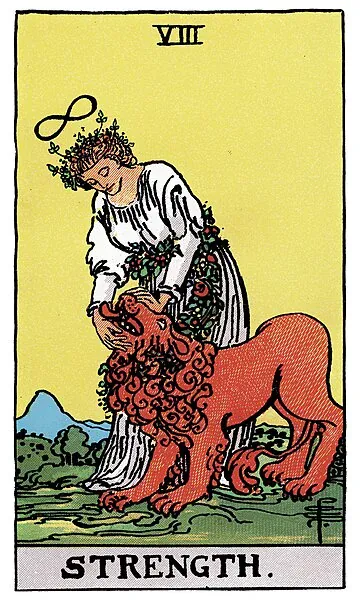
Inner restraint modulating the outer verdict — the hand that does not strike from rage. Strength is the woman who closes the lion's jaw without violence; Justice is the figure who sets the hand down only after listening has finished. Together they describe the verdict filtered through patience first. The judgment that emerges from inner steadiness does not need to be loud, and does not need the verdict to feel like punishment to feel like resolution.
Death
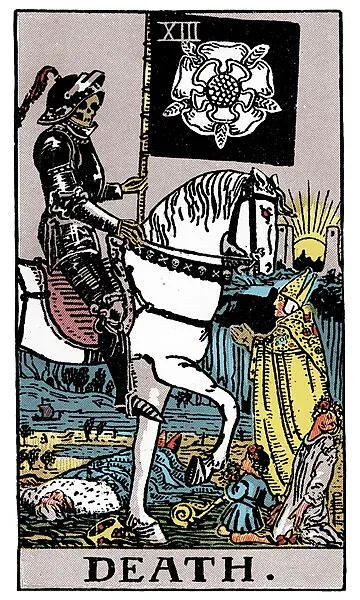
The verdict authorizes the actual ending. Justice issues the ruling; Death performs the close. The divorce papers signed. The resignation accepted. The estate finalized. The relationship ended cleanly enough that both parties can build different lives. This combination is sober but not punitive — the verdict has been issued, and the verdict allows the ending the seeker has been needing. Now the actual ending happens, and life after the ending begins.

Judgement
Mortal accounting beside cosmic reckoning. Justice is the personal verdict — what is owed, by whom, to whom, in this matter. Judgement is the soul-level call, the rising into the next stage, the great realignment of the whole life. Together they describe the verdict you are weighing as also a threshold the seeker is crossing. Take the verdict seriously. The next chapter is not the same as the one you have been living.
Two of Swords
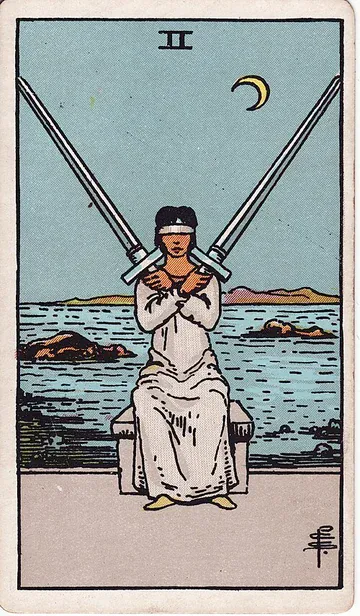
The blindfolded weighing-stage that precedes the verdict — both cards Libra-coded. The Two of Swords is the listening through silence, the stay in suspension; Justice is the moment the hand sets down. Together they describe the full arc of weighing. If the Two of Swords is dominant, more listening is required. If Justice is dominant, the verdict is due. The sequence cannot be skipped, but it also cannot be lived in forever.
Frequently Asked Questions
Is the Justice tarot card reversed a yes or no?
The justice tarot reversed yes or no answer is a soft no — not punitive, but procedural. The card refuses to rule on a matter whose scale is tilted by something unacknowledged. Whatever you are asking about cannot be blessed in its current setup; the obstacle is not the matter itself but the bias or evasion shaping how the matter is being weighed. Address the tilt; then the answer becomes available.
What does the Justice tarot card reversed mean in love?
The justice tarot reversed love reading describes a relationship whose ledger has drifted out of fairness and whose partners have grown attached to the drift. Unspoken inequities. The conversation indefinitely postponed. The premature verdict on each other that has stopped being updated. It does not mean the relationship is doomed; it means the relationship requires the honest accounting that has been actively avoided. For reconciliation questions, the card supports return only after real change in the conditions that broke the bond.
What does the Justice tarot card reversed mean in career?
Justice tarot reversed in career describes the workplace where formal procedures exist but the actual decisions are being made by something other than the procedures — the predetermined slate, the politically negotiated outcome, the contract whose verbal pitch does not match the document. The card invites you to interrogate the offer carefully, document scope honestly, and refuse to assume the procedure is on your side simply because it is the procedure.
What is Justice reversed warning about?
Justice reversed warns about the verdict issued from a tilted scale — bias dressed as principle, evasion dressed as patience, self-justification dressed as inner work. It describes the moral statute of limitations the seeker is hoping will resolve a matter that will not resolve through erosion. The card asks you to find the hand pressing one side down — yours or someone else's — and lift it before any verdict, however formally issued, can stand.
How do I integrate Justice reversed?
Re-open one closed case you have stopped questioning, and review it honestly. Lift the hand on the scale by naming the fear shaping the imbalance. Stop ruling on cases that are not yours; return the attention to your own ledger. Where you have ruled unfairly in the past, name the instance and repair what you can. Where the chronic verdict is against yourself, weigh that one honestly too — most of those weights were placed by voices that were never fair witnesses.