
King of Pentacles · Core Meaning
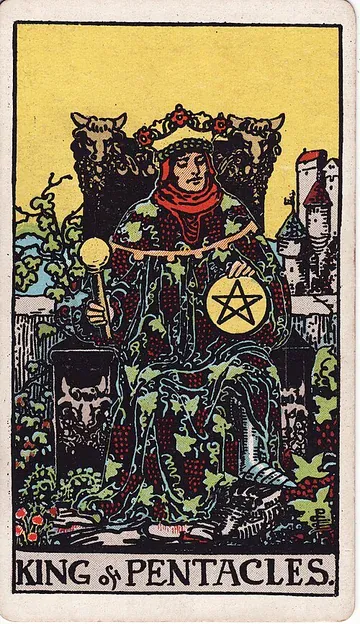
The King of Pentacles sits on a stone throne ringed in grapevine, the arms carved with bulls' heads. His robe is embroidered so densely with ripe bunches of grapes that the cloth itself seems to be telling him: already borne fruit. In his left hand a golden five-pointed star rests against his thigh; his right hand holds a scepter topped with a gold orb. Below his feet, ramparts. In the distance, a castle stands quietly, never once glanced at. He does not need to look. The realm is already there. The king has been there long enough that the realm has shaped itself around the chair.
This is the card of established mastery — not the moment of arriving, but the long season afterward, when the table has been set for years and the question is no longer whether the harvest will come but how to keep it from rotting in the storeroom. The Knight of Pentacles plowed; the Queen of Pentacles tended; the King of Pentacles has lived long enough on the land that he has become the land's grammar. His power was not seized in a war. It grew up around him out of patience, ledgers, contracts honored, mouths fed. The bulls on the arms of his throne are not trophies. They are emblems of the ground he understood.
The signature tension of the card is the difference between protection and possession. Everything the king holds, he has earned, and everything he has earned is now being asked to outlast him. The closed orb in his right hand is not a hoard — it is a charge. He can no longer expand. He can only steward. This is harder than it sounds. The instincts that built the estate (push outward, take more land, plant another field) are the wrong instincts for keeping the estate alive after the builder is gone. The king's work is to convert himself into something other than himself: a written rule, a trained successor, an institution.
The traditional astrological signature places the King of Pentacles on the Aries third decan into the Taurus first decan — the cusp 4/11 to 5/10. Aries' last decan is Mars-ruled fire pushing into the final pulse of expansion; Taurus' first decan is the planted ground itself, Venusian and slow. The king occupies the bridge — the will of the conqueror cooled into the patience of the gardener. The Court itself reads as earth-of-court with an inner element of air: he is the ventilation in the granary, the column lines in the ledger, the structure that keeps abundance from souring. Not cold regulation. The wind that lets the wheat breathe.
Read the King of Pentacles in any spread as the answer that arrives in writing. Whatever the question, the king answers with a document, a deed, a dependable presence — not a poem. He is the partner who adds your name to the insurance. The boss who keeps your bonus the year the company tightens. The father who never said "I love you" out loud but paid for the dentist for thirty-five years. He is also, in the wrong light, the man who confused his bank balance with his soul. Read him carefully. The pause between his stewardship and his miserliness is one of the most important pauses in the deck.
King of Pentacles · Love & Relationships
Dependability is the romance here, and the King of Pentacles does not apologize for that. He is not the flashy lover and not the high-romance card. He is the partner who shows up — at the surgery, at the airport, at the parents' anniversary dinner — and who keeps showing up after the high romance of the first year has settled into the slower architecture of a life. Whatever the shape of the bond, this card means the ground beneath the relationship has been quietly built. There is a foundation under the feet that you may not have noticed because you were not standing on a fault line.
For an existing partnership, the King of Pentacles describes the season of established mutuality. The arguments about money have been worked out. The arguments about whose family hosts which holiday have been worked out. The body has stopped flinching when the door opens. He has put your name on accounts you forgot existed. She remembers the medication you take and refills it without being asked. The king's love language is the language of provision that does not announce itself. Read this card in a long bond as confirmation that the structure is sound, the partner is steady, and the work — if there is work — is to keep noticing the love that has stopped needing to be performed.
For a new spark, the King of Pentacles often arrives when the right person finally shows up after a long stretch of starter relationships. They are slightly older or slightly more settled than your last partner. They have a job they do not complain about, an apartment they own or rent reasonably, a circle of friendships that have lasted a decade. They are not exciting in the cinematic sense. They are exciting in the ordinary sense — the sense of recognizing, over the second dinner, that you are sitting across from someone who would never lie about the rent. If you are accustomed to chaos, the king can feel boring. The card asks you to slow down. The dependable man is not boring. He is uncommon.
For a single seeker who is asking whether love is possible, the King of Pentacles answers yes — and adds that the love this card describes looks like an estate, not a fireworks display. The shape is not the swept-off-your-feet shape; it is the welcomed-onto-the-property shape. The card warns against the pattern of dismissing the steady partner as not enough because their texture differs from the chaos you have been calling chemistry. Sit at the table with the steady person. Eat the meal. Notice that the meal is real.
For love after a wound — divorce, betrayal, a long grief — the King of Pentacles is one of the kinder cards. He is the partner who arrives after the storm has wrecked you. He has lived long enough to have wrecks of his own. He does not need you to be unbroken. He needs you to be honest about what was broken and to let him stand near it. This is the card of late-life remarriage, the second relationship that lasts because both people have stopped pretending. Receive carefully.
The card's particular love language is provision. He pays the bill before you reach for it. He drives in the rain because he prefers you not drive in the rain. He upgrades the appliances without telling you. He calls the contractor about the roof without making it your problem. None of this is romance in the abstract sense. All of it is romance in the lived sense. Some readers, raised on louder partnership models, miss this love language entirely. They feel under-loved. The card asks them to look at what is actually being done, not at what is being said.
For the question of "is this person in love with me" and the King of Pentacles arrives upright, read it as a quiet, deliberate yes. He has integrated you into his finances or his calendar or his five-year plan. He is not playing it cool. He is making space — slow, structural space, the kind that stays. He may not have said the word love yet. He has already said it in everything that requires actual cost.
For partnerships under financial pressure, the king is the card of the steady earner who weathers the bad year. He picks up the slack. He does not score it. He does not make the partner who is struggling pay for the struggle in shame. This is the upright king at his best — power that has stopped needing to be visible.
For partnerships where the question is commitment — engagement, marriage, the children conversation — the King of Pentacles is one of the deck's clearer green lights. He commits the way he does everything else: in writing, with witnesses, with a structure designed to last beyond the two of you. If he is taking time, it is not hesitation. It is precision. He is not committing until he can deliver.
A note for queer and non-traditional partnerships: the King of Pentacles is not a gendered card. The figure is masculine in the deck's iconography, but the role he plays — the dependable provider, the patron of the household, the legal-spine of the relationship — appears in any gender. Read the card as the role, not the body. Your steady-handed partner of any gender, who handles the practical scaffolding so the rest of your shared life can stay tender, is a King of Pentacles.
King of Pentacles · As Feelings
Settled, deliberate, quietly invested — the King of Pentacles reports a feeling the way a surveyor reports land. He does not feel about you the way a young suitor feels — the spike, the flutter, the breathless announcement to friends. He feels the way a man who has spent decades distinguishing real value from passing infatuation feels: he has decided you are worth a chair at his table, and he is not in the habit of revising those decisions.
If he is reserved by nature — and the King of Pentacles personality often is reserved — read his silence as accounting, not absence. He is putting you into the ledger of his life. He is moving line items. He is calling his accountant to make sure that adding you does not destabilize the structure he has spent forty years building. None of this is unromantic. All of it is the way this particular character loves. The man who never says "I love you" but who has quietly transferred half of everything to your name has not failed at romance. He has executed it.
If he is demonstrative — and some King of Pentacles types are, especially after long marriage or in cultures where patriarchs perform warmth publicly — his demonstration is logistical. He shows up to the airport. He brings the cooler with the food you like. He has called ahead and arranged the upgrade. He is hosting his feeling for you in the form of made arrangements. Receive this as the love it is, not as the love language you wished he had.
For a long bond, the King of Pentacles in feelings is one of the most reassuring cards in the deck. He has stopped wishing you were different. He has stopped wishing the relationship were different. He has settled into what is — and what is, to him, is good. The years have not eroded his appreciation; they have refined it. He notices small things you no longer notice about yourself. He has memorized the rhythm of your sleep, the food that makes you ill, the friends who drain you, the friends who restore you. He may never narrate any of this to you. He simply uses it.
For a new connection, the King of Pentacles in feelings means he has decided you are not a phase. This is unusual for him; he has been around long enough to have seen most things turn out to be phases. The fact that he is investing structurally — calendar, money, mutual friends, future plans — means his interior verdict on you has shifted from possibility into permanence. Take this seriously. He does not move things into permanence lightly.
For someone who has been single for a long time and finds this card describing a new prospect's feelings: he is taking longer than the usual modern courtship demands because he is making sure. Do not read his measured pace as disinterest. His feelings are present. His system requires verification. If you can tolerate the pace, the verification is what makes the eventual commitment unbreakable.
A caution runs through the grapevines stitched across his robe. The King of Pentacles personality, in his shadow form, can confuse providing for you with knowing you. He can pay for everything and never ask what you need. He can host the family without ever sitting across from any one member of it. If you sense his feelings as warm but undirected — as if you happen to be the current occupant of a chair he would have set for any acceptable partner — that is the shadow speaking. Most upright Kings do not behave that way. The card in its full upright voice means he chose you, not the role you fill. But the line is real and worth watching.
For the Aries-third-decan / Taurus-first-decan signature carried in the card's astrological span: there is fire still in his feelings, even if it has been buried under a quarter-century of restraint. He is more passionate than he reads. The cusp from late Aries into early Taurus is an unusual band — the will of conquest cooled into the patience of cultivation. His feelings, when stirred, run hotter than people expect. Couples who have been married to a King of Pentacles for thirty years often know this; the public servant of the family is, in private, more romantic than the deck's iconography suggests.
Take the King of Pentacles in feelings as confirmation that the emotional ground beneath the question is sound. Whatever he feels, he has thought about it. Whatever he feels, the actions match the feeling. The work, if there is work, is yours: to read his actions as the romantic dialect they are, not as a deficient version of someone else's louder one.
King of Pentacles · Career & Work
In career readings, the King of Pentacles upright is the card of the patron, the institution-builder, the person whose work has accumulated into something that outlasts a single project. The bonus comes through. The contract gets honored. The boss who said he would back you up backs you up in writing, on the day of the conflict, in front of the people who needed to hear it. The card describes the moment your career stops being a sequence of jobs and starts being a body of work attached to a name people recognize.
If you are asking whether a current role will turn out well, the King of Pentacles answers yes — with the caveat that the role's value will compound over time rather than spike. You are not in the right place for a meteoric promotion. You are in the right place for the long, quiet build that becomes a senior partnership in fifteen years, a department named after you in twenty, a pension that lets your grown children stop worrying about you. The card asks you to read your career on a longer timeline than the surrounding tech industry's quarterly noise. The king does not chase the next launch. He builds the company he can leave to a successor.
For someone considering a new role, the King of Pentacles upright is the card of the offer worth taking. The compensation is fair. The benefits are real. The boss will be on your side when you need them on your side. The institution is solid enough that the work you do will not vanish in the next reorganization. The only question the card asks before you sign is whether the role will let you eventually own a piece of it — a department, a product line, a real seniority. If the role is a glorified individual contributor seat with no ladder, the king sighs. If the role offers a real path toward stewardship, the king nods.
For entrepreneurs and freelancers, the King of Pentacles is the card of the practice that has matured into a small institution. The clients return. The reputation precedes you. Referrals do most of your sales work. The card describes the season after a small business stops being a hustle and becomes a firm — when the freelancer becomes a studio, when the consultant becomes a partnership, when the artist becomes someone with a reputation that survives between projects. Read the card as confirmation that the practice can hold weight. The work now is to professionalize: contracts, invoicing terms, a successor who can take a meeting in your place when you are sick, a brand that exists separately from your personal exhaustion.
For someone in the senior phase of a long career, the King of Pentacles asks the harder question: what are you building that outlasts you? Most professionals never reach this card's altitude. Those who do face a particular task — the conversion of personal mastery into something transmissible. Mentorship. Documentation. The book that records the methods. The institution that codifies the tradition. The protégé whose career you carry on your shoulders for a few years until they can carry it themselves. The card warns against the late-career version of arrival without succession: the brilliant practitioner who never trained anyone, whose entire body of knowledge dies with them.
For a job search after layoff or career pivot, the King of Pentacles upright is reassuring — not because the search will be quick, but because the search is for a real thing. You are not looking for a paycheck. You are looking for a chair you can settle into for the long stretch. Take the time. Decline the offers that do not fit. The right one will look like home, not like a stepping stone.
For creative practices, the King of Pentacles describes the artist who has built a body of work substantial enough to support the next generation. The musician who runs the small label. The writer with the imprint. The painter whose studio takes apprentices. The card asks whether you are still working on your own next project at the expense of the practice that should outlast you, or whether you are starting to see your work as part of a larger architecture. Both are possible. Both are honorable. The card simply names the choice.
For ambition and the question of whether to chase a bigger opportunity: the King of Pentacles is generally not a card of expansion. He is a card of consolidation. If you are torn between the bigger flashier role and the steadier rooted one, the card almost always points you toward the rooted one. The flashier role will burn brighter. The rooted role will outlast you. Choose the role you would still be proud of in twenty years when the industry has moved on.
For workplace conflict — a difficult colleague, a contested promotion, a political mess — the King of Pentacles advises documentation. Put the agreements in writing. Confirm the verbal commitments via email. Make sure the next person who joins the company can read what was decided without needing to ask three different witnesses. The king solves political problems by writing them into a structure that makes politics less effective.
For questions of authority and recognition at work, the upright King of Pentacles validates what you are sensing — your authority is real, your seniority has been earned, your name carries weight. The work is to use it carefully. The senior figure who throws their weight around devalues their own currency. The senior figure who deploys it sparingly, only when the situation demands, keeps the currency strong for decades.
King of Pentacles · Money & Finances
Money arrives in writing when the King of Pentacles is upright. The estate is solid. The portfolio is diversified. The accountant is competent. The retirement plan was made twenty years ago, contributions have continued, and the math now works. Whatever the financial question you brought to the deck, the king answers with the slow, deliberate confidence of someone who has lived through three downturns and emerged each time with the foundation intact.
For a question about whether a financial plan will work, the King of Pentacles answers yes. The plan is sound. The numbers are real. You have been more careful than you give yourself credit for. The card asks you to stop second-guessing the structure you have built and to start trusting it. This is one of the deck's clearest green lights for boring financial decisions: increase the retirement contribution, refinance the mortgage, consolidate the accounts at the credit union your parents used. The king's money advice is rarely glamorous. It is almost always correct.
For someone managing scarcity — paying down debt, saving for a first home, building a buffer after a hard year — the King of Pentacles describes the season when the climb stops feeling impossible. The numbers tip the other direction. The interest works for you instead of against you. The cushion grows. The card is the card of the long climb that finishes — not in a windfall, but in the quieter realization that you are no longer afraid to open the bank app on Monday morning. There is a particular dignity in this kind of arrival, and the king carries it.
For a question about a financial bet, an investment, a big purchase, the King of Pentacles answers with measured caution. He does not reject risk. He examines it. He asks what the downside looks like if the bet fails — not as catastrophizing but as planning. If the downside is survivable, take the bet. If the downside would unwind the ground beneath your life, do not. The king has lived long enough to have seen friends destroyed by single bad bets. He is not impressed by upside without a floor. Build the floor first. Then take the swing.
For windfalls — inheritance, lottery, the unexpected check, the sale of an asset that appreciated more than you expected — the King of Pentacles' counsel is to do nothing fast. Park the money. Let it sit in a high-yield account for six months. Read the situation. Talk to a fee-only advisor. Decide deliberately. The windfall not handled with care evaporates faster than the long earned dollar. The king has seen this happen and warns gently.
For investment philosophy in general, the upright King of Pentacles is on the side of the boring index fund, the diversified portfolio, the low-fee broker, the contributions that compound for forty years. He is not on the side of the stock tip from a friend, the speculative crypto trade, the leveraged bet on the company everyone is talking about. None of these are immoral to him. He simply knows the math. The math says boring wins. He has watched it win across decades.
For debt, the king's counsel is honest: pay it down systematically, in order of interest rate, automating the payments so willpower is not required. Close the accounts that got you into trouble. Build a buffer that means you do not need to borrow again for ordinary surprises. Read the card not as judgment about how you arrived in debt — most adults arrive at debt for reasons that are, in retrospect, understandable — but as guidance about the way out.
For the seeker accumulating real wealth for the first time — the late-thirties professional whose income has finally outpaced their lifestyle, the entrepreneur after the first profitable year, the heir of a small estate — the King of Pentacles' particular wisdom is this: the difficult financial work of the next decade is not earning more. It is holding. New wealth is psychologically destabilizing. People who arrive at it without preparation often blow it within a few years through overspending, status-chasing purchases, or relationships that drain the new resource. The card describes the discipline required to let new wealth solidify into ground you can stand on for the rest of your life. Do not buy the house at the top of your range. Do not upgrade everything at once. Do not announce the new wealth to circles that will tax it socially. Sit with it. Build slowly. The king has the bull-carved throne because he resisted the impulse to flaunt it for the first decade.
For estate planning, generational wealth, family money, the King of Pentacles is one of the deck's most direct cards. Make the will. Update the beneficiaries. Have the conversation with your spouse about what happens if. Sit down with the children, even the young ones, and talk about what the family's relationship with money is and is not. The card's whole posture is the conversion of personal earnings into something that survives the personal life — and that conversion does not happen by accident. It happens because someone wrote it down.
King of Pentacles · Health
The King of Pentacles does not offer the body of perfect youth; he offers the body of someone who has learned to run the one he has. The metrics are stable. The sleep is mostly adequate. The diet has been adjusted over years to fit what the body actually responds to. The doctor's appointments happen on schedule. After a long stretch of either ignoring the body or fighting it, this card means the relationship has matured into stewardship.
The card's elemental signature is earth — and within the court structure, earth-of-earth bracing with air-within. The traditional body associations are the skeleton, the joints, and what older readers call the purse: the belly's slow digestive work, the structural systems that hold the body upright across decades. Read the king's health as a question about the foundational systems rather than the surface ones. Bone density. Joint mobility. The slow processes that show up in the seventies and eighties, depending on what you did in your fifties.
If you are asking whether a treatment will work, whether a procedure will go well, whether a recovery will hold, the King of Pentacles answers yes — with the caveat that the king is patient. The recovery will be on the body's timeline, not yours. The sprain will heal in eight weeks, not three. The surgery's full integration into normal life will take a year. The card asks you to plan for the actual recovery timeline, not the optimistic one your calendar wants. Take the leave. Do the rehabilitation. Do not return to lifting heavy things until the body has signed off. The king has lived long enough to have seen what happens to the people who skipped the boring middle of recovery.
For someone managing a chronic condition, the King of Pentacles is one of the more reassuring health cards. The condition does not disappear. The condition has a manageable structure. You have learned the medication regimen. You have learned the foods that flare it. You have learned the doctors who actually listen versus the ones who do not. The card describes the long maturity of living well alongside a body that is not going to be unbroken — and the dignity that emerges from that maturity.
The card's specific health caution for those carrying its energy unbalanced is the seated body. The king sits on his throne. He does not move enough. The estate has been built on the back of long hours at a desk, in meetings, behind a wheel. Cardiovascular health and joint mobility are the systems most likely to deteriorate quietly. Walk. Lift. Stretch. The king's body holds up under stewardship; it deteriorates under sedentary management. None of this is medical advice — see your practitioner for the specifics — but the card is nudging the seeker to get up from the throne every hour.
For someone managing weight, food relationships, or appetite, the upright King of Pentacles describes the season of stabilization. The disordered patterns of the twenties or thirties have settled. The body knows what foods do what. The relationship to eating has become routine in the steady sense, not the punishing sense. The card is on the side of nourishment — real meals, eaten at the table, with attention. It is against the snack-driven, screen-eating habits of overworked professional life. It is against treating food as either reward or punishment. The king eats. He enjoys what he eats. He stops when he is full. He has been doing this for decades.
For mental health questions, the King of Pentacles is the card of the steady baseline. The depressive seasons have not vanished, but they have become predictable in their rhythm and you have learned the practices that help — sleep hygiene, exercise, the small rituals that anchor a hard week. The anxiety that ran wild in earlier life has settled into something you manage rather than something that manages you. The therapeutic work, if there has been any, has paid off in compounded ways. None of this means the mind is unbroken. It means the mind has been honored long enough to have agreed to a working partnership.
For physical pain and joint issues, especially in seekers over forty, the king is honest. Slow down. Listen to the body's no. Some of the work that seemed indispensable in your thirties is the work that destroys your knees by sixty. The card asks for an audit of what your body has been carrying that your job, your household, or your habits have made invisible. Then it asks you to put the load down — at least the parts of it you can.
A note on aging: the King of Pentacles is the card of graceful aging, in the original sense — aging into a settled body that the seeker has stewarded with attention. The seekers most resistant to aging well tend to be those who never built the relationship with the body in the first place. The king's long horizon means the work begins now: the practices you build in your forties are the body you live in at seventy. A forty-year view of a body is perspective, not medical advice. See your practitioner. The card simply offers the long view.
King of Pentacles · Spirituality
The householder's path is the King of Pentacles' religion — no leaving the world, the whole practice conducted inside it. The stone throne does not move. The grapevine has been growing on the throne for decades. The bulls carved into the arms are not symbols of escape; they are symbols of engagement. The spirituality this king carries is the spirituality of the well-tended estate, where the daily acts of stewardship — paying bills on time, keeping promises, training the next generation, eating slowly with the family — are themselves the practice.
This is a difficult spirituality for seekers who came to the path through transcendence. The King of Pentacles does not transcend. He grounds. His mysticism, if it has one, is the mysticism of the soil — the slow felt knowledge that the work of being a steady person in a world that does not reward steadiness is itself a kind of holiness. The orchard tended faithfully for forty years is a prayer. The marriage held with care is a prayer. The business run with integrity is a prayer. The orb in his right hand is the world he has agreed to keep, not transcend.
For seekers in active practice — meditation, journaling, ritual, devotional work — the King of Pentacles asks a hard question: are you using the practice to leave your life or to inhabit it? The card respects practice. It is suspicious of practice that has become a cleaner alternative to the harder work of staying present in difficult relationships, harder financial decisions, harder ordinary conversations. The meditation cushion is not a place to hide. The retreat is not a substitute for showing up to the family dinner. The king's spirituality is the practice that sends you back into the world more capable of being there, not less.
For seekers exploring belief, the king is an unexpected teacher. He has seen religions and traditions and philosophies pass through his life like seasons. He has watched the people who staked their identity on a single tradition become brittle when the tradition's institutional forms failed them. He has watched the people who sampled traditions endlessly without commitment to any never deepen. His own posture, when seekers find it, is closer to the householder traditions of older religions — the merchant who kept Shabbat, the farmer who said grace, the patriarch who taught the children the prayers without ever debating their metaphysics. The card asks: can your spirituality survive being tested by ordinary life? If not, it is not yet your spirituality.
The card's specific spiritual practice, when one is needed, is to say grace — at meals, at the start of work, at the close of the ledger. Not in the religious sense, necessarily; in the older sense of acknowledging that what is in front of you was not earned alone. The food was grown by hands you do not know. The income was made possible by infrastructure you did not build. The marriage was held by the patience of someone who could have left. Practicing the recognition that you are held by a network larger than yourself, several times a day, for thirty years, will reorganize the soul. The king has been practicing this longer than you have been alive.
The card's spiritual caution is the trap of confusing wealth with worth. The seeker who has built well, accumulated well, become respected, can begin to mistake the externals for the inner condition. The bulls on the throne, originally emblems of patient labor, become signs of dominance. The orb in the hand, originally a charge of stewardship, becomes a possession to be guarded. When the spiritual ground rots inside the steady-handed king, he becomes the figure described in the reversed card — not by external collapse, but by interior shrinkage. The card asks the question gently: is your spiritual life still the soil under your feet, or has it become a coin in your pocket?
For questions about path, the King of Pentacles offers a warm, surprising answer: stay where you are. The work is the path. The marriage is the path. The job is the path. The family is the path. The seeker who keeps moving in search of a different path is often the seeker most needed in the path they currently occupy. There is no exotic enlightenment that the responsible business owner is missing. There is only the slow ripening of attention, in the same chair, across decades. The king has been ripening in the same chair for a long time. He is doing fine.
A small practice for when this card appears: pick one daily act of stewardship — paying a bill, washing a dish, walking a child to school, tending a plant — and do it as if it were the most important thing in the world. Not in the performative sense. In the actual sense. Notice that it might be.
King of Pentacles · Yes or No
Yes — but slowly, and in writing.
The King of Pentacles upright is one of the deck's clearest yes-cards for questions about stability, commitment, financial security, dependable partnership, and any decision where the right answer involves a long horizon. As the patron-card, he confirms that the foundation under your question is real, the people involved are trustworthy, and the path you are considering will hold weight over time. The answer comes without theatrics. The thing you are asking about is on solid ground.
For yes-or-no questions about a job offer, a property purchase, a long-term commitment, a partnership of any kind: yes. Take the offer. Sign the contract. The structure beneath the question is sound. The king has read the fine print and the fine print is in your favor. The only condition embedded in the yes is that you do the boring procedural work to make the yes durable: get it in writing, confirm the terms, set up the mechanisms that keep the agreement honored after the goodwill of the initial moment fades. A handshake is not enough. Get the document signed.
For questions about a relationship — should I commit to this person, will this partnership last, is this the right one — the upright King of Pentacles answers yes. The person in question has the architecture of someone who keeps their word. Their word, when you ask them to give it, will be given with the weight of someone who does not give it lightly. Read the king as a green light for partnership decisions that involve calendar years rather than calendar weeks.
For questions about money — should I make this purchase, take this risk, sign this contract — the king answers yes when the deal has been examined carefully, no when it has not. He is not anti-risk. He is anti-unexamined-risk. If you have done the due diligence, the answer is yes. If you have not, the answer is wait until you have.
Asked how soon the approval comes through, the King of Pentacles is rarely a fast yes. The yes arrives in the shape of an institutional decision, a formal approval, a process moving through its proper stages. Months, not weeks. But the months will end with a real yes, not a maybe. The card respects timelines. Plan accordingly.
For binary decisions about whether to act — should I take the offer, should I make the move, should I commit — the upright King of Pentacles says yes, with the further note that the action itself should be procedurally clean. Do not commit verbally and follow up with paperwork later. Commit on the paper itself. The king's yes is the yes that closes the deal at the table, in writing, with witnesses if the situation calls for them.
For questions about authority and trust — can I rely on this person, will they back me up, are they on my side — the upright king says yes. They will back you up. They will be on your side when it costs them something to be on your side. The card warns against second-guessing this person's reliability simply because they are quieter than you wish; their loudness is reserved for moments that earn it.
For questions about whether something will hold — will the marriage last, will the business survive, will the institution endure — the king's yes carries unusual weight. Things he stewards last because he steward them. Read the card as confirmation that the structure has the bones to outlast the present moment.
If the question was: will this work out the way I hoped? The king answers yes — and asks whether the way you hoped was the long-horizon version of the question or the short-horizon version. The long horizon almost always works out. The short horizon may not move on the calendar you had in mind.
King of Pentacles · Advice
Put it in writing — the King of Pentacles upright treats that as the whole of the advice. Whatever has been agreed to in conversation, on a phone call, in the warmth of a dinner — formalize it. Send the email confirming the terms. Sign the agreement. Update the will. Add the partner to the insurance. Name the successor. The king's whole life has been the conversion of intentions into structures that survive the people who made them. This week, this month, this season, do one act of conversion. Pick the loosest verbal arrangement in your life and tighten it into something written. Not out of mistrust — out of stewardship.
The card's first specific instruction is to train someone. Whatever skill, role, or responsibility you have been carrying alone, identify the person who could learn to carry it next and begin the slow work of teaching. The king is the card of the person who has worked at the same task long enough to be the only one who knows how it really runs. This is, in the long view, a vulnerability — for the institution, for the family, for the work itself. Begin succession before succession is forced on you. The protégé will mishandle the responsibility for the first two years. Let them. The mishandling is part of the curriculum.
The card's second instruction is generosity that is not booked. Whatever pattern you have for giving — to family, to causes, to those who lean on you — find one act this season that is given without expectation of return, without recordkeeping, without even the private mental note. Just give. The king's shadow is the patron who keeps a ledger of every gift; the king's full upright voice is the patron who has stopped needing to. The act of giving without bookkeeping is what distinguishes the steward from the miser, even when their bank balances are identical.
The card's third instruction is to take care of the body. Specifically, the seated body — the body that has been carrying the estate through hours at a desk, hours behind a wheel, hours at meetings where the only motion is the jaw. Walk. Lift weights. Stretch the hips and the lower back. Sleep enough to be the kind of person you want to be the next morning. The king's whole capacity to steward depends on the steady physical instrument that does the stewarding. None of this is glamorous advice. It is the advice that adds twenty good years to the back end of a life.
The card's fourth instruction is patience with the slow yes. If you are waiting on an answer — from an employer, from a partner, from an institution, from your own hesitating heart — the right answer is rarely going to arrive faster than it is currently arriving. The king is the card of the long approval process, the months-long courtship, the senior decision-maker who needs to think about it before committing. The temptation to push, to demand, to set ultimatums, almost always backfires when this card is governing the situation. Wait. Use the waiting time to prepare for the yes.
The card's fifth instruction, for seekers in mid-life or later, is to begin writing things down. Not in the keepsake sense — in the documentary sense. The history of how the business actually grew. The lessons of the marriage that worked. The financial decisions that turned out to matter. The mistakes. The names of the people you owe. Whatever you know that took you forty years to learn, the next generation will not learn it from absorption alone. Write it down. The card is the card of the patriarch who wrote the family's actual history before he died, so that the descendants would not have to invent it from speculation.
A practical small advice for the day this card appears: open the document or the spreadsheet you have been avoiding. Look at it for thirty minutes. Make one decision you have been deferring. Send one email confirming one verbal agreement. Schedule one meeting with the person you have been meaning to mentor. The king does not respond to grand resolutions. He responds to the small structural acts that accumulate, across years, into the architecture of a steady life.
King of Pentacles · Card Combinations
The King of Pentacles is one of the deck's most legible cards in combination — his presence in a spread tends to root the other cards, pulling them downward into the practical, the structural, the long-horizon question. He clarifies. He weights. He steadies. The five pairings below show the king beside cards that draw out his particular flavors: the King of Cups (his emotional twin), the Ten of Pentacles (the legacy his stewardship is building toward), the Emperor (the throne-archetype that refracts him), the Devil (his shadow when wealth becomes identity), and the Page of Pentacles (the heir he is in the process of training). Each is a different conversation with the same patron.
King of Pentacles + King of Cups
Two kings of the suit-pair that handles ordinary life — money and feeling, structure and water. When these two appear together, the reading is about the integration of provision and emotional attentiveness in a single bond, a single household, a single career. For partnerships, this combination is one of the deck's most stable: the partner who provides materially and the partner who provides emotionally, with each taking turns at each role across decades. For the seeker who carries both kings inside themselves, the combination asks whether you are letting both currents run, or whether one has become hidden under the other. The provider who has stopped feeling. The empath who has stopped earning. The work is letting both run.
King of Pentacles + Ten of Pentacles
The patron and the legacy. When these two appear together, the question is about generational wealth, family architecture, the structure that outlasts the individual. The king is the builder; the Ten is the built thing — the multi-generational household, the family business, the wealth that has stabilized into ground three generations stand on. For seekers asking about marriage, inheritance, family commitment: this pairing is one of the deck's clearest yes-cards for the long structural choice. For seekers carrying responsibility for a legacy not their own — a family business inherited, a parent's estate to manage, a tradition to keep — the combination asks how you steward what was handed to you. The king's wisdom is to add to it, not just preserve it. The Ten will not survive on preservation alone.
King of Pentacles + The Emperor
Two thrones in a single reading. The Emperor is the archetype of structural authority itself; the King of Pentacles is the local, embodied, practical version of that authority. When these appear together, the reading is about the seeker's relationship to authority — exercising it, submitting to it, rebelling against it, inheriting it. For someone in a position of formal power, the combination is a check: is your authority connected to the practical work of stewardship, or has it floated free into pure command? For someone under authority, the combination asks whether the figure above you is the steward-king (worth following) or the empty-throne emperor (worth questioning). The two cards together push the seeker to distinguish embodied authority from formal authority. They are not the same.
King of Pentacles + The Devil
The patron and his shadow — net worth as identity, comfort that has hardened into refusal, the steady hand that has clenched into a fist. This is one of the harder pairings the deck offers. The Devil's chains in the upright Devil are loose; what holds the figures bound is their own attachment. When the King of Pentacles arrives next to the Devil, the question is whether the wealth, the position, the institution he has built has begun to own him rather than the other way around. For someone in late-career stewardship, this combination is a warning that the estate has become a cage. For someone considering financial commitments — long contracts, golden handcuffs, status purchases — the combination asks whether the shape you are about to lock yourself into is one you still want to inhabit in fifteen years. The work of integration is to loosen the grip. Pour out one cup. Hand over one role. Let one share go out without booking it.
King of Pentacles + Page of Pentacles
The patron and the heir — the most quietly hopeful pairing the king appears in. When these two arrive together, the reading is about succession, mentorship, the slow transfer of mastery from one generation to the next. The Page is the apprentice with the new pentacle held up to the light, the student who has not yet seen what the king has seen but is willing to learn. The king's instinct in this pairing is to teach. The Page's task is to listen long enough to actually hear. For the seeker carrying the king's energy — the senior practitioner, the mentor, the elder — the combination is a call to invest deliberately in someone younger this season. For the seeker carrying the Page's energy — the apprentice, the new hire, the student — the combination confirms that the person above you is willing to teach if you are willing to stay. Both must be present. The king's wisdom does not transmit through proximity alone. It transmits through the apprentice's sustained, humble attention.
Card Combinations
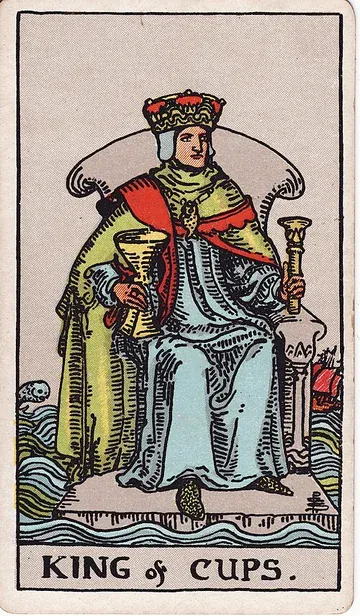
King of Cups
The earth king and the water king — provision and feeling, structure and current. Together they describe the partnership or single seeker where material steadiness and emotional attentiveness have to run in the same body. When both run, the bond holds for decades; when one is hidden under the other, the steady provider stops feeling or the empath stops earning.
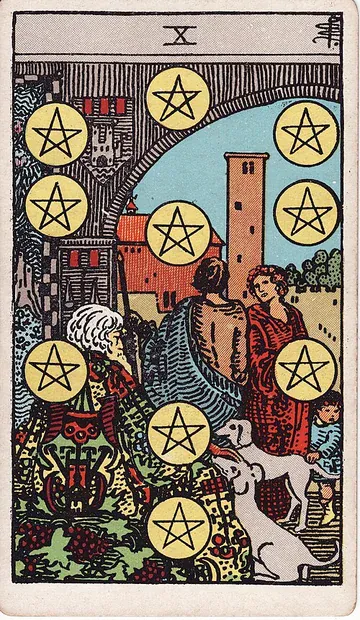
Ten of Pentacles
The patron and the legacy he is building toward. The king is the steward; the Ten is the multi-generational household, the family business, the wealth that has stabilized into ground three generations stand on. Together they confirm that the structure can outlast the individual — provided the patron does the harder work of writing the wisdom down, not just leaving the assets.
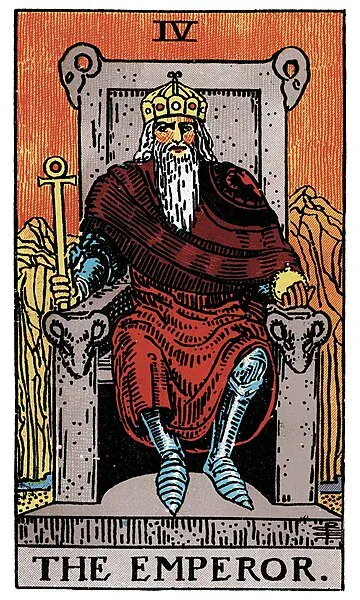
The Emperor
The local steward and the structural archetype of authority. Together they ask whether the seeker's authority is connected to the practical work of stewardship or has floated free into pure command. For someone in formal power, a check; for someone under authority, a way to distinguish the embodied steward from the empty throne.
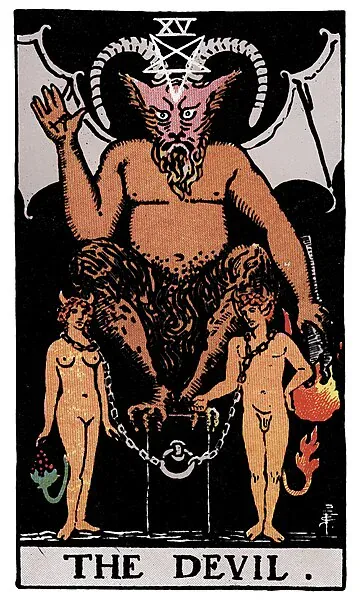
The Devil
Patron and shadow. Net worth as identity, the steady hand clenched into a fist, the chains of comfort that the seeker put on voluntarily. When the king meets the Devil, the question is whether the wealth, position, or institution he has built has begun to own him. The work of integration is to loosen the grip — pour one cup out, hand one role over, let one share go.
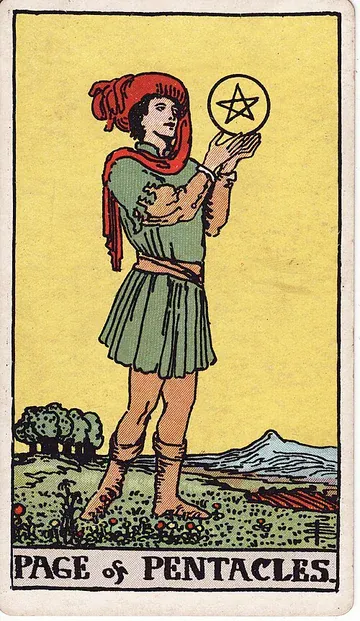
Page of Pentacles
Patron and heir. The most quietly hopeful of the king's pairings — the slow transfer of mastery from one generation to the next. The king's instinct is to teach; the Page's task is to listen long enough to actually hear. For the senior, a call to invest deliberately in someone younger. For the apprentice, confirmation that the figure above is willing to teach if the seeker is willing to stay.
Frequently Asked Questions
Is the King of Pentacles a yes for something that has to hold for years?
The King of Pentacles upright is one of the deck's clearest yes-cards for any question involving stability, long-term commitment, financial security, or dependable partnership. Read the answer as a deliberate yes — the foundation is real, the path is sound — with the small condition that the king prefers his yeses in writing. Confirm the verbal agreement on paper. The yes will hold.
Does the King of Pentacles mean a partner who provides rather than romances?
In love readings, the King of Pentacles is the dependable partner — the one who adds your name to the insurance, remembers your parents' birthdays, and shows up to the airport in the rain. He is rarely the high-romance card. He is the card of provision that does not announce itself. For long bonds, he confirms structural soundness. For new sparks, he is the steady person worth taking seriously even if their texture is quieter than the chaos you have been calling chemistry.
Does the King of Pentacles mean they have already decided I belong at their table?
When the King of Pentacles describes how someone feels about you, the answer is settled, deliberate, quietly invested. He has decided you are worth a chair at his table, and he is not in the habit of revising those decisions. Read his silence as accounting, not absence — he is moving the line items of his life to make room for you. His warmth shows up logistically: the upgrade arranged, the cooler packed, the airport pickup at 6 a.m.
What is the King of Pentacles tarot card meaning at work?
At work, the King of Pentacles is the patron, the institution-builder, the senior who has converted personal mastery into something transmissible. He is the card of the boss who backs you up in writing, the freelancer whose practice has matured into a firm, and the late-career professional facing the question of succession. Read him as confirmation that the role, the contract, or the institution can hold weight — and as a reminder that the work now is to consolidate, not to chase.
Can the King of Pentacles' spirituality be practiced without leaving ordinary life?
The King of Pentacles teaches the householder's path — the spirituality conducted entirely inside ordinary life. The orchard tended faithfully for forty years is a prayer. The marriage held with care is a prayer. The business run with integrity is a prayer. The card asks whether your spirituality survives being tested by ordinary life; if it cannot, it is not yet yours. Stay in the chair. The work is the path.
Continue Reading
King of Pentacles · Card overview · symbols · correspondences →
Return to the full card view — image, symbols, sensory correspondences, and Hermetic axes.
Read the reversed meaning →
Read the same depth on the opposite orientation.
Draw your reading now →
Bring this card to a question — open a quiet ritual.