
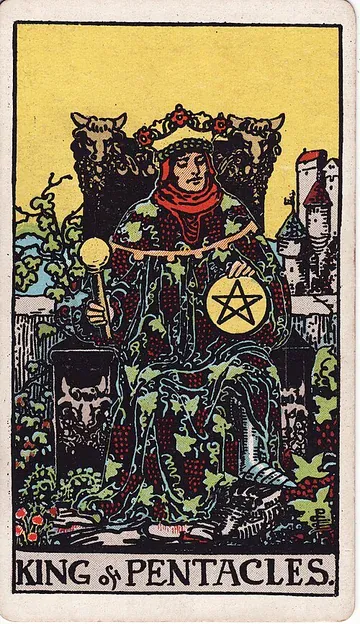
King of Pentacles Reversed · Core Meaning
The King of Pentacles reversed is the figure on the same stone throne, ringed with the same grapevine, embroidered with the same ripe grapes — but the hands have closed. The orb in the right hand, originally a charge of stewardship, has become a possession to be guarded. The five-pointed star in the left hand, originally a quiet emblem of completed work, has become a number tracked obsessively across spreadsheets. The bulls on the arms of the throne have stopped being symbols of patient labor and started being symbols of dominance. The grapevine still grows. The estate is still there. The interior has soured.
This is the reversed card's central knot: success that has hardened into refusal. The man who built the estate has become unable to imagine himself outside of it. The wealth that was once a foundation has become a wall. The reliability that was once a gift has become a price tag attached to every relationship. The reversed king does not necessarily lose money. He loses meaning. The estate keeps producing; the estate has stopped feeding anyone, including him.
There is a second flavor of the reversed card that is more visible from the outside: the patron who measures himself by his net worth. When the figure on the spreadsheet rises, he feels expansive. When it falls, he feels empty — not poorer, empty, as if the self had been a number all along and the number now reads less. This is one of the most common shadow forms of late-career stewardship. The seeker who has not built an interior life separate from their material accomplishments arrives at retirement, illness, or market downturn and discovers that there is no one home behind the bank balance. The card warns of this gently. There is still time to build the interior. But the building has to begin before the external structure cracks.
There is a third flavor — the harder one — which is the patron who has not trained a successor. The institution congealed into one person's shadow. Decisions never let go. The decree that no one else can be trusted to handle anything correctly. The reversed king at this register is not corrupt. He is exhausted, and the exhaustion has hidden behind grandiosity. He cannot delegate because he genuinely believes no one else will do it right. He may be correct in the short term. He is destroying the institution in the long term. The card asks for the painful work of letting things go imperfectly so that they can survive him.
The astrological signature reverses too. Aries-third / Taurus-first upright is the will of conquest cooled into the patience of cultivation. Reversed, it is the patience that has gone hard — the cultivator who has stopped tending and started hoarding, the conqueror's fire never properly let out, smoldering under the steward's role until it leaks as resentment. The earth-of-court with air-within structure becomes earth so dense that the air cannot move; the granary's vents have been closed; the abundance is rotting from within because it cannot breathe.
Reversed, the King of Pentacles asks: what are you holding too tightly? And: who would have to die for the thing you have built to outlast you? And: when did your accomplishment stop being the work and start being you?
King of Pentacles Reversed · Love & Relationships
Everything gets provided and nothing gets warm: that is the King of Pentacles reversed inside a partnership. He shows up to the airport. He keeps the joint accounts in order. He pays for the dental work. And the conversation at the dinner table has thinned to the logistics of a shared household. The relationship looks excellent in the family photographs. From inside, the partner who is being provided for is quietly starving for something the provider has stopped offering — usually because the provider has stopped offering it to himself first.
For an existing partnership, the reversed card often indicates the comfortable plateau that has hardened into a refusal to grow. The roles have ossified. He works; she runs the household; or the gendered analog of those roles. The agreements that hold the relationship together have also become the agreements that prevent it from changing. Both partners are competent. Neither is reaching. The shared interior life that fed the early years has become a museum. The card asks: when did you last actually look at this person, not as the holder of a role in your life, but as the person they have continued to become while you were busy maintaining the structure?
For a new connection, the reversed King of Pentacles can describe a partner whose interest in you reads as evaluative. They are checking your fit against a list — financial, social, demographic, scheduling. The interest may be real, but the warmth has been replaced by audit. You are not being courted. You are being interviewed. Some seekers can tolerate this; others find it slowly corrosive. The card invites honest reflection: is the assessment loosening as they get to know you, or is it intensifying? The first is reasonable due diligence. The second is the shadow.
For a single seeker who is asking whether love is possible, the reversed card describes the trap of the over-furnished solo life. You have built a beautiful household. The income is solid. The career is stable. The friendships are dependable. The chair across from you at dinner is unoccupied — and you have arranged the unoccupied chair so well that no actual person could fit into it without disrupting the architecture. The card asks: have you turned solitude into a fortress? The work is to leave a real seat empty, not a strategically empty one.
Where the question is whether someone loves you, the reversed King of Pentacles wants the provision and the withholding read side by side. They are present. They are providing. They have decided you are part of their life. And the warmth has been replaced by transaction. They are not lying about the commitment. They have simply stopped feeling it as an ongoing live thing and started executing it as a series of obligations met. None of this is malice. All of it is what happens when love that was real is allowed to harden into routine without active tending.
For partnerships under financial pressure, the reversed king is the harder card. He resents the partner who is struggling. He scores the bills. He brings up financial contributions in arguments that were not about money. The card warns that the steady provider who has stopped providing emotional generosity alongside the material one is in the process of poisoning a relationship that, structurally, looks fine. The work is honest acknowledgment that the resentment is in the room — and that the resentment is the symptom, not the diagnosis.
For partnerships where the question is commitment, the reversed King of Pentacles can warn of the contract-marriage — the partnership that exists because neither party has identified an exit ramp that justifies the disruption. The wedding will happen. The mortgage will be signed. The children may be raised. None of it will feel like the love that was promised in the early years. This is one of the harder readings the deck offers, but it is also one of the more honest. Some partnerships continue without integrity because nothing has come along to force the question. The card asks the question.
For reconciliation after a break, the reversed card is gentle but precise. Returning to the relationship would rebuild the comfortable shape — and the comfortable shape was the shape that broke. The provision was real. The withholding was also real. Returning without addressing the withholding will return you to the same exhaustion that drove the original separation. If reconciliation is the answer, it has to be a different relationship now. Not a return to the old one.
For queer and non-traditional partnerships under the reversed king's energy, the same patterns appear in the same shapes — the partner who has converted love into provision and stopped tending the relational interior. The body that holds the role is incidental. The role is the role.
The card's particular warning for those carrying the reversed king's energy in love is this: provision and presence are not the same. The most successful provider in your social circle can be the most absent partner. The most absent partner can wear the costume of the most successful provider for decades without anyone outside the relationship noticing the gap. The work is to let the provision become an extension of presence, not a substitute for it. The bills will still be paid. The conversation will return.
King of Pentacles Reversed · As Feelings
Ownership can pass for love at a distance, and the reversed King of Pentacles is where the difference shows. They feel something — a pleased ownership, a private satisfaction at having you in their life, a sense that you are good for them — and the feeling has not yet made it across the table to you. Worse, sometimes the feeling has stayed locked so long that it has begun to harden into something colder than feeling: a possession, a category, an asset class.
This is the card of the partner who likes having you in their life and has stopped figuring out how to be a partner to you. They are not pretending. The feelings are not fake. But the feelings have been allowed to settle without circulation. Like wine left too long without breathing, they have changed quality. What started as warmth has begun to taste of vinegar around the edges. The card is honest about this, and the honesty is part of the gift the deck is giving the seeker who drew it.
If they are reserved by nature, the reversed King of Pentacles in feelings can mean smug acquisition — they feel pleased with themselves for having you, in a way that is closer to ownership than connection. It is the least flattering thing this card says about an otherwise generous man, and it belongs on the page. They will praise you to others. They will display you at events. They will introduce you to colleagues with the satisfied air of someone who has acquired a good piece of property. None of this is consciously cruel. All of it is the shadow of the upright king's quiet pride taken one step too far.
If they are demonstrative, the reversed card warns of performative provision. They will tell people they take care of you. They will post the milestones. They will narrate the relationship in interviews and at dinners. And in the actual room, alone with you, the warmth is rationed. They are using the fact of you to stabilize their own image as a person who has succeeded at adult life. They are not yet a partner who shares it.
For a partner you have been with a long time, the reversed King of Pentacles in feelings can mean settled pleasure that has stopped being curious about you. They love you, and they have stopped asking who you are becoming. The feelings are real but the attention has narrowed into a category. The card asks for re-noticing. Not new feelings — new looking. Most reversed kings can return to upright through this single practice, sustained over a season.
For a new connection, the reversed king in feelings can describe someone who is privately deciding whether you fit their life rather than whether they want to build a life with you. The orientation is evaluative. They like you in the abstract. They are uncertain how to like you in the daily texture of a shared schedule. Closing out that evaluation is something only he can do. The verdict is not yours to write. You can only notice whether their evaluation is loosening as they know you better, or hardening into a verdict.
For someone in mid or late life, the reversed king in feelings describes the partner who has equated the longevity of the relationship with sufficient love. The thirty-year marriage exists. The house exists. The grandchildren exist. They feel settled. They are not feeling you. The card is asking — gently, because the reversed king of pentacles is rarely an unkind card — for the seeker to consider whether the structure has stopped serving the people inside it.
For someone in early middle age whose partner is reading reversed in feelings, the card warns of the slow drift. The career has accelerated. The hours have lengthened. The presence at home has thinned. They still feel love. The love does not show up at dinner. This is one of the most common readings the reversed king offers — and one of the most reversible, if both parties are willing to look at it before resentment hardens into permanent posture.
The card's specific caution in feelings is the move from "I love them" to "I have invested in them." The two phrases describe different interior states even when the actions look identical from outside. Love is alive; investment is calculated. The reversed king has made the conversion without noticing. The work of integration is to convert back — to feel the partner as a present person rather than as an account that has performed acceptably.
For the question of whether they will stay, the reversed king answers yes — but the staying may not be the staying you wanted. They will not leave. They have not yet decided to live. A man can occupy that carved throne for thirty years without once choosing to sit in it.
King of Pentacles Reversed · Career & Work
Mastery hardens into territory when the King of Pentacles reverses at work. The decisions have stopped being delegated. The successor has not been trained. The institution has congealed into one person's shadow, and the person at the center is too exhausted to admit they need help and too proud to share the load. From the inside, this looks like dedication. From the outside, especially from the perspective of the talented junior staff who keep leaving, this looks like a one-person bottleneck wearing the costume of leadership.
For someone considering whether to stay in a current role, the reversed card warns of the comfortable compromise that has become a cage. The role pays well. The benefits are real. The political position is secure. And the work has stopped being alive. You are no longer being challenged because the boss who used to challenge you has stopped having time, or stopped having interest, or stopped having vision. The institution has gone from being a place where work happens to being a place where work is managed. A carved throne is a comfortable chair to be stuck in. Nothing in the role is bad enough to leave. Nothing is alive enough to stay for. The reversed king's gift, when this is the reading, is to name the trap so the seeker can decide deliberately rather than drifting.
For someone considering a new role under a senior figure described by this card, the reversed king reads as a caution. The compensation may be generous. The title may be impressive. The institutional weight may be real. And the boss above you is unlikely ever to let you grow into your full role, because letting you grow would require letting go, and the reversed king's central wound is the inability to let go. Take the role with eyes open. Plan the exit. Use the institutional credibility to leverage the next move; do not expect the role itself to be your destination.
For entrepreneurs and freelancers, the reversed King of Pentacles is one of the most diagnostic cards the deck offers. The practice has matured into a small business. The revenue is stable. The reputation is solid. And every decision still goes through you. The team is small not because the work is small but because you have not learned to trust anyone to do it the way you would. The bookkeeping, the client management, the actual creative or technical work — all of it is bottlenecked at your desk. The card asks whether you are running the business or whether the business is running you. It also asks who would inherit the practice if you became unavailable for six months. If the answer is "no one," the practice is fragile, regardless of the surface metrics.
For a creative practice, the reversed king can describe the seasoned artist who has stopped taking risks. The body of work is established. The reputation is real. The new work is being judged by an internal critic who measures everything against the past achievement, and the measuring has begun to constrain what can emerge. The card invites a dangerous-feeling experiment — make a piece that would disappoint the senior critic-self. Show it to one person. The reversed king returns to upright through honest play that is not booked into the career ledger.
For questions about authority and recognition at work, the reversed card warns of the smug colleague — the figure who has arrived at a comfortable seniority and has stopped extending the ladder. If you are this person, the card offers the chance to notice and change. If you are working under this person, the card validates what you are sensing: their pleasure is real, their generosity has thinned, and the path forward for you may not be through them.
For a job search after layoff or contested departure, the reversed king reads with unusual specificity. You may have been pushed out by a senior figure who could not tolerate your growth threatening their centrality. The card validates this reading without bitterness. The exit, however painful, is also a release — you were running into the limits of what that institution could offer because the steward at the top had stopped growing. Find the next institution where the senior figure is still tending the garden, not just defending the harvest.
For mid-career professionals approaching seniority, the reversed king is a mirror with a hard edge. Are you becoming the kind of senior figure who actively makes room for the people coming up behind you, or the kind whose presence at the top crowds the path? Most professionals do not see this question until it is too late to answer well. The card offers it early. The honest answer requires honest looking.
For someone managing succession explicitly — the family business owner approaching retirement, the founder considering an exit, the senior partner contemplating handoff — the reversed king is one of the deck's clearest pieces of guidance. Begin earlier than feels comfortable. Hand over more than feels comfortable. Document more than feels comfortable. The institutional knowledge that lives only in your head is the institution's most fragile asset. Convert it into something transferable. The successor will mishandle it for a while. Let them. The mishandling is the curriculum.
For someone in their forties or fifties whose career has plateaued, the reversed king asks whether the plateau is a place to rest, a place to consolidate, or a place to reassess. None of those is wrong. The card simply asks the seeker to know which one they are doing. Drift is the danger.
King of Pentacles Reversed · Money & Finances
Money stops circulating under the reversed King of Pentacles and starts working as an identity instead. The numbers may be impressive. The lifestyle may be modest. The internal experience may still be of scarcity. The card warns that the mathematics of net worth has decoupled from the felt experience of having enough.
For someone who has been managing money carefully, the reversed king can describe the trap of compulsive thrift. The savings rate is enviable. The discretionary spending is minimal. And the joy of having money has been replaced by the anxiety of losing it. This is not financial discipline; it is financial fear performing as discipline. The card invites the seeker to spend something deliberately on something that is genuinely pleasurable, without booking it as a reward, without justifying it to themselves, without the mental note that this is a one-time exception. The exception is the integration. Money is for living. The hoard is for the heir.
For someone in financial recovery — the long climb out of debt, the rebuild after a setback — the reversed king warns of the inverse trap: the rebound spending that follows years of constraint. The system relaxed, and now the body is over-correcting. Small luxuries became routines. Routines became expectations. Expectations became invisible. The discipline that held the recovery together has loosened in a way that feels like rest but is actually the seed of the next crisis. The card asks for renewed attention without shame.
Asked about a major purchase, the reversed King of Pentacles counsels caution — the money is there; the reason for spending it is what needs checking. Whatever you are about to buy may deliver the literal thing without delivering the felt thing. The status car. The bigger house. The investment property. The luxury goods that signal arrival to a circle whose approval you have not actually wanted in five years. Wait a season. Notice if the desire is still real. Often, with this card, the desire was a symptom of a different need — the need to mark the achievement, to prove the success, to settle an old class injury that money cannot actually heal. The purchase, made impulsively, becomes a thing you own that asks nothing of you and gives nothing back.
For investments, gambles, or speculative moves, the reversed card warns of greed. The instinct to double down on a winning position is the wrong instinct. The reversed king has watched the steady-handed investor turn into a speculator at the worst possible moment, parlaying twenty years of careful gains into a single concentrated bet that the next decade reveals to have been ill-considered. Take the win. Diversify. Walk away from the position before the position takes more than it has given.
For windfalls — inheritance, gift, unexpected income, the sale of an asset — the reversed king describes the trap of the windfall mishandled. The money arrives. The recipient, unprepared, tries to compress decades of financial lessons into a few months of decisions. Mistakes follow quickly. Family relationships fracture around the inheritance. The card's counsel is to slow down — much slower than feels comfortable. Park the windfall in a high-yield account for at least six months. Tell almost no one. Make no major decisions. The windfall is not going anywhere; the patience to manage it well takes time to assemble.
For estate planning under the reversed king's energy, the card warns gently of the patriarch who refuses to discuss the will. Whatever the size of the estate, whatever the family dynamic, the conversation needs to happen before the death rather than after. The patriarch's reluctance is rarely about the estate itself; it is about the death the conversation forces him to confront. The card respects this reluctance and asks the seeker to begin anyway. The conversation that does not happen during life happens after death, in lawyers' offices, between heirs whose grief has been complicated by surprise.
For debt under the reversed king's energy, the card describes the cycle of high earner / high spender — the professional whose income has expanded along with their lifestyle in a way that has kept the savings rate at zero. From outside, this person looks successful. From inside, they are one missed paycheck away from collapse. The card asks for the unglamorous work of building the buffer first, before the next lifestyle upgrade. Three months of expenses. Then six. Then a year. The lifestyle can wait. The buffer cannot.
For the seeker accumulating real wealth for the first time, the reversed king is a sharp mirror. New wealth is psychologically destabilizing. People who arrive at it without preparation often blow it within a few years through overspending, status purchases, or relationships that drain the new resource. The reversed king warns of every direction the new wealth might leak. Take the time to build the discipline. Resist the friends who arrive with investment opportunities. Resist the impulse to upgrade everything at once. The wealth that lasts is the wealth that the seeker grew into psychologically before the numbers grew externally.
For someone whose self-worth has become entangled with their net worth, the reversed king is the deck's most direct mirror. The figure on the spreadsheet rises; you feel expansive. The figure falls; you feel empty. This is the most pernicious of the reversed king's wounds because the financial discipline that drives the wealth often feels like the same impulse as the spiritual emptying. The work is to disentangle them — to build the interior life that exists when the spreadsheet is closed. The integration is not financial. It is psychological. Begin by closing the app for a week.
King of Pentacles Reversed · Health
A body can be managed so carefully that the managing becomes the strain, which is the reversed King of Pentacles on a health question. The metrics are tracked. The supplements are organized. The exercise routine is dutiful. And the felt experience of being in the body has become anxious, controlling, joyless — the body managed as a portfolio rather than inhabited as a home. The reversed card warns of health as a project rather than a lived state.
There is also a second flavor: the body that has been ignored entirely while the estate was being built. The seated body has gone unmoved for too many hours per day for too many decades. The diet has decayed into whatever fits between meetings. The sleep has been sacrificed to the spreadsheet. The drinks at the end of the day have crept upward in frequency until they are no longer celebrations but maintenance. The reversed king describes the accumulating cost of years of subordinating the body to the estate. The bill is now coming due in joints, blood pressure, sleep architecture, and the slow collapse of vigor.
The card's specific health caution for those carrying its energy unbalanced is the pattern of comfort consumption that has crept into the daily structure. The drink with dinner has become two. The screen time has expanded. The portions have grown. The exercise has thinned. None of this is dramatic. None of it shows up on labs immediately. The labs will catch up in five to ten years. The card is asking the seeker to address the patterns now while the body still has the capacity to recover. The reversed king is not a card of catastrophic illness. It is a card of slow corrosion that catastrophic illness eventually emerges from if uncorrected.
For someone managing weight, food relationships, or appetite, the reversed king is a mirror with unusual specificity. The patterns of disordered eating that emerged in younger life have not disappeared; they have been integrated into the structure of adult life so thoroughly that they no longer feel like patterns. The 10 p.m. snacking ritual. The weekend overeating. The pattern of using food to mark the end of difficult days. None of these are catastrophic. All of them, accumulated across decades, become the metabolic syndromes that cluster in middle age. The card asks for honest inventory.
For someone managing alcohol, recreational substances, or other comfort behaviors, the reversed king is the deck's gentlest mirror — the patron who has come to rely on the substance to perform his patron role. He has not lost control. He has lost the question of whether he should still be using it daily. The card asks the question. No emergency has arrived at his table. The behavior is also not at health.
For chronic conditions, the reversed king can describe the season when self-management has slipped. What gets taken daily without a second thought is the substance; what gets taken when remembered is the prescription. The exercise is happening — sometimes. The discipline that held the condition stable has loosened. The King's own steadiness has become the account nobody is auditing. Resume the regimen the king's own steadiness used to guarantee without being asked. The condition has not changed. The relationship to it has.
For mental health, the reversed king describes the gap between feeling fine and being well. The depressive seasons may not have returned, but the practices that held you through the last one have been abandoned. The therapy is on pause. The journal is closed. The walks have stopped. The friendships that anchored the difficult years have thinned because you have not tended them. So the King puts the question plainly: are you well, or have you only become expert enough at managing the appearance of wellness that nobody around you checks any more?
For physical pain, especially in seekers over forty, the reversed king is honest. Some of the pain you are carrying is the body's audit of the years you ignored its feedback. The repetitive strain that became a baseline. The posture that became architecture. The sleep that was negotiable. The card asks for the slow rehabilitation that the original injury did not get. Rehabilitation has to be designed by someone qualified to design it, and this is not medical advice. See your practitioner. The card simply names the unglamorous truth: the body keeps the score, and the score is being read aloud.
For aging, the reversed king is a particular warning. The seekers who arrive at sixty, seventy, eighty in poor health are most often not the unlucky ones; they are the ones who, in their forties and fifties, did not tend the foundation. The reversed king is the late stage of that pattern. The card is gentle about the past. It is firm about the present. The work begins now, with smaller goals than feel adequate. A daily walk. A weekly weight session. A bedtime that is honored. A sleep regimen that is non-negotiable. The body the seeker lives in at seventy-five is being built, week by week, in their fifties.
For caretaking — the seeker who is caring for an aging parent, a sick partner, a child with chronic illness — the reversed king describes the caretaker who has stopped tending themselves. The caretaking is real. The caretaker is depleted. The card asks who is caring for the caretaker. If the answer is no one, that is the urgent question, and the rest of the health reading is downstream of it.
King of Pentacles Reversed · Spirituality
Reversed, the King of Pentacles shows an estate grown large enough to crowd out the practice that built it. The meditation cushion is in the corner of the room they no longer enter. The ritual life is reduced to a vestigial Sunday observance. The traditions that originally anchored their inner work have become socially performed without spiritual content. The seeker is competent, accomplished, respected, busy — and quietly hollow.
This is the householder whose path has degenerated into housekeeping. The card is not unsympathetic. Most householders pass through this season at some point. The estate demanded the energy. The energy was spent. The interior life accumulated dust. The reversed king arrives in the reading not as judgment but as the deck's gentle invitation to reopen the room.
For someone in active spiritual practice, the reversed card describes the plateau that has become a stop. The breakthroughs have ended. The teaching reads like an inventory of things already owned. The practice has become estate maintenance — upkeep where devotion used to be. The card asks whether the routine is still oriented toward growth or whether it has become a performance for the practitioner's own benefit. There is a particular flavor of long-term meditator who has been on the cushion for twenty years and has not actually been changing for fifteen of them. The reversed king is that practitioner's mirror.
For someone exploring belief, the reversed card warns against spiritual consumerism. The retreats. The teachers. The traditions sampled and abandoned. The library of unread books. The collected wisdom that lives only as collected. The card asks whether the seeker has begun to use spiritual material the same way they accumulate other forms of capital — for status, for comfort, for the feeling of having done the work without doing the work. The practice is not the books on the shelf. The practice is the morning the seeker actually sat for forty-five minutes and let what arose, arise.
The card's specific spiritual caution is the conversion of practice into possession. The discipline that originally cracked the seeker open has, over the years, been domesticated into a form of reassurance. They know the right vocabulary. They have the right teachers. They attend the right retreats. And the actual transformative pressure of the practice has been managed away. The card invites a return to discomfort. The teacher who challenges rather than soothes. The practice that is harder than the current one. The question that has been avoided.
For questions about path, the reversed king asks whether you have mistaken comfort for arrival. The practice that brought you peace fifteen years ago was a vehicle, not a destination. Are you still in motion, or have you set up camp at the place the vehicle stopped? The card respects the comfort. It just notices that the comfort has begun to function as a substitute for further work.
For seekers in late midlife or beyond, the reversed king has a particular gravity. The accumulated identity — the career, the family, the social standing, the financial structure — has begun to feel like the entirety of who you are, and the death that approaches from somewhere on the horizon has begun to seem like the destruction of that identity. The reversed king's spiritual work, in this season, is to begin the slow process of disidentification. The estate is not the self. The work is not the self. Even the relationships are not the self in the simple sense. Something else is here, and the only way to find out what it is requires loosening the grip on what you have been calling yourself for forty years.
For seekers in younger phases of life carrying the reversed king's energy — the high-achieving professional, the early-career success who has been performing competence so long they have forgotten how to fail — the card invites the equivalent loosening. Try a practice you are bad at. Show up to a community where your professional credentials mean nothing. Read a book in a tradition you find embarrassing. The reversed king integrates through the practice of being a beginner again, voluntarily, with witnesses.
A small practice when this card appears: give one teaching away. Give one ritual to a friend. Give one piece of wisdom you have collected to someone who is in the season you were in three years ago. The reversed card returns to upright when the cups begin moving again.
A second practice: sit for twenty minutes today without checking the spreadsheet, the email, the news, the messages. Just sit. Notice the discomfort that arises when the estate is not being actively maintained for twenty minutes. The discomfort is the diagnosis. The sitting is the medicine.
King of Pentacles Reversed · Yes or No
No warmth in this yes — and the warmth was the question.
Read it as a yes with the temperature missing rather than a refusal. It is more often the answer that arrives in the literal shape you asked for and not in the felt shape you needed. The job offer comes through, with the title and the compensation, and the institution turns out to be a cage. The relationship continues, with the calendar and the joint accounts, and the partner has been emotionally absent for years. The investment pays out, modestly, on a delayed timeline, and the investor has lost more in stress than they made in returns. The card answers literally. It does not deliver felt arrival.
For yes-or-no questions about a relationship under reversed-king conditions, the answer is technically yes — the relationship will continue, the commitment will hold structurally — but the warmth you were asking about may not return without active work from both parties. Read the yes carefully. The structure will outlast the feeling unless the feeling is tended.
For yes-or-no questions about a job, a role, a contract: yes, the offer is real, the institution is solid, the compensation will arrive. The work will be tolerable. The growth opportunities will be smaller than promised. The boss will not be the patron you hoped for. Take the role with eyes open, knowing what you are signing.
For yes-or-no questions about money — should I make this purchase, should I take this risk, should I sign this contract — the reversed king answers with caution. Yes, you can afford it. No, the purchase will not deliver the felt experience you are seeking. The expensive thing will not heal what is asking to be healed. The investment will not stabilize the part of you that feels unstable. The money is the wrong tool for the actual question.
For yes-or-no questions about whether someone is being honest or generous, the reversed card warns of pleasant surfaces. They are not lying outright. They are also not telling the whole truth. There is a comfortable refusal of full disclosure embedded in the way they discuss their own intentions. Read the contracts. Ask the second question. Trust the documentation more than the goodwill of the moment.
Asked when the decision comes down, the reversed King of Pentacles suggests yes, eventually, on the slow institutional timeline, with delays you have not yet accounted for. Plan for longer than you want to. The waiting will be productive only if you use it to prepare for the version of the yes that actually arrives, not the version of the yes you are imagining.
For binary decisions about whether to act, wait, or commit, the reversed card answers wait. Not forever. Long enough to verify that the version of the thing you are committing to is the actual version, not the version you are projecting onto it. A week. A season. Enough time for the structure beneath the offer to reveal whether it is sound.
For questions about whether something will hold under stress, the reversed king is honest. The structure will hold; the warmth may not. The institution will survive; the soul of the institution may have already left. Read the yes as a structural answer to a structural question. If your question was emotional, the yes does not address it.
If the question was: will this be enough? The reversed card answers no, gently, and asks what you actually wanted that the literal yes cannot provide. Most reversed-king questions are answered better by reframing the question than by reframing the yes.
King of Pentacles Reversed · Advice
Loosen one hand, deliberately, while the King of Pentacles reversed is on the table. Whatever you have been holding too tightly — the role, the institution, the relationship, the financial position, the children's choices, the spouse's career, the team's decisions — let one of them breathe. Not all of them at once. One. The reversed king integrates through the practice of releasing one specific thing this season, deliberately, without booking the release as a sacrifice or extracting credit for the generosity. The thing held loosely returns to life. The thing held too long grows cold.
If there is one specific instruction the reversed card offers, it is to train someone. The institution congealed into one person's shadow has to be reopened. Pick one responsibility you have been carrying alone for too long and find the person who could learn to carry it next. Begin the slow work of teaching. The first transfers will be incomplete. The successor will mishandle the responsibility for a year. Let them. The mishandling is the curriculum, and the curriculum is what produces the next generation of stewards.
A second instruction: give one share that is not booked. Whatever pattern you have for giving — to family, to causes, to the people who lean on you — find one act this season that is given without expectation of return, without recordkeeping, without even the private mental note. Pay the larger gratuity. Hand the bonus to the colleague who is struggling. Cover the dinner without making a thing of it. The reversed king integrates through the practice of generosity that is not converted into social currency. The act has to remain unconverted to count.
A third instruction: re-ask the original question. What did you actually want when you started building the estate, the career, the relationship, the practice? The reversed king is the card of the wish granted in the wrong shape — the literal achievement obtained at the cost of the felt achievement. Look back at the original wish. Was it the company, or was it the freedom the company was supposed to produce? Was it the marriage, or was it being known by another person? Was it the wealth, or was it the safety wealth was supposed to confer? The literal version was answered. The deeper version is still waiting. The card asks you to re-articulate it.
A fourth instruction: re-enter the body. The reversed king is the seated body, the body that has been stewarded by sitting for too many decades. Stand up. Walk. Lift weights. Stretch the parts of the body that have been compressed by the chair. The estate cannot be carried by a body that has stopped being a body. The reversed card returns to upright through the slow rebuilding of the physical instrument that carries the work.
A fifth instruction, gentler than the others: forgive yourself for the contraction. Most patrons pass through this card. Most stewards, at some point, find themselves holding too tightly to the thing they spent decades building. The reversed King of Pentacles is not failure. It is information. The information is that the next phase of your life will require loosening, sharing, succession, and a return to the interior life that was crowded out while the exterior life was being constructed.
A practical small advice for the day this card appears: hand one decision over today. The decision can be small — what restaurant the team eats at, which font the proposal uses, which of the two contractors handles the bathroom remodel. Whatever it is, pass it down without supervising the execution. Notice the discomfort. The discomfort is the muscle that has not been used. The use of the muscle is the integration.
A second small advice: spend one hour today doing something that is not productive, not ambitious, not booked into any goal. Walk without a podcast. Eat without a screen. Sit with a cup of tea and watch the steam. The reversed king has lost the capacity to do nothing, and the capacity to do nothing is what allows the soil under the estate to recover. Re-learn it. The estate will not collapse in one hour. The interior life will begin to rebuild within ten of them.
King of Pentacles Reversed · Card Combinations
The King of Pentacles reversed in combination tends to expose what other cards politely cover. He drains the warmth from cards that look romantic at first glance, names the shadow inside cards that look successful, and asks hard questions of cards that are themselves about commitment. The same five neighbor cards from the upright reading take on harder shapes here. The pairings are not different cards in the deck — they are the same cards read from inside the reversed king's particular knot.
King of Pentacles Reversed + King of Cups
Provider and feeler in their failure modes. The earth king has hardened; the water king has begun to leak. When both kings appear with one or both reversed, the reading is about a partnership where neither person can quite reach the other anymore — the provider has become transactional, the feeler has become passive, and the bond is held by structure rather than by current relationship. For the seeker carrying both kings unbalanced inside themselves, the integration is to let the earth king feel and the water king act. Both currents have to run. Either alone curdles.
King of Pentacles Reversed + Ten of Pentacles
The reversed patron and the legacy he has not earned the right to leave. When these appear together, the reading is about generational wealth that has accumulated without the wisdom to transmit it well — the family business about to be torn apart by inheritance, the estate that has produced heirs who do not know how to steward what they did not build, the patriarch who will hand over the ledger but not the philosophy. The combination is one of the deck's clearer warnings to do the harder work of transferring not just the assets but the practices, the values, the long view that produced the assets. The Ten of Pentacles without the patron's interior is a fragile thing. Do the documentation now.
King of Pentacles Reversed + The Emperor
Two thrones, both with a hidden brittleness. The Emperor is structural authority itself; reversed alongside the King of Pentacles, the structure has rigidified into a refusal to evolve. The institution that cannot be questioned. The hierarchy that has become a cage for the people inside it, including the figure at the top. For someone in a position of authority, this combination is a warning that the structure you have built has begun to cost more than it produces. For someone under such authority, the combination validates what you are sensing — the senior figure has stopped tending the realm and started defending it. The path forward, in either case, is unlikely to be inside the existing structure. The path forward usually requires building a new one.
King of Pentacles Reversed + The Devil
The reversed patron and the chains he has voluntarily accepted. Net worth confused for self, status purchases that have become identity markers, the golden handcuffs, the lifestyle creep that has converted a successful career into a financial trap. This is one of the most direct mirrors the deck offers to a seeker who has built well and then lost the freedom that the building was supposed to produce. The chains in the upright Devil card are loose; what holds the figures bound is their own attachment. The combination asks: which of your attachments is voluntary? Which could you release this week and discover that the structure does not collapse without it? The reversed king integrates with the Devil through the slow practice of releasing the markers of success that have begun to mark you in return.
King of Pentacles Reversed + Page of Pentacles
The patron who has refused to teach and the apprentice still hoping to be taught. When these appear together with the king reversed, the reading is about thwarted succession — the senior who never made room, the junior who waited too long for permission to grow that never came. For the seeker carrying the king's energy, the combination is the late-stage warning: the apprentices have been moving past you without the lessons you were the only one positioned to give. The window is closing. For the seeker carrying the Page's energy, the combination validates the slow recognition that the teacher you have been waiting on may not be capable of teaching what you came for. The work, on either side, is to acknowledge the failed transmission without bitterness and to find the next configuration. The Page can find another teacher. The king, if he chooses, can still find an apprentice — but only by relinquishing the centrality he has held too long.
Card Combinations
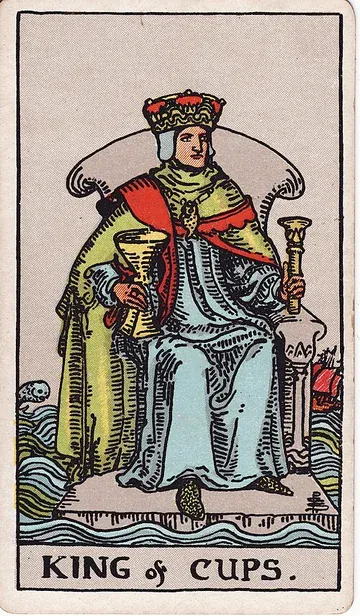
King of Cups
The earth king and the water king — provision and feeling, structure and current. Together they describe the partnership or single seeker where material steadiness and emotional attentiveness have to run in the same body. When both run, the bond holds for decades; when one is hidden under the other, the steady provider stops feeling or the empath stops earning.
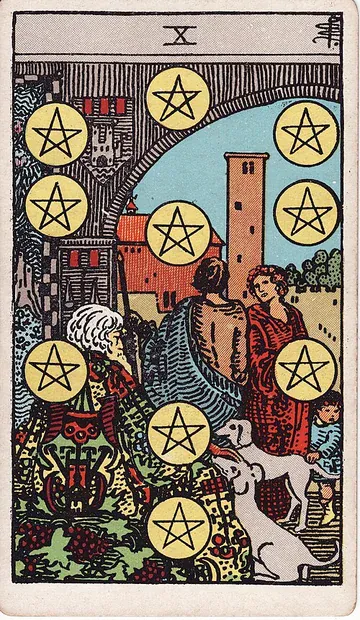
Ten of Pentacles
The patron and the legacy he is building toward. The king is the steward; the Ten is the multi-generational household, the family business, the wealth that has stabilized into ground three generations stand on. Together they confirm that the structure can outlast the individual — provided the patron does the harder work of writing the wisdom down, not just leaving the assets.
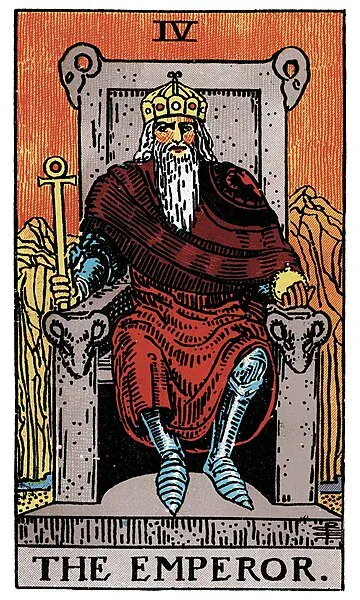
The Emperor
The local steward and the structural archetype of authority. Together they ask whether the seeker's authority is connected to the practical work of stewardship or has floated free into pure command. For someone in formal power, a check; for someone under authority, a way to distinguish the embodied steward from the empty throne.
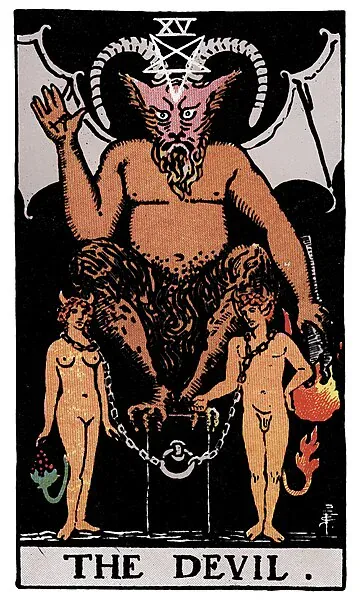
The Devil
Patron and shadow. Net worth as identity, the steady hand clenched into a fist, the chains of comfort that the seeker put on voluntarily. When the king meets the Devil, the question is whether the wealth, position, or institution he has built has begun to own him. The work of integration is to loosen the grip — pour one cup out, hand one role over, let one share go.
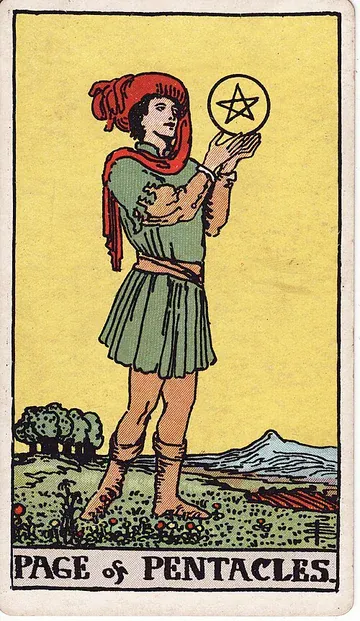
Page of Pentacles
Patron and heir. The most quietly hopeful of the king's pairings — the slow transfer of mastery from one generation to the next. The king's instinct is to teach; the Page's task is to listen long enough to actually hear. For the senior, a call to invest deliberately in someone younger. For the apprentice, confirmation that the figure above is willing to teach if the seeker is willing to stay.
Frequently Asked Questions
Is the King of Pentacles reversed a no, or a yes that will not feel like one?
The reversed King of Pentacles is rarely a clean no — it is more often a partial yes, a literal yes that does not deliver the felt experience you were asking about. The job will exist. The relationship will continue. The investment will pay. And the warmth, the freedom, or the satisfaction you were really asking about may not arrive without separate work. Treat it as a soft caution: the structure will hold, but check whether the question you asked was structural or emotional.
With the King of Pentacles reversed, is he providing instead of participating?
Reversed in love readings, the King of Pentacles describes the partnership that provides reliably and has stopped warming — the partner who shows up logistically while the relational interior has thinned. It can warn of an existing bond hardening into transaction, a new partner whose interest is evaluative rather than warm, or a single seeker who has over-furnished solo life into a fortress no real partner can enter. For reconciliation, it cautions that returning to the old shape would rebuild the same exhaustion that broke it.
Does the King of Pentacles reversed mean they are proud to have me rather than glad to love me?
When the King of Pentacles appears reversed to describe how someone feels about you, the warmth is real but locked behind a wall. They feel a pleased ownership rather than an active love — the feeling has stayed inside the cup so long it has begun to taste of vinegar. He may praise you to others, display you at events, narrate the relationship publicly, while in the private room the warmth is rationed. Read it as warmth that requires re-circulation, not as warmth that has departed.
What does the King of Pentacles reversed advise?
Loosen the grip. Train someone to take over a responsibility you have been carrying alone too long. Give one share that is not booked — generosity without recordkeeping. Re-ask the wish: what did you actually want when you started building? Re-enter the body that has been seated too long. The reversed king integrates through the practice of releasing one specific thing each season, deliberately, without extracting credit for the release.
What does the King of Pentacles reversed mistake his net worth for?
Net worth confused for self, comfort hardened into refusal, institution congealed into one person's shadow. The patron who has stopped circulating wealth, training successors, or tending the relational interior of his estate. The card warns against the late-career figure whose wealth and position have begun to own him rather than the other way around — and against the slow drift, in any seeker, from active stewardship to defensive hoarding. Pour out one cup. Hand over one role. Let one share go out without booking it.
Continue Reading
King of Pentacles · Card overview · symbols · correspondences →
Return to the full card view — image, symbols, sensory correspondences, and Hermetic axes.
Read the upright meaning →
Read the same depth on the opposite orientation.
Draw your reading now →
Bring this card to a question — open a quiet ritual.