
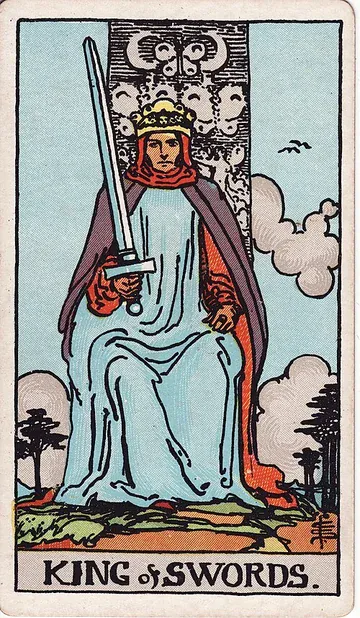
King of Swords · Core Meaning
The King of Swords is the deck's old lawgiver — the figure called when an argument has gone on so long that the room itself has begun to fray, and someone, finally, has to say the sentence that ends it. He sits squarely on a throne of stone, facing forward. The blue robe is long. The mantle across his shoulders is purple-red, the color of dried wine. The crown on his head is low gold, deliberately not high — this is not a king who rules by spectacle. His right hand holds a long sword upright before him, tilted only the smallest degree to the right, as though indicating a median line he has just drawn through the noise of the world.
The sky behind him is cold and pale. A few thin clouds move at altitude. Two birds pass far off, almost out of frame. He does not look at the sword, does not look downward, does not look at any petitioner. His gaze travels level outward — the look of someone waiting for a sentence that has been left unfinished to be finished, by him, in a moment, with care. The throne back is carved with butterflies and a pair of crescent moons. Logic that admits transformation. Clarity that leaves room for shadow.
The card's signature tension is held in that small rightward tilt of the blade. The King of Swords is not the iron tyrant the modern eye expects. The sword is upright, not raised; the verdict is firm, not vindictive; the cold sky is a working temperature, not a moral position. What is being held in suspension is the willingness to rule and the willingness to keep listening — together, in the same body, at the same instant. The butterflies on the throne would be ridiculous on any other king. On this one, they are the proof that he understands the thing he is about to decide.
His season is built the way his judgment is built: the King of Swords stands across the cusp of Capricorn into Aquarius, January 10 to February 8 — the season when winter has stripped the year down to structure, and the structure is what is left to think with. He is the air-of-air court: outer element air, inner element air, the wind within the wind. Air-of-air is nearly silent. It is the high-altitude wind that holds direction without making weather. It is the wind that decides whether the aircraft can come through the cloud layer at all. The Justice card stands as his kabbalistic neighbor, both seated at the level of Tiphareth, and the King of Swords is what Justice looks like when she steps down from the major arcana and takes a personal seat in your living room.
He is also the court figure who changes least in company, which is worth knowing before you read him beside anything else. Seated with Wands, his ruling is pushed straight into action — clear and fast in the same breath. Next to Pentacles he tends to nail down a reality that needed to keep a little give, and that is the pairing to watch. Cups will get him to soften a phrasing by one degree and never the ruling itself. When he meets his own suit, two blades deliberate together, and the danger is mutual injury: let the other one land the first stroke. Whatever else the spread is doing around him, the King of Swords holds direction. Air-of-air is the wind that does not change when the weather below has changed — which is his entire gift, and, turned one degree the wrong way, his entire shadow.
His actual gift is smaller and stranger than judgment. While everyone else is still circling, he rewrites the dispute, in one sentence, as a single question that can be answered. Four people arguing for an hour in a meeting room are usually arguing about three different questions without knowing it; the King of Swords is the one who says, near the end and without raising his voice, so the question is whether we ship in March or whether we ship at all — and the room goes quiet, because now there is something a person can say yes or no to. That is the work the long sword actually does. It does not come down on anybody. It divides the cloudy matter into clauses. Most of what this card is asked about, in any spread, turns on whether the seeker is willing to name the question everyone has been fighting around.
Ask what hour the card keeps and the answer is the coldest one: the minute before daybreak at the end of winter. Nothing has been decided yet in that minute, and everything is already visible. The scent is ground steel and stone steps after cold rain. The plants are holly and wormwood — one evergreen and armed, the other bitter and medicinal. The stones are lapis, which the old workshops ground into exactly the blue he is wearing, and diamond, which is nothing but clarity plus pressure plus time. Set the whole list side by side and you have the King of Swords' working temperature: hard, clean, faintly bitter, not unkind. Anyone who has had to deliver bad news at six in the morning, in person, to someone who deserved to hear it from a face rather than from a letter, knows this hour precisely.
Read the King of Swords the way you read a photograph of a magistrate who has just delivered a ruling no one wanted to hear. Whatever lives in that pause — the level gaze, the unmoved hand, the two distant birds that signal the world has not stopped — is the meaning of the card for that reading. He is not asking you to be cruel. He is asking you to be willing, finally, to say the sentence the room has been waiting for. By the foregoing clauses: this, yes; this, no.
King of Swords · Love & Relationships
The relationship needed a clear sentence and has finally been given one. Not a romantic sentence. Not a poem. The sentence that names what is allowable and what is not — the line drawn so cleanly that both people can stop spending half of every conversation tiptoeing around it. The card describes the love that survives because someone was willing to stop being polite and start being precise.
For an existing partnership, the King of Swords often arrives the season after a long, drifting argument has finally been resolved by a single agreement clearly spoken. The fight that recurred for two years stops recurring because someone finally put the rule into language: we do this, we do not do that, here is how we will know. The card describes the morning after that conversation, when both partners wake up and realize that the air in the apartment has changed color. There is a coolness to the love now — not coldness, but altitude. The kind of clarity that lets affection rest on something other than hope.
For a new spark, the King of Swords means a connection that begins with a real conversation. The first dinner is not chemistry alone — it is also two minds enjoying the precision of the other's thinking. The new partner says the unfashionable true sentence in the second hour, and you find yourself relieved rather than offended. They notice you do the same. The relationship is built on a particular pleasure: being understood without having to soften yourself first.
Two people four months in, sleeping together, texting daily, still calling it hanging out — this is the exact situation the King of Swords is best at. The card is not asking for a declaration. It is asking for one clause: are we seeing other people or are we not. The conversation itself takes ninety seconds; the dread in front of it takes six weeks. Couples negotiating an open arrangement, or renegotiating an old one, get the same instruction at higher resolution — write down what counts as a breach, in plain words, while everyone is calm, rather than inventing the rule at two in the morning in a kitchen while also defending yourself. The romance in this card is unglamorous and it works. Agreements made in daylight are the ones that survive the nights.
For a single seeker, the King of Swords describes the season when standards finally clarify. After years of getting close to the wrong person because the wrong person was warm enough, the card arrives when you can finally articulate what would actually count. Not a list of features — a clause. "I would like someone whose word is reliable." "I would like someone who can tell me the truth before I have to ask twice." "I would like someone who will not flinch at a clean disagreement." The card is the moment those clauses stop being abstract and become navigation.
For love after a wound, the King of Swords arrives as the surgeon. The grief of the previous relationship has been examined, named, broken into clauses you can read aloud. You know what happened. You know what your share was. You know what their share was. You know what you would not allow again. This card is not the soft poultice of recovery — it is the clean stitch. The wound is being closed properly. What grows back will grow back stronger because the seam is honest.
Sometimes the ruling this card is pointing at is the ending. Not every reading wants that, and the King of Swords takes no pleasure in it either — but he is the figure in the deck who understands that an ending dragged out in kindness has stopped being kind. Where a relationship has been over for a season and is still being conducted, the card describes the leaving done in one conversation instead of eleven. Name what has ended. Do not litigate the history on the way out. Do not leave the false door of maybe later standing open to make the hour easier on yourself. The mercy in this card is precision: a person can begin to recover from a sentence they actually heard, and cannot begin at all while the matter is still being circled.
A note on the card's particular love language: the King of Swords loves through accuracy. He does not bring flowers; he remembers what you said, exactly, six months ago, and uses your own words to show you he has been listening. He does not flatter; he names the thing you are good at without inflation. He does not perform affection; he removes obstacles. The blue robe and purple-red mantle do not glitter. The low gold crown is barely a crown. This is love by reliability — by the steady median line held without theater.
If you are asking whether someone is in love with you and the King of Swords arrives upright, read it as a yes spoken in a particular accent. They are not effusive. They are not melting. They are deciding, slowly, deliberately, in language. They have begun to use precise words about you to other people. They have begun to plan with you in their planning. They have begun to defend you, when defense is needed, without raising their voice. The verdict is being formed in their interior. When it lands, it will land cleanly and last.
If the King of Swords is the person across the table rather than the one holding the card, there is a way of being loved well by this temperament, and it is not by going softer to compensate. Bring him your actual sentence. Ask for the thing you want, once, in the words you mean, undecorated. He does not read hints; he reads clauses, and he honors them for years. What injures this kind of partner is not conflict — it is being handed a grievance that arrives already three weeks old and dressed as something else. A relationship with this card inside it works when both people have agreed that saying the thing early counts as an act of affection rather than an escalation.
For long bonds entering a structural decision — moving in, marrying, sharing finances, making a child — the King of Swords is one of the steadier cards to draw. The decision is being made well. Both parties know what they are agreeing to. The contract, formal or informal, has been read by both sides. The card warns against the trap of letting accuracy become coldness in the celebration itself: when the agreement is signed, allow some warmth back in. The agreement was the work; the life inside the agreement is the love.
For seekers worried that they have become too analytical about love — that the card describes them, and that this is a problem — the King of Swords answers that clarity is not the opposite of feeling. The two distant birds at altitude in the card's sky are the whole point. The world keeps moving. Verdicts do not stop the weather. You can think clearly about love and still be moved by it; the King is not coldhearted, only level-eyed. The work is to keep the heart open while the mind does the careful naming.
King of Swords · As Feelings
They have decided, and the deciding is what you are being shown. The feeling is no longer in the warm, blurred stage of attraction. It has moved into the part of their mind that drafts clauses. They have considered the question of you, weighed it, drawn the median line, and settled into a position they intend to hold. This is the card of the partner who has stopped wondering and started concluding.
The body language the card describes is composure. Level gaze. Unhurried hand. Words chosen one at a time. They are not bracing. They are not hedging. They are not playing the small games of distance and closeness that the early stages of feeling tend to demand. They have arrived at a private verdict about what you are to them, and the verdict is being held in the part of them that knows how to keep a promise. You may not see fireworks. You may see the steadier, less-photographed thing: a person whose word is becoming reliable around you.
If they are reserved by nature, the King of Swords in feelings is more or less their entire emotional vocabulary. They will not say the romance-novel sentence. They will say the precise one. "I have been thinking about what you said on Tuesday." "I would like to plan the trip with you." "I want you with me at the meeting." Read the precision as warmth. The reserved person who graduates from courtesy to specificity has crossed an inner border that most observers cannot see. The King of Swords personality, when in love, becomes a careful editor of the language he uses about the beloved. Listen for the editing.
If they are demonstrative, the King of Swords in feelings expresses itself as articulate enthusiasm. They will tell you, exactly, what they admire — and the list will be specific enough that you cannot dismiss it. Not "you are beautiful," but "the way you handled that conversation last Sunday." Not "I love you," but "I would not be making this decision without you." The demonstrative version of this feeling is still a thinking feeling. It is composed, not effusive. The signal is the precision.
For a partner you have been with a long time, the King of Swords in feelings is the card of the relationship that has stopped guessing about itself. They know you. They have stopped making up the version of you that is more convenient than the real one. They have decided who you are, and the decision is in your favor. There is enormous relief in this card for long bonds. The work of being seen is over. What remains is the work of living inside being seen.
For a new connection, the King of Swords in feelings can mean a partner who is moving slowly because they are taking the question seriously. They are not stringing you along. The pause is a bench, not a bluff. They are weighing — and they will tell you when they have weighed. This is the card of the lover who, when they finally speak the sentence, will mean it for years. Wait through the weighing. The verdict, when it lands, will be worth what the waiting cost.
There is a small caution embedded in this card's feelings. The King of Swords personality, when in love, can confuse clarity with completion. They can decide what you are to them and then stop investigating. They can love you in the shape of an early conclusion rather than continuing to update the picture as you change. If you sense them holding a verdict from a year ago and refusing to revise it as you have grown, the card responds to a careful question. Not "do you still love me." That is the wrong question for this temperament. The right question is: "what have you noticed in me lately?" The King answers questions cleanly when they are clean.
A second caution. The King of Swords in feelings can communicate through the precision of his criticism rather than through warmth. He may believe that telling you exactly how to improve is the highest form of his attention. Sometimes it is. Sometimes it is the avoidance of softer speech he has not yet learned. If the relationship is otherwise good, ask gently for one praise sentence per critical sentence. The King can do it. He has the vocabulary. He simply has not yet been told that you need it.
Take the King of Swords in feelings as confirmation that the emotional ground beneath the question is thought-through and stable. Whatever they feel, they have weighed. Whatever they have weighed, they intend to honor. The two distant birds in the card's sky are the reminder that the verdict, even at its best, is not the whole of love — the world keeps moving, and the love keeps having to be re-stated, year after year, in slightly new language. The King of Swords personality knows this and is willing.
King of Swords · Career & Work
Thinking is the deliverable in this role rather than a preface to it — the judgment itself is what is being paid for. The card describes the lawyer drafting the clause, the architect resolving the load, the senior engineer signing the design review, the editor making the cut, the doctor who finally tells the family the diagnosis in language they can use. Wherever the job is to bring a clean ruling out of a tangled set of facts, the King of Swords is the card of doing that job well.
If you are asking whether a current role is the right one, the King of Swords answers yes when the role gives you scope to make actual rulings. You are not just executing other people's verdicts; you are forming your own and being trusted to deliver them. The pay may be moderate, the title may be unflashy, but the authority is real. You sign things. You decide. People bring you the cloudy matter and walk away with it broken into clauses. This card validates the work even when the work is not glamorous. The low gold crown is deliberately low.
For someone considering a new role, the King of Swords upright is a strong yes if the new role is one that asks for your clearest thinking and pays for it directly. The interview was a good interview because both sides were precise. The offer was clean. The role description is honest. The card warns against accepting roles where the title is high but the actual decisions are made elsewhere; for this temperament, ceremonial authority is worse than no authority. You want the median line drawn by your hand, or you do not want the seat.
For someone considering a job-search, layoff, or transition, the King of Swords reframes the search itself as a thinking exercise. Stop scrolling. Sit down with paper. Define the clauses. What kind of decisions do you want to be paid to make? What kind of organisation respects clean rulings? What kind of manager will treat your verdicts as load-bearing rather than as opinions to override? The card describes the search that yields the right role because the search itself was conducted at the King's altitude.
Entrepreneurs and freelancers should read the King of Swords as a confirmation that the practice has matured into authority. You are no longer the person who builds anything for anyone for any price. You are the person who is brought in for a specific kind of judgment — the diagnostic call, the contract review, the architectural opinion, the editorial cut. Your fee reflects the verdict, not the hours. The card asks you to keep raising the rate until clients pay for the ruling and not for the time. The two distant birds at altitude are your reminder that the work continues without you having to be in every meeting.
For someone in a creative practice, the King of Swords describes the season when craft becomes critical clarity about your own work. You can finally tell what is good and what is not in your own pages. You can cut. You can hold the line on a manuscript against the well-meaning friends and the soft editors. The card is the late-stage editor inside the artist — the one who keeps the work honest. For writers especially, this card is the moment the prose stops apologizing and starts standing.
For job-search at the senior level, the King of Swords means an offer is being prepared in good faith by people who recognize the kind of mind they are hiring. The conversations have been substantive. The references will go well. The compensation will reflect the seriousness of the role. The card does not promise the most glamorous outcome — it promises the most honest one.
For decisions about promotion, the King of Swords answers in favor of the seeker who is being weighed for a real promotion — one that comes with real ruling authority. If the promotion is in title only, the card cools. The throne is carved from stone, not painted. Real decisions, real signature lines, real consequences for the work — these are what the card recognizes.
For a stalled or political workplace, the King of Swords offers a particular instruction: speak the sentence that everyone has been avoiding. The card describes the meeting in which the difficult clause is finally named — the under-performing teammate, the project that should be killed, the pivot that should have been called six months ago. You may not be the most senior person in the room. The card does not care. The verdict is yours to deliver because you can see the median line. Deliver it cleanly. Watch the room change color.
A note on stability and growth. The King of Swords does not predict explosive expansion. He predicts compounding authority. Year over year, your judgment matures. People come to you with harder questions. The fee or salary or scope rises slowly, then steadily. This is not a card of viral career moments; it is a card of becoming, over time, the person whose ruling everyone in the room quietly waits for.
King of Swords · Money & Finances
Money is governed here by written rule rather than by appetite, panic, or superstition. The seeker has a budget, or has just adopted one. The accounts are reconciled. The tax documents are filed. The investments follow a written policy rather than the news cycle. The card describes the relationship with money that has stopped being emotional and become structural.
For a question about whether a financial gamble will pay off, the King of Swords cools. This is not the card that endorses speculation. This is the card that asks whether the bet has been broken into clauses you can read aloud: what is the thesis, what is the time horizon, what is the maximum acceptable loss, what is the exit condition? If the answer is clear, the card permits the move. If the answer is hand-waving, the card declines. The blade is upright. The verdict is sober.
For the seeker negotiating a salary, contract, or fee, the King of Swords is one of the strongest cards to draw. State your number cleanly. Defend it with a single sentence of reasoning. Do not apologize. Do not pad. Do not over-explain. The card describes the negotiation in which precision wins — and precision is the temperament that earns more than warmth ever will. Air-of-air does not flinch in a salary conversation.
For someone in financial recovery, the King of Swords describes the season when the climb out of debt becomes a written plan rather than a wish. The total is named. The instalments are scheduled. The boring repetitive work has been put on a calendar. The card is the moment the wallet stops being a source of dread and becomes a system. There is a quiet pride in this — the pride of having made one's own difficult ruling and held to it.
For investments, the King of Swords supports the boring choice: index funds, written policy, regular rebalancing, no excitement. The card explicitly cautions against the seductive narrative — the friend with the hot tip, the social-media certainty, the pattern that obviously cannot fail. None of those bear scrutiny when the median line is drawn through them. Stay at altitude. Let the wind hold direction.
For a major purchase, the King of Swords answers based on whether the purchase has been thought through. A house bought after careful analysis: yes. A car bought because the dealer was charming: no. A laptop bought to do real work: yes. A subscription stack bought to feel productive: no. The card respects spending that has been ruled on and rejects spending that has not.
For windfall — inheritance, bonus, settlement — the King of Swords is the card of the seeker who treats the windfall like a small estate to be administered. Wait a season. Do not move the money the week it arrives. Set up the accounts. Define the policy. Decide the share that will be saved, the share that will be used, the share that will be given. The card warns against the windfall spent in pleasant fog. Drawn as a clear ruling, the same windfall lasts decades.
A practical move when this card appears in a money question: write your financial principles down on one page. Five clauses. Six at most. "I do not buy on impulse over a stated dollar amount." "I do not invest in anything I cannot explain in one paragraph." "I save x percent before I spend." The page becomes the throne. From it, every future decision is faster and cleaner. The King of Swords is the card of the seeker who has finally written the page.
King of Swords · Health
The body is being navigated by clear information. The labs have been read. The diagnosis, if there is one, has been named. The treatment plan is written. The seeker has stopped guessing and started navigating. The card describes the person who finally went to the appointment after years of avoidance and walked out with paper in hand and a decision made.
The card's particular signature in the body is the head — the skull, the forehead, the frontal lobe, the eyes that have done a great deal of focused work. The element of air rules the lungs and the nervous system as well; the King of Swords often appears for seekers whose health questions are above the neck. Tension headaches. Eye strain from screens. Jaw clenching at the desk. Sleep that is technically eight hours but never quite restful because the mind kept drafting clauses through the night. The card asks for attention to the way thinking has been worn into the body.
For a chronic condition, the King of Swords describes a season of careful management. The medication is being taken on time. The appointments are being kept. The data is being tracked. The seeker has accepted that the condition is part of the architecture of life and is managing it with sober competence rather than denial. There is dignity in this card around chronic illness — the dignity of not pretending, of not catastrophising, of holding the median line.
For an acute issue, the King of Swords answers that the right professional is being consulted, the right tests are being run, and the right ruling will be made. Trust the process. Do not over-research at three in the morning. The card describes the path that proceeds by clauses: consultation, test, result, decision, action. Each step in order. No skipping ahead to the worst-case fantasy.
For mental health questions, the King of Swords is unusually relevant. This is the air-of-air court — the temperament that lives in the head — and the card sometimes appears precisely because the head has been doing too much for too long. The seeker who is wired, hyperverbal, sleeping poorly, drafting plans at four in the morning may need the card's instruction reversed onto themselves: stop ruling for a while, and let the body and the heart speak. Therapy is a good move under this card. Cognitive work specifically — the kind that names and clauses the patterns — fits the card's character. The card supports it.
For somatic stress patterns, the King of Swords names the gap between thinking about the body and inhabiting it. Reading the perfect article on sleep hygiene is not sleep hygiene. Knowing the optimal protein target is not eating protein. The card warns the over-analytical seeker that knowledge alone does not heal, and asks for one concrete ruling per area: I sleep at this hour, I eat this kind of meal, I move my body this many times a week. The verdict is the practice. The practice is the medicine.
For seekers managing addiction or compulsive patterns — alcohol, screens, food, work — the King of Swords describes the moment the pattern is named in plain language and the rule is set. Not the moment of vow. The moment of clause. "I do not drink on weekdays." "I do not check the phone before nine." "I do not work past seven on Wednesdays." The clause is doable. The clause is checkable. The clause is the throne. The card is the part of you that finally agreed to write it.
A checkable clause about your own evenings is not medical advice. The card describes a felt season of clarity, not a diagnosis. Keep the specialist, keep the course of treatment, keep the ordinary discipline that supports both. The card simply confirms that the work, when conducted at altitude, is meeting the body honestly.
King of Swords · Spirituality
Discernment practiced as a discipline is the spiritual work here — not faith, not surrender, but the slow patient labor of distinguishing what is true from what is merely comforting, what is a teaching from what is a salesman in the costume of a teaching, what is your own voice from what is a borrowed phrase. The card stands at the level of Tiphareth alongside Justice, and the spiritual practice it asks for is the willingness to use the mind as an instrument of seeing rather than as an engine of avoidance.
For seekers in active practice — meditation, journaling, study — the King of Swords means the practice is ripening into clarity. The teaching that confused you three years ago now reads cleanly. The internal patterns that were once below the threshold of language now have names. The work has been done. The card is the part of the seeker who has actually started seeing rather than only believing they were seeing.
For seekers exploring belief, the King of Swords supports the careful examination of inherited frameworks. Whatever cosmology you grew up in, whatever rebellions you staged, whatever syncretic shape you assembled in your twenties — the card permits you to examine each clause in turn. Hold the line that the elders said was sacred. Read it again. Ask what it means now. Keep what holds. Let go of what is hand-waving. This is not desecration; this is fidelity. The teachings most worth keeping survive serious scrutiny.
The card's signature spiritual caution is the substitution of intellect for presence. The air-of-air court can read every book on meditation and never quite sit. Can write every essay on prayer and never quite kneel. Can analyze every tradition and never quite belong to one. The butterflies and the crescent moons on the throne are the King's own internal warning to himself: do not become a stele. Do not freeze the discernment into permanent verdict. The mind that keeps moving with the wind is the mind that is actually alive.
For questions about path, the King of Swords asks one clean question: what is true for you, in this season, today? Not what was true at twenty. Not what you wish were true. Not what would be impressive to claim is true. What is true. The card respects the answer that is provisional and revisited rather than the answer that is performative and ornamental. The two birds at altitude in the card's sky are the reminder that even the verdict has weather.
A practical practice when this card appears: spend thirty minutes with a notebook and write the clauses of your current spiritual life. What you actually do. What you actually believe. What you actually doubt. What you would defend in plain language if a skeptical friend asked. The page is the throne. The page is the practice. From it, the rest of the work proceeds.
For seekers near a turning point — leaving a tradition, entering one, beginning a practice after years of intellectual interest only — the King of Swords supports the deliberate move made in clean language. Tell one trusted person what you are doing and why, in three sentences, without poetic cover. The act of saying the move out loud, plainly, is itself the threshold rite. The card describes that exact crossing: the discernment that has finally produced a verdict the seeker is willing to live by, and the willingness to enter the new structure with eyes open rather than under the soft cover of unexamined enthusiasm.
The card invites a particular posture: clear-eyed reverence. The reverence is not less for being clear-eyed. The clarity is not colder for being reverent. Both at once. That is the King's altitude. That is what air-of-air actually feels like when a person inhabits it well.
King of Swords · Yes or No
Yes — but a yes that requires you to hold the ruling without flinching.
The King of Swords upright is one of the deck's clearer yes-cards for questions that can be settled by clean thinking. The path you are considering is the right one if you have done your work. The ruling you are about to deliver is the right ruling if you can deliver it without softening into apology. The verdict is yours to make, and the card confirms that you have what it takes to make it.
For yes-or-no questions about a decision you have been weighing, the King of Swords answers yes — go forward — provided you have actually weighed. The card does not endorse impulse. It endorses considered conclusion. If your thinking has been thorough, the answer is yes. If your thinking has been performative — the appearance of analysis without the substance — the card asks you to do the work properly first.
For questions about whether someone is being honest, whether a contract is fair, whether a plan will hold, the King of Swords answers in favor of close reading. Read the document carefully. Ask the second question. Listen to what is not said. The yes the card offers is the yes that survives careful inspection. If the matter does not survive close reading, the card's yes becomes a no.
For questions about whether to confront a difficult conversation, the King of Swords answers yes. Have it. Speak the sentence the room has been avoiding. The card knows that polite circling has already cost more than the clean ruling will cost. The verdict has been waiting for delivery; you are the one who will deliver it.
For questions about whether a promotion, role, or honor is on offer in good faith, the King of Swords usually answers yes. The institution is acting in earnest. Your work has been seen. The recognition is real. The card cautions only against the version of the offer in which the title is generous but the authority is small. Read the offer the way you would read a contract. If real ruling power comes with the seat, take it.
For timing questions — will it happen soon — the King of Swords is comparatively patient. The card answers in seasons rather than in days. Verdicts that hold are formed slowly. The thing you are waiting for is taking the time it needs to arrive in clean form. Do not rush it. The yes is on the way.
For binary action questions — should I act, should I wait — the King of Swords answers act, but only after one more pass of careful thought. The action is right. The phrasing of the action is what is still being worked out. Spend an hour drafting the sentence you mean to say or the message you mean to send. Then act. The card supports the carefully phrased move; it cools on the unedited one.
For a question about deserving — do I deserve this — the King of Swords answers yes, and asks why you keep needing to be told. The throne does not have to be earned through suffering. It has to be sat on, with the gaze level and the hand steady. You are allowed to take the seat.
The only caution embedded in this yes is that the King of Swords does not deliver verdicts that you can later un-deliver. Once you say the sentence, the room hears it. Once you sign the document, the document is signed. Choose your yes deliberately. The card respects that gravity. So should you.
King of Swords · Advice
Say the sentence the room has been waiting for. There is something — a decision, a clarification, a refusal, a permission — that has been deferred for too long. Everyone in the situation knows it. The deferral has begun to cost more than the sentence itself would. The card asks you to stop circling and finally speak. Cleanly. Without flattery. Without apology. The single sentence that ends the argument.
If there is one specific instruction the card offers, it is to write the sentence first. Sit down. Take a piece of paper. Draft the line you intend to say. Edit it once for accuracy and once for kindness. Then deliver it from your mouth in the same words. The card describes the temperament that improvises poorly under pressure and rules brilliantly when prepared. Prepare. Then speak.
A second instruction: cut. There is something in your life — a project, a commitment, a possession, a relationship dynamic — that has outlived the reason you took it on. The polite move is to keep carrying it. The card does not endorse the polite move. The card endorses the clean cut, made with the upright sword, while the matter is still small enough to cut without damage. Wait, and the matter grows; cut now, and the matter is closed. Choose now.
A third instruction: write the policy down. Whatever the issue is — money, time, attention, screens, late nights, soft commitments to people you do not actually want to spend time with — the King of Swords solves the recurring problem by replacing the moment-by-moment decision with the written rule. The page is the throne. The rule is the verdict. From the verdict forward, the daily life is easier because the daily life is no longer being argued.
A fourth instruction: ask the second question. The King of Swords is suspicious of pleasant first answers. The contract that looks fine on the first read may not survive the second. The friend who reassures you may not be telling you the whole picture. The career advice that sounds inspiring may be missing the practical clauses. The card asks for one more pass — the close-reading pass — before any major commitment. The second question is almost always the one that reveals what was hidden in the first.
A fifth instruction, gentler than the others: leave room for transformation. The butterflies and the crescent moons on the throne are not decoration. They are the King's reminder to himself that even the firmest ruling has to be re-examined when the facts change. The card asks you to deliver your verdict cleanly today and to remain willing, six months from now, to revise it if the world has shown you something you did not see. The integrity of the ruling is not in its permanence. The integrity of the ruling is in the seriousness with which it was made.
Practical advice for the day the card appears: speak one true unflattering sentence to one person who will benefit from hearing it. Not cruel. Not punishing. True. Watch the relationship — with that person, and with yourself — change color for the better. The card responds to courage of language. The card cools on softness used as avoidance.
A final note. The King of Swords does not ask you to be cold. The cold pale sky in the image is a working temperature, not a moral position. The card asks for clarity that does not pretend to be warmth, and warmth that does not pretend to be clarity. Both at once, in one body. The level gaze. The unhurried hand. The sentence delivered without theater. That is the King at his best, and that is the temperament the card is offering you to borrow for the day.
King of Swords · Card Combinations
The King of Swords' best pairings tend to clarify the median line he has just drawn. Some cards reinforce the verdict — Justice arrives and confirms that the personal ruling is mirrored by a cosmic one. Some pairings extend the verdict downward into the suit — the Queen of Swords sits beside him, the Page approaches with the question that becomes the ruling. Some pairings test the temperament against contrasting authority or warmth. Read each combined image as one composite, not two readings stacked.
King of Swords + Justice
The personal lawgiver next to the impersonal one. Whatever ruling you are preparing to deliver is not yours alone — it is mirrored by a structural truth in the situation that the cosmos itself supports. The combination describes the moment when the line you draw in your living room is also the line a court of law would draw, also the line the moral imagination would draw. There is no shadow side to the verdict. Speak it. The two figures together — the King with the upright sword, Lady Justice with her scales — are the same instinct expressed at two altitudes. When both arrive in one spread, the ruling is overdetermined. Trust it.
King of Swords + Queen of Swords
The court-suit pair. The dyad of mind. The King is the verdict; the Queen is the dispassionate clarity that pierced cleanly to the matter the verdict is now naming. Together they describe a partnership — romantic, professional, internal — built on shared exactness. Whatever the relationship is, both figures contribute. Neither softens the other's blade. The combined image is a kind of marriage of minds in which the affection is expressed through the shared work of seeing accurately. The caution: when both blades are upright in the same room, leave warmth in the room on purpose, or the room becomes a courtroom.
King of Swords + Page of Swords
The pupil arriving at the throne. The Page comes with the question, the curiosity, the scout's restless energy — and the King receives the question and translates it into the clause that can finally be answered. The combination describes mentorship at its best: the older mind making the younger mind's question more precise rather than dismissing it. For seekers in apprenticeship, the combined image is the moment your line of inquiry is finally taken seriously by someone who can show you how to ask it cleanly. For mentors, the image is a reminder that the Page's question, treated with respect, becomes the ruling that defines the next chapter.
King of Swords + The Emperor
Two seats of authority — the Major card of structural rule next to the suit's judicial figure. Together they describe an institution functioning well: the Emperor's architecture and the King of Swords' verdicts working in concert. For career questions, this combination means an organisation in which decisions actually get made, hierarchy is taken seriously without being abused, and the work has the dignity of structure. For personal life, it can describe a household with clear rules — sometimes too many rules. The caution embedded in the pair: two patriarchs in one room can ossify. Leave a window open for the butterflies.
King of Swords + King of Cups
Series sibling, tonal contrast. Same throne height, opposite element. The cold judge meets the warm father. The combination describes a counsel that finally has both kinds of authority in the room — the one who tells you the precise truth and the one who can hold the feeling that the truth produces. For anyone navigating a hard decision, the combined image is the meeting in which the clear ruling and the emotional containment arrive together. Neither King is enough alone. Together they are the rare composite the situation actually needs. Sometimes the two Kings are two people; sometimes they are two parts of yourself, finally in conversation.
Card Combinations
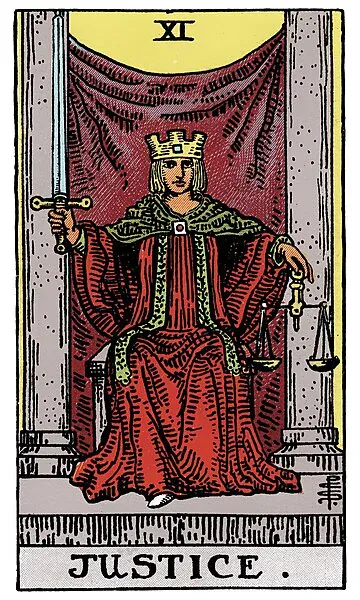
Justice
Personal lawgiver beside the cosmic one. The verdict you are about to deliver is mirrored by a structural truth in the situation — the line you draw in your living room is the line a court would draw, the line the moral imagination would draw. There is no shadow side to the ruling. Speak it. The combination is overdetermined; trust it.
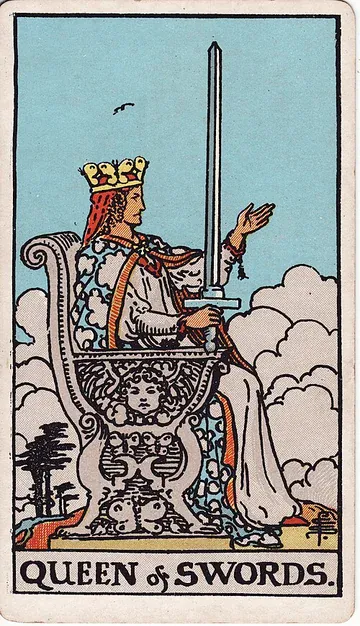
Queen of Swords
The court-suit pair, the dyad of mind. The Queen pierces; the King rules. Together they describe a partnership built on shared exactness — neither softens the other's blade, and the affection is expressed through the work of seeing accurately. The caution: when both blades are upright in the same room, leave warmth in the room on purpose, or the marriage becomes a courtroom.
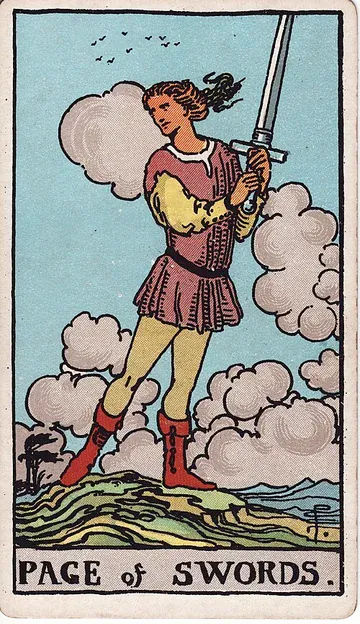
Page of Swords
The pupil approaches the throne. The Page's restless question is received and translated into the clause that can finally be answered. For apprentices, this is mentorship at its best — the older mind making the younger mind's question more precise rather than dismissing it. For mentors, the image is a reminder that the question, treated with respect, becomes the ruling that opens the next chapter.
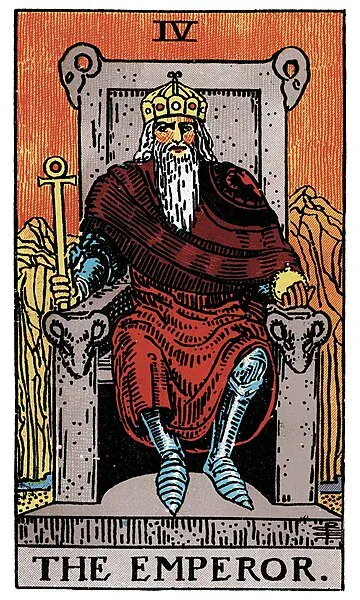
The Emperor
Two seats of authority — the Emperor's structural rule and the King of Swords' judicial rulings working in concert. Together they describe an institution functioning well: hierarchy taken seriously without being abused, decisions actually getting made, the work given the dignity of structure. The caution embedded in the pair: two patriarchs in one room can ossify. Leave a window open for the butterflies.
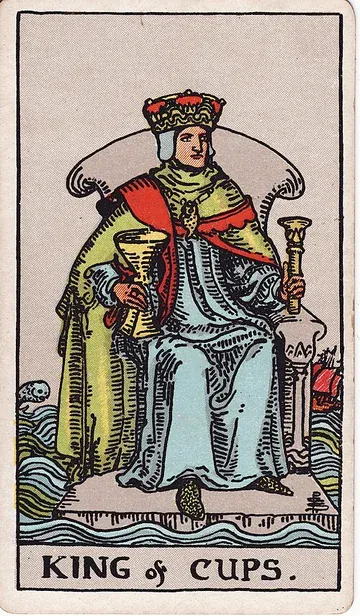
King of Cups
Same throne height, opposite element. The cold judge meets the warm father. The combination describes a counsel that finally has both kinds of authority in the room — the one who tells the precise truth and the one who can hold the feeling that the truth produces. Neither King is enough alone; together they are the rare composite the situation actually needs. Sometimes two people, sometimes two parts of yourself in conversation.
Frequently Asked Questions
Why is the King of Swords' sword tilted rather than held straight up?
Because a verdict is a decision and not a threat. He is the deck's old lawgiver — the air-of-air court who delivers the clean ruling no one else has been willing to make. He sits with a long sword tilted slightly rightward, butterflies and crescent moons carved into the throne behind him, and the cold pale sky stretching above. The card means clarity made into authority: the willingness to stop the argument and say, by the foregoing clauses, this is so.
Can precision be a love language?
In this court it is the only one on offer. In love, the King of Swords describes the relationship that survives because someone was willing to be precise. Not romantic in the soft-focus sense — romantic in the clean-line sense. He is the partner who articulates what is allowable and what is not, who notices what you said and uses your own words to show you he was listening. For singles, the card means standards have finally clarified into language. The love this card supports is reliable rather than effusive.
Does the King of Swords endorse a conclusion I reached quickly?
Only where the speed came after the work. Upright, he is a yes for questions that can be settled by clean thinking — yes if you have done your work, no if your analysis has been performative. The card endorses the considered conclusion and cools on the impulsive move. Treat it as a yes that requires you to hold the ruling without flinching: speak the sentence cleanly, sign the document deliberately, and accept that once delivered, the verdict has gravity.
What does the King of Swords mean as a person?
As a person, the King of Swords is composed, articulate, and reliably precise. He does not flatter; he edits. He does not perform affection; he removes obstacles. The temperament is air-of-air — the high-altitude wind that holds direction without theater. He may seem cool at first meeting, but his word is load-bearing. Watch for the small tilt of attention rather than the large gesture; that is where his care actually lives.
What does the King of Swords mean in career and work?
In career, the King of Swords is the role in which thinking is the actual deliverable — the lawyer drafting the clause, the senior engineer signing the design review, the editor making the cut. The card validates roles where you sign things, decide things, and are trusted to render verdicts. It cools on ceremonial titles without ruling authority. For freelancers, it means the practice has matured to the point where clients pay for the judgment rather than the hours.
Continue Reading
King of Swords · Card overview · symbols · correspondences →
Return to the full card view — image, symbols, sensory correspondences, and Hermetic axes.
Read the reversed meaning →
Read the same depth on the opposite orientation.
Draw your reading now →
Bring this card to a question — open a quiet ritual.